EP0943979B1 - Informationsverarbeitungsvorrichtung - Google Patents
Informationsverarbeitungsvorrichtung Download PDFInfo
- Publication number
- EP0943979B1 EP0943979B1 EP19990302023 EP99302023A EP0943979B1 EP 0943979 B1 EP0943979 B1 EP 0943979B1 EP 19990302023 EP19990302023 EP 19990302023 EP 99302023 A EP99302023 A EP 99302023A EP 0943979 B1 EP0943979 B1 EP 0943979B1
- Authority
- EP
- European Patent Office
- Prior art keywords
- hook
- condition
- switch
- hook member
- pawl portion
- Prior art date
- Legal status (The legal status is an assumption and is not a legal conclusion. Google has not performed a legal analysis and makes no representation as to the accuracy of the status listed.)
- Expired - Lifetime
Links
Images




Classifications
-
- G—PHYSICS
- G06—COMPUTING OR CALCULATING; COUNTING
- G06F—ELECTRIC DIGITAL DATA PROCESSING
- G06F1/00—Details not covered by groups G06F3/00 - G06F13/00 and G06F21/00
- G06F1/16—Constructional details or arrangements
- G06F1/1613—Constructional details or arrangements for portable computers
- G06F1/1633—Constructional details or arrangements of portable computers not specific to the type of enclosures covered by groups G06F1/1615 - G06F1/1626
- G06F1/1675—Miscellaneous details related to the relative movement between the different enclosures or enclosure parts
- G06F1/1677—Miscellaneous details related to the relative movement between the different enclosures or enclosure parts for detecting open or closed state or particular intermediate positions assumed by movable parts of the enclosure, e.g. detection of display lid position with respect to main body in a laptop, detection of opening of the cover of battery compartment
-
- G—PHYSICS
- G06—COMPUTING OR CALCULATING; COUNTING
- G06F—ELECTRIC DIGITAL DATA PROCESSING
- G06F1/00—Details not covered by groups G06F3/00 - G06F13/00 and G06F21/00
- G06F1/16—Constructional details or arrangements
- G06F1/1613—Constructional details or arrangements for portable computers
- G06F1/1615—Constructional details or arrangements for portable computers with several enclosures having relative motions, each enclosure supporting at least one I/O or computing function
- G06F1/1616—Constructional details or arrangements for portable computers with several enclosures having relative motions, each enclosure supporting at least one I/O or computing function with folding flat displays, e.g. laptop computers or notebooks having a clamshell configuration, with body parts pivoting to an open position around an axis parallel to the plane they define in closed position
- G06F1/162—Constructional details or arrangements for portable computers with several enclosures having relative motions, each enclosure supporting at least one I/O or computing function with folding flat displays, e.g. laptop computers or notebooks having a clamshell configuration, with body parts pivoting to an open position around an axis parallel to the plane they define in closed position changing, e.g. reversing, the face orientation of the screen with a two degrees of freedom mechanism, e.g. for folding into tablet PC like position or orienting towards the direction opposite to the user to show to a second user
-
- G—PHYSICS
- G06—COMPUTING OR CALCULATING; COUNTING
- G06F—ELECTRIC DIGITAL DATA PROCESSING
- G06F1/00—Details not covered by groups G06F3/00 - G06F13/00 and G06F21/00
- G06F1/16—Constructional details or arrangements
- G06F1/1613—Constructional details or arrangements for portable computers
- G06F1/1633—Constructional details or arrangements of portable computers not specific to the type of enclosures covered by groups G06F1/1615 - G06F1/1626
- G06F1/1675—Miscellaneous details related to the relative movement between the different enclosures or enclosure parts
- G06F1/1679—Miscellaneous details related to the relative movement between the different enclosures or enclosure parts for locking or maintaining the movable parts of the enclosure in a fixed position, e.g. latching mechanism at the edge of the display in a laptop or for the screen protective cover of a PDA
-
- G—PHYSICS
- G06—COMPUTING OR CALCULATING; COUNTING
- G06F—ELECTRIC DIGITAL DATA PROCESSING
- G06F1/00—Details not covered by groups G06F3/00 - G06F13/00 and G06F21/00
- G06F1/16—Constructional details or arrangements
- G06F1/1613—Constructional details or arrangements for portable computers
- G06F1/1633—Constructional details or arrangements of portable computers not specific to the type of enclosures covered by groups G06F1/1615 - G06F1/1626
- G06F1/1675—Miscellaneous details related to the relative movement between the different enclosures or enclosure parts
- G06F1/1681—Details related solely to hinges
Definitions
- the present invention relates to an improvement in an information processing device or an electronic device suitable for portable use.
- One type of information processing device suitable for portable use, includes a first member (e.g., a cover having a display unit), a second member (e.g., a body having a keyboard unit), and a connecting member for connecting the first and second members.
- a first member e.g., a cover having a display unit
- a second member e.g., a body having a keyboard unit
- a connecting member for connecting the first and second members.
- a previously-considered simple hook mechanism applicable to such a device includes a displaceable hook member provided in one of the first and second members and a hole formed in the other for engaging the hook member.
- a transparent touch panel is provided on a display unit. By making contact of the tip of the stylus with the touch panel, inputting from the display unit is performed or inputting from a keyboard unit is assisted.
- the use of an electromagnetic induction digitizer has also been considered.
- the electromagnetic induction digitizer capable of sensing magnetism is located under an LCD (liquid crystal display).
- LCD liquid crystal display
- the stylus When the stylus is brought into contact with the LCD or a transparent plate for protecting the LCD, the stylus generates magnetism.
- the stylus By detecting the magnetism generated from the stylus with the digitizer, coordinate inputting is carried out.
- the inputting may be difficult when the first member, comprising the display unit, is in the open condition with respect to the second member.
- the first member has a first surface and a second surface, and the display unit is provided on the first surface, it is convenient to obtain a first condition where the first surface is opposed to the second member and a second condition where the second surface is opposed to the second member. That is, both in the first condition and in the second condition, the first member is closed with respect to the second member, and in the second condition the display unit is oriented outward of the device, thereby facilitating the inputting with the touch panel and the stylus.
- the connecting member for connecting the first and second members may be improved.
- One such improved connecting member considered previously includes two parallel shafts each for rotatably supporting the first member or two orthogonal shafts each for rotatably supporting the first member.
- a signal is switched on and off in synchronism with the opening and closing operations of the first member with respect to the second member for the purpose of simplification of operation by a user, etc.
- a signal for the backlight is automatically switched on when opening the first member with respect to the second member, whereas the signal is automatically switched off when closing the first member with respect to the second member.
- a previously-considered technique for allowing such switching in synchronism with the opening and closing operations uses a switch mechanism having a switch member retractably projecting from a small hole formed in a surface of the second member to be opposed to the first member.
- the switch member is normally biased to project outward of the second member, so that in synchronism with the opening and closing operations of the first member the switch member can be projected and retracted to thereby switch on and off a signal for backlighting or the like.
- Such a switch mechanism has the problem that if the user erroneously depresses the switch member or if the device is placed on a flat surface such as a desktop with the switch member directed downward in the open condition of the first member with respect to the second member, the switch mechanism may improperly operate.
- Document US 5555157 discloses an electronic device having a connecting mechanism and a securing mechanism allowing the device to be closed in two different positions.
- JP-04 332016A discloses a laptop computer comprising a first member having a first surface and a second surface; a second member having a third surface, a fourth surface and a first hole formed in the third surface; a connecting mechanism connecting said first and second members so that said first and second members can be relatively displaced; a hook mechanism mounted to said first member for maintaining a closed condition of said first member with respect to said second member, said hook mechanism comprising a hook member to be engaged with said first hole; and a switch provided to said second member, switching on and off a signal in response to movement of said hook member. Similar arrangements are disclosed in JP 05 080893A, EP-A-0593242 and US-A-5497296. However, it is desirable to provide an electronic device having a hook-activated switch mechanism to which the input of data can be facilitated when using a touch panel or a stylus.
- an electronic device comprising: a first member having a first surface and a second surface; a second member having a third surface, a fourth surface and a first hole formed in the third surface; a connecting mechanism connecting said first and second members so that said first and second members can be relatively displaced; a hook mechanism mounted to said first member for maintaining a closed condition of said first member with respect to said second member, said hook mechanism comprising a hook member to be engaged with said first hole; and a switch provided to said second member, switching on and off a signal in response to movement of said hook member; characterised in that said second member has a second hole formed in the fourth surface; and in that a slider is provided for supporting said hook member so that said hook member is slidable in a direction substantially perpendicular to a direction of insertion of said hook member into said first and second holes, said hook member being mounted on said slider so as to be rotatable about 90°; and in that said connecting mechanism includes two parallel axes each for rotatably supporting said first
- the keyboard unit and the display unit are exposed, or oriented outward of the device, in the second condition. Accordingly, this device may be held by an operator's hand or placed on a desktop in the second condition such that the display unit is oriented upward, thereby allowing easy inputting with a stylus on the display unit as viewing the display unit.
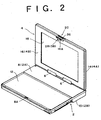
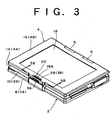
- FIGS. 1 to 3 are perspective views showing a preferred embodiment of an information processing device according to the present invention.
- This device includes a body (corresponding to the second member) 2, a cover (corresponding to the first member) 4, and a connecting member 6 for connecting the body 2 and the cover 4 so that these members 2 and 4 can be relatively displaced.
- the connecting member 6 constitutes a connecting mechanism of this device.
- the body 2 includes an upper housing 8 and a lower housing 10 for respectively providing an upper surface 2A and a lower surface 2B.
- the upper housing 8 is provided with a keyboard unit 12 for data inputting or the like. That is, the upper surface 2A of the body 2 has the keyboard unit 12.
- the keyboard unit 12 constitutes an input device or an input portion of this device.
- the cover 4 includes an upper housing 14 and a lower housing 16 for respectively providing an upper surface 4A and a lower surface 4B of the cover 4.
- the lower housing 16 of the cover 4 is provided with a display unit 18 for displaying and stylus inputting. That is, the lower surface 4B of the cover 4 has the display unit 18.
- the display unit 18 has an LCD (liquid crystal display) panel and a transparent touch panel provided on the LCD panel.
- the display unit 18 constitutes a display device, a display portion, or a touch input device of this device.
- a method using an electromagnetic induction digitizer may be adopted.
- the electromagnetic induction digitizer capable of sensing magnetism is located under an LCD.
- the stylus When the stylus is brought into contact with the LCD or a transparent plate for protecting the LCD, the stylus generates magnetism.
- the digitizer detects the magnetism generated from the stylus, coordinates inputting is performed.
- the cover 4 has a hook mechanism 20.
- the hook mechanism 20 constitutes an engaging mechanism of this device.
- Each of the body 2 and the cover 4 is in the form of substantially rectangular plate, and the hook mechanism 20 is located at an end portion of the cover 4 opposite to the connecting member 6. The reason of such location of the hook mechanism 20 is to minimize a force acting on the hook mechanism 20 required to maintain the closed condition of the cover 4 with respect to the body 2.
- the configuration and operation of the hook mechanism 20 will be hereinafter described in detail.
- the connecting member 6 in this preferred embodiment has a simple configuration such that it has two parallel shafts (or axes) 22 and 24 each for rotatably supporting the cover 4 relative to the body 2. More specifically, the shaft 22 allows about 180° rotation of the connecting member 6 relative to the body 2, and the shaft 24 allows about 180° rotation of the cover 4 relative to the connecting member 6. As a result, the cover 4 is rotatable relative to the body 2 in the range of about 360°. Each of the shafts 22 and 24 rotatably supports the cover 4 and the body 2.
- the use of the connecting member 6 allows relative displacement of the body 2 and the cover 4 between a first condition where the cover 4 is closed with respect to the body 2 with the lower surface 4B of the cover 4 opposed to the body 2 as shown in FIG. 1 and a second condition where the cover 4 is closed with respect to the body 2 with the upper surface 4A of the cover 4 opposed to the body 2 as shown in FIG. 3.
- the lower surface 4B of the cover 4 is opposed to the upper surface 2A of the body 2.
- the upper surface 4A of the cover 4 is opposed to the lower surface 2B of the body 2.
- the keyboard unit 12 and the display unit 18 are confined between the body 2 and the cover 4, thereby allowing protection of the keyboard unit 12 and the display unit 18.
- the keyboard unit 12 and the display unit 18 are exposed, or oriented outward of the device.
- the display unit 18 is oriented upward, thereby allowing easy inputting with a stylus on the display unit 18 as viewing the display unit 18.
- the cover 4 can be maintained in an open condition with respect to the body 2 as shown in FIG. 2 between the first condition and the second condition, thereby allowing easy inputting with the keyboard unit 12 as viewing the display unit 18.
- inputting with a stylus on the display unit 18 in the condition shown in FIG. 2 may be performed.
- the cover 4 may be rotated about 180° from the first condition shown in FIG. 1 to use this device in the condition where the keyboard unit 12 and the display unit 18 are oriented upward.
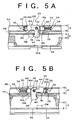
- FIG. 5A is a sectional view of the hook mechanism 20 as taken along the line 5A-5A in FIG. 1;
- FIG. 5B is a sectional view of the hook mechanism 20 as taken along the line 5B-5B in FIG. 3; and
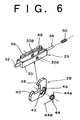
- FIG. 6 is an exploded perspective view showing parts of the hook mechanism 20.
- the hook mechanism 20 includes a slider 26 and a hook member 28 supported to the slider 26 so as to be rotatable relative thereto in the range of about 90°.
- the hook member 28 constitutes a first engaging portion of this device.
- the slider 26 has a boxlike frame 30 open at its upper and lower ends, a shorter sliding shaft 32 projecting outward from one longitudinal end of the frame 30, and a longer sliding shaft 34 projecting outward from the other longitudinal end of the frame 30.
- a slide button 36 is provided on one side surface of the frame 30.
- the hook member 28 has a first pawl portion 38 as a first engaging member and a second pawl portion 40 as a second engaging member substantially perpendicular to each other.
- the first and second pawl portions 38 and 40 are related as an object and its mirror image.
- the hook member 28 further has a shaft 42 as a center of rotation of the hook member 28 and a projection 46 formed in the vicinity of the shaft 42.
- a spring 44 is mounted on the hook member 28 so as to surround a portion of the shaft 42 on one side of the hook member 28.
- the shaft 42 is inserted at its opposite ends in a pair of holes 30A and 30B formed through the opposite side walls of the frame 30, thereby being rotatably supported to the slider 26.
- the spring 44 constitutes a biasing member or a biasing portion of this device.
- a stopper 48 for limiting the rotatable range of the hook member 28 to about 90° is formed on the inside surface of the frame 30.
- One end 44A of the spring 44 is in abutment against the projection 46 of the hook member 28, and the other end 44B of the spring 44 is in abutment against a shoulder (not shown) formed inside the frame 30.
- the spring 44 normally exerts an elastic restoring force so as to increase an angle between the one end 44A and the other end 44B, thereby biasing the hook member 28 in a direction where the back of the first pawl portion 38 abuts against the stopper 48.
- a coil spring 50 is mounted on the longer sliding shaft 34.
- the lower housing 16 of the cover 4 is formed with two slider supports 52 and 54 projecting inside the cover 4.
- the sliding shafts 32 and 34 of the slider 26 are slidably supported to the slider supports 52 and 54, respectively. Accordingly, the slider 26 is slidable within the cover 4.
- the coil spring 50 is interposed under compression between the slider support 54 and the frame 30 of the slider 26, and accordingly the coil spring 50 normally biases the slider 26 in a direction from the slider support 54 toward the slider support 52.
- the upper housing 14 of the cover 4 has an opening 14A for allowing projection of the second pawl portion 40 of the hook member 28 from the upper surface 4A of the cover 4.
- the lower housing 16 of the cover 4 has an opening 16A for allowing projection of the first pawl portion 38 of the hook member 28 from the lower surface 4B of the cover 4.
- a portion of the lower housing 16 surrounding the opening 16A is gently curved outward of the cover 4, thereby obtaining a predetermined spacing between the body 2 and the cover 4 in the first condition.
- the upper housing 8 of the body 2 has a hole or hole portion 8A for releasably engaging the first pawl portion 38 of the hook member 28.
- the lower housing 10 of the body 2 has a hole or hole portion 10A for releasably engaging the second pawl portion 40 of the hook member 28.
- Each of the holes 8A and 10A is a second engaging portion of this device.
- the slide button 36 is exposed to the outside of the cover 4 as shown in FIG. 1, for example.
- the slide button 36 is connected through an opening (not shown) of the cover 4 to the slider 26 provided inside the cover 4. Accordingly, by moving the slide button 36, the slider 26 can be moved from the left to the right as viewed in FIG. 5A against the biasing force of the coil spring 50.
- a taper formed outside the first pawl portion 38 comes into abutment against a taper formed inside the opening 8A, and these tapers slide on each other to convert the direction of a force applied to the hook member 28 by closing the cover 4 toward the body 2 into a direction of slightly compressing the coil spring 50. Then, the tip of the taper of the first pawl portion 38 passes the tip of the taper of the opening 8A to relieve the slight compression of the coil spring 50, thus obtaining the condition shown in FIG. 5A where the inside horizontal surface of the first pawl portion 38 is engaged with the inner surface of the upper housing 8 of the body 2 in the vicinity of the opening 8A. This engagement of the hook member 28 with the opening 8A is maintained by the biasing force of the coil spring 50, thus maintaining the first condition shown in FIG. 1.
- the slide button 36 is moved by the operator to slide the slider 26 against the biasing force of the coil spring 50, that is, compress the coil spring 50.
- the first pawl portion 38 of the hook member 28 is disengaged from the opening 8A to thereby allow the first pawl portion 38 to pass through the opening 8A. Accordingly, the cover 4 can be opened with respect to the body 2.
- the hook mechanism 20 when changing the condition shown in FIG. 2 to the second condition shown in FIG. 3 will now be described.
- the back of the first pawl portion 38 is pressed on the stopper 48 by the biasing force of the spring 44, so that the hook member 28 is in a stable condition.
- the hook member 28 can be rotated until the back of the second pawl portion 40 comes into abutment against the stopper 48. That is, the hook member 28 is rotated by 90° clockwise from the condition shown in FIG. 5A.
- the first pawl portion 38 is retracted into the cover 4, and the second pawl portion 40 is projected from the upper surface 4A of the cover 4 through the opening 14A.
- the second pawl portion 40 can be engaged with the opening 10A of the lower housing 10 of the body 2 as shown in FIG. 5B in a manner similar to that of the case of obtaining the first condition. Accordingly, the second condition shown in FIG. 3 can be maintained by the hook mechanism 20.
- the slide button 36 is moved by the operator to slide the slider 26 against the biasing force of the coil spring 50, that is, compress the coil spring 50.
- the second pawl portion 40 of the hook member 28 is allowed to pass through the opening 10A, so that the cover 4 can be opened.
- the biasing force of the spring 44 is relieved, so that the hook member 28 is automatically rotated by 90° counterclockwise as viewed in FIG. 5B to restore the stable condition shown in FIG. 2.
- the reason why the hook member 28 is stabilized by using the spring 44 as shown in FIG. 2 is that the operation of closing the cover 4 from the condition shown in FIG. 2 toward the first condition shown in FIG. 1 is usually much more frequent than the operation of closing the cover 4 from the condition shown in FIG. 2 toward the second condition shown in FIG. 3, so that the stable position of the hook member 28 as shown in FIG. 2 is advantageous for the former operation.
- the hook member 28 has the first pawl portion 38 and the second pawl portion 40 so that the hook member 28 projects from either the upper surface 4A or the lower surface 4B of the cover 4 in the closed condition thereof into the body 2. Accordingly, by operating the hook mechanism 20 in each of the first and second conditions, the hook member 28 is prevented from projecting outside the device, thereby improving the operability of the device and providing a good appearance of the device.
- each of the first and second conditions can be maintained by using the hook mechanism 20, thereby providing an advantage in handling the device.
- the stability of the device during operation can be increased to thereby improve the operability, because the second condition shown in FIG. 3 can be maintained by using the hook mechanism 20.
- the hook member 28 as a single member is used commonly to maintain both the first condition and the second condition, the configuration of the device can be made simple as compared with the case of using two simple hook mechanisms as in previously-considered designs.
- the hook member 28 does not project outside the device, thereby ensuring safety.
- the hook member 28 can be automatically returned to the ready position as shown in FIG. 2, thereby improving the operability and increasing the safety.
- a switch mechanism SM is adopted to switch on and off a signal in synchronism with the opening and closing operations of the cover 4 with respect to the body 2.
- the switch mechanism SM is provided inside the body 2, so as to prevent an improper switching operation.
- This switch mechanism SM operates as an outputting unit outputting a signal in accordance with movement of the engaging mechanism. And this switch mechanism SM is one embodiment or example of the outputting unit.
- the switch mechanism SM is provided in the vicinity of the hole 8A on the inner surface of the upper housing 8 of hole 8A on the inner surface of the upper housing 8 of the body 2, so as to make the on and off states of a signal correspond to the first condition shown in FIG. 5A and the other conditions.
- the reason why the switch mechanism SM is provided in the vicinity of the hole 8A is to apply a force by the sliding operation of the hook member 28 to the switch mechanism SM.
- the switch mechanism SM is operated by a force exerted by the sliding operation of the hook member 28 moving together with the slider 26.
- the signal to be switched on and off by the switch mechanism SM are a control signal for the display device or the display portion, a signal for switching on and off a backlight for the display unit 18, for example, a signal for switching on and off a main power of the device, and a signal for performing suspend and resume processing.
- the switch mechanism SM may include a switch for directly controlling supply of power, or may include a switch for controlling a small signal related to a CPU (central processing unit).
- FIGS. 7A and 7B there are shown a first example of the switch mechanism or the outputting unit for use in a preferred embodiment of the present invention.
- FIG. 7A corresponds to the cross section shown in FIG. 5A, showing a specific configuration of the switch mechanism SM or the outputting unit.
- FIG. 7B shows a condition where the hook member 28 has been slid rightward as viewed in FIG. 7A by using the slide button 36 (see FIG. 1, for example).
- the switch mechanism SM shown in FIG. 7A includes a switch 56 having a displaceable switching pin(or switch member) 56A for determining on and off positions, and a movable member 58 for transmitting a force exerted by the sliding operation of the hook member 28 to the switching pin 56A.
- the switch 56 may be provided by a commercially available microswitch.
- the switching pin 56A is normally biased by a spring (not shown) provided in the switch 56 so as to project out of the switch 56. Particularly in this preferred embodiment, when the switching pin 56A is depressed as shown in FIG. 7A, the switch 56 becomes off, whereas when the switching pin 56A projects as shown by a solid line in FIG. 7B, the switch 56 becomes on.
- the movable member 58 is provided by an elastically deformable plate elongated in a direction perpendicular to the sheet plane of each of FIGS. 7A and 7B. An end portion of the movable member 58 on the back side in this direction is fixed to the body 2, and the other end portion of the movable member 58 on the front side in this direction is displaceable in a horizontal direction as viewed in each of FIGS. 7A and 7B.
- the reason why the movable member 58 is used in this preferred embodiment is to adapt the sharp tip of the first pawl portion 38 of the hook member 28 to the switching pin 56A. More specifically, when the first pawl portion 38 of the hook member 28 is engaged with the hole 8A to maintain the first condition as shown in FIG.
- a force exerted by the sliding operation of the hook member 28 e.g., a force of extension of the coil spring 50
- the hook member 28 is slid rightward by using the slide button 36 as shown in FIG. 7B, or when any condition other than the first condition is obtained as shown in FIG. 2 or 3
- a depression force of the hook member 28 to the movable member 58 and the switching pin 56A is removed, so that the switching pin 56A is allowed to project, thereby turning on the switch 56.
- FIG. 8 is a block diagram showing a hardware configuration for use in an information processing device embodying the present invention.
- the hardware configuration shown in FIG. 8 includes a CPU 201, LCD controller 202, RAM (random access memory) 203, ROM (read-only memory) 204, system bus 205, keyboard unit 12, touch panel 181, main switch 206, transistor 207, and switch 56.
- the keyboard unit 12, the switch 56, and the display unit (LCD) 18 are the same as those shown in FIGS. 1 to 7.
- the touch panel 181 is configured by a transparent electrode provided so as to cover the display unit 18. While the touch panel 181 configured by a transparent electrode is used in this preferred embodiment, an electromagnetic induction digitizer may be used instead as mentioned above.
- the CPU 201 functions to execute a program stored in the RAM 203 or the ROM 204.
- the main switch 206 is a main power switch of the device.
- the LCD controller 202 performs display control of the display unit 18, on/off control of the backlight for the display unit 18, etc.
- a backlight signal 208 is input through the transistor 207 to the LCD controller 202. When the backlight signal 208 is ON, the LCD controller 202 keeps backlighting for the display unit 18 in an on state. Normally, the backlight signal 208 is ON (the case of turning off this signal will be hereinafter described).
- the switch 56 When the switch 56 is in a condition where it is not depressed by the hook member 28, the switch 56 applies a voltage to the transistor 207 so as to open the gate of the transistor 207, whereas when the switch 56 is depressed by the hook member 28, the gate of the transistor 207 is closed. Accordingly, when the switch 56 is depressed by the hook member 28, the normally ON backlight signal 208 is cut off, so that the LCD controller 202 turns off the backlight signal 208 applied to the LCD 18.
- the backlight signal 208 may be turned off irrespective of the operation of the switch 56 as in the case of suspend and resume processing or using a timer (the backlight signal 208 is turned off for the purpose of power saving after a given period of time has elapsed).
- the CPU 201 or another processor turns off the backlight signal 208.
- FIG. 9 shows another hardware configuration, in which the same reference numerals as those shown in FIG. 8 denote the same components.
- the switch 56 is connected to the system bus 205.
- the ROM 204 preliminarily stores a program for performing the operation shown by a flowchart of FIG. 10, and the CPU 201 execute this program.
- FIG. 10 is a flowchart showing the control operation by the switch mechanism SM or the outputting unit in the preferred embodiment shown in FIG. 9.
- the operation shown in FIG. 10 corresponds to the program stored in the ROM 204 shown in FIG. 9.
- main power main switch 206
- step 101 the program proceeds to step 102.
- step 102 a subroutine for the switch mechanism SM is started.
- step 103 it is determined whether or not the switch 56 is on (whether or not the hook member 28 is inserted in the hole 8A). If the switch 56 is on, the program proceeds to step 104.
- step 104 a control signal indicating that the switch 56 is on is input into the CPU 201.
- step 105 on/off control of a specific signal (e.g., a signal directing the LCD controller 202 to turn off backlighting) is carried out according to an instruction from the CPU 201.
- step 106 other processing is carried out, and the program then returns to step 102. If it is determined in step 103 that the switch 56 is off, the program jumps steps 104 and 105 to proceed to step 106.
- a specific signal e.g., a signal directing the LCD controller 202 to turn off backlighting
- the switch mechanism SM performs on/off control of a signal in synchronism with the operation of the hook member 28.
- the backlight can be automatically switched off in the first condition shown in FIG. 1, and can be automatically switched on in the condition shown in FIG. 2 or in the second condition shown in FIG. 3. Accordingly, the operability of the device can be improved and the power consumption can be suppressed.
- the switch mechanism SM as the outputting unit outputs the signal in accordance with the movement of the engaging mechanism including the hook member 28 and the hole 8A. Therefore, it is difficult for the user to operate the outputting unit without the movement of the engaging mechanism, and so an improper operation, as in previously-considered devices, can be eliminated.
- the operator is prohibited from operating the switch mechanism SM without using the hook member 28 in any cases except a willful case and an unavoidable abnormal case due to the entry of foreign matter. Accordingly, an improper switching operation can be prevented.
- FIG. 11 shows a previously-considered switch mechanism as described hereinbefore in the introduction.
- This switch mechanism includes a switching pin 62 provided in a small hole 60 formed through the upper surface 2A of the body 2.
- the switching pin 62 is retractably projected from the upper surface 2A.
- the operator can directly contact the switching pin 62, so that the operator can operate the switch mechanism irrespective of the opening and closing operations of the cover 4 with respect to the body 2, causing a possibility of an improper switching operation.
- the switching pin 62 may be depressed by the weight of the device to undesirably turn off the backlight for the display unit 18, for example.
- the switch mechanism SM in this preferred embodiment is completely built in the body 2 to prevent an improper switching operation as mentioned above.
- the disadvantages of the Figure 11 switch mechanism can be eliminated.
- the switch mechanism SM may be applied to a known suspend (resume) function.
- the suspend function is a function of temporarily stopping a task
- the resume function is a function of restarting the task temporarily stopped.
- the suspend (resume) function means a function of cutting off or greatly reducing power supply to devices other than memories. That is, the task is suspended (temporarily stopped) with the personal computer kept in an operative condition.
- a previously-considered notebook (or portable) personal computer employs a function of automatically suspending a task when closing a display. In such a device, closing the display is detected by the configuration shown in FIG.
- closing the display can be detected by the switch mechanism SM to enter a suspended mode. Further, opening the display from the above closed condition in the suspended mode can also be detected by the switch mechanism SM to resume the task. According to this preferred embodiment, the operation of the device is not shifted to a suspended mode in the second condition shown in FIG. 3 unlike the case shown in FIG. 11.
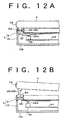
- FIGS. 12A and 12B are sectional views showing a second example of a switch mechanism or an outputting unit for use in a preferred embodiment of the present invention.
- the switch 56 is modified in position and orientation to switch on and off a signal in synchronism with insertion of the hook member 28 into the hole 8A.
- the switch 56 is fixed to a printed wiring board 64 provided in the body 2, and is positioned so that the switching pin 56A is pointed to the upper housing 8 of the body 2.
- a movable member 58' is fixed to the inner surface of the upper housing 8 of the body 2, so as to transmit to the switching pin 56A a force exerted by the inserting operation of the first pawl portion 38 of the hook member 28 into the hole 8A.
- the movable member 58' is provided by a plate member suitably bent so as to be adapted to a positional relation between the hook member 28 and the switching pin 56A in the first condition.
- One end of the movable member 58' is fixed to the inner surface of the upper housing 8, and the other end of the movable member 58' is adapted to come into contact with the hook member 28.
- the switch 56 is off.
- the cover 4 is opened from the first condition to obtain another condition, for example, as shown in FIG. 12B, a depression force of the hook member 28 to the switching pin 56A and the movable member 58' is removed, so that the movable member 58' is returned to the upper housing 8 by its elastic restoring force, and the switching pin 56A projects. As a result, the switch 56 becomes on.
- the switch mechanism SM as the outputting unit outputs the signal in accordance with the movement of the engaging mechanism including the hook member 28 and the hole 8A. Therefore, it is difficult for the user to operate the outputting unit without the movement of the engaging mechanism, and so an improper operation, as may occur in the previously-considered device, can be eliminated.
- the switch mechanism is completely built in the body 2, thereby preventing an improper switching operation.
- Other technical effects by this preferred embodiment are similar to those by the first preferred embodiment, so the description thereof will be omitted herein.
- FIGS. 13A and 13B are sectional views showing a third example of a switch mechanism or an outputting unit for use in an embodiment of the present invention.
- the switch mechanism adopts an optical sensor 66 for detecting whether or not the hook member 28 (the first pawl portion 38) is inserted through the hole 8A into the body 2. More specifically, the optical sensor 66 is provided on a printed wiring board 64 at a position facing the hook member 28 inserted.
- the optical sensor 66 includes a light source for emitting light and a photodetector for detecting the quantity of reflected light (as by irregular reflection) from the hook member 28, thus detecting the hook member 28 inserted according to the quantity of reflected light.
- the surface of the first pawl portion 38 of the hook member 28 may be coated with a material having a high reflectivity to the emitted light.
- the hook member 28 inserted through the hole 8A into the body 2 is detected by the optical sensor 66 provided inside the body 2, thereby preventing an improper switching operation. Further, no mechanical means is required to detect the hook member 28, thereby improving the reliability of on/off control of a signal.
- optical sensor 66 is used to detect the hook member 28 inserted in this preferred embodiment, a sensor using any electromagnetic radiation other than light may be adopted.
- the members relating to the hook mechanism 20, such as the slider 26 and the hook member 28 are provided on the display unit 18 (cover 4) side, and the members relating to the switch or the outputting unit, such as the switch mechanism SM as well as the engaging portion such as the hole 8A to be engaged with the hook member 28 are provided on the keyboard unit 12 (body 2) side.
- a reverse configuration may be used in an embodiment of the present invention.
- the members relating to the switch or the outputting unit, such as the switch mechanism SM as well as the engaging portion such as the hole 8A to be engaged with the hook member 28 may be provided on the display unit 18 (cover 4) side, and the members relating to the hook mechanism 20, such as the slider 26 and the hook member 28 may be provided on the keyboard unit 12 (body 2) side.
- this configuration corresponds to a configuration obtained by exchanging the switch mechanism SM and the hook mechanism 20 with each other in FIGS. 1 to 10 and 12A to 13B.
- an embodiment of the present invention can provide an electronic device such as an information processing device which can prevent an improper switching operation and which, moreover, can assist in the input of data when using a touch panel or a stylus.
- an embodiment of the present invention is applicable to a device, an equipment, or an apparatus which substantially processes a kind of information, such as a personal digital assistant (PDA) or an electronic pocketbook. These device, equipment and apparatus may constitute a part of a information processing device embodying the present invention. Furthermore, an embodiment of the present invention is applicable to another electronic device which may not process an information, such as a device for electronic controlling.
- PDA personal digital assistant
- an embodiment of the present invention is applicable to another electronic device which may not process an information, such as a device for electronic controlling.
Landscapes
- Engineering & Computer Science (AREA)
- Computer Hardware Design (AREA)
- Theoretical Computer Science (AREA)
- Physics & Mathematics (AREA)
- Human Computer Interaction (AREA)
- General Engineering & Computer Science (AREA)
- General Physics & Mathematics (AREA)
- Mathematical Physics (AREA)
- Casings For Electric Apparatus (AREA)
- Power Sources (AREA)
- Input From Keyboards Or The Like (AREA)
Claims (9)
- Elektronische Vorrichtung, umfassend:wobei der Verbindungsmechanismus (6) zwei parallele Achsen (24, 22) jeweils zum drehbaren Tragen des ersten Elements (4) bzw. des zweiten Elements (2) aufweist, sodass die ersten und zweiten Elemente (4, 2) jeweils zwischen einem ersten Zustand, wobei die erste Oberfläche (4B) der dritten Oberfläche (2A) gegenüberliegt, und einem zweiten Zustand, wobei die zweite Oberfläche (4A) der vierten Oberfläche (2B) gegenüberliegt, relativ verschoben werden kann;ein erstes Element (4) mit einer ersten Oberfläche (4B) und einer zweiten Oberfläche (4A);ein zweites (2) Element mit einer dritten Oberfläche (2A), einer vierten Oberfläche (2B), einem ersten Loch (8A), das in der dritten Oberfläche ausgebildet ist, und einem zweiten Loch (10A), das in der vierten Oberfläche (2B) ausgebildet ist;einen Verbindungsmechanismus (6), der die ersten und zweiten Elemente (4, 2) verbindet, sodass die ersten und zweiten Elemente (4, 2) relativ verschoben werden können,
einen Hakenmechanismus (20), der an dem ersten Element (4) angebracht ist, um einen geschlossenen zustand des ersten Elements (4) mit Bezug auf das zweite Element (2) aufrechtzuerhalten, wobei der Hakenmechanismus (20) ein Hakenelement (28) umfasst, das mit dem ersten Loch (8A) in Eingriff zu nehmen ist;
dadurch gekennzeichnet, dass die elektronische Vorrichtung einen Schalter (56) umfasst, der dem zweiten Element (2B) zur Verfügung gestellt wird, der ein Signal als Reaktion auf die Bewegung des Hakenelements (28) an- und ausschaltet;
dass ein Gleitstück (26) zum Tragen des Hakenelements (28) bereitgestellt wird, sodass das Hakenelement (28) in einer Richtung im Wesentlichen senkrecht zu einer Richtung der Einfügung des Hakenelements (28) in die ersten und zweiten Löcher (8A, 10A) verschiebbar ist, wobei das Hakenelement (28) auf dem Gleitstück (26) angebracht ist, um um 90° drehbar zu sein;
und dadurch, dass das Hakenelement (28) einen ersten Klinkenabschnitt (38) und einen zweiten Klinkenabschnitt (40) im Wesentlichen senkrecht zueinander aufweist, wobei der erste Klinkenabschnitt (38) mit dem ersten Loch (8A) in Eingriff kommt, und der zweite Klinkenabschnitt (40) in dem ersten Element (4) in dem ersten Zustand positioniert ist, und der zweite Klinkenabschnitt (40) mit dem zweiten Loch (10A) in Eingriff kommt, und der erste Klinkenabschnitt (38) in dem ersten Element (4) in dem zweiten Zustand positioniert ist. - Elektronische Vorrichtung gemäß Anspruch 1, bei der die Rotationsachse des Hakenelements (28) senkrecht zu einer Ebene ist, die durch die Gleitrichtung des Gleitstücks (26) und der Eingriffsrichtung des ersten Klinkenabschnitts (38) des ersten Hakenelements (28) in dem ersten Loch (8A) definiert ist, und der zweite Klinkenabschnitt (40) des Hakenelements (28) zusätzlich dazu, senkrecht zu der ersten Klinke (38) zu sein, in der Ebene ist.
- Elektronische Vorrichtung gemäß Anspruch 1 oder 2, bei der:der Schalter (56) ein Schalterelement (56A) aufweist, das verschiebbar ist, um einen An- oder Aus-Zustand des Schalters (56) zu bestimmen; unddie Vorrichtung ferner ein bewegbares Element (58) umfasst, um eine Kraft, die durch einen Schiebevorgang des Hakenelements (28) ausgeübt wird, zu dem Schaltelement (56A) zu übertragen.
- Elektronische Vorrichtung gemäß Anspruch 1, 2 oder 3, bei der die ersten bzw, zweiten Elemente (4, 2) eine Anzeigeeinheit (18) und eine Tastatureinheit (12) aufweisen, die einander gegenüberliegen, wenn das erste Element (4) mit Bezug auf das zweite Element (2) geschlossen ist.
- Elektronische Vorrichtung gemäß Anspruch 1 oder 2, bei der:wobei die Anzeigeeinheit (18) und die Tastatureinheit (12) zwischen den ersten und zweiten Elementen (4, 2) in dem ersten Zustand beschränkt sind, und die Anzeigeeinheit (18) und die Tastatureinheit (12) in dem zweiten Zustand von der Vorrichtung nach außen orientiert sind.das erste Elemente (4) eine Anzeigeeinheit (18) auf der ersten Oberfläche (4B) aufweist; unddas zweite Element (2) eine Tastatureinheit (12) auf der dritten Oberfläche (2A) aufweist;
- Elektronische Vorrichtung gemäß Anspruch 1, bei der der Schalter (56) einen optischen Sensor (66) umfasst.
- Elektronische Vorrichtung gemäß Anspruch 4 oder 5, bei der die Anzeigesteuerung der Anzeigeeinheit (18) und/oder die Steuerung von Unterbrechungs- und Wiederaufnahmefunktionen gemäß dem Signal ausgeführt werden/wird.
- Elektronische Vorrichtung gemäß einem vorhergehenden Anspruch, bei der das erste Element (4) ferner eine Feder (44) zum Vorspannen des Hakenelements (28) in seiner Rotationsrichtung umfasst.
- Elektronische Vorrichtung gemäß Anspruch 1, 2 oder 3, ferner umfassend eine Berührungseingabevorrichtung, die auf der ersten Oberfläche (4B) bereitgestellt wird.
Applications Claiming Priority (4)
| Application Number | Priority Date | Filing Date | Title |
|---|---|---|---|
| JP6503598 | 1998-03-16 | ||
| JP6503598 | 1998-03-16 | ||
| JP5722099 | 1999-03-04 | ||
| JP05722099A JP4212708B2 (ja) | 1998-03-16 | 1999-03-04 | 情報処理装置及び電子機器 |
Publications (3)
| Publication Number | Publication Date |
|---|---|
| EP0943979A2 EP0943979A2 (de) | 1999-09-22 |
| EP0943979A3 EP0943979A3 (de) | 2003-10-22 |
| EP0943979B1 true EP0943979B1 (de) | 2005-08-03 |
Family
ID=26398238
Family Applications (1)
| Application Number | Title | Priority Date | Filing Date |
|---|---|---|---|
| EP19990302023 Expired - Lifetime EP0943979B1 (de) | 1998-03-16 | 1999-03-16 | Informationsverarbeitungsvorrichtung |
Country Status (4)
| Country | Link |
|---|---|
| US (1) | US6122152A (de) |
| EP (1) | EP0943979B1 (de) |
| JP (1) | JP4212708B2 (de) |
| DE (1) | DE69926428T2 (de) |
Families Citing this family (45)
| Publication number | Priority date | Publication date | Assignee | Title |
|---|---|---|---|---|
| US6201688B1 (en) * | 1998-10-06 | 2001-03-13 | Micron Electronics, Inc. | Apparatus for securing a laptop computer |
| US6266235B1 (en) | 1998-10-06 | 2001-07-24 | Micron Technology, Inc. | Method for securing a laptop computer |
| KR100536587B1 (ko) * | 1999-03-13 | 2005-12-14 | 삼성전자주식회사 | 잠금장치를 갖는 휴대형 컴퓨터 |
| CN1302006A (zh) * | 1999-12-29 | 2001-07-04 | 仁宝电脑工业股份有限公司 | 便携式电脑用的磁控式启闭装置 |
| JP3722663B2 (ja) * | 2000-02-29 | 2005-11-30 | 株式会社タニタ | 生体測定装置 |
| JP2002091612A (ja) * | 2000-09-11 | 2002-03-29 | Internatl Business Mach Corp <Ibm> | 携帯型情報処理装置 |
| KR100762391B1 (ko) * | 2001-07-10 | 2007-10-02 | 엘지전자 주식회사 | 휴대형 디스크 재생장치 |
| KR100418707B1 (ko) * | 2001-07-13 | 2004-02-11 | 삼성전자주식회사 | 휴대용컴퓨터 |
| TW551518U (en) * | 2001-09-07 | 2003-09-01 | Wistron Corp | Electronic equipment having dual-way fastened apparatus |
| JP2003091332A (ja) * | 2001-09-18 | 2003-03-28 | Fujitsu Ltd | 情報処理装置 |
| US6771494B2 (en) * | 2001-12-17 | 2004-08-03 | Toshiba America Information Systems, Inc. | Portable computer usable in laptop and tablet configurations |
| US6517129B1 (en) * | 2002-04-15 | 2003-02-11 | Compal Electronics, Inc. | Lock device for an electronic appliance |
| JP2004005210A (ja) | 2002-05-31 | 2004-01-08 | Toshiba Corp | 電子機器 |
| US6865075B2 (en) * | 2002-06-27 | 2005-03-08 | Intel Corporation | Transformable computing apparatus |
| US7280348B2 (en) * | 2003-02-14 | 2007-10-09 | Intel Corporation | Positioning mechanism for a pen-based computing system |
| JP3696215B2 (ja) | 2003-02-24 | 2005-09-14 | 株式会社東芝 | 電子機器 |
| KR100568176B1 (ko) | 2003-06-07 | 2006-04-05 | 삼성전자주식회사 | 휴대용 컴퓨터 |
| CN100403215C (zh) * | 2003-08-27 | 2008-07-16 | 华宇电脑股份有限公司 | 双面扣合装置 |
| US20050078440A1 (en) * | 2003-10-08 | 2005-04-14 | Neng Liu | Compound power supply switch for notebook computers |
| TWI225980B (en) * | 2003-10-24 | 2005-01-01 | Asustek Comp Inc | Apparatus with hidden latch |
| CN100399868C (zh) * | 2004-02-16 | 2008-07-02 | 纬创资通股份有限公司 | 具有活动卡勾的机构系统 |
| TWM254641U (en) * | 2004-04-13 | 2005-01-01 | Tatung Co | Hidden hook to engage portable computer and base |
| US7181238B2 (en) * | 2004-07-08 | 2007-02-20 | Inventec Corporation | Structure for turning on/off wireless communications of notebook computer by latch member |
| JP2006065695A (ja) * | 2004-08-27 | 2006-03-09 | Fujitsu Ltd | 電子装置および留め具ユニット |
| CN1764360A (zh) * | 2004-10-20 | 2006-04-26 | 摩托罗拉公司 | 可闭合电子设备 |
| TWI257040B (en) * | 2004-12-27 | 2006-06-21 | Tatung Co | Common lock structure for dual portable computer |
| JP4647350B2 (ja) * | 2005-03-08 | 2011-03-09 | 富士通株式会社 | 電子機器 |
| CN100501636C (zh) * | 2005-06-10 | 2009-06-17 | 鸿富锦精密工业(深圳)有限公司 | 数据存储器固定装置 |
| TWI274242B (en) * | 2005-08-15 | 2007-02-21 | Asustek Comp Inc | Electronic device and latch structure thereof |
| DE102005049048B4 (de) * | 2005-10-13 | 2007-10-04 | Fujitsu Siemens Computers Gmbh | Verriegelungsvorrichtung |
| CN2850207Y (zh) * | 2005-10-25 | 2006-12-20 | 鸿富锦精密工业(深圳)有限公司 | 卡钩装置组合 |
| CN101162399B (zh) * | 2006-10-13 | 2011-05-04 | 鸿富锦精密工业(深圳)有限公司 | 笔记本电脑卡合装置 |
| US8174837B2 (en) * | 2007-04-27 | 2012-05-08 | Hewlett-Packard Development Company, L.P. | Wireless enable/disable locking system |
| US7477508B1 (en) * | 2008-04-29 | 2009-01-13 | International Business Machines Corporation | Combination keyboard and digital tablet |
| JP2010112967A (ja) * | 2008-08-29 | 2010-05-20 | Toshiba Corp | 映像再生装置および照明装置の制御方法 |
| JP5169945B2 (ja) * | 2009-03-30 | 2013-03-27 | 富士通株式会社 | 情報端末装置 |
| KR101045544B1 (ko) * | 2009-07-10 | 2011-06-30 | 주식회사 다이아벨 | 슬라이딩 장치 및 이를 갖춘 전자기기 |
| JP2012160911A (ja) * | 2011-01-31 | 2012-08-23 | Toshiba Corp | 電子機器、電子機器の制御方法 |
| TWI438616B (zh) * | 2011-05-27 | 2014-05-21 | Wistron Corp | 電子裝置及其電源控制方法 |
| JP5296177B2 (ja) * | 2011-10-28 | 2013-09-25 | 株式会社東芝 | 電子機器 |
| USD687037S1 (en) * | 2012-08-23 | 2013-07-30 | Hon Hai Precision Industry Co., Ltd. | Dock station |
| US9176537B2 (en) | 2013-03-15 | 2015-11-03 | Intel Corporation | Connector assembly for an electronic device |
| WO2017077667A1 (ja) * | 2015-11-06 | 2017-05-11 | パナソニックIpマネジメント株式会社 | 電子機器およびラッチ機構 |
| JP2018010265A (ja) * | 2016-07-11 | 2018-01-18 | 正仁 櫨田 | 磁気スイッチを使ったラップトップパソコンのバックライトのon/offの方法 |
| JP7065154B2 (ja) * | 2020-08-18 | 2022-05-11 | レノボ・シンガポール・プライベート・リミテッド | 電子機器、及び制御方法 |
Family Cites Families (16)
| Publication number | Priority date | Publication date | Assignee | Title |
|---|---|---|---|---|
| JPH0614432B2 (ja) * | 1985-05-20 | 1994-02-23 | 松下電器産業株式会社 | 蓋の開閉連動スイツチ装置 |
| JPH04169917A (ja) * | 1990-05-07 | 1992-06-17 | Toshiba Corp | 携帯型電子機器 |
| JP2788332B2 (ja) * | 1990-06-22 | 1998-08-20 | 株式会社東芝 | ラッチ装置およびラッチ装置を有する携帯形情報機器 |
| JPH04332016A (ja) * | 1991-05-08 | 1992-11-19 | Alps Electric Co Ltd | ラップトップ型コンピュータ |
| US5404271A (en) * | 1991-07-30 | 1995-04-04 | Kabushiki Kaisha Toshiba | Electronic apparatus having a card storing section formed within a body between a support frame and an upper case of the body and having functional elements mounted between the support frame and a lower case of the body |
| JPH0540536A (ja) * | 1991-08-02 | 1993-02-19 | Mitsubishi Electric Corp | 電子計算機 |
| JPH0580893A (ja) * | 1991-09-20 | 1993-04-02 | Canon Inc | 電子装置 |
| JPH05189084A (ja) * | 1992-01-10 | 1993-07-30 | Toshiba Corp | 小形電子機器 |
| JPH0738505B2 (ja) * | 1992-10-12 | 1995-04-26 | インターナショナル・ビジネス・マシーンズ・コーポレイション | 蓋付き構造体、及び、情報処理装置 |
| CA2110189C (en) * | 1992-11-30 | 1999-06-15 | Kaori Honjo | A notebook type information processing apparatus having input function with pen |
| DE69416280D1 (de) * | 1993-06-21 | 1999-03-11 | Motorola Inc | Reibungskupplung für ein doppelscharniergelenk |
| JP3073121B2 (ja) * | 1993-09-30 | 2000-08-07 | シャープ株式会社 | 表示機器の外装構造 |
| US5555157A (en) * | 1994-03-02 | 1996-09-10 | Apple Computer, Inc. | Enclosure for electronic apparatus having a cover catch member engageable with two different housing catch members |
| US5548478A (en) * | 1994-07-25 | 1996-08-20 | Khyber Technologies Corporation | Portable computing device having an adjustable hinge |
| JP2701750B2 (ja) * | 1994-08-17 | 1998-01-21 | カシオ計算機株式会社 | 表示機能付き折り畳み式電子機器 |
| US5666694A (en) * | 1995-09-28 | 1997-09-16 | Hewlett-Packard Company | Hinge arrangement |
-
1999
- 1999-03-04 JP JP05722099A patent/JP4212708B2/ja not_active Expired - Fee Related
- 1999-03-15 US US09/267,400 patent/US6122152A/en not_active Expired - Lifetime
- 1999-03-16 EP EP19990302023 patent/EP0943979B1/de not_active Expired - Lifetime
- 1999-03-16 DE DE69926428T patent/DE69926428T2/de not_active Expired - Lifetime
Also Published As
| Publication number | Publication date |
|---|---|
| JP2000003230A (ja) | 2000-01-07 |
| EP0943979A3 (de) | 2003-10-22 |
| JP4212708B2 (ja) | 2009-01-21 |
| DE69926428D1 (de) | 2005-09-08 |
| US6122152A (en) | 2000-09-19 |
| EP0943979A2 (de) | 1999-09-22 |
| DE69926428T2 (de) | 2006-02-16 |
Similar Documents
| Publication | Publication Date | Title |
|---|---|---|
| EP0943979B1 (de) | Informationsverarbeitungsvorrichtung | |
| JP3676891B2 (ja) | 小型携帯用情報処理装置 | |
| US6125040A (en) | Information processing apparatus and hook mechanism applicable to the apparatus | |
| US5085394A (en) | Flat display supporting mechanism | |
| US5077551A (en) | Display panel open/closed detection mechanism, and portable electronic apparatus using the same | |
| EP0807879B1 (de) | Informationsverarbeitungsgerät mit einem Hauptkörper und einem Deckelkörper | |
| KR930008270B1 (ko) | 디스플레이 유니트를 트위스트 회동 가능한 휴대형 전자기기 | |
| US5208736A (en) | Portable computer with trackball mounted in display section | |
| EP0480700A2 (de) | Kombinierte Maus und Rollkugel | |
| US5953205A (en) | Portable type information apparatus having a first housing with a display portion and a second housing movable to cover the first housing with a key in one, extending into a recess of the other, of the first and second housings | |
| US6906698B2 (en) | Data processing apparatus | |
| US20060244720A1 (en) | Collapsible projection assembly | |
| US6219036B1 (en) | Electronic equipment with pointing device | |
| US6800840B2 (en) | Portable information processor | |
| JP5053962B2 (ja) | 情報処理装置 | |
| KR960003057B1 (ko) | 데이터처리장치 | |
| JP3321808B2 (ja) | 手書き入力装置のケース | |
| JPH05289774A (ja) | 情報処理装置 | |
| JPH05250069A (ja) | トラックボール付入力装置 | |
| JP2513559Y2 (ja) | 携帯用ノ―ト型パ―ソナルコンピュ―タ | |
| WO2002069125A1 (en) | Mouse | |
| JP2000311057A (ja) | 入力装置 | |
| JPH10207392A (ja) | 電子機器 | |
| JPH04237317A (ja) | 手書き入力装置 | |
| JPH04237321A (ja) | 携帯用入力装置 |
Legal Events
| Date | Code | Title | Description |
|---|---|---|---|
| PUAI | Public reference made under article 153(3) epc to a published international application that has entered the european phase |
Free format text: ORIGINAL CODE: 0009012 |
|
| AK | Designated contracting states |
Kind code of ref document: A2 Designated state(s): AT BE CH CY DE DK ES FI FR GB GR IE IT LI LU MC NL PT SE |
|
| AX | Request for extension of the european patent |
Free format text: AL;LT;LV;MK;RO;SI |
|
| PUAL | Search report despatched |
Free format text: ORIGINAL CODE: 0009013 |
|
| AK | Designated contracting states |
Kind code of ref document: A3 Designated state(s): AT BE CH CY DE DK ES FI FR GB GR IE IT LI LU MC NL PT SE |
|
| AX | Request for extension of the european patent |
Extension state: AL LT LV MK RO SI |
|
| 17P | Request for examination filed |
Effective date: 20040105 |
|
| 17Q | First examination report despatched |
Effective date: 20040322 |
|
| AKX | Designation fees paid |
Designated state(s): DE FR GB |
|
| GRAP | Despatch of communication of intention to grant a patent |
Free format text: ORIGINAL CODE: EPIDOSNIGR1 |
|
| GRAS | Grant fee paid |
Free format text: ORIGINAL CODE: EPIDOSNIGR3 |
|
| GRAA | (expected) grant |
Free format text: ORIGINAL CODE: 0009210 |
|
| AK | Designated contracting states |
Kind code of ref document: B1 Designated state(s): DE FR GB |
|
| REG | Reference to a national code |
Ref country code: GB Ref legal event code: FG4D |
|
| REF | Corresponds to: |
Ref document number: 69926428 Country of ref document: DE Date of ref document: 20050908 Kind code of ref document: P |
|
| ET | Fr: translation filed | ||
| PLBE | No opposition filed within time limit |
Free format text: ORIGINAL CODE: 0009261 |
|
| STAA | Information on the status of an ep patent application or granted ep patent |
Free format text: STATUS: NO OPPOSITION FILED WITHIN TIME LIMIT |
|
| 26N | No opposition filed |
Effective date: 20060504 |
|
| PGFP | Annual fee paid to national office [announced via postgrant information from national office to epo] |
Ref country code: GB Payment date: 20090311 Year of fee payment: 11 |
|
| PGFP | Annual fee paid to national office [announced via postgrant information from national office to epo] |
Ref country code: FR Payment date: 20090316 Year of fee payment: 11 |
|
| GBPC | Gb: european patent ceased through non-payment of renewal fee |
Effective date: 20100316 |
|
| REG | Reference to a national code |
Ref country code: FR Ref legal event code: ST Effective date: 20101130 |
|
| PG25 | Lapsed in a contracting state [announced via postgrant information from national office to epo] |
Ref country code: FR Free format text: LAPSE BECAUSE OF NON-PAYMENT OF DUE FEES Effective date: 20100331 |
|
| PG25 | Lapsed in a contracting state [announced via postgrant information from national office to epo] |
Ref country code: GB Free format text: LAPSE BECAUSE OF NON-PAYMENT OF DUE FEES Effective date: 20100316 |
|
| PGFP | Annual fee paid to national office [announced via postgrant information from national office to epo] |
Ref country code: DE Payment date: 20130314 Year of fee payment: 15 |
|
| REG | Reference to a national code |
Ref country code: DE Ref legal event code: R119 Ref document number: 69926428 Country of ref document: DE |
|
| REG | Reference to a national code |
Ref country code: DE Ref legal event code: R119 Ref document number: 69926428 Country of ref document: DE Effective date: 20141001 |
|
| PG25 | Lapsed in a contracting state [announced via postgrant information from national office to epo] |
Ref country code: DE Free format text: LAPSE BECAUSE OF NON-PAYMENT OF DUE FEES Effective date: 20141001 |