EP0938378B1 - Catalysts for the oxidation of ethane to acetic acid, processes of making same and processes of using same - Google Patents
Catalysts for the oxidation of ethane to acetic acid, processes of making same and processes of using same Download PDFInfo
- Publication number
- EP0938378B1 EP0938378B1 EP98942926A EP98942926A EP0938378B1 EP 0938378 B1 EP0938378 B1 EP 0938378B1 EP 98942926 A EP98942926 A EP 98942926A EP 98942926 A EP98942926 A EP 98942926A EP 0938378 B1 EP0938378 B1 EP 0938378B1
- Authority
- EP
- European Patent Office
- Prior art keywords
- ethane
- catalyst
- acetic acid
- oxidation
- selectivity
- Prior art date
- Legal status (The legal status is an assumption and is not a legal conclusion. Google has not performed a legal analysis and makes no representation as to the accuracy of the status listed.)
- Expired - Lifetime
Links
- QTBSBXVTEAMEQO-UHFFFAOYSA-N Acetic acid Chemical compound CC(O)=O QTBSBXVTEAMEQO-UHFFFAOYSA-N 0.000 title claims description 165
- 239000003054 catalyst Substances 0.000 title claims description 99
- OTMSDBZUPAUEDD-UHFFFAOYSA-N Ethane Chemical compound CC OTMSDBZUPAUEDD-UHFFFAOYSA-N 0.000 title claims description 59
- 238000000034 method Methods 0.000 title claims description 50
- 230000008569 process Effects 0.000 title claims description 36
- 238000007254 oxidation reaction Methods 0.000 title claims description 27
- 230000003647 oxidation Effects 0.000 title claims description 26
- 239000000203 mixture Substances 0.000 claims description 48
- 238000006243 chemical reaction Methods 0.000 claims description 42
- MYMOFIZGZYHOMD-UHFFFAOYSA-N Dioxygen Chemical compound O=O MYMOFIZGZYHOMD-UHFFFAOYSA-N 0.000 claims description 21
- 229910052760 oxygen Inorganic materials 0.000 claims description 20
- 239000001301 oxygen Substances 0.000 claims description 20
- 150000001875 compounds Chemical class 0.000 claims description 11
- 239000007789 gas Substances 0.000 claims description 10
- 238000004519 manufacturing process Methods 0.000 claims description 9
- 239000011541 reaction mixture Substances 0.000 claims description 8
- QVGXLLKOCUKJST-UHFFFAOYSA-N atomic oxygen Chemical compound [O] QVGXLLKOCUKJST-UHFFFAOYSA-N 0.000 claims description 6
- 229910001882 dioxygen Inorganic materials 0.000 claims description 6
- 230000001590 oxidative effect Effects 0.000 claims description 3
- 150000001735 carboxylic acids Chemical class 0.000 claims description 2
- 239000007809 chemical reaction catalyst Substances 0.000 claims description 2
- 239000012530 fluid Substances 0.000 claims 3
- VGGSQFUCUMXWEO-UHFFFAOYSA-N Ethene Chemical compound C=C VGGSQFUCUMXWEO-UHFFFAOYSA-N 0.000 description 23
- 239000005977 Ethylene Substances 0.000 description 23
- 239000010955 niobium Substances 0.000 description 20
- XLYOFNOQVPJJNP-UHFFFAOYSA-N water Substances O XLYOFNOQVPJJNP-UHFFFAOYSA-N 0.000 description 19
- 229910052698 phosphorus Inorganic materials 0.000 description 18
- 229910001868 water Inorganic materials 0.000 description 17
- 239000011574 phosphorus Substances 0.000 description 16
- OAICVXFJPJFONN-UHFFFAOYSA-N Phosphorus Chemical compound [P] OAICVXFJPJFONN-UHFFFAOYSA-N 0.000 description 15
- MUBZPKHOEPUJKR-UHFFFAOYSA-N Oxalic acid Chemical compound OC(=O)C(O)=O MUBZPKHOEPUJKR-UHFFFAOYSA-N 0.000 description 12
- 229910052720 vanadium Inorganic materials 0.000 description 12
- 229910052750 molybdenum Inorganic materials 0.000 description 11
- LEONUFNNVUYDNQ-UHFFFAOYSA-N vanadium atom Chemical compound [V] LEONUFNNVUYDNQ-UHFFFAOYSA-N 0.000 description 11
- ZOKXTWBITQBERF-UHFFFAOYSA-N Molybdenum Chemical compound [Mo] ZOKXTWBITQBERF-UHFFFAOYSA-N 0.000 description 9
- 230000003197 catalytic effect Effects 0.000 description 9
- 239000011733 molybdenum Substances 0.000 description 9
- CURLTUGMZLYLDI-UHFFFAOYSA-N Carbon dioxide Chemical compound O=C=O CURLTUGMZLYLDI-UHFFFAOYSA-N 0.000 description 7
- 238000001354 calcination Methods 0.000 description 7
- 230000000694 effects Effects 0.000 description 7
- 239000000463 material Substances 0.000 description 7
- 238000003756 stirring Methods 0.000 description 7
- 229910052758 niobium Inorganic materials 0.000 description 6
- -1 vanadyl pyrophosphate Chemical compound 0.000 description 6
- IJGRMHOSHXDMSA-UHFFFAOYSA-N Atomic nitrogen Chemical compound N#N IJGRMHOSHXDMSA-UHFFFAOYSA-N 0.000 description 5
- 229910052751 metal Inorganic materials 0.000 description 5
- 239000002184 metal Substances 0.000 description 5
- PORWMNRCUJJQNO-UHFFFAOYSA-N tellurium atom Chemical compound [Te] PORWMNRCUJJQNO-UHFFFAOYSA-N 0.000 description 5
- QGZKDVFQNNGYKY-UHFFFAOYSA-O Ammonium Chemical compound [NH4+] QGZKDVFQNNGYKY-UHFFFAOYSA-O 0.000 description 4
- ZOXJGFHDIHLPTG-UHFFFAOYSA-N Boron Chemical compound [B] ZOXJGFHDIHLPTG-UHFFFAOYSA-N 0.000 description 4
- 238000002441 X-ray diffraction Methods 0.000 description 4
- 229910002092 carbon dioxide Inorganic materials 0.000 description 4
- 239000003085 diluting agent Substances 0.000 description 4
- 238000001035 drying Methods 0.000 description 4
- 235000006408 oxalic acid Nutrition 0.000 description 4
- 229910052714 tellurium Inorganic materials 0.000 description 4
- 229910052721 tungsten Inorganic materials 0.000 description 4
- 239000002253 acid Substances 0.000 description 3
- UNTBPXHCXVWYOI-UHFFFAOYSA-O azanium;oxido(dioxo)vanadium Chemical compound [NH4+].[O-][V](=O)=O UNTBPXHCXVWYOI-UHFFFAOYSA-O 0.000 description 3
- 229910052796 boron Inorganic materials 0.000 description 3
- 239000001569 carbon dioxide Substances 0.000 description 3
- 230000008859 change Effects 0.000 description 3
- 230000007423 decrease Effects 0.000 description 3
- MNNHAPBLZZVQHP-UHFFFAOYSA-N diammonium hydrogen phosphate Chemical compound [NH4+].[NH4+].OP([O-])([O-])=O MNNHAPBLZZVQHP-UHFFFAOYSA-N 0.000 description 3
- 229910000388 diammonium phosphate Inorganic materials 0.000 description 3
- 150000002739 metals Chemical class 0.000 description 3
- 150000003891 oxalate salts Chemical class 0.000 description 3
- 239000000376 reactant Substances 0.000 description 3
- 238000012360 testing method Methods 0.000 description 3
- QGZKDVFQNNGYKY-UHFFFAOYSA-N Ammonia Chemical compound N QGZKDVFQNNGYKY-UHFFFAOYSA-N 0.000 description 2
- NBIIXXVUZAFLBC-UHFFFAOYSA-N Phosphoric acid Chemical compound OP(O)(O)=O NBIIXXVUZAFLBC-UHFFFAOYSA-N 0.000 description 2
- VYPSYNLAJGMNEJ-UHFFFAOYSA-N Silicium dioxide Chemical compound O=[Si]=O VYPSYNLAJGMNEJ-UHFFFAOYSA-N 0.000 description 2
- GWEVSGVZZGPLCZ-UHFFFAOYSA-N Titan oxide Chemical compound O=[Ti]=O GWEVSGVZZGPLCZ-UHFFFAOYSA-N 0.000 description 2
- MCMNRKCIXSYSNV-UHFFFAOYSA-N Zirconium dioxide Chemical compound O=[Zr]=O MCMNRKCIXSYSNV-UHFFFAOYSA-N 0.000 description 2
- 150000001242 acetic acid derivatives Chemical class 0.000 description 2
- 150000007513 acids Chemical class 0.000 description 2
- 150000001299 aldehydes Chemical class 0.000 description 2
- 150000001335 aliphatic alkanes Chemical class 0.000 description 2
- PNEYBMLMFCGWSK-UHFFFAOYSA-N aluminium oxide Inorganic materials [O-2].[O-2].[O-2].[Al+3].[Al+3] PNEYBMLMFCGWSK-UHFFFAOYSA-N 0.000 description 2
- 150000003863 ammonium salts Chemical class 0.000 description 2
- 239000006227 byproduct Substances 0.000 description 2
- 229910052799 carbon Inorganic materials 0.000 description 2
- 235000019838 diammonium phosphate Nutrition 0.000 description 2
- 239000012153 distilled water Substances 0.000 description 2
- 150000002148 esters Chemical class 0.000 description 2
- 238000010438 heat treatment Methods 0.000 description 2
- 238000002156 mixing Methods 0.000 description 2
- 230000004048 modification Effects 0.000 description 2
- 238000012986 modification Methods 0.000 description 2
- 239000002808 molecular sieve Substances 0.000 description 2
- 239000005078 molybdenum compound Substances 0.000 description 2
- 150000002752 molybdenum compounds Chemical class 0.000 description 2
- 229910052759 nickel Inorganic materials 0.000 description 2
- GUCVJGMIXFAOAE-UHFFFAOYSA-N niobium atom Chemical compound [Nb] GUCVJGMIXFAOAE-UHFFFAOYSA-N 0.000 description 2
- ZKATWMILCYLAPD-UHFFFAOYSA-N niobium pentoxide Chemical compound O=[Nb](=O)O[Nb](=O)=O ZKATWMILCYLAPD-UHFFFAOYSA-N 0.000 description 2
- XNHGKSMNCCTMFO-UHFFFAOYSA-D niobium(5+);oxalate Chemical compound [Nb+5].[Nb+5].[O-]C(=O)C([O-])=O.[O-]C(=O)C([O-])=O.[O-]C(=O)C([O-])=O.[O-]C(=O)C([O-])=O.[O-]C(=O)C([O-])=O XNHGKSMNCCTMFO-UHFFFAOYSA-D 0.000 description 2
- 150000003017 phosphorus Chemical class 0.000 description 2
- 239000000047 product Substances 0.000 description 2
- 229910052702 rhenium Inorganic materials 0.000 description 2
- 150000003839 salts Chemical class 0.000 description 2
- URGAHOPLAPQHLN-UHFFFAOYSA-N sodium aluminosilicate Chemical compound [Na+].[Al+3].[O-][Si]([O-])=O.[O-][Si]([O-])=O URGAHOPLAPQHLN-UHFFFAOYSA-N 0.000 description 2
- 239000011949 solid catalyst Substances 0.000 description 2
- 229910052715 tantalum Inorganic materials 0.000 description 2
- WFKWXMTUELFFGS-UHFFFAOYSA-N tungsten Chemical compound [W] WFKWXMTUELFFGS-UHFFFAOYSA-N 0.000 description 2
- 239000010937 tungsten Substances 0.000 description 2
- 150000003682 vanadium compounds Chemical class 0.000 description 2
- UGFAIRIUMAVXCW-UHFFFAOYSA-N Carbon monoxide Chemical compound [O+]#[C-] UGFAIRIUMAVXCW-UHFFFAOYSA-N 0.000 description 1
- FEWJPZIEWOKRBE-JCYAYHJZSA-N Dextrotartaric acid Chemical compound OC(=O)[C@H](O)[C@@H](O)C(O)=O FEWJPZIEWOKRBE-JCYAYHJZSA-N 0.000 description 1
- LFQSCWFLJHTTHZ-UHFFFAOYSA-N Ethanol Chemical compound CCO LFQSCWFLJHTTHZ-UHFFFAOYSA-N 0.000 description 1
- AEMRFAOFKBGASW-UHFFFAOYSA-N Glycolic acid Chemical class OCC(O)=O AEMRFAOFKBGASW-UHFFFAOYSA-N 0.000 description 1
- FEWJPZIEWOKRBE-UHFFFAOYSA-N Tartaric acid Natural products [H+].[H+].[O-]C(=O)C(O)C(O)C([O-])=O FEWJPZIEWOKRBE-UHFFFAOYSA-N 0.000 description 1
- 229910052770 Uranium Inorganic materials 0.000 description 1
- XHCLAFWTIXFWPH-UHFFFAOYSA-N [O-2].[O-2].[O-2].[O-2].[O-2].[V+5].[V+5] Chemical class [O-2].[O-2].[O-2].[O-2].[O-2].[V+5].[V+5] XHCLAFWTIXFWPH-UHFFFAOYSA-N 0.000 description 1
- 150000001336 alkenes Chemical class 0.000 description 1
- 229910000147 aluminium phosphate Inorganic materials 0.000 description 1
- 150000001412 amines Chemical class 0.000 description 1
- 229910021529 ammonia Inorganic materials 0.000 description 1
- 229910052787 antimony Inorganic materials 0.000 description 1
- KGBXLFKZBHKPEV-UHFFFAOYSA-N boric acid Chemical compound OB(O)O KGBXLFKZBHKPEV-UHFFFAOYSA-N 0.000 description 1
- 239000004327 boric acid Substances 0.000 description 1
- 229910002091 carbon monoxide Inorganic materials 0.000 description 1
- 150000001732 carboxylic acid derivatives Chemical class 0.000 description 1
- 239000012018 catalyst precursor Substances 0.000 description 1
- 238000006555 catalytic reaction Methods 0.000 description 1
- 239000007795 chemical reaction product Substances 0.000 description 1
- 150000003841 chloride salts Chemical class 0.000 description 1
- 229910052804 chromium Inorganic materials 0.000 description 1
- 229910052802 copper Inorganic materials 0.000 description 1
- 238000003795 desorption Methods 0.000 description 1
- 235000011180 diphosphates Nutrition 0.000 description 1
- 239000002019 doping agent Substances 0.000 description 1
- 238000002474 experimental method Methods 0.000 description 1
- 238000004880 explosion Methods 0.000 description 1
- 238000004817 gas chromatography Methods 0.000 description 1
- 238000010574 gas phase reaction Methods 0.000 description 1
- 239000001307 helium Substances 0.000 description 1
- 229910052734 helium Inorganic materials 0.000 description 1
- SWQJXJOGLNCZEY-UHFFFAOYSA-N helium atom Chemical compound [He] SWQJXJOGLNCZEY-UHFFFAOYSA-N 0.000 description 1
- 239000008240 homogeneous mixture Substances 0.000 description 1
- 230000036571 hydration Effects 0.000 description 1
- 238000006703 hydration reaction Methods 0.000 description 1
- 229930195733 hydrocarbon Natural products 0.000 description 1
- 150000002430 hydrocarbons Chemical class 0.000 description 1
- 229910052742 iron Inorganic materials 0.000 description 1
- 229910052748 manganese Inorganic materials 0.000 description 1
- VUZPPFZMUPKLLV-UHFFFAOYSA-N methane;hydrate Chemical compound C.O VUZPPFZMUPKLLV-UHFFFAOYSA-N 0.000 description 1
- 229910000476 molybdenum oxide Inorganic materials 0.000 description 1
- VLAPMBHFAWRUQP-UHFFFAOYSA-L molybdic acid Chemical compound O[Mo](O)(=O)=O VLAPMBHFAWRUQP-UHFFFAOYSA-L 0.000 description 1
- 150000002822 niobium compounds Chemical class 0.000 description 1
- 150000002825 nitriles Chemical class 0.000 description 1
- 229910052757 nitrogen Inorganic materials 0.000 description 1
- JCXJVPUVTGWSNB-UHFFFAOYSA-N nitrogen dioxide Inorganic materials O=[N]=O JCXJVPUVTGWSNB-UHFFFAOYSA-N 0.000 description 1
- MWUXSHHQAYIFBG-UHFFFAOYSA-N nitrogen oxide Inorganic materials O=[N] MWUXSHHQAYIFBG-UHFFFAOYSA-N 0.000 description 1
- 238000005839 oxidative dehydrogenation reaction Methods 0.000 description 1
- PQQKPALAQIIWST-UHFFFAOYSA-N oxomolybdenum Chemical class [Mo]=O PQQKPALAQIIWST-UHFFFAOYSA-N 0.000 description 1
- 239000002245 particle Substances 0.000 description 1
- 239000002244 precipitate Substances 0.000 description 1
- 238000012545 processing Methods 0.000 description 1
- 239000002994 raw material Substances 0.000 description 1
- WUAPFZMCVAUBPE-UHFFFAOYSA-N rhenium atom Chemical compound [Re] WUAPFZMCVAUBPE-UHFFFAOYSA-N 0.000 description 1
- 229920006395 saturated elastomer Polymers 0.000 description 1
- 239000000377 silicon dioxide Substances 0.000 description 1
- 239000007787 solid Substances 0.000 description 1
- 239000002904 solvent Substances 0.000 description 1
- 238000001179 sorption measurement Methods 0.000 description 1
- 229910001220 stainless steel Inorganic materials 0.000 description 1
- 239000010935 stainless steel Substances 0.000 description 1
- 150000003467 sulfuric acid derivatives Chemical class 0.000 description 1
- 235000002906 tartaric acid Nutrition 0.000 description 1
- 239000011975 tartaric acid Substances 0.000 description 1
- 150000003892 tartrate salts Chemical class 0.000 description 1
- 229910052719 titanium Inorganic materials 0.000 description 1
- 229910000314 transition metal oxide Inorganic materials 0.000 description 1
- 229910001935 vanadium oxide Inorganic materials 0.000 description 1
- 239000010457 zeolite Substances 0.000 description 1
Images
Classifications
-
- B—PERFORMING OPERATIONS; TRANSPORTING
- B01—PHYSICAL OR CHEMICAL PROCESSES OR APPARATUS IN GENERAL
- B01J—CHEMICAL OR PHYSICAL PROCESSES, e.g. CATALYSIS OR COLLOID CHEMISTRY; THEIR RELEVANT APPARATUS
- B01J23/00—Catalysts comprising metals or metal oxides or hydroxides, not provided for in group B01J21/00
- B01J23/002—Mixed oxides other than spinels, e.g. perovskite
-
- B—PERFORMING OPERATIONS; TRANSPORTING
- B01—PHYSICAL OR CHEMICAL PROCESSES OR APPARATUS IN GENERAL
- B01J—CHEMICAL OR PHYSICAL PROCESSES, e.g. CATALYSIS OR COLLOID CHEMISTRY; THEIR RELEVANT APPARATUS
- B01J23/00—Catalysts comprising metals or metal oxides or hydroxides, not provided for in group B01J21/00
- B01J23/16—Catalysts comprising metals or metal oxides or hydroxides, not provided for in group B01J21/00 of arsenic, antimony, bismuth, vanadium, niobium, tantalum, polonium, chromium, molybdenum, tungsten, manganese, technetium or rhenium
- B01J23/24—Chromium, molybdenum or tungsten
- B01J23/28—Molybdenum
-
- B—PERFORMING OPERATIONS; TRANSPORTING
- B01—PHYSICAL OR CHEMICAL PROCESSES OR APPARATUS IN GENERAL
- B01J—CHEMICAL OR PHYSICAL PROCESSES, e.g. CATALYSIS OR COLLOID CHEMISTRY; THEIR RELEVANT APPARATUS
- B01J27/00—Catalysts comprising the elements or compounds of halogens, sulfur, selenium, tellurium, phosphorus or nitrogen; Catalysts comprising carbon compounds
- B01J27/14—Phosphorus; Compounds thereof
- B01J27/186—Phosphorus; Compounds thereof with arsenic, antimony, bismuth, vanadium, niobium, tantalum, polonium, chromium, molybdenum, tungsten, manganese, technetium or rhenium
- B01J27/195—Phosphorus; Compounds thereof with arsenic, antimony, bismuth, vanadium, niobium, tantalum, polonium, chromium, molybdenum, tungsten, manganese, technetium or rhenium with vanadium, niobium or tantalum
- B01J27/198—Vanadium
- B01J27/199—Vanadium with chromium, molybdenum, tungsten or polonium
-
- C—CHEMISTRY; METALLURGY
- C07—ORGANIC CHEMISTRY
- C07C—ACYCLIC OR CARBOCYCLIC COMPOUNDS
- C07C51/00—Preparation of carboxylic acids or their salts, halides or anhydrides
- C07C51/16—Preparation of carboxylic acids or their salts, halides or anhydrides by oxidation
- C07C51/21—Preparation of carboxylic acids or their salts, halides or anhydrides by oxidation with molecular oxygen
- C07C51/215—Preparation of carboxylic acids or their salts, halides or anhydrides by oxidation with molecular oxygen of saturated hydrocarbyl groups
-
- B—PERFORMING OPERATIONS; TRANSPORTING
- B01—PHYSICAL OR CHEMICAL PROCESSES OR APPARATUS IN GENERAL
- B01J—CHEMICAL OR PHYSICAL PROCESSES, e.g. CATALYSIS OR COLLOID CHEMISTRY; THEIR RELEVANT APPARATUS
- B01J23/00—Catalysts comprising metals or metal oxides or hydroxides, not provided for in group B01J21/00
- B01J23/16—Catalysts comprising metals or metal oxides or hydroxides, not provided for in group B01J21/00 of arsenic, antimony, bismuth, vanadium, niobium, tantalum, polonium, chromium, molybdenum, tungsten, manganese, technetium or rhenium
- B01J23/20—Vanadium, niobium or tantalum
-
- B—PERFORMING OPERATIONS; TRANSPORTING
- B01—PHYSICAL OR CHEMICAL PROCESSES OR APPARATUS IN GENERAL
- B01J—CHEMICAL OR PHYSICAL PROCESSES, e.g. CATALYSIS OR COLLOID CHEMISTRY; THEIR RELEVANT APPARATUS
- B01J2523/00—Constitutive chemical elements of heterogeneous catalysts
-
- Y—GENERAL TAGGING OF NEW TECHNOLOGICAL DEVELOPMENTS; GENERAL TAGGING OF CROSS-SECTIONAL TECHNOLOGIES SPANNING OVER SEVERAL SECTIONS OF THE IPC; TECHNICAL SUBJECTS COVERED BY FORMER USPC CROSS-REFERENCE ART COLLECTIONS [XRACs] AND DIGESTS
- Y02—TECHNOLOGIES OR APPLICATIONS FOR MITIGATION OR ADAPTATION AGAINST CLIMATE CHANGE
- Y02P—CLIMATE CHANGE MITIGATION TECHNOLOGIES IN THE PRODUCTION OR PROCESSING OF GOODS
- Y02P20/00—Technologies relating to chemical industry
- Y02P20/50—Improvements relating to the production of bulk chemicals
- Y02P20/582—Recycling of unreacted starting or intermediate materials
Definitions
- the present invention relates to a process for preparing acetic acid according to claim 1.
- the invention relates to improved catalysts, methods of making the same and to processes of using the same for low temperature oxydehydrogenation of ethane to acetic acid and ethylene providing increased ethane conversion and higher selectivity to acetic acid.
- US-A-4,454,326 is directed to the use of a calcined catalyst of the formula Mo a V b Nb c Sb a X e .
- European Patent Publication EP 02 94 845 discloses a process for the higher selective production of acetic acid by the oxidation of ethane with oxygen in contact with a mixture of catalysts consisting of (A) a catalyst for oxydehydrogenation of ethane to ethylene and (B) a catalyst for hydration/oxidation of ethylene.
- the ethane oxydehydrogenation catalyst is represented by the formula Mo x V y Z z , wherein Z can be nothing or Nb, Sb, Ta, W and many other metals.
- EP-A-0 480 594 is directed to the use of an oxide catalyst composition comprising tungsten, vanadium, rhenium and at least one of the alkaline metals for the production of ethylene and acetic acid by oxidation of ethane with a molecular oxygen containing gas.
- the replacement of tungsten in whole or part by molybdenum carried out in EP-A-0 407 091 results in an increase in selectivity to acetic acid at the expense of the selectivity to ethylene.
- EP-A-0 518 548 relates to a process for making acetic acid by oxidation of ethane in contact with a solid catalyst having empirical formula VP a M b O x , where M is one or more optional elements selected from Co, Cu, Re, Nb, W and many other elements, excluding molybdenum, a is 0.5 to 3, b is 0 to 0.1.
- the patent publication discloses that the catalyst contains a crystalline vanadyl pyrophosphate phase.
- European Patent Publication EP-A-0 627 401 describes the use of a V a Ti b O x catalyst for oxidation of ethane to acetic acid.
- the catalyst composition may comprise additional components from a large list of possible elements.
- GB-A-2 002 770 discloses oxydehydrogenation of certain ⁇ C 4 saturated acids, esters and aldehydes, catalytically and exothermically, to the corresponding ⁇ , ⁇ -unsaturated acids, esters and/or aldehydes carried out by using a calcined catalyst containing the elements Mo and V and having the formula Mo a V b Nb c O d P e , wherein a is 16, b is 0.5 to 16, c is 0.0 to 8.0, d is > 0.0 and e is ⁇ 0.0.
- US-A-5,059,692 describes a process for producing a nitrile which comprises subjecting an alkane to a gas-phase catalytic oxidation reaction with ammonia in the presence of a complex oxide solid catalyst composed of molybdenum, vanadium, tellurium and niobium.
- an improved MoVNb catalyst useful for the conversion of ethane to acetic acid is provided.
- ethane is oxidized with molecular oxygen to acetic acid in a gas phase reaction at relatively high levels of conversion, selectivity and productivity and at temperatures 150°C to 450°C and at pressures 1-50 bar.
- the modified MoVNb catalytic system provides yield of acetic acid up to 40% as compared to the unmodified catalyst.
- the improved catalyst is formed from a calcined composition of Mo A V B Nb c P D O Y wherein:
- the numerical values of A, B, C and D represent the relative gram-atom ratios of the elements Mo , v , Nb and P , respectively, in the catalyst.
- the elements are present in combination with oxygen in the form of various oxides.
- the catalysts are preferably produced using the methods disclosed herein.
- One aspect of the invention relates to a process for the selective oxidation of ethane to acetic acid in using a catalyst composition having the formula in the following ratio: Mo A V B Nb C P D O Y
- A ranges from 2 to 3, C ranges from 0.20 to 0.45 and D ranges from 0.01 to 0.1.
- A is 2.5, C is 0.3 and D is 0.01 to 0.1.
- A is 2.5, C is 0.32 and D is 0.03 to 0.05.
- D is 0.04.
- Example 9 contained the amount of phosphorus commensurable with the amounts of basic elements. This sample did not show any activity in the oxidation of ethane in agreement with Example 48 of the US-A-4,250,346. Similar results for boron (example 11) and tellurium (example 10) modified catalysts, having a higher selectivity to acetic acid as compared to unmodified (example 1) are obtained.
- the catalyst used in the process of the invention can be formed with or without a support.
- Suitable supports for the catalyst include alumina, silica, titania, zirconia, zeolites, molecular sieves and other micro/nanaporous materials, and mixtures thereof.
- the supported catalyst When used on a support, the supported catalyst usually comprises from 10 to 50% by weight of the catalyst composition, with the remainder being the support material.
- the selection of the compounds used as well as the specific procedures followed in preparing a catalyst can have a significant effect on the performance of a catalyst.
- the elements of the catalyst's resultant composition are preferably in combination with oxygen as oxides.
- the catalyst used in the process according to the invention may be prepared from a solution of soluble compounds (salts, complexes or other compounds) of each of the metals.
- the solution is preferably an aqueous system having a pH of 1 to 10, more preferably at a pH of 1 to 7, and at a temperature of from 30°C to 100°C.
- a mixture of compounds containing the elements is prepared by dissolving sufficient quantities of soluble compounds and dispersing the insoluble compounds so as to provide the desired gram-atom ratios of the elements in the catalyst composition.
- the catalyst composition is then prepared by removing the water or/and other solvent from the mixture of the compounds in the solution system.
- the dried material is then calcined by heating to a temperature from 250°C to 450°C, preferably 300°C to 380°C, in air or oxygen for a period of time from one hour to 16 hours to produce the desired catalyst composition.
- the molybdenum may be introduced into the solution in the form of ammonium salts such as ammonium paramolybdate, or organic acid salts of molybdenum such as acetates, oxalates, mandelates, and glycolates.
- ammonium salts such as ammonium paramolybdate
- organic acid salts of molybdenum such as acetates, oxalates, mandelates, and glycolates.
- Some other partially water soluble molybdenum compounds which may also be used include molybdenum oxides, molybdic acid, and chlorides of molybdenum.
- the vanadium may be introduced into the solution in the form of ammonium salts such as ammonium metavanadate and ammonium decavanadate, or organic salts of vanadium such as acetates, oxalates, and tartrates.
- ammonium salts such as ammonium metavanadate and ammonium decavanadate
- organic salts of vanadium such as acetates, oxalates, and tartrates.
- Partially water soluble vanadium compounds such as vanadium oxides, and sulfates of vanadium can be used.
- a certain amount of oxalic or tartaric acid can also be added.
- the niobium may be used in the form of oxalates.
- Other sources of this metal in soluble form include compounds in which the metal is coordinated, bonded or ccmplexed to a beta-diketonate, carboxylic acid, and amine, and alcohol, or an alkanolamine.
- the phosphorus may be introduced into the solution in the form of diammonium hydrogen phosphate.
- Other soluble compounds of phosphorus can also be used such as phosphoric acid.
- the catalyst used in the process of the present invention is prepared by the following general procedure.
- the vanadium compound is mixed with water and oxalic acid to form a first solution
- the niobium compound is mixed with water to form a second solution
- the molybdenum compound is mixed with water to form a third solution
- phosphorus compound is mixed with water to form a fourth solution.
- the first and second solutions are heated separately and mixed, and then combined and heated for about fifteen minutes with continuous stirring.
- the third solution is heated and mixed, and then added to the combined first and second solutions to form a combined gel.
- the fourth solution is slowly added to the combined gel solution. After mixing and heating for about fifteen minutes, the resultant gel is dried to incipient wetness with continuous stirring at 100°C.
- the dried material After drying the resultant gel mixture at 120°C for 16 hours, the dried material is heated to 350°C at the rate of 2°C per minute and calcined at this temperature in air for 4 hours to produce the desired oxide composition.
- This processing regime appears to be close to optimum as it allows the composition to form a catalyst with the desired structure.
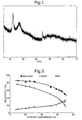
- the catalyst employed for practice of the process of the present invention has a structure which is poorly crystallized and can be characterized by the X-ray diffraction (XRD) pattern presented in Table 1.
- XRD X-ray diffraction
- Catalyst XRD characteristics Interplanar distance (A) Intensity (a.u.) 4.03 100 3.57 60-85 2.01 40-60 1.86 50-70
- the catalyst is preferably prepared as stated hereinabove. After the catalyst precursor is obtained, it is then activated by calcining. During calcining at 350°C, the partially crystallized phase specified above is formed which is believed to be the active structure in the oxidation of ethane to acetic acid. Both the.amorphous phase typically obtained by calcination at temperatures lower than 350°C and the well-crystallized structure typically obtained by calcination at temperatures higher than 350°C are less effective with respect to production of acetic acid.
- the catalyst can be promoted with one or more promoters elements without affecting the foregoing XRD pattern.
- the addition of small amounts of the promoter element, up to 0.1 atom per atom of vanadium, does not weaken or destroy the activity of the catalyst by changing its structure, but rather maintains the desired poor-crystallized structure. It is believed the promoter element increases the catalyst acidity. This facilitates the adsorption of ethylene as well as the desorption of acetic acid, both leading to an increase in the selectivity to acetic acid.
- the present invention relates to methods for the production of acetic acid by the catalytic oxidation of ethane with oxygen in contact with the catalyst.
- the invention relates to a catalytic process for preparing acetic acid by means of ethane oxidation comprising the step of oxidizing ethane in a reaction mixture comprising ethane and oxygen or a compound capable of providing oxygen in a reaction zone in the presence of a catalyst containing a catalyst composition having the formula Mo A V B Nb C P D O Y wherein A is a number ranging from 1 to 5; B is 1; C is a number ranging from 0.01 tc 0.5; D is a number ranging from greater than 0 to 0.1 and Y is a number determined by the valence requirements of the other elements in the catalyst composition.
- the catalyst is in the form of a fixed or fluidized bed and the oxidation is carried out by feeding a feed mixture comprising ethane into the reaction zone.
- the feed mixture may further comprises air, oxygen, ethane, steam or mixtures thereof.
- the feed mixture comprises 1 to 70% by volume of ethane.
- the feed mixture comprises molecular oxygen ranging from 0.1 to 50% by volume of the feed and/or is diluted with steam in an amount ranging from 0 to 40% by volume.
- the oxidation is achieved while operating in gas phase at a temperature of from 150 to 450°C, under a pressure of from 1 to 50 bars, and/or with a contact time between the reaction mixture and catalyst of from 0.1 to 10 seconds.
- the gaseous components of the reaction mixture preferably include ethane, oxygen and a diluent, and these components are uniformly admixed prior to being introduced into the reaction zone.
- the components may be preheated, individually or after being admixed, prior to being introduced into the reaction zone which should have temperature of from 150°C to 450°C.
- reaction mixture used in carrying out the catalytic process generally contains one mole of ethane, 0.01 to 2.0 moles of molecular oxygen either as pure oxygen or in the form of air, and zero to 4.0 moles of water in the form of steam.
- the water or steam is used as a reaction diluent and as a heat moderator for the reaction.
- Other gases may be used as reaction diluent or heat moderators such as helium, nitrogen, and carbon dioxide.
- the raw material used as the source of the ethane can be a gas stream which contains at least five volume percent of ethane.
- the gas stream can also contain minor amounts of the C 3 -C 4 alkanes and alkenes, preferably less than five volume percent of each.
- the gas stream can also contain major amounts, more than five volume percent, of nitrogen, carbon dioxide, and water in the form of steam.
- the reaction zone generally has a reaction pressure of from 1 to 50 bar, preferably from 1 to 30 bar.
- the reaction pressure is initially provided by the feed of the gaseous reactant and diluent and, after the reaction has commenced, is maintained by the use of suitable back-pressure controller placed on the reactor outlet stream.
- the reaction temperature is generally from about 150°C to about 450°C, preferably from 200°C to 300°C.
- the reaction temperature is provided by placing the catalyst bed within a tubular converter having walls placed in a furnace heated to the desired reaction temperature.
- the reaction contact time between the reaction mixture and the catalyst is from about 0.01 second to 100 seconds, preferably 0.1 to 50 seconds, and advantageously from 0.1 second to 10 seconds.
- the contact time is defined as the ratio between the apparent volume of the catalyst bed and the volume of the gaseous reaction mixture feed to the catalyst bed under the given reaction conditions in a unit of time.
- the reaction zone generally has a space hourly velocity of from 50 to 50,000 h -1 , preferably from 100 to 10,000 h -1 and most preferably from 200 to 3,000 h -1 .
- the space velocity may be calculated by determining total reactor outlet gas equivalent in liters of the total effluent evolved over a period of one hour divided by the liters of catalyst in the reactor. This room temperature volume is converted to the volume at 0°C at 1 bar.
- the oxygen concentration in the feed gas mixture can vary widely, from 0.1 to 50% or higher of the feed mixture by applying of proper measures to avoid explosion problems. Air is the preferred source of oxygen in the feed.
- the amount of oxygen present may be a stoichiometric amount, or higher, of the hydrocarbons in the feed.
- the process is generally carried out in a single stage with all the oxygen and reactants being supplied as a single feed with unreacted initial reactants being recycled.
- the process may further comprise the step of introducing oxygen into the feed mixture and/or reaction zone to increase the yield, selectivity or both yield and selectivity of acetic acid.
- the oxidation performed according to the invention provides a selectivity to acetic acid of 50% at a 50% conversion of ethane per single pass through said reaction zone.
- the catalyst of the invention is not limited to use in the oxydehydrogenation of ethane to ethylene and acetic acid and may be applied, for example, in oxidizing alpha-beta unsaturated aliphatic aldehydes in the vapour phase with molecular oxygen to produce the corresponding alpha-beta unsaturated carboxylic acids.
- Carbon dioxide, ethane and ethylene and water were analyzed using a 1.8 m by 3mm column packed with material sold under the tradename HAYASEPTM Q.
- Acetic acid was were analyzed using a 0.5 m by 3 mm column packed with material sold under the trademark PORAPACK" N.
- the yield of acetic acid was calculated by multiplying the selectivity to acetic acid by ethane conversion.
- a catalyst was prepared to have the following composition: Mo 2.5 V 1.0 Nb 0.32
- the resulting solid was put in a China dish and dried further in an oven at 120°C for sixteen hours.
- the dried material was cooled to room temperature and placed in a furnace.
- the temperature was raised from room temperature to 350°C at the rate of 2°/min and thereafter held at 350°C for four hours.
- Calcined catalyst was formulated into uniform particles of the 40-60 mesh size and tested according to the described test. The results are shown in Table 3.
- phosphorus containing catalysts of the following general formula were prepared: Mo 2.5 V 1.0 Nb 0.32 P x where X is 0.01 to 1.0.
- the required amount of diammonium hydrogen phosphate was added to about 5 to 10 ml of distilled water and combined slowly with the gel mixture formed from mixing ammonium metavanadate, niobium oxalate and ammonium paramolybdate solutions (Mixture E in Example 1). After achieving a homogeneous mixture, the resultant gel was dried slowly to incipient dryness at 95-98°C with continuous stirring. The drying and calcination procedures were the same as used in Example 1. Table 2 shows weight of the phosphorus salt added to the base case catalyst, grams of phosphorus salt per gram of catalyst and catalyst composition.
- tellurium containing catalyst was prepared by adding of 3.81E-o4g of teleuric acid to the gel mixture E in Example 1. Drying and calcination of the catalyst was done by following the procedure mentioned in Example 1.
- boron containing catalyst was prepared by adding of 1.344E-o3g of boric acid to the gel mixture E in Example 1. Drying and calcination of the catalyst was done by following the procedure mentioned in Example 1. Phosphorus containing catalysts Example (NH 4 ) 2 HPO 4 (g) g of phos.
- Fig. 2 shows a typical curve relating selectivity to ethylene plus acetic acid to conversion of ethane for the unmodified MoVNb oxide catalyst over the preferred operating regime. From this figure, it can be seen also that the selectivity to ethylene declines while the selectivity to acetic acid increases with increasing ethane conversion. Taking into account these dependencies, a slight increase of the total selectivity to ethylene and acetic acid with the amount of phosphorus in the catalyst can be related to the decrease of ethane conversion observed on P-doped catalysts.
Landscapes
- Chemical & Material Sciences (AREA)
- Organic Chemistry (AREA)
- Engineering & Computer Science (AREA)
- Materials Engineering (AREA)
- Chemical Kinetics & Catalysis (AREA)
- Oil, Petroleum & Natural Gas (AREA)
- Organic Low-Molecular-Weight Compounds And Preparation Thereof (AREA)
- Low-Molecular Organic Synthesis Reactions Using Catalysts (AREA)
- Catalysts (AREA)
Applications Claiming Priority (3)
| Application Number | Priority Date | Filing Date | Title |
|---|---|---|---|
| US08/932,075 US6013597A (en) | 1997-09-17 | 1997-09-17 | Catalysts for the oxidation of ethane to acetic acid processes of making same and, processes of using same |
| US932075 | 1997-09-17 | ||
| PCT/GB1998/002791 WO1999013980A1 (en) | 1997-09-17 | 1998-09-15 | Catalysts for the oxidation of ethane to acetic acid, processes of making same and processes of using same |
Publications (2)
| Publication Number | Publication Date |
|---|---|
| EP0938378A1 EP0938378A1 (en) | 1999-09-01 |
| EP0938378B1 true EP0938378B1 (en) | 2004-12-08 |
Family
ID=25461731
Family Applications (1)
| Application Number | Title | Priority Date | Filing Date |
|---|---|---|---|
| EP98942926A Expired - Lifetime EP0938378B1 (en) | 1997-09-17 | 1998-09-15 | Catalysts for the oxidation of ethane to acetic acid, processes of making same and processes of using same |
Country Status (6)
| Country | Link |
|---|---|
| US (2) | US6013597A (enExample) |
| EP (1) | EP0938378B1 (enExample) |
| JP (1) | JP4596377B2 (enExample) |
| CN (1) | CN1105599C (enExample) |
| DE (1) | DE69828026T2 (enExample) |
| WO (1) | WO1999013980A1 (enExample) |
Families Citing this family (31)
| Publication number | Priority date | Publication date | Assignee | Title |
|---|---|---|---|---|
| GB9807142D0 (en) * | 1998-04-02 | 1998-06-03 | Bp Chem Int Ltd | Catalyst and process utilising the catalyst |
| CA2271397A1 (en) * | 1998-05-21 | 1999-11-21 | Rohm And Haas Company | A process for preparing a catalyst |
| US6087297A (en) * | 1998-06-29 | 2000-07-11 | Saudi Basic Industries Corporation | Catalysts for gas phase production of acetic acid from ethane, processes of making the same and methods of using same |
| KR100373895B1 (ko) * | 1998-08-28 | 2003-02-26 | 아사히 가세이 가부시키가이샤 | 프로판 또는 이소부탄으로부터 아크릴로니트릴 또는메트아크릴로니트릴을 제조하는데 사용하기 위한 산화물촉매의 제조 방법 |
| US6143921A (en) * | 1999-05-14 | 2000-11-07 | Saudi Basic Industries Corporation | Method for producing vinyl acetate monomer from ethane or ethylene oxidation |
| US6258992B1 (en) * | 1999-09-17 | 2001-07-10 | Saudi Basic Industries Corporation | Gas phase catalytic oxidation of hydrocarbons to carboxylic acids and dehydrogenated products |
| US6693059B2 (en) * | 2000-02-09 | 2004-02-17 | Rohm And Haas Company | Process for preparing a catalyst and catalytic oxidation therewith |
| US6337424B1 (en) * | 2000-04-28 | 2002-01-08 | Saudi Basic Industries Corporation | Catalysts oxidation of lower olefins to unsaturated aldehydes, methods of making and using the same |
| US6444845B1 (en) * | 2000-04-28 | 2002-09-03 | Saudia Basic Industries Corporation | Process for the oxidation of unsaturated aldehydes to produce carboxylic acids using Mo-V based catalysts |
| US6531631B1 (en) | 2000-04-28 | 2003-03-11 | Saudi Basic Industries Corporation | Oxidation of ethane to acetic acid and ethylene using molybdenum and vanadium based catalysts |
| US6977064B1 (en) | 2000-05-05 | 2005-12-20 | Saudi Basic Industries Corporation | Apparatus for the controlled optimized addition of reactants in continuous flow reaction systems |
| ES2192983B1 (es) * | 2002-01-31 | 2004-09-16 | Universidad Politecnica De Valencia. | Un catalizador para la deshidrogenacion oxidativa de etano a eteno. |
| US20070149390A1 (en) * | 2003-12-18 | 2007-06-28 | Avantium International B.V. | Catalysts for alkane or alkene oxidation and ammoxidation |
| BRPI0611208A2 (pt) * | 2005-06-01 | 2010-08-24 | Celanese Int Corp | processo para preparar etileno a partir de alimentaÇço gasosa que compreende etano e oxigÊnio e processo para oxidar etano para produzir etileno e Ácido acÉtico |
| US7795469B2 (en) * | 2006-12-21 | 2010-09-14 | Rohm And Haas Company | Process for the selective (AMM) oxidation of lower molecular weight alkanes and alkenes |
| EP2179793A1 (en) * | 2008-10-21 | 2010-04-28 | Sued-Chemie AG | Phosphorous-containing mixed oxide catalysts |
| WO2013148006A1 (en) * | 2012-03-28 | 2013-10-03 | Rohm And Haas Company | Process for making ethylene and acetic acid |
| US9409156B2 (en) | 2012-10-19 | 2016-08-09 | Instituto Mexicano Del Petroleo | Oxidative dehydrogenation of ethane to ethylene and preparation of multimetallic mixed oxide catalyst for such process |
| CA2907955A1 (en) | 2013-05-13 | 2014-11-20 | Saudi Basic Industries Corporation | Methods for preparing acetic acid via ethane oxidation |
| KR20160027102A (ko) | 2013-08-30 | 2016-03-09 | 사빅 글로벌 테크놀러지스 비.브이. | 방향족 알코올의 에스테르 교환반응을 위한 불균일계 촉매; 및 그의 제조 방법 및 용도 |
| CN103920516B (zh) * | 2014-04-15 | 2016-03-16 | 高丽娜 | 可用于烷烃氧化的催化剂制备方法 |
| CN105727978B (zh) * | 2014-12-06 | 2018-01-16 | 中国石油化工股份有限公司 | 一种用于乙烷氧化脱氢制乙烯的催化剂制备方法 |
| CN108114731A (zh) * | 2016-11-26 | 2018-06-05 | 中国科学院大连化学物理研究所 | 用于氧化反应的催化剂组合物 |
| EP3555036A1 (en) | 2016-12-19 | 2019-10-23 | SABIC Global Technologies B.V. | Method of purifying acetic acid |
| WO2020194228A1 (en) | 2019-03-26 | 2020-10-01 | Sabic Global Technologies B.V. | Method of reactivating catalyst |
| EP4059916A1 (de) | 2021-03-15 | 2022-09-21 | Linde GmbH | Verfahren und anlage zur erzeugung eines produktkohlenwasserstoffs |
| CN116328755B (zh) * | 2021-12-22 | 2025-02-28 | 中国石油天然气股份有限公司 | 复合氧化物催化剂及其制备方法与应用 |
| CN116408061A (zh) * | 2021-12-31 | 2023-07-11 | 中国石油天然气股份有限公司 | 乙烷选择氧化制乙酸和乙烯的催化剂及其制备方法与应用 |
| EP4342873A1 (de) | 2022-09-26 | 2024-03-27 | Linde GmbH | Verfahren und anlage zur herstellung von ethylen und essigsäure, verfahren und anlage zur herstellung einer zielverbindung unter verwendung von ethylen und essigsäure |
| CN116251607B (zh) * | 2022-12-21 | 2026-06-16 | 安徽环轩材料科技有限公司 | 一种工业尾气中乙酸脱除催化剂的制备方法及其在乙烷氧化脱氢制备乙烯反应中应用 |
| CN119702065B (zh) * | 2023-09-28 | 2025-11-18 | 中国石油天然气股份有限公司 | 一种乙烷氧化脱氢的复合型催化剂及其制备方法 |
Family Cites Families (24)
| Publication number | Priority date | Publication date | Assignee | Title |
|---|---|---|---|---|
| DE1129469B (de) * | 1957-09-28 | 1962-05-17 | Hoechst Ag | Verfahren zur Herstellung von Aldehyden, Ketonen oder den Aldehyden entsprechenden Saeuren |
| US3057915A (en) * | 1957-09-14 | 1962-10-09 | Hoechst Ag | Process for oxidizing olefins to aldehydes, ketones and acids |
| US3240805A (en) * | 1961-10-13 | 1966-03-15 | Halcon International Inc | Process for producing acetic acid |
| US4339355A (en) * | 1975-10-09 | 1982-07-13 | Union Carbide Corporation | Catalytic oxide of molybdenum, vanadium, niobium and optional 4th metal |
| US4250054A (en) * | 1976-06-01 | 1981-02-10 | The Standard Oil Company (Ohio) | Catalysts for producing unsaturated aliphatic acids |
| US4148757A (en) * | 1977-08-10 | 1979-04-10 | The Standard Oil Company | Process for forming multi-component oxide complex catalysts |
| US4249020A (en) * | 1977-08-19 | 1981-02-03 | Union Carbide Corporation | Oxydehydrogenation of certain≧C4 saturated oxyhydrocarbon compounds |
| US4250346A (en) * | 1980-04-14 | 1981-02-10 | Union Carbide Corporation | Low temperature oxydehydrogenation of ethane to ethylene |
| GB8915410D0 (en) * | 1989-07-05 | 1989-08-23 | Bp Chem Int Ltd | Chemical process |
| US4524236A (en) * | 1984-06-28 | 1985-06-18 | Union Carbide Corporation | Process for oxydehydrogenation of ethane to ethylene |
| US4568790A (en) * | 1984-06-28 | 1986-02-04 | Union Carbide Corporation | Process for oxydehydrogenation of ethane to ethylene |
| US4596787A (en) * | 1985-04-11 | 1986-06-24 | Union Carbide Corporation | Process for preparing a supported catalyst for the oxydehydrogenation of ethane to ethylene |
| US4899003A (en) * | 1985-07-11 | 1990-02-06 | Union Carbide Chemicals And Plastics Company Inc. | Process for oxydehydrogenation of ethane to ethylene |
| US5162578A (en) * | 1987-06-12 | 1992-11-10 | Union Carbide Chemicals & Plastics Technology Corporation | Acetic acid from ethane, ethylene and oxygen |
| CN1020597C (zh) * | 1987-11-25 | 1993-05-12 | 三菱化成株式会社 | 生产腈的方法 |
| JP2608768B2 (ja) * | 1987-11-25 | 1997-05-14 | 三菱化学株式会社 | ニトリルの製造法 |
| US5049692A (en) * | 1987-11-25 | 1991-09-17 | Mitsubishi Kasei Corporation | Catalytic conversion of alkanes to nitriles, and a catalyst therefor |
| EP0441312B1 (en) * | 1990-02-08 | 1995-02-01 | Nippon Shokubai Kagaku Kogyo Co. Ltd. | Process for producing methacrylic acid |
| JP2574948B2 (ja) * | 1990-02-08 | 1997-01-22 | 株式会社日本触媒 | メタクリル酸の製造方法 |
| GB9022127D0 (en) * | 1990-10-11 | 1990-11-21 | Bp Chem Int Ltd | Process |
| US5300682A (en) * | 1991-06-10 | 1994-04-05 | The Standard Oil Co. | Catalytic oxidation of ethane to acetic acid |
| US5198580A (en) * | 1991-11-18 | 1993-03-30 | The Standard Oil Company | Process for oxidation of propane |
| TW295579B (enExample) * | 1993-04-06 | 1997-01-11 | Showa Denko Kk | |
| FR2705668B1 (fr) * | 1993-05-28 | 1995-08-25 | Rhone Poulenc Chimie | Procédé de préparation d'acide acétique par oxydation ménagée de l'éthane. |
-
1997
- 1997-09-17 US US08/932,075 patent/US6013597A/en not_active Expired - Lifetime
-
1998
- 1998-05-27 US US09/085,347 patent/US5907056A/en not_active Expired - Lifetime
- 1998-09-15 WO PCT/GB1998/002791 patent/WO1999013980A1/en not_active Ceased
- 1998-09-15 EP EP98942926A patent/EP0938378B1/en not_active Expired - Lifetime
- 1998-09-15 DE DE69828026T patent/DE69828026T2/de not_active Expired - Lifetime
- 1998-09-15 CN CN98801493A patent/CN1105599C/zh not_active Expired - Lifetime
- 1998-09-15 JP JP51755399A patent/JP4596377B2/ja not_active Expired - Lifetime
Also Published As
| Publication number | Publication date |
|---|---|
| JP4596377B2 (ja) | 2010-12-08 |
| CN1105599C (zh) | 2003-04-16 |
| US5907056A (en) | 1999-05-25 |
| WO1999013980A1 (en) | 1999-03-25 |
| US6013597A (en) | 2000-01-11 |
| EP0938378A1 (en) | 1999-09-01 |
| DE69828026D1 (de) | 2005-01-13 |
| JP2001505129A (ja) | 2001-04-17 |
| DE69828026T2 (de) | 2005-04-07 |
| CN1241146A (zh) | 2000-01-12 |
Similar Documents
| Publication | Publication Date | Title |
|---|---|---|
| US5907056A (en) | Catalysts for the oxidation of ethane to acetic acid, processes of making same and processes of using same | |
| US6030920A (en) | Catalysts for producing acetic acid from ethane oxidation, processes of making same and method of using same | |
| US4568790A (en) | Process for oxydehydrogenation of ethane to ethylene | |
| US4524236A (en) | Process for oxydehydrogenation of ethane to ethylene | |
| EP1140355B1 (en) | Catalytic oxidation of alkanes to corresponding acids | |
| US6143928A (en) | Catalysts for low temperature selective oxidation of propylene, methods of making and using the same | |
| EP1276558B1 (en) | Process for the oxidation of ethane to acetic acid and ethylene | |
| KR20020032402A (ko) | 알켄 및 카르복실산을 제조하기 위한 산화 방법 | |
| US6130356A (en) | Catalysts for the oxidation of ethane to acetic acid, methods of making and using the same | |
| US6156928A (en) | Method for gas phase production of acetic acid from ethane | |
| US6620973B2 (en) | Catalysts for oxidation of lower olefins to unsaturated aldehydes, methods of making and using the same | |
| JP2005298508A (ja) | 低級アルカンの変換のための改良された接触(アンモ)酸化法 |
Legal Events
| Date | Code | Title | Description |
|---|---|---|---|
| PUAI | Public reference made under article 153(3) epc to a published international application that has entered the european phase |
Free format text: ORIGINAL CODE: 0009012 |
|
| AK | Designated contracting states |
Kind code of ref document: A1 Designated state(s): BE DE FR GB NL |
|
| 17P | Request for examination filed |
Effective date: 19990819 |
|
| 17Q | First examination report despatched |
Effective date: 20020809 |
|
| GRAP | Despatch of communication of intention to grant a patent |
Free format text: ORIGINAL CODE: EPIDOSNIGR1 |
|
| GRAS | Grant fee paid |
Free format text: ORIGINAL CODE: EPIDOSNIGR3 |
|
| GRAA | (expected) grant |
Free format text: ORIGINAL CODE: 0009210 |
|
| AK | Designated contracting states |
Kind code of ref document: B1 Designated state(s): BE DE FR GB NL |
|
| REG | Reference to a national code |
Ref country code: GB Ref legal event code: FG4D |
|
| REF | Corresponds to: |
Ref document number: 69828026 Country of ref document: DE Date of ref document: 20050113 Kind code of ref document: P |
|
| PLBE | No opposition filed within time limit |
Free format text: ORIGINAL CODE: 0009261 |
|
| STAA | Information on the status of an ep patent application or granted ep patent |
Free format text: STATUS: NO OPPOSITION FILED WITHIN TIME LIMIT |
|
| ET | Fr: translation filed | ||
| 26N | No opposition filed |
Effective date: 20050909 |
|
| REG | Reference to a national code |
Ref country code: FR Ref legal event code: PLFP Year of fee payment: 19 |
|
| REG | Reference to a national code |
Ref country code: FR Ref legal event code: PLFP Year of fee payment: 20 |
|
| PGFP | Annual fee paid to national office [announced via postgrant information from national office to epo] |
Ref country code: GB Payment date: 20170913 Year of fee payment: 20 Ref country code: DE Payment date: 20170912 Year of fee payment: 20 Ref country code: FR Payment date: 20170810 Year of fee payment: 20 |
|
| PGFP | Annual fee paid to national office [announced via postgrant information from national office to epo] |
Ref country code: NL Payment date: 20170919 Year of fee payment: 20 Ref country code: BE Payment date: 20170814 Year of fee payment: 20 |
|
| REG | Reference to a national code |
Ref country code: DE Ref legal event code: R071 Ref document number: 69828026 Country of ref document: DE |
|
| REG | Reference to a national code |
Ref country code: NL Ref legal event code: MK Effective date: 20180914 |
|
| REG | Reference to a national code |
Ref country code: GB Ref legal event code: PE20 Expiry date: 20180914 |
|
| REG | Reference to a national code |
Ref country code: BE Ref legal event code: MK Effective date: 20180915 |
|
| PG25 | Lapsed in a contracting state [announced via postgrant information from national office to epo] |
Ref country code: GB Free format text: LAPSE BECAUSE OF EXPIRATION OF PROTECTION Effective date: 20180914 |