EP0935438B1 - Reinigungswerkzeug - Google Patents
Reinigungswerkzeug Download PDFInfo
- Publication number
- EP0935438B1 EP0935438B1 EP97948857A EP97948857A EP0935438B1 EP 0935438 B1 EP0935438 B1 EP 0935438B1 EP 97948857 A EP97948857 A EP 97948857A EP 97948857 A EP97948857 A EP 97948857A EP 0935438 B1 EP0935438 B1 EP 0935438B1
- Authority
- EP
- European Patent Office
- Prior art keywords
- cleaning
- monofilaments
- cleaning tool
- tool according
- brush
- Prior art date
- Legal status (The legal status is an assumption and is not a legal conclusion. Google has not performed a legal analysis and makes no representation as to the accuracy of the status listed.)
- Expired - Lifetime
Links
- 239000002250 absorbent Substances 0.000 claims abstract description 21
- 230000002745 absorbent Effects 0.000 claims abstract description 20
- 239000004033 plastic Substances 0.000 claims abstract description 9
- 229920003023 plastic Polymers 0.000 claims abstract description 9
- 238000004140 cleaning Methods 0.000 claims description 63
- 239000004744 fabric Substances 0.000 claims description 35
- 239000004753 textile Substances 0.000 claims description 9
- 239000000463 material Substances 0.000 claims description 8
- 238000003466 welding Methods 0.000 claims description 6
- 229920000728 polyester Polymers 0.000 claims description 4
- 238000004026 adhesive bonding Methods 0.000 claims description 3
- 238000000034 method Methods 0.000 claims description 3
- 239000004952 Polyamide Substances 0.000 claims description 2
- 229920002647 polyamide Polymers 0.000 claims description 2
- 239000012815 thermoplastic material Substances 0.000 claims description 2
- 239000000203 mixture Substances 0.000 claims 1
- 238000009966 trimming Methods 0.000 claims 1
- 238000005452 bending Methods 0.000 abstract description 4
- 230000001680 brushing effect Effects 0.000 abstract description 3
- 238000007790 scraping Methods 0.000 abstract description 2
- 239000000835 fiber Substances 0.000 description 13
- XLYOFNOQVPJJNP-UHFFFAOYSA-N water Substances O XLYOFNOQVPJJNP-UHFFFAOYSA-N 0.000 description 8
- 229920000742 Cotton Polymers 0.000 description 4
- 206010052904 Musculoskeletal stiffness Diseases 0.000 description 3
- -1 Polypropylene Polymers 0.000 description 3
- 239000004743 Polypropylene Substances 0.000 description 3
- 239000007788 liquid Substances 0.000 description 3
- 229920001155 polypropylene Polymers 0.000 description 3
- 238000010521 absorption reaction Methods 0.000 description 2
- 239000000428 dust Substances 0.000 description 2
- 238000005516 engineering process Methods 0.000 description 2
- 239000010410 layer Substances 0.000 description 2
- 238000005201 scrubbing Methods 0.000 description 2
- 239000000126 substance Substances 0.000 description 2
- 229920000297 Rayon Polymers 0.000 description 1
- 239000012790 adhesive layer Substances 0.000 description 1
- 238000005266 casting Methods 0.000 description 1
- 230000001419 dependent effect Effects 0.000 description 1
- 238000009826 distribution Methods 0.000 description 1
- 238000005108 dry cleaning Methods 0.000 description 1
- 230000000694 effects Effects 0.000 description 1
- 238000001125 extrusion Methods 0.000 description 1
- 210000003811 finger Anatomy 0.000 description 1
- 239000011521 glass Substances 0.000 description 1
- 239000004519 grease Substances 0.000 description 1
- 238000007373 indentation Methods 0.000 description 1
- 238000004519 manufacturing process Methods 0.000 description 1
- 239000002184 metal Substances 0.000 description 1
- 239000002245 particle Substances 0.000 description 1
- 238000005498 polishing Methods 0.000 description 1
- 229920006149 polyester-amide block copolymer Polymers 0.000 description 1
- 238000003825 pressing Methods 0.000 description 1
- 230000000717 retained effect Effects 0.000 description 1
- 238000007788 roughening Methods 0.000 description 1
- 210000003813 thumb Anatomy 0.000 description 1
Images
Classifications
-
- A—HUMAN NECESSITIES
- A46—BRUSHWARE
- A46B—BRUSHES
- A46B9/00—Arrangements of the bristles in the brush body
- A46B9/06—Arrangement of mixed bristles or tufts of bristles, e.g. wire, fibre, rubber
-
- A—HUMAN NECESSITIES
- A47—FURNITURE; DOMESTIC ARTICLES OR APPLIANCES; COFFEE MILLS; SPICE MILLS; SUCTION CLEANERS IN GENERAL
- A47L—DOMESTIC WASHING OR CLEANING; SUCTION CLEANERS IN GENERAL
- A47L13/00—Implements for cleaning floors, carpets, furniture, walls, or wall coverings
- A47L13/10—Scrubbing; Scouring; Cleaning; Polishing
- A47L13/16—Cloths; Pads; Sponges
Definitions
- the invention relates to a cleaning tool according to the preamble of claim 1.
- a cleaning tool is known from DE-A-38 21 857 in the form of a plush-like cleaning cloth.
- the absorbent threads here consist of twisted polyester fibers.
- the threads have capillary action and water absorption capacity due to the narrow gaps between the parallel, adjacent fibers. You can wet the surface to be cleaned and then take up dirty water again.
- the stronger cleaning component consists of crimped threads.
- the threads are untwisted from their ends due to the crimp, the fibers become independent.
- the crimped fibers become when pressing and moving the cleaning cloth not simply dragged along the length of the surface to be cleaned, but with transverse, at least sloping and corresponding scraping sections.
- the pile threads are welded into the basic structure of the plush-like cleaning cloth anchored.
- DE-A-27 26 485 relates to a textile fabric for cleaning purposes and deals with the problem of such cloths sticking to the floor.
- the water-absorbing cotton tends to do this.
- it is proposed to cover a base fabric or a similar absorbent, water-absorbing layer with a velvet or plush fabric or to anchor fine bristles to the base fabric in a comparable arrangement by means of a porous adhesive layer.
- the dense arrangement of the fine bristles there are capillary spaces between them, which themselves are not capable of absorbing water, which create a line connection for water to be dispensed and dirty water to be taken up between the surface of the floor and the reservoir made available in the base fabric.
- the function of wet cleaning is retained.
- the velvet or plush bristles made of non-water-absorbent material prevent them from sucking up. In between, individual wick-like, absorbent threads should be arranged.
- a dust, polishing or dry cleaning cloth should also be composed of two types of thread. It is proposed that chemical fiber threads with a roughened, fluffy surface run in the warp or weft direction, are arranged parallel to these cotton threads and the diameter of the chemical fiber threads is larger than the diameter of the cotton threads.
- the fabric should have a rib structure with dust collecting spaces lying between the ribs.
- the Cleaning glove is especially intended for cleaning motor vehicles.
- One side is for cleaning the metal, glass and plastic surfaces suitable pile material.
- the other side is with slanted bristles occupied to clean the upholstery.
- the pile here is made up of shrinkable and non-shrinkable pile fibers.
- the purpose of the different shrinkage is to achieve a different end length. With the different end lengths, either patterns for upholstery fabrics and carpets formed by indentations are to be created, or artificial fur in which the shrunk pile fibers form the lower fur.
- An artificial fur as cleaning textile is known from DE-A-28 44 185. It should be used on a window cleaning device, wrapped in several layers. His hair should have a hardness tearing open the dirt film.
- US-A-5,142,727 relates to a scrubbing cloth for Carpets, which means a more thorough cleaning of a carpet allowed.
- the scrubbing cloth consists of a combination of one Carpet cleaning cloth and a brush, which areas which is specifically designed for the inclusion of Cleaning liquid are suitable, and those that primarily have a brush function.
- the cleaning cloth of US-A-5,142,727 consists of two identical cloths, the inside of which are connected are. Each cloth has a basic fabric made of one Polypropylene fabric. Stripes are in this fabric Absorption of the cleaning liquid and between them Strips with fibers with an abrasive effect are provided.
- the areas for absorbing the cleaning liquid are off a polyester / viscose yarn, and the areas with Brushing effects are made from a variety of polypropylene monofilament fibers manufactured. The latter only own a low flexural strength.
- the object of the invention is to provide a cleaning tool for use to provide particularly heavy soiling.
- a brush has been modified to work with absorbent threads has been provided and thus also the water-releasing and Has received water and dirt-absorbing properties of a textile material.
- the brush-like component is no more textile thread.
- the cleaning tool can be used as a brush with a stiff back plate that can be gripped by hand be made of plastic in which the absorbent threads and the brush-like component are anchored.
- the brush-like Component consists of plastic monofilaments of such a length and bending stiffness as well as stocking density, that the ends at least partially under normal force essentially brush over the surface to be cleaned, i.e. not with hang up a section of their length. You leave produce with absolutely reproducible dimensions and material properties.
- the monofilaments have a structured surface.
- the monofilaments can also be used for cleaning purposes in working positions made in which their ends fold. Then the structuring scrapes.
- the proposal particularly concerns rougher floor surfaces, at least those with depressions.
- little or no curved monofilaments should protrude into the depressions and grasp the bottom of the wells with their tips while in the area and also bent monofilaments in the higher edge areas of the depressions structuring their surface.
- the structuring can be achieved on thermoformed monofilaments made of thermoplastic material, for example immediately after extrusion through air nozzles acting from the sides. However, it could also be created as a roughening by an abrasive treatment.
- the monofilaments will have a length of 7 to 15 mm, preferably about 10 to 12 mm.
- the monofilaments have a diameter of 0.3 to 1.0 mm, preferably 0.5 to 0.8 mm, and a stocking density of 50 to 200, preferably 70 to 150, per cm 2 .
- the proportion of monofilaments may be 5 to 50%, usually between 10 and 40%, of the total number of absorbent threads and monofilaments.
- Another aspect is, with different structure regarding Material selection, length, diameter, surface structuring and stocking density of the Monofilament and possibly a set of cleaning tools with regard to the absorbent threads to create the graded in their properties and for different levels of pollution and / or floors or other surfaces are optimized.
- This set is primarily intended for a set of fabrics for a cleaning device.
- the variants cleaning pillow, cleaning glove or covering of a cleaning device in one assortment are possible side by side. Gradually they can also be designed differently.
- the brush with a graspable rigid back plate is the hardest cleaning tool, the cleaning pad is a bit softer and the cleaning glove is a bit softer.
- the force is distributed over a larger area; either a smaller proportion of even harder brush-like components or a larger proportion of softer brush-like components may be provided here.
- the double plush process is primarily considered for production in textile technology; the monofilaments are worked into a base fabric together with the absorbent threads as a pile. They should be anchored in the base fabric by welding, for which purpose, for example, weldable fibers can be contained in the material of the base fabric in a manner known per se.
- the monofilaments are held firmly in the whitened fabric. They cannot push backwards despite the considerable force with which they are supported in the tissue due to their stiffness. Due to the welding, the monofilaments are also completely bordered on their entire circumference, so that bending moments are completely transferred into the fabric and the monofilaments cannot kink with respect to the base fabric.
- the base fabric can be made stiff enough to hold the bending forces. Instead of welding, gluing is also possible by means of a finish applied to the back.
- a non-woven basic structure such as a Knitted or knitted fabrics in which the monofilaments as well as the absorbent threads e.g. can be classified. You can also do this by welding or gluing be anchored.
- the absorbent threads and monofilaments are essentially equally long and arranged in an even distribution.
- the absorbent threads can be made of cotton or in a manner known per se spun polyester fibers exist.
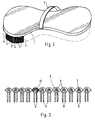
- Fig. 1 shows a back plate 1 made of plastic, which is retracted in the middle to be grasped here by hand.
- a belt 2 extends obliquely across the width of the plastic plate at the retraction. The hand can be pushed under with the fingers, the thumb remains in front of it.
- the plastic plate 1 twisted, absorbent threads 3 and, in comparison, rigid monofilaments 4 are anchored by casting.
- the pile of absorbent threads 3 moistens the dirt on the surface to be cleaned and later takes up dirty water and larger dirt particles.
- the monofilaments 4 scrape the adhering dirt off the surface to be cleaned like a brush. In this way, heavy soiling, including grease, can be removed.
- the pile fabric shown in Fig. 2 consists in a manner known per se from a Base fabric 5 from warp threads 6 and weft threads 7 to the twisted, absorbent threads 8 and comparatively rigid monofilaments 9 are beaten as a pole.
- the pole is in that Basic fabric welded.
- the welding of a monofilament 9 is indicated at 10.
- a cleaning tool made from the polypropylene, in particular a cleaning pad, a cleaning glove or a covering of a cleaning device works in principle in the same way as the cleaning tool according to Fig. 1. It is a brush combined with a cleaning plush.
Landscapes
- Cleaning Implements For Floors, Carpets, Furniture, Walls, And The Like (AREA)
- Brushes (AREA)
- Electrical Discharge Machining, Electrochemical Machining, And Combined Machining (AREA)
- Telephone Function (AREA)
- Organic Low-Molecular-Weight Compounds And Preparation Thereof (AREA)
- Valve Device For Special Equipments (AREA)
- Printers Or Recording Devices Using Electromagnetic And Radiation Means (AREA)
- Sampling And Sample Adjustment (AREA)
Description
Die saugfähigen Fäden bestehen hier aus verzwirnten Polyesterfasern. Mit den engen Zwischenräumen zwischen den parallel geschlungenen, aneinanderliegenden Fasern haben die Fäden Kapillarwirkung und Wasseraufnahmekapazität. Sie können die zu reinigende Fläche anfeuchten und dann auch Schmutzwasser wieder aufnehmen.
Als Lösung ist vorgeschlagen, ein Grundgewebe oder eine ähnliche saugfähige, wasseraufnehmende Schicht mit einem Samt- oder Plüschgewebe zu belegen oder mittels einer porösen Kleberschicht in vergleichbarer Anordnung feine Borsten an dem Grundgewebe zu verankern. Infolge der dichten Anordnung der feinen Borsten bestehen zwischen diesen, die selbst nicht wasseraufnahmefähig sind, Kapillarräume, die eine Leitungsverbindung für abzugebendes Wasser und aufzunehmendes Schmutzwasser zwischen der Bodenoberfläche und dem in dem Grundgewebe zur Verfügung gestellten Reservoir schaffen. Die Funktion der Naßreinigung bleibt so erhalten. Die Samt- oder Plüschborsten aus nicht-wasseraufnahmefähigem Material verhindern aber ein Festsaugen.
Dazwischen sollen ggf. einzelne dochtartige, saugende Fäden angeordnet sein.
Vorgeschlagen ist, daß Chemiefaserfäden mit aufgerauhter, flauschartiger Oberfläche in Kett- oder Schußrichtung verlaufen, parallel zu diesen Baumwollfäden angeordnet sind und der Durchmesser der Chemiefaserfäden größer als der Durchmesser der Baumwollfäden ist. So soll das Gewebe eine Rippenstruktur mit zwischen den Rippen liegenden Staubsammelräumen aufweisen.
Der Flor ist hier aus schrumpffähigen und nicht-schrumpffähigen Florfasern aufgebaut. Zweck der unterschiedlichen Schrumpfung ist, eine unterschiedliche Endlänge zu erzielen. Mit der unterschiedlichen Endlänge sollen entweder durch Vertiefungen gebildete Muster für Polstergewebe und Teppiche erzeugt werden oder Kunstfelle, in denen die geschrumpften Florfasern den Unterpelz bilden.
Es soll, in mehreren Lagen gewickelt, an einem Fensterreinigungsgerät eingesetzt werden. Seine Haare sollen eine den Schmutzfilm aufreißende Härte aufweisen.
Sie könnte aber auch als Aufrauhung durch eine schmirgelnde Behandlung erzeugt werden.
Es versteht sich, daß die drei verschiedenen Größen wechselseitig Einfluß aufeinander haben und auch von den Eigenschaften des Materials, in der Regel einem Polyester oder Polyamid, abhängig sind sowie in gewissem Maße von der anderen, aus den saugfähigen Fäden bestehenden Komponente des Besatzes. Auf diese entfällt ein Teil der auszuübenden Kraft.
Der Anteil der Monofile mag dabei 5 bis 50%, meist zwischen 10 und 40%, der Gesamtzahl von saugfähigen Fäden und Monofilen betragen.
Unabhängig davon sind die Varianten Reinigungskissen, Reinigungshandschuh oder Bespannung eines Reinigungsgerätes in einem Sortiment nebeneinander möglich. Auch sie können graduell unterschiedlich konzipiert sein. Beispielsweise ist die Bürste mit einer faßbaren steifen Rückenplatte das härteste Reinigungswerkzeug, das Reinigungskissen etwas weicher und der Reinigungshandschuh noch etwas weicher. Bei der Bespannung eines Reinigungsgerätes wird die Kraft auf eine größere Fläche verteilt; hier mag entweder ein geringerer Anteil an noch härterer bürstenartiger Komponente oder ein größerer Anteil an weicherer bürstenartiger Komponente vorgesehen sein.
Statt des Verschweißens ist auch ein Verkleben mittels einer auf der Rückseite aufgebrachten Appretur möglich.
- Fig. 1
- zeigt ein Reinigungswerkzeug nach Art einer Bürste in perspektivischer Darstellung,
- Fig. 2
- zeigt schematisch ein Polgewebe zur Herstellung eines Reinigungskissens, Reinigungshandschuhs oder einer Bespannung eines Reinigungsgerätes.
In der Kunststoffplatte 1 sind aus Fasern gedrillte, saugfähige Fäden 3 und im Vergleich dazu steife Monofile 4 durch Eingießen verankert.
So kann starke Verschmutzung, auch mit Fett, beseitigt werden.
Claims (10)
- Feucht-Reinigungswerkzeug zur Entfernung von Schmutz von einer zu reinigenden Oberfläche, mit einem Besatz, der in Mischung mit saugfähigen Fäden (3;8) eine stärker reinigende bürstenartige Komponente (4;9) aufweist, wobei die saugfähigen Fäden (3;8) und die stärker reinigende Komponente (4;9) im wesentlichen gleich lang und in einem textilen Grundgewebe (5), Gewirke, Gestricke oder einer steifen Rückenplatte (1) durch Schweissen oder Verkleben verankert sind, dadurch gekennzeichnet, dass die stärker reinigende Komponente (4;9) aus Kunststoff-Monofilen (4;9) eines Durchmessers zwischen 0,3 bis 1,0 mm und einer solchen Länge und Biege steifigkeit sowie Besatzdichte besteht, dass bei normaler Kraftausübung die Enden mindestens teilweise im wesentlichen als Spitzen über die zu reinigende Fläche streichen, wobei die Besatzdichte 50 bis 200 Monofile (4;9) pro cm2 beträgt, und dass die Monofile (4;9) und die saugfähigen Fäden (3;8) in gleichmässiger Verteilung angeordnet sind.
- Reinigungswerkzeug nach Anspruch 1, dadurch gekennzeichnet, dass es als Bürste mit einer von Hand fassbaren steifen Rückenplatte (1) aus Kunststoff gestaltet ist, in der die saugfähigen Fäden (3) und die bürstenartige Komponente (4) verankert sind.
- Reinigungswerkzeug nach Anspruch 1, dadurch gekennzeichnet, dass es in Textiltechnik hergestellt und als Reinigungskissen, Reinigungshandschuh oder Bespannung eines Reinigungsgeräts konfektioniert ist.
- Reinigungswerkzeug nach einem der Ansprüche 1 bis 3, dadurch gekennzeichnet, dass die Monofile eine strukturierte Oberfläche aufweisen.
- Reinigungswerkzeug nach Anspruch 4, dadurch gekennzeichnet, dass die Monofile aus thermoplastischem Material bestehen und die Oberfläche durch eine Warmverformung strukturiert ist.
- Reinigungswerkzeug nach Anspruch 4, dadurch gekennzeichnet, dass die Oberfläche durch eine schmirgelnde Behandlung strukturiert ist.
- Reinigungswerkzeug nach einem der Ansprüche 1 bis 6, dadurch gekennzeichnet, dass die Länge der Monofile (4;9) 7 bis 15 mm, vorzugsweise 10 bis 12 mm, beträgt.
- Reinigungswerkzeug nach einem der Ansprüche 1 bis 7, dadurch gekennzeichnet, dass der Durchmesser der Monofile (4;9) 0,5 bis 0,8 mm beträgt.
- Reinigungswerkzeug nach einem der Ansprüche 1 bis 8, dadurch gekennzeichnet, dass die Besatzdichte 70 bis 150 Monofile (4;9) pro cm2 beträgt.
- Reinigungswerkzeug nach einem der Ansprüche 1 bis 9, dadurch gekennzeichnet, dass die Monofile (4;9) aus einem Polyester oder einem Polyamid bestehen.
Applications Claiming Priority (3)
| Application Number | Priority Date | Filing Date | Title |
|---|---|---|---|
| DE19645224A DE19645224A1 (de) | 1996-11-02 | 1996-11-02 | Reinigungswerkzeug |
| DE19645224 | 1996-11-02 | ||
| PCT/EP1997/006037 WO1998019588A1 (de) | 1996-11-02 | 1997-11-03 | Reinigungswerkzeug |
Publications (2)
| Publication Number | Publication Date |
|---|---|
| EP0935438A1 EP0935438A1 (de) | 1999-08-18 |
| EP0935438B1 true EP0935438B1 (de) | 2001-07-04 |
Family
ID=7810486
Family Applications (1)
| Application Number | Title | Priority Date | Filing Date |
|---|---|---|---|
| EP97948857A Expired - Lifetime EP0935438B1 (de) | 1996-11-02 | 1997-11-03 | Reinigungswerkzeug |
Country Status (5)
| Country | Link |
|---|---|
| EP (1) | EP0935438B1 (de) |
| AT (1) | ATE202684T1 (de) |
| DE (2) | DE19645224A1 (de) |
| DK (1) | DK0935438T3 (de) |
| WO (1) | WO1998019588A1 (de) |
Families Citing this family (2)
| Publication number | Priority date | Publication date | Assignee | Title |
|---|---|---|---|---|
| DE19956652B4 (de) * | 1999-11-25 | 2006-06-08 | Friedmann, Rainer | Textiles Material mit abrasiver Wirkung |
| DE10010161A1 (de) * | 2000-03-03 | 2001-09-06 | Gregor Kohlruss | Reinigungsvorrichtung mit Halterungsschlaufe |
Family Cites Families (23)
| Publication number | Priority date | Publication date | Assignee | Title |
|---|---|---|---|---|
| IT605163A (de) * | 1958-03-04 | |||
| DE1957845C3 (de) * | 1969-11-18 | 1975-10-16 | Fa. Alfred Kornbusch, 4290 Bocholt | Staub-, Polier- oder Trocken-Reinigungstuch |
| FR2198365A5 (en) * | 1972-08-31 | 1974-03-29 | Rhone Poulenc Textile | Brush having synthetic tufts - formed by stiff fibres and fibres whose flexibi-lity increases from root to tip |
| US3924286A (en) * | 1974-01-24 | 1975-12-09 | Minnesota Mining & Mfg | Cleaning brush |
| DE2726485A1 (de) * | 1977-06-11 | 1978-12-21 | Scheibler Peltzer & Co | Textiles flaechengebilde fuer reinigungszwecke |
| DE2757046A1 (de) * | 1977-12-21 | 1979-07-05 | Braun Ag | Buerste zum reinigen von oberflaechen |
| DE2758419A1 (de) * | 1977-12-28 | 1979-07-05 | Verdol Sa | Verfahren und vorrichtung zur behandlung eines synthetischen endlosgarns |
| DE7830211U1 (de) * | 1978-10-11 | 1979-02-01 | Raab, Hans, 6602 Dudweiler | Fensterreinigungsgeraet |
| US4305234A (en) * | 1980-02-04 | 1981-12-15 | Flo-Pac Corporation | Composite brush |
| FR2485350B1 (fr) * | 1980-06-24 | 1985-06-21 | Dugay Francis | Brosse a lustrer les meubles |
| DE3116189A1 (de) * | 1981-04-23 | 1982-12-23 | Bodo 2000 Hamburg Jesse | Profilierte borsten fuer zahnbuersten und buersten aller art |
| US4670930A (en) * | 1984-10-02 | 1987-06-09 | Lu Ming | Cleaning gloves |
| AT382502B (de) * | 1985-06-27 | 1987-03-10 | Frieb Eduard Gmbh | Haarbuerste |
| DE3821857A1 (de) * | 1988-06-29 | 1990-01-04 | Hans Raab | Verfahren zur herstellung eines plueschartigen reinigungstuches und nach dem verfahren hergestelltes reinigungstuch oder hergestellter reinigungshandschuh |
| DE3839648A1 (de) * | 1988-11-24 | 1990-05-31 | Hopf Rolf | Verfahren und vorrichtung zur herstellung wollaehnlicher chemiefasern |
| DE4013564C1 (de) * | 1990-04-27 | 1991-07-11 | Fritz 7869 Schoenau De Rueb | |
| DE9010901U1 (de) * | 1990-07-23 | 1990-11-22 | Burkhardt, Margarete, 8961 Wildpoldsried | Einrichtung zum Reinigen von Oberflächen |
| US5142727A (en) * | 1991-10-28 | 1992-09-01 | Koester James A | Carpet scrubbing bonnet |
| DE9301534U1 (de) * | 1993-02-04 | 1993-03-25 | Coronet-Werke GmbH, 6948 Wald-Michelbach | Haushaltsreinigungstuch |
| DE9306485U1 (de) * | 1993-04-29 | 1993-06-24 | Wematik AG, Stans | Reinigungstuch |
| DE4322871A1 (de) * | 1993-07-09 | 1995-01-12 | Coronet Werke Gmbh | Mittel zum Reinigen oder Behandeln von Oberflächen und Verfahren zu ihrer Herstellung |
| US5442829A (en) * | 1994-09-29 | 1995-08-22 | Summers; Andre D. | Personal hand and nail brush |
| DE29512702U1 (de) * | 1994-10-04 | 1996-01-04 | Meyer, Ingrid, 93155 Hemau | Reinigungstextilie |
-
1996
- 1996-11-02 DE DE19645224A patent/DE19645224A1/de not_active Withdrawn
-
1997
- 1997-11-03 EP EP97948857A patent/EP0935438B1/de not_active Expired - Lifetime
- 1997-11-03 WO PCT/EP1997/006037 patent/WO1998019588A1/de not_active Ceased
- 1997-11-03 AT AT97948857T patent/ATE202684T1/de not_active IP Right Cessation
- 1997-11-03 DK DK97948857T patent/DK0935438T3/da active
- 1997-11-03 DE DE59703971T patent/DE59703971D1/de not_active Expired - Fee Related
Also Published As
| Publication number | Publication date |
|---|---|
| EP0935438A1 (de) | 1999-08-18 |
| DK0935438T3 (da) | 2001-10-01 |
| ATE202684T1 (de) | 2001-07-15 |
| WO1998019588A1 (de) | 1998-05-14 |
| DE19645224A1 (de) | 1998-05-07 |
| DE59703971D1 (de) | 2001-08-09 |
Similar Documents
| Publication | Publication Date | Title |
|---|---|---|
| EP1448048B1 (de) | Reinigungshandschuh, verwendung des handschuhs als tierpflegehandschuh und tierpflegeset | |
| DE19631617C2 (de) | Mopbezug für einen Mophalter | |
| EP0334139B1 (de) | Feuchtwischbezug für die Fussbodenpflege | |
| EP0265466B1 (de) | Florfaserbürste zur reinigung von textilgeweben | |
| DE2024616B2 (de) | Vorrichtung zum saeubern von textilien | |
| DE29701349U1 (de) | Gerät zur Naßreinigung von Fußböden oder ähnlichen Flächen | |
| EP1194052B1 (de) | Teppichreinigungsbürste | |
| EP0632990A1 (de) | Mittel zum Reinigen oder Behandeln von Oberflächen und Verfahren zu ihrer Herstellung | |
| EP0988933A2 (de) | Polierscheibe | |
| DE29918620U1 (de) | Reinigungstextilie | |
| DE19811283C2 (de) | Vorrichtung für die Reinigung von Zähnen | |
| EP0935438A1 (de) | Reinigungswerkzeug | |
| DE2100465A1 (de) | Fadenaufnehmer für eine Vorrichtung zum Säubern von Textilien | |
| DE102013006194B4 (de) | Mopp und Verfahren zur Herstellung seiner Reinigungsstreifen | |
| DE19956652B4 (de) | Textiles Material mit abrasiver Wirkung | |
| EP1259210B1 (de) | Textile hautreinigungsvorrichtung | |
| EP0630606B1 (de) | Wischbezug | |
| DE29613983U1 (de) | Reinigungstextilie | |
| DE7018772U (de) | Vorrichtung zum saeubern von textilien | |
| EP4512300B1 (de) | Kombination aus einer wischerplatte für ein bodenwischgerät mit einem zugehörigen, an die wischerplatte angepassten wischbezug | |
| DE19634924A1 (de) | Textiles Flächengebilde für die Reinigung von Oberflächen, insbesondere Böden | |
| DE2620235A1 (de) | Vorrichtung zum entfernen von staub, schmutz und fasern von textilien | |
| DE9104623U1 (de) | Vorrichtung zum Entfernen von Staub, Schmutz und anderen Verunreinigungen | |
| WO1995022277A1 (de) | Einrichtung zum reinigen | |
| DE8901641U1 (de) | Feuchtwischbezug für die Fußbodenpflege |
Legal Events
| Date | Code | Title | Description |
|---|---|---|---|
| PUAI | Public reference made under article 153(3) epc to a published international application that has entered the european phase |
Free format text: ORIGINAL CODE: 0009012 |
|
| 17P | Request for examination filed |
Effective date: 19990429 |
|
| AK | Designated contracting states |
Kind code of ref document: A1 Designated state(s): AT BE CH DE DK ES FI FR GB IT LI NL PT SE |
|
| 17Q | First examination report despatched |
Effective date: 19990928 |
|
| GRAG | Despatch of communication of intention to grant |
Free format text: ORIGINAL CODE: EPIDOS AGRA |
|
| GRAG | Despatch of communication of intention to grant |
Free format text: ORIGINAL CODE: EPIDOS AGRA |
|
| GRAH | Despatch of communication of intention to grant a patent |
Free format text: ORIGINAL CODE: EPIDOS IGRA |
|
| GRAH | Despatch of communication of intention to grant a patent |
Free format text: ORIGINAL CODE: EPIDOS IGRA |
|
| RIN1 | Information on inventor provided before grant (corrected) |
Inventor name: RAAB, HANS |
|
| GRAA | (expected) grant |
Free format text: ORIGINAL CODE: 0009210 |
|
| AK | Designated contracting states |
Kind code of ref document: B1 Designated state(s): AT BE CH DE DK ES FI FR GB IT LI NL PT SE |
|
| PG25 | Lapsed in a contracting state [announced via postgrant information from national office to epo] |
Ref country code: FI Free format text: LAPSE BECAUSE OF FAILURE TO SUBMIT A TRANSLATION OF THE DESCRIPTION OR TO PAY THE FEE WITHIN THE PRESCRIBED TIME-LIMIT Effective date: 20010704 |
|
| REF | Corresponds to: |
Ref document number: 202684 Country of ref document: AT Date of ref document: 20010715 Kind code of ref document: T |
|
| REG | Reference to a national code |
Ref country code: CH Ref legal event code: NV Representative=s name: RIEDERER HASLER & PARTNER PATENTANWAELTE AG Ref country code: CH Ref legal event code: EP |
|
| REF | Corresponds to: |
Ref document number: 59703971 Country of ref document: DE Date of ref document: 20010809 |
|
| GBT | Gb: translation of ep patent filed (gb section 77(6)(a)/1977) |
Effective date: 20010829 |
|
| REG | Reference to a national code |
Ref country code: DK Ref legal event code: T3 |
|
| PG25 | Lapsed in a contracting state [announced via postgrant information from national office to epo] |
Ref country code: PT Free format text: LAPSE BECAUSE OF FAILURE TO SUBMIT A TRANSLATION OF THE DESCRIPTION OR TO PAY THE FEE WITHIN THE PRESCRIBED TIME-LIMIT Effective date: 20011004 |
|
| ET | Fr: translation filed | ||
| PG25 | Lapsed in a contracting state [announced via postgrant information from national office to epo] |
Ref country code: GB Free format text: LAPSE BECAUSE OF NON-PAYMENT OF DUE FEES Effective date: 20011103 |
|
| REG | Reference to a national code |
Ref country code: GB Ref legal event code: IF02 |
|
| PG25 | Lapsed in a contracting state [announced via postgrant information from national office to epo] |
Ref country code: ES Free format text: LAPSE BECAUSE OF FAILURE TO SUBMIT A TRANSLATION OF THE DESCRIPTION OR TO PAY THE FEE WITHIN THE PRESCRIBED TIME-LIMIT Effective date: 20020131 |
|
| PLBI | Opposition filed |
Free format text: ORIGINAL CODE: 0009260 |
|
| PLBF | Reply of patent proprietor to notice(s) of opposition |
Free format text: ORIGINAL CODE: EPIDOS OBSO |
|
| 26 | Opposition filed |
Opponent name: CARL FREUDENBERG KG Effective date: 20020404 |
|
| GBPC | Gb: european patent ceased through non-payment of renewal fee |
Effective date: 20011103 |
|
| NLR1 | Nl: opposition has been filed with the epo |
Opponent name: CARL FREUDENBERG KG |
|
| PLBF | Reply of patent proprietor to notice(s) of opposition |
Free format text: ORIGINAL CODE: EPIDOS OBSO |
|
| PLBF | Reply of patent proprietor to notice(s) of opposition |
Free format text: ORIGINAL CODE: EPIDOS OBSO |
|
| PLCK | Communication despatched that opposition was rejected |
Free format text: ORIGINAL CODE: EPIDOSNREJ1 |
|
| PLBN | Opposition rejected |
Free format text: ORIGINAL CODE: 0009273 |
|
| STAA | Information on the status of an ep patent application or granted ep patent |
Free format text: STATUS: OPPOSITION REJECTED |
|
| 27O | Opposition rejected |
Effective date: 20030727 |
|
| NLR2 | Nl: decision of opposition |
Effective date: 20030727 |
|
| PGFP | Annual fee paid to national office [announced via postgrant information from national office to epo] |
Ref country code: FR Payment date: 20051110 Year of fee payment: 9 Ref country code: DE Payment date: 20051110 Year of fee payment: 9 |
|
| PGFP | Annual fee paid to national office [announced via postgrant information from national office to epo] |
Ref country code: SE Payment date: 20051114 Year of fee payment: 9 Ref country code: NL Payment date: 20051114 Year of fee payment: 9 |
|
| PGFP | Annual fee paid to national office [announced via postgrant information from national office to epo] |
Ref country code: AT Payment date: 20051115 Year of fee payment: 9 Ref country code: DK Payment date: 20051115 Year of fee payment: 9 |
|
| PGFP | Annual fee paid to national office [announced via postgrant information from national office to epo] |
Ref country code: CH Payment date: 20051125 Year of fee payment: 9 |
|
| PGFP | Annual fee paid to national office [announced via postgrant information from national office to epo] |
Ref country code: BE Payment date: 20051216 Year of fee payment: 9 |
|
| PG25 | Lapsed in a contracting state [announced via postgrant information from national office to epo] |
Ref country code: AT Free format text: LAPSE BECAUSE OF NON-PAYMENT OF DUE FEES Effective date: 20061103 |
|
| PG25 | Lapsed in a contracting state [announced via postgrant information from national office to epo] |
Ref country code: SE Free format text: LAPSE BECAUSE OF NON-PAYMENT OF DUE FEES Effective date: 20061104 |
|
| PG25 | Lapsed in a contracting state [announced via postgrant information from national office to epo] |
Ref country code: LI Free format text: LAPSE BECAUSE OF NON-PAYMENT OF DUE FEES Effective date: 20061130 Ref country code: DK Free format text: LAPSE BECAUSE OF NON-PAYMENT OF DUE FEES Effective date: 20061130 Ref country code: CH Free format text: LAPSE BECAUSE OF NON-PAYMENT OF DUE FEES Effective date: 20061130 Ref country code: BE Free format text: LAPSE BECAUSE OF NON-PAYMENT OF DUE FEES Effective date: 20061130 |
|
| PGFP | Annual fee paid to national office [announced via postgrant information from national office to epo] |
Ref country code: IT Payment date: 20061130 Year of fee payment: 10 |
|
| PG25 | Lapsed in a contracting state [announced via postgrant information from national office to epo] |
Ref country code: NL Free format text: LAPSE BECAUSE OF NON-PAYMENT OF DUE FEES Effective date: 20070601 Ref country code: DE Free format text: LAPSE BECAUSE OF NON-PAYMENT OF DUE FEES Effective date: 20070601 |
|
| REG | Reference to a national code |
Ref country code: DK Ref legal event code: EBP |
|
| REG | Reference to a national code |
Ref country code: CH Ref legal event code: PL |
|
| EUG | Se: european patent has lapsed | ||
| NLV4 | Nl: lapsed or anulled due to non-payment of the annual fee |
Effective date: 20070601 |
|
| REG | Reference to a national code |
Ref country code: FR Ref legal event code: ST Effective date: 20070731 |
|
| BERE | Be: lapsed |
Owner name: *SANAMUNDI A.G. Effective date: 20061130 |
|
| PG25 | Lapsed in a contracting state [announced via postgrant information from national office to epo] |
Ref country code: FR Free format text: LAPSE BECAUSE OF NON-PAYMENT OF DUE FEES Effective date: 20061130 |
|
| PG25 | Lapsed in a contracting state [announced via postgrant information from national office to epo] |
Ref country code: IT Free format text: LAPSE BECAUSE OF NON-PAYMENT OF DUE FEES Effective date: 20071103 |