EP0934329B1 - Glycokonjugate von modifizierten camptothecin-derivaten (20-o-verknüpfung) - Google Patents
Glycokonjugate von modifizierten camptothecin-derivaten (20-o-verknüpfung) Download PDFInfo
- Publication number
- EP0934329B1 EP0934329B1 EP97942940A EP97942940A EP0934329B1 EP 0934329 B1 EP0934329 B1 EP 0934329B1 EP 97942940 A EP97942940 A EP 97942940A EP 97942940 A EP97942940 A EP 97942940A EP 0934329 B1 EP0934329 B1 EP 0934329B1
- Authority
- EP
- European Patent Office
- Prior art keywords
- carbon atoms
- represent
- independently
- another
- compounds
- Prior art date
- Legal status (The legal status is an assumption and is not a legal conclusion. Google has not performed a legal analysis and makes no representation as to the accuracy of the status listed.)
- Expired - Lifetime
Links
- 0 CC[C@@](C(*)=O)(C(C=C1N2Cc3cc(cccc4)c4nc13)=C(CO)C2O)O Chemical compound CC[C@@](C(*)=O)(C(C=C1N2Cc3cc(cccc4)c4nc13)=C(CO)C2O)O 0.000 description 6
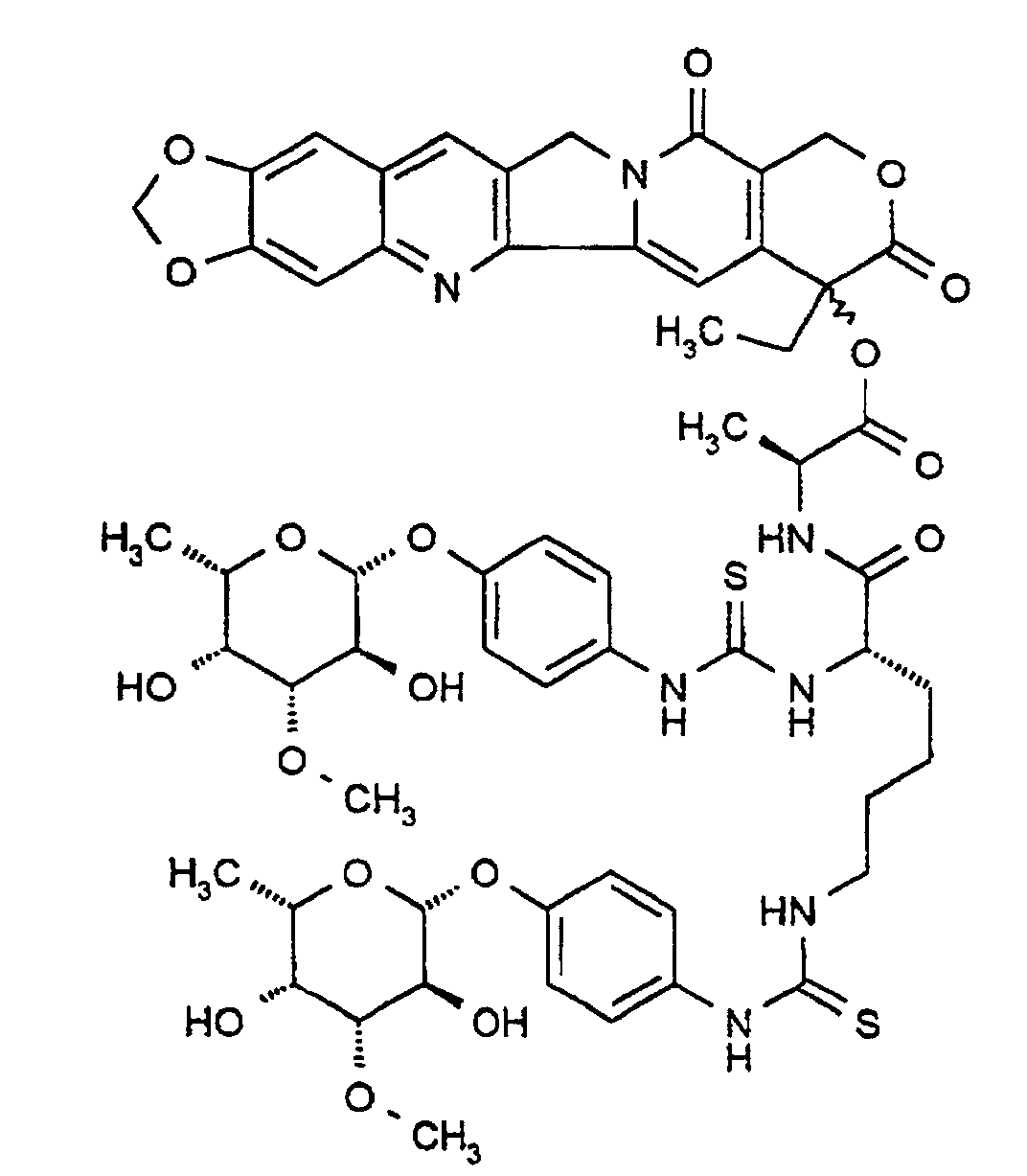
- NCEPSWRCFLEEOI-YSFZNNBQSA-N CC(C)C[C@@H](C(OC([C@@H]1C)[C@@]1(C(C=C1N2Cc3c(CN4CCN(C)CC4)c(cc4OCCOc4c4)c4nc13)=C(CO1)C2=O)C1=O)=O)NC([C@H](CCCCN)NC(Nc(cc1)ccc1O[C@H]([C@H]([C@@H]1OC)O)O[C@@H](C)[C@H]1O)=S)=O Chemical compound CC(C)C[C@@H](C(OC([C@@H]1C)[C@@]1(C(C=C1N2Cc3c(CN4CCN(C)CC4)c(cc4OCCOc4c4)c4nc13)=C(CO1)C2=O)C1=O)=O)NC([C@H](CCCCN)NC(Nc(cc1)ccc1O[C@H]([C@H]([C@@H]1OC)O)O[C@@H](C)[C@H]1O)=S)=O NCEPSWRCFLEEOI-YSFZNNBQSA-N 0.000 description 1
Classifications
-
- C—CHEMISTRY; METALLURGY
- C07—ORGANIC CHEMISTRY
- C07D—HETEROCYCLIC COMPOUNDS
- C07D491/00—Heterocyclic compounds containing in the condensed ring system both one or more rings having oxygen atoms as the only ring hetero atoms and one or more rings having nitrogen atoms as the only ring hetero atoms, not provided for by groups C07D451/00 - C07D459/00, C07D463/00, C07D477/00 or C07D489/00
- C07D491/22—Heterocyclic compounds containing in the condensed ring system both one or more rings having oxygen atoms as the only ring hetero atoms and one or more rings having nitrogen atoms as the only ring hetero atoms, not provided for by groups C07D451/00 - C07D459/00, C07D463/00, C07D477/00 or C07D489/00 in which the condensed system contains four or more hetero rings
-
- A—HUMAN NECESSITIES
- A61—MEDICAL OR VETERINARY SCIENCE; HYGIENE
- A61K—PREPARATIONS FOR MEDICAL, DENTAL OR TOILETRY PURPOSES
- A61K47/00—Medicinal preparations characterised by the non-active ingredients used, e.g. carriers or inert additives; Targeting or modifying agents chemically bound to the active ingredient
- A61K47/50—Medicinal preparations characterised by the non-active ingredients used, e.g. carriers or inert additives; Targeting or modifying agents chemically bound to the active ingredient the non-active ingredient being chemically bound to the active ingredient, e.g. polymer-drug conjugates
- A61K47/51—Medicinal preparations characterised by the non-active ingredients used, e.g. carriers or inert additives; Targeting or modifying agents chemically bound to the active ingredient the non-active ingredient being chemically bound to the active ingredient, e.g. polymer-drug conjugates the non-active ingredient being a modifying agent
- A61K47/54—Medicinal preparations characterised by the non-active ingredients used, e.g. carriers or inert additives; Targeting or modifying agents chemically bound to the active ingredient the non-active ingredient being chemically bound to the active ingredient, e.g. polymer-drug conjugates the non-active ingredient being a modifying agent the modifying agent being an organic compound
- A61K47/549—Sugars, nucleosides, nucleotides or nucleic acids
-
- A—HUMAN NECESSITIES
- A61—MEDICAL OR VETERINARY SCIENCE; HYGIENE
- A61P—SPECIFIC THERAPEUTIC ACTIVITY OF CHEMICAL COMPOUNDS OR MEDICINAL PREPARATIONS
- A61P35/00—Antineoplastic agents
-
- C—CHEMISTRY; METALLURGY
- C07—ORGANIC CHEMISTRY
- C07H—SUGARS; DERIVATIVES THEREOF; NUCLEOSIDES; NUCLEOTIDES; NUCLEIC ACIDS
- C07H15/00—Compounds containing hydrocarbon or substituted hydrocarbon radicals directly attached to hetero atoms of saccharide radicals
- C07H15/20—Carbocyclic rings
-
- C—CHEMISTRY; METALLURGY
- C07—ORGANIC CHEMISTRY
- C07H—SUGARS; DERIVATIVES THEREOF; NUCLEOSIDES; NUCLEOTIDES; NUCLEIC ACIDS
- C07H15/00—Compounds containing hydrocarbon or substituted hydrocarbon radicals directly attached to hetero atoms of saccharide radicals
- C07H15/26—Acyclic or carbocyclic radicals, substituted by hetero rings
-
- C—CHEMISTRY; METALLURGY
- C07—ORGANIC CHEMISTRY
- C07K—PEPTIDES
- C07K5/00—Peptides containing up to four amino acids in a fully defined sequence; Derivatives thereof
- C07K5/04—Peptides containing up to four amino acids in a fully defined sequence; Derivatives thereof containing only normal peptide links
- C07K5/06—Dipeptides
- C07K5/06086—Dipeptides with the first amino acid being basic
-
- C—CHEMISTRY; METALLURGY
- C07—ORGANIC CHEMISTRY
- C07K—PEPTIDES
- C07K5/00—Peptides containing up to four amino acids in a fully defined sequence; Derivatives thereof
- C07K5/04—Peptides containing up to four amino acids in a fully defined sequence; Derivatives thereof containing only normal peptide links
- C07K5/06—Dipeptides
- C07K5/06139—Dipeptides with the first amino acid being heterocyclic
-
- A—HUMAN NECESSITIES
- A61—MEDICAL OR VETERINARY SCIENCE; HYGIENE
- A61K—PREPARATIONS FOR MEDICAL, DENTAL OR TOILETRY PURPOSES
- A61K38/00—Medicinal preparations containing peptides
Definitions
- the present invention relates to glycoconjugates of camptothecin derivatives, in which have at least one carbohydrate component via suitable spacers and Spacers linked to the 20-hydroxyl group of a camptothecin derivative is.
- the invention further relates to methods for producing the invention Compounds and their use as medicines, especially in Cancer related.
- Salts from A-ring and B-ring modified were used to improve water solubility Camptothecin derivatives and 20-O-acyl derivatives with ionizable Groups described (Vishnuvajjala et al. US 4943579).
- the latter The prodrug concept was later also modified on camptothecin derivatives transferred (Wani et al. WO 9602546)
- the 20-O-acyl prodrugs described have a very short half-life in vivo and become very fast split to the main body.
- EP-A-0 640 622 in general discloses polysaccharide derivatives of active substances and the increased tumor selectivity of these compounds. Camptothecin is described in EP-A-0 640 622 possible active ingredient not mentioned at any point.
- DE-A-42 36 237 contains no example of a corresponding one Campthotecin compound.
- alkyl groups is intended within the meaning of the invention straight-chain, branched, cyclic and cycloalkyl radicals containing Include alkyl radicals. This definition should also apply to everyone else Residues containing alkyl groups apply, such as, for example, alkoxy, acyl, etc.
- arylmethyl and hetarylmethyl given in the definition of R 6 can mean, for example, phenylmethyl or pyridylmethyl.
- the carbohydrate building blocks K 1 , K 2 , K 3 , K 4 , K 5 and / or K 6 each comprise a maximum of two monosaccharide building blocks.
- Sp 1 , Sp 2 , Sp 3 , Sp 4 , Sp 5 and / or Sp 6 can independently represent arylene with up to 10 carbon atoms, each with a group K 1 , K 2 , K 3 , K 4 , K 5 or K 6 and L 1 , L 2 , L 3 , L 4 , L 5 or L 6 is linked and optionally with one or more hydroxyl, carboxy, carboxyalkyl up to 4 carbon atoms, nitro, cyano, halogen, alkyl with up to 4 carbon atoms, haloalkyl with up to 4 carbon atoms or with alkoxy with up to 4 carbon atoms, and their isomers, isomer mixtures and salts.
- Sp 1 , Sp 2 , Sp 3 , Sp 4 , Sp 5 and / or Sp 6 are particularly preferred apart from K 1 , K 2 , K 3 , K 4 , K 5 or K 6 and L 1 , L 2 , L 3 , L 4 , L 5 or L 6 unsubstituted or optionally substituted by halogen, nitro, alkyl having up to 6 carbon atoms, alkoxy having up to 2 carbon atoms, -OCF 3 and / or CF 3 .
- Sp 1 , Sp 2 , Sp 3 , Sp 4 , Sp 5 and / or Sp 6 are very particularly preferred, each with a group of K 1 , K 2 , K 3 , K 4 , K 5 or K 6 and L 1 , L 2 , L 3 , L 4 , L 5 or L 6 linked and carry no further substituents.
- L 1 , L 2 , L 3 , L 4 , L 5 and L 6 are particularly preferably
- M 1 and M 2 can independently represent a peptide which links to L 1 , L 2 , L 3 , L 4 , L 5 and / or L 6 via an amino function is linked to Cp via an acyl function and its amino acid units can optionally carry protective groups.
- Mono-, di- and tripeptides are particularly preferred, in particular mono- and dipeptides.
- the amino acid units are preferably selected from the group glycyl, Alanyl, valyl, leucyl, lysyl, seryl, glutamyl, threonyl, asparagyl, isoleucyl, Diaminopropionyl, diaminobutyryl, arginyl, histidyl and / or ornithyl.
- amino acid building blocks glycyl, alanyl, valyl, leucyl, Lysyl, Seryl, Asparagyl, Histidyl and / or Glutamyl.
- the compounds according to the invention can be in stereoisomeric forms, for example as enantiomers or diastereomers, or as mixtures thereof, for example as a racemate.
- the invention relates to both the pure Stereoisomers as well as their mixtures
- Mixtures of stereoisomers can, if necessary, be introduced in a known manner into the stereoisomerically uniform constituents are separated, for example by Chromatography or by crystallization processes
- the stereochemistry at the anomeric center of the carbohydrate building blocks K 1 , K 2 , K 3 , K 4 , K 5 and / or K 6 can be ⁇ or ⁇ . Furthermore, they can be in the D or L form. The stereochemistry at the other centers can result in the gluco, manno, galacto, gulo, rhamno or fuco configuration.
- the amino acid building blocks can each be in the D or L form.
- the camptothecin building block Cp can be in the 20 (R) or in the 20 (S) configuration or as a mixture of these two steroisomeric forms.
- the inventive Compounds occur in rotationally isomeric forms or as a mixture thereof.
- the invention relates both to the pure rotational isomers and to their mixtures.
- Rotary isomer mixtures can, if necessary, by means of known methods are separated into the uniform components, for example by chromatography (e.g. HPLC) or by crystallization processes. This is possible on the final stage and possibly also on intermediate stages From the rotamer-pure intermediates, if necessary, by suitable Synthesis guide the rotamer pure amplifiers are produced.
- chromatography e.g. HPLC
- crystallization processes This is possible on the final stage and possibly also on intermediate stages From the rotamer-pure intermediates, if necessary, by suitable Synthesis guide the rotamer pure amplifiers are produced.
- camptothecin building block are:
- the compounds according to the invention can also be present in the form of their salts.
- salts with organic or inorganic bases or Acids and internal salts called.
- the acids that can be added preferably include hydrohalic acids, such as. hydrochloric acid and hydrobromic acid, in particular hydrochloric acid, also phosphoric acid, nitric acid, sulfuric acid, mono- and bifunctional carboxylic acids and hydroxycarboxylic acids, such as e.g. Acetic acid, trifluoroacetic acid, maleic acid, malonic acid, oxalic acid, gluconic acid, Succinic acid, fumaric acid, tartaric acid, citric acid, salicylic acid, sorbic acid and lactic acid as well as sulfonic acids, e.g. p-toluenesulfonic acid, 1,5-naphthalenedisulfonic acid or camphorsulfonic acid.
- hydrohalic acids such as. hydrochloric acid and hydrobromic acid, in particular hydrochloric acid, also phosphoric acid, nitric acid, sulfuric acid, mono- and bifunctional carboxylic acids and hydroxycarboxylic acids, such
- Physiologically acceptable salts can also be metal or ammonium salts of the compounds according to the invention which have a free carboxyl group.
- metal or ammonium salts of the compounds according to the invention which have a free carboxyl group.
- Sodium, potassium, magnesium or Calcium salts as well as ammonium salts, which are derived from ammonia or organic amines such as ethylamine, di- or triethylamine, di- or Triethanolamine, dicyclohexylamine, dimethylaminoethanol, arginine, lysine, Ethylenediamine or phenethylamine.
- glycoconjugates according to the invention can be produced, for example by linking modified camptothecin derivatives with activated ones Carboxyl components, which in turn are parts of protected amino acids, peptides or carbohydrate-modified peptides.
- the invention therefore further relates to a process for the preparation of compounds of the general formula (I), characterized in that compounds of the general formula (III) H B -Cp-H A wherein Cp has the meaning indicated above, and the hydrogen atom H A on the sits with # and H B in the with * designated position, if appropriate after replacing H B by a protective group, with the above-defined radical M 1 corresponding activated carboxyl component M 1 a, which optionally carries protective groups, is reacted in a suitable solvent, if appropriate in the presence of a base, by customary methods, if appropriate selectively removes one, more or all of the protective groups from M 1 by known methods and the product is reacted with compounds of the general formula (IV) K 1 -Sp 1 -L 1 a wherein K 1 and Sp 1 are as defined above and L 1 a stands for a reactive precursor of the group L 1 , where appropriate the protective groups are split off selectively and gradually different groups K 2 -Sp 2 -L 2 - and K 3
- the reactions can take place at different pressure and temperature conditions, for example 0.5 to 2 bar, or -30 to + 100 ° C, in suitable solvents such as dimethylformamide (DMF), tetrahydrofuran (THF), dichloromethane, chloroform, lower alcohols, acetonitrile, dioxane, water or in mixtures of mentioned solvents are carried out.
- suitable solvents such as dimethylformamide (DMF), tetrahydrofuran (THF), dichloromethane, chloroform, lower alcohols, acetonitrile, dioxane, water or in mixtures of mentioned solvents are carried out.
- suitable solvents such as dimethylformamide (DMF), tetrahydrofuran (THF), dichloromethane, chloroform, lower alcohols, acetonitrile, dioxane, water or in mixtures of mentioned solvents are carried out.
- DMF dimethylformamide
- THF tetrahydrofuran
- Adducts with carbodiimides e.g. N, N'-diethyl, N, N'-diisopropyl, N, N'-dicyclohexylcarbodiimide, N- (3-dimethylaminopropyl) -N'-ethyl-carbodiimide hydrochloride, N-cyclohexyl-N '- (2-morpholinoethyl) carbodiimide metho-p-toluenesulfonate, or Carbonyl compounds such as carbonyldiimidazole, or 1,2-oxazolium compounds such as 2-ethyl-5-phenyl-1,2-oxazolium-3-sulfate or 2-tert-butyl-5-methyl-isoxazolium perchlorate, or acylamino compounds such as 2-ethoxy-1-ethoxycarbonyl-1,2-dihydroquinoline, or
- Triethylamine, ethyldiisopropylamine, pyridine, N, N-dimethylaminopyridine or others can be used.
- protective groups for possible further reactive functions in the camptothecin part or for third-party functions of the amino acids can be used in peptide chemistry known protecting groups, for example from urethane, alkyl, acyl, ester or Amide type can be used.
- Amino protecting groups in the context of the invention are the usual ones in peptide chemistry amino protecting groups used.
- benzyloxycarbonyl 3,4-dimethoxybenzyloxycarbonyl, 3,5-dimethoxybenzyloxycarbonyl, 2,4-dimethoxybenzyloxycarbonyl, 4-methoxybenzyloxycarbonyl, 4-nitrobenzyloxycarbonyl, 2-nitrobenzyloxycarbonyl, 2-nitro-4,5-dimethoxybenzyloxycarbonyl, Methoxycarbonyl, ethoxycarbonyl, tert-butoxycarbonyl (Boc), allyloxycarbonyl, vinyloxycarbonyl, 3,4,5-trimethoxybenzyloxycarbonyl, Phthaloyl, 2,2,2-trichloroethoxycarbonyl, 2,2,2-trichloro-tert-butoxycarbonyl, Menthyloxycarbonyl, 4-nitrophenoxycarbonyl, fluorenyl-9-methoxycarbonyl (Fmoc), formyl, acetyl, propionyl, pival
- Preferred carboxyl protecting groups are linear or branched C 1 -C 4 alkyl esters.
- the modification of the camptothecin derivatives linked with a bridge group M 1 and / or M 2 with carbohydrate residues can be carried out using various methods and linker groups. For example, preference is given to converting p-amino-phenylglycosides to isothiocyanates and linking them, for example, to amino groups. Furthermore, carboxyalkyl or amino-alkyl glycosides can also be easily coupled with amino or carboxyl groups.
- Protective groups can be split off in appropriate reaction steps for example by exposure to acid or base, hydrogenolytically or on otherwise done reductively.
- the human colon cell lines SW 480 and HT 29 (ATCC No. CCL 228 and HBT-38) and the mouse melanoma cell line B16F10 were grown in Roux dishes in RPMI 1640 medium with the addition of 10% FCS. It was then trypsinized and taken up in RPMI plus 10% FCS to a cell number of 50,000 cells / ml. 100 ⁇ l of cell suspension / well were placed in a 96 microwave plate and incubated for 1 day at 37 ° C. in a CO 2 incubator. Then a further 100 ⁇ l RPMI medium and 1 ⁇ l DMSO with the test substances were added. The growth was checked after day 3 and day 6.
- MTT solution (3- (4,5-dimethylthiazol-2-yl) -2,5-diphenyltetrazoline bromide) with an initial concentration of 5 mg / ml H 2 O was added to each microwave. It was incubated for 5 hours in a CO 2 incubator at 37 ° C. The medium was then suctioned off and 100 ⁇ l of i-propanol / well were added. After shaking with 100 ⁇ l H 2 O for 30 min, the absorbance at 540 nm was measured with a Titertek Multiskan MCC / 340 (Flow).
- the cytotoxic effect is given in Table 1 as an IC 50 value for the SW 480 and HT 29 and B16F10 cell lines: example IC 50 / nM SW 480 IC 50 / nM HT 29 IC 50 / nM B16F10 1.1 15 10 30th 1.5 100 60 300 2.1 7 5 15 2.3 6 3rd 9 2.4 5 3rd 10 3.1 10 8th 150 4.1 40 40 300 5.1 70 40 200 6.1 150 200 3000
- Bone marrow cells were rinsed from the femur of the mouse 10 5 cells were in McCoy 5A medium (0.3% agar) together with recombinant murine GM-CSF (Genzyme; stem cell colonization) and the substances (10 -4 to 100 ⁇ g / ml) incubated at 37 ° C and 7% CO 2 . Seven days later, the colonies ( ⁇ 50 cells) and clusters (17-50 cells) were counted.
- the examined glycoconjugates show a drastically reduced inhibition of the bone marrow stem cell proliferation compared to the underlying active ingredient.
- Inhibition of CSF-induced proliferation of mouse bone marrow stem cells example IC 50 [ ⁇ g / ml] 7-ethyl camptothecin 2 x 10 -6 1.1 2 x 10 -3 9-amino-camptothecin 1 x 10 -3 3.1 2 x 10 -2
- NMRI nu / nu strain For all in vivo experiments to investigate the inhibition of tumor growth athymic nude mice (NMRI nu / nu strain) were used.
- the selected large cell lung carcinoma LXFL 529 was developed by serial passage in nude mice.
- the human origin the tumor was diagnosed by isoerizymatic and immunohistochemical Methods proven.
- the tumor was subcutaneously in both flanks from 6 to 8 weeks old implanted nu / nu nude mice. Treatment became dependent on that Doubling time started as soon as the tumors had a diameter of Had reached 5-7 mm.
- the mice were the treatment group and the Control group (5 mice per group with 8-10 evaluable tumors) allocated by randomization. The individual tumors of the control group all grew progressively.
- the size of the tumors was measured in two dimensions using a slide gauge.
- the tumor volume which correlates well with the cell number, was then used for all evaluations.
- the volume was calculated according to the formula "length x width x width / 2" ([axb 2 ] / 2, a and b stand for two diameters arranged at right angles).
- the relative tumor volume (RTV) values were for each individual Tumor by dividing the tumor size on day X by the tumor size of day 0 (at the time of randomization). The middle ones RTV values were then used for further evaluation.
- the compounds were applied on days 1, 2 and 3 after Randomization intraperitoneally (i.p).
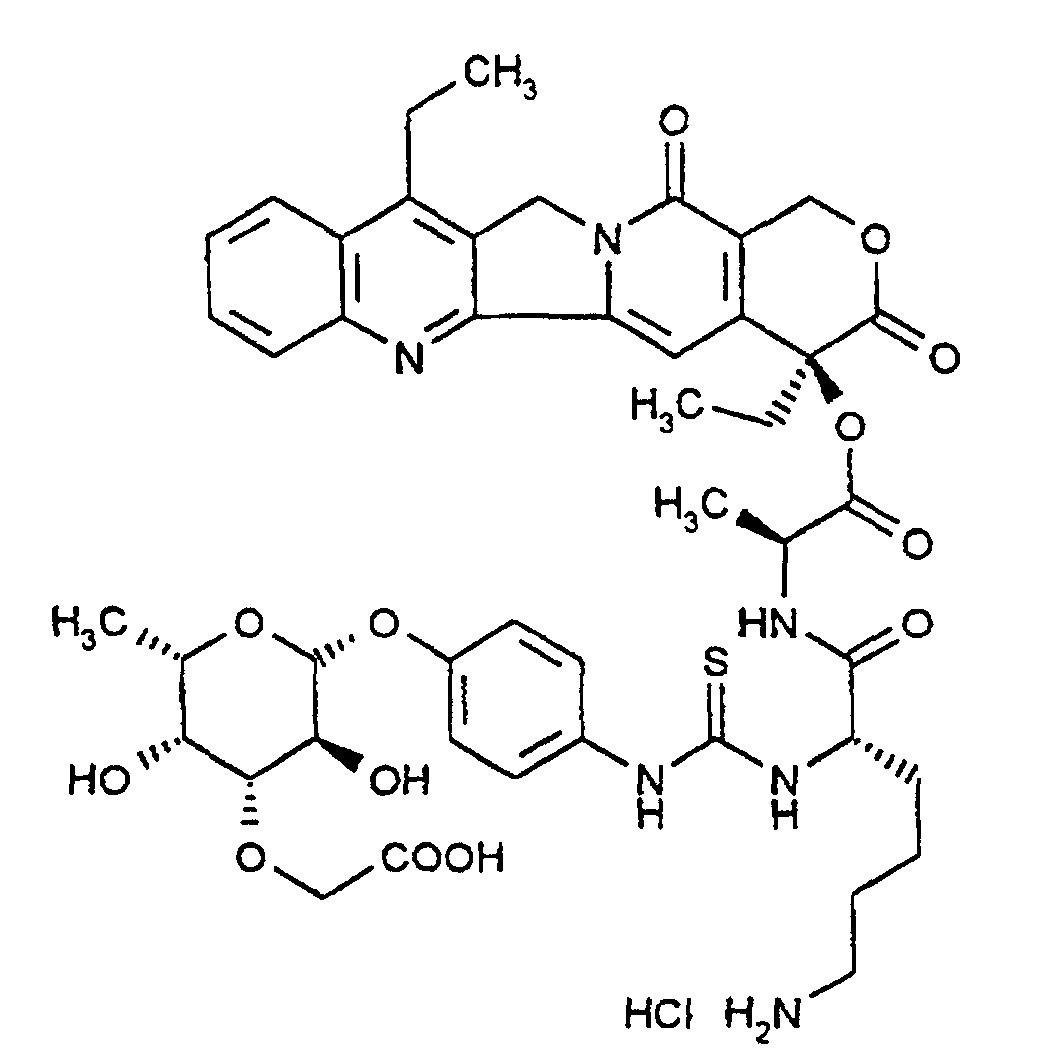
- the therapeutic efficacy of the glycoconjugates according to the invention against the large-cell human lung tumor xenograph LXFL 529 is shown on the basis of the compound from Example 1.1.
- Therapy leads to significant tumor remission at the maximum tolerable dose (MTD) and 1/2 MTD.
- therapy Dose [mg / kg / day] Survival time [days] Number of tumors relative tumor volume on day 14 [% of day 0] Relative body weight on day 7 [% of day 0] Control group - > 21 > 21 692 102 > 21 > 21 > 21 1.1 12.5 (MTD) > 21 > 21 9 0.1 95 > 21 > 21 > 21 1.1 6.25 > 21 > 21 8th 32 98 > 21 > 21 13
- the compounds of the invention exhibit both in vitro and in vivo a surprisingly strong antitumor activity against various Tumors, especially those of the lungs and colon, associated with a great selectivity towards non-malignant cells.
- the present invention includes pharmaceutical preparations which, in addition to non-toxic, inert pharmaceutically acceptable excipients one or more Contain compounds of the invention or those of one or more Active substances according to the invention exist, and methods for producing them Preparations.
- the active ingredient (s) may optionally be present in one or more of the above specified carrier substances are also present in microencapsulated form.
- the therapeutically active compounds are listed in the above pharmaceutical preparations preferably in a concentration of about 0.1 to 99.5, preferably from about 0.5 to 95% by weight of the total mixture is present his.
- a single dose contains the or the active compounds according to the invention preferably in amounts of about 1 to about 80, especially 3 to 30 mg / kg body weight
- the glycoconjugate is prepared analogously to Example 1.1 from 361.7 mg (0.45 mmol) Peptide conjugate 1.1.d and 313.3 mg (1.0 mmol) of p-aminophenyl-3-O-carboxymethyl- ⁇ -L-fucopyranoside (Example 1.2).
- Example 1.1.b The conjugate from Example 1.1.b is prepared in analogy to the instructions from Example 1.1.c. linked with N ⁇ - (tert-butoxycarbonyl) -N ⁇ - (fluorenyl-9-methoxycarbonyl) -lysine and then with the ⁇ -amino function according to Example I.1.d. unblocked.
- Example 1.3.a The compound from Example 1.3.a is analogous to Example 1.1 with 1.2 equivalents the carbohydrate derivative from Example I.2 implemented.
- the conjugate 1.3.b is deblocked with piperidine in DMF. After 30min. you narrow and digest the residue twice with dichloromethane. Then in DMF taken up and precipitated with methanol / ether. The product is suctioned off with Washed ether and then lyophilized from dioxane / water. Then takes one in water, mixed with 1 equivalent of a 0.01N HCl solution and lyophilized again.
- connection is established analogously to 1.3.
- the conjugate 1.5.e is deblocked with piperidine in DMF. After 3 hours, concentrate and precipitates the residue twice from dichloromethane / methanol 1: 1 with diethyl ether around. Then it is taken up in water, mixed with 1 equivalent of one 0.01N HCl solution and lyophilized.
- camptothecin derivative is according to Wall et al. (J.Med.Chem., 29 (1986), 2358) from the racemic tricyclic.
- glycoconjugate is used in analogy to the provisions of 1.1.c, 1.1.d and 1.1 prepared from the alanyl conjugate in Example 2.1.b.
- camptothecin derivative is according to Wall et al. (J Med. Chem., 29 (1986), 2358) from the S-configured, enantiomerically pure tricyclic compound, which is characterized by Racemate resolution can be obtained
- Example 2.3.a The conjugate from Example 2.3.a is prepared in analogy to the instructions from Example 1.1.c. linked with N ⁇ - (tert-butoxycarbonyl) -N ⁇ - (fluorenyl-9-methoxycarbonyl) -lysine and then unblocked at the ⁇ -amino function by the action of trifluoroacetic acid. Education: 52% over 2 levels.
- Example 2.3.b The compound from Example 2.3.b is reacted in analogy to Example 1.1 with 1.2 equivalents of the carbohydrate derivative from Example 1.2.
- Example 2.4.a The conjugate from Example 2.4.a is linked in analogy to the instructions of Example 1.1.c with N ⁇ - (tert-butoxycarbonyl) -N ⁇ - (fluorenyl-9-methoxycarbonyl) -lysine and then at the ⁇ -amino function by the action of Trifluoroacetic acid deblocated. Education: 69% over 2 levels.
- Example 2.4.b The compound from Example 2.4.b is reacted in analogy to Example 1.1 with 1.2 equivalents of the carbohydrate derivative from Example I.1.
- the conjugate is prepared from Example 4.1.b in analogy to Examples 1.1.c, 1.1.d and 1.1, but at all stages with twice the amount of the respective reactants.
- Example 5.1.b The conjugate from Example 5.1.b is linked in analogy to the instructions of Example 1.1.c with N ⁇ - (tert-butoxycarbonyl) -N ⁇ - (fluorenyl) -9-methoxycarbonyl) -lysine and then by action on the ⁇ -amino function unblocked by trifluoroacetic acid.
- the Boc-protected intermediate stage is purified by flash chromatography [dichloromethane / methanol 10: 1] yield: 53% over two stages.
- [DC. Acetonitrile / water / glacial acetic acid 5: 1: 0.2 R f 0.13]
- Example 5.1.c The compound from Example 5.1.c is reacted analogously to Example 1.1 with 1.2 equivalent of the carbohydrate derivative from Example I.1.
- the compound is prepared from 392.4 mg (1.0 mmol) of 20 (S) -7-ethyl-10-hydroxy-camptothecin (S. Sawada et al., Chem. Pharm. Bull 39 (1991) 3183-3188) and a total of 2.43 g (10.0 mmol) of N- (tert-butoxycarbonyl) -valine-N-carboxylic acid hydride within 6 days.
- the conjugate 6.1.e is deblocked with piperidine in DMF. After 2 hours, concentrate and precipitates the residue twice from dichloromethane / methanol 1: 1 with diethyl ether around. Then it is taken up in water, mixed with 1 equivalent of one 0.01N HCl solution and lyophilized.
Landscapes
- Chemical & Material Sciences (AREA)
- Organic Chemistry (AREA)
- Health & Medical Sciences (AREA)
- Life Sciences & Earth Sciences (AREA)
- General Health & Medical Sciences (AREA)
- Molecular Biology (AREA)
- Biochemistry (AREA)
- Genetics & Genomics (AREA)
- Medicinal Chemistry (AREA)
- Engineering & Computer Science (AREA)
- Biotechnology (AREA)
- Biophysics (AREA)
- Proteomics, Peptides & Aminoacids (AREA)
- Pharmacology & Pharmacy (AREA)
- Animal Behavior & Ethology (AREA)
- Public Health (AREA)
- Veterinary Medicine (AREA)
- Bioinformatics & Cheminformatics (AREA)
- Epidemiology (AREA)
- General Chemical & Material Sciences (AREA)
- Chemical Kinetics & Catalysis (AREA)
- Nuclear Medicine, Radiotherapy & Molecular Imaging (AREA)
- Pharmaceuticals Containing Other Organic And Inorganic Compounds (AREA)
- Nitrogen Condensed Heterocyclic Rings (AREA)
- Medicines That Contain Protein Lipid Enzymes And Other Medicines (AREA)
- Peptides Or Proteins (AREA)
- Steroid Compounds (AREA)
- Saccharide Compounds (AREA)
Description

- Durch die esterartige Anknüpfung der Carrier-Reste an die 20-Hydroxylgruppe wird der für die Wirkung wichtige Lactonring der Camptothecin-Derivate stabilisiert.
- Die so erhaltenen Konjugate zeigen in-vitro eine hohe Aktivität gegenüber Tumorzellinien und Tumorxenografts.
- Sie weisen gegenüber den zugrundeliegenden Toxophoren eine deutlich höhere Verträglichkeit und Tumorselektivität sowie eine verbesserte Löslichkeit, insbesondere in wäßrigen Medien auf.
- In-vivo zeigen sie exzellente therapeutische Wirksamkeit über mehrere Dosisstufen
- Sie sind in extrazellularem Medium und in Blut wesentlich stabiler als die zuvor beschriebenen 20-O-Acyl-Prodrugs von Camptothecin.
- Cp
- für eine Gruppe der Formeln
worin

- R1, R2, R3 und R4
- unabhängig voneinander Wasserstoff, Alkyl mit bis zu 3 Kohlenstoffatomen, Halogen, Amino, Hydroxy oder Nitro bedeuten können oder
- R2 und R3
- zusammen eine Gruppe der Formel
bedeuten, wobei
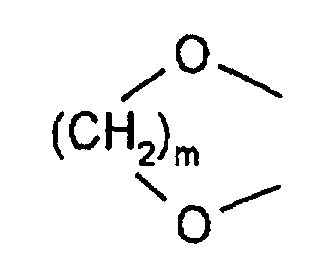
- m
- die Werte 1 oder 2 annehmen kann, und
- R5
- für H, -CH2CH3, -CH2-O-*, -CH2-NH*,
steht,

oder für -CH2-N(CH2CH3)R6 odersteht,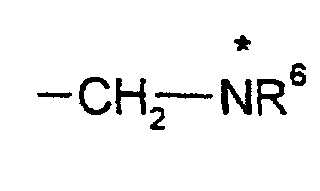
worin R6 Arylmethyl oder Hetarylmethyl bedeutet,worin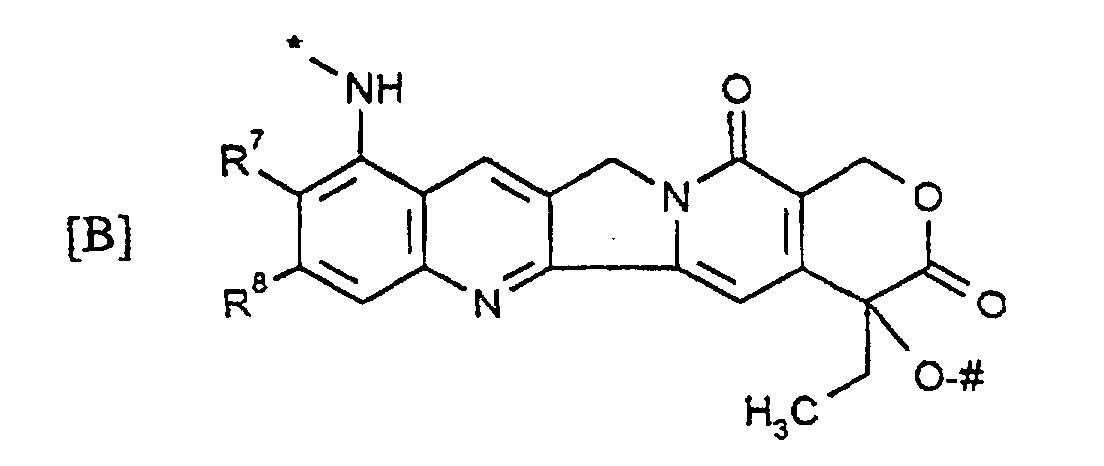
- R7 und R8 wie R2 und R3
- definiert sind und mit diesen gleich oder
verschieden sein können,
worin
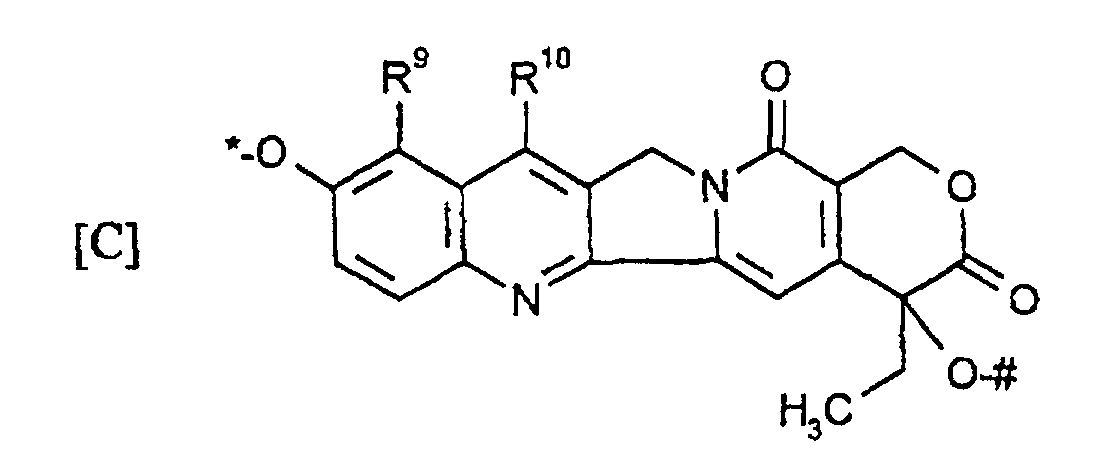
- R9
- für Wasserstoff oder -CH2-N(CH3)2 steht und
- R10
- für Wasserstoff oder Ethyl steht,
oderworin
- R11 und R12 wie R2 und R3
- definiert sind und mit diesen gleich
oder verschieden sein können,
oderworin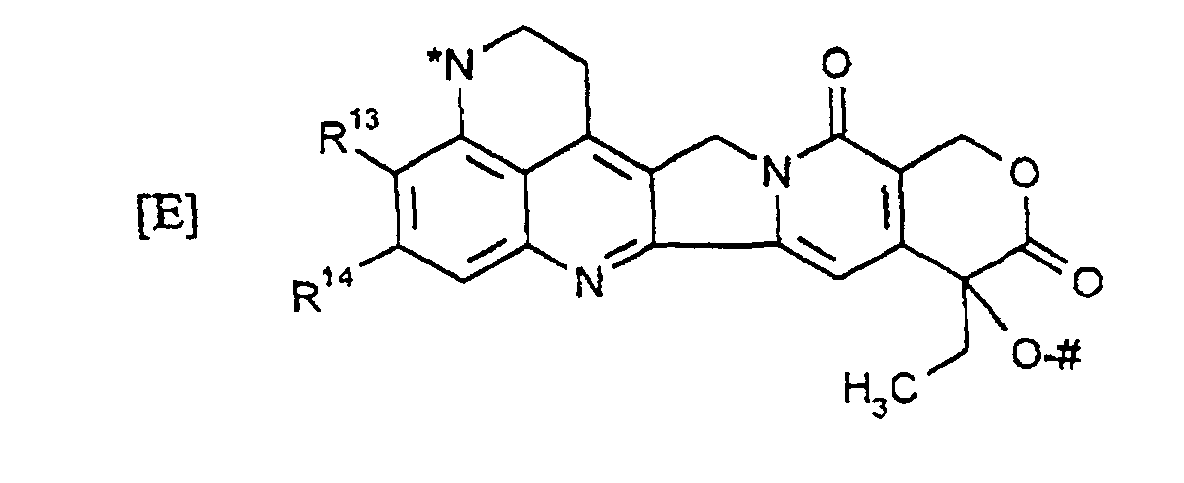
- R13 und R14 wie R2 und R3
- definiert sind und mit diesen gleich oder verschieden sein können,
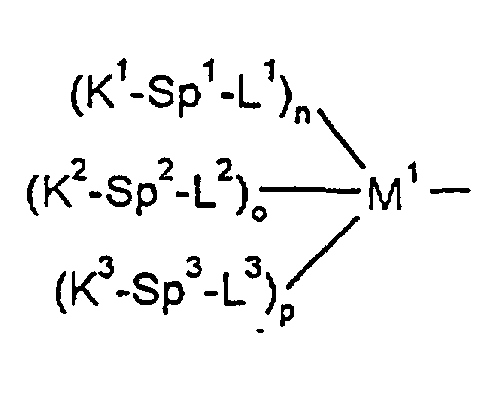
- A
- einen Rest der Formel
bedeutet, wobei gilt 1 ≤ (n + o + p) ≤ 3,

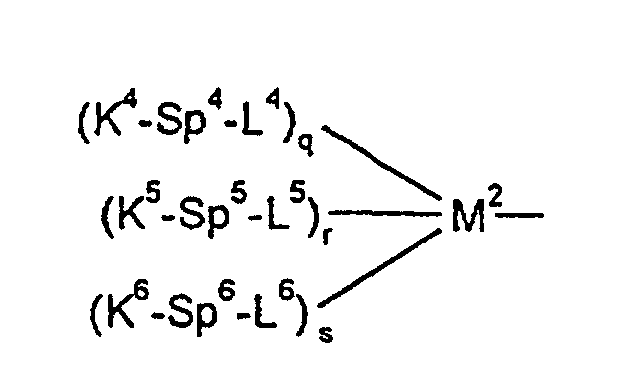
- B
- Wasserstoff oder einen Rest der Formel
bedeutet, wobei gilt 0 ≤ (q + r + s) ≤ 3, worin
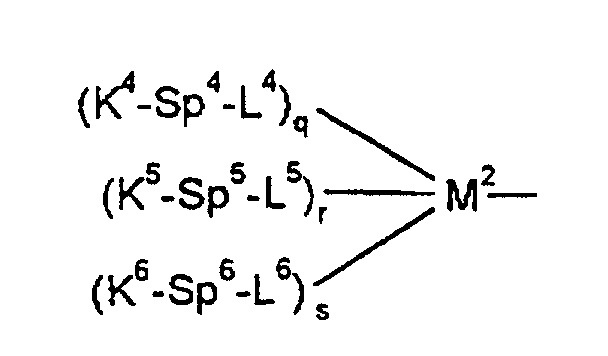
- M1 und M2
- unabhängig voneinander für eine Brücken-Gruppierung stehen, deren Hauptkette bis zu 21 Atome in linearer Abfolge umfaßt,
- L1, L2, L3, L4, L5 und L6
- unabhängig voneinander für Linker-Gruppierungen stehen, wie sie in der Glycokonjugatchemie gängigerweise eingesetzt werden (siehe Übersichtsartikel Lee Y.C. und Lee R. in Lectins and Cancer 1991, 53-69, ed. by Gabius HJ and Gabius S., Springer-Verlag),
- Sp1, Sp2, Sp3, Sp4, Sp5 und Sp6
- unabhängig voneinander für Arylen mit bis zu 10 Kohlenstoffatomen oder für Alkylen mit bis zu 8 Kohlenstoffatomen stehen, die jeweils gegebenenfalls substituiert sind, und
- K1, K2, K3, K4, K5 und K6
- unabhangig voneinander für einen Rest der
Formel (II)
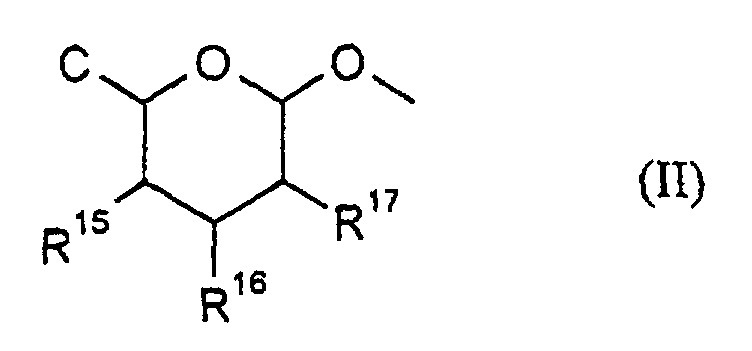
- C
- Methyl, Hydroxymethyl, Alkoxymethyl mit bis zu 6 Kohlenstoffatomen, Acyloxymethyl mit bis zu 6 Kohlenstoffatomen oder einen Rest der Formel -CH2-D bedeutet, worin
- D
- für einen Rest der Formel (II) steht,
- R15, R16 und R17
- unabhängig voneinander Wasserstoff, Hydroxy,
gegebenenfalls durch Hydroxyl substituiertes Alkoxy mit bis
zu 6 Kohlenstoffatomen, gegebenenfalls durch Alkyl oder
Acyl mit bis zu 6 Kohlenstoffatomen substituiertes Amino,
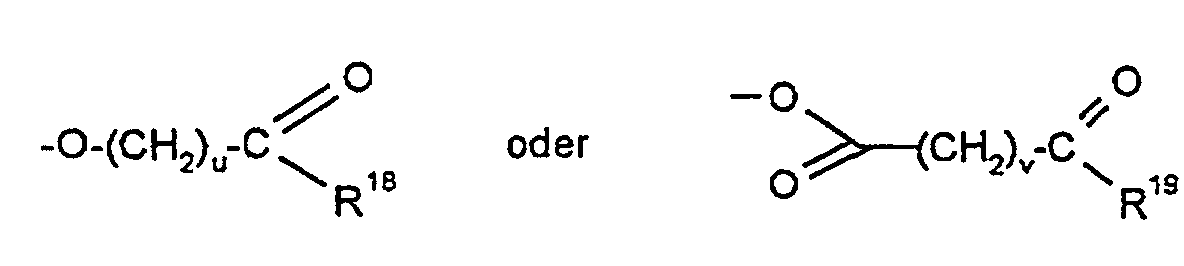
Halogen, Sulfat oder eine Gruppe der Formeln
bedeuten, worin

- R18 und R19
- unabhängig voneinander für Hydroxyl oder Alkoxy mit bis zu 6 Kohlenstoffatomen stehen oder für Amino, das gegebenenfalls durch Alkyl mit bis zu 6 Kohlenstoffatomen substituiert ist, stehen und
- u und v
- unabhängig voneinander die Werte 0, 1, 2, 3 oder 4,
insbesondere die Werte 1, 2, 3 oder 4, annehmen
können
oder - R15, R16 und R17
- unabhängig voneinander für einen Rest der Formel (II) stehen
zwei der Reste R15, R16, R17 zusammen für eine Epoxygruppe stehen,
sowie deren Isomere, Isomerengemische und Salze
mit der Maßgabe, dass R1, R2, R3, R4 und R5 nicht gleichzeitig Wasserstoff sein können.
- c
- Methyl, Hydroxymethyl, Methoxymethyl oder Acetoxymethyl bedeutet,
- R15
- Wasserstoff, Hydroxyl, Methoxy oder eine Gruppe der Formeln
bedeutet, worin

- u und v
- unabhängig voneinander die Werte 1 oder 2 annehmen können und
- R18 und R19
- unabhängig voneinander für Hydroxyl oder Alkoxy mit bis zu 4 Kohlenstoffatomen stehen,
- R15
- für einen Rest der Formel (II) steht,
- R16
- Wasserstoff, Hydroxyl, Halogen, Alkoxy mit bis zu 4 Kohlenstoffatomen,
Sulfat oder eine Gruppe der Formeln
bedeutet, worin

- u und v
- unabhängig voneinander die Werte 1 oder 2 annehmen können und
- R18 und R19
- unabhängig voneinander für Hydroxy oder Alkoxy mit bis zu 4 Kohlenstoffatomen stehen oder für Amino, das gegebenenfalls durch Alkyl mit bis zu 4 Kohlenstoffatomen substituiert ist, stehen,
- R17
- Hydroxyl, Alkoxy mit bis zu 4 Kohlenstoffatomen, das gegebenenfalls
durch Hydroxy substituiert ist, gegebenenfalls durch Alkyl oder Acyl mit
bis zu 4 Kohlenstoffatomen substituiertes Amino, oder eine Gruppe der
Formeln

- u und v
- unabhängig voneinander die Werte 1 oder 2 annehmen können und
- R18 und R19
- unabhängig voneinander für Hydroxyl oder Alkoxy mit bis zu 4 Kohlenstoffatomen stehen,
- R15 und R16
- gemeinsam für eine Epoxygruppe stehen,
- C
- Methyl, Hydroxymethyl, Methoxymethyl oder Acetoxymethyl bedeutet
- R15 und R17
- jeweils ein Hydroxylgruppe bedeuten und
- R16
- Wasserstoff, Hydroxyl, Halogen, Alkoxy mit bis zu 4 Kohlenstoffatomen,
Sulfat oder eine Gruppe der Formeln
bedeutet, worin

- u und v
- unabhangig voneinander die Werte 1 oder 2 annehmen können und
- R18 und R19
- unabhängig voneinander für Hydroxy oder Alkoxy mit bis zu 4 Kohlenstoffatomen stehen oder für Amino, das gegebenenfalls durch Alkyl mit bis zu 4 Kohlenstoffatomen substituiert ist, stehen.
worin


R20 für Chlor oder für Hydroxyalkylamino mit bis zu 6 Kohlenstoffatomen steht.




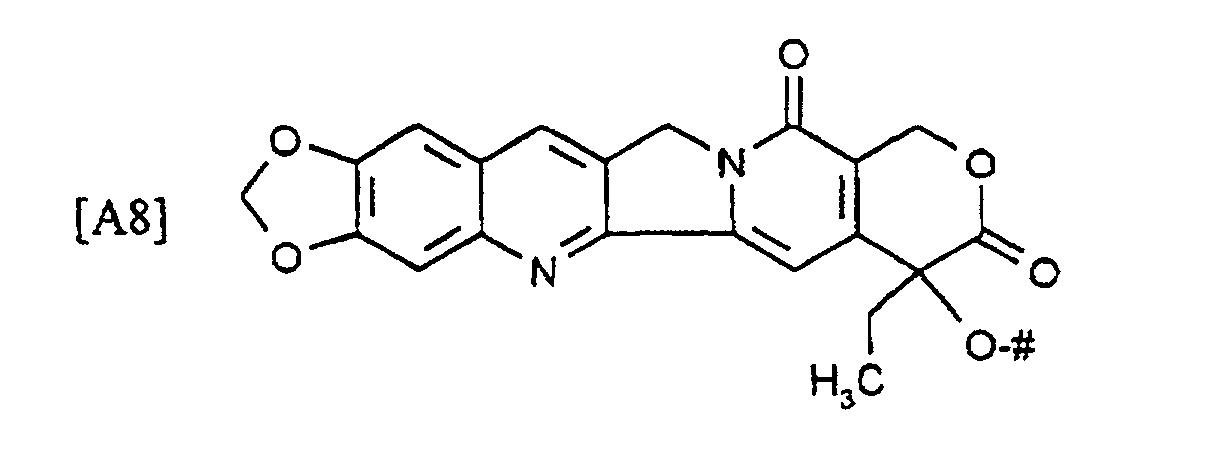


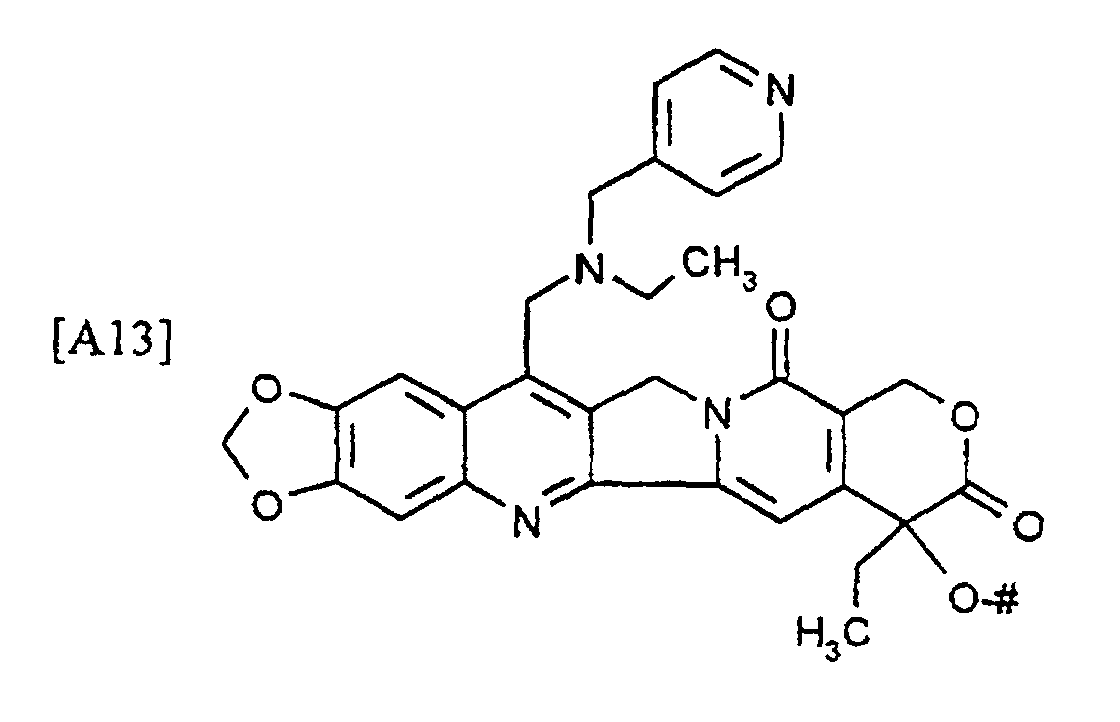

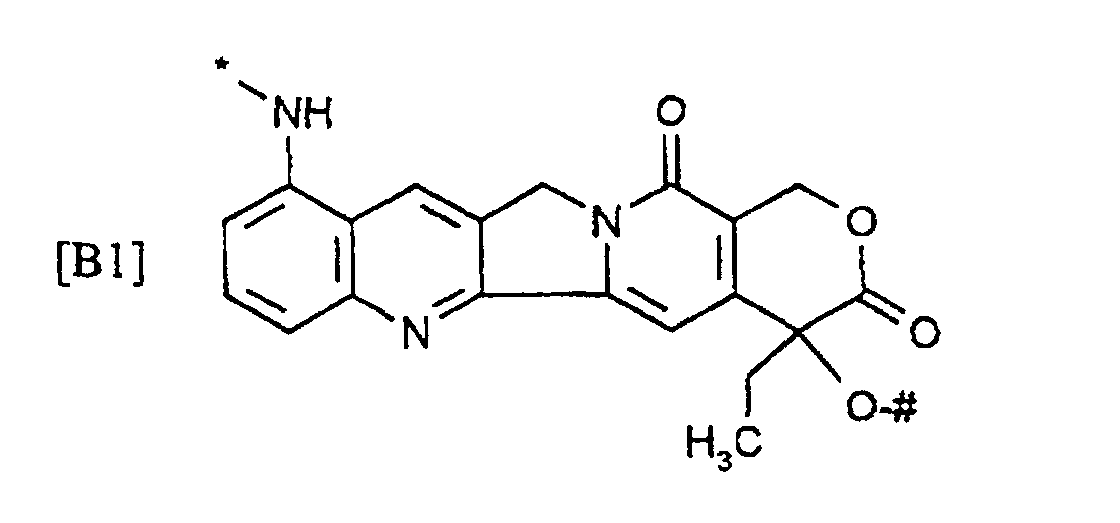
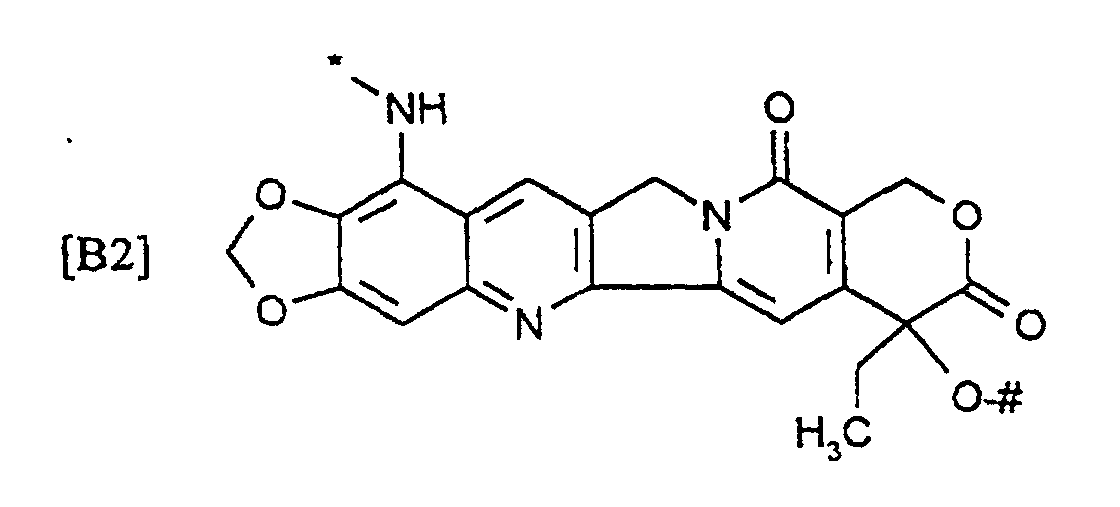


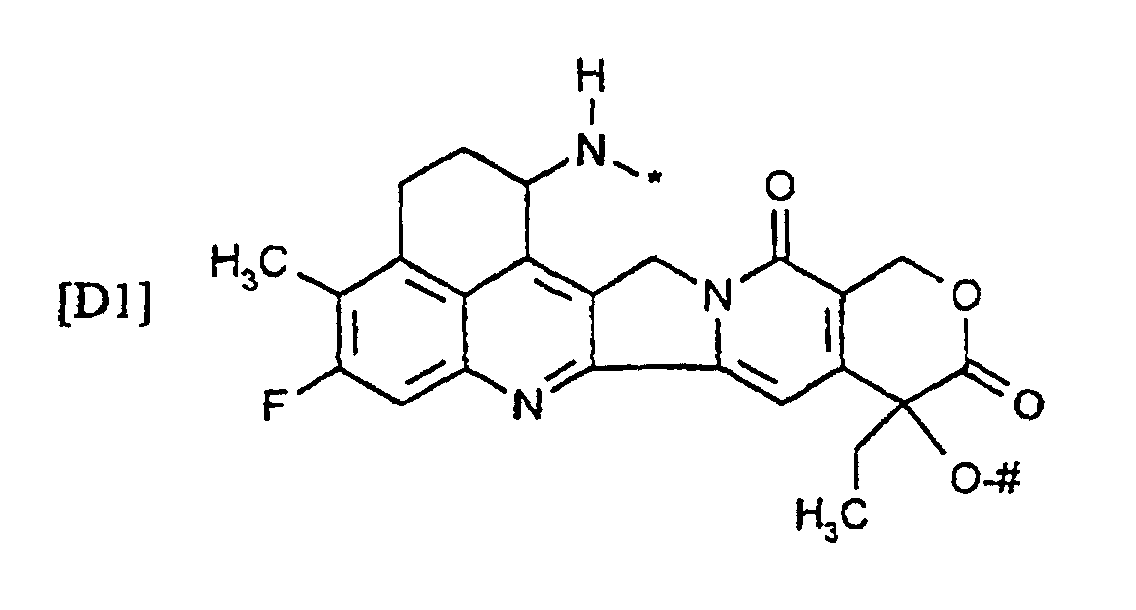
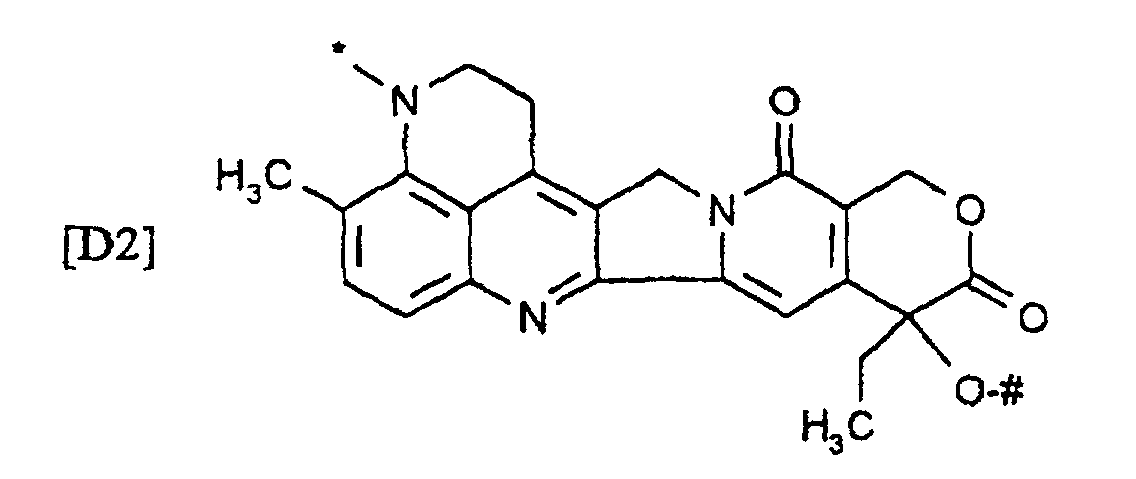
oder daß man, falls M1 und/oder M2 ein Peptid bedeuten, in vergleichbarer Weise nach üblichen Methoden einen ersten Aminosäurerest in Form der entsprechenden gegebenenfalls Schutzgruppen tragenden Carboxylkomponente einführt, gegebenenfalls Schutzgruppen abspaltet, weiterhin gegebenenfalls Schutzgruppen tragende Aminosäurereste anknüpft, gegebenenfalls erneut Schutzgruppen abspaltet wie oben angegeben Reste der Formeln K1-Sp1-L1-, K2-Sp2-L2-, K3-Sp3-L3-, K4-Sp4-L4-, K5-Sp5-L5- und/oder K6-Sp6-L6- einführt und falls erforderlich Schutzgruppen abspaltet.
| Beispiel | IC50 / nM SW 480 | IC50 / nM HT 29 | IC50 / nM B16F10 |
| 1.1 | 15 | 10 | 30 |
| 1.5 | 100 | 60 | 300 |
| 2.1 | 7 | 5 | 15 |
| 2.3 | 6 | 3 | 9 |
| 2.4 | 5 | 3 | 10 |
| 3.1 | 10 | 8 | 150 |
| 4.1 | 40 | 40 | 300 |
| 5.1 | 70 | 40 | 200 |
| 6.1 | 150 | 200 | 3000 |
| Hemmung der CSF-induzierten Proliferation von Knochenmarkstammzellen der Maus | |
| Beispiel | IC50 [µg/ml] |
| 7-Ethyl-Camptothecin | 2 x 10⁻⁶ |
| 1.1 | 2 x 10⁻³ |
| 9-Amino-Camptothecin | 1 x 10⁻³ |
| 3.1 | 2 x 10⁻² |
| Therapie | Dosis [mg/kg/ Tag] | Überlebenszeit [Tage] | Zahl der Tumoren | relatives Tumorvolumen an Tag 14 [% des Tages 0] | relatives Körpergewicht an Tag 7 [% des Tages 0] | |
| Kontrollgruppe | - | >21 | >21 | 692 | 102 | |
| >21 | >21 | |||||
| >21 | ||||||
| 1.1 | 12,5 (MTD) | >21 | >21 | 9 | 0,1 | 95 |
| >21 | >21 | |||||
| >21 | ||||||
| 1.1 | 6,25 | >21 | >21 | 8 | 32 | 98 |
| >21 | >21 | |||||
| 13 |



Ausb.: 97 % [FAB-MS: m/z = 464 = M+H]

Ausb.: 88 % [DC: Dichlormethan/Methanol/Ammoniak 17 %ig 15.4:0,5 Rf = 0,27]

Ausb.: 95 % [DC. Acetonitril/Wasser 20:1 Rf = 0,48].


Claims (10)
- Verbindungen der allgemeinen Formel (I)
- Cp
- für eine Gruppe der Formeln
worin

- R1, R2, R3 und R4
- unabhängig voneinander Wasserstoff, Alkyl mit bis zu 3 Kohlenstoffatomen, Halogen, Amino, Hydroxy oder Nitro bedeuten können oder
- R2 und R3
- zusammen eine Gruppe der Formel
bedeuten, wobei
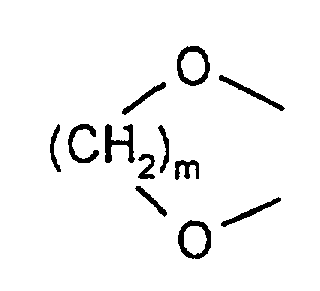
- m
- die Werte 1 oder 2 annehmen kann, und
- R5
- für H, -CH2CH3, -CH2-O-*, -CH2-NH*,
steht,

oder für -CH2-N(CH2CH3)R6 odersteht,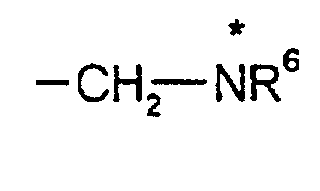
worin R6 Arylmethyl oder Hetarylmethyl bedeutet,worin
- R7 und R8 wie R2 und R3
- definiert sind und mit diesen
gleich oder verschieden sein können,
worin
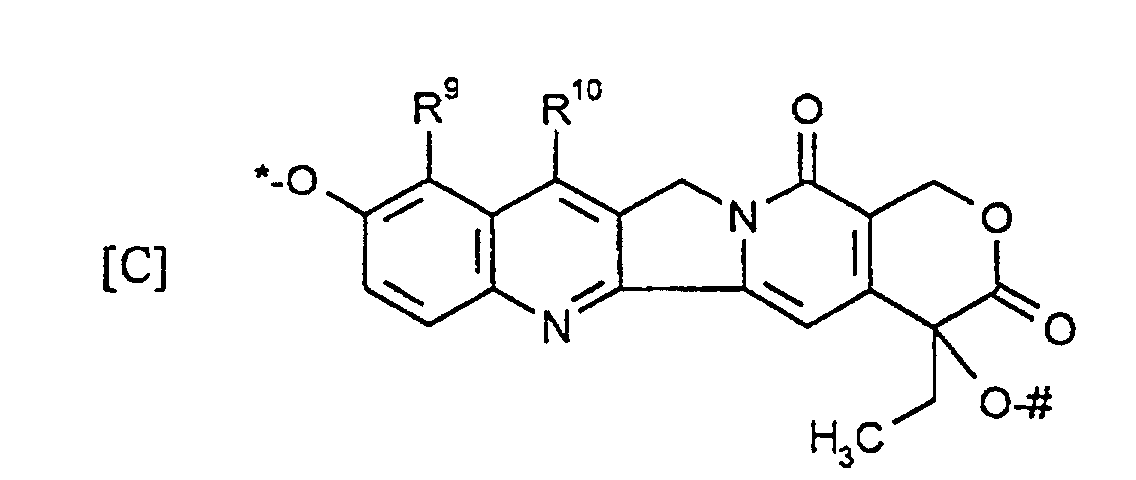
- R9
- für Wasserstoff oder -CH2-N(CH3)2 steht und
- R10
- für Wasserstoff oder Ethyl steht,
oderworin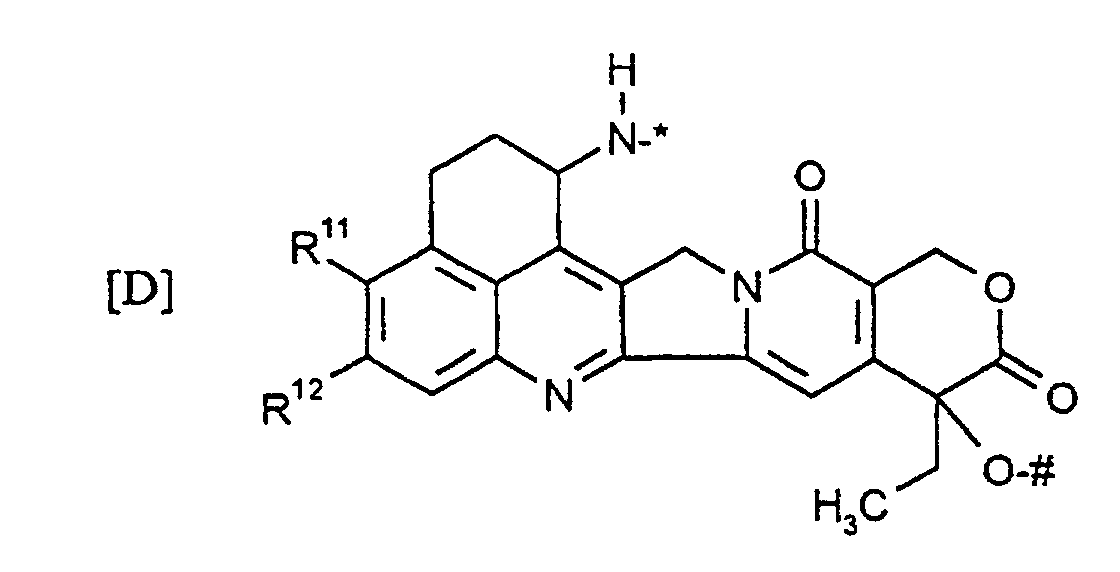
- R11 und R12 wie R2 und R3
- definiert sind und mit diesen
gleich oder verschieden sein können,
oderworin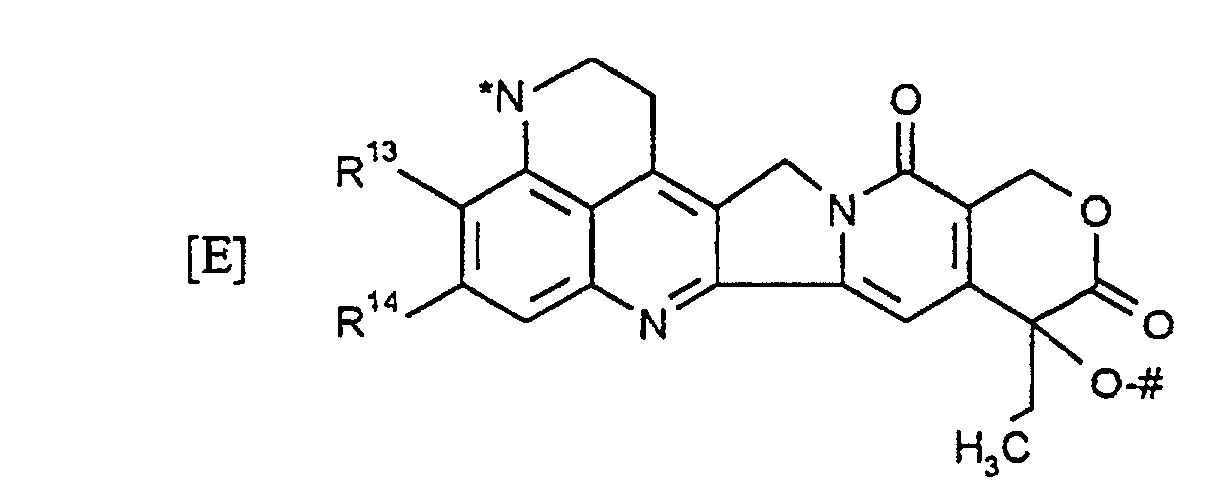
- R13 und R14 wie R2 und R3
- definiert sind und mit diesen gleich oder verschieden sein können,
- A
- einen Rest der Formel
bedeutet, wobei gilt 1 ≤ (n + o + p) ≤ 3,
- B
- Wasserstoff oder einen Rest der Formel
bedeutet, wobei gilt 0 ≤ (q + r + s) ≤ 3, worin
- M1 und M2
- unabhängig voneinander für eine Brücken-Gruppierung stehen, deren Hauptkette bis zu 21 Atome in linearer Abfolge umfaßt,
- L1, L2, L3, L4, L5 und L6
- unabhängig voneinander für Linker-Gruppierungen stehen, wie sie in der Glycokonjugatchemie gängigerweise eingesetzt werden,
- Sp1, Sp2, Sp3, Sp4, Sp5 und Sp6
- unabhängig voneinander für Arylen mit bis zu 10 Kohlenstoffatomen oder für Alkylen mit bis zu 8 Kohlenstoffatomen stehen, die jeweils gegebenenfalls substituiert sind, und
- K1, K2, K3, K4, K5 und K6
- unabhängig voneinander für einen Rest
der Formel (II)
stehen, worin
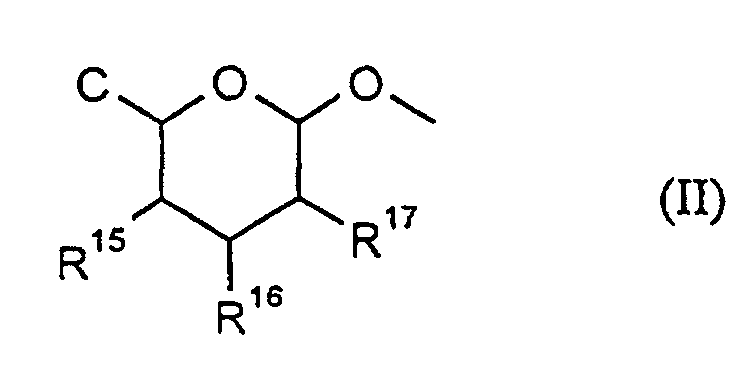
- C
- Methyl, Hydroxymethyl, Alkoxymethyl mit bis zu 6 Kohlenstoffatomen, Acyloxymethyl mit bis zu 6 Kohlenstoffatomen oder einen Rest der Formel -CH2-D bedeutet, worin
- D
- für einen Rest der Formel (II) steht,
- R15, R16 und R17
- unabhängig voneinander Wasserstoff,
Hydroxy, gegebenenfalls durch Hydroxyl substituiertes
Alkoxy mit bis zu 6 Kohlenstoffatomen,
gegebenenfalls durch Alkyl oder Acyl mit bis zu 6
Kohlenstoffatomen substituiertes Amino, Halogen,
Sulfat oder eine Gruppe der Formeln

- R18 und R19
- unabhängig voneinander für Hydroxyl oder Alkoxy mit bis zu 6 Kohlenstoffatomen stehen oder für Amino, das gegebenenfalls durch Alkyl mit bis zu 6 Kohlenstoffatomen substituiert ist, stehen und
- u und v
- unabhängig voneinander die Werte 0, 1, 2, 3 oder 4 annehmen können
- R15, R16 und R17
- unabhängig voneinander für einen Rest der
Formel (II) stehen
oder
zwei der Reste R15, R16, R17 zusammen für eine Epoxygruppe stehen,
- Verbindungen der allgemeinen Formel (I) gemäß Anspruch 1, worin K1, K2, K3, K4, K5 und K6 unabhängig voneinander für einen Rest der Formel (II) stehen können, wobei
- C
- Methyl, Hydroxymethyl, Methoxymethyl oder Acetoxymethyl bedeutet,
- R15
- Wasserstoff, Hydroxyl, Methoxy oder eine Gruppe der Formeln

- u und v
- unabhängig voneinander die Werte 1 oder 2 annehmen können und
- R18 und R19
- unabhängig voneinander für Hydroxyl oder Alkoxy mit
bis zu 4 Kohlenstoffatomen stehen,
oder - R15
- für einen Rest der Formel (II) steht,
- R16
- Wasserstoff, Hydroxyl, Halogen, Alkoxy mit bis zu 4 Kohlenstoffatomen,
Sulfat oder eine Gruppe der Formeln
bedeutet, worin
- u und v
- unabhängig voneinander die Werte 1 oder 2 annehmen können und
- R18 und R19
- unabhängig voneinander für Hydroxy oder Alkoxy mit bis zu 4 Kohlenstoffatomen stehen oder für Amino, das gegebenenfalls durch Alkyl mit bis zu 4 Kohlenstoffatomen substituiert ist, stehen,
- R17
- Hydroxyl, Alkoxy mit bis zu 4 Kohlenstoffatomen, das
gegebenenfalls durch Hydroxy substituiert ist, gegebenenfalls durch
Alkyl oder Acyl mit bis zu 4 Kohlenstoffatomen substituiertes
Amino, oder eine Gruppe der Formeln
bedeutet, worin

- u und v
- unabhängig voneinander die Werte 1 oder 2 annehmen können und
- R18 und R19
- unabhängig voneinander für Hydroxyl oder Alkoxy mit bis zu 4 Kohlenstoffatomen stehen,
- R15 und R16
- gemeinsam für eine Epoxygruppe stehen,
- Verbindungen der allgemeinen Formel (I) gemäß Anspruch 1, worin Sp1, Sp2, Sp3, Sp4. Sp5 und Sp6 unabhängig voneinander für Arylen mit bis zu 10 Kohlenstoffatomen stehen können, das mit je einer Gruppe K1, K2, K3, K4, K5 oder K6 und L1, L2, L3, L4, L5 oder L6 verknüpft ist und das gegebenenfalls noch ein- oder mehrfach durch Hydroxy, Carboxy, Carboxyalkyl mit bis zu 4 Kohlenstoffatomen, Nitro, Cyano, Halogen, Alkyl mit bis zu 4 Kohlenstoffatomen, Halogenalkyl mit bis zu 4 Kohlenstoffatomen oder durch Alkoxy mit bis zu 4 Kohlenstoffatomen substituiert ist, sowie deren Isomere, Isomerengemische und Salze.
- Verbindungen der allgemeinen Formel (I) gemäß Anspruch 1, worinsowie deren Isomere, Isomerengemische und Salze.L1, L2, L3, L4, L5 und L6 unabhängig voneinanderoder
 bedeuten, wobei
 R20 für Chlor oder für Hydroxyalkylamino mit bis zu 6 Kohlenstoffatomen steht,
 - Verbindungen der allgemeinen Formel (I) gemäß Anspruch 1, worin M1 und M2 unabhängig voneinander für ein Peptid stehen können, das über eine Aminofunktion mit L1, L2, L3, L4, L5 und/oder L6 verknüpft ist, über eine Acylfunktion mit Cp verknüpft ist und dessen Aminosäurebausteine gegebenenfalls Schutzgruppen tragen können, sowie deren Isomere, Isomerengemische und Salze.
- Verbindungen gemäß Anspruch 5, dadurch gekennzeichnet, daß M1 und/oder M2 für ein Mono-, Di- oder Tripeptid stehen.
- Verbindungen gemäß Anspruch 5 oder 6, dadurch gekennzeichnet, daß das Peptid aus gegebenenfalls Schutzgruppen tragenden Aminosäurebausteinen besteht, ausgewählt aus der Gruppe bestehend aus Glycyl, Alanyl, Valyl, Leucyl, Lysyl, Seryl, Glutamyl, Threonyl, Asparagyl, Isoleucyl, Diaminopropionyl, Diaminobutyryl, Arginyl, Histidyl und/oder Ornithyl.
- Verfahren zur Herstellung von Verbindungen der allgemeinen Formel (I) gemäß Anspruch 1, dadurch gekennzeichnet, daß man Verbindungen der allgemeinen Formel (III)
oder daß man, falls M1 und/oder M2 ein Peptid bedeuten, in vergleichbarer Weise nach üblichen Methoden einen ersten Aminosäurerest in Form der entsprechenden gegebenenfalls Schutzgruppen tragenden Carboxylkomponente einführt, gegebenenfalls Schutzgruppen abspaltet, weiterhin gegebenenfalls Schutzgruppen tragende Aminosäurereste anknüpft, gegebenenfalls erneut Schutzgruppen abspaltet, wie oben angegeben Reste der Formeln K1-Sp1-L1-, K2-Sp2-L2-, K3-Sp3-L3-, K4-Sp4-L4-, K5-Sp5-L5-und/oder K6-Sp6-L6- einführt und falls erforderlich Schutzgruppen abspaltet,
und daß man weiterhin gegebenenfalls nach üblichen Methoden die Stereoisomeren trennt und daß man gegebenenfalls die Verbindungen in ihre Salze überführt. - Verwendung der Verbindungen der allgemeinen Formel (I) gemäß Anspruch 1 zur Herstellung von Arzneimitteln.
- Arzneimittel, enthaltend Verbindungen der allgemeinen Formel (I) gemäß Anspruch 1.
Applications Claiming Priority (5)
| Application Number | Priority Date | Filing Date | Title |
|---|---|---|---|
| DE19640206 | 1996-09-30 | ||
| DE19640206 | 1996-09-30 | ||
| DE19643764 | 1996-10-23 | ||
| DE19643764A DE19643764A1 (de) | 1996-09-30 | 1996-10-23 | Glycokonjugate von modifizierten Camptothecin-Derivaten (20-0-Verknüpfung) |
| PCT/EP1997/005088 WO1998014459A1 (de) | 1996-09-30 | 1997-09-17 | Glycokonjugate von modifizierten camptothecin-derivaten (20-o-verknüpfung) |
Publications (2)
| Publication Number | Publication Date |
|---|---|
| EP0934329A1 EP0934329A1 (de) | 1999-08-11 |
| EP0934329B1 true EP0934329B1 (de) | 2001-12-12 |
Family
ID=26029947
Family Applications (1)
| Application Number | Title | Priority Date | Filing Date |
|---|---|---|---|
| EP97942940A Expired - Lifetime EP0934329B1 (de) | 1996-09-30 | 1997-09-17 | Glycokonjugate von modifizierten camptothecin-derivaten (20-o-verknüpfung) |
Country Status (10)
| Country | Link |
|---|---|
| US (1) | US6492335B1 (de) |
| EP (1) | EP0934329B1 (de) |
| JP (1) | JP2001504453A (de) |
| AT (1) | ATE210673T1 (de) |
| AU (1) | AU4459297A (de) |
| CA (1) | CA2267328A1 (de) |
| DK (1) | DK0934329T3 (de) |
| ES (1) | ES2169429T3 (de) |
| PT (1) | PT934329E (de) |
| WO (1) | WO1998014459A1 (de) |
Families Citing this family (19)
| Publication number | Priority date | Publication date | Assignee | Title |
|---|---|---|---|---|
| ID23424A (id) * | 1997-05-14 | 2000-04-20 | Bayer Ag | Glikokonjugat dari 20(s)-kamptotesin |
| US7049410B2 (en) | 1999-05-14 | 2006-05-23 | Majumdar Adhip P N | Antibodies to a novel EGF-receptor related protein (ERRP) |
| DE10005275A1 (de) * | 2000-02-07 | 2001-08-09 | Bayer Ag | Neuartige Glycokonjugate |
| US6350756B1 (en) | 2001-01-18 | 2002-02-26 | California Pacific Medical Center | Camptothecin derivatives |
| US6403604B1 (en) | 2001-03-01 | 2002-06-11 | California Pacific Medical Center | Nitrogen-based camptothecin derivatives |
| US6855720B2 (en) | 2001-03-01 | 2005-02-15 | California Pacific Medical Center | Nitrogen-based camptothecin derivatives |
| US6933302B2 (en) | 2002-06-03 | 2005-08-23 | California Pacific Medical Center | Nitrogen-based homo-camptothecin derivatives |
| US20080182801A1 (en) | 2003-12-22 | 2008-07-31 | Btg International Limited | Core 2 glcnac-t inhibitors |
| GB0513881D0 (en) | 2005-07-06 | 2005-08-10 | Btg Int Ltd | Core 2 GLCNAC-T Inhibitors III |
| GB0329667D0 (en) | 2003-12-22 | 2004-01-28 | King S College London | Core 2 GlcNAc-T inhibitor |
| WO2005062985A2 (en) * | 2003-12-23 | 2005-07-14 | American Bioscience, Inc. | Di-ester prodrugs of camptothecin, process for their preparation and their therapeutical applications |
| US20060135546A1 (en) * | 2004-12-16 | 2006-06-22 | Jagadevappa Basavaraja | Methods for the purification of 20(S)- camptothecin |
| GB0513888D0 (en) | 2005-07-06 | 2005-08-10 | Btg Int Ltd | Core 2 GLCNAC-T Inhibitors II |
| US7875602B2 (en) * | 2005-10-21 | 2011-01-25 | Sutter West Bay Hospitals | Camptothecin derivatives as chemoradiosensitizing agents |
| CN102153607B (zh) * | 2010-02-11 | 2015-07-15 | 湖南方盛华美医药科技有限公司 | 水溶性喜树碱衍生物及包含其的药物组合物 |
| JP2021095424A (ja) * | 2018-03-28 | 2021-06-24 | 持田製薬株式会社 | 抗癌剤結合アルギン酸誘導体 |
| CN108822120A (zh) * | 2018-07-11 | 2018-11-16 | 浙江工业大学 | Fl118氨基酸盐酸盐及其制备方法与应用 |
| CN111171041B (zh) * | 2018-11-12 | 2021-07-27 | 中国海洋大学 | 20位取代的喜树碱衍生物及其制备方法和应用 |
| CN115850291B (zh) * | 2021-09-24 | 2024-11-15 | 石药集团巨石生物制药有限公司 | 喜树碱衍生物及其用途 |
Citations (2)
| Publication number | Priority date | Publication date | Assignee | Title |
|---|---|---|---|---|
| DE4236237A1 (de) * | 1992-10-27 | 1994-04-28 | Behringwerke Ag | Prodrugs, ihre Herstellung und Verwendung als Arzneimittel |
| EP0640622A1 (de) * | 1993-02-26 | 1995-03-01 | Drug Delivery System Institute, Ltd. | Polysaccharidderivat und wirkstoffträger |
Family Cites Families (10)
| Publication number | Priority date | Publication date | Assignee | Title |
|---|---|---|---|---|
| US4943579A (en) | 1987-10-06 | 1990-07-24 | The United States Of America As Represented By The Secretary Of The Department Of Health And Human Services | Water soluble prodrugs of camptothecin |
| DK0418099T3 (da) * | 1989-09-15 | 2002-04-02 | Res Triangle Inst | Fremgangsmåde til fremstilling af 10,11-methylendioxy-20(RS)-camptothecin og 10,11-methylendioxy-20(S)-camptothecinanaloger |
| US6214345B1 (en) * | 1993-05-14 | 2001-04-10 | Bristol-Myers Squibb Co. | Lysosomal enzyme-cleavable antitumor drug conjugates |
| GB9320781D0 (en) * | 1993-10-08 | 1993-12-01 | Erba Carlo Spa | Polymer-bound camptothecin derivatives |
| US5646159A (en) | 1994-07-20 | 1997-07-08 | Research Triangle Institute | Water-soluble esters of camptothecin compounds |
| US5646262A (en) * | 1994-07-28 | 1997-07-08 | Georgetown University | Antisense oligonucleotides against hepatitis B viral replication |
| GB9504065D0 (en) * | 1995-03-01 | 1995-04-19 | Pharmacia Spa | Poly-pyrrolecarboxamidonaphthalenic acid derivatives |
| DE19512484A1 (de) * | 1995-04-04 | 1996-10-17 | Bayer Ag | Kohlenhydratmodifizierte Cytostatika |
| SG50747A1 (en) * | 1995-08-02 | 1998-07-20 | Tanabe Seiyaku Co | Comptothecin derivatives |
| CA2192725C (en) * | 1995-12-28 | 2004-04-20 | Kenji Tsujihara | Camptothecin derivatives |
-
1997
- 1997-09-17 AT AT97942940T patent/ATE210673T1/de not_active IP Right Cessation
- 1997-09-17 DK DK97942940T patent/DK0934329T3/da active
- 1997-09-17 CA CA002267328A patent/CA2267328A1/en not_active Abandoned
- 1997-09-17 WO PCT/EP1997/005088 patent/WO1998014459A1/de not_active Ceased
- 1997-09-17 US US09/269,317 patent/US6492335B1/en not_active Expired - Fee Related
- 1997-09-17 JP JP51618198A patent/JP2001504453A/ja active Pending
- 1997-09-17 PT PT97942940T patent/PT934329E/pt unknown
- 1997-09-17 AU AU44592/97A patent/AU4459297A/en not_active Abandoned
- 1997-09-17 ES ES97942940T patent/ES2169429T3/es not_active Expired - Lifetime
- 1997-09-17 EP EP97942940A patent/EP0934329B1/de not_active Expired - Lifetime
Patent Citations (2)
| Publication number | Priority date | Publication date | Assignee | Title |
|---|---|---|---|---|
| DE4236237A1 (de) * | 1992-10-27 | 1994-04-28 | Behringwerke Ag | Prodrugs, ihre Herstellung und Verwendung als Arzneimittel |
| EP0640622A1 (de) * | 1993-02-26 | 1995-03-01 | Drug Delivery System Institute, Ltd. | Polysaccharidderivat und wirkstoffträger |
Also Published As
| Publication number | Publication date |
|---|---|
| WO1998014459A1 (de) | 1998-04-09 |
| EP0934329A1 (de) | 1999-08-11 |
| DK0934329T3 (da) | 2002-04-08 |
| AU4459297A (en) | 1998-04-24 |
| JP2001504453A (ja) | 2001-04-03 |
| ATE210673T1 (de) | 2001-12-15 |
| PT934329E (pt) | 2002-05-31 |
| CA2267328A1 (en) | 1998-04-09 |
| ES2169429T3 (es) | 2002-07-01 |
| US6492335B1 (en) | 2002-12-10 |
Similar Documents
| Publication | Publication Date | Title |
|---|---|---|
| EP0939765B1 (de) | Glycokonjugate von modifizierten camptothecin-derivaten(a- oder b-ring-verknüpfung) | |
| DE69432627T2 (de) | Polymergebundene camptothecin-derivate | |
| WO1998014459A1 (de) | Glycokonjugate von modifizierten camptothecin-derivaten (20-o-verknüpfung) | |
| EP0819135B1 (de) | Kohlenhydratmodifizierte cytostatika | |
| EP0981542B1 (de) | Glycokonjugate von 20(s)-camptothecin | |
| DE3826595A1 (de) | Tripeptide, die als immunostimulantien sowie bei der verhuetung von metastasen nuetzlich sind | |
| CH679045A5 (de) | ||
| EP0929570A1 (de) | Modifizierte cytostatika | |
| DE69600244T2 (de) | Basische prolinamid derivate von ge2270 und ge2270-ahnlichten antibiotika | |
| DE2723453C2 (de) | 1-Desamino-asparagin↑4↑-D-arginin↑8↑-vasopressin, Verfahren zu seiner Herstellung sowie dieses Peptid enthaltende antidiuretische Arzneimittel | |
| DE19643764A1 (de) | Glycokonjugate von modifizierten Camptothecin-Derivaten (20-0-Verknüpfung) | |
| DE19909979A1 (de) | Verfahren zur Herstellung von Glycokonjugaten von 20(S)-Camptothecin | |
| DE19815812A1 (de) | Modifizierte Cytostatika | |
| WO2001058932A1 (de) | Glycokonjugate von cytostatika | |
| DE19640969A1 (de) | 20-0-verknüpfte Glycokonjugate von Camptothecin | |
| DE10005275A9 (de) | Neuartige glycokonjugate | |
| EP2497765B1 (de) | Verfahren zur herstellung von kreatinamiden | |
| DE19813137A1 (de) | Glycokonjugate von 20(S)-Camptothecin | |
| DE19801037A1 (de) | Glycokonjugate von 20(S)-Camptothecin | |
| RU2184122C2 (ru) | Гликоконъюгаты 20(s)-камптотецина | |
| DE3820770A1 (de) | Polypeptide | |
| CZ401799A3 (cs) | Glykokonjugáty 20(S)-camptothecinu, způsob jejich výroby, jejich použití a léčiva tyto látky obsahující | |
| KR20010012558A (ko) | 20(s) 캄프토테신 당결합체 | |
| DE2422310A1 (de) | 1-alpha-aminoisobuttersaeure-corticotropinpeptide, deren salze und komplexe, verfahren zu ihrer herstellung und diese peptide enthaltende arzneipraeparate |
Legal Events
| Date | Code | Title | Description |
|---|---|---|---|
| PUAI | Public reference made under article 153(3) epc to a published international application that has entered the european phase |
Free format text: ORIGINAL CODE: 0009012 |
|
| 17P | Request for examination filed |
Effective date: 19990503 |
|
| AK | Designated contracting states |
Kind code of ref document: A1 Designated state(s): AT BE CH DE DK ES FI FR GB GR IE IT LI LU MC NL PT SE |
|
| 17Q | First examination report despatched |
Effective date: 20000128 |
|
| GRAG | Despatch of communication of intention to grant |
Free format text: ORIGINAL CODE: EPIDOS AGRA |
|
| GRAG | Despatch of communication of intention to grant |
Free format text: ORIGINAL CODE: EPIDOS AGRA |
|
| GRAH | Despatch of communication of intention to grant a patent |
Free format text: ORIGINAL CODE: EPIDOS IGRA |
|
| GRAH | Despatch of communication of intention to grant a patent |
Free format text: ORIGINAL CODE: EPIDOS IGRA |
|
| GRAA | (expected) grant |
Free format text: ORIGINAL CODE: 0009210 |
|
| AK | Designated contracting states |
Kind code of ref document: B1 Designated state(s): AT BE CH DE DK ES FI FR GB GR IE IT LI LU MC NL PT SE |
|
| REF | Corresponds to: |
Ref document number: 210673 Country of ref document: AT Date of ref document: 20011215 Kind code of ref document: T |
|
| REG | Reference to a national code |
Ref country code: CH Ref legal event code: NV Representative=s name: E. BLUM & CO. PATENTANWAELTE Ref country code: CH Ref legal event code: EP |
|
| REG | Reference to a national code |
Ref country code: GB Ref legal event code: IF02 |
|
| REG | Reference to a national code |
Ref country code: IE Ref legal event code: FG4D Free format text: GERMAN |
|
| REF | Corresponds to: |
Ref document number: 59705805 Country of ref document: DE Date of ref document: 20020124 |
|
| GBT | Gb: translation of ep patent filed (gb section 77(6)(a)/1977) |
Effective date: 20020301 |
|
| REG | Reference to a national code |
Ref country code: DK Ref legal event code: T3 |
|
| REG | Reference to a national code |
Ref country code: PT Ref legal event code: SC4A Free format text: AVAILABILITY OF NATIONAL TRANSLATION Effective date: 20020222 |
|
| REG | Reference to a national code |
Ref country code: ES Ref legal event code: FG2A Ref document number: 2169429 Country of ref document: ES Kind code of ref document: T3 |
|
| REG | Reference to a national code |
Ref country code: GR Ref legal event code: EP Ref document number: 20020400952 Country of ref document: GR |
|
| PLBE | No opposition filed within time limit |
Free format text: ORIGINAL CODE: 0009261 |
|
| STAA | Information on the status of an ep patent application or granted ep patent |
Free format text: STATUS: NO OPPOSITION FILED WITHIN TIME LIMIT |
|
| 26N | No opposition filed | ||
| PGFP | Annual fee paid to national office [announced via postgrant information from national office to epo] |
Ref country code: DE Payment date: 20030814 Year of fee payment: 7 |
|
| PGFP | Annual fee paid to national office [announced via postgrant information from national office to epo] |
Ref country code: IE Payment date: 20030818 Year of fee payment: 7 |
|
| PGFP | Annual fee paid to national office [announced via postgrant information from national office to epo] |
Ref country code: GR Payment date: 20030821 Year of fee payment: 7 Ref country code: FI Payment date: 20030821 Year of fee payment: 7 Ref country code: ES Payment date: 20030821 Year of fee payment: 7 |
|
| PGFP | Annual fee paid to national office [announced via postgrant information from national office to epo] |
Ref country code: FR Payment date: 20030822 Year of fee payment: 7 |
|
| PGFP | Annual fee paid to national office [announced via postgrant information from national office to epo] |
Ref country code: SE Payment date: 20030825 Year of fee payment: 7 |
|
| PGFP | Annual fee paid to national office [announced via postgrant information from national office to epo] |
Ref country code: PT Payment date: 20030827 Year of fee payment: 7 |
|
| PGFP | Annual fee paid to national office [announced via postgrant information from national office to epo] |
Ref country code: MC Payment date: 20030901 Year of fee payment: 7 |
|
| PGFP | Annual fee paid to national office [announced via postgrant information from national office to epo] |
Ref country code: AT Payment date: 20030908 Year of fee payment: 7 |
|
| PGFP | Annual fee paid to national office [announced via postgrant information from national office to epo] |
Ref country code: LU Payment date: 20030917 Year of fee payment: 7 Ref country code: GB Payment date: 20030917 Year of fee payment: 7 Ref country code: DK Payment date: 20030917 Year of fee payment: 7 Ref country code: CH Payment date: 20030917 Year of fee payment: 7 |
|
| PGFP | Annual fee paid to national office [announced via postgrant information from national office to epo] |
Ref country code: BE Payment date: 20030925 Year of fee payment: 7 |
|
| PGFP | Annual fee paid to national office [announced via postgrant information from national office to epo] |
Ref country code: NL Payment date: 20030930 Year of fee payment: 7 |
|
| PG25 | Lapsed in a contracting state [announced via postgrant information from national office to epo] |
Ref country code: LU Free format text: LAPSE BECAUSE OF NON-PAYMENT OF DUE FEES Effective date: 20040917 Ref country code: IE Free format text: LAPSE BECAUSE OF NON-PAYMENT OF DUE FEES Effective date: 20040917 Ref country code: GB Free format text: LAPSE BECAUSE OF NON-PAYMENT OF DUE FEES Effective date: 20040917 Ref country code: FI Free format text: LAPSE BECAUSE OF NON-PAYMENT OF DUE FEES Effective date: 20040917 Ref country code: AT Free format text: LAPSE BECAUSE OF NON-PAYMENT OF DUE FEES Effective date: 20040917 |
|
| PG25 | Lapsed in a contracting state [announced via postgrant information from national office to epo] |
Ref country code: SE Free format text: LAPSE BECAUSE OF NON-PAYMENT OF DUE FEES Effective date: 20040918 Ref country code: ES Free format text: LAPSE BECAUSE OF NON-PAYMENT OF DUE FEES Effective date: 20040918 |
|
| PG25 | Lapsed in a contracting state [announced via postgrant information from national office to epo] |
Ref country code: MC Free format text: LAPSE BECAUSE OF NON-PAYMENT OF DUE FEES Effective date: 20040930 Ref country code: LI Free format text: LAPSE BECAUSE OF NON-PAYMENT OF DUE FEES Effective date: 20040930 Ref country code: DK Free format text: LAPSE BECAUSE OF NON-PAYMENT OF DUE FEES Effective date: 20040930 Ref country code: CH Free format text: LAPSE BECAUSE OF NON-PAYMENT OF DUE FEES Effective date: 20040930 Ref country code: BE Free format text: LAPSE BECAUSE OF NON-PAYMENT OF DUE FEES Effective date: 20040930 |
|
| PG25 | Lapsed in a contracting state [announced via postgrant information from national office to epo] |
Ref country code: PT Free format text: LAPSE BECAUSE OF NON-PAYMENT OF DUE FEES Effective date: 20050317 |
|
| BERE | Be: lapsed |
Owner name: *BAYER A.G. Effective date: 20040930 |
|
| PG25 | Lapsed in a contracting state [announced via postgrant information from national office to epo] |
Ref country code: NL Free format text: LAPSE BECAUSE OF NON-PAYMENT OF DUE FEES Effective date: 20050401 Ref country code: DE Free format text: LAPSE BECAUSE OF NON-PAYMENT OF DUE FEES Effective date: 20050401 |
|
| PG25 | Lapsed in a contracting state [announced via postgrant information from national office to epo] |
Ref country code: GR Free format text: LAPSE BECAUSE OF NON-PAYMENT OF DUE FEES Effective date: 20050405 |
|
| EUG | Se: european patent has lapsed | ||
| GBPC | Gb: european patent ceased through non-payment of renewal fee |
Effective date: 20040917 |
|
| REG | Reference to a national code |
Ref country code: CH Ref legal event code: PL |
|
| PG25 | Lapsed in a contracting state [announced via postgrant information from national office to epo] |
Ref country code: FR Free format text: LAPSE BECAUSE OF NON-PAYMENT OF DUE FEES Effective date: 20050531 |
|
| REG | Reference to a national code |
Ref country code: PT Ref legal event code: MM4A Free format text: LAPSE DUE TO NON-PAYMENT OF FEES Effective date: 20050317 |
|
| NLV4 | Nl: lapsed or anulled due to non-payment of the annual fee |
Effective date: 20050401 |
|
| REG | Reference to a national code |
Ref country code: DK Ref legal event code: EBP |
|
| REG | Reference to a national code |
Ref country code: IE Ref legal event code: MM4A |
|
| REG | Reference to a national code |
Ref country code: FR Ref legal event code: ST |
|
| PG25 | Lapsed in a contracting state [announced via postgrant information from national office to epo] |
Ref country code: IT Free format text: LAPSE BECAUSE OF NON-PAYMENT OF DUE FEES;WARNING: LAPSES OF ITALIAN PATENTS WITH EFFECTIVE DATE BEFORE 2007 MAY HAVE OCCURRED AT ANY TIME BEFORE 2007. THE CORRECT EFFECTIVE DATE MAY BE DIFFERENT FROM THE ONE RECORDED. Effective date: 20050917 |
|
| REG | Reference to a national code |
Ref country code: ES Ref legal event code: FD2A Effective date: 20040918 |
|
| BERE | Be: lapsed |
Owner name: *BAYER A.G. Effective date: 20040930 |