EP0917430B1 - Enzym-vorgranulat für tierfuttermittel-granulate - Google Patents
Enzym-vorgranulat für tierfuttermittel-granulate Download PDFInfo
- Publication number
- EP0917430B1 EP0917430B1 EP97922981A EP97922981A EP0917430B1 EP 0917430 B1 EP0917430 B1 EP 0917430B1 EP 97922981 A EP97922981 A EP 97922981A EP 97922981 A EP97922981 A EP 97922981A EP 0917430 B1 EP0917430 B1 EP 0917430B1
- Authority
- EP
- European Patent Office
- Prior art keywords
- enzyme
- weight
- mixture
- granules
- flour
- Prior art date
- Legal status (The legal status is an assumption and is not a legal conclusion. Google has not performed a legal analysis and makes no representation as to the accuracy of the status listed.)
- Expired - Lifetime
Links
Classifications
-
- C—CHEMISTRY; METALLURGY
- C12—BIOCHEMISTRY; BEER; SPIRITS; WINE; VINEGAR; MICROBIOLOGY; ENZYMOLOGY; MUTATION OR GENETIC ENGINEERING
- C12N—MICROORGANISMS OR ENZYMES; COMPOSITIONS THEREOF; PROPAGATING, PRESERVING, OR MAINTAINING MICROORGANISMS; MUTATION OR GENETIC ENGINEERING; CULTURE MEDIA
- C12N9/00—Enzymes; Proenzymes; Compositions thereof; Processes for preparing, activating, inhibiting, separating or purifying enzymes
- C12N9/98—Preparation of granular or free-flowing enzyme compositions
-
- A—HUMAN NECESSITIES
- A23—FOODS OR FOODSTUFFS; TREATMENT THEREOF, NOT COVERED BY OTHER CLASSES
- A23K—FODDER
- A23K20/00—Accessory food factors for animal feeding-stuffs
- A23K20/10—Organic substances
- A23K20/189—Enzymes
-
- A—HUMAN NECESSITIES
- A23—FOODS OR FOODSTUFFS; TREATMENT THEREOF, NOT COVERED BY OTHER CLASSES
- A23K—FODDER
- A23K40/00—Shaping or working-up of animal feeding-stuffs
- A23K40/10—Shaping or working-up of animal feeding-stuffs by agglomeration; by granulation, e.g. making powders
-
- A—HUMAN NECESSITIES
- A23—FOODS OR FOODSTUFFS; TREATMENT THEREOF, NOT COVERED BY OTHER CLASSES
- A23K—FODDER
- A23K40/00—Shaping or working-up of animal feeding-stuffs
- A23K40/20—Shaping or working-up of animal feeding-stuffs by moulding, e.g. making cakes or briquettes
-
- A—HUMAN NECESSITIES
- A23—FOODS OR FOODSTUFFS; TREATMENT THEREOF, NOT COVERED BY OTHER CLASSES
- A23K—FODDER
- A23K40/00—Shaping or working-up of animal feeding-stuffs
- A23K40/25—Shaping or working-up of animal feeding-stuffs by extrusion
Definitions
- the invention relates to the production of an activity stable Enzyme pre-granules that serve the purpose in particles of an animal feed granulate to be incorporated.
- the invention relates to the after the manufacturing process obtained activity-stable pre-granules for incorporation into Animal feed pellets.
- enzymes in animal feed enables better usability of the nutrients contained in animal feed, because by adding enzymes the utilization of not fully or difficult to digest ingredients for the animal is relieved.
- Enzyme addition to animal feed proves to be an effective way to Feed in unconventional and inexpensive preparation to develop the optimal use of the feed ensure contained nutrients. This makes it possible. inexpensive raw materials such as cereals; Beans or others Seeds optimally for the production of qualitatively high quality feed components, especially for Young animals are suitable to use.
- Enzymes are available that have special enzyme activities for degradation of special feed components such as glucans, Starch, proteins, pectin-like polysaccharides, phytic acid, Galactomannans, galactoarabans, polygalacturones, raffinose, Stachyose, Hemicellulose, Cellulose, Pentosane and other nutritional components exhibit.
- Animal feed often lies as Granules, i.e. as coarser or granular piles; the Animal feed specialists then often speak of "feed pellets", even if the shape of the granulate particles is not in the proper sense of the word "pellet" (spherical particle) is rounded.
- the enzymes can be added to the feed, a premix of the same or a mixture component admixed or in granules of these components be incorporated.
- Granulated enzyme products can can be mixed very easily with the feed components, as far as these enzyme granules on ordinary feed components based, e.g. Wheat or soy flakes.
- state Methods are also known in the art which involve dissolved enzymes Putter particles in a fluidized bed, in a moving or Spray on the stirred bed and then dry if necessary. The disadvantage here is that often an undesirable Contamination of the feed is observed.
- the enzymes directly in the particles of animal feed granules to incorporate in order to achieve the and homogeneous mixing of the enzyme in the particles of the To achieve animal feed granules yourself.
- the desired components of the animal feed with an enzyme preparation are therefore the desired components of the animal feed with an enzyme preparation mixed, the mixture subsequently by spraying conditioned with steam and then extruded from it Strand cuttings generated.
- the added enzymes a high temperature load and a high pressure load and exposed to friction and shear forces. Thereby the original enzyme activity often becomes not only very impaired, but is often even completely lost.
- the task was therefore to find a suitable procedure to provide for the formulation of feed enzymes, to overcome the above drawbacks and to enable the enzymes without significant loss of activity in the Incorporate particles of animal feed granules homogeneously.
- the invention provides a method for producing an activity-stable enzyme pre-granulate, which is used for incorporation into the particles of an animal feed granulate, the method according to the invention being characterized in that firstly, moist granules are produced by: 0.01 to 20 parts by weight of enzyme or enzyme mixture (calculated as the dry matter content of the enzyme preparation used), 80 to 99.99 parts by weight (including moisture content) of an organic flour type with a degree of grinding of 30% to 100%, the flour type being obtained by grinding a flour source, optionally previously washed and / or cleaned, treated with dry superheated steam, and wherein the parts by weight of the enzyme or enzyme mixture and the flour type add up to 100 parts by weight, if desired up to a total of 20 parts by weight of granulation auxiliaries (calculated as anhydrous granulation auxiliaries), using a calculated amount of water which is sufficient to set a moisture content in the wet granules of 20 to 50% by weight (based on the sum of the components of the wet
- the above method is characterized in that the moist granules are produced 0.01 to 10 parts by weight of enzyme or enzyme mixture, preferably 2 to 7 parts by weight of enzyme or enzyme mixture, 90 to 99.99 parts by weight of flour type, preferably 93 to 98 parts by weight of flour type, if desired up to a total of 15 parts by weight, preferably 0.5 to 5 parts by weight, of granulation aids, and uses a calculated amount of water which is sufficient to establish a moisture content of 25 to 40% by weight, preferably 25 to 35% by weight, in the wet granules.
- organic flours i.e. flours from organic raw materials
- organic flour includes in the context of Invention all more or less crushed, powdery to fine-grained products, which are characterized by crushing (grinding) solid organic materials of natural origin (flour source) won.
- Process used organic flours which one through Grinding cereal grains, legume fruits and / or fruits the Malvaceae family (e.g. cotton seeds).
- the preferably serving as flour source within the scope of the invention Cereals are especially wheat or rye, but also barley, Oats, rice and corn as well as sorghum and other types of millet can be used.
- buckwheat in itself is not too belongs to the cereals (knotweed), can beech-like meal fruits also within the scope of the invention be used as a flour source; this is especially true in Consideration for animal feed granules for poultry, however is in the production of animal feed granules for Grazing cattle because of the content of photosensitizing fagopyrin if necessary, caution is advised, insofar as feeding is intended for predominantly white-haired cattle.
- Another preferred variant of the invention is served by legume fruits as a source of flour. Under legumes they become here vegetable foods belonging to fruit vegetables (legumes) Roger that.
- a flour source in the context of the invention hence the fruits of legume species such as: pisum (peas), Cajamus (pigeon pea), cicer (chickpea); Lens; Phaseolus (beans), Vigna (cow beans), Dolchius (helmet beans), Cassavalia (heavy beans), Vicia (horse beans or Vetch); Peluschken; Arachis (peanuts); lupins; Alfalfa; Soybeans and lima beans and possibly other legumes and also Malvaceae fruits (e.g. of the Gossipium genus, cotton) into consideration. Soybeans are preferred.
- the flours that can be used in the context of the invention are different according to the grinding method used and the result achieved in each case Degree of grinding fine powder from yellowish white to gray-dark color (light or dark flours) or if necessary even more or less granular (grist, semolina, semolina) or white-yellowish brown mottled products.
- the invention Organic flour types used usually have a moisture content up to about 15% by weight (e.g. a moisture content from 7 to 15% by weight), which is used in the calculation of the percentage moisture content of the in the high-speed mixer according to the invention produced wet granules must be taken into account.
- Such flour is commonly used in the invention used, which have a moisture content of about 10 to 15 wt .-%, in particular have 13 to 15% by weight; the flours from legume fruits or fruits of the Malvaceae family usually show a moisture content of about 9 (+/- 2)% by weight.
- the degree of grinding corresponds to Weight amount of the flour obtained based on 100 parts by weight of the regrind used (thus within the scope of the invention the grain or legume used); he is a percentage flour yield.
- finest flour e.g. from the Inside the grain, on and during further grinding, so e.g. as the degree of grinding increases, the proportion of crude fiber and shell content in the flour too; the proportion of starch thereby less.
- the degree of grinding is therefore also reflected in the so-called "flour type", which is given as a number for Classification of flours - especially cereal flours - is used and which is based on the ash content of the flour (so-called ash scale).
- the flour type or the number of types gives here the amount of ash (minerals) in mg that the Burning 100 g of flour dry substance remains.
- the type number can clarify the type number as follows become: The higher the type number, the darker the flour and the higher the degree of grinding, since the core of the grain approximately only 0.4% by weight, the shell, however, approximately contains around 5% by weight of ash. Contains a type 405 wheat flour so e.g. on average 0.405 wt% ash.
- the majority of the grain flours consist of flour from the crushed flour body, i.e. the starch component the cereal grains; with a higher degree of grinding contain the Grain flours also the crushed, protein-containing aleurone layer the cereal grains, and the ingredients for grist of the protein and fat-containing seedling as well as the crude fiber and ash-containing seed pans.
- the degree of grinding of the flour used according to the invention is 30% to 100%.
- the degree of grinding corresponds to 30% a finest flour, the degree of grinding 100% a whole grain flour.
- the degree of grinding of the Flour type is 50% to 100%, preferably 70% to 100%.
- the flour used in the method according to the invention draws the fact that it was obtained from a flour source, before grinding a treatment with dry superheated steam with a temperature of in particular 100 to about 110 ° C. under approximately normal pressure to slight excess pressure (e.g. 0.8 up to 1.2 bar overpressure) and a treatment time (length of stay in the superheated steam treatment device described below) of up to about 1 hour.
- dry Superheated steam is an overheated and unsaturated water vapor, which in a conventional manner by overheating and separating from possible water condensate or by releasing steam from high pressure can be generated.
- the steam treatment of the For example, Mehián can be used using a down widening, conical bunkers with one or several ring nozzles or steam lances for the introduction of the dry superheated steam.
- the bunker can continuous operation with the flour source, e.g. via screw conveyors coated and emptied via heated screw conveyors become.
- the hot steam-treated flour source is subsequently e.g. in a downstream fluid bed dryer conditioned a constant water content of at most 15 wt .-% and in another fluid bed dryer for the subsequent one Grilled cooled.
- the treated, cooled flour source is then continuously fed to a grinding machine and to a grain size distribution with the main part of the grain sizes in Range from 500 to 50 ⁇ m milled; preferably exceeds the proportion of particles with grain sizes of less than 50 ⁇ m in not ground flour 35 wt .-% and the proportion of particles with grain sizes of 300 to 500 ⁇ m, it exceeds 10% by weight Not.
- a non-sticky wet granulate obtained by adding water, possibly over an enzyme solution or with a possibly added granulation aid, continuously depending on the supply of the main solid components added that the moisture content in the wet granules (i.e. before drying) at the outlet of the mixer generally 20 to 50% by weight, preferably 25 to 40% by weight and in particular 25 up to 35% by weight.
- the mixing time in the high-speed mixer, or with continuous Working method, the average length of stay is at The method according to the invention generally up to a maximum of 15 minutes; the person skilled in the art can determine the mixing time or residence time to the desired properties of the wet granules (e.g. freedom from tack, grain sizes) or the respective mixer to adjust.
- appropriate mixing or dwell times for batches Granulation have periods of around 2 minutes 10 minutes, especially 3 to 8 minutes, has been found to be sufficient.
- Continuous operations are also essential shorter average residence times in the mixer are sufficient; so is enough with continuous operation in the high-speed mixer of the Type Schugi Flexomix that depends on the size of the apparatus and the volume flow dependent average length of stay only in the range of a few Seconds. e.g. up to 30 seconds, especially 1 to 10 seconds.
- the wet granules become one conventional, enzyme-friendly drying. e.g. in one Fluid bed dryer, subjected to and to a granulate with one desired moisture content, in particular a moisture content of 3 to 12 wt .-%, preferably 7 to 9 wt .-% dried.
- the enzyme pre-granules can still be used in a conventional manner Way coated with a varnish or coating become.
- the coating or lacquer can be another enzyme contain or serve to color the granules, or also a delay in the release of the enzyme or enzyme mixture, e.g. also pH-dependent controlled release in different Gastrointestinal areas.
- the paint or the Coating can be both continuous and batchwise be applied to the enzyme pregranules.
- the enzyme can be an isolated, pure enzyme (ie without secondary activities) or a mixture of enzymes.
- An enzyme mixture can be put together from pure enzymes without any side activities or can be obtained in a simple manner in the form of an enzyme mixture resulting from the process of enzyme extraction from microorganisms;
- Such process-dependent enzyme mixtures depending on the microorganism, usually comprise, in addition to a main enzyme, various accompanying enzymes (so-called side activities) which generally have a favorable synergistic side effect.
- the enzyme or enzyme mixture can thus generally be a hydrolase.
- carbohydrases preferably from the group of carbohydrases, proteases, lipases and esterases, or an oxinitrilase, tannase. Chitinase, Keratinase, Oxidase or a mixture of these enzymes.
- the carbohydrases for the process according to the invention are e.g. B. selected from beta-glucanases, cellulases, amylases, pentosanases (eg endopentosanases), pectinases, xylanases.
- feed enzymes for example arabanases, hemicellulases, galactomannases, polygalacturonases, phytases, glucoamylases, ⁇ -galactosidases, pullulanases, Driselase R and others such as lysozyme or muramidases can also be used in the context of the invention.
- oxidases can be glucose oxidases or peroxidases.
- the proportion (the amount) of the enzyme introduced depends on the individual, specific enzyme activity and the desired activity in the finished enzyme pre-granulate.
- pentosanase generally has a high specific activity and can ensure sufficient enzyme activity in the finished enzyme pre-granulate even in quantities of 0.01 to 0.1 part by weight.
- Bacteria especially from the genus Pseudomonas or Bacillus, or Fungi, especially from the genus Aspergillus, Trichoderma, Rhizopus, Penicillium, Irpex, are generally used to produce the enzymes or enzyme mixtures. It is also possible, if desired, to clone and express the structural genes of the enzymes in suitable strains of microorganisms. For this purpose, any microorganism per se is suitable which takes up the DNA to be cloned for the enzyme plasmid (episomal) or genomic (chromosomal) and can perform the corresponding functions.
- the enzyme used in the process according to the invention or Enzyme mixture can be in the form of a powder or an aqueous Solution of the enzyme or enzyme mixture can be used.
- expedient Enzymes or enzyme mixtures are enzyme preparations, as is usually the case in industrial production. Such enzyme preparations usually do not only contain a single enzyme or a mixture of enzymes, but still other manufacturing-related substances in subordinate Amounts.
- An example of such accompanying substances are e.g. salts those for the precipitation of the enzyme from the mother liquor, like this one obtained after separating the biomass from a fermentation broth will be added and partially during precipitation can be included by the enzyme precipitate.
- the Enzymes or enzyme mixtures can also be conventional enzyme stabilizers and conventional setting and preserving agents as others Accompanying substances included.
- Examples of such accompanying substances are alcohols, glycols, glycol ethers, such as 1-methyloxy-2-propanol, Isopropanol, butyl diglycol, sodium benzoate, calcium salts, Glucose, parabens, potassium and sodium sorbate, table salt.
- aqueous solutions of the enzyme or enzyme mixture used so can do this by subsequently dissolving enzyme or enzyme mixture powders be prepared; or it can be in one another variant also directly the mother liquors, like this one after Separation of the biomass from the fermentation solution, if necessary after concentration or dilution become.
- aqueous solutions of the enzymes or enzyme mixtures usually contain a small proportion of manufacturing-related Accompanying substances in addition to the actual enzyme activity or in addition to the various enzyme activities Enzyme mixtures.
- Enzyme mixtures can pass through directly Fermentation are obtained, in which case the usual enzymes formed by the microorganism used are mixed together in natural proportions.
- enzyme mixtures can also by simply mixed from commercially available single enzymes become.
- Granulation aids in the process according to the invention enzyme-compatible and nutritionally harmless Binder, fillers and / or organic solvents be used.
- Appropriate binders are in particular degraded soluble starch and / or wheat glue.
- the process is pre-mixed in powder form
- Ingredients for the enzyme pre-granulate (“premix”) batchwise or continuously fed to the high-speed mixer and there also one sentence or continuously for adjustment of the moisture content suitable amount of water or an aqueous Solution, possibly with granulation aids dissolved in it (e.g. binder) and / or enzyme or enzyme mixture dissolved therein, metered in and then the enzyme wet granules by intensive Mixing formed and after a specified length of stay removed from the high-speed mixer or continuously withdrawn.
- the invention also relates to the enzyme pre-granules produced by the process according to the invention, which are particularly suitable for incorporation into the particles of an animal feed granulate.
- Such enzyme granules according to the invention are particularly characterized in that they consist of 0.08 to 22 wt .-% (dry substance) enzyme or enzyme mixture, 55 to 96.92 wt .-% (dry substance without moisture) of a flour type with a degree of grinding of 30% to 100%, the flour type by grinding one, if appropriate flour source previously washed and / or cleaned, treated with dry superheated steam, optionally up to a total of 18.5% by weight of granulation auxiliaries (calculated as anhydrous substance), and 3 to 12% by weight of moisture exist, wherein the sum of the components of the enzyme or enzyme mixture, flour-dry substance moisture and optionally granulating aid is 100% by weight.
- Appropriate enzyme pre-granules according to the invention consist of 0.08 to 11 wt .-% (dry substance) enzyme or enzyme mixture, 66 to 96.92 wt .-% (dry substance without moisture) of a flour type with a degree of grinding of 30% to 100%, the flour type by grinding with dry superheated steam treated flour source was obtained optionally up to a total of 14.5% by weight of granulation auxiliaries (calculated as an anhydrous substance), 3 to 12% by weight of moisture, the sum of the constituents of the enzyme or enzyme mixture, flour-dry substance moisture and, if appropriate, pelletizing auxiliary being 100% by weight.
- Particularly preferred enzyme pre-granules according to the invention consist of 1.9 to 7.8% by weight (dry substance) of enzyme or enzyme mixture, 76 to 94.6% by weight (dry substance without moisture) of a flour type with a degree of grinding of 30% to 100%, the flour type by grinding with dry hot steam treated flour source was obtained a total of 0.5 to 5.4% by weight of granulation auxiliaries (calculated as an anhydrous substance), 3 to 12% by weight of moisture, the sum of the constituents of enzyme or enzyme mixture, flour-dry substance moisture and optionally granulation aid being 100% by weight.
- Activity-stable enzyme pre-granules for incorporation into the Particles of animal feed granules are provided.
- the enzyme pre-granules according to the invention provided in this way with regard to further processing, i.e. with regard incorporation into the particles of the animal feed granulate various advantages.
- the invention Enzyme pre-granulate an exceptional thermal stability, Pressure stability and friction stability. This succeeds it, the enzyme pre-granulate into the particles of an animal feed granulate as part of conventional extrusion processes Incorporate without having to go through the conditioning steps (Spraying with hot steam) and subsequent extrusion (pressure and Frictional stress) for the production of strand cuttings significant activity losses occur.
- the enzymes are therefore in provided a form that enables them to high demands in the conditioning process steps and extrusion in animal feed granule production survive.
- the invention therefore further relates to the use of the enzyme pre-granules produced according to the invention for Production of animal feed granules, in particular for Production of such animal feed granules in which the enzyme as homogeneous as possible and protected against inactivation by extrusion process into the particles of the animal feed granules (i.e. so-called animal feed "pellets”) should be.
- the enzyme pre-granules according to the invention also has an advantageous grain size setting, whereby in particular also a favorable miscibility and incorporation into the formulation components of animal feed granules is guaranteed; the enzyme pregranulate particles according to the invention show no tendency to segregate and can therefore do well in the extrusion process with the feed ingredients mixed and good in the feed granulate are incorporated (dispersed).
- the cereal or legume grains became continuous by means of the steam-heated preheating screw in the conical Promoted attenuators. There was the three ring nozzles and three steam lances to apply dry superheated steam (reduced from 8 bar to 0.8 bar overpressure). The good temperature in the steamer was approx. 100 ° C, the residence time approx. 40 minutes.
- the discharge of the treated grain or legume grains was carried out via a steam-heated screw through which the treated Good for steam removal and, if necessary, for Treatment of condensate formed in a fluid bed dryer was transferred. After cooling in a subsequent one Cooled fluid bed was used to grind the treated grain or Leguminous grains in a classic way by desired degree of grinding.
- the flours treated with hot steam according to the invention thus showed excellent microbiological purity. This high Microbiological purity was achieved even with high grades (high proportion of shells in the flour) observed.
- the invention Treated flours were excellent for the following Granulation of feed enzymes under mild conditions especially under conditions without thermal treatment or thermal microbial count reduction.
- enzyme preparations and Cereal and / or legume flours obtained according to Example 1 by agglomeration of a powdery starting mixture Addition of granulating liquid were enzyme preparations and Cereal and / or legume flours obtained according to Example 1 by agglomeration of a powdery starting mixture Addition of granulating liquid.
- the powdery Starting mixture of enzyme preparation and cereal or legume flour was in a continuously operating high-speed mixer / agglomerator Flexomix (from Schugi) at Spray the granulating liquid thoroughly mixed and the resulting granulate in a continuous Fluid bed dryer dried. Undersize ( ⁇ 100 ⁇ m) was in the Fluid bed dryer blown out (wind sifting), oversize (> 800 ⁇ m) was sieved and ground. The missing grain was completely recycled into the granulation process.
- a commercial pentosanase preparation and cellulase preparation were used as the enzyme preparation. Both enzyme preparations are so-called enzyme concentrate powders.
- the Fine fraction ( ⁇ 50 ⁇ m) of the flour used is as low as possible (e.g. in particular below 30% by weight).
- the powdery starting mixture used in the granulation process from enzyme preparation and flour consisted of 95 parts by weight Whole wheat flour as a carrier and 5 parts by weight Enzyme concentrate powder.
- the powdered starting mixture was with an aqueous spray solution containing 4% by weight dissolved modified starch, agglomerated.
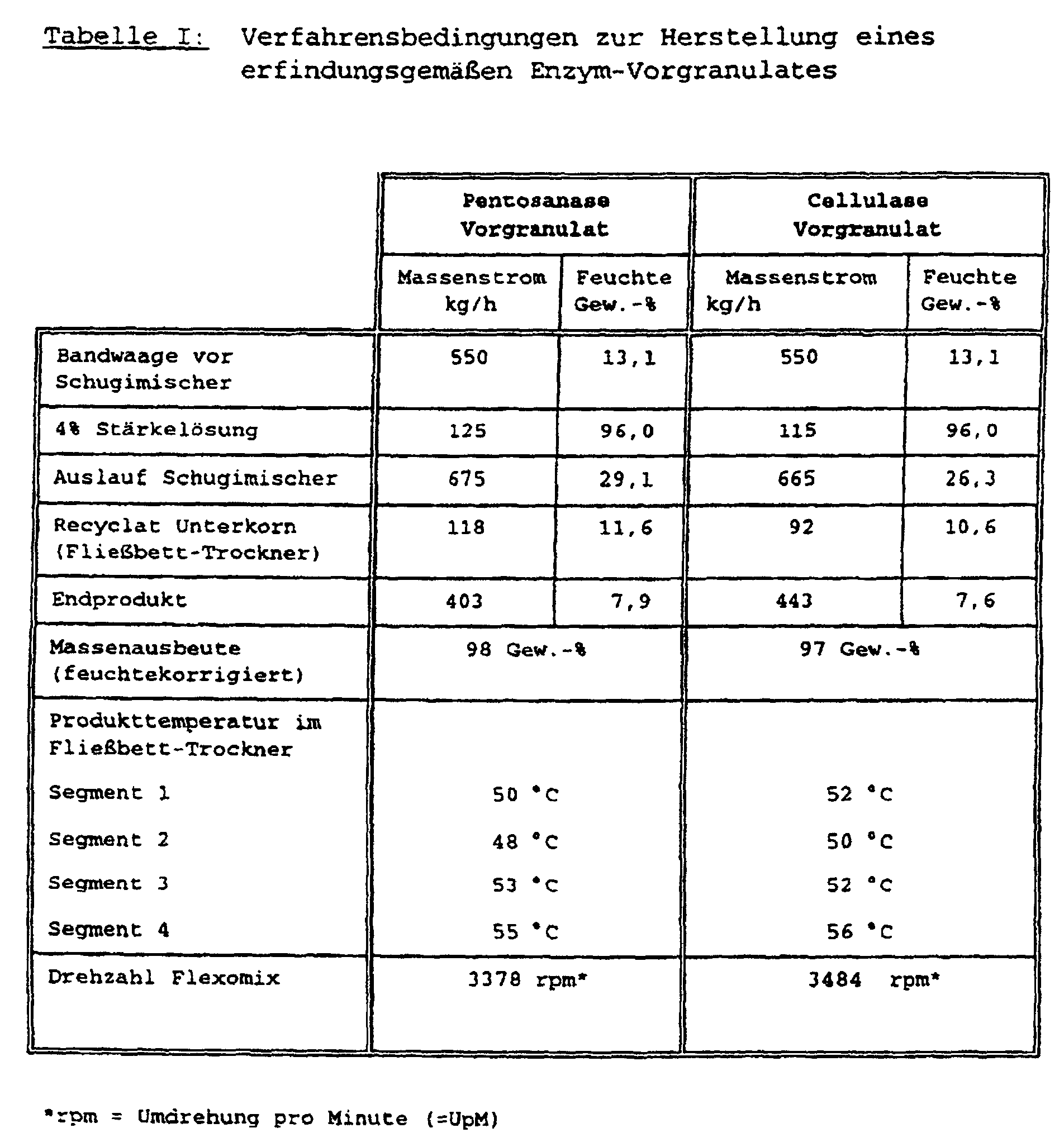
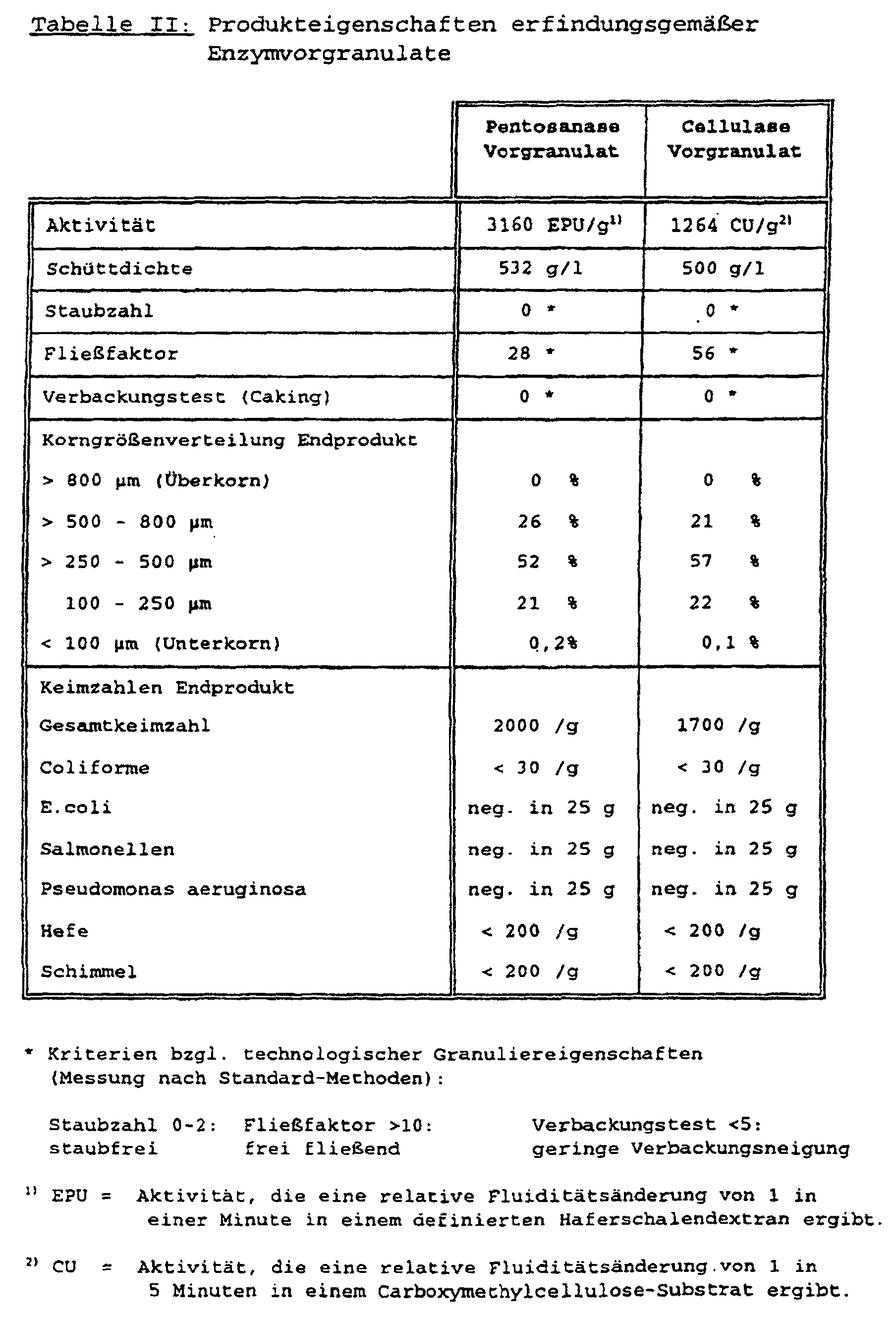
- Further exemplary process conditions are shown in Table I, the product properties of those obtained according to the invention Enzyme pre-granules for incorporation into animal feed granules are shown in Table II.
- enzyme pre-granules with excellent microbiological quality were produced in accordance with the specifications with regard to particle size distribution and activity with very good technological granule properties.
- the enzyme pre-granules produced according to the invention in Example 2 were applied in a pelletizing plant ("Pelletier” plant) mixed into a feed premix, thermally conditioned and then in the extrusion process granulated ("pelleted").
- the typical plant used for compound feed pelleting included a premixer to mix the solid components, a dosing container, a short-term condition for adjustment approx. 3% saturated steam (product temperature 60 to 70 ° C), a pelleting press (product temperature 65 to 80 ° C) and a Abkühlsieb.
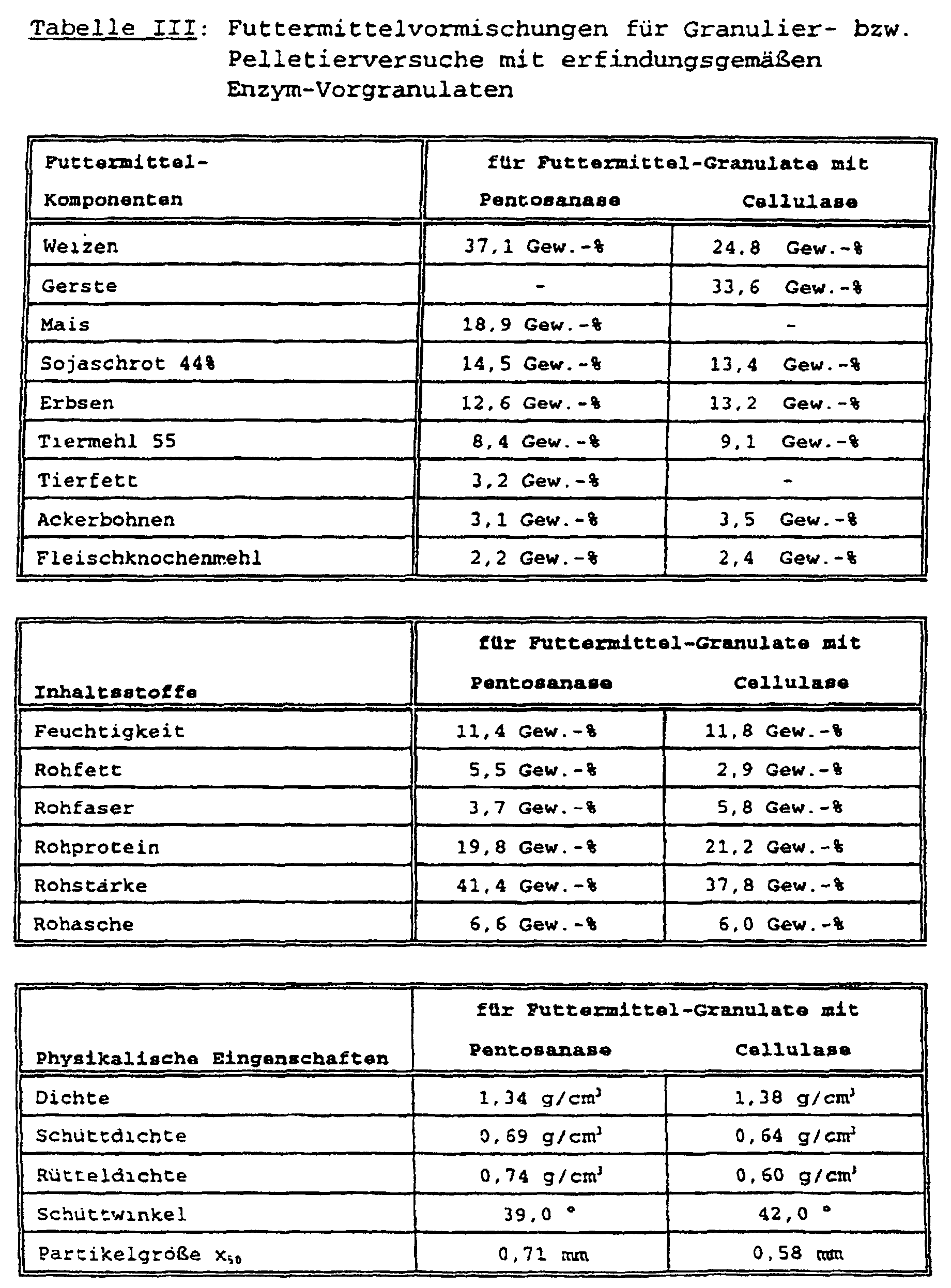
- composition of the feed premixes into which the enzyme pre-granules according to the invention (with pentosanase or cellulase) have been incorporated is given in Table III.
- the measurement and analysis data of the pelleting tests with the given feed premix and pre-granulate according to the invention are shown in Table IV.
- Table IV The measurement and analysis data of the pelleting tests with the given feed premix and pre-granulate according to the invention.
- Enzyme pre-granules were produced in a model system the thermal stability of an enzyme pregranulate according to the invention in a matrix of different animal feeds checked.
- a cellulase or pentosanase pre-granulate with animal feed for poultry (usual ingredients) mixed.
- the enzyme was in a lot of 5 wt .-% introduced into the feed mixture.
- the measurement was carried out as follows: Glass tubes (10x1 cm) were filled with 5 g of the feed mixture and then kept in a thermostatted water bath for a certain time at a certain temperature. After the temperature treatment, the tube was immediately cooled in an ice water bath. The remaining cellulase activity was determined by a colorimetric method using a reference activity standard. This test was based on the enzymatic hydrolysis of the inner beta-1,4-glycosidic bonds of a defined azurin cross-linked cellulose. The recovered activity in% of the originally used activity is shown in Table V for the checked enzymes pentosanase (Table Va) and cellulase (Table Vb).
- cellulase After a treatment of more than one hour at temperatures below 80 ° C with recovered activities over 95%, cellulase proves to be very stable in the feed mixture. Pentosanase also proves to be very temperature stable in the feed mixture at temperatures of 83 ° C and a test duration of 60 minutes with 83% residual activity. In the case of very short periods, for example 5 minutes, even higher residual activities are found (for example almost 100% at 95 ° C., 5 minutes).
- Temperature stability of enzyme pre-granules according to the invention in feed matrix pentosanase as enzyme attempt No. time [Min] temperature [° C] residual activity [%] 1.1 0 70 100 1.2 5 70 130 1.3 33 70 94 1.4 33 70 72 1.5 60 70 81 1.6 60 70 72 2.1 0 78 100 2.2 23 78 102 2.3 42 78 91 3.1 0 83 100 3.2 5 83 119 3.3 5 83 130 3.4 60 83 83 3.5 60 83 89 4.1 0 87 100 4.2 23 87 96 4.3 42 87 89 5.1 0 95 100 5.2 5 95 111 5.3 5 95 120 5.4 23 95 75 5.5 33 95 60 5.6 60 95 47 Temperature stability of enzyme pre-granules according to the invention in feed matrix: cellulase as enzyme attempt No.
Landscapes
- Life Sciences & Earth Sciences (AREA)
- Chemical & Material Sciences (AREA)
- Polymers & Plastics (AREA)
- Zoology (AREA)
- Engineering & Computer Science (AREA)
- Food Science & Technology (AREA)
- Health & Medical Sciences (AREA)
- Organic Chemistry (AREA)
- Wood Science & Technology (AREA)
- Genetics & Genomics (AREA)
- Bioinformatics & Cheminformatics (AREA)
- Biotechnology (AREA)
- General Health & Medical Sciences (AREA)
- Molecular Biology (AREA)
- Microbiology (AREA)
- Medicinal Chemistry (AREA)
- Biochemistry (AREA)
- General Engineering & Computer Science (AREA)
- Biomedical Technology (AREA)
- Animal Husbandry (AREA)
- Fodder In General (AREA)
- Enzymes And Modification Thereof (AREA)
- Meat, Egg Or Seafood Products (AREA)
- Medicinal Preparation (AREA)
- Medicines That Contain Protein Lipid Enzymes And Other Medicines (AREA)
Description
0,01 bis 20 Gew.-Teile Enzym oder Enzymgemisch (berechnet als Trockensubstanzgehalt des eingesetzten Enzympräparates),
80 bis 99,99 Gew.-Teile (inklusive Feuchtegehalt) einer organischen Mehltype mit einem Ausmahlungsgrad von 30 % bis 100 %,
wobei die Mehltype durch Ausmahlen einer, gegebenenfalls zuvor gewaschenen und/oder gereinigten, mit trockenem Heißdampf behandelten Mehlquelle gewonnen wurde,
und wobei sich die Gew.-Teile des Enzyms oder Enzymgemisches und der Mehltype auf 100 Gew.-Teile summieren,
gewünschtenfalls bis zu insgesamt 20 Gew.-Teile Granulierhilfsstoffe (berechnet als wasserfreie Granulierhilfsstoffe),
unter Verwendung einer berechneten Menge Wasser, die zur Einstellung eines Feuchtegehaltes im Feuchtgranulat von 20 bis 50 Gew.-% (bezogen auf die Summe der Bestandteile des Feuchtgranulates als 100 Gew.-%) ausreicht,
in einem Schnellmischer durch intensives Mischen zu einem klebefreien Feuchtgranulat mit gewünschtem Korngrößenbereich aufbaut,
man das derart erhaltene Feuchtgranulat trocknet und nachfolgend gewünschtenfalls noch durch Siebung von Unter- und/oder Überkorn befreit. Der Begriff "klebefrei" bedeutet hierbei, daß das Feuchtgranulat nicht mehr an den Mischeinrichtungen oder der Mischerwand anhaftet.
0,01 bis 10 Gew.-Teile Enzym oder Enzymgemisch, vorzugsweise
2 bis 7 Gew.-Teile Enzym oder Enzymgemisch,
90 bis 99,99 Gew.-Teile Mehltype, vorzugsweise 93 bis
98 Gew.-Teile Mehltype,
gewünschtenfalls bis zu insgesamt 15 Gew.-Teile, vorzugsweise 0,5 bis 5 Gew.-Teile, Granulierhilfsstoffe,
und eine berechnete Menge Wasser einsetzt, die zur Einstellung eines Feuchtegehaltes von 25 bis 40 Gew.-%, vorzugsweise von 25 bis 35 Gew.-%, im Feuchtgranulat ausreicht.
0,08 bis 22 Gew.-% (Trockensubstanz) Enzym oder Enzymgemisch, 55 bis 96,92 Gew.-% (Trockensubstanz ohne Feuchte) einer Mehltype mit einem Ausmahlungsgrad von 30 % bis 100 %, wobei die Mehlytype durch Ausmahlen einer , gegebenenfalls zuvor gewaschenen und/oder gereinigten, mit trockenem Heißdampf behandelten Mehlquelle gewonnen wurde,
gegebenenfalls bis zu insgesamt 18,5 Gew.-% Granulierhilfsstoffe (als wasserfreie Substanz berechnet), und
3 bis 12 Gew.-% Feuchte bestehen,
wobei die Summe der Bestandteile aus Enzym oder Enzymgemisch, Mehl-Trockensubstanz Feuchte und gegebenenfalls Granulierhilfsstoff 100 Gew.-% beträgt.
0,08 bis 11 Gew.-% (Trockensubstanz) Enzym oder Enzymgemisch, 66 bis 96,92 Gew.-% (Trockensubstanz ohne Feuchte) einer Mehltype mit einem Ausmahlungsgrad von 30 % bis 100 %, wobei die Mehlytype durch Ausmahlen mit trockenem Heißdampf behandelten Mehlquelle gewonnen wurde,
gegebenenfalls bis zu insgesamt 14,5 Gew.-% Granulierhilfsstoffe (als wasserfreie Substanz berechnet),
3 bis 12 Gew.-% Feuchte, wobei die Summe der Bestandteile aus Enzym oder Enzymgemisch, Mehl-Trockensubstanz Feuchte und gegebenenfalls Granulierhilfsscoff 100 Gew.-% beträgt.
1,9 bis 7,8 Gew.-% (Trockensubstanz) Enzym oder Enzymgemisch, 76 bis 94,6 Gew.-% (Trockensubstanz ohne Feuchte) einer Mehltype mit einem Ausmahlungsgrad von 30 % bis 100 %, wobei die Mehlytype durch Ausmahlen mit trockenem Heißdampf behandelten Mehlquelle gewonnen wurde,
insgesamt 0,5 bis 5,4 Gew.-% Granulierhilfsstoffe (als wasserfreie Substanz berechnet),
3 bis 12 Gew.-% Feuchte, wobei die Summe der Bestandteile aus Enzym oder Enzymgemisch, Mehl-Trockensubstanz Feuchte und gegebenenfalls Granulierhilfsstoff 100 Gew.-% beträgt.
- dampfbeheizte Vorwärmschnecke, Temperatur ca 40 bis 50 °C;
- wärmeisolierter und kontinuierlich arbeitender Bedämpfer (vertikal stehender konischer Zylinder mit Höhe 5 m; Durchmesser oben ca. 40 cm, unten ca. 60 cm; Temperatur ca. 100 bis 110 °C) ;
- drei Dampf-Ringdüsen im oberen Bereich des Bedämpfers und im unteren Bereich drei vertikal angeordnete Dampflanzen;
- dampfbeheizte Austragsschnecke;
- ein nachgeschalteter Fließbett-Trockner und ein sich daran anschließender Fließbett-Kühler.
| Enzym | Pentosanase-Präparat / Aktivität** | Cellulase-Präparat/ Aktivität | ||
| Pentosanase | 1.030.000 (Leitaktivität) | EU/g | 160.000 | EU/g |
| beca-Glucanase | 350 | EU/g | 720 | EU/g |
| alfa-Amylase | 8.800 | EU/g | 107.000 | EU/g |
| Galactomannanase | 4.300 | EU/g | 13.300 | EU/g |
| Cellulase | 16.000 | EU/g | 30.900 (Leitaktivität) | EU/g |
| Korngröße Bereich | Gew.-%-Anteil (Spezifikation) |
| ≥ 300 µm | ca. 4 |
| < 300 bis ≥ 250 µm | ca. 10 |
| < 250 bis ≥ 200 µm | ca. 10 |
| < 200 bis ≥ 150 µm | ca. 15 |
| < 150 bis ≥ 100 µm | ca. 15 |
| < 100 bis ≥ 50 µm | ca. 20 |
| < 50 µm | ca. 26 |

Glasröhrchen (10x1 cm) wurden mit 5 g der Futtermittel-Mischung befüllt und anschließend in einem thermostatiertem Wasserbad jeweils für eine bestimmte Zeit bei einer bestimmten Temperatur gehalten. Nach der Temperaturbehandlung wurde das Röhrchen sofort in einem Eiswasserbad abgekühlt. Die restliche Cellulaseaktivität wurde durch eine kolorimetrische Methode bestimmt, unter Verwendung eines Referenz-Aktivitäts-Standards. Dieser Test basierte auf der enzymatischen Hydrolyse der inneren Beta-1,4-glykosidischen Bindungen einer definierten Azurin-kreuzvernetzten Cellulose. Die wiedergefundene Aktivität in % der ursprünglich eingesetzten Aktivität ist in Tabelle V für die überprüften Enzyme Pentosanase (Tabelle Va) und Cellulase (Tabelle Vb) wiedergegeben. Hierbei erweist sich Cellulase nach einer Behandlung von über einer Stunde bei Temperaturen unterhalb 80 °C mit wiedergefundenen Aktivitäten über 95 % als sehr stabil in der Futtermittel-Mischung. Auch Pentosanase erweist sich bei Temperaturen von 83 °C und einer Testdauer von 60 Minuten mit 83 % Restaktivität als sehr temperaturstabil in der Futtermittel-Mischung. Bei sehr kurzen Zeiträumen, z.B. 5 Minuten, werden noch höhere Restaktivitäten wiedergefunden (z.B. nahezu 100 % bei 95 °C, 5 Minuten).
| Temperaturstabilität erfindungsgemäßer Enzym-Vorgranulate in Futtermittel-Matrix: Pentosanase als Enzym | |||
| Versuch Nr. | Zeit [min] | Temperatur [°C] | Restaktivität [%] |
| 1.1 | 0 | 70 | 100 |
| 1.2 | 5 | 70 | 130 |
| 1.3 | 33 | 70 | 94 |
| 1.4 | 33 | 70 | 72 |
| 1.5 | 60 | 70 | 81 |
| 1.6 | 60 | 70 | 72 |
| 2.1 | 0 | 78 | 100 |
| 2.2 | 23 | 78 | 102 |
| 2.3 | 42 | 78 | 91 |
| 3.1 | 0 | 83 | 100 |
| 3.2 | 5 | 83 | 119 |
| 3.3 | 5 | 83 | 130 |
| 3.4 | 60 | 83 | 83 |
| 3.5 | 60 | 83 | 89 |
| 4.1 | 0 | 87 | 100 |
| 4.2 | 23 | 87 | 96 |
| 4.3 | 42 | 87 | 89 |
| 5.1 | 0 | 95 | 100 |
| 5.2 | 5 | 95 | 111 |
| 5.3 | 5 | 95 | 120 |
| 5.4 | 23 | 95 | 75 |
| 5.5 | 33 | 95 | 60 |
| 5.6 | 60 | 95 | 47 |
| Temperaturstabilität erfindungsgemäßer Enzym-Vorgranulate in Futtermittel-Matrix: Cellulase als Enzym | |||
| Versuch Nr. | Zeit [min] | Temperatur [°C] | Restaktivität [%] |
| 1.1 | 0 | 70 | 100 |
| 1.2 | 5 | 70 | 110 |
| 1.3 | 33 | 70 | 98 |
| 1.4 | 33 | 70 | 98 |
| 1.5 | 60 | 70 | 94 |
| 1.6 | 60 | 70 | 103 |
| 2.1 | 0 | 78 | 100 |
| 2.2 | 23 | 78 | 97 |
| 2.3 | 42 | 78 | 93 |
| 3.1 | 0 | 83 | 100 |
| 3.2 | 5 | 83 | 102 |
| 3.3 | 5 | 83 | 105 |
| 3.4 | 60 | 83 | 91 |
| 3.5 | 60 | 83 | 86 |
| 4.1 | 0 | 87 | 100 |
| 4.2 | 23 | 87 | 88 |
| 4.3 | 42 | 87 | 87 |
| 5.1 | 0 | 95.5 | 100 |
| 5.2 | 5 | 95.5 | 96 |
| 5.3 | 5 | 95.5 | 99 |
| 5.4 | 23 | 95.5 | 91 |
| 5.5 | 33 | 95.5 | 71 |
| 5.6 | 60 | 95.5 | 65 |
Claims (21)
- Verfahren zur Herstellung eines aktivitätsstabilen Enzymgranulates zur Einarbeitung in Teilchen eines Tierfuttermittels, dadurch gekennzeichnet, daß das Verfahren die folgenden Schritte a-e umfaßt:a) eine Mehlquelle wird mit trockenem Heißdampf behandeltb) diese Mehlquelle wird gemahlen, bis eine organische Mehltype mit einem Ausmahlungsgrad von 30 bis 100 Gew.% erhalten wirdc) eine Mischung wird bereitet durch Mischen von 80 bis 99,99 Gew.-Teilen inklusive Feuchtegehalt der organischen Mehltype mit 0,01 bis 20 Gew.-Teilen eines Enzyms oder Enzymgemisches, berechnet als Trockensubstanzgehalt des eingesetzten Enzympräperates, wobei sich die Gew.-Teile des Enzyms oder Enzymgemisches und der Mehltype auf 100 Gew.-Teile summierend) diese Mischung wird durch Zugabe von Wasser und/oder bis zu 20 Gew.-% Granulierhilfsstoffen und/oder einer wäßrigen Lösung eines Enzyms oder Enzymgemisches auf einen Gesamtfeuchtegehalt von 20 bis 50 Gew.% eingestellte) das derart erhaltene Feuchtgranulat wird getrocknet.
- Verfahren nach Anspruch 1, dadurch gekennzeichnet, daß zur Gewinnung der organischen Mehltype als Mehlquelle Getreidekömer, Leguminosenfrüchte und/oder Früchte der Familie Malvaceae eingesetzt werden.
- Verfahren nach Anspruch 1, dadurch gekennzeichnet, daß im Schritt a) die Behandlung der Mehlquelle mit trockenem Heißdampf mit einer Temperatur von insbesondere 100 bis etwa 110°C unter annähernd Normaldruck bis leichtem Überdruck und einer Behandlungsdauer von bis zu etwa 1 Stunde durchgeführt wurde.
- Verfahren nach Anspruch 1, dadurch gekennzeichnet, daß im Schritt b) der Ausmahlungsgrad der Mehltype 30 bis 100%, vorzugsweise 50 bis 100%, besonders bevorzugt 70 bis 100% beträgt.
- Verfahren nach Anspruch 1, dadurch gekennzeichnet, daß man im Schritt c) 0,01 bis 10 Gew.-Teile Enzym oder Enzymgemisch mit 90 bis 99,99 Gew.-Teile der organischen Mehltype mischt.
- Verfahren nach Anspruch 5 dadurch gekennzeichnet, daß man im Schritt c) vorzugsweise 2 bis 7 Gew.-Teile Enzym oder Enzymgemisch mit vorzugsweise 93 bis 98 Gew.-Teile der organischen Mehltype mischt.
- Verfahren nach Anspruch 1, dadurch gekennzeichnet, daß man im Schritt d) die Mischung durch Zugabe von Wasser und/oder Granulierhilfsstoffen und/oder einer wäßrigen Lösung eines Enzyms oder Enzymgemisches auf einen Gesamtfeuchtegehalt von 25 bis 40 Gew.%, vorzugsweise von 25 bis 35 Gew.-% eingestellt.
- Verfahren nach Anspruch 1, dadurch gekennzeichnet, daß das Enzym oder Enzymgemisch in Form eines Pulvers oder einer wäßrigen Lösung des Enzyms oder Enzymgemisches eingesetzt wird.
- Verfahren nach Anspruch 1, dadurch gekennzeichnet, daß das Enzym oder Enzymgemisch eine Hydrolase, vorzugsweise aus der Gruppe der Carbohydrasen, Proteasen, Lipasen und Esterasen, oder eine Oxinitrilase, Tannase, Chitinase, Keratinase, Oxidase oder ein Gemisch dieser Enzyme ist.
- Verfahren nach Anspruch 9, dadurch gekennzeichnet, daß ein Enzym mit Nebenaktivitäten oder ein Enzymgemisch eingesetzt wird.
- Verfahren nach Anspruch 9, dadurch gekennzeichnet, daß die Carbohydrasen ausgewählt sind aus β-Glucanasen, Cellulasen, Amylasen, Pentosanasen, Pectinasen, Xylanasen, Arabanasen, Hemicellulasen, Galactomannasen, Polygalacturonasen, Phytasen, Glucoamylasen, α-Galactsidasen, Pullulanasen, Driselase®.
- Verfahren nach Anspruch 9, dadurch gekennzeichnet, daß die Oxidase eine Glucoseoxidase oder Peroxidase ist.
- Verfahren nach Anspruch 9, dadurch gekennzeichnet, daß das Enzym Lysozym oder Muramidase ist.
- Verfahren nach Anspruch 1, dadurch gekennzeichnet, daß man im Schritt d) bis zu insgesamt 20 Gew.-Teile, vorzugsweise 15 Gew.-Teile insbesondere 0,5 bis 5 Gew.-Teile Granulierhilfsstoffe zugibt.
- Verfahren nach Anspruch 1, dadurch gekennzeichnet, daß als Granulierhilfsstoffe enzym- und ernährungsphysiologisch verträgliche Bindemittel, Füllstoffe und/oder organische Lösungsmittel natürlichen Ursprungs eingesetzt werden.
- Verfahren nach Anspruch 15, dadurch gekennzeichnet, daß als Bindemittel abgebaute lösliche Stärke und/oder Weizenkleber eingesetzt wird.
- Verfahren nach Anspruch 1, dadurch gekennzeichnet, daß man ein Feuchtgranulat mit einem Komgrößenbereich von 50 bis 800 µm, vorzugsweise von 100 bis 800 um, insbesondere von 100 bis 500 µm aufbaut.
- Verfahren nach Anspruch 1, dadurch gekennzeichnet, daß man die in pulvriger Form vorgemischt vorliegenden Bestandteile für das Enzymgranulat satzweise oder kontinuierlich in den Schnellmischer zuführt und dort ebenfalls satzweise oder kontinuierlich eine zur Einstellung des Feuchtegehaltes geeignete Menge Wasser oder eine wäßrige Lösung, gegebenenfalls mit darin gelösten Granulierhilfsstoffen oder darin gelöstem Enzym oder Enzymgemisch zudosiert und man nach vorgegebener Verweildauer das Enzym-Feuchtgranulat aus dem Schnellmischer entnimmt oder kontinuierlich abzieht.
- Aktivitätsstabiles Enzym-Vorgranulat zur Einarbeitung in Teilchen eines Tierfuttermittel-Granulates, darurch gekennzeichnet, daß das Enzym-Vorgranulat nach einem Verfahren der Ansprüche 1 bis 18 erhältlich ist.
- Enzymgranulat nach Anspruch 19, dadurch gekennzeichnet, daß es aus 0,08 bis 22 Gew.-% Trockensubstanz des Enzyms oder Enzymgemisches, 55 bis 96,92 Gew.-% Trockensubstanz der organischen Mehltype, gegebenenfalls bis zu insgesamt 18,5 Gew.-% Granulierhilfsstoffen (als wasserfreie Substanz berechnet) mit 3 bis 12 Gew.-% Feuchte besteht, wobei die Summe der Bestandteile aus Enzym oder Enzymgemisch, Mehl-Trockensubstanz, Feuchte und gegebenenfalls Granulierhilfsstoff 100 Gew.-% beträgt.
- Verwendung von Enzym-Vorgranulaten, gemäß einer der Ansprüche 19 oder 20 zur Herstellung von Tierfuttermittel-Granulaten, vorzugsweise derart, daß die Enzym-Vorgranulate in übliche Tierfuttermittelbestandteile eingemischt und diese Mischung durch Extrusion zu einem homogenen Tierfuttermittel-Granulat verarbeitet wird.
Applications Claiming Priority (3)
| Application Number | Priority Date | Filing Date | Title |
|---|---|---|---|
| DE19619219A DE19619219A1 (de) | 1996-05-13 | 1996-05-13 | Enzym-Vorgranulat für Tierfuttermittel-Granulate |
| DE19619219 | 1996-05-13 | ||
| PCT/EP1997/002306 WO1997042837A1 (de) | 1996-05-13 | 1997-05-06 | Enzym-vorgranulat für tierfuttermittel-granulate |
Publications (3)
| Publication Number | Publication Date |
|---|---|
| EP0917430A1 EP0917430A1 (de) | 1999-05-26 |
| EP0917430B1 true EP0917430B1 (de) | 2003-02-19 |
| EP0917430B2 EP0917430B2 (de) | 2008-03-12 |
Family
ID=7794166
Family Applications (1)
| Application Number | Title | Priority Date | Filing Date |
|---|---|---|---|
| EP97922981A Expired - Lifetime EP0917430B2 (de) | 1996-05-13 | 1997-05-06 | Enzym-vorgranulat für tierfuttermittel-granulate |
Country Status (16)
| Country | Link |
|---|---|
| US (1) | US6221406B1 (de) |
| EP (1) | EP0917430B2 (de) |
| JP (1) | JP3782828B2 (de) |
| AT (1) | ATE232687T1 (de) |
| AU (1) | AU2892297A (de) |
| BG (1) | BG64034B1 (de) |
| CZ (1) | CZ365898A3 (de) |
| DE (2) | DE19619219A1 (de) |
| DK (1) | DK0917430T3 (de) |
| ES (1) | ES2192681T5 (de) |
| NO (1) | NO320976B1 (de) |
| PL (1) | PL185296B1 (de) |
| PT (1) | PT917430E (de) |
| SK (1) | SK155098A3 (de) |
| TR (1) | TR199802287T2 (de) |
| WO (1) | WO1997042837A1 (de) |
Families Citing this family (20)
| Publication number | Priority date | Publication date | Assignee | Title |
|---|---|---|---|---|
| TW409035B (en) * | 1997-06-04 | 2000-10-21 | Gist Brocades Bv | Starch-based enzyme granulates |
| BR9809919B1 (pt) * | 1997-06-04 | 2010-05-18 | granulado de fitase, seu uso, composição compreendendo o mesmo, processo de preparação de ração de animal, pré-mistura ou precursor de ração de animal, e processo não terapêutico de promoção do crescimento de animal. | |
| DE19922753A1 (de) * | 1999-05-18 | 2000-11-23 | Basf Ag | Enzym-Instantformulierungen für die Tierernährung |
| WO2001004279A1 (en) * | 1999-07-09 | 2001-01-18 | Novozymes A/S | A process for preparing an enzyme containing granule |
| US6399123B1 (en) * | 2000-05-25 | 2002-06-04 | University Of Missouri Board Of Curators | Oligosaccharide removal from animal feed |
| DE10105306A1 (de) * | 2001-02-02 | 2002-08-22 | Nutrinova Gmbh | Futtermittel für die Nutztieraufzucht enthaltend Sorbinsäure und Enzyme |
| DE10157069A1 (de) * | 2001-11-12 | 2003-05-28 | Ipc Process Ct Gmbh | Tiernahrungsergänzungsmittel und Verfahren zu seiner Herstellung |
| AU2003298543C1 (en) * | 2002-08-09 | 2011-06-02 | Bioresource International, Inc. | Methods and compositions for improving growth of meat-type poultry |
| DK2341136T3 (en) * | 2003-04-04 | 2016-09-12 | Basf Enzymes Llc | Pectate lyases, nucleic acids encoding them, and methods of making and using them |
| US20070031555A1 (en) * | 2005-08-05 | 2007-02-08 | Axelrod Glen S | Direct starch molding |
| US20080241343A1 (en) * | 2007-03-28 | 2008-10-02 | California Natural Products | Lupin food product base and processes |
| US10980244B2 (en) | 2008-11-04 | 2021-04-20 | The Quaker Oats Company | Whole grain composition comprising hydrolyzed starch |
| US10689678B2 (en) * | 2008-11-04 | 2020-06-23 | The Quaker Oats Company | Method and composition comprising hydrolyzed starch |
| ITMI20091406A1 (it) * | 2009-08-03 | 2011-02-04 | Biotecnologie B T S R L | Produzione di pellet contenenti sostanze termolabili |
| GB201102857D0 (en) * | 2011-02-18 | 2011-04-06 | Danisco | Feed additive composition |
| BR112013024263A2 (pt) | 2011-03-21 | 2016-12-27 | Pepsico Inc | método para preparar bebidas de grãos inteiros com alto ácido rdt |
| BR112014002956A8 (pt) | 2011-07-12 | 2022-09-06 | Pepsico Inc | Método de preparar uma bebida láctea contendo aveia |
| JP6240019B2 (ja) * | 2014-04-01 | 2017-11-29 | 日清製粉株式会社 | 麺類の製造方法 |
| US20170275662A1 (en) | 2016-03-22 | 2017-09-28 | The Quaker Oats Company | Method and Apparatus for Controlled Hydrolysis |
| US11172695B2 (en) | 2016-03-22 | 2021-11-16 | The Quaker Oats Company | Method, apparatus, and product providing hydrolyzed starch and fiber |
Family Cites Families (16)
| Publication number | Priority date | Publication date | Assignee | Title |
|---|---|---|---|---|
| US3869558A (en) * | 1970-10-26 | 1975-03-04 | Ogilvie Flour Mills Company Li | Process for making a free flowing flour |
| US3764708A (en) * | 1971-08-11 | 1973-10-09 | Kikkoman Shoyu Co Ltd | Method of preparing soy and miso-paste |
| JPS62269685A (ja) | 1986-05-15 | 1987-11-24 | Showa Denko Kk | 酵素粒剤 |
| FI77359C (fi) * | 1986-08-22 | 1989-03-10 | Suomen Sokeri Oy | Foderfix och foerfarande foer framstaellning av densamma. |
| DK80588A (da) † | 1987-02-23 | 1988-08-24 | Suomen Sokeri Oy | Fjerkrae-foder, fodringsmetode og fremgangsmaade til forbedring af fordoejeligheden af fjerkrae-foder |
| US4903414A (en) * | 1988-07-25 | 1990-02-27 | Ve Holding Corp. | High pressure conditioning system |
| FR2678145B1 (fr) * | 1991-06-28 | 1993-09-03 | Rhone Poulenc Nutrition Animal | Compositions sous forme de pellets contenant des principes actifs non proteges vis a vis de la panse des ruminants associes a des principes actifs proteges contre la degradation dans la panse des ruminants. |
| DE4041752A1 (de) * | 1990-12-24 | 1992-06-25 | Henkel Kgaa | Enzymzubereitung fuer wasch- und reinigungsmittel |
| DK13491D0 (da) * | 1991-01-25 | 1991-01-25 | Novo Nordisk As | Anvendelse af et enzymholdigt granulat og fremgangsmaade til fremstilling af et forderstof i tabletform |
| DE69101434T2 (de) * | 1991-05-29 | 1994-06-23 | Nestle Sa | Verfahren zur Erzeugung pasteurisierter Granulate aus Getreidemehl. |
| DE4310506A1 (de) † | 1993-03-31 | 1994-10-06 | Cognis Bio Umwelt | Enzymzubereitung für Wasch- und Reinigungsmittel |
| FR2714575B1 (fr) | 1994-01-03 | 1996-02-02 | Rhone Poulenc Nutrition Animal | Nouveaux granulés contenant des organismes vivant pour l'alimentation animale. |
| CA2231667C (en) † | 1995-10-06 | 2007-08-21 | Genencor International, Inc. | Microgranule for food/feed applications |
| JPH11514240A (ja) * | 1995-11-02 | 1999-12-07 | ノボ ノルディスク アクティーゼルスカブ | 飼料酵素調製品 |
| DE19619221A1 (de) * | 1996-05-13 | 1997-11-20 | Solvay Enzymes Gmbh & Co Kg | Enzymgranulat für Wasch- und Reinigungsanwendungen |
| DE19619222A1 (de) * | 1996-05-13 | 1997-11-20 | Solvay Enzymes Gmbh & Co Kg | Enzymgranulat für lebensmitteltechnologische Anwendungen |
-
1996
- 1996-05-13 DE DE19619219A patent/DE19619219A1/de not_active Withdrawn
-
1997
- 1997-05-06 DK DK97922981T patent/DK0917430T3/da active
- 1997-05-06 TR TR1998/02287T patent/TR199802287T2/xx unknown
- 1997-05-06 EP EP97922981A patent/EP0917430B2/de not_active Expired - Lifetime
- 1997-05-06 PL PL97329939A patent/PL185296B1/pl unknown
- 1997-05-06 JP JP54046997A patent/JP3782828B2/ja not_active Expired - Fee Related
- 1997-05-06 AU AU28922/97A patent/AU2892297A/en not_active Abandoned
- 1997-05-06 CZ CZ983658A patent/CZ365898A3/cs unknown
- 1997-05-06 WO PCT/EP1997/002306 patent/WO1997042837A1/de not_active Ceased
- 1997-05-06 PT PT97922981T patent/PT917430E/pt unknown
- 1997-05-06 US US09/180,617 patent/US6221406B1/en not_active Expired - Lifetime
- 1997-05-06 AT AT97922981T patent/ATE232687T1/de not_active IP Right Cessation
- 1997-05-06 DE DE59709356T patent/DE59709356D1/de not_active Expired - Lifetime
- 1997-05-06 ES ES97922981T patent/ES2192681T5/es not_active Expired - Lifetime
- 1997-05-06 SK SK1550-98A patent/SK155098A3/sk unknown
-
1998
- 1998-11-02 NO NO19985115A patent/NO320976B1/no not_active IP Right Cessation
- 1998-11-03 BG BG102891A patent/BG64034B1/bg unknown
Also Published As
| Publication number | Publication date |
|---|---|
| ATE232687T1 (de) | 2003-03-15 |
| ES2192681T3 (es) | 2003-10-16 |
| EP0917430A1 (de) | 1999-05-26 |
| BG64034B1 (bg) | 2003-11-28 |
| PL329939A1 (en) | 1999-04-26 |
| EP0917430B2 (de) | 2008-03-12 |
| PL185296B1 (pl) | 2003-04-30 |
| US6221406B1 (en) | 2001-04-24 |
| DE19619219A1 (de) | 1997-12-04 |
| JP2002502236A (ja) | 2002-01-22 |
| AU2892297A (en) | 1997-12-05 |
| NO320976B1 (no) | 2006-02-20 |
| NO985115D0 (no) | 1998-11-02 |
| TR199802287T2 (xx) | 1999-02-22 |
| DE59709356D1 (de) | 2003-03-27 |
| NO985115L (no) | 1998-11-02 |
| DK0917430T3 (da) | 2003-06-10 |
| ES2192681T5 (es) | 2008-08-16 |
| CZ365898A3 (cs) | 1999-02-17 |
| BG102891A (en) | 1999-09-30 |
| PT917430E (pt) | 2003-07-31 |
| JP3782828B2 (ja) | 2006-06-07 |
| WO1997042837A1 (de) | 1997-11-20 |
| SK155098A3 (en) | 1999-04-13 |
Similar Documents
| Publication | Publication Date | Title |
|---|---|---|
| EP0917430B2 (de) | Enzym-vorgranulat für tierfuttermittel-granulate | |
| DE69201952T2 (de) | Verwendung eines enzymhaltigen granulates und verfahren zur herstellung von einem pelletisierten futter. | |
| DE69332027T2 (de) | Methode zur stabilisierung von reiskleie und reiskleieprodukten | |
| EP1996028B1 (de) | Feste enymformulierungen und verfahren zu deren herstellung | |
| DE69333071T2 (de) | Phytate-Hydrolyse und enzymatische Zusammensetzung für die Hydrolyse von Phytat | |
| DE69835815T2 (de) | Auf stärke basierte phospatase-granulate | |
| DE19619221A1 (de) | Enzymgranulat für Wasch- und Reinigungsanwendungen | |
| EP1926393B1 (de) | Phytasehaltiges enzymgranulat i | |
| DE3751325T2 (de) | Vormischungszusammensetzung und ihr Herstellungsverfahren. | |
| EP1928260B1 (de) | Phytasehaltiges enzymgranulat ii | |
| CH625943A5 (en) | Process for preparing enzyme-containing animal feeds. | |
| DE3886799T2 (de) | Verfahren zum Behandeln von rohem Futtermaterial, rohes Futtermaterial und Futtermischung. | |
| DE19619222A1 (de) | Enzymgranulat für lebensmitteltechnologische Anwendungen | |
| DE2643093C3 (de) | Herstellung von Futtermitteln oder Futtermittelzusätzen | |
| DE3141174A1 (de) | Verfahren zur herstellung von mitteln zur verwendung in der lebensmittelindustrie und fuer futterzwecke durch verarbeiten von cyanhaltigen tropischen knollenpflanzen | |
| EP1033078A1 (de) | Verfahren zur hydrothermischen Behandlung von Futtermitteln | |
| EP1933636A1 (de) | Enzymhaltige granulate für futtermittel | |
| DE2745035A1 (de) | Als futtermittelzusatz verwendbares zinkbacitracinpraeparat und verfahren zu seiner herstellung | |
| DE2234819A1 (de) | Verfahren zur herstellung von in der landwirtschaft einsetzbaren stickstoff langsam freisetzenden produkten | |
| DE4036960C1 (de) | ||
| DE68905955T2 (de) | Verfahren zur herstellung von einem basismaterial fuer rinderfutter und nach diesem verfahren hergestelltes basismaterial. | |
| JPS626641A (ja) | ウサギ、モルモツト用飼料 | |
| CH651450A5 (en) | Process for the preparation of feed additives | |
| DD266728A1 (de) | Futtermittelaufschlussverfahren fuer getreide und koernerfruechte | |
| RU98122651A (ru) | Грануляты с ферментами для введения в состав гранулированных кормов для животных |
Legal Events
| Date | Code | Title | Description |
|---|---|---|---|
| PUAI | Public reference made under article 153(3) epc to a published international application that has entered the european phase |
Free format text: ORIGINAL CODE: 0009012 |
|
| 17P | Request for examination filed |
Effective date: 19981214 |
|
| AK | Designated contracting states |
Kind code of ref document: A1 Designated state(s): AT BE CH DE DK ES FI FR GB GR IE IT LI LU NL PT SE |
|
| AX | Request for extension of the european patent |
Free format text: RO PAYMENT 19981214;SI PAYMENT 19981214 |
|
| RAP1 | Party data changed (applicant data changed or rights of an application transferred) |
Owner name: AKZO NOBEL N.V. |
|
| 17Q | First examination report despatched |
Effective date: 20010330 |
|
| GRAH | Despatch of communication of intention to grant a patent |
Free format text: ORIGINAL CODE: EPIDOS IGRA |
|
| GRAH | Despatch of communication of intention to grant a patent |
Free format text: ORIGINAL CODE: EPIDOS IGRA |
|
| GRAH | Despatch of communication of intention to grant a patent |
Free format text: ORIGINAL CODE: EPIDOS IGRA |
|
| GRAA | (expected) grant |
Free format text: ORIGINAL CODE: 0009210 |
|
| AK | Designated contracting states |
Designated state(s): AT BE CH DE DK ES FI FR GB GR IE IT LI LU NL PT SE |
|
| AX | Request for extension of the european patent |
Extension state: RO SI |
|
| REG | Reference to a national code |
Ref country code: GB Ref legal event code: FG4D Free format text: NOT ENGLISH |
|
| REG | Reference to a national code |
Ref country code: CH Ref legal event code: EP |
|
| REG | Reference to a national code |
Ref country code: IE Ref legal event code: FG4D Free format text: GERMAN |
|
| REF | Corresponds to: |
Ref document number: 59709356 Country of ref document: DE Date of ref document: 20030327 Kind code of ref document: P |
|
| REG | Reference to a national code |
Ref country code: CH Ref legal event code: NV Representative=s name: ISLER & PEDRAZZINI AG |
|
| GBT | Gb: translation of ep patent filed (gb section 77(6)(a)/1977) |
Effective date: 20030507 |
|
| REG | Reference to a national code |
Ref country code: SE Ref legal event code: TRGR |
|
| REG | Reference to a national code |
Ref country code: DK Ref legal event code: T3 |
|
| REG | Reference to a national code |
Ref country code: GR Ref legal event code: EP Ref document number: 20030401739 Country of ref document: GR |
|
| ET | Fr: translation filed | ||
| REG | Reference to a national code |
Ref country code: ES Ref legal event code: FG2A Ref document number: 2192681 Country of ref document: ES Kind code of ref document: T3 |
|
| PLBQ | Unpublished change to opponent data |
Free format text: ORIGINAL CODE: EPIDOS OPPO |
|
| PLBI | Opposition filed |
Free format text: ORIGINAL CODE: 0009260 |
|
| PLAX | Notice of opposition and request to file observation + time limit sent |
Free format text: ORIGINAL CODE: EPIDOSNOBS2 |
|
| 26 | Opposition filed |
Opponent name: BASF AKTIENGESELLSCHAFT Effective date: 20031119 |
|
| NLR1 | Nl: opposition has been filed with the epo |
Opponent name: BASF AKTIENGESELLSCHAFT |
|
| PLAX | Notice of opposition and request to file observation + time limit sent |
Free format text: ORIGINAL CODE: EPIDOSNOBS2 |
|
| PLAX | Notice of opposition and request to file observation + time limit sent |
Free format text: ORIGINAL CODE: EPIDOSNOBS2 |
|
| PLBB | Reply of patent proprietor to notice(s) of opposition received |
Free format text: ORIGINAL CODE: EPIDOSNOBS3 |
|
| RIN2 | Information on inventor provided after grant (corrected) |
Inventor name: SOMMER, MARIO Inventor name: KONIECZNY-JANDA, GERHARD Inventor name: SANDER, VERA Inventor name: SPANNAGEL, ROLF Inventor name: HERMANN, HUBERT Inventor name: MESCHONAT, BEATE |
|
| RAP2 | Party data changed (patent owner data changed or rights of a patent transferred) |
Owner name: BIOVET JSC |
|
| REG | Reference to a national code |
Ref country code: CH Ref legal event code: PUE Owner name: BIOVET JSC Free format text: AKZO NOBEL N.V.#VELPERWEG 76#6824 BM ARNHEM (NL) -TRANSFER TO- BIOVET JSC#39, PETAR RACKOV STREET#4550 PESHTERA (BG) |
|
| REG | Reference to a national code |
Ref country code: GB Ref legal event code: 732E |
|
| REG | Reference to a national code |
Ref country code: PT Ref legal event code: PC4A Owner name: BIOVET JOINT STOCK COMPANY, BG Effective date: 20060707 |
|
| NLT2 | Nl: modifications (of names), taken from the european patent patent bulletin |
Owner name: BIOVET JSC Effective date: 20060712 |
|
| NLS | Nl: assignments of ep-patents |
Owner name: BIOVET JSC Effective date: 20060707 |
|
| REG | Reference to a national code |
Ref country code: ES Ref legal event code: PC2A |
|
| REG | Reference to a national code |
Ref country code: FR Ref legal event code: TP |
|
| REG | Reference to a national code |
Ref country code: CH Ref legal event code: PCAR Free format text: ISLER & PEDRAZZINI AG;POSTFACH 1772;8027 ZUERICH (CH) |
|
| PUAH | Patent maintained in amended form |
Free format text: ORIGINAL CODE: 0009272 |
|
| STAA | Information on the status of an ep patent application or granted ep patent |
Free format text: STATUS: PATENT MAINTAINED AS AMENDED |
|
| 27A | Patent maintained in amended form |
Effective date: 20080312 |
|
| AK | Designated contracting states |
Kind code of ref document: B2 Designated state(s): AT BE CH DE DK ES FI FR GB GR IE IT LI LU NL PT SE |
|
| AX | Request for extension of the european patent |
Extension state: RO SI |
|
| REG | Reference to a national code |
Ref country code: CH Ref legal event code: AEN Free format text: AUFRECHTERHALTUNG DES PATENTES IN GEAENDERTER FORM |
|
| NLR2 | Nl: decision of opposition |
Effective date: 20080312 |
|
| REG | Reference to a national code |
Ref country code: SE Ref legal event code: RPEO |
|
| GBTA | Gb: translation of amended ep patent filed (gb section 77(6)(b)/1977) |
Effective date: 20080430 |
|
| PLAB | Opposition data, opponent's data or that of the opponent's representative modified |
Free format text: ORIGINAL CODE: 0009299OPPO |
|
| REG | Reference to a national code |
Ref country code: GR Ref legal event code: EP Ref document number: 20080401477 Country of ref document: GR |
|
| PGFP | Annual fee paid to national office [announced via postgrant information from national office to epo] |
Ref country code: DK Payment date: 20080526 Year of fee payment: 12 |
|
| NLR3 | Nl: receipt of modified translations in the netherlands language after an opposition procedure | ||
| REG | Reference to a national code |
Ref country code: ES Ref legal event code: DC2A Date of ref document: 20080611 Kind code of ref document: T5 |
|
| ET3 | Fr: translation filed ** decision concerning opposition | ||
| PG25 | Lapsed in a contracting state [announced via postgrant information from national office to epo] |
Ref country code: DK Free format text: LAPSE BECAUSE OF FAILURE TO SUBMIT A TRANSLATION OF THE DESCRIPTION OR TO PAY THE FEE WITHIN THE PRESCRIBED TIME-LIMIT Effective date: 20080612 |
|
| PGFP | Annual fee paid to national office [announced via postgrant information from national office to epo] |
Ref country code: PT Payment date: 20100301 Year of fee payment: 14 Ref country code: IE Payment date: 20100218 Year of fee payment: 14 |
|
| PGFP | Annual fee paid to national office [announced via postgrant information from national office to epo] |
Ref country code: LU Payment date: 20100429 Year of fee payment: 14 |
|
| PGFP | Annual fee paid to national office [announced via postgrant information from national office to epo] |
Ref country code: FI Payment date: 20100518 Year of fee payment: 14 |
|
| PGFP | Annual fee paid to national office [announced via postgrant information from national office to epo] |
Ref country code: AT Payment date: 20100323 Year of fee payment: 14 |
|
| PGFP | Annual fee paid to national office [announced via postgrant information from national office to epo] |
Ref country code: CH Payment date: 20100603 Year of fee payment: 14 |
|
| PGFP | Annual fee paid to national office [announced via postgrant information from national office to epo] |
Ref country code: SE Payment date: 20100518 Year of fee payment: 14 |
|
| REG | Reference to a national code |
Ref country code: PT Ref legal event code: MM4A Free format text: LAPSE DUE TO NON-PAYMENT OF FEES Effective date: 20111107 |
|
| REG | Reference to a national code |
Ref country code: CH Ref legal event code: PL |
|
| REG | Reference to a national code |
Ref country code: SE Ref legal event code: EUG |
|
| PG25 | Lapsed in a contracting state [announced via postgrant information from national office to epo] |
Ref country code: PT Free format text: LAPSE BECAUSE OF NON-PAYMENT OF DUE FEES Effective date: 20111107 Ref country code: LI Free format text: LAPSE BECAUSE OF NON-PAYMENT OF DUE FEES Effective date: 20110531 Ref country code: FI Free format text: LAPSE BECAUSE OF NON-PAYMENT OF DUE FEES Effective date: 20110506 Ref country code: CH Free format text: LAPSE BECAUSE OF NON-PAYMENT OF DUE FEES Effective date: 20110531 |
|
| REG | Reference to a national code |
Ref country code: AT Ref legal event code: MM01 Ref document number: 232687 Country of ref document: AT Kind code of ref document: T Effective date: 20110506 |
|
| PG25 | Lapsed in a contracting state [announced via postgrant information from national office to epo] |
Ref country code: AT Free format text: LAPSE BECAUSE OF NON-PAYMENT OF DUE FEES Effective date: 20110506 |
|
| REG | Reference to a national code |
Ref country code: IE Ref legal event code: MM4A |
|
| PG25 | Lapsed in a contracting state [announced via postgrant information from national office to epo] |
Ref country code: IE Free format text: LAPSE BECAUSE OF NON-PAYMENT OF DUE FEES Effective date: 20110506 |
|
| PGFP | Annual fee paid to national office [announced via postgrant information from national office to epo] |
Ref country code: GR Payment date: 20120517 Year of fee payment: 16 Ref country code: GB Payment date: 20120531 Year of fee payment: 16 |
|
| PG25 | Lapsed in a contracting state [announced via postgrant information from national office to epo] |
Ref country code: SE Free format text: LAPSE BECAUSE OF NON-PAYMENT OF DUE FEES Effective date: 20110507 |
|
| PG25 | Lapsed in a contracting state [announced via postgrant information from national office to epo] |
Ref country code: LU Free format text: LAPSE BECAUSE OF NON-PAYMENT OF DUE FEES Effective date: 20110506 |
|
| GBPC | Gb: european patent ceased through non-payment of renewal fee |
Effective date: 20130506 |
|
| REG | Reference to a national code |
Ref country code: GR Ref legal event code: ML Ref document number: 20080401477 Country of ref document: GR Effective date: 20131204 |
|
| PG25 | Lapsed in a contracting state [announced via postgrant information from national office to epo] |
Ref country code: GR Free format text: LAPSE BECAUSE OF NON-PAYMENT OF DUE FEES Effective date: 20131204 |
|
| PG25 | Lapsed in a contracting state [announced via postgrant information from national office to epo] |
Ref country code: GB Free format text: LAPSE BECAUSE OF NON-PAYMENT OF DUE FEES Effective date: 20130506 |
|
| PGFP | Annual fee paid to national office [announced via postgrant information from national office to epo] |
Ref country code: NL Payment date: 20140423 Year of fee payment: 18 |
|
| PGFP | Annual fee paid to national office [announced via postgrant information from national office to epo] |
Ref country code: BE Payment date: 20140515 Year of fee payment: 18 |
|
| REG | Reference to a national code |
Ref country code: DE Ref legal event code: R119 Ref document number: 59709356 Country of ref document: DE |
|
| REG | Reference to a national code |
Ref country code: DE Ref legal event code: R073 Ref document number: 59709356 Country of ref document: DE |
|
| REG | Reference to a national code |
Ref country code: NL Ref legal event code: MM Effective date: 20150601 |
|
| REG | Reference to a national code |
Ref country code: DE Ref legal event code: R074 Ref document number: 59709356 Country of ref document: DE |
|
| REG | Reference to a national code |
Ref country code: FR Ref legal event code: PLFP Year of fee payment: 20 |
|
| PG25 | Lapsed in a contracting state [announced via postgrant information from national office to epo] |
Ref country code: NL Free format text: LAPSE BECAUSE OF NON-PAYMENT OF DUE FEES Effective date: 20150601 |
|
| PGFP | Annual fee paid to national office [announced via postgrant information from national office to epo] |
Ref country code: FR Payment date: 20160311 Year of fee payment: 20 |
|
| PGFP | Annual fee paid to national office [announced via postgrant information from national office to epo] |
Ref country code: ES Payment date: 20160415 Year of fee payment: 20 Ref country code: DE Payment date: 20160523 Year of fee payment: 20 |
|
| PGFP | Annual fee paid to national office [announced via postgrant information from national office to epo] |
Ref country code: IT Payment date: 20160509 Year of fee payment: 20 |
|
| REG | Reference to a national code |
Ref country code: DE Ref legal event code: R071 Ref document number: 59709356 Country of ref document: DE |
|
| PG25 | Lapsed in a contracting state [announced via postgrant information from national office to epo] |
Ref country code: BE Free format text: LAPSE BECAUSE OF NON-PAYMENT OF DUE FEES Effective date: 20150531 |
|
| REG | Reference to a national code |
Ref country code: ES Ref legal event code: FD2A Effective date: 20170825 |
|
| PG25 | Lapsed in a contracting state [announced via postgrant information from national office to epo] |
Ref country code: ES Free format text: LAPSE BECAUSE OF EXPIRATION OF PROTECTION Effective date: 20170507 |