EP0902297A2 - Adapteranordnungen zum Testen von Leiterplatten - Google Patents
Adapteranordnungen zum Testen von Leiterplatten Download PDFInfo
- Publication number
- EP0902297A2 EP0902297A2 EP98116790A EP98116790A EP0902297A2 EP 0902297 A2 EP0902297 A2 EP 0902297A2 EP 98116790 A EP98116790 A EP 98116790A EP 98116790 A EP98116790 A EP 98116790A EP 0902297 A2 EP0902297 A2 EP 0902297A2
- Authority
- EP
- European Patent Office
- Prior art keywords
- contact
- film
- nth
- bump
- point
- Prior art date
- Legal status (The legal status is an assumption and is not a legal conclusion. Google has not performed a legal analysis and makes no representation as to the accuracy of the status listed.)
- Withdrawn
Links
- 238000012360 testing method Methods 0.000 title claims abstract description 98
- 239000004020 conductor Substances 0.000 claims abstract description 56
- 239000002356 single layer Substances 0.000 claims abstract description 14
- 238000003825 pressing Methods 0.000 claims abstract description 13
- 239000011810 insulating material Substances 0.000 claims abstract description 10
- 238000007747 plating Methods 0.000 abstract 1
- 239000010410 layer Substances 0.000 description 16
- 239000000463 material Substances 0.000 description 11
- PXHVJJICTQNCMI-UHFFFAOYSA-N Nickel Chemical compound [Ni] PXHVJJICTQNCMI-UHFFFAOYSA-N 0.000 description 6
- RYGMFSIKBFXOCR-UHFFFAOYSA-N Copper Chemical compound [Cu] RYGMFSIKBFXOCR-UHFFFAOYSA-N 0.000 description 5
- 229910052782 aluminium Inorganic materials 0.000 description 5
- XAGFODPZIPBFFR-UHFFFAOYSA-N aluminium Chemical compound [Al] XAGFODPZIPBFFR-UHFFFAOYSA-N 0.000 description 5
- 238000004519 manufacturing process Methods 0.000 description 4
- 210000004379 membrane Anatomy 0.000 description 4
- 229910052802 copper Inorganic materials 0.000 description 3
- 239000010949 copper Substances 0.000 description 3
- 238000005516 engineering process Methods 0.000 description 3
- PCHJSUWPFVWCPO-UHFFFAOYSA-N gold Chemical compound [Au] PCHJSUWPFVWCPO-UHFFFAOYSA-N 0.000 description 3
- 239000010931 gold Substances 0.000 description 3
- 229910052737 gold Inorganic materials 0.000 description 3
- 229910052751 metal Inorganic materials 0.000 description 3
- 239000002184 metal Substances 0.000 description 3
- 238000001465 metallisation Methods 0.000 description 3
- 238000000034 method Methods 0.000 description 3
- 229910052759 nickel Inorganic materials 0.000 description 3
- XUIMIQQOPSSXEZ-UHFFFAOYSA-N Silicon Chemical compound [Si] XUIMIQQOPSSXEZ-UHFFFAOYSA-N 0.000 description 2
- ATJFFYVFTNAWJD-UHFFFAOYSA-N Tin Chemical compound [Sn] ATJFFYVFTNAWJD-UHFFFAOYSA-N 0.000 description 2
- 238000009826 distribution Methods 0.000 description 2
- 239000012528 membrane Substances 0.000 description 2
- TWNQGVIAIRXVLR-UHFFFAOYSA-N oxo(oxoalumanyloxy)alumane Chemical compound O=[Al]O[Al]=O TWNQGVIAIRXVLR-UHFFFAOYSA-N 0.000 description 2
- 238000000206 photolithography Methods 0.000 description 2
- 229920001721 polyimide Polymers 0.000 description 2
- 239000004065 semiconductor Substances 0.000 description 2
- 229910052710 silicon Inorganic materials 0.000 description 2
- 239000010703 silicon Substances 0.000 description 2
- LAXBNTIAOJWAOP-UHFFFAOYSA-N 2-chlorobiphenyl Chemical compound ClC1=CC=CC=C1C1=CC=CC=C1 LAXBNTIAOJWAOP-UHFFFAOYSA-N 0.000 description 1
- 239000004642 Polyimide Substances 0.000 description 1
- 101710149812 Pyruvate carboxylase 1 Proteins 0.000 description 1
- 229920001940 conductive polymer Polymers 0.000 description 1
- 239000011889 copper foil Substances 0.000 description 1
- 238000005553 drilling Methods 0.000 description 1
- 239000006260 foam Substances 0.000 description 1
- 239000011888 foil Substances 0.000 description 1
- MSNOMDLPLDYDME-UHFFFAOYSA-N gold nickel Chemical compound [Ni].[Au] MSNOMDLPLDYDME-UHFFFAOYSA-N 0.000 description 1
- 238000009413 insulation Methods 0.000 description 1
- 150000002739 metals Chemical class 0.000 description 1
- 238000001020 plasma etching Methods 0.000 description 1
- 229920000642 polymer Polymers 0.000 description 1
Images

Classifications
-
- H—ELECTRICITY
- H05—ELECTRIC TECHNIQUES NOT OTHERWISE PROVIDED FOR
- H05K—PRINTED CIRCUITS; CASINGS OR CONSTRUCTIONAL DETAILS OF ELECTRIC APPARATUS; MANUFACTURE OF ASSEMBLAGES OF ELECTRICAL COMPONENTS
- H05K3/00—Apparatus or processes for manufacturing printed circuits
- H05K3/36—Assembling printed circuits with other printed circuits
- H05K3/361—Assembling flexible printed circuits with other printed circuits
- H05K3/365—Assembling flexible printed circuits with other printed circuits by abutting, i.e. without alloying process
-
- G—PHYSICS
- G01—MEASURING; TESTING
- G01R—MEASURING ELECTRIC VARIABLES; MEASURING MAGNETIC VARIABLES
- G01R31/00—Arrangements for testing electric properties; Arrangements for locating electric faults; Arrangements for electrical testing characterised by what is being tested not provided for elsewhere
- G01R31/28—Testing of electronic circuits, e.g. by signal tracer
- G01R31/2801—Testing of printed circuits, backplanes, motherboards, hybrid circuits or carriers for multichip packages [MCP]
- G01R31/2806—Apparatus therefor, e.g. test stations, drivers, analysers, conveyors
- G01R31/2808—Holding, conveying or contacting devices, e.g. test adapters, edge connectors, extender boards
-
- G—PHYSICS
- G01—MEASURING; TESTING
- G01R—MEASURING ELECTRIC VARIABLES; MEASURING MAGNETIC VARIABLES
- G01R1/00—Details of instruments or arrangements of the types included in groups G01R5/00 - G01R13/00 and G01R31/00
- G01R1/02—General constructional details
- G01R1/04—Housings; Supporting members; Arrangements of terminals
Definitions
- the invention relates to adapter arrangements for testing at least single-layer, bare printed circuit boards.
- the aluminum interconnects lead to the edge of the single IC arranged aluminum pads.
- the contact needles are part of it an adapter arrangement that electrically the contact needles connects to a measuring device. Are on the adapter assembly the contact needles are adjustable on the pads.
- the tips are required to be on the surface of Aluminum always present aluminum oxide layer safely to be able to penetrate, because only then a necessary, contact with the pads is as low as possible.
- the adapter arrangement is for this purpose as long as Pads too moved until the slanted contact pins apply spring pressure to the tips and pads to let.
- test points are the mentioned pads correspond, mostly not on the edge of the Printed circuit board arranged, but arbitrarily over its area distributed. The number of test points is also important larger than that of the pads of single ICs.
- circuit boards are due to their large areas Considered considerably less even over the entire area than the single ICs mentioned and neither torsion-free.
- IPC-TM-650 Institute of Printed Circuits
- IPC Institute of Printed Circuits
- An object of the invention is therefore to test of, in particular also large, circuit boards suitable Specify adapter arrangements that with contact bumps Make testing possible, especially when the middle of the test points only have a distance of about 150 ⁇ m, which value the Lower limit of these distances with today's producible Represents circuit boards.
- An advantage of the invention is that one specifically adapter arrangement suitable for testing printed circuit boards is created, all to be put to them Requirements met and easy with those in the Printed circuit board technology can be produced, so is compatible with this technology.
- Fig. 1 one is not yet electronic Components populated circuit board 1, which in the input mentioned sense must be tested with a simple Layout shown in perspective.
- the circuit board 1 has one underside not visible and a top 11 and is then with eight conductor tracks 21, 22, 23, 24, 25, 26, 27, 28 Mistake.
- the conductor track 21 is at one end with one first test point 211 and the conductor track 22 at one End with a second test point 221.
- Another Test point 222 is at the other end of the trace 22; further test points 231, 232; 241, 242; 251, 252; 261, 262 are located at the ends of the conductor tracks 23, 24, 25, 26.
- connection surfaces 273, 283 are also shown, through which through the circuit board electrical connection to any existing, not to seeing conductor tracks on the underside of the circuit board 1 can be manufactured. This is e.g. through by the manufacturer through-metallizations already produced on the circuit board or only by the user of the circuit board using a Component to be soldered releasable.
- test points are created by the user the printed circuit board after delivery electronic Components such as MELF or MiniMELF components appropriate.
- the circuit board 1 is single-ply in Fig. 1 shown, but this is not mandatory.
- test points are during the test process using a Adapter arrangement to a test device, not shown to connect, which is of conventional design, so that its presentation and explanation are omitted here can.
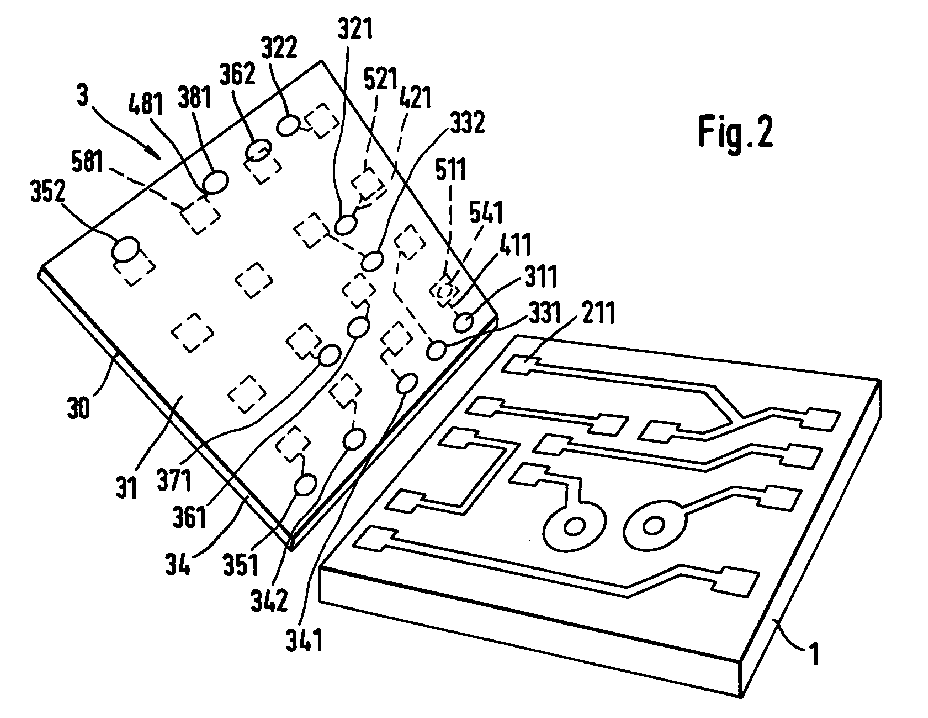
- FIG. 2 is perspective and together with the 1 a first variant of a Adapter arrangement 3 shown.
- a first and a second are on and / or in the film 30 and an nth electrically conductive contact bump 311, 321, 381 arranged. Furthermore, ten further contact bumps 322; 331, 332; 341, 342; 351, 352; 361, 362; 371 available.
- the Reference numerals of the contact bumps are chosen so that their last two digits the last two digits of the Reference numerals of test points 222; 231, 232; 241, 242; 251, 252; 261, 262; 271 are the same.
- the first contact bump 311 On the back of the film 30 is the first contact bump 311 by means of a first conductor track 411 with a first Contact point 511 connected.
- the other conductor lines and no reference numerals assigned to the other contact points are not limited to the other contact points.
- the reference numerals of the conductor tracks are chosen so that their last two digits the last two digits of the Reference numbers for test points 211, 221, 222, 231, 232, 241, 242, 251, 252, 261, 262, 271, 281 and contact bumps 311, 321, 322, 331, 332, 341, 342, 351, 352, 361, 362, 371, 381 are the same.
- the first contact point is 511 with one first contact needle of an input contact field of the Test device, the second contact point 521 with a second Contact pin of the input contact field, the nth Contact point 581 with an nth contact needle and the further contact points of a corresponding one further contact needle of the input contact field electrically to contact.
- the input contact field of the test device has one in lines and Columns regular arrangement of the contact pins mentioned.
- the surface is a mirror image of this arrangement Distribution of the contact points to which the contact points 511, 521, 581 belong.
- the contact bump has a contacting part 3111 and a longitudinal axis 3112. It leads perpendicularly from the Back 32 to front 31 through the film 30 in one Through hole 33, which has a central axis 330.
- Such a contact bump is usually in the bore 33 produces that therein, starting from the Backside 32 existing conductor track 411, galvanic or Electroless copper over the edge at the front 31 bore 33 is grown out.
- This forms a contacting part 3111, the front 31 towered over in one stage and seated in the bore 33 such that the longitudinal axis 3112 coincides with the central axis 330.
- the surface of the contacting part 3111 is one Nickel-gold layer 3113 plated.
- Fig. 3 is also because of the better representation than shown in Fig. 2 that an electrically insulating, resilient intermediate film 34 on the back 32 of the Film 30 is arranged, which e.g. mechanically firm be connected and e.g. made of a suitable foam can exist.
- an electrically insulating, resilient intermediate film 34 on the back 32 of the Film 30 is arranged, which e.g. mechanically firm be connected and e.g. made of a suitable foam can exist.
- the film 30 hugs the pressures mentioned during testing very well to the PCB 1 on, even if they are quite uneven should.
- the first variant of the invention according to FIG. 2 can also be used for double-sided printed circuit boards are used.
- this Case is for the bottom of the two-sided circuit board one corresponding to the adapter arrangement 3 To provide adapter arrangement. This is when testing using one corresponding to the intermediate film 34 Intermediate film to the input contact field of the test device to press.
- the adapter assembly 6 is essentially a single-layer flexible film 60 Insulating material with a front 61 and one Back 62 and with a first part 63 and one with it contiguous second part 64.
- the conductor tracks also extend into the second part 64 the film 60 and end there in associated front side contact points; of these is only that for Fig. 4 Front contact point 652 belonging to contact bump 352 shown.
- the contacting is done by the second part 64 of the Foil 60 is turned by about 180 ° and by that Input contact field on the front 61 of the film 60 in second part 64 pressed, with an intermediate layer an electrically insulating, resilient Intermediate film 74 between the first part 63 and the second part 64 of the rear side 62 of the film 60.
- the intermediate film 74 is only partial in FIG. 5 shown so that it does not cover other parts of the figure.
- the intermediate film 74 exercises its Bump leveling function both at first Part 63 and the circuit board 1 as well as the second Part 64 and the input contact field.
- the second variant of the invention according to FIG. 4 can also can be used together with double-sided printed circuit boards. This is for the back of the two-sided circuit board another one corresponding to the adapter arrangement 6, provide two-part adapter arrangement. This is with Test by turning 180 ° and using one of the Intermediate film 74 corresponding further intermediate film press the input contact field of the test device.
Landscapes
- Engineering & Computer Science (AREA)
- Microelectronics & Electronic Packaging (AREA)
- Metallurgy (AREA)
- Manufacturing & Machinery (AREA)
- Computer Hardware Design (AREA)
- General Engineering & Computer Science (AREA)
- Physics & Mathematics (AREA)
- General Physics & Mathematics (AREA)
- Testing Of Short-Circuits, Discontinuities, Leakage, Or Incorrect Line Connections (AREA)
Abstract
Description
- eine als Membran wirkende, mehrschichtige flexible Folie
aus Isoliermaterial mit
- -- einer Vorder- und einer Rückseite,
- -- einer an der Vorderseite liegenden Vorderseiten-Schicht,
- -- einer an der Rückseite liegenden Rückseiten-Schicht,
- -- einer zwischen der Vorderseiten- und der Rückseiten-Schicht angeordneten Mittelschicht,
- -- einem ersten, einem zweiten und einem n-ten elektrisch
leitenden Kontaktbump mit einer Längsachse und einem
Kontaktierungsteil, der an seinem Ende harte, spitze
Mikrovorsprünge trägt, welcher Kontaktbump
- --- durch die Vorderseiten-Schicht in einer Bohrung, die eine Mittelachse hat, zur Vorderseite senkrecht hindurchführt,
- --- die Vorderseite in zwei Stufen derart überragt,
- ---- daß eine erste Stufe eine seitliche elektrische Verbindung zum Kontaktierungsteil herstellt und
- ---- daß der Kontaktierungsteil gegenüber der Bohrung seitlich versetzt ist,
- --- von welchen Kontaktbumps während des Testens der erste Kontaktbump mit dem ersten Testpunkt, der zweite Kontaktbump mit dem zweiten Testpunkt und der n-te Kontaktbump mit dem n-ten Testpunkt durch flächiges Andrücken der Folie an die Leiterplatte mechanisch in Berührung zu bringen und dadurch elektrisch zu kontaktieren ist,
- -- einer den ersten Kontaktbump kontaktierenden, auf einer von der Vorderseite abgewandten Seite der Vorderseiten-Schicht verlaufenden ersten Leiterbahn,
- -- einer den zweiten Kontaktbump kontaktierenden, auf der von der Vorderseite abgewandten Seite der Vorderseiten-Schicht verlaufenden zweiten Leiterbahn und
- -- einer den n-ten Kontaktbump kontaktierenden, auf der von
der Vorderseite abgewandten Seite der Vorderseiten-Schicht
verlaufenden n-ten Leiterbahn,
- --- von denen die erste Leiterbahn mit einem ersten Kontaktpad, die zweite Leiterbahn mit einem zweiten Kontaktpad und die n-te Leiterbahn mit einem n-ten Kontaktpad dauernd verbunden ist, und
- eine Blattfedervorrichtung,
- -- mit der die Membran über einen Stempel flächig an die Pads gedrückt werden kann und
- -- deren Federkraft einstellbar ist.
- eine einschichtige flexible Folie aus Isoliermaterial
- -- mit einer Vorderseite und einer Rückseite,
- -- mit einem ersten, einem zweiten und einem n-ten
elektrisch leitenden Kontaktbump, der
- --- die Vorderseite einstufig überragt und
- --- zur Rückseite hin durch die Folie hindurch mittels
mehrerer in einem Raster angeordneter, metallgefüllter
Bohrungen und mittels mehreren auf der Rückseite der
Folie verlaufenden Leiterzügen kontaktiert ist,
- ---- von denen je ein Leiterzug zu je einer Bohrung gehört, und
- --- von welchen Kontaktbumps während des Testens der erste Kontaktbump mit dem ersten Testpunkt, der zweite Kontaktbump mit dem zweiten Testpunkt und der n-te Kontaktbump mit dem n-ten Testpunkt durch flächiges Andrücken der Folie an die Leiterplatte mechanisch in Berührung zu bringen und dadurch elektrisch zu kontaktieren ist.
- eine einschichtige flexible Folie aus Isoliermaterial
- -- mit einer Vorderseite und einer Rückseite,
- -- mit einem ersten, einem zweiten und einem n-ten
elektrisch leitenden Kontaktbump, der
- --- die Vorderseite einstufig überragt und
- --- zur Rückseite hin durch die Folie hindurch mittels einer einzigen von mehreren in einem Raster angeordneten, metallgefüllten Bohrungen und mittels einer einzigen zugehörigen von mehreren auf der Rückseite der Folie verlaufenden Leiterzügen kontaktiert ist,
- --- von welchen Kontaktbumps während des Testens der erste Kontaktbump mit dem ersten Testpunkt, der zweite Kontaktbump mit dem zweiten Testpunkt und der n-te Kontaktbump mit dem n-ten Testpunkt durch flächiges Andrücken der Folie an die Leiterplatte mechanisch in Berührung zu bringen und dadurch elektrisch zu kontaktieren ist.
- eine einschichtige flexible Folie aus einem
Isoliermaterial
- -- mit einer Vorder- und einer Rückseite,
- -- mit einem ersten, einem zweiten und einem n-ten
elektrisch leitenden Kontaktbump mit einem
Kontaktierungsteil und einer Längsachse, welcher
Kontaktbump
- --- von der Rückseite zur Vorderseite durch die Folie in einer Bohrung, die eine Mittelachse hat, senkrecht hindurchführt,
- --- die Vorderseite einstufig überragt und
- --- derart in der Bohrung sitzt, daß die Längsachse mit deren Mittelachse zusammenfällt, und
- --- von welchen Kontaktbumps während des Testens der erste Kontaktbump mit dem ersten Testpunkt, der zweite Kontaktbump mit dem zweiten Testpunkt und der n-te Kontaktbump mit dem n-ten Testpunkt durch flächiges Andrücken der Folie an die Leiterplatte mechanisch in Berührung zu bringen und dadurch elektrisch zu kontaktieren ist,
- -- mit einem den ersten Kontaktbump kontaktierenden, auf der Rückseite der Folie verlaufenden ersten Leiterzug,
- -- mit einem den zweiten Kontaktbump kontaktierenden, auf der Rückseite der Folie verlaufenden zweiten Leiterzug,
- -- mit einem den n-ten Kontaktbump kontaktierenden, auf der
Rückseite der Folie verlaufenden n-ten Leiterzug,
- --- von denen der erste Kontaktpunkt mit einer ersten
Kontaktnadel eines Eingangskontaktfelds des
Testgeräts, der zweite Kontaktpunkt mit einer zweiten
Kontaktnadel des Eingangskontaktfelds und der n-te
Kontaktpunkt mit einer n-ten Kontaktnadel des
Eingangskontaktfelds mittels dessen Andrückens an die
Rückseite der Folie unter Zwischenlage einer
elektrisch isolierenden, elastisch federnden
Zwischenfolie elektrisch zu kontaktieren ist,
- ---- die dort, wo eine Kontaktnadel einen Kontaktpunkt zu kontaktieren hat, eine elektrische Durchkontaktierung aufweist.
- eine einschichtige flexible Folie aus einem
Isoliermaterial
- -- mit einer Vorder- und einer Rückseite sowie mit einem ersten und einem damit zusammenhängenden zweiten Teil,
- -- mit einem ersten, einem zweiten und einem n-ten
elektrisch leitenden Kontaktbump mit einem
Kontaktierungsteil und einer Längsachse, welcher
Kontaktbump
- --- im ersten Teil der Folie angeordnet ist,
- --- von der Rückseite zur Vorderseite durch die Folie in einer Bohrung, die eine Mittelachse hat, senkrecht hindurchführt,
- --- die Vorderseite einstufig überragt und
- --- derart in der Bohrung sitzt, daß die Längsachse mit deren Mittelachse zusammenfällt, und
- --- von welchen Kontaktbumps während des Testens der erste Kontaktbump mit dem ersten Testpunkt, der zweite Kontaktbump mit dem zweiten Testpunkt und der n-te Kontaktbump mit dem n-ten Testpunkt durch flächiges Andrücken der Folie an die Leiterplatte mechanisch in Berührung zu bringen und dadurch elektrisch zu kontaktieren ist,
- -- mit einem den ersten Kontaktbump kontaktierenden, auf der Rückseite der Folie verlaufenden ersten Leiterzug,
- -- mit einem den zweiten Kontaktbump kontaktierenden, auf der Rückseite der Folie verlaufenden zweiten Leiterzug,
- -- mit einem den n-ten Kontaktbump kontaktierenden, auf der
Rückseite der Folie verlaufenden n-ten Leiterzug, von
denen
- --- der erste Leiterzug bis zu einem ersten, im zweiten Teil der Folie liegenden Vorderseiten-Kontaktpunkt führt und mit diesem durch die Folie hindurch kontaktiert ist,
- --- der zweite Leiterzug bis zu einem zweiten, im zweiten Teil der Folie liegenden Vorderseiten-Kontaktpunkt führt und mit diesem durch die Folie hindurch kontaktiert ist, und
- --- der n-te Leiterzug zu bis einem n-ten, im zweiten Teil
der Folie liegenden Vorderseiten-Kontaktpunkt führt
und mit diesem durch die Folie hindurch kontaktiert
ist, wobei
- ---- der erste Vorderseiten-Kontaktpunkt mit einer ersten Kontaktnadel eines Eingangskontaktfelds des Testgeräts, der zweite Vorderseiten-Kontaktpunkt mit einer zweiten Kontaktnadel des Eingangskontaktfelds und der n-te Vorderseiten-Kontaktpunkt mit einer n-ten Kontaktnadel des Eingangskontaktfelds durch Wenden des zweiten Teils der Folie um ca. 180° und mittels Andrückens des Eingangskontaktfelds an die Vorderseite der Folie im zweiten Teil unter Zwischenlage einer elektrisch isolierenden, elastisch federnden Zwischenfolie zwischen die Rückseite der Folie in deren erstem und zweitem Teil elektrisch zu kontaktieren ist.
- Fig. 1
- zeigt perspektivisch eine Leiterplatte mit einem einfachen Layout,
- Fig. 2
- zeigt perspektivisch eine Adapteranordnung entsprechend einer ersten Variante der Erfindung zusammen mit der Leiterplatte von Fig. 1,
- Fig. 3
- zeigt im Schnitt einen Kontaktbump der Adapteranordnung, und
- Fig. 4
- zeigt perspektivisch eine Adapteranordnung entsprechend einer zweiten Variante der Erfindung zusammen mit der Leiterplatte von Fig. 1.
- Handelsübliche Polyimidfolie als Material der Folien,
- Kupfer-Folie als Material der Leiterbahnen,
- galvanisch oder außenstromlos abgeschiedenes Kupfer als Metallisierung der Füllung der Bohrungen,
- galvanisch oder außenstromlos abgeschiedenes Nickel/Gold als Material der Kontaktbumps,
- handelsübliche nichtleitende Polymerfolien als Material der Zwischenfolien,
- handelsübliche gefederte Stifte oder flexible Zylinder aus elektrisch leitfähigen elastischen Polymeren als Material der Durchkontaktierungen entsprechend Fig. 2.
- Strukturieren der Bohrungen mittels üblichem Plasmaätzen oder Laserbohren oder Photolithographie,
- Strukturieren der Kontaktbumps und der Leiterbahnen mittels Photolithographie und galvanischer oder außenstromloser Metallisierung.
Claims (3)
- Adapteranordnung (3) zum elektrischen Anschluß von zu testenden, mindestens einlagigen, unbestückten Leiterplatten (1) an ein Testgerät, die einen ersten, einen zweiten und einen n-ten Testpunkt (211, 221, 281) aufweisen, wobei n eine beliebig vorgebbare ganze Zahl ist, welche Adapteranordnung umfaßt:eine einschichtige flexible Folie (30) aus einem Isoliermaterial-- mit einer Vorderseite (31) und einer Rückseite (32),-- mit einem ersten, einem zweiten und einem n-ten elektrisch leitenden Kontaktbump (311, 321, 381) mit einem Kontaktierungsteil (3111) und einer Längsachse (3112), welcher Kontaktbump--- von der Rückseite zur Vorderseite durch die Folie in einer Bohrung (33), die eine Mittelachse (330) hat, senkrecht hindurchführt,--- die Vorderseite einstufig überragt und--- derart in der Bohrung sitzt, daß die Längsachse mit deren Mittelachse zusammenfällt, und--- von welchen Kontaktbumps während des Testens der erste Kontaktbump (311) mit dem ersten Testpunkt (211), der zweite Kontaktbump (321) mit dem zweiten Testpunkt (221) und der n-te Kontaktbump (381) mit dem n-ten Testpunkt (281) durch flächiges Andrücken der Folie (30) an die Leiterplatte (1) mechanisch in Berührung zu bringen und dadurch elektrisch zu kontaktieren ist,-- mit einem den ersten Kontaktbump (311) kontaktierenden, auf der Rückseite der Folie zu einem ersten Kontaktpunkt (511) verlaufenden ersten Leiterzug (411),-- mit einem den zweiten Kontaktbump (321) kontaktierenden, auf der Rückseite der Folie zu einem zweiten Kontaktpunkt (521) verlaufenden zweiten Leiterzug (421),-- mit einem den n-ten Kontaktbump (381) kontaktierenden, auf der Rückseite der Folie zu einem n-ten Kontaktpunkt (581) verlaufenden n-ten Leiterzug (481),--- von denen der erste Kontaktpunkt (511) mit einer ersten Kontaktnadel eines Eingangskontaktfelds des Testgeräts, der zweite Kontaktpunkt (521) mit einer zweiten Kontaktnadel des Eingangskontaktfelds und der n-te Kontaktpunkt (581) mit einer n-ten Kontaktnadel des Eingangskontaktfelds mittels dessen Andrückens an die Rückseite der Folie (30) unter Zwischenlage einer elektrisch isolierenden, elastisch federnden Zwischenfolie (34) elektrisch zu kontaktieren ist,---- die dort, wo eine Kontaktnadel einen Kontaktpunkt zu kontaktieren hat, eine elektrische Durchkontaktierung aufweist (Fig. 2).
- Adapteranordnung (6) zum elektrischen Anschluß von zu testenden, mindestens einlagigen, unbestückten Leiterplatten (1) an ein Testgerät, die einen ersten, einen zweiten und einen n-ten Testpunkt (252) aufweisen, wobei n eine beliebig vorgebbare ganze Zahl ist, welche Adapteranordnung umfaßt:eine einschichtige flexible Folie (60) aus einem Isoliermaterial-- mit einer Vorder- und einer Rückseite (61, 62) sowie mit einem ersten und einem damit zusammenhängenden zweiten Teil (63, 64),-- mit einem ersten, einem zweiten und einem n-ten elektrisch leitenden Kontaktbump (352) mit einem Kontaktierungsteil (3111) und einer Längsachse (3112), welcher Kontaktbump--- im ersten Teil (63) der Folie angeordnet ist,--- von der Rückseite zur Vorderseite durch die Folie in einer Bohrung (33), die eine Mittelachse (330) hat, senkrecht hindurchführt,--- die Vorderseite einstufig überragt und--- derart in der Bohrung sitzt, daß die Längsachse mit deren Mittelachse zusammenfällt, und--- von welchen Kontaktbumps während des Testens der erste Kontaktbump mit dem ersten Testpunkt, der zweite Kontaktbump mit dem zweiten Testpunkt und der n-te Kontaktbump mit dem n-ten Testpunkt durch flächiges Andrücken der Folie an die Leiterplatte mechanisch in Berührung zu bringen und dadurch elektrisch zu kontaktieren ist,-- mit einem den ersten Kontaktbump kontaktierenden, auf der Rückseite der Folie verlaufenden ersten Leiterzug,-- mit einem den zweiten Kontaktbump kontaktierenden, auf der Rückseite der Folie verlaufenden zweiten Leiterzug,-- mit einem den n-ten Kontaktbump kontaktierenden, auf der Rückseite der Folie verlaufenden n-ten Leiterzug (452), von denen--- der erste Leiterzug bis zu einem ersten, im zweiten Teil der Folie liegenden Vorderseiten-Kontaktpunkt führt und mit diesem durch die Folie hindurch kontaktiert ist,--- der zweite Leiterzug bis zu einem zweiten, im zweiten Teil der Folie liegenden Vorderseiten-Kontaktpunkt (652) führt und mit diesem durch die Folie hindurch kontaktiert ist, und--- der n-te Leiterzug bis zu einem n-ten, im zweiten Teil der Folie liegenden Vorderseiten-Kontaktpunkt führt und mit diesem durch die Folie hindurch kontaktiert ist, wobei---- der erste Vorderseiten-Kontaktpunkt mit einer ersten Kontaktnadel eines Eingangskontaktfelds des Testgeräts, der zweite Vorderseiten-Kontaktpunkt mit einer zweiten Kontaktnadel des Eingangskontaktfelds und der n-te Vorderseiten-Kontaktpunkt mit einer n-ten Kontaktnadel des Eingangskontaktfelds durch Wenden des zweiten Teils der Folie um ca. 180° und mittels Andrückens des Eingangskontaktfelds an die Vorderseite der Folie im zweiten Teil unter Zwischenlage einer elektrisch isolierenden, elastisch federnden Zwischenfolie (74) zwischen die Rückseite der Folie in deren erstem und zweitem Teil elektrisch zu kontaktieren ist (Fig. 4).
- Adapteranordnung nach Anspruch 1, bei der die Durchkontaktierungen in Form von in Längsrichtung federnden Stiften oder in Form von elastischen leitenden Zylindern realisiert sind.
Priority Applications (1)
| Application Number | Priority Date | Filing Date | Title |
|---|---|---|---|
| EP98116790A EP0902297A3 (de) | 1997-09-11 | 1998-09-05 | Adapteranordnungen zum Testen von Leiterplatten |
Applications Claiming Priority (3)
| Application Number | Priority Date | Filing Date | Title |
|---|---|---|---|
| EP97810646A EP0902296A1 (de) | 1997-09-11 | 1997-09-11 | Adapteranordnungen zum Testen von Leiterplatten |
| EP97810646 | 1997-09-11 | ||
| EP98116790A EP0902297A3 (de) | 1997-09-11 | 1998-09-05 | Adapteranordnungen zum Testen von Leiterplatten |
Publications (2)
| Publication Number | Publication Date |
|---|---|
| EP0902297A2 true EP0902297A2 (de) | 1999-03-17 |
| EP0902297A3 EP0902297A3 (de) | 2001-11-28 |
Family
ID=26148060
Family Applications (1)
| Application Number | Title | Priority Date | Filing Date |
|---|---|---|---|
| EP98116790A Withdrawn EP0902297A3 (de) | 1997-09-11 | 1998-09-05 | Adapteranordnungen zum Testen von Leiterplatten |
Country Status (1)
| Country | Link |
|---|---|
| EP (1) | EP0902297A3 (de) |
Cited By (1)
| Publication number | Priority date | Publication date | Assignee | Title |
|---|---|---|---|---|
| CN112748322A (zh) * | 2019-10-31 | 2021-05-04 | 南亚科技股份有限公司 | 测试治具及测试组件 |
Family Cites Families (4)
| Publication number | Priority date | Publication date | Assignee | Title |
|---|---|---|---|---|
| US5228189A (en) * | 1988-11-12 | 1993-07-20 | Mania Gmbh & Co. | Adapter arrangement for electrically connecting flat wire carriers |
| US5399982A (en) * | 1989-11-13 | 1995-03-21 | Mania Gmbh & Co. | Printed circuit board testing device with foil adapter |
| JP2733359B2 (ja) * | 1989-12-19 | 1998-03-30 | 日東電工株式会社 | テストヘッド構造 |
| US5252916A (en) * | 1992-01-27 | 1993-10-12 | Everett Charles Technologies, Inc. | Pneumatic test fixture with springless test probes |
-
1998
- 1998-09-05 EP EP98116790A patent/EP0902297A3/de not_active Withdrawn
Cited By (1)
| Publication number | Priority date | Publication date | Assignee | Title |
|---|---|---|---|---|
| CN112748322A (zh) * | 2019-10-31 | 2021-05-04 | 南亚科技股份有限公司 | 测试治具及测试组件 |
Also Published As
| Publication number | Publication date |
|---|---|
| EP0902297A3 (de) | 2001-11-28 |
Similar Documents
| Publication | Publication Date | Title |
|---|---|---|
| DE69302400T2 (de) | Testanordnung mit filmadaptor fuer leiterplatten | |
| EP1484950B1 (de) | Elektrisches Kontaktierungsverfahren | |
| DE3639367C2 (de) | ||
| DE69200500T2 (de) | Gestufte Mehrlagenverbindungsplatte und Herstellungsmethoden. | |
| DE69011223T2 (de) | Verbinderanordnung mit einem beweglichen Wagen. | |
| DE3634491A1 (de) | Schaltungsplatine und sondenkabelanordnung | |
| EP0838688B1 (de) | Vorrichtung und Verfahren zum Prüfen von Leiterplatten | |
| DE19944980A1 (de) | Ummantelte elektrische Verbindung für eine Anschlußstruktur | |
| DE10015744A1 (de) | Ummantelte elektrische Verbindung für eine Anschlußstruktur | |
| DE2525166A1 (de) | Kontakt-sondenvorrichtung | |
| DE102009049848A1 (de) | Elektrische Verbindungsvorrichtung | |
| DE69020204T2 (de) | Mehrschichtige gedruckte Leiterplatte. | |
| DE4129925A1 (de) | Bauelement-testplatte fuer einen halbleiter-bauelement-tester mit einem rekonfigurierbaren koaxialen verbindungsgitter, und verfahren zu dessen gebrauch | |
| DE2453843A1 (de) | Steckverbinder-anordnung | |
| EP0875767B1 (de) | Vorrichtung und Verfahren zum Prüfen von unbestückten Leiterplatten | |
| DE69102917T2 (de) | Testgerät für integrierte Schaltkreise. | |
| DE102004034357A1 (de) | Prüfkarten Trägerelement | |
| EP0995235B1 (de) | Kontakt für kleinste bondkontakte sowie verfahren zur herstellung eines kontaktes | |
| EP0902296A1 (de) | Adapteranordnungen zum Testen von Leiterplatten | |
| EP1031042B1 (de) | Vorrichtung zum prüfen von leiterplatten | |
| DE3804425C1 (en) | PCB testing arrangement using several pins - forms contact between test pins and board tracks by compression under vacuum of sheets | |
| CH698875B1 (de) | Verfahren zur Bestückung einer Leiterplatte mit einem Stecker. | |
| DE60201537T2 (de) | Elektrische verbindungsanordnung für elektronische bauteile | |
| EP2263094B1 (de) | Prüfkontaktanordnung | |
| DE10324450A1 (de) | Kontaktierungsvorrichtung für elektronische Schaltungseinheiten und Herstellungsverfahren |
Legal Events
| Date | Code | Title | Description |
|---|---|---|---|
| PUAI | Public reference made under article 153(3) epc to a published international application that has entered the european phase |
Free format text: ORIGINAL CODE: 0009012 |
|
| AK | Designated contracting states |
Kind code of ref document: A2 Designated state(s): AT BE CH CY DE DK ES FI FR GB GR IE IT LI LU MC NL PT SE |
|
| AX | Request for extension of the european patent |
Free format text: AL;LT;LV;MK;RO;SI |
|
| PUAL | Search report despatched |
Free format text: ORIGINAL CODE: 0009013 |
|
| AK | Designated contracting states |
Kind code of ref document: A3 Designated state(s): AT BE CH CY DE DK ES FI FR GB GR IE IT LI LU MC NL PT SE |
|
| AX | Request for extension of the european patent |
Free format text: AL;LT;LV;MK;RO;SI |
|
| AKX | Designation fees paid | ||
| REG | Reference to a national code |
Ref country code: DE Ref legal event code: 8566 |
|
| 19U | Interruption of proceedings before grant |
Effective date: 20020401 |
|
| 19W | Proceedings resumed before grant after interruption of proceedings |
Effective date: 20100401 |
|
| RAP1 | Party data changed (applicant data changed or rights of an application transferred) |
Owner name: WUERTH ELEKTRONIK SCHOPFHEIM GMBH & CO. KG |
|
| STAA | Information on the status of an ep patent application or granted ep patent |
Free format text: STATUS: THE APPLICATION IS DEEMED TO BE WITHDRAWN |
|
| 18D | Application deemed to be withdrawn |
Effective date: 20020529 |