EP0902289B1 - Formulation d'additifs contenant une glucanase spécifique pour l'héparine et son utilisation - Google Patents
Formulation d'additifs contenant une glucanase spécifique pour l'héparine et son utilisation Download PDFInfo
- Publication number
- EP0902289B1 EP0902289B1 EP98114886A EP98114886A EP0902289B1 EP 0902289 B1 EP0902289 B1 EP 0902289B1 EP 98114886 A EP98114886 A EP 98114886A EP 98114886 A EP98114886 A EP 98114886A EP 0902289 B1 EP0902289 B1 EP 0902289B1
- Authority
- EP
- European Patent Office
- Prior art keywords
- tube
- formulation
- heparin
- heparinase
- additive formulation
- Prior art date
- Legal status (The legal status is an assumption and is not a legal conclusion. Google has not performed a legal analysis and makes no representation as to the accuracy of the status listed.)
- Expired - Lifetime
Links
- 239000000203 mixture Substances 0.000 title claims description 111
- 238000009472 formulation Methods 0.000 title claims description 102
- 239000000654 additive Substances 0.000 title claims description 71
- 230000000996 additive effect Effects 0.000 title claims description 71
- HTTJABKRGRZYRN-UHFFFAOYSA-N Heparin Chemical compound OC1C(NC(=O)C)C(O)OC(COS(O)(=O)=O)C1OC1C(OS(O)(=O)=O)C(O)C(OC2C(C(OS(O)(=O)=O)C(OC3C(C(O)C(O)C(O3)C(O)=O)OS(O)(=O)=O)C(CO)O2)NS(O)(=O)=O)C(C(O)=O)O1 HTTJABKRGRZYRN-UHFFFAOYSA-N 0.000 title claims description 55
- 229920000669 heparin Polymers 0.000 title claims description 55
- 229960002897 heparin Drugs 0.000 title claims description 55
- 108010022901 Heparin Lyase Proteins 0.000 claims description 64
- 210000004369 blood Anatomy 0.000 claims description 41
- 239000008280 blood Substances 0.000 claims description 41
- HDTRYLNUVZCQOY-UHFFFAOYSA-N α-D-glucopyranosyl-α-D-glucopyranoside Natural products OC1C(O)C(O)C(CO)OC1OC1C(O)C(O)C(O)C(CO)O1 HDTRYLNUVZCQOY-UHFFFAOYSA-N 0.000 claims description 35
- HDTRYLNUVZCQOY-LIZSDCNHSA-N alpha,alpha-trehalose Chemical compound O[C@@H]1[C@@H](O)[C@H](O)[C@@H](CO)O[C@@H]1O[C@@H]1[C@H](O)[C@@H](O)[C@H](O)[C@@H](CO)O1 HDTRYLNUVZCQOY-LIZSDCNHSA-N 0.000 claims description 35
- HDTRYLNUVZCQOY-WSWWMNSNSA-N Trehalose Natural products O[C@@H]1[C@@H](O)[C@@H](O)[C@@H](CO)O[C@@H]1O[C@@H]1[C@H](O)[C@@H](O)[C@@H](O)[C@@H](CO)O1 HDTRYLNUVZCQOY-WSWWMNSNSA-N 0.000 claims description 34
- 230000035602 clotting Effects 0.000 claims description 17
- 206010053567 Coagulopathies Diseases 0.000 claims description 15
- 238000000034 method Methods 0.000 claims description 15
- 230000000694 effects Effects 0.000 claims description 14
- QVGXLLKOCUKJST-UHFFFAOYSA-N atomic oxygen Chemical compound [O] QVGXLLKOCUKJST-UHFFFAOYSA-N 0.000 claims description 12
- 239000001301 oxygen Substances 0.000 claims description 12
- 229910052760 oxygen Inorganic materials 0.000 claims description 12
- 238000001035 drying Methods 0.000 claims description 11
- 239000003381 stabilizer Substances 0.000 claims description 11
- 108090000790 Enzymes Proteins 0.000 claims description 10
- 102000004190 Enzymes Human genes 0.000 claims description 10
- 230000003413 degradative effect Effects 0.000 claims description 8
- 239000001488 sodium phosphate Substances 0.000 claims description 7
- 229910000162 sodium phosphate Inorganic materials 0.000 claims description 7
- RYFMWSXOAZQYPI-UHFFFAOYSA-K trisodium phosphate Chemical compound [Na+].[Na+].[Na+].[O-]P([O-])([O-])=O RYFMWSXOAZQYPI-UHFFFAOYSA-K 0.000 claims description 7
- 239000000872 buffer Substances 0.000 claims description 6
- 238000011010 flushing procedure Methods 0.000 claims description 6
- 239000008246 gaseous mixture Substances 0.000 claims description 6
- 239000007921 spray Substances 0.000 claims description 6
- 239000012503 blood component Substances 0.000 claims description 5
- 238000005507 spraying Methods 0.000 claims description 5
- 230000001678 irradiating effect Effects 0.000 claims description 4
- 238000002156 mixing Methods 0.000 claims description 4
- 238000001291 vacuum drying Methods 0.000 claims description 4
- FBPFZTCFMRRESA-KVTDHHQDSA-N D-Mannitol Chemical compound OC[C@@H](O)[C@@H](O)[C@H](O)[C@H](O)CO FBPFZTCFMRRESA-KVTDHHQDSA-N 0.000 claims description 3
- WQZGKKKJIJFFOK-QTVWNMPRSA-N D-mannopyranose Chemical compound OC[C@H]1OC(O)[C@@H](O)[C@@H](O)[C@@H]1O WQZGKKKJIJFFOK-QTVWNMPRSA-N 0.000 claims description 3
- 229930195725 Mannitol Natural products 0.000 claims description 3
- 238000001914 filtration Methods 0.000 claims description 3
- 239000000594 mannitol Substances 0.000 claims description 3
- 235000010355 mannitol Nutrition 0.000 claims description 3
- 239000003595 mist Substances 0.000 claims description 2
- 230000001766 physiological effect Effects 0.000 claims description 2
- 239000003146 anticoagulant agent Substances 0.000 description 7
- 238000002360 preparation method Methods 0.000 description 7
- 229940088598 enzyme Drugs 0.000 description 6
- 102000009123 Fibrin Human genes 0.000 description 5
- 108010073385 Fibrin Proteins 0.000 description 5
- BWGVNKXGVNDBDI-UHFFFAOYSA-N Fibrin monomer Chemical compound CNC(=O)CNC(=O)CN BWGVNKXGVNDBDI-UHFFFAOYSA-N 0.000 description 5
- 229940127219 anticoagulant drug Drugs 0.000 description 5
- 229950003499 fibrin Drugs 0.000 description 5
- 238000011084 recovery Methods 0.000 description 5
- 238000003860 storage Methods 0.000 description 5
- FAPWRFPIFSIZLT-UHFFFAOYSA-M Sodium chloride Chemical compound [Na+].[Cl-] FAPWRFPIFSIZLT-UHFFFAOYSA-M 0.000 description 4
- 238000002560 therapeutic procedure Methods 0.000 description 4
- 238000011282 treatment Methods 0.000 description 4
- 102000004411 Antithrombin III Human genes 0.000 description 3
- 108090000935 Antithrombin III Proteins 0.000 description 3
- 238000004458 analytical method Methods 0.000 description 3
- 229960005348 antithrombin iii Drugs 0.000 description 3
- 230000015556 catabolic process Effects 0.000 description 3
- 239000000306 component Substances 0.000 description 3
- 238000006731 degradation reaction Methods 0.000 description 3
- 239000004615 ingredient Substances 0.000 description 3
- 238000001990 intravenous administration Methods 0.000 description 3
- -1 preferably Chemical compound 0.000 description 3
- 210000002966 serum Anatomy 0.000 description 3
- 238000012360 testing method Methods 0.000 description 3
- XLYOFNOQVPJJNP-UHFFFAOYSA-N water Substances O XLYOFNOQVPJJNP-UHFFFAOYSA-N 0.000 description 3
- 241000605114 Pedobacter heparinus Species 0.000 description 2
- 235000014680 Saccharomyces cerevisiae Nutrition 0.000 description 2
- 241000611223 Selaginella lepidophylla Species 0.000 description 2
- VYPSYNLAJGMNEJ-UHFFFAOYSA-N Silicium dioxide Chemical compound O=[Si]=O VYPSYNLAJGMNEJ-UHFFFAOYSA-N 0.000 description 2
- 108090000190 Thrombin Proteins 0.000 description 2
- 239000002253 acid Substances 0.000 description 2
- 239000012190 activator Substances 0.000 description 2
- 238000010256 biochemical assay Methods 0.000 description 2
- 239000007853 buffer solution Substances 0.000 description 2
- 238000011109 contamination Methods 0.000 description 2
- 230000036425 denaturation Effects 0.000 description 2
- 238000004925 denaturation Methods 0.000 description 2
- 238000000502 dialysis Methods 0.000 description 2
- 230000006870 function Effects 0.000 description 2
- 238000010438 heat treatment Methods 0.000 description 2
- 230000002452 interceptive effect Effects 0.000 description 2
- 229920002521 macromolecule Polymers 0.000 description 2
- 238000004519 manufacturing process Methods 0.000 description 2
- 230000000813 microbial effect Effects 0.000 description 2
- 238000006386 neutralization reaction Methods 0.000 description 2
- 230000005855 radiation Effects 0.000 description 2
- 239000011347 resin Substances 0.000 description 2
- 229920005989 resin Polymers 0.000 description 2
- 239000011780 sodium chloride Substances 0.000 description 2
- 239000012064 sodium phosphate buffer Substances 0.000 description 2
- 238000001694 spray drying Methods 0.000 description 2
- 238000001356 surgical procedure Methods 0.000 description 2
- 229960004072 thrombin Drugs 0.000 description 2
- 241000238582 Artemia Species 0.000 description 1
- 241001672739 Artemia salina Species 0.000 description 1
- 241001250090 Capra ibex Species 0.000 description 1
- 206010051055 Deep vein thrombosis Diseases 0.000 description 1
- 241000196324 Embryophyta Species 0.000 description 1
- 108010049003 Fibrinogen Proteins 0.000 description 1
- 102000008946 Fibrinogen Human genes 0.000 description 1
- WHXSMMKQMYFTQS-UHFFFAOYSA-N Lithium Chemical compound [Li] WHXSMMKQMYFTQS-UHFFFAOYSA-N 0.000 description 1
- 241001465754 Metazoa Species 0.000 description 1
- 239000004743 Polypropylene Substances 0.000 description 1
- 240000004808 Saccharomyces cerevisiae Species 0.000 description 1
- 108010023197 Streptokinase Proteins 0.000 description 1
- 208000007536 Thrombosis Diseases 0.000 description 1
- 108090000373 Tissue Plasminogen Activator Proteins 0.000 description 1
- 102000003978 Tissue Plasminogen Activator Human genes 0.000 description 1
- 239000007983 Tris buffer Substances 0.000 description 1
- 108090000435 Urokinase-type plasminogen activator Proteins 0.000 description 1
- 102000003990 Urokinase-type plasminogen activator Human genes 0.000 description 1
- 206010047249 Venous thrombosis Diseases 0.000 description 1
- 150000007513 acids Chemical class 0.000 description 1
- 230000002411 adverse Effects 0.000 description 1
- BFNBIHQBYMNNAN-UHFFFAOYSA-N ammonium sulfate Chemical compound N.N.OS(O)(=O)=O BFNBIHQBYMNNAN-UHFFFAOYSA-N 0.000 description 1
- 229910052921 ammonium sulfate Inorganic materials 0.000 description 1
- 235000011130 ammonium sulphate Nutrition 0.000 description 1
- 229960004676 antithrombotic agent Drugs 0.000 description 1
- 239000012736 aqueous medium Substances 0.000 description 1
- 230000001580 bacterial effect Effects 0.000 description 1
- 244000052616 bacterial pathogen Species 0.000 description 1
- 230000008033 biological extinction Effects 0.000 description 1
- 230000000157 blood function Effects 0.000 description 1
- 210000000476 body water Anatomy 0.000 description 1
- 230000003139 buffering effect Effects 0.000 description 1
- 150000001720 carbohydrates Chemical class 0.000 description 1
- 238000002144 chemical decomposition reaction Methods 0.000 description 1
- 238000006243 chemical reaction Methods 0.000 description 1
- 238000010835 comparative analysis Methods 0.000 description 1
- 208000031513 cyst Diseases 0.000 description 1
- 239000007857 degradation product Substances 0.000 description 1
- 230000003292 diminished effect Effects 0.000 description 1
- 208000037265 diseases, disorders, signs and symptoms Diseases 0.000 description 1
- 238000006073 displacement reaction Methods 0.000 description 1
- 229940079593 drug Drugs 0.000 description 1
- 239000003814 drug Substances 0.000 description 1
- 238000005516 engineering process Methods 0.000 description 1
- 229940012952 fibrinogen Drugs 0.000 description 1
- 239000003527 fibrinolytic agent Substances 0.000 description 1
- 230000003480 fibrinolytic effect Effects 0.000 description 1
- 239000012530 fluid Substances 0.000 description 1
- 239000013022 formulation composition Substances 0.000 description 1
- 239000007789 gas Substances 0.000 description 1
- 239000000499 gel Substances 0.000 description 1
- 239000011521 glass Substances 0.000 description 1
- 238000001631 haemodialysis Methods 0.000 description 1
- 230000002489 hematologic effect Effects 0.000 description 1
- 230000000322 hemodialysis Effects 0.000 description 1
- 239000001257 hydrogen Substances 0.000 description 1
- 229910052739 hydrogen Inorganic materials 0.000 description 1
- 125000002887 hydroxy group Chemical group [H]O* 0.000 description 1
- 230000005764 inhibitory process Effects 0.000 description 1
- 229910052744 lithium Inorganic materials 0.000 description 1
- 239000012528 membrane Substances 0.000 description 1
- QSHDDOUJBYECFT-UHFFFAOYSA-N mercury Chemical compound [Hg] QSHDDOUJBYECFT-UHFFFAOYSA-N 0.000 description 1
- 229910052753 mercury Inorganic materials 0.000 description 1
- 150000002840 non-reducing disaccharides Chemical class 0.000 description 1
- 230000000399 orthopedic effect Effects 0.000 description 1
- 239000004033 plastic Substances 0.000 description 1
- 229920003023 plastic Polymers 0.000 description 1
- 229920000139 polyethylene terephthalate Polymers 0.000 description 1
- 239000005020 polyethylene terephthalate Substances 0.000 description 1
- 229920001155 polypropylene Polymers 0.000 description 1
- 230000002035 prolonged effect Effects 0.000 description 1
- 230000000069 prophylactic effect Effects 0.000 description 1
- 230000001681 protective effect Effects 0.000 description 1
- 102000004169 proteins and genes Human genes 0.000 description 1
- 108090000623 proteins and genes Proteins 0.000 description 1
- 238000009877 rendering Methods 0.000 description 1
- 239000000377 silicon dioxide Substances 0.000 description 1
- 239000000243 solution Substances 0.000 description 1
- 229960005202 streptokinase Drugs 0.000 description 1
- 239000004094 surface-active agent Substances 0.000 description 1
- 230000002537 thrombolytic effect Effects 0.000 description 1
- 229960000187 tissue plasminogen activator Drugs 0.000 description 1
- 229960005356 urokinase Drugs 0.000 description 1
Images
Classifications
-
- G—PHYSICS
- G01—MEASURING; TESTING
- G01N—INVESTIGATING OR ANALYSING MATERIALS BY DETERMINING THEIR CHEMICAL OR PHYSICAL PROPERTIES
- G01N33/00—Investigating or analysing materials by specific methods not covered by groups G01N1/00 - G01N31/00
- G01N33/48—Biological material, e.g. blood, urine; Haemocytometers
- G01N33/50—Chemical analysis of biological material, e.g. blood, urine; Testing involving biospecific ligand binding methods; Immunological testing
- G01N33/86—Chemical analysis of biological material, e.g. blood, urine; Testing involving biospecific ligand binding methods; Immunological testing involving blood coagulating time or factors, or their receptors
-
- C—CHEMISTRY; METALLURGY
- C12—BIOCHEMISTRY; BEER; SPIRITS; WINE; VINEGAR; MICROBIOLOGY; ENZYMOLOGY; MUTATION OR GENETIC ENGINEERING
- C12Q—MEASURING OR TESTING PROCESSES INVOLVING ENZYMES, NUCLEIC ACIDS OR MICROORGANISMS; COMPOSITIONS OR TEST PAPERS THEREFOR; PROCESSES OF PREPARING SUCH COMPOSITIONS; CONDITION-RESPONSIVE CONTROL IN MICROBIOLOGICAL OR ENZYMOLOGICAL PROCESSES
- C12Q1/00—Measuring or testing processes involving enzymes, nucleic acids or microorganisms; Compositions therefor; Processes of preparing such compositions
- C12Q1/56—Measuring or testing processes involving enzymes, nucleic acids or microorganisms; Compositions therefor; Processes of preparing such compositions involving blood clotting factors, e.g. involving thrombin, thromboplastin, fibrinogen
-
- G—PHYSICS
- G01—MEASURING; TESTING
- G01N—INVESTIGATING OR ANALYSING MATERIALS BY DETERMINING THEIR CHEMICAL OR PHYSICAL PROPERTIES
- G01N2333/00—Assays involving biological materials from specific organisms or of a specific nature
- G01N2333/90—Enzymes; Proenzymes
- G01N2333/988—Lyases (4.), e.g. aldolases, heparinase, enolases, fumarase
Definitions
- This invention relates to an additive preparation, the method of making the additive preparation and the method of using the additive preparation.
- the additive preparation is most particularly for use in blood collection devices wherein the additive preparation comes in contact with a blood specimen that has been previously treated with heparin.
- the additive preparation desirably comprises a formulation comprising heparinase and a carbohydrate.
- the additive formulation is desirably spray dried onto the inner wall of a blood collection device.
- the additive formulation of the present invention exhibits stability even when subjected to gamma irradiation.
- Heparin is an anticoagulant that is used in surgical procedures and dialysis therapy to prevent clotting in intravenous lines and in the treatment of thrombolytic disorders. It affects thrombin activity by catalyzing the action of antithrombin III (ATIII), thereby preventing the conversion of fibrinogen to fibrin which results in clotting inhibition.
- ATIII antithrombin III
- Heparin is also applied to a variety of clinical situations in addition to its use as an anticoagulant. It is used in hemodialysis treatments to prevent the blood from clotting during dialysis and as an antithrombotic agent in the treatment of deep venous thrombosis and orthopedic surgery. As a prophylactic of thrombosis, it is used in conjunction with prolonged intermittent intravenous administration of drugs and fluids. Recently, heparin also has been used in fibrinolytic therapy where it is co-administered with promoters of fibrin degradation such as tissue plasminogen activator, streptokinase or urokinase. Therefore, varying quantities of heparin are found in the blood of numerous hospitalized patients.
- specimens with identifiable extended clotting times require additional handling and longer preparation times to remove or manage the heparin interference.
- clots are not identified prior to assaying the specimen on an automated analyzer, clots forming within the instrument may lead to incomplete test results and/or instrument clogging. Therefore, testing accuracy is minimized, unnecessary instrument downtime may need to take place to unclog the instrument, additional specimens may need to be obtained to repeat the test and technical operator time is increased.
- US-A-5,262,325 discloses heparinase formulations which are stabilized with ammonium sulfate.
- heparin interference problem It is therefore desirable to resolve the heparin interference problem with a method that could expeditiously and specifically remove heparin from blood samples immediately after blood collection.
- the additive needed to accomplish this must function over a broad range of conditions. Such conditions include, but are not limited to, heparin being neutralized, quickly, while the additive itself, should not impart any effects on blood components over a lengthy exposure period. Furthermore, the treated samples containing heparin should give a result identical to untreated samples that have not been exposed to heparin.
- the present invention is a gamma irradiation stable additive formulation comprising a degradative glucanase enzyme specific for heparin and a stabilizer.
- the formulation may be effectively used as an additive in a tube to neutralize residual heparin in specimens taken from heparinized patients and accelerate clotting.
- the formulation is irradiation stable.
- the additive formulation is useful in effectively minimizing interference from heparin in a blood sample when used in a blood collection tube without interfering with the clinical analysis.
- the present invention relates to an additive formulation comprising:
- the additive formulation desirably comprises a degradative glucanase enzyme specific for heparin such as, preferably, heparinase.
- the stabilizer of additive formulation is to provide heparinase stability during controlled drying and elevated temperature storage of the formulation so that the heparinase can be stable.
- An effective additive formulation compromising heparinase and trehalose may be sprayed onto the wall of a tube and be rendered irradiation stable in the tube by controlled drying and prior removal of oxygen in the tube by backflushing with an alternate gas.
- the additive formulation may further comprise a buffer solution so that the formulation resists changes in pH.
- the additive formulation comprises:
- the unit heparinase is an International Unit (IU) which is the amount of heparinase which causes 1 micromole of double bonds to form per minute based on a molar extinction coefficient of 5.1 at 232 nm for the degradation products, the unsaturated uronic acids.
- IU International Unit
- the additive formulation is used in a collection device such as a blood collection tube wherein the formulation is spray-dried onto the interior of the tube.
- Additive formulations of the present invention are useful in providing neutralization of heparin and clotting of blood specimens.
- Another attribute of the additive formulation is that it is stable when heated, dried and irradiated.
- the additive achieves heparin neutralization of a blood sample of a heparinized patient faster and more completely than other available methods. Therefore, the additive formulation is useful in substantially removing heparin from a blood sample when used in a blood collection tube without interfering with the clinical analysis.
- the combination of the heparinase and trehalose in proper proportion is useful in eliminating the interference in clotting due to the presence of heparin. Therefore the additive formulation will help to deactivate residual heparin in specimens collected from heparinized patients. This method would reduce the handling of specimens from heparinized patients whereby current handling requires manual removal of latent fibrin from slow clotting specimens. Therefore, the method obviates the requirement for identifying problematic specimens or patient populations.
- An advantage of the additive formulation comprising heparinase and trehalose and oxygen removal is a unique heat and radiation stable formulation.
- the formulation provides substantial recovery of 50% to 60% post irradiation.
- An important attribute of the formulation of the present invention is that it exhibits stability even when subjected to gamma irradiation.
- a method of protecting heparinase against denaturation during drying and irradiation comprises the steps of incorporating an effective amount of trehalose into the heparinase. Therefore, according to the present invention there is provided a method of drying heparinase at a temperature above ambient, by incorporating trehalose into the heparinase which is to be spray dried, followed by oxygen removal prior to irradiation by back flushing the tube with a gaseous mixture of CO 2 /H 2 ; 80:20 ratio.
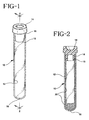
- FIG. 1 is a perspective view of a typical blood collection tube with a stopper.
- FIG. 2 is a longitudinal sectional view of the tube of FIG. 1, taken along line 2-2, comprising the spray dried additive formulation of the present invention.
- the additive formulation preferably comprises:
- Heparinase is a composition that can eliminate heparin interference of normal blood function.
- the heparinase present in the additive formulation of the present invention is selected to neutralize residual heparin in specimens collected from heparinized patients.
- Heparinase 1 (EC 4.2.2.7) is an enzyme derived from Flavobacterium heparinum, a Gram negative non pathogenic bacteria. Heparinase cleaves heparin at 11 active sites (alpha-glycosidic linkages), including the ATIII binding site, and can deactivate heparin in a specimen allowing normal clot formation.
- the preferred heparinase in the additive formulation is heparinase isolated from Flavobacterium heparinum has an optimal activity at pH of 6.5 to 7.0; sodium chloride concentration of 0.1M and of 37°C, wherein the anticoagulant component does not bind to a polysulfated resin at about pH 7.0, conductivity between 3 and 12 mmhos, and the heparinase does bind to a polysulfated resin at pH 7.0, conductivity between 3 and 12 mmhos.
- the method of preparing and using anticoagulant free heparinase is described in U.S. -A-5,338,677 and 5,262,325.
- a highly purified bacterial heparinase is available from IBEX Technologies, St. Laurent, Quebec, Canada.
- heparinase is present in the additive formulation in an amount from 50 IU/mL to 80 IU/mL, and most preferably at about 65 IU/mL.
- a stabilizer is a component which can provide protection to enzymes and proteins by maintaining the macromolecular structure of these during drying.
- Stabilizers are typically characterized by their ability to provide protection against chemical degradation during radiation and elevated temperature storage.
- a specific selection of stabilizers is required for the additive formulation so that the activity of heparinase is maintained post heating, drying and/or irradiation
- the stabilizer in the additive formulation is trehalose.
- trehalose is present in the additive formulation in an amount from 8 weight percent to 12 weight percent, and most preferably at 10 weight percent.
- Trehalose alpha-D-glucopyranosyl-alpha-D-glucopyranoside
- trehalose is a naturally occurring non-reducing disaccharide which is typically associated with cell protection. It is known that some organisms, both plant and animal, can resist desiccation to very low levels of body water during drought conditions. These organisms include brine shrimps cysts (Artemia salina), the resurrection plant (Selaginella lepidophylla) and bakers yeast (Saccharomyces cerevisiae). They all share, as a common feature, the presence of large amounts of trehalose in their cells.
- Trehalose is used in the present invention to preserve the stability of the heparinase.
- Heparinase can only be stored for brief time period and the stability of heparinase is diminished upon heating and irradiation.
- the stability of the heparinase is preserved when heated and/or dried and by removal of oxygen the stability is further preserved when irradiated.
- trehalose preserves the structure and function of heparinase in the dry state due to hydrogen bonding of trehalose molecules via their hydroxyl groups, to appropriate groups on the macromolecule. In this way trehalose takes the place of structural (bound) water molecules so that there is no collapse of macromolecular structure upon spray drying of the formulation and later when the formulation is irradiated.
- the trehalose acts as a dry scaffold maintaining the structural integrity of the heparinase.
- a buffer solution may also be used in the formulation of the present invention to provide an aqueous medium to the formulation that resists changes in pH.
- Buffers that may be used in the formulation of the present invention include TRIS, sodium chloride and sodium phosphate.
- the most preferred buffer is sodium phosphate because of its pH buffering capacity.
- sodium phosphate is present in the additive formulation in an amount of 15 mL of a 150 mM solution.
- the additive formulation of the present invention is prepared for spray drying as follows:
- clot activators include but are not limited to silica, thrombin, and elegic acid.
- the additive formulation may also include gels and surfactants.
- the additive formulation of the present invention may be used in blood collection devices.
- the blood collection tubes may be either an evacuated blood collection device or a non-evacuated blood collection device.
- the blood collection device is desirably made of plastic, such as but not limited to polyethylene terephthalate, or polypropylene, or glass.
- FIG. 1 shows a typical blood collection tube 10, having an open end 16, a closed end 18 and a stopper 14 that includes a lower annular portion or skirt 15 which extends into and presses against the inside wall 12 of the tube for maintaining stopper 14 in place.
- FIG. 2 shows the use of the additive formulation of the present invention in a typical blood collection tube.
- An additive formulation 20 is shown on the inside wall of the tube.
- a blood specimen sample of interest can be transferred into tube 10 that comprises the additive formulation 20 , wherein the specimen contacts the additive formulation so that the formulation rapidly dissolves into the specimen and neutralizes any heparin which is present. Tube 10 is then allowed to clot, at which time it is centrifuged and the serum of the sample is ready for analysis.
- the method for preparing a collection device with the additive formulation of the present invention comprises the following steps:
- the additive formulation is metered and dispensed into the collection device, such as a blood collection tube, by a volumetric type device, such as a positive displacement pump.
- the formulation concentration (amount of heparinase and trehalose per unit volume of formulation) is tailored with the dispense volume so that the desired amount of formulation is dispensed into the device.
- Other spraying techniques include ultrasonic spraying.
- the additive formulation of the present invention may be used to eliminate the physiological effects of heparin on blood components in a mixture of blood components and heparin in a blood collection tube comprising the following method:
- An additive formulation was made by mixing in a suitably sized vessel, for a sufficient amount of time to ensure homogeneity, to form a formulation with the following ingredients: Ingredients Amounts Heparinase 50-80 IU/mL Trehalose 8-12% w/v Sodium Phosphate 150mM
- the activity of the heparinase was first measured. Then the activity of the heparinase was adjusted from about 50 to about 80 IU/mL by the addition of about 15mL of 150mM of sodium phosphate.
- Example 1 About fifteen (15) microliters of the formulation that was prepared in Example 1 was spray coated into each of 100 tubes (VACUTAINER Brand Plus Serum tubes, 6 mL, Catalog No. 367815, Becton, Dickinson and Company, Franklin Lakes, NJ). Each tube was then air dried from about 25 to about 30°C. The tubes were then vacuum dried for about 2 hours at about 35°C at about 80 kPa (600 millimeters Hg). After the 2 hours, the tubes were back flushed with a gaseous mixture of CO 2 /H 2 (80/20), stoppered and irradiated within 2 to 5 hours of stoppering.
- VACUTAINER Brand Plus Serum tubes 6 mL, Catalog No. 367815, Becton, Dickinson and Company, Franklin Lakes, NJ. Each tube was then air dried from about 25 to about 30°C. The tubes were then vacuum dried for about 2 hours at about 35°C at about 80 kPa (600 millimeters Hg). After the 2 hours,
- Example 1 The additive formulation that was made in Example 1 was tested for heat and irradiation stability.
- the tubes were stored at 25°C and 40°C and then the percent recovery of heparinase was measured by activity. The results are shown in Table 2.
- HEPARINASE RECOVERY RESULTS % Heparinase Activity Recovery vs.
- trehalose renders temperature stability for heparinase recovery. It is believed that based upon the results reported in Table 2 that heparinase degradation during irradiation is associated with residual moisture and/or the presence of oxygen. Therefore, heparinase degradation during irradiation can be controlled with combinations of drying and oxygen removal by backflushing of the collection container as illustrated in this Example.
- the formulation of the present invention neutralized heparin in human blood by allowing normal clot formulation to occur in 40 minutes as shown by the results reported for Tube #2.
- Tube #3 which contained heparin but did not contain the formulation of the present invention, the blood sample did not clot, but remained anticoagulated by the heparin.
- Tube #1 without heparin or heparinase allowed the blood to clot in 15 minutes.
Landscapes
- Health & Medical Sciences (AREA)
- Life Sciences & Earth Sciences (AREA)
- Chemical & Material Sciences (AREA)
- Engineering & Computer Science (AREA)
- Hematology (AREA)
- Molecular Biology (AREA)
- Organic Chemistry (AREA)
- Immunology (AREA)
- Biochemistry (AREA)
- Microbiology (AREA)
- Urology & Nephrology (AREA)
- Zoology (AREA)
- Wood Science & Technology (AREA)
- Biomedical Technology (AREA)
- Physics & Mathematics (AREA)
- Analytical Chemistry (AREA)
- Biotechnology (AREA)
- General Health & Medical Sciences (AREA)
- Proteomics, Peptides & Aminoacids (AREA)
- Biophysics (AREA)
- Bioinformatics & Cheminformatics (AREA)
- Pathology (AREA)
- General Physics & Mathematics (AREA)
- Medicinal Chemistry (AREA)
- Food Science & Technology (AREA)
- Cell Biology (AREA)
- Neurosurgery (AREA)
- General Engineering & Computer Science (AREA)
- Genetics & Genomics (AREA)
- Investigating Or Analysing Biological Materials (AREA)
- Pharmaceuticals Containing Other Organic And Inorganic Compounds (AREA)
- Medicinal Preparation (AREA)
- Medicines That Contain Protein Lipid Enzymes And Other Medicines (AREA)
- Measuring Or Testing Involving Enzymes Or Micro-Organisms (AREA)
- Measurement Of The Respiration, Hearing Ability, Form, And Blood Characteristics Of Living Organisms (AREA)
Claims (7)
- Formulation d'additifs comprenant :(a) une enzyme glucanase dégradante spécifique de l'héparine ; et(b) un stabilisant choisi parmi le tréhalose, le mannitol ou le mannose.
- Formulation d'additifs selon la revendication 1, dans laquelle ladite enzyme glucanase dégradante spécifique de l'héparine, est l'héparinase.
- Formulation d'additifs selon la revendication 1 comprenant :(a) de 50 UI/mL à 80 UI/mL de l'enzyme glucanase dégradante pour l'héparine ;(b) de 8 pour cent en poids à 12 pour cent en poids du stabilisant ; et(c) 15 mL d'un tampon à 150 millimoles par litre (mM).
- Procédé pour éliminer les effets physiologiques de l'héparine sur un constituant du sang dans un mélange de constituants sanguins et d'héparine dans un tube pour recueillir le sang, comprenant les étapes consistant à :(a) préparer une formulation d'additifs comprenant une enzyme glucanase dégradante spécifique de l'héparine, et un stabilisant choisi parmi le tréhalose, le mannitol ou le mannose ;(b) projeter par aspersion la formulation d'additifs sur la paroi intérieure d'un tube pour recueillir le sang ;(c) sécher la formulation appliquée en appliquant un jet d'air ou de l'air forcé sur la paroi intérieure du tube revêtu à 25 - 30°C et pendant 5 à 10 minutes ;(d) sécher sous vide la paroi intérieure du tube pendant 2 heures ;(e) éliminer l'oxygène de la paroi intérieure du tube en effectuant un rétrobalayage du tube avec un mélange gazeux de CO2 et de H2 ;(f) boucher le tube ;(g) irradier les tubes dans un délai de 2 à 5 heures après le bouchage à 1,5 Mrads ;(h) introduire dans le tube un échantillon de sang contenant de l'héparine ;(i) mélanger le prélèvement dans le tube avec la formulation d'additifs en retournant manuellement le tube 5 à 10 fois ; et(j) laisser coaguler le prélèvement.
- Procédé de préparation d'une formulation d'additifs comprenant les étapes consistant à :(a) mesurer l'activité de l'héparinase ;(b) mélanger l'héparinase avec du phosphate de sodium 150 mM pour ajuster l'activité de l'héparinase de 50 à 80 UI/mL;(c) ajouter 8 à 12% de tréhalose avec le mélange ; et(d) filtrer le mélange à travers un filtre de 0,22 µm.
- Tube (10) pour préparer un prélèvement hépariné pour coagulation comprenant une extrémité haute (16), une extrémité basse (18), une paroi latérale s'étendant de ladite extrémité haute (16) à ladite extrémité basse (18) et comprenant une surface extérieure et une surface intérieure (12), une formulation d'additifs projetée par aspersion (20) comprenant un mélange d'un tampon, d'héparinase et de tréhalose sur ladite surface intérieure dudit tube.
- Procédé de fabrication d'un tube destiné à manipuler un prélèvement hépariné pour coagulation comprenant les étapes consistant à :(a) fournir un récipient possédant une extrémité ouverte, une extrémité fermée, une paroi latérale s'étendant entre ladite extrémité ouverte et ladite extrémité fermée et possédant une surface de paroi intérieure et une surface de paroi extérieure ;(b) préparer une formulation d'additifs comprenant un mélange de phosphate de sodium, d'héparinase et de tréhalose ;(c) appliquer ladite formulation sur la paroi intérieure dudit tube en un fin brouillard ;(d) sécher ladite formulation en appliquant de l'air forcé pendant suffisamment longtemps pour sécher la formulation, afin qu'il reste une formulation sèche ;(e) sécher sous vide la paroi intérieure du tube pendant 2 heures à 35°C sous 80 kPa (600 millimètres de Hg) ;(f) éliminer l'oxygène du tube en effectuant un rétrobalayage avec un mélange gazeux de CO2 et de H2 dans des proportions de 80/20;(g) boucher le tube ; et(h) irradier ledit tube et ladite formulation au moyen d'un rayonnement gamma.
Applications Claiming Priority (2)
| Application Number | Priority Date | Filing Date | Title |
|---|---|---|---|
| US92383897A | 1997-09-04 | 1997-09-04 | |
| US923838 | 1997-09-04 |
Publications (3)
| Publication Number | Publication Date |
|---|---|
| EP0902289A2 EP0902289A2 (fr) | 1999-03-17 |
| EP0902289A3 EP0902289A3 (fr) | 2000-12-20 |
| EP0902289B1 true EP0902289B1 (fr) | 2003-02-05 |
Family
ID=25449335
Family Applications (1)
| Application Number | Title | Priority Date | Filing Date |
|---|---|---|---|
| EP98114886A Expired - Lifetime EP0902289B1 (fr) | 1997-09-04 | 1998-08-07 | Formulation d'additifs contenant une glucanase spécifique pour l'héparine et son utilisation |
Country Status (6)
| Country | Link |
|---|---|
| US (2) | US6187553B1 (fr) |
| EP (1) | EP0902289B1 (fr) |
| JP (1) | JP4575529B2 (fr) |
| AU (1) | AU753216B2 (fr) |
| CA (1) | CA2242693C (fr) |
| DE (1) | DE69811165T2 (fr) |
Families Citing this family (11)
| Publication number | Priority date | Publication date | Assignee | Title |
|---|---|---|---|---|
| CA2242693C (fr) * | 1997-09-04 | 2002-09-17 | Becton, Dickinson And Company | Formulation pour additif et methode d'utilisation |
| WO2003041759A1 (fr) * | 2001-11-13 | 2003-05-22 | Becton, Dickinson And Company | Procede de dessiccation par atomisation permettant d'appliquer un anticoagulant sur un cylindre de seringue |
| EP1435241A1 (fr) * | 2002-12-30 | 2004-07-07 | Kyokuto Pharmaceutical Industrial Co. Ltd | Methode pour la stabilisation du sang, serum ou plasma et recipient contenant untampon |
| US8193612B2 (en) * | 2004-02-12 | 2012-06-05 | International Rectifier Corporation | Complimentary nitride transistors vertical and common drain |
| CA2680801A1 (fr) * | 2007-03-14 | 2008-09-18 | Sierra Molecular Corporation | Compositions, systemes et procedes de conservation et/ou de stabilisation d'une cellule et/ou d'une macromolecule |
| EP2834635A4 (fr) * | 2012-04-03 | 2015-09-02 | Smiths Medical Asd Inc | Compositions d'agents de charge d'héparine et procédés associés |
| EP2915878A1 (fr) * | 2014-03-07 | 2015-09-09 | Institut Pasteur | Procédé et dispositif pour conserver des neutrophiles polymorphonucléaires humains et fonctionnels |
| CN114703167B (zh) | 2014-10-23 | 2024-11-19 | Q-塞拉有限公司 | 改善的凝血组合物 |
| CN107561257A (zh) * | 2017-08-16 | 2018-01-09 | 北京乐普医疗科技有限责任公司 | 一种评估肝素类药物疗效及残留情况的检测方法 |
| WO2019074886A1 (fr) | 2017-10-09 | 2019-04-18 | Terumo Bct Biotechnologies, Llc | Récipient de lyophilisation et son procédé d'utilisation |
| US11609042B2 (en) | 2019-03-14 | 2023-03-21 | Terumo Bct Biotechnologies, Llc | Multi-part lyophilization container and method of use |
Family Cites Families (20)
| Publication number | Priority date | Publication date | Assignee | Title |
|---|---|---|---|---|
| US4562151A (en) * | 1983-09-06 | 1985-12-31 | Monsanto Company | Stabilization of L-phenylalanine ammonia-lyase enzyme |
| JPH0779694B2 (ja) * | 1985-07-09 | 1995-08-30 | カドラント バイオリソ−シズ リミテツド | 蛋白質および同類品の保護 |
| JP2610851B2 (ja) * | 1986-03-10 | 1997-05-14 | ティーディーケイ株式会社 | 磁気記録媒体およびその製造方法 |
| JPH0611290B2 (ja) * | 1986-11-05 | 1994-02-16 | 住友ベークライト株式会社 | ポリビニルアルコ−ルゲルのγ線滅菌法 |
| JPH01305036A (ja) * | 1988-05-31 | 1989-12-08 | Green Cross Corp:The | 血漿蛋白成分の加熱処理方法および血漿蛋白成分製剤 |
| JP2843617B2 (ja) * | 1989-11-13 | 1999-01-06 | 日本原子力研究所 | 放射線酸化による高強度炭化ケイ素系セラミック繊維の製造方法 |
| JPH04285561A (ja) * | 1991-03-14 | 1992-10-09 | Terumo Corp | 医療用材料の滅菌方法および医療用器具の製造方法 |
| US5262325A (en) * | 1991-04-04 | 1993-11-16 | Ibex Technologies, Inc. | Method for the enzymatic neutralization of heparin |
| JPH06242106A (ja) * | 1993-02-01 | 1994-09-02 | Becton Dickinson & Co | 採血器具 |
| US5643721A (en) * | 1994-02-09 | 1997-07-01 | Abbott Laboratories | Bioreagent immobilization medium |
| JPH07250891A (ja) * | 1994-03-16 | 1995-10-03 | Teijin Ltd | 血液透析装置のガンマ線滅菌方法 |
| US6093563A (en) * | 1994-07-08 | 2000-07-25 | Ibex Technologies R And D, Inc. | Chondroitin lyase enzymes |
| JPH08109140A (ja) * | 1994-10-12 | 1996-04-30 | Green Cross Corp:The | 高血圧症予防治療剤 |
| JP3554750B2 (ja) * | 1994-10-24 | 2004-08-18 | アークレイ株式会社 | 尿中白血球を検出するための試験紙の品質管理および/または精度管理用組成物、並びに品質管理方法および/または精度管理方法 |
| JP3820601B2 (ja) * | 1995-03-27 | 2006-09-13 | 大塚製薬株式会社 | 活性酸素消去剤 |
| JP3469973B2 (ja) * | 1995-09-08 | 2003-11-25 | 久光製薬株式会社 | 経皮吸収製剤 |
| CA2233343A1 (fr) * | 1995-09-29 | 1997-04-03 | Biomarin Pharmaceutical, Inc. | Utilisation d'heparinase pour diminuer les reactions inflammatoires |
| US5716683A (en) * | 1996-01-30 | 1998-02-10 | Becton, Dickinson And Company | Blood collection tube assembly |
| US6010911A (en) * | 1997-04-30 | 2000-01-04 | Medtronic, Inc. | Apparatus for performing a heparin-independent high sensitivity platelet function evaluation technique |
| CA2242693C (fr) * | 1997-09-04 | 2002-09-17 | Becton, Dickinson And Company | Formulation pour additif et methode d'utilisation |
-
1998
- 1998-07-09 CA CA002242693A patent/CA2242693C/fr not_active Expired - Lifetime
- 1998-08-07 DE DE69811165T patent/DE69811165T2/de not_active Expired - Lifetime
- 1998-08-07 EP EP98114886A patent/EP0902289B1/fr not_active Expired - Lifetime
- 1998-08-11 AU AU79892/98A patent/AU753216B2/en not_active Ceased
- 1998-09-04 JP JP25160498A patent/JP4575529B2/ja not_active Expired - Lifetime
-
1999
- 1999-05-04 US US09/304,382 patent/US6187553B1/en not_active Expired - Fee Related
-
2002
- 2002-06-26 US US10/180,396 patent/US6506573B2/en not_active Expired - Lifetime
Also Published As
| Publication number | Publication date |
|---|---|
| EP0902289A3 (fr) | 2000-12-20 |
| US6506573B2 (en) | 2003-01-14 |
| CA2242693A1 (fr) | 1999-03-04 |
| JP4575529B2 (ja) | 2010-11-04 |
| DE69811165T2 (de) | 2003-10-09 |
| AU7989298A (en) | 1999-03-18 |
| DE69811165D1 (de) | 2003-03-13 |
| US6187553B1 (en) | 2001-02-13 |
| AU753216B2 (en) | 2002-10-10 |
| US20020192734A1 (en) | 2002-12-19 |
| JPH11139987A (ja) | 1999-05-25 |
| CA2242693C (fr) | 2002-09-17 |
| EP0902289A2 (fr) | 1999-03-17 |
Similar Documents
| Publication | Publication Date | Title |
|---|---|---|
| US6187553B1 (en) | Method of using additive formulation and method for making a tube with an additive formulation | |
| AU658418B2 (en) | Enzymatic neutralization of heparin | |
| EP1576153B1 (fr) | Dispositif et procede destines a la preparation de serum autologue de thrombine | |
| EP2645932B1 (fr) | Dispositifs de prélèvement sanguin contenant un agent de stabilisation du sang | |
| CN113325185B (zh) | 多水平质控品及其制备方法和在血栓弹力图检测上的应用 | |
| KR100265531B1 (ko) | 안정한 액상 트롬보플라스틴 시약 | |
| US5000854A (en) | Protamine-based filter device for removal of heparin from blood samples | |
| CN103764028B (zh) | 凝固控制剂和包含凝固控制剂的装置 | |
| JP4521840B2 (ja) | 血液採取容器 | |
| EP1221479B1 (fr) | Procede de la stabilisation de la thrombine | |
| US20010001708A1 (en) | Additive formulation and method of use thereof | |
| AU2002300536B2 (en) | Additive formulation and method of use thereof | |
| JPH06769Y2 (ja) | 採血管 | |
| EP0480496A2 (fr) | Compositions de tampon et méthode pour la fabrication de ces compositions | |
| Aiach et al. | Low molecular weight (LMW) heparin derivatives in experimental extra-corporeal circulation (ECC) | |
| Lanchantin et al. | A comparison of the esterase (TAMe) and clotting activities of human and bovine thrombin preparations | |
| EP0040601B1 (fr) | Methode de detection d'enzymes proteolytiques dans le sang | |
| Skarada et al. | Assessments of thrombogenicity by three in vitro techniques | |
| AT18359U1 (de) | Blutentnahmeröhrchen | |
| JPH04249767A (ja) | 採血容器 | |
| JPH1172493A (ja) | 血液検査用容器及び血液抗凝固方法 | |
| CN119125589A (zh) | 一种凝血酶原时间检测或测定试剂盒及其制备方法和应用 | |
| JPS62253036A (ja) | 凝固促進剤入採血管 |
Legal Events
| Date | Code | Title | Description |
|---|---|---|---|
| PUAI | Public reference made under article 153(3) epc to a published international application that has entered the european phase |
Free format text: ORIGINAL CODE: 0009012 |
|
| AK | Designated contracting states |
Kind code of ref document: A2 Designated state(s): DE ES FR GB IT |
|
| AX | Request for extension of the european patent |
Free format text: AL;LT;LV;MK;RO;SI |
|
| PUAL | Search report despatched |
Free format text: ORIGINAL CODE: 0009013 |
|
| AK | Designated contracting states |
Kind code of ref document: A3 Designated state(s): AT BE CH CY DE DK ES FI FR GB GR IE IT LI LU MC NL PT SE |
|
| AX | Request for extension of the european patent |
Free format text: AL;LT;LV;MK;RO;SI |
|
| 17P | Request for examination filed |
Effective date: 20010208 |
|
| AKX | Designation fees paid |
Free format text: DE ES FR GB IT |
|
| 17Q | First examination report despatched |
Effective date: 20011029 |
|
| GRAH | Despatch of communication of intention to grant a patent |
Free format text: ORIGINAL CODE: EPIDOS IGRA |
|
| GRAH | Despatch of communication of intention to grant a patent |
Free format text: ORIGINAL CODE: EPIDOS IGRA |
|
| GRAA | (expected) grant |
Free format text: ORIGINAL CODE: 0009210 |
|
| AK | Designated contracting states |
Designated state(s): DE ES FR GB IT |
|
| PG25 | Lapsed in a contracting state [announced via postgrant information from national office to epo] |
Ref country code: IT Free format text: LAPSE BECAUSE OF FAILURE TO SUBMIT A TRANSLATION OF THE DESCRIPTION OR TO PAY THE FEE WITHIN THE PRESCRIBED TIME-LIMIT;WARNING: LAPSES OF ITALIAN PATENTS WITH EFFECTIVE DATE BEFORE 2007 MAY HAVE OCCURRED AT ANY TIME BEFORE 2007. THE CORRECT EFFECTIVE DATE MAY BE DIFFERENT FROM THE ONE RECORDED. Effective date: 20030205 |
|
| REG | Reference to a national code |
Ref country code: GB Ref legal event code: FG4D |
|
| REF | Corresponds to: |
Ref document number: 69811165 Country of ref document: DE Date of ref document: 20030313 Kind code of ref document: P |
|
| PG25 | Lapsed in a contracting state [announced via postgrant information from national office to epo] |
Ref country code: ES Free format text: LAPSE BECAUSE OF FAILURE TO SUBMIT A TRANSLATION OF THE DESCRIPTION OR TO PAY THE FEE WITHIN THE PRESCRIBED TIME-LIMIT Effective date: 20030828 |
|
| ET | Fr: translation filed | ||
| PLBE | No opposition filed within time limit |
Free format text: ORIGINAL CODE: 0009261 |
|
| STAA | Information on the status of an ep patent application or granted ep patent |
Free format text: STATUS: NO OPPOSITION FILED WITHIN TIME LIMIT |
|
| 26N | No opposition filed |
Effective date: 20031106 |
|
| REG | Reference to a national code |
Ref country code: FR Ref legal event code: PLFP Year of fee payment: 19 |
|
| REG | Reference to a national code |
Ref country code: FR Ref legal event code: PLFP Year of fee payment: 20 |
|
| PGFP | Annual fee paid to national office [announced via postgrant information from national office to epo] |
Ref country code: DE Payment date: 20170719 Year of fee payment: 20 Ref country code: GB Payment date: 20170719 Year of fee payment: 20 Ref country code: FR Payment date: 20170720 Year of fee payment: 20 |
|
| REG | Reference to a national code |
Ref country code: DE Ref legal event code: R071 Ref document number: 69811165 Country of ref document: DE |
|
| REG | Reference to a national code |
Ref country code: GB Ref legal event code: PE20 Expiry date: 20180806 |
|
| PG25 | Lapsed in a contracting state [announced via postgrant information from national office to epo] |
Ref country code: GB Free format text: LAPSE BECAUSE OF EXPIRATION OF PROTECTION Effective date: 20180806 |