EP0897809B1 - Wärmeempfindliches Aufzeichnungsmedium des spontan farbenverändernden Typs - Google Patents
Wärmeempfindliches Aufzeichnungsmedium des spontan farbenverändernden Typs Download PDFInfo
- Publication number
- EP0897809B1 EP0897809B1 EP98306603A EP98306603A EP0897809B1 EP 0897809 B1 EP0897809 B1 EP 0897809B1 EP 98306603 A EP98306603 A EP 98306603A EP 98306603 A EP98306603 A EP 98306603A EP 0897809 B1 EP0897809 B1 EP 0897809B1
- Authority
- EP
- European Patent Office
- Prior art keywords
- colour
- leuco dye
- parts
- recording medium
- dispersion
- Prior art date
- Legal status (The legal status is an assumption and is not a legal conclusion. Google has not performed a legal analysis and makes no representation as to the accuracy of the status listed.)
- Expired - Lifetime
Links
- AAAQKTZKLRYKHR-UHFFFAOYSA-N triphenylmethane Chemical compound C1=CC=CC=C1C(C=1C=CC=CC=1)C1=CC=CC=C1 AAAQKTZKLRYKHR-UHFFFAOYSA-N 0.000 claims description 49
- 238000011161 development Methods 0.000 claims description 35
- 239000002243 precursor Substances 0.000 claims description 19
- 238000010521 absorption reaction Methods 0.000 claims description 11
- MOZDKDIOPSPTBH-UHFFFAOYSA-N Benzyl parahydroxybenzoate Chemical compound C1=CC(O)=CC=C1C(=O)OCC1=CC=CC=C1 MOZDKDIOPSPTBH-UHFFFAOYSA-N 0.000 claims description 9
- -1 4-hydroxybenzoic acid ester Chemical class 0.000 claims description 8
- 239000000758 substrate Substances 0.000 claims description 7
- FJKROLUGYXJWQN-UHFFFAOYSA-N papa-hydroxy-benzoic acid Natural products OC(=O)C1=CC=C(O)C=C1 FJKROLUGYXJWQN-UHFFFAOYSA-N 0.000 claims description 6
- IPAJDLMMTVZVPP-UHFFFAOYSA-N Crystal violet lactone Chemical compound C1=CC(N(C)C)=CC=C1C1(C=2C=CC(=CC=2)N(C)C)C2=CC=C(N(C)C)C=C2C(=O)O1 IPAJDLMMTVZVPP-UHFFFAOYSA-N 0.000 claims description 5
- 239000011230 binding agent Substances 0.000 claims description 5
- 229940090248 4-hydroxybenzoic acid Drugs 0.000 claims description 4
- 239000003795 chemical substances by application Substances 0.000 claims description 4
- 239000000945 filler Substances 0.000 claims description 4
- 125000001797 benzyl group Chemical group [H]C1=C([H])C([H])=C(C([H])=C1[H])C([H])([H])* 0.000 claims description 3
- 239000012766 organic filler Substances 0.000 claims description 3
- 125000006701 (C1-C7) alkyl group Chemical group 0.000 claims description 2
- 239000011256 inorganic filler Substances 0.000 claims description 2
- 239000000463 material Substances 0.000 claims 4
- 239000000975 dye Substances 0.000 description 103
- 239000006185 dispersion Substances 0.000 description 86
- 239000000243 solution Substances 0.000 description 62
- CEZCCHQBSQPRMU-UHFFFAOYSA-L chembl174821 Chemical compound [Na+].[Na+].COC1=CC(S([O-])(=O)=O)=C(C)C=C1N=NC1=C(O)C=CC2=CC(S([O-])(=O)=O)=CC=C12 CEZCCHQBSQPRMU-UHFFFAOYSA-L 0.000 description 38
- 238000000034 method Methods 0.000 description 29
- 235000019646 color tone Nutrition 0.000 description 22
- 238000002156 mixing Methods 0.000 description 18
- 238000000576 coating method Methods 0.000 description 15
- 239000004927 clay Substances 0.000 description 14
- 239000004372 Polyvinyl alcohol Substances 0.000 description 10
- 239000011248 coating agent Substances 0.000 description 10
- 150000001875 compounds Chemical class 0.000 description 10
- 229920002451 polyvinyl alcohol Polymers 0.000 description 10
- 235000019422 polyvinyl alcohol Nutrition 0.000 description 10
- 230000035945 sensitivity Effects 0.000 description 9
- XLYOFNOQVPJJNP-UHFFFAOYSA-N water Substances O XLYOFNOQVPJJNP-UHFFFAOYSA-N 0.000 description 9
- 230000000052 comparative effect Effects 0.000 description 8
- VYPSYNLAJGMNEJ-UHFFFAOYSA-N Silicium dioxide Chemical compound O=[Si]=O VYPSYNLAJGMNEJ-UHFFFAOYSA-N 0.000 description 7
- IISBACLAFKSPIT-UHFFFAOYSA-N bisphenol A Chemical compound C=1C=C(O)C=CC=1C(C)(C)C1=CC=C(O)C=C1 IISBACLAFKSPIT-UHFFFAOYSA-N 0.000 description 7
- QTBSBXVTEAMEQO-UHFFFAOYSA-N Acetic acid Chemical compound CC(O)=O QTBSBXVTEAMEQO-UHFFFAOYSA-N 0.000 description 6
- 238000011156 evaluation Methods 0.000 description 6
- LXCFILQKKLGQFO-UHFFFAOYSA-N methylparaben Chemical compound COC(=O)C1=CC=C(O)C=C1 LXCFILQKKLGQFO-UHFFFAOYSA-N 0.000 description 6
- 229920005989 resin Polymers 0.000 description 6
- 239000011347 resin Substances 0.000 description 6
- 239000000654 additive Substances 0.000 description 5
- 239000007864 aqueous solution Substances 0.000 description 5
- 229920001577 copolymer Polymers 0.000 description 5
- 238000012360 testing method Methods 0.000 description 5
- WNZQDUSMALZDQF-UHFFFAOYSA-N 2-benzofuran-1(3H)-one Chemical compound C1=CC=C2C(=O)OCC2=C1 WNZQDUSMALZDQF-UHFFFAOYSA-N 0.000 description 4
- ABJAMKKUHBSXDS-UHFFFAOYSA-N 3,3-bis(6-amino-1,4-dimethylcyclohexa-2,4-dien-1-yl)-2-benzofuran-1-one Chemical compound C1=CC(C)=CC(N)C1(C)C1(C2(C)C(C=C(C)C=C2)N)C2=CC=CC=C2C(=O)O1 ABJAMKKUHBSXDS-UHFFFAOYSA-N 0.000 description 4
- NUVBSKCKDOMJSU-UHFFFAOYSA-N ethylparaben Chemical compound CCOC(=O)C1=CC=C(O)C=C1 NUVBSKCKDOMJSU-UHFFFAOYSA-N 0.000 description 4
- 125000001041 indolyl group Chemical group 0.000 description 4
- 230000007774 longterm Effects 0.000 description 4
- 238000002360 preparation method Methods 0.000 description 4
- 239000004576 sand Substances 0.000 description 4
- UHOVQNZJYSORNB-UHFFFAOYSA-N Benzene Chemical compound C1=CC=CC=C1 UHOVQNZJYSORNB-UHFFFAOYSA-N 0.000 description 3
- 238000005562 fading Methods 0.000 description 3
- 125000001424 substituent group Chemical group 0.000 description 3
- VTYYLEPIZMXCLO-UHFFFAOYSA-L Calcium carbonate Chemical compound [Ca+2].[O-]C([O-])=O VTYYLEPIZMXCLO-UHFFFAOYSA-L 0.000 description 2
- RTZKZFJDLAIYFH-UHFFFAOYSA-N Diethyl ether Chemical compound CCOCC RTZKZFJDLAIYFH-UHFFFAOYSA-N 0.000 description 2
- LFQSCWFLJHTTHZ-UHFFFAOYSA-N Ethanol Chemical compound CCO LFQSCWFLJHTTHZ-UHFFFAOYSA-N 0.000 description 2
- 239000002174 Styrene-butadiene Substances 0.000 description 2
- XLOMVQKBTHCTTD-UHFFFAOYSA-N Zinc monoxide Chemical compound [Zn]=O XLOMVQKBTHCTTD-UHFFFAOYSA-N 0.000 description 2
- 125000000217 alkyl group Chemical group 0.000 description 2
- MTAZNLWOLGHBHU-UHFFFAOYSA-N butadiene-styrene rubber Chemical compound C=CC=C.C=CC1=CC=CC=C1 MTAZNLWOLGHBHU-UHFFFAOYSA-N 0.000 description 2
- WOZVHXUHUFLZGK-UHFFFAOYSA-N dimethyl terephthalate Chemical compound COC(=O)C1=CC=C(C(=O)OC)C=C1 WOZVHXUHUFLZGK-UHFFFAOYSA-N 0.000 description 2
- 230000000694 effects Effects 0.000 description 2
- 230000001804 emulsifying effect Effects 0.000 description 2
- 150000002148 esters Chemical class 0.000 description 2
- 125000001495 ethyl group Chemical group [H]C([H])([H])C([H])([H])* 0.000 description 2
- 235000010228 ethyl p-hydroxybenzoate Nutrition 0.000 description 2
- 230000004927 fusion Effects 0.000 description 2
- LEQAOMBKQFMDFZ-UHFFFAOYSA-N glyoxal Chemical compound O=CC=O LEQAOMBKQFMDFZ-UHFFFAOYSA-N 0.000 description 2
- 150000002576 ketones Chemical class 0.000 description 2
- 125000002496 methyl group Chemical group [H]C([H])([H])* 0.000 description 2
- 239000000049 pigment Substances 0.000 description 2
- QELSKZZBTMNZEB-UHFFFAOYSA-N propylparaben Chemical compound CCCOC(=O)C1=CC=C(O)C=C1 QELSKZZBTMNZEB-UHFFFAOYSA-N 0.000 description 2
- 239000002904 solvent Substances 0.000 description 2
- 239000011115 styrene butadiene Substances 0.000 description 2
- 229920003048 styrene butadiene rubber Polymers 0.000 description 2
- 239000000126 substance Substances 0.000 description 2
- LNAZSHAWQACDHT-XIYTZBAFSA-N (2r,3r,4s,5r,6s)-4,5-dimethoxy-2-(methoxymethyl)-3-[(2s,3r,4s,5r,6r)-3,4,5-trimethoxy-6-(methoxymethyl)oxan-2-yl]oxy-6-[(2r,3r,4s,5r,6r)-4,5,6-trimethoxy-2-(methoxymethyl)oxan-3-yl]oxyoxane Chemical compound CO[C@@H]1[C@@H](OC)[C@H](OC)[C@@H](COC)O[C@H]1O[C@H]1[C@H](OC)[C@@H](OC)[C@H](O[C@H]2[C@@H]([C@@H](OC)[C@H](OC)O[C@@H]2COC)OC)O[C@@H]1COC LNAZSHAWQACDHT-XIYTZBAFSA-N 0.000 description 1
- 125000004178 (C1-C4) alkyl group Chemical group 0.000 description 1
- 125000004191 (C1-C6) alkoxy group Chemical group 0.000 description 1
- JTWBMEAENZGSOQ-UHFFFAOYSA-N 1,2-bis(phenoxymethyl)benzene Chemical compound C=1C=CC=C(COC=2C=CC=CC=2)C=1COC1=CC=CC=C1 JTWBMEAENZGSOQ-UHFFFAOYSA-N 0.000 description 1
- USUVZXVXRBAIEE-UHFFFAOYSA-N 1,4-bis(2-ethenoxyethoxy)benzene Chemical compound C=COCCOC1=CC=C(OCCOC=C)C=C1 USUVZXVXRBAIEE-UHFFFAOYSA-N 0.000 description 1
- QLCJOAMJPCOIDI-UHFFFAOYSA-N 1-(butoxymethoxy)butane Chemical class CCCCOCOCCCC QLCJOAMJPCOIDI-UHFFFAOYSA-N 0.000 description 1
- IANQTJSKSUMEQM-UHFFFAOYSA-N 1-benzofuran Chemical compound C1=CC=C2OC=CC2=C1 IANQTJSKSUMEQM-UHFFFAOYSA-N 0.000 description 1
- AGPLQTQFIZBOLI-UHFFFAOYSA-N 1-benzyl-4-phenylbenzene Chemical group C=1C=C(C=2C=CC=CC=2)C=CC=1CC1=CC=CC=C1 AGPLQTQFIZBOLI-UHFFFAOYSA-N 0.000 description 1
- KXCSYFARFKNDBV-UHFFFAOYSA-N 1-chloro-4-[2-(4-chlorophenoxy)ethoxy]benzene Chemical compound C1=CC(Cl)=CC=C1OCCOC1=CC=C(Cl)C=C1 KXCSYFARFKNDBV-UHFFFAOYSA-N 0.000 description 1
- ICVRZXVMQZSFLB-UHFFFAOYSA-N 1-hydroxy-2-phenyl-2H-naphthalene-1-carboxylic acid Chemical compound C1=CC2=CC=CC=C2C(C(=O)O)(O)C1C1=CC=CC=C1 ICVRZXVMQZSFLB-UHFFFAOYSA-N 0.000 description 1
- QHLJMDDGQALHRZ-UHFFFAOYSA-N 1-methoxy-4-[2-(2-methylphenoxy)ethoxy]benzene Chemical compound C1=CC(OC)=CC=C1OCCOC1=CC=CC=C1C QHLJMDDGQALHRZ-UHFFFAOYSA-N 0.000 description 1
- VGMACPCJKUXETI-UHFFFAOYSA-N 1-methoxy-4-[2-(4-methoxyphenoxy)ethoxy]benzene Chemical compound C1=CC(OC)=CC=C1OCCOC1=CC=C(OC)C=C1 VGMACPCJKUXETI-UHFFFAOYSA-N 0.000 description 1
- OAGNKYSIOSDNIG-UHFFFAOYSA-N 1-methyl-3-[2-(3-methylphenoxy)ethoxy]benzene Chemical compound CC1=CC=CC(OCCOC=2C=C(C)C=CC=2)=C1 OAGNKYSIOSDNIG-UHFFFAOYSA-N 0.000 description 1
- UIFAEJQCFLEWCF-UHFFFAOYSA-N 1-methyl-4-[2-(4-methylphenoxy)ethoxy]benzene Chemical compound C1=CC(C)=CC=C1OCCOC1=CC=C(C)C=C1 UIFAEJQCFLEWCF-UHFFFAOYSA-N 0.000 description 1
- GQMJRBJIQKXIPN-UHFFFAOYSA-N 1-phenylethyl 4-hydroxybenzoate Chemical compound C=1C=CC=CC=1C(C)OC(=O)C1=CC=C(O)C=C1 GQMJRBJIQKXIPN-UHFFFAOYSA-N 0.000 description 1
- BVYHLNUUYGZVSL-UHFFFAOYSA-N 2-(1-propan-2-ylcyclohexa-2,4-dien-1-yl)ethylbenzene Chemical compound C=1C=CC=CC=1CCC1(C(C)C)CC=CC=C1 BVYHLNUUYGZVSL-UHFFFAOYSA-N 0.000 description 1
- ULNNVTYFXWWXFN-UHFFFAOYSA-N 2-benzyl-4-phenylmethoxybenzoic acid Chemical compound C1=C(CC=2C=CC=CC=2)C(C(=O)O)=CC=C1OCC1=CC=CC=C1 ULNNVTYFXWWXFN-UHFFFAOYSA-N 0.000 description 1
- QKJAZPHKNWSXDF-UHFFFAOYSA-N 2-bromoquinoline Chemical compound C1=CC=CC2=NC(Br)=CC=C21 QKJAZPHKNWSXDF-UHFFFAOYSA-N 0.000 description 1
- YCMLQMDWSXFTIF-UHFFFAOYSA-N 2-methylbenzenesulfonimidic acid Chemical compound CC1=CC=CC=C1S(N)(=O)=O YCMLQMDWSXFTIF-UHFFFAOYSA-N 0.000 description 1
- XCSGHNKDXGYELG-UHFFFAOYSA-N 2-phenoxyethoxybenzene Chemical compound C=1C=CC=CC=1OCCOC1=CC=CC=C1 XCSGHNKDXGYELG-UHFFFAOYSA-N 0.000 description 1
- WLTCCDHHWYAMCG-UHFFFAOYSA-N 2-phenylmethoxynaphthalene Chemical compound C=1C=C2C=CC=CC2=CC=1OCC1=CC=CC=C1 WLTCCDHHWYAMCG-UHFFFAOYSA-N 0.000 description 1
- JZEPXWWZAJGALH-UHFFFAOYSA-N 3,3-bis(1-butyl-2-methylindol-3-yl)-2-benzofuran-1-one Chemical compound C1=CC=C2C(C3(C4=CC=CC=C4C(=O)O3)C3=C(C)N(C4=CC=CC=C43)CCCC)=C(C)N(CCCC)C2=C1 JZEPXWWZAJGALH-UHFFFAOYSA-N 0.000 description 1
- CONFUNYOPVYVDC-UHFFFAOYSA-N 3,3-bis(1-ethyl-2-methylindol-3-yl)-2-benzofuran-1-one Chemical compound C1=CC=C2C(C3(C4=CC=CC=C4C(=O)O3)C3=C(C)N(C4=CC=CC=C43)CC)=C(C)N(CC)C2=C1 CONFUNYOPVYVDC-UHFFFAOYSA-N 0.000 description 1
- GMMTWIQGRDFZGG-UHFFFAOYSA-N 3,3-bis[4-(dimethylamino)phenyl]-6-(dipropylamino)-2-benzofuran-1-one Chemical compound C=1C(N(CCC)CCC)=CC=C2C=1C(=O)OC2(C=1C=CC(=CC=1)N(C)C)C1=CC=C(N(C)C)C=C1 GMMTWIQGRDFZGG-UHFFFAOYSA-N 0.000 description 1
- PYSRRFNXTXNWCD-UHFFFAOYSA-N 3-(2-phenylethenyl)furan-2,5-dione Chemical compound O=C1OC(=O)C(C=CC=2C=CC=CC=2)=C1 PYSRRFNXTXNWCD-UHFFFAOYSA-N 0.000 description 1
- YICAMJWHIUMFDI-UHFFFAOYSA-N 4-acetamidotoluene Chemical compound CC(=O)NC1=CC=C(C)C=C1 YICAMJWHIUMFDI-UHFFFAOYSA-N 0.000 description 1
- 125000005274 4-hydroxybenzoic acid group Chemical group 0.000 description 1
- RCVMSMLWRJESQC-UHFFFAOYSA-N 7-[4-(diethylamino)-2-ethoxyphenyl]-7-(1-ethyl-2-methylindol-3-yl)furo[3,4-b]pyridin-5-one Chemical compound CCOC1=CC(N(CC)CC)=CC=C1C1(C=2C3=CC=CC=C3N(CC)C=2C)C2=NC=CC=C2C(=O)O1 RCVMSMLWRJESQC-UHFFFAOYSA-N 0.000 description 1
- LSNNMFCWUKXFEE-UHFFFAOYSA-M Bisulfite Chemical compound OS([O-])=O LSNNMFCWUKXFEE-UHFFFAOYSA-M 0.000 description 1
- QFOHBWFCKVYLES-UHFFFAOYSA-N Butylparaben Chemical compound CCCCOC(=O)C1=CC=C(O)C=C1 QFOHBWFCKVYLES-UHFFFAOYSA-N 0.000 description 1
- OKTJSMMVPCPJKN-UHFFFAOYSA-N Carbon Chemical group [C] OKTJSMMVPCPJKN-UHFFFAOYSA-N 0.000 description 1
- 239000004215 Carbon black (E152) Substances 0.000 description 1
- 229920002134 Carboxymethyl cellulose Polymers 0.000 description 1
- ORAWFNKFUWGRJG-UHFFFAOYSA-N Docosanamide Chemical compound CCCCCCCCCCCCCCCCCCCCCC(N)=O ORAWFNKFUWGRJG-UHFFFAOYSA-N 0.000 description 1
- 239000001856 Ethyl cellulose Substances 0.000 description 1
- ZZSNKZQZMQGXPY-UHFFFAOYSA-N Ethyl cellulose Chemical compound CCOCC1OC(OC)C(OCC)C(OCC)C1OC1C(O)C(O)C(OC)C(CO)O1 ZZSNKZQZMQGXPY-UHFFFAOYSA-N 0.000 description 1
- ZTJORNVITHUQJA-UHFFFAOYSA-N Heptyl p-hydroxybenzoate Chemical compound CCCCCCCOC(=O)C1=CC=C(O)C=C1 ZTJORNVITHUQJA-UHFFFAOYSA-N 0.000 description 1
- 229920000663 Hydroxyethyl cellulose Polymers 0.000 description 1
- 239000004354 Hydroxyethyl cellulose Substances 0.000 description 1
- XPJVKCRENWUEJH-UHFFFAOYSA-N Isobutylparaben Chemical compound CC(C)COC(=O)C1=CC=C(O)C=C1 XPJVKCRENWUEJH-UHFFFAOYSA-N 0.000 description 1
- 239000005909 Kieselgur Substances 0.000 description 1
- 239000004793 Polystyrene Substances 0.000 description 1
- XUIMIQQOPSSXEZ-UHFFFAOYSA-N Silicon Chemical compound [Si] XUIMIQQOPSSXEZ-UHFFFAOYSA-N 0.000 description 1
- 229920002125 Sokalan® Polymers 0.000 description 1
- 229920000147 Styrene maleic anhydride Polymers 0.000 description 1
- GWEVSGVZZGPLCZ-UHFFFAOYSA-N Titan oxide Chemical compound O=[Ti]=O GWEVSGVZZGPLCZ-UHFFFAOYSA-N 0.000 description 1
- SMEGJBVQLJJKKX-HOTMZDKISA-N [(2R,3S,4S,5R,6R)-5-acetyloxy-3,4,6-trihydroxyoxan-2-yl]methyl acetate Chemical compound CC(=O)OC[C@@H]1[C@H]([C@@H]([C@H]([C@@H](O1)O)OC(=O)C)O)O SMEGJBVQLJJKKX-HOTMZDKISA-N 0.000 description 1
- DHKHKXVYLBGOIT-UHFFFAOYSA-N acetaldehyde Diethyl Acetal Natural products CCOC(C)OCC DHKHKXVYLBGOIT-UHFFFAOYSA-N 0.000 description 1
- 150000001241 acetals Chemical class 0.000 description 1
- 229940081735 acetylcellulose Drugs 0.000 description 1
- 239000002253 acid Substances 0.000 description 1
- 230000000996 additive effect Effects 0.000 description 1
- 238000007754 air knife coating Methods 0.000 description 1
- WNROFYMDJYEPJX-UHFFFAOYSA-K aluminium hydroxide Chemical compound [OH-].[OH-].[OH-].[Al+3] WNROFYMDJYEPJX-UHFFFAOYSA-K 0.000 description 1
- 150000001408 amides Chemical class 0.000 description 1
- 239000003963 antioxidant agent Substances 0.000 description 1
- RWCCWEUUXYIKHB-UHFFFAOYSA-N benzophenone Chemical compound C=1C=CC=CC=1C(=O)C1=CC=CC=C1 RWCCWEUUXYIKHB-UHFFFAOYSA-N 0.000 description 1
- 239000012965 benzophenone Substances 0.000 description 1
- IZJIAOFBVVYSMA-UHFFFAOYSA-N bis(4-methylphenyl) carbonate Chemical compound C1=CC(C)=CC=C1OC(=O)OC1=CC=C(C)C=C1 IZJIAOFBVVYSMA-UHFFFAOYSA-N 0.000 description 1
- 229910000019 calcium carbonate Inorganic materials 0.000 description 1
- 125000003178 carboxy group Chemical group [H]OC(*)=O 0.000 description 1
- 239000001768 carboxy methyl cellulose Substances 0.000 description 1
- 235000010948 carboxy methyl cellulose Nutrition 0.000 description 1
- 239000008112 carboxymethyl-cellulose Substances 0.000 description 1
- 239000001913 cellulose Chemical class 0.000 description 1
- 229920002678 cellulose Chemical class 0.000 description 1
- 229920002301 cellulose acetate Polymers 0.000 description 1
- 238000006243 chemical reaction Methods 0.000 description 1
- 230000001276 controlling effect Effects 0.000 description 1
- 235000014113 dietary fatty acids Nutrition 0.000 description 1
- OEIWPNWSDYFMIL-UHFFFAOYSA-N dioctyl benzene-1,4-dicarboxylate Chemical compound CCCCCCCCOC(=O)C1=CC=C(C(=O)OCCCCCCCC)C=C1 OEIWPNWSDYFMIL-UHFFFAOYSA-N 0.000 description 1
- 238000007598 dipping method Methods 0.000 description 1
- 239000002270 dispersing agent Substances 0.000 description 1
- 238000001035 drying Methods 0.000 description 1
- 229940108623 eicosenoic acid Drugs 0.000 description 1
- 229920001249 ethyl cellulose Polymers 0.000 description 1
- 235000019325 ethyl cellulose Nutrition 0.000 description 1
- 239000004744 fabric Substances 0.000 description 1
- 239000000194 fatty acid Substances 0.000 description 1
- 229930195729 fatty acid Natural products 0.000 description 1
- 150000004665 fatty acids Chemical class 0.000 description 1
- 239000010419 fine particle Substances 0.000 description 1
- 239000007850 fluorescent dye Substances 0.000 description 1
- 239000011888 foil Substances 0.000 description 1
- 229940015043 glyoxal Drugs 0.000 description 1
- 229910052736 halogen Inorganic materials 0.000 description 1
- 150000002367 halogens Chemical group 0.000 description 1
- FEEPBTVZSYQUDP-UHFFFAOYSA-N heptatriacontanediamide Chemical compound NC(=O)CCCCCCCCCCCCCCCCCCCCCCCCCCCCCCCCCCCC(N)=O FEEPBTVZSYQUDP-UHFFFAOYSA-N 0.000 description 1
- HSEMFIZWXHQJAE-UHFFFAOYSA-N hexadecanamide Chemical compound CCCCCCCCCCCCCCCC(N)=O HSEMFIZWXHQJAE-UHFFFAOYSA-N 0.000 description 1
- ULULAZKOCFNOIM-UHFFFAOYSA-N hexyl 4-hydroxybenzoate Chemical compound CCCCCCOC(=O)C1=CC=C(O)C=C1 ULULAZKOCFNOIM-UHFFFAOYSA-N 0.000 description 1
- 229930195733 hydrocarbon Natural products 0.000 description 1
- 150000002430 hydrocarbons Chemical class 0.000 description 1
- 125000002887 hydroxy group Chemical group [H]O* 0.000 description 1
- 235000019447 hydroxyethyl cellulose Nutrition 0.000 description 1
- 229910003475 inorganic filler Inorganic materials 0.000 description 1
- 230000003993 interaction Effects 0.000 description 1
- 229920002521 macromolecule Polymers 0.000 description 1
- 238000012423 maintenance Methods 0.000 description 1
- 229910052751 metal Inorganic materials 0.000 description 1
- 239000002184 metal Substances 0.000 description 1
- XMYQHJDBLRZMLW-UHFFFAOYSA-N methanolamine Chemical compound NCO XMYQHJDBLRZMLW-UHFFFAOYSA-N 0.000 description 1
- 229920000609 methyl cellulose Polymers 0.000 description 1
- 239000001923 methylcellulose Substances 0.000 description 1
- 235000010981 methylcellulose Nutrition 0.000 description 1
- 239000000203 mixture Substances 0.000 description 1
- RQAQWBFHPMSXKR-UHFFFAOYSA-N n-(4-chlorophenyl)-3-(phosphonooxy)naphthalene-2-carboxamide Chemical compound OP(O)(=O)OC1=CC2=CC=CC=C2C=C1C(=O)NC1=CC=C(Cl)C=C1 RQAQWBFHPMSXKR-UHFFFAOYSA-N 0.000 description 1
- MJGLMEMIYDUEHA-UHFFFAOYSA-N n-(4-methylphenyl)-3-oxobutanamide Chemical compound CC(=O)CC(=O)NC1=CC=C(C)C=C1 MJGLMEMIYDUEHA-UHFFFAOYSA-N 0.000 description 1
- JHOKTNSTUVKGJC-UHFFFAOYSA-N n-(hydroxymethyl)octadecanamide Chemical compound CCCCCCCCCCCCCCCCCC(=O)NCO JHOKTNSTUVKGJC-UHFFFAOYSA-N 0.000 description 1
- 125000004108 n-butyl group Chemical group [H]C([H])([H])C([H])([H])C([H])([H])C([H])([H])* 0.000 description 1
- DVVFBRPYROBXHJ-UHFFFAOYSA-N n-octadecanoylbenzamide Chemical compound CCCCCCCCCCCCCCCCCC(=O)NC(=O)C1=CC=CC=C1 DVVFBRPYROBXHJ-UHFFFAOYSA-N 0.000 description 1
- 125000004123 n-propyl group Chemical group [H]C([H])([H])C([H])([H])C([H])([H])* 0.000 description 1
- 125000000449 nitro group Chemical group [O-][N+](*)=O 0.000 description 1
- LYRFLYHAGKPMFH-UHFFFAOYSA-N octadecanamide Chemical compound CCCCCCCCCCCCCCCCCC(N)=O LYRFLYHAGKPMFH-UHFFFAOYSA-N 0.000 description 1
- WGOROJDSDNILMB-UHFFFAOYSA-N octatriacontanediamide Chemical compound NC(=O)CCCCCCCCCCCCCCCCCCCCCCCCCCCCCCCCCCCCC(N)=O WGOROJDSDNILMB-UHFFFAOYSA-N 0.000 description 1
- 230000033116 oxidation-reduction process Effects 0.000 description 1
- 239000003208 petroleum Substances 0.000 description 1
- 229920003023 plastic Polymers 0.000 description 1
- 239000004033 plastic Substances 0.000 description 1
- 239000002985 plastic film Substances 0.000 description 1
- 229920006255 plastic film Polymers 0.000 description 1
- 239000004584 polyacrylic acid Substances 0.000 description 1
- 229920006122 polyamide resin Polymers 0.000 description 1
- 229920000642 polymer Polymers 0.000 description 1
- 238000006116 polymerization reaction Methods 0.000 description 1
- 229920002223 polystyrene Polymers 0.000 description 1
- 229920005990 polystyrene resin Polymers 0.000 description 1
- 229920000915 polyvinyl chloride Polymers 0.000 description 1
- 239000004800 polyvinyl chloride Substances 0.000 description 1
- 125000002924 primary amino group Chemical group [H]N([H])* 0.000 description 1
- 230000001105 regulatory effect Effects 0.000 description 1
- 230000027756 respiratory electron transport chain Effects 0.000 description 1
- 150000003839 salts Chemical class 0.000 description 1
- 125000002914 sec-butyl group Chemical group [H]C([H])([H])C([H])([H])C([H])(*)C([H])([H])[H] 0.000 description 1
- 229910052710 silicon Inorganic materials 0.000 description 1
- 239000010703 silicon Substances 0.000 description 1
- 239000000377 silicon dioxide Substances 0.000 description 1
- 239000007787 solid Substances 0.000 description 1
- 238000001179 sorption measurement Methods 0.000 description 1
- 238000005507 spraying Methods 0.000 description 1
- 238000004544 sputter deposition Methods 0.000 description 1
- 125000000547 substituted alkyl group Chemical group 0.000 description 1
- 239000000454 talc Substances 0.000 description 1
- 229910052623 talc Inorganic materials 0.000 description 1
- 150000003505 terpenes Chemical class 0.000 description 1
- 235000007586 terpenes Nutrition 0.000 description 1
- 125000000999 tert-butyl group Chemical group [H]C([H])([H])C(*)(C([H])([H])[H])C([H])([H])[H] 0.000 description 1
- OGIDPMRJRNCKJF-UHFFFAOYSA-N titanium oxide Inorganic materials [Ti]=O OGIDPMRJRNCKJF-UHFFFAOYSA-N 0.000 description 1
- LMYRWZFENFIFIT-UHFFFAOYSA-N toluene-4-sulfonamide Chemical compound CC1=CC=C(S(N)(=O)=O)C=C1 LMYRWZFENFIFIT-UHFFFAOYSA-N 0.000 description 1
- 150000003852 triazoles Chemical class 0.000 description 1
- 125000002023 trifluoromethyl group Chemical group FC(F)(F)* 0.000 description 1
- 239000012801 ultraviolet ray absorbent Substances 0.000 description 1
- 229920002554 vinyl polymer Polymers 0.000 description 1
- 239000011787 zinc oxide Substances 0.000 description 1
Classifications
-
- B—PERFORMING OPERATIONS; TRANSPORTING
- B41—PRINTING; LINING MACHINES; TYPEWRITERS; STAMPS
- B41M—PRINTING, DUPLICATING, MARKING, OR COPYING PROCESSES; COLOUR PRINTING
- B41M5/00—Duplicating or marking methods; Sheet materials for use therein
- B41M5/26—Thermography ; Marking by high energetic means, e.g. laser otherwise than by burning, and characterised by the material used
- B41M5/30—Thermography ; Marking by high energetic means, e.g. laser otherwise than by burning, and characterised by the material used using chemical colour formers
- B41M5/323—Organic colour formers, e.g. leuco dyes
-
- B—PERFORMING OPERATIONS; TRANSPORTING
- B41—PRINTING; LINING MACHINES; TYPEWRITERS; STAMPS
- B41M—PRINTING, DUPLICATING, MARKING, OR COPYING PROCESSES; COLOUR PRINTING
- B41M5/00—Duplicating or marking methods; Sheet materials for use therein
- B41M5/26—Thermography ; Marking by high energetic means, e.g. laser otherwise than by burning, and characterised by the material used
- B41M5/30—Thermography ; Marking by high energetic means, e.g. laser otherwise than by burning, and characterised by the material used using chemical colour formers
- B41M5/333—Colour developing components therefor, e.g. acidic compounds
- B41M5/3333—Non-macromolecular compounds
- B41M5/3335—Compounds containing phenolic or carboxylic acid groups or metal salts thereof
-
- B—PERFORMING OPERATIONS; TRANSPORTING
- B41—PRINTING; LINING MACHINES; TYPEWRITERS; STAMPS
- B41M—PRINTING, DUPLICATING, MARKING, OR COPYING PROCESSES; COLOUR PRINTING
- B41M5/00—Duplicating or marking methods; Sheet materials for use therein
- B41M5/26—Thermography ; Marking by high energetic means, e.g. laser otherwise than by burning, and characterised by the material used
- B41M5/30—Thermography ; Marking by high energetic means, e.g. laser otherwise than by burning, and characterised by the material used using chemical colour formers
- B41M5/323—Organic colour formers, e.g. leuco dyes
- B41M5/327—Organic colour formers, e.g. leuco dyes with a lactone or lactam ring
-
- B—PERFORMING OPERATIONS; TRANSPORTING
- B41—PRINTING; LINING MACHINES; TYPEWRITERS; STAMPS
- B41M—PRINTING, DUPLICATING, MARKING, OR COPYING PROCESSES; COLOUR PRINTING
- B41M5/00—Duplicating or marking methods; Sheet materials for use therein
- B41M5/26—Thermography ; Marking by high energetic means, e.g. laser otherwise than by burning, and characterised by the material used
- B41M5/30—Thermography ; Marking by high energetic means, e.g. laser otherwise than by burning, and characterised by the material used using chemical colour formers
- B41M5/323—Organic colour formers, e.g. leuco dyes
- B41M5/327—Organic colour formers, e.g. leuco dyes with a lactone or lactam ring
- B41M5/3275—Fluoran compounds
-
- B—PERFORMING OPERATIONS; TRANSPORTING
- B41—PRINTING; LINING MACHINES; TYPEWRITERS; STAMPS
- B41M—PRINTING, DUPLICATING, MARKING, OR COPYING PROCESSES; COLOUR PRINTING
- B41M5/00—Duplicating or marking methods; Sheet materials for use therein
- B41M5/26—Thermography ; Marking by high energetic means, e.g. laser otherwise than by burning, and characterised by the material used
- B41M5/30—Thermography ; Marking by high energetic means, e.g. laser otherwise than by burning, and characterised by the material used using chemical colour formers
- B41M5/337—Additives; Binders
- B41M5/3372—Macromolecular compounds
-
- B—PERFORMING OPERATIONS; TRANSPORTING
- B41—PRINTING; LINING MACHINES; TYPEWRITERS; STAMPS
- B41M—PRINTING, DUPLICATING, MARKING, OR COPYING PROCESSES; COLOUR PRINTING
- B41M5/00—Duplicating or marking methods; Sheet materials for use therein
- B41M5/26—Thermography ; Marking by high energetic means, e.g. laser otherwise than by burning, and characterised by the material used
- B41M5/30—Thermography ; Marking by high energetic means, e.g. laser otherwise than by burning, and characterised by the material used using chemical colour formers
- B41M5/337—Additives; Binders
- B41M5/3375—Non-macromolecular compounds
-
- B—PERFORMING OPERATIONS; TRANSPORTING
- B41—PRINTING; LINING MACHINES; TYPEWRITERS; STAMPS
- B41M—PRINTING, DUPLICATING, MARKING, OR COPYING PROCESSES; COLOUR PRINTING
- B41M5/00—Duplicating or marking methods; Sheet materials for use therein
- B41M5/26—Thermography ; Marking by high energetic means, e.g. laser otherwise than by burning, and characterised by the material used
- B41M5/40—Thermography ; Marking by high energetic means, e.g. laser otherwise than by burning, and characterised by the material used characterised by the base backcoat, intermediate, or covering layers, e.g. for thermal transfer dye-donor or dye-receiver sheets; Heat, radiation filtering or absorbing means or layers; combined with other image registration layers or compositions; Special originals for reproduction by thermography
- B41M5/42—Intermediate, backcoat, or covering layers
-
- B—PERFORMING OPERATIONS; TRANSPORTING
- B41—PRINTING; LINING MACHINES; TYPEWRITERS; STAMPS
- B41M—PRINTING, DUPLICATING, MARKING, OR COPYING PROCESSES; COLOUR PRINTING
- B41M5/00—Duplicating or marking methods; Sheet materials for use therein
- B41M5/26—Thermography ; Marking by high energetic means, e.g. laser otherwise than by burning, and characterised by the material used
- B41M5/40—Thermography ; Marking by high energetic means, e.g. laser otherwise than by burning, and characterised by the material used characterised by the base backcoat, intermediate, or covering layers, e.g. for thermal transfer dye-donor or dye-receiver sheets; Heat, radiation filtering or absorbing means or layers; combined with other image registration layers or compositions; Special originals for reproduction by thermography
- B41M5/42—Intermediate, backcoat, or covering layers
- B41M5/426—Intermediate, backcoat, or covering layers characterised by inorganic compounds, e.g. metals, metal salts, metal complexes
-
- B—PERFORMING OPERATIONS; TRANSPORTING
- B41—PRINTING; LINING MACHINES; TYPEWRITERS; STAMPS
- B41M—PRINTING, DUPLICATING, MARKING, OR COPYING PROCESSES; COLOUR PRINTING
- B41M5/00—Duplicating or marking methods; Sheet materials for use therein
- B41M5/26—Thermography ; Marking by high energetic means, e.g. laser otherwise than by burning, and characterised by the material used
- B41M5/40—Thermography ; Marking by high energetic means, e.g. laser otherwise than by burning, and characterised by the material used characterised by the base backcoat, intermediate, or covering layers, e.g. for thermal transfer dye-donor or dye-receiver sheets; Heat, radiation filtering or absorbing means or layers; combined with other image registration layers or compositions; Special originals for reproduction by thermography
- B41M5/42—Intermediate, backcoat, or covering layers
- B41M5/44—Intermediate, backcoat, or covering layers characterised by the macromolecular compounds
Definitions
- the present invention relates to a spontaneously colour changing type thermally sensitive recording medium which utilizes a colour developing reaction between an electron donating colour developing compound and an electron accepting compound.
- a thermally sensitive recording medium possessing a thermally sensitive recording layer mainly comprising a colourless or a pale coloured electron donating dye precursor (hereinafter shortened to dye precursor) and a colour developer which develops colour when heated with said dye precursor was disclosed in JP-A-45-14035 and has been widely used.
- a thermal printer to which a thermal head is installed can be used.
- the recording method mentioned above has advantages in comparison with other conventional recording methods, namely it is noiseless during recording, no developing and printing procedure is needed, it is maintenance free, the apparatus is of relatively low price and compact and the recorded pattern is very vivid.
- thermally sensitive recording media with a recorded pattern which fades out or changes spontaneously and which, just after developing, can be easily distinguished from a pattern recorded one day or two days previously.
- Such media are required for use in entrance tickets to amusement parks or ski lift passes, for instance.
- JP-A-2-258286 and JP-A-3-65383 a thermally sensitive recording medium whose colour pattern fades out after recording and which uses a pigment which changes colour by an oxidation-reduction state change is disclosed. Further, in JP-A-52-140483 a medium which uses hydroxy benzoic esters is disclosed. However, since the recorded pattern of the media disclosed in above mentioned documents has a tendency to fade out within several hours or one day after developing, such media cannot be used in practice as recording media for information.
- the object of this invention is to provide a spontaneously colour changing type thermally sensitive recording medium.
- the colour of the recorded pattern on said medium gradually changes and the pattern just after developing can easily be distinguished from that of one day ago.
- the present invention provides a spontaneously colour changing type thermally sensitive recording medium which comprises, on a substrate, a thermally sensitive recording layer comprising
- a C 1 -C 7 group may be, for instance, a C 1 -C 4 alkyl group such as methyl, ethyl, ipropyl, n-propyl, s-butyl, n-butyl or t-butyl.
- the alkyl group may in turn be substituted by any conventional substituent such as hydroxy, halogen, C 1 -C 6 alkoxy, amino, nitro or CF 3.
- a thermally sensitive recording medium is composed of a dye precursor which is an electron donor and a colour precursor which is an electron acceptor. Between said dye precursor and colour developer electrons are transferred by thermal fusion, and by this electron transfer a complex is formed and a pattern is developed.
- the invention relates to the spontaneously colour changing type thermally sensitive recording medium as described above wherein the colour difference b* value prescribed by Japanese Industrial Standard JIS-Z-8729 of the developed pattern just after development is less than 0 and the colour difference b* 24 hours after development is greater than b* just after development by more than 10.
- the colour difference b* value is a parameter which indicates the intensity of blue colour. Bigger minus numerical value indicate a deeper blue colour whereas minus numerical numbers close to zero indicate a lighter blue. When the value turns positive the colour turns a yellowish or red colour.
- the colour difference b* value is used as an index, and the difference between the b* value of a pattern just after developing and that after a time lapse is regulated, which is an effective means to measure the degree (state) of colour change. If the b* value increases by more than 10 compared to that just after developing the difference can be easily distinguished and is sufficient to accomplish the object of this invention. Desirably, if the increase of b* is by more than 20, a thermally sensitive recording medium which has good discrimination can be obtained.
- the thermally sensitive recording medium is one whose content of triphenylmethane-based leuco dye is from 0.07 to 1 parts to 1 part of colour developer and the content of reddish colour developing leuco dye having maximum adsorption wave length at 450 to 560 nm is 0.05 to 1 part of triphenylmethane-based leuco dye.
- the main object is to improve colour sensitivity or to improve preserving stability. This is to prevent a fading out or vanishing of the recorded pattern.
- the improvement of preserving stability of the recorded pattern is contrary to the spontaneously colour changing phenomenon which is the object of this invention.
- the recorded pattern must have an adequate colour developing density which is sufficient for the actual use as a thermally sensitive recording medium.
- the colour tone change from blue to red is an important factor which affects the degree of colour change.
- the content of triphenylmethane based leuco dye (a) is 0.07 to 1 parts per 1 part of colour developer (c). More preferably in this embodiment the content of the reddish colour developing leuco dye (b) is 0.05 - 1 parts to 1 part of the triphenylmethane-based leuco dye (a). Using these proportions a thermally sensitive recording medium which vividly and distinguishably changes colour of the recorded pattern is obtained.
- the thermally sensitive recording medium can change colour changing speed or colour tone at need.
- the recording medium comprises as components (c) and (a) respectively:
- a spontaneously colour changing type thermally sensitive recording medium of this invention can be obtained by the following procedure. That is, a thermally sensitive colour developing coating is prepared by dispersing an organic colour developer and a dye precursor together with a binder, adding a filler and other additives at need coating and drying it on a substrate.
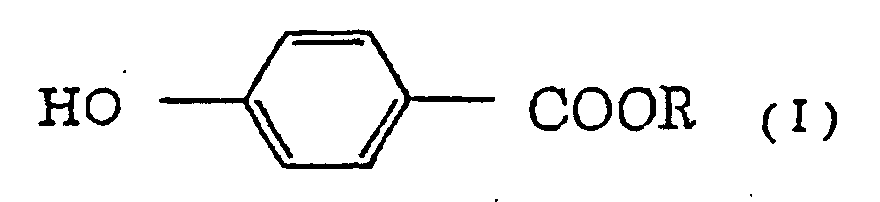
- R in the general formula represents a hydric carbon group and as the concrete examples an unsubstituted or a substituted alkyl group or a benzyl group can be mentioned. Further, it is possible to insert a substituent group which does not obstruct the colour developing sensitivity or colour fading effect of R, and as concrete examples of such substituents, lower alkyl groups such as a methyl group or an ethyl group can be mentioned. Examples of a compound represented by general formula (I) include:
- 4-hydroxybenzoic acid-benzyl ester can be preferably used. These 4-hydroxybenzoic esters can be used alone or by mixing.
- a colour developer which prevents the colour changing property for example the well known bis-phenol A, cannot be used.
- triphenylmethane-based leuco dye used in this invention examples include:
- the leuco dye whose maximum absorption wave length measured in 99% acetic acid solution is 450 ⁇ 560 nm can be used.
- Examples include:
- red colour developing leuco dyes can be used alone or by mixing more than two kinds of them to obtain a desired reddish colour such as red, magenta, vermilion, orange or purplish red.
- a conventional well known sensitizer can be used to the extent that the desired effect of this invention is not prevented.
- the sensitizer include:
- full saponificated polyvinyl alcohol of 200 ⁇ 1900 degree of polymerization partially saponificated polyvinyl alcohol denatured polyvinyl alcohol such as ; denatured polyvinyl alcohol by carboxyl, denatured polyvinyl alcohol by amide, denatured polyvinyl alcohol by sulfonic acid and denatured polyvinyl alcohol by butylal, cellulose derivatives such as ; hydroxyethyl cellulose, methyl cellulose, ethyl cellulose, carboxymethyl cellulose and acetyl cellulose, copolymer of styrene-maleic anhydride, copolymer of styrene-butadiene, polyvinyl chloride, polyvinyl acetal, polyacrylicamide, polyacrylic acid ester, polyvinylbutylal, polystyrene and copolymer of these polymer, polyamide resin, silicon resin, petroleum resin, terpene
- These high molecular compounds can be used not only by dissolving in a solvent e.g. water, alcohol, ketone, ester or hydrocarbon but also in paste form by dispersing or emulsifying in water or other medium. These states can be used in combination according to the desired quality.
- a solvent e.g. water, alcohol, ketone, ester or hydrocarbon
- These states can be used in combination according to the desired quality.
- an inorganic or an organic filler such as silica, calcium carbonate, kaoline, calcined kaoline, diatomaceous earth, talc, titanium oxide, zinc oxide, aluminum hydroxide, polystyrene resin, urea-formalin resin, copolymer of styrene-methacrylilate acid, copolymer of styrene-butadiene and hollow plastic pigment can be mentioned.
- a parting agent such as the metal salt of a fatty acid, a slipping agent such as wax, an ultra violet ray absorbent such as benzophenone-based or triazole-based, a water proof agent such as glyoxal, a dispersing agent, a deformer, an anti-oxidation agent and a fluorescent dye can be used as an additive.
- paper synthetic paper, plastic film, non-woven cloth, metallic foil and a hybrid sheet composed by said substances can be used.
- an overcoat layer composed of a macromolecular substance can be provided on the surface of the thermal sensitive colour developing layer.
- an undercoat layer containing organic or inorganic filler can be provided between the colour developing layer and the substrate.
- the amount of colour developer and dye precursor, and the kind and amount of other additives to be used in the spontaneously colour changing type thermal sensitive recording medium of this invention are decided according to the required quality and recording features, and are not restricted. However, in general, it is preferable to use 0.5 ⁇ 4 parts of filler to 1 part of colour developer and 5 ⁇ 25 % of binder to the total amount of solid. Also, it is preferable to use 0.07 ⁇ 1 parts of triphenylmethane-based leuco dye to 1 part of colour developer although this amount can be adjusted according to the desired recording sensitivity, colour changing speed and colour tone.
- the desirable amount of a reddish colour developing leuco dye whose maximum absorption wave length is 450 ⁇ 560 nm is 0.05 ⁇ 1 parts to 1 part of triphenylmethane-based leuco dye, and also this amount can be adjusted according to the desired recording sensitivity, colour changing speed and colour tone.
- These colour developer, dye and other additives which are added as required are ground to fine particles smaller than several micrometres in diameter by means of a pulverizer such as a ball mill, an attritor or a sand grinder, or by means of an adequate emulsifying device, then binder and other additives are added at need, thus the coating is prepared.
- a hand coating a size press coating method, a roll coating method, an air knife coating method, a blend coating method, a flow coating method, a comma direct method, a gravure direct method, a gravure reverse method and a reverse ⁇ roll coating method can be mentioned. Further, the method to dry up after sputtering, spraying or dipping can also be used.
- the spontaneously colour changing type thermal sensitive recording medium of this invention is illustrated by following Examples.
- terms of parts and % indicate parts by weight and weight %.
- Example 1 is an example of the spontaneously colour changing type thermal sensitive recording medium of this invention in which 4-hydroxybenzoic acid benzyl ester (hereinafter shortened to BZ) is used as a colour developer, 3,3-bis(p-dimethylaminophenyl)-6-dimethylaminophthalide (shortened to CVL) is used as a triphenylmethane-based leuco dye and 3,3-bis( 1-n-buthyl-2-methylindol-3-yl)phthalide (shortened to Red 40) is used as a reddish colour developing dye whose maximum absorption wave length is 450 ⁇ 560 nm.
- BZ 4-hydroxybenzoic acid benzyl ester
- Dispersion of colour developer (A solution), dispersion of triphenylmethane-based leuco dye (B solution) and reddish leuco dye (C solution) prepared by following blending proportion are separately ground in a wet condition to average diameter of 1 ⁇ m by means of a sand grinder.
- the prepared coating is applied to one side of 50g/m 2 substrate paper and dried up, then the paper is processed by a super calendar to surface smoothness of 500 ⁇ 600 second and the spontaneously colour changing type thermal sensitive recording medium of 6.0 g/m 2 coating amount can be obtained.
- the spontaneously colour changing type thermal sensitive recording medium is prepared by the same procedure to Example 1.
- the mixing proportion of dispersion is mentioned below.
- a solution (dispersion of colour developer [BZ]) 36.0 parts
- B solution (dispersion of triphenylmethane-based leuco dye [CVL]) 13.8 parts
- C solution (dispersion of reddish leuco dye [Red 40]) 2.3 parts Kaoline clay (50% dispersion) 12.0 parts
- the thermal sensitive recording medium is prepared by the same procedure to Example 1.
- the mixing proportion of dispersion is mentioned below.
- a solution (dispersion of colour developer [BZ]) 36.0 parts
- B solution (dispersion of triphenylmethane-based leuco dye [CVL]) 13.8 parts
- C solution (dispersion of reddish leuco dye [Red 40]) 1.38 parts Kaoline clay (50% dispersion) 12.0 parts
- the spontaneously colour changing thermal sensitive recording medium is prepared by the same procedure to Example 1.
- the mixing proportion of dispersion is mentioned below.
- the spontaneously colour changing thermal sensitive recording medium is prepared by the same procedure to Example 1.
- the mixing proportion of dispersion is mentioned below.
- a solution (dispersion of colour developer [BZ]) 36.0 parts
- the spontaneously colour changing thermal sensitive recording medium is prepared by the same procedure to Example 1.
- the mixing proportion of dispersion is mentioned below.
- a solution (dispersion of colour developer [BZ]) 36.0 parts
- B solution (dispersion of triphenylmethane-based leuco dye [CVL])
- C solution (dispersion of reddish leuco dye [Red 40]) 0.23 parts
- Kaoline clay (50% dispersion) 12.0 parts
- the spontaneously colour changing type thermal sensitive recording medium is prepared by the same procedure to Example 1.
- 4-hydroxybenzoic acid ethyl ester (shortened to Et) and 4-hydroxybenzoic acid methyl ester (shortened to Me) are used instead of 4-hydroxybenzoic acid benzyl ester (BZ)
- the spontaneously colour changing type thermal sensitive recording medium is prepared by the same procedure to Example 1.
- 4-hydroxybenzoic acid benzyl ester (BZ) and 4-hydroxybenzoic acid methyl ester (Me) are used together with as the colour developer.
- the mixing proportion of dispersion is mentioned below.
- the spontaneously colour changing type thermal sensitive recording medium is prepared by the same procedure to Example 1.
- B solution 3,3-bis(p-dimethylaminophenyl)-6-pyrrolydinophthalide and 3,3-bis(p-dimethylaminophenyl)phthalide are used instead of CVL.
- the spontaneously colour changing type thermal sensitive recording medium is prepared by the same procedure to Example 1.
- CVL and 3,3-bis(p-dimethylaminophenyl)phthalide are used together with as triphenylmethane-based leuco dye.
- the mixing proportion of dispersion is mentioned below.
- C solution (dispersion of reddish leuco dye [Red 40] 4.6 parts
- the spontaneously colour changing type thermal sensitive recording medium is prepared by the same procedure to Example 1.
- 3-cyclohexylamino-6-chlorofuruoran shortened to Orange 100
- 3,3-bis(1-ethylmethylindol-3-yl)phtalide shortened to Indolyl Red
- the spontaneously colour changing type thermal sensitive recording medium is prepared by the same procedure to Example 1.
- Red 40 and Orange 100 are used together with as the reddish leuco dye.
- the mixing proportion of dispersion is mentioned below.
- a solution (dispersion of colour developer [BZ]) 36.0 parts
- B solution (dispersion of dye precursor [CVL]) 13.8 parts
- C solution (dispersion of reddish leuco dye [Red 40]) 2.3 parts
- the spontaneously colour changing thermal sensitive recording medium is prepared by the same procedure to Example 1.
- the mixing proportion of dispersion is mentioned below.
- a solution (dispersion of colour developer [BZ]) 36.0 parts
- B solution (dispersion of triphenylmethane-based leuco dye [CVL]) 32.2 parts
- C solution (dispersion of reddish leuco dye [Red 40]) 4.6 parts Kaoline clay (50% dispersion) 12.0 parts
- the spontaneously colour changing thermal sensitive recording medium is prepared by the same procedure to Example 1.
- the mixing proportion of dispersion is mentioned below.
- a solution (dispersion of colour developer [BZ]) 36.0 parts
- the spontaneously colour changing thermal sensitive recording medium is prepared by the same procedure to Example 1.
- the mixing proportion of dispersion is mentioned below.
- a solution (dispersion of colour developer [BZ]) 36.0 parts
- the spontaneously colour changing thermal sensitive recording medium is prepared by the same procedure to Example 1.
- the mixing proportion of dispersion is mentioned below.
- a solution (dispersion of colour developer [BZ]) 36.0 parts
- Comparative Example 1 is an example to use bis-phenol A (BPA) as a colour developer.
- the thermal sensitive recording medium for Comparative Example is prepared by the same procedure to Example 1.
- Dispersion of BPA (D solution) is ground in a wet condition to average diameter of 1 ⁇ m by means of a sand grinder.
- D solution dispersion of colour developer [BPA]) bisphenol A (BPA) 6.0 parts 10% polyvinylalchol aqueous solution 18.8 parts water 11.2 parts
- Comparative Example 2 is an example to use 3-(4-diethylamino-2-ethoxyphenyl)-3-(1-ethyl-2-methylindol-3-yl)-4-azaphthalide (shortened to Blue 63) instead of triphenylmethane-based leuco dye.
- the thermal sensitive recording medium for Comparative Example is prepared by the same procedure to Example 1.
- Dispersion of Blue63 (E solution) is ground in a wet condition to average diameter of 1 ⁇ m by means of a sand grinder.
- E solution (dispersion of dye precursor) Blue 63 1.0 parts 10% polyvinylalchol aqueous solution 2.3 parts water 1.3 parts
- mark A indicates that the specimen which has passed 24 hours from the development can easily be distinguished from that of just after development
- mark B indicates that the specimen which has passed 48 hours from development can be distinguished from that of just after development and others are ranked as mark C.
- Table 1 and Table 2 The obtained results are summarized in Table 1 and Table 2.
- the Examples 1 ⁇ 19 of this invention are the substantial examples which use 4-hydroxybenzoic acid esters represented by general formula ( ⁇ ), triphenylmethane-based leuco dye and reddish colour developing leuco dye whose maximum absorption wave length is 450 ⁇ 560 nm, and the degree of colour change of 24 hours passed to that of just after development superiors to that of the Comparative Examples which do not use 4-hydroxybenzoic acid esters or triphenylmethane-based leuco dye.
- ⁇ 4-hydroxybenzoic acid esters represented by general formula ( ⁇ )
- triphenylmethane-based leuco dye and reddish colour developing leuco dye whose maximum absorption wave length is 450 ⁇ 560 nm
- the thermal sensitive recording medium of this invention is suited for the application which is necessary to distinguish the recorded pattern which is just after development from that of one or two days passed.
- Example 17 which contains 0.05 parts of triphenylmethane-based leuco dye to 1 part of colour developer, the colour difference b* value of 20 minutes passed after development increases about 20 points and the colour tone change by appearance is visible, however, the stability of image is slightly bad and is suited to the application to distinguish short term change of recorded pattern rather than long term change such as after several days.
- Example 16 which contain 1.17 parts of triphenylmethane-based leuco dye to 1 part of colour developer, although the colour change is in same blue colour tone and the degree of colour change is not so obvious, the difference between colour difference b* value of 24 or 48 hours passed from development and that of just after development is bigger than 10 and is sufficient for the practical use.
- Example 19 which contains 0.01 parts of reddish colour developing leuco dye to 1 part of triphenylmethane-based leuco dye, the colour tone change by appearance is slightly difficult to distinguish, however, the difference between colour difference b* value of 24 hours passed after development and that of just after development is bigger than 20 and has a sufficient discrimination.
- Example 18 which contains 1.2 parts of reddish colour developing leuco dye to 1 part of triphenylmethane-based leuco dye, since the colour of just after development is reddish, the colour tone change is slightly difficult to distinguish by appearance evaluation, however, the difference between colour difference b* value of 24 hours passed after development and that of just after development is bigger than 20, it is sufficient for discrimination.
- the thermal sensitive recording medium of this invention even if the colour tone change is not so vivid, since the colour change progresses by time lapse, it can be used for the application which is necessary to be distinguished after long term lapse.
- the thermal sensitive recording medium of Examples 16, 18 and 19 are the thermal sensitive recording medium which are suited for the purpose to distinguish the recorded pattern of long term passed from that of just after developed lather than one or two days passed.
- the spontaneously colour changing type thermal sensitive recording medium of this invention has a sufficient colour developing sensitivity and the colour fades out slowly, therefore the recorded pattern of one or two days passed can easily distinguished from that of just after printed. Therefore, the thermal sensitive recording medium of this invention fulfils it's function as the recording medium same as the conventional thermal sensitive recording medium for several hours after development, and after one or two days the colour obviously changes and has a remarkable distinguishing feature.
- the thermal sensitive recording medium of this invention can be applied to the use which prevent the reuse of an used ticket such as a lift riding ticket of a skiing ground or as entrance ticket of an amusement park, further the use which is necessary to distinguish from that issued on the previous day such as a statement of delivery.
Landscapes
- Chemical & Material Sciences (AREA)
- Chemical Kinetics & Catalysis (AREA)
- General Chemical & Material Sciences (AREA)
- Physics & Mathematics (AREA)
- Optics & Photonics (AREA)
- Heat Sensitive Colour Forming Recording (AREA)
Claims (8)
- Spontan farbänderndes, thermisch empfindliches Aufzeichnungsmedium, das umfaßt auf einem Substrat eine thermisch empfindliche Aufzeichnungsschicht, die umfaßtwobei R eine nicht substituierte oder substituierte C1-C7-Alkylgruppe oder Benzylgruppe ist.(a) einen farblosen oder schwach farbigen Farbstoffvorläufer, welcher ein Triphenylmethan-basierter Leukofarbstoff ist,(b) einen rötliche Farbe entwickelnden Leukofarbstoff mit einer maximalen Absorptionswellenlänge von 450 bis 560 nm, und(c) einen organischen Farbentwickler, der ein 4-Hydroxybenzoesäurester gemäß der Formel (I) ist:
- Aufzeichnungsmedium gemäß Anspruch 1, welches ein entwickeltes Muster ergibt, wobei der Farbunterschiedswert b*, der durch die Japanische Industrienorm Z-8729 vorgeschrieben ist, direkt nach der Entwicklung weniger als 0 ist und der Farbunterschied b* 24 Stunden nach der Entwicklung um wenigstens 10 größer ist als der Wert von b* direkt nach der Entwicklung.
- Aufzeichnungsmedium gemäß Anspruch 1 oder 2, wobei der Gehalt an dem Triphenylmethan-basierten Leukofarbstoff 0,07-1 Teil(e) zu 1 Teil des Farbentwicklers (c) beträgt.
- Aufzeichnungsmaterial gemäß Anspruch 1, 2 oder 3, wobei der Gehalt an rötliche Farbe entwickelnden Leukofarbstoff (b) 0,05 -1 Teil(e) zu 1 Teil des Triphenylmethan-basierten Leukofarbstoffs (a) beträgt.
- Aufzeichnungsmedium gemäß einem der vorhergehenden Ansprüche, wobei der 4-Hydroxybenzoesäureester gemäß Formel (I) 4-Hydroxybenzoesäurebenzylester und der Triphenylmethan-basierte Leukofarbstoff (a) 3,3-Bis(p-dimethylaminophenyl)-6-dimethylaminophthalid ist.
- Aufzeichnungsmaterial gemäß einem der vorhergehenden Ansprüche, wobei die Aufzeichnungsschicht weiter einen Sensibilisator, ein Bindemittel, Füllstoff oder Trennmittel umfaßt.
- Aufzeichnungsmaterial gemäß einem der vorhergehenden Ansprüche, das weiter auf der Oberfläche der Farbentwicklungsschicht eine Deckschicht umfaßt.
- Aufzeichnungsmaterial gemäß einem der vorhergehenden Ansprüche, das weiter zwischen der Farbentwicklungsschicht und dem Substrat eine Grundbeschichtung, die anorganischen oder organischen Füllstoff enthält, umfaßt.
Applications Claiming Priority (3)
| Application Number | Priority Date | Filing Date | Title |
|---|---|---|---|
| JP22183297 | 1997-08-19 | ||
| JP221832/97 | 1997-08-19 | ||
| JP22183297 | 1997-08-19 |
Publications (2)
| Publication Number | Publication Date |
|---|---|
| EP0897809A1 EP0897809A1 (de) | 1999-02-24 |
| EP0897809B1 true EP0897809B1 (de) | 2002-03-06 |
Family
ID=16772900
Family Applications (1)
| Application Number | Title | Priority Date | Filing Date |
|---|---|---|---|
| EP98306603A Expired - Lifetime EP0897809B1 (de) | 1997-08-19 | 1998-08-18 | Wärmeempfindliches Aufzeichnungsmedium des spontan farbenverändernden Typs |
Country Status (3)
| Country | Link |
|---|---|
| US (1) | US6093678A (de) |
| EP (1) | EP0897809B1 (de) |
| DE (1) | DE69804062T2 (de) |
Families Citing this family (12)
| Publication number | Priority date | Publication date | Assignee | Title |
|---|---|---|---|---|
| JP2000079758A (ja) * | 1998-06-22 | 2000-03-21 | Nippon Paper Industries Co Ltd | 感熱記録体 |
| US7727319B2 (en) * | 2006-04-19 | 2010-06-01 | Crayola Llc | Water-based ink system |
| US7815723B2 (en) * | 2006-04-19 | 2010-10-19 | Crayola Llc | Water-based ink system |
| US8500895B2 (en) * | 2006-05-22 | 2013-08-06 | Marken-Imaje Corporation | Methods of marking and related structures and compositions |
| US7935656B2 (en) | 2006-07-13 | 2011-05-03 | Nashua Corporation | Thermosensitive recording media and methods of making and using the same |
| US8048471B2 (en) | 2007-12-21 | 2011-11-01 | Innovatech, Llc | Marked precoated medical device and method of manufacturing same |
| US8231927B2 (en) | 2007-12-21 | 2012-07-31 | Innovatech, Llc | Marked precoated medical device and method of manufacturing same |
| US7811623B2 (en) | 2007-12-21 | 2010-10-12 | Innovatech, Llc | Marked precoated medical device and method of manufacturing same |
| US8231926B2 (en) | 2007-12-21 | 2012-07-31 | Innovatech, Llc | Marked precoated medical device and method of manufacturing same |
| US7714217B2 (en) | 2007-12-21 | 2010-05-11 | Innovatech, Llc | Marked precoated strings and method of manufacturing same |
| EP2325018A1 (de) | 2009-11-24 | 2011-05-25 | Mondi Uncoated Fine & Kraft Paper GmbH | Thermisch sensibles Aufzeichnungsmaterial |
| US8900652B1 (en) | 2011-03-14 | 2014-12-02 | Innovatech, Llc | Marked fluoropolymer surfaces and method of manufacturing same |
Family Cites Families (5)
| Publication number | Priority date | Publication date | Assignee | Title |
|---|---|---|---|---|
| CA987103A (en) * | 1972-02-17 | 1976-04-13 | Kinichi Adachi | Dichromatic thermo-sensitive paper |
| JPS5951587B2 (ja) * | 1976-05-19 | 1984-12-14 | 富士写真フイルム株式会社 | サ−モクロミズム材料 |
| JPS57129785A (en) * | 1981-02-06 | 1982-08-11 | Jujo Paper Co Ltd | Heat sensitive recording paper |
| JPS5933183A (ja) * | 1982-08-19 | 1984-02-22 | Ricoh Co Ltd | 2色感熱記録材料 |
| US5811369A (en) * | 1995-12-01 | 1998-09-22 | Nippon Paper Industries Co., Ltd. | Thermal recording medium |
-
1998
- 1998-08-18 US US09/135,644 patent/US6093678A/en not_active Expired - Fee Related
- 1998-08-18 DE DE69804062T patent/DE69804062T2/de not_active Expired - Fee Related
- 1998-08-18 EP EP98306603A patent/EP0897809B1/de not_active Expired - Lifetime
Also Published As
| Publication number | Publication date |
|---|---|
| DE69804062T2 (de) | 2002-11-28 |
| DE69804062D1 (de) | 2002-04-11 |
| US6093678A (en) | 2000-07-25 |
| EP0897809A1 (de) | 1999-02-24 |
Similar Documents
| Publication | Publication Date | Title |
|---|---|---|
| JPH0158076B2 (de) | ||
| EP0897809B1 (de) | Wärmeempfindliches Aufzeichnungsmedium des spontan farbenverändernden Typs | |
| EP0273752A2 (de) | Verfahren zur Herstellung eines wärmeempfindlichen Aufzeichnungsmaterials | |
| JPH0153198B2 (de) | ||
| WO2005032838A1 (en) | Improvements in thermal paper | |
| CA1263019A (en) | Heat-sensitive recording material | |
| JPS583899A (ja) | 感熱記録シ−ト | |
| JP3433419B2 (ja) | 自然変色型感熱記録体 | |
| JP2754447B2 (ja) | 感熱記録体 | |
| JP3403757B2 (ja) | 可逆性感熱記録材料 | |
| JP3177544B2 (ja) | 感熱記録材料 | |
| JP4152115B2 (ja) | 感熱記録体 | |
| JP3158386B2 (ja) | 感熱記録体 | |
| JP2511552B2 (ja) | 感熱記録材料 | |
| JPH02155687A (ja) | 感熱記録紙 | |
| JP4573460B2 (ja) | 感熱記録シート | |
| JPS61225097A (ja) | 転写型感熱記録材料 | |
| JPH0313385A (ja) | 感熱記録材料 | |
| JPS63203379A (ja) | 感熱記録紙 | |
| JPH01105779A (ja) | 感熱記録材料 | |
| JPH01180382A (ja) | 感熱記録材料 | |
| JP2002293038A (ja) | 感熱記録体 | |
| JPH0995061A (ja) | 二色系感熱記録媒体 | |
| JPH1120312A (ja) | 自然消色型感熱記録体 | |
| JP2002293037A (ja) | 感熱記録体 |
Legal Events
| Date | Code | Title | Description |
|---|---|---|---|
| PUAI | Public reference made under article 153(3) epc to a published international application that has entered the european phase |
Free format text: ORIGINAL CODE: 0009012 |
|
| AK | Designated contracting states |
Kind code of ref document: A1 Designated state(s): BE DE FR GB IT SE |
|
| AX | Request for extension of the european patent |
Free format text: AL;LT;LV;MK;RO;SI |
|
| 17P | Request for examination filed |
Effective date: 19990415 |
|
| AKX | Designation fees paid |
Free format text: BE DE FR GB IT SE |
|
| 17Q | First examination report despatched |
Effective date: 19991220 |
|
| GRAG | Despatch of communication of intention to grant |
Free format text: ORIGINAL CODE: EPIDOS AGRA |
|
| GRAG | Despatch of communication of intention to grant |
Free format text: ORIGINAL CODE: EPIDOS AGRA |
|
| GRAH | Despatch of communication of intention to grant a patent |
Free format text: ORIGINAL CODE: EPIDOS IGRA |
|
| GRAH | Despatch of communication of intention to grant a patent |
Free format text: ORIGINAL CODE: EPIDOS IGRA |
|
| REG | Reference to a national code |
Ref country code: GB Ref legal event code: IF02 |
|
| GRAA | (expected) grant |
Free format text: ORIGINAL CODE: 0009210 |
|
| AK | Designated contracting states |
Kind code of ref document: B1 Designated state(s): BE DE FR GB IT SE |
|
| REF | Corresponds to: |
Ref document number: 69804062 Country of ref document: DE Date of ref document: 20020411 |
|
| ET | Fr: translation filed | ||
| PLBE | No opposition filed within time limit |
Free format text: ORIGINAL CODE: 0009261 |
|
| STAA | Information on the status of an ep patent application or granted ep patent |
Free format text: STATUS: NO OPPOSITION FILED WITHIN TIME LIMIT |
|
| 26N | No opposition filed |
Effective date: 20021209 |
|
| PGFP | Annual fee paid to national office [announced via postgrant information from national office to epo] |
Ref country code: SE Payment date: 20030806 Year of fee payment: 6 |
|
| PGFP | Annual fee paid to national office [announced via postgrant information from national office to epo] |
Ref country code: FR Payment date: 20030808 Year of fee payment: 6 |
|
| PGFP | Annual fee paid to national office [announced via postgrant information from national office to epo] |
Ref country code: GB Payment date: 20030813 Year of fee payment: 6 |
|
| PGFP | Annual fee paid to national office [announced via postgrant information from national office to epo] |
Ref country code: DE Payment date: 20030828 Year of fee payment: 6 |
|
| PGFP | Annual fee paid to national office [announced via postgrant information from national office to epo] |
Ref country code: BE Payment date: 20031014 Year of fee payment: 6 |
|
| PG25 | Lapsed in a contracting state [announced via postgrant information from national office to epo] |
Ref country code: GB Free format text: LAPSE BECAUSE OF NON-PAYMENT OF DUE FEES Effective date: 20040818 |
|
| PG25 | Lapsed in a contracting state [announced via postgrant information from national office to epo] |
Ref country code: SE Free format text: LAPSE BECAUSE OF NON-PAYMENT OF DUE FEES Effective date: 20040819 |
|
| PG25 | Lapsed in a contracting state [announced via postgrant information from national office to epo] |
Ref country code: BE Free format text: LAPSE BECAUSE OF NON-PAYMENT OF DUE FEES Effective date: 20040831 |
|
| BERE | Be: lapsed |
Owner name: *NIPPON PAPER INDUSTRIES CO. LTD Effective date: 20040831 |
|
| PG25 | Lapsed in a contracting state [announced via postgrant information from national office to epo] |
Ref country code: DE Free format text: LAPSE BECAUSE OF NON-PAYMENT OF DUE FEES Effective date: 20050301 |
|
| EUG | Se: european patent has lapsed | ||
| GBPC | Gb: european patent ceased through non-payment of renewal fee |
Effective date: 20040818 |
|
| PG25 | Lapsed in a contracting state [announced via postgrant information from national office to epo] |
Ref country code: FR Free format text: LAPSE BECAUSE OF NON-PAYMENT OF DUE FEES Effective date: 20050429 |
|
| REG | Reference to a national code |
Ref country code: FR Ref legal event code: ST |
|
| PG25 | Lapsed in a contracting state [announced via postgrant information from national office to epo] |
Ref country code: IT Free format text: LAPSE BECAUSE OF NON-PAYMENT OF DUE FEES Effective date: 20050818 |
|
| BERE | Be: lapsed |
Owner name: *NIPPON PAPER INDUSTRIES CO. LTD Effective date: 20040831 |