EP0897783B1 - Recycling process of a cross-linked polymeric material, in particular from electric cable coating materials - Google Patents
Recycling process of a cross-linked polymeric material, in particular from electric cable coating materials Download PDFInfo
- Publication number
- EP0897783B1 EP0897783B1 EP19980440165 EP98440165A EP0897783B1 EP 0897783 B1 EP0897783 B1 EP 0897783B1 EP 19980440165 EP19980440165 EP 19980440165 EP 98440165 A EP98440165 A EP 98440165A EP 0897783 B1 EP0897783 B1 EP 0897783B1
- Authority
- EP
- European Patent Office
- Prior art keywords
- cross
- extruder
- mixer
- process according
- linked
- Prior art date
- Legal status (The legal status is an assumption and is not a legal conclusion. Google has not performed a legal analysis and makes no representation as to the accuracy of the status listed.)
- Expired - Lifetime
Links
- 239000000463 material Substances 0.000 title claims description 99
- 238000000034 method Methods 0.000 title claims description 37
- 230000008569 process Effects 0.000 title claims description 35
- 238000000576 coating method Methods 0.000 title claims description 13
- 238000004064 recycling Methods 0.000 title claims description 12
- 239000011248 coating agent Substances 0.000 title claims description 7
- 239000012815 thermoplastic material Substances 0.000 claims description 12
- 238000001125 extrusion Methods 0.000 claims description 9
- 230000009471 action Effects 0.000 claims description 5
- 238000003754 machining Methods 0.000 claims description 5
- 229920003020 cross-linked polyethylene Polymers 0.000 description 15
- 229920000642 polymer Polymers 0.000 description 14
- 239000004703 cross-linked polyethylene Substances 0.000 description 13
- 239000003795 chemical substances by application Substances 0.000 description 12
- 239000000203 mixture Substances 0.000 description 9
- 150000002978 peroxides Chemical class 0.000 description 9
- 238000004132 cross linking Methods 0.000 description 8
- YXFVVABEGXRONW-UHFFFAOYSA-N Toluene Chemical compound CC1=CC=CC=C1 YXFVVABEGXRONW-UHFFFAOYSA-N 0.000 description 6
- 229920001169 thermoplastic Polymers 0.000 description 6
- 229920006037 cross link polymer Polymers 0.000 description 5
- 239000011243 crosslinked material Substances 0.000 description 5
- 238000005516 engineering process Methods 0.000 description 5
- 238000004519 manufacturing process Methods 0.000 description 5
- 229920000573 polyethylene Polymers 0.000 description 5
- 239000000843 powder Substances 0.000 description 5
- 239000004416 thermosoftening plastic Substances 0.000 description 5
- 239000004698 Polyethylene Substances 0.000 description 4
- 229920001038 ethylene copolymer Polymers 0.000 description 4
- 239000000945 filler Substances 0.000 description 4
- -1 polyethylene Polymers 0.000 description 4
- VTYYLEPIZMXCLO-UHFFFAOYSA-L Calcium carbonate Chemical compound [Ca+2].[O-]C([O-])=O VTYYLEPIZMXCLO-UHFFFAOYSA-L 0.000 description 3
- 238000009533 lab test Methods 0.000 description 3
- 238000000465 moulding Methods 0.000 description 3
- 239000003921 oil Substances 0.000 description 3
- 230000008901 benefit Effects 0.000 description 2
- 235000010216 calcium carbonate Nutrition 0.000 description 2
- 230000015556 catabolic process Effects 0.000 description 2
- 238000006731 degradation reaction Methods 0.000 description 2
- 239000011810 insulating material Substances 0.000 description 2
- 238000009413 insulation Methods 0.000 description 2
- 239000012764 mineral filler Substances 0.000 description 2
- 239000000243 solution Substances 0.000 description 2
- 239000002699 waste material Substances 0.000 description 2
- VXNZUUAINFGPBY-UHFFFAOYSA-N 1-Butene Chemical compound CCC=C VXNZUUAINFGPBY-UHFFFAOYSA-N 0.000 description 1
- LIKMAJRDDDTEIG-UHFFFAOYSA-N 1-hexene Chemical compound CCCCC=C LIKMAJRDDDTEIG-UHFFFAOYSA-N 0.000 description 1
- GIEMHYCMBGELGY-UHFFFAOYSA-N 10-undecen-1-ol Chemical compound OCCCCCCCCCC=C GIEMHYCMBGELGY-UHFFFAOYSA-N 0.000 description 1
- 239000005995 Aluminium silicate Substances 0.000 description 1
- OYPRJOBELJOOCE-UHFFFAOYSA-N Calcium Chemical compound [Ca] OYPRJOBELJOOCE-UHFFFAOYSA-N 0.000 description 1
- 229920002943 EPDM rubber Polymers 0.000 description 1
- 235000021355 Stearic acid Nutrition 0.000 description 1
- 239000000654 additive Substances 0.000 description 1
- 230000000996 additive effect Effects 0.000 description 1
- 238000004220 aggregation Methods 0.000 description 1
- 230000002776 aggregation Effects 0.000 description 1
- XFBXDGLHUSUNMG-UHFFFAOYSA-N alumane;hydrate Chemical compound O.[AlH3] XFBXDGLHUSUNMG-UHFFFAOYSA-N 0.000 description 1
- 235000012211 aluminium silicate Nutrition 0.000 description 1
- 238000004458 analytical method Methods 0.000 description 1
- 125000003118 aryl group Chemical group 0.000 description 1
- DQXBYHZEEUGOBF-UHFFFAOYSA-N but-3-enoic acid;ethene Chemical group C=C.OC(=O)CC=C DQXBYHZEEUGOBF-UHFFFAOYSA-N 0.000 description 1
- IAQRGUVFOMOMEM-UHFFFAOYSA-N butene Natural products CC=CC IAQRGUVFOMOMEM-UHFFFAOYSA-N 0.000 description 1
- 229920005549 butyl rubber Polymers 0.000 description 1
- 229910052791 calcium Inorganic materials 0.000 description 1
- 229910000019 calcium carbonate Inorganic materials 0.000 description 1
- 239000003054 catalyst Substances 0.000 description 1
- 230000008859 change Effects 0.000 description 1
- 238000007906 compression Methods 0.000 description 1
- 230000006835 compression Effects 0.000 description 1
- 239000006185 dispersion Substances 0.000 description 1
- 229920001971 elastomer Polymers 0.000 description 1
- 150000002148 esters Chemical class 0.000 description 1
- 238000011156 evaluation Methods 0.000 description 1
- 230000002349 favourable effect Effects 0.000 description 1
- 238000009472 formulation Methods 0.000 description 1
- 239000008187 granular material Substances 0.000 description 1
- BHEPBYXIRTUNPN-UHFFFAOYSA-N hydridophosphorus(.) (triplet) Chemical class [PH] BHEPBYXIRTUNPN-UHFFFAOYSA-N 0.000 description 1
- 238000009776 industrial production Methods 0.000 description 1
- 238000002347 injection Methods 0.000 description 1
- 239000007924 injection Substances 0.000 description 1
- NLYAJNPCOHFWQQ-UHFFFAOYSA-N kaolin Chemical compound O.O.O=[Al]O[Si](=O)O[Si](=O)O[Al]=O NLYAJNPCOHFWQQ-UHFFFAOYSA-N 0.000 description 1
- 230000002045 lasting effect Effects 0.000 description 1
- ZLNQQNXFFQJAID-UHFFFAOYSA-L magnesium carbonate Chemical class [Mg+2].[O-]C([O-])=O ZLNQQNXFFQJAID-UHFFFAOYSA-L 0.000 description 1
- 239000001095 magnesium carbonate Substances 0.000 description 1
- 235000011160 magnesium carbonates Nutrition 0.000 description 1
- VTHJTEIRLNZDEV-UHFFFAOYSA-L magnesium dihydroxide Chemical compound [OH-].[OH-].[Mg+2] VTHJTEIRLNZDEV-UHFFFAOYSA-L 0.000 description 1
- 239000000347 magnesium hydroxide Substances 0.000 description 1
- 229910001862 magnesium hydroxide Inorganic materials 0.000 description 1
- 235000012254 magnesium hydroxide Nutrition 0.000 description 1
- 238000003801 milling Methods 0.000 description 1
- QIQXTHQIDYTFRH-UHFFFAOYSA-N octadecanoic acid Chemical compound CCCCCCCCCCCCCCCCCC(O)=O QIQXTHQIDYTFRH-UHFFFAOYSA-N 0.000 description 1
- OQCDKBAXFALNLD-UHFFFAOYSA-N octadecanoic acid Natural products CCCCCCCC(C)CCCCCCCCC(O)=O OQCDKBAXFALNLD-UHFFFAOYSA-N 0.000 description 1
- TVMXDCGIABBOFY-UHFFFAOYSA-N octane Chemical compound CCCCCCCC TVMXDCGIABBOFY-UHFFFAOYSA-N 0.000 description 1
- 239000002245 particle Substances 0.000 description 1
- 238000011084 recovery Methods 0.000 description 1
- 239000005060 rubber Substances 0.000 description 1
- 150000003839 salts Chemical class 0.000 description 1
- 239000004065 semiconductor Substances 0.000 description 1
- 239000007787 solid Substances 0.000 description 1
- 239000008117 stearic acid Substances 0.000 description 1
- 235000012222 talc Nutrition 0.000 description 1
- XLYOFNOQVPJJNP-UHFFFAOYSA-N water Substances O XLYOFNOQVPJJNP-UHFFFAOYSA-N 0.000 description 1
Images
Classifications
-
- B—PERFORMING OPERATIONS; TRANSPORTING
- B29—WORKING OF PLASTICS; WORKING OF SUBSTANCES IN A PLASTIC STATE IN GENERAL
- B29B—PREPARATION OR PRETREATMENT OF THE MATERIAL TO BE SHAPED; MAKING GRANULES OR PREFORMS; RECOVERY OF PLASTICS OR OTHER CONSTITUENTS OF WASTE MATERIAL CONTAINING PLASTICS
- B29B17/00—Recovery of plastics or other constituents of waste material containing plastics
- B29B17/04—Disintegrating plastics, e.g. by milling
-
- B—PERFORMING OPERATIONS; TRANSPORTING
- B29—WORKING OF PLASTICS; WORKING OF SUBSTANCES IN A PLASTIC STATE IN GENERAL
- B29B—PREPARATION OR PRETREATMENT OF THE MATERIAL TO BE SHAPED; MAKING GRANULES OR PREFORMS; RECOVERY OF PLASTICS OR OTHER CONSTITUENTS OF WASTE MATERIAL CONTAINING PLASTICS
- B29B17/00—Recovery of plastics or other constituents of waste material containing plastics
- B29B17/0026—Recovery of plastics or other constituents of waste material containing plastics by agglomeration or compacting
-
- B—PERFORMING OPERATIONS; TRANSPORTING
- B29—WORKING OF PLASTICS; WORKING OF SUBSTANCES IN A PLASTIC STATE IN GENERAL
- B29C—SHAPING OR JOINING OF PLASTICS; SHAPING OF MATERIAL IN A PLASTIC STATE, NOT OTHERWISE PROVIDED FOR; AFTER-TREATMENT OF THE SHAPED PRODUCTS, e.g. REPAIRING
- B29C48/00—Extrusion moulding, i.e. expressing the moulding material through a die or nozzle which imparts the desired form; Apparatus therefor
- B29C48/022—Extrusion moulding, i.e. expressing the moulding material through a die or nozzle which imparts the desired form; Apparatus therefor characterised by the choice of material
-
- B—PERFORMING OPERATIONS; TRANSPORTING
- B29—WORKING OF PLASTICS; WORKING OF SUBSTANCES IN A PLASTIC STATE IN GENERAL
- B29C—SHAPING OR JOINING OF PLASTICS; SHAPING OF MATERIAL IN A PLASTIC STATE, NOT OTHERWISE PROVIDED FOR; AFTER-TREATMENT OF THE SHAPED PRODUCTS, e.g. REPAIRING
- B29C48/00—Extrusion moulding, i.e. expressing the moulding material through a die or nozzle which imparts the desired form; Apparatus therefor
- B29C48/25—Component parts, details or accessories; Auxiliary operations
- B29C48/36—Means for plasticising or homogenising the moulding material or forcing it through the nozzle or die
- B29C48/395—Means for plasticising or homogenising the moulding material or forcing it through the nozzle or die using screws surrounded by a cooperating barrel, e.g. single screw extruders
-
- B—PERFORMING OPERATIONS; TRANSPORTING
- B29—WORKING OF PLASTICS; WORKING OF SUBSTANCES IN A PLASTIC STATE IN GENERAL
- B29C—SHAPING OR JOINING OF PLASTICS; SHAPING OF MATERIAL IN A PLASTIC STATE, NOT OTHERWISE PROVIDED FOR; AFTER-TREATMENT OF THE SHAPED PRODUCTS, e.g. REPAIRING
- B29C48/00—Extrusion moulding, i.e. expressing the moulding material through a die or nozzle which imparts the desired form; Apparatus therefor
- B29C48/25—Component parts, details or accessories; Auxiliary operations
- B29C48/36—Means for plasticising or homogenising the moulding material or forcing it through the nozzle or die
- B29C48/395—Means for plasticising or homogenising the moulding material or forcing it through the nozzle or die using screws surrounded by a cooperating barrel, e.g. single screw extruders
- B29C48/40—Means for plasticising or homogenising the moulding material or forcing it through the nozzle or die using screws surrounded by a cooperating barrel, e.g. single screw extruders using two or more parallel screws or at least two parallel non-intermeshing screws, e.g. twin screw extruders
- B29C48/402—Means for plasticising or homogenising the moulding material or forcing it through the nozzle or die using screws surrounded by a cooperating barrel, e.g. single screw extruders using two or more parallel screws or at least two parallel non-intermeshing screws, e.g. twin screw extruders the screws having intermeshing parts
-
- C—CHEMISTRY; METALLURGY
- C08—ORGANIC MACROMOLECULAR COMPOUNDS; THEIR PREPARATION OR CHEMICAL WORKING-UP; COMPOSITIONS BASED THEREON
- C08J—WORKING-UP; GENERAL PROCESSES OF COMPOUNDING; AFTER-TREATMENT NOT COVERED BY SUBCLASSES C08B, C08C, C08F, C08G or C08H
- C08J11/00—Recovery or working-up of waste materials
- C08J11/04—Recovery or working-up of waste materials of polymers
- C08J11/10—Recovery or working-up of waste materials of polymers by chemically breaking down the molecular chains of polymers or breaking of crosslinks, e.g. devulcanisation
- C08J11/12—Recovery or working-up of waste materials of polymers by chemically breaking down the molecular chains of polymers or breaking of crosslinks, e.g. devulcanisation by dry-heat treatment only
-
- B—PERFORMING OPERATIONS; TRANSPORTING
- B29—WORKING OF PLASTICS; WORKING OF SUBSTANCES IN A PLASTIC STATE IN GENERAL
- B29C—SHAPING OR JOINING OF PLASTICS; SHAPING OF MATERIAL IN A PLASTIC STATE, NOT OTHERWISE PROVIDED FOR; AFTER-TREATMENT OF THE SHAPED PRODUCTS, e.g. REPAIRING
- B29C48/00—Extrusion moulding, i.e. expressing the moulding material through a die or nozzle which imparts the desired form; Apparatus therefor
- B29C48/03—Extrusion moulding, i.e. expressing the moulding material through a die or nozzle which imparts the desired form; Apparatus therefor characterised by the shape of the extruded material at extrusion
- B29C48/06—Rod-shaped
-
- B—PERFORMING OPERATIONS; TRANSPORTING
- B29—WORKING OF PLASTICS; WORKING OF SUBSTANCES IN A PLASTIC STATE IN GENERAL
- B29K—INDEXING SCHEME ASSOCIATED WITH SUBCLASSES B29B, B29C OR B29D, RELATING TO MOULDING MATERIALS OR TO MATERIALS FOR MOULDS, REINFORCEMENTS, FILLERS OR PREFORMED PARTS, e.g. INSERTS
- B29K2105/00—Condition, form or state of moulded material or of the material to be shaped
- B29K2105/26—Scrap or recycled material
-
- Y—GENERAL TAGGING OF NEW TECHNOLOGICAL DEVELOPMENTS; GENERAL TAGGING OF CROSS-SECTIONAL TECHNOLOGIES SPANNING OVER SEVERAL SECTIONS OF THE IPC; TECHNICAL SUBJECTS COVERED BY FORMER USPC CROSS-REFERENCE ART COLLECTIONS [XRACs] AND DIGESTS
- Y02—TECHNOLOGIES OR APPLICATIONS FOR MITIGATION OR ADAPTATION AGAINST CLIMATE CHANGE
- Y02W—CLIMATE CHANGE MITIGATION TECHNOLOGIES RELATED TO WASTEWATER TREATMENT OR WASTE MANAGEMENT
- Y02W30/00—Technologies for solid waste management
- Y02W30/50—Reuse, recycling or recovery technologies
- Y02W30/62—Plastics recycling; Rubber recycling
Definitions
- This invention concerns a process for the recycling of cross-linked polymeric materials, in particular coming from scraps of electric cable coating materials and from unused electric cable coating materials, and a material obtained by the process.
- cross-linked polymers and in particular cross-linked polyethylenes, for the coating and insulation of electric cables
- cross-linking i.e. a three-dimensional cross-link of intermolecular bonds
- cross-linking i.e. a three-dimensional cross-link of intermolecular bonds
- the cross-linking degree of the scraps from extrusion also depends on the stocking conditions of the scraps themselves, specifically on the presence of water or air humidity.
- both the cross-linking degree and composition of cross-linked polymer scraps generated during a manufacturing cycle of electric cables are generally highly variable, save the fact that anyway said materials cannot be regarded as thermoplastic materials.
- cross-linking makes the polymeric materials substantially infusible and, if this may represent an advantage from an applicative standpoint, it does anyway limit recovery and recycling opportunities of such materials: therefore, known recycling processes of polymeric materials are applicable to thermoplastic materials only, which once brought into their melt state, they may be reworked according to common technologies, usually mixed with a virgin polymer of same nature or compatible with it.
- patent JP 04-197456 discloses that cross-linked material is heated and submitted to extremely high mechanical shear stresses in a Bambury-type internal mixer: a very fine (0 to 500 ⁇ m) powder is obtained by the end of the process lasting 10 to 60 minutes.
- a similar process is also disclosed in patent JP 57-136 wherein degradation of cross-linked material to its powder state is carried out in a single-screw extruder or in a cylinder mixer or still in a Brabender-type mixer.
- the cross-linked polymer is reduced to a powder that, anyway, may not be used directly alone due to its lack of cohesion, but it should be used as an additive to a virgin polymer; additionally, this powder has the drawback of a very low apparent density, hence being very bulky.
- a recycling process for a cross-linked polymeric material, in particular from scraps of electric cable coating materials, characterized in that it comprises a mechanical mixing cycle for said cross-linked polymeric material, during which said cross-linked polymeric material is subjected, for a pre-established time, to a mechanical mixing action and to shear stresses higher than a pre-established value, capable of causing dereticulation of said material.
- said mechanical mixing cycle is carried out in either a continuous or intermittent mixing equipment, a specific power per mass unit of material comprised between about 0,5 and about 1 kW/h per kg of material being imparted to said material by said mixing equipment.
- the mechanical mixing cycle is carried out in a continuous mixing equipment, e.g. a twin-screw extruder-mixer, where the dwelling time of said cross-linked polymeric material inside said continuous mixing equipment is comprised from about 20 to about 60 seconds, during said mechanical mixing cycle said material is subjected to shear stresses of value ranging from about 50 to about 150 s -1 .
- a continuous mixing equipment e.g. a twin-screw extruder-mixer
- the shear stress imparted to the material is expressed by the shear rate, measured in s -1 .
- the process according to this invention allows the recycling of cross-linked polymeric materials, e.g. scraps of electric cable coatings or coatings of unused electric cables, without the need of eliminating them through expensive and/or polluting operations: moreover, the recycled material is substantially a homogeneous material having satisfactory mechanical properties that may be converted through the usual machining technologies for thermoplastic materials and re-used in a large number of applications, either alone or mixed with virgin polymers.
- the Applicant technicians have surprisingly observed that submitting a cross-linked polymeric material to a mechanical mixing action for a sufficient time to induce shear stresses and temperatures higher than pre-established minimum levels in the material itself (i.e. exposing the material to a higher specific power than a pre-established level), the material goes back to a state that can be considered as substantially thermoplastic.
- the process may take place in continuous operation, e.g. in an extruder-mixer Dereticulation is obtained, anyway, by subjecting the material to a mechanical mixing action with sufficient levels of stress, temperature and duration: an extruder-mixer appears more convenient only from a costing standpoint if compared with an internal mixer, equally effective in obtaining dereticulation.
- the equipment in which the process according to the invention is carried out shall be provided with characteristics capable of subjecting the material to a mechanical action as required for obtaining the dereticulation.
- an extruder if used, this should have a geometrical configuration such as to ensure that dwelling time of the cross-linked polymer inside it is enough to cause dereticulation, and both the screw profiles and temperature profile within the extruder shall be optimized to reach sufficiently high temperature and shear stress level.
- a screw profile with various mixing zones and "counterthreaded" sections returning the material to said mixing zones should be used to have dereticulation taking actually place.
- thermoplastic material obtained at the mixer outlet, which can be reduced to granules, cooled and dried as any other thermoplastic material: thereafter, the dereticulated material can be re-used according to the usual machining technologies for thermoplastic materials, such as moulding or extrusion, either alone or mixed with virgin polymers.
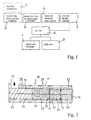
- the process according to this invention comprises a mechanical mixing cycle 3, where a specific power per mass unit is imparted to the pulverized cross-linked polymeric material, such to cause shear stresses and temperatures higher than pre-established minimum levels in the material, which are enough to determine dereticulation of the material and cause it to go back to a state that can be substantially regarded as thermoplastic.
- the preliminary crushing step 1 is not strictly required to obtain the dereticulation result provided by this invention, but it has the function of improving material feeding to the equipment (mixer) wherein mixing cycle 3 is taking place.
- Step 5 of Fig. 1 the material can be cooled, dried and sacked (step 5 of Fig. 1) and therefore is ready for re-use 6, either alone or mixed with virgin polymers, according to usual machining technologies for thermoplastic materials.
- the recycled material according to this invention is suitable for re-use either as moulding material, for instance for the manufacture of technical items (Step 7 of Fig. 1) or as extrusion material, for instance to obtain sheaths and fillers for electric cables (Step 8).
- an extruder-mixer indicated by 10 can be favourably used to execute the mechanical mixing cycle 3 of the process according to the invention.
- the extruder 10 comprises a cylinder 11, containing inside at least a rotary screw 12, and is provided with a feed hopper 13 and an extrusion head 14 located on the opposite cylinder ends 11, respectively.
- the extruder 10 comprises preferably two flanked or overlapped screws (12), rotating in the same direction or in opposite directions, however with the same profile: specifically, the screw/(s) profile 12 as well as the temperature profile inside the cylinder 11 is optimized to obtain temperature and shear stresses on the material that are sufficiently high to cause material dereticulation.
- the screw 12 has a plurality of mixing zones (or blocks) and conveying zones spaced by "counter-threaded” sections returning the material to the mixing zones.
- the screw 12 sequentially comprises a first conveying block 20, a first mixing block 21, a second conveying 22 and a second mixing block 23; the second mixing block 23 is followed in the following order by a first "counter-threaded” block 24, a third conveying block 25, a third mixing block 26 and a second "counter-threaded” block 27; finally, before the head 14 of the extruder 10 the screw 12 comprises a fourth last conveying block 28.
- the screw 12 and the head 14 of the extruder 10 are maintained at their pre-established temperatures, respectively, for instance about 70°C for the screw 12 (preferred range 50°C to 80°C) and about 230°C for the head 14 (preferred range 200°C to 240°C), whereas the cylinder 11 is heated to have an increasing temperature profile from a feeding zone 30 in line with the hopper 13 and maintained at a relatively low temperature (preferred range 50°C to 100°C) towards the extrusion head 14; specifically, downstream of the feed zone 30 the cylinder 11 may have a central zone 31 and an end zone 32 at the head 14; the end zone 32 is maintained at high temperature, near or equal to the temperature of the head 14 (preferred range 180°C to 240°C), whereas the central zone 31 is maintained at an intermediate temperature between the temperatures of the feed zone 30 and end zone 31 (preferred range 110°C to 210°C).
- the waste materials were first milled to a pulverized material consisting of small particles having an average size less than 4 mm. Pulverized materials were then introduced into a twin-screw extruder having a special screw profile as previously described with reference to Fig. 2 of the attached drawing.
- the material obtained was tested to determine its cross-link degree, specifically expressed by the percentage contents of gel and its solubility in toluene.
- thermoplastic state of recycled materials was also made by measuring the thermofluidity index at 120°C with a weight of 21.60 kg, expressed in extruded grams within 10 minutes. The results are given in Table 3.
- thermofluidity index depends on the nature of starting polymers; anyway, according to the values observed, the materials treated according to the invention can be considered as substantially thermoplastics.
- Material Thermofluidity Index at 120°C (extr. g in 10 min) Cross-linked polyethylene with peroxide before treatment 0
- Cross-linked polyethylene with silanic agents after treatment 0,50 ⁇ 9
- Cross-linked polymeric materials treated as described in the above example 1 were used in some industrial applications to evaluate their real capability of use. Specifically, these materials were directly used to manufacture internal "padding" sheaths of the type usually provided under armored wires and bands in electric cables. Moreover, these materials were used as polymeric components of filler mixtures, as provided to "fill” the voids between insulated cores and the external sheath of electric cables, in partial or total replacement of virgin polymers usually adopted for this kind of applications. Mixture formulations listed under Table 5 were used (shown compositions are expressed in parts per weight for 100 parts of polymer).
- Elastomeric polymers stand for e.g. EPDM rubbers, EVA rubbers (VA ranging from 28 to 80%), butyl rubbers, etc.
- Thermoplastic polythenes mainly stand for polyethylene, polyethylene copolymers with butene, hexene, octane, butyl-acrilates, ethylacrilates, etc.
- Mineral fillers stand for e.g. calcium carbonate, calcium and magnesium carbonates, aluminium hydrate, magnesium hydroxide, talcs, kaolin.
- Plasticizing oils stand for e.g.
- cross-linked polymeric materials treated as described in the previous example 1 were also used as moulding materials. Specifically, consideration was given to a material originated from scraps based on a cross-linked polyethylene mixture with peroxide along with cross-linked polyethylenes with silanic agents, in equal parts. Both the materials were injection moulded as "handlebar" test tubes, which were then submitted to usual tests for determining their mechanical properties. An ultimate tensile strength of about 20 Mpa and an ultimate elongation of about 60% were observed on both materials. Both the materials have shown an excellent moulded surface.
Landscapes
- Engineering & Computer Science (AREA)
- Mechanical Engineering (AREA)
- Chemical & Material Sciences (AREA)
- Environmental & Geological Engineering (AREA)
- Medicinal Chemistry (AREA)
- Sustainable Development (AREA)
- Health & Medical Sciences (AREA)
- Thermal Sciences (AREA)
- Chemical Kinetics & Catalysis (AREA)
- Physics & Mathematics (AREA)
- Polymers & Plastics (AREA)
- Organic Chemistry (AREA)
- Life Sciences & Earth Sciences (AREA)
- Separation, Recovery Or Treatment Of Waste Materials Containing Plastics (AREA)
- Processing And Handling Of Plastics And Other Materials For Molding In General (AREA)
- Insulated Conductors (AREA)
- Extrusion Moulding Of Plastics Or The Like (AREA)
- Organic Insulating Materials (AREA)
- Compositions Of Macromolecular Compounds (AREA)
- Processes Specially Adapted For Manufacturing Cables (AREA)
- Processes Of Treating Macromolecular Substances (AREA)
Applications Claiming Priority (2)
| Application Number | Priority Date | Filing Date | Title |
|---|---|---|---|
| ITTO970739 | 1997-08-12 | ||
| IT97TO000739 IT1293969B1 (it) | 1997-08-12 | 1997-08-12 | Procedimento per il riciclaggio di un materiale polimerico reticolato, in particolare proveniente da materiali di rivestimento di cavi |
Publications (3)
| Publication Number | Publication Date |
|---|---|
| EP0897783A2 EP0897783A2 (en) | 1999-02-24 |
| EP0897783A3 EP0897783A3 (en) | 1999-03-24 |
| EP0897783B1 true EP0897783B1 (en) | 2001-11-14 |
Family
ID=11415951
Family Applications (1)
| Application Number | Title | Priority Date | Filing Date |
|---|---|---|---|
| EP19980440165 Expired - Lifetime EP0897783B1 (en) | 1997-08-12 | 1998-07-31 | Recycling process of a cross-linked polymeric material, in particular from electric cable coating materials |
Country Status (8)
| Country | Link |
|---|---|
| US (1) | US6127434A (da) |
| EP (1) | EP0897783B1 (da) |
| JP (1) | JPH11189670A (da) |
| CA (1) | CA2242264C (da) |
| DE (1) | DE69802479T2 (da) |
| DK (1) | DK0897783T3 (da) |
| IT (1) | IT1293969B1 (da) |
| NO (1) | NO983675L (da) |
Families Citing this family (13)
| Publication number | Priority date | Publication date | Assignee | Title |
|---|---|---|---|---|
| ES2168818T3 (es) * | 1999-03-16 | 2002-06-16 | Christine Brauer | Uso de desechos de plastico preclasificados para la fabricacion de un granulado como filtro para la limpieza de aguas residuales. |
| CA2375137C (en) * | 1999-06-08 | 2006-11-07 | Kabushiki Kaisha Toyota Chuo Kenkyusho | Method of reclaiming crosslinked rubber |
| JP4650963B2 (ja) * | 1999-10-01 | 2011-03-16 | 株式会社日本製鋼所 | 電線被覆材のリサイクル方法およびリサイクル装置 |
| JP4690541B2 (ja) * | 2000-12-22 | 2011-06-01 | 古河電気工業株式会社 | 熱可塑性グラフトポリマーの製造方法 |
| US6384093B1 (en) | 2001-06-22 | 2002-05-07 | Cryovac, Inc. | Method of melt processing crosslinked thermoplastic material |
| US7247675B2 (en) * | 2003-12-30 | 2007-07-24 | Kimberly-Clark Worldwide, Inc. | Elastomer compositions and method of making them |
| JP2006066238A (ja) * | 2004-08-27 | 2006-03-09 | Yazaki Corp | 電線・ケーブル |
| JP4667793B2 (ja) * | 2004-08-27 | 2011-04-13 | 東京電力株式会社 | 電線・ケーブル |
| JP4935710B2 (ja) * | 2008-02-21 | 2012-05-23 | 日立電線株式会社 | 高分子化合物の処理方法及び装置 |
| JP5175611B2 (ja) * | 2008-05-15 | 2013-04-03 | 三和化工株式会社 | 多軸押出機 |
| CN103072214B (zh) * | 2013-01-08 | 2015-06-10 | 江苏德威新材料股份有限公司 | 110kV及以上可化学交联的绝缘料的制备方法及设备 |
| CN104385485A (zh) * | 2014-10-08 | 2015-03-04 | 四川大学 | 一种废弃交联聚乙烯回收材料及其回收方法 |
| KR102151360B1 (ko) * | 2019-10-28 | 2020-09-02 | 엘에스전선 주식회사 | 케이블 개재용 탈가교 폴리올레핀 수지 및 이를 포함하는 수지 조성물 |
Family Cites Families (12)
| Publication number | Priority date | Publication date | Assignee | Title |
|---|---|---|---|---|
| US3891372A (en) * | 1970-12-18 | 1975-06-24 | Ikegai Iron Works Ltd | Apparatus for the high-pressure cross-linking molding of polymers |
| US3956541A (en) * | 1974-05-02 | 1976-05-11 | Capital Wire & Cable, Division Of U. S. Industries | Structural member of particulate material and method of making same |
| US5026512A (en) * | 1975-08-30 | 1991-06-25 | Chang Shao C | Method for manufacturing molded products of thermoplastic and inorganic materials |
| JPS57136A (en) * | 1980-06-03 | 1982-01-05 | Nippon Zeon Co Ltd | Filler for thermoplastic resin |
| DE3332629A1 (de) * | 1983-09-09 | 1985-03-28 | Hermann Berstorff Maschinenbau Gmbh, 3000 Hannover | Verfahren und vorrichtung zum pulverisieren von polymeren |
| US4875847A (en) * | 1984-04-23 | 1989-10-24 | Wenger Manufacturing, Inc. | Twin-screw extruder having respective conical nose screw sections |
| US4607796A (en) * | 1984-11-30 | 1986-08-26 | Nauchno-Proizvodstvennoe Obiedinenie "Norplast" | Method of making powder from rubber and vulcanization products |
| EP0475377A3 (en) * | 1990-09-13 | 1992-05-06 | Phoenix Aktiengesellschaft | Process for recycling plastic scraps or waste, especially cross-linked plastic |
| JPH04197457A (ja) * | 1990-11-28 | 1992-07-17 | Nippon Telegr & Teleph Corp <Ntt> | 樹脂系材料の破壊工法 |
| DE4102237A1 (de) * | 1991-01-23 | 1992-07-30 | Univ Chemnitz Tech | Verfahren zur herstellung eines thermoplastischen elastomers - tpe |
| US5704555A (en) * | 1993-08-02 | 1998-01-06 | Illinois Institute Of Technology | Single-screw extruder for solid state shear extrusion pulverization and method |
| FR2712292B1 (fr) * | 1993-11-08 | 1995-12-29 | Lens Cableries | Procédé de recyclage de déchets de matériaux élastomères à base de polyéthylène, ou de copolymères d'éthylène et d'un autre monomère oléfinique, réticulés par silane. |
-
1997
- 1997-08-12 IT IT97TO000739 patent/IT1293969B1/it active IP Right Grant
-
1998
- 1998-07-23 US US09/121,784 patent/US6127434A/en not_active Expired - Fee Related
- 1998-07-31 DE DE69802479T patent/DE69802479T2/de not_active Expired - Lifetime
- 1998-07-31 EP EP19980440165 patent/EP0897783B1/en not_active Expired - Lifetime
- 1998-07-31 DK DK98440165T patent/DK0897783T3/da active
- 1998-08-11 CA CA 2242264 patent/CA2242264C/en not_active Expired - Fee Related
- 1998-08-11 NO NO983675A patent/NO983675L/no not_active Application Discontinuation
- 1998-08-11 JP JP22691098A patent/JPH11189670A/ja not_active Withdrawn
Also Published As
| Publication number | Publication date |
|---|---|
| EP0897783A3 (en) | 1999-03-24 |
| DK0897783T3 (da) | 2002-02-25 |
| US6127434A (en) | 2000-10-03 |
| ITTO970739A1 (it) | 1999-02-12 |
| NO983675D0 (no) | 1998-08-11 |
| DE69802479T2 (de) | 2002-07-11 |
| JPH11189670A (ja) | 1999-07-13 |
| EP0897783A2 (en) | 1999-02-24 |
| DE69802479D1 (de) | 2001-12-20 |
| NO983675L (no) | 1999-02-15 |
| IT1293969B1 (it) | 1999-03-15 |
| CA2242264C (en) | 2005-08-09 |
| CA2242264A1 (en) | 1999-02-12 |
Similar Documents
| Publication | Publication Date | Title |
|---|---|---|
| EP0897783B1 (en) | Recycling process of a cross-linked polymeric material, in particular from electric cable coating materials | |
| US3923947A (en) | Process for continuously preparing extrudable, crosslinkable polyethylene compositions | |
| CN1868006B (zh) | 具有从废材料制备的包覆层的电缆及其制备方法 | |
| CA3021622C (en) | Molecular modification of polyethylene resin | |
| MX2007013639A (es) | Metodo para formar materiales mixtos de polipropileno reforzados con fibras. | |
| EP0769361A2 (en) | Process for producing thermoplastic elastomer compostion | |
| CA2123556A1 (en) | Process and apparatus for extruding mixtures of thermoplastic and thermoset materials and products made therefrom | |
| AU2005334397A1 (en) | Counter-rotating twin screw extruder | |
| CN108239330B (zh) | 一种汽车线用辐照交联低烟无卤阻燃料及其制备方法 | |
| JPS6360062B2 (da) | ||
| US4045403A (en) | Method of compounding thermo-plastic polymeric materials and fillers | |
| CN109627568A (zh) | 聚烯烃电缆护套料及其制备方法 | |
| AU2012379976B2 (en) | Process for producing an energy cable having a thermoplastic electrically insulating layer | |
| JP2001131331A (ja) | 架橋ポリエチレン樹脂の再生方法 | |
| US4046849A (en) | Method of compounding thermo-plastic polymeric materials and fillers and extruding onto electrical conductors | |
| KR920001654B1 (ko) | 상호분산된 중합체 절연 조성물 | |
| US3962531A (en) | Electrical conductor insulated with filled polymeric compounds | |
| JP3895521B2 (ja) | 架橋ポリオレフィンの可塑化方法 | |
| JPH0873669A (ja) | ポリエチレン成形組成物 | |
| CN104046018A (zh) | 一种聚己二酰己二胺组合物 | |
| US3171866A (en) | Peroxide cured polyethylene with polyvinyl chloride filler and wire coated with the same | |
| CA1136087A (en) | Method for producing rubber articles | |
| KR102642395B1 (ko) | 탈가교된 재생 폴리에틸렌을 포함하는 성형체 조성물 | |
| CN112795107B (zh) | 力缆用高绝缘性epdm绝缘料及其制备方法 | |
| US10696835B2 (en) | Polymer composition for insulation layer of power cable, insulation layer including the same and power cable including the same |
Legal Events
| Date | Code | Title | Description |
|---|---|---|---|
| PUAI | Public reference made under article 153(3) epc to a published international application that has entered the european phase |
Free format text: ORIGINAL CODE: 0009012 |
|
| PUAL | Search report despatched |
Free format text: ORIGINAL CODE: 0009013 |
|
| AK | Designated contracting states |
Kind code of ref document: A2 Designated state(s): CH DE DK FI FR GB IT LI NL SE |
|
| AX | Request for extension of the european patent |
Free format text: AL;LT;LV;MK;RO;SI |
|
| AK | Designated contracting states |
Kind code of ref document: A3 Designated state(s): AT BE CH CY DE DK ES FI FR GB GR IE IT LI LU MC NL PT SE |
|
| AX | Request for extension of the european patent |
Free format text: AL;LT;LV;MK;RO;SI |
|
| RAP3 | Party data changed (applicant data changed or rights of an application transferred) |
Owner name: ALCATEL |
|
| 17P | Request for examination filed |
Effective date: 19990916 |
|
| AKX | Designation fees paid |
Free format text: CH DE DK FI FR GB IT LI NL SE |
|
| 17Q | First examination report despatched |
Effective date: 20000707 |
|
| GRAG | Despatch of communication of intention to grant |
Free format text: ORIGINAL CODE: EPIDOS AGRA |
|
| GRAG | Despatch of communication of intention to grant |
Free format text: ORIGINAL CODE: EPIDOS AGRA |
|
| GRAH | Despatch of communication of intention to grant a patent |
Free format text: ORIGINAL CODE: EPIDOS IGRA |
|
| GRAG | Despatch of communication of intention to grant |
Free format text: ORIGINAL CODE: EPIDOS AGRA |
|
| GRAH | Despatch of communication of intention to grant a patent |
Free format text: ORIGINAL CODE: EPIDOS IGRA |
|
| RAP1 | Party data changed (applicant data changed or rights of an application transferred) |
Owner name: NEXANS |
|
| GRAH | Despatch of communication of intention to grant a patent |
Free format text: ORIGINAL CODE: EPIDOS IGRA |
|
| GRAA | (expected) grant |
Free format text: ORIGINAL CODE: 0009210 |
|
| AK | Designated contracting states |
Kind code of ref document: B1 Designated state(s): CH DE DK FI FR GB IT LI NL SE |
|
| REG | Reference to a national code |
Ref country code: CH Ref legal event code: EP |
|
| REG | Reference to a national code |
Ref country code: CH Ref legal event code: NV Representative=s name: CABINET ROLAND NITHARDT CONSEILS EN PROPRIETE INDU |
|
| REF | Corresponds to: |
Ref document number: 69802479 Country of ref document: DE Date of ref document: 20011220 |
|
| REG | Reference to a national code |
Ref country code: GB Ref legal event code: IF02 |
|
| REG | Reference to a national code |
Ref country code: DK Ref legal event code: T3 |
|
| REG | Reference to a national code |
Ref country code: CH Ref legal event code: AEN Free format text: LA POURSUITE DE LA PROCEDURE REQUISE LE 21.02.2002 A ETE ACCORDEE. LE BREVET EST REACTIVE. |
|
| PGFP | Annual fee paid to national office [announced via postgrant information from national office to epo] |
Ref country code: FI Payment date: 20020712 Year of fee payment: 5 |
|
| PLBE | No opposition filed within time limit |
Free format text: ORIGINAL CODE: 0009261 |
|
| STAA | Information on the status of an ep patent application or granted ep patent |
Free format text: STATUS: NO OPPOSITION FILED WITHIN TIME LIMIT |
|
| 26N | No opposition filed | ||
| PG25 | Lapsed in a contracting state [announced via postgrant information from national office to epo] |
Ref country code: FI Free format text: LAPSE BECAUSE OF NON-PAYMENT OF DUE FEES Effective date: 20030731 |
|
| PGFP | Annual fee paid to national office [announced via postgrant information from national office to epo] |
Ref country code: DK Payment date: 20070713 Year of fee payment: 10 |
|
| PGFP | Annual fee paid to national office [announced via postgrant information from national office to epo] |
Ref country code: NL Payment date: 20070716 Year of fee payment: 10 |
|
| REG | Reference to a national code |
Ref country code: DK Ref legal event code: EBP |
|
| NLV4 | Nl: lapsed or anulled due to non-payment of the annual fee |
Effective date: 20090201 |
|
| PG25 | Lapsed in a contracting state [announced via postgrant information from national office to epo] |
Ref country code: NL Free format text: LAPSE BECAUSE OF NON-PAYMENT OF DUE FEES Effective date: 20090201 |
|
| PG25 | Lapsed in a contracting state [announced via postgrant information from national office to epo] |
Ref country code: DK Free format text: LAPSE BECAUSE OF NON-PAYMENT OF DUE FEES Effective date: 20080731 |
|
| PGFP | Annual fee paid to national office [announced via postgrant information from national office to epo] |
Ref country code: DE Payment date: 20130722 Year of fee payment: 16 Ref country code: CH Payment date: 20130719 Year of fee payment: 16 Ref country code: SE Payment date: 20130719 Year of fee payment: 16 |
|
| REG | Reference to a national code |
Ref country code: DE Ref legal event code: R119 Ref document number: 69802479 Country of ref document: DE |
|
| REG | Reference to a national code |
Ref country code: CH Ref legal event code: PL |
|
| REG | Reference to a national code |
Ref country code: SE Ref legal event code: EUG |
|
| PG25 | Lapsed in a contracting state [announced via postgrant information from national office to epo] |
Ref country code: DE Free format text: LAPSE BECAUSE OF NON-PAYMENT OF DUE FEES Effective date: 20150203 Ref country code: CH Free format text: LAPSE BECAUSE OF NON-PAYMENT OF DUE FEES Effective date: 20140731 Ref country code: LI Free format text: LAPSE BECAUSE OF NON-PAYMENT OF DUE FEES Effective date: 20140731 |
|
| REG | Reference to a national code |
Ref country code: DE Ref legal event code: R119 Ref document number: 69802479 Country of ref document: DE Effective date: 20150203 |
|
| PG25 | Lapsed in a contracting state [announced via postgrant information from national office to epo] |
Ref country code: SE Free format text: LAPSE BECAUSE OF NON-PAYMENT OF DUE FEES Effective date: 20140801 |
|
| REG | Reference to a national code |
Ref country code: FR Ref legal event code: PLFP Year of fee payment: 18 |
|
| PGFP | Annual fee paid to national office [announced via postgrant information from national office to epo] |
Ref country code: FR Payment date: 20150626 Year of fee payment: 18 |
|
| PGFP | Annual fee paid to national office [announced via postgrant information from national office to epo] |
Ref country code: GB Payment date: 20150721 Year of fee payment: 18 |
|
| PGFP | Annual fee paid to national office [announced via postgrant information from national office to epo] |
Ref country code: IT Payment date: 20150727 Year of fee payment: 18 |
|
| GBPC | Gb: european patent ceased through non-payment of renewal fee |
Effective date: 20160731 |
|
| PG25 | Lapsed in a contracting state [announced via postgrant information from national office to epo] |
Ref country code: FR Free format text: LAPSE BECAUSE OF NON-PAYMENT OF DUE FEES Effective date: 20160801 |
|
| REG | Reference to a national code |
Ref country code: FR Ref legal event code: ST Effective date: 20170331 |
|
| PG25 | Lapsed in a contracting state [announced via postgrant information from national office to epo] |
Ref country code: GB Free format text: LAPSE BECAUSE OF NON-PAYMENT OF DUE FEES Effective date: 20160731 |
|
| PG25 | Lapsed in a contracting state [announced via postgrant information from national office to epo] |
Ref country code: IT Free format text: LAPSE BECAUSE OF NON-PAYMENT OF DUE FEES Effective date: 20160731 |