EP0890162B1 - Siegel- oder verschlussetikett - Google Patents
Siegel- oder verschlussetikett Download PDFInfo
- Publication number
- EP0890162B1 EP0890162B1 EP97954934A EP97954934A EP0890162B1 EP 0890162 B1 EP0890162 B1 EP 0890162B1 EP 97954934 A EP97954934 A EP 97954934A EP 97954934 A EP97954934 A EP 97954934A EP 0890162 B1 EP0890162 B1 EP 0890162B1
- Authority
- EP
- European Patent Office
- Prior art keywords
- sealing
- adhesive
- closure label
- adhesive force
- accordance
- Prior art date
- Legal status (The legal status is an assumption and is not a legal conclusion. Google has not performed a legal analysis and makes no representation as to the accuracy of the status listed.)
- Expired - Lifetime
Links
- 238000007789 sealing Methods 0.000 title claims abstract description 97
- 230000001070 adhesive effect Effects 0.000 claims abstract description 170
- 239000000853 adhesive Substances 0.000 claims abstract description 169
- 239000011888 foil Substances 0.000 claims abstract description 52
- 238000000034 method Methods 0.000 claims abstract description 13
- 230000003287 optical effect Effects 0.000 claims abstract description 11
- 239000010410 layer Substances 0.000 claims description 133
- 239000012790 adhesive layer Substances 0.000 claims description 44
- 239000011248 coating agent Substances 0.000 claims description 17
- 238000000576 coating method Methods 0.000 claims description 17
- 239000004922 lacquer Substances 0.000 claims description 10
- 239000004821 Contact adhesive Substances 0.000 claims 2
- 230000004075 alteration Effects 0.000 claims 2
- 239000007767 bonding agent Substances 0.000 claims 1
- 230000004048 modification Effects 0.000 abstract 1
- 238000012986 modification Methods 0.000 abstract 1
- 230000001105 regulatory effect Effects 0.000 abstract 1
- 239000010408 film Substances 0.000 description 192
- 239000013039 cover film Substances 0.000 description 120
- 239000002966 varnish Substances 0.000 description 47
- 230000000181 anti-adherent effect Effects 0.000 description 36
- 239000004820 Pressure-sensitive adhesive Substances 0.000 description 19
- 239000002318 adhesion promoter Substances 0.000 description 18
- 230000000694 effects Effects 0.000 description 17
- 238000004806 packaging method and process Methods 0.000 description 13
- 238000000926 separation method Methods 0.000 description 10
- 239000000758 substrate Substances 0.000 description 10
- 239000003973 paint Substances 0.000 description 8
- 238000004519 manufacturing process Methods 0.000 description 7
- 239000000463 material Substances 0.000 description 7
- 238000004080 punching Methods 0.000 description 7
- 229920001296 polysiloxane Polymers 0.000 description 6
- 239000002184 metal Substances 0.000 description 5
- 239000005871 repellent Substances 0.000 description 5
- 238000005452 bending Methods 0.000 description 4
- 238000003860 storage Methods 0.000 description 3
- 239000003638 chemical reducing agent Substances 0.000 description 2
- 239000003795 chemical substances by application Substances 0.000 description 2
- 239000003086 colorant Substances 0.000 description 2
- 239000002131 composite material Substances 0.000 description 2
- 230000007613 environmental effect Effects 0.000 description 2
- 230000002427 irreversible effect Effects 0.000 description 2
- 230000033001 locomotion Effects 0.000 description 2
- 238000002203 pretreatment Methods 0.000 description 2
- 230000000007 visual effect Effects 0.000 description 2
- 239000004698 Polyethylene Substances 0.000 description 1
- 238000005299 abrasion Methods 0.000 description 1
- 238000010521 absorption reaction Methods 0.000 description 1
- 239000011111 cardboard Substances 0.000 description 1
- 238000004040 coloring Methods 0.000 description 1
- 239000002537 cosmetic Substances 0.000 description 1
- 239000003814 drug Substances 0.000 description 1
- 238000003912 environmental pollution Methods 0.000 description 1
- 239000011521 glass Substances 0.000 description 1
- 239000005001 laminate film Substances 0.000 description 1
- 238000010030 laminating Methods 0.000 description 1
- 230000007246 mechanism Effects 0.000 description 1
- 239000000825 pharmaceutical preparation Substances 0.000 description 1
- 229940127557 pharmaceutical product Drugs 0.000 description 1
- 239000004033 plastic Substances 0.000 description 1
- 229920003023 plastic Polymers 0.000 description 1
- 229920006267 polyester film Polymers 0.000 description 1
- -1 polyethylene Polymers 0.000 description 1
- 229920000573 polyethylene Polymers 0.000 description 1
- 235000015096 spirit Nutrition 0.000 description 1
- 239000000126 substance Substances 0.000 description 1
- 230000029305 taxis Effects 0.000 description 1
- 230000001960 triggered effect Effects 0.000 description 1
Images



Classifications
-
- G—PHYSICS
- G09—EDUCATION; CRYPTOGRAPHY; DISPLAY; ADVERTISING; SEALS
- G09F—DISPLAYING; ADVERTISING; SIGNS; LABELS OR NAME-PLATES; SEALS
- G09F3/00—Labels, tag tickets, or similar identification or indication means; Seals; Postage or like stamps
- G09F3/02—Forms or constructions
- G09F3/0291—Labels or tickets undergoing a change under particular conditions, e.g. heat, radiation, passage of time
- G09F3/0292—Labels or tickets undergoing a change under particular conditions, e.g. heat, radiation, passage of time tamper indicating labels
-
- B—PERFORMING OPERATIONS; TRANSPORTING
- B65—CONVEYING; PACKING; STORING; HANDLING THIN OR FILAMENTARY MATERIAL
- B65D—CONTAINERS FOR STORAGE OR TRANSPORT OF ARTICLES OR MATERIALS, e.g. BAGS, BARRELS, BOTTLES, BOXES, CANS, CARTONS, CRATES, DRUMS, JARS, TANKS, HOPPERS, FORWARDING CONTAINERS; ACCESSORIES, CLOSURES, OR FITTINGS THEREFOR; PACKAGING ELEMENTS; PACKAGES
- B65D55/00—Accessories for container closures not otherwise provided for
- B65D55/02—Locking devices; Means for discouraging or indicating unauthorised opening or removal of closure
- B65D55/06—Deformable or tearable wires, strings or strips; Use of seals
Definitions
- the present invention relates to a seal or closure label with a Cover film for sealing two parts or objects that move against each other, such that a first area of the seal or closure label on one of the two parts or objects lie and a second area of the seal or Closure labels lie on the other of the two parts or objects, the Cover film is removable in at least one of the two areas and the process of Peeling off triggers a visual change in the seal or closure label.
- pairs of parts or moving objects in this sense would be to name: the body of a folding box and the associated lid, the Flap of an envelope and the rest of the envelope, a bottle and a cap closing this, an object such as for example a key to be attached to another item.
- sealing or sealing labels as vignettes, for example for Road tolls, but also for taxes or insurance, have suffered so far to a considerable extent under the serious inadequacy that the fact that the seal or seal labels used have been used one or more times were replaced, could not be seen with the naked eye.
- WO 91/19649 describes a method for producing a color change unit known, which is subject to a change in color under bending stress of the unit, wherein a flexible substrate with a color-forming metal on a first surface is provided and this color-generating metal is anodized at a voltage, which is large enough to form an anodic film on the substrate.
- the Thickness of the anodic film is to produce the color in the presence of a adhesion-reducing agent suitable for the anodic film, this Adhesion reducing agent is present in such an amount that a Color change occurs when the substrate and with it the anodic film Subject to bending stress.
- the cited publication also deals with a color change unit, which is a flexible substrate with a color-generating Metal on a first surface and an optically thin anodic film on the color-forming metal which is in direct contact with the first surface of the Stands substrate and generates an interference color, the unit at least one Has area in which the interference color due to bending stress of the flexible Substrate can be changed.
- a forgery-proof laminated structure is known from US Pat. No. 4,837,061 Layer separation shows an irreversible color change.
- the structure includes a Laminate of at least two layers by light interference and Absorption phenomena can produce a color, which is direct and immediate Contact between the two abutting layers is required.
- the strength of the Cohesion between the layers of the laminate is such that the laminate in one piece and reliable at the interface between the two abutting layers can be separated.
- One about it lying flexible strip of transparent or translucent material is on Laminate applied to facilitate the removal process. When separating of the laminate, the color produced is irretrievably lost, which is proof is used to manipulate the structure.
- the production of this known laminate structure is also expensive and pollutes the environment.
- the known laminate structure is only suitable to a limited extent for sealing two objects moving against each other. If the layers are separated, whereby the optical change is achieved, one of the two remains Layers on the two objects and keep them sealed. The trigger The optical effect is therefore not clear evidence that the two objects have been unsealed and moved against each other, for example the lid a box has been moved relative to the body of the box, around the box to open.
- the unsealing of the two sealed objects is the known one laminated structure rather only by detaching the second layer from the two Objects possible. It is therefore independent of the detachment of the first layer and consequently also independent of the triggering of the optical change.
- the invention is therefore based on the object of a seal or closure label create that on the one hand after opening a product or packaging On the other hand, this product or packaging can be reclosed However, after the first opening irreversibly indicates that the product or the Packaging has been opened once or several times.
- the present invention aims that the product or its Packaging is always clearly recognizable as the original, which means that the product is clearly and securely distinguishable from possible forgeries or copies.
- Another object of the present invention is a sealing or Closure label can be created that reliably against undetected interventions and Tampering protects. In this way, the present invention should also optimal storage and transport security can be guaranteed.
- the invention is based on the additional object of a sealing or To create a closure label of the type mentioned, in which the process of Opening, regardless of the nature of the surface on which the seal or Closure label sticks, requires a defined force, which is not too small but also shouldn't be too big.
- the present invention is intended to be a seal or closure label be provided, in which a clearly noticeable material saving is guaranteed that without sacrificing functionality and / or security of the Sealing or sealing labels are accompanied.
- the present invention turns a seal or seal label strived for by high adaptability, flexibility and flexibility in distinguishes the application on objects of various types, shapes and sizes.
- the sealing or Closure label has at least one lower film section, the only is arranged in the first or exclusively in the second area that between the at least one lower film section and the cover film at least one Color layer is arranged, which with a first adhesive force on the cover film and adheres to the at least one lower film section with a second adhesive force, and that adhesive force adjusting means are provided to adjust the relationship between the the first and the second adhesive force locally.
- the measure according to the invention ensures that when pulling or Opening the seal or closure label is provided according to the invention Color layer partly on the cover film and partly on the invention provided lower film section remains. This creates one irreversible optical change of the seal or closure label. Even if after the opening process, the cover film is “glued” back onto the lower film section the part of the color layer remaining on the lower film section other reflective properties because between this layer of paint and the again recycled cover film air enters, giving the visual impression of the paint layer changed irreversibly and clearly recognizable.
- the seal or seal label according to the invention is therefore ideally suited to two against each other moving objects, such as a can body and a can lid to seal with each other, so that opening the seal is possible, but that First opening appears irrevocably, even if the seal - depending on special design - would be closed again.
- having at least one Lower film section is provided, which is only in the first region of the Sealing or sealing labels is arranged, that is in the area in which Sealing two moving objects completely or predominantly on one of the adheres to both objects, it is achieved that the triggering of the optical change of the Sealing or sealing labels regardless of the surface properties of the sealing objects is triggered.
- the color layer is through Printing applied. All printing methods, but preferably book or Flexographic printing can be used.
- a particularly advantageous embodiment of a seal or closure label according to the invention is characterized in that the adhesive force adjusting means a treatment of the cover film carried out in places and / or a treatment in places treatment of the at least one lower film section.
- the adhesive force adjusting means a treatment of the cover film carried out in places and / or a treatment in places treatment of the at least one lower film section.
- Anti-adhesive varnish can be advantageous as an adhesive force adjusting agent.
- the anti-adhesive varnish light in the form of a fine pattern or in the form of a lettering be printed so that a special picture, for example the word "open", becomes visible when the two foils are separated.
- the adhesive force setting means can be one include adhesion promoter (primer) applied in places.
- adhesion promoter which is a particularly intimate connection between the printing ink and causes the background, can be easily applied by printing.
- the at least one lower film section coated on its side facing away from the cover film with adhesive there can advantageously be a pressure sensitive adhesive.
- an adhesive is used, which is from the object is removable.
- the cover film is on the at least one side facing the lower film section with an adhesive coating Mistake.
- This adhesive coating ensures that the on the Sub-film section arranged color layer with a precisely adjustable force the cover film adheres.
- seal or closure labels where the resealability is not an adhesive coating is advantageously used as the adhesive coating used. Is such a sticking back, for example to close one Container, however desired, is preferably (exclusively or additionally) one Pressure sensitive adhesive used, even after opening and closing the seal or Closure labels retain their adhesive properties.
- the adhesive force of the adhesive coating is less than the adhesive strength of the adhesive on the respective object. In this case is a safe separation of the two layers and thus a safe triggering of the guaranteed optical effect.
- the adhesive force setting means are and the at least one layer of paint on the at least one Lower film section arranged.
- An advantageous embodiment of the invention provides that both in the first and a lower film section is also provided in the second area. Consequently defined separation properties are specified, regardless of which of the two Objects the attached seal or closure label should be removed.
- the two Lower film sections can easily be produced by a continuous film composite in the border area between the two areas Die cuts, a recess or perforations and so on the film composite is divided into two sub-film sections. It is important that the two lower film sections essentially only in the first or are arranged in the second area, so that after the cover film has been removed the two objects are movable against each other, i.e. are unsealed.
- the Lower film section has security punchings, which when pulling on a Object adhering at least one lower film section tearing the Effect lower film section. Such security punchings thus prevent that the lower film section detached and for example for the purpose of counterfeiting attached to another object.
- the lower film section may be desirable to use at least one Remove the bottom film section from the objects to seal them in after unsealing to bring an aesthetically perfect condition.
- the direction in which the subtraction is possible chosen so that it is from a sector between the first and second area of the seal or closure label towards the relevant one at least one lower film section runs. In other words, that the lower film section or the two lower film sections does not extend from the edge of the Sealing or sealing labels, but only starting from the central area the seal or seal label can be removed.
- cover film is preferably colored or printed with a non-opaque light color.
- cover film is preferably colored or printed with a non-opaque light color.
- a particularly clearly recognizable contrast effect results when the color layer has a has dark and / or opaque color.
- the clarity of the display is further enhanced by the fact that according to a another advantageous embodiment of the lower film section one to the color the color layer has contrasting coloring.
- the identification of the opening that has taken place becomes particularly clear when after a further particularly advantageous embodiment of the invention as a cover film a stretchable film is used.
- a cover film To remove the cover sheet and to open the seal or closure label, so to speak, inevitably a force is exerted on the cover film.
- the cover film becomes permanent deformed so that when the seal or closure label is closed again part of the color layer adhering to the cover film is no longer geometrically exact Gaps of the color layer remaining on the lower film section fits and this therefore remain partially visible.
- the adhesive force setting means at least in places in the form of a fine Patterns of lines, dots or the like are provided, is already at a very small geometric positional deviation of the cover film after sticking back a clear structure or color change on the lower film section visible.
- the cover film is preferably provided with an imprint, the information may contain about the content of the sealed item.
- the imprint can however also contain complicated geometric figures or coats of arms, which in turn are not easily imitated and in this way guarantee the originality of the goods.
- the imprint can be on the side facing away from the at least one lower film section Side, i.e. so to speak on the top of the seal or seal label be arranged. In this case, it is advantageous if the imprint by a Laminate layer is sealed and protected. A print of the opposite Side, that is to say the side facing the at least one lower film section Side of the cover film is also possible. In this case, an imprint of a Writing be made in mirror image.
- the seal or seal label in whole or in part by the Detach objects with the help of heat, for example on one attaching other object are thwarted by the fact that the seal or Closure label according to a particularly advantageous embodiment Has temperature indicator.
- This temperature indicator for example with the cover film can be connected, irreversibly changes color when heated, so that the attempt at forgery is recognizable and the seal or seal label for further uses are no longer usable.
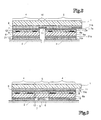
- Figure 1 shows a seal or closure label according to the invention in section.
- the Sealing or sealing label has a transparent cover film 1, which on its Underside is coated with a pressure sensitive adhesive 9.
- the coating stretches almost over the entire underside of the cover sheet 1, but a small one Edge section 11 (handle tab) is left adhesive-free to cover with the cover film to be able to grip and pull them off.
- the Lower film sections 6, 6a are in each case on their side facing the cover film 1 (Top) with an adhesive force adjusting means in the form of an anti-adhesive varnish 8, 8a, for example a silicone varnish, printed.
- the print is in the form of a special geometric pattern or lettering applied.
- About the anti-stick varnish 8 and 8a is a continuous layer of an adhesion promoter 12, 12a printed. There is one in each case over the adhesion promoter layer 12, 12a Color layer 7, 7a printed.
- the side facing the cover film 1 of the respective Color layer 7 or 7a adheres to the adhesive coating 9 of the cover film 1 with a first adhesive force and the side of the lower film section facing the Color layer 7 or 7a adheres to the lower film section 6 or 6a with a second one Adhesive force.
- the relationship between the two adhesive forces is determined locally by the the anti-adhesive varnish 8, 8a and the adhesion promoter 12, 12a
- Adhesive force adjusting means varies so that the first adhesive force is greater than the second adhesive force in the areas with anti-adhesive varnish 8, 8a and the first Adhesive force is less than the second adhesive force in the areas without anti-adhesive varnish.
- the adhesive force of the adhesive layer 10, 10a is significantly greater than the adhesive force the adhesive layer 9. For this reason, the seal or seal label sticks as whole with a stronger adhesive force on objects 2 and 3, while the inner one Cohesion between the cover film 1 and the lower film sections 6 and 6a is less.
- the seal or closure label according to FIG. 1 is used as follows: As usual, the seal or seal label is on an adhesive-repellent Carrier tape (not shown) ready for use. It is being detached from this and then pressed onto two objects 2, 3 such that the first area 4 of the seal or Closure labels on the first object 2 and the second area 5 of the seal or Closure labels stick to the second object 3. The sector 16 between the both areas 4, 5 lie in the area of the boundary line of the two objects 2 and 3.
- the cover sheet 1 is gripped on the adhesive-free edge 11 and subtracted at least to such an extent that it is separated from the lower film section 6a. Because the adhesive force of the adhesive layer 10, 10a is significantly greater than that Adhesive force of the adhesive layer 9, the separation takes place in such a way that the cover film is lifted off and the two lower film sections remain on the objects 2, 3.
- the force to be used here is independent of the surface quality of the Objects 2, 3 and can be set exactly by choosing the materials used become. Since the lower film sections 6 and 6a exclusively in the areas 4 and 5 are arranged, is already described by the partial lifting of the cover film 1 the two objects have been unsealed, i.e. the two objects are relative to each other freely movable.
- the anti-adhesive layers 8, 8a that is Means for locally adjusting the relationship between the first and second Adhesive force for the sake of simplicity of presentation only in the form of two rectangles each on the two lower film sections 6, 6a. It it goes without saying, however, that the anti-adhesive varnish also in the form of a Lettering, which for example reproduces the word OPEN, can be printed.
- Figure 2 shows the cover sheet 1 after peeling.
- the cover film 1 is transparent and coated with a transparent adhesive. As a result, they are at theirs adhesive-coated side adhering parts of the color layer 7 recognizable, which the Have the shape of two rectangles in areas 4 and 5, respectively.
- Figure 3 shows the two lower film sections 6 and 6a, which after the removal of the Cover film 1 remains on objects 2 and 3.
- the color layers 7, 7a cross-hatched
- the color layers 7, 7a respectively partially cover.
- the color layers 7, 7a have cutouts 13, 13 a.
- the adhesive force was between the respective color layer 7 and cover sheet 1 larger than between the color layer and the respective lower film section 6, 6a, so that these parts of the color layers 7, 7a are left on the cover film 1.
- a detachment of the lower film sections 6, 6a in one other direction is not possible or only under difficult conditions. This is ensured by die cuts 14, 14a on the lower film sections 6, 6a.
- the Punchings 14, 14a run from the edge of sector 16 facing sector 16 each lower film section obliquely to the respective adjacent edge area.
- Figure 4 is a variant of the sealing or closure label according to the Invention shown. This differs from that shown in FIG. 1 Seal and seal label in that only a single lower film section 6a is provided while the cover film 1 is in the area 4 directly on the object 2 is liable. Such an embodiment variant is preferred if the Cover film section 1 adheres securely to the object 2 and the cover film 1 is pulled off of object 2 is not possible. For unsealing objects 2 and 3 it is then sufficient to lift the cover film in area 5 and thus from it To remove bottom film section 6a. The effects that occur are the same as described with reference to Figures 1 and 2 and 3, which is why from a new detailed representation can be disregarded.
- FIG. 5 Another variant of the seal or closure label according to the The invention is shown in FIG. 5 in a sectional view.
- the two lower film sections 6 and 6a are sealed designed adjacent to each other.
- the lower film sections 6, 6a made from a single web, which after laminating with the Cover film 1 is punched to form lower film sections.
- the punch through the separate lower film sections 6 and 6a in the Areas 4 and 5 are generated from a straight line while at Embodiment of Figure 1, a punched out a certain width is provided is. Multiple punching or perforation punching is in the same way possible.
- a pressure 18 is applied, which in the drawing is indicated by four black bars.
- This imprint can be a Instructions for use to trade a trademark or a seal.
- the imprint is protected against abrasion by a laminate film 19.
- the adjoining lower film sections 6, 6a of the one shown in FIG. 5 Sealing or closure labels are shown in top view in FIG. 6.
- the Lower film sections 6, 6a carry the majority of the color layer 7 through Recesses 13, 13a is interrupted.
- the lower film sections 6 and 6a are with provided with a wave-shaped security punch 17, which prevents the Lower film sections 6, 6a can be easily removed. An attempt to seal or Removing the closure label in its entirety inevitably leads to tearing of the lower film sections 6, 6a.
- FIG. 7 shows a further embodiment variant of the sealing or Closure labels shown.
- the embodiment variant according to FIG. 7 differs of the embodiment variant according to FIG. 5 inter alia in that the imprint 18 in the embodiment of Figure 7 on the lower, i.e. the Lower film section facing side of the transparent cover film 1 and is thus protected by this.
- the imprint 18, the mirror image attached is viewed through the transparent cover film 1.
- the cover film 1 is with a Laminated transparent temperature indicator 20.
- the temperature indicator 20 changes irreversibly and thus indicates that a Attempt has been made to bypass the seal or seal label open the display function by adding heat.
- the embodiment of Figure 7 also differs from that Embodiments of Figures 1, 4 and 5 characterized in that instead of a separate Adhesive layer 9 and a separate color layer 7 a layer of a colored adhesive varnish 7, 9 is used, the effect of the two layers 7 and 9th united in the previous embodiments.
- the lower film sections 6, 6a are subjected to a pressure pretreatment over the entire surface been so that the color layer / adhesive layer 7, 9 adheres well there.
- an adhesive force adjuster an anti-adhesive varnish 8, 8a applied in places is provided. Of there is no use of an adhesion promoter layer.
- an adhesion promoter layer To those with anti-stick varnish 8, 8a printed areas are followed by the color layer / adhesive layer 7, 9 when the seal is opened the cover film 1, while the remaining areas of the color layer / Kiebe Anlagen 7, 9 on the lower film sections 6, 6a remain.
- the two lower film sections 6, 6a are only in the embodiment of Figure 7 separated from each other by a punching line. It can vary depending on the application be problematic, the boundary line between the two lower film sections exactly to position on the boundary between the two objects 2, 3 to be sealed, especially when the two objects are close together, as shown in Figure 7. To have a certain tolerance when positioning the seal or closure label have, in the embodiment of Figure 7, the adhesive layers 10 and 10a in the border area between the two lower film sections 6, 6a recessed. As shown in FIG. 7, the lower film section 6 extends as a result of inaccurate positioning of the seal or closure label except for the neighboring one Object 3.
- the lower film section 6 does not adhere to the two lower film sections neighboring object 3, so that after removing the cover sheet 1, the two objects are mutually movable and thus the unsealing is also guaranteed if the seal or seal label has not been optimally positioned.
- FIG. 8 shows a particularly preferred embodiment (best mode) of one Sealing or closure labels according to the invention in section.
- the seal or Closure label has a transparent cover film 1 made of polyethylene with a thickness from 50 to 200 microns, which is coated on its underside with a pressure sensitive adhesive 9 is. The coating extends over the entire underside of the cover film 1
- Layer of pressure sensitive adhesive 9 on the underside of the cover sheet 1 is partially with a Lacquer 11, 11a printed in order to have the effect of the pressure-sensitive adhesive 9 at the printed areas repeal.
- a non-adhesive edge is created by the lacquer layer 11a in order to there to be able to grasp the cover film 1 with the fingers and pull it off.
- the paint layer 11 prevents the cover film from being connected to a substrate, as further below is described.
- sub-film sections 6 and 6a which consist of a transparent polyester film exist, which has a thickness of 20 to 50 microns.
- the Lower film sections 6, 6a are in each case on their side facing the cover film 1 (Top) with an adhesive force adjusting means in the form of an anti-adhesive varnish 8, 8a, for example a silicone varnish, printed.
- the print is in the form of a special geometric pattern or lettering applied.
- About the anti-stick varnish 8 and 8a is a continuous layer of an adhesion promoter 12, 12a printed.
- Color layer 7, 7a which is preferably a light, in particular a white color, printed.
- the side facing the cover film 1 of the respective Color layer 7 or 7a adheres to the adhesive coating 9 of the cover film 1 with a first adhesive force and the side of the lower film section facing the Color layer 7 or 7a adheres to the lower film section 6 or 6a with a second one Adhesive force.
- Adhesive force adjusting means varies so that the first adhesive force is greater than the second adhesive force in the areas with anti-adhesive varnish 8, 8a and the first Adhesive force is less than the second adhesive force in the areas without anti-H aftlack.
- Layers of adhesive 10, 10a are applied to the flexographic printing ink 21, 21a.
- a first area 4 of the seal or closure label constructed in this way adheres through the adhesive layer 10 to an object 2 during a second area 5 of the seal or closure label with the adhesive layer 10a on an object 3 is liable.
- Objects 2 and 3 can be, for example, a bottle and a bottle act the screw cap closing the bottle.
- a sector 16 that borders represents between the two areas 4 and 5, lies with proper application of the Sealing or sealing labels on the border of the two objects 2 to be sealed, 3rd
- the adhesive force of the adhesive layer 10, 10a is significantly greater than the adhesive force the adhesive layer 9. For this reason, the seal or seal label sticks as whole with a stronger adhesive force on objects 2 and 3, while the inner one Cohesion between the cover film 1 and the lower film sections 6 and 6a is less.
- the seal or closure label according to FIG. 8 is used as follows: As usual, the seal or seal label is on an adhesive-repellent Carrier tape (not shown) ready for use. It is being detached from this and then pressed onto two objects 2, 3 such that the first area 4 of the seal or Closure labels on the first object 2 and the second area 5 of the seal or Closure labels stick to the second object 3. The sector 16 between the both areas 4, 5 lie in the area of the boundary line of the two objects 2 and 3.
- the cover sheet 1 is gripped on the non-adhesive edge 11a and subtracted at least to such an extent that it is separated from the lower film section 6a. Because the adhesive force of the adhesive layer 10, 10a is significantly greater than that Adhesive force of the adhesive layer 9, the separation takes place in such a way that the cover film is lifted off and the two lower film sections remain on the objects 2, 3.
- the force to be used here is independent of the surface quality of the Objects 2, 3 and can be set exactly by choosing the materials used become.
- the color layers 7 and 7a on the top of the lower film sections 6 and 6a adhere firmly to the top of the through the action of the adhesion promoter 12, 12a Lower film sections 6 and 6a, except where the Lower film sections 6, 6a before application of the adhesion promoter 12, 12a with anti-adhesive varnish 8, 8a have been prepared. These areas are affected by the effects of Adhesive layer 9 when the cover film 1 is removed from the color layer 7 or 7a torn out and remain on the underside of the cover film 1. In the white Color layers 7 and 7a form gaps through which the black color layer passes 21 or 21a becomes recognizable.
- the anti-adhesive layers 8, 8a that is Means for locally adjusting the relationship between the first and second Adhesive force for the sake of simplicity of presentation only in the form of two rectangles each on the two lower film sections 6, 6a. It it goes without saying, however, that the anti-adhesive varnish also in the form of a Lettering, which for example reproduces the word OPEN, can be printed.
- Figure 9 shows a seal or closure label according to the invention in section.
- the Sealing or sealing label has a transparent cover film 1, which on its Underside is coated with a pressure sensitive adhesive 9.
- the coating stretches almost over the entire underside of the cover sheet 1, but a small one Edge section 11 (handle tab) is left adhesive-free to cover with the cover film to be able to grip and pull them off.
- the Lower film section 6 is located in a central area 5 and is all around surrounded the lower film section 6a. To make the two Lower film sections 6, 6a will of course become a continuous film used, which is divided accordingly by a punch.
- the Lower film section 6a is on its side facing the cover film 1 (upper side) in places with an adhesive force setting means in the form of an anti-adhesive varnish 8, for example, printed a silicone varnish.
- the print is in the form of a special geometric pattern or a lettering applied.
- About the anti-stick varnish 8 a continuous layer of an adhesion promoter 12, 12a is printed on each.
- a color layer 7, 7a is in each case above the adhesion promoter layer 12, 12a printed on.
- the side of the respective color layer 7 facing the cover film 1 or 7a adheres to the adhesive coating 9 of the cover film 1 with a first one Adhesive force and the side of the color layer 7 facing the lower film section or 7a adheres to the lower film section 6 or 6a with a second Adhesive force.
- Adhesive force adjusting means varies so that the first adhesive force is greater than the second adhesive force in the areas with anti-adhesive varnish 8 and the first Adhesive force is less than the second adhesive force in the areas without anti-adhesive varnish.
- the adhesive force of the adhesive layer 10 is significantly greater than the adhesive force of the Adhesive layer 9. For this reason, the seal or seal label adheres as whole with a stronger adhesive force on the object 2, while the inner Cohesion between the cover film 1 and the lower film sections 6 and 6a is less.
- the seal or closure label according to FIG. 9 is used as follows: As usual, the seal or seal label is on an adhesive-repellent Carrier tape (not shown) ready for use. It is being detached from this and then placed on objects 2, 3 such that the first area 4 of the sealing or Closure labels adhere to the first object 2 and the second area 5 of the seal or Closure labels covered the second object 3.
- an adhesive-repellent Carrier tape (not shown) ready for use. It is being detached from this and then placed on objects 2, 3 such that the first area 4 of the sealing or Closure labels adhere to the first object 2 and the second area 5 of the seal or Closure labels covered the second object 3.
- the Cover film 1 is gripped on the adhesive-free edge 11 and removed at least as far as that it is separated from the lower film section 6a. Because the adhesive strength of the Adhesive layer 10 is substantially greater than the adhesive force of adhesive layer 9, the separation takes place in such a way that the cover film 1 is lifted off and the Lower film section 6a remains on the object 2.
- the force to be used is independent of the surface condition of object 2 and can be chosen of the materials used can be set exactly. Since the lower film section 6 non-adhesive on its underside and from the lower film section 6a of the region 4 is separated by a punch, he follows the movement of the cover sheet 1 and gives the Look at the key 3 freely, which can then be removed.
- the anti-adhesive layers 8, 8a that is Means for locally adjusting the relationship between the first and second Adhesive force for the sake of simplicity of presentation only in the form of two rectangles each on the two lower film sections 6, 6a. It it goes without saying, however, that the anti-adhesive varnish also in the form of a Lettering, which for example reproduces the word OPEN, can be printed.
- FIG. 10 shows a further embodiment variant of the seal or closure label in section according to the invention.
- the seal or seal label has one transparent cover film 1 on the underside with a Adhesive force adjusting means in the form of an anti-adhesive varnish 8, for example one Silicone varnish, printed.
- the print is in the form of a special geometric Pattern or lettering applied.
- the coating stretches over the entire underside of the cover film 1.
- the layer of pressure sensitive adhesive 9 the underside of the cover sheet 1 is partially printed with a varnish 11, 11a to the printed areas cancel the effect of the pressure sensitive adhesive 9.
- the lacquer layer 11a creates a non-adhesive edge in order to cover film 1 there to be able to grip and pull them off.
- the lacquer layer 11 prevents one Connect the cover film to a substrate, as described below.
- the side of the color layer 7 facing the cover film 1 adheres to the cover film 1 a first adhesive force and the side coated with pressure sensitive adhesive 9 Color layer 7 adheres in a first area 4 to an object 2 and in one second area 5 on a lower film section, which in total with the Reference numeral 6a is designated with a second adhesive force.
- the ratio of The two adhesive forces are localized by those consisting of the anti-adhesive varnish 8
- Adhesive force adjusting means varies so that the first adhesive force is less than the second adhesive force in the areas with anti-adhesive varnish 8 and the first Adhesive force is greater than the second adhesive force in the areas without anti-adhesive varnish 8 is.
- the lower film section 6a has a transparent cover film 22 which is attached to it
- the underside in places with an adhesive force adjuster in the form of an anti-stick varnish 24, for example a silicone lacquer, is printed.
- the print is in shape a special geometric pattern or lettering.
- On the A color layer 23 is printed on anti-adhesive varnish 24.
- At the bottom of the Color layer 23 is a layer of pressure sensitive adhesive 10a.
- the layer out Pressure-sensitive adhesive 10a completely covers the underside of the color layer 23.
- the side of the color layer 23 facing the cover film 22 adheres to the cover film 22 with a first adhesive force and the side of the coated with pressure sensitive adhesive 10a Color layer 23 adheres to an object 3 with a second adhesive force.
- the relationship between the two adhesive forces is determined locally by the anti-adhesive varnish 24 existing adhesive force adjusting means varies so that the first adhesive force is less than the second adhesive force in the areas with anti-adhesive varnish 24 and the first adhesive force is greater than the second adhesive force in the areas without Anti-stick varnish.
- the adhesive force of the adhesive layer 10a is significantly greater than the adhesive force of the Adhesive layer 9. For this reason, the seal or seal label adheres as whole with a stronger adhesive force on the objects 3, while the inner Cohesion between the cover film 1 and the lower film section 6a is less.
- the seal or closure label according to FIG. 10 is used as follows: As usual, the seal or seal label is on an adhesive-repellent Carrier tape (not shown) ready for use. It is being detached from this and then pressed onto two objects 2, 3 such that the first area 4 of the seal or Closure labels on the first object 2 and the second area 5 of the seal or Closure labels stick to the second object 3.
- the sector 16 between the both areas 4, 5 lies in the area of the boundary line of the two objects 2 and 3 and is made non-adhesive by the lacquer layer 11, so that there are no undesirable Adhesive connection in this sector 16 comes.
- the cover sheet 1 is gripped on the non-adhesive edge 11a and subtracted at least to such an extent that it is separated from the lower film section 6a. Because the adhesive force of the adhesive layer 10a is significantly greater than the adhesive force the adhesive layer 9, the separation takes place in such a way that the cover film 1 is lifted off and the lower film section 6a remains on the object 3.
- the one here The force to be applied is independent of the surface condition of the object 3 and can be set exactly by choosing the materials used. Since the Bottom film section 6a is arranged exclusively in the area 5 is already by the partial lifting of the cover film 1 described unsealing of the two Objects reached, i.e. the two objects are freely movable relative to each other.
- the color layer 7 on the underside of the cover sheet 1 adheres firmly to the underside of the Cover film 1, with the exception of those areas prepared with anti-adhesive varnish 8 have been. These areas are affected by the effect of the adhesive layer 9 Pull off the cover film 1 torn out of the color layer 7 and remain on the Top of the lower film section 6a.
- the bottom film section 6a with the layers 22, 24, 23 and 10a in principle the has the same structure as the cover film 1 covering the two objects 2 and 3 with layers 8, 7 and 9, the same effect occurs when trying to do that Detach label as a whole from the two objects and onto another To move object.
- the ink layer 23 separates, just as when the cover layer 1 is detached, such as a separation of the color layer 7 described in detail above.
- FIG. 11 shows a further embodiment variant of the seal or closure label in section according to the invention.
- the seal or seal label has one transparent cover film 1 on the underside with a Adhesive force adjusting means in the form of an anti-adhesive varnish 8, for example one Silicone varnish, printed.
- the print is in the form of a special geometric Pattern or lettering applied.
- the coating stretches over the entire underside of the cover film 1.
- the layer of pressure sensitive adhesive 9 the underside of the cover sheet 1 is partially printed with a varnish 11, 11a to the printed areas cancel the effect of the pressure sensitive adhesive 9.
- the lacquer layer 11a creates a non-adhesive edge in order to cover film 1 there to be able to grip and pull them off.
- the lacquer layer 11 prevents one Connect the cover film to a substrate, as described below.
- the side of the color layer 7 facing the cover film 1 adheres to the cover film 1 a first adhesive force and the side coated with pressure sensitive adhesive 9 Color layer 7 adheres in a first area 4 to an object 2 and in one second area 5 on a lower film section, which in total with the Reference numeral 6a is designated with a second adhesive force.
- the ratio of The two adhesive forces are localized by those consisting of the anti-adhesive varnish 8
- Adhesive force adjusting means varies so that the first adhesive force is less than the second adhesive force in the areas with anti-adhesive varnish 8 and the first Adhesive force is greater than the second adhesive force in the areas without anti-adhesive varnish 8 is.
- the lower film section comprises a first transparent film 22, which is separated by a Adhesive layer 25 is connected to a second transparent film 26.
- the Adhesive layer 25 covers the underside of the transparent film 22 with Exception of an adhesive-free edge region 15a.
- the second transparent film 26 has on its underside a layer of pressure-sensitive adhesive 10a with which it is applied to a Object 3 is liable.
- the adhesives of layers 9, 25 and 10a are chosen so that the The adhesive force of layer 9 is the lowest, the adhesive force of layer 10a is greatest and the adhesive force of the layer 25 between the two adhesive forces of the layers 9 and 10a.
- the seal or closure label according to FIG. 11 is used as follows: As usual, the seal or seal label is on an adhesive-repellent Carrier tape (not shown) ready for use. It is being detached from this and then pressed onto two objects 2, 3 such that the first area 4 of the seal or Closure labels on the first object 2 and the second area 5 of the seal or Closure labels stick to the second object 3.
- the sector 16 between the both areas 4, 5 lies in the area of the boundary line of the two objects 2 and 3 and is made non-adhesive by the lacquer layer 11, so that there are no undesirable Adhesive connection in this sector 16 comes.
- the cover sheet 1 is gripped on the non-adhesive edge 11a and subtracted at least to such an extent that it is separated from the lower film section 6a. Because the adhesive force of the adhesive layer 10a is significantly greater than the adhesive force the adhesive layer 9, the separation takes place in such a way that the cover film 1 is lifted off and the lower film section 6a remains on the object 3.
- the one here The force to be applied is independent of the surface condition of the object 3 and can be set exactly by choosing the materials used. Since the Bottom film section 6a is arranged exclusively in the area 5 is already by the partial lifting of the cover film 1 described unsealing of the two Objects reached, i.e. the two objects are freely movable relative to each other.
- the color layer 7 on the underside of the cover sheet 1 adheres firmly to the underside of the Cover film 1, with the exception of those areas prepared with anti-adhesive varnish 8 have been. These areas are affected by the effect of the Kiebstoff Anlagen 9 Pull off the cover film 1-torn out of the color layer 7 and remain on the Top of the lower film section 6a.
- the lower film section 6a remaining on the object 3 after opening can be at aesthetically disturbing some applications, especially since proven mentioned - has residues of the color layer 7.
- the remains of the color layer 7 supporting transparent film 22 can be gripped on the non-adhesive edge 15a and be removed from the transparent film 26.
- the Sealing or sealing labels only the second transparent film 26 on the Item 3 back, which is hardly noticeable due to its transparency and at least not is disturbing.
- the seal or Closure label in particular the cover film 1, with additional security means or authenticity features, such as luminance components, microtags, Infrared colors, UV colors, holograms, biocode substances, temperature indicators etc. be equipped.
Landscapes
- Engineering & Computer Science (AREA)
- Mechanical Engineering (AREA)
- Physics & Mathematics (AREA)
- General Physics & Mathematics (AREA)
- Theoretical Computer Science (AREA)
- Closures For Containers (AREA)
- Packages (AREA)
- Road Signs Or Road Markings (AREA)
- Labeling Devices (AREA)
Description
- Figur 1:
- Einen Schnitt durch ein Siegel- oder Verschlußetikett gemäß der Erfindung, das eine Deckfolie und zwei Unterfolienabschnitte aufweist.
- Figur 2:
- Den abgezogenen Deckfolienabschnitt des Etiketts der Figur 1 in der Draufsicht.
- Figur 3:
- Die beiden Unterfolienabschnitte des Etiketts der Figur 1 in der Draufsicht.
- Figur 4:
- Eine Ausführungsvariante des Siegel- oder Verschlußetiketts gemäß der Erfindung mit nur einem Unterfolienabschnitt im Schnitt.
- Figur 5:
- Eine weitere Ausführungsvariante des Siegel- oder Verschlußetiketts mit einer Deckfolie und zwei Unterfolienabschnitten gemäß der Erfindung im Schnitt.
- Figur 6:
- Die beiden Unterfolienabschnitte des Siegel- oder Verschlußetiketts aus Figur 5 in der Draufsicht.
- Figur 7:
- Eine weitere Ausführungsform des Siegel- oder Verschlußetiketts gemäß der Erfindung im Schnitt.
- Figur 8:
- Eine weitere Ausführungsform des Siegel- oder Verschlußetiketts gemäß der Erfindung im Schnitt.
- Figur 9:
- Eine weitere Ausführungsform des Siegel- oder Verschlußetiketts gemäß der Erfindung zum Versiegeln eines Gegenstandes auf einem Untergrund.
- Figur 10:
- Eine weitere Ausführungsform des Siegel- oder Verschlußetiketts gemäß der Erfindung mit nur einem Unterfolienabschnitt im Schnitt.
- Figur 11:
- Eine weitere Ausführungsvariante des Siegel- oder Verschlußetiketts gemäß der Erfindung mit nur einem Unterfolienabschnitt im Schnitt.
Claims (27)
- Siegel- oder Verschlußetikett mit einer Deckfolie (1) zum Übersiegeln von zwei gegeneinander beweglichen Objekten (2, 3), derart, daß ein erster Bereich (4) des Siegel- oder Verschlußetiketts auf dem einen (2) der beiden Objekte (2, 3) haftet und ein zweiter Bereich (5) des Siegel- oder Verschlußetiketts auf dem anderen (3) der beiden Objekte (2, 3) haftet, wobei die Deckfolie (1) in mindestens einem der beiden Bereiche (4, 5) abziehbar ist und der Vorgang des Abziehens eine optische Veränderung des Siegel- oder Verschlußetiketts auslöst, dadurch gekennzeichnet, daß das Siegel- oder Verschlußetikett mindestens einen Unterfolienabschnitt (6, 6a) aufweist, der ausschließlich in dem ersten (4) oder ausschließlich in dem zweiten (5) Bereich angeordnet ist, daß zwischen dem mindestens einen Unterfolienabschnitt (6, 6a) und der Deckfolie (1) mindestens eine Farbschicht (7, 7a) angeordnet ist, die mit einer ersten Adhäsionskraft an der Deckfolie (1) und mit einer zweiten Adhäsionskraft an dem mindestens einen Unterfolienabschnitt (6, 6a) haftet, und daß Adhäsionskrafteinstellmittel (8, 8a, 12, 12a) vorgesehen sind, um das Verhältnis zwischen der ersten und der zweiten Adhäsionskraft lokal einzustellen.
- Siegel- oder Verschlußetikett nach Anspruch 1, dadurch gekennzeichnet, daß die mindestens eine Farbschicht (7, 7a) durch Drucken erzeugt ist.
- Siegel- oder Verschlußetikett nach Anspruch 1 oder 2, dadurch gekennzeichnet, daß die Adhäsionskrafteinstellmittel einen stellenweise aufgetragenen Anti-Haftlack (8, 8a) umfassen.
- Siegel- oder Verschlußetikett nach einem der Ansprüche 1-3, dadurch gekennzeichnet, daß die Adhäsionskrafteinstellmittel (12, 12a) einen stellenweise aufgetragenen Haftvermittler umfassen.
- Siegel- oder Verschlußetikett nach Anspruch 3 oder 4, dadurch gekennzeichnet, daß die Adhäsionskrafteinstellmittel (12, 12a) durch Drucken aufgebracht sind.
- Siegel- oder Verschlußetikett nach einem der Ansprüche 1-5, dadurch gekennzeichnet, daß die Adhäsionskrafteinstellmittel (12, 12a) die Form eines Schriftzuges aufweisen.
- Siegel- oder Verschlußetikett nach einem der Ansprüche 1-6, dadurch gekennzeichnet, daß der mindestens eine Unterfolienabschnitt (6, 6a) an seiner der Deckfolie (1) abgewandten Seite mit Klebstoff (10, 10a) beschichtet ist.
- Siegel- oder Verschlußetikett nach Anspruch 7, dadurch gekennzeichnet, daß der Klebstoff (10, 10a) ein von dem Objekt (2, 3) ablösbarer Klebstoff ist.
- Siegel- oder Verschlußetikett nach einem der Ansprüche 1-8, dadurch gekennzeichnet, daß die Deckfolie (1) an ihrer dem mindestens einen Unterfolienabschnitt (6, 6a) zugewandten Seite eine Klebstoffbeschichtung (9) aufweist.
- Siegel- oder Verschlußetikett nach den Ansprüchen 7 und 9, dadurch gekennzeichnet, daß die Klebekraft der Klebstoffbeschichtung (9) kleiner als die Klebekraft des Klebstoffs (10, 10a) auf dem jeweiligen Objekt (2, 3) ist.
- Siegel- oder Verschlußetikett nach einem der Ansprüche 1-10, dadurch gekennzeichnet, daß die Adhäsionskrafteinstellmittel (8, 8a, 12, 12a) und die mindestens eine Farbschicht (7, 7a) auf dem mindestens einen Unterfolienabschnitt (6, 6a) angeordnet sind.
- Siegel- oder Verschlußetikett nach einem der Ansprüche 1-11, dadurch gekennzeichnet, daß sowohl in dem ersten (4) als auch in dem zweiten Bereich (5) jeweils ein Unterfolienabschnitt (6, 6a) vorgesehen ist.
- Siegel- oder Verschlußetikett nach einem der Ansprüche 1-12, dadurch gekennzeichnet, daß der mindestens eine Unterfolienabschnitt (6, 6a) Sicherheitsstanzungen (17) aufweist, die bei Abziehen des auf einem Objekt (2, 3) haftenden mindestens einen Unterfolienabschnitts (6, 6a) das Zerreißen des Unterfolienabschnitts (6, 6a) bewirken.
- Siegel- oder Verschlußetikett nach einem der Ansprüche 1-13, dadurch gekennzeichnet, daß der mindestens eine Unterfolienabschnitt (6, 6a) Stanzungen (14) aufweist, die das Abziehen des auf einem Objekt (2, 3) haftenden mindestens einen Unterfolienabschnitts (6, 6a) nur in einer Richtung ermöglichen und bei einem Abziehversuch in einer anderen Richtung das Zerreißen des Unterfolienabschnitts (6, 6a) bewirken.
- Siegel- oder Verschlußetikett nach einem der Ansprüche 1-14, dadurch gekennzeichnet, daß die Deckfolie (1) transparent ist.
- Siegel- oder Verschlußetikett nach Anspruch 15, dadurch gekennzeichnet, daß die Deckfolie (1) mit einer nicht deckenden Farbe gefärbt oder bedruckt ist.
- Siegel- oder Verschlußetikett nach einem der Ansprüche 1-16, dadurch gekennzeichnet, daß die Deckfolie (1) mit einem eingefärbten Klebstoff beschichtet ist.
- Siegel- oder Verschlußetikett nach einem der Ansprüche 1-17, dadurch gekennzeichnet, daß die mindestens eine Farbschicht (7, 7a) eine dunkle und/oder deckende Farbe aufweist.
- Siegel- oder Verschlußetikett nach einem der Ansprüche 1-18, dadurch gekennzeichnet, daß der mindestens eine Unterfolienabschnitt (6, 6a) eine zu der Farbe der Farbschicht (7, 7a) kontrastierende Färbung aufweist.
- Siegel- oder Verschlußetikett nach einem der Ansprüche 1-19, dadurch gekennzeichnet, daß die Deckfolie (1) einen als Anfaßlasche (11) dienenden klebstofffreien Rand aufweist.
- Siegel- oder Verschlußetikett nach einem der Ansprüche 1-20, dadurch gekennzeichnet, daß es einen auf Erwärmung irreversibel ansprechenden Temperaturindikator (20) aufweist.
- Siegel- oder Verschlußetikett nach einem der Ansprüche 1-21, dadurch gekennzeichnet, daß mindestens ein Teil der Adhäsionskrafteinstellmittel (8, 8a, 12, 12a) und die Farbschicht (7, 7a) an der Deckfolie (1) angeordnet sind.
- Siegel- oder Verschlußetikett nach einem der Ansprüche 1-22, dadurch gekennzeichnet, daß der Unterfolienabschnitt (6, 6a) eine Folie (22), an der Folie (22) angeordnete Adhäsionskrafteinstellmittel (24), eine Farbschicht (23) und eine Schicht aus Haftklebstoff (10a) aufweist.
- Siegel- oder Verschlußetikett nach einem der Ansprüche 1-22, dadurch gekennzeichnet, daß der Unterfolienabschnitt (6, 6a) eine erste Folie (22), eine an der ersten Folie (22) mittels einer Klebstoffschicht (25) haftende zweite Folie (26) und eine Schicht aus Haftklebstoff (10a) aufweist.
- Siegel- oder Verschlußetikett mit einer Deckfolie (1) mit mindestens zwei Bereichen (4, 5), von denen ein erster Bereich (4) des Siegel- oder Verschlußetiketts ein erstes Teil oder Objekt (2) überdeckt und ein zweiter Bereich (5) des Siegel- oder Verschlußetiketts ein zweites Teil oder Objekt (3) überdeckt, wobei die Deckfolie (1) in mindestens einem der beiden Bereiche (4, 5) abziehbar ist und der Vorgang des Abziehens eine optische Veränderung des Siegel- oder Verschlußetiketts auslöst, dadurch gekennzeichnet, daß das Siegel- oder Verschlußetikett mindestens einen Unterfolienabschnitt (6, 6a) aufweist, der ausschließlich in dem ersten (4) oder ausschließlich in dem zweiten (5) Bereich angeordnet ist, daß zwischen dem mindestens einen Unterfolienabschnitt (6, 6a) und der Deckfolie (1) mindestens eine Farbschicht (7, 7a) angeordnet ist, die mit einer ersten Adhäsionskraft an der Deckfolie (1) und mit einer zweiten Adhäsionskraft an dem mindestens einen Unterfolienabschnitt (6, 6a) haftet, und daß Adhäsionskrafteinstellmittel (8, 8a, 12, 12a) vorgesehen sind, um das Verhältnis zwischen der ersten und der zweiten Adhäsionskraft lokal einzustellen.
- Siegel- oder Verschlußetikett nach Anspruch 25, dadurch gekennzeichnet, daß einer der beiden Bereiche (4,5) im wesentlichen im Zentrum des Siegel- oder Verschlußetiketts angeordnet ist und von dem anderen der beiden Bereiche (4, 5) umgeben wird.
- Siegel- oder Verschlußetikett nach Anspruch 25 oder 26, dadurch gekennzeichnet, daß mindestens ein Teil der Adhäsionskrafteinstellmittel (8, 8a, 12, 12a) und die Farbschicht (7, 7a) an der Deckfolie (1) angeordnet sind.
Applications Claiming Priority (3)
| Application Number | Priority Date | Filing Date | Title |
|---|---|---|---|
| DE19653891A DE19653891C1 (de) | 1996-12-21 | 1996-12-21 | Siegel- oder Verschlußetikett |
| DE19653891 | 1996-12-21 | ||
| PCT/EP1997/007200 WO1998028728A1 (de) | 1996-12-21 | 1997-12-19 | Siegel- oder verschlussetikett |
Publications (2)
| Publication Number | Publication Date |
|---|---|
| EP0890162A2 EP0890162A2 (de) | 1999-01-13 |
| EP0890162B1 true EP0890162B1 (de) | 2001-07-25 |
Family
ID=7815927
Family Applications (1)
| Application Number | Title | Priority Date | Filing Date |
|---|---|---|---|
| EP97954934A Expired - Lifetime EP0890162B1 (de) | 1996-12-21 | 1997-12-19 | Siegel- oder verschlussetikett |
Country Status (8)
| Country | Link |
|---|---|
| EP (1) | EP0890162B1 (de) |
| AT (1) | ATE203615T1 (de) |
| AU (1) | AU6090698A (de) |
| DE (2) | DE19653891C1 (de) |
| DK (1) | DK0890162T3 (de) |
| ES (1) | ES2159411T3 (de) |
| PT (1) | PT890162E (de) |
| WO (1) | WO1998028728A1 (de) |
Cited By (1)
| Publication number | Priority date | Publication date | Assignee | Title |
|---|---|---|---|---|
| US12039895B2 (en) | 2021-07-28 | 2024-07-16 | S+P Samson Gmbh | Label, label tape and method for manufacturing labels |
Families Citing this family (22)
| Publication number | Priority date | Publication date | Assignee | Title |
|---|---|---|---|---|
| DE19738540C2 (de) * | 1997-09-03 | 1999-07-08 | Schreiner Etiketten | Siegelband |
| DE19755793C5 (de) * | 1997-12-16 | 2006-11-16 | Witte Safemark Gmbh | Sicherheits-Abdeckaufkleber, insbesondere zur Abdeckung einer auf einem Papierdokument angebrachten Zeichenfolge, wie PIN-Code |
| DE19832990B4 (de) * | 1998-07-22 | 2006-04-20 | Schreiner Etiketten Und Selbstklebetechnik Gmbh & Co. | Etikett und Verfahren zum Verdecken von Informationen |
| US6416857B1 (en) | 2000-10-25 | 2002-07-09 | 3M Innovative Properties Company | Tamper indicating device |
| DE10140491A1 (de) * | 2001-05-28 | 2002-12-05 | Tesa Ag | Selbstklebendes Sicherheitsetikett |
| FR2849255B1 (fr) * | 2002-12-19 | 2005-02-11 | Mc 3 | Bande bobinee porte-etiquette pour la pose automatisee d'etiquettes, etiquettes issue d'une telle bande et son procede d'obtention |
| WO2004095401A2 (en) | 2003-04-21 | 2004-11-04 | 3M Innovative Properties Company | Tamper indicating devices and methods for securing information |
| DE20314291U1 (de) | 2003-09-16 | 2003-11-06 | Rinke Etiketten Karl Rinke GmbH & Co. KG, 45549 Sprockhövel | Kleidungsstück mit gewebtem Etikett |
| DE102007007413A1 (de) * | 2007-02-12 | 2008-08-14 | Tesa Ag | Sicherheitsetikett |
| FR2918966B1 (fr) * | 2007-07-18 | 2012-08-10 | Frederic Berjon | Dispositif permettant de securiser et de garantir l'authenticite notamment d'une bouteille de vin et mode de realisation |
| US20130248406A1 (en) * | 2012-03-21 | 2013-09-26 | Multi Packaging Solutions | Tamper evident packaging |
| DE102012105207A1 (de) * | 2012-06-15 | 2013-12-19 | Schreiner Group Gmbh & Co. Kg | Sicherheitsetikett |
| DE102014100784B4 (de) | 2014-01-23 | 2022-01-13 | Trautwein Gmbh & Co. | Verschlusssiegelsystem und Verfahren zur Herstellung einer Versiegelung |
| US9827741B2 (en) | 2014-05-15 | 2017-11-28 | Multi Packaging Solutions, Inc. | Display device |
| EP3392163A1 (de) | 2014-10-01 | 2018-10-24 | Sonoco Development, Inc. | Behälterstruktur mit integrierter öffnungs- und wiederverschliessfunktion |
| US10138026B2 (en) | 2015-04-01 | 2018-11-27 | Sonoco Development, Inc. | Resealable flexible package and method of using the same |
| US9928757B2 (en) | 2015-05-21 | 2018-03-27 | Sonoco Development, Inc. | Flexible laminate for packaging with integrated peelable portion |
| US11203477B2 (en) | 2015-10-30 | 2021-12-21 | Sonoco Development, Inc. | Integrated package opening feature |
| US11623806B2 (en) | 2017-02-27 | 2023-04-11 | Sonoco Development, Inc. | Resealable flexible packaging |
| US10351294B2 (en) | 2017-07-21 | 2019-07-16 | Sonoco Development, Inc. | Tamper evident hybrid resealable container |
| US11225355B2 (en) | 2017-11-08 | 2022-01-18 | Sonoco Development, Inc. | Membrane lid with integrated peelable portion |
| DE102018001379A1 (de) * | 2018-02-21 | 2019-08-22 | Giesecke+Devrient Currency Technology Gmbh | Transferträger |
Family Cites Families (7)
| Publication number | Priority date | Publication date | Assignee | Title |
|---|---|---|---|---|
| DE2613131C2 (de) * | 1976-03-27 | 1984-05-17 | Karl Dr. 2320 Plön Schröder | Folienkennzeichen für Kraftfahrzeuge |
| US5060848A (en) * | 1988-05-13 | 1991-10-29 | Frederick R. Ewan | Tamper indicating containers and seals |
| US5582887A (en) * | 1989-08-17 | 1996-12-10 | The Kendall Company | Tamper-evident tape having discontinuous barrier layer |
| US5551729A (en) * | 1994-11-07 | 1996-09-03 | Morgan; Brian R. | Tamper indication device |
| DE29518961U1 (de) * | 1995-11-29 | 1997-03-27 | Steinbeis PPL GmbH, 83098 Brannenburg | Originalitätsverschlußetikett |
| DE29615495U1 (de) * | 1996-09-05 | 1996-12-19 | Schreiner Etiketten und Selbstklebetechnik GmbH & Co, 85764 Oberschleißheim | Siegel- oder Verschlußetikett |
| DE29615496U1 (de) * | 1996-09-05 | 1996-12-19 | Schreiner GmbH & Co KG, 80995 München | Siegel- oder Verschlußetikett |
-
1996
- 1996-12-21 DE DE19653891A patent/DE19653891C1/de not_active Expired - Fee Related
-
1997
- 1997-12-19 WO PCT/EP1997/007200 patent/WO1998028728A1/de not_active Ceased
- 1997-12-19 DE DE59704126T patent/DE59704126D1/de not_active Expired - Lifetime
- 1997-12-19 EP EP97954934A patent/EP0890162B1/de not_active Expired - Lifetime
- 1997-12-19 DK DK97954934T patent/DK0890162T3/da active
- 1997-12-19 AT AT97954934T patent/ATE203615T1/de active
- 1997-12-19 PT PT97954934T patent/PT890162E/pt unknown
- 1997-12-19 ES ES97954934T patent/ES2159411T3/es not_active Expired - Lifetime
- 1997-12-19 AU AU60906/98A patent/AU6090698A/en not_active Abandoned
Cited By (1)
| Publication number | Priority date | Publication date | Assignee | Title |
|---|---|---|---|---|
| US12039895B2 (en) | 2021-07-28 | 2024-07-16 | S+P Samson Gmbh | Label, label tape and method for manufacturing labels |
Also Published As
| Publication number | Publication date |
|---|---|
| ES2159411T3 (es) | 2001-10-01 |
| PT890162E (pt) | 2002-01-30 |
| ATE203615T1 (de) | 2001-08-15 |
| WO1998028728A1 (de) | 1998-07-02 |
| DK0890162T3 (da) | 2001-09-24 |
| DE59704126D1 (de) | 2001-08-30 |
| DE19653891C1 (de) | 1998-06-10 |
| AU6090698A (en) | 1998-07-17 |
| EP0890162A2 (de) | 1999-01-13 |
Similar Documents
| Publication | Publication Date | Title |
|---|---|---|
| EP0890162B1 (de) | Siegel- oder verschlussetikett | |
| DE68915048T2 (de) | Behälter und Behälterverschluss mit Anzeige unbefugten Öffnens. | |
| DE69506554T2 (de) | Schrumpfbares originalitätsband | |
| DE69704495T2 (de) | Sicherheitsmanschette für gegenstände,insbesondere für behälter mit verschlussvorrichtung | |
| DE69101707T2 (de) | Anordnung zur durch biegen erzeugten farbänderung. | |
| DE69122755T2 (de) | Originalitätssicherheitssiegel | |
| DE102011106768B4 (de) | Dichtscheibe mit Lasche | |
| EP1577226B1 (de) | Zweilagenplatine | |
| DE69203155T2 (de) | Sicherheitsbeutel und Dichtungsmittel. | |
| DE29821703U1 (de) | Etikett zum Verdecken von Informationen | |
| DE3534557A1 (de) | Aufklebematerial zur verhinderung der wiederverwendung | |
| DE3534558A1 (de) | Aufklebematerial zur verhinderung des wiederaufklebens | |
| DE20004025U1 (de) | Abdeck- oder Siegeletikett | |
| EP0836953A2 (de) | Trägermaterial für ein Formular mit heraustrennbarer Karte | |
| DE68915417T2 (de) | Druckprodukte mit einem latent vorhandenen Bild, das gegen Fälschung oder dergleichen anwendbar ist, beispielweise für ein fälschungssicheres aktives Siegel und deren Herstellungsverfahren. | |
| DE202007001713U1 (de) | Verschlussetikett | |
| EP1050482B1 (de) | Folie mit Sicherheitsmerkmal, ein Verfahren zu deren Herstellung sowie deren Verwendung als Verpackungsmaterial | |
| DE69922503T2 (de) | Hitzeschrumpfende sicherheitsmanschette mit einem identifikationsband | |
| DE202007001716U1 (de) | Verschlussetikett | |
| DE102008016624B4 (de) | Versiegelungsfolie | |
| DE29620808U1 (de) | Siegel- oder Verschlußetikett | |
| EP2285588B1 (de) | Druckträger zur übertragung von vertraulicher information | |
| EP1125860A1 (de) | Aufreissfaden für Verpackungen | |
| DE4236393B4 (de) | Originalitätsverschluß | |
| DE102014115910A1 (de) | Etikett zum Beschriften mit einer zunächst verborgenen Innenbeschriftung |
Legal Events
| Date | Code | Title | Description |
|---|---|---|---|
| PUAI | Public reference made under article 153(3) epc to a published international application that has entered the european phase |
Free format text: ORIGINAL CODE: 0009012 |
|
| 17P | Request for examination filed |
Effective date: 19981106 |
|
| AK | Designated contracting states |
Kind code of ref document: A2 Designated state(s): AT BE CH DE DK ES FR GB IE IT LI NL PT SE |
|
| GRAG | Despatch of communication of intention to grant |
Free format text: ORIGINAL CODE: EPIDOS AGRA |
|
| GRAG | Despatch of communication of intention to grant |
Free format text: ORIGINAL CODE: EPIDOS AGRA |
|
| GRAH | Despatch of communication of intention to grant a patent |
Free format text: ORIGINAL CODE: EPIDOS IGRA |
|
| 17Q | First examination report despatched |
Effective date: 20001204 |
|
| GRAH | Despatch of communication of intention to grant a patent |
Free format text: ORIGINAL CODE: EPIDOS IGRA |
|
| GRAA | (expected) grant |
Free format text: ORIGINAL CODE: 0009210 |
|
| AK | Designated contracting states |
Kind code of ref document: B1 Designated state(s): AT BE CH DE DK ES FR GB IE IT LI NL PT SE |
|
| REF | Corresponds to: |
Ref document number: 203615 Country of ref document: AT Date of ref document: 20010815 Kind code of ref document: T |
|
| ITF | It: translation for a ep patent filed | ||
| REG | Reference to a national code |
Ref country code: CH Ref legal event code: EP |
|
| REG | Reference to a national code |
Ref country code: IE Ref legal event code: FG4D Free format text: GERMAN |
|
| REF | Corresponds to: |
Ref document number: 59704126 Country of ref document: DE Date of ref document: 20010830 |
|
| REG | Reference to a national code |
Ref country code: CH Ref legal event code: NV Representative=s name: FREI PATENTANWALTSBUERO |
|
| REG | Reference to a national code |
Ref country code: DK Ref legal event code: T3 |
|
| GBT | Gb: translation of ep patent filed (gb section 77(6)(a)/1977) |
Effective date: 20010904 |
|
| REG | Reference to a national code |
Ref country code: ES Ref legal event code: FG2A Ref document number: 2159411 Country of ref document: ES Kind code of ref document: T3 |
|
| ET | Fr: translation filed | ||
| REG | Reference to a national code |
Ref country code: GB Ref legal event code: IF02 |
|
| REG | Reference to a national code |
Ref country code: PT Ref legal event code: SC4A Free format text: AVAILABILITY OF NATIONAL TRANSLATION Effective date: 20011024 |
|
| PLBQ | Unpublished change to opponent data |
Free format text: ORIGINAL CODE: EPIDOS OPPO |
|
| PLBI | Opposition filed |
Free format text: ORIGINAL CODE: 0009260 |
|
| PLBF | Reply of patent proprietor to notice(s) of opposition |
Free format text: ORIGINAL CODE: EPIDOS OBSO |
|
| 26 | Opposition filed |
Opponent name: STRALFORS AB Effective date: 20020419 |
|
| PLBF | Reply of patent proprietor to notice(s) of opposition |
Free format text: ORIGINAL CODE: EPIDOS OBSO |
|
| NLR1 | Nl: opposition has been filed with the epo |
Opponent name: STRALFORS AB |
|
| PLCK | Communication despatched that opposition was rejected |
Free format text: ORIGINAL CODE: EPIDOSNREJ1 |
|
| PLBN | Opposition rejected |
Free format text: ORIGINAL CODE: 0009273 |
|
| STAA | Information on the status of an ep patent application or granted ep patent |
Free format text: STATUS: OPPOSITION REJECTED |
|
| 27O | Opposition rejected |
Effective date: 20030618 |
|
| NLR2 | Nl: decision of opposition |
Effective date: 20030618 |
|
| PGFP | Annual fee paid to national office [announced via postgrant information from national office to epo] |
Ref country code: IE Payment date: 20121211 Year of fee payment: 16 |
|
| PGFP | Annual fee paid to national office [announced via postgrant information from national office to epo] |
Ref country code: PT Payment date: 20121219 Year of fee payment: 16 |
|
| PGFP | Annual fee paid to national office [announced via postgrant information from national office to epo] |
Ref country code: DK Payment date: 20131210 Year of fee payment: 17 |
|
| PGFP | Annual fee paid to national office [announced via postgrant information from national office to epo] |
Ref country code: CH Payment date: 20131212 Year of fee payment: 17 Ref country code: SE Payment date: 20131211 Year of fee payment: 17 Ref country code: GB Payment date: 20131218 Year of fee payment: 17 |
|
| PGFP | Annual fee paid to national office [announced via postgrant information from national office to epo] |
Ref country code: FR Payment date: 20131209 Year of fee payment: 17 Ref country code: NL Payment date: 20131210 Year of fee payment: 17 |
|
| PGFP | Annual fee paid to national office [announced via postgrant information from national office to epo] |
Ref country code: BE Payment date: 20131217 Year of fee payment: 17 |
|
| REG | Reference to a national code |
Ref country code: PT Ref legal event code: MM4A Free format text: LAPSE DUE TO NON-PAYMENT OF FEES Effective date: 20140619 |
|
| PG25 | Lapsed in a contracting state [announced via postgrant information from national office to epo] |
Ref country code: PT Free format text: LAPSE BECAUSE OF NON-PAYMENT OF DUE FEES Effective date: 20140619 |
|
| REG | Reference to a national code |
Ref country code: IE Ref legal event code: MM4A |
|
| PG25 | Lapsed in a contracting state [announced via postgrant information from national office to epo] |
Ref country code: IE Free format text: LAPSE BECAUSE OF NON-PAYMENT OF DUE FEES Effective date: 20131219 |
|
| PGFP | Annual fee paid to national office [announced via postgrant information from national office to epo] |
Ref country code: ES Payment date: 20141111 Year of fee payment: 18 |
|
| PGFP | Annual fee paid to national office [announced via postgrant information from national office to epo] |
Ref country code: IT Payment date: 20141210 Year of fee payment: 18 |
|
| PG25 | Lapsed in a contracting state [announced via postgrant information from national office to epo] |
Ref country code: BE Free format text: LAPSE BECAUSE OF NON-PAYMENT OF DUE FEES Effective date: 20141231 |
|
| REG | Reference to a national code |
Ref country code: DK Ref legal event code: EBP Effective date: 20141231 |
|
| REG | Reference to a national code |
Ref country code: NL Ref legal event code: V1 Effective date: 20150701 |
|
| REG | Reference to a national code |
Ref country code: NL Ref legal event code: V1 Effective date: 20150701 |
|
| PG25 | Lapsed in a contracting state [announced via postgrant information from national office to epo] |
Ref country code: SE Free format text: LAPSE BECAUSE OF NON-PAYMENT OF DUE FEES Effective date: 20141220 |
|
| REG | Reference to a national code |
Ref country code: CH Ref legal event code: PL |
|
| REG | Reference to a national code |
Ref country code: SE Ref legal event code: EUG |
|
| GBPC | Gb: european patent ceased through non-payment of renewal fee |
Effective date: 20141219 |
|
| REG | Reference to a national code |
Ref country code: FR Ref legal event code: ST Effective date: 20150831 |
|
| PG25 | Lapsed in a contracting state [announced via postgrant information from national office to epo] |
Ref country code: NL Free format text: LAPSE BECAUSE OF NON-PAYMENT OF DUE FEES Effective date: 20150701 |
|
| PG25 | Lapsed in a contracting state [announced via postgrant information from national office to epo] |
Ref country code: LI Free format text: LAPSE BECAUSE OF NON-PAYMENT OF DUE FEES Effective date: 20141231 Ref country code: GB Free format text: LAPSE BECAUSE OF NON-PAYMENT OF DUE FEES Effective date: 20141219 Ref country code: CH Free format text: LAPSE BECAUSE OF NON-PAYMENT OF DUE FEES Effective date: 20141231 |
|
| PG25 | Lapsed in a contracting state [announced via postgrant information from national office to epo] |
Ref country code: FR Free format text: LAPSE BECAUSE OF NON-PAYMENT OF DUE FEES Effective date: 20141231 |
|
| PG25 | Lapsed in a contracting state [announced via postgrant information from national office to epo] |
Ref country code: DK Free format text: LAPSE BECAUSE OF NON-PAYMENT OF DUE FEES Effective date: 20141231 |
|
| PG25 | Lapsed in a contracting state [announced via postgrant information from national office to epo] |
Ref country code: IT Free format text: LAPSE BECAUSE OF NON-PAYMENT OF DUE FEES Effective date: 20151219 |
|
| REG | Reference to a national code |
Ref country code: ES Ref legal event code: FD2A Effective date: 20170127 |
|
| PG25 | Lapsed in a contracting state [announced via postgrant information from national office to epo] |
Ref country code: ES Free format text: LAPSE BECAUSE OF NON-PAYMENT OF DUE FEES Effective date: 20151220 |
|
| PGFP | Annual fee paid to national office [announced via postgrant information from national office to epo] |
Ref country code: AT Payment date: 20161219 Year of fee payment: 20 |
|
| PGFP | Annual fee paid to national office [announced via postgrant information from national office to epo] |
Ref country code: DE Payment date: 20161220 Year of fee payment: 20 |
|
| REG | Reference to a national code |
Ref country code: DE Ref legal event code: R071 Ref document number: 59704126 Country of ref document: DE |
|
| REG | Reference to a national code |
Ref country code: AT Ref legal event code: MK07 Ref document number: 203615 Country of ref document: AT Kind code of ref document: T Effective date: 20171219 |