EP0889660B1 - Schnurloses Informationsverarbeitungsendgerät und Steuerungsverfahren dazu - Google Patents
Schnurloses Informationsverarbeitungsendgerät und Steuerungsverfahren dazu Download PDFInfo
- Publication number
- EP0889660B1 EP0889660B1 EP98304838A EP98304838A EP0889660B1 EP 0889660 B1 EP0889660 B1 EP 0889660B1 EP 98304838 A EP98304838 A EP 98304838A EP 98304838 A EP98304838 A EP 98304838A EP 0889660 B1 EP0889660 B1 EP 0889660B1
- Authority
- EP
- European Patent Office
- Prior art keywords
- base station
- wireless
- terminal
- access point
- data
- Prior art date
- Legal status (The legal status is an assumption and is not a legal conclusion. Google has not performed a legal analysis and makes no representation as to the accuracy of the status listed.)
- Expired - Lifetime
Links
Images

Classifications
-
- H—ELECTRICITY
- H04—ELECTRIC COMMUNICATION TECHNIQUE
- H04W—WIRELESS COMMUNICATION NETWORKS
- H04W8/00—Network data management
- H04W8/22—Processing or transfer of terminal data, e.g. status or physical capabilities
- H04W8/24—Transfer of terminal data
- H04W8/245—Transfer of terminal data from a network towards a terminal
-
- H—ELECTRICITY
- H04—ELECTRIC COMMUNICATION TECHNIQUE
- H04W—WIRELESS COMMUNICATION NETWORKS
- H04W8/00—Network data management
- H04W8/18—Processing of user or subscriber data, e.g. subscribed services, user preferences or user profiles; Transfer of user or subscriber data
- H04W8/183—Processing at user equipment or user record carrier
Definitions
- This invention relates to a wireless information processing terminal that has wireless communication functions like a PHS (Personal Handyphone System) and a method of controlling the same and, more particularly, to a wireless information processing terminal that has additional information processing functions like a PDA (Personal Digital Assistant) and a method of controlling the same. More specifically, this invention relates to a wireless information processing terminal of the type, which is connectable to a BBS (Bulletin Board System) or a provider of the Internet (or to an access point prepared by such a provider), and a method of controlling the same.
- BBS Billulletin Board System
- a provider of the Internet or to an access point prepared by such a provider
- WO 94/29995 A1 discloses information retrieval in a cellular system, wherein a database associated with a base station stores telephone number of emergency assistance organizations associated with various geographic areas. A mobile terminal requesting emergency assistance provides positional information to the base station, and the database is accessed to transmit to the terminal the telephone number of the emergency organization which is most appropriate for the location of the mobile terminal.
- the Internet is a generic name of networks around the whole world interconnected together based on the network "NSFnet", which was established in 1970s on an investment of National Science Foundation (U.S.A.). While the Internet was originally intended to construct an international network for connecting universities and/or research institutions in 54 countries to exchange information among them, as a respective server (mainly, UNIX workstation) installed at each of the universities and/or research institutions repeated interconnections independently, it has grown into an enormous collection of networks covering the whole world (the present day's Internet comprises several hundred thousands of servers scattered around the whole world). Remotely located server machines are interconnected in accordance with a protocol called "TCP/IP (Transmission Control Protocol/Internet Protocol), whereby a data transfer or a communication on a BBS may be made between the connected computer systems.
- TCP/IP Transmission Control Protocol/Internet Protocol
- the Internet comprises a collection of networks, each having a different administrative/controlling organization with a different policy, there is no centralized organization to inclusively manage the Internet as a whole.
- each of the servers e.g., database servers, file servers
- each user of the Internet may act as an information provider, or may access any information on the Internet in a seamless manner.
- This is quite contrast to the conventional "Personal Computer Network", which allows limited access to a given host only.
- the Internet is commonly denoted in English as the aforementioned proper noun (“the Internet”).
- a user In order to make use of the Internet, a user must connect his/her own computer (personal computer) to a subscriber server as its client. If the user is a researcher or a student, his/her computer may be connected as a client to a server machine owned by a research institute or a college to which the user belongs. On the other hand, in case of a general or regular user, he/she must enter into a contract with a commercial internet service provider (hereinafter called "internet connection provider” or “service provider”). As the commercial internet services, there are “IBM internet connection service” of IBM Japan, Ltd. or “BEKKOAME/INTERNET” of Bekkoame Internet and the like.
- IP Internet Protocol
- any computer system (server) connected to the Internet must acquire an identification number called "IP address”.
- IP address an identification number
- a service provider has a number of IP addresses, which are sequentially assigned to each of the contracted users who request an Internet connection via a telephone line (i.e., dials-up), thereby to provide a window of the Internet.
- connection points i.e., access points
- a user may save his/her telephone charges by dialling the nearest access point.
- a user may use a telephone line and a modem for connecting his/her own PC to a server of a service provider as its client, thereby to establish a connection to the Internet.
- the user may access data at another server (e.g., Web page) on the Internet.
- PDA or PHS is merely capable of executing a simple application alone due to its limited input/output and processing capabilities, nevertheless it is capable of exchanging electronic mails and displaying data (e.g., text portions only). This is why a PDA or PHS having a smaller size and a lighter weight is desired under a mobile environment, rather than a PC adhering to the full specifications.
- an object of this invention to provide an improved wireless information processing terminal that has additional information processing functions like a PDA, and a method of controlling the same.
- a second aspect of this invention resides a method of controlling a wireless information processing terminal as claimed in claim 5.
- a third aspect of this invention resides in a computer readable storage medium for storing in a tangible form a computer program executable on a wireless information processing terminal as claimed in claim 9.
- a mobile station may transmit/receive data to/from one base station within a certain range, which is limited to a given area centering around the base station due to attenuation of radiowaves or the like caused by environmental factors. In general, such an area is called “wireless cell” (or simply "cell”).
- wireless cell or simply "cell”
- a mobile station When a mobile station enters a wireless cell that is served by one base station and this mobile station registers its current location at said one base station, this mobile station may establish a wireless communication with said one base station.
- each base station may accommodate a plurality of mobile stations within its own wireless cell, thereby to control access to each of the mobile stations.
- a wireless cell In case of using a PHS that is defined to output a weaker radiowave than a cellular telephone, a wireless cell has to have a limited coverage with the radius of hundreds of meters at most. Stated in another way, in such a case, it may frequently happen that a PHS moves across wireless cells. For this reason and to make preparations for repetitive location registration operations, a PHS base station periodically (at intervals of 1.2 seconds in accordance with the standards for the PHS public service) transmits a base station-ID (CS-ID) for indicating its existence, whereas a PHS mobile station responds to receipt of the base station-ID for registering its location at the base station.
- CS-ID base station-ID
- This invention has been made in consideration of the facets that a PHS base station transmits a base station-ID, and that a base station-ID contains location information (because a base station does not move at all).
- this terminal When a user of this terminal requests connection to the Internet, this terminal extracts a CS-ID (more precisely, an NTT exchange identification number) from notification information transmitted from a current wireless base station and, then, retrieves the association table provided in its own memory, thereby to acquire a telephone number of the access point nearest to the current location.
- a CS-ID more precisely, an NTT exchange identification number
- this terminal dials-up to the acquired access point to establish an internet connection.
- this terminal is allowed to download an electronic mail destined therefor, a Web page (HTML file or the like) stored in a disk of a given Web server and the like.
- this terminal is allowed to transmit data contained therein (or a file and/or an electronic mail edited on this terminal) to another computer system connected to the Internet, or to upload such data to a disk of a given Web server.
- the nearest access point is automatically selected such that a dial-up IP connection is established.
- the computer readable storage medium relating to the third aspect of this invention define a structural or functional collaborative relationship between a computer program and the storage medium for implementing functions of a wireless information processing terminal of this invention.
- the storage medium onto this terminal (or installing the computer program into this terminal), it becomes possible to demonstrate the collaborative functions on this terminal, thereby to obtain advantages similar to those of the first aspect of this invention.
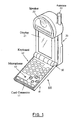
- Fig. 1 shows an external view of an information processing terminal 100 adapted for implementing this invention. It should be understood that this terminal 100 is provided with both functions of the so-called PDA (Personal Digital Assistant) and PHS (Personal Handyphone System) for a wireless communication.
- PDA Personal Digital Assistant
- PHS Personal Handyphone System
- the information processing terminal 100 comprises a relatively thin first housing 10 and a relatively thick second housing 20.
- the second housing 20 is pivotally supported by a hinge 30 at one end of the first housing 10.
- the first housing 10 has an interface defined by PCMCIA (Personal Computer Memory Card International Association) and JEIDA (Japan Electronic Industry Development Association).
- An exemplary external computer system connectable to the information processing terminal 100 of the present embodiment is a personal computer with a PC card slot, which conforms to the specification of OADG (PC Open Architecture Developer's Group), such as a notebook PC called "IBM ThinkPad 765" ("ThinkPad” is a trademark of IBM Corp.), commercially available from IBM Japan, Ltd.
- OADG PC Open Architecture Developer's Group
- a keyboard 12 including a plurality of keypads is provided on the top surface of the first housing 10.
- the keyboard 12 comprises ten keys, function keys, cursor keys, a power switch, as well as a key input control circuit embedded in the housing for generating a scan code in response to a key input.
- the keyboard 12 used as input means for the PDA functions, and in case of using the terminal 100 as a PHS, it is used for entering a telephone number or switching operation modes.
- an upper portion of a microphone 13 for inputting audio signals is exposed. The microphone 13 is used for a speech conversation when the terminal 100 is used as a PHS.
- a liquid crystal display 21 is provided as output means for the PDA functions.
- the display 21 has a relatively large screen of 200 x 320 dot resolution.
- processed data e.g., PIM (Personal Information Manager) data downloaded from a PC, contents of a Web page and/or an electronic mail received at the PHS section, or the like
- PIM Personal Information Manager
- a top edge portion of the second housing 20 is formed in a semicylindrical shape. On the surface of this semicylindrical shape, a speaker 22 for outputting a voice is provided. Further, at the left side edge of the second housing 20, an antenna 23 for wireless transmission/reception is mounted along a longitudinal axis of the second housing 20.
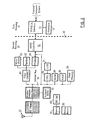
- Fig. 2 schematically shows an internal hardware configuration of the information processing terminal 100.
- the PCMCIA interface 51 is a circuit that includes functions for implementing an interface protocol with a connected external computer system, as well as other functions for generating a scan code in response to a key input on the keyboard 12. Such a circuit may be made by using the ASIC (Application Specific Integrated Circuit) technology. Data downloaded from an external computer system (not shown) is captured into the terminal 100 via this PCMCIA interface 51.
- ASIC Application Specific Integrated Circuit
- the PDA functions In the second housing 20, there is mounted almost all components for the PDA functions to process computer data, together with major components for the PHS functions to implement a wireless communication. It should be understood in this respect that the hatched hardware blocks shown in Fig. 2 are those components dedicated to the wireless communication functions.
- a MISC controller 61 is provided with functions for feeding signals from the PCMCIA interface 51 to an internal bus 62.
- each component is interconnected.
- a CPU 63 is a main controller for controlling the PDA functions of the information processing terminal 100.
- CPU 63 is also arranged to control the display 21.
- ROM 55 is a read-only memory, which permanently stores code groups for controlling hardware operations in the terminal 100.
- RAM 65 is a writable volatile memory, which is primarily used as a working area of CPU 63.
- a flash memory 66 is an erasable non-volatile memory, which is used for retaining, for example, confidential data of the terminal 100.
- OS operating system
- applications e.g., "Dialer” (tentatively named) for calling a called party's telephone, "Browser” (tentatively named) for browsing a Web page on the Internet, "Mail” (tentatively named) for exchanging an electronic mail via the Internet, and the like
- OS operating system
- applications e.g., "Dialer” (tentatively named) for calling a called party's telephone, "Browser” (tentatively named) for browsing a Web page on the Internet, "Mail” (tentatively named) for exchanging an electronic mail via the Internet, and the like
- OS operating system
- a voice CODEC 67 is a dedicated circuit for expanding/compressing voice data. For example, voice data inputted via the microphone 13 is compressed by the voice CODEC 67 and is subsequently captured into the terminal 100. Conversely, voice data expanded by the voice CODEC 67 is outputted by the speaker 22 as a voice.
- a modem 66 is a dedicated circuit for modulating computer data as an analog signal available on a telephone line, or conversely, for demodulating a received analog signal as computer data.
- computer data received from an external computer system via the PCMCIA interface 51 and the MISC controller 61 is modulated by the modem 66, compressed by the voice CODEC 67, and then converted into a wireless code for transmission from the antenna 23.
- a received wireless code is demodulated by the modem 66 and, then, it is processed by the internal CPU 63 or a connected external computer system (not shown).
- a wireless communication means 71 is a main controller for administering the PHS functions of the terminal 100. Also, this wireless communication means 71 supports a variety of functions as a PHS telephone, including but not limited to calling on telephone directory, redial, history of call incoming, dial lock, calling party number identification, automatic answering telephone service, and the like.
- a protocol ROM 73 permanently stores control code for performing operations in accordance with predetermined communication schemes. In general, communication schemes are different for each of the carriers (e.g., Astel, DDI Pocket and the like).
- RF means 72 is a dedicated circuit for implementing input/output of wireless data via the antenna 23.
- the RF means 72 outputs transmission data passed from the wireless communication means 71 as wireless data, or conversely, it captures wireless data received via the antenna 23 into the terminal 100.
- the terminal 100 is provided with a battery 81 as a primary power source.
- a secondary battery such as a lithium-ion battery may be adopted.
- Output terminal voltage of the battery 81 is level converted by a DC-DC converter 82 and then fed to each component. Also, there is provided a backup battery 83.
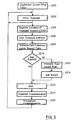
- Fig. 3 shows a flow chart of a first operational example of the information processing terminal 100.
- the terminal 100 is previously rendered to implement therein (e.g., in a memory such as ROM 64, flash memory 66 or the like) an association table for associating each PHS support area (i.e., each base station) with its nearest access point of a destined internet (or BBS) provider (step S100).
- a memory such as ROM 64, flash memory 66 or the like
- Table 1 schematically illustrates the association table.
- this table one record is prepared for each of the NTT exchanges respectively, and this record includes fields for containing an NTT exchange identification number and a telephone number of its associated access point. Since locations of the NTT exchanges are physically fixed, and they imply locations of calling parties (callers), it is possible to determine the nearest access point by using an NTT exchange identification number. Incidentally, in regard to such an area with an NTT toll number where no access point of the internet/BBS provider exists, data of the nearest access point may be conveniently retained, or an NTT toll number may be simply calculated to select an access point.
- This association table may be permanently stored into ROM 64 of the information processing terminal 100 by its manufacturer before its shipment, or this table may be alternatively written into the flash memory 66 such that content thereof is appropriately updated. In consideration of a trend that new access points are further constructed in the near future, the latter approach will be more useful (an update method of this table may rely on downloading from an external computer system via the PCMCIA interface 51, or a wireless transmission from the contracted internet/BBS provider).
- step S102 a user carrying the information processing terminal 100 moves in another cell.
- the information processing terminal 100 performs location registration at the base station of the newly entered cell, as well known in the art (step S104).
- each base station is defined to periodically (1 slot per 1.2 second interval) transmit notification information for location registration of a PHS mobile station.
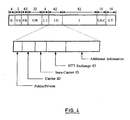
- Fig. 4 schematically shows a format of this notification information.
- R and GT fields contain ramp bits and guard bits respectively, each providing a sufficient margin for transient response.
- SS and PR fields contain a start symbol and preamble respectively, each forming continuous signals of 2T used for bit synchronization.
- UW field contains a unique word used for frame synchronization.
- CI field contains a channel identifier, which is equal to 4 (hex) for the notification information.
- I field contains 62 bits allocated to an information message, and it describes a configuration of a super-frame or the like in a predetermined format.
- CRC field contains a CRC (cyclic redundancy check) code.
- ID field contains a base station-ID (CS-ID), which normally comprises 42 bits.
- This CS-ID field is further divided into subfields, including "public/private”, “carrier identification number”, “intra-carrier identification number”, “NTT exchange identification number” and “additional information” (However, structure of the CS-ID may be slightly changed for each of the carriers).
- NTT exchange identification number there is described an identification number of an NTT exchange that covers the current base station. Note that such an identification number has a one-to-one correspondence with an NTT toll number (e.g., "03" for Tokyo, "045" for Yokohama).
- step S102 the process returns to step S102 again, where it waits for either entrance of the terminal 100 into the next cell or starting of given terminal software.
- the acquired CS-ID of the current base station has been saved in a given address of the flash memory 66, for example.
- a user of the information processing terminal 100 starts terminal software such as "Browser” for browsing a Web page, "Mail” for exchanging an electronic mail or the like (step S106). Since starting of “Browser” or “Mail” is subject to connection to the Internet, it requests another terminal software, "Dialer”, to connect to the Internet.
- terminal software such as "Browser” for browsing a Web page, "Mail” for exchanging an electronic mail or the like
- “Dialer” extracts an NTT exchange identification number from the current CS-ID previously acquired and, then, retrieves a record for this identification number from the association table as set forth in TABLE 1, thereby to acquire a telephone number of an access point that is nearest to the current location (step S108).
- "Dialer” dials the acquired telephone number of this access point (step S110).
- the terminal 100 is authenticated by the selected access point and a communication therewith is established, a dial-up connection to the contracted provider is accomplished. As a result, the terminal 100 is allowed to access a desired Web server for acquiring a Web page, or to exchange an electronic mail (step S112).
- step S114 When a user closes the active terminal software (e.g., "Browser” or "Mail") after having done an intended work such as browsing of a Web page or exchanging of an electronic mail, the currently established communication with the access point is disconnected (step S114). Thereafter, the process returns to step S102, where it waits for either entrance of the terminal 100 into the next cell or starting of given terminal software.
- active terminal software e.g., "Browser” or "Mail
- step S202 it is assumed at this stage that a user carrying the information processing terminal 100 moves into another cell.
- the information processing terminal 100 performs location registration at the base station of the newly entered cell, as well known in the art (step S204).
- each base station is defined to periodically (1 slot per 1.2 second interval) transmit notification information for location registration of a PHS mobile station.
- notification information, format of CS-ID included therein, or the like were already described above, with reference to Fig. 4.
- the process returns to step S202 again, where it waits for either entrance of the terminal 100 into the next cell or starting of given terminal software.
- the acquired CS-ID of the current base station has been saved in a given address of the flash memory 66, for example.
- a user of the information processing terminal 100 starts terminal software such as "Browser” for browsing a Web page, "Mail” for exchanging an electronic mail or the like (step S206). Since starting of “Browser” or “Mail” is subject to connection to the Internet, it requests another terminal software, "Dialer”, to connect to the Internet.
- terminal software such as "Browser” for browsing a Web page, "Mail” for exchanging an electronic mail or the like
- “Dialer” extracts an NTT exchange identification number from the current CS-ID previously acquired and, then, retrieves a record for this identification number from the past "communication record table" (step S208). If there is any communication record for the current NTT exchange identification number, this record is referenced to acquire a telephone number of the nearest access table. Then, "Dialer” dials the acquired telephone number of this access point (step S216).
- a user is prompted on the display 21, for example, to manually input a telephone number of a desired access point (step S212). Thereafter, a record that describes an association between the inputted telephone number of this access point and the current NTT exchange identification number is written into the "communication record table" (step S214). Then, the telephone number of this access point is dialled accordingly.
- the terminal 100 When the terminal 100 is authenticated by the selected access point and a communication therewith is established, a dial-up connection to the contracted provider is accomplished. As a result, the terminal 100 is allowed to access a desired Web server for acquiring a Web page, or to exchange an electronic mail (step S218).
- step S220 When a user closes the active terminal software (e.g., "Browser” or "Mail") after having done an intended work such as browsing of a Web page or exchanging of an electronic mail, the currently established communication with the access point is disconnected (step S220). Thereafter, the process returns to step S202, where it waits for either entrance of the terminal 100 into the next cell or starting of given terminal software.
- active terminal software e.g., "Browser” or "Mail
- the aforesaid second operational example will be advantageously applied.
- the aforesaid second operational example will be advantageously applied as well to save the required memory capacity.
- an improved wireless information processing terminal that is connectable to an appropriate one of the access points prepared by an internet provider even under a mobile environment (i.e., at each moving location), and a method of controlling the same.
Landscapes
- Engineering & Computer Science (AREA)
- Databases & Information Systems (AREA)
- Computer Networks & Wireless Communication (AREA)
- Signal Processing (AREA)
- Mobile Radio Communication Systems (AREA)
- Electrophonic Musical Instruments (AREA)
- Telephonic Communication Services (AREA)
- Selective Calling Equipment (AREA)
- General Factory Administration (AREA)
- Data Exchanges In Wide-Area Networks (AREA)
- Information Transfer Between Computers (AREA)
Claims (9)
- Drahtloses Datenverarbeitungsendgerät (10), das über eine Vielzahl von drahtlosen Zellen bewegt werden kann und einen drahtlosen Datenaustauschvorgang mit einer drahtlosen Basisstation ausführt, die eine der drahtlosen Zellen bedient, in der das Endgerät sich gerade befindet, das Folgendes umfasst:wobei das Endgerät gekennzeichnet ist durch:Kommunikationsmittel (71, 72) zum Ausführen einer Kommunikation mit einer drahtlosen Basisstation; undein Mittel zum Entnehmen einer Basisstations-ID aus von einer drahtlosen Basisstation empfangenen Daten;Speichermittel (64, 66) zum Speichern von Zuordnungen zwischen den Basisstations-IDs und den nächstgelegenen Zugangspunkten eines Anbieters;ein Zugangspunktabrufmittel zum Zugreifen auf das Speichermittel und zum Abrufen von einem der Zugangspunkte, die einer aktuellen drahtlosen Basisstation zugeordnet sind; undein Mittel, um zu versuchen, eine Verbindung mit dem abgerufenen Zugangspunkt einzurichten.
- Drahtloses Datenverarbeitungsendgerät nach Anspruch 1, das außerdem Folgendes umfasst:ein Anzeigemittel (21) zum Anzeigen von verarbeiteten Daten und dergleichen;ein Mittel zum Herunterladen von Daten, um Daten durch den verbundenen Zugangspunkt herunterzuladen; undein Anzeigesteuermittel (63), um das Anzeigemittel zum Anzeigen der heruntergeladenen Daten veranlassen.
- Drahtloses Datenverarbeitungsendgerät nach Anspruch 1 oder Anspruch 2, das außerdem Folgendes umfasst:wobei das Speichermittel für die Speicherung von Daten und von einem Programm geeignet ist und das Zugangspunktabrufmittel auf eine Benutzeranforderung zur Verbindung mit einem Zugangspunkt anspricht, um auf das Speichermittel zuzugreifen und die Telefonnummer eines der Basisstations-ID der aktuellen drahtlosen Basisstation zugeordneten Zugangspunktes abzurufen.ein Eingabemittel (12), um es einem Benutzer zu ermöglichen, Daten und einen Befehl einzugeben; undein Schreibmittel, um eine vom Benutzer eingegebene Telefonnummer eines Zugangspunktes eines Anbieters in Verbindung mit der Basisstations-ID einer aktuellen drahtlosen Basisstation in das Speichermittel zu schreiben;
- Drahtloses Datenverarbeitungsendgerät nach Anspruch 2,
wobei das Mittel zum Einrichten einer Verbindung ein Mittel zum Anwählen des abgerufenen Zugangspunktes enthält;
wobei das Mittel zum Herunterladen von Daten Web-Daten über den angewählten Zugangspunkt herunterlädt; und
wobei das Anzeigesteuermittel das Anzeigemittel zum Anzeigen der heruntergeladenen Daten veranlasst. - Verfahren zum Steuern eines drahtlosen Datenverarbeitungsendgerätes, das über eine Vielzahl von drahtlosen Zellen bewegt werden kann, wobei das Endgerät eine Tabelle zum Beschreiben von Zuordnungen zwischen Basisstations-IDs und den nächstgelegenen Zugangspunkten eines Anbieters aufweist, und zum Ausführen eines drahtlosen Datenaustauschvorgangs mit einer drahtlosen Basisstation, die eine der drahtlosen Zellen bedient, in der das Endgerät sich aktuell befindet, wobei das Verfahren die folgenden Schritte umfasst:Empfangen von Benachrichtigungsdaten von einer drahtlosen Basisstation, die eine der drahtlosen Zellen bedient, in der das Endgerät sich gerade befindet; Entnehmen einer Basisstations-ID aus den empfangenen Benachrichtigungsdaten; Abrufen der Tabelle zum Anfordern von einem der der Basisstations-ID zugeordneten Zugangspunkte; undVersuchen, eine Verbindung mit dem angeforderten Zugangspunkt einzurichten.
- Verfahren nach Anspruch 5, wobei das Endgerät ein Eingabemittel zum Eingeben von Daten aufweist und der Abrufschritt einen Datensatz aus der Tabelle abruft, der sich auf die Basisstations-ID bezieht, wobei das Verfahren die folgenden Schritte umfasst:Antworten auf eine erfolgreiche Suche des Datensatzes bezüglich der Basisstations-ID in der Tabelle, um zu versuchen, eine Verbindung mit dem in dem Datensatz beschriebenen Zugangspunkt einzurichten;Antworten auf eine nichterfolgreiche Suche des Datensatzes bezüglich der Basisstations-ID in der Tabelle, um einen Benutzer zur Eingabe von Daten über einen Zugangspunkt aufzufordern; undRegistrieren eines Datensatzes, um den eingegebenen Zugangspunkt der Basisstations-ID in der Tabelle zuzuordnen.
- Verfahren nach Anspruch 5 oder 6, wobei das Endgerät ein Anzeigemittel zum Anzeigen von Daten aufweist, wobei das Verfahren die folgenden Schritte umfasst:Herunterladen von Daten über den verbundenen Zugangspunkt im Anschluss an das Einrichten der Verbindung; undVeranlassen des Anzeigemittels zum Anzeigen der heruntergeladenen Daten.
- Verfahren nach Anspruch 7, wobei der Abrufschritt die Tabelle abruft, um eine Telefonnummer eines der Basisstations-ID zugeordneten Zugangspunktes abzurufen, wobei der Verbindungsschritt das Anwählen der angeforderten Telefonnummer des Zugangspunktes beinhaltet, wobei der Schritt des Herunterladens Web-Daten über den verbundenen Zugangspunkt herunterlädt und das Anzeigemittel die heruntergeladenen Web-Daten anzeigt.
- Computerlesbares Speichermedium zum physischen Speichern eines Computerprogramms, das in einem drahtlosen Datenverarbeitungsendgerät ausgeführt werden kann, das über eine Vielzahl von drahtlosen Zellen bewegt werden kann, wobei das Endgerät eine Tabelle zum Beschreiben von Zuordnungen zwischen Basisstations-IDs und den nächstgelegenen Zugangspunkten eines Anbieters aufweist, und zum Ausführen eines drahtlosen Datenaustauschvorgangs mit einer drahtlosen Basisstation, die eine der drahtlosen Zellen bedient, in der das Endgerät sich aktuell befindet, wobei das Computerprogramm Folgendes umfasst:eine Routine zum Empfangen von Benachrichtigungsdaten von einer drahtlosen Basisstation, die eine der drahtlosen Zellen bedient, in der sich das Endgerät aktuell befindet;eine Routine zum Entnehmen einer Basisstations-ID aus den empfangenen Benachrichtigungsdaten;eine Routine zum Abrufen der Tabelle zum Anfordern von einem der der Basisstations-ID zugeordneten Zugangspunkte; undeine Routine, um zu versuchen, eine Verbindung mit dem angeforderten Zugangspunkt einzurichten.
Applications Claiming Priority (3)
| Application Number | Priority Date | Filing Date | Title |
|---|---|---|---|
| JP9179195A JPH1141643A (ja) | 1997-07-04 | 1997-07-04 | 無線情報処理端末及びその制御方法 |
| JP179195/97 | 1997-07-04 | ||
| JP17919597 | 1997-07-04 |
Publications (3)
| Publication Number | Publication Date |
|---|---|
| EP0889660A2 EP0889660A2 (de) | 1999-01-07 |
| EP0889660A3 EP0889660A3 (de) | 2000-01-12 |
| EP0889660B1 true EP0889660B1 (de) | 2004-10-13 |
Family
ID=16061602
Family Applications (1)
| Application Number | Title | Priority Date | Filing Date |
|---|---|---|---|
| EP98304838A Expired - Lifetime EP0889660B1 (de) | 1997-07-04 | 1998-06-19 | Schnurloses Informationsverarbeitungsendgerät und Steuerungsverfahren dazu |
Country Status (11)
| Country | Link |
|---|---|
| US (1) | US6233452B1 (de) |
| EP (1) | EP0889660B1 (de) |
| JP (1) | JPH1141643A (de) |
| KR (1) | KR100276405B1 (de) |
| CN (1) | CN1098607C (de) |
| AT (1) | ATE279841T1 (de) |
| CA (1) | CA2240654A1 (de) |
| DE (1) | DE69826932T2 (de) |
| ES (1) | ES2229452T3 (de) |
| SG (1) | SG84513A1 (de) |
| TW (1) | TW398159B (de) |
Cited By (11)
| Publication number | Priority date | Publication date | Assignee | Title |
|---|---|---|---|---|
| US7590696B1 (en) | 2002-11-18 | 2009-09-15 | Aol Llc | Enhanced buddy list using mobile device identifiers |
| US8452849B2 (en) | 2002-11-18 | 2013-05-28 | Facebook, Inc. | Host-based intelligent results related to a character stream |
| US8577972B1 (en) | 2003-09-05 | 2013-11-05 | Facebook, Inc. | Methods and systems for capturing and managing instant messages |
| US8701014B1 (en) | 2002-11-18 | 2014-04-15 | Facebook, Inc. | Account linking |
| US8874672B2 (en) | 2003-03-26 | 2014-10-28 | Facebook, Inc. | Identifying and using identities deemed to be known to a user |
| US8965964B1 (en) | 2002-11-18 | 2015-02-24 | Facebook, Inc. | Managing forwarded electronic messages |
| US9203879B2 (en) | 2000-03-17 | 2015-12-01 | Facebook, Inc. | Offline alerts mechanism |
| US9203794B2 (en) | 2002-11-18 | 2015-12-01 | Facebook, Inc. | Systems and methods for reconfiguring electronic messages |
| US9203647B2 (en) | 2002-11-18 | 2015-12-01 | Facebook, Inc. | Dynamic online and geographic location of a user |
| US9246975B2 (en) | 2000-03-17 | 2016-01-26 | Facebook, Inc. | State change alerts mechanism |
| US9363212B2 (en) | 2000-03-06 | 2016-06-07 | Facebook, Inc. | Method and system for messaging across cellular networks and a public data network |
Families Citing this family (94)
| Publication number | Priority date | Publication date | Assignee | Title |
|---|---|---|---|---|
| US5835061A (en) * | 1995-06-06 | 1998-11-10 | Wayport, Inc. | Method and apparatus for geographic-based communications service |
| US8606851B2 (en) | 1995-06-06 | 2013-12-10 | Wayport, Inc. | Method and apparatus for geographic-based communications service |
| US7302446B1 (en) | 1996-11-13 | 2007-11-27 | Intellisync Corporation | Synchronizing databases |
| US6405218B1 (en) | 1996-11-13 | 2002-06-11 | Pumatech, Inc. | Synchronizing databases |
| US6304881B1 (en) * | 1998-03-03 | 2001-10-16 | Pumatech, Inc. | Remote data access and synchronization |
| JP2000083284A (ja) * | 1998-06-25 | 2000-03-21 | Canon Inc | 無線通信装置およびその制御方法 |
| CN1134937C (zh) | 1998-07-21 | 2004-01-14 | 塔奇昂公司 | 通信系统内用于多址接入的方法和装置 |
| KR100335417B1 (ko) * | 1998-07-30 | 2002-06-20 | 윤종용 | 무선통신단말기의왑(wap)서버어드레스지정방법 |
| US6674730B1 (en) | 1998-08-04 | 2004-01-06 | Tachyon, Inc. | Method of and apparatus for time synchronization in a communication system |
| US6256483B1 (en) | 1998-10-28 | 2001-07-03 | Tachyon, Inc. | Method and apparatus for calibration of a wireless transmitter |
| US7007003B1 (en) | 1998-12-04 | 2006-02-28 | Intellisync Corporation | Notification protocol for establishing synchronization mode for use in synchronizing databases |
| FI990049A7 (fi) * | 1999-01-13 | 2000-07-14 | Jaakko Olavi Pentikaeinen | Modulaarinen johdoton verkko/konsepti (MWC/MWN) |
| JP2000251401A (ja) * | 1999-02-26 | 2000-09-14 | Sony Corp | 無線装置およびデータ再生装置 |
| GB2349545A (en) * | 1999-04-26 | 2000-11-01 | Nokia Mobile Phones Ltd | Terminal for providing an application using a browser |
| TW462159B (en) | 1999-05-14 | 2001-11-01 | Ntt Docomo Inc | Mobile communication terminal |
| AU2005200458B2 (en) * | 1999-05-14 | 2007-07-19 | Ntt Docomo, Inc. | Mobile communication terminal |
| FR2795900B1 (fr) * | 1999-06-29 | 2004-09-24 | Sigma B V B A | Centre d'appel adaptatif |
| US6735188B1 (en) | 1999-08-27 | 2004-05-11 | Tachyon, Inc. | Channel encoding and decoding method and apparatus |
| US6532220B1 (en) | 1999-08-27 | 2003-03-11 | Tachyon, Inc. | System and method for efficient channel assignment |
| US6218896B1 (en) | 1999-08-27 | 2001-04-17 | Tachyon, Inc. | Vectored demodulation and frequency estimation apparatus and method |
| US6665292B1 (en) | 1999-08-27 | 2003-12-16 | Tachyon, Inc. | Transmission and reception of TCP/IP data over a wireless communication channel |
| US6982969B1 (en) | 1999-09-28 | 2006-01-03 | Tachyon, Inc. | Method and system for frequency spectrum resource allocation |
| US6674731B1 (en) | 1999-08-27 | 2004-01-06 | Tachyon, Inc. | Transmission and reception of TCP/IP data over a wireless communication channel |
| US6650636B1 (en) | 1999-08-27 | 2003-11-18 | Tachyon, Inc. | Transmission and reception of TCP/IP data over a wireless communication channel |
| JP2001075881A (ja) * | 1999-08-31 | 2001-03-23 | Casio Comput Co Ltd | 通信装置及び通信システム |
| US6571221B1 (en) | 1999-11-03 | 2003-05-27 | Wayport, Inc. | Network communication service with an improved subscriber model using digital certificates |
| IL149356A0 (en) * | 1999-11-03 | 2002-11-10 | Wayport Inc | Distributed network communication system which enables multiple network providers to use a common distributed network infrastructure |
| KR20010045359A (ko) * | 1999-11-04 | 2001-06-05 | 조영선 | 파일 및 데이터원격관리기능을 가지고 있는 이동전화시스템 |
| FR2801451B1 (fr) * | 1999-11-22 | 2002-02-08 | Cit Alcatel | Procede de validation de donnees dans un terminal |
| FR2801452B1 (fr) * | 1999-11-22 | 2002-02-08 | Cit Alcatel | Procede de validation du provissionnement primaire d'un terminal |
| FR2801453B1 (fr) * | 1999-11-22 | 2002-02-08 | Cit Alcatel | Procede de provisionnement domestique et itinerant pour un terminal mobile |
| US6873841B1 (en) * | 1999-12-16 | 2005-03-29 | Koninklijke Philips Electronics N.V. | Shared address-data service for personal CE equipment |
| JP3414352B2 (ja) | 2000-02-03 | 2003-06-09 | 日本電気株式会社 | 無線端末、情報処理システムおよび外部処理端末 |
| US6760580B2 (en) | 2000-03-06 | 2004-07-06 | America Online, Incorporated | Facilitating instant messaging outside of user-defined buddy group in a wireless and non-wireless environment |
| US20020022483A1 (en) * | 2000-04-18 | 2002-02-21 | Wayport, Inc. | Distributed network communication system which allows multiple wireless service providers to share a common network infrastructure |
| WO2001084871A1 (en) * | 2000-05-04 | 2001-11-08 | Telefonaktiebolaget Lm Ericsson (Publ) | Personal information server for a mobile phone |
| JP2001346256A (ja) * | 2000-05-31 | 2001-12-14 | Toshiba Corp | 移動通信端末装置の発信方法および移動通信端末装置および情報提供サーバ |
| JP4543513B2 (ja) * | 2000-07-17 | 2010-09-15 | ソニー株式会社 | 双方向通信システム、表示装置、ベース装置および双方向通信方法 |
| FR2812418B1 (fr) * | 2000-07-28 | 2002-10-31 | Sagem | Telechargement de donnees sur un telephone portable |
| KR100351682B1 (ko) * | 2000-09-06 | 2002-09-05 | 주식회사 이씨오 | 무선 통신장치를 이용한 컴퓨터의 원격 제어시스템 및 방법 |
| KR100418744B1 (ko) * | 2000-10-02 | 2004-02-14 | (주) 젠터닷컴 | 서비스 코드를 이용한 핸드폰 서비스 시스템 및 방법과 그프로그램 소스를 저장한 기록매체 |
| US8676921B1 (en) * | 2000-10-03 | 2014-03-18 | Nokia Corporation | Contextual mapping based learning by converting information |
| JP2002111686A (ja) * | 2000-10-04 | 2002-04-12 | Sony Corp | 通信方法および通信装置 |
| JP3929693B2 (ja) * | 2000-11-20 | 2007-06-13 | 株式会社日立製作所 | 通信システム |
| US20020065881A1 (en) * | 2000-11-29 | 2002-05-30 | Tapio Mansikkaniemi | Wireless family bulletin board |
| KR100565157B1 (ko) * | 2000-12-06 | 2006-03-30 | 닛본 덴끼 가부시끼가이샤 | 가상 사설망 |
| US6971060B1 (en) | 2001-02-09 | 2005-11-29 | Openwave Systems Inc. | Signal-processing based approach to translation of web pages into wireless pages |
| US20050065779A1 (en) * | 2001-03-29 | 2005-03-24 | Gilad Odinak | Comprehensive multiple feature telematics system |
| US7236777B2 (en) | 2002-05-16 | 2007-06-26 | Intellisist, Inc. | System and method for dynamically configuring wireless network geographic coverage or service levels |
| US7406421B2 (en) | 2001-10-26 | 2008-07-29 | Intellisist Inc. | Systems and methods for reviewing informational content in a vehicle |
| US20020143611A1 (en) * | 2001-03-29 | 2002-10-03 | Gilad Odinak | Vehicle parking validation system and method |
| US6487494B2 (en) * | 2001-03-29 | 2002-11-26 | Wingcast, Llc | System and method for reducing the amount of repetitive data sent by a server to a client for vehicle navigation |
| USRE46109E1 (en) | 2001-03-29 | 2016-08-16 | Lg Electronics Inc. | Vehicle navigation system and method |
| US6885735B2 (en) * | 2001-03-29 | 2005-04-26 | Intellisist, Llc | System and method for transmitting voice input from a remote location over a wireless data channel |
| US8175886B2 (en) | 2001-03-29 | 2012-05-08 | Intellisist, Inc. | Determination of signal-processing approach based on signal destination characteristics |
| US7359920B1 (en) | 2001-04-18 | 2008-04-15 | Intellisync Corporation | Communication protocol for synchronization of personal information management databases |
| US6560454B2 (en) * | 2001-05-30 | 2003-05-06 | Nokia Corp. | System and method for delivery and updating of data transmitted to a mobile terminal |
| DE10127865C2 (de) * | 2001-06-06 | 2003-10-23 | Siemens Ag | Verfahren und Anordnung zum Kontrollieren des Zugriffs auf Daten in Mobil-Kommunikationsnetzen |
| JP4010782B2 (ja) | 2001-07-19 | 2007-11-21 | 三洋電機株式会社 | 無線端末装置およびその受信動作制御プログラム |
| KR20030012663A (ko) * | 2001-08-03 | 2003-02-12 | 엘지전자 주식회사 | 오프라인 상태에서 휴대폰을 사용한 웹사이트 검색 방법 |
| KR20030026011A (ko) * | 2001-09-24 | 2003-03-31 | 조동규 | 모바일용 비대칭 온라인/오프라인 검색/전송 시스템 |
| US7164922B2 (en) * | 2001-10-05 | 2007-01-16 | Intellisist, Inc. | Local phone number lookup and cache |
| US20090168719A1 (en) * | 2001-10-11 | 2009-07-02 | Greg Mercurio | Method and apparatus for adding editable information to records associated with a transceiver device |
| JP2003152731A (ja) * | 2001-11-16 | 2003-05-23 | Mitsumi Electric Co Ltd | 通信装置、ipアドレス取得方法、ローミング方法 |
| JP2003162469A (ja) * | 2001-11-27 | 2003-06-06 | Toshiba Tec Corp | 情報保管入力システム及び情報保管入力サービス、並びに画面表示システム |
| US8249880B2 (en) * | 2002-02-14 | 2012-08-21 | Intellisist, Inc. | Real-time display of system instructions |
| WO2004046867A2 (en) | 2002-11-18 | 2004-06-03 | America Online, Inc. | People lists |
| US7899862B2 (en) | 2002-11-18 | 2011-03-01 | Aol Inc. | Dynamic identification of other users to an online user |
| US7428580B2 (en) | 2003-11-26 | 2008-09-23 | Aol Llc | Electronic message forwarding |
| KR100542119B1 (ko) * | 2002-12-12 | 2006-01-11 | 한국전자통신연구원 | 무선 랜 에이피 자동 탐색 방법 및 그 방법을 수행하는단말기 |
| JP3764435B2 (ja) * | 2003-03-26 | 2006-04-05 | 株式会社東芝 | 情報処理装置およびプログラム |
| US8429227B2 (en) * | 2003-06-02 | 2013-04-23 | Seiko Epson Corporation | Image display device and method of announcing a presence of an image display device over a network |
| US20050089007A1 (en) * | 2003-10-28 | 2005-04-28 | Samsung Electronics Co., Ltd. | System and method for performing handoffs of mobile station-to-mobile station packet data calls in a wireless network |
| KR100755209B1 (ko) * | 2006-04-03 | 2007-09-04 | 주식회사 에이로직스 | 휴대 인터넷 단말의 위치정보를 제공하는 방법과 그 방법을채용한 중계기 및 휴대 인터넷 단말기 |
| KR100791847B1 (ko) * | 2006-12-04 | 2008-01-07 | 삼성전자주식회사 | 이동통신 단말기에서 메시지 전송 방법 및 장치 |
| KR101248542B1 (ko) * | 2007-01-10 | 2013-04-03 | 닛본 덴끼 가부시끼가이샤 | 무선 통신 단말 장치, 액세스 포인트 장치 및 무선 통신 시스템, 그 정보 제공 방법 및 정보 취출 방법 |
| US8634796B2 (en) | 2008-03-14 | 2014-01-21 | William J. Johnson | System and method for location based exchanges of data facilitating distributed location applications |
| US8761751B2 (en) | 2008-03-14 | 2014-06-24 | William J. Johnson | System and method for targeting data processing system(s) with data |
| US8600341B2 (en) | 2008-03-14 | 2013-12-03 | William J. Johnson | System and method for location based exchanges of data facilitating distributed locational applications |
| US8639267B2 (en) | 2008-03-14 | 2014-01-28 | William J. Johnson | System and method for location based exchanges of data facilitating distributed locational applications |
| US8897742B2 (en) | 2009-11-13 | 2014-11-25 | William J. Johnson | System and method for sudden proximal user interface |
| US8566839B2 (en) | 2008-03-14 | 2013-10-22 | William J. Johnson | System and method for automated content presentation objects |
| US20110223886A1 (en) * | 2009-09-18 | 2011-09-15 | Qualcomm Incorporated | Access point-based control of access control list |
| US8942690B2 (en) * | 2009-09-18 | 2015-01-27 | Qualcomm Incorporated | Access control based on receipt of defined information from access terminal |
| US9392528B2 (en) * | 2009-09-18 | 2016-07-12 | Qualcomm Incorporated | Access control based on receipt of message from access terminal |
| HK1206121A1 (zh) | 2012-03-07 | 2015-12-31 | 实耐珀时尚股份有限公司 | 基於地理位置通过网络集合社交网络信息的方法和系统 |
| EP2683143B1 (de) | 2012-07-05 | 2016-06-22 | Ernst Wojak | Verfahren zum Betreiben eines Mobilfunkgeräts, Mobilfunkgerät sowie Verfahren zum automatischen Senden einer Nachricht |
| DE102012106044B8 (de) | 2012-07-05 | 2015-06-18 | Capinvision AG | Verfahren zum Betreiben eines Mobilfunkgeräts, Mobilfunkgerät sowie Verfahren zum automatischen Senden einer Nachricht |
| US9173068B2 (en) | 2012-07-05 | 2015-10-27 | Ernst Wojak | Method for operating a mobile radio apparatus, mobile radio apparatus as well as method for automatically transmitting a message |
| US9215560B1 (en) * | 2012-07-12 | 2015-12-15 | two forty four a.m. LLC | System and method for device-centric location detection and geofencing |
| US9477991B2 (en) | 2013-08-27 | 2016-10-25 | Snap Trends, Inc. | Methods and systems of aggregating information of geographic context regions of social networks based on geographical locations via a network |
| US20150089595A1 (en) * | 2013-09-24 | 2015-03-26 | Shun Yao | Method and system for facilitating online gaming |
| US9894489B2 (en) | 2013-09-30 | 2018-02-13 | William J. Johnson | System and method for situational proximity observation alerting privileged recipients |
| RU2739866C2 (ru) * | 2018-12-28 | 2020-12-29 | Акционерное общество "Лаборатория Касперского" | Способ обнаружения совместимых средств для систем с аномалиями |
Family Cites Families (18)
| Publication number | Priority date | Publication date | Assignee | Title |
|---|---|---|---|---|
| JPH0650558B2 (ja) * | 1985-12-25 | 1994-06-29 | 日本電装株式会社 | 車載用のナビゲ−シヨン装置 |
| US5815814A (en) * | 1991-12-26 | 1998-09-29 | Sygnet Communications, Inc. | Cellular telephone system that uses position of a mobile unit to make call management decisions |
| GB9223586D0 (en) * | 1992-11-11 | 1992-12-23 | Vodafone Ltd | Radio telecommunication systems and methods |
| WO1994022240A1 (en) * | 1993-03-19 | 1994-09-29 | Motorola, Inc. | Method and apparatus for selecting the best fixed communication unit |
| BR9405399A (pt) * | 1993-06-14 | 1999-09-08 | Motorola Inc | Radiotelefone celular remoto, sistema de comunicação e processo para operar transceptor de localização remota |
| US5493696A (en) * | 1994-05-31 | 1996-02-20 | Motorola, Inc. | Method for locating a subscriber unit that is in close proximity to a requesting subscriber unit in a wide area communication system |
| JP2933495B2 (ja) * | 1994-11-24 | 1999-08-16 | 富士通テン株式会社 | 携帯用パーソナルコンピュータ |
| JPH08223641A (ja) * | 1995-02-09 | 1996-08-30 | Matsushita Electric Ind Co Ltd | 無線通信装置 |
| US5835061A (en) * | 1995-06-06 | 1998-11-10 | Wayport, Inc. | Method and apparatus for geographic-based communications service |
| US5793964A (en) * | 1995-06-07 | 1998-08-11 | International Business Machines Corporation | Web browser system |
| US5737333A (en) * | 1995-06-23 | 1998-04-07 | Lucent Technologies Inc. | Method and apparatus for interconnecting ATM-attached hosts with telephone-network attached hosts |
| JP3224507B2 (ja) * | 1995-09-07 | 2001-10-29 | 富士通株式会社 | 情報検索装置及びこれを用いた情報検索システム |
| US5742598A (en) * | 1995-10-19 | 1998-04-21 | International Business Machines Corp. | Network for efficiently locating resources and routing service requests received from individual node connections |
| US5911485A (en) * | 1995-12-11 | 1999-06-15 | Unwired Planet, Inc. | Predictive data entry method for a keypad |
| US5905955A (en) * | 1995-12-12 | 1999-05-18 | At&T Wireless Services Inc. | Method for selecting a wireless service provider in a multi-service provider environment using a geographic database |
| US5727159A (en) * | 1996-04-10 | 1998-03-10 | Kikinis; Dan | System in which a Proxy-Server translates information received from the Internet into a form/format readily usable by low power portable computers |
| US5963861A (en) * | 1996-04-05 | 1999-10-05 | Lucent Technologies Inc. | Dealer-locator service and apparatus for mobile telecommunications system |
| US5946618A (en) * | 1996-11-04 | 1999-08-31 | Qualcomm Incorporated | Method and apparatus for performing position-based call processing in a mobile telephone system using multiple location mapping schemes |
-
1997
- 1997-07-04 JP JP9179195A patent/JPH1141643A/ja active Pending
-
1998
- 1998-05-11 TW TW087107248A patent/TW398159B/zh not_active IP Right Cessation
- 1998-06-03 CN CN98109602A patent/CN1098607C/zh not_active Expired - Lifetime
- 1998-06-09 KR KR1019980021253A patent/KR100276405B1/ko not_active Expired - Fee Related
- 1998-06-16 CA CA002240654A patent/CA2240654A1/en not_active Abandoned
- 1998-06-19 AT AT98304838T patent/ATE279841T1/de not_active IP Right Cessation
- 1998-06-19 EP EP98304838A patent/EP0889660B1/de not_active Expired - Lifetime
- 1998-06-19 DE DE69826932T patent/DE69826932T2/de not_active Expired - Lifetime
- 1998-06-19 ES ES98304838T patent/ES2229452T3/es not_active Expired - Lifetime
- 1998-07-02 US US09/109,568 patent/US6233452B1/en not_active Expired - Lifetime
- 1998-07-03 SG SG9801599A patent/SG84513A1/en unknown
Cited By (35)
| Publication number | Priority date | Publication date | Assignee | Title |
|---|---|---|---|---|
| US9363212B2 (en) | 2000-03-06 | 2016-06-07 | Facebook, Inc. | Method and system for messaging across cellular networks and a public data network |
| US9203879B2 (en) | 2000-03-17 | 2015-12-01 | Facebook, Inc. | Offline alerts mechanism |
| US9246975B2 (en) | 2000-03-17 | 2016-01-26 | Facebook, Inc. | State change alerts mechanism |
| US9253136B2 (en) | 2002-11-18 | 2016-02-02 | Facebook, Inc. | Electronic message delivery based on presence information |
| US9313046B2 (en) | 2002-11-18 | 2016-04-12 | Facebook, Inc. | Presenting dynamic location of a user |
| US8775560B2 (en) | 2002-11-18 | 2014-07-08 | Facebook, Inc. | Host-based intelligent results related to a character stream |
| US8819176B2 (en) | 2002-11-18 | 2014-08-26 | Facebook, Inc. | Intelligent map results related to a character stream |
| US9571440B2 (en) | 2002-11-18 | 2017-02-14 | Facebook, Inc. | Notification archive |
| US8954530B2 (en) | 2002-11-18 | 2015-02-10 | Facebook, Inc. | Intelligent results related to a character stream |
| US8954531B2 (en) | 2002-11-18 | 2015-02-10 | Facebook, Inc. | Intelligent messaging label results related to a character stream |
| US8954534B2 (en) | 2002-11-18 | 2015-02-10 | Facebook, Inc. | Host-based intelligent results related to a character stream |
| US9171064B2 (en) | 2002-11-18 | 2015-10-27 | Facebook, Inc. | Intelligent community based results related to a character stream |
| US9047364B2 (en) | 2002-11-18 | 2015-06-02 | Facebook, Inc. | Intelligent client capability-based results related to a character stream |
| US9053174B2 (en) | 2002-11-18 | 2015-06-09 | Facebook, Inc. | Intelligent vendor results related to a character stream |
| US9053175B2 (en) | 2002-11-18 | 2015-06-09 | Facebook, Inc. | Intelligent results using a spelling correction agent |
| US9053173B2 (en) | 2002-11-18 | 2015-06-09 | Facebook, Inc. | Intelligent results related to a portion of a search query |
| US9571439B2 (en) | 2002-11-18 | 2017-02-14 | Facebook, Inc. | Systems and methods for notification delivery |
| US8701014B1 (en) | 2002-11-18 | 2014-04-15 | Facebook, Inc. | Account linking |
| US9560000B2 (en) | 2002-11-18 | 2017-01-31 | Facebook, Inc. | Reconfiguring an electronic message to effect an enhanced notification |
| US8965964B1 (en) | 2002-11-18 | 2015-02-24 | Facebook, Inc. | Managing forwarded electronic messages |
| US9075867B2 (en) | 2002-11-18 | 2015-07-07 | Facebook, Inc. | Intelligent results using an assistant |
| US9203794B2 (en) | 2002-11-18 | 2015-12-01 | Facebook, Inc. | Systems and methods for reconfiguring electronic messages |
| US9203647B2 (en) | 2002-11-18 | 2015-12-01 | Facebook, Inc. | Dynamic online and geographic location of a user |
| US8452849B2 (en) | 2002-11-18 | 2013-05-28 | Facebook, Inc. | Host-based intelligent results related to a character stream |
| US7590696B1 (en) | 2002-11-18 | 2009-09-15 | Aol Llc | Enhanced buddy list using mobile device identifiers |
| US9075868B2 (en) | 2002-11-18 | 2015-07-07 | Facebook, Inc. | Intelligent results based on database queries |
| US9319356B2 (en) | 2002-11-18 | 2016-04-19 | Facebook, Inc. | Message delivery control settings |
| US9356890B2 (en) | 2002-11-18 | 2016-05-31 | Facebook, Inc. | Enhanced buddy list using mobile device identifiers |
| US8156193B1 (en) | 2002-11-18 | 2012-04-10 | Aol Inc. | Enhanced buddy list using mobile device identifiers |
| US9515977B2 (en) | 2002-11-18 | 2016-12-06 | Facebook, Inc. | Time based electronic message delivery |
| US9516125B2 (en) | 2003-03-26 | 2016-12-06 | Facebook, Inc. | Identifying and using identities deemed to be known to a user |
| US9531826B2 (en) | 2003-03-26 | 2016-12-27 | Facebook, Inc. | Managing electronic messages based on inference scores |
| US8874672B2 (en) | 2003-03-26 | 2014-10-28 | Facebook, Inc. | Identifying and using identities deemed to be known to a user |
| US8577972B1 (en) | 2003-09-05 | 2013-11-05 | Facebook, Inc. | Methods and systems for capturing and managing instant messages |
| US9070118B2 (en) | 2003-09-05 | 2015-06-30 | Facebook, Inc. | Methods for capturing electronic messages based on capture rules relating to user actions regarding received electronic messages |
Also Published As
| Publication number | Publication date |
|---|---|
| DE69826932T2 (de) | 2006-02-23 |
| CN1098607C (zh) | 2003-01-08 |
| KR100276405B1 (ko) | 2000-12-15 |
| EP0889660A3 (de) | 2000-01-12 |
| CN1204934A (zh) | 1999-01-13 |
| DE69826932D1 (de) | 2004-11-18 |
| ES2229452T3 (es) | 2005-04-16 |
| SG84513A1 (en) | 2001-11-20 |
| CA2240654A1 (en) | 1999-01-04 |
| EP0889660A2 (de) | 1999-01-07 |
| JPH1141643A (ja) | 1999-02-12 |
| KR19990013393A (ko) | 1999-02-25 |
| TW398159B (en) | 2000-07-11 |
| ATE279841T1 (de) | 2004-10-15 |
| US6233452B1 (en) | 2001-05-15 |
Similar Documents
| Publication | Publication Date | Title |
|---|---|---|
| EP0889660B1 (de) | Schnurloses Informationsverarbeitungsendgerät und Steuerungsverfahren dazu | |
| US5940752A (en) | Arrangement for remotely programming a cellular telephone terminal | |
| KR100417360B1 (ko) | 디스패치 호를 설정하기 위한 이동 통신 장치의 초기화 방법 | |
| US6996072B1 (en) | Method and apparatus for exchange of information in a communication network | |
| EP0926612A2 (de) | Kommunikationsapparat für elektronische Post, System für elektronische Post und Kommunikationsverfahren für elektronische Post | |
| JP2003058286A (ja) | データをバックアップする方法およびシステム | |
| EP1856937B1 (de) | Verfahren und Vorrichtung zur Verwendung einer Rufnummer, die auf einem Mobilgerät gespeichert ist, um einen Anruf zwischen zwei anderen Endgeräten aufzubauen | |
| CN1555646A (zh) | 通过用户电话簿中的被叫方姓名增强的账单记录 | |
| JP3950252B2 (ja) | 呼処理方法及び装置 | |
| CN101521705A (zh) | 一种基于在线电话簿模式实现通信的系统和方法 | |
| EP1528772A1 (de) | Mobiltelefonsystem zur verwendung eines lokales kommunikationsnetz | |
| JP2003536336A (ja) | 永続ストレージを変更するための方法及び装置 | |
| KR100832337B1 (ko) | 인터넷 가상저장공간을 이용한 휴대폰의 데이터 관리방법 | |
| KR100467544B1 (ko) | 유무선 통신단말장치에서의 메시지 통합관리방법 | |
| KR100678056B1 (ko) | 이동통신 단말기의 전화번호 표시 및 발신 방법 | |
| EP1825650B1 (de) | System zum verbindungsaufbau in einem mobilkommunikationsgerät | |
| KR100733908B1 (ko) | 공중전화망의 평생번호 서비스를 인터넷상에서 구현하기위한 가상번호 서비스 장치 및 그 방법 | |
| Jonsson et al. | Personal communication—Network aspects and implementations | |
| WO2004017571A1 (en) | System and device for providing portable wireless telephony services | |
| JP2001157257A (ja) | 発信先限定方法及びその方法を使用する移動通信制御システム | |
| MXPA97005625A (en) | Arrangement to program a remote control celu telephone terminal | |
| JPH06343098A (ja) | 電話交換システムにおける電話機の代行自動発信制御方式 | |
| CN1427640A (zh) | 快速拨打电话号码装置及方法 |
Legal Events
| Date | Code | Title | Description |
|---|---|---|---|
| PUAI | Public reference made under article 153(3) epc to a published international application that has entered the european phase |
Free format text: ORIGINAL CODE: 0009012 |
|
| AK | Designated contracting states |
Kind code of ref document: A2 Designated state(s): AT BE CH DE ES FR GB IE IT LI NL SE |
|
| AX | Request for extension of the european patent |
Free format text: AL;LT;LV;MK;RO;SI |
|
| PUAL | Search report despatched |
Free format text: ORIGINAL CODE: 0009013 |
|
| AK | Designated contracting states |
Kind code of ref document: A3 Designated state(s): AT BE CH CY DE DK ES FI FR GB GR IE IT LI LU MC NL PT SE |
|
| AX | Request for extension of the european patent |
Free format text: AL;LT;LV;MK;RO;SI |
|
| 17P | Request for examination filed |
Effective date: 20000427 |
|
| AKX | Designation fees paid |
Free format text: AT BE CH DE ES FR GB IE IT LI NL SE |
|
| GRAP | Despatch of communication of intention to grant a patent |
Free format text: ORIGINAL CODE: EPIDOSNIGR1 |
|
| GRAS | Grant fee paid |
Free format text: ORIGINAL CODE: EPIDOSNIGR3 |
|
| GRAA | (expected) grant |
Free format text: ORIGINAL CODE: 0009210 |
|
| AK | Designated contracting states |
Kind code of ref document: B1 Designated state(s): AT BE CH DE ES FR GB IE IT LI NL SE |
|
| PG25 | Lapsed in a contracting state [announced via postgrant information from national office to epo] |
Ref country code: NL Free format text: LAPSE BECAUSE OF FAILURE TO SUBMIT A TRANSLATION OF THE DESCRIPTION OR TO PAY THE FEE WITHIN THE PRESCRIBED TIME-LIMIT Effective date: 20041013 Ref country code: BE Free format text: LAPSE BECAUSE OF FAILURE TO SUBMIT A TRANSLATION OF THE DESCRIPTION OR TO PAY THE FEE WITHIN THE PRESCRIBED TIME-LIMIT Effective date: 20041013 Ref country code: AT Free format text: LAPSE BECAUSE OF FAILURE TO SUBMIT A TRANSLATION OF THE DESCRIPTION OR TO PAY THE FEE WITHIN THE PRESCRIBED TIME-LIMIT Effective date: 20041013 |
|
| REG | Reference to a national code |
Ref country code: GB Ref legal event code: FG4D |
|
| REG | Reference to a national code |
Ref country code: CH Ref legal event code: EP |
|
| REG | Reference to a national code |
Ref country code: CH Ref legal event code: NV Representative=s name: DIPL.-ING. PETER M. KLETT C/O IBM RESEARCH LABORAT |
|
| REG | Reference to a national code |
Ref country code: IE Ref legal event code: FG4D |
|
| REF | Corresponds to: |
Ref document number: 69826932 Country of ref document: DE Date of ref document: 20041118 Kind code of ref document: P |
|
| PG25 | Lapsed in a contracting state [announced via postgrant information from national office to epo] |
Ref country code: SE Free format text: LAPSE BECAUSE OF FAILURE TO SUBMIT A TRANSLATION OF THE DESCRIPTION OR TO PAY THE FEE WITHIN THE PRESCRIBED TIME-LIMIT Effective date: 20050113 |
|
| NLV1 | Nl: lapsed or annulled due to failure to fulfill the requirements of art. 29p and 29m of the patents act | ||
| REG | Reference to a national code |
Ref country code: ES Ref legal event code: FG2A Ref document number: 2229452 Country of ref document: ES Kind code of ref document: T3 |
|
| PGFP | Annual fee paid to national office [announced via postgrant information from national office to epo] |
Ref country code: ES Payment date: 20050608 Year of fee payment: 8 |
|
| PGFP | Annual fee paid to national office [announced via postgrant information from national office to epo] |
Ref country code: FR Payment date: 20050620 Year of fee payment: 8 |
|
| PLBE | No opposition filed within time limit |
Free format text: ORIGINAL CODE: 0009261 |
|
| STAA | Information on the status of an ep patent application or granted ep patent |
Free format text: STATUS: NO OPPOSITION FILED WITHIN TIME LIMIT |
|
| ET | Fr: translation filed | ||
| 26N | No opposition filed |
Effective date: 20050714 |
|
| PG25 | Lapsed in a contracting state [announced via postgrant information from national office to epo] |
Ref country code: ES Free format text: LAPSE BECAUSE OF NON-PAYMENT OF DUE FEES Effective date: 20060620 |
|
| PGFP | Annual fee paid to national office [announced via postgrant information from national office to epo] |
Ref country code: IT Payment date: 20060630 Year of fee payment: 9 |
|
| REG | Reference to a national code |
Ref country code: CH Ref legal event code: PUE Owner name: LENOVO (SINGAPORE) PTE LTD Free format text: INTERNATIONAL BUSINESS MACHINES CORPORATION# #ARMONK, NY 10504 (US) -TRANSFER TO- LENOVO (SINGAPORE) PTE LTD#7, CHANGI BUSINESS PARK CENTRAL 1#SINGAPORE 486048 (SG) Ref country code: CH Ref legal event code: NV Representative=s name: CRONIN INTELLECTUAL PROPERTY |
|
| REG | Reference to a national code |
Ref country code: GB Ref legal event code: 732E |
|
| REG | Reference to a national code |
Ref country code: FR Ref legal event code: TP |
|
| REG | Reference to a national code |
Ref country code: CH Ref legal event code: PCAR Free format text: CRONIN INTELLECTUAL PROPERTY;CHEMIN DE PRECOSSY 31;1260 NYON (CH) |
|
| REG | Reference to a national code |
Ref country code: FR Ref legal event code: ST Effective date: 20070228 |
|
| REG | Reference to a national code |
Ref country code: ES Ref legal event code: FD2A Effective date: 20060620 |
|
| PG25 | Lapsed in a contracting state [announced via postgrant information from national office to epo] |
Ref country code: FR Free format text: LAPSE BECAUSE OF NON-PAYMENT OF DUE FEES Effective date: 20060630 |
|
| PGFP | Annual fee paid to national office [announced via postgrant information from national office to epo] |
Ref country code: IE Payment date: 20080613 Year of fee payment: 11 Ref country code: CH Payment date: 20080710 Year of fee payment: 11 |
|
| PGFP | Annual fee paid to national office [announced via postgrant information from national office to epo] |
Ref country code: GB Payment date: 20080625 Year of fee payment: 11 |
|
| PG25 | Lapsed in a contracting state [announced via postgrant information from national office to epo] |
Ref country code: IT Free format text: LAPSE BECAUSE OF NON-PAYMENT OF DUE FEES Effective date: 20070619 |
|
| REG | Reference to a national code |
Ref country code: CH Ref legal event code: PL |
|
| GBPC | Gb: european patent ceased through non-payment of renewal fee |
Effective date: 20090619 |
|
| REG | Reference to a national code |
Ref country code: IE Ref legal event code: MM4A |
|
| PG25 | Lapsed in a contracting state [announced via postgrant information from national office to epo] |
Ref country code: LI Free format text: LAPSE BECAUSE OF NON-PAYMENT OF DUE FEES Effective date: 20090630 Ref country code: IE Free format text: LAPSE BECAUSE OF NON-PAYMENT OF DUE FEES Effective date: 20090619 Ref country code: CH Free format text: LAPSE BECAUSE OF NON-PAYMENT OF DUE FEES Effective date: 20090630 |
|
| PG25 | Lapsed in a contracting state [announced via postgrant information from national office to epo] |
Ref country code: GB Free format text: LAPSE BECAUSE OF NON-PAYMENT OF DUE FEES Effective date: 20090619 |
|
| PGFP | Annual fee paid to national office [announced via postgrant information from national office to epo] |
Ref country code: DE Payment date: 20160614 Year of fee payment: 19 |
|
| REG | Reference to a national code |
Ref country code: DE Ref legal event code: R119 Ref document number: 69826932 Country of ref document: DE |
|
| PG25 | Lapsed in a contracting state [announced via postgrant information from national office to epo] |
Ref country code: DE Free format text: LAPSE BECAUSE OF NON-PAYMENT OF DUE FEES Effective date: 20180103 |