EP0886468B1 - Beschlagsystem zum reduzieren von prellungen bei pferdehufen - Google Patents
Beschlagsystem zum reduzieren von prellungen bei pferdehufen Download PDFInfo
- Publication number
- EP0886468B1 EP0886468B1 EP97919264A EP97919264A EP0886468B1 EP 0886468 B1 EP0886468 B1 EP 0886468B1 EP 97919264 A EP97919264 A EP 97919264A EP 97919264 A EP97919264 A EP 97919264A EP 0886468 B1 EP0886468 B1 EP 0886468B1
- Authority
- EP
- European Patent Office
- Prior art keywords
- hoof
- shoe
- insert
- shoe insert
- horse
- Prior art date
- Legal status (The legal status is an assumption and is not a legal conclusion. Google has not performed a legal analysis and makes no representation as to the accuracy of the status listed.)
- Expired - Lifetime
Links
- 210000000003 hoof Anatomy 0.000 title claims description 118
- 230000035939 shock Effects 0.000 title description 4
- 241000283086 Equidae Species 0.000 title description 2
- 239000011324 bead Substances 0.000 claims description 35
- XEEYBQQBJWHFJM-UHFFFAOYSA-N Iron Chemical compound [Fe] XEEYBQQBJWHFJM-UHFFFAOYSA-N 0.000 claims description 27
- 239000000463 material Substances 0.000 claims description 12
- 229910052742 iron Inorganic materials 0.000 claims description 11
- 239000004033 plastic Substances 0.000 claims description 6
- 229920003023 plastic Polymers 0.000 claims description 6
- 239000007787 solid Substances 0.000 claims description 6
- 239000002184 metal Substances 0.000 claims description 5
- 229910052751 metal Inorganic materials 0.000 claims description 5
- 230000002093 peripheral effect Effects 0.000 claims 2
- 238000004026 adhesive bonding Methods 0.000 claims 1
- 238000000465 moulding Methods 0.000 claims 1
- 238000013016 damping Methods 0.000 description 20
- 238000005299 abrasion Methods 0.000 description 10
- 210000003284 horn Anatomy 0.000 description 4
- 229910000831 Steel Inorganic materials 0.000 description 3
- 235000000396 iron Nutrition 0.000 description 3
- 230000009191 jumping Effects 0.000 description 3
- 239000010959 steel Substances 0.000 description 3
- 210000002435 tendon Anatomy 0.000 description 2
- 229910001315 Tool steel Inorganic materials 0.000 description 1
- 235000004869 Tussilago farfara Nutrition 0.000 description 1
- -1 V2a Substances 0.000 description 1
- 208000027418 Wounds and injury Diseases 0.000 description 1
- 238000010521 absorption reaction Methods 0.000 description 1
- 210000003423 ankle Anatomy 0.000 description 1
- 210000000988 bone and bone Anatomy 0.000 description 1
- 239000000969 carrier Substances 0.000 description 1
- 239000000919 ceramic Substances 0.000 description 1
- 238000004140 cleaning Methods 0.000 description 1
- 238000004040 coloring Methods 0.000 description 1
- 230000006378 damage Effects 0.000 description 1
- 201000010099 disease Diseases 0.000 description 1
- 208000037265 diseases, disorders, signs and symptoms Diseases 0.000 description 1
- 230000000694 effects Effects 0.000 description 1
- 239000013013 elastic material Substances 0.000 description 1
- 208000014674 injury Diseases 0.000 description 1
- 239000010985 leather Substances 0.000 description 1
- 210000003205 muscle Anatomy 0.000 description 1
- 230000000399 orthopedic effect Effects 0.000 description 1
- 230000003068 static effect Effects 0.000 description 1
Images



Classifications
-
- A—HUMAN NECESSITIES
- A01—AGRICULTURE; FORESTRY; ANIMAL HUSBANDRY; HUNTING; TRAPPING; FISHING
- A01L—SHOEING OF ANIMALS
- A01L7/00—Accessories for shoeing animals
- A01L7/02—Elastic inserts or soles for horseshoes
-
- A—HUMAN NECESSITIES
- A01—AGRICULTURE; FORESTRY; ANIMAL HUSBANDRY; HUNTING; TRAPPING; FISHING
- A01L—SHOEING OF ANIMALS
- A01L7/00—Accessories for shoeing animals
-
- A—HUMAN NECESSITIES
- A01—AGRICULTURE; FORESTRY; ANIMAL HUSBANDRY; HUNTING; TRAPPING; FISHING
- A01L—SHOEING OF ANIMALS
- A01L7/00—Accessories for shoeing animals
- A01L7/04—Solid calks or studs
-
- A—HUMAN NECESSITIES
- A01—AGRICULTURE; FORESTRY; ANIMAL HUSBANDRY; HUNTING; TRAPPING; FISHING
- A01L—SHOEING OF ANIMALS
- A01L7/00—Accessories for shoeing animals
- A01L7/10—Horseshoe nails
Definitions
- the innovation relates to a fitting system according to the preamble of claim 1.
- horseshoes are shod with horseshoes that are nailed on.
- orthopedic horseshoes in which a leather or Plastic plate is nailed between the hoof and horseshoe. To this plate To replace wear, the nail connection on the hoof must be destroyed. A such an arrangement is unsanitary and promotes diseases on the hoof, since one Cleaning in the soles area is not possible.
- the insert 12 consists of a damping Sole plate 16 with a plurality of lug-shaped ones which come into contact with the ground Lugs 18, which protrude from the insert 12 facing away from the hoof and reach through openings 20 in the horseshoe 14.
- Horseshoe 14 and hoof pad 12 are with the hoof 32 by means of nails 42 through openings 40, 32 in the horseshoe and nailed through the hoof pad so that the hoof pad over the entire Horseshoe shape is firmly connected to the horseshoe and the hoof and the hoof pad neither relative to the hoof nor to the horseshoe a relative movement can perform.
- the task of the innovation is to create a horseshoe system that is optimal for the horse Comfort and the horse's hooves a high level of cushioning and energy absorption offers a perfect fit and hold against twisting of the hoof ensures and a controllable costume mechanism without horn abrasion results.
- the basic carrier (the horseshoe) is embedded in damping material.
- the tread can also be quickly installed and removed by a non-specialist.
- a thin damping ring made of elastic material, for example rubber, plastic or the like, in the form of the base carrier, which leaves the sole area accessible, is nailed in.
- the damping ring has a vibration and shock absorbing effect. Since it is adapted to the shape of the basic carrier, ie does not represent a full plate, as is customary, the sole area can be cleaned and the hoof can breathe ".
- the damping ring is used to compensate for minor unevenness between the hoof rim and base frame, so that a full fit is guaranteed both when hot shoeing and when cold shoeing.
- treads can be attached to the basic carrier, each according to the circumstances, e.g. harder or softer floor, are freely selectable.
- a tread can be a combination of steel and rubber that the Additionally dampens vibrations and shocks.
- the steel core of the basic carrier can be from are embedded in damping material at the top and bottom and is therefore opposite Vibration and vibration isolated. This has the advantage that the required Stability of the steel can be used without the disadvantages of vibration must be taken.
- Different treads can be achieved using different profiles with different levels of grip.
- the Adjust the track "of the horse's legs as is necessary, for example, for western riding.
- a closed tread that is screwed onto the horseshoe it is possible to turn the horseshoe inwards or outwards by turning the horseshoe horizontally. This makes it possible to adjust the track of the horse's legs to the existing ground conditions without having to consult a farrier.
- the track can be changed by turning the entire running plate or by changing the movable track.
- a slider used to Horseshoe is aimed and its gliding ability is higher than that of the hoof pad.
- the hoof pad is fixed by a bead on the inside, so that a Fixing with the aid of rivets, nails or the like is not necessary.
- a bulge on The hoof pad prevents dirt and box dirt from compacting in the hoof, so that the hoof is protected from rotting between the sole of the hoof and the horseshoe.
- Such a bead is inside the hoof pad and covers the entire circumference as well as for Hoof raised. If pressure is exerted on the bead, it presses on the hoof and thus protects the hoof from deposits between the hoof and the horseshoe. It also reduces dirt in the hoof.
- the base carrier or the horseshoe is in a special embodiment of the Innovation made of light metal or PVC to reduce weight. Have in itself these materials have a relatively high abrasion, so the thickness of the horseshoe should be chosen larger.
- the base frames are made Light metal or PVC with abrasion-resistant material, e.g. V2a, ceramics, tool steel, Hard detail, provided.
- the horseshoe or base carrier has a tread an increase on, and the raised gripping edge passes through the outer part of the Basic carrier; in the nail area the gripping edge lies outside the nail line.
- the Gripping edge can be cast on the horseshoe. It can serve as a stud replacement.
- the abrasion-resistant parts protrude or decrease a strong abrasion poured flat.
- the abrasion parts are e.g. out of one piece and cover the entire hoof in the form of a horseshoe; alternatively, they can be made from several short parts that surround the entire circumference of the horseshoe are spaced apart.
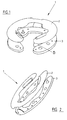
- the fitting system 1 consists of a damping insert or Hoof pad 2 made of cushioning material, e.g. Rubber, plastic or the like Hoof pad 2 is inserted into a horseshoe or a base 3, so that the Underside of the hoof on the horseshoe 3 with the interposition of the cushioning insert 2 lies on.
- a damping insert or Hoof pad 2 made of cushioning material, e.g. Rubber, plastic or the like Hoof pad 2 is inserted into a horseshoe or a base 3, so that the Underside of the hoof on the horseshoe 3 with the interposition of the cushioning insert 2 lies on.
- a second one Damping insert 4 which is designed to be exchangeable and preferably closed, and a profile gripping iron 5 with an open, replaceable tread is provided, wherein the profile gripping iron represents the tread surface of the fitting system that is in contact with the ground, and the second damping insert 4 damping between the two irons 3 and 5 results.
- the second damping insert is preferably different Coloring designed for different uses and
- the hoof pad 2 has bead sections 6, 7 viewed in the area on both sides of the open horseshoe ends (rear part of the iron 3) on the inside of the hoof pad 2 are formed as an approach above and stabilize the hoof inwards, i.e. absorb and limit pressure on the hoof inwards and outwards.
- the profile gripping iron 5 are by means of studs 8, which in the holes 9 of the Gripping irons 5 are screwed in or fixed in a corresponding manner by the second damping insert 4 detachably fastened to the base body 3. The Cleats hold the hoof when it is placed on the ground.
- the profiles 11 are wear parts of the same or different material used or cast (at 10), which if the base body 3 is the bottom side of the shoeing system, e.g. the hoof when jumping and Giving the necessary support to running and which can do the job of studs.
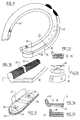
- Figure 4 shows a section through the damping insert 4 with the downward facing Inner bead 12
- Figure 5 shows a section through the damping insert 4 with upwards directed inner bead 13.
- FIG. 6 shows a hoof pad 14 with a traditional mechanism, which has an inner bead 15, which is formed in one piece.
- the bead can be solid or hollow, e.g. tubular, in one piece on each side, interrupted, profiled or be designed in a similar manner.
- the hoof pad 14 has a on the bottom surface Recess 17 in which a slider 16 made of metal, plastic or the like abrasion-resistant material, which is attached to the underlying horseshoe 18 by means of a fixing pin 19 is set, is used.
- the hoof 20 sits on the insert 14 and is by the Bead 15 prevented from moving sideways inwards.
- the slider 16 is in the Area of the costume provided. It has a higher sliding property than that of the Hoof pad, which promotes the hoof mechanism and the abrasion of horn corresponding stresses on the hoof is greatly reduced.
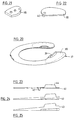
- the hoof pad 21 has an inner circumference extending bead 22 and a slider 23 inserted into the hoof insert 21 in the two rear areas of the horseshoe.
- the slider 23 is by at least fixed a fixing pin 24 on the horseshoe 26. With 25 nail spots are referred over the horseshoe 26 is attached to the horse's hoof with the slider.
- the hoof pad 21 is, as shown in FIG. 10, formed in one piece with the inner bead 22, which is solid, or - as indicated in the drawing, hollow, e.g. be tubular (22 ') can.
- the slider 23 has two Fixing pins 24, 24 'attached to the horseshoe 26.
- the slider 23 has recesses 25, 25 ', e.g. in the form of elongated holes, so that the slide (23) in Arrow direction adjustable relative to the horseshoe and laterally when the hoof is used is movable.
- Figures 12-15 are different cross sections for the hoof insert with slide shown
- Figure 12 shows a section along the line G - H of Figure 9.
- Figure 13 shows the sliding piece 23 with two fixing pins 24, 24 ', which in corresponding Bores or recesses of the horseshoe 26 shown in the cutout attached are.
- FIG. 14 shows a section I - K through the hoof insert 21 and the bead 22 with Slider 23.
- FIG. 15 shows another embodiment of a hoof pad 27 with Slider 28, which has the same width as the hoof pad and a fixing bead 29 having.
- the illustration according to FIG. 15 shows a section along the line L - M.
- FIG. 16 17, 18 and 19, 19a, 19b are different embodiments of Bead arrangements of a hoof pad 30 are shown.
- the beads 31 are on the inside Bumps of the hoof insert in solid execution or in tubular, i.e. hollow Execution.
- the bead 32 is shown as an interrupted bead, i.e. in the form of individual sections 32, and the bead 33 consists of individual finger-like elements that are also made in one piece with the hoof pad 30.
- the slider is always with 34 denotes the horseshoe with 35.
- the hoof pad 30 according to Figure 17 with a tubular bead 31 shows a slider 34 with fixing pin 34 ', the 18 a hoof pad 13 with a solid or full bead 31 and a Cleit Sharing 34 without fixing pin.
- a hoof pad 30 is full Bead and a pad 36 shown for nailing.
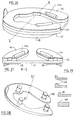
- Figures 20-25 show embodiments of a hoof pad 37 with slide 38 and beads 39.
- the slider 38 has a fixing pin 40 on one Attachment end to the hoof or horseshoe, so that the sliders each around the Axis of the fixing pin 40 in the hoof pad level together with the hoof pad are mobile.
- Figures 23, 24 and 25 show hoof pads continuous ascent from the toe to the hoof.
- These different Embodiments of hoof pads are designated 41, 42 and 43, which as Wedge inserts are formed. They can be made in one piece in the shape of a horseshoe, but also in two parts, so that the hoof pads each have only one leg Represent horseshoe, so it is a divided hoof pad, both Parts are connected to the horseshoe at the front end.
- the Wedge inserts 41, 42, 43 each have a short inner bead 44.
- the Wedge insert is only arranged at the rear end of the hoof, the hoof insert can also be used as a one-piece horseshoe-shaped hoof insert as a wedge insert be trained.
- Figures 26, 27, 28 and 29 show embodiments of a base support or horseshoe 45 with hoof pad 46 and short inside bead 46a in connection with an interchangeable closed rubber or plastic plate 47 and an interchangeable one Tread or gripping iron 48, which is referred to as profile iron 5 in FIG. 2a and are shown.
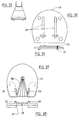
- FIG. 30-32 show a closed, replaceable tread 49 with it fastened, so stuck track 50, which with the help of fastening screws 51st are attached to the fitting system.
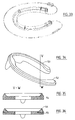
- FIG. 33 shows a hoof pad with the bead facing upwards Inside in the form of a tubular profile and with fixing beads on the outside.
- the Hoof pad shows in the traditional area on the other hoof
- the outer edge of the hoof insert protrudes from the sides and protrudes, Knobs or the like on, which prevent that when striking the horseshoe of one One leg may injure the other leg or the horse be warned becomes.
- FIG. 33 shows a hoof pad with the bead facing upwards Inside in the form of a tubular profile and with fixing beads on the outside.
- the Hoof pad shows in the traditional area on the other hoof
- the outer edge of the hoof insert protrudes from the sides and protrudes, Knobs or the like on, which prevent that when striking the horseshoe of one One leg may injure the other leg or
- the base support 53 is widened Leg ends 52 and a gripping edge formed.
- the sectional view according to the figure 35 shows a base support 54 with a cast gripping edge made of the same Material like the basic carrier is made of.
- the embodiment according to FIG. 36 shows one Basic carrier 55 with cast-in gripping edge 56 made of a material that is higher Has abrasion resistance than the basic carrier.
- the hoof pad can after 37 and 38 instead of as a horseshoe-shaped damping insert as a full surface Insert 57 can be designed to prevent the ingress of dirt or the like To prevent the bottom of the hoof. So that the insert 57 analogous to the damping insert 2 e.g. 1 can deflect in the rear area, the full-surface insert is in the middle provided with a fan-like, closed fold area 58, so that the flat When the hoof is stressed, insert in the rear area in the plane of the can stretch or compress flat insert. There are beads 59, 59 'on the insert provided that are integrated into the insert and that a sideways movement of the hoof enable on the one hand and limit on the other.
Landscapes
- Life Sciences & Earth Sciences (AREA)
- Engineering & Computer Science (AREA)
- Wood Science & Technology (AREA)
- Zoology (AREA)
- Environmental Sciences (AREA)
- Footwear And Its Accessory, Manufacturing Method And Apparatuses (AREA)
Description

- Fig. 1
- eine Ausführungsform eines Beschlagsystems nach der Erfindung in auseinandergezogener Darstellung, in einer Ansicht von hinten,
- Fig. 1a
- eine andere Ausführungsform eines Beschlagsystems nach der Erfindung in der der Fig. 1 entsprechenden Darstellung,
- Fig. 2
- die Darstellung nach Fig. 1 in perspektivischer Seitenansicht,
- Fig. 2a
- die Darstellung nach Fig. 1a in perspektivischer Seitenansicht,
- Fig. 3
- einen Schnitt längs der Linie C-D der Fig. 1,
- Fig. 4
- einen Schnitt längs der Linie A-B der Fig. 1,
- Fig. 5
- einen Schnitt einer Variante der Fig. 4,
- Fig. 6
- eine andere Ausführungsform eines Grundträgers mit Dämpfungseinlage,
- Fig. 7
- in vergrößerter Darstellung einen Ausschnitt aus Fig. 6 mit Gieitstück in perspektivischer Darstellung,
- Fig. 8
- einen Schnitt durch die Darstellung nach der Linie E-F der Fig. 6,
- Fig. 9
- eine weitere Ausführungsform eines Grundträgers mit Dämpfungseinlage in perspektivischer Darstellung,
- Fig. 10
- eine Detailansicht einer Wulstanordnung nach Fig. 9,
- Fig. 11
- eine Detailansicht eines Gleitstückes nach Fig. 9 mit Dämpfungseinlage und Wulst,
- Fig. 12
- einen Schnitt durch die Darstellung nach Fig. 9 längs der Linie G-H,
- Fig. 13
- die Darstellung eines Gleitstückes in seitlicher und in Schnittansicht,
- Fig. 14
- einen Schnitt durch eine Hufeinlage mit Gleitstück längs der Schnittlinie I-K,
- Fig. 15
- eine Schnittansicht durch eine andere Ausbildung der Hufeinlage mit Gleitstück,
- Fig. 16
- einen Ausschnitt aus einer weiteren Ausführungsform einer Hufeinlage mit Innenwulst,
- Fig. 17
- längs der Linie N-O der Fig. 16,
- Fig. 18
- eine Schnittansicht längs der Schnittlinie P-Q der Fig. 16,
- Fig. 19, 19a und 19b
- verschiedene Ausführungsformen von Wulstanordnungen,
- Fig. 20
- eine weitere Ausführungsform einer Hufeinlage nach der Erfindung,
- Fig. 21, 22
- Darstellungen von Gleitstücken mit Fixierungsstift,
- Fig. 23, 24, 25
- unterschiedliche Ausführungsformen von Hufeinlagen in Seitenansicht,
- Fig. 26
- eine weitere Ausführungsform einer Hufeinlage mit Grundträger in Schrägansicht,
- Fig. 27
- eine Schnittansicht der Anordnung nach Fig. 26 längs der Linie R-S der Fig. 26,
- Fig. 28
- eine auswechselbare Lauffläche für die Anordnung nach Fig. 26,
- Fig. 29
- vier verschiedene Profilformen der auswechselbaren Lauffläche nach Fig. 28 im Schnitt,
- Fig. 30
- eine Aufsicht auf eine geschlossene Lauffläche,
- Fig. 31
- eine Ansicht der Lauffläche nach Fig. 30 von hinten,
- Fig. 32
- eine schematische Darstellung eines Hufes mit daran befestigter Lauffläche,
- Fig. 33
- eine schematische, perspektivische Ansicht einer weiteren Ausführungsform einer Hufeinlage,
- Fig. 34
- eine perspektivische Darstellung einer weiteren Ausführungsform eines Grundträgers,
- Fig. 35
- eine Schnittansicht des Grundträgers nach Fig. 34 längs der Schnittlinie V-W,
- Fig. 36
- eine Schnittansicht einer abgeänderten Ausführung der Fig. 34,
- Fig. 37
- eine Aufsicht auf eine vollflächige Dämpfungseinlage, und
- Fig. 38
- eine Endansicht der Darstellung nach Fig. 37.
Claims (17)
- Beschlagsystem (1) mit Hufeisen bzw. Grundträger (3; 18) und einer Hufeinlage (2; 14) aus einem dämpfenden Werkstoff, z.B. Gummi, Kunststoff oder dgl., zwischen Huf (20) und Hufeisen (3, 18), dadurch gekennzeichnet, daß die einteilig oder zweiteilig ausgebildete Hufeinlage (2; 14) im wesentlichen der Form des Hufeisens (3; 18) angepaßt und in Vorderbereich zwischen Huf und Hufeisen eingenagelt sowie im hinteren Bereich zusammen mit dem Huf relativ zum Hufeisen seitwärts beweglich ist.
- System nach Anspruch 1, dadurch gekennzeichnet, daß am Trachtenende der Hufeinlage (3; 14) jeweils ein Gleitstück (16) zwischen Hufeinlage (14) und Hufeisen (18) vorgesehen ist, dessen Reibungskoeffizient kleiner, gleich oder größer ist als der der Hufeinlage (14), und unabhängig von dem Reibungskoeffizienten der Hufeinlage wählbar ist.
- System nach Anspruch 1 oder 2, dadurch gekennzeichnet, daß die Hufeinlage (2; 18) auf der Innenseite im Trachtenbereich eine dem Huf (20) zugewandte Wulst bzw. Erhebung (6, 7; 15, 22) aufweist, die eine nach innen gerichtete Verschiebung der Hufeinlage (2; 18) relativ zum Hufeisen (3; 18) ermöglicht, eine nach außen gerichtete Verschiebung jedoch begrenzt.
- System nach einem der Ansprüche 1 - 3, dadurch gekennzeichnet, daß die dem Huf (20) zugewandte Wulst (15) sich zumindest teilweise über den Hufumfang herum erstreckt.
- System nach Anspruch 2, dadurch gekennzeichnet, daß das Gleitstück (16) die Hufeinlage (2; 18) im Trachtenbereich ganz oder teilflächig deckt und wahlweise mit der Hufeinlage fest, z.B. eingegossen, eingeklebt oder lösber, z.B. aufgesteckt verbunden ist.
- System nach einem der Ansprüche 1 bis 5, durch gekennzeichnet, daß die Hufeinlage (2; 18) aus Gummi, PVC oder ähnlichen Material besteht und auswechselbar zwischen Hufeisen (3; 18) und Huffläche angeordnet ist.
- System nach Anspruch 3 oder 4, dadurch gekennzeichnet, daß die Wulst (13; 22) ein Voll- oder Hohlprofil ist, auf der Innenseite des Hufes (20) anliegt, in Umfangsrichtung unterbrochen oder ununterbrochen ausgebildet ist, und von der Hufeinlage (2; 14) ausgehend nach oben zum Huf (20) angeordnet ist.
- System nach Anspruch 3 oder 4, dadurch gekennzeichnet, daß die Wulst (12) ein Voll- oder Hohlprofil ist, auf der Innenseite des Hufes anliegt, in Umfangsrichtung unterbrochen oder ununterbrochen ausgebildet ist, und von der Hufeinlage ausgehend ganz oder in Teilen nach unten zur Lauffläche angeordnet ist.
- System nach Anspruch 2 oder 5, dadurch gekennzeichnet, daß das Gleitstück (23) eine Fixiervorrichtung (24) aufweist, z.B. einen Rundstift, einen Rohraufsatz oder dergleichen, die in einer Ausnehmung (25) des Hufeisens (26) festlegbar ist.
- System nach Anspruch 3, 4 oder 7, dadurch gekennzeichnet, daß die Hufeinlage (37) ausgespart ist und die Aussparung ein Gleitstück (38) gleicher Dicke wie die Hufeinlage aufnimmt.
- System nach Anspruch 1 oder einem der folgenden, dadurch gekennzeichnet, daß die Hufeinlage (37) von der Hufzehe zur Trachte hin eine zunehmende Dickendimension in Form einer Keilhufeinlage (41, 42, 43) aufweist und den gesamten oder einen Teil des Hufumfangs abdeckt.
- System nach Anspruch 1 oder einem der folgenden, dadurch gekennzeichnet, daß zusätzlich zur Hufeinlage (46) ein Greifeisen (48) vorgesehen ist, das an mehreren Befestigungspunkten am Hufeisen befestigbar ist.
- System nach Anspruch 12, dadurch gekennzeichnet, daß das auswechselbare Greifeisen (48) ein erhöhtes Laufprofil aufweist, das unterbrochen oder ununterbrochen über den gesamten Umfang des Hufeisens (45) verläuft und zwischen Hufeisen (45) und Greifeisen (48) zur Aufnahme einer zweiten Dämpfungseinlage (47) ausgebildet ist.
- System nach Anspruch 12 oder 13, dadurch gekennzeichnet, daß das auswechselbare Greifeisen (48) eine geschlossene Platte (49) ist, die mit erhöhten Spureisen (50) und mit Spurverstellmitteln (51) versehen ist.
- System nach Anspruch 1 oder einem der folgenden, dadurch gekennzeichnet, daß das Hufeisen bzw. der Grundträger (54) aus Metall oder Leichtmetall besteht und Laufflächen mit einer Erhöhung (56) gegenüber dem Hufeisen aufweist, und daß der erhöhte Greifrand (56) des Grundträgers (55) den Außenteil des Grundträgers durchläuft und der Greifrand im Nagelbereich außerhalb der Nagellinie liegt.
- System nach Anspruch 1 oder einem der folgenden, dadurch gekennzeichnet, daß die Hufeinlage (37) am Außenumfang nach oben oder nach unten vorstehende Fixieransätze (40) aufweist.
- System nach Anspruch 14 oder 15, dadurch gekennzeichnet, daß der Grundträger 53) mit verbreiterten Schenkelenden (52) ausgebildet ist, und daß diese Hufeisenschenkel im Trachtenbereich eine Verbreiterung von mindestens 5 mm zur Normalbreite des Hufeisens im Zehenbereich aufweisen.
Applications Claiming Priority (5)
| Application Number | Priority Date | Filing Date | Title |
|---|---|---|---|
| DE29604676U DE29604676U1 (de) | 1996-03-14 | 1996-03-14 | Beschlagssystem zur Verminderung von Prellungen im Hufapparat der Pferde und Aufnahme von variablen Laufflächen |
| DE29604676U | 1996-03-14 | ||
| DE29614112U | 1996-11-13 | ||
| DE29614112U DE29614112U1 (de) | 1996-03-14 | 1996-11-13 | Auswechselbare Laufflächen, Hufbeschlagssystem zur Vermeidung von Prellungen |
| PCT/DE1997/000472 WO1997033468A1 (de) | 1996-03-14 | 1997-03-12 | Beschlagsystem zum reduzieren von prellungen bei pferdehufen |
Publications (2)
| Publication Number | Publication Date |
|---|---|
| EP0886468A1 EP0886468A1 (de) | 1998-12-30 |
| EP0886468B1 true EP0886468B1 (de) | 2000-01-12 |
Family
ID=26058735
Family Applications (1)
| Application Number | Title | Priority Date | Filing Date |
|---|---|---|---|
| EP97919264A Expired - Lifetime EP0886468B1 (de) | 1996-03-14 | 1997-03-12 | Beschlagsystem zum reduzieren von prellungen bei pferdehufen |
Country Status (4)
| Country | Link |
|---|---|
| US (1) | US6244352B1 (de) |
| EP (1) | EP0886468B1 (de) |
| AU (1) | AU2379897A (de) |
| WO (1) | WO1997033468A1 (de) |
Cited By (1)
| Publication number | Priority date | Publication date | Assignee | Title |
|---|---|---|---|---|
| EP2103209A2 (de) | 2008-03-20 | 2009-09-23 | Helmut Fischlein | Vorrichtung zur Verhinderung des Abtretens eines Hufschutzes |
Families Citing this family (12)
| Publication number | Priority date | Publication date | Assignee | Title |
|---|---|---|---|---|
| WO2003000049A1 (en) * | 2001-06-21 | 2003-01-03 | Brent James Cran | An improved horseshoe |
| DE20219286U1 (de) * | 2002-12-12 | 2003-11-20 | CERA Handelsgesellschaft mbH, 87600 Kaufbeuren | Hufeisenförmige Hufbeschlageinlage |
| WO2004103205A2 (en) * | 2003-05-15 | 2004-12-02 | Morris Patrick J | Inflatable horseshoe support pad |
| USD574740S1 (en) * | 2003-09-04 | 2008-08-12 | Rubbermaid Incorporated | Scale |
| USD573904S1 (en) | 2003-09-04 | 2008-07-29 | Rubbermaid Incorporated | Thermometer |
| US20060118311A1 (en) * | 2004-12-02 | 2006-06-08 | Serritella Samuel M | Composite horseshoe and method of manufacture |
| US7270192B2 (en) * | 2005-11-30 | 2007-09-18 | Nancy Kay Leonard | Portable adjustable hoof support stand |
| USD571231S1 (en) | 2007-05-15 | 2008-06-17 | Rubbermaid Incorporated | Thermometer |
| WO2009140964A1 (en) * | 2008-05-19 | 2009-11-26 | Triple International Aps | A shock-absorbing horseshoe |
| GB2534873B (en) * | 2015-02-02 | 2017-11-08 | The 3Rd Millennium Ltd | Improvements in and relating to horseshoes |
| CN112568205B (zh) * | 2021-01-05 | 2022-11-01 | 平克宇 | 一种测量马蹄利用废钢筋制造马掌钉的设备 |
| US20250204509A1 (en) * | 2023-12-22 | 2025-06-26 | Easycare, Inc. | Equine shoe with interchangeable traction system |
Family Cites Families (27)
| Publication number | Priority date | Publication date | Assignee | Title |
|---|---|---|---|---|
| US302185A (en) * | 1884-07-15 | Horseshoe | ||
| US301721A (en) * | 1884-07-08 | Horseshoe | ||
| US479912A (en) * | 1892-08-02 | mooney | ||
| DE41393C (de) * | J. W. ROLAPPE in Bremen, Gartenweg 10 | Gummisteg für Hufeisen | ||
| US206939A (en) * | 1878-08-13 | Improvement in horseshoes | ||
| DE221008C (de) * | ||||
| US429460A (en) * | 1890-06-03 | Horseshoe | ||
| US624529A (en) * | 1899-05-09 | Soft tread horseshoe | ||
| US626091A (en) * | 1899-05-30 | District | ||
| GB189407997A (en) * | 1894-04-23 | 1895-04-13 | Theodore Norman Jones | Improvements in Horse Shoes. |
| US770917A (en) * | 1903-02-25 | 1904-09-27 | Myers Adjustable Horse Shoe Co | Horseshoe. |
| US823497A (en) * | 1904-04-02 | 1906-06-19 | Louis Alarme | Antislipping device for horseshoes. |
| FR355598A (fr) * | 1905-06-24 | 1905-11-07 | Richard Pfeffel | Fer à cheval |
| US869838A (en) * | 1907-01-31 | 1907-10-29 | William T Green | Horseshoe. |
| US1212266A (en) * | 1916-05-19 | 1917-01-16 | Lee B Schrader | Horseshoe. |
| GB224407A (en) * | 1924-01-08 | 1924-11-13 | William David Blanchard | Improvements in or relating to horse-shoes |
| US1953281A (en) * | 1931-05-05 | 1934-04-03 | Veran Antoine | Horseshoe |
| US2096504A (en) * | 1935-06-27 | 1937-10-19 | George H Jackson Ltd | Horseshoe |
| US3180421A (en) * | 1963-09-09 | 1965-04-27 | Howard Z Hirshberg | Shock absorbent horseshoe |
| CH575706A5 (de) * | 1973-12-21 | 1976-05-31 | Cattaneo Giuseppe | |
| US4207947A (en) * | 1977-08-26 | 1980-06-17 | Jojan, Inc. | Means for increasing traction in racehorse horseshoes |
| CH662245A5 (de) * | 1983-08-25 | 1987-09-30 | Giuseppe Cattaneo | Hufeiseneinlage. |
| US4645008A (en) * | 1985-05-20 | 1987-02-24 | Benning James M | Racing-type horseshoe |
| US5029648A (en) * | 1989-09-08 | 1991-07-09 | Stephens Dennis N | Method and apparatus for protecting the hooves of horses from concussive forces |
| AT393932B (de) * | 1990-02-12 | 1992-01-10 | Mayerhofer Richard | Hufeiseneinlage |
| US5180017A (en) * | 1991-09-03 | 1993-01-19 | Alagna Samuel M | Horseshoe having replaceable horseshoe pad |
| US5343957A (en) * | 1993-07-19 | 1994-09-06 | Chapman Larry L | Horseshoe made of resilient material, horseshoeing system and method |
-
1997
- 1997-03-12 AU AU23798/97A patent/AU2379897A/en not_active Abandoned
- 1997-03-12 WO PCT/DE1997/000472 patent/WO1997033468A1/de not_active Ceased
- 1997-03-12 US US09/147,027 patent/US6244352B1/en not_active Expired - Fee Related
- 1997-03-12 EP EP97919264A patent/EP0886468B1/de not_active Expired - Lifetime
Cited By (3)
| Publication number | Priority date | Publication date | Assignee | Title |
|---|---|---|---|---|
| EP2103209A2 (de) | 2008-03-20 | 2009-09-23 | Helmut Fischlein | Vorrichtung zur Verhinderung des Abtretens eines Hufschutzes |
| DE102008015139A1 (de) | 2008-03-20 | 2009-10-01 | Helmut Fischlein | Vorrichtung zur Verhinderung des Abtretens eines Hufschutzes |
| DE102008015139B4 (de) * | 2008-03-20 | 2009-12-10 | Helmut Fischlein | Vorrichtung zur Verhinderung des Abtretens eines Hufschutzes |
Also Published As
| Publication number | Publication date |
|---|---|
| EP0886468A1 (de) | 1998-12-30 |
| WO1997033468A1 (de) | 1997-09-18 |
| US6244352B1 (en) | 2001-06-12 |
| AU2379897A (en) | 1997-10-01 |
Similar Documents
| Publication | Publication Date | Title |
|---|---|---|
| EP0886468B1 (de) | Beschlagsystem zum reduzieren von prellungen bei pferdehufen | |
| EP1565054B1 (de) | Grössenverstellbarer schuh für huftiere | |
| DE60107770T2 (de) | Spannvorrichtung für Schuhwerk | |
| DE60308937T2 (de) | Skateboardschuh mit einer eine variable Härte aufweisenden Laufsohle | |
| EP0207063A2 (de) | Golfschuh | |
| DE69936951T2 (de) | Rollschuh mit flexibler Sohle | |
| EP1008295A2 (de) | Hufschuh | |
| DE19642011A1 (de) | Einspuriger Rollschuh | |
| EP0233335A2 (de) | Pferdehufschuh | |
| EP2950641B1 (de) | Hufeisen | |
| DE69418431T2 (de) | Übungsschuh-Sohle | |
| DE102016011019A1 (de) | Längen- und breitenverstellbarer Hufschuh (Schuh für Pferde) | |
| DE3423838A1 (de) | Hufbeschlag insbesondere zum beschlagen von pferdehufen | |
| DE29704426U1 (de) | Beschlagsystem zum Reduzieren von Prellungen bei Pferdehufen | |
| DE29614112U1 (de) | Auswechselbare Laufflächen, Hufbeschlagssystem zur Vermeidung von Prellungen | |
| EP0893057A1 (de) | Offener Hufbeschlag aus Kunststoff | |
| WO2002011533A1 (de) | Hufeisenartiger, plattenförmiger hufbeschlag aus kunststoff | |
| DE2108818C2 (de) | Aufklebbarer Hufbelag für Pferde | |
| DE3340095A1 (de) | Hufbeschlag mit kern | |
| DE4135131A1 (de) | Hufschuh | |
| EP2179646A1 (de) | Hufschutz, insbesondere Hufeisen für Reittierhufe | |
| DE3841925A1 (de) | Hufeisen-einlage | |
| DE2630444A1 (de) | Hufbeschlag fuer die hufen einzehiger huftiere | |
| EP0191778A1 (de) | Hufbeschlag insbesondere zum beschlagen von pferdehufen | |
| DE2656348A1 (de) | Kunststoff-hufbeschlag |
Legal Events
| Date | Code | Title | Description |
|---|---|---|---|
| PUAI | Public reference made under article 153(3) epc to a published international application that has entered the european phase |
Free format text: ORIGINAL CODE: 0009012 |
|
| 17P | Request for examination filed |
Effective date: 19980909 |
|
| AK | Designated contracting states |
Kind code of ref document: A1 Designated state(s): DE FR GB NL SE |
|
| GRAG | Despatch of communication of intention to grant |
Free format text: ORIGINAL CODE: EPIDOS AGRA |
|
| 17Q | First examination report despatched |
Effective date: 19990331 |
|
| GRAG | Despatch of communication of intention to grant |
Free format text: ORIGINAL CODE: EPIDOS AGRA |
|
| GRAH | Despatch of communication of intention to grant a patent |
Free format text: ORIGINAL CODE: EPIDOS IGRA |
|
| GRAH | Despatch of communication of intention to grant a patent |
Free format text: ORIGINAL CODE: EPIDOS IGRA |
|
| GRAA | (expected) grant |
Free format text: ORIGINAL CODE: 0009210 |
|
| AK | Designated contracting states |
Kind code of ref document: B1 Designated state(s): DE FR GB NL SE |
|
| PG25 | Lapsed in a contracting state [announced via postgrant information from national office to epo] |
Ref country code: SE Free format text: THE PATENT HAS BEEN ANNULLED BY A DECISION OF A NATIONAL AUTHORITY Effective date: 20000112 Ref country code: NL Free format text: LAPSE BECAUSE OF FAILURE TO SUBMIT A TRANSLATION OF THE DESCRIPTION OR TO PAY THE FEE WITHIN THE PRESCRIBED TIME-LIMIT Effective date: 20000112 |
|
| REF | Corresponds to: |
Ref document number: 59701004 Country of ref document: DE Date of ref document: 20000217 |
|
| GBT | Gb: translation of ep patent filed (gb section 77(6)(a)/1977) |
Effective date: 20000419 |
|
| ET | Fr: translation filed | ||
| NLV1 | Nl: lapsed or annulled due to failure to fulfill the requirements of art. 29p and 29m of the patents act | ||
| PLBE | No opposition filed within time limit |
Free format text: ORIGINAL CODE: 0009261 |
|
| STAA | Information on the status of an ep patent application or granted ep patent |
Free format text: STATUS: NO OPPOSITION FILED WITHIN TIME LIMIT |
|
| 26N | No opposition filed | ||
| REG | Reference to a national code |
Ref country code: GB Ref legal event code: IF02 |
|
| PGFP | Annual fee paid to national office [announced via postgrant information from national office to epo] |
Ref country code: GB Payment date: 20020313 Year of fee payment: 6 |
|
| PG25 | Lapsed in a contracting state [announced via postgrant information from national office to epo] |
Ref country code: GB Free format text: LAPSE BECAUSE OF NON-PAYMENT OF DUE FEES Effective date: 20030312 |
|
| GBPC | Gb: european patent ceased through non-payment of renewal fee |
Effective date: 20030312 |
|
| PGFP | Annual fee paid to national office [announced via postgrant information from national office to epo] |
Ref country code: DE Payment date: 20090323 Year of fee payment: 13 |
|
| PGFP | Annual fee paid to national office [announced via postgrant information from national office to epo] |
Ref country code: FR Payment date: 20090316 Year of fee payment: 13 |
|
| REG | Reference to a national code |
Ref country code: FR Ref legal event code: ST Effective date: 20101130 |
|
| PG25 | Lapsed in a contracting state [announced via postgrant information from national office to epo] |
Ref country code: FR Free format text: LAPSE BECAUSE OF NON-PAYMENT OF DUE FEES Effective date: 20100331 |
|
| PG25 | Lapsed in a contracting state [announced via postgrant information from national office to epo] |
Ref country code: DE Free format text: LAPSE BECAUSE OF NON-PAYMENT OF DUE FEES Effective date: 20101001 |