EP0880530B1 - Phosphatidyloligoglycerine - Google Patents
Phosphatidyloligoglycerine Download PDFInfo
- Publication number
- EP0880530B1 EP0880530B1 EP97903308A EP97903308A EP0880530B1 EP 0880530 B1 EP0880530 B1 EP 0880530B1 EP 97903308 A EP97903308 A EP 97903308A EP 97903308 A EP97903308 A EP 97903308A EP 0880530 B1 EP0880530 B1 EP 0880530B1
- Authority
- EP
- European Patent Office
- Prior art keywords
- formula
- compound
- liposomes
- alkyl
- mol
- Prior art date
- Legal status (The legal status is an assumption and is not a legal conclusion. Google has not performed a legal analysis and makes no representation as to the accuracy of the status listed.)
- Expired - Lifetime
Links
Images

Classifications
-
- C—CHEMISTRY; METALLURGY
- C12—BIOCHEMISTRY; BEER; SPIRITS; WINE; VINEGAR; MICROBIOLOGY; ENZYMOLOGY; MUTATION OR GENETIC ENGINEERING
- C12N—MICROORGANISMS OR ENZYMES; COMPOSITIONS THEREOF; PROPAGATING, PRESERVING, OR MAINTAINING MICROORGANISMS; MUTATION OR GENETIC ENGINEERING; CULTURE MEDIA
- C12N15/00—Mutation or genetic engineering; DNA or RNA concerning genetic engineering, vectors, e.g. plasmids, or their isolation, preparation or purification; Use of hosts therefor
- C12N15/09—Recombinant DNA-technology
- C12N15/87—Introduction of foreign genetic material using processes not otherwise provided for, e.g. co-transformation
-
- A—HUMAN NECESSITIES
- A61—MEDICAL OR VETERINARY SCIENCE; HYGIENE
- A61K—PREPARATIONS FOR MEDICAL, DENTAL OR TOILETRY PURPOSES
- A61K47/00—Medicinal preparations characterised by the non-active ingredients used, e.g. carriers or inert additives; Targeting or modifying agents chemically bound to the active ingredient
- A61K47/06—Organic compounds, e.g. natural or synthetic hydrocarbons, polyolefins, mineral oil, petrolatum or ozokerite
- A61K47/24—Organic compounds, e.g. natural or synthetic hydrocarbons, polyolefins, mineral oil, petrolatum or ozokerite containing atoms other than carbon, hydrogen, oxygen, halogen, nitrogen or sulfur, e.g. cyclomethicone or phospholipids
-
- A—HUMAN NECESSITIES
- A61—MEDICAL OR VETERINARY SCIENCE; HYGIENE
- A61K—PREPARATIONS FOR MEDICAL, DENTAL OR TOILETRY PURPOSES
- A61K48/00—Medicinal preparations containing genetic material which is inserted into cells of the living body to treat genetic diseases; Gene therapy
-
- A—HUMAN NECESSITIES
- A61—MEDICAL OR VETERINARY SCIENCE; HYGIENE
- A61K—PREPARATIONS FOR MEDICAL, DENTAL OR TOILETRY PURPOSES
- A61K9/00—Medicinal preparations characterised by special physical form
- A61K9/10—Dispersions; Emulsions
- A61K9/127—Synthetic bilayered vehicles, e.g. liposomes or liposomes with cholesterol as the only non-phosphatidyl surfactant
- A61K9/1271—Non-conventional liposomes, e.g. PEGylated liposomes or liposomes coated or grafted with polymers
-
- A—HUMAN NECESSITIES
- A61—MEDICAL OR VETERINARY SCIENCE; HYGIENE
- A61K—PREPARATIONS FOR MEDICAL, DENTAL OR TOILETRY PURPOSES
- A61K9/00—Medicinal preparations characterised by special physical form
- A61K9/10—Dispersions; Emulsions
- A61K9/127—Synthetic bilayered vehicles, e.g. liposomes or liposomes with cholesterol as the only non-phosphatidyl surfactant
- A61K9/1271—Non-conventional liposomes, e.g. PEGylated liposomes or liposomes coated or grafted with polymers
- A61K9/1272—Non-conventional liposomes, e.g. PEGylated liposomes or liposomes coated or grafted with polymers comprising non-phosphatidyl surfactants as bilayer-forming substances, e.g. cationic lipids or non-phosphatidyl liposomes coated or grafted with polymers
-
- C—CHEMISTRY; METALLURGY
- C07—ORGANIC CHEMISTRY
- C07C—ACYCLIC OR CARBOCYCLIC COMPOUNDS
- C07C43/00—Ethers; Compounds having groups, groups or groups
- C07C43/02—Ethers
- C07C43/03—Ethers having all ether-oxygen atoms bound to acyclic carbon atoms
- C07C43/04—Saturated ethers
- C07C43/13—Saturated ethers containing hydroxy or O-metal groups
- C07C43/135—Saturated ethers containing hydroxy or O-metal groups having more than one ether bond
-
- C—CHEMISTRY; METALLURGY
- C07—ORGANIC CHEMISTRY
- C07C—ACYCLIC OR CARBOCYCLIC COMPOUNDS
- C07C43/00—Ethers; Compounds having groups, groups or groups
- C07C43/02—Ethers
- C07C43/03—Ethers having all ether-oxygen atoms bound to acyclic carbon atoms
- C07C43/14—Unsaturated ethers
- C07C43/178—Unsaturated ethers containing hydroxy or O-metal groups
-
- C—CHEMISTRY; METALLURGY
- C07—ORGANIC CHEMISTRY
- C07D—HETEROCYCLIC COMPOUNDS
- C07D317/00—Heterocyclic compounds containing five-membered rings having two oxygen atoms as the only ring hetero atoms
- C07D317/08—Heterocyclic compounds containing five-membered rings having two oxygen atoms as the only ring hetero atoms having the hetero atoms in positions 1 and 3
- C07D317/10—Heterocyclic compounds containing five-membered rings having two oxygen atoms as the only ring hetero atoms having the hetero atoms in positions 1 and 3 not condensed with other rings
- C07D317/14—Heterocyclic compounds containing five-membered rings having two oxygen atoms as the only ring hetero atoms having the hetero atoms in positions 1 and 3 not condensed with other rings with substituted hydrocarbon radicals attached to ring carbon atoms
- C07D317/18—Radicals substituted by singly bound oxygen or sulfur atoms
- C07D317/22—Radicals substituted by singly bound oxygen or sulfur atoms etherified
-
- C—CHEMISTRY; METALLURGY
- C07—ORGANIC CHEMISTRY
- C07F—ACYCLIC, CARBOCYCLIC OR HETEROCYCLIC COMPOUNDS CONTAINING ELEMENTS OTHER THAN CARBON, HYDROGEN, HALOGEN, OXYGEN, NITROGEN, SULFUR, SELENIUM OR TELLURIUM
- C07F9/00—Compounds containing elements of Groups 5 or 15 of the Periodic Table
- C07F9/02—Phosphorus compounds
- C07F9/06—Phosphorus compounds without P—C bonds
- C07F9/08—Esters of oxyacids of phosphorus
- C07F9/09—Esters of phosphoric acids
- C07F9/091—Esters of phosphoric acids with hydroxyalkyl compounds with further substituents on alkyl
-
- C—CHEMISTRY; METALLURGY
- C07—ORGANIC CHEMISTRY
- C07F—ACYCLIC, CARBOCYCLIC OR HETEROCYCLIC COMPOUNDS CONTAINING ELEMENTS OTHER THAN CARBON, HYDROGEN, HALOGEN, OXYGEN, NITROGEN, SULFUR, SELENIUM OR TELLURIUM
- C07F9/00—Compounds containing elements of Groups 5 or 15 of the Periodic Table
- C07F9/02—Phosphorus compounds
- C07F9/06—Phosphorus compounds without P—C bonds
- C07F9/08—Esters of oxyacids of phosphorus
- C07F9/09—Esters of phosphoric acids
- C07F9/10—Phosphatides, e.g. lecithin
-
- Y—GENERAL TAGGING OF NEW TECHNOLOGICAL DEVELOPMENTS; GENERAL TAGGING OF CROSS-SECTIONAL TECHNOLOGIES SPANNING OVER SEVERAL SECTIONS OF THE IPC; TECHNICAL SUBJECTS COVERED BY FORMER USPC CROSS-REFERENCE ART COLLECTIONS [XRACs] AND DIGESTS
- Y10—TECHNICAL SUBJECTS COVERED BY FORMER USPC
- Y10T—TECHNICAL SUBJECTS COVERED BY FORMER US CLASSIFICATION
- Y10T428/00—Stock material or miscellaneous articles
- Y10T428/29—Coated or structually defined flake, particle, cell, strand, strand portion, rod, filament, macroscopic fiber or mass thereof
- Y10T428/2982—Particulate matter [e.g., sphere, flake, etc.]
- Y10T428/2984—Microcapsule with fluid core [includes liposome]
Definitions
- the invention relates to phosphatidyl compounds, the one contain defined hydrophilic residue, as well as liposomes that have an extended lifespan.
- liposomes have a residence time of up to to 5 hours on. Especially when using liposomes however, as a carrier for active pharmaceutical ingredients longest possible residence time of liposomes in the bloodstream desirable.
- Stepalth liposomes were then developed, which have an extended lifespan.
- This "Stealth liposomes” are based on phosphatidyl compounds built up an extended polyethylene glycol residue contain.
- the polyethylene glycol residue proved for the targeted extended life is most effective at molecular weights between 2000 and 3000.
- a major disadvantage these "stealth liposomes" or the phosphatidyl compounds with polyethylene glycol residue, however, is that it is not a precisely defined compound, because the polyethylene glycol residues have different chain lengths.
- the object of the present invention was to provide of compounds that increase the lifespan of liposomes and at the same time have an exact composition.
- Formula (A) is not an indefinite mixture of different molecules Composition and chain length but it can a desired structure can be obtained in a targeted manner.
- the content of monoglycerol, diglycerol, tetraglycerol and the content of monoglycerol, diglycerol, tetraglycerol and higher oligoglycerol derivatives is low.
- A is preferred Glycerol derivative of certain chain length essentially free obtained from glycerol derivatives of different chain lengths.
- the content of monoglycerol derivatives is low and is less than 5%, preferably less than 1% and especially preferably less than 0.1%, based on the desired oligoglycerol derivative.
- the compound of formula (A) is uniform Connection of defined structure. Preferred is the connection with respect to the value of m greater than 95%, particularly preferably greater than 99% uniform. However, it is also possible to connect with a uniformity of to provide more than 99.9% of the value of m.
- the compound is preferably an oligoglycerol derivative with 2 to 5 glycerol units, preferably with 2 to 4 Glycerol units. These are preferably 1.3-linked linear oligoglycerin residues.
- the radicals R 1 and R 2 preferably independently of one another represent hydrogen, a saturated or unsaturated C 1 -C 24 -alkyl or C 1 -C 24 -acyl radical, preferably hydrogen or a saturated or unsaturated C 8 -C 24 -alkyl- or C 8 -C 24 acyl radical, preferably at least one of the radicals R 1 and R 2 being an acyl radical.
- the radical R 3 preferably represents hydrogen or an alkyl radical having 1 to 4 carbon atoms.
- the compound of formula (A) can exist as a racemate containing a phospho-rac- (1 or 3) oligoglycerol linkage or as a stereospecific isomer.
- the stereoisomers can have a phospho-sn-1-oligoglycerin linkage or a phosphosn-3-oligoglycerin linkage.
- the stereospecific linkage can be formed analogously to the methods described in the literature (DE 31 30 867 A1; H. Eibl et al., Chem. Phys. Lipids, 28 (1981), 1-5, 41 (1986), 53-63 and 47 (1988, 47-53).
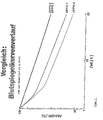
- the liposomes according to the invention have a half-life in Serum up to 18 to 20 hours. It was surprisingly a linear decrease in liposome concentration found in the blood.
- the phospholipids and / or alkyl phospholipids can for example Diacylphosphoglycerins be defined structure. Generally, these components of the lipids can be used as compounds defined structure can be used.
- the liposomes according to the invention have a significantly increased Half-life in the bloodstream. It is preferably Half-life at least 10 hours, more preferably more, than 12 hours. There were half-lives of the invention Get liposomes from 18 to 20 hours. Surprisingly were absolutely linear decrease curves of the lipid concentrations found in the blood. Preferred according to the invention are more than 50% and special after 6 hours preferably more than 60% of the amount of liposome added in Blood.
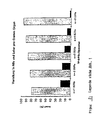
- a particularly surprising property of the liposomes according to the invention has proven to be their preferred accumulation in the spleen.
- enrichment factors in the spleen have already been reached by about 25 times compared to the liver.
- the accumulation in the spleen compared to the liver increases with increasing value for m in formula A and with increasing size of the liposomes.
- the degree of enrichment in the spleen increases many times during the transition from SUVS (Small Unilamellar Liposomes; diameter approx. 60 nm) to LUVs (Large Unilamellar Liposomes; diameter approx. 190 nm).
- the preferred enrichment in the spleen also increases with increasing number of carbon atoms in R 1 and R 2 .
- the liposomes according to the invention can also be enriched in certain tumor tissues. So it was found that such an enrichment with the Methylnitrosourea-induced breast cancer (MNU carcinoma) takes place.
- MNU carcinoma Methylnitrosourea-induced breast cancer
- liposomes according to the invention can additionally contain one or more active pharmaceutical ingredients.
- active ingredients can be used as active ingredients become involved in the plasma by means of liposomes to let.
- Preferred groups of active ingredients are on the one hand Cytostatics, especially anthracycline antibiotics, such as Doxorubicin, Epirubicin or Daunomycin, with Doxorubicin is particularly preferred.
- Other preferred cytostatics are Idarubicin, hexadecylphosphocholine, 1-octadecyl-2-methyl-racglycero-3-phosphocholine, 5-fluorouracil, cis-platinum complexes such as Carboplatin and Novantron as well as Mitomycine.
- active ingredients are immunomodulating Substances such as cytokines, among which in turn the Interferons and especially the ⁇ -interferon are particularly preferred are antifungal substances (e.g. amphotericin B) and agents against protozoan diseases (malaria, Trypanosome and leishmania infections). Also preferred is taxol as an active ingredient.
- immunomodulating Substances such as cytokines, among which in turn the Interferons and especially the ⁇ -interferon are particularly preferred are antifungal substances (e.g. amphotericin B) and agents against protozoan diseases (malaria, Trypanosome and leishmania infections).
- antifungal substances e.g. amphotericin B
- protozoan diseases malaria, Trypanosome and leishmania infections
- taxol as an active ingredient.
- Another preferred group of active ingredients are lytic active ingredients, as described in DE 41 32 345 A1.
- the content of this patent application is hereby incorporated by reference added.
- Miltefosine, edelfosine and ilmofosine are preferred and SRI62-834.
- Another object of the present invention is thus the use of liposomes according to the invention for the preparation an anti-tumor agent, the active ingredient being particularly preferred Is doxorubicin.
- Another object of the present invention is Use of the liposomes according to the invention for the production an agent for influencing cell proliferation, wherein the active ingredient is a cytokine, particularly preferably ⁇ -interferon is.
- Another object of the invention is a pharmaceutical Composition containing the liposomes described above and in the liposomes included one or more pharmaceutical Active ingredients optionally together with pharmaceutical contains usual diluents, auxiliaries, carriers and fillers.
- the liposomes according to the invention are known per se Methods manufactured using commonly used devices.
- Appropriate measures to transfer a lipid suspension in liposomes are known to the person skilled in the art.
- P refers 5 to 15 mol% of a compound of the general formula (A) with 35 to 43 mol% cholesterol and 42 to 60 mol% phospholipids or / and alkyl phospholipids in a lipid suspension transferred, which is then taken by appropriate measures is converted into liposomes in a known manner.
- Such known methods can also be used to produce a pharmaceutical preparation containing the liposomes according to the invention and contains one or more active pharmaceutical ingredients, be used.
- the active ingredient is combined with the lipid components solved while including water-soluble active ingredients the lipid film is mixed with an aqueous solution, which contains the water-soluble active ingredient.
- n 1 by linking a defined oligoglycerol via the Amino group made with a phosphatidylethanolamine become. This gives you neutral connections, i.e. connections without excess charge.
- For those used for linking defined oligoglycerols are compounds of formula (B).
- POCl 3 is preferably used as the phosphorylating agent.
- a racemic Compound are formed that have a phospho-rac- (1 or 3) oligoglycerol linkage contains. are preferred by the
- a racemic Compound are formed that have a phospho-rac- (1 or 3) oligoglycerol linkage contains. Are preferred by the Process formed stereospecific connections that a Phopsho-sn-1-oligoglycerin linkage or a Phopsho-sn-3-oligoglycerin linkage having. Is preferred for production a compound of formula (A) is a linear oligoglycerin defined chain length used.
- Y is preferably an integer from 1 to 3.
- Oligoglycerols of a certain chain length can be produced which contain practically no contamination by oligoglycerols of a different chain length.
- the oligoglycerols used according to the invention have practically no contamination by monomeric glycerol. It is therefore a matter of uniform connections of a defined structure.
- X can also be another suitable protective group represent. Furthermore, instead of acetone, too another protective group, in particular another ketone, is present his.
- the alkyl oligoglycerols are also uniform compounds of a defined structure.
- oligoglycerols The production of oligoglycerols, protected oligoglycerols and alkyl oligoglycerols is of particular interest because with the help of these raw materials a number of important and new auxiliaries for solving and improving membrane permeation can be obtained.
- phosphatidyl oligoglycerol derivatives of formula (A) the additional hydroxyl groups in the polar Wear area.
- Liposomes in the spleen are generally suitable for these liposomes the selective introduction of substances into the spleen. in this connection it can be a drug, contrast medium or the like. In particular, this is for the improvement of Quality of vaccines is important as the spleen for the Formation of antibodies in the context of the immune system in particular important is.
- the enrichment found is also the Liposomes according to the invention in tumor tissue of importance for the specific supply of active substances, contrast agents and Like. In such a tumor tissue.
- liposomes consisting of 40 Mol% cholesterol, 10 mol% phosphatidylglycerol and 50% Dipalmitoyl lecithin passed. This resulted in a half-life in serum of 4 hours with a typical decay curve, i.e. Decrease very rapid at first, later slower Loss.
- Liposomes of the same composition were made in which the phosphatidylglycerol by an inventive Phosphatidylglycerin G2 replaced. It has had a half-life in serum from 18 to 20 hours with an absolutely linear decrease curve receive. The linear decay curve became independent of the size of the liposomes produced. It was with 50 nm liposomes and the same linear with 150 nm liposomes Decreased liposome concentration found in serum. Farther was the linear decrease in blood liposome concentration found at different initial concentrations.
- Liposomes according to the invention were produced from dipalmitoyl-sn-G-3-PC / cholesterol / dipalmitoyl-sn-G-3-PG Y in a molar ratio of 45: 45: 10.
- the percentage of the originally added amount of liposomes found in the blood after 6 hours are shown in Table 1.
- Y Comparative example Y Example of the invention 0 18% 0 21% 2 19% 2 80% 3 - 3 82% 4 20% 4 56%
- the oligoglycerols diglycerin (G 2 ), triglycerin (G 3 ) and tetraglycerin (G 4 ) can be prepared from an easily accessible, central intermediate of formula I, 1,2-isopropylidene-rac-glycero-3.1-rac-glycero-3-allyl ether (see scheme A).
- the intermediate described in Formula I can be large Amounts from commercially available allyl glycidyl ether catalyzed by NaOH Ring opening with also available in the chemical trade 1,2-isopropylidene-rac-glycerol can be obtained:
- 1.2-Isopropylidene-rac-glycerol (MW 132.16; 16 mol - 2115 g) is mixed with catalytic amounts of NaOH (MW 40.00; 0.6 mol - 24 g) and dissolved with stirring and heating to 80 ° C.
- allyl glycidyl ether (MW 114.14; 6 mol - 685 g) is added dropwise over a period of 2 hours and the mixture is stirred at 80 ° C for a further 2 hours.
- the epoxy had completely converted (Rf 0.8 in ether) to form the G 3 building block (Rf 0.60 in ether).
- the excess isopropylidene-rac-glycerol has an Rf value of 0.65 in ether and is removed from the reaction mixture at 75 ° C./10 mbar.
- the residue is mixed with 1 l of diisopropyl ether and extracted twice with 1 l of NaCl (1% solution in H 2 O).
- the organic phase is rotated in and distilled (Kpi 10 -1 mbar 125 ° C).
- the intermediate of formula I can also be made from 1,2-isopropylidene-rac-glycero-3-glycidyl ether ring opening catalyzed by NaOH can be obtained with allyl alcohol. In this case first 1,2-isopropylidene-rac-glycero-3-glycidyl ether Allylglycerol can be produced.
- the reaction mixture is mixed with 1 l of diisopropyl ether and with 1 l of 1% NaCl solution, shaken, and the upper phase is spun in.
- the product can be used directly or can be obtained in pure form by chromatography on silica gel in approximately 90% yield.
- Molecular formula C 19 H 28 O 5 (MG 336.42) calc. C, 67.83; H, 8.39; O, 23.79 gef. C, 67.78; H, 8.34; O,
- benzyl bromide and allyl chloride can also be used or allyl bromide and the halides or mesylates of primary alcohols. Lead in particular the products from the primary or secondary reaction Hydroxyl groups with alkyl mesylates in high yields (> 90%) to the desired target connections.
- the propenyl protective group is split off
- G 2 basic structure 2-0-benzyl-rac-G 1 -1.3-0.0-1.2-isopropylidene-rac-G 2 (yield 82%).
- G 3 basic structure 2-0-benzyl-rac-G 1 -1.3-0.0-2-0-benzyl-rac-G 2 -1.3-0.0-1.2-isopropylidene-rac-G 3
- 1,2-isopropylidene-rac-glycero-3-0-allyl ether (MW 172.22; 1 mol - 172 g) is dissolved in 1 l CH 2 Cl 2 .
- 3-Chloroperoxybenzoic acid (1.1 mol) is added in portions and the mixture is stirred at 25-30 ° C. for 6 hours.
- the starting material (Rf 0.5 in diethyl ether / pentane 1: 1) has completely converted into the desired product (Rf 0.2 in the above system).
- the precipitate is filtered off with suction, 100 g of Na 2 CO 3 are added to the filtrate and the mixture is stirred at 20 ° C. for a further 3 hours.
- the precipitate is filtered off and the solvent is removed in vacuo.
- the yield of epoxy (MW 188.22) is 170 g (90%).
- the epoxide is now, as described under epoxy opening with alcohols (Ex. 4a), converted with benzyl alcohol into 1-0-benzyl-rac-G 1 -3.1-0.0-2.3-isopropylidene-rac-G 2 and the free OH group converted to the tetrahydropyran derivative with 3,4-dihydro-2H-pyran.
- G2 backbone 2-0-tetrahydropyranyl-rac-G 1 -1.3-0.0-1.2-isopropylidene-rac-G 2 (yield 80% based on the epoxide)
- connection with other basic frameworks can be converted into THP-protected structures.
- the 3-O-allyl ether of Example 4a can be converted to an epoxide and opened with allyl alcohol.
- a 3-O-allyl ether is formed again, which is epoxidized and opened with benzyl alcohol to give the product below, which can be converted into an intermediate with a G 4 backbone by introducing 3 THP protective groups and catalytic hydrogenolysis.
- a central intermediate product for the preparation of the G 2 basic bodies can be obtained from formula I (see scheme B).
- the secondary OH function in formula I is alkylated, benzylated or protected with tetrahydropyranyl.
- X saturated or unsaturated alkyl, benzyl or THP
- Unsaturated 1-O-alkyl diglycerides can also be obtained directly via epoxide opening of 1,2-isopropylidene-glycero-glycidyl ether (Scheme D, Formula IV) with alcohols, for example 1-O-undecenyl-G 2 C 17 H 34 O 5 (318.45)
- the compound of formula III is obtained by basic rearrangement of allyl to propenyl, benzylation of the secondary OH group and subsequent acidic cleavage of the propenyl protective group.
- the compound of formula V is made from allyl glycerol. After the addition of isopropylidene, epoxidation is carried out and intermediate IV is obtained. After opening the epoxide with benzyl alcohol, the THP protective group is introduced and the benzyl group is removed.
- the triglycerides can be developed from the central intermediate of formula II, including the allyl group. After epoxidation, various intermediate or end products of pharmaceutical interest can be produced from the epoxy.
- Triglycerols can be prepared from the central intermediate of formula VI; the intermediate product also serves to produce the G 4 basic body.
- X represents hydrogen, a saturated alkyl, a benzyl or a THP radical.
- the protective groups are removed in the usual way.
- the rearrangement of the allyl protective group must take place before the alkylation.
- only the THP protective group, but not benzyl, can be used in G 2 in this case.
- Benzyl residues can be removed easily and under mild conditions, but with the restriction that only saturated fatty acids can be used.
- THP residues are of particular interest because they can be removed in one step in conjunction with isopropyl protective groups.
- G 4 basic bodies can be produced from the central intermediate of formula IX.
- Tetraglycerols can be obtained from the central intermediate of formula IX getting produced. You can also use it to manufacture be used by pentaglycerols.
- Oligoglycerols can also be used with the intermediate compounds two or more alkyl radicals are prepared. Suitable starting compounds for this there are molecules of formula IX in which X represents a saturated alkyl radical.
- the stereospecific linkage can be carried out analogously to the methods described in the literature (DE 31 30 867 A1; H. Eibl, Chem. Phys. Lipids 28 (1981) 1-5; H. Eibl et al., Chem. Phys. Lipids 41 (1986) 53-63; H. Eibl et al., Chem. Phys. Lipids 47 (1988) 47-53).
- the starting product for this linkage is 2-0-benzyl-3-0-allyl-sn-glycerin, which is converted into the diol by hydrolysis after epoxidation.
- 2-0-Be-sn-G 1 -3.1-0.0- (1.2-isopropylidene) - rac -G 2 After reaction with H + /2.2- dimethoxypropane, 2-0-Be-sn-G 1 -3.1-0.0- (1.2-isopropylidene) - rac -G 2 , a molecule of the formula XII, which forms an sn-1 link to Phosphate group in phospholipids enables and corresponds to the racemate of formula III.
- the starting product for this linkage is again 2-0-benzyl-3-0-allyl-sn-glycerin.
- epoxidation is carried out and the epoxy ring is opened with 1,2-isopropylidene glycerol.
- the released OH puncture is benzylated in G 2 , the THP protective group is removed and the molecule of the formula XIII is obtained which enables an sn-1 link to the phosphate group in phospholipids.
- Molecule XIII corresponds to the racemate of formula VII.
- the starting product is again 2-0-benzyl-3-0-allyl-sn-glycerin, to ensure the sn-1 link.
- the THP protective group is epoxidized and the epoxy with allyl alcohol open.
- the two free OH groups benzylated and THP removed.
- compounds with sn-3-G 1 -G 2 -, sn-3-G 1 -G 2 -G 3 - or sn-3-G 1 -G 2 -G 3 -G 4 linkage can accordingly be made to phosphate.
- the enantiomeric 2-0-benzyl-1-0-allyl-snglycerol must be used instead of 2-0-benzyl-2-0-allyl-sn-glycerol in the same sequence of reactions.
- the starting product is 2-O-benzyl-3-O-allyl-sn-glycerin.
- D-Mannitol is particularly interesting as an open form of inositol, -xylitol, which is used in a phosphorylation has no optical activity at the middle carbon atom and that as 1.2; Easy to obtain 4,5-diisopropylidene xylitol and meso-erythritol. Most of them are used as protective groups Isopropylidene, trityl in combination with benzyl or Allyl used. The tetrahydropyranyl protecting group also has some meaning here.
- Possibilities described are some examples described.
- the isopropylidene protecting group can be reintroduced in the 5.6 position.
- the result is a central intermediate for the synthesis of phosphatidyl-D-mannitol compounds, 2-0-benzyl-3.4; 5.6-diisopropylidene-D-mannitol.
- From 1.2.6.5-diisopropylidene-D-mannitol can be obtained by benzylation in 3.4 position and cleavage of the isopropylidene protective groups 3.4-0.0-dibenzyl-D-mannitol can be produced.
- tritylation and benzylation of the free OH group is obtained after cleavage the trityl group compound XV, which is in the polar Range of phospholipids can be incorporated.
- 1,2-isopropylidene-3.4-0.0-dibenyzl-D-mannitol (see above) is cleaved with periodic acid and reduced to alcohol XVI with NaBH 4 .
- This compound can be built into the polar region of phospholipids.
- the compound XVI is obtained by benzylation in 1,2-isopropylidene-3.4.5-0.0.0-tribenyzl-D-lyxite converted. After spin-off the isopropylidene protecting group, periodic acid cleavage and Reduction to alcohol gives XVII. This can be done in the usual way Installed in the polar region of phospholipids become.
- Phospholipids that contain oligoglycerols in the polar region are Phospholipids that contain oligoglycerols in the polar region
- the compounds mentioned can be prepared using two different methods. This results from the fact that a phosphoric diester is to be prepared from two alcohols, R 1 -OH and R 2 -OH.
- the alcohols under R 1 -OH are alcohols which contain a glycerol skeleton with two fatty acid chains and a free hydroxyl group. However, they can also contain only one fatty acid chain and an additional protective group, usually benzyl, for the production of monoacrylic phospholipids, but R 1 -OH can also be an alcohol with a simple alkyl radical with one or two cis double bonds.
- the alcohols under R 2 -OH are alcohols which have been referred to as G 2 , G 3 and G 4 in the previous text. They are mentioned under the structural formulas III and V (for G 2 ), VII and VIII (for G 3 ) and X to XIV (for G 4 ). Accordingly, the sugar alcohol derivatives XV to XVII can also be used.
- Scheme G describes how two alcohols R 1 -OH and R 2 -OH can be used in good yields for the preparation of phosphoric acid diesters.
- Phosphorus oxychloride is used as the phosphorylating agent. From the two alcohols R 1 OH or R 2 OH to be linked via phosphate, the corresponding phosphoric acid dichloride is first prepared, which is converted to phosphoric acid monochloride by reaction with the other alcohol. Slightly basic hydrolysis then leads to the phosphoric acid diesters which, after the protective groups have been split off, for example pass into XVIII, in 1,2-dipalmitoyl-sn-glycero-3-phospho-G 1 -G 2 -G 3 -G 4 ; Na + salt.
- phosphatidyl oligoglycerols produced can be adjusted to a desired property in the oligoglycerin range even more Contain alkyl chains or fatty acid residues.
- oligoglycerols can be used and modified in many ways to vary the properties of liposomes and influence.
- Hexydecylphosphocholines are the erucylphosphocholines
- substances may also be important biologically active substances Molecules that signal transduction and thus cellular functional pathways influence.
- sn-1-G 1 -G 2 1. 1,2-dipylmitoyl-sn-glycero-3-phospho-sn-1-G 1 -G 2 ; Na + salt: C 41 H 80 NaO 12 P. (819.04) Second 1,2-distearoyl-sn-glycero-3-phospho-sn-1-G 1 -G 2 ; Na + salt: C 45 H 88 NaO 12 P. (875.14) Third 1-stearoyl-2-lauroyl-sn-glycero-3-phospho-sn-1-G 1 -G 2 ; Na + salt: C 39 H 76 NaO 12 P. (790.98) 4th 1-stearoyl-2-oleoyl-sn-glycero-3-phospho-sn-1-G 1 -G 2 ; Na + salt: C 45 H 86 NaO 12 P. (873.13)
- sn-1-G 1 -G 2 -G 3 1. Dipalmitoyl-sn-glycero-3-phospho-sn-1-G 1 -G 2 -G 3 ; Na + salt: C 44 H 86 NaO 14 P (893.12) Second 1,2-distearoyl-sn-glycero-3-phospho-sn-1-G 1 -G 2 -G 3 ; Na + salt: C 48 H 94 NaO 14 P. (949.22)
- sn-1-G 1 -G 2 -G 3 -G 4 1. 1,2-dipalmitoyl-sn-glycero-3-phospho-sn-1-G 1 -G 2 -G 3 -G 4 ; Na + salt: C 47 H 92 NaO 16 P. (967.20) Second 1,2-distearoyl-sn-glycero-3-phospho-sn-1-G 1 -G 2 -G 3 -G 4 ; Na + salt: C 51 H 100 NaO 16 P. (1023.30)
- Phospho-D-mannitol compounds 1. 1,2-dipalmitoyl-sn-glycero-3-phospho-D-mannitol; Na + salt: C 41 H 80 NaO 13 P (835.03) Second 1,2-distearoyl-sn-glycero-3-phospho-D-mannitol; Na + salt: C 45 H 88 NaO 13 P (891.13) Third 1-palmitoyl-2-lauroyl-sn-glycero-3-phospho-D-mannitol; Na + salt: C 37 H 72 NaO 13 P (788.92) 4th 1-Stearoyl-2-lauroyl-sn-glycero-3-phospho-D-mannitol; Na + salt: C 39 H 76 NaO 13 P (806.97) 5th 1-stearoyl-2-myristoyl-sn-glycero-3-phospho-D-mannitol; Na + salt: C 41 H 80 NaO 13 P (835.03) 6th 1-Stearoyl-
- Phospho-D-lyxitol compounds 1. 1,2-dipalmitoyl-sn-glycero-3-phospho-D-lyxitol; Na + salt: C 40 H 78 NaO 12 P. (805.00) Second 1,2-distearoyl-sn-glycero-3-phospho-D-lyxitol; Na + salt: C 44 H 86 NaO 12 P (861.10) Third 1-palmitoyl-2-lauroyl-sn-glycero-3-phospho-D-lyxitol; Na + salt: C 36 H 70 NaO 12 P (758.89) 4th 1-Stearoyl-z-lauroyl-sn-glycero-3-phospho-D-lyxitol; Na + salt: C 38 H 74 NaO 12 P. (776.94) 5th 1-stearoyl-2-myristoyl-sn-glycero-3-phospho-D-lyxitol; Na + salt: C 40 H 78 NaO 12 P
- Phospho-D-threitol compounds 1. 1,2-dipalmitoyl-sn-glycero-3-phospho-D-threitol; Na + salt: C 39 H 76 NaO 11 P (774.97) Second 1,2-distearoyl-sn-glycero-3-phospho-D-threitol; Na + salt: C 43 H 84 NaO 11 P (831.07) Third 1-Stearoyl-2-lauroyl-sn-glycero-3-phospho-D-threitol; Na + salt: C 37 H 72 NaO 11 P (746.91) 4th 1-stearoyl-2-myristoyl-sn-glycero-3-phospho-D-threitol; Na + salt: C 39 H 76 NaO 11 P (774.97)
- POCl 3 (0.1 mol - 15.3 g) in 15 ml of THF are placed in a 1 1 three-necked flask. With vigorous stirring and ice cooling, 1,2-dipalmitoyl-sn-glycerol (0.1 mol - 57 g) in 100 ml THF and separately triethylamine (0.11 mol - 11 g) are added dropwise so that a slight excess of triethylamine over 1,2-dipalmitoyl- sn-glycerin is present to absorb the hydrogen chloride that forms. The temperature in the reaction mixture should not exceed 16 ° C. After the dropwise addition, the mixture is left at 16 ° C.
- 1,2-dipalmitoyl-sn-glycero-3-phospho-2-O-benzyl-rac-glycero-1.3-0.0-1.2-isopropylidene-rac-glycerol monochloride is not hydrolyzed in addition completely converted 1,2-dipalmitoyl-sn-glycero-3-phosphoric acid dichloride, with 26 g of Na 2 CO 3 dissolved in 260 ml of H 2 O. After 4 hours, 400 ml of diisopropyl ether are added and the upper phase, which contains the product, is so far evaporated until the first crystals form.
- the lower CHCl 3 phase is washed again with 600 ml CH 3 OH and 500 ml H 2 O, but add enough Na 2 CO 3 so that the pH of the aqueous phase reaches 6.
- the lower chloroform phase is spun in and the residue is taken up in 400 ml of THF.
- the solution is mixed with 6 g Pd / C and debenzylated in an H 2 atmosphere.
- the reaction is complete after about 4 hours.
- the catalyst is filtered off, the solvent is removed and the residue ( ⁇ 30 g) is taken up in 100 ml of CHCl 3 .
- 900 ml of acetone are added and the crystals formed are filtered off with suction.
- a white powder is obtained, 1,2-dipalmitoyl-sn-glycero-3-phospho-glycero-glycerin, Na + salt, yield: 26 g ( ⁇ 32%).
- lysophosphatidyl oligoglycerols For the preparation of phosphatidyl oligoglycerols with an aliphatic chain, the so-called lysophosphatidyl oligoglycerols, it is possible to start from compounds which carry a benzyl ether group in the sn-2 position of the glycerol, for example 1-palmitoyl-2-O-benzyl-sn -glycerol, 1-stearoyl-2-O-benzyl-sn-glycerol, 1-O-hexadecyl-2-O-benzyl-sn-glycerol, 1-O-octadecyl-2-O-benzyl-sn-glycerol etc.
- 1-palmitoyl-2-O-benzyl-sn -glycerol 1-stearoyl-2-O-benzyl-sn-glycerol
- any unsaturated and also saturated fatty acids can now be used into positions sn-1 and sn-2 of the glycerol molecule be introduced.
- the dioleoyl compounds crystallize hard and therefore need to be purified by chromatography while the dierucyl compounds already in good crystalline form can be obtained.
- the phosphoric acid triester strategy is also recommended for the preparation of mixed-chain phosphatidyl oligoglycerols.
- the 1-acyl-2-O-benzyl-sn-glycerols or the 1-O-alkyl-2-O-benzyl-sn-glycerols are used as starting products and analogously to 1.2 -Dibenzyl-sn-glycerin implemented.
- the following are obtained as intermediates after catalytic debenzylation for the G 2 compound:
- PP-G-PG 4 is the only PP-G-PG n to form a clear isotropic solution.
- the lipids PP-G-PG 1 , PP-G-PG 2 and PP-G-PG 3 dissolve in water when heated above 40 ° C and form superstructures. After falling below this temperature, lamellar structures are formed with different hysteresis, which are recognizable by anisotropy (birefringence in polarized light).
- the PP-G-PG 1 solution becomes cloudy the fastest and excess lipid precipitates after standing at room temperature.
- the lamellar phases of PP-G-PG 2 and PP-G-PG 3 remain stable even at low temperatures (up to 4 ° C). While the transition from the isotropic to the anisotropic phase at room temperature can be seen after a few minutes for PP-G-PG 2 , this takes several hours for PP-G-PG 3 . The differences in polarity are also reflected in various retention factors (Rf value) in the thin-layer chromatogram on Kieseigel.
Landscapes
- Chemical & Material Sciences (AREA)
- Health & Medical Sciences (AREA)
- Organic Chemistry (AREA)
- Life Sciences & Earth Sciences (AREA)
- General Health & Medical Sciences (AREA)
- Molecular Biology (AREA)
- Engineering & Computer Science (AREA)
- Genetics & Genomics (AREA)
- Public Health (AREA)
- Epidemiology (AREA)
- Animal Behavior & Ethology (AREA)
- Pharmacology & Pharmacy (AREA)
- Medicinal Chemistry (AREA)
- Veterinary Medicine (AREA)
- Biophysics (AREA)
- Biotechnology (AREA)
- Biochemistry (AREA)
- Wood Science & Technology (AREA)
- Zoology (AREA)
- Biomedical Technology (AREA)
- General Engineering & Computer Science (AREA)
- Dispersion Chemistry (AREA)
- Bioinformatics & Cheminformatics (AREA)
- Oil, Petroleum & Natural Gas (AREA)
- Physics & Mathematics (AREA)
- Microbiology (AREA)
- General Chemical & Material Sciences (AREA)
- Chemical Kinetics & Catalysis (AREA)
- Plant Pathology (AREA)
- Medicinal Preparation (AREA)
- Pharmaceuticals Containing Other Organic And Inorganic Compounds (AREA)
- Organic Low-Molecular-Weight Compounds And Preparation Thereof (AREA)
Applications Claiming Priority (5)
| Application Number | Priority Date | Filing Date | Title |
|---|---|---|---|
| DE19605833 | 1996-02-16 | ||
| DE19605833 | 1996-02-16 | ||
| DE19622224A DE19622224A1 (de) | 1996-02-16 | 1996-06-03 | Phosphatidyloligoglycerine |
| DE19622224 | 1996-06-03 | ||
| PCT/EP1997/000749 WO1997030058A1 (de) | 1996-02-16 | 1997-02-17 | Phosphatidyloligoglycerine |
Publications (2)
| Publication Number | Publication Date |
|---|---|
| EP0880530A1 EP0880530A1 (de) | 1998-12-02 |
| EP0880530B1 true EP0880530B1 (de) | 2003-07-02 |
Family
ID=26022970
Family Applications (1)
| Application Number | Title | Priority Date | Filing Date |
|---|---|---|---|
| EP97903308A Expired - Lifetime EP0880530B1 (de) | 1996-02-16 | 1997-02-17 | Phosphatidyloligoglycerine |
Country Status (9)
| Country | Link |
|---|---|
| US (4) | US6413543B1 (enExample) |
| EP (1) | EP0880530B1 (enExample) |
| JP (1) | JP2000506121A (enExample) |
| AT (1) | ATE244254T1 (enExample) |
| AU (1) | AU715208B2 (enExample) |
| CA (1) | CA2246568C (enExample) |
| DK (1) | DK0880530T3 (enExample) |
| ES (1) | ES2202576T3 (enExample) |
| WO (1) | WO1997030058A1 (enExample) |
Families Citing this family (22)
| Publication number | Priority date | Publication date | Assignee | Title |
|---|---|---|---|---|
| ATE244254T1 (de) * | 1996-02-16 | 2003-07-15 | Max Planck Gesellschaft | Phosphatidyloligoglycerine |
| DE19622224A1 (de) | 1996-02-16 | 1997-08-21 | Max Planck Gesellschaft | Phosphatidyloligoglycerine |
| EP1019417B1 (de) * | 1997-08-18 | 2002-10-16 | Max-Planck-Gesellschaft zur Förderung der Wissenschaften e.V. | Phospholipidanaloge verbindungen |
| DE19835611A1 (de) | 1998-08-06 | 2000-02-10 | Max Planck Gesellschaft | Neuartige Phospholipide mit synthetischen, ungesättigten Alkyl- und Acylketten |
| JP2000169520A (ja) * | 1998-10-01 | 2000-06-20 | Dai Ichi Kogyo Seiyaku Co Ltd | 新規分解型反応性乳化剤、及びこれを用いたポリマ―改質方法 |
| DE10015814A1 (de) * | 2000-03-30 | 2001-10-11 | Max Planck Gesellschaft | Arzneimittel zur Stimulierung der Leukopoese, zur Behandlung von Tumor- und Protozoenerkrankungen und Verfahren zu seiner Herstellung |
| DE10122855A1 (de) * | 2001-05-11 | 2002-11-14 | Max Planck Gesellschaft | Mittel zur Verbesserung der Gewebepenetration |
| DE10148066A1 (de) * | 2001-09-28 | 2003-04-24 | Max Planck Gesellschaft | Liposome enthaltend (Ether)-Lysolecithine |
| DE10148065A1 (de) * | 2001-09-28 | 2003-04-17 | Max Planck Gesellschaft | (Ester)-Lysolecithine in Liposomen |
| GB0205327D0 (en) * | 2002-03-06 | 2002-04-17 | Glaxo Group Ltd | compounds |
| DE10242367A1 (de) * | 2002-09-12 | 2004-03-18 | MAX-PLANCK-Gesellschaft zur Förderung der Wissenschaften e.V. | Thermolabiles Liposom mit geregelter Freigabetemperatur |
| ES2594927T3 (es) | 2010-02-18 | 2016-12-23 | INSERM (Institut National de la Santé et de la Recherche Médicale) | Métodos para prevenir las metástasis cancerosas |
| CN105189430B (zh) * | 2012-12-28 | 2018-08-10 | 道康宁东丽株式会社 | 高纯度含单烯基甘油衍生物及其制造方法 |
| EA033891B1 (ru) * | 2013-06-18 | 2019-12-05 | Термозоме Гмбх | Стереоспецифические липиды для локорегионарной терапии с помощью долговременной циркуляции чувствительных к раздражителям нанотранспортных систем |
| CN111971066B (zh) * | 2018-01-18 | 2025-03-11 | 伊泽阿恩埃免疫疗法股份有限公司 | 脂质纳米颗粒 |
| CA3185118A1 (en) | 2020-07-07 | 2022-01-13 | Martin HOSSANN | Liposome formulations |
| WO2022154055A1 (ja) * | 2021-01-13 | 2022-07-21 | 地方独立行政法人神奈川県立産業技術総合研究所 | ポリグリセロール、該ポリグリセロールを含む複合ゲル組成物、該複合ゲル組成物を含む薬剤送達マイクロニードルおよびそれらの製造方法 |
| EP4527379A1 (en) | 2023-09-19 | 2025-03-26 | Thermosome Gmbh | Lipids containing an oligoglycerol group |
| EP4780425A1 (en) | 2023-09-19 | 2026-07-29 | Thermosome Gmbh | Lipid nanoparticles |
| EP4527380A1 (en) | 2023-09-19 | 2025-03-26 | Thermosome Gmbh | Lipid nanoparticles |
| KR20260074737A (ko) | 2023-09-19 | 2026-05-26 | 테르모조메 게엠베하 | 올리고글리세롤 기를 함유하는 지질 |
| EP4527843A1 (en) | 2023-09-19 | 2025-03-26 | Thermosome Gmbh | Stereoisomeric phosphatidyloligoglycerol |
Family Cites Families (12)
| Publication number | Priority date | Publication date | Assignee | Title |
|---|---|---|---|---|
| DE240020C (enExample) | ||||
| JPS5813530A (ja) * | 1981-07-20 | 1983-01-26 | Kao Corp | 2,3−ジアルコキシプロピルグリセリルエ−テル及びその製造法並びにこれを含有する化粧料 |
| JPS6028944A (ja) | 1983-07-25 | 1985-02-14 | Kao Corp | 新規なポリオ−ルエ−テル化合物およびその製造方法ならびにこれを含有する化粧料 |
| LU85952A1 (fr) | 1985-06-14 | 1987-01-13 | Oreal | Nouveaux composes hemiacetaliques et leurs applications |
| DD240020A1 (de) * | 1985-08-02 | 1986-10-15 | Univ Leipzig | Verfahren zur herstellung neuer, pharmakologisch hochwirksamer phospholipide |
| US5290565A (en) * | 1989-04-06 | 1994-03-01 | L'oreal | Composition for promoting healing |
| FR2668366B1 (fr) * | 1990-10-30 | 1993-01-29 | Oreal | Utilisation cosmetique d'une composition ayant une activite antierythemale et composition correspondante. |
| EP0510165B1 (fr) | 1990-11-14 | 1995-01-25 | L'oreal | Composes amphiphiles non-ioniques derives du glycerol, leur procede de preparation, composes intermediaires correspondants et compositions contenant lesdits composes |
| JP2898768B2 (ja) | 1991-02-25 | 1999-06-02 | 花王株式会社 | 洗浄剤組成物 |
| JPH0812519A (ja) | 1994-06-24 | 1996-01-16 | Kao Corp | 皮膚外用剤組成物 |
| ATE244254T1 (de) * | 1996-02-16 | 2003-07-15 | Max Planck Gesellschaft | Phosphatidyloligoglycerine |
| JPH1180749A (ja) | 1997-08-29 | 1999-03-26 | Ishikawajima Harima Heavy Ind Co Ltd | 油分の分離方法およびその装置 |
-
1997
- 1997-02-17 AT AT97903308T patent/ATE244254T1/de not_active IP Right Cessation
- 1997-02-17 US US09/125,276 patent/US6413543B1/en not_active Expired - Lifetime
- 1997-02-17 CA CA002246568A patent/CA2246568C/en not_active Expired - Lifetime
- 1997-02-17 DK DK97903308T patent/DK0880530T3/da active
- 1997-02-17 EP EP97903308A patent/EP0880530B1/de not_active Expired - Lifetime
- 1997-02-17 US US09/125,276 patent/US20020090383A1/en active Granted
- 1997-02-17 ES ES97903308T patent/ES2202576T3/es not_active Expired - Lifetime
- 1997-02-17 AU AU17912/97A patent/AU715208B2/en not_active Ceased
- 1997-02-17 WO PCT/EP1997/000749 patent/WO1997030058A1/de not_active Ceased
- 1997-02-17 JP JP9529011A patent/JP2000506121A/ja active Pending
-
2002
- 2002-03-13 US US10/095,970 patent/US20030053978A1/en not_active Abandoned
-
2004
- 2004-05-07 US US10/840,607 patent/US7351428B2/en not_active Expired - Fee Related
Also Published As
| Publication number | Publication date |
|---|---|
| CA2246568C (en) | 2007-08-07 |
| ATE244254T1 (de) | 2003-07-15 |
| JP2000506121A (ja) | 2000-05-23 |
| US6413543B1 (en) | 2002-07-02 |
| WO1997030058A1 (de) | 1997-08-21 |
| AU715208B2 (en) | 2000-01-20 |
| US7351428B2 (en) | 2008-04-01 |
| US20030053978A1 (en) | 2003-03-20 |
| EP0880530A1 (de) | 1998-12-02 |
| US20020090383A1 (en) | 2002-07-11 |
| ES2202576T3 (es) | 2004-04-01 |
| AU1791297A (en) | 1997-09-02 |
| DK0880530T3 (da) | 2003-10-27 |
| US20040213836A1 (en) | 2004-10-28 |
| CA2246568A1 (en) | 1997-08-21 |
Similar Documents
| Publication | Publication Date | Title |
|---|---|---|
| WO1997030058A1 (de) | Phosphatidyloligoglycerine | |
| EP0116566B1 (de) | Neue d-mannit-abkömmlinge als vorprodukte zur synthese von phospholipiden | |
| EP0526531B1 (de) | Liposomen mit positiver überschussladung | |
| DD151931A5 (de) | Verfahren zur herstellung neuer polyolderivate | |
| JP3218313B2 (ja) | エルシル−、ブラシジル−およびネルボニル誘導体、その製造方法、それを含有する腫瘍および原虫によるおよび菌類による疾患に対抗するための医薬および自己免疫疾患および骨髄障害の治療のための医薬およびその医薬の製造方法 | |
| EP1019417B1 (de) | Phospholipidanaloge verbindungen | |
| EP1102775B1 (de) | Phospholipide mit ungesattigten alkyl- und acylketten | |
| DE69221496T2 (de) | Formierung von stabilen Liposomen aus Lipidextrakten von Archaeobakterien. | |
| US8076520B2 (en) | Phosphatidyl oligoglycerols | |
| EP0099068B1 (de) | Neue Glycerinderivate zur Synthese von Phospholipiden | |
| EP0002062B1 (de) | Phosphororganische Ringverbindungen, Verfahren zu ihrer Herstellung und ihre Verwendung | |
| EP1005466A1 (de) | Tetraetherlipidderivate und tetraetherlipidderivate enthaltende liposomen und lipidagglomerate sowie deren verwendung | |
| DE19735776A1 (de) | Phospholipidanaloge Verbindungen | |
| EP1556391B1 (de) | Lipidanaloge phosphors uretriester |
Legal Events
| Date | Code | Title | Description |
|---|---|---|---|
| PUAI | Public reference made under article 153(3) epc to a published international application that has entered the european phase |
Free format text: ORIGINAL CODE: 0009012 |
|
| 17P | Request for examination filed |
Effective date: 19980817 |
|
| AK | Designated contracting states |
Kind code of ref document: A1 Designated state(s): AT BE CH DE DK ES FI FR GB IE IT LI NL SE |
|
| 17Q | First examination report despatched |
Effective date: 20000309 |
|
| GRAH | Despatch of communication of intention to grant a patent |
Free format text: ORIGINAL CODE: EPIDOS IGRA |
|
| RTI1 | Title (correction) |
Free format text: PHOSPHATIDYL OLIGOGLYCEROLS |
|
| RTI1 | Title (correction) |
Free format text: PHOSPHATIDYL OLIGOGLYCEROLS |
|
| GRAH | Despatch of communication of intention to grant a patent |
Free format text: ORIGINAL CODE: EPIDOS IGRA |
|
| GRAA | (expected) grant |
Free format text: ORIGINAL CODE: 0009210 |
|
| AK | Designated contracting states |
Designated state(s): AT BE CH DE DK ES FI FR GB IE IT LI NL SE |
|
| REG | Reference to a national code |
Ref country code: GB Ref legal event code: FG4D Free format text: NOT ENGLISH |
|
| REG | Reference to a national code |
Ref country code: CH Ref legal event code: EP |
|
| REG | Reference to a national code |
Ref country code: CH Ref legal event code: NV Representative=s name: A. BRAUN, BRAUN, H?RITIER, ESCHMANN AG PATENTANWAE |
|
| REG | Reference to a national code |
Ref country code: IE Ref legal event code: FG4D Free format text: GERMAN |
|
| REF | Corresponds to: |
Ref document number: 59710376 Country of ref document: DE Date of ref document: 20030807 Kind code of ref document: P |
|
| GBT | Gb: translation of ep patent filed (gb section 77(6)(a)/1977) | ||
| REG | Reference to a national code |
Ref country code: SE Ref legal event code: TRGR |
|
| REG | Reference to a national code |
Ref country code: ES Ref legal event code: FG2A Ref document number: 2202576 Country of ref document: ES Kind code of ref document: T3 |
|
| ET | Fr: translation filed | ||
| PLBE | No opposition filed within time limit |
Free format text: ORIGINAL CODE: 0009261 |
|
| STAA | Information on the status of an ep patent application or granted ep patent |
Free format text: STATUS: NO OPPOSITION FILED WITHIN TIME LIMIT |
|
| 26N | No opposition filed |
Effective date: 20040405 |
|
| PGFP | Annual fee paid to national office [announced via postgrant information from national office to epo] |
Ref country code: AT Payment date: 20070213 Year of fee payment: 11 |
|
| PGFP | Annual fee paid to national office [announced via postgrant information from national office to epo] |
Ref country code: DK Payment date: 20070214 Year of fee payment: 11 Ref country code: CH Payment date: 20070214 Year of fee payment: 11 |
|
| REG | Reference to a national code |
Ref country code: CH Ref legal event code: PFA Owner name: MAX-PLANCK-GESELLSCHAFT ZUR FOERDERUNG DER WISSEN Free format text: MAX-PLANCK-GESELLSCHAFT ZUR FOERDERUNG DER WISSENSCHAFTEN E.V.#HOFGARTENSTRASSE 2#80539 MUENCHEN (DE) -TRANSFER TO- MAX-PLANCK-GESELLSCHAFT ZUR FOERDERUNG DER WISSENSCHAFTEN E.V.#HOFGARTENSTRASSE 2#80539 MUENCHEN (DE) |
|
| REG | Reference to a national code |
Ref country code: DK Ref legal event code: EBP |
|
| REG | Reference to a national code |
Ref country code: CH Ref legal event code: PL |
|
| PG25 | Lapsed in a contracting state [announced via postgrant information from national office to epo] |
Ref country code: LI Free format text: LAPSE BECAUSE OF NON-PAYMENT OF DUE FEES Effective date: 20080229 Ref country code: CH Free format text: LAPSE BECAUSE OF NON-PAYMENT OF DUE FEES Effective date: 20080229 |
|
| PG25 | Lapsed in a contracting state [announced via postgrant information from national office to epo] |
Ref country code: AT Free format text: LAPSE BECAUSE OF NON-PAYMENT OF DUE FEES Effective date: 20080217 |
|
| PG25 | Lapsed in a contracting state [announced via postgrant information from national office to epo] |
Ref country code: DK Free format text: LAPSE BECAUSE OF NON-PAYMENT OF DUE FEES Effective date: 20080229 |
|
| PGFP | Annual fee paid to national office [announced via postgrant information from national office to epo] |
Ref country code: IE Payment date: 20120217 Year of fee payment: 16 Ref country code: FR Payment date: 20120227 Year of fee payment: 16 |
|
| PGFP | Annual fee paid to national office [announced via postgrant information from national office to epo] |
Ref country code: DE Payment date: 20111130 Year of fee payment: 16 |
|
| PGFP | Annual fee paid to national office [announced via postgrant information from national office to epo] |
Ref country code: GB Payment date: 20120221 Year of fee payment: 16 Ref country code: BE Payment date: 20120329 Year of fee payment: 16 Ref country code: SE Payment date: 20120217 Year of fee payment: 16 Ref country code: IT Payment date: 20120227 Year of fee payment: 16 Ref country code: FI Payment date: 20120213 Year of fee payment: 16 |
|
| PGFP | Annual fee paid to national office [announced via postgrant information from national office to epo] |
Ref country code: NL Payment date: 20120228 Year of fee payment: 16 |
|
| PGFP | Annual fee paid to national office [announced via postgrant information from national office to epo] |
Ref country code: ES Payment date: 20120224 Year of fee payment: 16 |
|
| BERE | Be: lapsed |
Owner name: *MAX-PLANCK-GESELLSCHAFT ZUR FORDERUNG DER WISSENS Effective date: 20130228 |
|
| REG | Reference to a national code |
Ref country code: NL Ref legal event code: V1 Effective date: 20130901 |
|
| REG | Reference to a national code |
Ref country code: SE Ref legal event code: EUG |
|
| GBPC | Gb: european patent ceased through non-payment of renewal fee |
Effective date: 20130217 |
|
| PG25 | Lapsed in a contracting state [announced via postgrant information from national office to epo] |
Ref country code: NL Free format text: LAPSE BECAUSE OF NON-PAYMENT OF DUE FEES Effective date: 20130901 Ref country code: FI Free format text: LAPSE BECAUSE OF NON-PAYMENT OF DUE FEES Effective date: 20130217 Ref country code: SE Free format text: LAPSE BECAUSE OF NON-PAYMENT OF DUE FEES Effective date: 20130218 |
|
| REG | Reference to a national code |
Ref country code: FR Ref legal event code: ST Effective date: 20131031 |
|
| REG | Reference to a national code |
Ref country code: IE Ref legal event code: MM4A |
|
| REG | Reference to a national code |
Ref country code: DE Ref legal event code: R119 Ref document number: 59710376 Country of ref document: DE Effective date: 20130903 |
|
| PG25 | Lapsed in a contracting state [announced via postgrant information from national office to epo] |
Ref country code: IT Free format text: LAPSE BECAUSE OF NON-PAYMENT OF DUE FEES Effective date: 20130217 |
|
| PG25 | Lapsed in a contracting state [announced via postgrant information from national office to epo] |
Ref country code: GB Free format text: LAPSE BECAUSE OF NON-PAYMENT OF DUE FEES Effective date: 20130217 Ref country code: IE Free format text: LAPSE BECAUSE OF NON-PAYMENT OF DUE FEES Effective date: 20130217 Ref country code: BE Free format text: LAPSE BECAUSE OF NON-PAYMENT OF DUE FEES Effective date: 20130228 Ref country code: DE Free format text: LAPSE BECAUSE OF NON-PAYMENT OF DUE FEES Effective date: 20130903 Ref country code: FR Free format text: LAPSE BECAUSE OF NON-PAYMENT OF DUE FEES Effective date: 20130228 |
|
| REG | Reference to a national code |
Ref country code: ES Ref legal event code: FD2A Effective date: 20140408 |
|
| PG25 | Lapsed in a contracting state [announced via postgrant information from national office to epo] |
Ref country code: ES Free format text: LAPSE BECAUSE OF NON-PAYMENT OF DUE FEES Effective date: 20130218 |