EP0807618B1 - Procédé pour la préparation d'acides carboxyliques aromatiques, d'aldéhydes aromatiques et d'alcools aromatiques - Google Patents
Procédé pour la préparation d'acides carboxyliques aromatiques, d'aldéhydes aromatiques et d'alcools aromatiques Download PDFInfo
- Publication number
- EP0807618B1 EP0807618B1 EP97303410A EP97303410A EP0807618B1 EP 0807618 B1 EP0807618 B1 EP 0807618B1 EP 97303410 A EP97303410 A EP 97303410A EP 97303410 A EP97303410 A EP 97303410A EP 0807618 B1 EP0807618 B1 EP 0807618B1
- Authority
- EP
- European Patent Office
- Prior art keywords
- aromatic
- acid
- compound
- carboxylic acid
- transition metal
- Prior art date
- Legal status (The legal status is an assumption and is not a legal conclusion. Google has not performed a legal analysis and makes no representation as to the accuracy of the status listed.)
- Expired - Lifetime
Links
- 238000000034 method Methods 0.000 title claims description 72
- 150000003934 aromatic aldehydes Chemical class 0.000 title claims description 39
- -1 aromatic carboxylic acids Chemical class 0.000 title claims description 28
- 238000006243 chemical reaction Methods 0.000 claims description 59
- LPNBBFKOUUSUDB-UHFFFAOYSA-N p-toluic acid Chemical compound CC1=CC=C(C(O)=O)C=C1 LPNBBFKOUUSUDB-UHFFFAOYSA-N 0.000 claims description 54
- WPYMKLBDIGXBTP-UHFFFAOYSA-N benzoic acid Chemical compound OC(=O)C1=CC=CC=C1 WPYMKLBDIGXBTP-UHFFFAOYSA-N 0.000 claims description 38
- WVDDGKGOMKODPV-UHFFFAOYSA-N Benzyl alcohol Chemical compound OCC1=CC=CC=C1 WVDDGKGOMKODPV-UHFFFAOYSA-N 0.000 claims description 34
- URLKBWYHVLBVBO-UHFFFAOYSA-N Para-Xylene Chemical group CC1=CC=C(C)C=C1 URLKBWYHVLBVBO-UHFFFAOYSA-N 0.000 claims description 28
- 238000007254 oxidation reaction Methods 0.000 claims description 28
- 239000002994 raw material Substances 0.000 claims description 27
- 239000002253 acid Substances 0.000 claims description 23
- 239000007789 gas Substances 0.000 claims description 18
- 230000001590 oxidative effect Effects 0.000 claims description 18
- 150000003623 transition metal compounds Chemical class 0.000 claims description 18
- XLYOFNOQVPJJNP-UHFFFAOYSA-N water Substances O XLYOFNOQVPJJNP-UHFFFAOYSA-N 0.000 claims description 18
- MYMOFIZGZYHOMD-UHFFFAOYSA-N Dioxygen Chemical compound O=O MYMOFIZGZYHOMD-UHFFFAOYSA-N 0.000 claims description 13
- 239000003054 catalyst Substances 0.000 claims description 13
- 238000005406 washing Methods 0.000 claims description 13
- 150000004945 aromatic hydrocarbons Chemical class 0.000 claims description 12
- 150000001875 compounds Chemical class 0.000 claims description 12
- 150000001491 aromatic compounds Chemical class 0.000 claims description 10
- 150000003512 tertiary amines Chemical class 0.000 claims description 9
- 229910052723 transition metal Inorganic materials 0.000 claims description 9
- CTQNGGLPUBDAKN-UHFFFAOYSA-N O-Xylene Chemical compound CC1=CC=CC=C1C CTQNGGLPUBDAKN-UHFFFAOYSA-N 0.000 claims description 8
- 229910001882 dioxygen Inorganic materials 0.000 claims description 8
- 238000004821 distillation Methods 0.000 claims description 8
- 150000003624 transition metals Chemical class 0.000 claims description 8
- 239000008096 xylene Substances 0.000 claims description 8
- 125000000217 alkyl group Chemical group 0.000 claims description 6
- 229910017052 cobalt Inorganic materials 0.000 claims description 6
- 239000010941 cobalt Substances 0.000 claims description 6
- GUTLYIVDDKVIGB-UHFFFAOYSA-N cobalt atom Chemical compound [Co] GUTLYIVDDKVIGB-UHFFFAOYSA-N 0.000 claims description 6
- 239000000203 mixture Substances 0.000 claims description 6
- 150000003839 salts Chemical class 0.000 claims description 6
- 125000003710 aryl alkyl group Chemical group 0.000 claims description 5
- 125000003118 aryl group Chemical group 0.000 claims description 5
- 238000001816 cooling Methods 0.000 claims description 5
- 239000013078 crystal Substances 0.000 claims description 5
- 238000002425 crystallisation Methods 0.000 claims description 5
- 230000008025 crystallization Effects 0.000 claims description 5
- ZWLPBLYKEWSWPD-UHFFFAOYSA-N o-toluic acid Chemical compound CC1=CC=CC=C1C(O)=O ZWLPBLYKEWSWPD-UHFFFAOYSA-N 0.000 claims description 5
- WAPNOHKVXSQRPX-UHFFFAOYSA-N 1-phenylethanol Chemical compound CC(O)C1=CC=CC=C1 WAPNOHKVXSQRPX-UHFFFAOYSA-N 0.000 claims description 3
- 150000001558 benzoic acid derivatives Chemical class 0.000 claims description 3
- GVPFVAHMJGGAJG-UHFFFAOYSA-L cobalt dichloride Chemical compound [Cl-].[Cl-].[Co+2] GVPFVAHMJGGAJG-UHFFFAOYSA-L 0.000 claims description 3
- 125000001188 haloalkyl group Chemical group 0.000 claims description 3
- WPBNNNQJVZRUHP-UHFFFAOYSA-L manganese(2+);methyl n-[[2-(methoxycarbonylcarbamothioylamino)phenyl]carbamothioyl]carbamate;n-[2-(sulfidocarbothioylamino)ethyl]carbamodithioate Chemical compound [Mn+2].[S-]C(=S)NCCNC([S-])=S.COC(=O)NC(=S)NC1=CC=CC=C1NC(=S)NC(=O)OC WPBNNNQJVZRUHP-UHFFFAOYSA-L 0.000 claims description 3
- 239000005711 Benzoic acid Substances 0.000 claims description 2
- CPELXLSAUQHCOX-UHFFFAOYSA-M Bromide Chemical compound [Br-] CPELXLSAUQHCOX-UHFFFAOYSA-M 0.000 claims description 2
- 229910052684 Cerium Inorganic materials 0.000 claims description 2
- VYZAMTAEIAYCRO-UHFFFAOYSA-N Chromium Chemical compound [Cr] VYZAMTAEIAYCRO-UHFFFAOYSA-N 0.000 claims description 2
- ZOKXTWBITQBERF-UHFFFAOYSA-N Molybdenum Chemical compound [Mo] ZOKXTWBITQBERF-UHFFFAOYSA-N 0.000 claims description 2
- 235000010233 benzoic acid Nutrition 0.000 claims description 2
- ZMIGMASIKSOYAM-UHFFFAOYSA-N cerium Chemical compound [Ce][Ce][Ce][Ce][Ce][Ce][Ce][Ce][Ce][Ce][Ce][Ce][Ce][Ce][Ce][Ce][Ce][Ce][Ce][Ce][Ce][Ce][Ce][Ce][Ce][Ce][Ce][Ce][Ce][Ce][Ce][Ce][Ce][Ce][Ce][Ce][Ce][Ce] ZMIGMASIKSOYAM-UHFFFAOYSA-N 0.000 claims description 2
- 229910052804 chromium Inorganic materials 0.000 claims description 2
- 239000011651 chromium Substances 0.000 claims description 2
- BZRRQSJJPUGBAA-UHFFFAOYSA-L cobalt(ii) bromide Chemical compound Br[Co]Br BZRRQSJJPUGBAA-UHFFFAOYSA-L 0.000 claims description 2
- 229910052750 molybdenum Inorganic materials 0.000 claims description 2
- 239000011733 molybdenum Substances 0.000 claims description 2
- 230000000737 periodic effect Effects 0.000 claims description 2
- 230000001376 precipitating effect Effects 0.000 claims description 2
- 238000004064 recycling Methods 0.000 claims description 2
- WFKWXMTUELFFGS-UHFFFAOYSA-N tungsten Chemical compound [W] WFKWXMTUELFFGS-UHFFFAOYSA-N 0.000 claims description 2
- 229910052721 tungsten Inorganic materials 0.000 claims description 2
- 239000010937 tungsten Substances 0.000 claims description 2
- 229910052720 vanadium Inorganic materials 0.000 claims description 2
- GPPXJZIENCGNKB-UHFFFAOYSA-N vanadium Chemical compound [V]#[V] GPPXJZIENCGNKB-UHFFFAOYSA-N 0.000 claims description 2
- QTBSBXVTEAMEQO-UHFFFAOYSA-M Acetate Chemical compound CC([O-])=O QTBSBXVTEAMEQO-UHFFFAOYSA-M 0.000 claims 1
- VEXZGXHMUGYJMC-UHFFFAOYSA-M Chloride anion Chemical compound [Cl-] VEXZGXHMUGYJMC-UHFFFAOYSA-M 0.000 claims 1
- QAOWNCQODCNURD-UHFFFAOYSA-L Sulfate Chemical compound [O-]S([O-])(=O)=O QAOWNCQODCNURD-UHFFFAOYSA-L 0.000 claims 1
- 238000003916 acid precipitation Methods 0.000 claims 1
- 229940011182 cobalt acetate Drugs 0.000 claims 1
- QAHREYKOYSIQPH-UHFFFAOYSA-L cobalt(II) acetate Chemical compound [Co+2].CC([O-])=O.CC([O-])=O QAHREYKOYSIQPH-UHFFFAOYSA-L 0.000 claims 1
- 230000007774 longterm Effects 0.000 claims 1
- 239000000243 solution Substances 0.000 description 39
- HEMHJVSKTPXQMS-UHFFFAOYSA-M Sodium hydroxide Chemical compound [OH-].[Na+] HEMHJVSKTPXQMS-UHFFFAOYSA-M 0.000 description 36
- 239000002585 base Substances 0.000 description 20
- 230000003647 oxidation Effects 0.000 description 17
- JUJWROOIHBZHMG-UHFFFAOYSA-N Pyridine Chemical compound C1=CC=NC=C1 JUJWROOIHBZHMG-UHFFFAOYSA-N 0.000 description 12
- ZMANZCXQSJIPKH-UHFFFAOYSA-N Triethylamine Chemical compound CCN(CC)CC ZMANZCXQSJIPKH-UHFFFAOYSA-N 0.000 description 12
- KMTDMTZBNYGUNX-UHFFFAOYSA-N 4-methylbenzyl alcohol Chemical compound CC1=CC=C(CO)C=C1 KMTDMTZBNYGUNX-UHFFFAOYSA-N 0.000 description 11
- 238000004817 gas chromatography Methods 0.000 description 11
- 239000012535 impurity Substances 0.000 description 11
- FXLOVSHXALFLKQ-UHFFFAOYSA-N p-tolualdehyde Chemical compound CC1=CC=C(C=O)C=C1 FXLOVSHXALFLKQ-UHFFFAOYSA-N 0.000 description 11
- KWYUFKZDYYNOTN-UHFFFAOYSA-M Potassium hydroxide Chemical compound [OH-].[K+] KWYUFKZDYYNOTN-UHFFFAOYSA-M 0.000 description 9
- DHKHKXVYLBGOIT-UHFFFAOYSA-N acetaldehyde Diethyl Acetal Natural products CCOC(C)OCC DHKHKXVYLBGOIT-UHFFFAOYSA-N 0.000 description 7
- 125000002777 acetyl group Chemical class [H]C([H])([H])C(*)=O 0.000 description 7
- 238000004458 analytical method Methods 0.000 description 7
- 239000006227 byproduct Substances 0.000 description 7
- 239000000047 product Substances 0.000 description 7
- GOUHYARYYWKXHS-UHFFFAOYSA-N 4-formylbenzoic acid Chemical compound OC(=O)C1=CC=C(C=O)C=C1 GOUHYARYYWKXHS-UHFFFAOYSA-N 0.000 description 6
- VTYYLEPIZMXCLO-UHFFFAOYSA-L Calcium carbonate Chemical compound [Ca+2].[O-]C([O-])=O VTYYLEPIZMXCLO-UHFFFAOYSA-L 0.000 description 6
- 239000000706 filtrate Substances 0.000 description 6
- 238000004128 high performance liquid chromatography Methods 0.000 description 6
- 239000010410 layer Substances 0.000 description 6
- 239000007791 liquid phase Substances 0.000 description 6
- BWHMMNNQKKPAPP-UHFFFAOYSA-L potassium carbonate Chemical compound [K+].[K+].[O-]C([O-])=O BWHMMNNQKKPAPP-UHFFFAOYSA-L 0.000 description 6
- UMJSCPRVCHMLSP-UHFFFAOYSA-N pyridine Natural products COC1=CC=CN=C1 UMJSCPRVCHMLSP-UHFFFAOYSA-N 0.000 description 6
- 238000007086 side reaction Methods 0.000 description 6
- 239000007864 aqueous solution Substances 0.000 description 5
- 239000012071 phase Substances 0.000 description 5
- 238000003756 stirring Methods 0.000 description 5
- IMFACGCPASFAPR-UHFFFAOYSA-N tributylamine Chemical compound CCCCN(CCCC)CCCC IMFACGCPASFAPR-UHFFFAOYSA-N 0.000 description 5
- BSKHPKMHTQYZBB-UHFFFAOYSA-N 2-methylpyridine Chemical compound CC1=CC=CC=N1 BSKHPKMHTQYZBB-UHFFFAOYSA-N 0.000 description 4
- CDBYLPFSWZWCQE-UHFFFAOYSA-L Sodium Carbonate Chemical compound [Na+].[Na+].[O-]C([O-])=O CDBYLPFSWZWCQE-UHFFFAOYSA-L 0.000 description 4
- KKEYFWRCBNTPAC-UHFFFAOYSA-N Terephthalic acid Chemical compound OC(=O)C1=CC=C(C(O)=O)C=C1 KKEYFWRCBNTPAC-UHFFFAOYSA-N 0.000 description 4
- 239000000543 intermediate Substances 0.000 description 4
- 125000002496 methyl group Chemical group [H]C([H])([H])* 0.000 description 4
- 239000001301 oxygen Substances 0.000 description 4
- 229910052760 oxygen Inorganic materials 0.000 description 4
- 238000000746 purification Methods 0.000 description 4
- 239000002904 solvent Substances 0.000 description 4
- 150000001649 bromium compounds Chemical class 0.000 description 3
- 229910000019 calcium carbonate Inorganic materials 0.000 description 3
- AXCZMVOFGPJBDE-UHFFFAOYSA-L calcium dihydroxide Chemical compound [OH-].[OH-].[Ca+2] AXCZMVOFGPJBDE-UHFFFAOYSA-L 0.000 description 3
- 239000000920 calcium hydroxide Substances 0.000 description 3
- 229910001861 calcium hydroxide Inorganic materials 0.000 description 3
- 239000007788 liquid Substances 0.000 description 3
- 238000004519 manufacturing process Methods 0.000 description 3
- 229910000027 potassium carbonate Inorganic materials 0.000 description 3
- 238000010992 reflux Methods 0.000 description 3
- 125000001424 substituent group Chemical group 0.000 description 3
- YFTHZRPMJXBUME-UHFFFAOYSA-N tripropylamine Chemical compound CCCN(CCC)CCC YFTHZRPMJXBUME-UHFFFAOYSA-N 0.000 description 3
- 239000002912 waste gas Substances 0.000 description 3
- FYGHSUNMUKGBRK-UHFFFAOYSA-N 1,2,3-trimethylbenzene Chemical compound CC1=CC=CC(C)=C1C FYGHSUNMUKGBRK-UHFFFAOYSA-N 0.000 description 2
- OISVCGZHLKNMSJ-UHFFFAOYSA-N 2,6-dimethylpyridine Chemical compound CC1=CC=CC(C)=N1 OISVCGZHLKNMSJ-UHFFFAOYSA-N 0.000 description 2
- BMYNFMYTOJXKLE-UHFFFAOYSA-N 3-azaniumyl-2-hydroxypropanoate Chemical compound NCC(O)C(O)=O BMYNFMYTOJXKLE-UHFFFAOYSA-N 0.000 description 2
- WWYFPDXEIFBNKE-UHFFFAOYSA-N 4-(hydroxymethyl)benzoic acid Chemical compound OCC1=CC=C(C(O)=O)C=C1 WWYFPDXEIFBNKE-UHFFFAOYSA-N 0.000 description 2
- LFQSCWFLJHTTHZ-UHFFFAOYSA-N Ethanol Chemical compound CCO LFQSCWFLJHTTHZ-UHFFFAOYSA-N 0.000 description 2
- CPELXLSAUQHCOX-UHFFFAOYSA-N Hydrogen bromide Chemical compound Br CPELXLSAUQHCOX-UHFFFAOYSA-N 0.000 description 2
- MHAJPDPJQMAIIY-UHFFFAOYSA-N Hydrogen peroxide Chemical compound OO MHAJPDPJQMAIIY-UHFFFAOYSA-N 0.000 description 2
- UIIMBOGNXHQVGW-UHFFFAOYSA-M Sodium bicarbonate Chemical compound [Na+].OC([O-])=O UIIMBOGNXHQVGW-UHFFFAOYSA-M 0.000 description 2
- 230000002411 adverse Effects 0.000 description 2
- 150000001299 aldehydes Chemical class 0.000 description 2
- 239000003513 alkali Substances 0.000 description 2
- 150000007514 bases Chemical class 0.000 description 2
- 230000005540 biological transmission Effects 0.000 description 2
- 150000001732 carboxylic acid derivatives Chemical class 0.000 description 2
- 230000003197 catalytic effect Effects 0.000 description 2
- 238000009833 condensation Methods 0.000 description 2
- 230000005494 condensation Effects 0.000 description 2
- RWGFKTVRMDUZSP-UHFFFAOYSA-N cumene Chemical compound CC(C)C1=CC=CC=C1 RWGFKTVRMDUZSP-UHFFFAOYSA-N 0.000 description 2
- VLKZOEOYAKHREP-UHFFFAOYSA-N n-Hexane Chemical compound CCCCCC VLKZOEOYAKHREP-UHFFFAOYSA-N 0.000 description 2
- 238000006386 neutralization reaction Methods 0.000 description 2
- 230000003472 neutralizing effect Effects 0.000 description 2
- 239000012044 organic layer Substances 0.000 description 2
- UOHMMEJUHBCKEE-UHFFFAOYSA-N prehnitene Chemical compound CC1=CC=C(C)C(C)=C1C UOHMMEJUHBCKEE-UHFFFAOYSA-N 0.000 description 2
- 239000011541 reaction mixture Substances 0.000 description 2
- 238000001953 recrystallisation Methods 0.000 description 2
- 238000005070 sampling Methods 0.000 description 2
- 238000000926 separation method Methods 0.000 description 2
- JHJLBTNAGRQEKS-UHFFFAOYSA-M sodium bromide Chemical compound [Na+].[Br-] JHJLBTNAGRQEKS-UHFFFAOYSA-M 0.000 description 2
- 229910000029 sodium carbonate Inorganic materials 0.000 description 2
- 125000006702 (C1-C18) alkyl group Chemical group 0.000 description 1
- RVHSTXJKKZWWDQ-UHFFFAOYSA-N 1,1,1,2-tetrabromoethane Chemical compound BrCC(Br)(Br)Br RVHSTXJKKZWWDQ-UHFFFAOYSA-N 0.000 description 1
- NWUYHJFMYQTDRP-UHFFFAOYSA-N 1,2-bis(ethenyl)benzene;1-ethenyl-2-ethylbenzene;styrene Chemical compound C=CC1=CC=CC=C1.CCC1=CC=CC=C1C=C.C=CC1=CC=CC=C1C=C NWUYHJFMYQTDRP-UHFFFAOYSA-N 0.000 description 1
- HYFLWBNQFMXCPA-UHFFFAOYSA-N 1-ethyl-2-methylbenzene Chemical compound CCC1=CC=CC=C1C HYFLWBNQFMXCPA-UHFFFAOYSA-N 0.000 description 1
- QGZKDVFQNNGYKY-UHFFFAOYSA-O Ammonium Chemical compound [NH4+] QGZKDVFQNNGYKY-UHFFFAOYSA-O 0.000 description 1
- IJGRMHOSHXDMSA-UHFFFAOYSA-N Atomic nitrogen Chemical compound N#N IJGRMHOSHXDMSA-UHFFFAOYSA-N 0.000 description 1
- GRYLNZFGIOXLOG-UHFFFAOYSA-N Nitric acid Chemical compound O[N+]([O-])=O GRYLNZFGIOXLOG-UHFFFAOYSA-N 0.000 description 1
- PWATWSYOIIXYMA-UHFFFAOYSA-N Pentylbenzene Chemical compound CCCCCC1=CC=CC=C1 PWATWSYOIIXYMA-UHFFFAOYSA-N 0.000 description 1
- RTAQQCXQSZGOHL-UHFFFAOYSA-N Titanium Chemical compound [Ti] RTAQQCXQSZGOHL-UHFFFAOYSA-N 0.000 description 1
- YXFVVABEGXRONW-UHFFFAOYSA-N Toluene Chemical class CC1=CC=CC=C1 YXFVVABEGXRONW-UHFFFAOYSA-N 0.000 description 1
- 150000001242 acetic acid derivatives Chemical class 0.000 description 1
- 230000002378 acidificating effect Effects 0.000 description 1
- 229910001513 alkali metal bromide Inorganic materials 0.000 description 1
- 238000013459 approach Methods 0.000 description 1
- 150000004982 aromatic amines Chemical class 0.000 description 1
- KCXMKQUNVWSEMD-UHFFFAOYSA-N benzyl chloride Chemical compound ClCC1=CC=CC=C1 KCXMKQUNVWSEMD-UHFFFAOYSA-N 0.000 description 1
- 230000015572 biosynthetic process Effects 0.000 description 1
- 238000007664 blowing Methods 0.000 description 1
- GDTBXPJZTBHREO-UHFFFAOYSA-N bromine Substances BrBr GDTBXPJZTBHREO-UHFFFAOYSA-N 0.000 description 1
- 229910052794 bromium Inorganic materials 0.000 description 1
- KDPAWGWELVVRCH-UHFFFAOYSA-M bromoacetate Chemical compound [O-]C(=O)CBr KDPAWGWELVVRCH-UHFFFAOYSA-M 0.000 description 1
- 125000006278 bromobenzyl group Chemical group 0.000 description 1
- 230000005587 bubbling Effects 0.000 description 1
- 239000007795 chemical reaction product Substances 0.000 description 1
- 150000001805 chlorine compounds Chemical class 0.000 description 1
- KRVSOGSZCMJSLX-UHFFFAOYSA-L chromic acid Substances O[Cr](O)(=O)=O KRVSOGSZCMJSLX-UHFFFAOYSA-L 0.000 description 1
- 150000001869 cobalt compounds Chemical class 0.000 description 1
- 229910000428 cobalt oxide Inorganic materials 0.000 description 1
- IVMYJDGYRUAWML-UHFFFAOYSA-N cobalt(ii) oxide Chemical compound [Co]=O IVMYJDGYRUAWML-UHFFFAOYSA-N 0.000 description 1
- 238000007796 conventional method Methods 0.000 description 1
- 238000005260 corrosion Methods 0.000 description 1
- 230000007797 corrosion Effects 0.000 description 1
- 238000000151 deposition Methods 0.000 description 1
- ZBCBWPMODOFKDW-UHFFFAOYSA-N diethanolamine Chemical compound OCCNCCO ZBCBWPMODOFKDW-UHFFFAOYSA-N 0.000 description 1
- HPYNZHMRTTWQTB-UHFFFAOYSA-N dimethylpyridine Natural products CC1=CC=CN=C1C HPYNZHMRTTWQTB-UHFFFAOYSA-N 0.000 description 1
- 229910001873 dinitrogen Inorganic materials 0.000 description 1
- 238000004090 dissolution Methods 0.000 description 1
- 238000001035 drying Methods 0.000 description 1
- 238000004880 explosion Methods 0.000 description 1
- 238000000605 extraction Methods 0.000 description 1
- 238000001914 filtration Methods 0.000 description 1
- 239000012467 final product Substances 0.000 description 1
- AWJWCTOOIBYHON-UHFFFAOYSA-N furo[3,4-b]pyrazine-5,7-dione Chemical compound C1=CN=C2C(=O)OC(=O)C2=N1 AWJWCTOOIBYHON-UHFFFAOYSA-N 0.000 description 1
- 239000011521 glass Substances 0.000 description 1
- 238000010438 heat treatment Methods 0.000 description 1
- 229910000042 hydrogen bromide Inorganic materials 0.000 description 1
- XLYOFNOQVPJJNP-UHFFFAOYSA-M hydroxide Chemical compound [OH-] XLYOFNOQVPJJNP-UHFFFAOYSA-M 0.000 description 1
- 150000004679 hydroxides Chemical class 0.000 description 1
- 229910001503 inorganic bromide Inorganic materials 0.000 description 1
- 239000003456 ion exchange resin Substances 0.000 description 1
- 229920003303 ion-exchange polymer Polymers 0.000 description 1
- 238000002955 isolation Methods 0.000 description 1
- 150000007522 mineralic acids Chemical class 0.000 description 1
- 229910017604 nitric acid Inorganic materials 0.000 description 1
- VLZLOWPYUQHHCG-UHFFFAOYSA-N nitromethylbenzene Chemical compound [O-][N+](=O)CC1=CC=CC=C1 VLZLOWPYUQHHCG-UHFFFAOYSA-N 0.000 description 1
- BTFQKIATRPGRBS-UHFFFAOYSA-N o-tolualdehyde Chemical compound CC1=CC=CC=C1C=O BTFQKIATRPGRBS-UHFFFAOYSA-N 0.000 description 1
- 150000007524 organic acids Chemical class 0.000 description 1
- 239000003960 organic solvent Substances 0.000 description 1
- 239000007800 oxidant agent Substances 0.000 description 1
- 239000003444 phase transfer catalyst Substances 0.000 description 1
- 239000002798 polar solvent Substances 0.000 description 1
- 229920000642 polymer Polymers 0.000 description 1
- 238000002360 preparation method Methods 0.000 description 1
- 239000000376 reactant Substances 0.000 description 1
- 230000035484 reaction time Effects 0.000 description 1
- 230000009257 reactivity Effects 0.000 description 1
- 229910000030 sodium bicarbonate Inorganic materials 0.000 description 1
- 235000017557 sodium bicarbonate Nutrition 0.000 description 1
- 150000003467 sulfuric acid derivatives Chemical class 0.000 description 1
- 230000001629 suppression Effects 0.000 description 1
- KKEYFWRCBNTPAC-UHFFFAOYSA-L terephthalate(2-) Chemical compound [O-]C(=O)C1=CC=C(C([O-])=O)C=C1 KKEYFWRCBNTPAC-UHFFFAOYSA-L 0.000 description 1
- 239000010936 titanium Substances 0.000 description 1
- 229910052719 titanium Inorganic materials 0.000 description 1
- 150000003613 toluenes Chemical class 0.000 description 1
- 238000010977 unit operation Methods 0.000 description 1
- 238000003809 water extraction Methods 0.000 description 1
Classifications
-
- C—CHEMISTRY; METALLURGY
- C07—ORGANIC CHEMISTRY
- C07C—ACYCLIC OR CARBOCYCLIC COMPOUNDS
- C07C63/00—Compounds having carboxyl groups bound to a carbon atoms of six-membered aromatic rings
- C07C63/04—Monocyclic monocarboxylic acids
- C07C63/06—Benzoic acid
-
- C—CHEMISTRY; METALLURGY
- C07—ORGANIC CHEMISTRY
- C07C—ACYCLIC OR CARBOCYCLIC COMPOUNDS
- C07C29/00—Preparation of compounds having hydroxy or O-metal groups bound to a carbon atom not belonging to a six-membered aromatic ring
- C07C29/48—Preparation of compounds having hydroxy or O-metal groups bound to a carbon atom not belonging to a six-membered aromatic ring by oxidation reactions with formation of hydroxy groups
- C07C29/50—Preparation of compounds having hydroxy or O-metal groups bound to a carbon atom not belonging to a six-membered aromatic ring by oxidation reactions with formation of hydroxy groups with molecular oxygen only
-
- C—CHEMISTRY; METALLURGY
- C07—ORGANIC CHEMISTRY
- C07C—ACYCLIC OR CARBOCYCLIC COMPOUNDS
- C07C45/00—Preparation of compounds having >C = O groups bound only to carbon or hydrogen atoms; Preparation of chelates of such compounds
- C07C45/27—Preparation of compounds having >C = O groups bound only to carbon or hydrogen atoms; Preparation of chelates of such compounds by oxidation
- C07C45/32—Preparation of compounds having >C = O groups bound only to carbon or hydrogen atoms; Preparation of chelates of such compounds by oxidation with molecular oxygen
- C07C45/33—Preparation of compounds having >C = O groups bound only to carbon or hydrogen atoms; Preparation of chelates of such compounds by oxidation with molecular oxygen of CHx-moieties
- C07C45/34—Preparation of compounds having >C = O groups bound only to carbon or hydrogen atoms; Preparation of chelates of such compounds by oxidation with molecular oxygen of CHx-moieties in unsaturated compounds
- C07C45/36—Preparation of compounds having >C = O groups bound only to carbon or hydrogen atoms; Preparation of chelates of such compounds by oxidation with molecular oxygen of CHx-moieties in unsaturated compounds in compounds containing six-membered aromatic rings
-
- C—CHEMISTRY; METALLURGY
- C07—ORGANIC CHEMISTRY
- C07C—ACYCLIC OR CARBOCYCLIC COMPOUNDS
- C07C47/00—Compounds having —CHO groups
- C07C47/52—Compounds having —CHO groups bound to carbon atoms of six—membered aromatic rings
- C07C47/542—Alkylated benzaldehydes
-
- C—CHEMISTRY; METALLURGY
- C07—ORGANIC CHEMISTRY
- C07C—ACYCLIC OR CARBOCYCLIC COMPOUNDS
- C07C51/00—Preparation of carboxylic acids or their salts, halides or anhydrides
- C07C51/16—Preparation of carboxylic acids or their salts, halides or anhydrides by oxidation
- C07C51/21—Preparation of carboxylic acids or their salts, halides or anhydrides by oxidation with molecular oxygen
- C07C51/255—Preparation of carboxylic acids or their salts, halides or anhydrides by oxidation with molecular oxygen of compounds containing six-membered aromatic rings without ring-splitting
-
- C—CHEMISTRY; METALLURGY
- C07—ORGANIC CHEMISTRY
- C07C—ACYCLIC OR CARBOCYCLIC COMPOUNDS
- C07C51/00—Preparation of carboxylic acids or their salts, halides or anhydrides
- C07C51/16—Preparation of carboxylic acids or their salts, halides or anhydrides by oxidation
- C07C51/21—Preparation of carboxylic acids or their salts, halides or anhydrides by oxidation with molecular oxygen
- C07C51/255—Preparation of carboxylic acids or their salts, halides or anhydrides by oxidation with molecular oxygen of compounds containing six-membered aromatic rings without ring-splitting
- C07C51/265—Preparation of carboxylic acids or their salts, halides or anhydrides by oxidation with molecular oxygen of compounds containing six-membered aromatic rings without ring-splitting having alkyl side chains which are oxidised to carboxyl groups
Definitions
- the present invention relates to a method for preparing aromatic carboxylic acids, aromatic aldehydes, and aromatic alcohols, wherein the aromatic carboxylic acids, aromatic aldehydes, and aromatic alcohols are compounds represented by following formulae ( II ), (III), and (IV); wherein n represents any of integer 1 to 5; and substituent R represents a C 1-18 alkyl group, a C 6-18 aryl group, a C 6-18 aralkyl group or a haloalkyl group.
- aromatic carboxylic acids aromatic aldehydes, and aromatic alcohols are all regarded as industrially important raw materials for pharmaceutical and agricultural products, and polymer products.
- GB 1561464 proposes a method for oxidation of p-toluene derivatives especially for the preparation of p-substituted benzaldehydes.
- the oxidation takes place in the presence of a cobalt compound, a bromine compound and a carboxylic acid.
- EP-A-0071166 also concerns the oxidation of methyl substituted aromatic compounds using a cobalt catalyst to prepare aromatic aldehydes.
- a reaction solution containing aromatic acid, aromatic aldehyde and aromatic alcohol is subjected to subsequent separation processes.
- an aromatic carboxylic acid may be obtained by distilling, sedimenting with acid, or crystallizing reacting solution, or that an aromatic aldehyde and an aromatic alcohol may also be obtained by directly distilling the reaction solution, or by extracting the desired component from the reaction solution using an extracting solution, followed by rectification thereof (JP-B-48-023430, JP-A-53-082734, JP-A-54-079244, JP-B-62-002576, JP-B-62-030974, JP-B-62-030975, JP-A-02-073038, JP-B-04-003370, JP-B-07-116096 and WO-A-95/20560).
- p-toluic acid may be produced by oxidizing p-xylene.
- p-methylbenzyl alcohol, p-tolualdehyde, p-hydroxymethylbenzoic acid, 4-carboxybenzaldehyde, terephthalic acid and the like may be formed.
- a process which comprises treating at a high temperature crude p-toluic acid solution in an organic solvent, which is capable of selectively reacting in forming a salt of the byproducts, and removing the salt, thus produced, in water extraction, and cooling the same (JP-A-54-079244). Subsequently, washing the crystals with n-hexane is carried out to further improve the purity of the p-toluic acid.
- an oxidizing reaction according to the conventional method is exclusively aimed at effectively producing aromatic carboxylic acids from aromatic hydrocarbons, regardless of the fact that some of the intermediates in the oxidation process, for example, aromatic aldehyde and aromatic alcohol, are useful as a raw material for pharmaceutical or agricultural products, the intermediates are disposed of as impurities, and are not effectively utilized.
- p-toluic acid suffers a significantly large loss of the product in the washing operation, due to solubility thereof.
- p-methylbenzyl alcohol and p-tolualdehyde which are byproducts, may form p-toluic acid by subsequent oxidation, these byproducts have never been recovered, nor utilized, so far.
- An object of the present invention is to provide a method for efficiently preparing an aromatic carboxylic acid, simultaneously with an aromatic aldehyde and an aromatic alcohol.
- the invention provides a method for preparing at least one aromatic carboxylic acid, aromatic aldehyde and aromatic alcohol, by oxidizing an aromatic compound represented by formula (I), which is as follows: wherein n represents any integer of 1 to 5; and each substituent R is C 1-18 alkyl, C 6-18 aryl, C 6-18 aralkyl or haloalkyl.
- the oxidation is carried out with a gas containing molecular oxygen, in the presence of catalyst composed of transition metal compound, a tertiary amine and a bromide compound wherein the transition metal compound is present in an amount of 0.2 wt% or less, calculated as an amount of the transition metal, with respect to the weight of the raw material and the weight ratio of the transition metal compound:tertiary amine is 1:0.1 to 1:100.
- catalyst composed of transition metal compound, a tertiary amine and a bromide compound wherein the transition metal compound is present in an amount of 0.2 wt% or less, calculated as an amount of the transition metal, with respect to the weight of the raw material and the weight ratio of the transition metal compound:tertiary amine is 1:0.1 to 1:100.
- the oxidation may be carried out in the liquid phase.
- the present invention provides a method for efficiently obtaining an aromatic aldehyde by an acid depositing, or crystal precipitating treatment upon reaction solution, which is obtained by the above method of oxidizing the compound represented by formula (I), and simultaneously obtaining aromatic aldehyde and aromatic alcohol from the filtrate by a treatment, such as distillation.
- the present invention provides a method for attaining a preferable result of the above oxidation method by removal of acid, which would otherwise have acted as a catalyst in an acetal forming reaction, by adding base into a mixture solution containing aromatic aldehyde and aromatic alcohol to be distilled, in order not to suppress production of aromatic aldehyde and aromatic alcohol in distillation step.
- the present invention provides a method for efficiently preparing aromatic carboxylic acid of high purity, which comprises purifying crude aromatic hydrocarbons, obtained by the above oxidizing method, by washing with raw aromatic hydrocarbons, and simultaneously using in a recycled manner, as a raw material, from which solution and crude aromatic carboxylic acid are removed by a washing step.
- At least one of the aromatic hydrocarbons represented by the following formula (I) is used as a raw material. (wherein n, R 1 , R 2 and R 3 are as defined above)
- raw materials comprising at least one of aromatic hydrocarbons, or oxidation products thereof, wherein substituent R in the formula (I) represents any of an alkyl group, an aryl group, or an aralkyl group, are preferably used.
- xylene, methylbenzaldehyde, and methylbenzyl alcohol are preferably used as a raw material.
- the reaction is characterized by oxidation, which may be liquid phase oxidation, with a gas containing molecular oxygen, in the presence of catalyst comprising transition metal compound, tertiary amine, and bromide compound, and is to produce aromatic carboxylic acid, aromatic aldehyde, and aromatic alcohol, simultaneously.
- oxidation which may be liquid phase oxidation, with a gas containing molecular oxygen, in the presence of catalyst comprising transition metal compound, tertiary amine, and bromide compound, and is to produce aromatic carboxylic acid, aromatic aldehyde, and aromatic alcohol, simultaneously.
- the amount of the transition metal compound to be used is less than 0.2 wt %, calculated as transition metal, with respect to the raw material. If the amount is above this, the load-in operation cost and cost for separating the transition metal compound from the raw material may be increased.
- the transition metal present in the transition metal compound is preferably selected from 5 to 10 groups in the long-form Periodic Table, and several elements may be used in combination to further improve catalytic activity.
- At least one of manganese, tungsten, molybdenum, chromium, vanadium, cobalt, and cerium are preferable, and cobalt is the most preferable.
- chlorides, bromides, acetates, and sulfates thereof are preferred.
- Examples of the preferred transition metal compounds include cobalt chloride, cobalt bromide and cobalt actetate.
- the weight ratio of the transition metal compound to tertiary amine is within a range of 1:0.1 to 1:100, 'preferably 1:1 to 1:30, still more preferably 1:5 to 1:20. Since even if an excess amount of the tertiary amine may be used, no remarkable advantage may be attained, so the use thereof in an excess amount should be avoided.
- the kind of tertiary amine to be used has no specific limit; however, the use of an aromatic amine such as pyridine, picoline, lutidine and xynoline, or an aliphatic amine, such as tributylamine and triethylamine, are preferred.
- the weight ratio of the transition metal compound to the bromide compound is preferably within a range of 1:0.1 to 1:100, more preferably 1:1 to 1:30, still more preferably 1:5 to 1:20.
- the use of the bromide compound in a large amount is not preferable because it may cause corrosion of apparatus.
- bromide compound examples include inorganic bromide compounds, such as hydrogen bromide, alkali metal bromide and ammonium'bromide, and organic bromide compounds, such as tetrabromoethane, bromoacetate and bromobenzyl, as available.
- inorganic bromide compounds such as hydrogen bromide, alkali metal bromide and ammonium'bromide
- organic bromide compounds such as tetrabromoethane, bromoacetate and bromobenzyl, as available.
- a small amount of water may be added into a charged mixture, containing raw material and catalyst.
- the amount thereof is 0.01 to 20 wt % with respect to the amount of the raw material, more preferably 1.0 to 10 wt%.
- the oxidation reaction of the present invention may be carried out at a temperature of 100 to 250°C, preferably 140 to 200°C. With higher temperatures a side reaction may be caused, whereas with lower temperatures the reaction rate may be remarkably lowered.
- the gas containing molecular oxygen although pure oxygen or industrial exhaust gas may be used, in industrial use common air or a mixture of air and industrial exhaust gas are suitably available.
- the reaction pressure is preferably within a range of 0.1 to 6MPa, preferably 0.5 to 2MPa, and the oxygen content in the waste gas from the reactor is preferably controlled so as to be below explosion limit in concentration.
- the reaction may be carried out in the presence of a solvent, wherein the solvent is preferably inactive under the oxidizing reaction.
- a reactor to be used in a method of the present invention is preferably of a forced stirring type, rather than the simple bubbling tower type. That is, in order to accelerate dissolution of the gas containing molecular oxygen into the reaction mixture, and smoothly contact reactants with each other, in the reactor, it is preferable to use a reactor which is provided with many gas blowing nozzles at its lower part and is capable of operating in a forced stirring with a revolving stirring vane, or circulating pump provided at the outside thereof.
- a reflux condenser is provided at the upper part of the reactor so that the waste gas may be exhausted through the reflux condenser, and the solvent, raw material, etc. which are accompanied with the waste gas are condensed and recycled to the reactor.
- any of the compounds represented by the formula (I) may be used as a raw material.
- Specific examples thereof include xylene, ethyl toluene, cumene, butyl toluene, trimethyl benzene and tetramethyl benzene, and preferably xylene.
- oxidizing reaction solution used in the present invention other than the liquid phase reaction using a gas containing molecular oxygen, in the presence of the transition metal, such as cobalt, manganese, etc., a gas phase oxidation, or a liquid phase or gas phase oxidation using oxidizing agents, such as permanganic acid, chromic acid, hydrogen peroxide, nitric acid, etc., may be used.
- the transition metal such as cobalt, manganese, etc.
- oxidizing agents such as permanganic acid, chromic acid, hydrogen peroxide, nitric acid, etc.
- liquid phase oxidation reaction using a gas containing molecular oxygen is the most preferred.
- the reaction solution, obtained by the above process, is separated into the aromatic carboxylic acid and residue containing aromatic aldehyde, and aromatic alcohol, by cooling or crystallizing, after condensing thereof, on demand.
- the aromatic carboxylic acid further purified may be obtained by recrystallization of the crude aromatic carboxylic acid.
- the aromatic carboxylic acid further purified may be obtained by treating the reaction solution with a base to separate the salts obtained, i.e. compounds which are to be impurities of the aromatic carboxylic acid, aromatic aldehyde, and aromatic alcohol, followed by cooling and crystallization.
- Examples of the base which may be used for treating the reaction solution, include an aqueous solution of sodium hydroxide, potassium hydroxide, calcium hydroxide, potassium carbonate, calcium carbonate and sodium hydrogencarbonate, and an aqueous solution of organic basic compounds, such as pyridine, picoline, triethylamine, tripropylamine and tributylamine. These bases may be used either alone or in combination.
- the treating temperature has no specific limit; however, having regard to operability or probability in causing side reaction, the temperature is preferably as low as possible, which is 60 to 120°C.
- the reaction time has also no specific limit, since the reaction is for simple neutralization; however, having regard to the probability of causing the side reaction, it is not necessary to carry out the reaction for a long time, and 5 to 60 minutes may be sufficient.
- the amount of the base to be used is from 1.0 to 10.0 times the molar amount of the impurity, preferably 3.0 to 7.0 times.
- the amount of water, which is required for dissolving the base is also not specifically limited; however, having regard to loss of the effective component, an amount of 0.05 to 0.3 wt % of the reaction solution may be sufficient for removing the impurity. From the stand point for removing the impurity, a repeated treatment of the same operation is acceptable.
- an impurity dissolved in a water layer part, wherein the water is derived from a byproduct in the oxidation reaction is preferably removed previously.
- the water phase obtained by the above process may be available for recycling to the original oxidation reaction depending on the process, since the water phase is mainly composed of the catalyst component.
- the aromatic aldehyde and aromatic alcohol may be obtained.
- the aromatic aldehyde and aromatic alcohol are able to be more efficiently obtained.
- the component such as aromatic carboxylic acid, etc.
- an acid component shows volatility, and is capable of being removed by a distilling condensation process, almost all of said component may be so removed.
- the component may be removed by any method of repeatedly conducting condensing and crystallization, neutralizing removal with required amount of the base, absorbing removal with ion-exchange resin, or the like.
- a preferable method, easily operable, and capable of removing a small amount of the acid component is a neutralizing removal with a required amount of the base, regardless of whether the acid component may be volatile, or not.
- the base which may be used in the removal process, includes an aqueous solution of hydroxide, such as sodium hydroxide, potassium hydroxide, calcium hydroxide, sodium carbonate, potassium carbonate and calcium carbonate, and an aqueous organic basic compound, such as pyridine, picoline, triethylamine, tripropylamine and tributylamine. These bases may be used alone, or in combination.
- the treating temperature has no specific limit, provided that a residue may be maintained in a liquid state, and the neutralization reaction may proceed; however, having regard to the capability for causing side reaction, the temperature is preferably as low as possible, i.e. within a range of 60 to 120°C.
- the treating time has also no specific limit because the reaction is simple; however, having regard to the capability for causing side reaction, it is not necessary to carry out the reaction for a long time, and 30 to 120 minutes is sufficient.
- a molar amount of the base of from 1.0 to 10.0 times the molar amount of the acid component, preferably 1.0 to 3.0 times, the acid component can be removed.
- the acid component can function as a catalyst to form an acetal, thereby lowering a purity and yield of the aromatic aldehyde and aromatic alcohol, no more than a small amount of the acid component may be present.
- a base is added to a solution containing aromatic aldehyde and aromatic alcohol, which are raw materials, on distilling the solution.
- the acid component in the distilling raw material is captured by the base to form salt, thereby losing catalytic activity in acetal forming reaction.
- an organic acid such as a carboxylic acid, etc., which is formed by the oxidizing reaction, and inorganic acid derived from a catalyst component in the oxidation reaction may be adopted.
- Examples of the base to be used include aqueous solutions of hydroxides, such as sodium hydroxide, potassium hydroxide, calcium hydroxide, sodium carbonate, potassium carbonate and calcium carbonate and aqueous organic base compounds, such as pyridine, picoline, triethylamine, tripropylamine and tributylamine. These bases may be used alone or in combination. Having regard to easy availability and avoidance of contaminating the final product, sodium hydroxide is preferably used as a base in the form of an aqueous solution.
- hydroxides such as sodium hydroxide, potassium hydroxide, calcium hydroxide, sodium carbonate, potassium carbonate and calcium carbonate
- aqueous organic base compounds such as pyridine, picoline, triethylamine, tripropylamine and tributylamine.
- the amount of the base to be added is 10 wt% or less, preferably 1 wt% or less with respect to a total amount of the aromatic aldehyde and aromatic alcohol. If the base is used in excess, impurity will be increased due to side reaction. Furthermore, the aromatic alcohol is liable to be decomposed by the base. If the base is not used in an amount of 1 or more mole ratio, with respect to acid component in the solution containing the aromatic aldehyde and aromatic alcohol, the suppression effect for forming acetal will be lowered.
- the residue obtained by the above distilling operation may be recycled to be used in the original oxidation reaction, depending on the operation. It is also possible to isolate effective aromatic carboxylic acid from the solution containing acid component.
- the aromatic carboxylic acid in high purity is efficiently prepared by washing and purifying the crude aromatic carboxylic acid, which was obtained by oxidizing aromatic hydrocarbons having at least one, methyl group, with the raw aromatic hydrocarbons, and simultaneously by using the solution, which is obtained after washing operation, and from which the crude aromatic carboxylic acid is removed, in recycled manner, as a raw material.
- the aromatic hydrocarbon used in the present invention as a raw material are aromatic hydrocarbons having at least one methyl group as previously defined, and the aromatic carboxylic acid produced may be a benzoic acid substituted with an alkyl group.
- the raw material preferably include xylene, more preferably p-xylene, and example of the product preferably includes toluic acid, more preferably p-toluic acid.
- the compound used for washing p-toluic acid produced may be p-xylene, which is raw material, in an amount chosen so as to be sufficient for washing an impurity out, which is adsorbed over the crystal surface of the p-toluic acid, but so as to not dissolve large amount of the p-toluic acid.
- the filtrate after obtaining toluic acid, and the washing solution for toluic acid may be combined together to be used as a raw material for the subsequent reaction.
- the residual impurities remaining in the combined solution show no adverse affect on a reaction to obtain p-toluic acid.
- Example 2 The process was repeated in the same manner as that of Example 1, except that 0.71 g of sodium bromide (Katayama Kagaku, Special grade) was used in place of the hydrobromic acid.
- a pressure resistive apparatus of glass provided with an liquid inlet tube, which is capable of charging alkali solution, etc., a sampling tube, which is capable of withdrawing liquid from lower layer, and a revolving vane stirrer, 524 g of the reaction mixture, which was obtained according to the same condition as of the Example 1, was charged, and the pressure was raised to 0.2 MPa.G with nitrogen gas, followed by raising the temperature to 130°C (pressure was raised to about 0.5 MPa.G). Then, 15 minutes after standing still, 4.0 g of a water layer remaining in the lower layer, was drawn out through the sampling tube.
- the reaction solution was cooled to about 30°C, filtered with suction as it is, to obtain 69.6 g of cake and 418.6 g of filtrate.
- 102.2 g of p-xylene (1.5 times with respect to the cake) was added, and after stirring at 40 °C for 30 minutes, a process for filtration under suction and drying was carried out to obtain 52.4 g of p-toluic acid as white crystal (63.4% in isolated yield with respect to the toluic acid in the reacting solution).
- the p-toluic acid obtained showed 98.8% in purity, and 96.1% in transmission at 460 nm.
- compositions as stated below: p-Xylene 70.2 % p-Toluic acid 3.8 % p-Tolualdehyde 6.6 % p-Methylbenzyl alcohol 4.8 % Terephthalic acid ⁇ 0.1 % p- Carboxybenzaldehyde ⁇ 0.1 % p-Hydroxymethylbenzoic acid ⁇ 0.1 % p-Methylbenzyl toluate ⁇ 0.1 % Other 10.8 %
- Example 1 A study of the method of Example 1 was carried out in the same manner, except that the concentration of the sodium hydroxide was varied. The results for the crystallized p-toluic acid obtained are shown in Table 1 below. Molar Factor of NaOH p- Toluic Acid (mol/mol) Yield (%) Purity (%) Transmission at 460nm ( % ) Example 6 3.4 64.2 98.5 96.8 Example 7 5.7 55.3 98.9 96.6
- Xylene was added to the washing solution, which was obtained by reacting under the same conditions as in Example 1, and treating with the alkali solution under the same conditions as in Example 5, and the residue obtained under the same conditions as in Example 8, so that the total amount of the p-xylene was to be 500 g, together with that contained in the washing solution, and reacted under the same conditions as in Example 1.
- the conversion of p-xylene was 34.8% by gas chromatography
- the selectivity of p-toluic acid by high performance liquid chromatography was 45.7%
- the selectivity of p-tolualdehyde and p-methylbenzyl alcohol by gas chromatography was 15.2%, and 12.0%, respectively.
- the filtrate and washing solution showed the same reactivity as in the initial reaction, even on recycle use.
Landscapes
- Chemical & Material Sciences (AREA)
- Organic Chemistry (AREA)
- Engineering & Computer Science (AREA)
- Oil, Petroleum & Natural Gas (AREA)
- Chemical Kinetics & Catalysis (AREA)
- Organic Low-Molecular-Weight Compounds And Preparation Thereof (AREA)
- Low-Molecular Organic Synthesis Reactions Using Catalysts (AREA)
Claims (31)
- Méthode de préparation d'au moins un acide carboxylique aromatique, un aldéhyde aromatique et un alcool aromatique, par oxydation d'au moins un composé aromatique représenté par la formule (I) comme suit :où n est un entier de 1 à 5 et chaque R, indépendamment, est alkyle C1-18, aryle C6-18, arakyle C6-18 ou haloakyle,
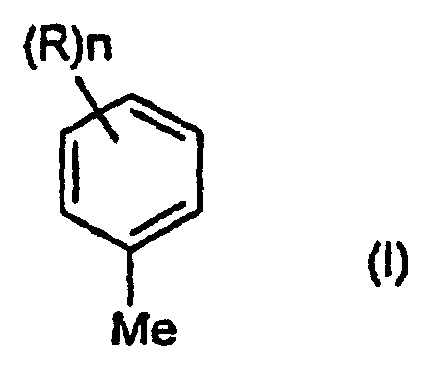
la méthode comprenant l'oxydation d'au moins un composé aromatique de formule (I) en tant que matière première avec un gaz contenant de l'oxygène moléculaire en présence d'un catalyseur comprenant un composé d'un métal de transition, une amine tertiaire et un composé de bromure, où le composé d'un métal de transition est présent en une quantité de 0,2% ou moins, calculée en tant qu'une quantité du métal de transition par rapport au poids de la matière première et le rapport pondéral du composé métal de transition : amine tertiaire est dans une gamme de 1:0,1 à 1:100. - Méthode selon la revendication 1, où dans la formule (I), chaque R indépendamment est alkyle C1-18 ou aralkyle C6-18.
- Méthode selon la revendication 1 ou 2, où la matière première est au moins un composé sélectionné parmi xylène, tolualdéhyde et alcool méthylbenzylique.
- Méthode selon l'une quelconque des revendications précédentes, où le métal de transition est sélectionné dans le groupe de 5 à 10 dans la Table Périodique à long terme.
- Méthode selon la revendication 4, où le métal de transition est sélectionné parmi manganèse, tungstène, molybdène, chrome, vanadium, cobalt et cérium.
- Méthode selon toute revendication précédente, où le composé d'un métal de transition est sélectionné parmi un chlorure, un bromure, un acétate et un sulfate.
- Méthode selon la revendication 6, où le composé d'un métal de transition est sélectionné parmi le chlorure de cobalt, le bromure de cobalt et l'acétate de cobalt.
- Méthode selon toute revendication précédente, où le rapport pondéral du composé métal de transition : composé de bromure est dans une gamme de 1:0,1 à 1:100.
- Méthode selon toute revendication précédente, où de l'eau est ajoutée dans une solution de réaction chargée.
- Méthode selon la revendication 9, où l'eau est présente en une quantité de 0,01 à 20% en poids par rapport au poids de la matière première.
- Méthode selon toute revendication précédente, où la réaction d'oxydation est effectuée à une température de 100 à 250°C.
- Méthode selon toute revendication précédente, où la réaction d'oxydation est effectuée sous une pression de 0,1 à 6 MPa.
- Méthode selon toute revendication précédente, qui comprend l'étape additionnelle de séparer un composé aromatique de la solution réactionnelle, lequel composé aromatique est au moins un dudit acide aromatique dudit aldéhyde aromatique et dudit alcool aromatique.
- Méthode selon la revendication 13, où l'acide carboxylique aromatique est séparé par cristallisation.
- Méthode selon la revendication 13, où l'acide carboxylique aromatique est séparé par précipitation acide.
- Méthode selon la revendication 16, où l'aldéhyde aromatique et l'alcool aromatique sont séparés de la solution réactionnelle par distillation.
- Méthode selon la revendication 13, où le composé aromatique est du xylène.
- Méthode selon l'une quelconque des revendications 13 à 15, où avant la séparation de l'acide carboxylique aromatique, une couche aqueuse de la solution de réaction est séparée et éliminée.
- Méthode selon la revendication 18, où la couche aqueuse est recyclée et utilisée dans le procédé d'oxydation.
- Méthode selon la revendication 13, où avant le refroidissement et la précipitation des cristaux de la solution réactionnelle, la solution est mise en contact avec une base avec ensuite séparation du sel formé.
- Méthode selon la revendication 20, où la solution réactionnelle contactée par la base est encore contactée par de l'eau.
- Méthode selon la revendication 16, où à la distillation de la solution réactionnelle, d'où est éliminé l'acide carboxylique aromatique, la distillation est effectuée après élimination des composants acides.
- Méthode selon la revendication 16, où le résidu obtenu après distillation de la solution réactionnelle est recyclé pour une utilisation dans la réaction d'oxydation.
- Méthode selon l'une quelconque des revendications 16, 22 et 23 qui comprend l'autre étape de distiller le mélange comprenant l'aldéhyde aromatique et l'alcool aromatique contenant additionnellement un acide aromatique en présence d'une base.
- Méthode selon la revendication 24, où l'aldéhyde aromatique est le tolualdéhyde.
- Méthode selon la revendication 24, où l'alcool aromatique est l'alcool méthylbenzylique.
- Méthode selon l'une quelconque des revendications 24 à 26, où la base est ajoutée en une quantité de 10% en poids ou moins par rapport à la quantité totale de l'aldéhyde aromatique et de l'alcool aromatique.
- Méthode selon l'une quelconque des revendications 1 à 15 qui comprend l'étape additionnelle de purifier un acide carboxylique aromatique brut obtenu par ladite méthode et de recycler simultanément la solution de lavage pour une utilisation comme matière première.
- Méthode selon la revendication 28, où l'acide carboxylique aromatique obtenu est un acide benzoïque alkyle substitué.
- Méthode selon la revendication 29, où l'hydrocarbure aromatique brut est le xylène et l'acide carboxylique aromatique est l'acide toluïque.
- Méthode selon la revendication 30, où l'hydrocarbure aromatique brut est le p-xylène et l'acide carboxylique aromatique est l'acide p-toluïque.
Applications Claiming Priority (9)
| Application Number | Priority Date | Filing Date | Title |
|---|---|---|---|
| JP123147/96 | 1996-05-17 | ||
| JP123148/96 | 1996-05-17 | ||
| JP12314796 | 1996-05-17 | ||
| JP12314796 | 1996-05-17 | ||
| JP12314996A JPH09301918A (ja) | 1996-05-17 | 1996-05-17 | 芳香族カルボン酸の製造方法 |
| JP12314896 | 1996-05-17 | ||
| JP123149/96 | 1996-05-17 | ||
| JP12314896 | 1996-05-17 | ||
| JP12314996 | 1996-05-17 |
Publications (3)
| Publication Number | Publication Date |
|---|---|
| EP0807618A2 EP0807618A2 (fr) | 1997-11-19 |
| EP0807618A3 EP0807618A3 (fr) | 1999-04-21 |
| EP0807618B1 true EP0807618B1 (fr) | 2003-09-03 |
Family
ID=27314637
Family Applications (1)
| Application Number | Title | Priority Date | Filing Date |
|---|---|---|---|
| EP97303410A Expired - Lifetime EP0807618B1 (fr) | 1996-05-17 | 1997-05-19 | Procédé pour la préparation d'acides carboxyliques aromatiques, d'aldéhydes aromatiques et d'alcools aromatiques |
Country Status (5)
| Country | Link |
|---|---|
| US (3) | US6242643B1 (fr) |
| EP (1) | EP0807618B1 (fr) |
| KR (1) | KR100449282B1 (fr) |
| CN (1) | CN1093108C (fr) |
| DE (1) | DE69724510T2 (fr) |
Families Citing this family (45)
| Publication number | Priority date | Publication date | Assignee | Title |
|---|---|---|---|---|
| US6242643B1 (en) * | 1996-05-17 | 2001-06-05 | Toray Industries, Inc. | Method for preparing aromatic carboxylic acids, aromatic aldehydes, and aromatic alcohols |
| KR20000041506A (ko) * | 1998-12-22 | 2000-07-15 | 유현식 | 아로마틱폴리카본산의 제조방법 |
| EP1053990A3 (fr) * | 1999-05-14 | 2000-12-20 | Toray Industries, Inc. | Procédé de préparation d'un cétone aromatique ainsi que composition contenant un cétone aromatique |
| FR2824556B1 (fr) * | 2001-05-11 | 2003-06-27 | Rhodia Chimie Sa | Procede d'oxydation d'un aldehyde aromatique en acide carboxylique correspondant |
| US6657068B2 (en) | 2002-03-22 | 2003-12-02 | General Electric Company | Liquid phase oxidation of halogenated ortho-xylenes |
| US6657067B2 (en) | 2002-03-22 | 2003-12-02 | General Electric Company | Method for the manufacture of chlorophthalic anhydride |
| US6649773B2 (en) | 2002-03-22 | 2003-11-18 | General Electric Company | Method for the manufacture of halophthalic acids and anhydrides |
| US7381836B2 (en) | 2004-09-02 | 2008-06-03 | Eastman Chemical Company | Optimized liquid-phase oxidation |
| US7589231B2 (en) | 2004-09-02 | 2009-09-15 | Eastman Chemical Company | Optimized liquid-phase oxidation |
| US7582793B2 (en) | 2004-09-02 | 2009-09-01 | Eastman Chemical Company | Optimized liquid-phase oxidation |
| US7608733B2 (en) | 2004-09-02 | 2009-10-27 | Eastman Chemical Company | Optimized liquid-phase oxidation |
| US7507857B2 (en) | 2004-09-02 | 2009-03-24 | Eastman Chemical Company | Optimized liquid-phase oxidation |
| US7482482B2 (en) | 2004-09-02 | 2009-01-27 | Eastman Chemical Company | Optimized liquid-phase oxidation |
| US7692037B2 (en) | 2004-09-02 | 2010-04-06 | Eastman Chemical Company | Optimized liquid-phase oxidation |
| US7910769B2 (en) | 2004-09-02 | 2011-03-22 | Eastman Chemical Company | Optimized liquid-phase oxidation |
| US7741515B2 (en) | 2004-09-02 | 2010-06-22 | Eastman Chemical Company | Optimized liquid-phase oxidation |
| US7390921B2 (en) | 2004-09-02 | 2008-06-24 | Eastman Chemical Company | Optimized liquid-phase oxidation |
| US7572936B2 (en) | 2004-09-02 | 2009-08-11 | Eastman Chemical Company | Optimized liquid-phase oxidation |
| US7572932B2 (en) * | 2004-09-02 | 2009-08-11 | Eastman Chemical Company | Optimized liquid-phase oxidation |
| US7563926B2 (en) | 2004-09-02 | 2009-07-21 | Eastman Chemical Company | Optimized liquid-phase oxidation |
| US7399882B2 (en) | 2004-09-02 | 2008-07-15 | Eastman Chemical Company | Optimized liquid-phase oxidation |
| US7608732B2 (en) | 2005-03-08 | 2009-10-27 | Eastman Chemical Company | Optimized liquid-phase oxidation |
| US7495125B2 (en) | 2004-09-02 | 2009-02-24 | Eastman Chemical Company | Optimized liquid-phase oxidation |
| US7692036B2 (en) | 2004-11-29 | 2010-04-06 | Eastman Chemical Company | Optimized liquid-phase oxidation |
| US7371894B2 (en) * | 2004-09-02 | 2008-05-13 | Eastman Chemical Company | Optimized liquid-phase oxidation |
| US7586000B2 (en) | 2004-09-02 | 2009-09-08 | Eastman Chemical Company | Optimized liquid-phase oxidation |
| US7683210B2 (en) | 2004-09-02 | 2010-03-23 | Eastman Chemical Company | Optimized liquid-phase oxidation |
| US7568361B2 (en) | 2004-09-02 | 2009-08-04 | Eastman Chemical Company | Optimized liquid-phase oxidation |
| US7361784B2 (en) | 2004-09-02 | 2008-04-22 | Eastman Chemical Company | Optimized liquid-phase oxidation |
| US7504535B2 (en) | 2004-09-02 | 2009-03-17 | Eastman Chemical Company | Optimized liquid-phase oxidation |
| KR100657744B1 (ko) | 2005-01-26 | 2006-12-13 | 주식회사 엘지화학 | 테레프탈알데히드의 정제방법 |
| US7884232B2 (en) | 2005-06-16 | 2011-02-08 | Eastman Chemical Company | Optimized liquid-phase oxidation |
| US7358389B2 (en) * | 2006-01-04 | 2008-04-15 | Eastman Chemical Company | Oxidation system employing internal structure for enhanced hydrodynamics |
| US7355068B2 (en) | 2006-01-04 | 2008-04-08 | Eastman Chemical Company | Oxidation system with internal secondary reactor |
| KR100874568B1 (ko) * | 2006-06-29 | 2008-12-16 | 주식회사 엘지화학 | 테레프탈알데히드의 정제방법 |
| CN101440028B (zh) * | 2008-11-06 | 2012-10-31 | 浙江工业大学 | 一种对叔丁基苯甲醛的合成方法 |
| CN102219662B (zh) * | 2011-04-27 | 2013-04-10 | 武汉万园寺药业有限公司 | 甲苯空气催化氧化制备苯甲醛、苯甲醇、苯甲酸苄酯的方法 |
| CN103145527B (zh) * | 2013-02-28 | 2014-12-10 | 南京大学 | 一种对甲氧基苯甲醛或对叔丁基苯甲醛合成工艺 |
| CN105085228B (zh) * | 2015-07-30 | 2017-07-11 | 山东省农药科学研究院 | 一种3,5‑二甲基苯甲酸的生产方法 |
| CN106854142A (zh) * | 2016-11-07 | 2017-06-16 | 常州大学 | 一种2,5‑二氯甲苯连续氧化制备2,5‑二氯苯甲醛的方法 |
| CN106699526A (zh) * | 2016-11-07 | 2017-05-24 | 常州大学 | 一种2,4‑二氯甲苯连续氧化制备2,4‑二氯苯甲醛的方法 |
| CN106748684A (zh) * | 2016-11-07 | 2017-05-31 | 常州大学 | 一种间氟甲苯连续氧化制备间氟苯甲醛的方法 |
| CN106699525A (zh) * | 2016-11-07 | 2017-05-24 | 常州大学 | 一种2,3‑二氯甲苯连续氧化制备2,3‑二氯苯甲醛的方法 |
| CN106748685A (zh) * | 2016-11-07 | 2017-05-31 | 常州大学 | 一种对氯甲苯连续氧化制备对氯苯甲醛的方法 |
| CN110655458B (zh) * | 2018-06-29 | 2022-07-12 | 中国石油化工股份有限公司 | 一种同时生产苯甲酸和丙酮的方法 |
Family Cites Families (19)
| Publication number | Priority date | Publication date | Assignee | Title |
|---|---|---|---|---|
| US1815985A (en) * | 1928-06-19 | 1931-07-28 | Ig Farbenindustrie Ag | Process for the manufacture of oxygenated organic compounds |
| US2245528A (en) * | 1938-10-18 | 1941-06-10 | Du Pont | Catalytic oxidation of alkyl substituted aromatic compounds |
| GB970492A (en) | 1960-10-18 | 1964-09-23 | Standard Oil Co | Production of aromatic carboxylic acids |
| NL128577C (fr) * | 1963-05-22 | |||
| US3607920A (en) | 1967-10-20 | 1971-09-21 | Cowles Chem Co | Process for the preparation of high purity isomers of toluic acid |
| FR1564916A (fr) * | 1968-03-14 | 1969-04-25 | ||
| FR2076413A6 (fr) * | 1970-01-14 | 1971-10-15 | Rhone Poulenc Sa | |
| US3714263A (en) * | 1969-10-29 | 1973-01-30 | Universal Oil Prod Co | Selective oxidation of alkyl aromatic compounds |
| US3679740A (en) * | 1969-12-17 | 1972-07-25 | Universal Oil Prod Co | Preparation of aromatic acids |
| CS153277B1 (fr) * | 1971-11-29 | 1974-02-25 | ||
| US3855305A (en) * | 1972-02-07 | 1974-12-17 | Olin Corp | Method for preparing aromatic aldehydes |
| US3865870A (en) | 1973-03-14 | 1975-02-11 | Borg Warner | Oxidation of methylated benzenes |
| GB1561464A (en) * | 1977-02-02 | 1980-02-20 | Shell Int Research | Oxidation of alkaryl compounds |
| JPS5655341A (en) | 1979-10-12 | 1981-05-15 | Nippon Jiyouriyuu Kogyo Kk | Preparation of high-purity o-toluic acid |
| DE3129194C2 (de) | 1981-07-24 | 1983-12-08 | Hoechst Ag, 6230 Frankfurt | "Verfahren zur Herstellung von aromatischen Aldehyden" |
| JPS5953442A (ja) | 1982-09-22 | 1984-03-28 | Nippon Kayaku Co Ltd | フロロ置換芳香族カルボン酸の製造法 |
| JPS6019736A (ja) | 1983-07-13 | 1985-01-31 | Toray Ind Inc | p−t−ブチルベンズアルデヒドとp−t−ブチル安息香酸の同時製造法 |
| US5144066A (en) * | 1990-06-26 | 1992-09-01 | Nippon Shokubai Co., Ltd. | Method of producing naphthalenedicarboxylic acids and diaryldicarboxylic acids |
| US6242643B1 (en) * | 1996-05-17 | 2001-06-05 | Toray Industries, Inc. | Method for preparing aromatic carboxylic acids, aromatic aldehydes, and aromatic alcohols |
-
1997
- 1997-05-13 US US08/855,072 patent/US6242643B1/en not_active Expired - Fee Related
- 1997-05-16 CN CN97113647A patent/CN1093108C/zh not_active Expired - Fee Related
- 1997-05-17 KR KR1019970019116A patent/KR100449282B1/ko not_active Expired - Fee Related
- 1997-05-19 DE DE69724510T patent/DE69724510T2/de not_active Expired - Fee Related
- 1997-05-19 EP EP97303410A patent/EP0807618B1/fr not_active Expired - Lifetime
-
2001
- 2001-03-19 US US09/812,135 patent/US6590129B2/en not_active Expired - Fee Related
- 2001-03-19 US US09/811,728 patent/US6437176B2/en not_active Expired - Fee Related
Also Published As
| Publication number | Publication date |
|---|---|
| US6590129B2 (en) | 2003-07-08 |
| US6437176B2 (en) | 2002-08-20 |
| US20010016667A1 (en) | 2001-08-23 |
| KR970074739A (ko) | 1997-12-10 |
| DE69724510D1 (de) | 2003-10-09 |
| CN1093108C (zh) | 2002-10-23 |
| EP0807618A2 (fr) | 1997-11-19 |
| KR100449282B1 (ko) | 2004-11-16 |
| DE69724510T2 (de) | 2004-07-08 |
| CN1166480A (zh) | 1997-12-03 |
| EP0807618A3 (fr) | 1999-04-21 |
| US6242643B1 (en) | 2001-06-05 |
| US20010018543A1 (en) | 2001-08-30 |
Similar Documents
| Publication | Publication Date | Title |
|---|---|---|
| US6437176B2 (en) | Method for preparing aromatic carboxylic acids, aromatic aldehydes, and aromatic alcohols | |
| US6153790A (en) | Method to produce aromatic dicarboxylic acids using cobalt and zirconium catalysts | |
| US4357475A (en) | Process for the production and the recovery of terephthalic acid | |
| EP1214285B1 (fr) | Procede de production d'acide terephthalique pur presentant une plus grande capacite de recuperation de precurseurs, de solvant et de methylacetate | |
| AU732522B2 (en) | Method to produce aromatic carboxylic acids | |
| GB2094800A (en) | Production of terephthalic acid | |
| EP0476009A1 (fr) | Procede d'extraction permettant l'elimination d'impuretes d'un filtrat d'acide terephthalique. | |
| GB2032920A (en) | Process for preparing terephthalic acid | |
| WO2003045889A1 (fr) | Procédé de production d'acide (méth)acrylique | |
| US20010020579A1 (en) | Process for recovering benzyl benzoate | |
| EP0132450B1 (fr) | Procédé de purification de l'acide méthacrylique | |
| EP1439161B1 (fr) | Procédé pour la préparation de l' acide pyromellique et de l' anhydride pyromellique | |
| US4259522A (en) | Process for the production of isophtahalic acid | |
| CN101146755A (zh) | 通过对-二甲苯在水中的液相氧化来制备对-甲苯甲酸的方法 | |
| JPH0764777B2 (ja) | パラヒドロキシベンズアルデヒドの精製法 | |
| JPH043370B2 (fr) | ||
| JPH04182452A (ja) | 脂肪族ジカルボン酸モノエステルの製造方法 | |
| JPH04279549A (ja) | 精製テレフタル酸の製造方法 | |
| JPS6230974B2 (fr) | ||
| JPS622576B2 (fr) | ||
| JPH11171826A (ja) | 芳香族カルボン酸の製造方法 | |
| JPS6230975B2 (fr) | ||
| JPH1053545A (ja) | 芳香族カルボン酸、芳香族アルデヒドおよび/または芳香族アルコールの製造法 | |
| JPH07179396A (ja) | アシルオキシベンゼンジカルボン酸の製造方法 | |
| JPH0761966B2 (ja) | パラヒドロキシベンズアルデヒドの精製方法 |
Legal Events
| Date | Code | Title | Description |
|---|---|---|---|
| PUAI | Public reference made under article 153(3) epc to a published international application that has entered the european phase |
Free format text: ORIGINAL CODE: 0009012 |
|
| AK | Designated contracting states |
Kind code of ref document: A2 Designated state(s): CH DE FR GB IE IT LI |
|
| PUAL | Search report despatched |
Free format text: ORIGINAL CODE: 0009013 |
|
| AK | Designated contracting states |
Kind code of ref document: A3 Designated state(s): CH DE FR GB IE IT LI |
|
| 17P | Request for examination filed |
Effective date: 19990908 |
|
| 17Q | First examination report despatched |
Effective date: 20000410 |
|
| GRAH | Despatch of communication of intention to grant a patent |
Free format text: ORIGINAL CODE: EPIDOS IGRA |
|
| GRAS | Grant fee paid |
Free format text: ORIGINAL CODE: EPIDOSNIGR3 |
|
| GRAA | (expected) grant |
Free format text: ORIGINAL CODE: 0009210 |
|
| RIN1 | Information on inventor provided before grant (corrected) |
Inventor name: KITAMURA, AKIRA Inventor name: SUEMATSU, MASAAKI Inventor name: MATSUOKA, SHOTARO |
|
| AK | Designated contracting states |
Kind code of ref document: B1 Designated state(s): CH DE FR GB IE IT LI |
|
| REG | Reference to a national code |
Ref country code: GB Ref legal event code: FG4D |
|
| REG | Reference to a national code |
Ref country code: CH Ref legal event code: EP |
|
| REF | Corresponds to: |
Ref document number: 69724510 Country of ref document: DE Date of ref document: 20031009 Kind code of ref document: P |
|
| REG | Reference to a national code |
Ref country code: IE Ref legal event code: FG4D |
|
| ET | Fr: translation filed | ||
| PLBE | No opposition filed within time limit |
Free format text: ORIGINAL CODE: 0009261 |
|
| STAA | Information on the status of an ep patent application or granted ep patent |
Free format text: STATUS: NO OPPOSITION FILED WITHIN TIME LIMIT |
|
| 26N | No opposition filed |
Effective date: 20040604 |
|
| PGFP | Annual fee paid to national office [announced via postgrant information from national office to epo] |
Ref country code: IE Payment date: 20050511 Year of fee payment: 9 |
|
| PGFP | Annual fee paid to national office [announced via postgrant information from national office to epo] |
Ref country code: DE Payment date: 20060511 Year of fee payment: 10 |
|
| PGFP | Annual fee paid to national office [announced via postgrant information from national office to epo] |
Ref country code: FR Payment date: 20060515 Year of fee payment: 10 Ref country code: CH Payment date: 20060515 Year of fee payment: 10 |
|
| PGFP | Annual fee paid to national office [announced via postgrant information from national office to epo] |
Ref country code: GB Payment date: 20060517 Year of fee payment: 10 |
|
| PG25 | Lapsed in a contracting state [announced via postgrant information from national office to epo] |
Ref country code: IE Free format text: LAPSE BECAUSE OF NON-PAYMENT OF DUE FEES Effective date: 20060519 |
|
| PGFP | Annual fee paid to national office [announced via postgrant information from national office to epo] |
Ref country code: IT Payment date: 20060531 Year of fee payment: 10 |
|
| REG | Reference to a national code |
Ref country code: IE Ref legal event code: MM4A |
|
| REG | Reference to a national code |
Ref country code: CH Ref legal event code: PL |
|
| GBPC | Gb: european patent ceased through non-payment of renewal fee |
Effective date: 20070519 |
|
| PG25 | Lapsed in a contracting state [announced via postgrant information from national office to epo] |
Ref country code: LI Free format text: LAPSE BECAUSE OF NON-PAYMENT OF DUE FEES Effective date: 20070531 Ref country code: CH Free format text: LAPSE BECAUSE OF NON-PAYMENT OF DUE FEES Effective date: 20070531 |
|
| REG | Reference to a national code |
Ref country code: FR Ref legal event code: ST Effective date: 20080131 |
|
| PG25 | Lapsed in a contracting state [announced via postgrant information from national office to epo] |
Ref country code: DE Free format text: LAPSE BECAUSE OF NON-PAYMENT OF DUE FEES Effective date: 20071201 |
|
| PG25 | Lapsed in a contracting state [announced via postgrant information from national office to epo] |
Ref country code: GB Free format text: LAPSE BECAUSE OF NON-PAYMENT OF DUE FEES Effective date: 20070519 |
|
| PG25 | Lapsed in a contracting state [announced via postgrant information from national office to epo] |
Ref country code: FR Free format text: LAPSE BECAUSE OF NON-PAYMENT OF DUE FEES Effective date: 20070531 |
|
| PG25 | Lapsed in a contracting state [announced via postgrant information from national office to epo] |
Ref country code: IT Free format text: LAPSE BECAUSE OF NON-PAYMENT OF DUE FEES Effective date: 20070519 |