EP0805167B1 - Verfahren zur Herstellung von Polyvinylacetalen und -ketalen - Google Patents
Verfahren zur Herstellung von Polyvinylacetalen und -ketalen Download PDFInfo
- Publication number
- EP0805167B1 EP0805167B1 EP97107020A EP97107020A EP0805167B1 EP 0805167 B1 EP0805167 B1 EP 0805167B1 EP 97107020 A EP97107020 A EP 97107020A EP 97107020 A EP97107020 A EP 97107020A EP 0805167 B1 EP0805167 B1 EP 0805167B1
- Authority
- EP
- European Patent Office
- Prior art keywords
- procedure
- reaction
- accordance
- acid
- reactor
- Prior art date
- Legal status (The legal status is an assumption and is not a legal conclusion. Google has not performed a legal analysis and makes no representation as to the accuracy of the status listed.)
- Expired - Lifetime
Links
- 238000000034 method Methods 0.000 title claims abstract description 25
- 229920002554 vinyl polymer Polymers 0.000 title abstract description 9
- 238000002360 preparation method Methods 0.000 title description 3
- 150000001241 acetals Chemical class 0.000 title 1
- 229920002451 polyvinyl alcohol Polymers 0.000 claims abstract description 33
- 239000002253 acid Substances 0.000 claims abstract description 32
- 239000004372 Polyvinyl alcohol Substances 0.000 claims abstract description 26
- 238000004519 manufacturing process Methods 0.000 claims abstract description 9
- 239000012429 reaction media Substances 0.000 claims abstract description 7
- 239000003054 catalyst Substances 0.000 claims abstract description 5
- 150000002576 ketones Chemical class 0.000 claims abstract description 5
- 235000019422 polyvinyl alcohol Nutrition 0.000 claims description 28
- 238000006243 chemical reaction Methods 0.000 claims description 26
- 239000012528 membrane Substances 0.000 claims description 23
- ZTQSAGDEMFDKMZ-UHFFFAOYSA-N Butyraldehyde Chemical compound CCCC=O ZTQSAGDEMFDKMZ-UHFFFAOYSA-N 0.000 claims description 18
- 150000001299 aldehydes Chemical class 0.000 claims description 10
- 239000011521 glass Substances 0.000 claims description 4
- 229920006254 polymer film Polymers 0.000 claims description 4
- ABLZXFCXXLZCGV-UHFFFAOYSA-N Phosphorous acid Chemical compound OP(O)=O ABLZXFCXXLZCGV-UHFFFAOYSA-N 0.000 claims description 2
- 235000012216 bentonite Nutrition 0.000 claims description 2
- 230000007062 hydrolysis Effects 0.000 claims description 2
- 238000006460 hydrolysis reaction Methods 0.000 claims description 2
- 229910010272 inorganic material Inorganic materials 0.000 claims description 2
- 239000011147 inorganic material Substances 0.000 claims description 2
- 150000001732 carboxylic acid derivatives Chemical class 0.000 claims 1
- 125000002091 cationic group Chemical group 0.000 claims 1
- BDHFUVZGWQCTTF-UHFFFAOYSA-N sulfonic acid Chemical compound OS(=O)=O BDHFUVZGWQCTTF-UHFFFAOYSA-N 0.000 claims 1
- 125000002777 acetyl group Chemical class [H]C([H])([H])C(*)=O 0.000 abstract description 9
- 125000002485 formyl group Chemical class [H]C(*)=O 0.000 abstract 1
- 239000000243 solution Substances 0.000 description 27
- 239000000047 product Substances 0.000 description 20
- XLYOFNOQVPJJNP-UHFFFAOYSA-N water Substances O XLYOFNOQVPJJNP-UHFFFAOYSA-N 0.000 description 15
- HEMHJVSKTPXQMS-UHFFFAOYSA-M Sodium hydroxide Chemical compound [OH-].[Na+] HEMHJVSKTPXQMS-UHFFFAOYSA-M 0.000 description 13
- 238000006359 acetalization reaction Methods 0.000 description 9
- 150000002500 ions Chemical class 0.000 description 8
- 239000012071 phase Substances 0.000 description 7
- HGBOYTHUEUWSSQ-UHFFFAOYSA-N valeric aldehyde Natural products CCCCC=O HGBOYTHUEUWSSQ-UHFFFAOYSA-N 0.000 description 7
- KWYUFKZDYYNOTN-UHFFFAOYSA-M Potassium hydroxide Chemical compound [OH-].[K+] KWYUFKZDYYNOTN-UHFFFAOYSA-M 0.000 description 6
- 238000000926 separation method Methods 0.000 description 6
- 239000007787 solid Substances 0.000 description 6
- 150000001768 cations Chemical class 0.000 description 5
- 238000005086 pumping Methods 0.000 description 5
- 239000000725 suspension Substances 0.000 description 5
- 229920000557 Nafion® Polymers 0.000 description 4
- 150000007513 acids Chemical class 0.000 description 4
- 125000003178 carboxy group Chemical group [H]OC(*)=O 0.000 description 4
- 238000001816 cooling Methods 0.000 description 4
- 239000000463 material Substances 0.000 description 4
- 238000005406 washing Methods 0.000 description 4
- LSNNMFCWUKXFEE-UHFFFAOYSA-M Bisulfite Chemical compound OS([O-])=O LSNNMFCWUKXFEE-UHFFFAOYSA-M 0.000 description 3
- 230000003197 catalytic effect Effects 0.000 description 3
- 238000005260 corrosion Methods 0.000 description 3
- 230000007797 corrosion Effects 0.000 description 3
- 239000003014 ion exchange membrane Substances 0.000 description 3
- 238000012545 processing Methods 0.000 description 3
- 238000012546 transfer Methods 0.000 description 3
- CSCPPACGZOOCGX-UHFFFAOYSA-N Acetone Chemical compound CC(C)=O CSCPPACGZOOCGX-UHFFFAOYSA-N 0.000 description 2
- LFQSCWFLJHTTHZ-UHFFFAOYSA-N Ethanol Chemical compound CCO LFQSCWFLJHTTHZ-UHFFFAOYSA-N 0.000 description 2
- VEXZGXHMUGYJMC-UHFFFAOYSA-N Hydrochloric acid Chemical compound Cl VEXZGXHMUGYJMC-UHFFFAOYSA-N 0.000 description 2
- QAOWNCQODCNURD-UHFFFAOYSA-N Sulfuric acid Chemical compound OS(O)(=O)=O QAOWNCQODCNURD-UHFFFAOYSA-N 0.000 description 2
- DHKHKXVYLBGOIT-UHFFFAOYSA-N acetaldehyde Diethyl Acetal Natural products CCOC(C)OCC DHKHKXVYLBGOIT-UHFFFAOYSA-N 0.000 description 2
- 230000002378 acidificating effect Effects 0.000 description 2
- 125000004432 carbon atom Chemical group C* 0.000 description 2
- 239000000969 carrier Substances 0.000 description 2
- 238000005341 cation exchange Methods 0.000 description 2
- 238000009833 condensation Methods 0.000 description 2
- 230000005494 condensation Effects 0.000 description 2
- 229920001577 copolymer Polymers 0.000 description 2
- JHIVVAPYMSGYDF-UHFFFAOYSA-N cyclohexanone Chemical compound O=C1CCCCC1 JHIVVAPYMSGYDF-UHFFFAOYSA-N 0.000 description 2
- 239000012510 hollow fiber Substances 0.000 description 2
- 239000003456 ion exchange resin Substances 0.000 description 2
- 229920003303 ion-exchange polymer Polymers 0.000 description 2
- 239000007788 liquid Substances 0.000 description 2
- 239000000178 monomer Substances 0.000 description 2
- 238000006386 neutralization reaction Methods 0.000 description 2
- 229920002492 poly(sulfone) Polymers 0.000 description 2
- 239000002244 precipitate Substances 0.000 description 2
- 239000011541 reaction mixture Substances 0.000 description 2
- 150000003839 salts Chemical class 0.000 description 2
- 239000002904 solvent Substances 0.000 description 2
- 239000007858 starting material Substances 0.000 description 2
- JOXIMZWYDAKGHI-UHFFFAOYSA-N toluene-4-sulfonic acid Chemical compound CC1=CC=C(S(O)(=O)=O)C=C1 JOXIMZWYDAKGHI-UHFFFAOYSA-N 0.000 description 2
- OKTJSMMVPCPJKN-UHFFFAOYSA-N Carbon Chemical compound [C] OKTJSMMVPCPJKN-UHFFFAOYSA-N 0.000 description 1
- 229920003935 Flemion® Polymers 0.000 description 1
- GRYLNZFGIOXLOG-UHFFFAOYSA-N Nitric acid Chemical compound O[N+]([O-])=O GRYLNZFGIOXLOG-UHFFFAOYSA-N 0.000 description 1
- 239000004698 Polyethylene Substances 0.000 description 1
- 239000004793 Polystyrene Substances 0.000 description 1
- 230000001476 alcoholic effect Effects 0.000 description 1
- 239000003513 alkali Substances 0.000 description 1
- 230000003113 alkalizing effect Effects 0.000 description 1
- 239000000956 alloy Substances 0.000 description 1
- 238000013459 approach Methods 0.000 description 1
- 239000012736 aqueous medium Substances 0.000 description 1
- 239000007864 aqueous solution Substances 0.000 description 1
- 230000004888 barrier function Effects 0.000 description 1
- 239000002585 base Substances 0.000 description 1
- 238000006482 condensation reaction Methods 0.000 description 1
- 238000010924 continuous production Methods 0.000 description 1
- 239000008367 deionised water Substances 0.000 description 1
- 229910021641 deionized water Inorganic materials 0.000 description 1
- 239000003995 emulsifying agent Substances 0.000 description 1
- 239000008187 granular material Substances 0.000 description 1
- 238000007210 heterogeneous catalysis Methods 0.000 description 1
- 229920001600 hydrophobic polymer Polymers 0.000 description 1
- 238000005907 ketalization reaction Methods 0.000 description 1
- 238000012423 maintenance Methods 0.000 description 1
- 239000011159 matrix material Substances 0.000 description 1
- 239000002609 medium Substances 0.000 description 1
- 238000012986 modification Methods 0.000 description 1
- 230000004048 modification Effects 0.000 description 1
- 230000007935 neutral effect Effects 0.000 description 1
- 229910017604 nitric acid Inorganic materials 0.000 description 1
- 239000011368 organic material Substances 0.000 description 1
- 229920000620 organic polymer Polymers 0.000 description 1
- 230000003647 oxidation Effects 0.000 description 1
- 238000007254 oxidation reaction Methods 0.000 description 1
- 238000004806 packaging method and process Methods 0.000 description 1
- 239000002245 particle Substances 0.000 description 1
- 230000005501 phase interface Effects 0.000 description 1
- 229920002037 poly(vinyl butyral) polymer Polymers 0.000 description 1
- 229920002239 polyacrylonitrile Polymers 0.000 description 1
- -1 polyethylene Polymers 0.000 description 1
- 229920000573 polyethylene Polymers 0.000 description 1
- 238000006116 polymerization reaction Methods 0.000 description 1
- 229920002223 polystyrene Polymers 0.000 description 1
- 229920003053 polystyrene-divinylbenzene Polymers 0.000 description 1
- 238000001556 precipitation Methods 0.000 description 1
- 238000007873 sieving Methods 0.000 description 1
- 239000002002 slurry Substances 0.000 description 1
- 239000011973 solid acid Substances 0.000 description 1
- 239000007790 solid phase Substances 0.000 description 1
- 239000012265 solid product Substances 0.000 description 1
- 125000006850 spacer group Chemical group 0.000 description 1
- 239000003381 stabilizer Substances 0.000 description 1
- 239000000126 substance Substances 0.000 description 1
- 125000000542 sulfonic acid group Chemical group 0.000 description 1
- 230000008961 swelling Effects 0.000 description 1
- BFKJFAAPBSQJPD-UHFFFAOYSA-N tetrafluoroethene Chemical group FC(F)=C(F)F BFKJFAAPBSQJPD-UHFFFAOYSA-N 0.000 description 1
- 239000002699 waste material Substances 0.000 description 1
- 238000010626 work up procedure Methods 0.000 description 1
- 239000010457 zeolite Substances 0.000 description 1
Images

Classifications
-
- C—CHEMISTRY; METALLURGY
- C08—ORGANIC MACROMOLECULAR COMPOUNDS; THEIR PREPARATION OR CHEMICAL WORKING-UP; COMPOSITIONS BASED THEREON
- C08F—MACROMOLECULAR COMPOUNDS OBTAINED BY REACTIONS ONLY INVOLVING CARBON-TO-CARBON UNSATURATED BONDS
- C08F8/00—Chemical modification by after-treatment
- C08F8/28—Condensation with aldehydes or ketones
-
- B—PERFORMING OPERATIONS; TRANSPORTING
- B01—PHYSICAL OR CHEMICAL PROCESSES OR APPARATUS IN GENERAL
- B01J—CHEMICAL OR PHYSICAL PROCESSES, e.g. CATALYSIS OR COLLOID CHEMISTRY; THEIR RELEVANT APPARATUS
- B01J31/00—Catalysts comprising hydrides, coordination complexes or organic compounds
- B01J31/02—Catalysts comprising hydrides, coordination complexes or organic compounds containing organic compounds or metal hydrides
- B01J31/06—Catalysts comprising hydrides, coordination complexes or organic compounds containing organic compounds or metal hydrides containing polymers
- B01J31/08—Ion-exchange resins
-
- B—PERFORMING OPERATIONS; TRANSPORTING
- B01—PHYSICAL OR CHEMICAL PROCESSES OR APPARATUS IN GENERAL
- B01J—CHEMICAL OR PHYSICAL PROCESSES, e.g. CATALYSIS OR COLLOID CHEMISTRY; THEIR RELEVANT APPARATUS
- B01J31/00—Catalysts comprising hydrides, coordination complexes or organic compounds
- B01J31/02—Catalysts comprising hydrides, coordination complexes or organic compounds containing organic compounds or metal hydrides
- B01J31/06—Catalysts comprising hydrides, coordination complexes or organic compounds containing organic compounds or metal hydrides containing polymers
- B01J31/08—Ion-exchange resins
- B01J31/10—Ion-exchange resins sulfonated
-
- C—CHEMISTRY; METALLURGY
- C08—ORGANIC MACROMOLECULAR COMPOUNDS; THEIR PREPARATION OR CHEMICAL WORKING-UP; COMPOSITIONS BASED THEREON
- C08F—MACROMOLECULAR COMPOUNDS OBTAINED BY REACTIONS ONLY INVOLVING CARBON-TO-CARBON UNSATURATED BONDS
- C08F116/00—Homopolymers of compounds having one or more unsaturated aliphatic radicals, each having only one carbon-to-carbon double bond, and at least one being terminated by an alcohol, ether, aldehydo, ketonic, acetal or ketal radical
- C08F116/02—Homopolymers of compounds having one or more unsaturated aliphatic radicals, each having only one carbon-to-carbon double bond, and at least one being terminated by an alcohol, ether, aldehydo, ketonic, acetal or ketal radical by an alcohol radical
- C08F116/04—Acyclic compounds
- C08F116/06—Polyvinyl alcohol ; Vinyl alcohol
-
- C—CHEMISTRY; METALLURGY
- C08—ORGANIC MACROMOLECULAR COMPOUNDS; THEIR PREPARATION OR CHEMICAL WORKING-UP; COMPOSITIONS BASED THEREON
- C08F—MACROMOLECULAR COMPOUNDS OBTAINED BY REACTIONS ONLY INVOLVING CARBON-TO-CARBON UNSATURATED BONDS
- C08F8/00—Chemical modification by after-treatment
- C08F8/48—Isomerisation; Cyclisation
-
- Y—GENERAL TAGGING OF NEW TECHNOLOGICAL DEVELOPMENTS; GENERAL TAGGING OF CROSS-SECTIONAL TECHNOLOGIES SPANNING OVER SEVERAL SECTIONS OF THE IPC; TECHNICAL SUBJECTS COVERED BY FORMER USPC CROSS-REFERENCE ART COLLECTIONS [XRACs] AND DIGESTS
- Y02—TECHNOLOGIES OR APPLICATIONS FOR MITIGATION OR ADAPTATION AGAINST CLIMATE CHANGE
- Y02P—CLIMATE CHANGE MITIGATION TECHNOLOGIES IN THE PRODUCTION OR PROCESSING OF GOODS
- Y02P20/00—Technologies relating to chemical industry
- Y02P20/50—Improvements relating to the production of bulk chemicals
- Y02P20/582—Recycling of unreacted starting or intermediate materials
Definitions
- the present invention relates to a process for the preparation of polyvinyl acetals and ketals through heterogeneous catalysis.
- Polyvinyl acetals are usually produced by homogeneously acid-catalyzed Condensation of polyvinyl alcohol and aldehyde in aqueous media. Aldehydes with up to four carbon atoms are only miscible with water, so that their reactions are not bound to phase interfaces.
- Hydrochloric acid, sulfuric acid and nitric acid are often used as the catalytic acid or p-toluenesulfonic acid are used.
- the acid used is not consumed and can therefore be used in catalytic amounts could be, in practice, a stoichiometric and even partially a stoichiometric one Amount needed because the product forming the acid in includes its granules insoluble in the reaction medium and the other Reaction evades.
- Such methods are described for example in DE-B 23 65 005, DE-B 12 47 663 and DE-C 891 745.
- Hasteloy alloy material which has high corrosion resistance having.
- the establishment of such a facility is both capital intensive as well characterized by high operating costs in maintenance.
- the object of the present invention was therefore a process for the production to develop polyvinyl acetals and ketals that operate continuously can be avoided and the inevitable occurrence of waste acid and the use cheaper, corrosion-resistant reactor materials.
- the object is achieved in that the condensation of the starting materials as Acid required catalyst is fixed on a suitable support material (supported Acid).
- the invention thus relates to a process for the preparation of polyvinyl acetals or ketals by reacting polyvinyl alcohol with an aldehyde or ketone in the presence of a catalyst containing acid groups one insoluble in the reaction medium in claim 1 defined flat carrier chemically bound are.
- Suitable carriers can be made of organic or inorganic material exist, which contains the acid groups optionally bound via spacers.
- Free acids can be carried, for example, as supported acids Use polymer films, especially membranes.
- the one with acid groups modified polymer films must be stable under the reaction conditions.
- the polymer films can carry any kind of acid groups, for example Sulfonic acid, phosphonic acid and / or carboxy groups.
- cation exchange membranes which carry -SO 3 H, COOH, -PO 3 H 2 , -PO 3 H - , preferably sulfonic acid groups.
- Materials of this type are commercially available and do not require any further modification.
- the particularly preferred membranes are known as electrically charged barriers or also as ion exchange membranes. The properties and production of such membranes have been described in detail in connection with their use as ion exchange membranes.
- the membranes used are also characterized by good mechanical properties Stability and form stability, in particular by low swelling or Tendency to shrink in the reaction medium.
- the chemical stability should be over range from pH 1 to 14, but especially in acidic and neutral pH range.
- Hydrophobic polymers are used as the organic polymer matrix for the membranes such as polystyrene, polyethylene or polysulfones, which may also be used can be networked. These are then sulfonated, for example, and are as sulfonated polystyrene-divinylbenzene membranes, sulfonated polysulfones, polyacrylonitrile methallylsulfonate copolymer Membrane commercially available.
- Membranes of the type ®NAFION (DuPont) or ®Flemion (Asahi Glass) are also suitable. These are perfluorinated membranes which were produced from tetrafluoroethylene and a monomer containing sulfonic acid and / or carboxy groups. These membranes are preferably used in their H + form, in which they are commercially available.
- Membranes for example based on zeolites and bentonites available. Such carriers are described, for example, in F. Helfferich, lon-Exchange, McGraw-Hill, London, 1962.
- Sheet-like structures made of glass can also be used as the supported acids, residues carrying the acid groups have been chemically fixed.
- Such Glasses are for example in K. Tanabe, Solid Acids and Bases, Academic Press, New York - London, 1970, pp. 45 ff.
- Such glasses are available, for example, under the trade name ®Deloxan (Degussa).
- (C 1 -C 4 ) aldehydes are preferably used for the acetalization of polyvinyl alcohol. Usually the aldehydes used do not exceed the chain length of ten carbon atoms. N-Butyraldehyde is particularly suitable.
- the ketalization is preferably carried out using (C 3 -C 10 ) ketones, in particular acetone and cyclohexanone.
- polyvinyl alcohols Both partially and fully hydrolyzed types are preferred as polyvinyl alcohols with a degree of hydrolysis of 60 to 100 mol%, and also copolymeric polyvinyl alcohols, for example with sulfonic acid and / or carboxyl group-containing Polyvinyl alcohols produced in monomers are used. In principle, everyone is Unmodified and modified polyvinyl alcohol can be used.
- the degrees of polymerization the polyvinyl alcohols used preferably range from 100 to 6000, especially from 150 to 500.
- Emulsifiers and oxidation stabilizers are used.
- the polyvinyl acetal obtained or -ketal which is insoluble in water, simply from the reaction medium can be removed and does not need to be freed from acid components.
- the Acid remains on the carrier and can, because it is catalytic and not is used for further reactions.
- a preferred continuous process for the production of polyvinyl acetal uses at least two reaction stages (pre-reactor and main reactor) and downstream work-up stages.
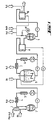
- the schematic manufacturing process is shown in Figure 1, for example.
- the reactors 3 and 6 are preferably continuously operated stirred tanks or tubular reactors.
- the reaction takes place at the reactive centers of a flat support which carries a suitable acid group.
- the reactive surface of the carrier can be in the reactor itself or in a pumping circuit.
- the stirrer can be surrounded, for example, by a guide tube 11 , on the surface of which there is the flat support 12 containing reactive acid groups (Figure No. 2).
- a membrane hollow fiber module or a tube bundle reactor on the tubes of which an ion exchange membrane is fixed, can be installed in the transfer pump.
- the optionally cooled educts are continuously fed into the pre-reactor dosed and mixed using a suitable stirrer.
- the polyvinyl alcohol solution is preferably pre-reactor by means of an ion exchanger freed from cations.
- suitable conditions for example by pumping over, it is ensured that the carrier containing acid groups is constantly flowing and the resulting partial product is not on the support surface can adhere and be removed.
- the reactor size is aligned after the desired average residence time. Excess water, for example from the condensation reaction, can in the reactor itself or in Pumping, for example by a membrane module or another suitable Apparatus to be separated. This ensures that concentration remains constant in time in the reactor and the reaction always under optimal Conditions can take place.
- the reaction can either be via jacket cooling or a heat exchanger also installed in the transfer pump at constant Temperature.
- the reaction in the pre-reactor preferably takes place at a temperature of 1 ° C to 70 ° C, especially at 1 ° C to 25 ° C, particularly preferably at 1 ° C to 15 ° C instead.
- the mean residence time ⁇ in the pre-reactor is preferably 10 to 120 minutes, especially 20 to 40 minutes.
- the reaction can take place at ambient pressure be performed.
- the reaction mixture is then in the form of a solution or Suspension transferred to the second reactor.
- the reaction is carried out in the main reactor to the desired degree of acetalization continued. This also happens on a carrier surface containing acid groups. As in the pre-reactor, this can either be in the boiler itself or in the Transfer pump installed. If necessary, can also be in the main reactor itself or in pumping around a water separation, for example by a membrane module, or by other suitable equipment. In the main reactor if necessary, aldehyde is replenished to the desired degree of acetalization to achieve.
- the temperature is also controlled here via the boiler jacket or a heat exchanger in the pump.
- the temperature in the main reactor is preferably 1 ° C to 80 ° C, especially 5 ° C to 65 ° C, particularly preferably at 10 ° C to 50 ° C.
- the mean residence time in the reactor is preferably 60 to 300 minutes, in particular 90 to 180 minutes.
- the reaction can be carried out under ambient pressure.
- the product suspension after the desired dwell time on a suitable apparatus for solid / liquid separation, for example, through a centrifuge, in which the Solid is separated from the reaction solution.
- the reaction solution which may still contain dissolved starting materials, is preferred returned to the main reactor.
- the solid can be used to adjust the pH with aqueous alkalis, for example with sodium hydroxide or potassium hydroxide, in another apparatus, for example a stirred tank or a Solids mixer to be slurried.
- the product can also be washed.
- the the resulting lye is used again to adjust the pH value in the previous slurry apparatus are returned.
- the washed The product can then be in a suitable dryer, for example a belt dryer, Plate dryer, paddle dryer, dried and then bottled become.
- a particularly preferred process for the production of polyvinyl butyral is divided into 6 phases.
- the process scheme is shown in Figure 1:
- the prereactor is preceded by an ion exchanger 1 , in which the aqueous polyvinyl alcohol solution is freed of cations (phase A).
- the pre-reactor consisting of boiler 2 , reactor 3 and module 4 , the first step of the implementation, the partial acetalization, takes place (phase B).
- optionally cooled polyvinyl alcohol as an aqueous solution PVA / H 2 O
- BA optionally cooled butyraldehyde
- the reactor 3 which is for example a tube bundle reactor or a hollow fiber module reactor.
- the solution then flows through the drainage (module 4 ), which consists, for example, of a suitable membrane module.
- the reaction mixture is brought into the boiler 5 (phase C). Together with the reactor 6 and the module 7, the boiler 5 represents the main reactor.
- the reactor 6 and the module 7 are identical or similar to the components of the pre-reactor.
- the reaction is continued analogously to the prereactor reaction to the desired degree of acetalization, butyraldehyde (BA) is added as required.
- the product suspension passes into the solid separation 8 (phase D).
- phase E the pH is adjusted by adding lye and water
- phase F the laundry and product separation 10
- polyvinyl alcohol in the form of an 8% solution of ®Mowiol 28-99 (91.5 g; approx. 2 mol) of completely demineralized water and butyraldehyde (57.48 g, 0.79 mol) are submitted at 13 ° C internal temperature.
- the polyvinyl alcohol solution was previously passed through an ion exchanger to remove cations.
- a ®Nafion 117 (lonic form H + ) cation exchange membrane is introduced.
- the pH of the solution is pH 3.
- the membrane was previously soaked in electric water for about 3-5 hours and thus pre-swollen. After about 15 minutes the solution becomes cloudy and becomes milky.
- the viscosity of the 5% ethanolic solution measured according to DIN 53015 is 80 mPa ⁇ s.
- the polyvinyl alcohol solution was previously freed of cations via an ion exchanger.
- the membrane of the type Nafion 117 (lonic form H + ) is introduced, the pH value of the solution is pH 3.
- the membrane was previously soaked in electric water for about 3-5 hours and thus pre-swollen. After about 15-20 minutes the solution becomes cloudy and becomes milky.
- the reaction is complete after about 120 minutes and the product formed can be filtered off.
- the pH is adjusted to approximately 8 by washing with 5% sodium hydroxide solution. After briefly rinsing with water, the oven dries at temperatures up to a maximum of 50 ° C. Weight: 120 g, dry matter 98.53%.
- the analysis shows a polyvinyl alcohol content of 29.3% and an OH number of 373.8 mg KOH / g (according to DIN 53783/53240 or ISO / DIS 4629).
- the viscosity of the 5% ethanolic solution measured according to DIN 53015 (Höppler falling ball viscometer) is 60 mPa ⁇ s.
- polyvinyl alcohol in the form of a 10% solution of Mowiol 8-88 (124.8 g; approx. 2.8 mol) in completely demineralized deionized water and butyraldehyde (119.57 g, 1 , 64 mol) at an internal temperature of 15 ° C.
- the polyvinyl alcohol solution was previously passed through an ion exchanger to remove cations.
- the membrane of the type ®Nafion 117 (lonic form H + ) is introduced, the pH of the solution is pH 3.
- the membrane was previously soaked in electric water for about 3-5 hours and thus pre-swollen. After approx. 30 minutes the solution becomes cloudy and becomes milky.
Landscapes
- Chemical & Material Sciences (AREA)
- Organic Chemistry (AREA)
- Chemical Kinetics & Catalysis (AREA)
- Engineering & Computer Science (AREA)
- Materials Engineering (AREA)
- Health & Medical Sciences (AREA)
- Medicinal Chemistry (AREA)
- Polymers & Plastics (AREA)
- General Chemical & Material Sciences (AREA)
- Addition Polymer Or Copolymer, Post-Treatments, Or Chemical Modifications (AREA)
- Organic Low-Molecular-Weight Compounds And Preparation Thereof (AREA)
- Manufacture Of Macromolecular Shaped Articles (AREA)
- Low-Molecular Organic Synthesis Reactions Using Catalysts (AREA)
Description
Im Vorreaktör, bestehend aus Kessel 2, Reaktor 3 und Modul 4, findet der erste Schritt der Umsetzung, die Teilacetalisierung statt (Phase B). Dazu werden gegebenenfalls gekühlter Polyvinylalkohol als wäßrige Lösung (PVA/H2O) und gegebenenfalls gekühlter Butyraldehyd (BA) kontinuierlich in den Kessel 2 eingespeist und intensiv vermischt. Durch Umpumpen gelangt diese Lösung in der Reaktor 3, der beispielsweise ein Rohrbündelreaktor oder ein Hohlfasermodulreaktor ist. Danach durchströmt die Lösung die Entwässerung (Modul 4), die beispielsweise aus einem geeigneten Membranmodul besteht. Nach Erreichen der gewünschten Verweilzeit τ wird das Reaktionsgemisch in den Kessel 5 verbracht (Phase C). Kessel 5 stellt zusammen mit dem Reaktor 6 und dem Modul 7 den Hauptreaktor dar. Der Reaktor 6 und das Modul 7 sind gleich oder ähnlich der Bauelemente des Vorreaktors. Die Reaktion wird analog der Vorreaktorreaktion bis zum gewünschten Acetalisierungsgrad fortgeführt, dazu wird nach Bedarf Butyraldehyd (BA) zugegeben. Nach Erreichen der gewünschten Verweilzeit τ gelangt die Produktsuspension in die Feststoffabtrennung 8 (Phase D). Während die abgetrennte Reaktionslösung wieder in den Kessel 5 zurückgeführt wird, gelangt das Festprodukt in der Kessel 9, wo durch Zugabe von Lauge und Wasser der pH-Wert eingestellt wird (Phase E). Anschließend wird diese Suspension in die Wäsche und Produktabscheidung 10 verbracht (Phase F). Das gewaschene abfiltrierte Produkt wird nachfolgend im Trockner getrocknet und gelangt von dort zur Verpackung oder direkten Weiterverarbeitung.
Claims (7)
- Verfahren zur Herstellung von Polyvinylacetalen oder -ketalen durch Umsetzung von Polyvinylalkohol mit einem Aldehyd oder Keton in Gegenwart eines Katalysators, der Säuregruppen enthält, die auf einem im Reaktionsmedium unlöslichen flächigen Träger chemisch gebunden sind, dadurch gekennzeichnet, dass als flächiger Träger eine Polymerfolie, eine Kationenaustauschermembran oder ein flächiges Gebilde aus einem anorganischen Material aus der Gruppe der Zeolithe, Bentonite und Gläser eingesetzt wird.
- Verfahren nach Anspruch 1, dadurch gekennzeichnet, dass ein Träger mit Säuregruppen aus der Gruppe Sulfonsäure, Phosphonsäure und Carbonsäure eingesetzt wird.
- Verfahren nach Anspruch 1, dadurch gekennzeichnet, dass als Aldehyd n-Butyraldehyd eingesetzt wird.
- Verfahren nach Anspruch 1, dadurch gekennzeichnet, dass Polyvinylalkohol mit einem Hydrolysegrad von 60 bis 100 Mol-% und einen Polymerisationsgrad von 150 bis 5000 eingesetzt wird.
- Verfahren nach Anspruch 1, dadurch gekennzeichnet, dass die Herstellung des Polyvinylacetals oder -ketals kontinuierlich erfolgt.
- Verfahren nach Anspruch 1, dadurch gekennzeichnet, dass der Polyvinylalkohol und der Aldehyd oder das Keton kontinuierlich in einen Vorreaktor dosiert werden, in Gegenwart des Säuregruppen enthaltenden Trägers teilweise zur Umsetzung gebracht werden, anschließend in einen Hauptreaktor überführt werden und in Gegenwart des Säuregruppen enthaltenden Trägers weiter zur Umsetzung gebracht werden.
- Verfahren nach Anspruch 6, dadurch gekennzeichnet, dass die Umsetzung im Vorreaktor bei einer Temperatur von 1 bis 70°C und einer mittleren Verweilzeit von 10 bis 120 Minuten und im Hauptreaktor bei einer Temperatur von 1 bis 80°C und einer mittleren Verweilzeit von 60 bis 300 Minuten durchgeführt wird.
Applications Claiming Priority (2)
| Application Number | Priority Date | Filing Date | Title |
|---|---|---|---|
| DE19617893 | 1996-05-04 | ||
| DE19617893A DE19617893C1 (de) | 1996-05-04 | 1996-05-04 | Verfahren zur Herstellung von Polyvinylacetalen und -ketalen |
Publications (3)
| Publication Number | Publication Date |
|---|---|
| EP0805167A2 EP0805167A2 (de) | 1997-11-05 |
| EP0805167A3 EP0805167A3 (de) | 1998-11-18 |
| EP0805167B1 true EP0805167B1 (de) | 2002-11-13 |
Family
ID=7793307
Family Applications (1)
| Application Number | Title | Priority Date | Filing Date |
|---|---|---|---|
| EP97107020A Expired - Lifetime EP0805167B1 (de) | 1996-05-04 | 1997-04-28 | Verfahren zur Herstellung von Polyvinylacetalen und -ketalen |
Country Status (13)
| Country | Link |
|---|---|
| US (1) | US5866654A (de) |
| EP (1) | EP0805167B1 (de) |
| JP (1) | JPH1036446A (de) |
| KR (1) | KR100479252B1 (de) |
| CN (1) | CN1074770C (de) |
| AT (1) | ATE227745T1 (de) |
| DE (2) | DE19617893C1 (de) |
| DK (1) | DK0805167T3 (de) |
| ES (1) | ES2187694T3 (de) |
| PT (1) | PT805167E (de) |
| RU (1) | RU2205839C2 (de) |
| SG (1) | SG73451A1 (de) |
| TW (1) | TW335404B (de) |
Families Citing this family (15)
| Publication number | Priority date | Publication date | Assignee | Title |
|---|---|---|---|---|
| US6528025B1 (en) * | 2000-06-26 | 2003-03-04 | Roche Vitamins Inc. | Process of manufacturing equipment for preparing acetals and ketals |
| AT410211B (de) * | 2000-12-15 | 2003-03-25 | Agrolinz Melamin Gmbh | Halbzeuge und formstoffe aus aminoplasten |
| SK7472003A3 (en) * | 2000-12-15 | 2004-04-06 | Agrolinz Melamin Gmbh | Polymer modified inorganic particles |
| WO2002079281A1 (en) * | 2001-03-28 | 2002-10-10 | Sekisui Chemical Co., Ltd. | Polyvinyl acetal resin for coating and ink, and coating and ink compositions |
| RU2321602C2 (ru) * | 2001-11-19 | 2008-04-10 | АМИ-Агролинц Меламин Интернейшнл ГмбХ | Продукты, особенно формующиеся материалы из полимеров, содержащих сегменты триазина, способ их производства и их использование |
| CN1282666C (zh) | 2002-02-07 | 2006-11-01 | 电气化学工业株式会社 | 聚乙烯醇缩醛树脂及其制造方法 |
| DE10242417A1 (de) * | 2002-09-12 | 2004-03-25 | Wacker Polymer Systems Gmbh & Co. Kg | Verfahren zur Herstellung von Polyvinylacetalen |
| EP1775311B1 (de) * | 2004-08-04 | 2018-09-05 | Sekisui Chemical Co., Ltd. | Verfahren zur herstellung von polyvinylacetalharz |
| US9012570B2 (en) * | 2009-04-18 | 2015-04-21 | Eastman Chemical Company | Continuous production of poly(vinyl butyral) |
| US7960503B2 (en) | 2009-05-26 | 2011-06-14 | Solutia, Inc. | Continuous washing of poly(vinyl butyral) |
| CN103288989A (zh) * | 2013-06-05 | 2013-09-11 | 扬州大学 | 一种离子液体制备聚乙烯醇缩醛类化合物的方法 |
| CN104193859B (zh) * | 2014-08-26 | 2016-06-15 | 浙江德斯泰塑胶有限公司 | 一种大密度聚乙烯醇缩丁醛树脂的合成方法 |
| TWI718342B (zh) * | 2016-11-02 | 2021-02-11 | 日商日本瓦姆 珀巴爾股份有限公司 | 懸浮聚合用分散助劑及使用其之乙烯系聚合物之製造方法 |
| CN110655746A (zh) * | 2019-10-28 | 2020-01-07 | 怀集县怀德新材料有限公司 | 一种无机纳米pvb树脂粉的生产方法 |
| CN115073633B (zh) * | 2021-08-31 | 2024-07-09 | 乐凯光电材料有限公司 | 一种聚乙烯醇缩醛树脂及其制备方法 |
Family Cites Families (17)
| Publication number | Priority date | Publication date | Assignee | Title |
|---|---|---|---|---|
| DE891745C (de) * | 1939-05-24 | 1953-10-01 | Hoechst Ag | Verfahren zur Herstellung von Polyvinylacetalen |
| US2258410A (en) * | 1939-06-20 | 1941-10-07 | Monsanto Chemicals | Method of making stable vinyl resins |
| US2496480A (en) * | 1946-06-12 | 1950-02-07 | Shawinigan Resins Corp | Preparation of polyvinyl acetal resins of improved stability |
| DE1247663C2 (de) * | 1961-02-24 | 1975-11-27 | E.I. Du Pont De Nemours And Company, Wilmington, Del. (V.St.A.) | Verfahren zur herstellung von polyvinylacetalen |
| JPS4990792A (de) * | 1972-12-30 | 1974-08-29 | ||
| US4400565A (en) * | 1982-04-28 | 1983-08-23 | Texaco Inc. | Co-catalyst for use with boron trifluoride in olefin oligomerization |
| US4464204A (en) * | 1982-11-29 | 1984-08-07 | A. E. Staley Manufacturing Company | Alkylidenation of fructose with perfluorinated acid catalysts |
| DE3246605A1 (de) * | 1982-12-16 | 1984-06-20 | Hoechst Ag, 6230 Frankfurt | Feinteilige polyvinylacetale, verfahren zu ihrer herstellung und ihre verwendung fuer einbrennbeschichtungen |
| DD216028A1 (de) * | 1983-06-20 | 1984-11-28 | Buna Chem Werke Veb | Verfahren zur herstellung von modifizierten polymeren |
| DD216031A1 (de) * | 1983-06-20 | 1984-11-28 | Buna Chem Werke Veb | Verfahren zur herstellung von modifizierten polymeren |
| JP3053231B2 (ja) * | 1991-02-19 | 2000-06-19 | 株式会社クラレ | インクジェット用記録シート |
| DE4109739A1 (de) * | 1991-03-25 | 1992-10-01 | Hoechst Ag | Oxoacetale von polyvinylalkoholen, verfahren zu ihrer herstellung und ihre verwendung |
| US5238994A (en) * | 1991-09-09 | 1993-08-24 | Monsanto Company | Forming polyvinyl butyral |
| GB9206783D0 (en) * | 1992-03-27 | 1992-05-13 | British Petroleum Co Plc | Deposition process |
| US5371110A (en) * | 1993-06-21 | 1994-12-06 | The United States Of America As Represented By The Administrator Of The National Aeronautics And Space Administration | Ion exchange polymers and method for making |
| US5425879A (en) * | 1993-11-01 | 1995-06-20 | E. I. Du Pont De Nemours And Company | Removal of base residues from poly(vinyl alcohol) reaction-slurries |
| KR100216028B1 (ko) * | 1996-12-21 | 1999-08-16 | 구자홍 | 이동통신 시스템의 억세스 채널 검색 방법 및 장치 |
-
1996
- 1996-05-04 DE DE19617893A patent/DE19617893C1/de not_active Expired - Fee Related
-
1997
- 1997-04-01 TW TW086104174A patent/TW335404B/zh active
- 1997-04-28 ES ES97107020T patent/ES2187694T3/es not_active Expired - Lifetime
- 1997-04-28 DE DE59708690T patent/DE59708690D1/de not_active Expired - Fee Related
- 1997-04-28 DK DK97107020T patent/DK0805167T3/da active
- 1997-04-28 PT PT97107020T patent/PT805167E/pt unknown
- 1997-04-28 AT AT97107020T patent/ATE227745T1/de not_active IP Right Cessation
- 1997-04-28 EP EP97107020A patent/EP0805167B1/de not_active Expired - Lifetime
- 1997-04-29 RU RU97107423/04A patent/RU2205839C2/ru not_active IP Right Cessation
- 1997-04-30 CN CN97110820A patent/CN1074770C/zh not_active Expired - Fee Related
- 1997-05-01 JP JP9113982A patent/JPH1036446A/ja active Pending
- 1997-05-02 US US08/850,555 patent/US5866654A/en not_active Expired - Fee Related
- 1997-05-02 SG SG1997001372A patent/SG73451A1/en unknown
- 1997-05-02 KR KR1019970016947A patent/KR100479252B1/ko not_active Expired - Fee Related
Non-Patent Citations (1)
| Title |
|---|
| Brockhaus -Enzyklopädie, Mannheim, Brockhaus, 19. Auflage, Bd. 7, 1988, S. 350, (Stichwort "Fläche") * |
Also Published As
| Publication number | Publication date |
|---|---|
| ES2187694T3 (es) | 2003-06-16 |
| EP0805167A3 (de) | 1998-11-18 |
| US5866654A (en) | 1999-02-02 |
| RU2205839C2 (ru) | 2003-06-10 |
| KR970074798A (ko) | 1997-12-10 |
| CN1168892A (zh) | 1997-12-31 |
| TW335404B (en) | 1998-07-01 |
| EP0805167A2 (de) | 1997-11-05 |
| JPH1036446A (ja) | 1998-02-10 |
| SG73451A1 (en) | 2000-06-20 |
| DK0805167T3 (da) | 2003-03-03 |
| DE59708690D1 (de) | 2002-12-19 |
| DE19617893C1 (de) | 1997-10-02 |
| KR100479252B1 (ko) | 2005-07-11 |
| PT805167E (pt) | 2003-02-28 |
| ATE227745T1 (de) | 2002-11-15 |
| CN1074770C (zh) | 2001-11-14 |
Similar Documents
| Publication | Publication Date | Title |
|---|---|---|
| DE19617893C1 (de) | Verfahren zur Herstellung von Polyvinylacetalen und -ketalen | |
| US5041688A (en) | Process for the preparation of polyglycerols | |
| DE69302474T2 (de) | Ein adiabatisches verfahren zur herstellung von ionaustauschern und absorbierende copolymere | |
| DE69522483T2 (de) | Methode zur Demineralisierung von Wasser oder einer wässerigen Flüssigkeit | |
| DE69530782T2 (de) | Ionenaustauscherharze-katalysator für die synthese von bisphenol und dessen herstellung | |
| DE69500662T2 (de) | Verfahren zur Herstellung von Bisphenolen | |
| DE69303832T2 (de) | Feinstoffretention mit aminfunktionellen Polymeren in der Papierherstellung | |
| CH667018A5 (de) | Verfahren zur behandlung von starksauren kationenaustauscher-katalysatoren. | |
| US20040006145A1 (en) | Process for preparing gel-type cation exchangers | |
| CN104098723B (zh) | 聚乙烯醇缩丁醛树脂的连续制备方法 | |
| KR100621945B1 (ko) | 겔형 공중합체 비드 및 이로부터 제조된 이온 교환 수지 | |
| KR20020086293A (ko) | 단분산 겔형 양이온 교환기의 제조 방법 | |
| US7388069B2 (en) | Method to purify poly(vinyl alcohol) | |
| EP0252958B1 (de) | Verfahren zur herstellung von ionenaustauschbaren gleichmässiger korngrosse für analytische und präparative zwecke | |
| DE2519244C3 (de) | Verfahren zur Herstellung von Kunstharzen mit anionenaustauschenden Eigenschaften | |
| US6300431B1 (en) | Phase transfer process with catalyst recovery | |
| DE102004006116A1 (de) | Verfahren zur Herstellung von monodispersen porenhaltigen Ionenaustauschern | |
| EP0838263B1 (de) | Verfahren zur Herstellung ausblutarmer Kationenaustauscher | |
| EP1239958A1 (de) | Verfahren zur konditionierung von ionenaustauschern | |
| DE3922201A1 (de) | Verfahren zur herstellung von schwachsauren kationenaustauschharzen | |
| US3417066A (en) | Process for chloromethylating and crosslinking high molecular weight aromatic compounds | |
| US5637627A (en) | Method for producing a spherical ion exchange resin | |
| US4275002A (en) | Process for preparing polymeric colorants having a poly(vinylamine) backbone | |
| DE3131975C2 (de) | ||
| DE68901652T2 (de) | Ionenaustauscherharze und verfahren zur herstellung davon. |
Legal Events
| Date | Code | Title | Description |
|---|---|---|---|
| PUAI | Public reference made under article 153(3) epc to a published international application that has entered the european phase |
Free format text: ORIGINAL CODE: 0009012 |
|
| AK | Designated contracting states |
Kind code of ref document: A2 Designated state(s): AT BE CH DE DK ES FI FR GB GR IE IT LI NL PT SE |
|
| PUAL | Search report despatched |
Free format text: ORIGINAL CODE: 0009013 |
|
| AK | Designated contracting states |
Kind code of ref document: A3 Designated state(s): AT BE CH DE DK ES FI FR GB GR IE IT LI NL PT SE |
|
| RAP1 | Party data changed (applicant data changed or rights of an application transferred) |
Owner name: CLARIANT GMBH |
|
| 17P | Request for examination filed |
Effective date: 19990518 |
|
| 17Q | First examination report despatched |
Effective date: 20010403 |
|
| GRAG | Despatch of communication of intention to grant |
Free format text: ORIGINAL CODE: EPIDOS AGRA |
|
| GRAG | Despatch of communication of intention to grant |
Free format text: ORIGINAL CODE: EPIDOS AGRA |
|
| GRAH | Despatch of communication of intention to grant a patent |
Free format text: ORIGINAL CODE: EPIDOS IGRA |
|
| GRAH | Despatch of communication of intention to grant a patent |
Free format text: ORIGINAL CODE: EPIDOS IGRA |
|
| RAP1 | Party data changed (applicant data changed or rights of an application transferred) |
Owner name: KURARAY SPECIALITIES EUROPE GMBH |
|
| GRAA | (expected) grant |
Free format text: ORIGINAL CODE: 0009210 |
|
| AK | Designated contracting states |
Kind code of ref document: B1 Designated state(s): AT BE CH DE DK ES FI FR GB GR IE IT LI NL PT SE |
|
| REF | Corresponds to: |
Ref document number: 227745 Country of ref document: AT Date of ref document: 20021115 Kind code of ref document: T |
|
| REG | Reference to a national code |
Ref country code: GB Ref legal event code: FG4D Free format text: NOT ENGLISH |
|
| REG | Reference to a national code |
Ref country code: CH Ref legal event code: EP |
|
| REG | Reference to a national code |
Ref country code: IE Ref legal event code: FG4D Free format text: GERMAN |
|
| REF | Corresponds to: |
Ref document number: 59708690 Country of ref document: DE Date of ref document: 20021219 |
|
| REG | Reference to a national code |
Ref country code: PT Ref legal event code: SC4A Free format text: AVAILABILITY OF NATIONAL TRANSLATION Effective date: 20021219 |
|
| REG | Reference to a national code |
Ref country code: DK Ref legal event code: T3 |
|
| REG | Reference to a national code |
Ref country code: GR Ref legal event code: EP Ref document number: 20030400428 Country of ref document: GR |
|
| GBT | Gb: translation of ep patent filed (gb section 77(6)(a)/1977) |
Effective date: 20030315 |
|
| REG | Reference to a national code |
Ref country code: ES Ref legal event code: FG2A Ref document number: 2187694 Country of ref document: ES Kind code of ref document: T3 |
|
| ET | Fr: translation filed | ||
| PLBE | No opposition filed within time limit |
Free format text: ORIGINAL CODE: 0009261 |
|
| STAA | Information on the status of an ep patent application or granted ep patent |
Free format text: STATUS: NO OPPOSITION FILED WITHIN TIME LIMIT |
|
| 26N | No opposition filed |
Effective date: 20030814 |
|
| PGFP | Annual fee paid to national office [announced via postgrant information from national office to epo] |
Ref country code: IE Payment date: 20040217 Year of fee payment: 8 |
|
| PGFP | Annual fee paid to national office [announced via postgrant information from national office to epo] |
Ref country code: GR Payment date: 20040227 Year of fee payment: 8 |
|
| PGFP | Annual fee paid to national office [announced via postgrant information from national office to epo] |
Ref country code: PT Payment date: 20040312 Year of fee payment: 8 |
|
| PGFP | Annual fee paid to national office [announced via postgrant information from national office to epo] |
Ref country code: FR Payment date: 20040421 Year of fee payment: 8 |
|
| PGFP | Annual fee paid to national office [announced via postgrant information from national office to epo] |
Ref country code: FI Payment date: 20040423 Year of fee payment: 8 Ref country code: AT Payment date: 20040423 Year of fee payment: 8 |
|
| PGFP | Annual fee paid to national office [announced via postgrant information from national office to epo] |
Ref country code: SE Payment date: 20040426 Year of fee payment: 8 Ref country code: CH Payment date: 20040426 Year of fee payment: 8 |
|
| PGFP | Annual fee paid to national office [announced via postgrant information from national office to epo] |
Ref country code: DK Payment date: 20040427 Year of fee payment: 8 |
|
| PGFP | Annual fee paid to national office [announced via postgrant information from national office to epo] |
Ref country code: GB Payment date: 20050414 Year of fee payment: 9 |
|
| PGFP | Annual fee paid to national office [announced via postgrant information from national office to epo] |
Ref country code: NL Payment date: 20050418 Year of fee payment: 9 |
|
| PGFP | Annual fee paid to national office [announced via postgrant information from national office to epo] |
Ref country code: ES Payment date: 20050421 Year of fee payment: 9 |
|
| PG25 | Lapsed in a contracting state [announced via postgrant information from national office to epo] |
Ref country code: IT Free format text: LAPSE BECAUSE OF NON-PAYMENT OF DUE FEES Effective date: 20050428 Ref country code: IE Free format text: LAPSE BECAUSE OF NON-PAYMENT OF DUE FEES Effective date: 20050428 Ref country code: AT Free format text: LAPSE BECAUSE OF NON-PAYMENT OF DUE FEES Effective date: 20050428 |
|
| PG25 | Lapsed in a contracting state [announced via postgrant information from national office to epo] |
Ref country code: SE Free format text: LAPSE BECAUSE OF NON-PAYMENT OF DUE FEES Effective date: 20050429 |
|
| PG25 | Lapsed in a contracting state [announced via postgrant information from national office to epo] |
Ref country code: LI Free format text: LAPSE BECAUSE OF NON-PAYMENT OF DUE FEES Effective date: 20050430 Ref country code: CH Free format text: LAPSE BECAUSE OF NON-PAYMENT OF DUE FEES Effective date: 20050430 |
|
| PG25 | Lapsed in a contracting state [announced via postgrant information from national office to epo] |
Ref country code: DK Free format text: LAPSE BECAUSE OF NON-PAYMENT OF DUE FEES Effective date: 20050502 |
|
| PGFP | Annual fee paid to national office [announced via postgrant information from national office to epo] |
Ref country code: DE Payment date: 20050624 Year of fee payment: 9 |
|
| PG25 | Lapsed in a contracting state [announced via postgrant information from national office to epo] |
Ref country code: PT Free format text: LAPSE BECAUSE OF NON-PAYMENT OF DUE FEES Effective date: 20051028 |
|
| PG25 | Lapsed in a contracting state [announced via postgrant information from national office to epo] |
Ref country code: GR Free format text: LAPSE BECAUSE OF NON-PAYMENT OF DUE FEES Effective date: 20051103 |
|
| REG | Reference to a national code |
Ref country code: DK Ref legal event code: EBP |
|
| EUG | Se: european patent has lapsed | ||
| REG | Reference to a national code |
Ref country code: CH Ref legal event code: PL |
|
| PG25 | Lapsed in a contracting state [announced via postgrant information from national office to epo] |
Ref country code: FR Free format text: LAPSE BECAUSE OF NON-PAYMENT OF DUE FEES Effective date: 20051230 |
|
| REG | Reference to a national code |
Ref country code: FR Ref legal event code: ST Effective date: 20051230 |
|
| PGFP | Annual fee paid to national office [announced via postgrant information from national office to epo] |
Ref country code: BE Payment date: 20060426 Year of fee payment: 10 |
|
| PG25 | Lapsed in a contracting state [announced via postgrant information from national office to epo] |
Ref country code: GB Free format text: LAPSE BECAUSE OF NON-PAYMENT OF DUE FEES Effective date: 20060428 |
|
| PG25 | Lapsed in a contracting state [announced via postgrant information from national office to epo] |
Ref country code: ES Free format text: LAPSE BECAUSE OF NON-PAYMENT OF DUE FEES Effective date: 20060429 |
|
| PG25 | Lapsed in a contracting state [announced via postgrant information from national office to epo] |
Ref country code: NL Free format text: LAPSE BECAUSE OF NON-PAYMENT OF DUE FEES Effective date: 20061101 Ref country code: DE Free format text: LAPSE BECAUSE OF NON-PAYMENT OF DUE FEES Effective date: 20061101 |
|
| GBPC | Gb: european patent ceased through non-payment of renewal fee |
Effective date: 20060428 |
|
| NLV4 | Nl: lapsed or anulled due to non-payment of the annual fee |
Effective date: 20061101 |
|
| REG | Reference to a national code |
Ref country code: ES Ref legal event code: FD2A Effective date: 20060429 |
|
| BERE | Be: lapsed |
Owner name: *KURARAY SPECIALITIES EUROPE G.M.B.H. Effective date: 20070430 |
|
| PG25 | Lapsed in a contracting state [announced via postgrant information from national office to epo] |
Ref country code: BE Free format text: LAPSE BECAUSE OF NON-PAYMENT OF DUE FEES Effective date: 20070430 |