EP0798077B2 - Linsenschleifgerät mit auf der gleichen Spindel montierten Randfase- und anderen Schleifsteinen - Google Patents
Linsenschleifgerät mit auf der gleichen Spindel montierten Randfase- und anderen Schleifsteinen Download PDFInfo
- Publication number
- EP0798077B2 EP0798077B2 EP96111388A EP96111388A EP0798077B2 EP 0798077 B2 EP0798077 B2 EP 0798077B2 EP 96111388 A EP96111388 A EP 96111388A EP 96111388 A EP96111388 A EP 96111388A EP 0798077 B2 EP0798077 B2 EP 0798077B2
- Authority
- EP
- European Patent Office
- Prior art keywords
- lens
- grinding
- chamfering
- processing
- data
- Prior art date
- Legal status (The legal status is an assumption and is not a legal conclusion. Google has not performed a legal analysis and makes no representation as to the accuracy of the status listed.)
- Expired - Lifetime
Links
- 238000012545 processing Methods 0.000 claims description 59
- 230000007246 mechanism Effects 0.000 description 16
- 238000005259 measurement Methods 0.000 description 9
- 238000000034 method Methods 0.000 description 5
- 238000012544 monitoring process Methods 0.000 description 4
- 229920003023 plastic Polymers 0.000 description 4
- 239000004033 plastic Substances 0.000 description 4
- 230000006870 function Effects 0.000 description 3
- 239000011521 glass Substances 0.000 description 3
- 238000004364 calculation method Methods 0.000 description 2
- 230000003247 decreasing effect Effects 0.000 description 2
- 238000010586 diagram Methods 0.000 description 2
- 230000003287 optical effect Effects 0.000 description 2
- 230000007423 decrease Effects 0.000 description 1
- 238000001514 detection method Methods 0.000 description 1
- 230000002093 peripheral effect Effects 0.000 description 1
- 238000002360 preparation method Methods 0.000 description 1
- 230000001179 pupillary effect Effects 0.000 description 1
- 230000004044 response Effects 0.000 description 1
- 238000004088 simulation Methods 0.000 description 1
Images




Classifications
-
- B—PERFORMING OPERATIONS; TRANSPORTING
- B24—GRINDING; POLISHING
- B24B—MACHINES, DEVICES, OR PROCESSES FOR GRINDING OR POLISHING; DRESSING OR CONDITIONING OF ABRADING SURFACES; FEEDING OF GRINDING, POLISHING, OR LAPPING AGENTS
- B24B9/00—Machines or devices designed for grinding edges or bevels on work or for removing burrs; Accessories therefor
- B24B9/02—Machines or devices designed for grinding edges or bevels on work or for removing burrs; Accessories therefor characterised by a special design with respect to properties of materials specific to articles to be ground
- B24B9/06—Machines or devices designed for grinding edges or bevels on work or for removing burrs; Accessories therefor characterised by a special design with respect to properties of materials specific to articles to be ground of non-metallic inorganic material, e.g. stone, ceramics, porcelain
- B24B9/08—Machines or devices designed for grinding edges or bevels on work or for removing burrs; Accessories therefor characterised by a special design with respect to properties of materials specific to articles to be ground of non-metallic inorganic material, e.g. stone, ceramics, porcelain of glass
- B24B9/14—Machines or devices designed for grinding edges or bevels on work or for removing burrs; Accessories therefor characterised by a special design with respect to properties of materials specific to articles to be ground of non-metallic inorganic material, e.g. stone, ceramics, porcelain of glass of optical work, e.g. lenses, prisms
- B24B9/148—Machines or devices designed for grinding edges or bevels on work or for removing burrs; Accessories therefor characterised by a special design with respect to properties of materials specific to articles to be ground of non-metallic inorganic material, e.g. stone, ceramics, porcelain of glass of optical work, e.g. lenses, prisms electrically, e.g. numerically, controlled
-
- B—PERFORMING OPERATIONS; TRANSPORTING
- B24—GRINDING; POLISHING
- B24B—MACHINES, DEVICES, OR PROCESSES FOR GRINDING OR POLISHING; DRESSING OR CONDITIONING OF ABRADING SURFACES; FEEDING OF GRINDING, POLISHING, OR LAPPING AGENTS
- B24B27/00—Other grinding machines or devices
- B24B27/0046—Column grinding machines
-
- B—PERFORMING OPERATIONS; TRANSPORTING
- B24—GRINDING; POLISHING
- B24B—MACHINES, DEVICES, OR PROCESSES FOR GRINDING OR POLISHING; DRESSING OR CONDITIONING OF ABRADING SURFACES; FEEDING OF GRINDING, POLISHING, OR LAPPING AGENTS
- B24B47/00—Drives or gearings; Equipment therefor
- B24B47/22—Equipment for exact control of the position of the grinding tool or work at the start of the grinding operation
- B24B47/225—Equipment for exact control of the position of the grinding tool or work at the start of the grinding operation for bevelling optical work, e.g. lenses
Definitions
- the present invention relates to a lens grinding apparatus which is used to grind an eyeglass lens so that it fits into an eyeglasses frame.
- an optician processes the edge of each eyeglass lens so that it fits into an eyeglasses frame selected by a customer, and then mounts the processed lenses into the frame.
- a lens grinding apparatus for grinding the edge of an eyeglass lens has plural kinds of grinding wheel for lens grinding which are mounted on a single rotary shaft at given positions and can be rotated at high speed, and a carriage for rotatably holding a subject lens by means of lens rotary shafts. By rotating the subject lens being held by the carriage on the rotary axis of the carriage, it is brought into contact with the grinding wheel and ground.
- a lens thus ground has angled portions at both front and rear perimeters. If the angled portions are left as they are, they may possibly hurt a user or become a cause of breakage or damage of the lens. Therefore, in general, a technician removes the angled portions, that is, chamfers the lens.
- a chamfering grinding wheel is provided separately from a grinding-wheel shaft for grinding and chamfering is performed with a predetermined load exerted between the chamfering grinding wheel and a subject lens.
- the lens grinding apparatus in which a predetermined load is exerted between the chamfering grinding wheel and a subject lens is disadvantageous in that the chamfering cannot be performed uniformly.
- the separate provision of the chamfering grinding wheel from the grinding-wheel shaft for grinding complicates the entire mechanism of the apparatus, probably causing a cost increase.
- US-A-5 347 762 describes the closest prior art and discloses a lens grinding apparatus for performing frame-fit processing on an eyeglass lens, comprising:
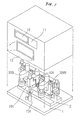
- reference numeral 1 denotes a main base
- 2 denotes a sub-base that is fixed to the main base 1.
- a lens chuck upper part 100 and a lens chuck lower part 150 hold a subject lens by means of their respective chuck shafts during processing it.
- a lens thickness measuring section 400 is accommodated below the lens chuck upper part 100 in the depth of the sub-base 2.
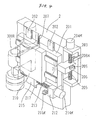
- Reference symbols 300R and 300L respectively represent right and left lens grinding parts each having grinding wheels for lens grinding on its rotary shaft.
- Each of the lens grinding parts 300R and 300L is held by a moving mechanism (described later) so as to be movable in the vertical and horizontal directions with respect the sub-base 2.
- a rough grinding wheel 30 for plastics and a finishing grinding wheel 31 are mounted on the rotary shaft of the lens grinding part 300L.
- a front surface chamfering grinding wheel 32 having a conical surface is coaxially attached to the upper end surface of the fishing grinding wheel 31, while a rear surface chamfering grinding wheel 33 having a conical surface is coaxially attached to the lower end surface of the rough grinding wheel 30.
- a mirror-finishing grinding wheel 34 is mounted on the rotary shaft of the lens grinding part 300R.
- a rough grinding wheel 30 for plastics which is the same as that of the lens grinding part 300L, a front surface mirror-chamfering grinding wheel 35 having a conical surface, and a rear surface mirror-chamfering grinding wheel 36 having a conical surface are coaxially mounted on the rotary shaft of the lens grinding part 300R.
- the diameter of these grinding wheels are relatively small, that is, about 60 mm.
- a display unit 10 for displaying processing data and other information and an input unit 11 for allowing a user to input data or an instruction to the lens grinding apparatus are provided in the front surface of a body of the apparatus.
- Reference numeral 12 denotes a closable door.
- Fig. 3 illustrates the lens chuck upper part 100 and the lens chuck lower part 150.
- a fixing block 101 is fixed to the sub-base 2.
- a DC motor 103 is mounted on top of the fixing block 101 by means of a mounting plate 102, and a pulley 104 is attached to the rotary shaft of the DC motor 103.
- a feed screw 105 is rotatably held by the fixing block 101 through a bearing 106, and a pulley 107 is attached to the upper end of the feed screw 105.
- a timing belt 108 engages with the two pulleys 104 and 107.
- a chuck shaft 121 is rotatably held by a chuck shaft holder 120 through bearings 122 and 123.
- a nut 124 that is threadedly engaged with the feed screw 105 is fixed to the chuck shaft holder 120.
- the chuck shaft holder 120 is formed with a guide groove along a vertically extending guide rail 109 that is fixed to the fixing block 101.
- the rotational force of the DC motor 103 is transmitted to the feed screw 105 via the pulley 104, timing belt 108, and pulley 107.
- the nut 124 that is threadedly engaged with the feed screw 104 causes the chuck shaft holder 120 to move vertically being guided by the guide rail 109.
- a micro switch 110 which is attached to the fixing block 101, detects a reference position when the chuck shaft holder 120 is elevated.
- a pulse motor 130 for rotating the chuck shaft 121 is fixed to the top portion of the chuck holder 120.
- the rotational force of the pulse motor 130 is transmitted, via a gear 131 that is attached to its rotary shaft and a relay gear 132, to a gear 133 that is attached to the chuck shaft 121, to rotate the chuck shaft 121.
- Reference numeral 135 denotes a photosensor and 136 denotes a light-shielding plate that is mounted on the chuck shaft 121.
- the photosensor 135 detects a rotation reference position of the chuck shaft 121.
- a lower chuck shaft 152 is rotatably held by a chuck shaft holder 151 through bearings 153 and 154, and the chuck shaft holder 151 is fixed to the main base 1.
- a gear 155 is fixed to the bottom end of the chuck shaft 152.
- the rotational force of a pulse motor 156 is transmitted to the chuck shaft 151 to the chuck shaft 121 by a gear arrangement (not shown) that is similar to the counterpart in the upper chuck part, to rotate the chuck shaft 151.
- Reference numeral 157 denotes a photosensor and 158 denotes a light-shielding plate that is mounted on the gear 155.
- the photosensor 157 detects a rotation reference position of the lower chuck shaft 151.
- Fig. 4 illustrates a mechanism for moving the right lens grinding part 300R. (Since a moving mechanism for the left lens grinding part 300L is symmetrical with the right lens grinding part 300R, it will not be described.)
- a vertical slide base is vertically slidable along two guide rails 202 that are fixed to the front surface of the sub-base 2.
- a vertically moving mechanism for the vertical slide base 201 is structured as follows.
- a bracket-shaped screw holder 203 is fixed to the right side surface of the sub-base 2.
- a pulse motor 204R is fixed to the surface of the screw holder 203, and a ball screw 205 that is rotatably held by the screw holder 203 is coupled to the rotary shaft of the pulse motor 204R.
- a nut block 206 has a nut which is threadedly engaged with the ball screw 205, and is fixed to the side surface of the vertical slide base 201.
- the vertical slide base 201 When the pulse motor 204R rotates the ball screw 205, the vertical slide base 201 is moved accordingly in the vertical direction being guided by the guide rails 202.
- a spring 207 is provided between the sub-base 2 and the vertical slide base 201. That is, the spring 207 urges the vertical slide base 201 upward to cancel out the downward load of the vertical slide base 201, thereby facilitating its vertical movement.
- a photosensor 208R is fixed to the screw holder 203, and a light-shielding plate 209 is fixed to the nut block 206.
- the photosensor 208R determines a reference position of the vertical movement of the vertical slide base 201 by detecting the position of the light-shielding plate 209.
- the lens grinding part 300R is foxed to a horizontal slide base 210.
- the horizontal slide base 210 is slidable in the horizontal direction along two slide guide rails 211 that are fixed to the front surface of the vertical slide base 201.
- a mechanism for moving the horizontal slide base 210 is basically the same as the above-described moving mechanism for the vertical slide base 201.
- a bracket-shaped screw holder 212 is fixed to the bottom surface of the vertical slide base 201, and holds a ball screw 213 rotatably.
- a pulse motor 214R is fixed to the side surface the screw holder 212, and the ball screw 213 is coupled to the rotary shaft of the pulse motor 214R.
- the ball screw 213 is in threaded engagement with a nut block 215 that is fixed to the bottom surface of the horizontal slide base 210.
- the pulse motor 214R rotates the ball screw 213
- the horizontal slide base 210 that is fixed to the nut block 215 is moved accordingly in the horizontal direction along the guide rails 211.
- a photosensor 216R is fixed to the screw holder 212, and a light-shielding plate 217 is fixed to the nut block 215.
- the photosensor 216R determines a reference position of the horizontal movement of the horizontal slide base 210 by detecting the position of the light-shielding plate 215.
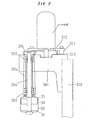
- Fig. 5 is a side sectional view showing the structure of the right lens grinding part 300R.
- a shaft support base 301 is fixed to the horizontal slide base 210.
- a housing 305 is fixed to the front portion of the shaft support base 301, and rotatably holds therein a vertically extending rotary shaft 304 through bearings 302 and 303.
- a group of grinding wheels including a rough grinding wheel 30 are mounted on the lower portion of the rotary shaft 304.
- a servo motor 310R for rotating the grinding wheels is fixed to the top surface of the shaft support base 301 through a mounting plate 311.
- a pulley 312 is attached to the rotary shaft of the servo motor 310R, and coupled, via a belt 313, to another pulley 306 that is attached to the upper end of the rotary shaft 304.
- each of the right and left lens grinding parts 300R and 300L is moved vertically and horizontally with respect to a subject lens being is held by the upper and lower chuck shafts 121 and 152.
- These movements of the right and left grinding parts 300R and 300L bring selected ones of the grinding wheels into contact with the subject lens, so that the selected grinding wheels grind the subject lens.
- the lens grinding apparatus includes the two groups of grinding wheels respectively mounted on the two rotary shafts thereof, it can grind the subject lens from the two directions at the same time (details of the grinding operation will be described later).
- the rotation axis of the chuck shafts 121 and 152 of the lens chuck upper part 100 and the lens chuck lower part 150 is so arranged as to be located on the straight line connecting the centers of the two respective shafts 304 of the lens grinding parts 300R and 300L (see Fig. 6).
- Fig. 7 illustrates the lens thickness measuring section 400.
- the lens thickness measuring section 400 includes a measuring arm 527 having two rotatable feelers 523 and 524, a rotation mechanism such as a DC motor (not shown) for rotating the measuring arm 527, a sensor plate 510 and photo-switches 504 and 505 for detecting the rotation of the measuring arm 527 to thereby allow control of the rotation of the DC motor, a detection mechanism such as a potentiometer 506 for detecting the amount of rotation of the measuring arm 527 to thereby obtain the shapes of the front and rear surfaces of the subject lens.
- the configuration of the lens thickness measuring section 400 is basically the same as that disclosed in Japanese Unexamined Patent Publication No. Hei. 3-20603 and U.S. Patent No.
- the lens thickness measuring section 400 of Fig. 7 is so controlled as to move in front-rear direction (indicated by arrows in Fig. 7) relative to the lens grinding apparatus by a front-rear moving means 401 based on measurement data of a lens shape measuring apparatus.
- the lens thickness is measured such that the measuring arm 527 is rotated upward from its lower initial position and the feelers 523 and 524 are respectively brought into contact with the front and rear refraction surfaces of the lens. Therefore, it is preferable that the rotary shaft of the measuring arm 527 be equipped with a coil spring or the like which cancels out the downward load of the measuring arm 527.
- the lens thickness (edge thickness) measurement is performed in the following manner. First, the lens thickness measuring section 400 is moved forward or backward by the front-rear moving means, and the measuring arm 527 is rotated, that is, elevated. The shape of the lens front refraction surface is obtained by rotating the lens while keeping the feeler 523 in contact with the lens front refraction surface (bevel bottom (or bevel top)). Then, the shape of the lens rear refraction surface is obtained by rotating the lens while keeping the feeler 524 in contact with the lens rear refraction surface to (this operation is basically the same as disclosed in Japanese Unexamined Patent Publication No. Hei. 3-20603 and U.S. Patent No. 5,333,412 mentioned above).
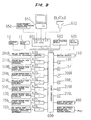
- Fig. 8 is a block diagram showing a general configuration of a control system of the lens grinding apparatus.
- Reference character 600 denotes a control unit which controls the whole apparatus.
- the display unit 10, input unit 11, micro switch 110, and photosensors are connected to the control unit 600.
- the motors for moving or rotating the respective parts are connected to the control unit 600 via drivers 620-628.
- the drivers 622 and 625 which are respectively connected to the servo motor 310R for the right lens grinding part 300R and the servo motor 310L for the left lens grinding part 300L, detect the torque of the servo motors 310R and 310L during the processing and feed back the detected torque to the control unit 600.
- the control unit 600 uses the torque information to control the movement of the lens grinding parts 300R and 300L as well as the rotation of the lens.
- Reference numeral 601 denotes an interface circuit which serves to transmit and receive data.
- a lens frame shape measuring apparatus 650, a host computer 651 for managing lens processing data, a bar code scanner 652, etc. may be connected to the interface circuit 601.
- a main program memory 602 stores a program for operating the lens grinding apparatus.
- a data memory 603 stores data that are supplied through the interface circuit 601, lens thickness measurement data, and other data.
- the operation of the lens grinding apparatus having the above-described configuration will be hereinafter described.
- the following description will be directed to a case where various kinds of data including the data (three-dimensional configurational data on a lens frame shape and a template) of a lens shape measuring apparatus 650 (see U.S. Patent No. 5,228,242, for instance) installed in each optician's shop, layout data (a distance between geometrical centers of both lens frame portions, a pupillary distance, etc.), a lens kind and strength data, and other data are transmitted through public communications lines to the host computer 651 which is provided in a processing center, and a lens is processed by the lens grinding apparatus according to the embodiment. It is assumed that the subject lens is a plastic lens, and that the lens is bevel-processed and then chamfered.
- Data that have been transmitted to the host computer 651 are input to the control unit 600 via the interface circuit 601 and then transferred to and stored into the data memory 603.
- the control unit 600 displays the received data on the display unit 10.
- An operator performs a given treatment on the subject lens, and places it on the chuck shaft 152.
- the operator depresses a start switch of the input unit 11 to start the processing.
- the lens grinding apparatus automatically performs a lens edge thickness measurement, rough processing, bevel processing, and chamfering, which will be described below in order.
- the control unit 600 drives the DC motor 103 to lower the chuck shaft holder 120, to thereby hold the subject lens by means cf the chuck shafts 121 and 152.
- the control unit 600 produces processing data which has the position of the lens optical axis as the origin based on the layout data, lens frame shape data, and other data. Edge information of the bevel top or bottom (preferably, the bevel bottom) is obtained in the edge thickness measurement of the subject lens.
- the motors 130 and 156 are driven to rotate the subject lens being held by the chuck shafts 121 and 152.
- the motors 130 and 156 are rotation-driven in synchronism with each other under the control of the control unit 600.
- the control unit 600 produces data of bevel processing data to be performed on the lens according to a given program and based on the measurement data (edge information) that has been obtained by the lens measuring section 400.
- the calculation of the bevel processing data there are proposed several methods including a method of calculating a curve from front and rear surface curves, a method of dividing the edge thickness, and a combination of these methods.
- U.S. Patent No. 5,347,762 filed by the present assignee.
- the bevel processing data thus obtained are stored in the data memory 603.
- the control unit 600 performs rough processing based on the lens processing data. That is, the control unit 600 drives the servo motors 310R and 310L to rotate the grinding wheels. As shown in Fig. 6, the grinding wheels of the left lens grinding part 300L are rotated counterclockwise (indicated by arrow A shown in Fig. 6) while the grinding wheels of the right lens grinding part 300R are rotated clockwise (indicated by arrow B). Further, the control unit 600 drives the pulse motors 204R and 204L to lower the right and left vertical slide bases 210, and causes both of the right and left rough grinding wheels 30 to be located at the same height as the subject lens by controlling the number of pulses applied to the pulse motors 204R and 204L. Then, the control unit 600 drives the pulse motors 214R and 214L to horizontally slide the lens grinding parts 300R and 300L toward the subject lens.
- the right and left rough grinding wheels 30 are moved toward the subject lens while being rotated, thereby gradually grind the subject lens from the two directions.
- the amounts of movement of the right and left rough grinding wheels 30 are controlled independently based on the lens frame shape data. That is, the movement of the two rough grinding wheels 30 is toward the subject lens is controlled based on lens frame shape data of the directions where the two rough grinding wheels 30 exist (as defined with respect to the reference direction of the subject lens being held by the chuck shafts 121 and 152).
- the right and left rough grinding wheels 30 are moved based on two shape data that are deviated from each other by 180°.
- the control unit 600 monitors the torque (i.e., motor load current) of each of the two servo motors 310R and 310L through the drivers 622 and 625.
- the control unit 600 synchronously drives the pulse motors 130 and 156 for the chuck shafts 121 and 152 to thereby start rotation of the lens being held by those chuck shafts (in the direction of arrow C in Fig. 6).
- This grinding operation is so performed that a value obtained by subtracting the radius of the grinding wheel 30 from the distance between the rotation center of each grinding wheel 30 and the lens processing center (i.e., the center of the chuck shafts 121 and 152) coincides with a frame shape value (plus a bevel processing margin) corresponding to a rotation angle of the subject lens.
- This grinding operation is based on the rotation angle data of the lens (which is obtained from the number of pulses supplied to the servo motors 130 and 156).
- the control unit 600 stops driving the pulse motors 130 and 156 for the chuck shafts 121 and 152 to thereby stop the rotation of the subject lens, and also stops the movement toward the lens of the rough grinding wheel 30 for which the torque has reached the given upper limit (or causes the rough grinding wheel 30 to retract a little).
- This measure can prevent an excessive load from being exerted on the subject lens as well as avoid such troubles as lens breakage.
- the control unit 600 permits movement of the rough grinding wheel 30 toward the subject lens and again rotates the lens, to restart grinding.
- the lens grinding apparatus performs rough processing on the subject lens by use of the two shafts that are located in the two respective directions deviated from each other by 180° based on the frame shape data while controlling the movement of the right and left rough grinding wheels 30 toward the lens (right-left direction) and the rotation of the lens with the monitoring of the torque of each of the servo motors 310R and 310L.
- the rough processing is completed while the subject lens makes 0.5 to 1.5 rotations depending on the lens edge thickness and the grinding amount.
- This rough grinding operation can be completed in a shorter time than a rough grinding operation from one direction by use of one shaft. Further, as shown in Fig.
- the torsion of the lens can be reduced from the case of a rotational mechanism in which the two chuck shafts are rotated by a single motor. This also contributes to improving the processing accuracy.
- bevel processing is started automatically.
- the control unit 600 drives the moving mechanisms for the lens grinding parts 300R and 300L so as to disengage the two rough grinding wheels 30 from the lens.
- the lens grinding part 300R is returned back to its original position and the rotation of the grinding wheels are stopped.
- the left lens grinding part 300L is moved based on the bevel processing data stored in the data memory 603 so that the V-groove of the finishing grinding wheel 31 is set at a height of an intended bevel shape of the lens. (Alternatively, first the lens grinding part 300L may also be returned to its original position, and then it may be moved toward the lens).
- bevel processing is performed such that based on the bevel processing data, the motor 214L is drive-controlled to move the finishing grinding wheel 31 in the right-left direction (toward the lens) and the motor 204L is drive-controlled to move the finishing grinding wheel 31 vertically.
- the control unit 600 monitors the torque of the servo motor 310L in the same manner as in the rough processing. When the control unit 600 has judged, through the torque monitoring, that the torque of the servo motor 310L has reached a given upper limit, it stops the movement of the finishing grinding wheel 31 and the rotation of the lens.
- control unit 600 When the control unit 600 has judged that the torque of the servo motor 310L has decreased to a given torque-up permission level, it restarts the movement of the finishing grinding wheel and the rotation of the lens. In this manner, the bevel processing is performed on the whole peripheral edge of the subject lens.
- the control unit 600 calculates, in consideration of a given chamfering amount (for instance, 0.3 mm), chamfering data (for the front and rear surfaces) by using front surface and rear surface curve data that are produced based on the measured data of the lens measuring section 400 (curves are obtained by substituting the measured data into a general formula of a spherical surface and solving the resulting simultaneous equations) and longitudinal line data that are produced based on the layout data, the lens frame shape data, and other data (as described above, in the present embodiment the point on the lens optical axis is employed as the origin). (Alternatively, there may be prepared a table which correlates the cutting amount of chamfering with the curve and the distance from the center of processing).
- the vertical and horizontal movement of the front surface chamfering grinding wheel 32 and rear surface chamfering grinding wheel 33 are controlled based on the chamfering data.
- front and rear surface curve data of an aspherical lens it is preferable to calculate curves for respective longitudinal lines.
- a low-diopter astigmatic lens may be considered a spherical surface.
- the lens grinding apparatus performs a front surface chamfering operation. That is, the control unit 600 moves the front surface chamfering grinding wheel 32 of the left lens grinding part 300L in the vertical direction so that the grinding wheel 32 is set at a chamfering height of the front surface shoulder portion of the subject lens, and moves, while rotating it, the front surface chamfering grinding wheel 32 toward the lens based on the chamfering data. Thereafter, the control unit 600 rotates the subject lens, and controls the vertical and horizontal movement of the chamfering grinding wheel 32 based on the front surface chamfering data, to thereby chamfer the whole periphery of the lens. Since the chamfering grinding wheel 32 has a relatively smaller diameter, it can chamfer most of lenses without contacting with any portions other than the portion to be chamfered.
- the rear surface chamfering grinding wheel 33 Upon completion of the front surface chamfering operation, the rear surface chamfering grinding wheel 33 is set at a chamfering height of the rear surface shoulder portion of the subject lens, and a chamfering operation is carried out based on the rear surface chamfering data in the same manner as in the above operation.
- the chamfering can be carried out efficiently without the need of a complicated chamfering mechanism.
- grinding wheels mounted on the two rotary axes various combinations other than those of the above embodiment may be employed.
- grinding wheels for glass may be used in place of the rough grinding wheels 30 for plastics.
- grinding wheels for glass may be added to the above-described grinding wheel combinations with the two rotary shafts.
- the bevel processing is performed with the finishing grinding wheel 31 that is mounted on one shaft
- another finishing grinding wheel 31 may be mounted also on the right lens grinding part 300R to perform the bevel processing from the two directions with the two shafts in the same manner as in the rough processing.
- the bevel processing time that is, the total processing time can be shortened.
- chamfering grinding wheels of the same configuration may be provided on the right and left sides, and chamfering operations on the rear surface side and the front surface side of the lens may be carried out at the same time.
- a key to be used for specifying a chamfering amount may be provided in the input unit 11.
- it is more effective to add a chamfering simulation function to a function of simulating a virtual bevel shape of a certain bevel processing data based on lens edge thickness measurement data see Japanese Unexamined Patent Publication No. Hei. 3-20603, which function is provided in an apparatus that allows specification of a curve and a position of a bevel shape.
Landscapes
- Engineering & Computer Science (AREA)
- Mechanical Engineering (AREA)
- Chemical & Material Sciences (AREA)
- Ceramic Engineering (AREA)
- Inorganic Chemistry (AREA)
- Grinding And Polishing Of Tertiary Curved Surfaces And Surfaces With Complex Shapes (AREA)
Claims (6)
- Eine Linsenschleifvorrichtung zur Durchführung einer Rahmenanpassung an einer Brillenlinse, mit:einer Eingabevorrichtung zum Empfang von Daten für die Rahmenanpassungsbearbeitung einschließlich Linsenrand-Positionsdaten;Vorrichtungen zum Berechnen von Bearbeitungsdaten auf der Grundlage der durch die Eingabevorrichtung erhaltenen Daten;Linsenhaltewellen zum Halten einer zu bearbeitenden Linse dazwischen;Vorrichtungen zum Drehen der Linsenhaltewellen;eine Schleifscheibenwelle, an der eine Schleifscheibe zur groben Schleifbearbeitung der Linsenkante und zur Abfasung und eine Schleifscheibe zum Abschrägen koaxial angeordnet sind;
wobei die Schleifscheibe zum Abfasen eine erste Schleifscheibe zum Abfasen einer Vorderseite der Linse und eine zweite Schleifscheibe zum Abfasen einer Rückseite der Linse aufweist;
wobei ein maximaler Durchmesser jeder der ersten und zweiten Schleifscheiben im wesentlichen gleich einem maximalen Durchmesser der Schleifscheiben für die grobe Schleifbearbeitung der Linsenkante und zum Abfasen ist; und
wobei jede der ersten und zweiten Schleifscheiben bezüglich den Schleifscheiben zum groben Linsenkantenschleifen und zum Abfasen an einer äußersten Position angeordnet ist;Vorrichtungen zum Drehen der Schleifscheibenwelle um ihre Achse;Bewegungsvorrichtungen zum Bewegen der Schleifscheibenwelle in Richtung einer Drehachse der Linsenhaltewellen und zum Bewegen der Schleifscheibenwelle in einer Längsrichtung hiervon relativ zu der zu bearbeitenden Linse, um die zu bearbeitende Linse zu schleifen oder abzuschrägen; undSteuervorrichtungen zum Steuern der Schleifacheibenwellen-Bewegungsvorrichtungen auf der Grundlage der Bearbeitungsdaten beim groben und Abfasungs-Bearbeiten und beim Abschrägen. - Die Linsenschleifvorrichtung nach Anspruch 1, wobei die Eingabevorrichtung Formmeßvorrichtungen zum Messen der Formen vorderer und hinterer Oberflächen der zu bearbeitenden Linse und Vorrichtungen aufweist zum Empfang von Brillenrahmendaten durch eine Brillenrahmen-Formmeßvorrichtung und von Layoutdaten, wobei die Bearbeitungedaten-Berechnungsvorrichtungen Vorrichtungen zum Berechnen einer Bewegungsdistanz der Schleifscheibenwelle auf der Grundlage von Daten beinhalten, welche die Formen der vorderen und hinteren Oberflächen der zu bearbeitenden Linse anzeigen, sowie auf der Grundlage von Brillenrahmendaten und der Layout-Daten.
- Die Linsenschleifvorrichtung nach Anspruch 2, wobei die Formmeßvorrichtungen weiterhin als Vorrichtungen zum Messen der Position des Randes der zu bearbeitenden Linse dienen, welche noch nicht bearbeitet wurde.
- Die Linsenschleifvorrichtung nach Anspruch 1, weiterhin mit Vorrichtungen, welche eine Spezifikation eines Abschrägungsbetrages erlauben.
- Die Linsenschleifvorrichtung nach Anspruch 1, wobei jede der Schleifscheiben zum Linsenschleifen und die Schleifscheibe zum Abschrägen einen Durchmesser von ungefähr 60 mm hat.
- Die Linsenschleifvorrichtung nach Anspruch 1, wobei die Schleifscheibenwellen-Bewegungsvorrichtungen die Schleifscheibenwelle in ihrer Längsrichtung derart bewegen, daß zumindest die Schleifscheiben zum Linsenschleifen oder die Schleifscheiben zum Abschrägen in einer Ausgangsposition zur Bearbeitung der zu bearbeitenden Linse angeordnet werden.
Applications Claiming Priority (3)
| Application Number | Priority Date | Filing Date | Title |
|---|---|---|---|
| JP9744596 | 1996-03-26 | ||
| JP09744596A JP4011134B2 (ja) | 1996-03-26 | 1996-03-26 | レンズ研削加工装置 |
| JP97445/96 | 1996-03-26 |
Publications (3)
| Publication Number | Publication Date |
|---|---|
| EP0798077A1 EP0798077A1 (de) | 1997-10-01 |
| EP0798077B1 EP0798077B1 (de) | 2000-03-15 |
| EP0798077B2 true EP0798077B2 (de) | 2005-12-28 |
Family
ID=14192533
Family Applications (1)
| Application Number | Title | Priority Date | Filing Date |
|---|---|---|---|
| EP96111388A Expired - Lifetime EP0798077B2 (de) | 1996-03-26 | 1996-07-15 | Linsenschleifgerät mit auf der gleichen Spindel montierten Randfase- und anderen Schleifsteinen |
Country Status (4)
| Country | Link |
|---|---|
| US (1) | US5803793A (de) |
| EP (1) | EP0798077B2 (de) |
| JP (1) | JP4011134B2 (de) |
| DE (1) | DE69607135T3 (de) |
Families Citing this family (24)
| Publication number | Priority date | Publication date | Assignee | Title |
|---|---|---|---|---|
| JP3667483B2 (ja) * | 1997-02-10 | 2005-07-06 | 株式会社ニデック | レンズ研削加工装置 |
| JPH10249692A (ja) * | 1997-03-11 | 1998-09-22 | Nidek Co Ltd | レンズ研削加工装置、レンズ研削加工方法及びそのための部品 |
| EP0868972B1 (de) | 1997-03-26 | 1999-06-09 | Optotech Optikmaschinen GmbH | Verfahren und Vorrichtung zur Bearbeitung optischer Linsen |
| JP4034868B2 (ja) * | 1997-03-31 | 2008-01-16 | 株式会社ニデック | レンズ研削加工装置 |
| JP4068177B2 (ja) * | 1997-03-31 | 2008-03-26 | 株式会社ニデック | レンズ研削加工装置 |
| JPH10328993A (ja) * | 1997-05-26 | 1998-12-15 | Topcon Corp | レンズ形状測定装置 |
| JP4002324B2 (ja) * | 1997-07-08 | 2007-10-31 | 株式会社ニデック | レンズ研削装置 |
| JPH11198013A (ja) * | 1998-01-09 | 1999-07-27 | Olympus Optical Co Ltd | 芯取り加工機 |
| JP3730406B2 (ja) | 1998-04-30 | 2006-01-05 | 株式会社ニデック | 眼鏡レンズ加工装置 |
| JP3730409B2 (ja) * | 1998-05-29 | 2006-01-05 | 株式会社ニデック | 眼鏡レンズ加工装置 |
| JP3778707B2 (ja) | 1998-09-29 | 2006-05-24 | 株式会社ニデック | 眼鏡レンズ加工装置 |
| DE19914174A1 (de) * | 1999-03-29 | 2000-10-12 | Wernicke & Co Gmbh | Verfahren und Vorrichtung zum Formbearbeiten des Umfangsrandes von Brillengläsern |
| JP4360764B2 (ja) * | 2000-04-28 | 2009-11-11 | 株式会社トプコン | 眼鏡レンズのレンズ周縁加工方法、レンズ周縁加工装置及び眼鏡レンズ |
| JP3990104B2 (ja) * | 2000-10-17 | 2007-10-10 | 株式会社ニデック | レンズ研削加工装置 |
| JP4429535B2 (ja) * | 2001-02-06 | 2010-03-10 | 株式会社トプコン | レンズ形状測定装置 |
| JP2003300140A (ja) * | 2002-04-08 | 2003-10-21 | Hoya Corp | レンズ加工装置 |
| ES2510466T3 (es) * | 2003-11-05 | 2014-10-21 | Hoya Corporation | Método para suministrar lentes de gafas |
| US7090559B2 (en) * | 2003-11-19 | 2006-08-15 | Ait Industries Co. | Ophthalmic lens manufacturing system |
| FR2870471B1 (fr) * | 2004-05-18 | 2006-08-25 | Briot Internat Sa | Procede de rainage ou de contre-biseautage de la peripherie d'une lentille ophtalmique |
| US7396275B2 (en) * | 2005-12-30 | 2008-07-08 | Essilor International (Compagnie General D'optique) | Polishing machine comprising sliding means transverse to the front face |
| JP5745909B2 (ja) * | 2011-03-30 | 2015-07-08 | 株式会社ニデック | 眼鏡レンズ周縁加工装置 |
| CN109926875B (zh) * | 2019-03-08 | 2024-06-04 | 河南省林晓科技开发有限公司 | 一种地铁疏散平台拉杆磨尖机及加工方法 |
| CN111216027A (zh) * | 2020-01-20 | 2020-06-02 | 江苏扬阳化工设备制造有限公司 | 一种用于搪玻璃设备内壁的调节抛光装置 |
| CN121821186B (zh) * | 2026-03-13 | 2026-07-24 | 福建省南安市裕兴石业有限公司 | 一种不同尺寸大理石倒角打磨设备 |
Family Cites Families (13)
| Publication number | Priority date | Publication date | Assignee | Title |
|---|---|---|---|---|
| US1521116A (en) * | 1921-04-07 | 1924-12-30 | George P Miller | Machine for beveling the edges of optical lenses |
| US2748541A (en) * | 1953-02-05 | 1956-06-05 | Connell Wade Hampton | Edge grinding optical lenses |
| US3158967A (en) * | 1963-02-01 | 1964-12-01 | Sun Tool And Machine Company | Machine and method for edge grinding lens blanks |
| JPS60238265A (ja) * | 1984-05-08 | 1985-11-27 | Tokyo Optical Co Ltd | 面取り用砥石及びそれを有する玉摺機 |
| DE3608957C2 (de) * | 1986-03-18 | 1994-02-10 | Wernicke & Co Gmbh | Brillenglasrandschleifmaschine |
| DE3814670A1 (de) * | 1988-04-28 | 1989-11-09 | Schoene Optik Maschinenfabrik | Brillenglasrandschleifmaschine |
| JP2761590B2 (ja) * | 1989-02-07 | 1998-06-04 | 株式会社ニデック | 眼鏡レンズ研削加工機 |
| US5053971A (en) * | 1989-08-30 | 1991-10-01 | Gerber Optical, Inc. | Method and apparatus for edging an optical lens |
| JPH03211458A (ja) * | 1990-01-17 | 1991-09-17 | Hitachi Constr Mach Co Ltd | 超音波顕微鏡の傾斜検出装置 |
| DE9004305U1 (de) * | 1990-04-18 | 1990-07-26 | Weco Wernicke & Co GmbH, 4000 Düsseldorf | Vorrichtung zum Randen von Brillengläsern |
| JP2925685B2 (ja) * | 1990-08-02 | 1999-07-28 | 株式会社ニデック | フレーム形状測定装置 |
| US5333412A (en) * | 1990-08-09 | 1994-08-02 | Nidek Co., Ltd. | Apparatus for and method of obtaining processing information for fitting lenses in eyeglasses frame and eyeglasses grinding machine |
| JP3011526B2 (ja) * | 1992-02-04 | 2000-02-21 | 株式会社ニデック | レンズ周縁加工機及びレンズ周縁加工方法 |
-
1996
- 1996-03-26 JP JP09744596A patent/JP4011134B2/ja not_active Expired - Lifetime
- 1996-07-12 US US08/682,884 patent/US5803793A/en not_active Expired - Lifetime
- 1996-07-15 DE DE69607135T patent/DE69607135T3/de not_active Expired - Lifetime
- 1996-07-15 EP EP96111388A patent/EP0798077B2/de not_active Expired - Lifetime
Also Published As
| Publication number | Publication date |
|---|---|
| EP0798077A1 (de) | 1997-10-01 |
| JP4011134B2 (ja) | 2007-11-21 |
| DE69607135D1 (de) | 2000-04-20 |
| EP0798077B1 (de) | 2000-03-15 |
| DE69607135T2 (de) | 2000-08-31 |
| US5803793A (en) | 1998-09-08 |
| JPH09254000A (ja) | 1997-09-30 |
| DE69607135T3 (de) | 2006-09-21 |
Similar Documents
| Publication | Publication Date | Title |
|---|---|---|
| EP0798076B1 (de) | Linsenschleifgerät zum Schleifen von Brillengläsern aus mehreren Richtungen | |
| EP0798077B1 (de) | Linsenschleifgerät mit auf der gleichen Spindel montierten Randfase- und anderen Schleifsteinen | |
| JP3730406B2 (ja) | 眼鏡レンズ加工装置 | |
| EP0857540B1 (de) | Linsenschleifgerät | |
| EP0890414B1 (de) | Linsenschleifvorrichtung | |
| EP1938923B1 (de) | Verfahren zum Schleifen einer Brillenglaslinse und Vorrichtung zum Schleifen einer Brillenglaslinse | |
| EP0917929B1 (de) | Linsenschleifmaschine | |
| EP0894567B1 (de) | Verfahren und Vorrichtung zum Messen eines Brillenlinsengestellaufbaus und Brillenlinsenschleifmaschine unter Verwendung desselben | |
| EP0904894B1 (de) | Vorrichtung zum Schleifen von Brillengläsern | |
| EP0917930B1 (de) | Linsenschleifmaschine | |
| EP1199134B1 (de) | Linsenschleifvorrichtung | |
| JP3774529B2 (ja) | レンズ研削加工装置 | |
| EP0857539B1 (de) | Linsenschleifgerät | |
| JP4036931B2 (ja) | 眼鏡レンズ研削装置 | |
| JPH11216651A (ja) | 眼鏡レンズ研削加工装置 | |
| JPH10225854A (ja) | レンズ研削加工装置 | |
| JPH11156685A (ja) | 眼鏡レンズ研削装置 |
Legal Events
| Date | Code | Title | Description |
|---|---|---|---|
| PUAI | Public reference made under article 153(3) epc to a published international application that has entered the european phase |
Free format text: ORIGINAL CODE: 0009012 |
|
| AK | Designated contracting states |
Kind code of ref document: A1 Designated state(s): DE FR GB |
|
| 17P | Request for examination filed |
Effective date: 19980331 |
|
| GRAG | Despatch of communication of intention to grant |
Free format text: ORIGINAL CODE: EPIDOS AGRA |
|
| 17Q | First examination report despatched |
Effective date: 19990526 |
|
| GRAG | Despatch of communication of intention to grant |
Free format text: ORIGINAL CODE: EPIDOS AGRA |
|
| GRAH | Despatch of communication of intention to grant a patent |
Free format text: ORIGINAL CODE: EPIDOS IGRA |
|
| GRAH | Despatch of communication of intention to grant a patent |
Free format text: ORIGINAL CODE: EPIDOS IGRA |
|
| GRAA | (expected) grant |
Free format text: ORIGINAL CODE: 0009210 |
|
| AK | Designated contracting states |
Kind code of ref document: B1 Designated state(s): DE FR GB |
|
| REF | Corresponds to: |
Ref document number: 69607135 Country of ref document: DE Date of ref document: 20000420 |
|
| ET | Fr: translation filed | ||
| PLBQ | Unpublished change to opponent data |
Free format text: ORIGINAL CODE: EPIDOS OPPO |
|
| PLBI | Opposition filed |
Free format text: ORIGINAL CODE: 0009260 |
|
| PLBQ | Unpublished change to opponent data |
Free format text: ORIGINAL CODE: EPIDOS OPPO |
|
| PLAB | Opposition data, opponent's data or that of the opponent's representative modified |
Free format text: ORIGINAL CODE: 0009299OPPO |
|
| PLBF | Reply of patent proprietor to notice(s) of opposition |
Free format text: ORIGINAL CODE: EPIDOS OBSO |
|
| 26 | Opposition filed |
Opponent name: LOH OPTIKMASCHINEN AG Effective date: 20001215 Opponent name: LOH OPTIKMASCHINEN AG Effective date: 20001214 |
|
| R26 | Opposition filed (corrected) |
Opponent name: LOH OPTIKMASCHINEN AG Effective date: 20001214 |
|
| PLBF | Reply of patent proprietor to notice(s) of opposition |
Free format text: ORIGINAL CODE: EPIDOS OBSO |
|
| PLBF | Reply of patent proprietor to notice(s) of opposition |
Free format text: ORIGINAL CODE: EPIDOS OBSO |
|
| REG | Reference to a national code |
Ref country code: GB Ref legal event code: IF02 |
|
| PLBO | Opposition rejected |
Free format text: ORIGINAL CODE: EPIDOS REJO |
|
| APAC | Appeal dossier modified |
Free format text: ORIGINAL CODE: EPIDOS NOAPO |
|
| APAC | Appeal dossier modified |
Free format text: ORIGINAL CODE: EPIDOS NOAPO |
|
| APAA | Appeal reference recorded |
Free format text: ORIGINAL CODE: EPIDOS REFN |
|
| PLAQ | Examination of admissibility of opposition: information related to despatch of communication + time limit deleted |
Free format text: ORIGINAL CODE: EPIDOSDOPE2 |
|
| PLAR | Examination of admissibility of opposition: information related to receipt of reply deleted |
Free format text: ORIGINAL CODE: EPIDOSDOPE4 |
|
| PLBQ | Unpublished change to opponent data |
Free format text: ORIGINAL CODE: EPIDOS OPPO |
|
| PLAB | Opposition data, opponent's data or that of the opponent's representative modified |
Free format text: ORIGINAL CODE: 0009299OPPO |
|
| APBU | Appeal procedure closed |
Free format text: ORIGINAL CODE: EPIDOSNNOA9O |
|
| R26 | Opposition filed (corrected) |
Opponent name: SATISLOH GMBH Effective date: 20001214 |
|
| APAH | Appeal reference modified |
Free format text: ORIGINAL CODE: EPIDOSCREFNO |
|
| PUAH | Patent maintained in amended form |
Free format text: ORIGINAL CODE: 0009272 |
|
| STAA | Information on the status of an ep patent application or granted ep patent |
Free format text: STATUS: PATENT MAINTAINED AS AMENDED |
|
| 27A | Patent maintained in amended form |
Effective date: 20051228 |
|
| AK | Designated contracting states |
Kind code of ref document: B2 Designated state(s): DE FR GB |
|
| ET3 | Fr: translation filed ** decision concerning opposition | ||
| PGFP | Annual fee paid to national office [announced via postgrant information from national office to epo] |
Ref country code: DE Payment date: 20130711 Year of fee payment: 18 |
|
| PGFP | Annual fee paid to national office [announced via postgrant information from national office to epo] |
Ref country code: GB Payment date: 20130710 Year of fee payment: 18 Ref country code: FR Payment date: 20130724 Year of fee payment: 18 |
|
| REG | Reference to a national code |
Ref country code: DE Ref legal event code: R119 Ref document number: 69607135 Country of ref document: DE |
|
| GBPC | Gb: european patent ceased through non-payment of renewal fee |
Effective date: 20140715 |
|
| REG | Reference to a national code |
Ref country code: FR Ref legal event code: ST Effective date: 20150331 |
|
| PG25 | Lapsed in a contracting state [announced via postgrant information from national office to epo] |
Ref country code: DE Free format text: LAPSE BECAUSE OF NON-PAYMENT OF DUE FEES Effective date: 20150203 |
|
| REG | Reference to a national code |
Ref country code: DE Ref legal event code: R119 Ref document number: 69607135 Country of ref document: DE Effective date: 20150203 |
|
| PG25 | Lapsed in a contracting state [announced via postgrant information from national office to epo] |
Ref country code: GB Free format text: LAPSE BECAUSE OF NON-PAYMENT OF DUE FEES Effective date: 20140715 Ref country code: FR Free format text: LAPSE BECAUSE OF NON-PAYMENT OF DUE FEES Effective date: 20140731 |