EP0792930B2 - Verfahren und Anlage zur Konditionierung und zur Verwendung stabilisierter Hefecreme - Google Patents
Verfahren und Anlage zur Konditionierung und zur Verwendung stabilisierter Hefecreme Download PDFInfo
- Publication number
- EP0792930B2 EP0792930B2 EP97870032A EP97870032A EP0792930B2 EP 0792930 B2 EP0792930 B2 EP 0792930B2 EP 97870032 A EP97870032 A EP 97870032A EP 97870032 A EP97870032 A EP 97870032A EP 0792930 B2 EP0792930 B2 EP 0792930B2
- Authority
- EP
- European Patent Office
- Prior art keywords
- container
- yeast cream
- cream
- yeast
- process according
- Prior art date
- Legal status (The legal status is an assumption and is not a legal conclusion. Google has not performed a legal analysis and makes no representation as to the accuracy of the status listed.)
- Expired - Lifetime
Links
Images




Classifications
-
- A—HUMAN NECESSITIES
- A21—BAKING; EDIBLE DOUGHS
- A21D—TREATMENT OF FLOUR OR DOUGH FOR BAKING, e.g. BY ADDITION OF MATERIALS; BAKING; BAKERY PRODUCTS
- A21D8/00—Methods for preparing or baking dough
- A21D8/02—Methods for preparing dough; Treating dough prior to baking
- A21D8/04—Methods for preparing dough; Treating dough prior to baking treating dough with microorganisms or enzymes
- A21D8/047—Methods for preparing dough; Treating dough prior to baking treating dough with microorganisms or enzymes with yeasts
-
- C—CHEMISTRY; METALLURGY
- C12—BIOCHEMISTRY; BEER; SPIRITS; WINE; VINEGAR; MICROBIOLOGY; ENZYMOLOGY; MUTATION OR GENETIC ENGINEERING
- C12N—MICROORGANISMS OR ENZYMES; COMPOSITIONS THEREOF; PROPAGATING, PRESERVING, OR MAINTAINING MICROORGANISMS; MUTATION OR GENETIC ENGINEERING; CULTURE MEDIA
- C12N1/00—Microorganisms; Compositions thereof; Processes of propagating, maintaining or preserving microorganisms or compositions thereof; Processes of preparing or isolating a composition containing a microorganism; Culture media therefor
- C12N1/04—Preserving or maintaining viable microorganisms
Definitions
- the present invention relates to a method of packaging and using a yeast cream after a quiet and prolonged storage in the form of a stable suspension.
- the document EP-A-0 461 725 proposes to abolish the mechanical stirrer and replace it by stabilizing the cream with conventional food stabilizers added in small quantities, namely gums of natural plant or microbial origin of various origins: gum originating from guar or carob seeds, gum tragacanth, arabic or xanthan used in the order of 0.03 to 1% by weight relative to the yeast cream.
- gums of natural plant or microbial origin of various origins gum originating from guar or carob seeds, gum tragacanth, arabic or xanthan used in the order of 0.03 to 1% by weight relative to the yeast cream.
- the use of gums provides only a solution to the stabilization of the yeast cream, but the only removal of a stirrer provides a very low economy to the facilities described above and in particular does not solve the problems related to risk of contamination during transport, delivery, and storage of the cream.
- the document EP-A-0 599 776 describes a conventional storage installation but miniaturized, mounted on wheels.
- This installation. of ordinary design includes the equipment of a conventional fixed installation, with the only difference that the cleaning in place is carried out in the yeast and not in the baker.
- the installation at the bakery does not include a circuit with a container containing a cleaning solution for cleaning its installation. This formula is very expensive and especially overlooks the cleaning problems that arise when using the cream.
- the present invention relates to a method of packaging and using a yeast cream to limit or even avoid any problem of contamination of the yeast cream since its packaging in an amount of 100 liters to 3000 liters, in general on its place of manufacture in the yeast, until its use in a kneader, to avoid transfers of creams of yeast. This process ensures the most hygienic preservation for long periods of storage, while not requiring complex and expensive facilities.
- the vent allows in particular degassing or removal of carbon dioxide formed during storage and retained within the stabilized cream.
- the hygienic provisions previously defined allow to avoid problems of contamination and / or degradation.
- the container used is either collected by the yeast to be cleaned and reused, or disposable.
- This process ensures storage, preservation and hygienic use of the yeast cream. It has the advantage of allowing, under conditions that are both completely hygienic, the cream of yeast being a highly perishable product, and very economical, the use of yeast cream in bakeries having reduced yeast consumption, the order of a few tens of liters to a few hundred liters of yeast cream to about 16-22% dry matter.
- the filling pipe is substantially vertical and is perforated laterally near the top of the container so as to be used in the vent system, when the container is filled with cream of yeast.
- Said pipework also has an opening located at a distance of less than 10 cm, preferably less than 5 cm from the bottom of the container.
- the container is equipped with at least one second perforated pipe laterally near the top of the container, so as to be used in the vent system, when the first pipe is used in circulation of a liquid.
- the vent in the outer portion of the container may for example be a strainer or a U-tube.
- the vent system is provided with a filter preventing the entry of contaminants.
- a filter is for example a filter having a porosity of less than 0.22 microns.
- the stabilized yeast cream is packaged in a flexible bag, preferably disposable, self-supporting or preferably in the form of a pocket supported by a recyclable reinforcement.
- the flexible container is equipped with a reusable vent and level probe system and is designed to be completely and easily drained.
- the level probe of the rigid or flexible container is advantageously a low level probe preferably connected to a low level alarm or an automatic system taking into account said low level.
- a volumetric pump is used which allows a slow circulation of the cream and a rapid circulation of the cleaning solution.
- the positive displacement pump can be set to have a yeast cream circulation rate of between 0.5 and 2 m / s, and for example a circulation speed of the cleaning solution greater than 2 m / s.
- said container provided with a vent is placed in a chamber whose temperature is maintained at a temperature of between -1 ° C. and 10 ° C., preferably between 0 ° and 8 ° C., in particular between 0 ° and 5 ° C. , the vent of the container opening into said enclosure.
- a volumetric pump is used for sampling of yeast cream out of the container to bring it into a loop of yeast cream circulation comprising said positive displacement pump, is taken at one or points of the loop of yeast cream to feed one or more kneaders, and returns the amount of stabilized cream not sampled at the aforesaid or at said collection points to the container.
- the yeast cream is returned to the container by piping having an opening above the bottom thereof but at a distance of less than 10 cm, preferably less than 10 cm. 5 cm from the bottom. It is particularly advantageous in this process to cool the yeast cream by means of a heat exchanger before returning the yeast cream to the container.
- each part of the cream circuit or circulation loop is preferably self-draining, that is to say each part of the cream circuit has a low point by which it can be completely emptied.
- the cream distribution pipes are placed in closed circuit on a tank containing a cleaning solution, the latter flowing through the volumetric pump said circuit for conveying the cream.
- a problem related to the use of stabilized yeast cream is due to the fact that it may contain carbon dioxide supersaturated that can be released suddenly, or pockets of gas.
- the release of carbon dioxide inside the yeast cream depends on the storage temperature. It is therefore advantageous to provide, as indicated above, a witness of the respect of temperature or a witness of release of important carbon gases are the sign of a deterioration of the baking quality of the cream. It is also advantageous to provide degassing means and to select a pump that can convey such a liquid, which is specifically the case for volumetric pumps.
- a food additive of the family of thickeners and food stabilizers in particular an additive selected from the family of homopolysaccharides, which may be modified, and more particularly preferably an additive selected from the group of starches, is used.
- cellulose derivatives is used.
- a homogeneous dispersion of a modified starch gel can be used to stabilize the yeast cream.
- the container comprises at least two pipes substantially vertical and perforated near the top. of the container, so that at least one pipe is free to be connected to the outside of the container and contribute to forming a vent, the vent preferably belonging to one of the following types: U-tube, strainer , filter, bacteriological filter.
- the circulation loop of the yeast cream comprises an exchanger for cooling the yeast cream before returning to the container.
- the installation includes an automatic pump shutdown system when a minimum level of yeast in the container is detected.
- each portion of the circulation loop of the yeast cream is self-drainable, that is to say, it can be emptied completely by gravity.
- the chamber is adapted to contain two containers, a first being mounted on the circulation loop for the withdrawal of yeast cream, while the second is in reserve.
- a system of connections preferably flexible, and valves, on the one hand, to a pipe supplying the positive displacement pump, and, on the other hand, to a feed pipe of the container receiving the amount of unslawed cream, and to control by a control system said valves, so that when a minimum level of yeast cream in a container is detected, the system controlling said valves so that the other container is put into use on the circulation loop of the yeast cream.
- the bonds may also be designed such that residual stabilized yeast cream in the container at the end of withdrawal can be transferred to the second container.
- the circulation loop is provided so as to be put into circulation automatically either on the yeast cream container, or on the tank for cleaning in place.
- the quiet conditioning of a yeast cream for several days in a container free of agitation requires that the yeast cream be stabilized with a thickening agent uniformly distributed throughout the mass of the yeast cream.
- the yeast cream contains, as a stabilizing agent, from 0.5 to 2% by weight of a thermally and / or chemically modified starch (from preferably a thermally and chemically modified starch), in particular from 0.8 to 1.5% of a chemically modified starch, such as acetylated diamidon adipate corresponding to the definition of the modified starch E1422 in the European nomenclature, this compound being used in a proportion of 0.8 to 1.5% by weight of the volume of the cream, that is to say 0.8 to 1.5 kg of modified starch per 100 liters of yeast cream.
- a thermally and / or chemically modified starch from preferably a thermally and chemically modified starch
- a chemically modified starch such as acetylated diamidon adipate corresponding to the definition of the modified starch E1422 in the European nomenclature
- a particularly interesting cellulose derivative is a high viscosity carboxymethylcellulose.
- Starches are conventional food thickeners, but hardly stabilizers in the strict sense of the term. Their use to stabilize yeast creams may seem all the more contraindicated as starches can serve as substrates for some potentially contaminating amylolytic bacteria.
- thermally and / or chemically modified starches in particular an acetylated diamidon adipate, it has been surprisingly possible to obtain perfect stabilization of the yeast cream over a long period of time. of time, while avoiding the risk of contamination by amylolytic bacteria.
- interesting stabilization results have also been obtained using chemically mill-dried, unmodified pregelatinized starch with a 70% amylopectin content. This pregelatinized starch is used at a rate of 20 g per liter of yeast cream.
- a gel is prepared by adding 9.2 kg of thermally and / or chemically modified starch type E1422 to 120 l of water.
- This modified starch E1422 is an acetylated diamidon adipate having the following characteristics: the starch before modification is a mill-dried corn starch containing 99% amylopectin. The mixture is stirred for 30 minutes in an industrial mixer (1420 rpm, 2.2 kW). The homogeneous gel is then mixed with the yeast cream in the following proportions: 26 l of gel (containing about 2 kg of modified starch) in 174 l of yeast cream and stirred for 30 min. in the same mixer, in order to obtain a final concentration of 1% starch E1422.
- the yeast gel and cream before mixing had a temperature of less than 10 ° C.
- the stabilized yeast cream is stored at 4 ° C .; temperature measurements are made every day. It is imperative that the cold chain is never interrupted: the temperature must always be kept below 10 ° C, preferably below 8 ° C, in particular below 5 ° C.
- Table 1 gives an evolution of the dry matter (in g / l) of the yeast cream during 4 weeks of storage at 4 ° C.
- Table 1 Dry matter content of a stabilized yeast cream 1% E1422 witnesses Below Above Below Above fresh 19.2 19.2 18.8 14.8 1 week 18.6 18.6 19.1 17.5 2 weeks 18.4 18.4 19.4 15.5 Three weeks 18.1 18.1 19.9 15.3 4 weeks 17.9 17.9 20.5 14.8
- Table 1 show no difference in dry matter content between the lower and upper layers of the stabilized cream during the four weeks of storage. There is a direct correlation between dry matter content and density because no density variation was found between the lower and upper layers of the stabilized cream. The slight decrease in dry matter concentration over time is due to yeast consumption of its reserve sugars and their conversion into CO 2 . Stabilized yeast cream remains perfectly homogeneous. After four weeks, the container is emptied and no deposit formation is observed.
- Stabilized yeast samples are taken from a layer underneath and from above a container.
- the fermentative power is evaluated by measuring the production of CO 2 over two hours, using the fermentometer of Burrows and Harrison published in Journal of Inst. of Brewing, 1959, Vol. 65, p. 39-45 , by S. Burrows and JS Harrison, according to the sugarless pulp procedure described in chapter 6.1 of the book " Practical guide for analysis in the cereal industries ", GODON, B. and LOISEL, W. (Coord.) 1984, Technique and Documentation Lavoisier, pp. 454-459 .
- a baking test is carried out in a pilot bakery.
- a determined quantity of dough is prepared in a bakery according to the following recipe: flour 2350 g water 1296 g yeast cream 71 g salt 47 g fat 47 g TOTAL 3811 g
- the dough is kneaded on an OASE ® Spiral Kneter spiral kneader SPK8 for 3 minutes at a lower speed of the mixer corresponding to graduation 1 of the kneader speed selector. It is then kneaded for 4 minutes at a higher rotation speed corresponding to the graduation 2.
- the quantity of paste obtained is then divided into four equal parts.
- a first part is used to measure the lift time T at 35 ° C necessary to reach a certain height, this time is measured and corresponds to the first digit expressed in minutes.
- This dough having a fermentation time T (minutes) at 35 ° C and 80% relative humidity is cooked, the volume of the bread obtained is expressed in liters and gives the second figure of Table 3.
- the other three parts are cooked baked after a standard 65-minute lift at 35 ° C and 80% relative humidity. The volume of these three breads after cooking is measured and their average is noted, this average forms the third digit of Table 3.
- Table 3 Time T to obtain a rise of a certain height / volume of a bread baked after a rise of a time T / average volume of a baked bread after a lift of 65 minutes.
- the bacteriological results express the total count of microorganisms at 35 ° C (PCA - ISO Standard 4833) and coliforms at 30 ° C (VRBA - ISO Standard 4832).
- Table 4 Evolution of bacteriological results week PCA / VRBA fresh ⁇ 100 / ⁇ 10 1 week ⁇ 100 / ⁇ 10 2 weeks ⁇ 100 / ⁇ 10 Three weeks ⁇ 100 / ⁇ 10 4 weeks ⁇ 100 / ⁇ 10
- CMC is added directly to the cream at a rate of 0.3%.
- the mixture 400 g of cream is stirred for 30 minutes by magnetic stirring (1500 rpm-1500 rpm).
- the stabilized cream is then stored at 4 ° C. It is imperative that the cold chain is never interrupted.
- Example 2 the dry matter content of samples taken from the top layer and bottom layer of a container of 200 was evaluated weekly for three weeks.
- Table 5 Dry matter content of yeast cream stabilized with 0.3% E466 4 ° C CMC E466 low high fresh 22.0 22.0 1 week 20.9 20.8 2 weeks 20.5 20.6 Three weeks 20.6 20.4
- Example 1 There is no difference from Example 1 in terms of dry matter content and sample density between the bottom and the top of the container.
- the figure 1 shows schematically a bakery installation using a flexible exchangeable container C. consisting of a bag 5 possibly disposable polyethylene or other, mounted in a box 1 with full sideboards, carried by a euro pallet 2 with four inputs adapted to the forks of an elevator.
- the container is placed in a cold chamber 16 whose temperature is maintained at 4 ° C by a device not shown, this cold room is in elevation, and at a small distance from the kneaders.
- the useful volume of the bag can be 100, 250, 500,750 or 1000 liters.
- This bag has two sleeves closed by two plugs, a sleeve and a cap on the top for filling, and a sleeve and a low plug, allowing its complete emptying, which cap can be replaced by a valve such as a butterfly valve.
- the yeast cream is gravity drawn through the bottom port of the container on which is mounted a butterfly valve C4 (connection point for the hose 4), a flexible hose 4 and a manual bleed valve 20 to a Pressure Indication and Alarm (PIA) pressure measuring device capable of detect a minimum and maximum level of yeast cream in the bag 5.
- the yeast cream is then brought by a fixed pipe 29 to a metering point provided with a manual drain valve 60, an electromagnetic flowmeter 31, an electromagnetic metering valve 32 and a pipe 40 for bringing the yeast cream to the kneader 34, this pipe extending between the electromagnetic dosing valve 32 and the kneader 34.
- PIA Pressure Indication and Alarm
- the last traces of yeast cream present in the pipe 40 are recovered and supplied by a stream of preparation water from a source 33 and introduced directly downstream of the electromagnetic metering valve 32 into the pipe 40 (FIG. figure 1 ). As soon as the required amounts of yeast cream and water are metered, the kneader 34 is started.
- a valve 21 is mounted on the pipe 29, said valve 21 being at a level higher than the valve C4. This valve 21 in the open position can be used to degass the gas produced by the cream in the pipe 29, that is to say serve as a vent.
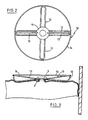
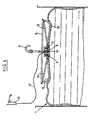
- the sleeve 6 having an external thread which forms the filling opening of the flexible container is provided with a stopper 7 ( figure 3 ).
- this plug 7 is replaced by a plastic plug 8 through which a vent or vent 9 has a discharge elbow folded on itself to prevent the introduction of dust.
- the replacement plug 8 is mounted on the upper mouth 6 of the container.
- a support ring 10 stabilizes the filling opening and therefore after screwing the plug 8, said plug and the vent 9.
- the support ring 10 comprises a central mounting disc 11 with a rigid threaded structure intended to be screwed onto the sleeve 6.
- the extreme curved ends of the tabs 12 are interconnected by an outer ring 14.
- Oblique rods 13 extend between the central disk 11 and the end point of the u-shaped curve facing upwards with lugs 12 to make the support ring 10 dimensionally stable ( Figures 2 and 3 ).
- the bleed hose 4 is detached from the bottom of the container and connected to a valve 24 of the in-place cleaning tank (N.E.P.) provided with a lid 26.
- N.E.P. the in-place cleaning tank
- the installation according to the invention as performed in this example and schematized in the figure 1 is extremely low production and operating costs, it is particularly suitable for bakeries of relatively limited capacity.
- the figure 4 shows a particular embodiment of a flexible container suitable for use in the installation described above.
- This container is similar to that described in Figures 1 to 3 , except that it is equipped with a level 19 electrode indicating the last possible dosage, and a device 17, 18 emitting a warning or alarm signal.
- the lower part of the tube forming the purger or the vent 9 is constituted by a tubular structure 15 acting as a single conductor electrode, which is mounted in the replacement plug 8.
- a flexible conductive wire 41 connects the tubular structure 15 to an amplifier 17 adapted to activate a warning light signal 18.
- the electrode forms a level gauge connected to an alarm. This gauge can detect a minimum level and / or a maximum level and can be mounted either in a disposable bag, but could also be mounted either in a rigid container, plastic or metal.
- these containers which must be maintained at less than 10 ° C may be provided with a warning indicator if the quality of the cream may have deteriorated.
- a warning indicator may for example be of a thermal nature so as to reveal the possible heating of the cream or else be a device capable of detecting an excess of CO 2 evolution (carbon dioxide measuring probe, carbon dioxide absorbing reagent with a change of color).
- Second example of a bakery installation comprising a rigid container connected to a metering device with a circulation loop
- the container C which serves to transport and store the stabilized yeast cream, consists of a rigid container of synthetic food or metal material for easy cleaning. It is mounted on a base base equipped with inputs allowing its easy handling by an elevator.
- This container is not insulated and has a capacity of 500 to 3000 liters. It is for example made of polyethylene or stainless steel, such as stainless steel 304. In a possible embodiment, the container could have been placed on a base or plate provided with freewheels.
- Each passage of a tube in the container is made by means of a sanitary connection.
- connections C1, C2, C3, C4 are closed, it being understood that one of the connections C1, C2 or C3 is closed by a strainer 9.
- the tubes 42,45,46 are perforated with holes 44, so that once the vent 9 placed on one of the connections C1, C2, C3, the container is always at atmospheric pressure.
- the vent may be provided with a filter so that the air entering the container during the withdrawal of yeast cream is rendered sterile.
- the filter has, for example, pores of less than 0.22 ⁇ m.
- the closed circulation loop B cream can serve as a means to ensure degassing of the cream, that is to say an elimination of carbon dioxide formed during storage and retained inside the cream.
- this release of carbon dioxide depends on the storage temperature of the yeast cream, and it is important to limit it to the maximum. It may be advantageous to have a witness of its importance.
- the level electrode 15 is connected to an alarm system 17 emitting at least one light signal 18 and possibly a signal controlling the stopping of the pump 36, when the level of cream in the container is minimal, for example when the cream level in the container is below the level of the orifice 43 of the tube 42 to bring the cream back into the container C.
- the pump 36 is a positive displacement pump which makes it possible to take the yeast cream from the container and to discharge the yeast cream into the circulation loop B, the said pump being adapted, to ensure the flow of the yeast cream into the loop. at a speed between 0.5 and 2 m / s and to prevent heating of the yeast cream due to friction in the pipes.
- the pump is variable speed so that it is able to ensure the circulation of a cleaning solution in the circulation loop at a speed greater than 2 m / s, so as to obtain a effective cleaning.
- the yeast cream taken by the metering device can be brought either directly to a kneader or into an intermediate tank 35 via a line 40 before supplying several kneaders 34 via a line 53 provided with feed valves 54 of cream to the mess.
- a water supply 33 not shown in FIG. figure 6 is provided on the pipe 40 just downstream of the metering device to ensure that the dose of cream measured by the device 32 passes entirely into the intermediate tank 35 and so as to rinse this circuit.
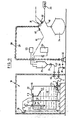
- the figure 7 schematically shows the circulation of the cream of yeast in the installation represented in figure 6 when drawing cream to the kneaders 34.
- the WATER and CREAM arrows respectively show the circulation or movement of water and cream.
- the dosing unit of the yeast cream in the kneaders is achieved through an electromagnetic flowmeter 31 and automated electromechanical valves 54 without intermediate reservoir.
- the pump 36 preferably rotates permanently and this permanent circulation of the stabilized cream allows its degassing.
- the enclosure 16 is provided to receive two containers, a first withdrawal and recirculation, a second in reserve.
- the installation represented at figure 6 also comprises a device for cleaning the circulation loop B.
- This device comprises a reservoir 25 supplied with either a cleaning solution from a source 55 and / or water from a source 56.
- the reservoir 25 is connected via a pipe 57 provided with a valve 24 to bring the cleaning solution to a connection point A2 located inside the chamber 16.
- a pipe 58 extends between a connection point B1 located in the chamber 16 to return the cleaning solution after passing through the circulation loop B to the tank 25.
- the cleaning operation in place takes about 40 minutes.
- a preliminary water rinse of about 5 minutes is followed by cleaning with a cleaner and disinfectant for about thirty minutes and then a final rinse with water for about five minutes.
- the pump 36 For carrying out the operation of cleaning the circulation loop, the pump 36 is turned off. Then, the valve 3 mounted on the flexible pipe 4 is closed before disconnecting the flexible conduit 4 from the connection C4 of the container C and connecting it to the connection point A2. Similarly, the flexible duct 52 is disconnected from the connection C1 of the container C to connect it to the connection point B1 of the duct 58 comprising a flexible duct that can be connected to the tank 25 or to a pipe 72 for discharging effluents to the water. sewer (position shown in figure 7 ).
- the tank 25 is filled with water from the source 55.
- the flexible conduit 71 is connected to the waste pipe 73 to the sewer.
- the valve 24 is opened and the pump 36 is turned on.
- a first quantity of water in the tank 25 rinses the entire circulation loop, including the flexible conduits 52 and 4.
- the valves mounted on the conduit 53, so as to allow the flushing of the conduit 53.
- the water leaving the conduit 53 is then brought to the sewer.
- This pre-rinsing step is carried out for 5 minutes.
- Prolonged pre-rinse of the circulation loop can also be carried out by connecting the flexible conduit to the reservoir 25.
- the pump is stopped and valve 30 is then opened to purge the circulation loop.
- the valve 30 is closed and the flexible conduit 71 of the rejection pipe 72 is disconnected to connect it to the tank 25.
- the pipe 53 comprises a flexible part that can be disconnected from the discharge pipe. and being connected to a connection of the tank 25 to allow the cleaning of the pipe 53 after the opening of the valve 32.
- a cleaning solution is prepared in the tank 25 from a bactericidal disinfectant such as, for example, a chlorinated alkaline of the Neophoschloro type originating from the tank 56 and water coming from the source 55.
- a bactericidal disinfectant such as, for example, a chlorinated alkaline of the Neophoschloro type originating from the tank 56 and water coming from the source 55.
- the pump After opening the valve 24 allowing the cleaning solution to flow to the pump 36, the pump is operated so as to ensure a circulation speed of the solution in the loop B of at least 2 m / s.
- the solution pumped by the pump 36 is discharged into the pipe 29 and into the pipe 51 before returning, via the flexible pipe 52 and the pipe 58, into the tank 25.
- the cleaning solution After circulation of the cleaning solution for about 30 minutes, the cleaning solution is evacuated via the purge valve 30 and a final rinse is finally carried out by means of water brought into the tank 25 for about 5 minutes, this rinsing being carried out in the manner described above for the pre-rinse .
- the valve 30 completely bleeds the circulation loop B.
- the flexible conduit 52 is connected to the connection C1 of a new container C, while the flexible conduit 4 is connected to the connection C4 of said container.
- the connection valve C4 is opened to allow the yeast cream to flow to the pump 36.
- the pump 36 can now be operated for circulation of yeast cream.
- the cleaning operation in place of the circulation loop is performed for example every week.
- the system can also be designed for more frequent cleaning.
- the cleaning solution is stored in the tank 25 so that it can be recycled and rinses where the water enters the circuit independently of the tank 25 and after circulation through the loop through the pump goes down the drain.
- the container is transported to the customer and used for two weeks, at a rate of 5 days per week, that is to say use for 10 working days at a rate of 100 l / day.
- the cold chain is continuously maintained throughout the period of storage, transport, storage and use at a temperature below 10 ° C, in particular at a temperature between 0 and 5 ° C.
- the cream after delivery to a baker had the following characteristics when used at the baker's: Table 6: Evolution of dry matter and density Day Dry matter Density fresh 19.2 1,068 2 18.8 1,067 5 18.6 1,066 8 18.4 1,063 12 18.3 1,063 15 18.1 1,061
- yeast cream Apart from a loss in dry matter and density, due to the production of CO 2 (as found in the example of yeast cream No. 1), the yeast cream remains homogeneous until the end of the two weeks of storage.
- Table 7 Fermentative strength and bread-making results according to the methods described for the example of cream n ° 1 Day fermentometer Bakery fresh 141 63 / 4.40 / 4.47 2 142 65 / 4.33 / 4.26 5 142 65 / 4.21 / 4.21 8 142 66 / 4.28 / 4.28 12 144 68 / 4.24 / 4.20 15 142 67 / 4.28 / 7.18
- Bacteriological contamination does not increase during the use of the cream for 15 days in the bakery.
- the installation represented at figure 9 is similar to that of the figure 6 , except that it does not have a line 51 to return to the container C the unused cream to the metering device 32 provided with a flow meter 31.
- the pump 36 unlike the previous example, does not work. continuous but only during the feeding of the kneader (s). This arrangement is only possible when the cold room and the kneader (s) are at a short distance from one another.
- the installation shown at figure 9 has a valve 60 mounted on the pipe 29 just upstream of the metering device.
- a flexible conduit 61 connects the valve 60 to the reservoir 25 for the circulation of the cleaning solution in the pipe 29 and in the pump 36.
- the figure 10 shows a detail of an embodiment of an installation similar to that shown in FIG. figure 6 .
- the chamber 16 is adapted to contain two containers C.Crés., A first C being mounted on the circulation loop for the withdrawal of yeast cream, while the second Cés. is in reserve.
- the first container C and the second container Crees. are connected by at least one pipe 100 to the pump 36, said pipe comprising two branches 101, 102 provided with electrically controlled valves 103, 104 and by the flexible pipes 105, 106 provided with manual valves 107, 108, said pipes being connectable to the
- the pump 36 delivers in the circulation loop B the yeast cream coming either from the container C when the valves 103 and 107 are open, or from the container Crees. when the valves 104 and 108 are open. Before returning the uncollected yeast cream to a container, the yeast cream is cooled in the exchanger 27.
- the circulation loop ends with two branches 109, 110 each provided with an electrically controlled valve 111, 112, and a flexible conduit 113, 114 intended to be connected to the connector C1 respectively of the container C and the container Crees.
- a control device 130 acts on the electrically controlled valves so as to close the valves 103, 111 and to open the valves 112, 104.
- the pump 36 takes the yeast cream from the container Crees. while the yeast cream not withdrawn from the loop is returned to the container Cre.
- the valves 111 and 112, 103 and 104 may be replaced by two three-way valves.
- the installation is provided with several purge valves 30, 120 so as to purge the different portions of the installation. Furthermore, one could also provide the necessary valves and connections so that the cleaning sequences can also be performed automatically.
Landscapes
- Life Sciences & Earth Sciences (AREA)
- Engineering & Computer Science (AREA)
- Chemical & Material Sciences (AREA)
- Health & Medical Sciences (AREA)
- Microbiology (AREA)
- Biotechnology (AREA)
- Organic Chemistry (AREA)
- Zoology (AREA)
- Bioinformatics & Cheminformatics (AREA)
- Wood Science & Technology (AREA)
- Genetics & Genomics (AREA)
- Tropical Medicine & Parasitology (AREA)
- Mycology (AREA)
- Virology (AREA)
- Biochemistry (AREA)
- General Engineering & Computer Science (AREA)
- General Health & Medical Sciences (AREA)
- Medicinal Chemistry (AREA)
- Biomedical Technology (AREA)
- Food Science & Technology (AREA)
- Dairy Products (AREA)
- Micro-Organisms Or Cultivation Processes Thereof (AREA)
- Preparation Of Compounds By Using Micro-Organisms (AREA)
- Bakery Products And Manufacturing Methods Therefor (AREA)
- Confectionery (AREA)
Claims (48)
- Verfahren zur Konditionierung und zur Verwendung einer Hefecreme nach einer ruhigen und langen Aufbewahrung in Form einer stabilen Suspension, wobei:- die Hefecreme durch die Verwendung eines Lebensmitteladditivs, das zu der Gattung der Lebensmittel-Verdickungsmittel und -Stabilisatoren gehört; stabilisiert wird,- die auf weniger als 10°Cgekühlte stabilisierte Hefecreme konditioniert wird, und in einem sauberen fast sterilen Gefäß (C), mit einem Fassungsvermögen zwischen etwa 100 und 3000 Liter, vorzugsweise zwischen 200 und 3000 Liter, versehen mit einem Lüftungssystem (9);- das Gefäß (C), während des ganzen Transports, während seiner Lagerung und während die Hefecreme aus dem Gefäß (C) zur Verwendung entnommen wird, in einem Fach (16) untergebracht wird, dessen Temperatur zwischen -1°C und 10°C, vorzugsweise zwischen 0 und 8°C, insbesondere zwischen 0 und 5°C gehalten wird;- die Hefecreme in der Nähe des Gefäßbodens (C) durch Schwerkraft und/oder durch eine Zumeßpumpe (36) entnommen wird, damit sie in ein Rohr oder in Röhren (29) zur Verteilung der stabilisierten Hefecreme eintritt, und in ein Knetwerk oder in Knetwerke (34) eingeführt wird; und- nach einer vorgegebenen Zeitspanne das Verteilerrohr oder die Verteilerröhren (29) mittels einer Reinigungslösung mindestens teilweise an Ort und Stelle gereinigt wird oder werden.
- Verfahren gemäß Anspruch 1, dadurch gekennzeichnet, dass das Lüftungssystem (9) mit einem Filter versehen ist, das den Eintritt von Kontaminierungsmitteln verhindert.
- Verfahren gemäß einem der Ansprüche 1 und 2, dadurch gekennzeichnet, dass das Gefäß (C) mit- einer Entleerungsrohrleitung (42), welche die Hefecreme in die Nähe des Bodens des Gefäßes (C) bringt,- mindestens einer Reinigungskugel (23),- einer Niveausonde (15)- einem Lüftungssystem (9) zur Beibehaltung des atmosphärischen Druckes im Gefäß (C),- einem niedrig angeordneten Entleerungsventil (C4)ausgestattet ist.
- Verfahren gemäß Anspruch 3, dadurch gekennzeichnet, dass die Entleerungsrohrleitung (42) im wesentlichen vertikal ist, dass sie seitlich in der Nähe des Oberteils des Gefäßes (C) perforiert ist (44), damit sie als Lüftungssystem dient, und dass sie eine Öffnung (43) aufweist, die weniger als 10 cm, vorzugsweise weniger als 5 cm vom Boden des Gefäßes (C) entfernt ist.
- Verfahren gemäß Anspruch 3 oder 4, dadurch gekennzeichnet, dass das Gefäß (C) mit mindestens zwei Rohrleitungen (42, 45, 46) ausgestattet ist, welche in der Nähe des Oberteils des Gefäßes (C) seitlich perforiert sind (44), um als Luftungssystem (9) zu dienen.
- Verfahren gemäß Anspruch 1, dadurch gekennzeichnet, dass das Gefäß (C) eine verformbare Tasche (5) ist, vorzugsweise eine Wegwerftasche, selbsttragend oder vorzugsweise in Form einer durch eine wieder verwendbare Vorrichtung aufgenommen Tasche.
- Verfahren gemäß Anspruch 6, dadurch gekennzeichnet, dass das verformbare Gefäß (5) mit einem wieder verwendbaren System (10) in Form eines Lüftungssystems (9) und einer Niveausonde (15) ausgestattet ist, und dass es vollständig entleert werden kann.
- Verfahren gemäß einem der Ansprüche 3 bis 5 und 7, dadurch gekennzeichnet dass, die Niveausonde (15) auf Niedrigniveau ansprechenden Alarmvorrichtung versehen ist.
- Verfahren gemäß einem der Ansprüche 1 bis 8, dadurch gekennzeichnet, dass eine Zumeßpumpe (36) eingesetzt wird, um eine langsame Zirkulation der Hefecreme und eine schnelle Zirkulation der Reinigungslösung zu erlauben.
- Verfahren gemäß Anspruch 9, dadurch gekennzeichnet, dass die Zumeßpumpe (36) derart geregelt werden kann, dass eine Zirkulationsgeschwindigkeit der Hefecreme zwischen 0,5 und 2 m/s erreicht wind.
- Verfahren gemäß Anspruch 9 oder 10, dadurch gekennzeichnet, dass die Zumeßpumpe (36) derart geregelt werden kann, dass eine Zirkulationsgeschwindigkeit der Reinigungslösung größer oder gleich 2 m/s erreicht wird.
- Verfahren gemäß einem der Ansprüche 1 bis 11, dadurch gekennzeichnet, dass die Zumeßpumpe (36) aus einer der folgenden Gruppen ausgewählt wird: pneumatische Membranpumpen, Pumpen mit Flügeln, Exzenter-Schneckenpumpen oder mit Gewindedom.
- Verfahren gemäß einem der vorigen Ansprüche, dadurch gekennzeichnet, dass die Verschlechterung der Backqualität der stabilisierten Hefecreme mittels einer Anzeige festgestellt wird.
- Verfahren gemäß einem der vorigen Ansprüche, dadurch gekennzeichnet, dass die Zumeßpumpe (36) zur Entnahme der Hefecreme aus dem Gefäß (C) und zu ihrer Einführung in eine Zirkulationsschleife (B) der Hefecreme, welche die Zumeßpumpe (36) beinhaltet, eingesetzt wird, dass Hefecreme an einer Stelle oder mehreren Stellen der Schleife (B) entnommen wird, um ein Knetwerk oder Knetwerke (34) zu speisen, und dass die Quantität der eingesetzten stabilisierten Creme, die an der genannten Stelle oder den genannten Stellen nicht entnommen wurde, zu dem Gefäß (C) zurückgefördert wird.
- Verfahren gemäß Anspruch 14, dadurch gekennzeichnet, dass das Gefäß (C) mit- einer Entleerungsrohrleitung (42),- mindestens einer Reinigungskugel (23),- einer Niveausonde (15),- einem Lüftungssystem (9) zur Beibehaltung des atmosphärische Druckes im Gefäß (C),- einem niedrig angeordneten Entleerungsventil (C4)ausgestattet ist, wobei die genannte Entleerungsrohrleitung (42) genügend nah an dem Boden des Gefäßes (C) liegt, damit keine Schaumbildung entsteht, wenn die Hefecreme im geschlossenen Zirkulationskreis in Bewegung gesetzt wird.
- Verfahren gemäß einem der Ansprüche 14 und 15, dadurch gekennzeichnet, dass die Hefecreme in das Gefäß (C) mittels einer Rohrleitung (42) zurückgefördert wird, die eine Öffnung (43) über dessen Boden aufweist, die vom Boden weniger als 10 cm, vorzugsweise weniger als 5 cm entfernt ist.
- Verfahren gemäß einem der Ansprüche 14 bis 16, dadurch gekennzeichnet, dass die Hefecreme mittels eines Wärmetauschers (27) gekühlt wird, bevor die Hefecreme in das Gefäß (C) zurückgefördert wird.
- Verfahren gemäß einem der Ansprüche 14 bis 17, dadurch gekennzeichnet, dass jedes Teil der Schleife (B) der Hefecreme selbstentleerbar ist, d.h. dass jedes Teil der Schleife (B) eine niedrige Stelle aufweist, an welcher sie vollständig entleerbar ist.
- Verfahren gemäß einem der Ansprüche 1 bis 18, dadurch gekennzeichnet, dass die Verteilerröhren (29) der Hefecreme auf einem eine Reinigungslösung enthaltenden Behälter (25) auf geschlossenen Zirkulationskreis geschaltet werden können, wobei der Transport der Hefecreme über die Zumeßpumpe (36) mittels der Reinigungslösung erfolgt.
- Verfahren gemäß einem der Ansprüche 1 bis 19, dadurch gekennzeichnet, dass für die Stabilisierung der Hefecreme ein aus der Gattung der Homopolysacchariden, eventuell modifiziertes, vorzugsweise aus der Gruppe der Stärken und der Cellulosenderivaten ausgewähltes Lebensmitteladditiv verwendet wird.
- Verfahren gemäß Anspruch 20, dadurch gekennzeichnet, dass eine homogene Dispersion eines modifizierten Stärkegels als Lebensmitteladditiv zur Stabilisierung der Hefecreme verwendet wird.
- Verfahren gemäß einem der Ansprüche 20 und 21, dadurch gekennzeichnet, dass als Lebensmitteladditiv für die Stabilisierung der Hefecreme 0,5 Gew.% bis 2,0 Gew.% der Hefecreme einer thermisch und/oder chemisch modifizierten Stärke, und vorzugsweise zwischen 0,5 Gew.% und 1,5 Gew.% der Hefecreme einer chemisch modifizierten Stärke verwendet wird.
- Verfahren gemäß einem der Ansprüche 20 bis 22, dadurch gekennzeichnet, dass als Lebensmitteladditiv für die Stabilisierung der Hefecreme acetyliertes Adipinat eines Diamids entsprechend der Definition der modifizierten Stärke E 1422 gemäß der europäischen Nomenklatur bei 0,5 Gew.% bis 1,5 Gew.%, vorzugsweise zwischen 0,8 Gew.% und 1,0 Gew.% der Hefecreme verwendet wird.
- Verfahren gemäß Anspruch 20, dadurch gekennzeichnet, dass als Lebensmitteladditiv zur Stabilisierung der Hefecreme eine Dispersion eines Cellulosenderivates, vorzugsweise von Carboxymethylcellulose verwendet wird.
- Verfahren gemäß Anspruch 20, dadurch gekennzeichnet, dass als Lebensmitteladditiv zur Stabilisierung der Hefecreme eine Carboxymethylcellulose mit hoher Viskosität bei 0,1 Gew.% bis 0,3 Gew.% der Hefecreme verwendet wird.
- Gefäß (C) zur Anwendung des Verfahrens gemäß einem der Ansprüche 1 bis 25, wobei das Gefäß (C):- ein Fassungsvermögen zwischen 100 und 3000 Liter,- ein Lüftungssystem (9), zur Beibehaltung des atmosphärischen Druckes,- ein in der Nähe des Gefäßbodens (C) angebrachtes Ventil (C4), um die Entnahme der Hefecreme zu ermöglichen,- mindestens eine Reinigungskugel (23), und- eine Entleerungsrohrleitung (42) des Gefäßes (C), welche Entleerungsrohrleitung (42) die Hefecreme in die Nähe des Gefäßbodens (C) bringt,aufweist,
wobei die Entleerungsrohrleitung (42) im wesentlichen vertikal verläuft, eine über dem Gefäßboden angebrachte Öffnung (43) aufweist, die weniger als 10 cm, vorzugsweise weniger als 5 cm vom Boden entfernt ist, und mindestens eine seitliche Perforierung (44) nahe dem Oberteil des Gefäßes (C) aufweist, welche als Lüftungssystem (9) dient. - Gefäß (C) gemäß Anspruch 26, dadurch gekennzeichnet, dass es mit einem Detektor (15) des im Gefäß (C) erreichten Mindestniveaus der Hefecreme ausgestattet ist, wobei der Detektor beim Feststellen des Mindestniveaus ein Alarmsignal sendet.
- Gefäß (C) gemäß einem der Ansprüche 26 bis 27, dadurch gekennzeichnet, dass es mindestens eine Anzeige der Verschlechterung der Backqualität der im Gefäß (C) befindlichen stabilisierten Hefecreme umfaßt.
- Gefäß (C) gemäß einem der Ansprüche 26 bis 28, dadurch gekennzeichnet, dass es mindestens zwei Rohrleitungen (42, 45, 46) beinhaltet, welche im wesentlichen vertikal und nahe dem Oberteil des Gefäßes (C) perforiert (44) sind, so dass mindestens eine Rohrleitung (42, 45, 46) frei ist, um außerhalb des Gefäßes (C) verbunden zu werden und ein Lüftungssystem (9) bildet, welches vorzugsweise zu einem der folgenden Typen gehört: Uförmiges Rohr, Schutzfilter, Filter, bakteriologischer Filter.
- Anlage zur Konditionierung und Verwendung, in Form einer stabilen Suspension, einer Hefecreme, die durch die Verwendung eines Lebensmitteladditivs der Gattung der Verdickungsmittel und der Lebensmittelstabilisatoren nach ruhiger und langer Aufbewahrung stabilisiert wurde, wobei die Anlage- ein sauberes und fast steriles Gefäß (C) mit einem Fassungsvermögen zwischen etwa 100 und 3000 Liter, ausgestattet mit einem Lüftungssystem (9),- ein Fach (16) entsprechend einer das Gefäß (C) enthaltenden Kammer, wobei die Temperatur der Kammer zwischen -1°C und 10°C gehalten wird,- ein Verteilerrohr oder Verteilerröhre (29) und- ein Knetwerk oder Knetwerke (34),aufweist, wobei die Anlage eine Entnahme der stabilisierten Hefecreme durch Schwerkraft nahe dem Gefäßboden (C) erlaubt, damit sie in ein Verteilerrohr oder in Verteilerröhre (29) eintritt, um einem Knetwerk oder Knetwerken (34) zugeführt zu werden,
wobei die Anlage die mindestens teilweise Reinigung des Verteilerrohrs oder der Verteilerröhren (29) an Ort und Stelle erlaubt. - Anlage zur Konditionierung und Verwendung, in Form einer stabilen Suspension, einer Hefecreme, die durch die Verwendung eines Lebensmitteladditivs der Gattung der Verdickungsmittel und der Lebensmittelstabilisatoren nach einer ruhigen und langen Aufbewahrung stabilisiert wurde, wobei die Anlage- ein sauberes und fast steriles Gefäß (C) mit einem Fassungsvermögen zwischen etwa 100 und 3000 Liter, ausgestattet mit einem Lüftungssystem (9),- ein Fach (16) entsprechend einer das Gefäß (C) enthaltenden Kammer, wobei die Temperatur der Kammer zwischen -1°C und 10°C gehalten wird,- ein Verteilerrohr oder Verteilerröhre (29),- eine Zumeßpumpe (36) und- ein Knetwerk oder Knetwerke (34),aufweist,
wobei die Zumeßpumpe eine Entnahme der stabilisierten Hefecreme nahe dem Gefäßboden (C) erlaubt, damit sie in ein Verteilerrohr oder in Verteilerröhre (29) eintritt, um einem Knetwerk oder Knetwerken (34) zugeführt zu werden,
wobei die Anlage die mindestens teilweise Reinigung des Verteilerrohrs oder der Verteilerröhren (29) an Ort und Stelle erlaubt. - Anlage gemäß Anspruch 31, dadurch gekennzeichnet, dass die Zumeßpumpe (36) aus der folgenden Gruppe ausgewählt wird: pneumatische Membranpumpen, Pumpen mit Flügeln, Exzenter-Schneckenpumpen oder mit Gewindedom.
- Anlage gemäß einem der Ansprüche 30 bis 32, dadurch gekennzeichnet, dass sie eine Reinigungsvorrichtung zur Reinigung an Ort und Stelle mittels einer Reinigungslösung für mindestens ein Teil des Verteilungsrohrs oder der Verteilungsröhre (29) aufweist.
- Anlage gemäß Anspruch 33, dadurch gekennzeichnet, dass die Reinigungsvorrichtung einen Behälter (25) aufweist, der die Reinigungslösung enthält.
- Anlage gemäß einem der Ansprüche 30 bis 34, dadurch gekennzeichnet, dass das Lüftungssystem (9) mit einem Filter ausgestattet ist, das den Eintritt von Kontaminierungsmitteln verhindert.
- Anlage gemäß einem der Ansprüche 30 bis 35, dadurch gekennzeichnet, dass das Gefäß (C) mit- einer Entleerungsrohrleitung (42) zum Entleeren des Gefäßes (C), wobei die Rohrleitung die Hefecreme in die Nähe des Gefäßbodens (C) bringt,- mindestens einer Reinigungskugel (23),- einer Niveausonde (15),- einem Lüftungssystem (9), zur Beibehaltung des atmosphärischen Druckes,- inem niedrig angeordneten Entleerungsventil (C4)ausgestattet ist.
- Anlage gemäß Anspruch 36, dadurch gekennzeichnet, dass die Entleerungsrohrleitung (42) im wesentlichen vertikal ist, dass sie nahe des Oberteils des Gefäßes derart seitlich perforiert ist (44), dass sie als Lüftungssystem dient, und dass sie eine Öffnung (43) aufweist, die weniger als 10 cm, vorzugsweise weniger als 5 cm vom Boden des Gefäßes (C) entfernt ist.
- Anlage gemäß einem der Ansprüche 36 und 37, dadurch gekennzeichnet, dass das Gefäß (C) mit mindestens zwei Rohrleitungen (42, 45, 46) ausgestattet ist, die in der Nähe des Oberteils des Gefäßes (C) seitlich perforiert (44) sind, um als Lüftungssystem (9) zu dienen.
- Anlage zur Anwendung des Verfahrens gemäß einem der Ansprüche 1 bis 25, wobei die Anlage:- ein Fach (16) entsprechend einer Kammer, die derart ausgestaltet ist, dass sie mindestens ein sauberes und fast steriles Gefäß (C) mit einem Fassungsvermögen zwischen etwa 100 und 3000 Liter, vorzugsweise zwischen 200 und 3000 Liter enthält, das ein Lüftungssystem (9) aufweist, wobei das Fach (16) mit einer Vorrichtung zur Beibehaltung der Temperatur der Kammer zwischen -1 °C und 10°C, vorzugsweise zwischen 0 und 8°C insbesondere zwischen 0 und 5°C versehen ist;- eine Zirkulationsschleife (B) zur Entnahme der Hefecreme in der Nähe des Bodens des Gefäßes (C) und zur Führung der Hefecreme zu einer oder mehreren Entnahmestellen der Schleife (B), an welchen Hefecreme für ein Knetwerk (34) entnommen werden kann, welche Schleife (B) mit einer Rohrleitung (52) endet, die es ermöglicht, die im Gefäß nicht entnommene Hefecreme nach ihrem Durchgang durch die Schleife (B) in das Gefäß (C) zurückzufördern;- eine Zumeßpumpe (36) zur Entnahme der Hefecreme aus dem Gefäß (C) und zum Zurückdrängen der Hefecreme in die Zirkulationsschleife (B), welche Pumpe (36) derart ausgestaltet ist, dass sie einerseits die Zirkulation der Hefecreme durch die Schleife (B) mit einer Geschwindigkeit zwischen 0,5 und 2 m/s sichert, um jede Erwärmung der Hefecreme zu vermeiden, und andererseits eine wirksame Zirkulation einer Reinigungslösung in die Zirkulationsschleife (B) sichert;- einen Behälter (25), welcher mit der Zirkulationsschleife durch eine Anzahl von beweglichen Anschlüssen oder durch jede andere diesbezüglich vorgesehene Vorrichtung verbunden werden kann, wobei an Ort und Stelle im geschlossenen Zirkulationskreis eine Reinigung der gesamten Rohrleitungen ermöglicht wind, die zur Zirkulation der Hefecreme dienen,aufweist.
- Anlage gemäß Anspruch 39, dadurch gekennzeichnet, dass die Zirkulationsschleife (B) der Hefecreme einen Wärmetauscher (27) aufweist, der es ermöglicht die Hefecreme abzukühlen bevor sie in das Gefäß (C) zurückgefördert wird.
- Anlage gemäß Anspruch 39 oder 40, dadurch gekennzeichnet, dass sie ein automatisches Sperrsystem aufweist, das die Pumpe (36) anhält, wenn ein Mindestniveau der Hefe im Gefäß (C) festgestellt wird.
- Anlage gemäß einem der Ansprüche 39 bis 41, dadurch gekennzeichnet, dass jeder Abschnitt der Durchflußschleife (B) der Hefecreme selbstentleerbar ist, d.h. durch Schwerkraft vollständig entleerbar ist.
- Anlage gemäß einem der Ansprüche 39 bis 42, dadurch gekennzeichnet, dass das Fach (16) derart ausgestaltet ist, das es zwei Gefässe (C, CRES) mit stabilisierter Hefecreme beinhalten kann, wobei das erste Gefäß (C) auf der Zirkulationsschleife (B) zur Entnahme der Hefecreme angebracht ist, während das zweite (CRES) in Reserve bleibt.
- Anlage gemäß Anspruch 43, dadurch gekennzeichnet, dass sie ein erstes Gefäß (C) und ein zweites Gefäß (CRES) beinhaltet, wobei beide genannte Gefässe (C, CRES) jeweils das erste und das zweite durch ein System von vorzugsweise verformbaren Anschlüssen und von Ventilen (109, 110, 113, 114) oder Dreiwegventilen einerseits, mit einer die Zumeßpumpe (36) speisende Rohrleitung (100) verbunden werden können, und andererseits mit einer Zufuhrrohrleitung (103, 104, 111, 112) für das Gefäß (C, CRES), welche die nicht entnommene Crememenge erhält, und dadurch, dass sie ein System (130) zur Steuerung der Ventile (109, 110, 113, 114) enthält, damit bei Feststellung eines Mindestniveaus der Hefecreme in dem Gefäß (C, CRES) während der Entnahme, das Steuerungsystem (130) die Ventile (109, 110, 113, 114) derart steuert, dass das andere Gefäß (CRES, C) auf der Zirkulationsschleife (B) der Hefecreme zum Einsatz gebracht wird.
- Anlage gemäß einem der Ansprüche 39 bis 44, dadurch gekennzeichnet, dass die Zirkulationsschleife (B) vorgesehen ist, damit sie automatisch entweder auf das Gefäß mit der Hefecreme (C), oder auf den Behälter (25) zur Reinigung an Ort und Stelle aufgeschaltet wird.
- Anlage gemäß einem der Ansprüche 30 bis 45, dadurch gekennzeichnet, dass sie eine Dosiervorrichtung (32) enthält.
- Anlage gemäß Anspruch 46, dadurch gekennzeichnet, dass die Dosiervorrichtung ein elektromagnetisches Dosierventil oder elektromagnetische Dosierventile (32, 54) aufweist.
- Anlage gemäß einem der Ansprüche 46 und 47, dadurch gekennzeichnet, dass die Dosiervorrichtung ein Durchflußmesser (31) aufweist.
Priority Applications (1)
| Application Number | Priority Date | Filing Date | Title |
|---|---|---|---|
| DE69714888T DE69714888T3 (de) | 1996-03-01 | 1997-02-28 | Verfahren und Anlage zur Konditionierung und zur Verwendung stabilisierter Hefecreme |
Applications Claiming Priority (2)
| Application Number | Priority Date | Filing Date | Title |
|---|---|---|---|
| BE9600184A BE1010054A3 (nl) | 1996-03-01 | 1996-03-01 | Werkwijze voor het bereiden, verpakken en gebruiken van gestabiliseerde gistroom. |
| BE9600184 | 1996-03-01 |
Publications (3)
| Publication Number | Publication Date |
|---|---|
| EP0792930A1 EP0792930A1 (de) | 1997-09-03 |
| EP0792930B1 EP0792930B1 (de) | 2002-08-28 |
| EP0792930B2 true EP0792930B2 (de) | 2009-12-16 |
Family
ID=3889580
Family Applications (1)
| Application Number | Title | Priority Date | Filing Date |
|---|---|---|---|
| EP97870032A Expired - Lifetime EP0792930B2 (de) | 1996-03-01 | 1997-02-28 | Verfahren und Anlage zur Konditionierung und zur Verwendung stabilisierter Hefecreme |
Country Status (6)
| Country | Link |
|---|---|
| EP (1) | EP0792930B2 (de) |
| AT (1) | ATE222952T1 (de) |
| BE (1) | BE1010054A3 (de) |
| DE (1) | DE69714888T3 (de) |
| ES (1) | ES2183122T5 (de) |
| PT (1) | PT792930E (de) |
Cited By (1)
| Publication number | Priority date | Publication date | Assignee | Title |
|---|---|---|---|---|
| US8186545B2 (en) | 2005-09-13 | 2012-05-29 | Lesaffre Et Compagnie | Metering valve comprising a fixed inner conduit and a mobile outer sleeve |
Families Citing this family (10)
| Publication number | Priority date | Publication date | Assignee | Title |
|---|---|---|---|---|
| JP4495307B2 (ja) * | 2000-06-09 | 2010-07-07 | オリエンタル酵母工業株式会社 | クリームイーストの輸送可貯留槽および供給方法 |
| PT1299291E (pt) * | 2000-06-30 | 2008-12-18 | Lesaffre & Cie | Embalagens para fermentos líquidos |
| DK1567445T3 (da) * | 2002-11-22 | 2012-07-16 | Lesaffre & Cie | Indretning og fremgangsmåde til dosering af gærcreme |
| EP1675467B1 (de) * | 2003-07-29 | 2016-11-30 | Panadoro Group Ag | Vorteigkonzentrat für ganz oder teilweise hefegetriebene bac kwaren |
| GB2439943A (en) * | 2006-07-06 | 2008-01-16 | C B Kaymich & Company Ltd | Additive preparation apparatus |
| FR3008849B1 (fr) | 2013-07-24 | 2015-07-31 | Lesaffre & Cie | Dispositif de distribution de levure en boulangerie et systeme de distribution de levure en boulangerie |
| FR3023125B1 (fr) * | 2014-07-03 | 2017-04-07 | Lesaffre & Cie | Teledistribution de levure en boulangerie |
| FR3064158B1 (fr) * | 2017-03-23 | 2019-06-07 | Lesaffre Et Compagnie | Teledistribution de levure en boulangerie ou d'un autre fluide alimentaire |
| FR3073365A1 (fr) * | 2017-11-14 | 2019-05-17 | Sas Holding Bernard Blachere | Systeme d'injection et d'etalage de pate a cuire, pate a crepes et machine de preparation de crepes associees |
| CN111718861A (zh) * | 2019-03-22 | 2020-09-29 | 安琪酵母股份有限公司 | 液体酵母组合物 |
Family Cites Families (5)
| Publication number | Priority date | Publication date | Assignee | Title |
|---|---|---|---|---|
| DE528981C (de) * | 1931-07-06 | Hansena A G | Vorrichtung zum Regenerieren und Aufbewahren von Bierhefe fuer deren Wiederverwendung zur Gaerung | |
| AT247820B (de) * | 1960-01-12 | 1966-06-27 | Winfried Schaefer | Verfahren zum Konservieren von Backhefe in Form von Heferahm |
| GB1425979A (en) * | 1973-08-03 | 1976-02-25 | Truman Ltd | Preserving yeasts |
| JPH02124054A (ja) * | 1988-11-04 | 1990-05-11 | Kanegafuchi Chem Ind Co Ltd | 油脂含有イースト組成物及びその製造法 |
| DE69121144T3 (de) * | 1990-06-11 | 2004-04-22 | Dsm N.V. | Stabilisierung von Hefekreme |
-
1996
- 1996-03-01 BE BE9600184A patent/BE1010054A3/nl active
-
1997
- 1997-02-28 DE DE69714888T patent/DE69714888T3/de not_active Expired - Lifetime
- 1997-02-28 PT PT97870032T patent/PT792930E/pt unknown
- 1997-02-28 ES ES97870032T patent/ES2183122T5/es not_active Expired - Lifetime
- 1997-02-28 AT AT97870032T patent/ATE222952T1/de active
- 1997-02-28 EP EP97870032A patent/EP0792930B2/de not_active Expired - Lifetime
Cited By (1)
| Publication number | Priority date | Publication date | Assignee | Title |
|---|---|---|---|---|
| US8186545B2 (en) | 2005-09-13 | 2012-05-29 | Lesaffre Et Compagnie | Metering valve comprising a fixed inner conduit and a mobile outer sleeve |
Also Published As
| Publication number | Publication date |
|---|---|
| DE69714888T3 (de) | 2011-06-30 |
| ATE222952T1 (de) | 2002-09-15 |
| ES2183122T3 (es) | 2003-03-16 |
| EP0792930B1 (de) | 2002-08-28 |
| BE1010054A3 (nl) | 1997-12-02 |
| PT792930E (pt) | 2003-01-31 |
| EP0792930A1 (de) | 1997-09-03 |
| ES2183122T5 (es) | 2010-04-23 |
| DE69714888T2 (de) | 2003-04-10 |
| DE69714888D1 (de) | 2002-10-02 |
Similar Documents
| Publication | Publication Date | Title |
|---|---|---|
| EP0792930B2 (de) | Verfahren und Anlage zur Konditionierung und zur Verwendung stabilisierter Hefecreme | |
| EP3380221B1 (de) | Samenbehandlungsverfahren | |
| FR2934371A1 (fr) | Dispositif capteur de biomasse a usage unique, procede de realisation de ce dispositif et bioreacteur a usage unique integrant ce capteur | |
| EP1283795B1 (de) | Verfahren zum füllen eines behälters mit einem verschiedene mischbare ingredienzen enthaltendem produkt | |
| FR2977249A1 (fr) | Installation de conditionnement comprenant des becs de remplissage equipes de conduits de mise en boucle du corps de bec | |
| CN116669846A (zh) | 使粉末溶解于溶剂中的设备和方法 | |
| EP0033987B1 (de) | Verfahren und Anlagen, die Hefe verwenden | |
| LU100173B1 (fr) | Berce pour camion avec cuve a dechets organiques | |
| FR2957566A1 (fr) | Dispositif pour le stockage et le transport de produits aquacoles. | |
| EP1567445B1 (de) | Verfahren und vorrichtung zum dosieren flüssiger hefe | |
| WO2021122433A1 (fr) | Bec de remplissage avec canalisation de retour | |
| CN112760199A (zh) | 一种化妆品微生物检测用防富集装置 | |
| FR3023125A1 (fr) | Teledistribution de levure en boulangerie | |
| CN219263972U (zh) | 输油系统 | |
| BE1028973B1 (fr) | Procédé de préparation et de conditionnement d’une pluralité de poudres de boisson instantanée | |
| EP0506644B1 (de) | Vorrichtung zur Nassfutterdosierung für Tiere, insbesondere für Ferkel | |
| JP4495307B2 (ja) | クリームイーストの輸送可貯留槽および供給方法 | |
| JP2000325012A (ja) | イーストクリームの供給装置および供給方法 | |
| CN121797098A (zh) | 一种多级纳滤系统 | |
| JPH0712299B2 (ja) | アセプテイツク・スクリユーコンベアおよび同コンベアを利用した固液混合物の定量充▲填▼方法 | |
| FR2723819A1 (fr) | Procede et dispositif de distribution automatique des composants d'une pate dans un petrin | |
| FR2616300A1 (fr) | Dispositif et procede de stockage refrigere de viandes | |
| CN112042547A (zh) | 一种饲料高效搅拌混合的防堵塞型宠物用喂食装置 | |
| CN1741962A (zh) | 酵母乳定量设备和方法 | |
| FR3107257A1 (fr) | Distributeur de liquide |
Legal Events
| Date | Code | Title | Description |
|---|---|---|---|
| PUAI | Public reference made under article 153(3) epc to a published international application that has entered the european phase |
Free format text: ORIGINAL CODE: 0009012 |
|
| AK | Designated contracting states |
Kind code of ref document: A1 Designated state(s): AT BE CH DE ES FR GB IE IT LI LU NL PT |
|
| 17P | Request for examination filed |
Effective date: 19971010 |
|
| GBC | Gb: translation of claims filed (gb section 78(7)/1977) | ||
| 17Q | First examination report despatched |
Effective date: 20010907 |
|
| TCNL | Nl: translation of patent claims filed | ||
| GRAG | Despatch of communication of intention to grant |
Free format text: ORIGINAL CODE: EPIDOS AGRA |
|
| RTI1 | Title (correction) |
Free format text: PROCESS AND SYSTEM FOR CONDITIONING AND USING STABILIZED YEAST CREAM |
|
| RTI1 | Title (correction) |
Free format text: PROCESS AND SYSTEM FOR CONDITIONING AND USING STABILIZED YEAST CREAM |
|
| RTI1 | Title (correction) |
Free format text: PROCESS AND SYSTEM FOR CONDITIONING AND USING STABILIZED YEAST CREAM |
|
| GRAG | Despatch of communication of intention to grant |
Free format text: ORIGINAL CODE: EPIDOS AGRA |
|
| GRAG | Despatch of communication of intention to grant |
Free format text: ORIGINAL CODE: EPIDOS AGRA |
|
| GRAH | Despatch of communication of intention to grant a patent |
Free format text: ORIGINAL CODE: EPIDOS IGRA |
|
| GRAH | Despatch of communication of intention to grant a patent |
Free format text: ORIGINAL CODE: EPIDOS IGRA |
|
| GRAA | (expected) grant |
Free format text: ORIGINAL CODE: 0009210 |
|
| AK | Designated contracting states |
Kind code of ref document: B1 Designated state(s): AT BE CH DE ES FR GB IE IT LI LU NL PT |
|
| REF | Corresponds to: |
Ref document number: 222952 Country of ref document: AT Date of ref document: 20020915 Kind code of ref document: T |
|
| REG | Reference to a national code |
Ref country code: GB Ref legal event code: FG4D Free format text: NOT ENGLISH |
|
| REG | Reference to a national code |
Ref country code: CH Ref legal event code: EP |
|
| REF | Corresponds to: |
Ref document number: 69714888 Country of ref document: DE Date of ref document: 20021002 |
|
| REG | Reference to a national code |
Ref country code: IE Ref legal event code: FG4D Free format text: FRENCH |
|
| REG | Reference to a national code |
Ref country code: CH Ref legal event code: NV Representative=s name: E. BLUM & CO. PATENTANWAELTE |
|
| GBT | Gb: translation of ep patent filed (gb section 77(6)(a)/1977) |
Effective date: 20021209 |
|
| REG | Reference to a national code |
Ref country code: PT Ref legal event code: SC4A Free format text: AVAILABILITY OF NATIONAL TRANSLATION Effective date: 20021126 |
|
| REG | Reference to a national code |
Ref country code: ES Ref legal event code: FG2A Ref document number: 2183122 Country of ref document: ES Kind code of ref document: T3 |
|
| PLBQ | Unpublished change to opponent data |
Free format text: ORIGINAL CODE: EPIDOS OPPO |
|
| PLBI | Opposition filed |
Free format text: ORIGINAL CODE: 0009260 |
|
| 26 | Opposition filed |
Opponent name: DSM IP ASSETS B.V. Effective date: 20030528 |
|
| PLAX | Notice of opposition and request to file observation + time limit sent |
Free format text: ORIGINAL CODE: EPIDOSNOBS2 |
|
| NLR1 | Nl: opposition has been filed with the epo |
Opponent name: DSM IP ASSETS B.V. |
|
| PLAX | Notice of opposition and request to file observation + time limit sent |
Free format text: ORIGINAL CODE: EPIDOSNOBS2 |
|
| PLAX | Notice of opposition and request to file observation + time limit sent |
Free format text: ORIGINAL CODE: EPIDOSNOBS2 |
|
| PLBB | Reply of patent proprietor to notice(s) of opposition received |
Free format text: ORIGINAL CODE: EPIDOSNOBS3 |
|
| PLAB | Opposition data, opponent's data or that of the opponent's representative modified |
Free format text: ORIGINAL CODE: 0009299OPPO |
|
| R26 | Opposition filed (corrected) |
Opponent name: DSM IP ASSETS B.V. Effective date: 20030528 |
|
| NLR1 | Nl: opposition has been filed with the epo |
Opponent name: DSM IP ASSETS B.V. |
|
| APBP | Date of receipt of notice of appeal recorded |
Free format text: ORIGINAL CODE: EPIDOSNNOA2O |
|
| APAH | Appeal reference modified |
Free format text: ORIGINAL CODE: EPIDOSCREFNO |
|
| APBP | Date of receipt of notice of appeal recorded |
Free format text: ORIGINAL CODE: EPIDOSNNOA2O |
|
| APAH | Appeal reference modified |
Free format text: ORIGINAL CODE: EPIDOSCREFNO |
|
| APBQ | Date of receipt of statement of grounds of appeal recorded |
Free format text: ORIGINAL CODE: EPIDOSNNOA3O |
|
| REG | Reference to a national code |
Ref country code: CH Ref legal event code: PFA Owner name: LESAFFRE ET CIE Free format text: LESAFFRE ET CIE#41, RUE ETIENNE MARCEL#F-75001 PARIS (FR) -TRANSFER TO- LESAFFRE ET CIE#41, RUE ETIENNE MARCEL#F-75001 PARIS (FR) |
|
| APBU | Appeal procedure closed |
Free format text: ORIGINAL CODE: EPIDOSNNOA9O |
|
| PLBP | Opposition withdrawn |
Free format text: ORIGINAL CODE: 0009264 |
|
| PLAB | Opposition data, opponent's data or that of the opponent's representative modified |
Free format text: ORIGINAL CODE: 0009299OPPO |
|
| PUAH | Patent maintained in amended form |
Free format text: ORIGINAL CODE: 0009272 |
|
| STAA | Information on the status of an ep patent application or granted ep patent |
Free format text: STATUS: PATENT MAINTAINED AS AMENDED |
|
| 27A | Patent maintained in amended form |
Effective date: 20091216 |
|
| AK | Designated contracting states |
Kind code of ref document: B2 Designated state(s): AT BE CH DE ES FR GB IE IT LI LU NL PT |
|
| REG | Reference to a national code |
Ref country code: CH Ref legal event code: AEN Free format text: BREVET MAINTENU DANS UNE FORME MODIFIEE |
|
| NLR2 | Nl: decision of opposition |
Effective date: 20091216 |
|
| REG | Reference to a national code |
Ref country code: NL Ref legal event code: T3 |
|
| REG | Reference to a national code |
Ref country code: ES Ref legal event code: DC2A Date of ref document: 20100223 Kind code of ref document: T5 |
|
| REG | Reference to a national code |
Ref country code: DE Ref legal event code: R074 Ref document number: 69714888 Country of ref document: DE Effective date: 20110202 Ref country code: DE Ref legal event code: 8570 |
|
| PGRI | Patent reinstated in contracting state [announced from national office to epo] |
Ref country code: DE Effective date: 20110202 |
|
| PGRI | Patent reinstated in contracting state [announced from national office to epo] |
Ref country code: DE Effective date: 20110202 |
|
| REG | Reference to a national code |
Ref country code: FR Ref legal event code: PLFP Year of fee payment: 19 |
|
| REG | Reference to a national code |
Ref country code: FR Ref legal event code: PLFP Year of fee payment: 20 |
|
| PGFP | Annual fee paid to national office [announced via postgrant information from national office to epo] |
Ref country code: LU Payment date: 20160211 Year of fee payment: 20 |
|
| PGFP | Annual fee paid to national office [announced via postgrant information from national office to epo] |
Ref country code: IE Payment date: 20160209 Year of fee payment: 20 Ref country code: DE Payment date: 20160223 Year of fee payment: 20 Ref country code: IT Payment date: 20160222 Year of fee payment: 20 Ref country code: ES Payment date: 20160113 Year of fee payment: 20 Ref country code: CH Payment date: 20160211 Year of fee payment: 20 |
|
| PGFP | Annual fee paid to national office [announced via postgrant information from national office to epo] |
Ref country code: FR Payment date: 20160108 Year of fee payment: 20 Ref country code: AT Payment date: 20160125 Year of fee payment: 20 Ref country code: NL Payment date: 20160210 Year of fee payment: 20 Ref country code: BE Payment date: 20151223 Year of fee payment: 20 Ref country code: GB Payment date: 20160224 Year of fee payment: 20 Ref country code: PT Payment date: 20160226 Year of fee payment: 20 |
|
| REG | Reference to a national code |
Ref country code: DE Ref legal event code: R071 Ref document number: 69714888 Country of ref document: DE |
|
| REG | Reference to a national code |
Ref country code: NL Ref legal event code: MK Effective date: 20170227 |
|
| REG | Reference to a national code |
Ref country code: CH Ref legal event code: PL |
|
| REG | Reference to a national code |
Ref country code: GB Ref legal event code: PE20 Expiry date: 20170227 Ref country code: IE Ref legal event code: MK9A |
|
| REG | Reference to a national code |
Ref country code: AT Ref legal event code: MK07 Ref document number: 222952 Country of ref document: AT Kind code of ref document: T Effective date: 20170228 |
|
| PG25 | Lapsed in a contracting state [announced via postgrant information from national office to epo] |
Ref country code: PT Free format text: LAPSE BECAUSE OF EXPIRATION OF PROTECTION Effective date: 20170308 Ref country code: GB Free format text: LAPSE BECAUSE OF EXPIRATION OF PROTECTION Effective date: 20170227 Ref country code: IE Free format text: LAPSE BECAUSE OF EXPIRATION OF PROTECTION Effective date: 20170228 |
|
| REG | Reference to a national code |
Ref country code: ES Ref legal event code: FD2A Effective date: 20170626 |
|
| PG25 | Lapsed in a contracting state [announced via postgrant information from national office to epo] |
Ref country code: ES Free format text: LAPSE BECAUSE OF EXPIRATION OF PROTECTION Effective date: 20170301 |