EP0786925B1 - White light-emitting electroluminescent devices - Google Patents
White light-emitting electroluminescent devices Download PDFInfo
- Publication number
- EP0786925B1 EP0786925B1 EP97200088A EP97200088A EP0786925B1 EP 0786925 B1 EP0786925 B1 EP 0786925B1 EP 97200088 A EP97200088 A EP 97200088A EP 97200088 A EP97200088 A EP 97200088A EP 0786925 B1 EP0786925 B1 EP 0786925B1
- Authority
- EP
- European Patent Office
- Prior art keywords
- layer
- hole
- host
- organic
- quinolinolato
- Prior art date
- Legal status (The legal status is an assumption and is not a legal conclusion. Google has not performed a legal analysis and makes no representation as to the accuracy of the status listed.)
- Expired - Lifetime
Links
- 239000000463 material Substances 0.000 claims description 29
- 125000003118 aryl group Chemical group 0.000 claims description 19
- 125000000217 alkyl group Chemical group 0.000 claims description 14
- 238000002347 injection Methods 0.000 claims description 13
- 239000007924 injection Substances 0.000 claims description 13
- 239000003446 ligand Substances 0.000 claims description 9
- -1 8-quinolinol Aluminum Chemical compound 0.000 claims description 6
- 230000005525 hole transport Effects 0.000 claims description 6
- 125000000753 cycloalkyl group Chemical group 0.000 claims description 5
- 229910052736 halogen Inorganic materials 0.000 claims description 5
- 150000002367 halogens Chemical class 0.000 claims description 5
- 229910052739 hydrogen Inorganic materials 0.000 claims description 5
- 239000001257 hydrogen Substances 0.000 claims description 5
- 125000004435 hydrogen atom Chemical class [H]* 0.000 claims description 5
- 125000001424 substituent group Chemical group 0.000 claims description 5
- 125000003545 alkoxy group Chemical group 0.000 claims description 4
- 125000003710 aryl alkyl group Chemical group 0.000 claims description 3
- 125000002252 acyl group Chemical group 0.000 claims description 2
- 125000003342 alkenyl group Chemical group 0.000 claims description 2
- AZDRQVAHHNSJOQ-UHFFFAOYSA-N alumane Chemical group [AlH3] AZDRQVAHHNSJOQ-UHFFFAOYSA-N 0.000 claims description 2
- 239000011368 organic material Substances 0.000 claims description 2
- 125000001183 hydrocarbyl group Chemical group 0.000 claims 1
- 239000000243 solution Substances 0.000 claims 1
- 239000010410 layer Substances 0.000 description 80
- 150000001875 compounds Chemical class 0.000 description 22
- 229910052751 metal Inorganic materials 0.000 description 19
- 239000002184 metal Substances 0.000 description 19
- 238000010276 construction Methods 0.000 description 9
- 239000011521 glass Substances 0.000 description 9
- 125000000732 arylene group Chemical group 0.000 description 8
- 238000004519 manufacturing process Methods 0.000 description 8
- 125000004432 carbon atom Chemical group C* 0.000 description 7
- 239000012044 organic layer Substances 0.000 description 7
- MCJGNVYPOGVAJF-UHFFFAOYSA-N quinolin-8-ol Chemical compound C1=CN=C2C(O)=CC=CC2=C1 MCJGNVYPOGVAJF-UHFFFAOYSA-N 0.000 description 7
- 239000000758 substrate Substances 0.000 description 7
- 229910052782 aluminium Inorganic materials 0.000 description 6
- XAGFODPZIPBFFR-UHFFFAOYSA-N aluminium Chemical compound [Al] XAGFODPZIPBFFR-UHFFFAOYSA-N 0.000 description 6
- 238000005401 electroluminescence Methods 0.000 description 6
- 125000005259 triarylamine group Chemical group 0.000 description 6
- YMWUJEATGCHHMB-UHFFFAOYSA-N Dichloromethane Chemical compound ClCCl YMWUJEATGCHHMB-UHFFFAOYSA-N 0.000 description 5
- 125000002947 alkylene group Chemical group 0.000 description 5
- 239000007850 fluorescent dye Substances 0.000 description 5
- 229910052749 magnesium Inorganic materials 0.000 description 5
- 239000011777 magnesium Substances 0.000 description 5
- 238000000034 method Methods 0.000 description 5
- 229960003540 oxyquinoline Drugs 0.000 description 5
- 229910052799 carbon Inorganic materials 0.000 description 4
- 239000002800 charge carrier Substances 0.000 description 4
- 238000005215 recombination Methods 0.000 description 4
- 230000006798 recombination Effects 0.000 description 4
- OKTJSMMVPCPJKN-UHFFFAOYSA-N Carbon Chemical group [C] OKTJSMMVPCPJKN-UHFFFAOYSA-N 0.000 description 3
- KRHYYFGTRYWZRS-UHFFFAOYSA-M Fluoride anion Chemical compound [F-] KRHYYFGTRYWZRS-UHFFFAOYSA-M 0.000 description 3
- FYYHWMGAXLPEAU-UHFFFAOYSA-N Magnesium Chemical compound [Mg] FYYHWMGAXLPEAU-UHFFFAOYSA-N 0.000 description 3
- YXFVVABEGXRONW-UHFFFAOYSA-N Toluene Chemical compound CC1=CC=CC=C1 YXFVVABEGXRONW-UHFFFAOYSA-N 0.000 description 3
- 125000004429 atom Chemical group 0.000 description 3
- 230000008901 benefit Effects 0.000 description 3
- 239000013522 chelant Substances 0.000 description 3
- 239000004020 conductor Substances 0.000 description 3
- AMGQUBHHOARCQH-UHFFFAOYSA-N indium;oxotin Chemical compound [In].[Sn]=O AMGQUBHHOARCQH-UHFFFAOYSA-N 0.000 description 3
- 125000001997 phenyl group Chemical group [H]C1=C([H])C([H])=C(*)C([H])=C1[H] 0.000 description 3
- 238000002360 preparation method Methods 0.000 description 3
- 229910052715 tantalum Inorganic materials 0.000 description 3
- GUVRBAGPIYLISA-UHFFFAOYSA-N tantalum atom Chemical compound [Ta] GUVRBAGPIYLISA-UHFFFAOYSA-N 0.000 description 3
- 239000010409 thin film Substances 0.000 description 3
- FSBPQTRUHOMNPG-UHFFFAOYSA-N 2,4-diphenyl-1h-pyrrole Chemical compound C=1NC(C=2C=CC=CC=2)=CC=1C1=CC=CC=C1 FSBPQTRUHOMNPG-UHFFFAOYSA-N 0.000 description 2
- KZMGYPLQYOPHEL-UHFFFAOYSA-N Boron trifluoride etherate Chemical compound FB(F)F.CCOCC KZMGYPLQYOPHEL-UHFFFAOYSA-N 0.000 description 2
- CPELXLSAUQHCOX-UHFFFAOYSA-M Bromide Chemical compound [Br-] CPELXLSAUQHCOX-UHFFFAOYSA-M 0.000 description 2
- VEXZGXHMUGYJMC-UHFFFAOYSA-M Chloride anion Chemical compound [Cl-] VEXZGXHMUGYJMC-UHFFFAOYSA-M 0.000 description 2
- RYGMFSIKBFXOCR-UHFFFAOYSA-N Copper Chemical compound [Cu] RYGMFSIKBFXOCR-UHFFFAOYSA-N 0.000 description 2
- UFHFLCQGNIYNRP-UHFFFAOYSA-N Hydrogen Chemical compound [H][H] UFHFLCQGNIYNRP-UHFFFAOYSA-N 0.000 description 2
- JGFZNNIVVJXRND-UHFFFAOYSA-N N,N-Diisopropylethylamine (DIPEA) Chemical compound CCN(C(C)C)C(C)C JGFZNNIVVJXRND-UHFFFAOYSA-N 0.000 description 2
- PXHVJJICTQNCMI-UHFFFAOYSA-N Nickel Chemical compound [Ni] PXHVJJICTQNCMI-UHFFFAOYSA-N 0.000 description 2
- KDLHZDBZIXYQEI-UHFFFAOYSA-N Palladium Chemical compound [Pd] KDLHZDBZIXYQEI-UHFFFAOYSA-N 0.000 description 2
- KAESVJOAVNADME-UHFFFAOYSA-N Pyrrole Chemical compound C=1C=CNC=1 KAESVJOAVNADME-UHFFFAOYSA-N 0.000 description 2
- 239000007983 Tris buffer Substances 0.000 description 2
- MWPLVEDNUUSJAV-UHFFFAOYSA-N anthracene Chemical compound C1=CC=CC2=CC3=CC=CC=C3C=C21 MWPLVEDNUUSJAV-UHFFFAOYSA-N 0.000 description 2
- 150000004982 aromatic amines Chemical class 0.000 description 2
- 125000004104 aryloxy group Chemical group 0.000 description 2
- 229910052802 copper Inorganic materials 0.000 description 2
- 239000010949 copper Substances 0.000 description 2
- 125000000582 cycloheptyl group Chemical group [H]C1([H])C([H])([H])C([H])([H])C([H])([H])C([H])(*)C([H])([H])C1([H])[H] 0.000 description 2
- 125000000113 cyclohexyl group Chemical group [H]C1([H])C([H])([H])C([H])([H])C([H])(*)C([H])([H])C1([H])[H] 0.000 description 2
- 125000001511 cyclopentyl group Chemical group [H]C1([H])C([H])([H])C([H])([H])C([H])(*)C1([H])[H] 0.000 description 2
- 238000000151 deposition Methods 0.000 description 2
- 239000002019 doping agent Substances 0.000 description 2
- 239000000975 dye Substances 0.000 description 2
- RBTKNAXYKSUFRK-UHFFFAOYSA-N heliogen blue Chemical compound [Cu].[N-]1C2=C(C=CC=C3)C3=C1N=C([N-]1)C3=CC=CC=C3C1=NC([N-]1)=C(C=CC=C3)C3=C1N=C([N-]1)C3=CC=CC=C3C1=N2 RBTKNAXYKSUFRK-UHFFFAOYSA-N 0.000 description 2
- 229910052738 indium Inorganic materials 0.000 description 2
- APFVFJFRJDLVQX-UHFFFAOYSA-N indium atom Chemical compound [In] APFVFJFRJDLVQX-UHFFFAOYSA-N 0.000 description 2
- 238000004020 luminiscence type Methods 0.000 description 2
- 239000011159 matrix material Substances 0.000 description 2
- 239000000203 mixture Substances 0.000 description 2
- 229910052757 nitrogen Inorganic materials 0.000 description 2
- 125000000843 phenylene group Chemical group C1(=C(C=CC=C1)*)* 0.000 description 2
- BASFCYQUMIYNBI-UHFFFAOYSA-N platinum Chemical compound [Pt] BASFCYQUMIYNBI-UHFFFAOYSA-N 0.000 description 2
- 238000005036 potential barrier Methods 0.000 description 2
- 239000011541 reaction mixture Substances 0.000 description 2
- 230000009467 reduction Effects 0.000 description 2
- 239000007787 solid Substances 0.000 description 2
- 229920002554 vinyl polymer Polymers 0.000 description 2
- XLYOFNOQVPJJNP-UHFFFAOYSA-N water Substances O XLYOFNOQVPJJNP-UHFFFAOYSA-N 0.000 description 2
- GRLGDALQUFILRJ-UHFFFAOYSA-N 3,5-diphenyl-1h-pyrrole-2-carbaldehyde Chemical compound O=CC=1NC(C=2C=CC=CC=2)=CC=1C1=CC=CC=C1 GRLGDALQUFILRJ-UHFFFAOYSA-N 0.000 description 1
- LOPVBQIQERMICX-UHFFFAOYSA-N 4,5-bis(4-methoxyphenyl)-2-naphthalen-2-yl-1,3-oxazole Chemical compound C1=CC(OC)=CC=C1C1=C(C=2C=CC(OC)=CC=2)OC(C=2C=C3C=CC=CC3=CC=2)=N1 LOPVBQIQERMICX-UHFFFAOYSA-N 0.000 description 1
- 239000005725 8-Hydroxyquinoline Substances 0.000 description 1
- ZOXJGFHDIHLPTG-UHFFFAOYSA-N Boron Chemical compound [B] ZOXJGFHDIHLPTG-UHFFFAOYSA-N 0.000 description 1
- OYPRJOBELJOOCE-UHFFFAOYSA-N Calcium Chemical compound [Ca] OYPRJOBELJOOCE-UHFFFAOYSA-N 0.000 description 1
- VYZAMTAEIAYCRO-UHFFFAOYSA-N Chromium Chemical compound [Cr] VYZAMTAEIAYCRO-UHFFFAOYSA-N 0.000 description 1
- JPVYNHNXODAKFH-UHFFFAOYSA-N Cu2+ Chemical compound [Cu+2] JPVYNHNXODAKFH-UHFFFAOYSA-N 0.000 description 1
- DGAQECJNVWCQMB-PUAWFVPOSA-M Ilexoside XXIX Chemical compound C[C@@H]1CC[C@@]2(CC[C@@]3(C(=CC[C@H]4[C@]3(CC[C@@H]5[C@@]4(CC[C@@H](C5(C)C)OS(=O)(=O)[O-])C)C)[C@@H]2[C@]1(C)O)C)C(=O)O[C@H]6[C@@H]([C@H]([C@@H]([C@H](O6)CO)O)O)O.[Na+] DGAQECJNVWCQMB-PUAWFVPOSA-M 0.000 description 1
- WHXSMMKQMYFTQS-UHFFFAOYSA-N Lithium Chemical compound [Li] WHXSMMKQMYFTQS-UHFFFAOYSA-N 0.000 description 1
- CBENFWSGALASAD-UHFFFAOYSA-N Ozone Chemical compound [O-][O+]=O CBENFWSGALASAD-UHFFFAOYSA-N 0.000 description 1
- ZLMJMSJWJFRBEC-UHFFFAOYSA-N Potassium Chemical compound [K] ZLMJMSJWJFRBEC-UHFFFAOYSA-N 0.000 description 1
- JUJWROOIHBZHMG-UHFFFAOYSA-N Pyridine Chemical group C1=CC=NC=C1 JUJWROOIHBZHMG-UHFFFAOYSA-N 0.000 description 1
- VYPSYNLAJGMNEJ-UHFFFAOYSA-N Silicium dioxide Chemical compound O=[Si]=O VYPSYNLAJGMNEJ-UHFFFAOYSA-N 0.000 description 1
- NINIDFKCEFEMDL-UHFFFAOYSA-N Sulfur Chemical group [S] NINIDFKCEFEMDL-UHFFFAOYSA-N 0.000 description 1
- 238000005874 Vilsmeier-Haack formylation reaction Methods 0.000 description 1
- HCHKCACWOHOZIP-UHFFFAOYSA-N Zinc Chemical compound [Zn] HCHKCACWOHOZIP-UHFFFAOYSA-N 0.000 description 1
- PTFCDOFLOPIGGS-UHFFFAOYSA-N Zinc dication Chemical compound [Zn+2] PTFCDOFLOPIGGS-UHFFFAOYSA-N 0.000 description 1
- 125000001931 aliphatic group Chemical group 0.000 description 1
- 229910052783 alkali metal Inorganic materials 0.000 description 1
- 150000001340 alkali metals Chemical class 0.000 description 1
- 229910052784 alkaline earth metal Inorganic materials 0.000 description 1
- 150000001342 alkaline earth metals Chemical class 0.000 description 1
- 125000002877 alkyl aryl group Chemical group 0.000 description 1
- REDXJYDRNCIFBQ-UHFFFAOYSA-N aluminium(3+) Chemical compound [Al+3] REDXJYDRNCIFBQ-UHFFFAOYSA-N 0.000 description 1
- 125000003277 amino group Chemical group 0.000 description 1
- 230000015572 biosynthetic process Effects 0.000 description 1
- 229910052796 boron Inorganic materials 0.000 description 1
- 229910052793 cadmium Inorganic materials 0.000 description 1
- 229910052791 calcium Inorganic materials 0.000 description 1
- 239000011575 calcium Substances 0.000 description 1
- 229910052804 chromium Inorganic materials 0.000 description 1
- 239000011651 chromium Substances 0.000 description 1
- 239000011248 coating agent Substances 0.000 description 1
- 238000000576 coating method Methods 0.000 description 1
- 229910017052 cobalt Inorganic materials 0.000 description 1
- 239000010941 cobalt Substances 0.000 description 1
- GUTLYIVDDKVIGB-UHFFFAOYSA-N cobalt atom Chemical compound [Co] GUTLYIVDDKVIGB-UHFFFAOYSA-N 0.000 description 1
- 125000002993 cycloalkylene group Chemical group 0.000 description 1
- 230000007547 defect Effects 0.000 description 1
- 239000008367 deionised water Substances 0.000 description 1
- 229910021641 deionized water Inorganic materials 0.000 description 1
- 230000001419 dependent effect Effects 0.000 description 1
- 230000008021 deposition Effects 0.000 description 1
- 239000003599 detergent Substances 0.000 description 1
- 150000004985 diamines Chemical class 0.000 description 1
- 125000005266 diarylamine group Chemical group 0.000 description 1
- 125000004986 diarylamino group Chemical group 0.000 description 1
- 230000008020 evaporation Effects 0.000 description 1
- 238000001704 evaporation Methods 0.000 description 1
- 230000005284 excitation Effects 0.000 description 1
- 238000011049 filling Methods 0.000 description 1
- 239000010408 film Substances 0.000 description 1
- 125000000623 heterocyclic group Chemical group 0.000 description 1
- 150000002430 hydrocarbons Chemical group 0.000 description 1
- 230000006872 improvement Effects 0.000 description 1
- 239000011133 lead Substances 0.000 description 1
- 125000005647 linker group Chemical group 0.000 description 1
- 239000004973 liquid crystal related substance Substances 0.000 description 1
- 229910052744 lithium Inorganic materials 0.000 description 1
- SKEDXQSRJSUMRP-UHFFFAOYSA-N lithium;quinolin-8-ol Chemical compound [Li].C1=CN=C2C(O)=CC=CC2=C1 SKEDXQSRJSUMRP-UHFFFAOYSA-N 0.000 description 1
- 229910001507 metal halide Inorganic materials 0.000 description 1
- 150000005309 metal halides Chemical class 0.000 description 1
- 229910044991 metal oxide Inorganic materials 0.000 description 1
- 150000004706 metal oxides Chemical class 0.000 description 1
- 150000002739 metals Chemical class 0.000 description 1
- IBHBKWKFFTZAHE-UHFFFAOYSA-N n-[4-[4-(n-naphthalen-1-ylanilino)phenyl]phenyl]-n-phenylnaphthalen-1-amine Chemical compound C1=CC=CC=C1N(C=1C2=CC=CC=C2C=CC=1)C1=CC=C(C=2C=CC(=CC=2)N(C=2C=CC=CC=2)C=2C3=CC=CC=C3C=CC=2)C=C1 IBHBKWKFFTZAHE-UHFFFAOYSA-N 0.000 description 1
- 229910052759 nickel Inorganic materials 0.000 description 1
- YCWSUKQGVSGXJO-NTUHNPAUSA-N nifuroxazide Chemical group C1=CC(O)=CC=C1C(=O)N\N=C\C1=CC=C([N+]([O-])=O)O1 YCWSUKQGVSGXJO-NTUHNPAUSA-N 0.000 description 1
- 125000004433 nitrogen atom Chemical group N* 0.000 description 1
- QJGQUHMNIGDVPM-UHFFFAOYSA-N nitrogen group Chemical group [N] QJGQUHMNIGDVPM-UHFFFAOYSA-N 0.000 description 1
- 230000003287 optical effect Effects 0.000 description 1
- 229910052763 palladium Inorganic materials 0.000 description 1
- JZRYQZJSTWVBBD-UHFFFAOYSA-N pentaporphyrin i Chemical compound N1C(C=C2NC(=CC3=NC(=C4)C=C3)C=C2)=CC=C1C=C1C=CC4=N1 JZRYQZJSTWVBBD-UHFFFAOYSA-N 0.000 description 1
- XHXFXVLFKHQFAL-UHFFFAOYSA-N phosphoryl trichloride Chemical compound ClP(Cl)(Cl)=O XHXFXVLFKHQFAL-UHFFFAOYSA-N 0.000 description 1
- IEQIEDJGQAUEQZ-UHFFFAOYSA-N phthalocyanine Chemical compound N1C(N=C2C3=CC=CC=C3C(N=C3C4=CC=CC=C4C(=N4)N3)=N2)=C(C=CC=C2)C2=C1N=C1C2=CC=CC=C2C4=N1 IEQIEDJGQAUEQZ-UHFFFAOYSA-N 0.000 description 1
- 239000002985 plastic film Substances 0.000 description 1
- 229920006255 plastic film Polymers 0.000 description 1
- 229910052697 platinum Inorganic materials 0.000 description 1
- 150000004032 porphyrins Chemical group 0.000 description 1
- 229910052700 potassium Inorganic materials 0.000 description 1
- 239000011591 potassium Substances 0.000 description 1
- 230000008569 process Effects 0.000 description 1
- 230000004044 response Effects 0.000 description 1
- 125000006413 ring segment Chemical group 0.000 description 1
- 239000000741 silica gel Substances 0.000 description 1
- 229910002027 silica gel Inorganic materials 0.000 description 1
- 229910052709 silver Inorganic materials 0.000 description 1
- 239000002356 single layer Substances 0.000 description 1
- 229910052708 sodium Inorganic materials 0.000 description 1
- 239000011734 sodium Substances 0.000 description 1
- HUAUNKAZQWMVFY-UHFFFAOYSA-M sodium;oxocalcium;hydroxide Chemical compound [OH-].[Na+].[Ca]=O HUAUNKAZQWMVFY-UHFFFAOYSA-M 0.000 description 1
- 239000002904 solvent Substances 0.000 description 1
- 238000001228 spectrum Methods 0.000 description 1
- 238000000859 sublimation Methods 0.000 description 1
- 230000008022 sublimation Effects 0.000 description 1
- 238000006467 substitution reaction Methods 0.000 description 1
- 229910052717 sulfur Inorganic materials 0.000 description 1
- 239000011593 sulfur Chemical group 0.000 description 1
- 238000003786 synthesis reaction Methods 0.000 description 1
- XOLBLPGZBRYERU-UHFFFAOYSA-N tin dioxide Chemical compound O=[Sn]=O XOLBLPGZBRYERU-UHFFFAOYSA-N 0.000 description 1
- 229910001887 tin oxide Inorganic materials 0.000 description 1
- OVTCUIZCVUGJHS-VQHVLOKHSA-N trans-dipyrrin Chemical compound C=1C=CNC=1/C=C1\C=CC=N1 OVTCUIZCVUGJHS-VQHVLOKHSA-N 0.000 description 1
- TVIVIEFSHFOWTE-UHFFFAOYSA-K tri(quinolin-8-yloxy)alumane Chemical compound [Al+3].C1=CN=C2C([O-])=CC=CC2=C1.C1=CN=C2C([O-])=CC=CC2=C1.C1=CN=C2C([O-])=CC=CC2=C1 TVIVIEFSHFOWTE-UHFFFAOYSA-K 0.000 description 1
- 238000007740 vapor deposition Methods 0.000 description 1
- 125000000391 vinyl group Chemical group [H]C([*])=C([H])[H] 0.000 description 1
- 229910052725 zinc Inorganic materials 0.000 description 1
- 239000011701 zinc Substances 0.000 description 1
Images
Classifications
-
- C—CHEMISTRY; METALLURGY
- C07—ORGANIC CHEMISTRY
- C07F—ACYCLIC, CARBOCYCLIC OR HETEROCYCLIC COMPOUNDS CONTAINING ELEMENTS OTHER THAN CARBON, HYDROGEN, HALOGEN, OXYGEN, NITROGEN, SULFUR, SELENIUM OR TELLURIUM
- C07F5/00—Compounds containing elements of Groups 3 or 13 of the Periodic Table
- C07F5/06—Aluminium compounds
- C07F5/069—Aluminium compounds without C-aluminium linkages
-
- C—CHEMISTRY; METALLURGY
- C09—DYES; PAINTS; POLISHES; NATURAL RESINS; ADHESIVES; COMPOSITIONS NOT OTHERWISE PROVIDED FOR; APPLICATIONS OF MATERIALS NOT OTHERWISE PROVIDED FOR
- C09K—MATERIALS FOR MISCELLANEOUS APPLICATIONS, NOT PROVIDED FOR ELSEWHERE
- C09K11/00—Luminescent, e.g. electroluminescent, chemiluminescent materials
- C09K11/06—Luminescent, e.g. electroluminescent, chemiluminescent materials containing organic luminescent materials
-
- H—ELECTRICITY
- H05—ELECTRIC TECHNIQUES NOT OTHERWISE PROVIDED FOR
- H05B—ELECTRIC HEATING; ELECTRIC LIGHT SOURCES NOT OTHERWISE PROVIDED FOR; CIRCUIT ARRANGEMENTS FOR ELECTRIC LIGHT SOURCES, IN GENERAL
- H05B33/00—Electroluminescent light sources
- H05B33/12—Light sources with substantially two-dimensional radiating surfaces
- H05B33/14—Light sources with substantially two-dimensional radiating surfaces characterised by the chemical or physical composition or the arrangement of the electroluminescent material, or by the simultaneous addition of the electroluminescent material in or onto the light source
-
- Y—GENERAL TAGGING OF NEW TECHNOLOGICAL DEVELOPMENTS; GENERAL TAGGING OF CROSS-SECTIONAL TECHNOLOGIES SPANNING OVER SEVERAL SECTIONS OF THE IPC; TECHNICAL SUBJECTS COVERED BY FORMER USPC CROSS-REFERENCE ART COLLECTIONS [XRACs] AND DIGESTS
- Y02—TECHNOLOGIES OR APPLICATIONS FOR MITIGATION OR ADAPTATION AGAINST CLIMATE CHANGE
- Y02B—CLIMATE CHANGE MITIGATION TECHNOLOGIES RELATED TO BUILDINGS, e.g. HOUSING, HOUSE APPLIANCES OR RELATED END-USER APPLICATIONS
- Y02B20/00—Energy efficient lighting technologies, e.g. halogen lamps or gas discharge lamps
-
- Y—GENERAL TAGGING OF NEW TECHNOLOGICAL DEVELOPMENTS; GENERAL TAGGING OF CROSS-SECTIONAL TECHNOLOGIES SPANNING OVER SEVERAL SECTIONS OF THE IPC; TECHNICAL SUBJECTS COVERED BY FORMER USPC CROSS-REFERENCE ART COLLECTIONS [XRACs] AND DIGESTS
- Y10—TECHNICAL SUBJECTS COVERED BY FORMER USPC
- Y10S—TECHNICAL SUBJECTS COVERED BY FORMER USPC CROSS-REFERENCE ART COLLECTIONS [XRACs] AND DIGESTS
- Y10S428/00—Stock material or miscellaneous articles
- Y10S428/917—Electroluminescent
Definitions
- This invention relates to organic electroluminescent (EL) devices. More specifically, the invention relates to organic electroluminescent devices which emit white light from a current conducting organic layer.
- EL organic electroluminescent
- the organic electroluminescent devices which emit white light from a current conducting organic layer have very important applications.
- the applications of such a device include paper-thin light sources, a backlight for liquid crystal display, and full color displays achieved by combining the emitters with micropatterned color filters.
- the following patents and publications disclose the preparation of organic EL devices, capable of emitting white light, comprising a hole transporting layer and an organic luminescent layer, and interposed between a pair of electrodes.
- JP 07,142,169 discloses an organic electroluminescent device, capable of emitting white light, is made by staking a blue light emitting layer next to the hole transporting layer and followed by a green light emitting layer having a region containing a red fluorescent dye.
- this device three emitter layers with different carrier transport properties, each emitting blue, green, or red light, are used to generate white light.
- Littman et al. in U.S. Patent No. 5,405,709 discloses another emitting organic electroluminescent device which is capable of emitting white light in response to hole-electron recombination and comprises a fluorescent material and a mixed ligand aluminum chelate.
- Tokailin et al. in U.S. Patent No. 5,126,214 taught an electroluminescent element comprising an electroluminescent layer which emits a blue light and a fluorescent layer spaced from the electroluminescent layer.
- the fluorescent layer absorbs the blue light generated by the electroluminescent layer and fluoresces in a visible light range from bluish green to red.
- the disclosed element is capable of producing white light.
- each luminescent layer is necessarily doped with one or more fluorescent dyes.
- the fabrication process is complicated.
- the emission color may vary, depending on the drive conditions because small changes in voltage may cause electron-hole recombination to take place in different layers producing color variations.
- the organic dye DCM 1 was added to AlQ to broaden the spectrum.
- a portion of an ALQ-layer of an electroluminiscent device is doped with the organic dye pyrromethene (PM 580).
- an electroluminescent device is provided as set forth in claim 1. Preferred embodiments are disclosed in the dependent claim.
- luminescence Upon electric excitation by either a DC or AC voltage source, luminescence is produced from this host-guest luminescent layer. Depending on the concentration of the guest molecule in the host, the color of the electroluminescence varies from the blue-green fluorescence of the pure host solid to the red fluorescence of the guest molecule. By selecting an appropriate guest concentration in the host, combination of these two emissions is produced, resulting in white electroluminescence.
- An advantage of the present invention is that the EL device structure is simple, using a single luminescent layer to produce white light.
- the materials of this invention when used as guest dopants in a host material provide a unique combination for producing a white EL device. It is also a feature that a single guest component in the host material can be effectively employed.
- Another advantage is that this white EL device is efficient and stable and should be useful in display and lighting applications.
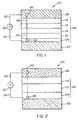
- an electroluminescent (EL) device 100 is shown.
- the device is formed on a glass substrate 102.
- This glass substrate can be borosilicate or soda lime.
- a layer 104 which forms the anode of the device 100.
- the anode layer typically can be formed from indium tin oxide.
- On the anode in sequence, there are provided the following layers, hole injection layer 110, hole transport layer 112, luminescent layer 114 and electron transport layer 116.
- the layers 110, 112, 114 and 116 all comprise the organic electroluminescent medium 106.
- On the medium 106 or the electron transport layer 116 is formed the cathode 108.
- the anode and cathode are connected to an external AC or DC power source 120 conductors 122 and 124, respectively.
- the power source can be pulsed or continuous wave (CW).
- the device 100 can be viewed as a diode which is forward biased. Under these conditions injection of hole 130 (positive charge carrier) from anode 104 occurs into the lower organic layer, as schematically shown in FIG. 1, while electron (negative charge carrier) are injected into the upper organic layer, as schematically shown at 140, into the luminescent medium.
- the injected holes and electrons each migrate toward the oppositely charged electrode, as shown by the arrows 132 and 142, respectively. This results in hole-electron recombination.
- a migrating electron drops from its conduction band to a valence band in filling a hole, energy is released as light.
- the organic luminescent medium forms between the electrodes a luminescence zone receiving mobile charge carriers from each electrode.
- the released light can be emitted from the organic luminescent material through the anode, through the cathode, or through any combination of the foregoing.
- FIG. 2 An alternative construction of the EL device is shown in FIG. 2.
- the hole-injection layer 110 and the electron-injection layer 116 of EL device 100 are omitted.
- the EL performance based on this simplified structure would still be functional provided the electrode contacts can adequately inject charge carriers into the EL medium.
- the potential barrier between the anode 104 and the hole-transport layer 112 is sufficiently low such that hole injection from the anode to the hole-transport layer is relatively unimpeded when the device is biased with a low voltage.
- the potential barrier between the cathode 108 and the luminescent layer 114 is sufficiently low such that the electron injection from the cathode to the luminescent layer is also unimpeded.
- the luminescent layer is capable of electron transport as well as electron-hole recombination is necessary for the production of electroluminescence.
- FIG. 1 Other alternative constructions of the EL device based on FIG. 1 are possible. For instance, one such construction would omit only the hole-injection layer 110, but retain all the other layers. Another construction would omit only the electron injection layer 116, but retain all other layers. The criteria for selecting one of these alternative construction is based on a combination of factors, such as the injection properties of the electrode contacts, the ionization potentials of the individual layers in contact with the electrodes as well as the transport characteristics of the individual organic layer comprising the EL medium.
- the hole injection layer 110 of EL device 100 contains a porphyrinic compound.
- a porphyrinic compound is any compound, natural or synthetic, which is derived from or includes a porphyrin structure, including porphine itself. Any of the prophyrinic compounds disclosed by Adler, U.S. Patent No. 3,935,031 or Tang U.S. Patent No. 4,356,429 can be employed.
- Preferred porphyrinic compounds are those of structural formula (III): wherein
- porphyrinic compounds differ from those of structural formula (III) by substitution of two hydrogens for the metal atom, as indicated by formula (IV):
- porphyrinic compounds are metal free phthalocyanines and metal containing phthalocyanines. While the porphyrinic compounds in general and the phthalocyanines in particular can contain any metal, the metal preferably has a positive valence of two or higher. Exemplary preferred metals are cobalt, magnesium, zinc, palladium, nickel, and, particularly, copper, lead, and platinum.
- the hole transporting layer of the organic EL device contains at least one hole transporting aromatic tertiary amine, where the latter is understood to be a compound containing at least one trivalent nitrogen atom that is bonded only to carbon atoms, at least one of which is a member of an aromatic ring.
- the aromatic tertiary amine can be an arylamine, such as a monarylamine, diarylamine, triarylamine, or a polymeric arylamine. Exemplary monomeric triarylamines are illustrated by Klupfel et al. U.S. Patent No. 3,180,730. Other suitable triarylamines substituted with vinyl or vinyl radicals and/or containing at least one active hydrogen containing group are disclosed by Brantley et al. U.S. Patent Nos. 3,567,450 and 3,658,520.
- aromatic tertiary amines are those which include at least two aromatic tertiary amine moieties.
- Such compounds include those represented by structural formula (V). wherein
- a preferred class of triarylamines satisfying structural formula (V) and containing two triarylamine moieties are those satisfying structural formula (VI): where
- tetraaryldiamines include two diarylamino groups, such as indicated by formula (VIII), linked through an arylene group: wherein
- the various alkyl, alkylene, aryl, and arylene moieties of the foregoing structural formulae (V), (VI), (VIII), can each in turn be substituted.
- Typical substituents including alkyl groups, alkoxy groups, aryl groups, aryloxy groups, and halogen such as fluoride, chloride, and bromide.
- the various alkyl and alkylene moieties typically contain from about 1 to 6 carbon atoms.
- the cycloalkyl moieties can contain from 3 to about 10 carbon atoms, but typically contain five, six, or seven ring carbon atoms e.g., cyclopentyl, cyclohexyl, and cycloheptyl ring structures.
- the aryl and arylene moieties are preferably phenyl and phenylene moieties wherein
- the various alkyl, alkylene, aryl, and arylene moieties of the foregoing structural formulae (V), (VI), (VIII), can each in turn be substituted.
- Typical substituents including alkyl groups, alkoxy groups, aryl groups, aryloxy groups, and halogen such as fluoride, chloride, and bromide.
- the various alkyl and alkylene moieties typically contain from about 1 to 6 carbon atoms.
- the cycloalkyl moieties can contain from 3 to about 10 carbon atoms, but typically contain five, six, or seven ring carbon atoms-e.g., cyclopentyl, cyclohexyl, and cycloheptyl ring structures.
- the aryl and arylene moieties are preferably phenyl and phenylene moieties.
- Illustrative of useful hole transport compounds are the following:
- the luminescent layer emitting white light in device 100 comprises of a host organic material uniformly doped with a small amount of a guest material.
- the guest materials of luminescent layer of device 100 contains a fluorescent compound represented by structural formula I: wherein R 1 -R 8 , which may be the same or different, are hydrogen, halogen, or alkyl, alkoxy, alkenyl, cycloalkyl, arylalkyl, acyl, wherein the alkyl portions each contain fewer than 24 carbons, or aryl heteroaryl, alone or in combination.
- R 1 -R 8 which may be the same or different, are hydrogen, halogen, or alkyl, alkoxy, alkenyl, cycloalkyl, arylalkyl, acyl, wherein the alkyl portions each contain fewer than 24 carbons, or aryl heteroaryl, alone or in combination.
- the host materials of luminescent layer of device 100 contains the compounds that emit blue green electroluminescence.
- the host compound is a mixed ligand aluminum chelate, specifically a bis(R S -8-quinolinolato) (phenolato)aluminum(III) chelate of formula II, wherein Q in each occurrence represents a substituted 8-quinolinolato ligand, R S represents an 8-quionolinolato ring substituent chosen to block sterically the attachment of more than two substituted 8-quinolinolato ligands to the aluminum atoms, O-L is a phenolato ligand, and L is a hydrocarbon group that includes an aryl moiety.
- the electron transport layer 116 of EL device 100 is a metal chelated oxinoid compound, including chelates of oxine itself (also commonly referred to as 8-quinolinol or 8-hydroxyquinoline). Such compounds exhibit both high levels of performance and are readily fabricated in the form of thin films.
- exemplary of contemplated oxinoid compounds are those satisfying structural formula (XI). wherein
- the metal can be monovalent, divalent, or trivalent metal.
- the metal can, for example, be an alkali metal, such as lithium, sodium, or potassium; an alkaline earth metal, such as magnesium or calcium; or an earth metal, such as boron or aluminum.
- any monovalent, divalent, or trivalent metal known to be a useful chelating metal can be employed.
- Z completes a heterocyclic nucleus containing at least two fused aromatic rings, at least one of which is an azole or azine ring. Additional rings, including both aliphatic and aromatic rings, can be fused with the two required rings, if required. To avoid adding molecular bulk without improving on function the number of ring atoms is preferably maintained at 18 or less.
- Illustrative of useful chelated oxinoid compounds are the following:
- the organic EL devices of the invention it is possible to maintain a current density compatible with efficient light emission while employing a relatively low voltage across the electrodes by limiting the total thickness of the organic luminescent medium to less than 10,000 ⁇ 10 -10 m (Angstroms). At a thickness of less than 1 mm an applied voltage of 20 volts results in a field potential of greater than 2 x 10⁵ volts/cm, which is compatible with efficient light emission.
- An order of magnitude reduction to 100 ⁇ 10 -10 m (Angstroms) in thickness of the organic luminescent medium, allowing further reductions in applied voltage and/or increase in the field potential and hence current density, are well within device construction capabilities.
- the preferred materials for forming the organic luminescent medium are each capable of fabrication in the form of a thin film that is, capable of being fabricated as a continuous layer having a thickness of less than 5000 ⁇ 10 -10 m (Angstroms).
- a preferred method for forming the organic luminescent medium is by vacuum vapor deposition. Extremely thin defect free continuous layers can be formed by this method. Specifically, individual layer thicknesses as low as about 50 ⁇ 10 -10 m (Angstroms) can be constructed while still realizing satisfactory EL device performance.
- a vacuum vapor deposited porphorinic compound as a hole injecting layer
- a film forming aromatic tertiary amine as a hole transporting layer
- a fluorescent emitting layer comprised of a mixture of a host material and a fluorescent compound
- a chelated oxinoid compound as an electron injecting and transporting layer
- individual layer thicknesses in the range of from about 50 to 5000 ⁇ 10 -10 m (Angstroms) are contemplated, with layer thicknesses in the range of from 100 to 2000 ⁇ 10 -10 m (angstroms) being preferred. It is generally preferred that the overall thickness of the organic luminescent medium be at least about 1000 ⁇ 10 -10 m (Angstroms).
- the anode 104 and cathode 108 of the EL device 100 can each take any convenient conventional form. Where it is intended to transmit light from the EL device 100 through the anode, this can be conveniently achieved by coating a thin conductive layer onto a light transmissive substrate, e.g., a transparent or substantially transparent glass plate or plastic film.
- the EL device 100 of this invention can follow the historical practice of including a light transmissive anode formed of tin oxide or indium tin oxide coated on a glass plate, as disclosed by Gurnee et al. U.S. Patent No. 3,172,862, Gurnee U.S. Patent No. 3,173,050, Dresner "Double Injection Electroluminescence in Anthracene", RCA Review, Volume 30, pages 322-334, 1969; and Dresner U.S. Patent No. 3,710,167 cited above.
- the EL device 100 of this invention can employ a cathode constructed of any metal, including any high or low work function metal, heretofore taught to be useful for this purpose.
- a cathode constructed of any metal, including any high or low work function metal, heretofore taught to be useful for this purpose.
- Unexpected fabrication, performance, and stability advantages have been realized by forming the cathode of a combination of a low work function metal and at least one other metal.
- the organic layer was separated and then passed through the short silica gel column. After removal of solvents the dark purple 4,4-difluoro-1,3,5,7-tetraphenyl-4-bora-3a,4a,-diaza-s-indacene (1.56 g) was obtained in 87% yield.
- the pure material used for cell fabrication was obtained by sublimation at 285 °C under 2,67 ⁇ 10 2 N/m 2 (2 Torr).
- the device structure has a four organic-layer stack, namely hole-injecting layer, hole transporting layer, luminescent layer , electron-transporting layer.
- the above sequence completed the deposition of the EL device.
- the device was then hermetically packaged in a dry glove box for protection against ambient environment.
- the EL devices were fabricated according to the procedure of Example 2. Except the fluorescent emitting layer was deposited with host material (H3) doped with various concentration of guest material, 4,4-difluoro-1,3,5,7-tetraphenyl-4-bora-3a,4a,-diazasindacene, (G5).
- host material H3 doped with various concentration of guest material, 4,4-difluoro-1,3,5,7-tetraphenyl-4-bora-3a,4a,-diazasindacene, (G5).
- Table 1 lists the luminance quantum efficiency measured in unit of candela per square meter, CIE color coordinates, and the luminance output under a constant current bias of 20 mA/cm ⁇ 2.
Landscapes
- Chemical & Material Sciences (AREA)
- Organic Chemistry (AREA)
- Engineering & Computer Science (AREA)
- Materials Engineering (AREA)
- Electroluminescent Light Sources (AREA)
- Luminescent Compositions (AREA)
Applications Claiming Priority (2)
| Application Number | Priority Date | Filing Date | Title |
|---|---|---|---|
| US08/592,830 US5683823A (en) | 1996-01-26 | 1996-01-26 | White light-emitting organic electroluminescent devices |
| US592830 | 1996-01-26 |
Publications (3)
| Publication Number | Publication Date |
|---|---|
| EP0786925A2 EP0786925A2 (en) | 1997-07-30 |
| EP0786925A3 EP0786925A3 (en) | 1997-09-24 |
| EP0786925B1 true EP0786925B1 (en) | 2002-06-19 |
Family
ID=24372239
Family Applications (1)
| Application Number | Title | Priority Date | Filing Date |
|---|---|---|---|
| EP97200088A Expired - Lifetime EP0786925B1 (en) | 1996-01-26 | 1997-01-13 | White light-emitting electroluminescent devices |
Country Status (4)
| Country | Link |
|---|---|
| US (1) | US5683823A (enExample) |
| EP (1) | EP0786925B1 (enExample) |
| JP (1) | JP3869061B2 (enExample) |
| DE (1) | DE69713410T2 (enExample) |
Cited By (2)
| Publication number | Priority date | Publication date | Assignee | Title |
|---|---|---|---|---|
| SG121713A1 (en) * | 2001-04-25 | 2006-05-26 | Toray Industries | Pyrromethene metal complex and light emitting device composition and light emitting devices using the same |
| KR101495154B1 (ko) | 2006-12-22 | 2015-02-24 | 소니 주식회사 | 유기 전계 발광 소자 및 표시 장치 |
Families Citing this family (185)
| Publication number | Priority date | Publication date | Assignee | Title |
|---|---|---|---|---|
| WO1997040648A1 (en) * | 1996-04-25 | 1997-10-30 | Philips Electronics N.V. | Organic electroluminescent device |
| CA2253819C (en) * | 1996-05-15 | 2004-11-02 | Chemipro Kasei Kaisha, Limited | Multicolor organic el element, method for manufacturing the same, and display using the same |
| US6949517B1 (en) * | 1996-06-24 | 2005-09-27 | Matti Siren | Method of treating inflammatory, tissue repair and infectious conditions |
| JP2914361B2 (ja) * | 1997-10-09 | 1999-06-28 | 日本電気株式会社 | 有機薄膜el素子 |
| US5851709A (en) * | 1997-10-31 | 1998-12-22 | Eastman Kodak Company | Method for selective transfer of a color organic layer |
| US6248458B1 (en) * | 1997-11-17 | 2001-06-19 | Lg Electronics Inc. | Organic electroluminescent device with improved long-term stability |
| US6252254B1 (en) | 1998-02-06 | 2001-06-26 | General Electric Company | Light emitting device with phosphor composition |
| JP3389888B2 (ja) | 1998-11-09 | 2003-03-24 | 東レ株式会社 | 発光素子 |
| US6391482B1 (en) | 1999-02-04 | 2002-05-21 | Matsushita Electric Industrial Co., Ltd. | Organic material for electroluminescent device and electroluminescent device using the same |
| JP3690931B2 (ja) * | 1999-02-04 | 2005-08-31 | 三井化学株式会社 | 有機電界発光素子 |
| US6242076B1 (en) | 1999-02-08 | 2001-06-05 | Michael D. Andriash | Illuminated imageable vision control panels and methods of fabricating |
| JP2000340364A (ja) * | 1999-05-25 | 2000-12-08 | Tdk Corp | 有機el素子 |
| US6521360B2 (en) | 1999-06-08 | 2003-02-18 | City University Of Hong Kong | White and colored organic electroluminescent devices using single emitting material by novel color change technique |
| KR100721656B1 (ko) | 2005-11-01 | 2007-05-23 | 주식회사 엘지화학 | 유기 전기 소자 |
| US6696177B1 (en) | 2000-08-30 | 2004-02-24 | Eastman Kodak Company | White organic electroluminescent devices with improved stability and efficiency |
| US6515314B1 (en) * | 2000-11-16 | 2003-02-04 | General Electric Company | Light-emitting device with organic layer doped with photoluminescent material |
| ES2178953B1 (es) * | 2000-12-20 | 2003-09-16 | Sl Para El Desarrollo Cientifi | Producto dentifrico. |
| AU2002309147A1 (en) * | 2001-06-12 | 2002-12-23 | Koninklijke Philips Electronics N.V. | (electro)luminescent device with an organic dye as an acceptor |
| US6627333B2 (en) * | 2001-08-15 | 2003-09-30 | Eastman Kodak Company | White organic light-emitting devices with improved efficiency |
| TW519852B (en) * | 2001-10-18 | 2003-02-01 | Opto Tech Corp | Organic light emitting device capable of projecting white light source and its manufacturing method |
| US10211268B1 (en) | 2012-09-28 | 2019-02-19 | Imaging Systems Technology, Inc. | Large area OLED display |
| US6903505B2 (en) * | 2001-12-17 | 2005-06-07 | General Electric Company | Light-emitting device with organic electroluminescent material and photoluminescent materials |
| US6610455B1 (en) | 2002-01-30 | 2003-08-26 | Eastman Kodak Company | Making electroluminscent display devices |
| US6872472B2 (en) | 2002-02-15 | 2005-03-29 | Eastman Kodak Company | Providing an organic electroluminescent device having stacked electroluminescent units |
| US6661023B2 (en) * | 2002-02-28 | 2003-12-09 | Eastman Kodak Company | Organic element for electroluminescent devices |
| US6824893B2 (en) * | 2002-02-28 | 2004-11-30 | Eastman Kodak Company | Organic element for electroluminescent devices |
| US6770502B2 (en) * | 2002-04-04 | 2004-08-03 | Eastman Kodak Company | Method of manufacturing a top-emitting OLED display device with desiccant structures |
| JP3902981B2 (ja) * | 2002-06-04 | 2007-04-11 | キヤノン株式会社 | 有機発光素子及び表示装置 |
| US6720092B2 (en) | 2002-07-08 | 2004-04-13 | Eastman Kodak Company | White organic light-emitting devices using rubrene layer |
| TW200402012A (en) * | 2002-07-23 | 2004-02-01 | Eastman Kodak Co | OLED displays with fiber-optic faceplates |
| US6890627B2 (en) | 2002-08-02 | 2005-05-10 | Eastman Kodak Company | Laser thermal transfer from a donor element containing a hole-transporting layer |
| US6939660B2 (en) * | 2002-08-02 | 2005-09-06 | Eastman Kodak Company | Laser thermal transfer donor including a separate dopant layer |
| KR100480442B1 (ko) | 2002-08-17 | 2005-04-06 | 한국과학기술연구원 | 미량도핑에 의한 고효율 백색 유기 발광 물질 및 이를이용한 전기발광소자 |
| US6747618B2 (en) | 2002-08-20 | 2004-06-08 | Eastman Kodak Company | Color organic light emitting diode display with improved lifetime |
| US20040043138A1 (en) * | 2002-08-21 | 2004-03-04 | Ramesh Jagannathan | Solid state lighting using compressed fluid coatings |
| US20040043140A1 (en) * | 2002-08-21 | 2004-03-04 | Ramesh Jagannathan | Solid state lighting using compressed fluid coatings |
| US20040058193A1 (en) * | 2002-09-16 | 2004-03-25 | Eastman Kodak Company | White organic light-emitting devices with improved performance |
| US6765349B2 (en) * | 2002-09-30 | 2004-07-20 | Eastman Kodak Company | High work function metal alloy cathode used in organic electroluminescent devices |
| US7230594B2 (en) | 2002-12-16 | 2007-06-12 | Eastman Kodak Company | Color OLED display with improved power efficiency |
| US7079091B2 (en) * | 2003-01-14 | 2006-07-18 | Eastman Kodak Company | Compensating for aging in OLED devices |
| US20040142098A1 (en) * | 2003-01-21 | 2004-07-22 | Eastman Kodak Company | Using compacted organic materials in making white light emitting oleds |
| US6967062B2 (en) | 2003-03-19 | 2005-11-22 | Eastman Kodak Company | White light-emitting OLED device having a blue light-emitting layer doped with an electron-transporting or a hole-transporting material or both |
| US7037601B2 (en) * | 2003-05-28 | 2006-05-02 | Eastman Kodak Company | White light-emitting device structures |
| EP1482573A3 (en) | 2003-05-29 | 2007-07-25 | Sony Corporation | Organic electroluminescence device |
| US6919140B2 (en) * | 2003-07-10 | 2005-07-19 | Eastman Kodak Company | Organic electroluminescent devices with high luminance |
| US7030553B2 (en) * | 2003-08-19 | 2006-04-18 | Eastman Kodak Company | OLED device having microcavity gamut subpixels and a within gamut subpixel |
| US6875524B2 (en) * | 2003-08-20 | 2005-04-05 | Eastman Kodak Company | White light-emitting device with improved doping |
| US7268485B2 (en) * | 2003-10-07 | 2007-09-11 | Eastman Kodak Company | White-emitting microcavity OLED device |
| US7238436B2 (en) * | 2003-10-22 | 2007-07-03 | Eastman Kodak Company | Stabilized white-light-emitting OLED device |
| US7074502B2 (en) * | 2003-12-05 | 2006-07-11 | Eastman Kodak Company | Organic element for electroluminescent devices |
| US7221332B2 (en) * | 2003-12-19 | 2007-05-22 | Eastman Kodak Company | 3D stereo OLED display |
| US20050136289A1 (en) * | 2003-12-22 | 2005-06-23 | Chu Hye Y. | White organic light emitting device |
| US20050147844A1 (en) * | 2004-01-05 | 2005-07-07 | Eastman Kodak Company | White oled devices with color filter arrays |
| US20050145326A1 (en) * | 2004-01-05 | 2005-07-07 | Eastman Kodak Company | Method of making an OLED device |
| KR100712098B1 (ko) * | 2004-01-13 | 2007-05-02 | 삼성에스디아이 주식회사 | 백색 발광 유기전계발광소자 및 그를 구비하는유기전계발광표시장치 |
| US7329466B2 (en) * | 2004-01-30 | 2008-02-12 | Eastman Kodak Company | Organic element for electroluminescent devices |
| US7070868B2 (en) * | 2004-01-30 | 2006-07-04 | Eastman Kodak Company | Organic element for electroluminescent devices |
| US6885026B1 (en) * | 2004-01-30 | 2005-04-26 | Eastman Kodak Company | Organic element for electroluminescent devices |
| US7074503B2 (en) * | 2004-01-30 | 2006-07-11 | Eastman Kodak Company | Organic element for electroluminescent devices |
| US7252893B2 (en) * | 2004-02-17 | 2007-08-07 | Eastman Kodak Company | Anthracene derivative host having ranges of dopants |
| KR100721551B1 (ko) * | 2004-03-17 | 2007-05-23 | 삼성에스디아이 주식회사 | 백색 발광 유기전계발광소자 및 그를 구비하는유기전계발광표시장치 |
| US7300709B2 (en) * | 2004-03-31 | 2007-11-27 | Eastman Kodak Company | Organic element for electroluminescent devices |
| US7129634B2 (en) * | 2004-04-07 | 2006-10-31 | Eastman Kodak Company | Color OLED with added color gamut pixels |
| US7192659B2 (en) * | 2004-04-14 | 2007-03-20 | Eastman Kodak Company | OLED device using reduced drive voltage |
| US8129906B1 (en) | 2004-04-26 | 2012-03-06 | Imaging Systems Technology, Inc. | Lumino-shells |
| US7247394B2 (en) * | 2004-05-04 | 2007-07-24 | Eastman Kodak Company | Tuned microcavity color OLED display |
| US7737635B2 (en) * | 2004-05-28 | 2010-06-15 | Harvatek Corporation | High efficiency white light emitting diode and method for manufacturing the same |
| US7023013B2 (en) * | 2004-06-16 | 2006-04-04 | Eastman Kodak Company | Array of light-emitting OLED microcavity pixels |
| US7288330B2 (en) * | 2004-07-01 | 2007-10-30 | Eaastman Kodak Company | High performance white light-emitting OLED device |
| US7208863B2 (en) | 2004-07-09 | 2007-04-24 | Eastman Kodak Company | Light emitting devices with patterned angular color dependency |
| US7316756B2 (en) | 2004-07-27 | 2008-01-08 | Eastman Kodak Company | Desiccant for top-emitting OLED |
| US7273663B2 (en) * | 2004-08-20 | 2007-09-25 | Eastman Kodak Company | White OLED having multiple white electroluminescence units |
| US9040170B2 (en) * | 2004-09-20 | 2015-05-26 | Global Oled Technology Llc | Electroluminescent device with quinazoline complex emitter |
| US7501152B2 (en) | 2004-09-21 | 2009-03-10 | Eastman Kodak Company | Delivering particulate material to a vaporization zone |
| US7812800B2 (en) * | 2004-09-22 | 2010-10-12 | Tpo Displays Corp. | Design Approach and panel and electronic device utilizing the same |
| US7560862B2 (en) * | 2004-10-22 | 2009-07-14 | Eastman Kodak Company | White OLEDs with a color-compensated electroluminescent unit |
| US8174182B2 (en) * | 2004-11-17 | 2012-05-08 | Global Oled Technology Llc | Selecting white point for OLED devices |
| KR100635575B1 (ko) * | 2004-11-17 | 2006-10-17 | 삼성에스디아이 주식회사 | 풀 칼라 유기 전계 발광 표시 소자 및 그 제조방법 |
| CN100514701C (zh) * | 2004-12-08 | 2009-07-15 | 富士电机控股株式会社 | 有机el元件 |
| US9179518B2 (en) * | 2004-12-24 | 2015-11-03 | Cambridge Display Technology Limited | Light emissive device |
| US20060145599A1 (en) * | 2005-01-04 | 2006-07-06 | Reza Stegamat | OLEDs with phosphors |
| US7236845B2 (en) * | 2005-03-10 | 2007-06-26 | Eastman Kodak Company | Selecting OLED devices using figure of merit |
| TWI282699B (en) * | 2005-03-14 | 2007-06-11 | Au Optronics Corp | Method of fabrication organic light emitting diode display |
| US8057916B2 (en) * | 2005-04-20 | 2011-11-15 | Global Oled Technology, Llc. | OLED device with improved performance |
| US20060240281A1 (en) * | 2005-04-21 | 2006-10-26 | Eastman Kodak Company | Contaminant-scavenging layer on OLED anodes |
| TWI333392B (en) * | 2005-05-25 | 2010-11-11 | Au Optronics Corp | Emission layer and organic light emitting diode using thereof |
| US7531959B2 (en) * | 2005-06-29 | 2009-05-12 | Eastman Kodak Company | White light tandem OLED display with filters |
| US7564182B2 (en) * | 2005-06-29 | 2009-07-21 | Eastman Kodak Company | Broadband light tandem OLED display |
| US20070069632A1 (en) * | 2005-09-26 | 2007-03-29 | Toppoly Optoelectronics Corp. | Electroluminescent device and pixel device |
| JP2007115419A (ja) * | 2005-10-18 | 2007-05-10 | Fuji Electric Holdings Co Ltd | 有機発光素子 |
| US8956738B2 (en) | 2005-10-26 | 2015-02-17 | Global Oled Technology Llc | Organic element for low voltage electroluminescent devices |
| US20070252516A1 (en) * | 2006-04-27 | 2007-11-01 | Eastman Kodak Company | Electroluminescent devices including organic EIL layer |
| US20070122657A1 (en) * | 2005-11-30 | 2007-05-31 | Eastman Kodak Company | Electroluminescent device containing a phenanthroline derivative |
| US9666826B2 (en) | 2005-11-30 | 2017-05-30 | Global Oled Technology Llc | Electroluminescent device including an anthracene derivative |
| US20070126347A1 (en) * | 2005-12-01 | 2007-06-07 | Eastman Kodak Company | OLEDS with improved efficiency |
| GB0526393D0 (en) * | 2005-12-23 | 2006-02-08 | Cdt Oxford Ltd | Light emissive device |
| US8680693B2 (en) | 2006-01-18 | 2014-03-25 | Lg Chem. Ltd. | OLED having stacked organic light-emitting units |
| US20090309094A1 (en) * | 2006-02-27 | 2009-12-17 | Technion Research And Development Foundation Ltd. | Color controlled electroluminescent devices |
| US20070207345A1 (en) * | 2006-03-01 | 2007-09-06 | Eastman Kodak Company | Electroluminescent device including gallium complexes |
| US7332860B2 (en) * | 2006-03-30 | 2008-02-19 | Eastman Kodak Company | Efficient white-light OLED display with filters |
| US9118020B2 (en) * | 2006-04-27 | 2015-08-25 | Global Oled Technology Llc | Electroluminescent devices including organic eil layer |
| EP2355198B1 (en) | 2006-05-08 | 2015-09-09 | Global OLED Technology LLC | OLED electron-injecting layer |
| US20080032123A1 (en) * | 2006-08-02 | 2008-02-07 | Spindler Jeffrey P | Dual electron-transporting layer for oled device |
| US7667391B2 (en) * | 2006-08-04 | 2010-02-23 | Eastman Kodak Company | Electrically excited organic light-emitting diodes with spatial and spectral coherence |
| US20080057183A1 (en) * | 2006-08-31 | 2008-03-06 | Spindler Jeffrey P | Method for lithium deposition in oled device |
| GB2442724B (en) * | 2006-10-10 | 2009-10-21 | Cdt Oxford Ltd | Light emissive device |
| US7837780B2 (en) | 2006-11-10 | 2010-11-23 | Global Oled Technology Llc | Green color filter element |
| JP2008174783A (ja) * | 2007-01-17 | 2008-07-31 | Fuji Electric Holdings Co Ltd | パターン状の蒸着膜の製造方法 |
| US20080176099A1 (en) * | 2007-01-18 | 2008-07-24 | Hatwar Tukaram K | White oled device with improved functions |
| US8795855B2 (en) * | 2007-01-30 | 2014-08-05 | Global Oled Technology Llc | OLEDs having high efficiency and excellent lifetime |
| US7816859B2 (en) * | 2007-04-30 | 2010-10-19 | Global Oled Technology Llc | White light tandem OLED |
| US7948165B2 (en) * | 2007-05-09 | 2011-05-24 | Global Oled Technology Llc | High-performance tandem white OLED |
| US7911133B2 (en) * | 2007-05-10 | 2011-03-22 | Global Oled Technology Llc | Electroluminescent device having improved light output |
| US20080284318A1 (en) * | 2007-05-17 | 2008-11-20 | Deaton Joseph C | Hybrid fluorescent/phosphorescent oleds |
| TWI335681B (en) * | 2007-05-18 | 2011-01-01 | Ind Tech Res Inst | White light organic electroluminescent element device |
| US8034465B2 (en) * | 2007-06-20 | 2011-10-11 | Global Oled Technology Llc | Phosphorescent oled having double exciton-blocking layers |
| US20090004485A1 (en) * | 2007-06-27 | 2009-01-01 | Shiying Zheng | 6-member ring structure used in electroluminescent devices |
| US7812531B2 (en) | 2007-07-25 | 2010-10-12 | Global Oled Technology Llc | Preventing stress transfer in OLED display components |
| US20090053557A1 (en) * | 2007-08-23 | 2009-02-26 | Spindler Jeffrey P | Stabilized white-emitting oled device |
| EP2193112B1 (en) * | 2007-09-20 | 2012-04-04 | Basf Se | Electroluminescent device |
| US20090110956A1 (en) * | 2007-10-26 | 2009-04-30 | Begley William J | Oled device with electron transport material combination |
| US8431242B2 (en) | 2007-10-26 | 2013-04-30 | Global Oled Technology, Llc. | OLED device with certain fluoranthene host |
| US8129039B2 (en) | 2007-10-26 | 2012-03-06 | Global Oled Technology, Llc | Phosphorescent OLED device with certain fluoranthene host |
| US8420229B2 (en) * | 2007-10-26 | 2013-04-16 | Global OLED Technologies LLC | OLED device with certain fluoranthene light-emitting dopants |
| US8076009B2 (en) | 2007-10-26 | 2011-12-13 | Global Oled Technology, Llc. | OLED device with fluoranthene electron transport materials |
| US8016631B2 (en) * | 2007-11-16 | 2011-09-13 | Global Oled Technology Llc | Desiccant sealing arrangement for OLED devices |
| US8900722B2 (en) | 2007-11-29 | 2014-12-02 | Global Oled Technology Llc | OLED device employing alkali metal cluster compounds |
| US8877350B2 (en) * | 2007-12-11 | 2014-11-04 | Global Oled Technology Llc | White OLED with two blue light-emitting layers |
| US20090162612A1 (en) * | 2007-12-19 | 2009-06-25 | Hatwar Tukaram K | Oled device having two electron-transport layers |
| US7955719B2 (en) | 2008-01-30 | 2011-06-07 | Global Oled Technology Llc | Tandem OLED device with intermediate connector |
| US7821201B2 (en) * | 2008-01-31 | 2010-10-26 | Global Oled Technology Llc | Tandem OLED device with intermediate connector |
| US8115399B2 (en) * | 2008-02-19 | 2012-02-14 | General Electric Company | OLED light source |
| US7534635B1 (en) | 2008-03-24 | 2009-05-19 | General Electric Company | Getter precursors for hermetically sealed packaging |
| US7947974B2 (en) * | 2008-03-25 | 2011-05-24 | Global Oled Technology Llc | OLED device with hole-transport and electron-transport materials |
| US8324800B2 (en) * | 2008-06-12 | 2012-12-04 | Global Oled Technology Llc | Phosphorescent OLED device with mixed hosts |
| JP2011526424A (ja) * | 2008-06-26 | 2011-10-06 | イー・アイ・デュポン・ドウ・ヌムール・アンド・カンパニー | 有機発光ダイオード照明器具 |
| TWI477564B (zh) | 2008-07-28 | 2015-03-21 | Sharp Kk | A polymer pigment material, a color conversion film thereof, and a multi-color light emitting organic EL device |
| JP5214360B2 (ja) * | 2008-07-29 | 2013-06-19 | シャープ株式会社 | 色変換方式有機elディスプレイ |
| US8247088B2 (en) * | 2008-08-28 | 2012-08-21 | Global Oled Technology Llc | Emitting complex for electroluminescent devices |
| EP2161272A1 (en) | 2008-09-05 | 2010-03-10 | Basf Se | Phenanthrolines |
| US7977872B2 (en) * | 2008-09-16 | 2011-07-12 | Global Oled Technology Llc | High-color-temperature tandem white OLED |
| CN102197507A (zh) | 2008-10-28 | 2011-09-21 | 密执安州立大学董事会 | 具有单独的红色、绿色和蓝色子元件的堆叠式白色oled |
| US8277697B2 (en) * | 2008-10-29 | 2012-10-02 | Global Oled Technology Llc | Color filter element with improved colorant dispersion |
| US7931975B2 (en) * | 2008-11-07 | 2011-04-26 | Global Oled Technology Llc | Electroluminescent device containing a flouranthene compound |
| US8088500B2 (en) | 2008-11-12 | 2012-01-03 | Global Oled Technology Llc | OLED device with fluoranthene electron injection materials |
| US7968215B2 (en) * | 2008-12-09 | 2011-06-28 | Global Oled Technology Llc | OLED device with cyclobutene electron injection materials |
| US8216697B2 (en) * | 2009-02-13 | 2012-07-10 | Global Oled Technology Llc | OLED with fluoranthene-macrocyclic materials |
| US8147989B2 (en) * | 2009-02-27 | 2012-04-03 | Global Oled Technology Llc | OLED device with stabilized green light-emitting layer |
| US8466856B2 (en) | 2011-02-22 | 2013-06-18 | Global Oled Technology Llc | OLED display with reduced power consumption |
| US20100231125A1 (en) * | 2009-03-12 | 2010-09-16 | Sheng Li | Organic light emitting device to emit in near infrared |
| US20100244677A1 (en) * | 2009-03-31 | 2010-09-30 | Begley William J | Oled device containing a silyl-fluoranthene derivative |
| US8283054B2 (en) | 2009-04-03 | 2012-10-09 | Global Oled Technology Llc | Tandem white OLED with efficient electron transfer |
| US8206842B2 (en) * | 2009-04-06 | 2012-06-26 | Global Oled Technology Llc | Organic element for electroluminescent devices |
| US8389985B2 (en) | 2009-06-10 | 2013-03-05 | Sharp Kabushiki Kaisha | Color conversion film containing a conjugated high molecular weight copolymer and multicolor light-emitting organic EL device including the same |
| CN102482574B (zh) | 2009-06-18 | 2014-09-24 | 巴斯夫欧洲公司 | 用作场致发光器件的空穴传输材料的菲并唑化合物 |
| US8877356B2 (en) * | 2009-07-22 | 2014-11-04 | Global Oled Technology Llc | OLED device with stabilized yellow light-emitting layer |
| KR20110023851A (ko) | 2009-08-19 | 2011-03-08 | 후지 덴키 홀딩스 가부시키가이샤 | 색 변환층 및 그 제조 방법 |
| JP2013502743A (ja) | 2009-08-24 | 2013-01-24 | イー・アイ・デュポン・ドウ・ヌムール・アンド・カンパニー | 有機発光ダイオード照明器具 |
| WO2011028482A2 (en) | 2009-08-24 | 2011-03-10 | E. I. Du Pont De Nemours And Company | Organic light-emitting diode luminaires |
| JP5471162B2 (ja) * | 2009-08-25 | 2014-04-16 | 住友化学株式会社 | 有機エレクトロルミネッセンス素子 |
| US8716700B2 (en) * | 2009-10-29 | 2014-05-06 | E I Du Pont De Nemours And Company | Organic light-emitting diodes having white light emission |
| US20110260142A1 (en) * | 2009-10-29 | 2011-10-27 | E. I. Du Pont De Nemours And Company | Organic light-emitting diode luminaires |
| US8674343B2 (en) | 2009-10-29 | 2014-03-18 | E I Du Pont De Nemours And Company | Organic light-emitting diodes having white light emission |
| JP2013509723A (ja) * | 2009-10-29 | 2013-03-14 | イー・アイ・デュポン・ドウ・ヌムール・アンド・カンパニー | 有機発光ダイオード照明器具 |
| US20110260141A1 (en) * | 2009-10-29 | 2011-10-27 | E.I. Du Pont De Nemours And Company | Organic light-emitting diode luminaires |
| US8716699B2 (en) * | 2009-10-29 | 2014-05-06 | E I Du Pont De Nemours And Company | Organic light-emitting diodes having white light emission |
| JP2011199174A (ja) * | 2010-03-23 | 2011-10-06 | Fujifilm Corp | 発光層形成用固形材料、並びに有機電界発光素子及びその製造方法 |
| FR2958455B1 (fr) * | 2010-04-06 | 2015-06-26 | Commissariat Energie Atomique | Diode electroluminescente organique comportant au moins deux couches electroluminescentes. |
| TWI552406B (zh) * | 2011-03-25 | 2016-10-01 | 出光興產股份有限公司 | 有機電致發光元件 |
| KR101821256B1 (ko) * | 2011-11-03 | 2018-01-24 | 삼성디스플레이 주식회사 | 헤테로고리 화합물 및 이를 포함하는 유기 전계 발광 소자 |
| JP2013105665A (ja) * | 2011-11-15 | 2013-05-30 | Idemitsu Kosan Co Ltd | 白色系有機エレクトロルミネッセンス素子 |
| US9024526B1 (en) | 2012-06-11 | 2015-05-05 | Imaging Systems Technology, Inc. | Detector element with antenna |
| US8901547B2 (en) | 2012-08-25 | 2014-12-02 | Polyera Corporation | Stacked structure organic light-emitting transistors |
| US10593886B2 (en) | 2013-08-25 | 2020-03-17 | Molecular Glasses, Inc. | OLED devices with improved lifetime using non-crystallizable molecular glass mixture hosts |
| KR102144993B1 (ko) | 2013-10-02 | 2020-08-14 | 삼성전자주식회사 | 디스플레이 장치 |
| US9666822B2 (en) | 2013-12-17 | 2017-05-30 | The Regents Of The University Of Michigan | Extended OLED operational lifetime through phosphorescent dopant profile management |
| EP2960280A1 (en) | 2014-06-26 | 2015-12-30 | E.T.C. S.r.l. | Photocrosslinkable compositions, patterned high k thin film dielectrics and related devices |
| EP2978035A1 (en) | 2014-07-24 | 2016-01-27 | E.T.C. S.r.l. | Organic electroluminescent transistor |
| EP2978037A1 (en) | 2014-07-24 | 2016-01-27 | E.T.C. S.r.l. | Organic electroluminescent transistor |
| WO2016014980A1 (en) | 2014-07-24 | 2016-01-28 | E.T.C.S.R.L. | Organic electroluminescent transistor |
| WO2016100983A1 (en) | 2014-12-19 | 2016-06-23 | Polyera Corporation | Photocrosslinkable compositions, patterned high k thin film dielectrics and related devices |
| JP6749900B2 (ja) * | 2015-06-05 | 2020-09-02 | ソニーセミコンダクタソリューションズ株式会社 | 固体撮像素子、光電変換膜、電子ブロック層、撮像装置、および電子機器 |
| CN105895819B (zh) * | 2016-04-28 | 2018-07-06 | 京东方科技集团股份有限公司 | 一种oled器件及其制备方法、oled显示面板 |
| JP6903169B2 (ja) | 2017-06-08 | 2021-07-14 | 日東電工株式会社 | ディスプレイデバイスで使用するためのbodipy化合物 |
| JP2019165101A (ja) * | 2018-03-19 | 2019-09-26 | 出光興産株式会社 | 有機エレクトロルミネッセンス素子、及び電子機器 |
Family Cites Families (29)
| Publication number | Priority date | Publication date | Assignee | Title |
|---|---|---|---|---|
| NL250330A (enExample) | 1959-04-09 | |||
| US3172862A (en) | 1960-09-29 | 1965-03-09 | Dow Chemical Co | Organic electroluminescent phosphors |
| US3173050A (en) | 1962-09-19 | 1965-03-09 | Dow Chemical Co | Electroluminescent cell |
| US3567450A (en) | 1968-02-20 | 1971-03-02 | Eastman Kodak Co | Photoconductive elements containing substituted triarylamine photoconductors |
| US3658520A (en) | 1968-02-20 | 1972-04-25 | Eastman Kodak Co | Photoconductive elements containing as photoconductors triarylamines substituted by active hydrogen-containing groups |
| US3710167A (en) | 1970-07-02 | 1973-01-09 | Rca Corp | Organic electroluminescent cells having a tunnel injection cathode |
| US4539507A (en) | 1983-03-25 | 1985-09-03 | Eastman Kodak Company | Organic electroluminescent devices having improved power conversion efficiencies |
| US4885211A (en) | 1987-02-11 | 1989-12-05 | Eastman Kodak Company | Electroluminescent device with improved cathode |
| US4769292A (en) * | 1987-03-02 | 1988-09-06 | Eastman Kodak Company | Electroluminescent device with modified thin film luminescent zone |
| JP2772019B2 (ja) | 1989-02-17 | 1998-07-02 | パイオニア株式会社 | 電界発光素子 |
| JPH03792A (ja) | 1989-02-17 | 1991-01-07 | Pioneer Electron Corp | 電界発光素子 |
| JP2731216B2 (ja) | 1989-02-23 | 1998-03-25 | パイオニア株式会社 | 電界発光素子 |
| US5126214A (en) | 1989-03-15 | 1992-06-30 | Idemitsu Kosan Co., Ltd. | Electroluminescent element |
| US4950950A (en) | 1989-05-18 | 1990-08-21 | Eastman Kodak Company | Electroluminescent device with silazane-containing luminescent zone |
| JP2815472B2 (ja) | 1990-01-22 | 1998-10-27 | パイオニア株式会社 | 電界発光素子 |
| US5326692B1 (en) * | 1992-05-13 | 1996-04-30 | Molecular Probes Inc | Fluorescent microparticles with controllable enhanced stokes shift |
| US5189029A (en) * | 1990-04-23 | 1993-02-23 | Bo-Dekk Ventures, Ltd. | Indacene compounds and methods for using the same |
| US5047687A (en) | 1990-07-26 | 1991-09-10 | Eastman Kodak Company | Organic electroluminescent device with stabilized cathode |
| US5073446A (en) | 1990-07-26 | 1991-12-17 | Eastman Kodak Company | Organic electroluminescent device with stabilizing fused metal particle cathode |
| US5059862A (en) | 1990-07-26 | 1991-10-22 | Eastman Kodak Company | Electroluminescent device with improved cathode |
| US5061569A (en) | 1990-07-26 | 1991-10-29 | Eastman Kodak Company | Electroluminescent device with organic electroluminescent medium |
| US5059861A (en) | 1990-07-26 | 1991-10-22 | Eastman Kodak Company | Organic electroluminescent device with stabilizing cathode capping layer |
| JP3016896B2 (ja) | 1991-04-08 | 2000-03-06 | パイオニア株式会社 | 有機エレクトロルミネッセンス素子 |
| US5187288A (en) * | 1991-05-22 | 1993-02-16 | Molecular Probes, Inc. | Ethenyl-substituted dipyrrometheneboron difluoride dyes and their synthesis |
| US5141671A (en) | 1991-08-01 | 1992-08-25 | Eastman Kodak Company | Mixed ligand 8-quinolinolato aluminum chelate luminophors |
| US5150006A (en) * | 1991-08-01 | 1992-09-22 | Eastman Kodak Company | Blue emitting internal junction organic electroluminescent device (II) |
| US5151629A (en) | 1991-08-01 | 1992-09-29 | Eastman Kodak Company | Blue emitting internal junction organic electroluminescent device (I) |
| US5405709A (en) * | 1993-09-13 | 1995-04-11 | Eastman Kodak Company | White light emitting internal junction organic electroluminescent device |
| JP3451680B2 (ja) | 1993-11-15 | 2003-09-29 | 三菱化学株式会社 | 有機電界発光素子 |
-
1996
- 1996-01-26 US US08/592,830 patent/US5683823A/en not_active Expired - Lifetime
-
1997
- 1997-01-13 EP EP97200088A patent/EP0786925B1/en not_active Expired - Lifetime
- 1997-01-13 DE DE69713410T patent/DE69713410T2/de not_active Expired - Lifetime
- 1997-01-24 JP JP01101197A patent/JP3869061B2/ja not_active Expired - Lifetime
Cited By (2)
| Publication number | Priority date | Publication date | Assignee | Title |
|---|---|---|---|---|
| SG121713A1 (en) * | 2001-04-25 | 2006-05-26 | Toray Industries | Pyrromethene metal complex and light emitting device composition and light emitting devices using the same |
| KR101495154B1 (ko) | 2006-12-22 | 2015-02-24 | 소니 주식회사 | 유기 전계 발광 소자 및 표시 장치 |
Also Published As
| Publication number | Publication date |
|---|---|
| JPH09208946A (ja) | 1997-08-12 |
| JP3869061B2 (ja) | 2007-01-17 |
| DE69713410T2 (de) | 2003-02-20 |
| EP0786925A2 (en) | 1997-07-30 |
| EP0786925A3 (en) | 1997-09-24 |
| US5683823A (en) | 1997-11-04 |
| DE69713410D1 (de) | 2002-07-25 |
Similar Documents
| Publication | Publication Date | Title |
|---|---|---|
| EP0786925B1 (en) | White light-emitting electroluminescent devices | |
| US5645948A (en) | Blue organic electroluminescent devices | |
| US5766779A (en) | Electron transporting materials for organic electroluminescent devices | |
| US5593788A (en) | Organic electroluminescent devices with high operational stability | |
| US5928802A (en) | Efficient blue organic electroluminescent devices | |
| US6020078A (en) | Green organic electroluminescent devices | |
| US5755999A (en) | Blue luminescent materials for organic electroluminescent devices | |
| US5935720A (en) | Red organic electroluminescent devices | |
| US5908581A (en) | Red organic electroluminescent materials | |
| US5935721A (en) | Organic electroluminescent elements for stable electroluminescent | |
| US6057048A (en) | Electroluminescent (EL) devices | |
| EP1308494B1 (en) | Organic electroluminescence element | |
| EP1347031A1 (en) | Organic electroluminescent element | |
| KR20020026867A (ko) | 유기 전자발광 소자 및 유기 발광 매체 | |
| JPWO2001072927A1 (ja) | 有機エレクトロルミネッセンス素子 | |
| WO2001048116A1 (en) | White organic electroluminescence element | |
| CN102796513A (zh) | 有机场致发光装置 | |
| JP2003151773A (ja) | 発光素子 | |
| KR20040015296A (ko) | 유기 전계 발광 소자 및 그것을 사용한 유기 전계 발광디스플레이 | |
| WO2001045469A1 (en) | Pentacene derivatives as red emitters in organic light emitting devices | |
| EP0766498B1 (en) | Organic electroluminescent devices with high operational stability | |
| US20030099861A1 (en) | Efficient red organic electroluminescent devices | |
| KR20240100277A (ko) | 신규한 다기능 화합물 및 이를 포함하는 유기발광다이오드 | |
| KR100354861B1 (ko) | 유기 엘렉트로루미넷센스 소자 | |
| JP3525434B2 (ja) | 有機エレクトロルミネッセンス素子 |
Legal Events
| Date | Code | Title | Description |
|---|---|---|---|
| PUAI | Public reference made under article 153(3) epc to a published international application that has entered the european phase |
Free format text: ORIGINAL CODE: 0009012 |
|
| AK | Designated contracting states |
Kind code of ref document: A2 Designated state(s): DE FR GB |
|
| PUAL | Search report despatched |
Free format text: ORIGINAL CODE: 0009013 |
|
| AK | Designated contracting states |
Kind code of ref document: A3 Designated state(s): DE FR GB |
|
| 17P | Request for examination filed |
Effective date: 19980318 |
|
| 17Q | First examination report despatched |
Effective date: 19990729 |
|
| GRAG | Despatch of communication of intention to grant |
Free format text: ORIGINAL CODE: EPIDOS AGRA |
|
| GRAG | Despatch of communication of intention to grant |
Free format text: ORIGINAL CODE: EPIDOS AGRA |
|
| GRAH | Despatch of communication of intention to grant a patent |
Free format text: ORIGINAL CODE: EPIDOS IGRA |
|
| GRAH | Despatch of communication of intention to grant a patent |
Free format text: ORIGINAL CODE: EPIDOS IGRA |
|
| GRAH | Despatch of communication of intention to grant a patent |
Free format text: ORIGINAL CODE: EPIDOS IGRA |
|
| GRAH | Despatch of communication of intention to grant a patent |
Free format text: ORIGINAL CODE: EPIDOS IGRA |
|
| GRAA | (expected) grant |
Free format text: ORIGINAL CODE: 0009210 |
|
| AK | Designated contracting states |
Kind code of ref document: B1 Designated state(s): DE FR GB |
|
| REG | Reference to a national code |
Ref country code: GB Ref legal event code: FG4D |
|
| REF | Corresponds to: |
Ref document number: 69713410 Country of ref document: DE Date of ref document: 20020725 |
|
| ET | Fr: translation filed | ||
| PLBE | No opposition filed within time limit |
Free format text: ORIGINAL CODE: 0009261 |
|
| STAA | Information on the status of an ep patent application or granted ep patent |
Free format text: STATUS: NO OPPOSITION FILED WITHIN TIME LIMIT |
|
| 26N | No opposition filed |
Effective date: 20030320 |
|
| REG | Reference to a national code |
Ref country code: FR Ref legal event code: TP |
|
| REG | Reference to a national code |
Ref country code: GB Ref legal event code: 732E Free format text: REGISTERED BETWEEN 20110224 AND 20110302 |
|
| REG | Reference to a national code |
Ref country code: FR Ref legal event code: PLFP Year of fee payment: 20 |
|
| PGFP | Annual fee paid to national office [announced via postgrant information from national office to epo] |
Ref country code: FR Payment date: 20151208 Year of fee payment: 20 |
|
| PGFP | Annual fee paid to national office [announced via postgrant information from national office to epo] |
Ref country code: DE Payment date: 20160105 Year of fee payment: 20 |
|
| PGFP | Annual fee paid to national office [announced via postgrant information from national office to epo] |
Ref country code: GB Payment date: 20160113 Year of fee payment: 20 |
|
| REG | Reference to a national code |
Ref country code: DE Ref legal event code: R071 Ref document number: 69713410 Country of ref document: DE |
|
| REG | Reference to a national code |
Ref country code: GB Ref legal event code: PE20 Expiry date: 20170112 |
|
| PG25 | Lapsed in a contracting state [announced via postgrant information from national office to epo] |
Ref country code: GB Free format text: LAPSE BECAUSE OF EXPIRATION OF PROTECTION Effective date: 20170112 |