EP0784042B1 - Verwendung von Hydrogen-bis-(oxalato)borat - Google Patents
Verwendung von Hydrogen-bis-(oxalato)borat Download PDFInfo
- Publication number
- EP0784042B1 EP0784042B1 EP97100109A EP97100109A EP0784042B1 EP 0784042 B1 EP0784042 B1 EP 0784042B1 EP 97100109 A EP97100109 A EP 97100109A EP 97100109 A EP97100109 A EP 97100109A EP 0784042 B1 EP0784042 B1 EP 0784042B1
- Authority
- EP
- European Patent Office
- Prior art keywords
- use according
- condensation
- ether
- oxalato
- borate
- Prior art date
- Legal status (The legal status is an assumption and is not a legal conclusion. Google has not performed a legal analysis and makes no representation as to the accuracy of the status listed.)
- Expired - Lifetime
Links
- 239000001257 hydrogen Substances 0.000 title claims abstract description 14
- 229910052739 hydrogen Inorganic materials 0.000 title claims abstract description 14
- 125000004435 hydrogen atom Chemical class [H]* 0.000 title claims abstract 5
- BTBUEUYNUDRHOZ-UHFFFAOYSA-N Borate Chemical compound [O-]B([O-])[O-] BTBUEUYNUDRHOZ-UHFFFAOYSA-N 0.000 title claims description 14
- 239000003377 acid catalyst Substances 0.000 claims abstract description 4
- 238000006482 condensation reaction Methods 0.000 claims abstract description 4
- 238000009833 condensation Methods 0.000 claims description 19
- 230000005494 condensation Effects 0.000 claims description 19
- YXFVVABEGXRONW-UHFFFAOYSA-N Toluene Chemical compound CC1=CC=CC=C1 YXFVVABEGXRONW-UHFFFAOYSA-N 0.000 claims description 18
- 239000011541 reaction mixture Substances 0.000 claims description 10
- 239000003054 catalyst Substances 0.000 claims description 9
- 238000005727 Friedel-Crafts reaction Methods 0.000 claims description 7
- QYKIQEUNHZKYBP-UHFFFAOYSA-N Vinyl ether Chemical compound C=COC=C QYKIQEUNHZKYBP-UHFFFAOYSA-N 0.000 claims description 7
- 239000002904 solvent Substances 0.000 claims description 7
- SPEUIVXLLWOEMJ-UHFFFAOYSA-N 1,1-dimethoxyethane Chemical compound COC(C)OC SPEUIVXLLWOEMJ-UHFFFAOYSA-N 0.000 claims description 6
- XEKOWRVHYACXOJ-UHFFFAOYSA-N Ethyl acetate Chemical compound CCOC(C)=O XEKOWRVHYACXOJ-UHFFFAOYSA-N 0.000 claims description 6
- FJKIXWOMBXYWOQ-UHFFFAOYSA-N ethenoxyethane Chemical compound CCOC=C FJKIXWOMBXYWOQ-UHFFFAOYSA-N 0.000 claims description 6
- QHMVQKOXILNZQR-ONEGZZNKSA-N (e)-1-methoxyprop-1-ene Chemical compound CO\C=C\C QHMVQKOXILNZQR-ONEGZZNKSA-N 0.000 claims description 5
- KEVYVLWNCKMXJX-ZCNNSNEGSA-N Isophytol Natural products CC(C)CCC[C@H](C)CCC[C@@H](C)CCC[C@@](C)(O)C=C KEVYVLWNCKMXJX-ZCNNSNEGSA-N 0.000 claims description 5
- SZNYYWIUQFZLLT-UHFFFAOYSA-N 2-methyl-1-(2-methylpropoxy)propane Chemical compound CC(C)COCC(C)C SZNYYWIUQFZLLT-UHFFFAOYSA-N 0.000 claims description 4
- SYBYTAAJFKOIEJ-UHFFFAOYSA-N 3-Methylbutan-2-one Chemical compound CC(C)C(C)=O SYBYTAAJFKOIEJ-UHFFFAOYSA-N 0.000 claims description 4
- 230000010933 acylation Effects 0.000 claims description 4
- 238000005917 acylation reaction Methods 0.000 claims description 4
- -1 aliphatic carboxylic ester Chemical class 0.000 claims description 4
- 150000004945 aromatic hydrocarbons Chemical class 0.000 claims description 4
- MVPPADPHJFYWMZ-UHFFFAOYSA-N chlorobenzene Chemical compound ClC1=CC=CC=C1 MVPPADPHJFYWMZ-UHFFFAOYSA-N 0.000 claims description 4
- JMMWKPVZQRWMSS-UHFFFAOYSA-N isopropanol acetate Natural products CC(C)OC(C)=O JMMWKPVZQRWMSS-UHFFFAOYSA-N 0.000 claims description 4
- 229940011051 isopropyl acetate Drugs 0.000 claims description 4
- GWYFCOCPABKNJV-UHFFFAOYSA-N isovaleric acid Chemical compound CC(C)CC(O)=O GWYFCOCPABKNJV-UHFFFAOYSA-N 0.000 claims description 4
- FDPIMTJIUBPUKL-UHFFFAOYSA-N pentan-3-one Chemical compound CCC(=O)CC FDPIMTJIUBPUKL-UHFFFAOYSA-N 0.000 claims description 4
- 238000010992 reflux Methods 0.000 claims description 4
- IZDSOVHFCMEEEZ-UHFFFAOYSA-N (4-hydroxy-2-methylnaphthalen-1-yl) benzoate Chemical compound CC1=CC(O)=C2C=CC=CC2=C1OC(=O)C1=CC=CC=C1 IZDSOVHFCMEEEZ-UHFFFAOYSA-N 0.000 claims description 3
- ZFGVCDSFRAMNMT-AATRIKPKSA-N (e)-1,1,4,4-tetramethoxybut-2-ene Chemical compound COC(OC)\C=C\C(OC)OC ZFGVCDSFRAMNMT-AATRIKPKSA-N 0.000 claims description 3
- BZLVMXJERCGZMT-UHFFFAOYSA-N Methyl tert-butyl ether Chemical compound COC(C)(C)C BZLVMXJERCGZMT-UHFFFAOYSA-N 0.000 claims description 3
- 150000001241 acetals Chemical class 0.000 claims description 3
- 125000001931 aliphatic group Chemical group 0.000 claims description 3
- 125000000391 vinyl group Chemical group [H]C([*])=C([H])[H] 0.000 claims description 3
- 229920002554 vinyl polymer Polymers 0.000 claims description 3
- DDQWVXPXXCLMDB-UHFFFAOYSA-N 2-(13,13-diethoxy-3,7,12-trimethyltrideca-1,3,5,7,11-pentaen-9-ynyl)-1,3,3-trimethylcyclohexene Chemical compound CCOC(OCC)C(C)=CC#CC=C(C)C=CC=C(C)C=CC1=C(C)CCCC1(C)C DDQWVXPXXCLMDB-UHFFFAOYSA-N 0.000 claims description 2
- CTQNGGLPUBDAKN-UHFFFAOYSA-N O-Xylene Chemical compound CC1=CC=CC=C1C CTQNGGLPUBDAKN-UHFFFAOYSA-N 0.000 claims description 2
- ZIXLDMFVRPABBX-UHFFFAOYSA-N alpha-methylcyclopentanone Natural products CC1CCCC1=O ZIXLDMFVRPABBX-UHFFFAOYSA-N 0.000 claims description 2
- 238000009835 boiling Methods 0.000 claims description 2
- 150000003997 cyclic ketones Chemical class 0.000 claims description 2
- BGTOWKSIORTVQH-UHFFFAOYSA-N cyclopentanone Chemical compound O=C1CCCC1 BGTOWKSIORTVQH-UHFFFAOYSA-N 0.000 claims description 2
- 239000008096 xylene Substances 0.000 claims description 2
- RTZKZFJDLAIYFH-UHFFFAOYSA-N Diethyl ether Chemical compound CCOCC RTZKZFJDLAIYFH-UHFFFAOYSA-N 0.000 claims 2
- ZKJNETINGMOHJG-GGWOSOGESA-N (e)-1-[(e)-prop-1-enoxy]prop-1-ene Chemical compound C\C=C\O\C=C\C ZKJNETINGMOHJG-GGWOSOGESA-N 0.000 claims 1
- ISWSIDIOOBJBQZ-UHFFFAOYSA-N Phenol Chemical compound OC1=CC=CC=C1 ISWSIDIOOBJBQZ-UHFFFAOYSA-N 0.000 claims 1
- DHKHKXVYLBGOIT-UHFFFAOYSA-N acetaldehyde Diethyl Acetal Natural products CCOC(C)OCC DHKHKXVYLBGOIT-UHFFFAOYSA-N 0.000 claims 1
- RXKJFZQQPQGTFL-UHFFFAOYSA-N dihydroxyacetone Chemical compound OCC(=O)CO RXKJFZQQPQGTFL-UHFFFAOYSA-N 0.000 claims 1
- 239000000203 mixture Substances 0.000 description 9
- 150000002431 hydrogen Chemical class 0.000 description 8
- 238000006243 chemical reaction Methods 0.000 description 7
- WFDIJRYMOXRFFG-UHFFFAOYSA-N Acetic anhydride Chemical compound CC(=O)OC(C)=O WFDIJRYMOXRFFG-UHFFFAOYSA-N 0.000 description 6
- MUBZPKHOEPUJKR-UHFFFAOYSA-N Oxalic acid Chemical compound OC(=O)C(O)=O MUBZPKHOEPUJKR-UHFFFAOYSA-N 0.000 description 6
- WTEOIRVLGSZEPR-UHFFFAOYSA-N boron trifluoride Chemical compound FB(F)F WTEOIRVLGSZEPR-UHFFFAOYSA-N 0.000 description 6
- GVJHHUAWPYXKBD-UHFFFAOYSA-N d-alpha-tocopherol Natural products OC1=C(C)C(C)=C2OC(CCCC(C)CCCC(C)CCCC(C)C)(C)CCC2=C1C GVJHHUAWPYXKBD-UHFFFAOYSA-N 0.000 description 5
- 238000000034 method Methods 0.000 description 5
- VEXZGXHMUGYJMC-UHFFFAOYSA-N Hydrochloric acid Chemical compound Cl VEXZGXHMUGYJMC-UHFFFAOYSA-N 0.000 description 4
- XEEYBQQBJWHFJM-UHFFFAOYSA-N Iron Chemical compound [Fe] XEEYBQQBJWHFJM-UHFFFAOYSA-N 0.000 description 4
- 239000002253 acid Substances 0.000 description 4
- WPYMKLBDIGXBTP-UHFFFAOYSA-N benzoic acid Chemical compound OC(=O)C1=CC=CC=C1 WPYMKLBDIGXBTP-UHFFFAOYSA-N 0.000 description 4
- 150000002148 esters Chemical class 0.000 description 4
- JIAARYAFYJHUJI-UHFFFAOYSA-L zinc dichloride Chemical compound [Cl-].[Cl-].[Zn+2] JIAARYAFYJHUJI-UHFFFAOYSA-L 0.000 description 4
- 229910015900 BF3 Inorganic materials 0.000 description 3
- 239000002841 Lewis acid Substances 0.000 description 3
- OKKJLVBELUTLKV-UHFFFAOYSA-N Methanol Chemical compound OC OKKJLVBELUTLKV-UHFFFAOYSA-N 0.000 description 3
- HEMHJVSKTPXQMS-UHFFFAOYSA-M Sodium hydroxide Chemical compound [OH-].[Na+] HEMHJVSKTPXQMS-UHFFFAOYSA-M 0.000 description 3
- 150000007517 lewis acids Chemical class 0.000 description 3
- 150000002989 phenols Chemical class 0.000 description 3
- 238000002360 preparation method Methods 0.000 description 3
- XLYOFNOQVPJJNP-UHFFFAOYSA-N water Substances O XLYOFNOQVPJJNP-UHFFFAOYSA-N 0.000 description 3
- SYBFHKUYZIOWMD-UHFFFAOYSA-N 1,1,3-trimethoxy-2-methylbutane Chemical compound COC(C)C(C)C(OC)OC SYBFHKUYZIOWMD-UHFFFAOYSA-N 0.000 description 2
- ZKJNETINGMOHJG-UHFFFAOYSA-N 1-prop-1-enoxyprop-1-ene Chemical class CC=COC=CC ZKJNETINGMOHJG-UHFFFAOYSA-N 0.000 description 2
- 239000005711 Benzoic acid Substances 0.000 description 2
- OFOBLEOULBTSOW-UHFFFAOYSA-N Malonic acid Chemical compound OC(=O)CC(O)=O OFOBLEOULBTSOW-UHFFFAOYSA-N 0.000 description 2
- 150000007513 acids Chemical class 0.000 description 2
- VSCWAEJMTAWNJL-UHFFFAOYSA-K aluminium trichloride Chemical compound Cl[Al](Cl)Cl VSCWAEJMTAWNJL-UHFFFAOYSA-K 0.000 description 2
- 235000010233 benzoic acid Nutrition 0.000 description 2
- 230000015572 biosynthetic process Effects 0.000 description 2
- KGBXLFKZBHKPEV-UHFFFAOYSA-N boric acid Chemical compound OB(O)O KGBXLFKZBHKPEV-UHFFFAOYSA-N 0.000 description 2
- 235000010338 boric acid Nutrition 0.000 description 2
- 229960002645 boric acid Drugs 0.000 description 2
- 235000021466 carotenoid Nutrition 0.000 description 2
- 150000001747 carotenoids Chemical class 0.000 description 2
- 230000003197 catalytic effect Effects 0.000 description 2
- JKWMSGQKBLHBQQ-UHFFFAOYSA-N diboron trioxide Chemical compound O=BOB=O JKWMSGQKBLHBQQ-UHFFFAOYSA-N 0.000 description 2
- 150000002009 diols Chemical class 0.000 description 2
- 239000000543 intermediate Substances 0.000 description 2
- 229910052742 iron Inorganic materials 0.000 description 2
- 238000004519 manufacturing process Methods 0.000 description 2
- 235000006408 oxalic acid Nutrition 0.000 description 2
- 238000006068 polycondensation reaction Methods 0.000 description 2
- 239000007858 starting material Substances 0.000 description 2
- 238000003786 synthesis reaction Methods 0.000 description 2
- 239000011732 tocopherol Substances 0.000 description 2
- 229960001295 tocopherol Drugs 0.000 description 2
- 229930003799 tocopherol Natural products 0.000 description 2
- 235000010384 tocopherol Nutrition 0.000 description 2
- 229940042585 tocopherol acetate Drugs 0.000 description 2
- 239000011592 zinc chloride Substances 0.000 description 2
- 235000005074 zinc chloride Nutrition 0.000 description 2
- GVJHHUAWPYXKBD-IEOSBIPESA-N α-tocopherol Chemical compound OC1=C(C)C(C)=C2O[C@@](CCC[C@H](C)CCC[C@H](C)CCCC(C)C)(C)CCC2=C1C GVJHHUAWPYXKBD-IEOSBIPESA-N 0.000 description 2
- 239000001707 (E,7R,11R)-3,7,11,15-tetramethylhexadec-2-en-1-ol Substances 0.000 description 1
- AUFZRCJENRSRLY-UHFFFAOYSA-N 2,3,5-trimethylhydroquinone Chemical compound CC1=CC(O)=C(C)C(C)=C1O AUFZRCJENRSRLY-UHFFFAOYSA-N 0.000 description 1
- ZFMOJHVRFMOIGF-UHFFFAOYSA-N 2,4,6-trimethoxy-1,3,5,2,4,6-trioxatriborinane Chemical compound COB1OB(OC)OB(OC)O1 ZFMOJHVRFMOIGF-UHFFFAOYSA-N 0.000 description 1
- FYIUEEWREMGMIE-UHFFFAOYSA-N 2,7,11-trimethyl-13-(2,6,6-trimethylcyclohexen-1-yl)trideca-2,6,8,10,12-pentaen-4-ynal Chemical compound O=CC(C)=CC#CC=C(C)C=CC=C(C)C=CC1=C(C)CCCC1(C)C FYIUEEWREMGMIE-UHFFFAOYSA-N 0.000 description 1
- ZOXJGFHDIHLPTG-UHFFFAOYSA-N Boron Chemical compound [B] ZOXJGFHDIHLPTG-UHFFFAOYSA-N 0.000 description 1
- 239000011627 DL-alpha-tocopherol Substances 0.000 description 1
- 235000001815 DL-alpha-tocopherol Nutrition 0.000 description 1
- UFHFLCQGNIYNRP-UHFFFAOYSA-N Hydrogen Chemical compound [H][H] UFHFLCQGNIYNRP-UHFFFAOYSA-N 0.000 description 1
- BLUHKGOSFDHHGX-UHFFFAOYSA-N Phytol Natural products CC(C)CCCC(C)CCCC(C)CCCC(C)C=CO BLUHKGOSFDHHGX-UHFFFAOYSA-N 0.000 description 1
- XBDQKXXYIPTUBI-UHFFFAOYSA-M Propionate Chemical compound CCC([O-])=O XBDQKXXYIPTUBI-UHFFFAOYSA-M 0.000 description 1
- HNZBNQYXWOLKBA-UHFFFAOYSA-N Tetrahydrofarnesol Natural products CC(C)CCCC(C)CCCC(C)=CCO HNZBNQYXWOLKBA-UHFFFAOYSA-N 0.000 description 1
- HCHKCACWOHOZIP-UHFFFAOYSA-N Zinc Chemical compound [Zn] HCHKCACWOHOZIP-UHFFFAOYSA-N 0.000 description 1
- PTFCDOFLOPIGGS-UHFFFAOYSA-N Zinc dication Chemical compound [Zn+2] PTFCDOFLOPIGGS-UHFFFAOYSA-N 0.000 description 1
- 150000008065 acid anhydrides Chemical class 0.000 description 1
- 150000007933 aliphatic carboxylic acids Chemical class 0.000 description 1
- BOTWFXYSPFMFNR-OALUTQOASA-N all-rac-phytol Natural products CC(C)CCC[C@H](C)CCC[C@H](C)CCCC(C)=CCO BOTWFXYSPFMFNR-OALUTQOASA-N 0.000 description 1
- 238000004458 analytical method Methods 0.000 description 1
- 239000012300 argon atmosphere Substances 0.000 description 1
- 229910052796 boron Inorganic materials 0.000 description 1
- 238000011088 calibration curve Methods 0.000 description 1
- 125000004432 carbon atom Chemical group C* 0.000 description 1
- 238000006555 catalytic reaction Methods 0.000 description 1
- 230000007797 corrosion Effects 0.000 description 1
- 238000005260 corrosion Methods 0.000 description 1
- SUSAGCZZQKACKE-UHFFFAOYSA-N cyclobutane-1,2-dicarboxylic acid Chemical compound OC(=O)C1CCC1C(O)=O SUSAGCZZQKACKE-UHFFFAOYSA-N 0.000 description 1
- 230000000694 effects Effects 0.000 description 1
- 230000032050 esterification Effects 0.000 description 1
- 238000005886 esterification reaction Methods 0.000 description 1
- WBJINCZRORDGAQ-UHFFFAOYSA-N formic acid ethyl ester Natural products CCOC=O WBJINCZRORDGAQ-UHFFFAOYSA-N 0.000 description 1
- 238000004817 gas chromatography Methods 0.000 description 1
- 238000011065 in-situ storage Methods 0.000 description 1
- FBAFATDZDUQKNH-UHFFFAOYSA-M iron chloride Chemical compound [Cl-].[Fe] FBAFATDZDUQKNH-UHFFFAOYSA-M 0.000 description 1
- 125000002524 organometallic group Chemical group 0.000 description 1
- BUFJIHPUGZHTHL-NKFFZRIASA-N phyllohydroquinone Chemical compound C1=CC=CC2=C(O)C(C/C=C(C)/CCC[C@H](C)CCC[C@H](C)CCCC(C)C)=C(C)C(O)=C21 BUFJIHPUGZHTHL-NKFFZRIASA-N 0.000 description 1
- BOTWFXYSPFMFNR-PYDDKJGSSA-N phytol Chemical compound CC(C)CCC[C@@H](C)CCC[C@@H](C)CCC\C(C)=C\CO BOTWFXYSPFMFNR-PYDDKJGSSA-N 0.000 description 1
- 229920000728 polyester Polymers 0.000 description 1
- 239000007787 solid Substances 0.000 description 1
- 238000003756 stirring Methods 0.000 description 1
- 229960000984 tocofersolan Drugs 0.000 description 1
- AOBORMOPSGHCAX-DGHZZKTQSA-N tocofersolan Chemical compound OCCOC(=O)CCC(=O)OC1=C(C)C(C)=C2O[C@](CCC[C@H](C)CCC[C@H](C)CCCC(C)C)(C)CCC2=C1C AOBORMOPSGHCAX-DGHZZKTQSA-N 0.000 description 1
- 231100000331 toxic Toxicity 0.000 description 1
- 230000002588 toxic effect Effects 0.000 description 1
- 231100000419 toxicity Toxicity 0.000 description 1
- 230000001988 toxicity Effects 0.000 description 1
- 150000003628 tricarboxylic acids Chemical class 0.000 description 1
- YNJBWRMUSHSURL-UHFFFAOYSA-N trichloroacetic acid Chemical compound OC(=O)C(Cl)(Cl)Cl YNJBWRMUSHSURL-UHFFFAOYSA-N 0.000 description 1
- GKASDNZWUGIAMG-UHFFFAOYSA-N triethyl orthoformate Chemical compound CCOC(OCC)OCC GKASDNZWUGIAMG-UHFFFAOYSA-N 0.000 description 1
- WRECIMRULFAWHA-UHFFFAOYSA-N trimethyl borate Chemical compound COB(OC)OC WRECIMRULFAWHA-UHFFFAOYSA-N 0.000 description 1
- 239000002351 wastewater Substances 0.000 description 1
- 239000011701 zinc Substances 0.000 description 1
- 229910052725 zinc Inorganic materials 0.000 description 1
Classifications
-
- C—CHEMISTRY; METALLURGY
- C07—ORGANIC CHEMISTRY
- C07C—ACYCLIC OR CARBOCYCLIC COMPOUNDS
- C07C67/00—Preparation of carboxylic acid esters
- C07C67/28—Preparation of carboxylic acid esters by modifying the hydroxylic moiety of the ester, such modification not being an introduction of an ester group
- C07C67/293—Preparation of carboxylic acid esters by modifying the hydroxylic moiety of the ester, such modification not being an introduction of an ester group by isomerisation; by change of size of the carbon skeleton
-
- C—CHEMISTRY; METALLURGY
- C07—ORGANIC CHEMISTRY
- C07B—GENERAL METHODS OF ORGANIC CHEMISTRY; APPARATUS THEREFOR
- C07B37/00—Reactions without formation or introduction of functional groups containing hetero atoms, involving either the formation of a carbon-to-carbon bond between two carbon atoms not directly linked already or the disconnection of two directly linked carbon atoms
-
- C—CHEMISTRY; METALLURGY
- C07—ORGANIC CHEMISTRY
- C07C—ACYCLIC OR CARBOCYCLIC COMPOUNDS
- C07C41/00—Preparation of ethers; Preparation of compounds having groups, groups or groups
- C07C41/48—Preparation of compounds having groups
- C07C41/50—Preparation of compounds having groups by reactions producing groups
-
- C—CHEMISTRY; METALLURGY
- C07—ORGANIC CHEMISTRY
- C07C—ACYCLIC OR CARBOCYCLIC COMPOUNDS
- C07C45/00—Preparation of compounds having >C = O groups bound only to carbon or hydrogen atoms; Preparation of chelates of such compounds
- C07C45/51—Preparation of compounds having >C = O groups bound only to carbon or hydrogen atoms; Preparation of chelates of such compounds by pyrolysis, rearrangement or decomposition
- C07C45/511—Preparation of compounds having >C = O groups bound only to carbon or hydrogen atoms; Preparation of chelates of such compounds by pyrolysis, rearrangement or decomposition involving transformation of singly bound oxygen functional groups to >C = O groups
- C07C45/513—Preparation of compounds having >C = O groups bound only to carbon or hydrogen atoms; Preparation of chelates of such compounds by pyrolysis, rearrangement or decomposition involving transformation of singly bound oxygen functional groups to >C = O groups the singly bound functional group being an etherified hydroxyl group
-
- C—CHEMISTRY; METALLURGY
- C07—ORGANIC CHEMISTRY
- C07C—ACYCLIC OR CARBOCYCLIC COMPOUNDS
- C07C2601/00—Systems containing only non-condensed rings
- C07C2601/12—Systems containing only non-condensed rings with a six-membered ring
- C07C2601/16—Systems containing only non-condensed rings with a six-membered ring the ring being unsaturated
Definitions
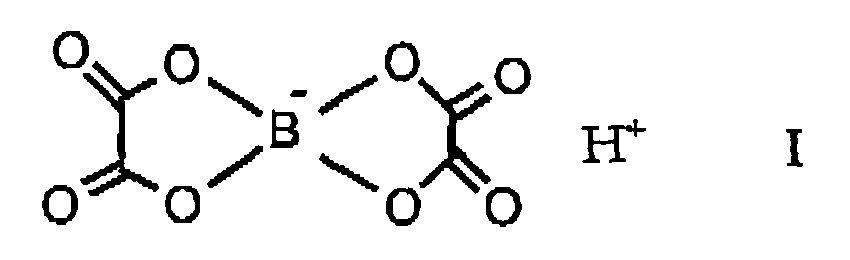
- the present invention relates to the use of hydrogen bis (oxalato) borate of the formula as proton acid catalyst in the following condensation reactions.
- DE 42 08 477 A1 describes a process for preparing dl- ⁇ -tocopherol or d1- ⁇ -tocopheryl acetate by acid-catalyzed reaction of 2,3,5-trimethylhydroquinone with phytol or isophytol in a solvent at elevated temperature and optionally subsequent esterification of the resulting tocopherol with acetic anhydride, which is characterized in that one carries out the reaction in the presence of a mixture of ortho-boric acid and certain aliphatic di- or tricarboxylic acids, preferably in the presence of a mixture of ortho-boric acid and oxalic acid.
- US 3,530,098 describes a process for preparing linear fibrous and film-forming polyesters by polycondensation of dicarboxylic acid bisdiol esters of certain aromatic dicarboxylic acids, optionally in admixture with up to 20 mol.% of certain aliphatic dicarboxylic acids and / or 1,2-cyclobutanedicarboxylic acid, wherein the diol component of the dicarboxylic acid bisdiol ester is a diol with 2 to 8 carbon atoms, in the presence of a catalyst, characterized in that a catalytic amount of certain mixed boron-containing acid anhydrides is used as the polycondensation catalyst.
- the object of the present invention is to provide a catalyst system for the abovementioned condensation processes which does not have the disadvantages of the previously known methods of operation.
- the provided catalyst system is not corrosive, is not toxic, does not pollute the environment, and catalyzes the desired reaction as selectively as possible and in high yields.
- the catalyst system should develop its effect even in really catalytic amounts and can be easily separated.
- this object has been achieved by using hydrogen bis (oxalato) borate of the above formula I as proton acid catalyst in the condensation reactions.
- the condensations can be carried out at temperatures between about 0 ° C and about 140 ° C, depending on the type of reaction (Friedel-Crafts condensation, vinyl ether condensation or acylation of phenols) and the starting materials used in the presence or absence of a solvent.
- the Friedel-Crafts condensation is conveniently carried out at temperatures between about 80 ° C and about 140 ° C, preferably between about 85 ° C and about 120 ° C, more preferably at the reflux temperature of the reaction mixture.
- the vinyl ether condensations are conveniently carried out in the absence of a solvent at temperatures between about 0 ° C and about 40 ° C, preferably between about 15 ° C and about 25 ° C, more preferably at about room temperature.
- Suitable solvents in the present invention may be aromatic hydrocarbons, e.g. Toluene, xylene and the like, halogenated aromatic hydrocarbons, e.g. Chlorobenzene and the like, aliphatic carboxylic acid esters, e.g. Ethyl acetate, isopropyl acetate and the like, aliphatic ethers, e.g. Methyl-tert. butyl ether, diisobutyl ether and the like, as well as aliphatic and cyclic ketones having a boiling point between about 80 ° C and about 140 ° C, e.g. Diethyl ketone, methyl isopropyl ketone, cyclopentanone and the like. Preference is given to toluene and isopropyl acetate.
- aromatic hydrocarbons e.g. Toluene, xylene and the like
- halogenated aromatic hydrocarbons e
- the condensation in the presence of about 0.1 to about 6, preferably about 0.2 to about 4, more preferably about 0.3 to about 3 mol% hydrogen bis (oxalato) borate can be carried out as catalyst (in each case based on the relevant molar amount of the starting material).
- the hydrogen bis (oxalato) borate of the above formula I used as catalyst is made of Journal of Organometallic Chemistry 329, 1-29 (1987 ) known. It can be prepared as described for example in Example 1, wherein it is advantageously not prepared and used in situ, but used in isolated form.
- reaction solution was then treated with 300 ml of water and 2 ml of 15% hydrochloric acid, and the resulting methanol was distilled off. Within 15 minutes, 12 ml of 15% sodium hydroxide solution was added and the mixture was stirred at 80 ° for a further 30 minutes. The cooled reaction mixture was then filtered and dried to give 2,7-dimethyl-2,4,6- (E, E, E) -octatriene dial in 67% yield (LC analysis).
Landscapes
- Chemical & Material Sciences (AREA)
- Organic Chemistry (AREA)
- Chemical Kinetics & Catalysis (AREA)
- Organic Low-Molecular-Weight Compounds And Preparation Thereof (AREA)
- Low-Molecular Organic Synthesis Reactions Using Catalysts (AREA)
- Catalysts (AREA)
- Lubricants (AREA)
Description
- Die vorliegende Erfindung betrifft die Verwendung von Hydrogen-bis(oxalato)borat der Formel
- Als Beispiele von Vinyletherkondensationen von Acetalen mit Vinyl- oder Propenylethern zur Herstellung von Zwischenprodukten in der Synthese von Carotinoiden seien die Umsetzung von Acetaldehyd-dimethylacetal oder (E)-1,1,4,4-Tetramethoxy-but-2-en mit Methyl-propenylether oder von 13-(2,6,6-Trimethyl-cyclohexen-1-yl)-2,7,11-trimethyl-trideca-2,6,8,10,12-pentaen-4-in-1-al-diethylacetal mit Ethyl-vinylether, und als Beispiele von Acylierungen von Phenolen die Herstellung von d,l-α-Tocopherolacetat aus d,l-α-Tocopherol genannt.
- Es wurden bereits verschiedene Verfahren zur Durchführung von Friedel-Crafts-Kondensationen in der Literatur beschrieben, welche unter Verwendung von Protonensäuren, wie Halogenwasserstoffsäuren, z.B. Chlorwasserstoffsäure, Trichloressigsäure und dgl., Lewis-Säuren, wie Aluminiumchlorid, Bortrifluorid, Eisenchlorid, Zinkchlorid und dgl., oder Gemischen von beiden Säurentypen, wie ein Gemisch von Zinkchlorid und einer starken Protonensäure und dgl., als Katalysatoren erfolgen.
- Alle diese vorbekannten Verfahren weisen gewichtige Nachteile auf: so treten bei allen Verfahren Korrosionsprobleme auf, bei Verwendung von Bortrifluorid zusätzlich noch Toxizitätsprobleme mit den Addukten von Bortrifluorid sowie bei Verwendung von Eisen oder Zink eine heute nicht mehr akzeptable Belastung des Abwassers mit Eisen- oder Zinkionen.
- Da Vinyletherkondensationen üblicherweise mit Lewis-Säuren durchgeführt werden, treten bei diesem Reaktionstyp ebenfalls Nachteile auf, wie sie oben für die Friedel-Crafts-Kondensationen mit Lewis-Säuren beschrie-ben sind.
-
DE 42 08 477 A1 beschreibt ein Verfahren zur Herstellung von dl-α-Tocopherol bzw. d1-α-Tocopherylacetat durch säurekatalysierte Umsetzung von 2,3,5-Trimethylhydrochinon mit Phytol oder Isophytol in einem Lösungsmittel bei erhöhter Temperatur und ggf. anschliessende Veresterung des erhaltenen Tocopherols mit Acetanhydrid, das dadurch gekennzeichnet ist, dass man die Umsetzung in Gegenwart von einer Mischung aus ortho-Borsäure und bestimmten aliphatischen Di- oder Tricarbonsäuren, vorzugsweise in Gegenwart von einer Mischung aus ortho-Borsäure und Oxalsäure durchführt. -
US 3,530,098 beschreibt ein Verfahren zur Herstellung linearer faser- und folienbildender Polyester durch Polykondensation von Dicarbonsäurebisdiolestern bestimmter aromatischer Dicarbonsäuren, ggf. im Gemisch mit bis zu 20 Mol.% an bestimmten aliphatischen Dicarbonsäuren und/oder 1,2-Cyclobutandicarbonsäure, wobei die Diolkomponente der Dicarbonsäurebisdiolester ein Diol mit 2 bis 8 C-Atomen ist, in Gegenwart eines Katalysators, dadurch gekennzeichnet, dass als Polykondensationskatalysator eine katalytische Menge bestimmter gemischter Bor-haltiger Säureanhydride eingesetzt wird. - Der vorliegenden Erfindung liegt die Aufgabe zugrunde, für die oben genannten Kondensationsverfahren ein Katalysatorsystem zur Verfügung zu stellen, das die Nachteile der vorbekannten Arbeitsweisen nicht aufweist. Dazu ist es notwendig, dass das zur Verfügung gestellte Katalysatorsystem nicht korrosiv wirkt, nicht toxisch ist, die Umwelt nicht belastet, und die erwünschte Reaktion möglichst selektiv und in hohen Ausbeuten katalysiert. Darüber hinaus soll das Katalysatorsystem seine Wirkung bereits in wirklich nur katalytischen Mengen entfalten und sich leicht abtrennen lassen.
- Im Rahmen der vorliegenden Erfindung wurde diese Aufgabe dadurch gelöst, dass man in den Kondensationsreaktionen Hydrogen-bis(oxalato)borat der obigen Formel I als Protonensäure-Katalysator verwendet.
- Die Kondensationen können in Abhängigkeit vom Reaktionstyp (Friedel-Crafts-Kondensation, Vinyletherkondensation bzw. Acylierung von Phenolen) sowie den eingesetzten Ausgangsstoffen in Gegenwart oder Abwesenheit eines Lösungsmittels bei Temperaturen zwischen etwa 0°C und etwa 140°C durchgeführt werden. So wird die Friedel-Crafts-Kondensation zweckmässigerweise bei Temperaturen zwischen etwa 80°C und etwa 140°C, vorzugsweise zwischen etwa 85°C und etwa 120°C, besonders bevorzugt bei der Rückflusstemperatur des Reaktionsgemisches, durchgeführt. Die Vinyletherkondensationen werden hingegen zweckmässigerweise in Abwesenheit eines Lösungsmittels bei Temperaturen zwischen etwa 0°C und etwa 40°C, vorzugsweise zwischen etwa 15°C und etwa 25°C, besonders bevorzugt bei etwa Raumtemperatur, durchgeführt.
- Als geeignete Lösungsmittel im Rahmen der vorliegenden Erfindung können aromatische Kohlenwasserstoffe, z.B. Toluol, Xylol und dergleichen, halogenierte aromatische Kohlenwasserstoffe, z.B. Chlorbenzol und dergleichen, aliphatische Carbonsäureester, z.B. Ethylacetat, Isopropylacetat und dergleichen, aliphatische Ether, z.B. Methyl-tert. butylether, Diisobutylether und dergleichen, sowie aliphatische und cyclische Ketone mit einem Siedepunkt zwischen etwa 80°C und etwa 140°C, z.B. Diethylketon, Methylisopropylketon, Cyclopentanon und dergleichen, genannt werden. Bevorzugt sind Toluol und Isopropylacetat.
- Erfindungsgemäss kann die Kondensation in Gegenwart von etwa 0,1 bis etwa 6, bevorzugt etwa 0,2 bis etwa 4, besonders bevorzugt etwa 0,3 bis etwa 3 Mol% Hydrogen-bis(oxalato)borat als Katalysator durchgeführt werden (jeweils bezogen auf die massgebliche molare Menge des Ausgangsmaterials).
- Das als Katalysator eingesetzte Hydrogen-bis(oxalato)borat der obigen Formel I ist aus Journal of Organometallic Chemistry 329, 1-29 (1987) bekannt. Es kann wie beispielsweise in Beispiel 1 beschrieben hergestellt werden, wobei es vorteilhafterweise nicht in situ hergestellt und eingesetzt, sondern in isolierter Form eingesetzt wird.
- Die folgenden Beispiele erläutern die Erfindung, sollen jedoch keinerlei Einschränkung darstellen. Alle Temperaturen sind in Celsiusgraden angegeben.
- In einem 1l-Kolben wurden 13,96 g (150,36 mmol) Oxalsäure und 2,62 g (37,59 mmol) Dibortrioxid [oder 8,4 ml (75,2 mmol) Trimethylborat oder 3,7 ml (25,1 mmol) Trimethoxyboroxin] in 450 ml Toluol suspendiert und 6 Stunden unter Rückfluss gerührt, wobei das anfallende Reaktionswasser mittels Wasserabscheider kontinuierlich abgetrennt wurde. Das kalte Reaktionsgemisch wurde anschliessend filtriert, und der feste Rückstand am Vakuum getrocknet, wobei Hydrogen-bis(oxalato)borat in 70%iger Ausbeute erhalten wurde.
- In einem 500 ml-Sulfierkolben wurden 28,398 g (100 mmol) Benzoesäure-(4-hydroxy-2-methyl-naphthalen-1-yl)ester mit 127,4 mg (0,569 mmol) Hydrogen-bis(oxalato)borat in 170 ml Toluol vorgelegt. Das Reaktionsgemisch wurde auf 98° erwärmt und anschliessend innerhalb von 15 Sekunden mit 17,76 g (56,9 mmol) Isophytol versetzt .
- Nach beendeter Zugabe wurde das Reaktionsgemisch noch 30 Minuten bei 98° gerührt. Die Ausbeute an Benzoesäure-[4-hydroxy-2-methyl-3-[(E)-3,7,11,15-tetramethyl-hexadec-2-enyl]-naphthalen-1-yl]ester beträgt 80% (berechnet auf Isophytol, direkte LC-Bestimmung aus dem Reaktionsgemisch anhand einer Eichkurve).
- In einem 200 ml-Sulfierkolben wurden unter Rühren 35,240 g (200 mmol) (E)-1,1,4,4-Tetramethoxy-but-2-en und 1,343 g (6 mmol) Hydrogen-bis (oxalato)borat vorgelegt. Innerhalb von 4 Stunden gab man anschliessend tropfenweise bei Raumtemperatur 28,840 g (400 mmol) Methyl-propenylether zu und liess nach beendeter Zugabe noch 30 Minuten nachreagieren.
- Die Reaktionslösung wurde danach mit 300 ml Wasser und 2 ml 15%-iger Salzsäure versetzt, und das entstandene Methanol abdestilliert. Innerhalb von 15 Minuten gab man 12 ml 15%-ige Natronlauge zu und liess noch 30 Minuten bei 80° nachrühren. Das erkaltete Reaktionsgemisch wurde dann filtriert und getrocknet, wobei 2,7-Dimethyl-2,4,6-(E,E,E)-octatrien-dial in 67%-iger Ausbeute (LC-Analyse) erhalten wurde.
- In einem 100 ml-Sulfierkolben wurden 27,04 g (300 mmol) Acetaldehyd-dimethylacetal und 282 mg (1,26 mmol) Hydrogen-bis(oxalato)borat vorgelegt und dann 7,21 g (100 mmol) Methyl-propenylether innerhalb von 2 Stunden bei Raumtemperatur zugetropft. Nachdem man das Reaktionsgemisch eine Stunde auf 40° erwärmt hatte, liess man auf Raumtemperatur abkühlen, wobei man 1,1,3-Trimethoxy-2-methyl-butan erhielt; der Gehalt an 1,1,3-Trimethoxy-2-methyl-butan betrug nach GC-Analyse 70%.
- In einem 100 ml-Sulfierkolben wurde ein Gemisch aus 5,0 g (14,3 mmol) 13-(2,6,6-Trimethyl-cyclohexen-1-yl)-2,7,11-trimethyl-trideca-2,6,8,10,12-pentaen-4-in-1-al, 3,1 ml (18,2 mmol) Orthoameisensäure-triethylester, 0,8 ml Ameisensäureethylester und 89,5 mg (0,4 mmol) Hydrogen-bis (oxalato)borat vorgelegt. Das Reaktionsgemisch wurde 1 Stunde bei 15° gerührt, anschliessend bei dieser Temperatur tropfenweise mit 1,9 ml (19,7 mmol) Ethyl-vinylether versetzt und nochmals 15 Minuten nachgerührt. Die Ausbeute an 13,15,15-Triethoxy-3,7,12-trimethyl-1-(2,6,6-trimethyl-cyclohex-1-enyl)-pentadeca-1,3,5,7,11-pentaen-9-in betrug 80%.
- In einem 100 ml-Sulfierkolben wurde ein Gemisch von 43,00 g (100 mmol) Tocopherol, 11,40 g (110 mmol) Essigsäureanhydrid und 94 mg (0,5 mmol) Hydrogen-bis(oxalato)borat vorgelegt, und das Reaktionsgemisch eine Stunde unter ArgonAtmosphäre zum Rückfluss erhitzt. Nach dem Einengen am Rotationsverdampfer blieben 47,2 g rohes d,1-α-Tocopherolacetat zurück, das einen Gehalt von 87% aufwies; Ausbeute 92%.
Claims (11)
- Verwendung von Hydrogen-bis(oxalato)borat der Formel

- Verwendung gemäss Anspruch 1, dadurch gekennzeichnet, dass das Hydrogen-bis(oxalato)borat der Formel I in isolierter Form eingesetzt wird.
- Verwendung gemäss Anspruch 1 oder 2, dadurch gekennzeichnet, dass 0,1 bis 6, bevorzugt 0,2 bis 4, besonders bevorzugt 0,3 bis 3, Mol% Hydrogen-bis(oxalato)borat als Katalysator eingesetzt wird.
- Verwendung gemäss einem der Ansprüche 1 bis 3, dadurch gekennzeichnet, dass die Friedel-Crafts-Kondensation bei Temperaturen zwischen 80°C und 140°C, vorzugsweise zwischen 85°C und 120°C, besonders bevorzugt bei der Rückflusstemperatur des Reaktionsgemisches, erfolgt.
- Verwendung gemäss einem der Ansprüche 1 bis 4, dadurch gekennzeichnet, dass als Lösungsmittel ein aromatischer Kohlenwasserstoff, ein halogenierter aromatischer Kohlenwasserstoff, ein aliphatischer Carbonsäureester, ein aliphatischer Ether oder ein aliphatisches oder cyclisches Keton mit einem Siedepunkt zwischen 85°C und 140°C eingesetzt wird.
- Verwendung gemäss Anspruch 5, dadurch gekennzeichnet, dass als Lösungsmittel Toluol, Xylol, Chlorbenzol, Ethylacetat, Isopropylacetat, Methyl-tert.butylether, Diisobutylether, Diethylketon, Methylisopropylketon oder Cyclopentanon, vorzugsweise Toluol oder Isopropylacetat, eingesetzt wird.
- Verwendung gemäss einem der Ansprüche 1 bis 3, dadurch gekennzeichnet, dass die Vinyletherkondensation bei Temperaturen zwischen etwa 0°C und etwa 40°C, vorzugsweise zwischen etwa 15°C und etwa 25°C, besonders bevorzugt bei etwa Raumtemperatur, erfolgt.
- Verwendung gemäss Anspruch 7, dadurch gekennzeichnet, dass die Kondensation in Abwesenheit eines Lösungsmittels erfolgt.
- Verwendung gemäss einem der Ansprüche 1 bis 3, 7 und 8, dadurch gekennzeichnet, dass Acetaldehyd-dimethylacetal mit Methylpropenylether umgesetzt wird.
- Verwendung gemäss einem der Ansprüche 1 bis 3, 7 und 8, dadurch gekennzeichnet, dass (E)-1,1,4,4-Tetramethoxy-but-2-en mit Methylpropenylether umgesetzt wird.
- Verwendung gemäss einem der Ansprüche 1 bis 3, 7 und 8, dadurch gekennzeichnet, dass 13-(2,6,6-Trimethylcyclohexen-1-yl)-2,7,11-trimethyl-trideca-2,6,8,10,12-pentaen-4-in-1-al-diethylacetal mit Ethylvinylether umgesetzt wird.
Applications Claiming Priority (2)
| Application Number | Priority Date | Filing Date | Title |
|---|---|---|---|
| CH9696 | 1996-01-12 | ||
| CH96/96 | 1996-01-12 |
Publications (2)
| Publication Number | Publication Date |
|---|---|
| EP0784042A1 EP0784042A1 (de) | 1997-07-16 |
| EP0784042B1 true EP0784042B1 (de) | 2009-05-27 |
Family
ID=4179163
Family Applications (1)
| Application Number | Title | Priority Date | Filing Date |
|---|---|---|---|
| EP97100109A Expired - Lifetime EP0784042B1 (de) | 1996-01-12 | 1997-01-07 | Verwendung von Hydrogen-bis-(oxalato)borat |
Country Status (7)
| Country | Link |
|---|---|
| US (1) | US5886196A (de) |
| EP (1) | EP0784042B1 (de) |
| JP (1) | JPH09192493A (de) |
| CN (1) | CN1099911C (de) |
| AT (1) | ATE432247T1 (de) |
| DE (1) | DE59713008D1 (de) |
| ID (1) | ID19039A (de) |
Families Citing this family (11)
| Publication number | Priority date | Publication date | Assignee | Title |
|---|---|---|---|---|
| WO2002042286A1 (de) * | 2000-11-22 | 2002-05-30 | Basf Aktiengesellschaft | Verfahren zur kontinuierlichen acylierung von chromanolesterderivaten |
| EP1227089B1 (de) * | 2001-01-18 | 2003-09-24 | Roche Vitamins AG | Herstellung von (all-rac)-alpha-Tocopherol |
| DE10108592C1 (de) * | 2001-02-22 | 2002-08-14 | Chemetall Gmbh | Borchelatkomplexe, Verfahren zu deren Herstellung sowie deren Verwendung |
| DE10108608C2 (de) * | 2001-02-22 | 2003-01-23 | Chemetall Gmbh | Verfahren zur Herstellung von Hydrogen-bis(chelato)boraten und Alkalimetall-bis(chelato)boraten und deren Verwendung |
| CN100448830C (zh) * | 2004-02-04 | 2009-01-07 | 帝斯曼知识产权资产管理有限公司 | 用于制备甲基庚烯酮的方法 |
| DE102004006579A1 (de) * | 2004-02-10 | 2005-08-25 | Basf Ag | Verfahren zur Herstellung von 2,7-Dimethyl-octa-2,4,6-triendial |
| US7459237B2 (en) * | 2004-03-15 | 2008-12-02 | The Gillette Company | Non-aqueous lithium electrical cell |
| JP2006111538A (ja) * | 2004-10-12 | 2006-04-27 | Central Glass Co Ltd | イオン性金属錯体の合成法 |
| WO2011086135A1 (en) | 2010-01-13 | 2011-07-21 | Dsm Ip Assets B.V. | Acylations in micro reaction systems |
| CN111943819B (zh) * | 2020-08-13 | 2022-09-20 | 万华化学集团股份有限公司 | 一种制备十碳双醛中间体的方法 |
| KR20250114547A (ko) | 2022-12-05 | 2025-07-29 | 디에스엠 아이피 어셋츠 비.브이. | 특정 촉매에 의한 트라이페닐포스핀 옥사이드의 환원 |
Family Cites Families (3)
| Publication number | Priority date | Publication date | Assignee | Title |
|---|---|---|---|---|
| DE1595667A1 (de) * | 1966-08-16 | 1970-01-22 | Hoechst Ag | Verfahren zur Herstellung linearer Polyester |
| GB8723603D0 (en) * | 1987-10-08 | 1987-11-11 | British Petroleum Co Plc | Polyketones |
| DE4208477A1 (de) * | 1992-03-17 | 1993-09-23 | Basf Ag | Verfahren zur herstellung von vitamin e |
-
1996
- 1996-12-18 US US08/768,680 patent/US5886196A/en not_active Expired - Lifetime
-
1997
- 1997-01-07 DE DE59713008T patent/DE59713008D1/de not_active Expired - Lifetime
- 1997-01-07 EP EP97100109A patent/EP0784042B1/de not_active Expired - Lifetime
- 1997-01-07 AT AT97100109T patent/ATE432247T1/de not_active IP Right Cessation
- 1997-01-08 CN CN97102008A patent/CN1099911C/zh not_active Expired - Lifetime
- 1997-01-09 JP JP9001788A patent/JPH09192493A/ja not_active Withdrawn
- 1997-01-13 ID IDP970081A patent/ID19039A/id unknown
Also Published As
| Publication number | Publication date |
|---|---|
| CN1161251A (zh) | 1997-10-08 |
| CN1099911C (zh) | 2003-01-29 |
| US5886196A (en) | 1999-03-23 |
| ATE432247T1 (de) | 2009-06-15 |
| DE59713008D1 (de) | 2009-07-09 |
| EP0784042A1 (de) | 1997-07-16 |
| JPH09192493A (ja) | 1997-07-29 |
| ID19039A (id) | 1998-06-04 |
Similar Documents
| Publication | Publication Date | Title |
|---|---|---|
| EP0784042B1 (de) | Verwendung von Hydrogen-bis-(oxalato)borat | |
| JP2002519416A (ja) | トコフェロールの製造 | |
| EP0623575B1 (de) | Verfahren zur Herstellung von Ketonen | |
| EP0882036A1 (de) | Verfahren zur herstellung von dl-alpha-tocopherol oder dl-alpha-tocopherylacetat | |
| DE2248337A1 (de) | Verfahren zur herstellung von 3,4,5trimethoxybenzaldehyd | |
| EP0631577B1 (de) | Verfahren zur herstellung von vitamin e | |
| DE69417527T2 (de) | Verfahren zu Herstellung von alfa-Tocoferol Derivaten | |
| DE69305599T2 (de) | Verfahren und Herstellung von Salicylaldoxim-Derivaten | |
| DE69417326T2 (de) | Verfahren zur Herstellung von Chromanen | |
| DE60100528T2 (de) | Verfahren zur Herstellung von (alle-rac)-alfa-Tocopherol | |
| DE69206423T2 (de) | Verfahren zur Herstellung von 5-(2,4-Difluorphenyl)-Salizylsäure. | |
| DE69804909T2 (de) | Verfahren zur Herstellung von Chromanen | |
| DE60102078T2 (de) | Verfahren zur herstellung von trimethylhydrochinon-diacetat und trimethylhydrochinon | |
| EP1463708B1 (de) | Herstellung von trimethylhydrochinondiacylaten | |
| EP0923532B1 (de) | Veresterung von phenolen | |
| DE2545338C3 (de) | Verfahren zur Herstellung von gegebenenfalls substituierten o-Hydroxymethyl-phenolen oder -naphtholen | |
| Haldorai et al. | Brønsted-Acidic Imidazolium Ionic Liquid [bmim (SO 3 H)][OTf]: A Mild Catalyst for Highly Efficient Synthesis of Coumarins. | |
| US3703541A (en) | Process for the production of 3-hydroxy-2,2,4-trimethylpentyl isobutyrate | |
| CN105968332A (zh) | 催化环酯聚合的苯并硼唑金属配合物及其应用 | |
| Oskooie et al. | Bis [Trinitratocerium (IV)] Chromate [Ce (No3) 2 Cro4] and tris-[Trinitratocerium (IV)] Paraperiodate [(No3) 3Ce] 3 H2IO6. Two Mild and Efficient Catalysts for Tetrahydropyranylation of Alcohols. | |
| JP4093647B2 (ja) | クロマン化合物の製造方法 | |
| DE19603142A1 (de) | Verfahren zur Herstellung von dl-alpha-Tocopherol oder dl-alpha-Tocopherylacetat | |
| DE60200037T2 (de) | Herstellung von (all-rac)-alpha-Tocopherol | |
| EP0861822B1 (de) | Verfahren zur Herstellung von 1-funktionellen Allyalkohol-Carbonsäureestern | |
| EP1417287B1 (de) | Acyloxylierte fettsäure oder fettsäurederivate , insbesondere schmierstoffe und druckübertragungsmittel, deren herstellung und verwendung |
Legal Events
| Date | Code | Title | Description |
|---|---|---|---|
| PUAI | Public reference made under article 153(3) epc to a published international application that has entered the european phase |
Free format text: ORIGINAL CODE: 0009012 |
|
| 17P | Request for examination filed |
Effective date: 19970107 |
|
| AK | Designated contracting states |
Kind code of ref document: A1 Designated state(s): AT BE CH DE DK ES FR GB IT LI NL |
|
| RAP1 | Party data changed (applicant data changed or rights of an application transferred) |
Owner name: DSM IP ASSETS B.V. |
|
| GRAP | Despatch of communication of intention to grant a patent |
Free format text: ORIGINAL CODE: EPIDOSNIGR1 |
|
| GRAP | Despatch of communication of intention to grant a patent |
Free format text: ORIGINAL CODE: EPIDOSNIGR1 |
|
| GRAS | Grant fee paid |
Free format text: ORIGINAL CODE: EPIDOSNIGR3 |
|
| GRAA | (expected) grant |
Free format text: ORIGINAL CODE: 0009210 |
|
| AK | Designated contracting states |
Kind code of ref document: B1 Designated state(s): AT BE CH DE DK ES FR GB IT LI NL |
|
| REG | Reference to a national code |
Ref country code: GB Ref legal event code: FG4D Free format text: NOT ENGLISH |
|
| REG | Reference to a national code |
Ref country code: CH Ref legal event code: EP |
|
| REF | Corresponds to: |
Ref document number: 59713008 Country of ref document: DE Date of ref document: 20090709 Kind code of ref document: P |
|
| NLV1 | Nl: lapsed or annulled due to failure to fulfill the requirements of art. 29p and 29m of the patents act | ||
| PG25 | Lapsed in a contracting state [announced via postgrant information from national office to epo] |
Ref country code: NL Free format text: LAPSE BECAUSE OF FAILURE TO SUBMIT A TRANSLATION OF THE DESCRIPTION OR TO PAY THE FEE WITHIN THE PRESCRIBED TIME-LIMIT Effective date: 20090527 |
|
| PG25 | Lapsed in a contracting state [announced via postgrant information from national office to epo] |
Ref country code: ES Free format text: LAPSE BECAUSE OF FAILURE TO SUBMIT A TRANSLATION OF THE DESCRIPTION OR TO PAY THE FEE WITHIN THE PRESCRIBED TIME-LIMIT Effective date: 20090907 Ref country code: DK Free format text: LAPSE BECAUSE OF FAILURE TO SUBMIT A TRANSLATION OF THE DESCRIPTION OR TO PAY THE FEE WITHIN THE PRESCRIBED TIME-LIMIT Effective date: 20090527 |
|
| PLBE | No opposition filed within time limit |
Free format text: ORIGINAL CODE: 0009261 |
|
| STAA | Information on the status of an ep patent application or granted ep patent |
Free format text: STATUS: NO OPPOSITION FILED WITHIN TIME LIMIT |
|
| 26N | No opposition filed |
Effective date: 20100302 |
|
| BERE | Be: lapsed |
Owner name: DSM IP ASSETS B.V. Effective date: 20100131 |
|
| REG | Reference to a national code |
Ref country code: CH Ref legal event code: PL |
|
| GBPC | Gb: european patent ceased through non-payment of renewal fee |
Effective date: 20100107 |
|
| REG | Reference to a national code |
Ref country code: FR Ref legal event code: ST Effective date: 20100930 |
|
| PG25 | Lapsed in a contracting state [announced via postgrant information from national office to epo] |
Ref country code: LI Free format text: LAPSE BECAUSE OF NON-PAYMENT OF DUE FEES Effective date: 20100131 Ref country code: FR Free format text: LAPSE BECAUSE OF NON-PAYMENT OF DUE FEES Effective date: 20100201 Ref country code: CH Free format text: LAPSE BECAUSE OF NON-PAYMENT OF DUE FEES Effective date: 20100131 |
|
| PG25 | Lapsed in a contracting state [announced via postgrant information from national office to epo] |
Ref country code: GB Free format text: LAPSE BECAUSE OF NON-PAYMENT OF DUE FEES Effective date: 20100107 |
|
| PG25 | Lapsed in a contracting state [announced via postgrant information from national office to epo] |
Ref country code: BE Free format text: LAPSE BECAUSE OF NON-PAYMENT OF DUE FEES Effective date: 20100131 |
|
| PG25 | Lapsed in a contracting state [announced via postgrant information from national office to epo] |
Ref country code: IT Free format text: LAPSE BECAUSE OF FAILURE TO SUBMIT A TRANSLATION OF THE DESCRIPTION OR TO PAY THE FEE WITHIN THE PRESCRIBED TIME-LIMIT Effective date: 20090527 |
|
| PG25 | Lapsed in a contracting state [announced via postgrant information from national office to epo] |
Ref country code: AT Free format text: LAPSE BECAUSE OF NON-PAYMENT OF DUE FEES Effective date: 20100107 |
|
| PGFP | Annual fee paid to national office [announced via postgrant information from national office to epo] |
Ref country code: DE Payment date: 20151229 Year of fee payment: 20 |
|
| REG | Reference to a national code |
Ref country code: DE Ref legal event code: R071 Ref document number: 59713008 Country of ref document: DE |