EP0773262B1 - Härtbare flüssige Zweikomponenten-Siliconzusammensetzung - Google Patents
Härtbare flüssige Zweikomponenten-Siliconzusammensetzung Download PDFInfo
- Publication number
- EP0773262B1 EP0773262B1 EP96117891A EP96117891A EP0773262B1 EP 0773262 B1 EP0773262 B1 EP 0773262B1 EP 96117891 A EP96117891 A EP 96117891A EP 96117891 A EP96117891 A EP 96117891A EP 0773262 B1 EP0773262 B1 EP 0773262B1
- Authority
- EP
- European Patent Office
- Prior art keywords
- composition
- component
- viscosity
- groups
- liquid
- Prior art date
- Legal status (The legal status is an assumption and is not a legal conclusion. Google has not performed a legal analysis and makes no representation as to the accuracy of the status listed.)
- Expired - Lifetime
Links
Classifications
-
- C—CHEMISTRY; METALLURGY
- C08—ORGANIC MACROMOLECULAR COMPOUNDS; THEIR PREPARATION OR CHEMICAL WORKING-UP; COMPOSITIONS BASED THEREON
- C08L—COMPOSITIONS OF MACROMOLECULAR COMPOUNDS
- C08L83/00—Compositions of macromolecular compounds obtained by reactions forming in the main chain of the macromolecule a linkage containing silicon with or without sulfur, nitrogen, oxygen or carbon only; Compositions of derivatives of such polymers
- C08L83/04—Polysiloxanes
-
- C—CHEMISTRY; METALLURGY
- C08—ORGANIC MACROMOLECULAR COMPOUNDS; THEIR PREPARATION OR CHEMICAL WORKING-UP; COMPOSITIONS BASED THEREON
- C08G—MACROMOLECULAR COMPOUNDS OBTAINED OTHERWISE THAN BY REACTIONS ONLY INVOLVING UNSATURATED CARBON-TO-CARBON BONDS
- C08G77/00—Macromolecular compounds obtained by reactions forming a linkage containing silicon with or without sulfur, nitrogen, oxygen or carbon in the main chain of the macromolecule
- C08G77/04—Polysiloxanes
- C08G77/12—Polysiloxanes containing silicon bound to hydrogen
-
- C—CHEMISTRY; METALLURGY
- C08—ORGANIC MACROMOLECULAR COMPOUNDS; THEIR PREPARATION OR CHEMICAL WORKING-UP; COMPOSITIONS BASED THEREON
- C08G—MACROMOLECULAR COMPOUNDS OBTAINED OTHERWISE THAN BY REACTIONS ONLY INVOLVING UNSATURATED CARBON-TO-CARBON BONDS
- C08G77/00—Macromolecular compounds obtained by reactions forming a linkage containing silicon with or without sulfur, nitrogen, oxygen or carbon in the main chain of the macromolecule
- C08G77/04—Polysiloxanes
- C08G77/14—Polysiloxanes containing silicon bound to oxygen-containing groups
- C08G77/18—Polysiloxanes containing silicon bound to oxygen-containing groups to alkoxy or aryloxy groups
-
- C—CHEMISTRY; METALLURGY
- C08—ORGANIC MACROMOLECULAR COMPOUNDS; THEIR PREPARATION OR CHEMICAL WORKING-UP; COMPOSITIONS BASED THEREON
- C08G—MACROMOLECULAR COMPOUNDS OBTAINED OTHERWISE THAN BY REACTIONS ONLY INVOLVING UNSATURATED CARBON-TO-CARBON BONDS
- C08G77/00—Macromolecular compounds obtained by reactions forming a linkage containing silicon with or without sulfur, nitrogen, oxygen or carbon in the main chain of the macromolecule
- C08G77/04—Polysiloxanes
- C08G77/20—Polysiloxanes containing silicon bound to unsaturated aliphatic groups
Definitions
- This invention relates to two-part curable liquid silicone compositions that are very storage-stable in two-part form and that when mixed provide a thixotropic curable liquid silicone composition with a viscosity higher than either of the precursors.
- Addition reaction-curing liquid silicone compositions cure rapidly at room or elevated temperature to form silicone gels and silicone rubbers with excellent physical and electrical properties. This has led to their use as coatings, potting agents, and adhesives for electrical and electronic components. Curable liquid silicone compositions of this type are typically divided into two parts for storage, and the two parts are mixed with each other to homogeneity just before application.
- curable silicone compositions rendered poorly fluid by a high content of inorganic filler such as silica, alumina, titanium oxide, glass, and the like.
- inorganic filler such as silica, alumina, titanium oxide, glass, and the like.
- Curable liquid organopolysiloxane compositions that contain silica and silanol-functional diorganosiloxane oligomer are known to exhibit thixotropy, that is, to be fluid under shear and poorly fluid at quiescence (JP-A 59-176347).
- the object of the present invention is to provide a two-part curable liquid silicone composition that is very storage stable in two-part form and that upon mixing of its two parts yields a thixotropic curable liquid silicone composition with a viscosity higher than either part.
- the present invention relates to a two-part curable liquid silicone composition
- a liquid composition (I) substantially composed of the components (A), (B), (C), and (D) described below which upon mixing yield a curable liquid silicone composition
- the two-part curable liquid silicone composition of the present invention comprises liquid compositions (I) and (II) and yields a curable liquid silicone composition comprising the aforementioned components (A) to (E) when these two parts are mixed.
- the organopolysiloxane (A) contains at least 2 alkenyl groups in each molecule.
- This alkenyl is exemplified by vinyl, allyl, butenyl, pentenyl, hexenyl, and heptenyl, with vinyl being specifically preferred.
- the alkenyl can be bonded, for example, in terminal and/or nonterminal positions on the molecular chain.
- the non-alkenyl silicon-bonded groups in component (A) are selected from the group consisting of alkyl groups such as methyl, ethyl, propyl, butyl, pentyl, hexyl, heptyl and octyl; aryl groups such as phenyl, tolyl and xylyl; aralkyl groups such as benzyl or phenethyl; and haloalkyl groups such as 3-chloropropyl, or 3,3,3-trifluoropropyl. Methyl and phenyl are particularly preferred.
- Component (A) can have a straight-chain, partially branched straight-chain, branched-chain, cyclic, or resin-like molecular structure.
- Component (A) can be a homopolymer with a molecular structure as described above, or it can be a mixture of polymers with the described molecular structures.
- component (B) does not consist substantially of a straight-chain structure
- component (A) should then consist substantially of a straight-chain structure for curing to yield a silicone gel or silicone rubber.
- the hydrogen-substituted organopolysiloxane (B), which functions as crosslinker for our curable liquid silicone composition, contains at least 2 silicon-bonded hydrogen atoms in each molecule. This hydrogen can be bonded, for example, in terminal and/or nonterminal positions on the molecular chain.
- the non-hydrogen silicon-bonded groups in component (B) are selected from the group consisting of alkyl groups such as methyl, ethyl, propyl, butyl, pentyl, hexyl, heptyl and octyl; aryl groups such as phenyl, tolyl and xylyl; aralkyl groups such as benzyl or phenethyl; and haloalkyl groups such as 3-chloropropyl and 3,3,3-trifluoropropyl. Methyl and phenyl are particularly preferred.
- Component (B) can have a straight-chain, partially branched straight-chain, branched-chain, cyclic, or resin-like molecular structure.
- Component (B) can be a homopolymer with a molecular structure as described above, or it can be a mixture of polymers with the described molecular structures. However, when component (A) does not consist substantially of a straight-chain structure, component (B) should then consist substantially of a straight-chain structure to yield a silicone gel or silicone rubber upon cure.
- the viscosity of component (B) at 25°C is in the range from 1 to 10,000 mPa.s for the following reasons: at a viscosity at 25°C below 1 mPa.s component (B) has a ready tendency to evaporate, which causes instability in the component proportions; a poor fluidity for the two-part system will be encountered in some cases at a viscosity at 25°C in excess of 10,000 mPa.s.
- Component (B) is added to the curable liquid silicone composition under consideration in a quantity that provides from 0.3 to 10 moles of silicon-bonded hydrogen from component (B) per 1 mole of alkenyl in component (A).
- the composition will not undergo a thorough cure when component (B) provides less than 0.3 mole of silicon-bonded hydrogen per mole of alkenyl in component (A).
- the cured product on the other hand, will have a poor mechanical strength when component (B) provides more than 10 moles of silicon-bonded hydrogen per mole of alkenyl in component (A).
- Component (C) has a specific surface of 50 to 500 m 2 /g for the following reasons: thixotropy cannot be readily imparted to the composition at a specific surface below 50 m 2 /g; at above 500 m 2 /g the composition has a poor fluidity and adjusting or controlling the viscosity becomes problematic.
- Component (C) is exemplified by silica, alumina, titanium oxide, and glass, wherein silica is preferred, and fumed silica is even more preferred.
- component (C) is inorganic filler whose surface has been treated with a surface-treatment agent exemplified by organoalkoxysilanes such as methyltrimethoxysilane.
- organoalkoxysilanes such as methyltrimethoxysilane.
- organochlorosilanes such as methyltrichlorosilane, dimethyldichlorosilane, and trimethylchlorosilane
- silazanes such as 1,1,1,3,3,3-hexamethyldisilazane and 1,1,
- Another example of the treatment method consists of mixing component (C) with the surface-treatment agent itself or with an organic solution prepared by diluting the surface-treatment agent with an organic solvent such as methanol, ethanol, hexane, heptane, toluene and xylene.
- Component (C) is used in the curable liquid silicone composition at from 2 to 50 weight parts per 100 weight parts of component (A). Thixotropy cannot be readily imparted to the composition when component (C) is used at less than 2 weight parts per 100 weight parts component (A). The two parts will have a poor fluidity when component (C) is used at more than 50 weight parts per 100 weight parts of component (A), which creates such problems as a difficult filtration for removing foreign substances, difficulties in defoaming the two parts at the dispenser, and an inability to uniformly apply the composition.
- Component (D) contains at least 2 silicon-bonded alkoxy groups in each molecule. This alkoxy group is exemplified by methoxy, ethoxy, propoxy and butoxy, with methoxy being specifically preferred.
- the non-alkoxy silicon-bonded groups in component (D) are exemplified by monovalent hydrocarbon groups, for example, alkyl groups such as methyl, ethyl, propyl, butyl, pentyl, hexyl, heptyl and octyl; alkenyl groups such as vinyl, allyl, butenyl, pentenyl and hexenyl; aryl groups such as phenyl, tolyl and xylyl; aralkyl groups such as benzyl or phenethyl; and haloalkyl groups such as 3-chloropropyl or 3,3,3-trifluoropropyl.
- alkyl groups such as methyl, ethyl, propyl, butyl, pentyl, hexyl, heptyl and octyl
- alkenyl groups such as vinyl, allyl, butenyl, pentenyl and he
- the non-alkoxy silicon-bonded groups in component (D) are also exemplified by the hydrogen atom and functionalized organic groups such as 3-glycidoxypropyl, 2-(3,4-epoxycyclohexyl)ethyl, and 3-methacryloxypropyl.
- Component (D) can have, for example, a straight-chain, partially branched straight-chain, branched-chain, cyclic, or resin-like molecular structure.
- component (D) at 25°C is in the range from 1 to 2,000 mPa.s for the following reasons: at a viscosity at 25°C below 1 mPa.s component (D) has a strong tendency to evaporate. which causes instability in the component proportions; a satisfactory thixotropy cannot be imparted to the composition at a viscosity at 25°C in excess of 2,000 mPa.s.
- organopolysiloxane (D) are the organopolysiloxanes with the following structures where m is an integer with a value of at least 1 where m and n are both integers with a value of at least 1 where m and n are both integers with a value of at least 1
- the platinum catalyst (E) provides an addition reaction-mediated cure our curable liquid silicone composition.
- Component (E) is exemplified by platinum black, platinum-on-silica, platinum-on-active carbon, platinum-on-alumina powder, chloroplatinic acid, alcohol solutions of chloroplatinic acid, platinum-olefin complexes, platinum-alkenylsiloxane complexes, and thermoplastic resins with a particle size no larger than 10 micrometers that contain a platinum catalyst as described above.
- the thermoplastic resin is exemplified by polystyrene, nylon, polycarbonate and silicone.
- the two-part curable liquid silicone composition of the present invention comprises the liquid composition (I) substantially composed of the above-described components (A), (C), and (E), and the liquid composition (II) substantially composed of the above-described components (A), (B), (C), and (D).
- components (A) and (C) are present in each of liquid compositions (I) and (II), and they are preferably mixed therein so as to equalize the viscosities of these liquid compositions.
- Thixotropy is induced when components (C) and (D) in our two-part curable liquid silicone composition are mixed with each other.
- liquid composition (II) will be somewhat thixotropic since it contains component (D) mixed with part of component (C), the viscosities of liquid compositions (I) and (II) can be equalized taking this into account.
- component (D) is substantially mixed into liquid composition (II)
- a portion of component (D) can also be used in liquid composition (I).
- Mixing these two parts yields a curable liquid silicone composition that can cure into a silicone gel or silicone rubber. This composition can be cured at room temperature or by heating. The heating temperature for the composition is preferably in the range from 50°C to 200°C.
- the two-part curable liquid silicone composition of the present invention comprises the liquid compositions (I) and (II), which prior to their mixing are fluid and which immediately upon their mixing yield a thixotropic, high-viscosity curable liquid silicone composition.
- the viscosity of the curable silicone composition after mixing can be any viscosity that is higher than either of the two parts, but it is preferably 1.3 to 30 times, and more preferably is 1.5 to 20 times the viscosity of the part with the higher viscosity.
- the curable liquid silicone composition is thixotropic as soon as mixing has occurred, its viscosity must be measured and compared under the same conditions used to measure the viscosity of the two parts, for example, using the same rotational viscometer, the same spindle number, and the same spindle rpm.
- the thixotropy of the curable liquid silicone composition afforded by mixing the two parts is expressed by the ratio between viscosities measured using the same spindle number at different spindle rpms.
- an addition-reaction inhibitor can also be admixed as an optional component.
- Addition-reaction inhibitors are exemplified by alkyne alcohols such as 3-methyl-1-butyn-3-ol, 3,5-dimethyl-1-hexyn-3-ol, and 3-phenyl-1-butyn-3-ol; ene-yne compounds such as 3-methyl-3-penten-1-yne or 3,5-dimethyl-3-hexen-1-yne; 1,3,5,7-tetramethyl-1,3,5,7-tetravinylcyclotetrasiloxane; 1,3,5,7-tetramethyl-1,3,5,7-tetrahexenylcyclotetrasiloxane and benzotriazole.
- the addition-reaction inhibitor can be mixed into either of liquid compositions (I) and (II), but is preferably added to composition (II).
- the addition-reaction inhibitor is preferably used at from 10 to 50,000 weight-ppm in the curable liquid silicone composition of this invention.
- inorganic fillers other than component (C) such as titanium dioxide, carbon black, alumina, quartz, glass, and the like; metal powders such as silver, nickel, copper, and so forth; the powders of resins such as fluororesins and silicone resins: adhesion promoters; heat stabilizers; flame retardants; colorants; and organic solvents.
- component (C) such as titanium dioxide, carbon black, alumina, quartz, glass, and the like
- metal powders such as silver, nickel, copper, and so forth
- the powders of resins such as fluororesins and silicone resins: adhesion promoters; heat stabilizers; flame retardants; colorants; and organic solvents.
- the two-part curable liquid silicone composition of the claimed invention has a relatively low viscosity and excellent handling characteristics prior to the mixing of its two parts. As a consequence, it is easily filled into the dispenser and, once filled, the two parts are easily defoamed and easily filtered to remove foreign material. Moreover, mixing these two parts and the application of the resulting composition gives a coated composition that immediately exhibits a high viscosity and thixotropic behavior. As a result of these features, our two-part curable liquid silicone composition is well qualified for coating operations that require precision application, such as the coating of semiconductors, the partial-surface moistureproof coating of electric circuit substrates, and the coating of optical fibers.
- the two-part curable liquid silicone composition of this invention will be explained in greater detail through working examples.
- the viscosity was measured in the examples at 25°C using a single-cylinder rotational viscometer (VismetronTM VG-A1 from the Shibaura System Company).
- liquid composition (i) that corresponds to liquid composition (I):
- liquid composition (ii) that corresponds to liquid composition (II):
- liquid composition (i) and 50 weight parts of liquid composition (ii) were mixed to homogeneity to give a curable liquid silicone composition with a viscosity immediately after mixing of 85,000 mPa.s as measured with spindle no. 4 at a spindle speed of 6 rpm.
- the viscosity of this composition was 120,000 mPa.s when measured with spindle no. 4 at a speed of 3 rpm.
- Heating this composition at 150°C for 30 minutes gave a silicone rubber with a durometer hardness (JIS A) of 40.
- Liquid compositions (i) and (ii) were separately loaded (500 g each) into the 2 tanks of a dispenser equipped with a static mixer for mixing the two parts and with 2 depressurizable tanks with capacities of 800 mL. Each of these tanks was then placed under a vacuum of 666.7 Pa (5 mmHg) for 5 minutes. When the liquid compositions (i) and (ii) in the two tanks were subsequently visually inspected, both were found to be free of bubbles and a complete defoaming was found to have occurred.
- a curable liquid silicone composition was then prepared by air-pressurizing the tanks and mixing equal amounts of liquid composition (i) and liquid composition (ii) to homogeneity. The resulting curable liquid silicone composition was found to be free of bubbles by visual inspection.
- Liquid compositions (i) and (ii) were also held for 1 month at 50°C. Viscosity measurements on the aged compositions showed that their viscosities had not changed over time.
- liquid composition (iii) that corresponds to liquid composition (I):
- liquid composition (iv) that corresponds to liquid composition (II):
- liquid composition (iii) and 50 weight parts of liquid composition (iv) were mixed to homogeneity to give a curable liquid silicone composition with a viscosity immediately post-mixing of 85,000 mPa.s as measured with spindle no. 4 at a spindle speed of 6 rpm.
- the viscosity of this composition was 120,000 mPa.s when measured with spindle no. 4 at a speed of 3 rpm.
- Heating this composition at 150°C for 30 minutes gave a silicone rubber with a durometer hardness (JIS A) of 40.
- Liquid compositions (iii) and (iv) were separately loaded (500 g each) into the 2 tanks of a dispenser equipped with a static mixer for mixing the two parts and with 2 depressurizable tanks with capacities of 800 mL. Each of these tanks was then placed under a vacuum of 666.7 Pa (5 mmHg) for 5 minutes. When the liquid compositions (iii) and (iv) in the two tanks were subsequently visually inspected, no bubbles were found in liquid composition (iv), but bubbles were found to be present in liquid composition (iii). A curable liquid silicone composition was then prepared by air-pressurizing the tanks and mixing equal amounts of liquid composition (iii) and liquid composition (iv) to homogeneity. Visual inspection determined that bubbles were present in the resulting curable liquid silicone composition.
- Liquid compositions (iii) and (iv) were also held for 1 month at 50°C. Viscosity measurements on the aged compositions showed that their viscosities had not changed.
- liquid composition (v) that corresponds to liquid composition (I):
- liquid composition (vi) that corresponds to liquid composition (II):
- liquid composition (v) and 50 weight parts of liquid composition (vi) were mixed to homogeneity to give a curable liquid silicone composition with a viscosity after mixing of 85,000 mPa.s as measured with spindle no. 4 at a spindle speed of 6 rpm.
- the viscosity of this composition was 120,000 mPa.s when measured with spindle no. 4 at a speed of 3 rpm. Heating this composition at 150°C for 30 minutes gave a silicone rubber.
- Liquid compositions (v) and (vi) were separately loaded (500 g each) into the 2 tanks of a dispenser equipped with a static mixer for mixing the two parts and with 2 depressurizable tanks with capacities of 800 mL. Each of these tanks was then placed under a vacuum of 666.7 Pa (5 mmHg) for 5 minutes. When the liquid compositions (v) and (vi) in the two tanks were subsequently visually inspected, no bubbles were found in liquid composition (v), but bubbles were found to be present in liquid composition (vi). A curable liquid silicone composition was then prepared by air-pressurizing the tanks and mixing equal amounts of liquid composition (v) and liquid composition (vi) to homogeneity. Visual inspection determined that bubbles were present in the resulting curable liquid silicone composition.
- Liquid compositions (v) and (vi) were also held for 1 month at 50°C. Viscosity measurements on the aged compositions showed that their viscosities had not changed.
- liquid composition (vii) that corresponds to liquid composition (I):
- liquid composition (viii) that corresponds to liquid composition (II):
- liquid composition (vii) and 50 weight parts of liquid composition (viii) were mixed to homogeneity to give a curable liquid silicone composition with a viscosity immediately after mixing of 110,000 mPa.s as measured with spindle no. 4 at a spindle speed of 3 rpm.
- the viscosity of this composition was 150,000 mPa.s when measured with spindle no. 4 at a speed of 1.5 rpm.
- the viscosity of this composition was at least 100,000 mPa.s (upper measurement limit) when measured with spindle no. 4 at a speed of 6 rpm.
- Heating this composition at 150°C for 30 minutes gave a silicone rubber with a durometer hardness (JIS A) of 40.
- Liquid compositions (vii) and (viii) were separately loaded (500 g each) into the 2 tanks of a dispenser equipped with a static mixer for mixing the two parts and with 2 depressurizable tanks with capacities of 800 mL. Each of these tanks was then placed under a vacuum of 666.7 Pa (5 mmHg) for 5 minutes. When the liquid compositions (vii) and (viii) in the two tanks were subsequently visually inspected, no bubbles were found to be present in either composition and a complete defoaming was found to have occurred. A curable liquid silicone composition was then prepared by air-pressurizing the tanks and mixing equal amounts of liquid composition (vii) and liquid composition (viii) to homogeneity. The resulting curable liquid silicone composition was found to be free of bubbles by visual inspection.
- Liquid compositions (vii) and (viii) were also held for 1 month at 50°C. Viscosity measurements on the aged compositions showed that their viscosities had not changed.
- liquid composition (ix) that corresponds to liquid composition (I):
- liquid composition (ix) and 50 weight parts of liquid composition (x) were mixed to homogeneity to give a curable liquid silicone composition with a viscosity immediately post-mixing of 110,000 mPa.s as measured with spindle no. 4 at a spindle speed of 3 rpm.
- the viscosity of this composition was 150,000 mPa.s when measured with spindle no. 4 at a speed of 1.5 rpm.
- the viscosity of this composition was at least 100,000 mPa.s (upper measurement limit) when measured with spindle no. 4 at a speed of 6 rpm.
- Heating this composition at 150°C for 30 minutes gave a silicone rubber with a durometer hardness (JIS A) of 40.
- Liquid compositions (ix) and (x) were separately loaded (500 g each) into the 2 tanks of a dispenser equipped with a static mixer for mixing the two parts and with 2 depressurizable tanks with capacities of 800 mL. Each of these tanks was then placed under a vacuum of 666.7 Pa (5 mmHg) for 5 minutes. When the liquid compositions (ix) and (x) in the two tanks were subsequently visually inspected, liquid composition (x) was found to be free of bubbles, but liquid composition (ix) was found to contain bubbles. A curable liquid silicone composition was then prepared by air-pressurizing the tanks and mixing equal amounts of liquid composition (ix) and liquid composition (x) to homogeneity. Visual inspection determined that bubbles were present in the resulting curable liquid silicone composition.
- Liquid compositions (ix) and (x) were also held for 1 month at 50°C. Viscosity measurements on the aged compositions showed that their viscosities had not changed.
- liquid composition (xi) that corresponds to liquid composition (I):
- liquid composition (xii) that corresponds to liquid composition (II):
- liquid composition (xi) and 50 weight parts of liquid composition (xii) were mixed to homogeneity to give a curable liquid silicone composition with a viscosity immediately post-mixing of 110,000 mPa.s as measured with spindle no. 4 at a spindle speed of 3 rpm.
- the viscosity of this composition was 150,000 mPa.s when measured with spindle no. 4 at a speed of 1.5 rpm.
- Heating this composition at 150°C for 30 minutes gave a silicone rubber with a durometer hardness (JIS A) of 40.
- Liquid compositions (xi) and (xii) were separately loaded (500 g each) into the 2 tanks of a dispenser equipped with a static mixer for mixing the two parts and with 2 depressurizable tanks with capacities of 800 mL. Each of these tanks was then placed under a vacuum of 666.7 Pa (5 mmHg) for 5 minutes. When the liquid compositions (xi) and (xii) in the two tanks were subsequently visually inspected, liquid composition (xi) was found to be free of bubbles, but liquid composition (xii) was found to contain bubbles. A curable liquid silicone composition was then prepared by air-pressurizing the tanks and mixing equal amounts of liquid composition (xi) and liquid composition (xii) to homogeneity. Visual inspection determined that bubbles were present in the resulting curable liquid silicone composition.
- Liquid compositions (xi) and (xii) were also held for 1 month at 50°C. Viscosity measurements on the aged compositions showed that their viscosities had not changed.
- a liquid composition (vii) that corresponds to liquid composition (I) was prepared as in Example 2.
- Liquid composition (vii) had a viscosity of 40,000 mPa.s as measured by spindle no. 4 at a spindle speed of 6 rpm.
- liquid composition (xiii) that corresponds to liquid composition (II):
- liquid composition (vii) and 50 weight parts of liquid composition (xiii) were mixed to homogeneity to give a curable liquid silicone composition with a viscosity immediately after mixing of 13,000 mPa.s as measured with spindle no. 4 at a spindle speed of 6 rpm. Heating this composition at 150°C for 30 minutes gave a silicone rubber with a durometer hardness (JIS A) of 40.
- Liquid compositions (vii) and (xiii) were separately loaded (500 g each) into the 2 tanks of a dispenser equipped with a static mixer for mixing the two parts and with 2 depressurizable tanks with capacities of 800 mL. Each of these tanks was then placed under a vacuum of 666.7 Pa (5 mmHg) for 5 minutes. When the liquid compositions (vii) and (xiii) in the two tanks were subsequently visually inspected, both were found to be free of bubbles and a complete defoaming was found to have occurred.
- a curable liquid silicone composition was then prepared by air-pressurizing the tanks and mixing equal amounts of liquid composition (vii) and liquid composition (xiii) to homogeneity. The resulting curable liquid silicone composition was found to be free of bubbles by visual inspection.
- Liquid compositions (vii) and (xiii) were also held for 1 month at 50°C. While the viscosity of liquid composition (vii) remained unchanged, liquid composition (xiii) underwent thickening as evidenced by its final viscosity of 12,000 mPa.s measured using spindle no. 4 at a spindle speed of 6 rpm.
- a liquid composition (vii) that corresponds to liquid composition (I) was prepared as in Example 2.
- Liquid composition (vii) had a viscosity of 40,000 mPa.s as measured by spindle no. 4 at a spindle speed of 6 rpm.
- liquid composition (xiv) that corresponds to liquid composition (II):
- liquid composition (vii) and 50 weight parts of liquid composition (xiv) were mixed to homogeneity to give a curable liquid silicone composition with a viscosity immediately after mixing of 180,000 mPa.s as measured with spindle no. 4 at a spindle speed of 3 rpm. Heating this composition at 150°C for 30 minutes gave a silicone rubber with a durometer hardness (JIS A) of 40.
- Liquid compositions (vii) and (xiv) were separately loaded (500 g each) into the 2 tanks of a dispenser equipped with a static mixer for mixing the two parts and with 2 depressurizable tanks with capacities of 800 mL. Each of these tanks was then placed under a vacuum of 666.7 Pa (5 mmHg) for 5 minutes. When the liquid compositions (vii) and (xiv) in the two tanks were subsequently visually inspected, both were found to be free of bubbles and a complete defoaming was found to have occurred.
- a curable liquid silicone composition was then prepared by air-pressurizing the tanks and mixing equal amounts of liquid composition (vii) and liquid composition (xiv) to homogeneity. The resulting curable liquid silicone composition was found to be free of bubbles by visual inspection.
- Liquid compositions (vii) and (xiv) were also held for 1 month at 50°C. While the viscosity of liquid composition (vii) remained unchanged, liquid composition (xiv) underwent a decline in viscosity as evidenced by its final viscosity of 36,000 mPa.s measured using spindle no. 4 at a spindle speed of 6 rpm.
- the two-part curable liquid silicone composition of the present invention is characterized by an excellent storage stability for its two parts and by facile defoaming of its two parts - which are fluids - prior to their mixing.
- the claimed composition is also characterized in that mixing its two parts gives a thixotropic curable liquid silicone composition with a viscosity higher than either of the two parts alone.
Landscapes
- Chemical & Material Sciences (AREA)
- Health & Medical Sciences (AREA)
- Chemical Kinetics & Catalysis (AREA)
- Medicinal Chemistry (AREA)
- Polymers & Plastics (AREA)
- Organic Chemistry (AREA)
- Compositions Of Macromolecular Compounds (AREA)
- Paints Or Removers (AREA)
Claims (8)
- Aus zwei Teilen bestehende härtbare flüssige Siliconzusammensetzung, die eine erste flüssige Zusammensetzung (I), die die Komponenten (A). (C) und (E) untfasst, und eine zweite flüssige Zusammensetzung (II), die die Komponenten (A). (B). (C) und (D) umfasst, die beim Mischen eine härtbare flüssige Siliconzusammensetzung liefert, die die folgenden Bestandleile umfasst:(A) 100 Gewichtteile eines Alkenyl-substituierten Polyorganopolysiloxans mit einer Viskosität bei 25°C von 10 bis 1.000.000 mPa·s, das mindestens zwei Alkenylgruppen in jedem Molekül enthält, wobei die Silicium-gebundenen Nichtalkenylgruppen in der Komponente (A) aus der Gruppe ausgewählt sind, die aus Alkylgruppen, Arylgruppen, Aralkylgruppen und Halogenalkylgruppen besteht;(B) ein Wasserstoff-substituiertes Organopolysiloxan mit einer Viskosität bei 25°C von 1 bis 10.000 mPa·s, das mindestens zwei Silicium-gebundene Wasserstoffatome in jedem Molekül enthält, in einer Menge, die 0,3 bis 10 mol Silicium-gebundenen Wasserstoff aus der Komponente (B) pro 1 mol Alkenylgruppen in der Komponente (A) liefert, wobei die Silicium-gebundenen Nichtwasserstoffgruppen in der Komponente (B) aus der Gruppe ausgewählt sind, die aus Alkylgruppen, Arylgruppen, Aralkylgruppen und Halogenalkylgruppen besteht;(C) 2 bis 50 Gewichtsteile eines anorganischen Füllstoffs, der eine spezifische Oberfläche von 50 bis 500 m2/g aufweist;(D) 0,1 bis 20 Gewichtsteile eines Alkoxy-substituierten Organopolysiloxans mit einer Viskosität bei 25°C von 1 bis 2.000 mPa·s, das mindestens zwei Silicium-gebundene Alkoxygruppen in jedem Molekül enthält; und(E) einen Platinkatalysator in einer Menge, die ausreicht, um die härtbare flüssige Siliconzusammensetzung zu härten, wobei die härtbare Siliconzusammensetzung, die erhalten wird, wenn die erste flüssige Zusammensetzung (I) und die zweite flüssige Zusammensetzung (II) vermischt werden, thixotrop ist und eine Viskosität unmittelbar nach dem Vermischen aufweist, die größer ist als die Viskosität der ersten flüssigen Zusammensetzung (I) oder der Viskosität der zweiten flüssigen Zusammensetzung (II)..
- Aus zwei Teilen bestehende Zusammensetzung nach Anspruch 1, wobei die Alkenylgruppen der Komponente (A) Vinylgruppen sind.
- Aus zwei Teilen bestehende Zusammensetzung nach Anspruch 1, wobei die Komponente (A) eine im Wesentlichen geradkettige Struktur aufweist.
- Aus zwei Teilen bestehende Zusammensetzung nach Anspruch 1, wobei die Komponente (B) eine im Wesentlichen geradkettige Struktur aufweist.
- Aus zwei Teilen bestehende Zusammensetzung nach Anspruch 1, wobei die Komponente (C) Quarzstaub ist.
- Aus zwei Teilen bestehende Zusammensetzung nach Anspruch 1, wobei die Komponente (C) mit einem Oberflächenbehandlungsmittel behandelt wurde, das aus der Gruppe ausgewählt ist, die aus einem Organoalkoxysilan, einem Organochlorsilan, einem Silazan oder einem Organosiloxanoligomer besteht.
- Aus zwei Teilen bestehende Zusammensetzung nach Anspruch 1, wobei die Silicium-gebundenen Atkoxygruppen der Komponente (D) Methoxygruppen sind.
- Aus zwei Teilen bestehende Zusammensetzung nach Anspruch 1, wobei die Komponente (D) eine Verbindung der folgenden Formel isteine Verbindung der folgenden Formel ist
 eine Verbindung der folgenden Formel ist
 eine Verbindung der folgenden Formel ist
 oder eine Verbindung der folgenden Formel ist
 worin m und n ganze Zahlen mit einem Wert von mindestens 1 sind.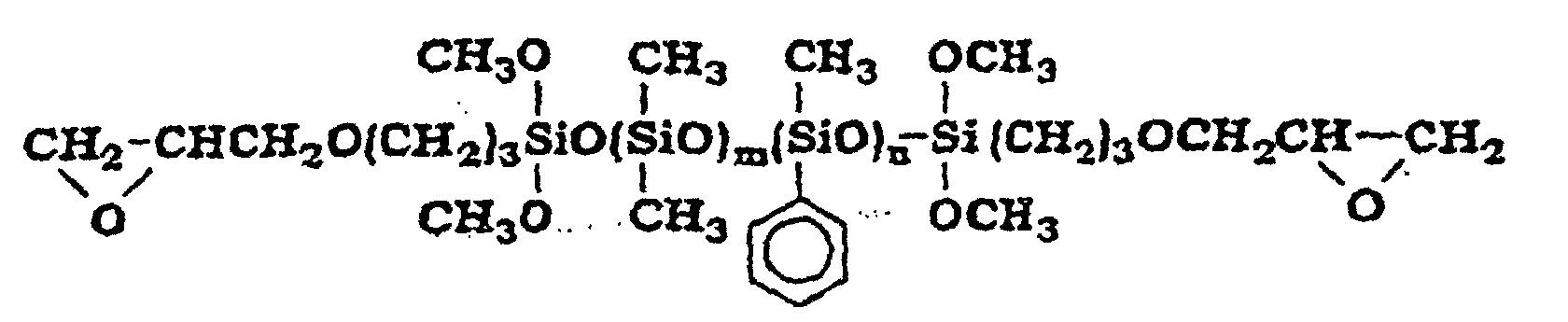
Applications Claiming Priority (3)
| Application Number | Priority Date | Filing Date | Title |
|---|---|---|---|
| JP7314849A JPH09132718A (ja) | 1995-11-08 | 1995-11-08 | 二液型硬化性液状シリコーン組成物 |
| JP31484995 | 1995-11-08 | ||
| JP314849/95 | 1995-11-08 |
Publications (3)
| Publication Number | Publication Date |
|---|---|
| EP0773262A2 EP0773262A2 (de) | 1997-05-14 |
| EP0773262A3 EP0773262A3 (de) | 1997-11-19 |
| EP0773262B1 true EP0773262B1 (de) | 2004-03-10 |
Family
ID=18058358
Family Applications (1)
| Application Number | Title | Priority Date | Filing Date |
|---|---|---|---|
| EP96117891A Expired - Lifetime EP0773262B1 (de) | 1995-11-08 | 1996-11-07 | Härtbare flüssige Zweikomponenten-Siliconzusammensetzung |
Country Status (4)
| Country | Link |
|---|---|
| US (1) | US5708054A (de) |
| EP (1) | EP0773262B1 (de) |
| JP (1) | JPH09132718A (de) |
| DE (1) | DE69631811T2 (de) |
Cited By (1)
| Publication number | Priority date | Publication date | Assignee | Title |
|---|---|---|---|---|
| DE10103446C5 (de) * | 2001-01-25 | 2007-06-28 | Kettenbach Gmbh & Co. Kg | Zweistufig härtbare mischergängige Materialien |
Families Citing this family (13)
| Publication number | Priority date | Publication date | Assignee | Title |
|---|---|---|---|---|
| JPH10130504A (ja) * | 1996-10-29 | 1998-05-19 | Toray Dow Corning Silicone Co Ltd | シリコーンゴム組成物 |
| US6482524B1 (en) * | 1997-03-11 | 2002-11-19 | Nippon Sheet Glass Co., Ltd. | Substrate having a treatment surface |
| JP3746394B2 (ja) * | 1999-04-14 | 2006-02-15 | 東レ・ダウコーニング株式会社 | シリコーンゲル組成物 |
| US6121368A (en) * | 1999-09-07 | 2000-09-19 | Dow Corning Corporation | Silicone composition and silicone pressure sensitive adhesive formed therefrom |
| FR2843119B1 (fr) * | 2002-07-30 | 2006-10-06 | Rhodia Chimie Sa | Composition d'huiles silicone reticulables en elastomeres pour le traitement par impregnation de materiaux fibreux |
| JP4578904B2 (ja) * | 2004-09-13 | 2010-11-10 | 富士フイルム株式会社 | 内視鏡 |
| JP5060074B2 (ja) * | 2006-05-11 | 2012-10-31 | 東レ・ダウコーニング株式会社 | 接着促進剤、硬化性オルガノポリシロキサン組成物、および半導体装置 |
| US8048351B2 (en) * | 2006-08-14 | 2011-11-01 | Swagelok Company | Bio-pharmaceutical hose |
| JP4895879B2 (ja) * | 2007-03-19 | 2012-03-14 | サンユレック株式会社 | 発光素子封止用シリコーン樹脂組成物及びこれを用いたポッティング方式による光半導体電子部品の製造方法 |
| DE102009031915A1 (de) * | 2009-07-06 | 2011-01-13 | Osram Opto Semiconductors Gmbh | Zusammensetzung zur Herstellung eines Filtermaterials für Strahlung, Verfahren zur Herstellung einer Zusammensetzung für ein Filtermaterial, Material zur Filterung von Strahlung und ein optoelektronisches Bauelement umfassend das Material |
| EP4010404B1 (de) * | 2019-08-09 | 2023-03-08 | Wacker Chemie AG | Vernetzbare zusammensetzungen auf der basis von organosiliciumverbindungen |
| US20250092283A1 (en) | 2022-01-12 | 2025-03-20 | Shin-Etsu Chemical Co., Ltd. | Thixotropic silicone gel composition for spot potting, cured product thereof, and photocoupler |
| US20250101226A1 (en) | 2022-01-12 | 2025-03-27 | Shin-Etsu Chemical Co., Ltd. | Thixotropic silicone gel composition, silicone gel cured product, and electrical/electronic components |
Family Cites Families (8)
| Publication number | Priority date | Publication date | Assignee | Title |
|---|---|---|---|---|
| FR1491412A (fr) * | 1966-06-27 | 1967-08-11 | Rhone Poulenc Sa | Procédé de préparation d'organotrisiloxanes |
| JPS59176347A (ja) * | 1983-03-25 | 1984-10-05 | Toray Silicone Co Ltd | オルガノポリシロキサン組成物 |
| JPS62229962A (ja) * | 1986-03-31 | 1987-10-08 | Oki Electric Ind Co Ltd | 樹脂封止ハイブリツドic装置 |
| US4720431A (en) * | 1986-05-21 | 1988-01-19 | American Telephone And Telegraph Company At&T Technologies, Inc. | Silicone encapsulated devices |
| JPH01313565A (ja) * | 1988-06-10 | 1989-12-19 | Toray Dow Corning Silicone Co Ltd | 硬化性オルガノポリシロキサン組成物 |
| DE3939176C2 (de) * | 1988-11-28 | 1997-03-27 | Shinetsu Chemical Co | Siliconkautschukmasse und daraus erhaltenes gehärtetes Produkt |
| JPH0739571B2 (ja) * | 1989-11-22 | 1995-05-01 | 信越化学工業株式会社 | 接着性オルガノポリシロキサン組成物 |
| JP2734302B2 (ja) * | 1992-01-21 | 1998-03-30 | 信越化学工業株式会社 | シリコーンゴム接着剤組成物 |
-
1995
- 1995-11-08 JP JP7314849A patent/JPH09132718A/ja active Pending
-
1996
- 1996-10-28 US US08/738,486 patent/US5708054A/en not_active Expired - Lifetime
- 1996-11-07 DE DE1996631811 patent/DE69631811T2/de not_active Expired - Lifetime
- 1996-11-07 EP EP96117891A patent/EP0773262B1/de not_active Expired - Lifetime
Cited By (1)
| Publication number | Priority date | Publication date | Assignee | Title |
|---|---|---|---|---|
| DE10103446C5 (de) * | 2001-01-25 | 2007-06-28 | Kettenbach Gmbh & Co. Kg | Zweistufig härtbare mischergängige Materialien |
Also Published As
| Publication number | Publication date |
|---|---|
| DE69631811T2 (de) | 2005-01-13 |
| US5708054A (en) | 1998-01-13 |
| JPH09132718A (ja) | 1997-05-20 |
| EP0773262A3 (de) | 1997-11-19 |
| DE69631811D1 (de) | 2004-04-15 |
| EP0773262A2 (de) | 1997-05-14 |
Similar Documents
| Publication | Publication Date | Title |
|---|---|---|
| US6797772B2 (en) | Alkenyl polyorganosiloxane, organohydrogensiloxane, organosilicon or silane treated silver particles and Pt catalyst | |
| EP1945716B1 (de) | Härtbare silikonzusammensetzung | |
| EP0773262B1 (de) | Härtbare flüssige Zweikomponenten-Siliconzusammensetzung | |
| JP3669718B2 (ja) | ワンパッケージのオルガノシロキサン組成物 | |
| EP1863876B1 (de) | Silikon-schmelzklebstoff | |
| JP3746394B2 (ja) | シリコーンゲル組成物 | |
| JPH0641562B2 (ja) | 硬化性オルガノポリシロキサン組成物 | |
| EP0682058A2 (de) | Adhäsionsfördernde Zusätze und diese enthaltende härtbare Organosiloxan-Zusammensetzungen | |
| EP1891160B1 (de) | Härtbare organopolysiloxanzusammensetzung | |
| KR102769563B1 (ko) | 다이 본딩용 실리콘 조성물, 그의 경화물 및 광반도체 장치 | |
| EP0727462B1 (de) | Silicongelzusammensetzung | |
| KR102794275B1 (ko) | 부가 경화형 실리콘 접착제 조성물 | |
| EP3868833B1 (de) | Härtbare organopolysiloxanzusammensetzung mit ausgezeichneter kaltbeständigkeit, verfahren zur herstellung von mustern, elektronische bauteile etc. | |
| JP3469325B2 (ja) | 接着促進添加剤および該添加剤を含有する低温硬化性オルガノシロキサン組成物 | |
| KR102924188B1 (ko) | 부가 경화형 실리콘 코팅 조성물, 실리콘 경화물 및 광반도체 장치 | |
| JP4454955B2 (ja) | 剥離性硬化皮膜形成用シリコーン組成物 | |
| AU677666B2 (en) | Method for curing organosiloxane compositions in the presence of cure inhibiting materials | |
| KR101127368B1 (ko) | 실온 경화성 오르가노폴리실록산 조성물 | |
| JP2005060549A (ja) | 定型接着剤 | |
| EP1788032B1 (de) | Verwendung von basischen Carbonaten zum Reduzieren des Druckverformungsrestes in additionsvernetzenden Silikonzusammensetzungen | |
| JP3683078B2 (ja) | 接着剤および接着方法 | |
| CN113493677A (zh) | 固晶用有机硅组合物、其固化物及光半导体装置 | |
| JP7790890B2 (ja) | 付加硬化型フルオロシリコーン組成物、シリコーンゴム、及び成形体 | |
| JPH0657797B2 (ja) | オルガノポリシロキサン組成物 | |
| TW202043419A (zh) | 黏晶用有機改質矽氧樹脂組成物、其硬化物及光半導體元件 |
Legal Events
| Date | Code | Title | Description |
|---|---|---|---|
| PUAI | Public reference made under article 153(3) epc to a published international application that has entered the european phase |
Free format text: ORIGINAL CODE: 0009012 |
|
| AK | Designated contracting states |
Kind code of ref document: A2 Designated state(s): DE FR GB IT |
|
| PUAL | Search report despatched |
Free format text: ORIGINAL CODE: 0009013 |
|
| AK | Designated contracting states |
Kind code of ref document: A3 Designated state(s): DE FR GB IT |
|
| 17P | Request for examination filed |
Effective date: 19980109 |
|
| 17Q | First examination report despatched |
Effective date: 20011016 |
|
| REG | Reference to a national code |
Ref country code: GB Ref legal event code: FG4D |
|
| GRAP | Despatch of communication of intention to grant a patent |
Free format text: ORIGINAL CODE: EPIDOSNIGR1 |
|
| GRAS | Grant fee paid |
Free format text: ORIGINAL CODE: EPIDOSNIGR3 |
|
| GRAA | (expected) grant |
Free format text: ORIGINAL CODE: 0009210 |
|
| AK | Designated contracting states |
Kind code of ref document: B1 Designated state(s): DE FR GB IT |
|
| REF | Corresponds to: |
Ref document number: 69631811 Country of ref document: DE Date of ref document: 20040415 Kind code of ref document: P |
|
| ET | Fr: translation filed | ||
| PLBE | No opposition filed within time limit |
Free format text: ORIGINAL CODE: 0009261 |
|
| STAA | Information on the status of an ep patent application or granted ep patent |
Free format text: STATUS: NO OPPOSITION FILED WITHIN TIME LIMIT |
|
| 26N | No opposition filed |
Effective date: 20041213 |
|
| PGFP | Annual fee paid to national office [announced via postgrant information from national office to epo] |
Ref country code: IT Payment date: 20061130 Year of fee payment: 11 |
|
| PG25 | Lapsed in a contracting state [announced via postgrant information from national office to epo] |
Ref country code: IT Free format text: LAPSE BECAUSE OF NON-PAYMENT OF DUE FEES Effective date: 20071107 |
|
| PGFP | Annual fee paid to national office [announced via postgrant information from national office to epo] |
Ref country code: FR Payment date: 20101123 Year of fee payment: 15 |
|
| PGFP | Annual fee paid to national office [announced via postgrant information from national office to epo] |
Ref country code: GB Payment date: 20101103 Year of fee payment: 15 |
|
| GBPC | Gb: european patent ceased through non-payment of renewal fee |
Effective date: 20111107 |
|
| REG | Reference to a national code |
Ref country code: FR Ref legal event code: ST Effective date: 20120731 |
|
| PG25 | Lapsed in a contracting state [announced via postgrant information from national office to epo] |
Ref country code: GB Free format text: LAPSE BECAUSE OF NON-PAYMENT OF DUE FEES Effective date: 20111107 |
|
| PG25 | Lapsed in a contracting state [announced via postgrant information from national office to epo] |
Ref country code: FR Free format text: LAPSE BECAUSE OF NON-PAYMENT OF DUE FEES Effective date: 20111130 |
|
| PGFP | Annual fee paid to national office [announced via postgrant information from national office to epo] |
Ref country code: DE Payment date: 20141105 Year of fee payment: 19 |
|
| REG | Reference to a national code |
Ref country code: DE Ref legal event code: R119 Ref document number: 69631811 Country of ref document: DE |
|
| PG25 | Lapsed in a contracting state [announced via postgrant information from national office to epo] |
Ref country code: DE Free format text: LAPSE BECAUSE OF NON-PAYMENT OF DUE FEES Effective date: 20160601 |