EP0771973B1 - Flüssigkeitsbetätigte Kupplung - Google Patents
Flüssigkeitsbetätigte Kupplung Download PDFInfo
- Publication number
- EP0771973B1 EP0771973B1 EP96117028A EP96117028A EP0771973B1 EP 0771973 B1 EP0771973 B1 EP 0771973B1 EP 96117028 A EP96117028 A EP 96117028A EP 96117028 A EP96117028 A EP 96117028A EP 0771973 B1 EP0771973 B1 EP 0771973B1
- Authority
- EP
- European Patent Office
- Prior art keywords
- piston
- force
- performance
- spring location
- engagement portion
- Prior art date
- Legal status (The legal status is an assumption and is not a legal conclusion. Google has not performed a legal analysis and makes no representation as to the accuracy of the status listed.)
- Expired - Lifetime
Links
- 239000012530 fluid Substances 0.000 title claims description 21
- 230000005540 biological transmission Effects 0.000 claims description 30
- 238000006243 chemical reaction Methods 0.000 claims description 23
- 239000000463 material Substances 0.000 description 17
- 230000004075 alteration Effects 0.000 description 5
- 239000000470 constituent Substances 0.000 description 5
- 230000007423 decrease Effects 0.000 description 4
- 238000010586 diagram Methods 0.000 description 4
- 238000010276 construction Methods 0.000 description 3
- 230000000694 effects Effects 0.000 description 3
- 230000002093 peripheral effect Effects 0.000 description 3
- 230000008859 change Effects 0.000 description 2
- 230000007246 mechanism Effects 0.000 description 2
- 238000002485 combustion reaction Methods 0.000 description 1
- 230000001419 dependent effect Effects 0.000 description 1
- 239000002783 friction material Substances 0.000 description 1
- 238000000034 method Methods 0.000 description 1
- 238000000465 moulding Methods 0.000 description 1
- 230000008569 process Effects 0.000 description 1
- 238000007789 sealing Methods 0.000 description 1
- 230000035939 shock Effects 0.000 description 1
Images





Classifications
-
- F—MECHANICAL ENGINEERING; LIGHTING; HEATING; WEAPONS; BLASTING
- F16—ENGINEERING ELEMENTS AND UNITS; GENERAL MEASURES FOR PRODUCING AND MAINTAINING EFFECTIVE FUNCTIONING OF MACHINES OR INSTALLATIONS; THERMAL INSULATION IN GENERAL
- F16H—GEARING
- F16H45/00—Combinations of fluid gearings for conveying rotary motion with couplings or clutches
- F16H45/02—Combinations of fluid gearings for conveying rotary motion with couplings or clutches with mechanical clutches for bridging a fluid gearing of the hydrokinetic type
-
- F—MECHANICAL ENGINEERING; LIGHTING; HEATING; WEAPONS; BLASTING
- F16—ENGINEERING ELEMENTS AND UNITS; GENERAL MEASURES FOR PRODUCING AND MAINTAINING EFFECTIVE FUNCTIONING OF MACHINES OR INSTALLATIONS; THERMAL INSULATION IN GENERAL
- F16H—GEARING
- F16H45/00—Combinations of fluid gearings for conveying rotary motion with couplings or clutches
- F16H45/02—Combinations of fluid gearings for conveying rotary motion with couplings or clutches with mechanical clutches for bridging a fluid gearing of the hydrokinetic type
- F16H2045/0221—Combinations of fluid gearings for conveying rotary motion with couplings or clutches with mechanical clutches for bridging a fluid gearing of the hydrokinetic type with damping means
- F16H2045/0226—Combinations of fluid gearings for conveying rotary motion with couplings or clutches with mechanical clutches for bridging a fluid gearing of the hydrokinetic type with damping means comprising two or more vibration dampers
-
- F—MECHANICAL ENGINEERING; LIGHTING; HEATING; WEAPONS; BLASTING
- F16—ENGINEERING ELEMENTS AND UNITS; GENERAL MEASURES FOR PRODUCING AND MAINTAINING EFFECTIVE FUNCTIONING OF MACHINES OR INSTALLATIONS; THERMAL INSULATION IN GENERAL
- F16H—GEARING
- F16H45/00—Combinations of fluid gearings for conveying rotary motion with couplings or clutches
- F16H45/02—Combinations of fluid gearings for conveying rotary motion with couplings or clutches with mechanical clutches for bridging a fluid gearing of the hydrokinetic type
- F16H2045/0273—Combinations of fluid gearings for conveying rotary motion with couplings or clutches with mechanical clutches for bridging a fluid gearing of the hydrokinetic type characterised by the type of the friction surface of the lock-up clutch
- F16H2045/0294—Single disk type lock-up clutch, i.e. using a single disc engaged between friction members
Definitions
- the present invention relates to a fluid clutch system according to the preamble of claim 1. Such a system is operated by hydraulic pressure.
- the preamble of claim 1 starts out from the fluid clutch system known from GB-A-2 130 311.
- a piston can - due to a pressure difference between chambers on both axial sides of the piston - be moved to a surface of a front cover so that a frictional engagement force can be generated between the piston and the surface of the front cover.
- a rotation of the front cover is transmitted to the piston, so that the piston pushes a transmission member in the same direction in which the opposing surface rotates.
- a piston is arranged so as to be axially movable frontwards and rearwards relative to a surface opposing to the piston.
- Two oil chambers of a first oil chamber and a second oil chamber are formed on both the axial sides of the piston holding the piston therebetween.
- the piston is advanced toward the opposing surface till its surface contact with the opposing surface by the difference between the internal pressures of both the first and second oil chambers, whereby a frictional engagement force is generated to transmit a torque between the piston and the opposing surface.
- a friction surface attached a frictional material is formed on the piston or the opposing surface as the need arises.
- the lockup clutch of a torque converter has been known as an example of such a fluid clutch.
- Fig. 11 illustrates the torque converter having the prior-art lockup clutch.
- the torque converter 1 is entirely enclosed with a front cover 2 and the pump cover 3a of a pump 3, and the interior thereof is filled up with oil (for example, an automatic transmission fluid abbreviated to "ATF").
- oil for example, an automatic transmission fluid abbreviated to "ATF"
- a turbine 4 a stator 5 and the piston 7 of the lockup clutch 6 are disposed inside the torque converter 1.
- a frictional material 8 is stuck on that part of the peripheral edge of the piston 7 which can come into contact with the surface S of the front cover 2 opposing to the piston 7.
- a first oil chamber 9 is formed on the side of the piston 7 near the front cover 2, and a second oil chamber 10 is formed on the side thereof near the turbine 4.
- first and second oil chambers 9, 10 are sealed or isolated from each other by the frictional material 8, and the frictional material 8 of the piston 7 is held in pressed contact with the front cover 2 by the difference between the pressures of both the oil chambers 9, 10.
- the lockup clutch 6 is engaged owing to a frictional engagement force generated by the pressed contact, and an engine torque is transmitted directly from the front cover 2 to the input shaft of a transmission (not shown) through the piston 7.
- the present invention has been made in order to solve the problem of the prior art as stated above, and has for its object to provide a fluid clutch system in which the capacity of the transmission torque of a clutch can be increased without spoiling an on-vehicle mounting quality.
- a pressure force is generated by assistant pressure force generation means so as to assist the frictional engagement force. Therefore, the frictional engagement force to be generated between the piston and the surface opposing thereto is increased, and the capacity of the transmission torque of a clutch can be enlarged without enlarging the diameter of the piston.
- the piston is joined through an engagement portion with a transmission member which is mated with the piston, and the assistant pressure force generation means is so constructed as to hold a piston side member and the transmission member in contact at the engagement portion with an inclination of predetermined angle at which the piston undergoes a component force in the axial direction thereof.
- the transmission torque capacity can be enlarged by minor improvements in the constituent parts of the prior-art clutch.
- a preferable aspect of performance consists in comprising second frictional force generation means for generating a further frictional engagement force at a position separate from said opposing surface, by receiving a reaction force of the assistant pressure force when said assistant pressure force has been generated.
- second frictional force generation means for generating a further frictional engagement force at a position separate from said opposing surface, by receiving a reaction force of the assistant pressure force when said assistant pressure force has been generated.
- the assistant pressure force generation means generates assistant pressure forces which differ between during forward rotation of an engine and during reverse rotation thereof.
- a pressure force for engaging (or applying) the clutch can be relieved in, e. g., an engine braking mode, so that a required gain can be made smaller, namely, the actual change of the frictional engagement force can be made smaller relative to the actual change of the differential pressure based on oil, to enhance the precision of a clutch control.
- Fig. 1 illustrates the vertical sectional view of a torque converter with a lockup clutch (a fluid clutch system) according to the first aspect of performance.
- the torque converter 12 is mainly constructed of a pump 16, a turbine 18 and a stator 20.
- the lockup clutch (fluid clutch system) 22 is mainly constructed of a piston 26 on which a frictional material 24 is stuck, and a front cover 14 which forms a surface opposing to the piston 26.
- a flange portion 28 formed at the lower part of the piston 26 is mounted on the bearing portion 32 of a turbine hub 30 so as to be slidable in the axial direction X of the piston 26 (the axial direction X being the front or rear direction of the piston 26, or the direction of the drawing).
- the flange portion 28 is sealed up by a sealing member 34.
- a first oil chamber 36 and a second oil chamber 38 are defined on both the sides of the piston 26 in the axial direction X.
- the piston 26 is moved frontwards or rearwards in the axial direction X by the difference between the internal pressures of both the oil chambers 36 and 38.
- the pressure of the second oil chamber 38 is higher, the piston 26 is moved frontwards till the frictional material 24 contacts with the front cover 14, whereby a frictional engagement force is generated.
- the torque converter 12 falls into the torque transmission state in which the torque of an engine (not shown) is directly transmitted or delivered to the turbine hub 30 by the lockup clutch 22.
- the torque is transmitted to a holding cover 44 through a spring location (transmission member) 40 held in engagement with the piston 26, and then through first and second damper springs 42 and 43.
- the inner peripheral side of the holding cover 44 is fixed to the turbine hub 30 by rivets 46.
- a spline 48 is provided on the inner peripheral side of the turbine hub 30, to engage with the input shaft of a gear shift mechanism not shown.
- the torque transmitted to the turbine hub 30 is delivered to the gear shift mechanism therefrom.
- Fig. 2 illustrates a enlarged sectional view taken along line II - II indicated in Fig. 1.
- the piston 26 is joined with the aforementioned spring location 40 at an engagement portion 26a so as to transmit the torque.
- assistant pressure force generation means is formed by contriving the shapes of the engagement portion 26a and the spring location 40.
- Fig. 12 the shapes of corresponding portions in the prior art are illustrated in Fig. 12.
- the constituent parts of the prior-art torque converter shall be cited by affixing symbols ' to the reference numerals indicated in Fig. 1.
- the engagement portion 26a' is formed horizontal as shown in Fig. 12. Accordingly, the engagement portion 26a' pushes the spring location 40' in only the same direction as the rotating direction of the engine. Namely the engagement portions 26a' does not generate a force in any other direction.
- a pressure force Fs' which presses the piston 26' against the front cover 14' is generated only by the pressure difference between the second oil chamber 38' and the first oil chamber 36'.
- the engagement portion 26a is not horizontal, but it has a predetermined angle ⁇ .
- the spring location 40 is in the shape conformed to the inclined engagement portion 26a.
- the engagement portion 26a and the spring location 40 thus formed with the inclination of the predetermined angle ⁇ constitute the assistant pressure force generation means for generating a pressure force which assists the frictional engagement force of the piston 26, whereby the transmission torque capacity of the lockup clutch 22 is increased. This effect will be detailed below.
- the engagement portion 26a pushes the spring location 40 with a force Fa in the same rotational direction of the engine (upwards as viewed in Fig. 3) as shown in Fig. 3.
- the radius of the engagement portion 26a be Ra as indicated in Fig. 1
- the spring location 40 comes to push the engagement portion 26a leftwards with a force of magnitude Fb which is generated as reaction against the above force Fb.
- the transmission torque capacity is enlarged in correspondence with ( ⁇ ⁇ Rc)/(tan ⁇ ⁇ Ra). That is, according to this aspect of performance, the transmission torque capacity can be enlarged by making the minor alterations of the parts with the known system construction substantially left intact.
- the surface of the spring location 40 lying in contact with the engagement portion 26a has the same inclination of the predetermined angle ⁇ as the inclination of the contact surface of the engagement portion 26a, so that both surfaces can contact superior.
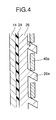
- a spring location 40a in the same shape as in the prior art as shown in Fig. 4 can be fabricated by the same easy press molding as in the prior art.
- the surface of a spring location 40b lying in contact with the engagement portion 26a is formed into a curved surface of circular arc shape as shown in Fig. 5, there is the merit that the angle ⁇ can be reliably defined.
- the shape of the spring location 40 is not restricted to such examples, but it may well be any of other various shapes. Furthermore, any of the shapes may well be applied to the side of engagement portion 26a. It is possible to adopt various combinations of the shapes as long as the component force Fb pushing the piston 26 in the axial direction X can be generated.
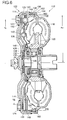
- Fig. 6 illustrates the vertical sectional view of a torque converter with a lockup clutch according to the second aspect of performance.
- the torque converter with the lockup clutch according to the first aspect of performance illustrated in Fig. 1 is provided with a reaction member 150 anew, and the reaction member 150 and a pump cover 160 comprises second frictional force generation means.
- the reaction member 150 is pressed against the pump cover 160 so as to generate a reaction force.
- the reaction member 150 is constructed by sticking a frictional material 154 on a plate 152.
- This reaction member 150 is rotated together with a piston 126, and is slidable in the axial direction X of the piston 126.
- the shapes of the piston 126 and a spring location 140 are somewhat altered due to the provision of the reaction member 150.
- the remaining constituent members or parts are the same as in the first aspect of performance, they shall be designated in Fig. 6 by reference numerals the two lower digits of which are the same as in Fig. 1, respectively.
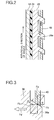
- Fig. 7 illustrates an enlarged sectional view taken along line VII - VII indicated in Fig. 6, in order to clarify the shapes of the piston 126 and the spring location 140.
- the spring location 140 presses the reaction member 150 rightwards in Fig. 7 with the axial component force Fb.
- the pressed reaction member 150 is brought into contact with the pump cover 160 being unitary with the front cover 114, and is brought into engagement therewith at the frictional material 154, so that all these constituent members are unitarily rotated.
- reaction member 150 is brought into engagement with the pump cover 160 (which is unitary with the front cover 114) through the frictional material 154 by the reaction force Fb, a force assisting the pressure force of the piston 126 can be obtained owing to the reaction force Fb, simultaneously with the aforementioned force Fb which develops between the spring location 140 and the engagement portion 126a.
- a total assistant force of 2 ⁇ Fb acts on the piston 126 in addition to a force Fs based on the pressure difference.
- the transmission torque capacity is enlarged in correspondence with 2 ⁇ ( ⁇ ⁇ Rc)/(tan ⁇ ⁇ Ra).
- the axial component force Fs is received by only the spring location 40, whereas in the second aspect of performance, the force Fs is received by the pump cover 160 through the reaction member 150 as stated above.
- the axial force acting on the spring location 140 can be balanced to bring forth the effects that the friction of the spring location 140 as a damper decreases and internal noise ascribable to the friction lowers.
- the durability of the lockup clutch 122 is enhanced owing to the enlarged friction surfaces.
- the shape of the spring location 140 is not restricted to the example shown in Fig. 7, but it may be any shape for generating a plus thrust force, e. g., a bilaterally symmetric shape as shown in Fig. 8.
- the shape of the spring location 140 in the second aspect of performance is altered, while the shapes of the piston 126 and reaction member 150 are also altered in conformity with the alteration of shape of the spring location 140, whereby different pressure forces are generated between during the forward rotation of an engine and during the reverse rotation thereof.
- a vertical sectional view showing the whole torque converter in the third aspect of performance is identical to Fig. 6.
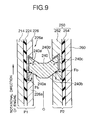
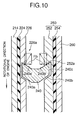
- Fig. 9 illustrates a sectional view which corresponds to Fig. 7 showing the shapes of the spring location 140, etc.
- a spring location 240 in the third aspect of performance is bilaterally symmetric.
- the part of the spring location 240, adapted to come into contact with the engagement portion 226a of a piston 226 has an inclined plane 240a of predetermined angle ⁇ .
- the part of the spring location 240, adapted to come into contact with the plate 252 of a reaction member 250 has an inclined plane 240b inverse to the inclined plane 240a.
- planes 240a' and 240b' opposite to the inclined planes 240a and 240b are parallel to these inclined planes 240a and 240b, respectively.
- the piston 226 in the driving state (the forward rotation mode) of the engine, the piston 226 is brought into contact with a front cover 214 by a force Fs generated on the basis of hydraulic pressures (a differential pressure), and is rotated unitarily with the front cover 214. Then, the engagement portion 226a of the piston 226 abuts against the inclined plane 240a of the spring location 240. As in the second aspect of performance, accordingly, a force Fa acts upwards in Fig. 9, and a force Fb acts rightwards, so that the spring location 240 is moved rightwards in the figure.
- the front cover 214 and a pump cover 260 are kept rotating unitarily, while the piston 226 and the plate 252 of the reaction member 250 are also kept rotating unitarily. Therefore, (although the force Fs based on the hydraulic pressures acts on only a side P1 indicated in Fig. 9,) the side P1 and a side P2 become quite symmetric with respect to a center O, as regards the generation of assistant forces Fb.
- the spring location 240 exerts the forces of the magnitude Fb on the piston 226 and the reaction member 250 so as to push them out leftwards and rightwards, respectively, as indicated by arrows in Fig. 9.
- a frictional engagement force is increased in correspondence with the force Fb more than the force Fs based on the hydraulic pressures.
- the force Fb as a frictional engagement force is generated on the side of a frictional material 254.
- the transmission torque capacity is reduced in correspondence with (2 ⁇ ⁇ ⁇ Rc)/ (tan ⁇ ⁇ Ra).
- the different pressure forces can be generated so as to increase the transmission torque capacity in the forward rotation mode of the engine and to decrease it in the reverse rotation mode.
- the pressure force for engaging (or applying) the clutch can be relieved, and the precision of a clutch control is enhanced owing to a smaller gain (owing to the fact that the increase or decrease of the frictional engagement force is smaller relative to the increase or decrease of the differential oil pressure).
- a fluid clutch system wherein a piston is hydraulically moved so as to come into frictional engagement with a surface opposing to the piston, comprising assistant pressure force generation device (26a and 40 in Fig. 2) for generating a pressure force which assists the frictional engagement force of the piston, whereby the transmission torque capacity of the fluid clutch system is enlarged without spoiling the on-vehicle mounting quality thereof.
Landscapes
- Engineering & Computer Science (AREA)
- General Engineering & Computer Science (AREA)
- Mechanical Engineering (AREA)
- Hydraulic Clutches, Magnetic Clutches, Fluid Clutches, And Fluid Joints (AREA)
Claims (3)
- Fluidkupplungssystem, in welchem ein Kolben (26) so angeordnet ist, daß er relativ zu einer dem Kolben (26) gegenüberliegenden Fläche (14) vorwärts und rückwärts beweglich ist, an beiden axialen Seiten des Kolbens (26) eine erste Ölkammer (36) und eine zweite Ölkammer (38) ausgebildet sind, die den Kolben (26) halten, und in welchem der Kolben (26) in seiner axialen Richtung (X) bewegt wird, bis der Kolben (26) durch eine Differenz zwischen den Innendrücken (Ps) der ersten und zweiten Ölkammer (36, 38) mit der gegenüberliegenden Fläche (14) in Kontakt gelangt, so daß eine Reibungseingriffskraft (Fs') zwischen dem Kolben (26) und der gegenüberliegenden Fläche (14) erzeugt werden kann,dadurch kennzeichnet, daßwobei das Fluidkupplungssystem eine Hilfsdruckkrafterzeugungseinrichtung (26a, 40) zur Erzeugung einer Hilfsdruckkraft (Fb) aufweist, welche die Reibungseingriffskraft (Fs') unterstützt, die auf einer Bewegung des Kolbens (26) basiert,wobei der Kolben (26) über einen Eingriffabschnitt (26a) mit einem Übertragungselement (40) verbunden ist, das im Eingriff mit besagtem Kolben (26) steht,
die Hilsdruckkrafterzeugungseinrichtung (26a, 40) so aufgebaut ist, daß der Kolben (26) und das Übertragungselement (40) an dem Eingriffabschnitt (26a) mit einer Neigung eines vorbestimmtem Winkels (Θ) in Kontakt stehen, bei dem der Kolben (26) eine Kraftkomponente in seiner axialen Richtung (X) erfährt, welche die Hilfsdruckkraft (Fb) ist. - Fluidkupplungssystem gemäß Patentanspruch 1, welches ferner eine zweite Reibungskrafterzeugungseinrichtung (150, 160) aufweist, die eine weitere Reibungseingriffskraft an einer von der gegenüberliegenden Fläche (14) separaten Position erzeugt, indem sie eine Reaktionskraft der Kraftkomponente (Fb) aufnimmt, wenn die Kraftkomponente (Fb) erzeugt worden ist.
- Fluidkupplungssystem gemäß Patentanspruch 1, wobei die Hilfsdruckkrafterzeugungseinrichtung (26a, 40) Kraftkomponenten erzeugt, die sich abhängig davon unterscheiden, ob der Motor sich im antreibenden oder im angetriebenen Zustand befindet.
Applications Claiming Priority (3)
| Application Number | Priority Date | Filing Date | Title |
|---|---|---|---|
| JP283632/95 | 1995-10-31 | ||
| JP28363295A JP3438439B2 (ja) | 1995-10-31 | 1995-10-31 | 湿式クラッチ装置 |
| JP28363295 | 1995-10-31 |
Publications (2)
| Publication Number | Publication Date |
|---|---|
| EP0771973A1 EP0771973A1 (de) | 1997-05-07 |
| EP0771973B1 true EP0771973B1 (de) | 2000-07-12 |
Family
ID=17668036
Family Applications (1)
| Application Number | Title | Priority Date | Filing Date |
|---|---|---|---|
| EP96117028A Expired - Lifetime EP0771973B1 (de) | 1995-10-31 | 1996-10-23 | Flüssigkeitsbetätigte Kupplung |
Country Status (5)
| Country | Link |
|---|---|
| US (1) | US5785161A (de) |
| EP (1) | EP0771973B1 (de) |
| JP (1) | JP3438439B2 (de) |
| KR (1) | KR100201804B1 (de) |
| DE (1) | DE69609285T2 (de) |
Family Cites Families (8)
| Publication number | Priority date | Publication date | Assignee | Title |
|---|---|---|---|---|
| DE921372C (de) * | 1952-10-03 | 1954-12-16 | Daimler Benz Ag | Wechselgetriebe, insbesondere fuer Kraftfahrzeuge, mit hydraulisch geschalteten Reibkupplungen |
| US2865483A (en) * | 1955-11-25 | 1958-12-23 | Gen Motors Corp | Lockup clutch means for fluid torque converters and the like |
| US3239042A (en) * | 1963-04-17 | 1966-03-08 | Ford Motor Co | Clutch with friction increasing means |
| US4153147A (en) * | 1977-10-26 | 1979-05-08 | General Motors Corporation | Torque converter and torque engaged slipping clutch |
| JPS5986750A (ja) * | 1982-11-10 | 1984-05-19 | Nissan Motor Co Ltd | ロツクアツプトルクコンバ−タのスリツプ制御装置 |
| JPS6081566A (ja) * | 1983-10-07 | 1985-05-09 | Nissan Motor Co Ltd | ロツクアツプトルクコンバ−タのスリツプ制御装置 |
| JPS61122032A (ja) * | 1984-11-17 | 1986-06-10 | Nissan Motor Co Ltd | 4輪駆動車の駆動力配分装置 |
| JP3214208B2 (ja) * | 1993-04-13 | 2001-10-02 | トヨタ自動車株式会社 | 湿式クラッチ |
-
1995
- 1995-10-31 JP JP28363295A patent/JP3438439B2/ja not_active Expired - Fee Related
-
1996
- 1996-10-18 US US08/732,686 patent/US5785161A/en not_active Expired - Fee Related
- 1996-10-23 DE DE69609285T patent/DE69609285T2/de not_active Expired - Fee Related
- 1996-10-23 EP EP96117028A patent/EP0771973B1/de not_active Expired - Lifetime
- 1996-10-30 KR KR1019960050253A patent/KR100201804B1/ko not_active Expired - Fee Related
Also Published As
| Publication number | Publication date |
|---|---|
| DE69609285T2 (de) | 2001-03-01 |
| JPH09126297A (ja) | 1997-05-13 |
| KR970021849A (ko) | 1997-05-28 |
| US5785161A (en) | 1998-07-28 |
| EP0771973A1 (de) | 1997-05-07 |
| KR100201804B1 (ko) | 1999-06-15 |
| JP3438439B2 (ja) | 2003-08-18 |
| DE69609285D1 (de) | 2000-08-17 |
Similar Documents
| Publication | Publication Date | Title |
|---|---|---|
| JP2010525267A (ja) | 原動機駆動車両用のトルク差または速度差応動クラッチ操作装置 | |
| US11542991B2 (en) | Clutch system interlocking with accelerator and brake pedal | |
| EP4336060A1 (de) | Kupplungsvorrichtung und motorrad | |
| EP0506015B1 (de) | Anordnung zur Drehmomentübertragung eines Vierradgetriebenen Fahrzeuges | |
| US5813506A (en) | Direct-coupled clutch for torque converter | |
| EP4368848B1 (de) | Kupplungsvorrichtung und motorrad | |
| CN117345780B (zh) | 离合器装置 | |
| JP4558772B2 (ja) | トルクダンパ | |
| EP0771973B1 (de) | Flüssigkeitsbetätigte Kupplung | |
| CN117366121A (zh) | 离合器装置及摩托车 | |
| EP1673546B1 (de) | Doppelkupplung, insbesondere für ein kraftfahrzeug | |
| JPH05172185A (ja) | 流体動力学的動力伝達装置用のロックアップクラッチ | |
| JP2005233359A (ja) | 動力伝達装置 | |
| EP0735290A1 (de) | Tellerfeder-Kupplungsvorrichtung für Kraftfahrzeuge | |
| JP2836325B2 (ja) | ロックアップクラッチ付き流体伝動装置 | |
| US4657122A (en) | Centrifugal friction clutch and coupling mechanism using such clutch | |
| JPH08510036A (ja) | 特に自動車用に適するトーションダンプ装置 | |
| JP3601522B2 (ja) | ダンパ装置 | |
| WO2015180778A1 (fr) | Dispositif d'embrayage, notamment pour vehicule automobile | |
| JP2824385B2 (ja) | 湿式クラッチ装置 | |
| JP5324345B2 (ja) | 動力伝達装置 | |
| EP1666751B1 (de) | Kupplung, insbesondere für Kraftfahrzeuge, umfassend einen Mechanismus mit verbessertem Kupplungsgehäuse. | |
| JPH0712651U (ja) | トルクコンバータのロックアップピストン | |
| JPH11148547A (ja) | トルクコンバータ用ロックアップクラッチ | |
| JPH11303971A (ja) | ロックアップ機構付トルクコンバータ |
Legal Events
| Date | Code | Title | Description |
|---|---|---|---|
| PUAI | Public reference made under article 153(3) epc to a published international application that has entered the european phase |
Free format text: ORIGINAL CODE: 0009012 |
|
| 17P | Request for examination filed |
Effective date: 19961023 |
|
| AK | Designated contracting states |
Kind code of ref document: A1 Designated state(s): DE FR GB |
|
| 17Q | First examination report despatched |
Effective date: 19980720 |
|
| GRAG | Despatch of communication of intention to grant |
Free format text: ORIGINAL CODE: EPIDOS AGRA |
|
| GRAG | Despatch of communication of intention to grant |
Free format text: ORIGINAL CODE: EPIDOS AGRA |
|
| GRAH | Despatch of communication of intention to grant a patent |
Free format text: ORIGINAL CODE: EPIDOS IGRA |
|
| GRAH | Despatch of communication of intention to grant a patent |
Free format text: ORIGINAL CODE: EPIDOS IGRA |
|
| GRAA | (expected) grant |
Free format text: ORIGINAL CODE: 0009210 |
|
| AK | Designated contracting states |
Kind code of ref document: B1 Designated state(s): DE FR GB |
|
| REF | Corresponds to: |
Ref document number: 69609285 Country of ref document: DE Date of ref document: 20000817 |
|
| ET | Fr: translation filed | ||
| PLBE | No opposition filed within time limit |
Free format text: ORIGINAL CODE: 0009261 |
|
| STAA | Information on the status of an ep patent application or granted ep patent |
Free format text: STATUS: NO OPPOSITION FILED WITHIN TIME LIMIT |
|
| 26N | No opposition filed | ||
| REG | Reference to a national code |
Ref country code: GB Ref legal event code: IF02 |
|
| REG | Reference to a national code |
Ref country code: GB Ref legal event code: 746 Effective date: 20041018 |
|
| REG | Reference to a national code |
Ref country code: FR Ref legal event code: D6 |
|
| PGFP | Annual fee paid to national office [announced via postgrant information from national office to epo] |
Ref country code: FR Payment date: 20051010 Year of fee payment: 10 |
|
| PGFP | Annual fee paid to national office [announced via postgrant information from national office to epo] |
Ref country code: GB Payment date: 20051019 Year of fee payment: 10 |
|
| PGFP | Annual fee paid to national office [announced via postgrant information from national office to epo] |
Ref country code: DE Payment date: 20051020 Year of fee payment: 10 |
|
| PG25 | Lapsed in a contracting state [announced via postgrant information from national office to epo] |
Ref country code: DE Free format text: LAPSE BECAUSE OF NON-PAYMENT OF DUE FEES Effective date: 20070501 |
|
| GBPC | Gb: european patent ceased through non-payment of renewal fee |
Effective date: 20061023 |
|
| REG | Reference to a national code |
Ref country code: FR Ref legal event code: ST Effective date: 20070629 |
|
| PG25 | Lapsed in a contracting state [announced via postgrant information from national office to epo] |
Ref country code: GB Free format text: LAPSE BECAUSE OF NON-PAYMENT OF DUE FEES Effective date: 20061023 |
|
| PG25 | Lapsed in a contracting state [announced via postgrant information from national office to epo] |
Ref country code: FR Free format text: LAPSE BECAUSE OF NON-PAYMENT OF DUE FEES Effective date: 20061031 |