EP0751111B1 - Verfahren zur Herstellung von 2,2-Dialkylaryliden-cycloalkanonen - Google Patents
Verfahren zur Herstellung von 2,2-Dialkylaryliden-cycloalkanonen Download PDFInfo
- Publication number
- EP0751111B1 EP0751111B1 EP96109473A EP96109473A EP0751111B1 EP 0751111 B1 EP0751111 B1 EP 0751111B1 EP 96109473 A EP96109473 A EP 96109473A EP 96109473 A EP96109473 A EP 96109473A EP 0751111 B1 EP0751111 B1 EP 0751111B1
- Authority
- EP
- European Patent Office
- Prior art keywords
- alkyl
- formula
- alkoxy
- halogen
- optionally substituted
- Prior art date
- Legal status (The legal status is an assumption and is not a legal conclusion. Google has not performed a legal analysis and makes no representation as to the accuracy of the status listed.)
- Expired - Lifetime
Links
- 238000004519 manufacturing process Methods 0.000 title description 5
- 229910052736 halogen Inorganic materials 0.000 claims description 21
- 150000002367 halogens Chemical group 0.000 claims description 21
- 238000000034 method Methods 0.000 claims description 21
- 125000004178 (C1-C4) alkyl group Chemical group 0.000 claims description 18
- 150000003509 tertiary alcohols Chemical class 0.000 claims description 13
- 150000001875 compounds Chemical class 0.000 claims description 12
- 125000000229 (C1-C4)alkoxy group Chemical group 0.000 claims description 11
- 150000001350 alkyl halides Chemical class 0.000 claims description 11
- -1 substituted Chemical class 0.000 claims description 10
- 239000000460 chlorine Substances 0.000 claims description 9
- 229910052801 chlorine Inorganic materials 0.000 claims description 9
- 238000002360 preparation method Methods 0.000 claims description 8
- ZAMOUSCENKQFHK-UHFFFAOYSA-N Chlorine atom Chemical compound [Cl] ZAMOUSCENKQFHK-UHFFFAOYSA-N 0.000 claims description 7
- 239000000203 mixture Substances 0.000 claims description 7
- 125000004093 cyano group Chemical group *C#N 0.000 claims description 6
- 239000012442 inert solvent Substances 0.000 claims description 6
- 229910000000 metal hydroxide Inorganic materials 0.000 claims description 6
- 150000004692 metal hydroxides Chemical class 0.000 claims description 6
- 150000003254 radicals Chemical class 0.000 claims description 6
- 239000011541 reaction mixture Substances 0.000 claims description 6
- XLYOFNOQVPJJNP-UHFFFAOYSA-N water Substances O XLYOFNOQVPJJNP-UHFFFAOYSA-N 0.000 claims description 6
- 125000006656 (C2-C4) alkenyl group Chemical group 0.000 claims description 5
- UFHFLCQGNIYNRP-UHFFFAOYSA-N Hydrogen Chemical compound [H][H] UFHFLCQGNIYNRP-UHFFFAOYSA-N 0.000 claims description 5
- 150000001340 alkali metals Chemical class 0.000 claims description 5
- 238000006243 chemical reaction Methods 0.000 claims description 5
- WKBOTKDWSSQWDR-UHFFFAOYSA-N Bromine atom Chemical compound [Br] WKBOTKDWSSQWDR-UHFFFAOYSA-N 0.000 claims description 4
- GDTBXPJZTBHREO-UHFFFAOYSA-N bromine Substances BrBr GDTBXPJZTBHREO-UHFFFAOYSA-N 0.000 claims description 4
- 229910052794 bromium Inorganic materials 0.000 claims description 4
- 125000004432 carbon atom Chemical group C* 0.000 claims description 4
- 229910052731 fluorine Inorganic materials 0.000 claims description 4
- 239000011737 fluorine Substances 0.000 claims description 4
- 239000001257 hydrogen Substances 0.000 claims description 4
- 229910052739 hydrogen Inorganic materials 0.000 claims description 4
- 125000001309 chloro group Chemical group Cl* 0.000 claims description 3
- 125000000449 nitro group Chemical group [O-][N+](*)=O 0.000 claims description 3
- ZCYVEMRRCGMTRW-UHFFFAOYSA-N 7553-56-2 Chemical compound [I] ZCYVEMRRCGMTRW-UHFFFAOYSA-N 0.000 claims description 2
- 229910001516 alkali metal iodide Inorganic materials 0.000 claims description 2
- 125000001153 fluoro group Chemical group F* 0.000 claims description 2
- 239000011630 iodine Substances 0.000 claims description 2
- 229910052740 iodine Inorganic materials 0.000 claims description 2
- 125000001424 substituent group Chemical group 0.000 claims description 2
- 125000000041 C6-C10 aryl group Chemical group 0.000 claims 1
- 229910000272 alkali metal oxide Inorganic materials 0.000 claims 1
- 229910001860 alkaline earth metal hydroxide Inorganic materials 0.000 claims 1
- 229910052799 carbon Inorganic materials 0.000 claims 1
- DKGAVHZHDRPRBM-UHFFFAOYSA-N Tert-Butanol Chemical compound CC(C)(C)O DKGAVHZHDRPRBM-UHFFFAOYSA-N 0.000 description 22
- KWYUFKZDYYNOTN-UHFFFAOYSA-M potassium hydroxide Inorganic materials [OH-].[K+] KWYUFKZDYYNOTN-UHFFFAOYSA-M 0.000 description 14
- NLKNQRATVPKPDG-UHFFFAOYSA-M potassium iodide Inorganic materials [K+].[I-] NLKNQRATVPKPDG-UHFFFAOYSA-M 0.000 description 14
- MSXVEPNJUHWQHW-UHFFFAOYSA-N 2-methylbutan-2-ol Chemical compound CCC(C)(C)O MSXVEPNJUHWQHW-UHFFFAOYSA-N 0.000 description 12
- IAZDPXIOMUYVGZ-UHFFFAOYSA-N Dimethylsulphoxide Chemical compound CS(C)=O IAZDPXIOMUYVGZ-UHFFFAOYSA-N 0.000 description 9
- OKKJLVBELUTLKV-UHFFFAOYSA-N Methanol Chemical compound OC OKKJLVBELUTLKV-UHFFFAOYSA-N 0.000 description 9
- YXFVVABEGXRONW-UHFFFAOYSA-N Toluene Chemical compound CC1=CC=CC=C1 YXFVVABEGXRONW-UHFFFAOYSA-N 0.000 description 9
- 239000003513 alkali Substances 0.000 description 8
- 239000002585 base Substances 0.000 description 8
- NEHMKBQYUWJMIP-UHFFFAOYSA-N chloromethane Chemical compound ClC NEHMKBQYUWJMIP-UHFFFAOYSA-N 0.000 description 8
- 239000000047 product Substances 0.000 description 7
- 125000000753 cycloalkyl group Chemical group 0.000 description 6
- 238000002844 melting Methods 0.000 description 6
- 230000008018 melting Effects 0.000 description 6
- 230000029936 alkylation Effects 0.000 description 5
- 238000005804 alkylation reaction Methods 0.000 description 5
- QGZKDVFQNNGYKY-UHFFFAOYSA-N Ammonia Chemical compound N QGZKDVFQNNGYKY-UHFFFAOYSA-N 0.000 description 4
- KEAYESYHFKHZAL-UHFFFAOYSA-N Sodium Chemical compound [Na] KEAYESYHFKHZAL-UHFFFAOYSA-N 0.000 description 4
- 229910052783 alkali metal Inorganic materials 0.000 description 4
- 150000002576 ketones Chemical class 0.000 description 4
- 229940050176 methyl chloride Drugs 0.000 description 4
- 239000012312 sodium hydride Substances 0.000 description 4
- 229910000104 sodium hydride Inorganic materials 0.000 description 4
- 239000002904 solvent Substances 0.000 description 4
- DCLKBNYCCJWXPK-UHFFFAOYSA-N 2-[(4-chlorophenyl)methylidene]-5-methylcyclopentan-1-one Chemical compound O=C1C(C)CCC1=CC1=CC=C(Cl)C=C1 DCLKBNYCCJWXPK-UHFFFAOYSA-N 0.000 description 3
- UHOVQNZJYSORNB-UHFFFAOYSA-N Benzene Chemical compound C1=CC=CC=C1 UHOVQNZJYSORNB-UHFFFAOYSA-N 0.000 description 3
- PXGOKWXKJXAPGV-UHFFFAOYSA-N Fluorine Chemical compound FF PXGOKWXKJXAPGV-UHFFFAOYSA-N 0.000 description 3
- ZLMJMSJWJFRBEC-UHFFFAOYSA-N Potassium Chemical compound [K] ZLMJMSJWJFRBEC-UHFFFAOYSA-N 0.000 description 3
- 150000008044 alkali metal hydroxides Chemical class 0.000 description 3
- 150000004678 hydrides Chemical class 0.000 description 3
- 238000007086 side reaction Methods 0.000 description 3
- HEMHJVSKTPXQMS-UHFFFAOYSA-M sodium hydroxide Inorganic materials [OH-].[Na+] HEMHJVSKTPXQMS-UHFFFAOYSA-M 0.000 description 3
- FVAUCKIRQBBSSJ-UHFFFAOYSA-M sodium iodide Chemical compound [Na+].[I-] FVAUCKIRQBBSSJ-UHFFFAOYSA-M 0.000 description 3
- 239000007858 starting material Substances 0.000 description 3
- 125000006650 (C2-C4) alkynyl group Chemical group 0.000 description 2
- MPPPKRYCTPRNTB-UHFFFAOYSA-N 1-bromobutane Chemical compound CCCCBr MPPPKRYCTPRNTB-UHFFFAOYSA-N 0.000 description 2
- DHZKFHRKOKWCKA-UHFFFAOYSA-N 5-[(4-chlorophenyl)methylidene]-2,2-dimethylcyclopentan-1-one Chemical compound O=C1C(C)(C)CCC1=CC1=CC=C(Cl)C=C1 DHZKFHRKOKWCKA-UHFFFAOYSA-N 0.000 description 2
- OSDWBNJEKMUWAV-UHFFFAOYSA-N Allyl chloride Chemical compound ClCC=C OSDWBNJEKMUWAV-UHFFFAOYSA-N 0.000 description 2
- XKRFYHLGVUSROY-UHFFFAOYSA-N Argon Chemical compound [Ar] XKRFYHLGVUSROY-UHFFFAOYSA-N 0.000 description 2
- IJGRMHOSHXDMSA-UHFFFAOYSA-N Atomic nitrogen Chemical compound N#N IJGRMHOSHXDMSA-UHFFFAOYSA-N 0.000 description 2
- LFQSCWFLJHTTHZ-UHFFFAOYSA-N Ethanol Chemical compound CCO LFQSCWFLJHTTHZ-UHFFFAOYSA-N 0.000 description 2
- YNQLUTRBYVCPMQ-UHFFFAOYSA-N Ethylbenzene Chemical compound CCC1=CC=CC=C1 YNQLUTRBYVCPMQ-UHFFFAOYSA-N 0.000 description 2
- DGAQECJNVWCQMB-PUAWFVPOSA-M Ilexoside XXIX Chemical compound C[C@@H]1CC[C@@]2(CC[C@@]3(C(=CC[C@H]4[C@]3(CC[C@@H]5[C@@]4(CC[C@@H](C5(C)C)OS(=O)(=O)[O-])C)C)[C@@H]2[C@]1(C)O)C)C(=O)O[C@H]6[C@@H]([C@H]([C@@H]([C@H](O6)CO)O)O)O.[Na+] DGAQECJNVWCQMB-PUAWFVPOSA-M 0.000 description 2
- FYYHWMGAXLPEAU-UHFFFAOYSA-N Magnesium Chemical compound [Mg] FYYHWMGAXLPEAU-UHFFFAOYSA-N 0.000 description 2
- BZLVMXJERCGZMT-UHFFFAOYSA-N Methyl tert-butyl ether Chemical compound COC(C)(C)C BZLVMXJERCGZMT-UHFFFAOYSA-N 0.000 description 2
- ZMXDDKWLCZADIW-UHFFFAOYSA-N N,N-Dimethylformamide Chemical compound CN(C)C=O ZMXDDKWLCZADIW-UHFFFAOYSA-N 0.000 description 2
- WYURNTSHIVDZCO-UHFFFAOYSA-N Tetrahydrofuran Chemical compound C1CCOC1 WYURNTSHIVDZCO-UHFFFAOYSA-N 0.000 description 2
- 238000005882 aldol condensation reaction Methods 0.000 description 2
- 150000004703 alkoxides Chemical group 0.000 description 2
- 150000001408 amides Chemical class 0.000 description 2
- 229910021529 ammonia Inorganic materials 0.000 description 2
- RDOXTESZEPMUJZ-UHFFFAOYSA-N anisole Chemical compound COC1=CC=CC=C1 RDOXTESZEPMUJZ-UHFFFAOYSA-N 0.000 description 2
- 125000003710 aryl alkyl group Chemical group 0.000 description 2
- GZUXJHMPEANEGY-UHFFFAOYSA-N bromomethane Chemical compound BrC GZUXJHMPEANEGY-UHFFFAOYSA-N 0.000 description 2
- 244000309464 bull Species 0.000 description 2
- 229910001861 calcium hydroxide Inorganic materials 0.000 description 2
- MVPPADPHJFYWMZ-UHFFFAOYSA-N chlorobenzene Chemical compound ClC1=CC=CC=C1 MVPPADPHJFYWMZ-UHFFFAOYSA-N 0.000 description 2
- 238000004140 cleaning Methods 0.000 description 2
- 239000012043 crude product Substances 0.000 description 2
- RWGFKTVRMDUZSP-UHFFFAOYSA-N cumene Chemical compound CC(C)C1=CC=CC=C1 RWGFKTVRMDUZSP-UHFFFAOYSA-N 0.000 description 2
- USIUVYZYUHIAEV-UHFFFAOYSA-N diphenyl ether Chemical compound C=1C=CC=CC=1OC1=CC=CC=C1 USIUVYZYUHIAEV-UHFFFAOYSA-N 0.000 description 2
- 239000000417 fungicide Substances 0.000 description 2
- 239000011261 inert gas Substances 0.000 description 2
- 239000000543 intermediate Substances 0.000 description 2
- 150000004694 iodide salts Chemical class 0.000 description 2
- 238000002955 isolation Methods 0.000 description 2
- 229910001862 magnesium hydroxide Inorganic materials 0.000 description 2
- 229910052751 metal Inorganic materials 0.000 description 2
- 239000002184 metal Substances 0.000 description 2
- LPNYRYFBWFDTMA-UHFFFAOYSA-N potassium tert-butoxide Chemical compound [K+].CC(C)(C)[O-] LPNYRYFBWFDTMA-UHFFFAOYSA-N 0.000 description 2
- 238000010992 reflux Methods 0.000 description 2
- 238000007363 ring formation reaction Methods 0.000 description 2
- 150000003839 salts Chemical class 0.000 description 2
- 238000003756 stirring Methods 0.000 description 2
- 239000000725 suspension Substances 0.000 description 2
- 125000004767 (C1-C4) haloalkoxy group Chemical group 0.000 description 1
- 125000004765 (C1-C4) haloalkyl group Chemical group 0.000 description 1
- AVMHMVJVHYGDOO-NSCUHMNNSA-N (e)-1-bromobut-2-ene Chemical compound C\C=C\CBr AVMHMVJVHYGDOO-NSCUHMNNSA-N 0.000 description 1
- RELMFMZEBKVZJC-UHFFFAOYSA-N 1,2,3-trichlorobenzene Chemical class ClC1=CC=CC(Cl)=C1Cl RELMFMZEBKVZJC-UHFFFAOYSA-N 0.000 description 1
- OKIRBHVFJGXOIS-UHFFFAOYSA-N 1,2-di(propan-2-yl)benzene Chemical class CC(C)C1=CC=CC=C1C(C)C OKIRBHVFJGXOIS-UHFFFAOYSA-N 0.000 description 1
- RYHBNJHYFVUHQT-UHFFFAOYSA-N 1,4-Dioxane Chemical compound C1COCCO1 RYHBNJHYFVUHQT-UHFFFAOYSA-N 0.000 description 1
- HLVFKOKELQSXIQ-UHFFFAOYSA-N 1-bromo-2-methylpropane Chemical compound CC(C)CBr HLVFKOKELQSXIQ-UHFFFAOYSA-N 0.000 description 1
- CYNYIHKIEHGYOZ-UHFFFAOYSA-N 1-bromopropane Chemical compound CCCBr CYNYIHKIEHGYOZ-UHFFFAOYSA-N 0.000 description 1
- VFWCMGCRMGJXDK-UHFFFAOYSA-N 1-chlorobutane Chemical compound CCCCCl VFWCMGCRMGJXDK-UHFFFAOYSA-N 0.000 description 1
- PRSLDITYOZTECZ-UHFFFAOYSA-N 2-(hydroxymethylidene)-6-methylcyclohexan-1-one Chemical compound CC1CCCC(=CO)C1=O PRSLDITYOZTECZ-UHFFFAOYSA-N 0.000 description 1
- FWDLOXVEAABHRJ-UHFFFAOYSA-N 2-[(4-chlorophenyl)methylidene]-6-methylcyclohexan-1-one Chemical compound O=C1C(C)CCCC1=CC1=CC=C(Cl)C=C1 FWDLOXVEAABHRJ-UHFFFAOYSA-N 0.000 description 1
- OOXAOPCNIYOINQ-UHFFFAOYSA-N 2-benzylidene-6-methylcyclohexan-1-one Chemical compound O=C1C(C)CCCC1=CC1=CC=CC=C1 OOXAOPCNIYOINQ-UHFFFAOYSA-N 0.000 description 1
- ZFFBIQMNKOJDJE-UHFFFAOYSA-N 2-bromo-1,2-diphenylethanone Chemical compound C=1C=CC=CC=1C(Br)C(=O)C1=CC=CC=C1 ZFFBIQMNKOJDJE-UHFFFAOYSA-N 0.000 description 1
- UPSXAPQYNGXVBF-UHFFFAOYSA-N 2-bromobutane Chemical compound CCC(C)Br UPSXAPQYNGXVBF-UHFFFAOYSA-N 0.000 description 1
- NAMYKGVDVNBCFQ-UHFFFAOYSA-N 2-bromopropane Chemical compound CC(C)Br NAMYKGVDVNBCFQ-UHFFFAOYSA-N 0.000 description 1
- BSPCSKHALVHRSR-UHFFFAOYSA-N 2-chlorobutane Chemical compound CCC(C)Cl BSPCSKHALVHRSR-UHFFFAOYSA-N 0.000 description 1
- FXBPINRBSNMESY-UHFFFAOYSA-N 2-oxocyclopentane-1-carboxylic acid Chemical compound OC(=O)C1CCCC1=O FXBPINRBSNMESY-UHFFFAOYSA-N 0.000 description 1
- XKIRHOWVQWCYBT-UHFFFAOYSA-N 3-ethylpentan-3-ol Chemical compound CCC(O)(CC)CC XKIRHOWVQWCYBT-UHFFFAOYSA-N 0.000 description 1
- FRDAATYAJDYRNW-UHFFFAOYSA-N 3-methyl-3-pentanol Chemical compound CCC(C)(O)CC FRDAATYAJDYRNW-UHFFFAOYSA-N 0.000 description 1
- QFZVEFAGTHVOQI-UHFFFAOYSA-N 4-[(3,3-dimethyl-2-oxocyclopentylidene)methyl]benzonitrile Chemical compound O=C1C(C)(C)CCC1=CC1=CC=C(C#N)C=C1 QFZVEFAGTHVOQI-UHFFFAOYSA-N 0.000 description 1
- JYYPTSVAXUHEFD-UHFFFAOYSA-N 5-[(3,4-dichlorophenyl)methylidene]-2,2-dimethylcyclopentan-1-one Chemical compound O=C1C(C)(C)CCC1=CC1=CC=C(Cl)C(Cl)=C1 JYYPTSVAXUHEFD-UHFFFAOYSA-N 0.000 description 1
- DHUNUYRPJNENMW-UHFFFAOYSA-N 5-[(4-chlorophenyl)methylidene]-2-ethyl-2-methylcyclopentan-1-one Chemical compound O=C1C(CC)(C)CCC1=CC1=CC=C(Cl)C=C1 DHUNUYRPJNENMW-UHFFFAOYSA-N 0.000 description 1
- YKEQQLZFOQPTBH-UHFFFAOYSA-N 5-[(4-fluorophenyl)methylidene]-2,2-dimethylcyclopentan-1-one Chemical compound O=C1C(C)(C)CCC1=CC1=CC=C(F)C=C1 YKEQQLZFOQPTBH-UHFFFAOYSA-N 0.000 description 1
- UROINPCTKGKEHG-UHFFFAOYSA-N 6-[(4-chlorophenyl)methylidene]-2,2-dimethylcyclohexan-1-one Chemical compound O=C1C(C)(C)CCCC1=CC1=CC=C(Cl)C=C1 UROINPCTKGKEHG-UHFFFAOYSA-N 0.000 description 1
- XLQUELJSXJSRFL-UHFFFAOYSA-N 6-[(4-chlorophenyl)methylidene]-2-ethyl-2-methylcyclohexan-1-one Chemical compound O=C1C(CC)(C)CCCC1=CC1=CC=C(Cl)C=C1 XLQUELJSXJSRFL-UHFFFAOYSA-N 0.000 description 1
- USWYHRHBCQIVDR-UHFFFAOYSA-N 6-benzylidene-2,2-dimethylcyclohexan-1-one Chemical compound O=C1C(C)(C)CCCC1=CC1=CC=CC=C1 USWYHRHBCQIVDR-UHFFFAOYSA-N 0.000 description 1
- KLPVPQQEWSWRNT-UHFFFAOYSA-N 7-[(4-chlorophenyl)methylidene]-2,2-dimethylcycloheptan-1-one Chemical compound O=C1C(C)(C)CCCCC1=CC1=CC=C(Cl)C=C1 KLPVPQQEWSWRNT-UHFFFAOYSA-N 0.000 description 1
- 0 CC1C=CC(C(*)=C(C(*)(*)*C2(*)*)C2=O)=CC=C1 Chemical compound CC1C=CC(C(*)=C(C(*)(*)*C2(*)*)C2=O)=CC=C1 0.000 description 1
- OYPRJOBELJOOCE-UHFFFAOYSA-N Calcium Chemical compound [Ca] OYPRJOBELJOOCE-UHFFFAOYSA-N 0.000 description 1
- 206010007269 Carcinogenicity Diseases 0.000 description 1
- XDTMQSROBMDMFD-UHFFFAOYSA-N Cyclohexane Chemical compound C1CCCCC1 XDTMQSROBMDMFD-UHFFFAOYSA-N 0.000 description 1
- GSNUFIFRDBKVIE-UHFFFAOYSA-N DMF Natural products CC1=CC=C(C)O1 GSNUFIFRDBKVIE-UHFFFAOYSA-N 0.000 description 1
- ZAFNJMIOTHYJRJ-UHFFFAOYSA-N Diisopropyl ether Chemical compound CC(C)OC(C)C ZAFNJMIOTHYJRJ-UHFFFAOYSA-N 0.000 description 1
- 229930194542 Keto Natural products 0.000 description 1
- WHXSMMKQMYFTQS-UHFFFAOYSA-N Lithium Chemical compound [Li] WHXSMMKQMYFTQS-UHFFFAOYSA-N 0.000 description 1
- 238000006845 Michael addition reaction Methods 0.000 description 1
- DHXVGJBLRPWPCS-UHFFFAOYSA-N Tetrahydropyran Chemical compound C1CCOCC1 DHXVGJBLRPWPCS-UHFFFAOYSA-N 0.000 description 1
- 239000002253 acid Substances 0.000 description 1
- 238000007792 addition Methods 0.000 description 1
- 150000001279 adipic acids Chemical class 0.000 description 1
- 150000001335 aliphatic alkanes Chemical class 0.000 description 1
- 150000001338 aliphatic hydrocarbons Chemical class 0.000 description 1
- 150000001348 alkyl chlorides Chemical class 0.000 description 1
- 150000001351 alkyl iodides Chemical class 0.000 description 1
- BHELZAPQIKSEDF-UHFFFAOYSA-N allyl bromide Chemical compound BrCC=C BHELZAPQIKSEDF-UHFFFAOYSA-N 0.000 description 1
- 229910052786 argon Inorganic materials 0.000 description 1
- 150000003934 aromatic aldehydes Chemical class 0.000 description 1
- 150000004945 aromatic hydrocarbons Chemical class 0.000 description 1
- 125000003118 aryl group Chemical group 0.000 description 1
- 150000004646 arylidenes Chemical group 0.000 description 1
- RQPZNWPYLFFXCP-UHFFFAOYSA-L barium dihydroxide Chemical compound [OH-].[OH-].[Ba+2] RQPZNWPYLFFXCP-UHFFFAOYSA-L 0.000 description 1
- 229910001863 barium hydroxide Inorganic materials 0.000 description 1
- KCXMKQUNVWSEMD-UHFFFAOYSA-N benzyl chloride Chemical class ClCC1=CC=CC=C1 KCXMKQUNVWSEMD-UHFFFAOYSA-N 0.000 description 1
- CODNYICXDISAEA-UHFFFAOYSA-N bromine monochloride Chemical compound BrCl CODNYICXDISAEA-UHFFFAOYSA-N 0.000 description 1
- RDHPKYGYEGBMSE-UHFFFAOYSA-N bromoethane Chemical compound CCBr RDHPKYGYEGBMSE-UHFFFAOYSA-N 0.000 description 1
- TVFDJXOCXUVLDH-UHFFFAOYSA-N caesium atom Chemical compound [Cs] TVFDJXOCXUVLDH-UHFFFAOYSA-N 0.000 description 1
- HUCVOHYBFXVBRW-UHFFFAOYSA-M caesium hydroxide Inorganic materials [OH-].[Cs+] HUCVOHYBFXVBRW-UHFFFAOYSA-M 0.000 description 1
- 239000011575 calcium Substances 0.000 description 1
- AXCZMVOFGPJBDE-UHFFFAOYSA-L calcium dihydroxide Chemical compound [OH-].[OH-].[Ca+2] AXCZMVOFGPJBDE-UHFFFAOYSA-L 0.000 description 1
- 239000000920 calcium hydroxide Substances 0.000 description 1
- 125000002915 carbonyl group Chemical group [*:2]C([*:1])=O 0.000 description 1
- 150000001735 carboxylic acids Chemical class 0.000 description 1
- 230000007670 carcinogenicity Effects 0.000 description 1
- 231100000260 carcinogenicity Toxicity 0.000 description 1
- 239000003054 catalyst Substances 0.000 description 1
- 238000006555 catalytic reaction Methods 0.000 description 1
- NEHMKBQYUWJMIP-NJFSPNSNSA-N chloro(114C)methane Chemical compound [14CH3]Cl NEHMKBQYUWJMIP-NJFSPNSNSA-N 0.000 description 1
- HRYZWHHZPQKTII-UHFFFAOYSA-N chloroethane Chemical compound CCCl HRYZWHHZPQKTII-UHFFFAOYSA-N 0.000 description 1
- YTKRILODNOEEPX-NSCUHMNNSA-N crotyl chloride Chemical compound C\C=C\CCl YTKRILODNOEEPX-NSCUHMNNSA-N 0.000 description 1
- 150000004292 cyclic ethers Chemical class 0.000 description 1
- 150000001987 diarylethers Chemical class 0.000 description 1
- 150000001991 dicarboxylic acids Chemical class 0.000 description 1
- 150000004816 dichlorobenzenes Chemical class 0.000 description 1
- 150000002148 esters Chemical class 0.000 description 1
- 229960003750 ethyl chloride Drugs 0.000 description 1
- 239000012065 filter cake Substances 0.000 description 1
- 238000010438 heat treatment Methods 0.000 description 1
- 239000001307 helium Substances 0.000 description 1
- 229910052734 helium Inorganic materials 0.000 description 1
- SWQJXJOGLNCZEY-UHFFFAOYSA-N helium atom Chemical compound [He] SWQJXJOGLNCZEY-UHFFFAOYSA-N 0.000 description 1
- 150000004679 hydroxides Chemical class 0.000 description 1
- PNDPGZBMCMUPRI-UHFFFAOYSA-N iodine Chemical compound II PNDPGZBMCMUPRI-UHFFFAOYSA-N 0.000 description 1
- INQOMBQAUSQDDS-UHFFFAOYSA-N iodomethane Chemical compound IC INQOMBQAUSQDDS-UHFFFAOYSA-N 0.000 description 1
- QTBFPMKWQKYFLR-UHFFFAOYSA-N isobutyl chloride Chemical compound CC(C)CCl QTBFPMKWQKYFLR-UHFFFAOYSA-N 0.000 description 1
- ULYZAYCEDJDHCC-UHFFFAOYSA-N isopropyl chloride Chemical compound CC(C)Cl ULYZAYCEDJDHCC-UHFFFAOYSA-N 0.000 description 1
- WMFOQBRAJBCJND-UHFFFAOYSA-M lithium hydroxide Inorganic materials [Li+].[OH-] WMFOQBRAJBCJND-UHFFFAOYSA-M 0.000 description 1
- 239000011777 magnesium Substances 0.000 description 1
- 239000000347 magnesium hydroxide Substances 0.000 description 1
- 229940091250 magnesium supplement Drugs 0.000 description 1
- 229910052987 metal hydride Inorganic materials 0.000 description 1
- 150000004681 metal hydrides Chemical class 0.000 description 1
- UZKWTJUDCOPSNM-UHFFFAOYSA-N methoxybenzene Substances CCCCOC=C UZKWTJUDCOPSNM-UHFFFAOYSA-N 0.000 description 1
- 229940102396 methyl bromide Drugs 0.000 description 1
- 125000004108 n-butyl group Chemical group [H]C([H])([H])C([H])([H])C([H])([H])C([H])([H])* 0.000 description 1
- SNMVRZFUUCLYTO-UHFFFAOYSA-N n-propyl chloride Chemical compound CCCCl SNMVRZFUUCLYTO-UHFFFAOYSA-N 0.000 description 1
- 229910052757 nitrogen Inorganic materials 0.000 description 1
- 239000000575 pesticide Substances 0.000 description 1
- DLRJIFUOBPOJNS-UHFFFAOYSA-N phenetole Chemical compound CCOC1=CC=CC=C1 DLRJIFUOBPOJNS-UHFFFAOYSA-N 0.000 description 1
- 239000011591 potassium Substances 0.000 description 1
- YORCIIVHUBAYBQ-UHFFFAOYSA-N propargyl bromide Chemical compound BrCC#C YORCIIVHUBAYBQ-UHFFFAOYSA-N 0.000 description 1
- LJZPPWWHKPGCHS-UHFFFAOYSA-N propargyl chloride Chemical compound ClCC#C LJZPPWWHKPGCHS-UHFFFAOYSA-N 0.000 description 1
- 238000000746 purification Methods 0.000 description 1
- 230000035484 reaction time Effects 0.000 description 1
- 230000009257 reactivity Effects 0.000 description 1
- 238000001953 recrystallisation Methods 0.000 description 1
- 239000011734 sodium Substances 0.000 description 1
- 235000009518 sodium iodide Nutrition 0.000 description 1
- 159000000000 sodium salts Chemical class 0.000 description 1
- SNOOUWRIMMFWNE-UHFFFAOYSA-M sodium;6-[(3,4,5-trimethoxybenzoyl)amino]hexanoate Chemical compound [Na+].COC1=CC(C(=O)NCCCCCC([O-])=O)=CC(OC)=C1OC SNOOUWRIMMFWNE-UHFFFAOYSA-M 0.000 description 1
- 239000007787 solid Substances 0.000 description 1
- 229910001220 stainless steel Inorganic materials 0.000 description 1
- 239000010935 stainless steel Substances 0.000 description 1
- CIOAGBVUUVVLOB-UHFFFAOYSA-N strontium atom Chemical compound [Sr] CIOAGBVUUVVLOB-UHFFFAOYSA-N 0.000 description 1
- 229910001866 strontium hydroxide Inorganic materials 0.000 description 1
- HXJUTPCZVOIRIF-UHFFFAOYSA-N sulfolane Chemical compound O=S1(=O)CCCC1 HXJUTPCZVOIRIF-UHFFFAOYSA-N 0.000 description 1
- 150000003457 sulfones Chemical class 0.000 description 1
- WFRBDWRZVBPBDO-UHFFFAOYSA-N tert-hexyl alcohol Natural products CCCC(C)(C)O WFRBDWRZVBPBDO-UHFFFAOYSA-N 0.000 description 1
- YLQBMQCUIZJEEH-UHFFFAOYSA-N tetrahydrofuran Natural products C=1C=COC=1 YLQBMQCUIZJEEH-UHFFFAOYSA-N 0.000 description 1
- AAAQKTZKLRYKHR-UHFFFAOYSA-N triphenylmethane Chemical compound C1=CC=CC=C1C(C=1C=CC=CC=1)C1=CC=CC=C1 AAAQKTZKLRYKHR-UHFFFAOYSA-N 0.000 description 1
- 238000011144 upstream manufacturing Methods 0.000 description 1
- 238000010626 work up procedure Methods 0.000 description 1
- 239000008096 xylene Substances 0.000 description 1
- 150000003738 xylenes Chemical class 0.000 description 1
Classifications
-
- C—CHEMISTRY; METALLURGY
- C07—ORGANIC CHEMISTRY
- C07C—ACYCLIC OR CARBOCYCLIC COMPOUNDS
- C07C49/00—Ketones; Ketenes; Dimeric ketenes; Ketonic chelates
- C07C49/587—Unsaturated compounds containing a keto groups being part of a ring
- C07C49/687—Unsaturated compounds containing a keto groups being part of a ring containing halogen
- C07C49/697—Unsaturated compounds containing a keto groups being part of a ring containing halogen containing six-membered aromatic rings
-
- C—CHEMISTRY; METALLURGY
- C07—ORGANIC CHEMISTRY
- C07C—ACYCLIC OR CARBOCYCLIC COMPOUNDS
- C07C45/00—Preparation of compounds having >C = O groups bound only to carbon or hydrogen atoms; Preparation of chelates of such compounds
- C07C45/61—Preparation of compounds having >C = O groups bound only to carbon or hydrogen atoms; Preparation of chelates of such compounds by reactions not involving the formation of >C = O groups
- C07C45/67—Preparation of compounds having >C = O groups bound only to carbon or hydrogen atoms; Preparation of chelates of such compounds by reactions not involving the formation of >C = O groups by isomerisation; by change of size of the carbon skeleton
- C07C45/68—Preparation of compounds having >C = O groups bound only to carbon or hydrogen atoms; Preparation of chelates of such compounds by reactions not involving the formation of >C = O groups by isomerisation; by change of size of the carbon skeleton by increase in the number of carbon atoms
-
- C—CHEMISTRY; METALLURGY
- C07—ORGANIC CHEMISTRY
- C07C—ACYCLIC OR CARBOCYCLIC COMPOUNDS
- C07C49/00—Ketones; Ketenes; Dimeric ketenes; Ketonic chelates
- C07C49/587—Unsaturated compounds containing a keto groups being part of a ring
- C07C49/657—Unsaturated compounds containing a keto groups being part of a ring containing six-membered aromatic rings
- C07C49/683—Unsaturated compounds containing a keto groups being part of a ring containing six-membered aromatic rings having unsaturation outside the aromatic rings
Definitions
- the present invention relates to a particularly advantageous method of manufacture of 2,2-dialkyl arylidene cycloalkanones from the corresponding 2-alkyl arylidene cycloalkanones by alkylation.
- EP-A1 378 953 describes the preparation of 2,2-diallyl-5- (4-chlorobenzylidene) cyclopentanone by reacting 2-allyl-5- (4-chlorobenzylidene) cyclopentanone with allyl chloride in the presence of sodium hydride in toluene / tert-amyl alcohol and the preparation of 2,2-dimethyl-6- (4-chlorobenzylidene) cyclohexanone from 2-methyl-6- (4-chlorobenzylidene) cyclohexanone Alkylation with methyl iodide in the presence of toluene / tert-amyl alcohol and Sodium hydride.
- Triphenylmethylides of the alkali metals have the disadvantage of a high level of triphenylmethane.
- the sodium salt of dimethyl sulfoxide used in some cases has the disadvantage that it can itself be added to the carbonyl group as a carbanion and can also be alkylated itself.
- this compound must first be formed in an upstream reaction from dimethyl sulfoxide and sodium hydride, again with the problem of using alkali hydrides (see J. Am. Chem. Soc. 87 , 1345 (1965) and 84 , 866 (1962) ).
- 2,2-Dialkyl-arylidene-cycloalkanones can also be prepared by aldol condensation of 2,2-dialkyl-substituted cycloalkanones with aromatic aldehydes.
- EP-A1 467 791 and EP-A1 467 792 describe the preparation of 2,2-dimethyl-5- (4-chlorobenzylidene) cyclopentanone.
- the problems of this process lie in the difficult accessibility of the starting materials. 2,2-dialkylcycloalkanones have to be reversibly blocked due to the presence of two methylene-active ⁇ -positions, which requires two additional reaction steps (see Org. Synth. 48 , 40 (1968)).
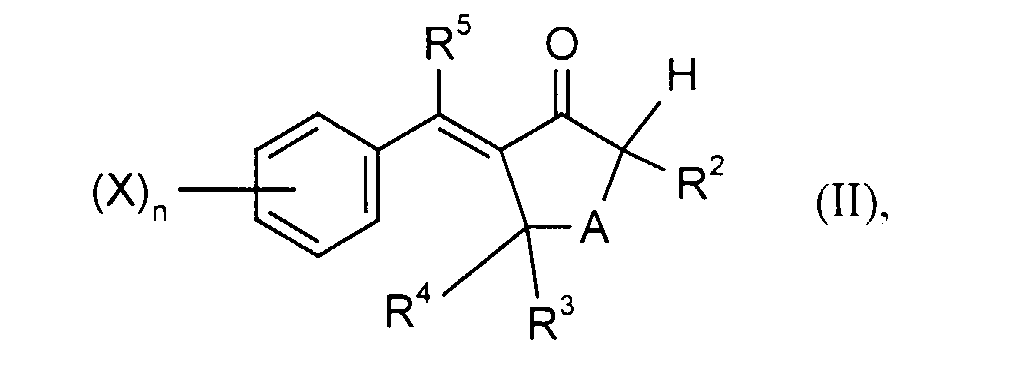
- R 1 and R 2 are C 1 -C 4 alkyl, this can optionally be halogen, C 1 -C 4 alkoxy, halogen C 1 -C 4 alkoxy, C 2 -C 4 alkenyl, C 2 -C 4 -alkynyl, halo-C 2 -C 4 -alkenyl or halo-C 2 -C 4 -alkynyl may be substituted. If R 1 and R 2 are C 3 -C 7 cycloalkyl, this can be substituted by halogen, C 1 -C 4 alkoxy or C 1 -C 4 alkyl. R 1 and R 2 are preferably independently of one another unsubstituted C 1 -C 4 -alkyl or unsubstituted C 2 -C 4 -alkenyl.
- Halogen can have all meanings, except for alkyl halides, for example fluorine, Chlorine or bromine mean. It is preferably fluorine or chlorine.
- Particularly preferred starting compounds of the formula (II) are: 2-methyl- and 2-ethyl-5- (4-fluoro-, 4-chloro-, 4-cyano- and 3,4-dichlorobenzylidene) -cyclopentanone, -cyclohexanone and -cycloheptanone.
- 2-alkyl-arylidene-cycloalkanones of the formula (II) are known compounds or analogous to known connections.
- a preferred process for the preparation of 2-alkyl-arylidene-cycloalkanones Formula (II) is exemplified in the preparation of 2-alkyl-arylidene-cyclopentanones explained as follows: First a 2-alkylcyclopentanone is produced, by reacting adipic acid esters with an alcoholate, so that the Salt of a cyclopentanone-2-carboxylic acid ester receives this without prior isolation alkylated, so a 2-alkyl-cyclopentanone-2-carboxylic acid ester and this without previous isolation by treatment with an acid and heating decarboxylated. The 2-alkyl-2-cyclopentanone thus obtained is then with a aromatic carbonyl compound in the presence of a basic catalyst. This procedure is the subject of other patent applications.
- Alkyl halides of the formula (III) in which R 1 has the preferred meaning given above and Y is chlorine or bromine are preferred.
- Particularly preferred alkyl halides of the formula (III) are: methyl chloride, methyl bromide, ethyl chloride, ethyl bromide, n-propyl chloride, iso-propyl chloride, n-propyl bromide, iso-propyl bromide, 1-chlorobutane, 2-chlorobutane, isobutyl chloride, 1-bromobutane, 2- Bromobutane. Isobutyl bromide, allyl chloride, allyl bromide, crotyl chloride, crotyl bromide, propargyl chloride and propargyl bromide.
- alkyl halides of the formula (III) where Y chlorine
- Use alkali iodides preferably potassium and / or sodium iodide.
- Related to Compound of formula (II) used can e.g. 0.1 to 50 mol%, preferably Use 1 to 25 mol% and particularly preferably 2.5 to 10 mol% alkali iodides.
- Alkyl halides are generally used in at least a stoichiometric amount used, for example per mole of compound of formula (II) 1 to 30 moles of alkyl halide. This amount is preferably 1.2 to 10 mol, in particular 1.3 to 2.5 moles.
- metal hydroxides e.g. Alkali and alkaline earth hydroxides such as lithium, Sodium, potassium, cesium, magnesium, calcium, strontium and barium hydroxide be used. Sodium, potassium, magnesium and Calcium hydroxide; potassium hydroxide is particularly preferred.
- Metal hydroxides are generally in at least equimolar amounts, preferably used in excess.
- Per mole of compound used Formula (II) can e.g. Use 1.09 to 10 equivalents of metal hydroxide. This amount is preferably 1.1 to 5 equivalents, in particular 1.2 to 2.5 Equivalents.
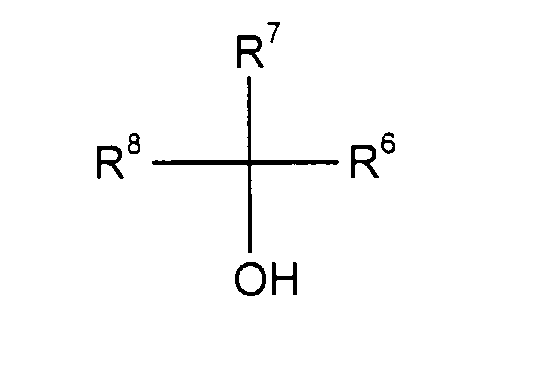
- tertiary alcohols which can be used are those of the formula (IV) in which R 6 , R 7 and R 8 are the same or different and are each for C 1 -C 4 alkyl, C 2 -C 4 alkenyl, C 2 -C 4 alkynyl, C 3 -C 7 cycloalkyl, C 6 -C 10 aryl or C 7 -C 12 aralkyl, where all these radicals can optionally be substituted by C 1 -C 4 alkoxy and / or halogen.
- the radicals R 6 and R 7 , R 7 and R 8 or R 6 , R 7 and R 8 can also each form a cycle containing 5 to 7 C atoms together with the intermediate C atom.
- Preferred tertiary alcohols are: tert-butanol, tert-amyl alcohol, methyldiethylcarbinol, Triethylcarbinol, 2-methyl-pentanol-2, 2-methylhexanol-2, 1-methyl-cyclopentanol-1 and 1-methylcyclohexanol-1.
- tert-butanol and tert-amyl alcohol are particularly preferred.
- the tertiary alcohols can be used as such or in a mixture with inert solvents.
- inert solvents are: aliphatic hydrocarbons such as cyclohexane, C 6 -C 12 alkanes and mixtures thereof; aromatic hydrocarbons such as benzene, toluene, xylenes, cumene, diisopropylbenzenes and ethylbenzene; halogenated aromatics such as chlorobenzene, dichlorobenzenes, trichlorobenzenes and chlorotoluenes; Dialkyl, aralkyl and diaryl ethers such as diisopropyl ether, methyl tert-butyl ether, anisole, phenetol and diphenyl ether; cyclic ethers such as tetrahydrofuran, tetrahydropyran and 1,4-dioxane and sulfones such as di
- tertiary alcohol e.g. 0.01 to 50% by weight and preferably Add 0.1 to 20% by weight of inert solvent.
- Particularly preferred tertiary alcohols are used without the addition of inert solvents.
- the tertiary alcohols can e.g. in amounts of 100 to 5,000 g per 100 g used compound of formula (II) can be used. Preferably chooses the amount of tertiary alcohol so that a readily stirrable reaction mixture arises.
- the method according to the invention can e.g. at temperatures in the range of -20 to + 200 ° C. Temperatures from 0 to 100 ° C. are preferred, especially from 20 to 50 ° C.
- the method according to the invention can e.g. carried out at pressures from 1 to 100 bar become. If the process of the invention at temperatures want to perform, in which individual components of the reaction mixture Normal pressure are gaseous, so it is necessary in closed vessels to work at least under the self-adjusting pressure. It is common advantageous to inject inert gases such as nitrogen, helium or argon and at 5 to work up to 50 bar, especially at 10 to 30 bar.
- inert gases such as nitrogen, helium or argon
- the reaction time depends in individual cases on the composition of the reaction mixture and the reaction conditions. It can e.g. between 1 and 48 hours. It is often in the range of 3 to 30 hours and at Working at 10 to 50 ° C often in the range of 5 to 24 hours.
- the reaction mixture present after the reaction according to the invention has ended can be worked up, for example, in such a way that first, possibly with reduced Pressure, tertiary alcohol and any inert present
- the solvent is separated off, the residue is mixed with water and the resulting Aspirates, rinses and dries crystalline product. If you go further want to clean, you can recrystallize it.
- 2-methyl-5- (4-chlorobenzylidene) cyclopentanone, tert-butanol and potassium iodide are placed in a pressure autoclave, potassium hydroxide is added and Methyl chloride pressed in with stirring. The mixture is stirred at room temperature for a certain time or slightly elevated temperature. Then you distill it major part of the tert-butanol and offsets the remaining suspension with water. The crystalline product is filtered off, washed and dried. For further cleaning it is e.g. recrystallized from an alcohol.
- alkali metal hydroxides can be used as bases for the alkylation of not particularly methylene-active ketones according to the invention, otherwise alkali metal alcoholates, which are many times more basic, are not sufficient for this purpose (see J. March, Advanced Organic Chemistry, 4th Edition, New York 1992 and the literature cited there).
- alkali tert-alkoxides such as potassium tert-butoxide in tert-butanol cannot be compared with the use of potassium hydroxide in tert-butanol because of the equilibrium is almost entirely on the left.
- alkylation with alkali metal hydroxides as the base is very poor mild conditions and with high yields.
- the invention Process is an extremely simple method to manufacture 2,2-dialkyl-arylidene-cycloalkanones of the formula (I) in high yields and below mild conditions.
- alkyl chlorides in the presence of alkali metal iodides leads to cost savings and avoids dealing with Alkyl iodides, which requires special effort because of their carcinogenicity.
- 2,2-dialkyl-arylidene-cycloalkanones of the formula (I) are valuable intermediates for the production of pesticides, especially fungicides (see EP-A1 378 953, EP-A1 467 791 and EP-A1 467 792). You let yourself through too Transfer reduction to 2,2-dialkyl-benzyl-cycloalkanones, which in turn again can serve as starting materials for fungicides (see EP-A1 267 778 and EP-A1 413 448).
- the crude product was slurried in 250 ml of methanol, for Heated to reflux temperature for 30 min and then cooled. The secluded The product was filtered, washed with methanol and dried. You got so 86 g of pure product with a melting point of 120 to 122 ° C.
Landscapes
- Chemical & Material Sciences (AREA)
- Organic Chemistry (AREA)
- Chemical Kinetics & Catalysis (AREA)
- Organic Low-Molecular-Weight Compounds And Preparation Thereof (AREA)
- Low-Molecular Organic Synthesis Reactions Using Catalysts (AREA)
Description

- A
- für gegebenenfalls substituiertes -(CH2)-x mit x = 1, 2 oder 3 steht,
- R1 und R2
- für gleiche oder verschiedene, gegebenenfalls substituierte C1-C4-Alkyl- oder C3-C7-Cycloalkylreste stehen,
- R3, R4 und R5
- gleich oder verschieden sind und für Wasserstoff oder gegebenenfalls substituiertes C1-C4-Alkyl oder C3-C7-Cycloalkyl stehen,
- X
- für Halogen, Cyano, Nitro. C1-C4-Alkyl, C1-C4-Halogenalkyl, C1-C4-Alkoxy oder C1-C4-Halogenalkoxy stehen, wobei beim Vorhandensein mehrerer X-Reste diese gleich oder verschieden sein können, und
- n
- für null oder eine ganze Zahl von 1 bis 5 steht,
- R1
- die oben angegebene Bedeutung hat und
- Y
- für Chlor, Brom oder Iod steht, umsetzt.
- A
- kann gegebenenfalls einen oder mehrere, gleiche oder verschiedene Substituenten aus der Gruppe C1-C4-Alkyl und C3-C7-Cycloalkyl enthalten, wobei C1-C4-Alkyl seinerseits gegebenenfalls durch Halogen oder C1-C4-Alkoxy und C3-C7-Cycloalkyl seinerseits gegebenenfalls durch Halogen, C1-C4-Alkyl oder C1-C4-Alkoxy substituiert sein kann. Vorzugsweise steht A für -CH2-, -CH2-CH2- oder -CH2-CH2-CH2-, d.h. vorzugsweise werden 2-Alkyl-aryliden-cyclopentanone, -cyclohexanone oder -cycloheptanone der Formel (II) zu 2,2-Dialkyl-5-aryliden-cyclopentanonen, 2,2-Dialkyl-6-arylidencyclohexanonen oder 2,2-Dialkyl-7-aryliden-cycloheptanonen der Formel (I) umgesetzt.
- X
- steht vorzugsweise für Fluor, Chlor, Cyano oder C1-C4-Alkyl.
- n
- steht vorzugsweise für null, 1 oder 2. Im Falle n = 1 befindet sich X vorzugsweise in 4-Stellung. Im Falle n = 2 befindet sich X vorzugsweise in 2- und 4-Stellung.


Claims (9)
- Verfahren zur Herstellung von 2,2-Dialkyl-aryliden-cycloalkanonen der Formelin der

- A
- für gegebenenfalls substituiertes -(CH2)-x mit x = 1, 2 oder 3 steht,
- R1 und R2
- für gleiche oder verschiedene, gegebenenfalls substituierte C1-C4-Alkyl- oder C3-C7-Cycloalkylreste stehen,
- R3, R4 und R5
- gleich oder verschieden sind und für Wasserstoff oder gegebenenfalls substituiertes C1-C4-Alkyl oder C3-C7-Cycloalkyl stehen.
- X
- für Halogen, Cyano, Nitro, C1-C4-Alkyl, C1-C4-Halogenalkyl, C1-C4-Alkoxy oder C1-C4-Halogenalkoxy stehen, wobei beim Vorhandensein mehrerer X-Reste diese gleich oder verschieden sein können und
- n
- für null oder eine ganze Zahl von 1 bis 5 steht,
in der die verwendeten Symbole die bei Formel (I) angegebene Bedeutung haben, in Gegenwart von Metallhydroxiden und tertiären Alkoholen mit Alkylhalogeniden der Formel (III)
- R1
- die oben angegebene Bedeutung hat und
- Y
- für Chlor, Brom oder lod steht, umsetzt.
- Verfahren nach Anspruch 1, dadurch gekennzeichnet, daß
- A
- gegebenenfalls einen oder mehrere, gleiche oder verschiedene Substituenten aus der Gruppe C1-C4-Alkyl und C3-C7-Cycloalkyl enthält, wobei C1-C4-Alkyl seinerseits gegebenenfalls durch Halogen oder C1-C4-Alkoxy und C3-C7-Cycloalkyl seinerseits gegebenenfalls durch Halogen, C1-C4-Alkyl oder C1-C4-Alkoxy substituiert sein kann.
- R1 und R2,
- soweit sie für C1-C4-Alkyl stehen, gegebenenfalls durch Halogen, C1-C4-Alkoxy, Halogen-C1-C4-alkoxy, C2-C4-Alkenyl, C2-C4-Alkenyl, Halogen-C2-C4-alkenyl oder Halogen-C2-C4-alkinyl substituiert sind und soweit R1 und R2 für C3-C7-Cycloalkyl stehen, dieses gegebenenfalls durch Halogen, C1-C4-Alkoxy oder C1-C4-Alkyl substituiert ist,
- R3, R4 und R5,
- soweit diese für C1-C4-Alkyl stehen, gegebenenfalls durch Halogen oder C1-C4-Alkoxy und soweit sie für C3-C7-Cycloalkyl stehen, gegebenenfalls durch Halogen, C1-C4-Alkyl oder C1-C4-Alkoxy substituiert sind,
- X
- für Fluor, Chlor, Cyano oder C1-C4-Alkyl und
- n
- für null, 1 oder 2 stehen.
- Verfahren nach Ansprüchen 1 und 2, dadurch gekennzeichnet, daß man als Verbindung der Formel (II) 2-Methyl- oder 2-Ethyl-5-(4-fluor-, 4-chlor-, 4-cyano- und 3,4-dichlor-benzyliden)-cyclopentanon, -cyclohexanon oder -cycloheptanon einsetzt.
- Verfahren nach Anspruch 3, dadurch gekennzeichnet, daß man zusätzlich zu einem Alkylhalogenid der Formel (III) mit Y = Chlor 0,1 bis 50 Mol.-% eines Akaliiodids einsetzt (bezogen auf die Verbindung der Formel (II)).
- Verfahren nach Ansprüchen 1 bis 4, dadurch geknnzeichnet, daß man Alkylhalogenide in Mengen von 1 bis 30 Molen bezogen auf l Mol eingesetzte Verbindung der Formel (II) einsetzt.
- Verfahren nach Ansprüchen 1 bis 5, dadurch gekennzeichnet, daß es sich bei den Metallhydroxiden um Alkali- oder Erdalkalihydroxide handelt, die in mindestens äquimolaren Mengen eingesetzt werden.
- Verfahren nach Ansprüchen 1 bis 6, dadurch gekennzeichnet, daß man als tertiäre Alkohole solche der Formel (IV) einsetztin der
R6, R7 und R8 gleich oder verschieden sind und jeweils für C1-C4-Alkyl, C2-C4-Alkenyl, C2-C4-Alkinyl, C3-C7-Cycloalkyl, C6-C10-Aryl oder C7-C12-Aralkyl stehen, wobei alle diese Reste gegebenenfalls durch C1-C4-Alkoxy und/oder Halogen substituiert sein können und die Reste R6 und R7oder R7 und R8 oder R6, R7 und R8 jeweils gemeinsam mit dem dazwischenliegenden C-Atom einen 5 bis 7 C-Atome enthaltenden Cyclus bilden können und man die tertiären Alkohole als solche oder im Gemisch mit inerten Lösungsmitteln und in Mengen von 100 bis 5 000 g pro 100 g Verbindung der Formel (II) einsetzt. - Verfahren nach Ansprüchen 1 bis 7, dadurch gekennzeichnet, daß man es bei Temperaturen im Bereich von -20 bis +200°C und bei Drucken im Bereich von 1 bis 100 bar durchführt.
- Verfahren nach Ansprüchen 1 bis 8, dadurch gekennzeichnet, daß man das nach Beendigung der Umsetzung vorliegende Reaktionsgemisch so aufarbeitet, daß man zunächst tertiären Alkohol und gegebenenfalls vorhandenes inertes Lösungsmittel abtrennt, den Rückstand mit Wasser versetzt und das sich bildende kristalline Produkt absaugt, nachwäscht und trocknet.
Applications Claiming Priority (2)
| Application Number | Priority Date | Filing Date | Title |
|---|---|---|---|
| DE19523449 | 1995-06-28 | ||
| DE19523449A DE19523449A1 (de) | 1995-06-28 | 1995-06-28 | Verfahren zur Herstellung von 2,2-Dialkyl-aryliden-cycloalkanonen |
Publications (3)
| Publication Number | Publication Date |
|---|---|
| EP0751111A2 EP0751111A2 (de) | 1997-01-02 |
| EP0751111A3 EP0751111A3 (de) | 1997-09-10 |
| EP0751111B1 true EP0751111B1 (de) | 2000-09-13 |
Family
ID=7765435
Family Applications (1)
| Application Number | Title | Priority Date | Filing Date |
|---|---|---|---|
| EP96109473A Expired - Lifetime EP0751111B1 (de) | 1995-06-28 | 1996-06-13 | Verfahren zur Herstellung von 2,2-Dialkylaryliden-cycloalkanonen |
Country Status (5)
| Country | Link |
|---|---|
| US (1) | US5663447A (de) |
| EP (1) | EP0751111B1 (de) |
| JP (1) | JPH0920716A (de) |
| DE (2) | DE19523449A1 (de) |
| IL (1) | IL118731A (de) |
Families Citing this family (4)
| Publication number | Priority date | Publication date | Assignee | Title |
|---|---|---|---|---|
| US6010444A (en) * | 1997-09-05 | 2000-01-04 | Isolyser Company, Inc. | Infectious waste containment system |
| JP2014500850A (ja) | 2010-10-01 | 2014-01-16 | ビーエーエスエフ ソシエタス・ヨーロピア | 5−[1−(4−クロロフェニル)−メチレン]−1−ヒドロキシメチル−2,2−ジメチル−シクロペンタノールを調製するための方法 |
| US20150018560A1 (en) | 2012-02-10 | 2015-01-15 | BASf ARGO B.V. ARNHEM (NL). ZURICH-BRANCH | Process for preparing cis-5-[1-(4-chlorophenyl)-methylene]-1-hydroxymethyl-2,2-dimethylcyclopentanol |
| CN119263969A (zh) * | 2023-06-30 | 2025-01-07 | 顺毅南通化工有限公司 | 一种dmbcp粗品结晶方法及其应用 |
Family Cites Families (8)
| Publication number | Priority date | Publication date | Assignee | Title |
|---|---|---|---|---|
| US3983175A (en) * | 1972-11-17 | 1976-09-28 | Kuraray Co., Ltd. | Process for the production of a substituted ketone |
| US4305034A (en) * | 1979-04-09 | 1981-12-08 | Hughes Aircraft Company | Magnetic field intensity measuring device with frequency change indication |
| DE3210725A1 (de) * | 1982-03-24 | 1983-10-06 | Bayer Ag | Verfahren zur herstellung von methylketonen |
| MA21706A1 (fr) * | 1988-12-29 | 1990-07-01 | Rhone Poulenc Agrochimie | Benzolidene azolylmethylcycloalcane et utilisation comme fongicide. |
| FR2662911B1 (fr) * | 1990-06-12 | 1996-12-13 | Rhone Poulenc Agrochimie | Procede pour proteger les produits de multiplication des vegetaux et les vegetaux en resultant au moyen d'un triazolyl cyclopentanol. |
| FR2663196A1 (fr) * | 1990-06-13 | 1991-12-20 | Rhone Poulenc Agrochimie | Composition fongicide a base d'un triazole et d'une autre matiere active pour le traitement des semences. |
| FR2705666B1 (fr) * | 1993-05-28 | 1995-07-21 | Rhone Poulenc Chimie | Procédé de préparation d'une cétone cyclique. |
| JPH0782219A (ja) * | 1993-09-14 | 1995-03-28 | Kureha Chem Ind Co Ltd | 3−(無置換または置換ベンジリデン)−1−アルキル−2−オキソシクロペンタンカルボン酸アルキルエステル誘導体、その製造方法、殺菌剤及び中間体としての利用 |
-
1995
- 1995-06-28 DE DE19523449A patent/DE19523449A1/de not_active Withdrawn
-
1996
- 1996-06-13 DE DE59605866T patent/DE59605866D1/de not_active Expired - Lifetime
- 1996-06-13 EP EP96109473A patent/EP0751111B1/de not_active Expired - Lifetime
- 1996-06-20 US US08/667,894 patent/US5663447A/en not_active Expired - Fee Related
- 1996-06-21 JP JP8179834A patent/JPH0920716A/ja active Pending
- 1996-06-25 IL IL11873196A patent/IL118731A/xx not_active IP Right Cessation
Also Published As
| Publication number | Publication date |
|---|---|
| IL118731A (en) | 2000-07-16 |
| IL118731A0 (en) | 1996-10-16 |
| EP0751111A2 (de) | 1997-01-02 |
| JPH0920716A (ja) | 1997-01-21 |
| DE59605866D1 (de) | 2000-10-19 |
| US5663447A (en) | 1997-09-02 |
| EP0751111A3 (de) | 1997-09-10 |
| DE19523449A1 (de) | 1997-01-02 |
Similar Documents
| Publication | Publication Date | Title |
|---|---|---|
| DE2533920C2 (de) | Verfahren zur Herstellung von Resorcinen | |
| EP0623575A1 (de) | Verfahren zur Herstellung von Ketonen | |
| EP0514683B1 (de) | Verfahren zur Herstellung von Alkyl-, Alkenyl- und Alkinylchloriden | |
| DE69808288T2 (de) | Verfahren zur herstellung von 1,3-dicarbonylverbindungen | |
| DE3006685A1 (de) | Substituiertes bromfluorbenzol und verfahren zu seiner herstellung | |
| DE69513673T2 (de) | Verfahren zur herstellung von cyclopropancarbonsäure und ihre derivaten | |
| EP0751111A2 (de) | Verfahren zur Herstellung von 2,2-Dialkylaryliden-cycloalkanonen | |
| DE69028199T2 (de) | Herstellung von ungesättigten ketonen von ketonen und paraformaldehyd | |
| DE2503699C2 (de) | Verfahren zur Herstellung von 1,2- Benzisothiazolen | |
| DE2263527C3 (de) | 2,2-Disubstituierte Phenylacetonitril-Derivate, Verfahren zu ihrer Herstellung und deren Verwendung | |
| DE19836698A1 (de) | Verfahren zur Herstellung von fluorierten Benzylalkoholen und -aldehyden | |
| DE2443142C2 (de) | Verfahren zur Herstellung von Cyclopropancarbonsäurenitril | |
| EP0409147A2 (de) | Verfahren zur Herstellung von Tetronsäurealkylestern | |
| DE2642608C2 (de) | Verfahren zur Herstellung eines 4-Hydroxymethyl-2-pyrrolidinons | |
| EP0590259B1 (de) | Verfahren zur Herstellung von Halogenaromaten | |
| EP0394644B1 (de) | Halogenbenzolderivate | |
| DE3802372C2 (de) | ||
| DE69503212T2 (de) | Verfahren zur Herstellung von (1,1-Dichloromethyl)methylether und (1,1-Dichloromethyl)ethylether | |
| EP0751112A2 (de) | Verfahren zur Herstellung von Arylidensubstituierten Alkylcycloalkanonen | |
| DE2804263A1 (de) | Verfahren zur herstellung von indolin-derivaten | |
| EP0025931B1 (de) | Verfahren zur Herstellung von 5-(2,2,-Dihalogenvinyl)-4,4-dialkyl-tetrahydrofuran-2-onen | |
| EP0672651A1 (de) | Verfahren zur Herstellung von 4-Fluoralkoxyzimtsäurenitrilen | |
| EP0497796A1 (de) | Verfahren zur herstellung von fluorbenzolen. | |
| DE2334608C2 (de) | Verfahren zur Herstellung von 0-Alkyl-0-phenylestern von Thionophosphonsäuren | |
| EP0015385B1 (de) | Verfahren zur Herstellung von n-Propylcyanessigsäureestern und n-Äthylcyanessigsäureestern |
Legal Events
| Date | Code | Title | Description |
|---|---|---|---|
| PUAI | Public reference made under article 153(3) epc to a published international application that has entered the european phase |
Free format text: ORIGINAL CODE: 0009012 |
|
| AK | Designated contracting states |
Kind code of ref document: A2 Designated state(s): CH DE FR GB IT LI NL |
|
| PUAL | Search report despatched |
Free format text: ORIGINAL CODE: 0009013 |
|
| RHK1 | Main classification (correction) |
Ipc: C07C 45/68 |
|
| AK | Designated contracting states |
Kind code of ref document: A3 Designated state(s): CH DE FR GB IT LI NL |
|
| 17P | Request for examination filed |
Effective date: 19980310 |
|
| 17Q | First examination report despatched |
Effective date: 19990430 |
|
| GRAG | Despatch of communication of intention to grant |
Free format text: ORIGINAL CODE: EPIDOS AGRA |
|
| GRAG | Despatch of communication of intention to grant |
Free format text: ORIGINAL CODE: EPIDOS AGRA |
|
| GRAH | Despatch of communication of intention to grant a patent |
Free format text: ORIGINAL CODE: EPIDOS IGRA |
|
| GRAH | Despatch of communication of intention to grant a patent |
Free format text: ORIGINAL CODE: EPIDOS IGRA |
|
| GRAA | (expected) grant |
Free format text: ORIGINAL CODE: 0009210 |
|
| AK | Designated contracting states |
Kind code of ref document: B1 Designated state(s): CH DE FR GB IT LI NL |
|
| REG | Reference to a national code |
Ref country code: CH Ref legal event code: NV Representative=s name: E. BLUM & CO. PATENTANWAELTE Ref country code: CH Ref legal event code: EP |
|
| GBT | Gb: translation of ep patent filed (gb section 77(6)(a)/1977) |
Effective date: 20000914 |
|
| REF | Corresponds to: |
Ref document number: 59605866 Country of ref document: DE Date of ref document: 20001019 |
|
| ITF | It: translation for a ep patent filed | ||
| ET | Fr: translation filed | ||
| PLBE | No opposition filed within time limit |
Free format text: ORIGINAL CODE: 0009261 |
|
| STAA | Information on the status of an ep patent application or granted ep patent |
Free format text: STATUS: NO OPPOSITION FILED WITHIN TIME LIMIT |
|
| 26N | No opposition filed | ||
| REG | Reference to a national code |
Ref country code: GB Ref legal event code: IF02 |
|
| PGFP | Annual fee paid to national office [announced via postgrant information from national office to epo] |
Ref country code: CH Payment date: 20020528 Year of fee payment: 7 |
|
| PGFP | Annual fee paid to national office [announced via postgrant information from national office to epo] |
Ref country code: GB Payment date: 20020612 Year of fee payment: 7 |
|
| PGFP | Annual fee paid to national office [announced via postgrant information from national office to epo] |
Ref country code: NL Payment date: 20020628 Year of fee payment: 7 |
|
| PG25 | Lapsed in a contracting state [announced via postgrant information from national office to epo] |
Ref country code: GB Free format text: LAPSE BECAUSE OF NON-PAYMENT OF DUE FEES Effective date: 20030613 |
|
| PG25 | Lapsed in a contracting state [announced via postgrant information from national office to epo] |
Ref country code: LI Free format text: LAPSE BECAUSE OF NON-PAYMENT OF DUE FEES Effective date: 20030630 Ref country code: CH Free format text: LAPSE BECAUSE OF NON-PAYMENT OF DUE FEES Effective date: 20030630 |
|
| PG25 | Lapsed in a contracting state [announced via postgrant information from national office to epo] |
Ref country code: NL Free format text: LAPSE BECAUSE OF NON-PAYMENT OF DUE FEES Effective date: 20040101 |
|
| GBPC | Gb: european patent ceased through non-payment of renewal fee |
Effective date: 20030613 |
|
| REG | Reference to a national code |
Ref country code: CH Ref legal event code: PL |
|
| NLV4 | Nl: lapsed or anulled due to non-payment of the annual fee |
Effective date: 20040101 |
|
| PG25 | Lapsed in a contracting state [announced via postgrant information from national office to epo] |
Ref country code: IT Free format text: LAPSE BECAUSE OF NON-PAYMENT OF DUE FEES;WARNING: LAPSES OF ITALIAN PATENTS WITH EFFECTIVE DATE BEFORE 2007 MAY HAVE OCCURRED AT ANY TIME BEFORE 2007. THE CORRECT EFFECTIVE DATE MAY BE DIFFERENT FROM THE ONE RECORDED. Effective date: 20050613 |
|
| REG | Reference to a national code |
Ref country code: FR Ref legal event code: TP |
|
| PGFP | Annual fee paid to national office [announced via postgrant information from national office to epo] |
Ref country code: FR Payment date: 20080617 Year of fee payment: 13 |
|
| REG | Reference to a national code |
Ref country code: FR Ref legal event code: ST Effective date: 20100226 |
|
| PG25 | Lapsed in a contracting state [announced via postgrant information from national office to epo] |
Ref country code: FR Free format text: LAPSE BECAUSE OF NON-PAYMENT OF DUE FEES Effective date: 20090630 |
|
| PGFP | Annual fee paid to national office [announced via postgrant information from national office to epo] |
Ref country code: DE Payment date: 20120607 Year of fee payment: 17 |
|
| REG | Reference to a national code |
Ref country code: DE Ref legal event code: R119 Ref document number: 59605866 Country of ref document: DE Effective date: 20140101 |
|
| PG25 | Lapsed in a contracting state [announced via postgrant information from national office to epo] |
Ref country code: DE Free format text: LAPSE BECAUSE OF NON-PAYMENT OF DUE FEES Effective date: 20140101 |