EP0745642B1 - Thermostabile, witterungsbeständige Polyamidformmassen - Google Patents
Thermostabile, witterungsbeständige Polyamidformmassen Download PDFInfo
- Publication number
- EP0745642B1 EP0745642B1 EP96107971A EP96107971A EP0745642B1 EP 0745642 B1 EP0745642 B1 EP 0745642B1 EP 96107971 A EP96107971 A EP 96107971A EP 96107971 A EP96107971 A EP 96107971A EP 0745642 B1 EP0745642 B1 EP 0745642B1
- Authority
- EP
- European Patent Office
- Prior art keywords
- molar amount
- copper
- equal
- contained
- polyamide
- Prior art date
- Legal status (The legal status is an assumption and is not a legal conclusion. Google has not performed a legal analysis and makes no representation as to the accuracy of the status listed.)
- Expired - Lifetime
Links
- 238000000465 moulding Methods 0.000 title claims description 51
- 239000000203 mixture Substances 0.000 title claims description 41
- 239000004952 Polyamide Substances 0.000 title claims description 25
- 229920002647 polyamide Polymers 0.000 title claims description 25
- 229910052802 copper Inorganic materials 0.000 claims description 30
- 239000010949 copper Substances 0.000 claims description 30
- 239000003381 stabilizer Substances 0.000 claims description 25
- RYGMFSIKBFXOCR-UHFFFAOYSA-N Copper Chemical compound [Cu] RYGMFSIKBFXOCR-UHFFFAOYSA-N 0.000 claims description 23
- -1 copper halide Chemical class 0.000 claims description 15
- NLKNQRATVPKPDG-UHFFFAOYSA-M potassium iodide Chemical compound [K+].[I-] NLKNQRATVPKPDG-UHFFFAOYSA-M 0.000 claims description 12
- 239000011574 phosphorus Substances 0.000 claims description 10
- 229910052698 phosphorus Inorganic materials 0.000 claims description 10
- 239000002253 acid Substances 0.000 claims description 8
- OAICVXFJPJFONN-UHFFFAOYSA-N Phosphorus Chemical compound [P] OAICVXFJPJFONN-UHFFFAOYSA-N 0.000 claims description 7
- 239000000654 additive Substances 0.000 claims description 7
- 239000003513 alkali Substances 0.000 claims description 7
- 150000002366 halogen compounds Chemical class 0.000 claims description 7
- 229910052784 alkaline earth metal Inorganic materials 0.000 claims description 6
- 229910052736 halogen Inorganic materials 0.000 claims description 6
- 150000002367 halogens Chemical class 0.000 claims description 6
- ACVYVLVWPXVTIT-UHFFFAOYSA-N phosphinic acid Chemical compound O[PH2]=O ACVYVLVWPXVTIT-UHFFFAOYSA-N 0.000 claims description 6
- FVAUCKIRQBBSSJ-UHFFFAOYSA-M sodium iodide Inorganic materials [Na+].[I-] FVAUCKIRQBBSSJ-UHFFFAOYSA-M 0.000 claims description 6
- DGAQECJNVWCQMB-PUAWFVPOSA-M Ilexoside XXIX Chemical compound C[C@@H]1CC[C@@]2(CC[C@@]3(C(=CC[C@H]4[C@]3(CC[C@@H]5[C@@]4(CC[C@@H](C5(C)C)OS(=O)(=O)[O-])C)C)[C@@H]2[C@]1(C)O)C)C(=O)O[C@H]6[C@@H]([C@H]([C@@H]([C@H](O6)CO)O)O)O.[Na+] DGAQECJNVWCQMB-PUAWFVPOSA-M 0.000 claims description 3
- 239000000945 filler Substances 0.000 claims description 3
- 235000009518 sodium iodide Nutrition 0.000 claims description 3
- 229920006345 thermoplastic polyamide Polymers 0.000 claims description 3
- 239000006057 Non-nutritive feed additive Substances 0.000 claims description 2
- 239000003063 flame retardant Substances 0.000 claims description 2
- 239000000975 dye Substances 0.000 claims 1
- 239000003607 modifier Substances 0.000 claims 1
- 239000000049 pigment Substances 0.000 claims 1
- 239000012744 reinforcing agent Substances 0.000 claims 1
- 150000001875 compounds Chemical class 0.000 description 20
- 230000032683 aging Effects 0.000 description 5
- 230000006641 stabilisation Effects 0.000 description 5
- 238000011105 stabilization Methods 0.000 description 5
- 229910021595 Copper(I) iodide Inorganic materials 0.000 description 4
- NBIIXXVUZAFLBC-UHFFFAOYSA-N Phosphoric acid Chemical compound OP(O)(O)=O NBIIXXVUZAFLBC-UHFFFAOYSA-N 0.000 description 4
- LSXDOTMGLUJQCM-UHFFFAOYSA-M copper(i) iodide Chemical compound I[Cu] LSXDOTMGLUJQCM-UHFFFAOYSA-M 0.000 description 4
- 229920000642 polymer Polymers 0.000 description 4
- 230000015556 catabolic process Effects 0.000 description 3
- 150000001879 copper Chemical class 0.000 description 3
- 238000006731 degradation reaction Methods 0.000 description 3
- 150000004820 halides Chemical class 0.000 description 3
- 239000005749 Copper compound Substances 0.000 description 2
- 239000004609 Impact Modifier Substances 0.000 description 2
- 229920002292 Nylon 6 Polymers 0.000 description 2
- 150000007513 acids Chemical class 0.000 description 2
- 229910000147 aluminium phosphate Inorganic materials 0.000 description 2
- 230000000052 comparative effect Effects 0.000 description 2
- 150000001880 copper compounds Chemical class 0.000 description 2
- 239000000835 fiber Substances 0.000 description 2
- 238000001746 injection moulding Methods 0.000 description 2
- 239000012779 reinforcing material Substances 0.000 description 2
- 150000003839 salts Chemical class 0.000 description 2
- 239000011265 semifinished product Substances 0.000 description 2
- 239000007787 solid Substances 0.000 description 2
- 230000000087 stabilizing effect Effects 0.000 description 2
- 239000000126 substance Substances 0.000 description 2
- KWSLGOVYXMQPPX-UHFFFAOYSA-N 5-[3-(trifluoromethyl)phenyl]-2h-tetrazole Chemical compound FC(F)(F)C1=CC=CC(C2=NNN=N2)=C1 KWSLGOVYXMQPPX-UHFFFAOYSA-N 0.000 description 1
- JXSRRBVHLUJJFC-UHFFFAOYSA-N 7-amino-2-methylsulfanyl-[1,2,4]triazolo[1,5-a]pyrimidine-6-carbonitrile Chemical compound N1=CC(C#N)=C(N)N2N=C(SC)N=C21 JXSRRBVHLUJJFC-UHFFFAOYSA-N 0.000 description 1
- ZCYVEMRRCGMTRW-UHFFFAOYSA-N 7553-56-2 Chemical compound [I] ZCYVEMRRCGMTRW-UHFFFAOYSA-N 0.000 description 1
- 239000004953 Aliphatic polyamide Substances 0.000 description 1
- 229920002302 Nylon 6,6 Polymers 0.000 description 1
- 229920002472 Starch Polymers 0.000 description 1
- 125000001931 aliphatic group Chemical group 0.000 description 1
- 229920003231 aliphatic polyamide Polymers 0.000 description 1
- 150000001447 alkali salts Chemical class 0.000 description 1
- 239000003963 antioxidant agent Substances 0.000 description 1
- 150000004982 aromatic amines Chemical class 0.000 description 1
- 238000000071 blow moulding Methods 0.000 description 1
- 238000004040 coloring Methods 0.000 description 1
- 230000006735 deficit Effects 0.000 description 1
- 150000004985 diamines Chemical class 0.000 description 1
- 150000001991 dicarboxylic acids Chemical class 0.000 description 1
- 229920001971 elastomer Polymers 0.000 description 1
- 239000004744 fabric Substances 0.000 description 1
- 239000011888 foil Substances 0.000 description 1
- 239000011521 glass Substances 0.000 description 1
- 239000003365 glass fiber Substances 0.000 description 1
- 239000008187 granular material Substances 0.000 description 1
- BHEPBYXIRTUNPN-UHFFFAOYSA-N hydridophosphorus(.) (triplet) Chemical compound [PH] BHEPBYXIRTUNPN-UHFFFAOYSA-N 0.000 description 1
- 238000010348 incorporation Methods 0.000 description 1
- 229910052740 iodine Inorganic materials 0.000 description 1
- 239000011630 iodine Substances 0.000 description 1
- 239000000314 lubricant Substances 0.000 description 1
- FLFJVPPJGJSHMF-UHFFFAOYSA-L manganese hypophosphite Chemical compound [Mn+2].[O-]P=O.[O-]P=O FLFJVPPJGJSHMF-UHFFFAOYSA-L 0.000 description 1
- 238000004519 manufacturing process Methods 0.000 description 1
- 239000000463 material Substances 0.000 description 1
- 238000000034 method Methods 0.000 description 1
- 239000012764 mineral filler Substances 0.000 description 1
- 239000000178 monomer Substances 0.000 description 1
- 239000002667 nucleating agent Substances 0.000 description 1
- 239000002530 phenolic antioxidant Substances 0.000 description 1
- 239000004033 plastic Substances 0.000 description 1
- 229920003023 plastic Polymers 0.000 description 1
- 238000006116 polymerization reaction Methods 0.000 description 1
- 229920000098 polyolefin Polymers 0.000 description 1
- 239000005060 rubber Substances 0.000 description 1
- 229910001379 sodium hypophosphite Inorganic materials 0.000 description 1
- KOUDKOMXLMXFKX-UHFFFAOYSA-N sodium oxido(oxo)phosphanium hydrate Chemical compound O.[Na+].[O-][PH+]=O KOUDKOMXLMXFKX-UHFFFAOYSA-N 0.000 description 1
- 238000009987 spinning Methods 0.000 description 1
- 235000019698 starch Nutrition 0.000 description 1
- 239000007858 starting material Substances 0.000 description 1
- 238000003878 thermal aging Methods 0.000 description 1
Classifications
-
- C—CHEMISTRY; METALLURGY
- C08—ORGANIC MACROMOLECULAR COMPOUNDS; THEIR PREPARATION OR CHEMICAL WORKING-UP; COMPOSITIONS BASED THEREON
- C08K—Use of inorganic or non-macromolecular organic substances as compounding ingredients
- C08K3/00—Use of inorganic substances as compounding ingredients
- C08K3/16—Halogen-containing compounds
Definitions
- the invention relates to thermostable, weather-resistant polyamide molding compositions.
- the stabilization is due to the simultaneous presence of copper, one or reached several halogens and phosphorus in the molding compound.
- U.S. Patent 2,705,227 describes a ternary stabilizer system consisting of a copper compound, a halogen compound and a Phosphoric acid or an alkali salt of a phosphoric acid.
- British patent application 1 140 047 describes a ternary stabilizer system from a copper salt, phosphorous or hypophosphorous acid or one Combination of these acids and an alkali halide.
- the claimed ternary stabilizer system the limitation is imposed that the Phosphorus compound in at most half the molar amount of the used Copper salt is used. Becomes hypophosphorous as a phosphorus compound Acid used, so according to British patent application 1 140 047 this at most a quarter of the molar concentration of the used Copper salt can be used.
- the phosphorus compound is cited in the molar deficit in relation to the amount of copper added to a to obtain the light color of the polyamide molding compound.
- German Offenlegungsschrift 2 107 406 describes a ternary stabilizer system consisting of copper stearate, potassium iodide and manganese hypophosphite. The Molding compositions stabilized with this mixture are described as colorless.
- EP-A 0 612 749 describes stabilized polyamide molding compositions which act as stabilizers an ionic or complex copper stabilizer as well as elementary, contain finely dispersed copper.
- the known stabilizer systems delay the thermooxidative and the photooxidative Aging of polyamide molding compounds.
- New applications increase that Requirements for the stability of polyamide molding compounds against thermo-oxidative or photooxidative degradation. This applies e.g. for the application of polyamide molding compounds in the engine compartment of automobiles. In this and in others Areas, the polyamide molding compounds are subject to a high temperature load exposed for long periods. A further stabilization over that with the Known stabilizer systems achievable degree is therefore necessary.
- polyamide molding compositions with a stabilizer system a mixture of a copper halide, a halogen compound and hypophosphorous acid or an alkali or alkaline earth salt thereof Acid in a certain molar ratio to each other is a very good one Show stabilization against thermooxidative and photooxidative aging.
- the invention therefore relates to thermoplastic polyamide molding compositions, containing as a stabilizer a mixture of a copper halide, one or several halogen compounds, preferably sodium or potassium iodide, and hypophosphorous acid or an alkali or alkaline earth salt of this acid, the individual components of the stabilizer mixture in such an amount added that the molar amount of halogen contained in the molding composition greater than or equal to six times the molar amount and less than or equal to that fifteen times, preferably twelve times, molar amounts of that in the Molding compound contained copper and the molar amount of phosphorus greater or equal to the molar amount and less than or equal to ten times, preferably is five times the molar amount of copper contained in the molding compound.
- halogen compounds preferably sodium or potassium iodide
- the invention further relates to the use of a mixture of a copper halide, one or more halogen compounds and hypophosphorous Acid or an alkali or alkaline earth metal salt of this acid as a stabilizer for polyamide molding compounds, characterized in that the in the molding compound contained molar amount of halogen greater than or equal to six times the molar Quantity and less than or equal to fifteen times, preferably twelve times, molar amount of copper contained and that contained in the molding compound molar amount of phosphorus greater than or equal to the molar amount and less or equal to ten times, preferably five times, the molar amount of obtained copper.
- the copper content in the molding composition is generally 0.001 to 1% by weight (corresponding to 0.0157 to 15.7 mmol copper), based on the weight of the Overall form phase, i.e. the total molding compound includes the polyamide To understand stabilizer and any additives added.
- polyamides or polyamides with a predominantly aliphatic content are used as polyamides in the thermoplastic polyamide molding compositions.
- the polyamide molding compositions according to the invention can contain additives.
- Additives can be, for example: fibrous or particulate fillers or Reinforcing materials such as Glass fibers, glass balls or mineral fillers; Processing aids such as Lubricants, nucleating agents; Flame retardants; Impact modifiers such as Polyolefins or other rubbers; Coloring fabrics or other common additives.
- the Additives are added in the usual amounts. Fillers and reinforcing materials and impact modifiers are generally used in an amount of up to 60, preferably 5 to 40 wt .-%. added.
- the addition of the substances that serve to stabilize the molding compound can done in different ways.
- the stabilizers can e.g. the monomers or added during the polymerization.
- the stabilizers can e.g. the polymer before, simultaneously or after the addition of the others Additives are added.
- the stabilizers can e.g. by means of a Extruders or otherwise incorporated into the polymer melt.
- the stabilizers can also on the surface of the granulated or in other form of solid polymers or on the surface of the solid Molding compound are applied.
- the incorporation of the stabilizers is preferred into the polymer melt with an extruder.
- the polyamide molding compositions according to the invention are for numerous applications suitable. You can e.g. for the production of fibers, moldings, semi-finished products or slides.
- the fibers, moldings, semi-finished products or foils can be through Spinning, injection molding, extruding, blow molding or other common techniques getting produced.
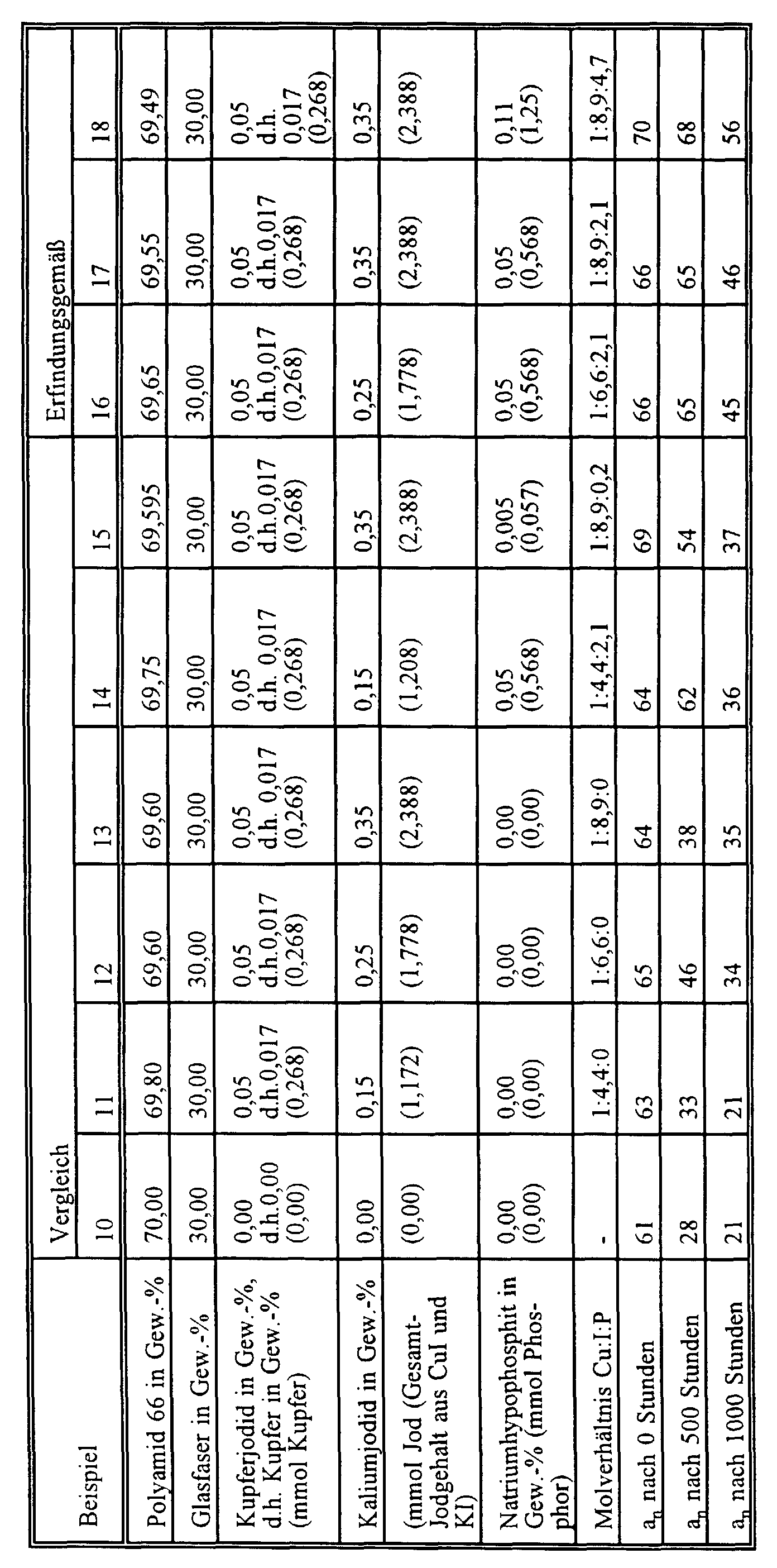
- the following table shows the amounts of the starting materials in% by weight.
- copper (I) iodide is in addition to the amount of copper (I) iodide %
- the corresponding amount of copper is also given in% by weight (1% by weight Copper (I) iodide corresponds to 0.334% by weight copper).
- brackets is the Amount of stabilizer components in mmol per 100 g of molding compound.
- the feed materials were mixed and extruded using a twin-screw kneader (ZSK 32 from Werner and Pfleiderer).
- the starches thus obtained were granulated.
- Rods measuring 80 mm x 10 mm x 4 mm were produced from the granulate by injection molding. These rods were subjected to thermal aging at 50 ° C in an air atmosphere. The course of the aging of the molding composition was monitored by measuring the Izod impact strength (a n ). Examples 1 to 6, 10 to 15 and 19 to 22 are comparative examples.
Landscapes
- Chemical & Material Sciences (AREA)
- Health & Medical Sciences (AREA)
- Chemical Kinetics & Catalysis (AREA)
- Medicinal Chemistry (AREA)
- Polymers & Plastics (AREA)
- Organic Chemistry (AREA)
- Compositions Of Macromolecular Compounds (AREA)
- Anti-Oxidant Or Stabilizer Compositions (AREA)
Description



Claims (7)
- Thermoplastische Polyamid-Formmassen, enthaltend als Stabilisator ein Gemisch aus einem Kupferhalogenid, einer oder mehreren Halogenverbindungen und hypophosphoriger Säure oder eines Alkali- oder Erdalkalisalzes dieser Säure, wobei die einzelnen Komponenten des Stabilisatorgemisches in einer solchen Menge zugesetzt werden, daß die in der Formmasse enthaltene molare Menge an Halogen größer oder gleich der sechsfachen molaren Menge und kleiner oder gleich der fünfzehnfachen molaren Menge des in der Formmasse enthaltenen Kupfers und die molare Menge an Phosphor größer oder gleich der molaren Menge und kleiner oder gleich der zehnfachen molaren Menge des in der Formmasse enthaltenen Kupfers beträgt.
- Polyamid-Formmassen gemäß Anspruch 1, wobei die einzelnen Komponenten des Stabilisatorgemisches in einer solchen Menge zugesetzt werden, daß die in der Formmasse enthaltene molare Menge an Halogen größer oder gleich der sechsfachen molaren Menge und kleiner oder gleich der zwölffachen molaren Menge des in der Formmasse enthaltenen Kupfers und die molaren Menge an Phosphor größer oder gleich der molaren Menge und kleiner oder gleich der fünffachen molaren Menge des in der Formmasse enthaltenen Kupfers beträgt.
- Polyamid-Formmassen gemäß Anspruch 1, wobei der Kupfergehalt in der Formmasse 0,001 bis 1 Gew.-% beträgt.
- Polyamid-Formmassen gemäß Anspruch 1, wobei der Kupfergehalt in der Formmasse 0,003 bis 0,3 Gew.-% beträgt.
- Polyamid-Formmassen gemäß Anspruch 1, wobei als Halogenverbindungen Natrium- und/oder Kaliumjodid verwendet werden.
- Polyamid-Formmassen gemäß Anspruch 1, die Zusatzstoffe ausgewählt aus Füll- und Verstärkungsstoffen, Verarbeitungshilfsmittel, Flammschutzmittel, Pigmente, Farbstoffe und Schlagzähmodifikatoren enthalten.
- Verwendung eines Gemisches aus einem Kupferhalogenid, einem oder mehrerer Halogenverbindungen und hypophosphoriger Säure oder eines Alkali- oder Erdalkalisalzes dieser Säure als Stabilisator für Polyamid-formmassen, dadurch gekennzeichnet, daß die in der Formmasse enthaltene molare Menge an Halogen und Phosphor den Mengen gemäß Anspruch 1 entspricht.
Applications Claiming Priority (2)
| Application Number | Priority Date | Filing Date | Title |
|---|---|---|---|
| DE19519820 | 1995-05-31 | ||
| DE19519820A DE19519820A1 (de) | 1995-05-31 | 1995-05-31 | Thermostabile, witterungsbeständige Polyamidformmassen |
Publications (2)
| Publication Number | Publication Date |
|---|---|
| EP0745642A1 EP0745642A1 (de) | 1996-12-04 |
| EP0745642B1 true EP0745642B1 (de) | 1999-12-08 |
Family
ID=7763228
Family Applications (1)
| Application Number | Title | Priority Date | Filing Date |
|---|---|---|---|
| EP96107971A Expired - Lifetime EP0745642B1 (de) | 1995-05-31 | 1996-05-20 | Thermostabile, witterungsbeständige Polyamidformmassen |
Country Status (4)
| Country | Link |
|---|---|
| US (1) | US6737462B2 (de) |
| EP (1) | EP0745642B1 (de) |
| JP (1) | JPH08333511A (de) |
| DE (2) | DE19519820A1 (de) |
Families Citing this family (17)
| Publication number | Priority date | Publication date | Assignee | Title |
|---|---|---|---|---|
| DE19839331A1 (de) * | 1998-08-28 | 2000-03-02 | Basf Ag | Formmassen auf der Basis von Polyarylenethersulfonen und aliphatischen Polyamiden |
| DE19847626B4 (de) * | 1998-10-15 | 2004-08-19 | L. Brüggemann KG | Mit Kupfersalz und aliphatischem halogeniertem Phosphat stabilisierte Polyamidzusammensetzung |
| DE102004051241A1 (de) | 2004-10-20 | 2006-05-04 | Basf Ag | Fließfähige Polyamide mit hyperverzweigten Polyestern/Polycarbonaten |
| DE102005005847A1 (de) * | 2005-02-08 | 2006-08-10 | Basf Ag | Wärmealterungsbeständige Polyamide |
| CN101479812B (zh) * | 2006-03-31 | 2015-06-24 | 古河电气工业株式会社 | 多层绝缘电线 |
| US20090142585A1 (en) * | 2007-11-08 | 2009-06-04 | Toshikazu Kobayashi | Nanocomposite compositions of polyamides, sepiolite-type clays and copper species and articles thereof |
| WO2009113590A1 (ja) | 2008-03-12 | 2009-09-17 | 旭化成ケミカルズ株式会社 | ポリアミド、ポリアミド組成物及びポリアミドの製造方法 |
| JP5079734B2 (ja) * | 2009-04-13 | 2012-11-21 | 旭化成ケミカルズ株式会社 | ポリアミド組成物 |
| CN102482415B (zh) | 2009-09-11 | 2013-11-06 | 旭化成化学株式会社 | 聚酰胺及聚酰胺组合物 |
| DE102010030212A1 (de) * | 2010-06-17 | 2011-12-22 | Robert Bosch Gmbh | Stabilisatorzusammensetzung für Polyamide |
| ES2535168T3 (es) * | 2010-10-18 | 2015-05-06 | Dsm Ip Assets B.V. | Composición de poliamida estabilizada por calor |
| US9611356B2 (en) | 2011-01-07 | 2017-04-04 | Asahi Kasei Chemicals Corporation | Copolymer polyamide |
| CN103403063B (zh) | 2011-03-15 | 2016-01-20 | 旭化成化学株式会社 | 聚酰胺及聚酰胺组合物 |
| BR112014012569B1 (pt) * | 2011-11-25 | 2021-08-31 | Basf Se | Composição de moldagem termoplástica, uso de composições de peça moldada termoplástica, e, peça moldada |
| JP6194687B2 (ja) * | 2013-08-06 | 2017-09-13 | 宇部興産株式会社 | ポリアミド樹脂、銅化合物及びハロゲン化カリウムを含む組成物並びにそれからなる成形品 |
| KR101720723B1 (ko) * | 2013-09-03 | 2017-03-28 | 롯데첨단소재(주) | 열가소성 수지 조성물을 이용한 자동차용 성형품 |
| CN109661554B (zh) | 2016-08-08 | 2021-05-11 | 提克纳有限责任公司 | 用于散热器的导热聚合物组合物 |
Family Cites Families (13)
| Publication number | Priority date | Publication date | Assignee | Title |
|---|---|---|---|---|
| US2510777A (en) * | 1946-12-30 | 1950-06-06 | Du Pont | Polyamide treated with a hypophosphorous acid compound |
| US2705227A (en) * | 1954-03-15 | 1955-03-29 | Du Pont | Heat stabilization of polyamides |
| NL265839A (de) * | 1960-06-14 | |||
| GB1140047A (en) * | 1965-04-02 | 1969-01-15 | Snia Viscosa | Improved process for producing substantially white, spinnable polyamide compositions, and compositions obtained thereby |
| US3431236A (en) * | 1966-01-13 | 1969-03-04 | Du Pont | Method of adding an antioxidant to a continuous polymerization process |
| DE1257425B (de) * | 1966-04-02 | 1967-12-28 | Bayer Ag | Verfahren zum Waermestabilisieren von Polyamiden |
| GB1162798A (en) * | 1966-11-25 | 1969-08-27 | Ici Ltd | Polyamides |
| ZA71465B (en) | 1970-02-17 | 1971-10-27 | Du Pont | Colorless polyamide compositions and shaped articles stabilized for weatherability |
| US3691131A (en) * | 1971-02-01 | 1972-09-12 | Ciba Geigy Corp | Stabilized polyamide compositions |
| US3814728A (en) * | 1971-11-11 | 1974-06-04 | Du Pont | Stabilization of polyamide |
| DE2516565B2 (de) * | 1975-04-16 | 1979-06-28 | Basf Ag, 6700 Ludwigshafen | Verfahren zum Stabilisieren von Polyamiden |
| IT1096743B (it) * | 1978-06-15 | 1985-08-26 | Snia Viscosa | Composizione liquida per aumentare la resistenza alla luce e al calore delle poliammidi |
| DE4305166A1 (de) * | 1993-02-19 | 1994-08-25 | Bayer Ag | Thermostabile kupferhaltige Polyamidformmassen |
-
1995
- 1995-05-31 DE DE19519820A patent/DE19519820A1/de not_active Withdrawn
-
1996
- 1996-05-20 DE DE59603830T patent/DE59603830D1/de not_active Expired - Lifetime
- 1996-05-20 EP EP96107971A patent/EP0745642B1/de not_active Expired - Lifetime
- 1996-05-24 JP JP8151872A patent/JPH08333511A/ja active Pending
-
2001
- 2001-11-20 US US09/989,347 patent/US6737462B2/en not_active Expired - Fee Related
Also Published As
| Publication number | Publication date |
|---|---|
| US20020077403A1 (en) | 2002-06-20 |
| DE19519820A1 (de) | 1996-12-05 |
| EP0745642A1 (de) | 1996-12-04 |
| US6737462B2 (en) | 2004-05-18 |
| JPH08333511A (ja) | 1996-12-17 |
| DE59603830D1 (de) | 2000-01-13 |
Similar Documents
| Publication | Publication Date | Title |
|---|---|---|
| DE68927469T2 (de) | Polyamidharz-Zusammensetzungen | |
| DE69834459T2 (de) | Flammgeschützte Polybutylenterephthalat-Zusammensetzung | |
| EP0605862B1 (de) | Schwerentflammbare Polyamidformmassen | |
| DE19519820A1 (de) | Thermostabile, witterungsbeständige Polyamidformmassen | |
| EP1121388B1 (de) | Mit kupferkomplexen und organischen halogenverbindungen stabilisierte polyamidzusammensetzung | |
| DE69222685T2 (de) | Flammhemmende Polybutylenterephthalatharzzusammensetzung | |
| DE3485944T2 (de) | Flammfeste polyamidzusammensetzungen. | |
| EP0612794B1 (de) | Thermostabile kupferhaltige Polyamidformmassen | |
| DE68929067T2 (de) | Stabilisatormischung für organische Polymere | |
| DE69632529T3 (de) | Lichtstabilisierte polyamidzusammensetzungen | |
| EP0242732B1 (de) | Flammfeste Polyamide | |
| EP0388583B1 (de) | In der Kälte schlagzähe thermoplastische Formmassen | |
| DE69312116T2 (de) | Zusammensetzungen auf Basis von flammfesten Polyamiden | |
| DE69306682T2 (de) | Polyamidharzzusammensetzung | |
| DE2706827C2 (de) | Verstärkte Polyamidmasse | |
| DE19847626B4 (de) | Mit Kupfersalz und aliphatischem halogeniertem Phosphat stabilisierte Polyamidzusammensetzung | |
| DE2605794C3 (de) | Polyamidmassen mit verbesserter thermischer Stabilität | |
| DE1248927B (de) | Verwendung von Dibenzylbenzolen als Weichmacher für Polyamide | |
| DE69224210T2 (de) | Flammhemmende polyamide | |
| DE3208486C2 (de) | Flammfeste Polyamid-Formmasse und Verfahren zu ihrer Herstellung | |
| DE3485943T2 (de) | Flammfeste polyamidzusammensetzungen. | |
| DE60008879T2 (de) | Aromatische polyamidformmassen-zusammensetzungen | |
| DE68908831T2 (de) | Mischungen auf der Basis von flammwidrigen Polyamiden. | |
| DE69738315T2 (de) | Farbstabiles flammgeschütztes polyamidharz | |
| EP0381943A2 (de) | Polyoxymethylen-Formmasse |
Legal Events
| Date | Code | Title | Description |
|---|---|---|---|
| PUAI | Public reference made under article 153(3) epc to a published international application that has entered the european phase |
Free format text: ORIGINAL CODE: 0009012 |
|
| AK | Designated contracting states |
Kind code of ref document: A1 Designated state(s): BE CH DE FR GB IT LI NL |
|
| 17P | Request for examination filed |
Effective date: 19970505 |
|
| 17Q | First examination report despatched |
Effective date: 19980115 |
|
| GRAG | Despatch of communication of intention to grant |
Free format text: ORIGINAL CODE: EPIDOS AGRA |
|
| GRAG | Despatch of communication of intention to grant |
Free format text: ORIGINAL CODE: EPIDOS AGRA |
|
| GRAH | Despatch of communication of intention to grant a patent |
Free format text: ORIGINAL CODE: EPIDOS IGRA |
|
| GRAH | Despatch of communication of intention to grant a patent |
Free format text: ORIGINAL CODE: EPIDOS IGRA |
|
| GRAA | (expected) grant |
Free format text: ORIGINAL CODE: 0009210 |
|
| AK | Designated contracting states |
Kind code of ref document: B1 Designated state(s): BE CH DE FR GB IT LI NL |
|
| REG | Reference to a national code |
Ref country code: CH Ref legal event code: NV Representative=s name: E. BLUM & CO. PATENTANWAELTE Ref country code: CH Ref legal event code: EP |
|
| REF | Corresponds to: |
Ref document number: 59603830 Country of ref document: DE Date of ref document: 20000113 |
|
| ITF | It: translation for a ep patent filed | ||
| GBT | Gb: translation of ep patent filed (gb section 77(6)(a)/1977) |
Effective date: 20000222 |
|
| ET | Fr: translation filed | ||
| PLBE | No opposition filed within time limit |
Free format text: ORIGINAL CODE: 0009261 |
|
| STAA | Information on the status of an ep patent application or granted ep patent |
Free format text: STATUS: NO OPPOSITION FILED WITHIN TIME LIMIT |
|
| 26N | No opposition filed | ||
| REG | Reference to a national code |
Ref country code: GB Ref legal event code: IF02 |
|
| REG | Reference to a national code |
Ref country code: GB Ref legal event code: 732E |
|
| PGFP | Annual fee paid to national office [announced via postgrant information from national office to epo] |
Ref country code: CH Payment date: 20060515 Year of fee payment: 11 |
|
| NLS | Nl: assignments of ep-patents |
Owner name: LANXESS DEUTSCHLAND GMBH Effective date: 20070305 |
|
| REG | Reference to a national code |
Ref country code: CH Ref legal event code: PFA Owner name: BAYER AG Free format text: BAYER AG# #51368 LEVERKUSEN (DE) -TRANSFER TO- BAYER AG# #51368 LEVERKUSEN (DE) |
|
| REG | Reference to a national code |
Ref country code: CH Ref legal event code: PUE Owner name: LANXESS DEUTSCHLAND GMBH Free format text: BAYER AG# #51368 LEVERKUSEN (DE) -TRANSFER TO- LANXESS DEUTSCHLAND GMBH# #51369 LEVERKUSEN (DE) |
|
| REG | Reference to a national code |
Ref country code: CH Ref legal event code: PL |
|
| PG25 | Lapsed in a contracting state [announced via postgrant information from national office to epo] |
Ref country code: LI Free format text: LAPSE BECAUSE OF NON-PAYMENT OF DUE FEES Effective date: 20070531 Ref country code: CH Free format text: LAPSE BECAUSE OF NON-PAYMENT OF DUE FEES Effective date: 20070531 |
|
| REG | Reference to a national code |
Ref country code: FR Ref legal event code: TP |
|
| PGFP | Annual fee paid to national office [announced via postgrant information from national office to epo] |
Ref country code: DE Payment date: 20130515 Year of fee payment: 18 Ref country code: GB Payment date: 20130515 Year of fee payment: 18 |
|
| PGFP | Annual fee paid to national office [announced via postgrant information from national office to epo] |
Ref country code: NL Payment date: 20130510 Year of fee payment: 18 Ref country code: IT Payment date: 20130520 Year of fee payment: 18 Ref country code: BE Payment date: 20130531 Year of fee payment: 18 Ref country code: FR Payment date: 20130531 Year of fee payment: 18 |
|
| REG | Reference to a national code |
Ref country code: DE Ref legal event code: R081 Ref document number: 59603830 Country of ref document: DE Owner name: LANXESS DEUTSCHLAND GMBH, DE Free format text: FORMER OWNER: LANXESS DEUTSCHLAND GMBH, 51373 LEVERKUSEN, DE Effective date: 20131113 |
|
| REG | Reference to a national code |
Ref country code: DE Ref legal event code: R119 Ref document number: 59603830 Country of ref document: DE |
|
| REG | Reference to a national code |
Ref country code: NL Ref legal event code: V1 Effective date: 20141201 |
|
| GBPC | Gb: european patent ceased through non-payment of renewal fee |
Effective date: 20140520 |
|
| REG | Reference to a national code |
Ref country code: DE Ref legal event code: R119 Ref document number: 59603830 Country of ref document: DE Effective date: 20141202 |
|
| PG25 | Lapsed in a contracting state [announced via postgrant information from national office to epo] |
Ref country code: NL Free format text: LAPSE BECAUSE OF NON-PAYMENT OF DUE FEES Effective date: 20141201 |
|
| REG | Reference to a national code |
Ref country code: FR Ref legal event code: ST Effective date: 20150130 |
|
| PG25 | Lapsed in a contracting state [announced via postgrant information from national office to epo] |
Ref country code: DE Free format text: LAPSE BECAUSE OF NON-PAYMENT OF DUE FEES Effective date: 20141202 Ref country code: IT Free format text: LAPSE BECAUSE OF NON-PAYMENT OF DUE FEES Effective date: 20140520 |
|
| PG25 | Lapsed in a contracting state [announced via postgrant information from national office to epo] |
Ref country code: GB Free format text: LAPSE BECAUSE OF NON-PAYMENT OF DUE FEES Effective date: 20140520 Ref country code: FR Free format text: LAPSE BECAUSE OF NON-PAYMENT OF DUE FEES Effective date: 20140602 |
|
| PG25 | Lapsed in a contracting state [announced via postgrant information from national office to epo] |
Ref country code: BE Free format text: LAPSE BECAUSE OF NON-PAYMENT OF DUE FEES Effective date: 20140531 |