EP0739429B1 - Verfahren zur gemeinsamen vorbehandlung von stahl, verzinktem stahl, magnesium und aluminium vor der verbindung mit gummi - Google Patents
Verfahren zur gemeinsamen vorbehandlung von stahl, verzinktem stahl, magnesium und aluminium vor der verbindung mit gummi Download PDFInfo
- Publication number
- EP0739429B1 EP0739429B1 EP95905132A EP95905132A EP0739429B1 EP 0739429 B1 EP0739429 B1 EP 0739429B1 EP 95905132 A EP95905132 A EP 95905132A EP 95905132 A EP95905132 A EP 95905132A EP 0739429 B1 EP0739429 B1 EP 0739429B1
- Authority
- EP
- European Patent Office
- Prior art keywords
- rubber
- steel
- metal
- treatment solution
- chemical pretreatment
- Prior art date
- Legal status (The legal status is an assumption and is not a legal conclusion. Google has not performed a legal analysis and makes no representation as to the accuracy of the status listed.)
- Expired - Lifetime
Links
- 238000000034 method Methods 0.000 title claims abstract description 33
- 229910000831 Steel Inorganic materials 0.000 title claims abstract description 16
- 229910052782 aluminium Inorganic materials 0.000 title claims abstract description 16
- XAGFODPZIPBFFR-UHFFFAOYSA-N aluminium Chemical compound [Al] XAGFODPZIPBFFR-UHFFFAOYSA-N 0.000 title claims abstract description 16
- 239000010959 steel Substances 0.000 title claims abstract description 16
- FYYHWMGAXLPEAU-UHFFFAOYSA-N Magnesium Chemical compound [Mg] FYYHWMGAXLPEAU-UHFFFAOYSA-N 0.000 title claims abstract description 9
- 229910052749 magnesium Inorganic materials 0.000 title claims abstract description 9
- 239000011777 magnesium Substances 0.000 title claims abstract description 9
- 239000004411 aluminium Substances 0.000 title claims 3
- 229920001971 elastomer Polymers 0.000 title description 14
- 239000005060 rubber Substances 0.000 title description 6
- 229910052751 metal Inorganic materials 0.000 claims abstract description 35
- 239000002184 metal Substances 0.000 claims abstract description 35
- 239000000126 substance Substances 0.000 claims abstract description 16
- KRHYYFGTRYWZRS-UHFFFAOYSA-M Fluoride anion Chemical compound [F-] KRHYYFGTRYWZRS-UHFFFAOYSA-M 0.000 claims abstract description 11
- -1 nitrate ions Chemical class 0.000 claims abstract description 10
- 229910001335 Galvanized steel Inorganic materials 0.000 claims abstract description 9
- 239000007864 aqueous solution Substances 0.000 claims abstract description 9
- 239000008397 galvanized steel Substances 0.000 claims abstract description 9
- NBIIXXVUZAFLBC-UHFFFAOYSA-K phosphate Chemical compound [O-]P([O-])([O-])=O NBIIXXVUZAFLBC-UHFFFAOYSA-K 0.000 claims abstract description 8
- 238000004519 manufacturing process Methods 0.000 claims abstract description 7
- 229910002651 NO3 Inorganic materials 0.000 claims abstract description 5
- 229920003052 natural elastomer Polymers 0.000 claims abstract description 5
- 229920001194 natural rubber Polymers 0.000 claims abstract description 5
- 239000011230 binding agent Substances 0.000 claims abstract description 4
- 229920003051 synthetic elastomer Polymers 0.000 claims abstract description 4
- 239000005061 synthetic rubber Substances 0.000 claims abstract description 4
- 239000000243 solution Substances 0.000 claims description 27
- 239000000853 adhesive Substances 0.000 claims description 5
- 230000001070 adhesive effect Effects 0.000 claims description 5
- 239000002736 nonionic surfactant Substances 0.000 claims description 4
- 238000005507 spraying Methods 0.000 claims description 4
- 239000002905 metal composite material Substances 0.000 description 14
- XEEYBQQBJWHFJM-UHFFFAOYSA-N Iron Chemical compound [Fe] XEEYBQQBJWHFJM-UHFFFAOYSA-N 0.000 description 10
- 238000005260 corrosion Methods 0.000 description 9
- 230000007797 corrosion Effects 0.000 description 9
- 239000000806 elastomer Substances 0.000 description 8
- XLYOFNOQVPJJNP-UHFFFAOYSA-N water Substances O XLYOFNOQVPJJNP-UHFFFAOYSA-N 0.000 description 6
- 238000005422 blasting Methods 0.000 description 5
- 125000004432 carbon atom Chemical group C* 0.000 description 5
- HEMHJVSKTPXQMS-UHFFFAOYSA-M sodium hydroxide Inorganic materials [OH-].[Na+] HEMHJVSKTPXQMS-UHFFFAOYSA-M 0.000 description 5
- 150000002191 fatty alcohols Chemical class 0.000 description 4
- 229910052742 iron Inorganic materials 0.000 description 4
- 239000004094 surface-active agent Substances 0.000 description 4
- 238000004073 vulcanization Methods 0.000 description 4
- VYZAMTAEIAYCRO-UHFFFAOYSA-N Chromium Chemical compound [Cr] VYZAMTAEIAYCRO-UHFFFAOYSA-N 0.000 description 3
- IAYPIBMASNFSPL-UHFFFAOYSA-N Ethylene oxide Chemical compound C1CO1 IAYPIBMASNFSPL-UHFFFAOYSA-N 0.000 description 3
- 239000002253 acid Substances 0.000 description 3
- 150000001450 anions Chemical class 0.000 description 3
- 238000009835 boiling Methods 0.000 description 3
- 238000004140 cleaning Methods 0.000 description 3
- 239000002131 composite material Substances 0.000 description 3
- 238000005238 degreasing Methods 0.000 description 3
- 239000000203 mixture Substances 0.000 description 3
- 238000002161 passivation Methods 0.000 description 3
- 238000010998 test method Methods 0.000 description 3
- LRXTYHSAJDENHV-UHFFFAOYSA-H zinc phosphate Chemical compound [Zn+2].[Zn+2].[Zn+2].[O-]P([O-])([O-])=O.[O-]P([O-])([O-])=O LRXTYHSAJDENHV-UHFFFAOYSA-H 0.000 description 3
- 229910000165 zinc phosphate Inorganic materials 0.000 description 3
- RTZKZFJDLAIYFH-UHFFFAOYSA-N Diethyl ether Chemical compound CCOCC RTZKZFJDLAIYFH-UHFFFAOYSA-N 0.000 description 2
- ZOKXTWBITQBERF-UHFFFAOYSA-N Molybdenum Chemical compound [Mo] ZOKXTWBITQBERF-UHFFFAOYSA-N 0.000 description 2
- NBIIXXVUZAFLBC-UHFFFAOYSA-N Phosphoric acid Chemical compound OP(O)(O)=O NBIIXXVUZAFLBC-UHFFFAOYSA-N 0.000 description 2
- GOOHAUXETOMSMM-UHFFFAOYSA-N Propylene oxide Chemical compound CC1CO1 GOOHAUXETOMSMM-UHFFFAOYSA-N 0.000 description 2
- RTAQQCXQSZGOHL-UHFFFAOYSA-N Titanium Chemical compound [Ti] RTAQQCXQSZGOHL-UHFFFAOYSA-N 0.000 description 2
- HCHKCACWOHOZIP-UHFFFAOYSA-N Zinc Chemical compound [Zn] HCHKCACWOHOZIP-UHFFFAOYSA-N 0.000 description 2
- 150000007513 acids Chemical class 0.000 description 2
- 229910052783 alkali metal Inorganic materials 0.000 description 2
- 238000004532 chromating Methods 0.000 description 2
- 229910052804 chromium Inorganic materials 0.000 description 2
- 239000011651 chromium Substances 0.000 description 2
- 238000007046 ethoxylation reaction Methods 0.000 description 2
- 238000007654 immersion Methods 0.000 description 2
- 229910052750 molybdenum Inorganic materials 0.000 description 2
- 239000011733 molybdenum Substances 0.000 description 2
- 238000010422 painting Methods 0.000 description 2
- 150000003839 salts Chemical class 0.000 description 2
- 239000007921 spray Substances 0.000 description 2
- 238000010561 standard procedure Methods 0.000 description 2
- 239000010936 titanium Substances 0.000 description 2
- 229910052719 titanium Inorganic materials 0.000 description 2
- 229910052725 zinc Inorganic materials 0.000 description 2
- 239000011701 zinc Substances 0.000 description 2
- XYLFFOSVQCBSDT-UHFFFAOYSA-N 1,2-dinitrosobenzene Chemical compound O=NC1=CC=CC=C1N=O XYLFFOSVQCBSDT-UHFFFAOYSA-N 0.000 description 1
- DDFHBQSCUXNBSA-UHFFFAOYSA-N 5-(5-carboxythiophen-2-yl)thiophene-2-carboxylic acid Chemical compound S1C(C(=O)O)=CC=C1C1=CC=C(C(O)=O)S1 DDFHBQSCUXNBSA-UHFFFAOYSA-N 0.000 description 1
- 229910000851 Alloy steel Inorganic materials 0.000 description 1
- QGZKDVFQNNGYKY-UHFFFAOYSA-O Ammonium Chemical compound [NH4+] QGZKDVFQNNGYKY-UHFFFAOYSA-O 0.000 description 1
- 229910001018 Cast iron Inorganic materials 0.000 description 1
- CWYNVVGOOAEACU-UHFFFAOYSA-N Fe2+ Chemical compound [Fe+2] CWYNVVGOOAEACU-UHFFFAOYSA-N 0.000 description 1
- 244000043261 Hevea brasiliensis Species 0.000 description 1
- AVXURJPOCDRRFD-UHFFFAOYSA-N Hydroxylamine Chemical compound ON AVXURJPOCDRRFD-UHFFFAOYSA-N 0.000 description 1
- JCXJVPUVTGWSNB-UHFFFAOYSA-N Nitrogen dioxide Chemical class O=[N]=O JCXJVPUVTGWSNB-UHFFFAOYSA-N 0.000 description 1
- 229910019142 PO4 Inorganic materials 0.000 description 1
- NBIIXXVUZAFLBC-UHFFFAOYSA-L Phosphate ion(2-) Chemical compound OP([O-])([O-])=O NBIIXXVUZAFLBC-UHFFFAOYSA-L 0.000 description 1
- 229920001665 Poly-4-vinylphenol Polymers 0.000 description 1
- XUIMIQQOPSSXEZ-UHFFFAOYSA-N Silicon Chemical compound [Si] XUIMIQQOPSSXEZ-UHFFFAOYSA-N 0.000 description 1
- 229910001515 alkali metal fluoride Inorganic materials 0.000 description 1
- 150000001340 alkali metals Chemical class 0.000 description 1
- 229910052784 alkaline earth metal Inorganic materials 0.000 description 1
- 150000001342 alkaline earth metals Chemical class 0.000 description 1
- 229910000147 aluminium phosphate Inorganic materials 0.000 description 1
- 150000003863 ammonium salts Chemical class 0.000 description 1
- 230000015572 biosynthetic process Effects 0.000 description 1
- 125000000484 butyl group Chemical group [H]C([*])([H])C([H])([H])C([H])([H])C([H])([H])[H] 0.000 description 1
- 238000006243 chemical reaction Methods 0.000 description 1
- KRVSOGSZCMJSLX-UHFFFAOYSA-L chromic acid Substances O[Cr](O)(=O)=O KRVSOGSZCMJSLX-UHFFFAOYSA-L 0.000 description 1
- 150000001845 chromium compounds Chemical class 0.000 description 1
- 239000008139 complexing agent Substances 0.000 description 1
- 150000001875 compounds Chemical class 0.000 description 1
- 229910052593 corundum Inorganic materials 0.000 description 1
- 239000010431 corundum Substances 0.000 description 1
- 239000008367 deionised water Substances 0.000 description 1
- 229910021641 deionized water Inorganic materials 0.000 description 1
- 229920003244 diene elastomer Polymers 0.000 description 1
- NBIIXXVUZAFLBC-UHFFFAOYSA-M dihydrogenphosphate Chemical compound OP(O)([O-])=O NBIIXXVUZAFLBC-UHFFFAOYSA-M 0.000 description 1
- RXCBCUJUGULOGC-UHFFFAOYSA-H dipotassium;tetrafluorotitanium;difluoride Chemical compound [F-].[F-].[F-].[F-].[F-].[F-].[K+].[K+].[Ti+4] RXCBCUJUGULOGC-UHFFFAOYSA-H 0.000 description 1
- 238000005516 engineering process Methods 0.000 description 1
- 230000007613 environmental effect Effects 0.000 description 1
- 150000002222 fluorine compounds Chemical class 0.000 description 1
- 238000005187 foaming Methods 0.000 description 1
- AWJWCTOOIBYHON-UHFFFAOYSA-N furo[3,4-b]pyrazine-5,7-dione Chemical compound C1=CN=C2C(=O)OC(=O)C2=N1 AWJWCTOOIBYHON-UHFFFAOYSA-N 0.000 description 1
- 230000007062 hydrolysis Effects 0.000 description 1
- 238000006460 hydrolysis reaction Methods 0.000 description 1
- CUPFNGOKRMWUOO-UHFFFAOYSA-N hydron;difluoride Chemical compound F.F CUPFNGOKRMWUOO-UHFFFAOYSA-N 0.000 description 1
- 239000003752 hydrotrope Substances 0.000 description 1
- 239000012535 impurity Substances 0.000 description 1
- 150000002500 ions Chemical class 0.000 description 1
- 229910000398 iron phosphate Inorganic materials 0.000 description 1
- 239000000463 material Substances 0.000 description 1
- MEFBJEMVZONFCJ-UHFFFAOYSA-N molybdate Chemical compound [O-][Mo]([O-])(=O)=O MEFBJEMVZONFCJ-UHFFFAOYSA-N 0.000 description 1
- 239000003960 organic solvent Substances 0.000 description 1
- 239000007800 oxidant agent Substances 0.000 description 1
- 230000002085 persistent effect Effects 0.000 description 1
- 239000010452 phosphate Substances 0.000 description 1
- 238000002203 pretreatment Methods 0.000 description 1
- 238000001303 quality assessment method Methods 0.000 description 1
- 230000005855 radiation Effects 0.000 description 1
- 238000000926 separation method Methods 0.000 description 1
- 229910052710 silicon Inorganic materials 0.000 description 1
- 239000010703 silicon Substances 0.000 description 1
- 239000011734 sodium Substances 0.000 description 1
- 235000015393 sodium molybdate Nutrition 0.000 description 1
- 239000011684 sodium molybdate Substances 0.000 description 1
- TVXXNOYZHKPKGW-UHFFFAOYSA-N sodium molybdate (anhydrous) Chemical compound [Na+].[Na+].[O-][Mo]([O-])(=O)=O TVXXNOYZHKPKGW-UHFFFAOYSA-N 0.000 description 1
- 159000000000 sodium salts Chemical class 0.000 description 1
- 239000002904 solvent Substances 0.000 description 1
- 229920003048 styrene butadiene rubber Polymers 0.000 description 1
- 239000000758 substrate Substances 0.000 description 1
- 238000011144 upstream manufacturing Methods 0.000 description 1
- 238000009736 wetting Methods 0.000 description 1
- 229910052845 zircon Inorganic materials 0.000 description 1
- 150000003755 zirconium compounds Chemical class 0.000 description 1
- GFQYVLUOOAAOGM-UHFFFAOYSA-N zirconium(iv) silicate Chemical compound [Zr+4].[O-][Si]([O-])([O-])[O-] GFQYVLUOOAAOGM-UHFFFAOYSA-N 0.000 description 1
Classifications
-
- C—CHEMISTRY; METALLURGY
- C08—ORGANIC MACROMOLECULAR COMPOUNDS; THEIR PREPARATION OR CHEMICAL WORKING-UP; COMPOSITIONS BASED THEREON
- C08J—WORKING-UP; GENERAL PROCESSES OF COMPOUNDING; AFTER-TREATMENT NOT COVERED BY SUBCLASSES C08B, C08C, C08F, C08G or C08H
- C08J5/00—Manufacture of articles or shaped materials containing macromolecular substances
- C08J5/12—Bonding of a preformed macromolecular material to the same or other solid material such as metal, glass, leather, e.g. using adhesives
-
- B—PERFORMING OPERATIONS; TRANSPORTING
- B29—WORKING OF PLASTICS; WORKING OF SUBSTANCES IN A PLASTIC STATE IN GENERAL
- B29C—SHAPING OR JOINING OF PLASTICS; SHAPING OF MATERIAL IN A PLASTIC STATE, NOT OTHERWISE PROVIDED FOR; AFTER-TREATMENT OF THE SHAPED PRODUCTS, e.g. REPAIRING
- B29C63/00—Lining or sheathing, i.e. applying preformed layers or sheathings of plastics; Apparatus therefor
- B29C63/48—Preparation of the surfaces
- B29C63/486—Preparation of the surfaces of metal surfaces
-
- C—CHEMISTRY; METALLURGY
- C23—COATING METALLIC MATERIAL; COATING MATERIAL WITH METALLIC MATERIAL; CHEMICAL SURFACE TREATMENT; DIFFUSION TREATMENT OF METALLIC MATERIAL; COATING BY VACUUM EVAPORATION, BY SPUTTERING, BY ION IMPLANTATION OR BY CHEMICAL VAPOUR DEPOSITION, IN GENERAL; INHIBITING CORROSION OF METALLIC MATERIAL OR INCRUSTATION IN GENERAL
- C23C—COATING METALLIC MATERIAL; COATING MATERIAL WITH METALLIC MATERIAL; SURFACE TREATMENT OF METALLIC MATERIAL BY DIFFUSION INTO THE SURFACE, BY CHEMICAL CONVERSION OR SUBSTITUTION; COATING BY VACUUM EVAPORATION, BY SPUTTERING, BY ION IMPLANTATION OR BY CHEMICAL VAPOUR DEPOSITION, IN GENERAL
- C23C22/00—Chemical surface treatment of metallic material by reaction of the surface with a reactive liquid, leaving reaction products of surface material in the coating, e.g. conversion coatings, passivation of metals
- C23C22/05—Chemical surface treatment of metallic material by reaction of the surface with a reactive liquid, leaving reaction products of surface material in the coating, e.g. conversion coatings, passivation of metals using aqueous solutions
- C23C22/06—Chemical surface treatment of metallic material by reaction of the surface with a reactive liquid, leaving reaction products of surface material in the coating, e.g. conversion coatings, passivation of metals using aqueous solutions using aqueous acidic solutions with pH less than 6
- C23C22/34—Chemical surface treatment of metallic material by reaction of the surface with a reactive liquid, leaving reaction products of surface material in the coating, e.g. conversion coatings, passivation of metals using aqueous solutions using aqueous acidic solutions with pH less than 6 containing fluorides or complex fluorides
- C23C22/36—Chemical surface treatment of metallic material by reaction of the surface with a reactive liquid, leaving reaction products of surface material in the coating, e.g. conversion coatings, passivation of metals using aqueous solutions using aqueous acidic solutions with pH less than 6 containing fluorides or complex fluorides containing also phosphates
-
- C—CHEMISTRY; METALLURGY
- C23—COATING METALLIC MATERIAL; COATING MATERIAL WITH METALLIC MATERIAL; CHEMICAL SURFACE TREATMENT; DIFFUSION TREATMENT OF METALLIC MATERIAL; COATING BY VACUUM EVAPORATION, BY SPUTTERING, BY ION IMPLANTATION OR BY CHEMICAL VAPOUR DEPOSITION, IN GENERAL; INHIBITING CORROSION OF METALLIC MATERIAL OR INCRUSTATION IN GENERAL
- C23C—COATING METALLIC MATERIAL; COATING MATERIAL WITH METALLIC MATERIAL; SURFACE TREATMENT OF METALLIC MATERIAL BY DIFFUSION INTO THE SURFACE, BY CHEMICAL CONVERSION OR SUBSTITUTION; COATING BY VACUUM EVAPORATION, BY SPUTTERING, BY ION IMPLANTATION OR BY CHEMICAL VAPOUR DEPOSITION, IN GENERAL
- C23C22/00—Chemical surface treatment of metallic material by reaction of the surface with a reactive liquid, leaving reaction products of surface material in the coating, e.g. conversion coatings, passivation of metals
- C23C22/05—Chemical surface treatment of metallic material by reaction of the surface with a reactive liquid, leaving reaction products of surface material in the coating, e.g. conversion coatings, passivation of metals using aqueous solutions
- C23C22/06—Chemical surface treatment of metallic material by reaction of the surface with a reactive liquid, leaving reaction products of surface material in the coating, e.g. conversion coatings, passivation of metals using aqueous solutions using aqueous acidic solutions with pH less than 6
- C23C22/40—Chemical surface treatment of metallic material by reaction of the surface with a reactive liquid, leaving reaction products of surface material in the coating, e.g. conversion coatings, passivation of metals using aqueous solutions using aqueous acidic solutions with pH less than 6 containing molybdates, tungstates or vanadates
- C23C22/44—Chemical surface treatment of metallic material by reaction of the surface with a reactive liquid, leaving reaction products of surface material in the coating, e.g. conversion coatings, passivation of metals using aqueous solutions using aqueous acidic solutions with pH less than 6 containing molybdates, tungstates or vanadates containing also fluorides or complex fluorides
Definitions
- the invention relates to a method for pretreating metal surfaces before connecting them with rubber, with which both steel, galvanized Steel as well as aluminum and magnesium individually or in combination can be treated.
- the process does not require organic solvents and does not require the use of chromium compounds, be it in Process itself or in any rinse steps.
- the process is particularly suitable for the production of rubber-metal composites, where the unvulcanized rubber compound is applied to the metal and, usually using vulcanization aids, in Contact with the metal surface is vulcanized.
- the metal surfaces must be in place before the rubber-metal composite is made first cleaned and then in an adequate one Liability appropriate condition. For this are, for example Suitable for blasting processes. However, these have the disadvantage that the corrosion resistance of the rubber-metal composite is inadequate in many cases is. The blasted parts also require rapid processing. The significant drop in blasting leads to Disposal problems. Therefore, it is common to put the metal surfaces in chemical pretreatment in a way that makes the Metal surface reduces and at the same time the rubber's adhesion improved on the metal.
- DE-A-26 38 723 describes Process to improve the resistance to hydrolysis of adhesion between a steel alloy and rubber products, which among other things the Steps: Apply a crystalline zinc phosphate layer and rinse the zinc phosphate layer with a chromic acid solution.
- US-A-5,143,562 sets itself the task of a method for corrosion protection treatment with which different metal surfaces, for example steel and aluminum, treated at the same time can be.
- This process represents iron phosphating and uses aqueous solutions, which may contain the following components: Phosphate ions, complex and simple fluorides, complexing agents for iron, Hydroxylamine as a phosphating accelerator, oxidizing agents such as Nitro aromatics or molybdates, surfactants, defoamers and hydrotropes to improve the solubility of these components.
- this method is used to achieve permanent corrosion protection the metal surface and especially as a pretreatment before subsequent painting used. None is said about whether the process is suitable for the production of rubber-metal composites.
- test methods are required with which the strength of the composites can be determined, particularly after corrosive stress.
- a compilation of such test methods is included, for example, in the article by D.Beiersdorf and H.Scheer: "Aqueous rubber-metal adhesives as an alternative to solvent-based systems", Kautschuk + Kunststoff Kunststoffst. 44 (7), 674-678 (1991). This explains, for example, the tensile shear test, peel test and boiling water test methods known to those skilled in the art as standard tests.
- the object of the invention is to provide a method represent the adhesive strength and corrosion resistance of rubber-metal composites improved and that for steel, galvanized steel, aluminum and magnesium can be used individually or in combination can.
- the anions mentioned can be in the form of the free acids or in the form of water-soluble Salts are used. They come as water-soluble salts Alkali metal and ammonium salts, preferably sodium salts. Each depending on whether the anions are used as acids or as salts the pH is raised or lowered to the range according to the invention will.
- the pH is preferably adjusted when necessary Raising with alkali metal lye, especially with sodium hydroxide, in the event of a necessary lowering with an acid that the named Forms anions, especially with phosphoric acid.
- Phosphate ions are mainly due to pH conditions and concentrations in the form of the dihydrogen phosphate ions and the monohydrogen phosphate ions in front.
- the fluoride required can be in free or complex form available. Fluoride levels in the upper concentration range are recommended if the baths have an aluminum content between 3 and Have built up 10 ppm. Higher Al contents lead to a drop in performance the treatment baths. In particular come as a source of free fluoride Hydrofluoric acid, ammonium fluoride and alkali metal fluoride are considered.
- Complex-bound fluoride can preferably be in the form of the fluorocomplexes of silicon, titanium and zircon can be used. Here is the Use of potassium hexafluorotitanate particularly preferred.
- the bathroom solution can also contain free and complex-bound fluoride side by side, provided the total fluoride concentration does not exceed 1 g / l. Higher Fluoride contents negatively influence the layer formation on Al.
- Corrosion protection and liability values can still be improved if one of the treatment solution molybdenum in amounts between 0.05 to 0.5 g / l adds.
- Ammonium and alkaline earth metal molybdates in particular are the source of these ions suitable, preferably sodium molybdate starts.
- nonionic surfactants in the quantity range add between 0.5 and 2 g / l. These are preferred selected from the group of ethoxylation and / or ethoxylation / propoxylation products of fatty alcohols with 10 to 18 carbon atoms. Suitable examples of this are addition products of 6 mol of ethylene oxide and 8 mol of propylene oxide to a fatty alcohol with 10 to 12 carbon atoms, Addition products of 5 moles of ethylene oxide and 4 moles of propylene oxide to one Fatty alcohol with 12 to 14 carbon atoms and addition products of 8 moles of ethylene oxide with fatty alcohols with 12 to 15 carbon atoms.
- non-ionic At least partially use surfactants that are end group capped are, i.e. present as ether.
- An example of this are butyl end groups capped Addition products of 9 mol ethylene oxide Fatty alcohols with 12 to 18 carbon atoms.
- the pretreatment of the metal parts according to the invention can be carried out in immersion or Spraying process take place.
- immersion procedures require longer Treatment times and higher bath temperatures than spray processes.
- immersion procedures require longer Treatment times and higher bath temperatures than spray processes.
- immersion procedures require longer Treatment times and higher bath temperatures than spray processes.
- immersion procedures require longer Treatment times and higher bath temperatures than spray processes.
- immersion procedures require longer Treatment times and higher bath temperatures than spray processes.
- immersion procedures require longer Treatment times and higher bath temperatures than spray processes.
- immersion procedures require longer Treatment times and higher bath temperatures than spray processes.
- immersion procedures require longer Treatment times and higher bath temperatures than spray processes.
- immersion procedures require longer Treatment times and higher bath temperatures than spray processes.
- immersion procedures require longer Treatment times and higher bath temperatures than spray processes.
- the pretreatment solution is done for 2 to 8 minutes, taking the treatment solution preferably has a temperature between 40 and 60 ° C.
- spraying the metal parts with the treatment solution for 1 to 3 minutes, taking the treatment solution preferably has a temperature between 30 and 50 ° C.
- the method steps according to the invention form part of a treatment chain
- This treatment chain can before the chemical according to the invention Pretreat the metal parts including cleaning / degreasing them. If the process according to the invention is carried out with a surfactant-containing one aqueous solution, so with not too stubborn pollution or oiling of the metal parts on a separate cleaning / degreasing step to be dispensed with. However, instruct the metal parts particularly persistent impurities or if you want the invention It is recommended to carry out procedures with a surfactant-free solution upstream a separate cleaning / degreasing step. This can be done with common, preferably alkaline, cleaners. Here pH values for aluminum, magnesium and galvanized steel are in the range 10-11, recommended for steel in the range 11 to 13.
- test specimens made of steel (ST37), aluminum (AlMgSi1F32) and electrolytically galvanized steel (EG).
- the test specimens were coated with a primer containing chlorinated rubber (Chemosil R 211, Henkel KGaA) and a binder based on dinitrosobenzene (Chemosil R 222, Henkel KGaA) for vulcanization with natural or synthetic rubber.
- a natural rubber (elastomer 1), a styrene-butadiene rubber mixture (elastomer 2) and EPDM (ethylene, propylene, diene rubber, elastomer 3) were tested as characteristic elastomers.
- the composites were cured by vulcanization for 10-30 minutes at 150-160 ° C under a contact pressure of 100 bar.
- the quality assessment of the rubber-metal bonds was carried out according to standard methods for dry grip and boiling water resistance.
- the dry adhesion was metal bodies according to ASTM 429B size 25 x 60 x 1.5 mm with an adhesive surface of 25 x 25 mm.
- the elastomer strip is at a speed of 50 mm / min along the entire length of the bond separated from the metal plate. From the maximum force in decanewtons / inch, which occurs in this peeling process, the separation force is related on the width of the test specimen.
- the ASTM test specimens were subjected to a boiling water test. This test is described in more detail in the Beiersdorf and Scheer publication cited above.
- the test substrates are sanded on the side and on the weld line carved into the metal with a needle. After that, they are for 2 Hours with a tensile load of 2 kg perpendicular to the weld line in water stored at 95 to 98 ° C.
- the rubber-metal composite is torn off and judged the fracture pattern.
- the corrosion resistance of the composite is judged to be the better, the more% breakage occurs in the elastomer. Ideally, 100% breakage in the elastomer is observed.
- rubber-metal composites were produced and tested at instead of chemical pretreatment, radiation using standard methods (for steel: blasting with chilled cast iron, for aluminum: blasting with corundum; in each case until a uniformly bright metallic finish is achieved Surface).
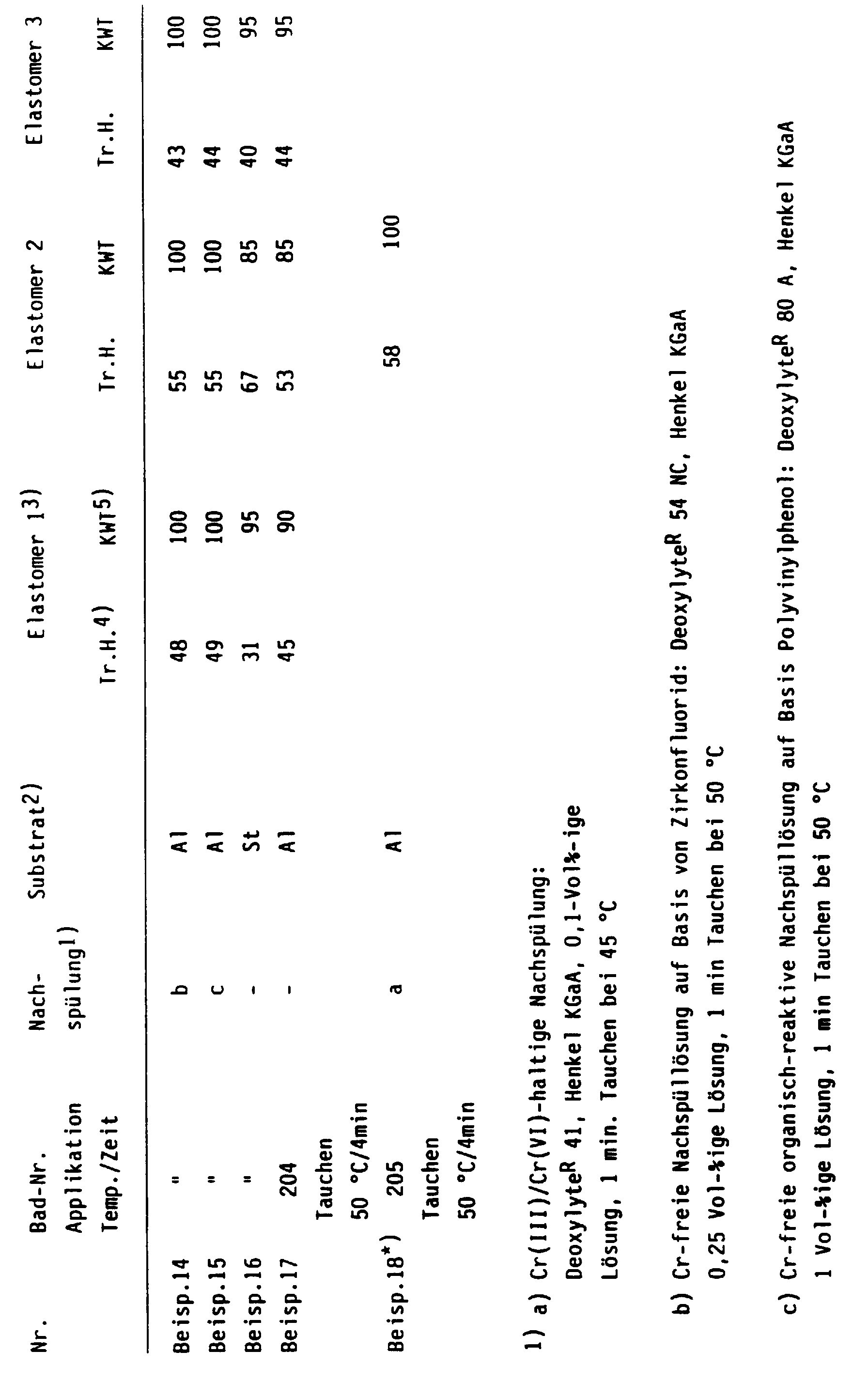
- Table 1 contains examples of the composition of pretreatment baths for the pretreatment according to the invention. All baths were at pH 4.5 set. Table 2 contains details of the procedure and about the test results.
Landscapes
- Chemical & Material Sciences (AREA)
- Engineering & Computer Science (AREA)
- Organic Chemistry (AREA)
- Chemical Kinetics & Catalysis (AREA)
- Materials Engineering (AREA)
- Manufacturing & Machinery (AREA)
- Metallurgy (AREA)
- Mechanical Engineering (AREA)
- General Chemical & Material Sciences (AREA)
- Health & Medical Sciences (AREA)
- Medicinal Chemistry (AREA)
- Polymers & Plastics (AREA)
- Chemical Treatment Of Metals (AREA)
- Manufacture Of Macromolecular Shaped Articles (AREA)
- Lining Or Joining Of Plastics Or The Like (AREA)
- Electroplating Methods And Accessories (AREA)
Description
- 4 bis 20 g/l Phosphationen,
- 0,1 bis 1 g/l freies oder komplex gebundenes Fluorid und
- 0,04 bis 1 g/l Nitrationen
- 0,05 bis 0,5 g/l Molybdationen
- 0,5 bis 2 g/l nichtionische Tenside
| Badzusammensetzungen | ||||||
| Bad-Nr. | PO4 3- g/l | NO3 - mg/l | F-(frei) mg/l | F-(Komplex) mg/l | Na-Molybdat, mg/l | Tensid (g/l) |
| Vergl.101 | 5 | 58 | - | - | - | a,1 |
| 102 | 5 | 58 | - | 380 | - | a,1 |
| 103 | 5 | 58 | - | 380 | 80 | a,1 |
| 104 | 10 | 60 | 200 | - | 80 | a,1 |
| 105 | 5 | 58 | - | 380 | 80 | - |
| Vergl.201 | 14 | 580 | - | - | - | b,1 |
| 202 | 14 | 580 | - | 400 | - | b,1 |
| 203 | 14 | 580 | - | 400 | 160 | b,1 |
| 204 | 14 | 580 | - | 400 | 160 | - |
| 205 | 14 | 580 | 800 | 160 | b,1 |




Claims (8)
- Verfahren zur Herstellung eines Gummi-Metall-Verbundes auf Stahl, verzinktem Stahl, Aluminium und/oder Magnesium, umfassend zumindest die Teilschrittedadurch gekennzeichnet, daß das chemische Vorbehandeln im Teilschritt a) mit einer wäßrigen Lösung mit einem pH-Wert zwischen 3,5 und 5,5 erfolgt, diea) Chemisches Vorbehandeln der Metallteileb) Zwischenspülungc) Aufvulkanisieren von Natur- oder Kunstkautschuk unter Verwendung von Primern und/oder Bindemitteln,enthält.4 bis 20 g/l Phosphationen,0,1 bis 1 g/l freies oder komplex gebundenes Fluorid und0,04 bis 1 g/l Nitrationen
- Verfahren nach Anspruch 1, dadurch gekennzeichnet, daß das chemische Vorbehandeln im Teilschritt a) mit einer wäßrigen Lösung erfolgt, die zusätzlichenthält.0,05 bis 0,5 g/l Molybdationen
- Verfahren nach einem oder beiden der Ansprüche 1 und 2, dadurch gekennzeichnet, daß das chemische Vorbehandeln im Teilschritt a) mit einer wäßrigen Lösung erfolgt, die zusätzlichenthält.0,5 bis 2 g/l nichtionische Tenside
- Verfahren nach einem oder mehreren der Ansprüche 1 bis 3, dadurch gekennzeichnet, daß das chemische Vorbehandeln im Teilschritt a) durch Eintauchen der Metallteile in die Behandlungslösung für 2 bis 8 Minuten erfolgt, wobei die Behandlungslösung vorzugsweise eine Temperatur zwischen 40 und 60 °C aufweist.
- Verfahren nach einem oder mehreren der Ansprüche 1 bis 3, dadurch gekennzeichnet, daß das chemische Vorbehandeln im Teilschritt a) durch Bespritzen der Metallteile mit der Behandlungslösung für 1 bis 3 Minuten erfolgt, wobei die Behandlungslösung vorzugsweise eine Temperatur zwischen 30 und 50 °C aufweist.
- Verwendung von wäßrigen Lösungen mit einem pH-Wert zwischen 3,5 und 5,5, diesowie vorzugsweise4 bis 20 g/l Phosphationen,0,1 bis 1 g/l freies oder komplex gebundenes Fluorid und0,04 bis 1 g/l Nitrationenund/oder0,05 bis 0,5 g/l Molybdationenenthalten,0,5 bis 2 g/l nichtionische Tenside
zur Erhöhung der Haftfestigkeit eines Gummi-Metall-Verbundes auf Stahl, verzinktem Stahl, Aluminium und/oder Magnesium. - Verwendung nach Anspruch 6, dadurch gekennzeichnet, daß die Applikation der Lösung durch Eintauchen der Metallteile in die Behandlungslösung für vorzugsweise 2 bis 8 Minuten erfolgt, wobei die Behandlungslösung vorzugsweise eine Temperatur zwischen 40 und 60 °C aufweist.
- Verwendung nach Anspruch 6, dadurch gekennzeichnet, daß die Applikation der Lösung durch Bespritzen der Metallteile mit der Behandlungslösung für vorzugsweise 1 bis 3 Minuten erfolgt, wobei die Behandlungslösung vorzugsweise eine Temperatur zwischen 30 und 50 °C aufweist.
Applications Claiming Priority (3)
| Application Number | Priority Date | Filing Date | Title |
|---|---|---|---|
| DE4401566A DE4401566A1 (de) | 1994-01-20 | 1994-01-20 | Verfahren zur gemeinsamen Vorbehandlung von Stahl, verzinktem Stahl, Magnesium und Aluminium vor der Verbindung mit Gummi |
| DE4401566 | 1994-01-20 | ||
| PCT/EP1995/000090 WO1995020061A1 (de) | 1994-01-20 | 1995-01-11 | Verfahren zur gemeinsamen vorbehandlung von stahl, verzinktem stahl, magnesium und aluminium vor der verbindung mit gummi |
Publications (2)
| Publication Number | Publication Date |
|---|---|
| EP0739429A1 EP0739429A1 (de) | 1996-10-30 |
| EP0739429B1 true EP0739429B1 (de) | 1998-04-08 |
Family
ID=6508306
Family Applications (1)
| Application Number | Title | Priority Date | Filing Date |
|---|---|---|---|
| EP95905132A Expired - Lifetime EP0739429B1 (de) | 1994-01-20 | 1995-01-11 | Verfahren zur gemeinsamen vorbehandlung von stahl, verzinktem stahl, magnesium und aluminium vor der verbindung mit gummi |
Country Status (5)
| Country | Link |
|---|---|
| US (1) | US6440231B1 (de) |
| EP (1) | EP0739429B1 (de) |
| AT (1) | ATE164890T1 (de) |
| DE (2) | DE4401566A1 (de) |
| WO (1) | WO1995020061A1 (de) |
Cited By (1)
| Publication number | Priority date | Publication date | Assignee | Title |
|---|---|---|---|---|
| DE102015215651B4 (de) * | 2015-08-17 | 2020-10-08 | Vacuumschmelze Gmbh & Co. Kg | Verfahren und Behandlungslösung zur Behandlung von Aluminiumbeschichtungen vor der Passivierung mit Chrom(III)-haltigen Lösungen |
Families Citing this family (20)
| Publication number | Priority date | Publication date | Assignee | Title |
|---|---|---|---|---|
| JP3623015B2 (ja) * | 1995-06-30 | 2005-02-23 | 日本パーカライジング株式会社 | アルミニウム含有金属材料用表面処理液および表面処理方法 |
| US6193815B1 (en) | 1995-06-30 | 2001-02-27 | Henkel Corporation | Composition and process for treating the surface of aluminiferous metals |
| DE19603060A1 (de) * | 1996-01-29 | 1997-08-07 | Freudenberg Carl Fa | Verfahren zur Herstellung eines Gummi-Metall-Teils |
| DE19755421A1 (de) | 1997-12-13 | 1999-06-17 | Henkel Kgaa | Gummi-Metall-Verbund |
| US6358349B1 (en) * | 1999-07-01 | 2002-03-19 | Eagle-Picher Industries, Inc. | Method to improve adhesion between pre-cured elastomer and metal surface |
| GB2374088A (en) * | 2001-03-29 | 2002-10-09 | Macdermid Plc | Conversion treatment of zinc and zinc alloy surfaces |
| TWI268965B (en) * | 2001-06-15 | 2006-12-21 | Nihon Parkerizing | Treating solution for surface treatment of metal and surface treatment method |
| WO2003002776A2 (en) * | 2001-06-28 | 2003-01-09 | Algat Sherutey Gimur Teufati | Method of anodizing of magnesium and magnesium alloys and producing conductive layers on an anodized surface |
| EP1515843A1 (de) * | 2002-06-14 | 2005-03-23 | Dow Global Technologies Inc. | Direkt mit einem metallsubstrat verbundenes thermoplastisches elastomer |
| US20050216459A1 (en) * | 2002-08-08 | 2005-09-29 | Aditya Vailaya | Methods and systems, for ontological integration of disparate biological data |
| JP4205939B2 (ja) * | 2002-12-13 | 2009-01-07 | 日本パーカライジング株式会社 | 金属の表面処理方法 |
| DE10358310A1 (de) * | 2003-12-11 | 2005-07-21 | Henkel Kgaa | Zweistufige Konversionsbehandlung |
| JP4789809B2 (ja) * | 2004-01-15 | 2011-10-12 | サムスン エレクトロニクス カンパニー リミテッド | ナノ結晶をドーピングしたマトリックス |
| JP4628726B2 (ja) * | 2004-03-02 | 2011-02-09 | 日本表面化学株式会社 | アルミニウム部材及びその製造方法と製造用薬剤 |
| JP2007285513A (ja) * | 2006-03-22 | 2007-11-01 | Tokai Rubber Ind Ltd | 金具付きゴム部材およびその製法 |
| JP5026846B2 (ja) | 2006-04-28 | 2012-09-19 | 東海ゴム工業株式会社 | アルミ系金属品付きゴム部材およびその製法 |
| US7993537B2 (en) * | 2007-02-23 | 2011-08-09 | GM Global Technology Operations LLC | Method for improving adhesion between a shape memory alloy and a polymer |
| JP4412341B2 (ja) * | 2007-03-29 | 2010-02-10 | 東海ゴム工業株式会社 | アルミ系金属品付きゴム部材の製法 |
| JP5604244B2 (ja) * | 2010-09-24 | 2014-10-08 | 株式会社ブリヂストン | ゴム−金属複合体の製造方法、ゴム−金属複合体、タイヤ、免震用のゴム支承体、工業用ベルト、及びクローラー |
| DE102014007715B4 (de) * | 2014-05-28 | 2018-06-07 | Chemetall Gmbh | Verfahren zur Herstellung einer Sandwichstruktur, die hiermit hergestellte Sandwichstruktur und ihre Verwendung |
Family Cites Families (11)
| Publication number | Priority date | Publication date | Assignee | Title |
|---|---|---|---|---|
| FR1007909A (fr) * | 1948-04-14 | 1952-05-12 | Tewa | Procédé pour le revêtement de surfaces métalliques avec du caoutchouc ou des produits de remplacement du caoutchouc |
| US2839439A (en) * | 1955-06-07 | 1958-06-17 | Detrex Chem Ind | Method and composition for producing phosphate coatings on metal |
| US2774701A (en) | 1956-07-16 | 1956-12-18 | Richard C Weiss | Method of bonding rubber to metal and the resulting article |
| US3697332A (en) * | 1971-02-11 | 1972-10-10 | Amchem Prod | Method for coating aluminum while avoiding objectionable wastes |
| US3996074A (en) * | 1975-08-28 | 1976-12-07 | Monsanto Company | Method for improving hydrolytic stability of the bond between steel surfaces and organic adhesives |
| US4017335A (en) | 1975-10-30 | 1977-04-12 | Economics Laboratory, Inc. | Liquid phosphatizing composition and use thereof |
| JPS5297639A (en) * | 1976-02-12 | 1977-08-16 | Matsushita Electric Ind Co Ltd | Amplifier circuit |
| JPS5935681A (ja) * | 1982-08-24 | 1984-02-27 | Nippon Paint Co Ltd | カチオン型電着塗装用金属表面のリン酸塩処理方法 |
| CS238183B1 (en) * | 1983-09-30 | 1985-11-13 | Karel Barton | Layer forming means with large specific surface on iron, aluminium,zinc and technical alloys of these metals |
| US5143562A (en) * | 1991-11-01 | 1992-09-01 | Henkel Corporation | Broadly applicable phosphate conversion coating composition and process |
| JP2962614B2 (ja) * | 1992-02-21 | 1999-10-12 | 日本パーカライジング株式会社 | 鉄鋼−アルミニウム含有金属複合材料の連続リン酸塩化成処理方法 |
-
1994
- 1994-01-20 DE DE4401566A patent/DE4401566A1/de not_active Withdrawn
-
1995
- 1995-01-11 AT AT95905132T patent/ATE164890T1/de not_active IP Right Cessation
- 1995-01-11 WO PCT/EP1995/000090 patent/WO1995020061A1/de not_active Ceased
- 1995-01-11 EP EP95905132A patent/EP0739429B1/de not_active Expired - Lifetime
- 1995-01-11 US US08/676,333 patent/US6440231B1/en not_active Expired - Fee Related
- 1995-01-11 DE DE59501848T patent/DE59501848D1/de not_active Expired - Fee Related
Cited By (1)
| Publication number | Priority date | Publication date | Assignee | Title |
|---|---|---|---|---|
| DE102015215651B4 (de) * | 2015-08-17 | 2020-10-08 | Vacuumschmelze Gmbh & Co. Kg | Verfahren und Behandlungslösung zur Behandlung von Aluminiumbeschichtungen vor der Passivierung mit Chrom(III)-haltigen Lösungen |
Also Published As
| Publication number | Publication date |
|---|---|
| EP0739429A1 (de) | 1996-10-30 |
| DE4401566A1 (de) | 1995-07-27 |
| DE59501848D1 (de) | 1998-05-14 |
| ATE164890T1 (de) | 1998-04-15 |
| US6440231B1 (en) | 2002-08-27 |
| WO1995020061A1 (de) | 1995-07-27 |
Similar Documents
| Publication | Publication Date | Title |
|---|---|---|
| EP0739429A1 (de) | Verfahren zur gemeinsamen vorbehandlung von stahl, verzinktem stahl, magnesium und aluminium vor der verbindung mit gummi | |
| EP0700452B1 (de) | Chromfreie konversionsbehandlung von aluminium | |
| DE3118375C2 (de) | ||
| EP2817434B1 (de) | Vorbehandlung von zinkoberflächen vor einer passivierung | |
| EP3350357B1 (de) | Vorbehandlung von aluminiumoberflächen mit zirkon- und molybdänhaltigen zusammensetzungen | |
| EP4073289A1 (de) | Verfahren zum herstellen eines stahlflachprodukts mit einer metallischen schutzschicht auf basis von zink und einer auf einer oberfläche der metallischen schutzschicht erzeugten phosphatierschicht und derartiges stahlflachprodukt | |
| EP3676419B1 (de) | Verbessertes verfahren zur nickelfreien phosphatierung von metallischen oberflächen | |
| EP0154367B1 (de) | Verfahren zur Phosphatierung von Metallen | |
| EP0261519B1 (de) | Schichtbildende Passivierung bei Multimetall-Verfahren | |
| EP0760870B1 (de) | Eisenphosphatierung unter verwendung von substituierten monocarbonsäuren | |
| EP1692325A1 (de) | Zweistufige konversionsbehandlung | |
| EP0111223B1 (de) | Verfahren zur Phosphatierung von Metalloberflächen sowie hierfür geeignete Badlösungen | |
| EP0656957B1 (de) | Verfahren zur phosphatierung von einseitig verzinktem stahlband | |
| EP0039093A1 (de) | Verfahren zur Phosphatierung von Metalloberflächen sowie dessen Anwendung | |
| EP0031103B1 (de) | Verfahren zur Vorbehandlung von Metalloberflächen vor dem Phosphatieren | |
| DE2638723A1 (de) | Verfahren zur verbesserung der hydrolysebestaendigkeit der haftung von organischen klebern auf stahlflaechen | |
| DE19735314A1 (de) | Verfahren zur Vorbehandlung von Bauteilen | |
| EP0224190B1 (de) | Verfahren zur Aktivierung von Metalloberflächen vor einer Zinkphosphatierung | |
| EP3947766A1 (de) | Verfahren zur modifizierung der oberfläche einer auf einem stahlflachprodukt aufgebrachten metallischen schutzschicht auf zn-al-mg-basis und stahlflachprodukt | |
| EP1019564A1 (de) | Verfahren zur phosphatierung von stahlband | |
| DE3217145A1 (de) | Verfahren zum reinigen, entfetten sowie aktivieren von metalloberflaechen | |
| EP0590594B1 (de) | Behandlung von Metalloberflächen zur Verbesserung der Haftung und deren Korrosionseigenschaften | |
| EP1350865A2 (de) | Verzinktes und phosphatiertes Blech sowie Verfahren zur Herstellung eines solchen Blechs | |
| DE102016008333A1 (de) | Verfahren zur wasserstoffarmen Zink-Nickel Beschichtung eines hochfesten Vergütungsstahls | |
| EP3336219B1 (de) | Verfahren zur korrosionsschützenden und reinigenden vorbehandlung von metallischen bauteilen |
Legal Events
| Date | Code | Title | Description |
|---|---|---|---|
| PUAI | Public reference made under article 153(3) epc to a published international application that has entered the european phase |
Free format text: ORIGINAL CODE: 0009012 |
|
| 17P | Request for examination filed |
Effective date: 19960711 |
|
| AK | Designated contracting states |
Kind code of ref document: A1 Designated state(s): AT BE DE FR GB IT |
|
| GRAG | Despatch of communication of intention to grant |
Free format text: ORIGINAL CODE: EPIDOS AGRA |
|
| 17Q | First examination report despatched |
Effective date: 19970131 |
|
| RBV | Designated contracting states (corrected) |
Designated state(s): AT BE DE FR GB IT |
|
| GRAG | Despatch of communication of intention to grant |
Free format text: ORIGINAL CODE: EPIDOS AGRA |
|
| GRAH | Despatch of communication of intention to grant a patent |
Free format text: ORIGINAL CODE: EPIDOS IGRA |
|
| GRAH | Despatch of communication of intention to grant a patent |
Free format text: ORIGINAL CODE: EPIDOS IGRA |
|
| GRAA | (expected) grant |
Free format text: ORIGINAL CODE: 0009210 |
|
| AK | Designated contracting states |
Kind code of ref document: B1 Designated state(s): AT BE DE FR GB IT |
|
| REF | Corresponds to: |
Ref document number: 164890 Country of ref document: AT Date of ref document: 19980415 Kind code of ref document: T |
|
| ET | Fr: translation filed | ||
| REF | Corresponds to: |
Ref document number: 59501848 Country of ref document: DE Date of ref document: 19980514 |
|
| ITF | It: translation for a ep patent filed | ||
| GBT | Gb: translation of ep patent filed (gb section 77(6)(a)/1977) |
Effective date: 19980602 |
|
| PLBE | No opposition filed within time limit |
Free format text: ORIGINAL CODE: 0009261 |
|
| STAA | Information on the status of an ep patent application or granted ep patent |
Free format text: STATUS: NO OPPOSITION FILED WITHIN TIME LIMIT |
|
| 26N | No opposition filed | ||
| REG | Reference to a national code |
Ref country code: GB Ref legal event code: IF02 |
|
| PGFP | Annual fee paid to national office [announced via postgrant information from national office to epo] |
Ref country code: GB Payment date: 20020109 Year of fee payment: 8 |
|
| PGFP | Annual fee paid to national office [announced via postgrant information from national office to epo] |
Ref country code: FR Payment date: 20020110 Year of fee payment: 8 |
|
| PGFP | Annual fee paid to national office [announced via postgrant information from national office to epo] |
Ref country code: AT Payment date: 20020111 Year of fee payment: 8 |
|
| PGFP | Annual fee paid to national office [announced via postgrant information from national office to epo] |
Ref country code: BE Payment date: 20020320 Year of fee payment: 8 |
|
| PG25 | Lapsed in a contracting state [announced via postgrant information from national office to epo] |
Ref country code: GB Free format text: LAPSE BECAUSE OF NON-PAYMENT OF DUE FEES Effective date: 20030111 Ref country code: AT Free format text: LAPSE BECAUSE OF NON-PAYMENT OF DUE FEES Effective date: 20030111 |
|
| PG25 | Lapsed in a contracting state [announced via postgrant information from national office to epo] |
Ref country code: BE Free format text: LAPSE BECAUSE OF NON-PAYMENT OF DUE FEES Effective date: 20030131 |
|
| GBPC | Gb: european patent ceased through non-payment of renewal fee | ||
| PG25 | Lapsed in a contracting state [announced via postgrant information from national office to epo] |
Ref country code: FR Free format text: LAPSE BECAUSE OF NON-PAYMENT OF DUE FEES Effective date: 20030930 |
|
| REG | Reference to a national code |
Ref country code: FR Ref legal event code: ST |
|
| PGFP | Annual fee paid to national office [announced via postgrant information from national office to epo] |
Ref country code: DE Payment date: 20040122 Year of fee payment: 10 |
|
| PG25 | Lapsed in a contracting state [announced via postgrant information from national office to epo] |
Ref country code: IT Free format text: LAPSE BECAUSE OF NON-PAYMENT OF DUE FEES;WARNING: LAPSES OF ITALIAN PATENTS WITH EFFECTIVE DATE BEFORE 2007 MAY HAVE OCCURRED AT ANY TIME BEFORE 2007. THE CORRECT EFFECTIVE DATE MAY BE DIFFERENT FROM THE ONE RECORDED. Effective date: 20050111 |
|
| PG25 | Lapsed in a contracting state [announced via postgrant information from national office to epo] |
Ref country code: DE Free format text: LAPSE BECAUSE OF NON-PAYMENT OF DUE FEES Effective date: 20050802 |