EP0737747B1 - Cytoplasmatische Expression von Antikörpern, Antikörperfragmenten und Antikörperfragment-Fusionsmolekülen in E. coli - Google Patents
Cytoplasmatische Expression von Antikörpern, Antikörperfragmenten und Antikörperfragment-Fusionsmolekülen in E. coli Download PDFInfo
- Publication number
- EP0737747B1 EP0737747B1 EP96103913A EP96103913A EP0737747B1 EP 0737747 B1 EP0737747 B1 EP 0737747B1 EP 96103913 A EP96103913 A EP 96103913A EP 96103913 A EP96103913 A EP 96103913A EP 0737747 B1 EP0737747 B1 EP 0737747B1
- Authority
- EP
- European Patent Office
- Prior art keywords
- coli
- enzyme
- glucuronidase
- antibody
- expression
- Prior art date
- Legal status (The legal status is an assumption and is not a legal conclusion. Google has not performed a legal analysis and makes no representation as to the accuracy of the status listed.)
- Expired - Lifetime
Links
Images


Classifications
-
- C—CHEMISTRY; METALLURGY
- C07—ORGANIC CHEMISTRY
- C07K—PEPTIDES
- C07K16/00—Immunoglobulins [IG], e.g. monoclonal or polyclonal antibodies
-
- C—CHEMISTRY; METALLURGY
- C12—BIOCHEMISTRY; BEER; SPIRITS; WINE; VINEGAR; MICROBIOLOGY; ENZYMOLOGY; MUTATION OR GENETIC ENGINEERING
- C12N—MICROORGANISMS OR ENZYMES; COMPOSITIONS THEREOF; PROPAGATING, PRESERVING, OR MAINTAINING MICROORGANISMS; MUTATION OR GENETIC ENGINEERING; CULTURE MEDIA
- C12N15/00—Mutation or genetic engineering; DNA or RNA concerning genetic engineering, vectors, e.g. plasmids, or their isolation, preparation or purification; Use of hosts therefor
- C12N15/09—Recombinant DNA-technology
- C12N15/11—DNA or RNA fragments; Modified forms thereof; Non-coding nucleic acids having a biological activity
- C12N15/62—DNA sequences coding for fusion proteins
-
- C—CHEMISTRY; METALLURGY
- C12—BIOCHEMISTRY; BEER; SPIRITS; WINE; VINEGAR; MICROBIOLOGY; ENZYMOLOGY; MUTATION OR GENETIC ENGINEERING
- C12N—MICROORGANISMS OR ENZYMES; COMPOSITIONS THEREOF; PROPAGATING, PRESERVING, OR MAINTAINING MICROORGANISMS; MUTATION OR GENETIC ENGINEERING; CULTURE MEDIA
- C12N9/00—Enzymes; Proenzymes; Compositions thereof; Processes for preparing, activating, inhibiting, separating or purifying enzymes
- C12N9/14—Hydrolases (3)
- C12N9/24—Hydrolases (3) acting on glycosyl compounds (3.2)
- C12N9/2402—Hydrolases (3) acting on glycosyl compounds (3.2) hydrolysing O- and S- glycosyl compounds (3.2.1)
-
- C—CHEMISTRY; METALLURGY
- C12—BIOCHEMISTRY; BEER; SPIRITS; WINE; VINEGAR; MICROBIOLOGY; ENZYMOLOGY; MUTATION OR GENETIC ENGINEERING
- C12N—MICROORGANISMS OR ENZYMES; COMPOSITIONS THEREOF; PROPAGATING, PRESERVING, OR MAINTAINING MICROORGANISMS; MUTATION OR GENETIC ENGINEERING; CULTURE MEDIA
- C12N9/00—Enzymes; Proenzymes; Compositions thereof; Processes for preparing, activating, inhibiting, separating or purifying enzymes
- C12N9/14—Hydrolases (3)
- C12N9/24—Hydrolases (3) acting on glycosyl compounds (3.2)
- C12N9/2402—Hydrolases (3) acting on glycosyl compounds (3.2) hydrolysing O- and S- glycosyl compounds (3.2.1)
- C12N9/2405—Glucanases
- C12N9/2434—Glucanases acting on beta-1,4-glucosidic bonds
-
- C—CHEMISTRY; METALLURGY
- C12—BIOCHEMISTRY; BEER; SPIRITS; WINE; VINEGAR; MICROBIOLOGY; ENZYMOLOGY; MUTATION OR GENETIC ENGINEERING
- C12Y—ENZYMES
- C12Y302/00—Hydrolases acting on glycosyl compounds, i.e. glycosylases (3.2)
- C12Y302/01—Glycosidases, i.e. enzymes hydrolysing O- and S-glycosyl compounds (3.2.1)
- C12Y302/01031—Beta-glucuronidase (3.2.1.31)
-
- A—HUMAN NECESSITIES
- A61—MEDICAL OR VETERINARY SCIENCE; HYGIENE
- A61K—PREPARATIONS FOR MEDICAL, DENTAL OR TOILETRY PURPOSES
- A61K38/00—Medicinal preparations containing peptides
-
- C—CHEMISTRY; METALLURGY
- C07—ORGANIC CHEMISTRY
- C07K—PEPTIDES
- C07K2317/00—Immunoglobulins specific features
- C07K2317/20—Immunoglobulins specific features characterized by taxonomic origin
- C07K2317/24—Immunoglobulins specific features characterized by taxonomic origin containing regions, domains or residues from different species, e.g. chimeric, humanized or veneered
-
- C—CHEMISTRY; METALLURGY
- C07—ORGANIC CHEMISTRY
- C07K—PEPTIDES
- C07K2317/00—Immunoglobulins specific features
- C07K2317/50—Immunoglobulins specific features characterized by immunoglobulin fragments
- C07K2317/55—Fab or Fab'
-
- C—CHEMISTRY; METALLURGY
- C07—ORGANIC CHEMISTRY
- C07K—PEPTIDES
- C07K2317/00—Immunoglobulins specific features
- C07K2317/60—Immunoglobulins specific features characterized by non-natural combinations of immunoglobulin fragments
- C07K2317/62—Immunoglobulins specific features characterized by non-natural combinations of immunoglobulin fragments comprising only variable region components
- C07K2317/622—Single chain antibody (scFv)
-
- C—CHEMISTRY; METALLURGY
- C07—ORGANIC CHEMISTRY
- C07K—PEPTIDES
- C07K2319/00—Fusion polypeptide
-
- C—CHEMISTRY; METALLURGY
- C07—ORGANIC CHEMISTRY
- C07K—PEPTIDES
- C07K2319/00—Fusion polypeptide
- C07K2319/30—Non-immunoglobulin-derived peptide or protein having an immunoglobulin constant or Fc region, or a fragment thereof, attached thereto
-
- C—CHEMISTRY; METALLURGY
- C07—ORGANIC CHEMISTRY
- C07K—PEPTIDES
- C07K2319/00—Fusion polypeptide
- C07K2319/61—Fusion polypeptide containing an enzyme fusion for detection (lacZ, luciferase)
-
- Y—GENERAL TAGGING OF NEW TECHNOLOGICAL DEVELOPMENTS; GENERAL TAGGING OF CROSS-SECTIONAL TECHNOLOGIES SPANNING OVER SEVERAL SECTIONS OF THE IPC; TECHNICAL SUBJECTS COVERED BY FORMER USPC CROSS-REFERENCE ART COLLECTIONS [XRACs] AND DIGESTS
- Y10—TECHNICAL SUBJECTS COVERED BY FORMER USPC
- Y10S—TECHNICAL SUBJECTS COVERED BY FORMER USPC CROSS-REFERENCE ART COLLECTIONS [XRACs] AND DIGESTS
- Y10S424/00—Drug, bio-affecting and body treating compositions
- Y10S424/801—Drug, bio-affecting and body treating compositions involving antibody or fragment thereof produced by recombinant dna technology
-
- Y—GENERAL TAGGING OF NEW TECHNOLOGICAL DEVELOPMENTS; GENERAL TAGGING OF CROSS-SECTIONAL TECHNOLOGIES SPANNING OVER SEVERAL SECTIONS OF THE IPC; TECHNICAL SUBJECTS COVERED BY FORMER USPC CROSS-REFERENCE ART COLLECTIONS [XRACs] AND DIGESTS
- Y10—TECHNICAL SUBJECTS COVERED BY FORMER USPC
- Y10S—TECHNICAL SUBJECTS COVERED BY FORMER USPC CROSS-REFERENCE ART COLLECTIONS [XRACs] AND DIGESTS
- Y10S435/00—Chemistry: molecular biology and microbiology
- Y10S435/8215—Microorganisms
- Y10S435/822—Microorganisms using bacteria or actinomycetales
- Y10S435/848—Escherichia
- Y10S435/849—Escherichia coli
Definitions
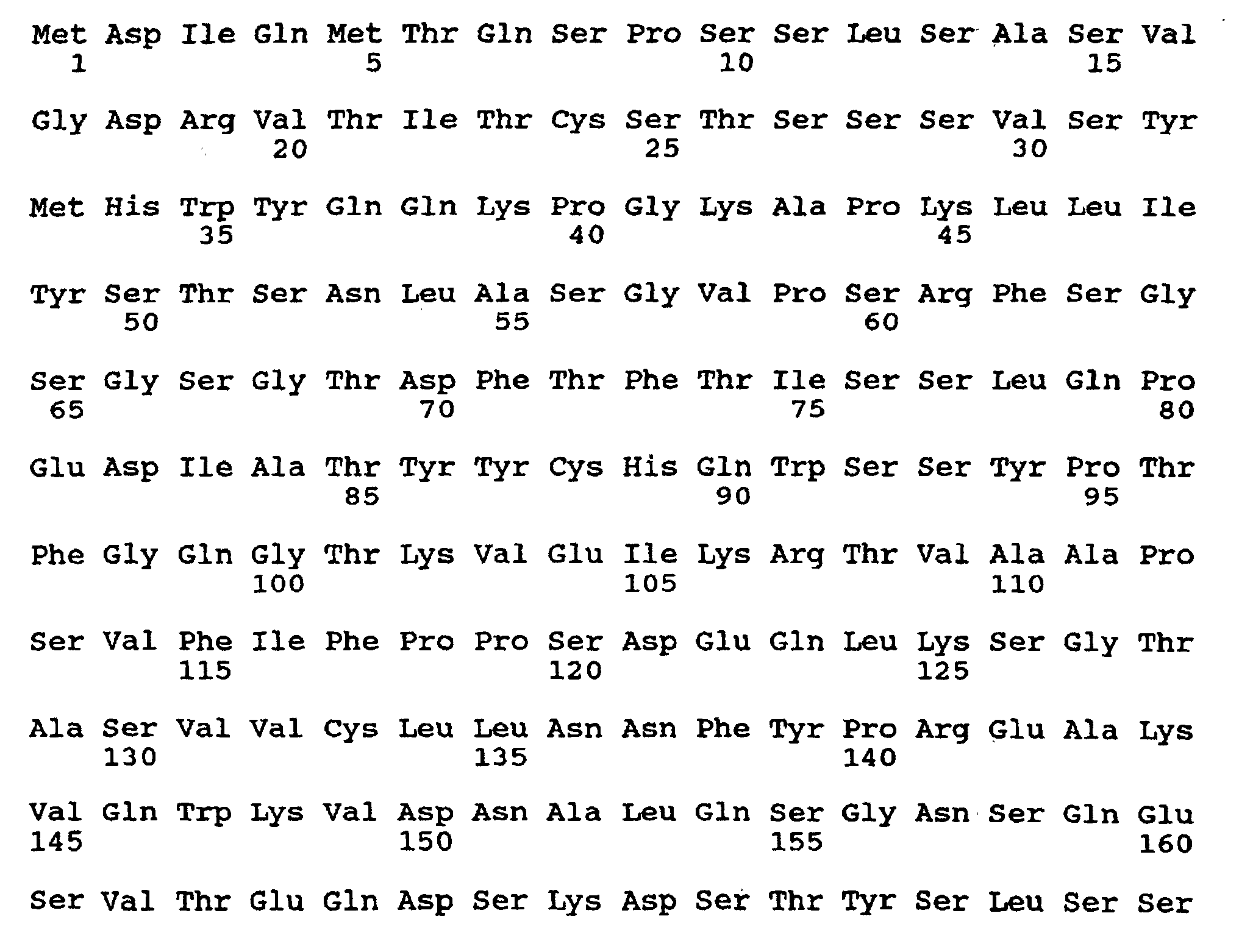
- the invention relates to the cytoplasmic expression of antibodies, antibody fragments and antibody fragment fusion molecules in E. coli.
- Antibody fragment fusion molecules with one directed against tumors Antibody part and a non-toxic "prodrug" into the toxic "drug” cleaving enzyme part are so while maintaining the respective functional Properties cheap to produce.
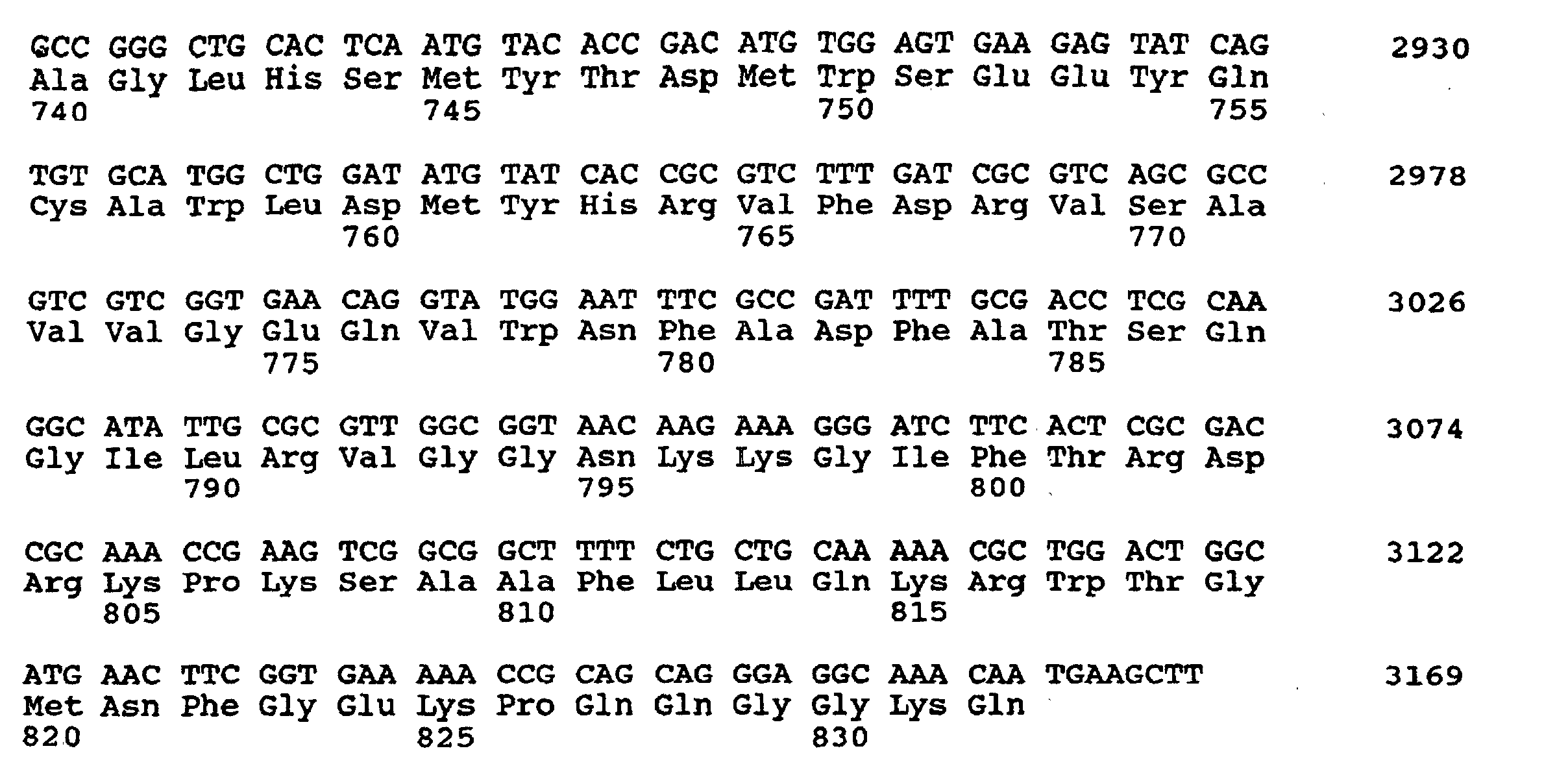
- the Escherichia coli ⁇ -glucuronidase is biochemically and genetically good examined.
- the gene (uid A) was developed by Jefferson et al. (PNAS Vol. 83, pp 8447 - 8451, 1986) cloned and used as a reporter gene for heterologous control regions.
- ⁇ -glucuronidase ( ⁇ -D-glucuroniside glucuronosohydrolase, E.C. 3.2.1.31) is an acidic hydrolase that catalyzes the cleavage of ⁇ -glucuronides. Because mammalian glucuronidases have been studied extensively, there are many Substances for histological, spectrophotometric and fluorometric Analyzes available. This enzyme has new, additional meaning in the Obtained use for fusion proteins for targeted tumor therapy. There , the human glucuronidase is in the form of a fusion protein with antibodies / antibody fragments or antigen binding regions used (Bosslet et al., Br.J. Cancer, 65, 234-238, 1992).
- E. coll- ⁇ -glucuronidase has the advantage that its catalytic activity in physiological pH is significantly higher than that of human ⁇ -glucuronidase.
- a fusion protein affinity-purified via anti-idiotype 400 ng of a fusion protein affinity-purified via anti-idiotype were obtained in 25 ⁇ l on a TSK Gel G 3000 SW XL column (TOSO HAAS, order no. 3.5WxN3211, 7.8 mm x 300 mm) in a suitable solvent (PBS, pH 7.2, 5 g / l maltose, 4.2 g / l arginine) with a flow rate of 0.5 ml / min. Chromatograph.
- a suitable solvent PBS, pH 7.2, 5 g / l maltose, 4.2 g / l arginine
Landscapes
- Health & Medical Sciences (AREA)
- Chemical & Material Sciences (AREA)
- Life Sciences & Earth Sciences (AREA)
- Genetics & Genomics (AREA)
- Organic Chemistry (AREA)
- Engineering & Computer Science (AREA)
- Zoology (AREA)
- Wood Science & Technology (AREA)
- Bioinformatics & Cheminformatics (AREA)
- Biochemistry (AREA)
- General Health & Medical Sciences (AREA)
- Molecular Biology (AREA)
- General Engineering & Computer Science (AREA)
- Biomedical Technology (AREA)
- Biotechnology (AREA)
- Medicinal Chemistry (AREA)
- Biophysics (AREA)
- Microbiology (AREA)
- Immunology (AREA)
- Proteomics, Peptides & Aminoacids (AREA)
- Physics & Mathematics (AREA)
- Plant Pathology (AREA)
- Peptides Or Proteins (AREA)
- Preparation Of Compounds By Using Micro-Organisms (AREA)
- Micro-Organisms Or Cultivation Processes Thereof (AREA)
- Medicines Containing Antibodies Or Antigens For Use As Internal Diagnostic Agents (AREA)
- Enzymes And Modification Thereof (AREA)
- Saccharide Compounds (AREA)
Description
| 1 : 2 | 1 : 4 | 1 : 8 | 1 : 16 | 1 : 32 | 1 : 64 | 1: 128 | 1: 256 | |
| FE Zellaufbruchsüberstand 1:3 | 8183 | 8149 | 7531 | 6631 | 4560 | 2509 | 1019 | 421,9 |
| FE Durchfluß 1:1 | 6548 | 5231 | 3222 | 1477 | 525,2 | 214 | 86,19 | 46,29 |
| FE Eluat pH 5,0 1:3 | 7782 | 7571 | 6360 | 4239 | 1983 | 815,7 | 302 | 113,9 |
| FE Eluat pH 5,0 Ultrakonzent, 1:10 | 7904 | 8106 | 8036 | 7153 | 5802 | 3618 | 1651 | 665,7 |
| FE Eluat pH 5,0 Ultrafiltrat 1:1 | 74,65 | 172,7 | 90,23 | 52,30 | 38,84 | 25,79 | 23,51 | 19,39 |
Antikoerperfragmenten und
Antikoerperfragmentfusionsmolekuelen in E. coli








Claims (4)
- Verfahren zur gentechnischen Expression von Antikörpern, Antikörperfragmenten oder Antikörperfragmentenzymfusionsmolekülen mit cytoplasmatischen Säuger- oder E. coil Enzymen als Fusionspartner, dadurch gekennzeichnet, daß Thioredoxinreduktase defiziente E. coli Stämme eingesetzt werden und die Expressionsprodukte aus dem Cytoplasma isoliert werden.
- Verfahren nach Anspruch 1, dadurch gekennzeichnet, daß Fab-Fragmente oder Antigenbinderegionen (sFv) exprimiert werden.
- Verfahren nach Anspruch 1, dadurch gekennzeichnet, daß das Antikörperfragmentenzymfusionsmolekül im Antikörper gegen Tumorzellen gerichtet ist und der Enzymteil in der Lage ist, untoxische "Prodrugs" in toxische "Drugs" zu spalten.
- Verfahren nach Anspruch 3, dadurch gekennzeichnet, daß der Antikörperteil humanisiert wurde und der Enzymteil ein humanes cytoplasmatisches Enzym ist.
Applications Claiming Priority (2)
| Application Number | Priority Date | Filing Date | Title |
|---|---|---|---|
| DE19513676 | 1995-04-11 | ||
| DE19513676A DE19513676A1 (de) | 1995-04-11 | 1995-04-11 | Cytoplasmatische Expression von Antikörpern, Antikörperfragmenten und Antikörperfragmentfusionsmolekülen in E.coli |
Publications (3)
| Publication Number | Publication Date |
|---|---|
| EP0737747A2 EP0737747A2 (de) | 1996-10-16 |
| EP0737747A3 EP0737747A3 (de) | 2001-03-28 |
| EP0737747B1 true EP0737747B1 (de) | 2003-06-11 |
Family
ID=7759450
Family Applications (1)
| Application Number | Title | Priority Date | Filing Date |
|---|---|---|---|
| EP96103913A Expired - Lifetime EP0737747B1 (de) | 1995-04-11 | 1996-03-13 | Cytoplasmatische Expression von Antikörpern, Antikörperfragmenten und Antikörperfragment-Fusionsmolekülen in E. coli |
Country Status (11)
| Country | Link |
|---|---|
| US (3) | US6008023A (de) |
| EP (1) | EP0737747B1 (de) |
| JP (1) | JPH08289794A (de) |
| KR (1) | KR960037833A (de) |
| AT (1) | ATE242808T1 (de) |
| AU (1) | AU713427B2 (de) |
| CA (1) | CA2173822C (de) |
| DE (2) | DE19513676A1 (de) |
| DK (1) | DK0737747T3 (de) |
| ES (1) | ES2203654T3 (de) |
| PT (1) | PT737747E (de) |
Families Citing this family (24)
| Publication number | Priority date | Publication date | Assignee | Title |
|---|---|---|---|---|
| EP1012280B1 (de) * | 1997-06-11 | 2004-11-10 | Borean Pharma A/S | Trimerisierendes modul |
| EP1131428A2 (de) * | 1998-11-19 | 2001-09-12 | Incyte Pharmaceuticals, Inc. | Proteine der immunoglobulin-superfamilie |
| US7396917B2 (en) | 2000-12-05 | 2008-07-08 | Alexion Pharmaceuticals, Inc. | Rationally designed antibodies |
| US20040253242A1 (en) * | 2000-12-05 | 2004-12-16 | Bowdish Katherine S. | Rationally designed antibodies |
| AU2002234001B2 (en) | 2000-12-05 | 2008-05-01 | Alexion Pharmaceuticals, Inc. | Rationally designed antibodies |
| US6979556B2 (en) * | 2000-12-14 | 2005-12-27 | Genentech, Inc. | Separate-cistron contructs for secretion of aglycosylated antibodies from prokaryotes |
| CN100513414C (zh) * | 2001-08-27 | 2009-07-15 | 杰南技术公司 | 进行抗体表达和装配的系统 |
| CN1164541C (zh) * | 2001-10-22 | 2004-09-01 | 中国石油化工股份有限公司 | 甲苯选择性歧化和甲苯与碳九及其以上芳烃歧化与烷基转移方法 |
| JP2005520569A (ja) * | 2002-03-23 | 2005-07-14 | リサーチ ディベロップメント ファンデーション | バクテリア内で複数のジスルフィド結合を有する蛋白質の分泌とその利用 |
| GB0224082D0 (en) | 2002-10-16 | 2002-11-27 | Celltech R&D Ltd | Biological products |
| EP1578447A4 (de) | 2002-10-31 | 2009-06-03 | Genentech Inc | Verfahren und zusammensetzungen zur erhöhung der antikörper-produktion |
| CA2513113A1 (en) * | 2003-01-23 | 2004-08-05 | Genentech, Inc. | Methods for producing humanized antibodies and improving yield of antibodies or antigen binding fragments in cell culture |
| JP2007537709A (ja) * | 2003-05-23 | 2007-12-27 | モーフオテク・インコーポレーテツド | 腫瘍抗原を特異的に結合するモノクローナル抗体 |
| AU2004273791A1 (en) * | 2003-09-05 | 2005-03-31 | Genentech, Inc. | Antibodies with altered effector functions |
| EP1716179A2 (de) * | 2004-02-12 | 2006-11-02 | Morphotek, Inc. | Monoklonaler antikörper spezifisch für den folatrezeptor alpha |
| CA2577082A1 (en) * | 2004-09-02 | 2006-03-16 | Genentech, Inc. | Heteromultimeric molecules |
| GB0425534D0 (en) | 2004-11-19 | 2004-12-22 | Celltech R&D Ltd | Process for obtaining antibodies |
| EP2322560B1 (de) * | 2005-03-10 | 2013-09-04 | Morphotek, Inc. | Anti-Mesothelin-Antikörper |
| JP2009521206A (ja) * | 2005-04-22 | 2009-06-04 | モルフォテック、インク. | 免疫エフェクター活性を有する葉酸受容体アルファ陽性細胞に内部移行する抗体 |
| HUE037162T2 (hu) | 2007-07-09 | 2018-08-28 | Genentech Inc | Diszulfidkötés redukciójának megelõzése polipeptidek rekombináns elõállítása során |
| US8388549B2 (en) * | 2008-12-29 | 2013-03-05 | St. Jude Medical, Atrial Fibrillation Division, Inc. | Anatomical thermal sensing device and method |
| US11352445B2 (en) | 2018-12-31 | 2022-06-07 | Jecho Laboratories Inc. | Method for preparing recombinant protein from bacterium and composition containing the same |
| JP2020130167A (ja) * | 2019-02-15 | 2020-08-31 | 国立大学法人宇都宮大学 | タンパク質の発現方法およびタンパク質発現用ベクター |
| CN113388631B (zh) * | 2020-03-12 | 2022-08-09 | 天津大学 | 一种高产IgG1的重组菌及构建方法 |
Family Cites Families (5)
| Publication number | Priority date | Publication date | Assignee | Title |
|---|---|---|---|---|
| DE4106389A1 (de) * | 1991-02-28 | 1992-09-03 | Behringwerke Ag | Fusionsproteine zur prodrug-aktivierung, ihre herstellung und verwendung |
| CA2116774C (en) * | 1991-09-19 | 2003-11-11 | Paul J. Carter | Expression in e. coli antibody fragments having at least a cysteine present as a free thiol. use for the production of bifunctional f(ab') 2 antibodies |
| WO1993022334A1 (en) * | 1992-05-04 | 1993-11-11 | Sri International | Pharmaceutical compositions and methods for colonic delivery of corticosteroids |
| DE4233152A1 (de) * | 1992-10-02 | 1994-04-07 | Behringwerke Ag | Antikörper-Enzym-Konjugate zur Prodrug-Aktivierung |
| DE4314556A1 (de) * | 1993-05-04 | 1994-11-10 | Behringwerke Ag | Modifizierte Antikörperenzymkonjugate und Fusionsproteine sowie ihre Anwendung zur tumorselektiven Therapie |
-
1995
- 1995-04-11 DE DE19513676A patent/DE19513676A1/de not_active Withdrawn
-
1996
- 1996-03-13 AT AT96103913T patent/ATE242808T1/de not_active IP Right Cessation
- 1996-03-13 ES ES96103913T patent/ES2203654T3/es not_active Expired - Lifetime
- 1996-03-13 PT PT96103913T patent/PT737747E/pt unknown
- 1996-03-13 DK DK96103913T patent/DK0737747T3/da active
- 1996-03-13 DE DE59610519T patent/DE59610519D1/de not_active Expired - Lifetime
- 1996-03-13 EP EP96103913A patent/EP0737747B1/de not_active Expired - Lifetime
- 1996-04-09 AU AU50537/96A patent/AU713427B2/en not_active Ceased
- 1996-04-10 JP JP8087788A patent/JPH08289794A/ja active Pending
- 1996-04-10 KR KR1019960010691A patent/KR960037833A/ko not_active Ceased
- 1996-04-10 US US08/630,820 patent/US6008023A/en not_active Expired - Lifetime
- 1996-04-10 CA CA002173822A patent/CA2173822C/en not_active Expired - Fee Related
-
1999
- 1999-03-22 US US09/273,453 patent/US6602688B1/en not_active Expired - Lifetime
-
2003
- 2003-08-04 US US10/632,815 patent/US7314753B2/en not_active Expired - Fee Related
Also Published As
| Publication number | Publication date |
|---|---|
| KR960037833A (ko) | 1996-11-19 |
| JPH08289794A (ja) | 1996-11-05 |
| US6602688B1 (en) | 2003-08-05 |
| US6008023A (en) | 1999-12-28 |
| PT737747E (pt) | 2003-10-31 |
| ATE242808T1 (de) | 2003-06-15 |
| CA2173822C (en) | 2009-06-23 |
| DE59610519D1 (de) | 2003-07-17 |
| US20050100984A1 (en) | 2005-05-12 |
| AU713427B2 (en) | 1999-12-02 |
| ES2203654T3 (es) | 2004-04-16 |
| AU5053796A (en) | 1996-10-24 |
| DE19513676A1 (de) | 1996-10-17 |
| EP0737747A2 (de) | 1996-10-16 |
| EP0737747A3 (de) | 2001-03-28 |
| US7314753B2 (en) | 2008-01-01 |
| DK0737747T3 (da) | 2003-09-22 |
| CA2173822A1 (en) | 1996-10-12 |
Similar Documents
| Publication | Publication Date | Title |
|---|---|---|
| EP0737747A2 (de) | Cytoplasmatische Expression von Antikörpern, Antikörperfragmenten und Antikörperfragment-Fusionsmolekülen in E. coli | |
| DE69233008T2 (de) | Fusionierung von Peptiden und Proteinen mit Thioredoxin und thioredoxin-ähnlichen Molekülen | |
| EP0602688B1 (de) | Methioninfreier G-CSF aus Prokaryonten | |
| US5235043A (en) | Production of biologically active, recombinant members of the ngf/bdnf family of neurotrophic proteins | |
| US5004686A (en) | Process for producing human epidermal growth factor and analogs thereof | |
| EP0324162B1 (de) | Verfahren zur gentechnischen Herstellung von Antikörpern | |
| DD210071A5 (de) | Verfahren zur herstellung einer lebensfaehigen kultur | |
| EP0440147A2 (de) | Herstellung und Verwendung von Genbanken menschlicher Antikörper ("Human-Antikörper-Bibliotheken") | |
| EP0510658A2 (de) | Verbesserung der Ausbeute bei der Sekretion von disulfidverbrückten Proteinen | |
| SU1720493A3 (ru) | Способ получени штамма SтRертососсUS SaNGUIS, способного секретировать @ -1,3-глюкан-3-глюканогидролазу | |
| AT400443B (de) | Menschliche mangan-superoxiddismutase cdna, ihre expression in bakterien und verfahren zur gewinnung enzymatisch aktiver, menschlicher mangan-superoxiddismutase | |
| EP0297291A2 (de) | Äusseres Membranprotein F von Pseudomonas aeruginosa | |
| US5218093A (en) | EGF variants and pharmaceutical use thereof | |
| JPS62278986A (ja) | ハイブリツドポリペプチド | |
| EP0501215A2 (de) | Monoklonalantikörper, Linker- und Beta-Glucuronidase enthaltende Fusionsproteine zur Prodrug-Aktivierung, ihre Herstellung und Verwendung | |
| US5015574A (en) | DNA sequence involved in gene expression and protein secretion, expression-secretion vector including the DNA sequence and the method of producing proteins by using the expression-secretion vector | |
| DE3687112T2 (de) | Verfahren zur ausscheidung von genprodukten in das wachstumsmedium von gram-negativen bakterien. | |
| DE3587205T2 (de) | Verfahren zur herstellung eines proteins und dafuer zu verwendender vektor, rekombinante dns und transformierte zelle. | |
| DE69430898T2 (de) | Enzymatische Umsetzung von Proteinen unter Verwendung immobilisierter Dipeptidylaminopeptidase aus Dictyostelium | |
| EP1169461B1 (de) | Verwendung von pankreatischer Procarboxypeptidase B zur Herstellung von Insulin | |
| DE69521281T2 (de) | Verfahren zur Herstellung von menschlichem oder humanem Matrilysin mittels rekombinanter DNA. | |
| DE3910084A1 (de) | Polypeptide mit wachstumsfaktor-aktivitaet und nukleinsaeuresequenzen | |
| EP0393039A1 (de) | Verfahren zur herstellung von peptiden durch spezifische spaltung von gentechnisch gewonnenen fusionsproteinen mit collagenasen | |
| JPS61128889A (ja) | 組換えdna及び該dnaによる形質転換体 | |
| DE10100305B4 (de) | Knorpelzellmarker, Verfahren sowie Verwendungen desselben |
Legal Events
| Date | Code | Title | Description |
|---|---|---|---|
| PUAI | Public reference made under article 153(3) epc to a published international application that has entered the european phase |
Free format text: ORIGINAL CODE: 0009012 |
|
| AK | Designated contracting states |
Kind code of ref document: A2 Designated state(s): AT BE CH DE DK ES FR GB GR IE IT LI LU NL PT SE |
|
| PUAL | Search report despatched |
Free format text: ORIGINAL CODE: 0009013 |
|
| AK | Designated contracting states |
Kind code of ref document: A3 Designated state(s): AT BE CH DE DK ES FR GB GR IE IT LI LU NL PT SE |
|
| 17P | Request for examination filed |
Effective date: 20010928 |
|
| 17Q | First examination report despatched |
Effective date: 20020222 |
|
| GRAH | Despatch of communication of intention to grant a patent |
Free format text: ORIGINAL CODE: EPIDOS IGRA |
|
| GRAH | Despatch of communication of intention to grant a patent |
Free format text: ORIGINAL CODE: EPIDOS IGRA |
|
| GRAA | (expected) grant |
Free format text: ORIGINAL CODE: 0009210 |
|
| RAP1 | Party data changed (applicant data changed or rights of an application transferred) |
Owner name: HOECHST AKTIENGESELLSCHAFT |
|
| AK | Designated contracting states |
Designated state(s): AT BE CH DE DK ES FR GB GR IE IT LI LU NL PT SE |
|
| REG | Reference to a national code |
Ref country code: GB Ref legal event code: FG4D Free format text: NOT ENGLISH |
|
| REG | Reference to a national code |
Ref country code: CH Ref legal event code: EP |
|
| REG | Reference to a national code |
Ref country code: IE Ref legal event code: FG4D Free format text: GERMAN |
|
| REF | Corresponds to: |
Ref document number: 59610519 Country of ref document: DE Date of ref document: 20030717 Kind code of ref document: P |
|
| REG | Reference to a national code |
Ref country code: DK Ref legal event code: T3 |
|
| REG | Reference to a national code |
Ref country code: SE Ref legal event code: TRGR |
|
| REG | Reference to a national code |
Ref country code: GR Ref legal event code: EP Ref document number: 20030403514 Country of ref document: GR |
|
| GBT | Gb: translation of ep patent filed (gb section 77(6)(a)/1977) |
Effective date: 20031014 |
|
| ET | Fr: translation filed | ||
| PG25 | Lapsed in a contracting state [announced via postgrant information from national office to epo] |
Ref country code: LU Free format text: LAPSE BECAUSE OF NON-PAYMENT OF DUE FEES Effective date: 20040313 Ref country code: AT Free format text: LAPSE BECAUSE OF NON-PAYMENT OF DUE FEES Effective date: 20040313 |
|
| PG25 | Lapsed in a contracting state [announced via postgrant information from national office to epo] |
Ref country code: SE Free format text: LAPSE BECAUSE OF NON-PAYMENT OF DUE FEES Effective date: 20040314 |
|
| PG25 | Lapsed in a contracting state [announced via postgrant information from national office to epo] |
Ref country code: IE Free format text: LAPSE BECAUSE OF NON-PAYMENT OF DUE FEES Effective date: 20040315 |
|
| PG25 | Lapsed in a contracting state [announced via postgrant information from national office to epo] |
Ref country code: LI Free format text: LAPSE BECAUSE OF NON-PAYMENT OF DUE FEES Effective date: 20040331 Ref country code: DK Free format text: LAPSE BECAUSE OF NON-PAYMENT OF DUE FEES Effective date: 20040331 Ref country code: CH Free format text: LAPSE BECAUSE OF NON-PAYMENT OF DUE FEES Effective date: 20040331 Ref country code: BE Free format text: LAPSE BECAUSE OF NON-PAYMENT OF DUE FEES Effective date: 20040331 |
|
| PLBE | No opposition filed within time limit |
Free format text: ORIGINAL CODE: 0009261 |
|
| REG | Reference to a national code |
Ref country code: ES Ref legal event code: FG2A Ref document number: 2203654 Country of ref document: ES Kind code of ref document: T3 |
|
| STAA | Information on the status of an ep patent application or granted ep patent |
Free format text: STATUS: NO OPPOSITION FILED WITHIN TIME LIMIT |
|
| 26N | No opposition filed |
Effective date: 20040312 |
|
| BERE | Be: lapsed |
Owner name: *HOECHST A.G. Effective date: 20040331 |
|
| PG25 | Lapsed in a contracting state [announced via postgrant information from national office to epo] |
Ref country code: NL Free format text: LAPSE BECAUSE OF NON-PAYMENT OF DUE FEES Effective date: 20041001 |
|
| PG25 | Lapsed in a contracting state [announced via postgrant information from national office to epo] |
Ref country code: GR Free format text: LAPSE BECAUSE OF NON-PAYMENT OF DUE FEES Effective date: 20041006 |
|
| PG25 | Lapsed in a contracting state [announced via postgrant information from national office to epo] |
Ref country code: PT Free format text: LAPSE BECAUSE OF NON-PAYMENT OF DUE FEES Effective date: 20041015 |
|
| EUG | Se: european patent has lapsed | ||
| REG | Reference to a national code |
Ref country code: CH Ref legal event code: PL |
|
| REG | Reference to a national code |
Ref country code: PT Ref legal event code: MM4A Free format text: LAPSE DUE TO NON-PAYMENT OF FEES Effective date: 20040930 |
|
| NLV4 | Nl: lapsed or anulled due to non-payment of the annual fee |
Effective date: 20041001 |
|
| REG | Reference to a national code |
Ref country code: IE Ref legal event code: MM4A |
|
| PG25 | Lapsed in a contracting state [announced via postgrant information from national office to epo] |
Ref country code: PT Free format text: LAPSE BECAUSE OF NON-PAYMENT OF DUE FEES Effective date: 20040313 |
|
| PGFP | Annual fee paid to national office [announced via postgrant information from national office to epo] |
Ref country code: IT Payment date: 20140306 Year of fee payment: 19 Ref country code: FR Payment date: 20140311 Year of fee payment: 19 Ref country code: ES Payment date: 20140211 Year of fee payment: 19 |
|
| PGFP | Annual fee paid to national office [announced via postgrant information from national office to epo] |
Ref country code: GB Payment date: 20140312 Year of fee payment: 19 |
|
| PGFP | Annual fee paid to national office [announced via postgrant information from national office to epo] |
Ref country code: DE Payment date: 20140417 Year of fee payment: 19 |
|
| REG | Reference to a national code |
Ref country code: DE Ref legal event code: R119 Ref document number: 59610519 Country of ref document: DE |
|
| GBPC | Gb: european patent ceased through non-payment of renewal fee |
Effective date: 20150313 |
|
| PG25 | Lapsed in a contracting state [announced via postgrant information from national office to epo] |
Ref country code: IT Free format text: LAPSE BECAUSE OF NON-PAYMENT OF DUE FEES Effective date: 20150313 |
|
| REG | Reference to a national code |
Ref country code: FR Ref legal event code: ST Effective date: 20151130 |
|
| PG25 | Lapsed in a contracting state [announced via postgrant information from national office to epo] |
Ref country code: GB Free format text: LAPSE BECAUSE OF NON-PAYMENT OF DUE FEES Effective date: 20150313 Ref country code: DE Free format text: LAPSE BECAUSE OF NON-PAYMENT OF DUE FEES Effective date: 20151001 |
|
| PG25 | Lapsed in a contracting state [announced via postgrant information from national office to epo] |
Ref country code: FR Free format text: LAPSE BECAUSE OF NON-PAYMENT OF DUE FEES Effective date: 20150331 |
|
| REG | Reference to a national code |
Ref country code: ES Ref legal event code: FD2A Effective date: 20160427 |
|
| PG25 | Lapsed in a contracting state [announced via postgrant information from national office to epo] |
Ref country code: ES Free format text: LAPSE BECAUSE OF NON-PAYMENT OF DUE FEES Effective date: 20150314 |