EP0440147A2 - Herstellung und Verwendung von Genbanken menschlicher Antikörper ("Human-Antikörper-Bibliotheken") - Google Patents
Herstellung und Verwendung von Genbanken menschlicher Antikörper ("Human-Antikörper-Bibliotheken") Download PDFInfo
- Publication number
- EP0440147A2 EP0440147A2 EP91101095A EP91101095A EP0440147A2 EP 0440147 A2 EP0440147 A2 EP 0440147A2 EP 91101095 A EP91101095 A EP 91101095A EP 91101095 A EP91101095 A EP 91101095A EP 0440147 A2 EP0440147 A2 EP 0440147A2
- Authority
- EP
- European Patent Office
- Prior art keywords
- human
- antibody
- cdna
- expression
- antibodies
- Prior art date
- Legal status (The legal status is an assumption and is not a legal conclusion. Google has not performed a legal analysis and makes no representation as to the accuracy of the status listed.)
- Granted
Links
Images

Classifications
-
- C—CHEMISTRY; METALLURGY
- C12—BIOCHEMISTRY; BEER; SPIRITS; WINE; VINEGAR; MICROBIOLOGY; ENZYMOLOGY; MUTATION OR GENETIC ENGINEERING
- C12N—MICROORGANISMS OR ENZYMES; COMPOSITIONS THEREOF; PROPAGATING, PRESERVING, OR MAINTAINING MICROORGANISMS; MUTATION OR GENETIC ENGINEERING; CULTURE MEDIA
- C12N15/00—Mutation or genetic engineering; DNA or RNA concerning genetic engineering, vectors, e.g. plasmids, or their isolation, preparation or purification; Use of hosts therefor
- C12N15/09—Recombinant DNA-technology
- C12N15/10—Processes for the isolation, preparation or purification of DNA or RNA
- C12N15/1034—Isolating an individual clone by screening libraries
- C12N15/1093—General methods of preparing gene libraries, not provided for in other subgroups
-
- C—CHEMISTRY; METALLURGY
- C12—BIOCHEMISTRY; BEER; SPIRITS; WINE; VINEGAR; MICROBIOLOGY; ENZYMOLOGY; MUTATION OR GENETIC ENGINEERING
- C12N—MICROORGANISMS OR ENZYMES; COMPOSITIONS THEREOF; PROPAGATING, PRESERVING, OR MAINTAINING MICROORGANISMS; MUTATION OR GENETIC ENGINEERING; CULTURE MEDIA
- C12N15/00—Mutation or genetic engineering; DNA or RNA concerning genetic engineering, vectors, e.g. plasmids, or their isolation, preparation or purification; Use of hosts therefor
- C12N15/09—Recombinant DNA-technology
- C12N15/11—DNA or RNA fragments; Modified forms thereof; Non-coding nucleic acids having a biological activity
-
- C—CHEMISTRY; METALLURGY
- C07—ORGANIC CHEMISTRY
- C07K—PEPTIDES
- C07K16/00—Immunoglobulins [IG], e.g. monoclonal or polyclonal antibodies
-
- C—CHEMISTRY; METALLURGY
- C07—ORGANIC CHEMISTRY
- C07K—PEPTIDES
- C07K16/00—Immunoglobulins [IG], e.g. monoclonal or polyclonal antibodies
- C07K16/44—Immunoglobulins [IG], e.g. monoclonal or polyclonal antibodies against material not provided for elsewhere, e.g. haptens, metals, DNA, RNA, amino acids
-
- C—CHEMISTRY; METALLURGY
- C07—ORGANIC CHEMISTRY
- C07K—PEPTIDES
- C07K7/00—Peptides having 5 to 20 amino acids in a fully defined sequence; Derivatives thereof
- C07K7/04—Linear peptides containing only normal peptide links
- C07K7/06—Linear peptides containing only normal peptide links having 5 to 11 amino acids
-
- C—CHEMISTRY; METALLURGY
- C12—BIOCHEMISTRY; BEER; SPIRITS; WINE; VINEGAR; MICROBIOLOGY; ENZYMOLOGY; MUTATION OR GENETIC ENGINEERING
- C12N—MICROORGANISMS OR ENZYMES; COMPOSITIONS THEREOF; PROPAGATING, PRESERVING, OR MAINTAINING MICROORGANISMS; MUTATION OR GENETIC ENGINEERING; CULTURE MEDIA
- C12N15/00—Mutation or genetic engineering; DNA or RNA concerning genetic engineering, vectors, e.g. plasmids, or their isolation, preparation or purification; Use of hosts therefor
- C12N15/09—Recombinant DNA-technology
- C12N15/63—Introduction of foreign genetic material using vectors; Vectors; Use of hosts therefor; Regulation of expression
- C12N15/65—Introduction of foreign genetic material using vectors; Vectors; Use of hosts therefor; Regulation of expression using markers
-
- C—CHEMISTRY; METALLURGY
- C12—BIOCHEMISTRY; BEER; SPIRITS; WINE; VINEGAR; MICROBIOLOGY; ENZYMOLOGY; MUTATION OR GENETIC ENGINEERING
- C12N—MICROORGANISMS OR ENZYMES; COMPOSITIONS THEREOF; PROPAGATING, PRESERVING, OR MAINTAINING MICROORGANISMS; MUTATION OR GENETIC ENGINEERING; CULTURE MEDIA
- C12N15/00—Mutation or genetic engineering; DNA or RNA concerning genetic engineering, vectors, e.g. plasmids, or their isolation, preparation or purification; Use of hosts therefor
- C12N15/09—Recombinant DNA-technology
- C12N15/63—Introduction of foreign genetic material using vectors; Vectors; Use of hosts therefor; Regulation of expression
- C12N15/70—Vectors or expression systems specially adapted for E. coli
-
- C—CHEMISTRY; METALLURGY
- C12—BIOCHEMISTRY; BEER; SPIRITS; WINE; VINEGAR; MICROBIOLOGY; ENZYMOLOGY; MUTATION OR GENETIC ENGINEERING
- C12N—MICROORGANISMS OR ENZYMES; COMPOSITIONS THEREOF; PROPAGATING, PRESERVING, OR MAINTAINING MICROORGANISMS; MUTATION OR GENETIC ENGINEERING; CULTURE MEDIA
- C12N9/00—Enzymes; Proenzymes; Compositions thereof; Processes for preparing, activating, inhibiting, separating or purifying enzymes
- C12N9/88—Lyases (4.)
-
- C—CHEMISTRY; METALLURGY
- C40—COMBINATORIAL TECHNOLOGY
- C40B—COMBINATORIAL CHEMISTRY; LIBRARIES, e.g. CHEMICAL LIBRARIES
- C40B30/00—Methods of screening libraries
- C40B30/04—Methods of screening libraries by measuring the ability to specifically bind a target molecule, e.g. antibody-antigen binding, receptor-ligand binding
-
- G—PHYSICS
- G01—MEASURING; TESTING
- G01N—INVESTIGATING OR ANALYSING MATERIALS BY DETERMINING THEIR CHEMICAL OR PHYSICAL PROPERTIES
- G01N33/00—Investigating or analysing materials by specific methods not covered by groups G01N1/00 - G01N31/00
- G01N33/48—Biological material, e.g. blood, urine; Haemocytometers
- G01N33/50—Chemical analysis of biological material, e.g. blood, urine; Testing involving biospecific ligand binding methods; Immunological testing
- G01N33/53—Immunoassay; Biospecific binding assay; Materials therefor
- G01N33/531—Production of immunochemical test materials
-
- G—PHYSICS
- G01—MEASURING; TESTING
- G01N—INVESTIGATING OR ANALYSING MATERIALS BY DETERMINING THEIR CHEMICAL OR PHYSICAL PROPERTIES
- G01N33/00—Investigating or analysing materials by specific methods not covered by groups G01N1/00 - G01N31/00
- G01N33/48—Biological material, e.g. blood, urine; Haemocytometers
- G01N33/50—Chemical analysis of biological material, e.g. blood, urine; Testing involving biospecific ligand binding methods; Immunological testing
- G01N33/68—Chemical analysis of biological material, e.g. blood, urine; Testing involving biospecific ligand binding methods; Immunological testing involving proteins, peptides or amino acids
- G01N33/6803—General methods of protein analysis not limited to specific proteins or families of proteins
- G01N33/6845—Methods of identifying protein-protein interactions in protein mixtures
-
- G—PHYSICS
- G01—MEASURING; TESTING
- G01N—INVESTIGATING OR ANALYSING MATERIALS BY DETERMINING THEIR CHEMICAL OR PHYSICAL PROPERTIES
- G01N33/00—Investigating or analysing materials by specific methods not covered by groups G01N1/00 - G01N31/00
- G01N33/48—Biological material, e.g. blood, urine; Haemocytometers
- G01N33/50—Chemical analysis of biological material, e.g. blood, urine; Testing involving biospecific ligand binding methods; Immunological testing
- G01N33/68—Chemical analysis of biological material, e.g. blood, urine; Testing involving biospecific ligand binding methods; Immunological testing involving proteins, peptides or amino acids
- G01N33/6854—Immunoglobulins
- G01N33/6857—Antibody fragments
-
- C—CHEMISTRY; METALLURGY
- C07—ORGANIC CHEMISTRY
- C07K—PEPTIDES
- C07K2317/00—Immunoglobulins specific features
- C07K2317/20—Immunoglobulins specific features characterized by taxonomic origin
- C07K2317/21—Immunoglobulins specific features characterized by taxonomic origin from primates, e.g. man
-
- C—CHEMISTRY; METALLURGY
- C07—ORGANIC CHEMISTRY
- C07K—PEPTIDES
- C07K2319/00—Fusion polypeptide
-
- C—CHEMISTRY; METALLURGY
- C07—ORGANIC CHEMISTRY
- C07K—PEPTIDES
- C07K2319/00—Fusion polypeptide
- C07K2319/01—Fusion polypeptide containing a localisation/targetting motif
- C07K2319/02—Fusion polypeptide containing a localisation/targetting motif containing a signal sequence
Definitions
- the invention relates to the production and use of gene banks of human antibodies (AK).
- AK human antibodies
- mRNA is translated into cDNA using oligo-dT primers.
- the AK-specific cDNA is then amplified using a polymerase chain reaction (PCR, polymerase chain reaction) using suitable oligonucleotide primer sequences.
- PCR polymerase chain reaction
- oligonucleotide primer sequences oligonucleotide primer sequences.
- the human or mammalian immune system has between 106 and 108 different antibodies. This number of antibodies is sufficient to elicit an immune response from the body against all naturally occurring antigens as well as against artificial antigens. If you also consider that often several antibodies react with the same antigen, the repertoire of really different antibodies will tend to be in the range 106 to 107.
- specific antibodies have always been obtained from immunization with the respective antigen, for example injection of the antigen into the organism or incubation of spleen cells in vitro with this antigen.
- the immunoglobulins can then be isolated from the serum and the specific antibodies can be obtained therefrom, for example by absorption processes.
- Monoclonal antibodies are bwz. isolated from the cell lysate of cloned spleen tumor cells (hybridoma cells) fused with individual B lymphocytes. The methods described above are particularly unsuitable for the production of specific human antibodies or human monoclonal antibodies.
- the object of the present invention was therefore to develop a generally viable method for producing specific human monoclonal antibodies (huMAK's) or antibody parts which contain the antigen binding site.
- huMAKs sought or their parts which contain the variable, antigen-binding domain can be isolated from gene banks of human immunogloblins.
- oligo-dT primers A specific amplification of the population of antibody cDNAs within the cDNA pool obtained was achieved using PCR.
- certain oligonucleotide "primers" were used which are homologous to conserved sequences at both ends of the antibody cDNA (see below and examples).
- the design of the primers for the reverse reaction for the synthesis of the non-coding strand of the heavy chain DNA is based on IgM sequences (Subclass III, since this comprises the most IgM sequences).
- IgM molecules are more frequently represented in non-activated B lymphocytes than all other classes of immunoglobulins.
- IgG sequences predominate in activated B lymphocytes, whose repertoire of different antibodies is much smaller. In the case of an IgG library, there is also the risk that one or a few particularly strongly expressed IgG dominate the library.
- the oligonucleotide "primers” contain suitable restriction sites to e.g. insert into the antibody expression plasmid pFMT (see below).
- This expression plasmid enables the expression of antibody cDNA and subsequent secretion of the expression products in bacteria (E. coli).
- the plasmid's antibody operon contains the sequences of the variable parts of both the heavy and light chains of an antibody.
- Suitable "leader" sequences from the amino-terminal part of a bacterial protein enable the antibody parts to be secreted.
- the "leader” sequences are cleaved off by a bacterial enzyme.
- primer sequences are used which are homologous to sequences in the constant domains of IgM cDNA. This is the best way to implement the invention, i.e. to make a very large variety of antibodies, namely the entire antibody repertoire, available in the form of a library. Expression in preferably E. coli then results in the searched human antibody library in which the searched human antibodies or antibody parts are found by screening bacterial clones with the antigen of choice.
- Suitable oligonucleotide primers for amplification are listed in Table 1. The positions of the aforementioned primers on the ⁇ , kappa and lambda chain are shown schematically in Table 2.
- the invention consequently relates to human-antibody libraries, produced by transcription of the mRNA from non-activated (peripheral) human B-lymphocytes by means of oligo-dT primer, subsequent amplification by PCR using primers containing sequences homologous to conserved regions of IgM- cDNA and subsequent incorporation in suitable expression plasmids for expression in microorganisms, preferably in the expression vector pFMT for expression in E. coli.
- a sequence is additionally incorporated which codes for a marker peptide, e.g. a "TAG" sequence so that the expression products with established monoclonal antibodies against the marker peptide (Wehland et al., (1984), EMBO J. 3, 1295) can be detected in a simple manner.
- the invention further encompasses the use of the above human antibody libraries for the isolation of sought-after human antibodies or antibody parts with a functional antigen binding site by "screening" with selected antigens, as well as methods for isolating said human antibodies or their antigen-binding parts and also methods for producing the called human antibody libraries.
- the invention also includes expression vectors with the properties of the antibody expression plasmid pFMT.
- the plasmid pKK233-2 (Amann and Brosius, (1985) Gene 40, 183 and Straus and Gilbert, (1985) Proc. Natl. Acad. Sci. 82, 2014) was chosen as the base vector for the construction of the antibody expression vector (FIG . 1).
- the plasmid was cut with SalI and BamHI, the ends were filled in with Klenow polymerase and ligated. This removed these two restriction sites and the DNA in between.
- the plasmid was cleaved with HindIII, the ends filled in with the Klenow polymerase and ligated with BamHI linkers. This operation removed the HindIII restriction site and inserted a BamHI site.
- the antibody DNA was inserted into this modified plasmid.
- a schematic construction pathway of the antibody operon, which codes for a bicistronic antibody mRNA, is shown in Table 3.
- the "leader" sequence of the bacterial enzyme pectate lyase was used.
- the "leader” sequence of this enzyme is already for the expression and secretion of a chimeric mouse-human antibody (Fab fragment, Better et al., Loc. Cit.) And the variable part of a "humanized” antibody (Ward et al., Loc. Cit ; Huse et al., Loc. Cit.).
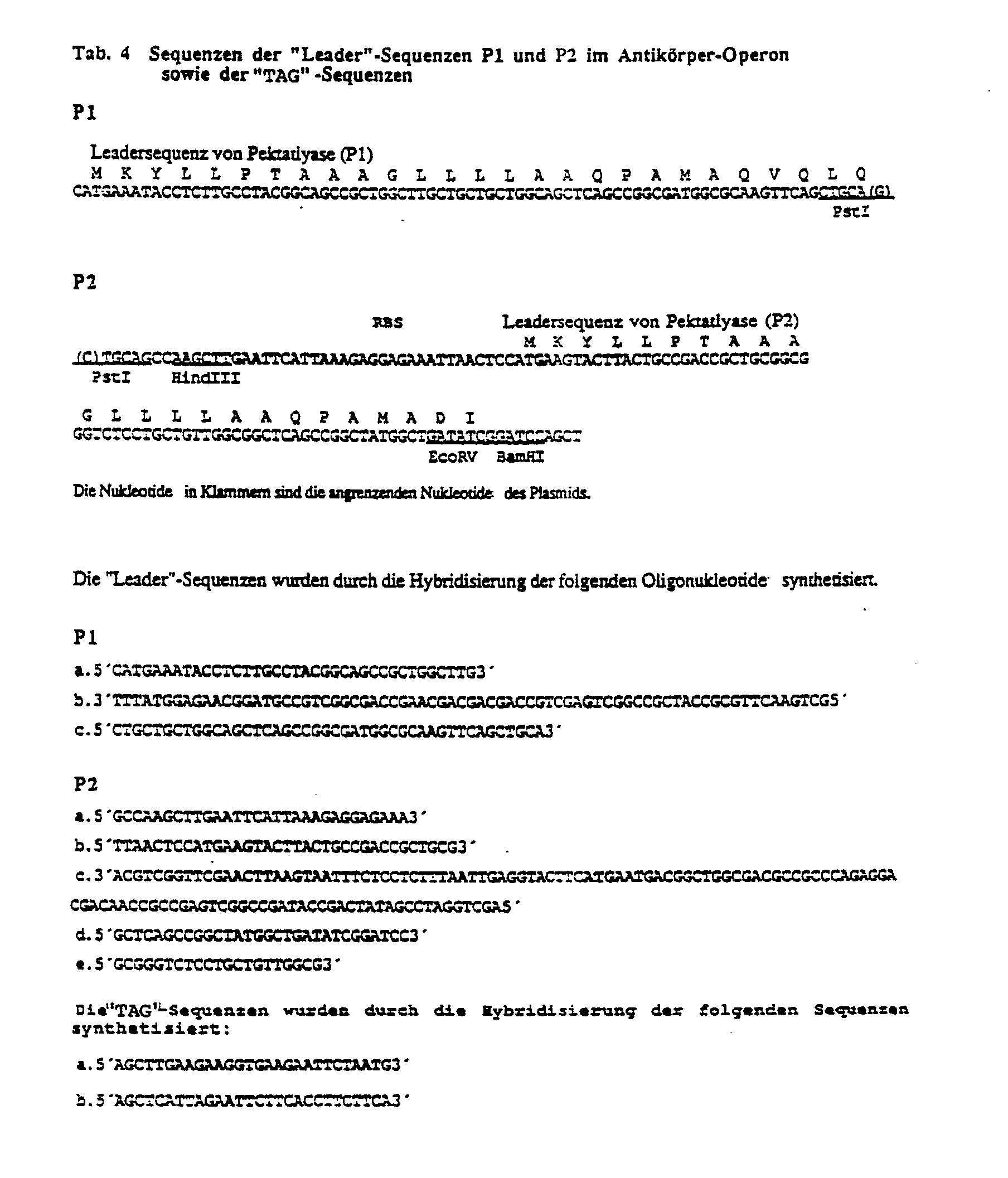
- DNA for the first "leader” sequence (P1 before the heavy chain) and the sequence for a second ribosome binding site (RBS) and a second "leader” sequence (P2 before the light chain) were synthesized from several oligonucleotides (Tab. 4) .
- Antibody cDNAs coding for the variable regions of the heavy and light chains of a human antibody were developed by Dr. G. Winter (Cambridge, UK). Restriction sites HindIII (HuVhlys) and EcoRV (HuVllys) were introduced to allow insertion of the antibody cDNA into the expression vector. Further restriction sites for BanII (HuVhlys) and BstEII or KpnI (HuVllys) were introduced to exchange hypervariable areas "en bloc". A stop signal was inserted at the end of the Huvhlys cDNA sequence.
- the modified plasmid pKK233-2 was digested with the restriction enzymes NcoI and PstI and P1 inserted between these sites (pKK233-2-P1). Further cloning steps up to the last step were undertaken with the plasmid pUC18. The reason is that the presence of individual parts of the antibody operon in the expression vector affects the growth of the bacterial host.
- a "TAG” sequence was ligated into the new Hind III site (Table 4).
- the "TAG” sequence encodes the peptide Glu-Glu-Gly-Glu-Glu-Phe and is recognized by the monoclonal antibody YL 1/2 (Wehland et al. (1984) EMBO J. 3, 1295).
- the resulting plasmid is pUC-HTP2L.
- peripheral B cells from human blood
- the adherent cells (monocytes and macrophages) adhere to the culture vessel and could thus be removed from the preparation be removed.
- the non-adherent cells were collected by centrifugation and homogenized in 4.4 M guanidinium isothiocyanate, 5% mercaptoethanol and 2% lauroylsarcosine. The homogenate was then centrifuged over a 5.7 M cushion of CsCl for 18 hours at 125000 g. The sedimented RNA was in bidist. H2O dissolved and precipitated with 70% ethanol and 1/20 vol. 8M LiCl at -20 ° C overnight.
- RNA preparations of 500 ml of the blood of 20 different people were mixed.
- mRNA was purified via oligo-dT-Sepharose (kit from Pharmacia) and translated into cDNA with reverse transcriptase (kit from Amersham) and oligo-dT primer.
- the products were used directly in the "polymerase chain reaction” (PCR).
- PCR primers and hybridization sites are shown in Tab. 1 and 2 respectively.
- the use of different primers for the synthesis of the non-coding strands in the "polymerase chain reaction” enables the production of two different types of antibodies, which in one case contain only the variable domain and in the other case additionally contain a constant domain (the Fab Fragment of an antibody similar).
- 4 ul of a cDNA synthesis with 0.2 nmol each of the two primers in a volume of 50 ul were implemented.
- the reaction mixture contained 100 mM KCl, 0.1% gelatin and 2.5 U Taq polymerase. To 30 polymerization cycles, consisting of 1 min. 95 ° C, 2 min. 55 ° C and 2 min. 72 ° C, the DNA was precipitated with ethanol.
- the precipitated DNA was taken up in loading buffer for agarose gels (0.1% bromophenol blue, 7% Ficoll R [Pharmacia]) and separated over 2% agarose at 10V / cm in TBE buffer (45 mM Tris-borate pH 8.0, 10 mM EDTA).
- the synthesized antibody DNA was identified by its molecular weight and eluted from the gel. After precipitation with ethanol, it was taken up in buffer for the respective restriction enzymes and cut with the corresponding (see Tables 1 and 2) restriction enzymes (Boehringer Mannheim). After precipitation in ethanol, it was ligated into the similarly cut vector pFMT, as shown schematically in Table 7.
- Competent E. coli are transfected with pFMT plasmids which contain the inserted antibody DNA library, grown on agarose plates and then incubated with nitrocellulose filters which are coated with the antigen sought. After removal of non-specifically bound antibodies, the active clones are identified with a labeled antibody against the human immunoglobulins secreted from E. coli.
- the monoclonal antibody YL 1/2 which is directed against the "TAG" sequence is used to identify the clones sought.
Landscapes
- Health & Medical Sciences (AREA)
- Life Sciences & Earth Sciences (AREA)
- Chemical & Material Sciences (AREA)
- Engineering & Computer Science (AREA)
- Genetics & Genomics (AREA)
- Organic Chemistry (AREA)
- Molecular Biology (AREA)
- Biomedical Technology (AREA)
- Immunology (AREA)
- Biochemistry (AREA)
- General Health & Medical Sciences (AREA)
- Biotechnology (AREA)
- Bioinformatics & Cheminformatics (AREA)
- Zoology (AREA)
- Wood Science & Technology (AREA)
- General Engineering & Computer Science (AREA)
- Medicinal Chemistry (AREA)
- Physics & Mathematics (AREA)
- Microbiology (AREA)
- Biophysics (AREA)
- Urology & Nephrology (AREA)
- Hematology (AREA)
- Proteomics, Peptides & Aminoacids (AREA)
- Plant Pathology (AREA)
- Pathology (AREA)
- General Physics & Mathematics (AREA)
- Food Science & Technology (AREA)
- Cell Biology (AREA)
- Analytical Chemistry (AREA)
- Bioinformatics & Computational Biology (AREA)
- Chemical Kinetics & Catalysis (AREA)
- Crystallography & Structural Chemistry (AREA)
- General Chemical & Material Sciences (AREA)
- Preparation Of Compounds By Using Micro-Organisms (AREA)
- Peptides Or Proteins (AREA)
- Medicines Containing Antibodies Or Antigens For Use As Internal Diagnostic Agents (AREA)
- Measuring Or Testing Involving Enzymes Or Micro-Organisms (AREA)
- Micro-Organisms Or Cultivation Processes Thereof (AREA)
Abstract
Description
- Die Erfindung betrifft die Herstellung und Verwendung von Genbanken menschlicher Antikörper (AK). Ausgehend von einem Gemisch humaner B-Lymphozyten wird deren mRNA, unter Verwendung von Oligo-dT-Primern in cDNA übersetzt. Anschließend findet eine Amplifikation der AK-spezifischen cDNA mittels Polymerase-Ketten Reaktion (PCR, Polymerase Chain Reaction) unter Einsatz von geeigneten Oligonukleotid-Primersequenzen statt. Durch Expression dieser amplifizierten AK-spezifischen cDNA in einem bakteriellen Expressionsvektor, z.B. dem nachstehend beschriebenen Vektor pFMT, in E.coli, steht somit eine Human-Antikörper-Bibliothek mit einem umfassenden Repertoire zum Durchprüfen ("Screenen") mit ausgewählten Antigenen in vitro zur Verfügung.
- Es wird geschätzt, daß das Immunsystem des Menschen bzw. eines Säugetiers zwischen 10⁶ und 10⁸ verschiedene Antikörper besitzt. Diese Zahl von Antikörpern reicht aus, um eine Immunreaktion des Körpers sowohl gegen sämtliche in der Natur vorkommende Antigene als auch gegen künstliche Antigene hervorzurufen. Wenn man weiterhin in Betracht zieht, daß oft mehrere Antikörper mit demselben Antigen reagieren, wird das Repertoire an wirklich verschiedenen Antikörpern eher im Bereich 10⁶ bis 10⁷ anzusiedeln sein.
- Bisher wurden spezifische Antikörper stets ausgehend von einer Immunisierung mit dem jeweiligen Antigen erhalten, beispielsweise Injektion des Antigens in den Organismus oder Inkubation von Milzzellen in vitro mit diesem Antigen. Im Fall von polyklonalen Antikörpern lassen sich die Immunglobuline anschließend aus dem Serum isolieren und z.B. durch Absorptionsverfahren die spezifischen Antikörper daraus gewinnen. Monoklonale Antikörper werden aus den Zellüberständen bwz. dem Zell-Lysat von mit einzelnen B-Lymphozyten fusionierten, klonierten Milztumorzellen (Hybridomzellen) isoliert. Die oben geschilderten Verfahren sind insbesondere zur Herstellung von spezifischen Human-Antikörpern bzw. humanen monoklonalen Antikörpern nicht geeignet.
- Die vorliegende Erfindung stellte sich deshalb die Aufgabe, eine allgemein gangbare Methode zur Erzeugung spezifischer humaner monoklonaler Antikörper (huMAK's) oder von Antikörperteilen, die die Antigenbindungsstelle enthalten, zu entwickeln.
- Es wurde gefunden, daß die gesuchten huMAK's oder deren Teile, die die variable, antigenbindende Domäne enthalten, aus Genbanken humaner Immunglobline isoliert werden können. Zunächst wurde ausgehend von einem Gemisch nicht aktivierter humaner B-Lymphozyten deren mRNA isoliert und mit Hilfe von Oligo-dT-Primern in cDNA übersetzt. Eine spezifische Amplifizierung der Population von Antikörper cDNAs innerhalb des erhaltenen cDNA-Pools wurde durch die Verwendung der PCR erreicht. Dazu wurden bestimmte Oligonukleotid-"Primer" verwendet, die homolog zu konservierten Sequenzen an beiden Enden der Antikörper-cDNA sind (siehe unten und Beispiele). Der Entwurf der Primer für die Rückreaktion zur Synthese des nicht-kodierenden Stranges der DNA der schweren Kette basiert auf IgM-Sequenzen (Subklasse III, da diese die meisten IgM-Sequenzen umfaßt). IgM-Moleküle sind in nicht-aktivierten B-Lymphozyten häufiger vertreten als alle andern Klassen von Immunglobulinen. IgG-Sequenzen überwiegen dagegen in aktivierten B-Lymphozyten, deren Repertoire verschiedener Antikörper sehr viel kleiner ist. Bei einer IgG-Bibliothek bestände außerdem die Gefahr, daß ein oder wenige besonders stark exprimierte IgG die Bibliothek dominieren.
- Bis zu 30 Amplifizierungs-Runden wurden zweckmäßigerweise durchgeführt. Die Oligonukleotid-"Primer" enthalten geeignete Restriktionsstellen, um die amplifizierte DNA z.B. in das Antikörper-Expressions-Plasmid pFMT (s.u.) zu insertieren. Dieses Expressions-Plasmid ermöglicht die Expression von Antikörper-cDNA und anschließende Sezernierung der Expressionsprodukte in Bakterien (E.coli). Das Antikörper-Operon des Plasmids enthält die Sequenzen der variablen Teile sowohl der schweren als auch der leichten Kette eines Antikörpers. Geeignete "Leader"-Sequenzen aus dem aminoterminalen Teil eines bakteriellen Proteins ermöglichen die Sezernierung der Antikörperteile. Die "Leader"-Sequenzen werden bei der Sekretion von einem bakteriellen Enzym abgespalten. Während der Sekretion der Antikörpor-cDNA-Produkte assoziieren die leichten und schweren Ketten des Antikörpers (mit oder ohne angrenzende konstante Domäne). Dadurch wird ein Antikörper oder Antikörperfragment gebildet, der bzw. das eine funktionelle Antigen-Bindungsstelle enthält. Ähnliche Konstrukte für einzelne Antikörper sind auch von anderen Autoren beschrieben worden (Better et al. (1988), Science 240, 1041, und Skerras & Plückthun (1988), Science 240, 1038).
- Die Amplifizierung von DNA, die für die variablen Teile von Antikörpern kodiert, wurde zwar von anderen Autoren beschrieben (Orlandi et al. (1989), Proc. Natl. Acad. Sci. 86, 3833; Sastry et al., (1989) Proc. Natl. Acad. Sci. 86, 5728; Ward et al. (1989), Nature 341, 544); Huse et al. (1989), Science 246, 275). Hier wurde jedoch die u.a. auch für Antikörper kodierende mRNA aus Hybridom-Zellen oder Milz-Lymphozyten nach Behandlung mit einem bestimmten Antigen isoliert. Deshalb wurden dort auch Primer-Sequenzen eingesetzt, die nur auf IgG-Sequenzen basieren. Das ist natürlich dort von Vorteil, wenn möglichst viele Antikörper-DNA-Klone gesucht werden, die von aktivierten Lymphozyten stammen. Mit Primern aus IgG-Sequenzen sind die Chancen viel größer, Klone zu finden, die DNA kodierend für Antikörper gegen das injizierte Antigen enthalten. Hinzuzufügen ist, daß in den vorstehenden Arbeiten murine und damit also nicht-humane Antikörper-DNA synthetisiert und zusätzlich unter Ausschluß von Bereichen der lambda-Kette amplifiziert wurde.
- In der vorliegenden Erfindung kommen dagegen Primer-Sequenzen zum Einsatz, die homolog zu Sequenzen in den konstanten Domänen von IgM-cDNA sind. So kann die Erfindung am besten realisiert werden, d.h. eine sehr große Vielfalt an Antikörpern, nämlich das gesamte Antikörper-Repertoire, in Form einer Bibliothek zur Verfügung zu stellen. Die Expression in vorzugsweise E.coli ergibt dann die gesuchte Human-Antikörper-Bibliothek, in der die gesuchten humanen Antikörper bzw. Antikörperteile durch Screenen von bakteriellen Klonen mit dem Antigen der Wahl aufgefunden werden.
- In Tab. 1 sind geeignete Oligonukleotidprimer zur Amplifikation zusammengestellt. Die Positionen der vorgenannten Primer auf der µ, kappa- und lambda-Kette sind schematisch in Tab. 2 dargestellt. Die molekularbiologischen Konstruktionen im einzelnen, darunter auch der Expressionsvektor, d.h. das Antikörper-Expressionsplasmid pFMT, sind in den nachfolgenden Beispielen beschrieben.
- Die Erfindung betrifft folglich Human-Antikörper-Bibliotheken, hergestellt über Transkription der mRNA aus nicht-aktivierten (peripheren) humanen B-Lymphozyten mittels Oligo-dT-Primer, anschließende Amplifikation durch PCR unter Verwendung von Primern enthaltend Sequenzen homolog zu konservierten Bereichen von IgM-cDNA und nachfolgenden Einbau in geeignete Expressionsplasmide zur Expression in Mikroorganismen, vorzugsweise in den Expressionssvektor pFMT zur Expression in E.coli. In einer bevorzugten Ausführungsform wird zusätzlich eine Sequenz eingebaut, die für ein Markerpeptid kodiert, z.B. eine "TAG"-Sequenz, so daß die Expressionsprodukte mit etablierten monoklonalen Antikörpern gegen das Markerpeptid (Wehland et al., (1984), EMBO J. 3, 1295) auf einfache Weise nachgewiesen werden können.
- Ferner umfaßt die Erfindung die Verwendung vorstehender Human-Antikörper-Bibliotheken zur Isolierung gesuchter humaner Antikörper bzw. Antikörperteile mit funktioneller Antigenbindungsstelle durch "Screenen" mit ausgewählten Antigenen sowie Verfahren zur Isolierung der genannten humanen Antikörper oder deren Antigen-bindenden Teile und auch Verfahren zur Herstellung der genannten Human-Antikörper-Bibliotheken.
- Die Erfindung umfaßt ferner Expressionsvektoren mit den Eigenschaften des Antikörper-Expressionsplasmids pFMT.
- Die nachfolgenden Beispiele führen die Erfindung weiter aus, ohne sie zu begrenzen. Schließlich ist die Erfindung in den Patentansprüchen enthalten.
- Das Plasmid pKK233-2 (Amann und Brosius, (1985) Gene 40, 183 und Straus und Gilbert, (1985) Proc. Natl. Acad. Sci. 82, 2014) wurde als Basisvektor für den Aufbau des Antikörper-Expressionsvektors gewählt (Fig. 1).
- Vor dem Einbau des Antikörper-Operons wurde das Plasmid mit SalI und BamHI geschnitten, die Enden mit Klenow-Polymerase aufgefüllt und ligiert. Dadurch wurden diese beiden Restriktionsstellen und die dazwischenliegende DNA entfernt. Außerdem wurde das Plasmid mit HindIII gespalten, die Enden mit der Klenow-Polymerase aufgefüllt und mit BamHI-Linkern ligiert. Durch diese Operation wurde die HindIII-Restriktionsstelle entfernt und eine BamHI-Stelle insertiert. In dieses modifizierte Plasmid wurde die Antikörper-DNA insertiert. Ein schematischer Konstruktionsweg des Antikörper-Operons, das für eine bicistronische Antikörper-mRNA kodiert, wird in Tab. 3 gezeigt. Um die Sezernierung des Antikörpers zu ermöglichen, wurde die "Leader"-Sequenz des bakteriellen Enzyms Pektatlyase verwendet. Die "Leader"-Sequenz von diesem Enzym ist schon zur Expression und Sezernierung eines chimären Maus-Mensch-Antikörpers (Fab-Fragment, Better et al., a.a.O.) sowie des variablen Teils eines "humanisierten" Antikörpers (Ward et al., a.a.O.; Huse et al., a.a.O.) verwendet worden. DNA für die erste "Leader"Sequenz (P₁ vor der schweren Kette) und die Sequenz für eine zweite Ribosomenbindungsstelle (RBS) und eine zweite "Leader"-Sequenz (P₂ vor der leichten Kette) wurden aus mehreren Oligonukleotiden synthetisiert (Tab. 4).
- Antikörper cDNAs, die für die variable Regionen der schweren und leichten Ketten eines menschlichen Antikörpers (HuVhlys bzw. HuVllys; Riechmann et al., (1988) J. Mol. Biol. 203, 825) kodieren, wurden von Dr. G. Winter (Cambridge, UK) erhalten. Die Restriktionsstellen HindIII (HuVhlys) und EcoRV (HuVllys) wurden eingeführt, um die Insertion der Antikörper-cDNA in den Expressionsvektor zu ermöglichen. Weitere Restriktionsstellen für BanII (HuVhlys) und BstEII bzw. KpnI (HuVllys) wurden eingeführt, um hypervariable Bereiche "en bloc" umzutauschen. Am Ende der Huvhlys-cDNA-Sequenz wurde ein Stopsignal eingebaut. Eine BanII-Stelle in der leichten Kette wurde entfernt. Diese Änderungen wurden mittels "site directed mutagenesis" in dem Bakteriophagen M13mp18 durchgeführt (Zoller und Smith, Meth. Enzymol. 100, 468-500). Die Sequenz der fertigen Antikörper-DNA ist in Tab. 5 gezeigt.
- Für die Insertion der "Leader"-Sequenz P₁ (Tab. 4) wurde das modifizierte Plasmid pKK233-2 mit den Restriktionsenzymen NcoI und PstI verdaut und P₁ zwischen diesen Stellen insertiert (pKK233-2-P₁). Weitere Klonierungsschritte bis auf den letzten Schritt wurden mit dem Plasmid pUC18 unternommen. Der Grund besteht darin, daß die Anwesenheit von einzelnen Teilen des Antikörper-Operons in dem Expressionsvektor das Wachstum des bakteriellen Wirts beeinträchtigt.
- Vor der Klonierung in pUC18 mußte dessen BamHI-Restriktionsstelle entfernt werden. Nach einem Verdau mit BamH1 wurden die einzelsträngigen Enden mit dem Klenow-Fragment aufgefüllt und religiert. Dieses modifizierte Plasmid wurde dann mit PstI und HindIII verdaut und P₂ plus RBS zwischen diesen Restriktionsstellen einligiert (pUC18-P₂). Bei dieser Operation verschwindet die ursprüngliche HindIII-Restriktionsstelle des Plasmids und eine neue HindIII-Restriktionsstelle wird eingebaut. pUC18-P₂ wurde dann mit PstI und HindIII verdaut und die DNA der schweren Kette (PstI-HindIII-Insert aus M13) wurde in diese beiden Stellen ligiert (pUC18-HP₂). Dieses Plasmid wurde dann mit EcoRV und BamHI verdaut und die DNA der leichten Kette (EcoRV-BamHI-Insert aus M13) wurde hineinligiert (pUC18-HP₂L).
- In einer bevorzugten Ausführungsform wurde in die neue HindIII-Schnittstelle eine "TAG"-Sequenz hineinligiert (Tab. 4). Die "TAG"-Sequenz kodiert für das Peptid Glu-Glu-Gly-Glu-Glu-Phe und wird von dem monoklonalen Antikörper YL 1/2 (Wehland et al. (1984) EMBO J. 3, 1295) erkannt. Das resultierende Plasmid ist pUC-HTP₂L.
- Für die Insertion von HP₂L bzw. HTP₂L in den Expressionsvektor wurden pUC18-HP₂L bzw. pUC-HTP₂L mit PstI und BamHI geschnitten und das betreffende Restriktionsfragment jeweils in das modifizierte Plasmid pKK233-2-P₁ in diese beiden Restriktionsstellen ligiert. Eine schematische Darstellung des fertigen Expressionsvektors pFMT wird in Tab. 6 gezeigt.
- Zur Anreicherung peripherer B-Zellen aus menschlichem Blut wurde dieses mit PBS ("phosphate buffered saline") 1:1 verdünnt und über ein FicollR(Pharmacia)-Kissen (1,077 kg/l) zentrifugiert. Die Zellen der Interphase wurden mit PBS zweimal gewaschen und in RPMI-Medium, das 10% fötales Kälberserum enthielt, auf einer Plastikunterlage (Kulturflasche) für eine Stunde bei 37°C inkubiert. Die adhärenten Zellen (Monocyten und Makrophagen) heften sich an das Kultur-Gefäß und konnten so aus der Präparation entfernt werden. Die nicht-adhärenten Zellen wurden durch Zentrifugation gesammelt und in 4,4 M Guanidiniumisothiocyanat, 5% Mercaptoethanol und 2% Lauroylsarcosin homogenisiert. Das Homogenat wurde dann über ein Kissen von 5,7 M CsCl für 18 Stunden bei 125000g zentrifugiert. Die sedimentierte RNA wurde in bidest. H₂O gelöst und mit 70% Ethanol und 1/20 Vol. 8M LiCl bei -20°C über Nacht gefällt.
- Um eine noch größere Vielfalt von Antikörpern verschiedener Spezifität zu erhalten, wurden RNA-Präparationen von jeweils 500 ml des Blutes von 20 verschiedenen Personen gemischt.
- Die mRNA wurde über Oligo-dT-Sepharose (Kit von Pharmacia) gereinigt und mit reverser Transkriptase (Kit von Amersham) und Oligo-dT-Primer in cDNA übersetzt. Die Produkte wurden direkt in der "polymerase chain reaction" (PCR) verwendet. PCR-Primer und Hybridisierungsstellen werden in Tab. 1 bzw. 2 gezeigt. Durch eine Kombination der erhaltenen µ-DNA mit entweder kappa- oder lambda-DNA im Vektor pFMT wurden zwei verschiedene Expressionsbanken hergestellt. Die Verwendung verschiedener Primer für die Synthese der nicht-kodierenden Stränge in der "polymerase chain reaction" ermöglicht die Herstellung zweier verschiedener Antikörper-Typen, die in einem Fall nur die variable Domäne, im anderen Fall noch zusätzlich eine konstante Domäne enthalten (dem Fab-Fragment eines Antikörpers ähnlich). Für die PCR wurden 4 µl einer cDNA Synthese mit jeweils 0,2 nmol der zwei Primer in einem Volumen von 50 µl umgesetzt. Der Reaktionsansatz enthielt 100 mM KCl, 0,1% Gelatine und 2,5 U Taq-Polymerase. Nach 30 Polymerisationszyklen, bestehend aus 1 Min. 95°C, 2 Min. 55°C und 2 Min. 72°C wurde die DNA mit Ethanol gefällt.
- Die gefällte DNA wurde in Ladepuffer für Agarosegele (0.1% Bromphenolblau, 7% FicollR [Pharmacia]) aufgenommen und über 2% Agarose bei 10V/cm in TBE-Puffer (45 mM Tris-Borat pH 8.0, 10 mM EDTA) aufgetrennt. Die synthetisierte Antikörper-DNA wurde anhand ihres Molekulargewichtes identifiziert und aus dem Gel eluiert. Nach Fällung mit Ethanol wurde sie in Puffer für die jeweiligen Restriktionsenzyme aufgenommen und mit den entsprechenden (vgl. Tab. 1 und 2) Restriktionsenzymen (Boehringer Mannheim) geschnitten . Nach einer Fällung in Ethanol wurde sie in den ebenso geschnittenen Vektor pFMT einligiert, wie in der Tab. 7 schematisch gezeigt.
- Kompetente E.coli werden mit pFMT-Plasmiden, die die insertierte Antikörper-DNA-Bibliothek enthalten, transfiziert, auf Agaroseplatten aufgezogen und anschließend mit Nitrozellulosefiltern inkubiert, die mit dem gesuchten Antigen beschichtet sind. Nach der Entfernung unspezifisch gebundener Antikörper werden die aktiven Klone mit einem markierten Antikörper gegen die aus E.coli sezernierten menschlichen Immunglobuline identifiziert. In der bevorzugten Ausführungsform wird zur Identifizierung der gesuchten Klone der monoklonale Antikörper YL 1/2 verwendet, der gegen die "TAG"-Sequenz gerichtet ist.
- Restriktionskarte des Expressionsvektors pKK233-2 (Amann und Brosius, a.a.O.).
- Ptrc
- bedeutet hybrider Tryptophan-lac Promotor
- RBS
- bedeutet Ribosomenbindungsstelle
- rrnB
- bedeutet ribosomale RNA B (5S RNA)
- 5S
- bedeutet Gen für 5S RNA (enthält rrnB)
- Vor der Klonierung von Antikörper-DNA in den Expressionsvektor wurden die folgenden Änderungen durchgeführt:
- 1) Die SalI und EcoRI Restriktionsstellen wurden zusammen mit der zwischenliegenden DNA entfernt.
- 2) Die HindIII Restriktionsstelle wurde in eine BamHI Restriktionsstelle umgewandelt.




Claims (10)
- Human-Antikörper-Bibliotheken, erhältlich über Transkription isolierter mRNA aus peripheren humanen B-Lymphozyten in cDNA, anschließende Amplifikation von für Antikörper kodierender cDNA durch "Polymerase Chain Reaction" (PCR) mittels geeigneter Primer und nachfolgenden Einbau in geeignete Expressionsplasmide und schließlich Expression der darin enthaltenen, in cDNA amplifizierten relevanten Antikörper-RNA in Einzelklonen.
- Human-Antikörper-Bibliotheken nach Anspruch 1, dadurch gekennzeichnet, daß die Expression im Plasmid pFMT erfolgt.
- Human-Antikörper-Bibliotheken nach Anspruch 1 oder 2, dadurch gekennzeichnet, daß durch Auswahl der geeigneten Primer nur die variable Region oder eine konstante Domäne plus die variable Region jeweils amplifiziert wird.
- Human-Antikörper-Bibliotheken nach Anspruch 1, 2 oder 3, dadurch gekennzeichnet, daß IgM-spezifische Primer im PCR-Schritt eingesetzt werden.
- Verfahren zur Herstellung von Human-Antikörper-Bibliotheken, dadurch gekennzeichnet, daß mRNA aus peripheren humanen B-Lymphozyten isoliert und in cDNA überschrieben wird, anschließend die für Antikörper kodierende cDNA durch PCR mittels geeigneter Primer amplifiziert wird, darauf folgend ein Einbau in geeignete Expressionsplasmide vorgenommen wird und schließlich Expression der Antikörper-cDNA in Einzelklonen erfolgt.
- Verfahren nach Anspruch 5, dadurch gekennzeichnet, daß die Expression im Plasmid pFMT erfolgt.
- Verfahren nach Anspruch 5 oder 6, dadurch gekennzeichnet, daß durch Auswahl der geeigneten Primer nur die variable Region oder eine konstante Domäne plus die variable Region jeweils amplifiziert wird.
- Verfahren zur Isolierung von spezifischen humanen Antikörpern, dadurch gekennzeichnet, daß Human-Antikörper-Bibliotheken nach Anspruch 1, 2, 3 oder 4 mit spezifischen Antigenen durchsucht werden.
- Verwendung von Human-Antikörper-Bibliotheken nach Anspruch 1, 2, 3 oder 4 zur Isolierung von spezifischen humanen Antikörpern.
- Antikörper-Expressionsplasmid pFMT.
Priority Applications (1)
| Application Number | Priority Date | Filing Date | Title |
|---|---|---|---|
| EP04008412A EP1566442B1 (de) | 1990-02-01 | 1991-01-28 | Herstellung und Verwendung von Genbanken menschlicher Antikörper("Human-Antikörper-Bibliotheken") |
Applications Claiming Priority (4)
| Application Number | Priority Date | Filing Date | Title |
|---|---|---|---|
| DE4002898A DE4002898A1 (de) | 1990-02-01 | 1990-02-01 | Herstellung und verwendung von genbanken menschlicher antikoerper ("human-antikoerper-bibliotheken") |
| DE4002898 | 1990-02-01 | ||
| DE4003881A DE4003881A1 (de) | 1990-02-09 | 1990-02-09 | Herstellung und verwendung von genbanken menschlicher antikoerper ("human-antikoerper-bibliotheken") |
| DE4003881 | 1990-02-09 |
Related Child Applications (3)
| Application Number | Title | Priority Date | Filing Date |
|---|---|---|---|
| EP04008412A Division-Into EP1566442B1 (de) | 1990-02-01 | 1991-01-28 | Herstellung und Verwendung von Genbanken menschlicher Antikörper("Human-Antikörper-Bibliotheken") |
| EP04008412A Division EP1566442B1 (de) | 1990-02-01 | 1991-01-28 | Herstellung und Verwendung von Genbanken menschlicher Antikörper("Human-Antikörper-Bibliotheken") |
| EP04008412.1 Division-Into | 2004-04-07 |
Publications (4)
| Publication Number | Publication Date |
|---|---|
| EP0440147A2 true EP0440147A2 (de) | 1991-08-07 |
| EP0440147A3 EP0440147A3 (en) | 1992-07-08 |
| EP0440147B1 EP0440147B1 (de) | 2004-09-22 |
| EP0440147B2 EP0440147B2 (de) | 2014-05-14 |
Family
ID=25889602
Family Applications (2)
| Application Number | Title | Priority Date | Filing Date |
|---|---|---|---|
| EP04008412A Expired - Lifetime EP1566442B1 (de) | 1990-02-01 | 1991-01-28 | Herstellung und Verwendung von Genbanken menschlicher Antikörper("Human-Antikörper-Bibliotheken") |
| EP91101095.7A Expired - Lifetime EP0440147B2 (de) | 1990-02-01 | 1991-01-28 | Herstellung und Verwendung von Genbanken menschlicher Antikörper ("Human-Antikörper-Bibliotheken") |
Family Applications Before (1)
| Application Number | Title | Priority Date | Filing Date |
|---|---|---|---|
| EP04008412A Expired - Lifetime EP1566442B1 (de) | 1990-02-01 | 1991-01-28 | Herstellung und Verwendung von Genbanken menschlicher Antikörper("Human-Antikörper-Bibliotheken") |
Country Status (12)
| Country | Link |
|---|---|
| US (1) | US6319690B1 (de) |
| EP (2) | EP1566442B1 (de) |
| JP (1) | JP3514778B2 (de) |
| KR (1) | KR100186823B1 (de) |
| AT (2) | ATE449853T1 (de) |
| AU (1) | AU633682B2 (de) |
| CA (1) | CA2035381C (de) |
| DE (2) | DE59109264D1 (de) |
| DK (1) | DK0440147T3 (de) |
| ES (2) | ES2336444T3 (de) |
| IE (1) | IE910335A1 (de) |
| PT (1) | PT96625B (de) |
Cited By (4)
| Publication number | Priority date | Publication date | Assignee | Title |
|---|---|---|---|---|
| EP0547631A3 (en) * | 1991-12-19 | 1994-07-06 | Boehringer Mannheim Gmbh | Antibody expression vector and antibodies produced thereby |
| EP0744958A4 (de) * | 1994-01-31 | 1997-07-30 | Univ Boston | Bibliotheken aus polyklonalen antikörpern |
| WO1999015696A1 (en) * | 1997-09-19 | 1999-04-01 | Medelys Laboratories Inc. | Method and kit for early diagnosis of autoimmunity and lymphoma in central nervous system |
| WO1999001475A3 (de) * | 1997-07-04 | 1999-05-14 | Deutsches Krebsforsch | Humaner antikörper gegen ein fusions(poly)peptid bzw. -protein, das einen anteil von mindestens sechs histidinen aufweist |
Families Citing this family (38)
| Publication number | Priority date | Publication date | Assignee | Title |
|---|---|---|---|---|
| ATE449853T1 (de) † | 1990-02-01 | 2009-12-15 | Siemens Healthcare Diagnostics | HERSTELLUNG UND VERWENDUNG VON GENBANKEN MENSCHLICHER ANTIKÖRPER(ßHUMAN-ANTIKÖRPER- BIBLIOTHEKENß) |
| FI940144A7 (fi) * | 1991-07-15 | 1994-01-12 | The Wellcome Foundation Ltd | Vasta-aineiden tuotanto |
| CA2372464C (en) | 1999-05-05 | 2012-07-31 | Phylogica Limited | Isolating biological modulators from biodiverse gene fragment libraries |
| US7803765B2 (en) * | 1999-05-05 | 2010-09-28 | Phylogica Limited | Methods of constructing biodiverse gene fragment libraries and biological modulators isolated therefrom |
| US7270969B2 (en) * | 1999-05-05 | 2007-09-18 | Phylogica Limited | Methods of constructing and screening diverse expression libraries |
| US8288322B2 (en) * | 2000-04-17 | 2012-10-16 | Dyax Corp. | Methods of constructing libraries comprising displayed and/or expressed members of a diverse family of peptides, polypeptides or proteins and the novel libraries |
| CA2798625C (en) * | 2000-04-17 | 2017-01-24 | Dyax Corp. | Novel methods of constructing libraries of genetic packages that collectively display the members of a diverse family of peptides, polypeptides or proteins |
| PT1360288E (pt) | 2000-12-18 | 2011-03-07 | Dyax Corp | Bibliotecas orientadas de pacotes genéticos |
| US20040005709A1 (en) * | 2001-10-24 | 2004-01-08 | Hoogenboom Henricus Renerus Jacobus Mattheus | Hybridization control of sequence variation |
| US20040067532A1 (en) | 2002-08-12 | 2004-04-08 | Genetastix Corporation | High throughput generation and affinity maturation of humanized antibody |
| JP4782700B2 (ja) | 2004-01-20 | 2011-09-28 | カロバイオス ファーマシューティカルズ インコーポレイティッド | 最低限必須な結合決定基を用いた抗体特異性の移入 |
| WO2005087812A1 (en) * | 2004-03-05 | 2005-09-22 | Ludwig Institute For Cancer Research | Multivalent antibody materials and methods for vegf/pdgf family of growth factors |
| CA2568644C (en) * | 2004-06-03 | 2015-11-24 | Phylogica Limited | Peptide modulators of cellular phenotype and bi-nucleic acid fragment library |
| PL1974020T3 (pl) * | 2005-12-16 | 2011-11-30 | Ribovax Biotechnologies Sa | Sposoby uzyskiwania unieśmiertelnionych komórek wydzielających przeciwciała |
| US20120208824A1 (en) | 2006-01-20 | 2012-08-16 | Cell Signaling Technology, Inc. | ROS Kinase in Lung Cancer |
| EP2671954B1 (de) | 2006-01-20 | 2018-05-16 | Cell Signaling Technology, Inc. | Translokation und Mutations-ROS-Kinase bei menschlichem nicht-kleinzelligem Lungenkrebs |
| DK1987178T3 (en) | 2006-02-20 | 2015-04-20 | Phylogica Ltd | Process for the construction and screening of peptide structure libraries |
| EP2447359B1 (de) | 2006-04-14 | 2015-11-04 | Cell Signaling Technology, Inc. | Gendefekte und mutierte ALK-Kinase in festen menschlichen Tumoren |
| US8063012B2 (en) * | 2006-09-19 | 2011-11-22 | Phylogica Limited | Neuroprotective peptide inhibitors of AP-1 signaling and uses therefor |
| US8822409B2 (en) * | 2007-06-20 | 2014-09-02 | Phylogica Limited | Compositions and uses thereof for the treatment of acute respiratory distress syndrome (ARDS) and clinical disorders associated with therewith |
| EP3124497B1 (de) | 2007-09-14 | 2020-04-15 | Adimab, LLC | Synthetische antikörperbibliotheken mit rationalem design und verwendungen davon |
| US12529164B2 (en) | 2007-09-14 | 2026-01-20 | Adimab, Llc | Rationally designed, synthetic antibody libraries and uses therefor |
| US8877688B2 (en) | 2007-09-14 | 2014-11-04 | Adimab, Llc | Rationally designed, synthetic antibody libraries and uses therefor |
| EP3741851A1 (de) | 2007-10-18 | 2020-11-25 | Cell Signaling Technology, Inc. | Translokation und mutante ros-kinase in humanem nichtkleinzelligem lungenkarzinom |
| WO2009114815A1 (en) | 2008-03-13 | 2009-09-17 | Dyax Corp | Libraries of genetic packages comprising novel hc cdr3 designs |
| WO2009132287A2 (en) | 2008-04-24 | 2009-10-29 | Dyax Corp. | Libraries of genetic packages comprising novel hc cdr1, cdr2, and cdr3 and novel lc cdr1, cdr2, and cdr3 designs |
| JP5979877B2 (ja) | 2009-02-12 | 2016-08-31 | セル・シグナリング・テクノロジー・インコーポレイテツド | ヒト癌における変異ros発現 |
| JP2013504602A (ja) * | 2009-09-14 | 2013-02-07 | ダイアックス コーポレーション | 新しく設計したhccdr3を含む遺伝子パッケージライブラリー |
| US20130052194A1 (en) | 2009-12-16 | 2013-02-28 | The Trustees Of The University Of Pennsylvania | Anti-prostate cancer antibodies and methods of detection and treatment of prostate cancer using the same |
| KR102024922B1 (ko) | 2010-07-16 | 2019-09-25 | 아디맵 엘엘씨 | 항체 라이브러리 |
| US20120101108A1 (en) | 2010-08-06 | 2012-04-26 | Cell Signaling Technology, Inc. | Anaplastic Lymphoma Kinase In Kidney Cancer |
| AU2012245073B2 (en) | 2011-04-21 | 2016-02-11 | Garvan Institute Of Medical Research | Modified variable domain molecules and methods for producing and using them b |
| ES2655842T3 (es) | 2012-04-18 | 2018-02-21 | Cell Signaling Technology, Inc. | EGFR y ROS1 en el cáncer |
| US10809264B2 (en) * | 2014-05-29 | 2020-10-20 | Siemens Healthcare Diagnostics Inc. | Rare molecule detection |
| EP3652209A2 (de) | 2017-07-11 | 2020-05-20 | Compass Therapeutics LLC | Agonistische antikörper zur bindung von humanem cd137 und verwendungen davon |
| US11718679B2 (en) | 2017-10-31 | 2023-08-08 | Compass Therapeutics Llc | CD137 antibodies and PD-1 antagonists and uses thereof |
| EP3713961A2 (de) | 2017-11-20 | 2020-09-30 | Compass Therapeutics LLC | Cd137-antikörper und tumorantigenbindende antikörper sowie deren verwendung |
| WO2020102387A1 (en) | 2018-11-13 | 2020-05-22 | Compass Therapeutics Llc | Multispecific binding constructs against checkpoint molecules and uses thereof |
Family Cites Families (5)
| Publication number | Priority date | Publication date | Assignee | Title |
|---|---|---|---|---|
| ES2052027T5 (es) † | 1988-11-11 | 2005-04-16 | Medical Research Council | Clonacion de secuencias de dominio variable de inmunoglobulina. |
| CA2016841C (en) † | 1989-05-16 | 1999-09-21 | William D. Huse | A method for producing polymers having a preselected activity |
| CA2016842A1 (en) † | 1989-05-16 | 1990-11-16 | Richard A. Lerner | Method for tapping the immunological repertoire |
| AU7247191A (en) * | 1990-01-11 | 1991-08-05 | Molecular Affinities Corporation | Production of antibodies using gene libraries |
| ATE449853T1 (de) † | 1990-02-01 | 2009-12-15 | Siemens Healthcare Diagnostics | HERSTELLUNG UND VERWENDUNG VON GENBANKEN MENSCHLICHER ANTIKÖRPER(ßHUMAN-ANTIKÖRPER- BIBLIOTHEKENß) |
-
1991
- 1991-01-28 AT AT04008412T patent/ATE449853T1/de not_active IP Right Cessation
- 1991-01-28 AT AT91101095T patent/ATE277179T1/de not_active IP Right Cessation
- 1991-01-28 ES ES04008412T patent/ES2336444T3/es not_active Expired - Lifetime
- 1991-01-28 EP EP04008412A patent/EP1566442B1/de not_active Expired - Lifetime
- 1991-01-28 DE DE59109264T patent/DE59109264D1/de not_active Expired - Lifetime
- 1991-01-28 DE DE59109273T patent/DE59109273D1/de not_active Expired - Lifetime
- 1991-01-28 ES ES91101095.7T patent/ES2225816T5/es not_active Expired - Lifetime
- 1991-01-28 EP EP91101095.7A patent/EP0440147B2/de not_active Expired - Lifetime
- 1991-01-28 DK DK91101095T patent/DK0440147T3/da active
- 1991-01-31 AU AU70113/91A patent/AU633682B2/en not_active Expired
- 1991-01-31 PT PT96625A patent/PT96625B/pt not_active IP Right Cessation
- 1991-01-31 CA CA002035381A patent/CA2035381C/en not_active Expired - Lifetime
- 1991-01-31 IE IE033591A patent/IE910335A1/en not_active IP Right Cessation
- 1991-02-01 KR KR1019910001733A patent/KR100186823B1/ko not_active Expired - Lifetime
- 1991-02-01 JP JP03221591A patent/JP3514778B2/ja not_active Expired - Lifetime
-
1993
- 1993-05-06 US US08/057,430 patent/US6319690B1/en not_active Expired - Lifetime
Cited By (5)
| Publication number | Priority date | Publication date | Assignee | Title |
|---|---|---|---|---|
| EP0547631A3 (en) * | 1991-12-19 | 1994-07-06 | Boehringer Mannheim Gmbh | Antibody expression vector and antibodies produced thereby |
| EP0744958A4 (de) * | 1994-01-31 | 1997-07-30 | Univ Boston | Bibliotheken aus polyklonalen antikörpern |
| EP1231268A3 (de) * | 1994-01-31 | 2002-08-21 | Trustees Of Boston University | Bibliotheken aus Polyklonalen Antikörpern |
| WO1999001475A3 (de) * | 1997-07-04 | 1999-05-14 | Deutsches Krebsforsch | Humaner antikörper gegen ein fusions(poly)peptid bzw. -protein, das einen anteil von mindestens sechs histidinen aufweist |
| WO1999015696A1 (en) * | 1997-09-19 | 1999-04-01 | Medelys Laboratories Inc. | Method and kit for early diagnosis of autoimmunity and lymphoma in central nervous system |
Also Published As
| Publication number | Publication date |
|---|---|
| US6319690B1 (en) | 2001-11-20 |
| ES2225816T5 (es) | 2014-08-21 |
| EP1566442A2 (de) | 2005-08-24 |
| ES2336444T3 (es) | 2010-04-13 |
| JP3514778B2 (ja) | 2004-03-31 |
| KR100186823B1 (ko) | 1999-04-01 |
| EP0440147B1 (de) | 2004-09-22 |
| AU633682B2 (en) | 1993-02-04 |
| DE59109273D1 (de) | 2010-01-07 |
| ATE277179T1 (de) | 2004-10-15 |
| PT96625A (pt) | 1991-11-29 |
| IE910335A1 (en) | 1991-08-14 |
| JPH04211394A (ja) | 1992-08-03 |
| AU7011391A (en) | 1991-08-08 |
| CA2035381A1 (en) | 1991-08-02 |
| DE59109264D1 (de) | 2004-10-28 |
| ATE449853T1 (de) | 2009-12-15 |
| DK0440147T3 (da) | 2005-01-17 |
| CA2035381C (en) | 2004-11-09 |
| EP0440147A3 (en) | 1992-07-08 |
| KR910021475A (ko) | 1991-12-20 |
| ES2225816T3 (es) | 2005-03-16 |
| EP0440147B2 (de) | 2014-05-14 |
| EP1566442A3 (de) | 2006-06-07 |
| EP1566442B1 (de) | 2009-11-25 |
| PT96625B (pt) | 1998-07-31 |
Similar Documents
| Publication | Publication Date | Title |
|---|---|---|
| EP0440147B1 (de) | Herstellung und Verwendung von Genbanken menschlicher Antikörper ("Human-Antikörper-Bibliotheken") | |
| EP0440146B1 (de) | Herstellung und Verwendung von Genbanken synthetischer menschlicher Antikörper ("synthetische Human-Anti-Körper-Bibliotheken) | |
| DE69718341T2 (de) | Verfahren und mittel zur auswahl von peptiden und proteinen mit spezifischer affinität zu einem zielmolekül | |
| DE69633175T2 (de) | Multimere proteine | |
| DE69331903T2 (de) | Veränderte Antikörper, damit zusammenhängende Produkte und Verfahren | |
| DE69233008T2 (de) | Fusionierung von Peptiden und Proteinen mit Thioredoxin und thioredoxin-ähnlichen Molekülen | |
| DE69330523T3 (de) | Immunoglobuline ohne leichte ketten | |
| DE69327229T2 (de) | Multivalente einkettige Antikörper | |
| DE69130506T2 (de) | Nukleotidsequenzen kodierend für ein humanes protein mit angiogenetisch-regulatorischen eigenschaften | |
| DE69000338T2 (de) | Expressionssystem zur herstellung von chimaeren monoklonalen antikoerpern. | |
| EP1078004B1 (de) | Tetravalente Antikörperkonstrukte | |
| EP1206555B1 (de) | Fv-antikörper-konstrukte mit bindungsstellen für einen cd16-rezeptor und ein cd30-oberflächenprotein | |
| WO1991018983A1 (de) | Komplexes virales antigen von hiv-1 bindendes rekombinantes protein | |
| WO1991017248A1 (de) | Variante cd44-oberflächenproteine, diese kodierende dna-sequenzen, antikörper gegen diese proteine sowie ihre verwendung in der diagnostik und therapie | |
| DE68918673T2 (de) | IgG-bindendes Protein H, kodierendes Gen dafür und Verfahren zu seiner Herstellung. | |
| EP0297291B1 (de) | Äusseres Membranprotein F von Pseudomonas aeruginosa | |
| DE69425843T2 (de) | Rekombinantes Vektor für die exozelluläre Verwendung von in Bacillus Subtilis exprimierten einkettigen Antikörpern | |
| DE3853481T2 (de) | Fv Antikörperfragment-Herstellung. | |
| DE69020112T2 (de) | Spezifische bindende Wirkstoffe. | |
| EP0357024A2 (de) | Lipoprotein I (OMPI) von Pseudomonas aeruginosa | |
| DE4344350C2 (de) | Bakterien zur Herstellung stabiler Fusionsproteine und Verfahren zu deren Nachweis | |
| DE19900635A1 (de) | Selektion von monoklonalen Antikörpern | |
| EP1307490B1 (de) | Fv-konstrukte mit beeinflussbarer affinitat zu einer zu bindenden substanz | |
| DE3645095C2 (de) | Antikörper | |
| DE19500723A1 (de) | Gen oder Genfragment eines Antikörpers, der krebsspezifisches Mucin erkennt |
Legal Events
| Date | Code | Title | Description |
|---|---|---|---|
| PUAI | Public reference made under article 153(3) epc to a published international application that has entered the european phase |
Free format text: ORIGINAL CODE: 0009012 |
|
| AK | Designated contracting states |
Kind code of ref document: A2 Designated state(s): AT BE CH DE DK ES FR GB GR IT LI LU NL SE |
|
| PUAL | Search report despatched |
Free format text: ORIGINAL CODE: 0009013 |
|
| AK | Designated contracting states |
Kind code of ref document: A3 Designated state(s): AT BE CH DE DK ES FR GB GR IT LI LU NL SE |
|
| 17P | Request for examination filed |
Effective date: 19930104 |
|
| 17Q | First examination report despatched |
Effective date: 19940511 |
|
| RAP1 | Party data changed (applicant data changed or rights of an application transferred) |
Owner name: BEHRING DIAGNOSTICS GMBH |
|
| RAP1 | Party data changed (applicant data changed or rights of an application transferred) |
Owner name: DADE BEHRING MARBURG GMBH |
|
| GRAP | Despatch of communication of intention to grant a patent |
Free format text: ORIGINAL CODE: EPIDOSNIGR1 |
|
| GRAS | Grant fee paid |
Free format text: ORIGINAL CODE: EPIDOSNIGR3 |
|
| GRAA | (expected) grant |
Free format text: ORIGINAL CODE: 0009210 |
|
| AK | Designated contracting states |
Kind code of ref document: B1 Designated state(s): AT BE CH DE DK ES FR GB GR IT LI LU NL SE |
|
| REG | Reference to a national code |
Ref country code: GB Ref legal event code: FG4D Free format text: NOT ENGLISH |
|
| RIC1 | Information provided on ipc code assigned before grant |
Ipc: 7C 12Q 1/68 B Ipc: 7G 01N 33/53 B Ipc: 7C 12P 21/08 B Ipc: 7C 12N 15/13 A |
|
| REG | Reference to a national code |
Ref country code: CH Ref legal event code: EP |
|
| REF | Corresponds to: |
Ref document number: 59109264 Country of ref document: DE Date of ref document: 20041028 Kind code of ref document: P |
|
| REG | Reference to a national code |
Ref country code: GR Ref legal event code: EP Ref document number: 20040403935 Country of ref document: GR |
|
| REG | Reference to a national code |
Ref country code: SE Ref legal event code: TRGR |
|
| REG | Reference to a national code |
Ref country code: DK Ref legal event code: T3 |
|
| GBT | Gb: translation of ep patent filed (gb section 77(6)(a)/1977) |
Effective date: 20050116 |
|
| REG | Reference to a national code |
Ref country code: ES Ref legal event code: FG2A Ref document number: 2225816 Country of ref document: ES Kind code of ref document: T3 |
|
| ET | Fr: translation filed | ||
| PLAQ | Examination of admissibility of opposition: information related to despatch of communication + time limit deleted |
Free format text: ORIGINAL CODE: EPIDOSDOPE2 |
|
| PLBI | Opposition filed |
Free format text: ORIGINAL CODE: 0009260 |
|
| PLBQ | Unpublished change to opponent data |
Free format text: ORIGINAL CODE: EPIDOS OPPO |
|
| PLAB | Opposition data, opponent's data or that of the opponent's representative modified |
Free format text: ORIGINAL CODE: 0009299OPPO |
|
| PLAX | Notice of opposition and request to file observation + time limit sent |
Free format text: ORIGINAL CODE: EPIDOSNOBS2 |
|
| 26 | Opposition filed |
Opponent name: CRUCELL HOLLAND B.V. Effective date: 20050621 |
|
| NLR1 | Nl: opposition has been filed with the epo |
Opponent name: CRUCELL HOLLAND B.V. |
|
| PLAF | Information modified related to communication of a notice of opposition and request to file observations + time limit |
Free format text: ORIGINAL CODE: EPIDOSCOBS2 |
|
| APBP | Date of receipt of notice of appeal recorded |
Free format text: ORIGINAL CODE: EPIDOSNNOA2O |
|
| APAH | Appeal reference modified |
Free format text: ORIGINAL CODE: EPIDOSCREFNO |
|
| APBQ | Date of receipt of statement of grounds of appeal recorded |
Free format text: ORIGINAL CODE: EPIDOSNNOA3O |
|
| APAL | Date of receipt of statement of grounds of an appeal modified |
Free format text: ORIGINAL CODE: EPIDOSCNOA3O |
|
| RAP2 | Party data changed (patent owner data changed or rights of a patent transferred) |
Owner name: SIEMENS HEALTHCARE DIAGNOSTICS PRODUCTS GMBH |
|
| NLT2 | Nl: modifications (of names), taken from the european patent patent bulletin |
Owner name: SIEMENS HEALTHCARE DIAGNOSTICS PRODUCTS GMBH Effective date: 20081015 |
|
| REG | Reference to a national code |
Ref country code: CH Ref legal event code: PFA Owner name: SIEMENS HEALTHCARE DIAGNOSTICS PRODUCTS GMBH Free format text: DADE BEHRING MARBURG GMBH#POSTFACH 11 49#35001 MARBURG (DE) -TRANSFER TO- SIEMENS HEALTHCARE DIAGNOSTICS PRODUCTS GMBH#EMIL-VON-BEHRING-STRASSE 76#35041 MARBURG (DE) Ref country code: CH Ref legal event code: NV Representative=s name: SIEMENS SCHWEIZ AG |
|
| NLT1 | Nl: modifications of names registered in virtue of documents presented to the patent office pursuant to art. 16 a, paragraph 1 |
Owner name: SIEMENS HEALTHCARE DIAGNOSTICS PRODUCTS GMBH |
|
| REG | Reference to a national code |
Ref country code: FR Ref legal event code: CD |
|
| PGFP | Annual fee paid to national office [announced via postgrant information from national office to epo] |
Ref country code: ES Payment date: 20100222 Year of fee payment: 20 Ref country code: LU Payment date: 20100114 Year of fee payment: 20 Ref country code: DK Payment date: 20100112 Year of fee payment: 20 |
|
| PGFP | Annual fee paid to national office [announced via postgrant information from national office to epo] |
Ref country code: IT Payment date: 20100127 Year of fee payment: 20 Ref country code: FR Payment date: 20100211 Year of fee payment: 20 |
|
| PGFP | Annual fee paid to national office [announced via postgrant information from national office to epo] |
Ref country code: BE Payment date: 20100204 Year of fee payment: 20 Ref country code: AT Payment date: 20091228 Year of fee payment: 20 Ref country code: GB Payment date: 20100115 Year of fee payment: 20 |
|
| PGFP | Annual fee paid to national office [announced via postgrant information from national office to epo] |
Ref country code: DE Payment date: 20100325 Year of fee payment: 20 Ref country code: NL Payment date: 20100118 Year of fee payment: 20 |
|
| PGFP | Annual fee paid to national office [announced via postgrant information from national office to epo] |
Ref country code: CH Payment date: 20100408 Year of fee payment: 20 |
|
| PGFP | Annual fee paid to national office [announced via postgrant information from national office to epo] |
Ref country code: SE Payment date: 20100112 Year of fee payment: 20 |
|
| PGFP | Annual fee paid to national office [announced via postgrant information from national office to epo] |
Ref country code: GR Payment date: 20100115 Year of fee payment: 20 |
|
| BE20 | Be: patent expired |
Owner name: *DADE BEHRING MARBURG G.M.B.H. Effective date: 20110128 |
|
| REG | Reference to a national code |
Ref country code: CH Ref legal event code: PL |
|
| REG | Reference to a national code |
Ref country code: DK Ref legal event code: EUP |
|
| REG | Reference to a national code |
Ref country code: GB Ref legal event code: PE20 Expiry date: 20110127 |
|
| REG | Reference to a national code |
Ref country code: ES Ref legal event code: FD2A Effective date: 20110224 |
|
| PG25 | Lapsed in a contracting state [announced via postgrant information from national office to epo] |
Ref country code: ES Free format text: LAPSE BECAUSE OF EXPIRATION OF PROTECTION Effective date: 20110129 Ref country code: GB Free format text: LAPSE BECAUSE OF EXPIRATION OF PROTECTION Effective date: 20110127 |
|
| REG | Reference to a national code |
Ref country code: NL Ref legal event code: V4 Effective date: 20110128 |
|
| APBU | Appeal procedure closed |
Free format text: ORIGINAL CODE: EPIDOSNNOA9O |
|
| PG25 | Lapsed in a contracting state [announced via postgrant information from national office to epo] |
Ref country code: DE Free format text: LAPSE BECAUSE OF EXPIRATION OF PROTECTION Effective date: 20110128 |
|
| PUAH | Patent maintained in amended form |
Free format text: ORIGINAL CODE: 0009272 |
|
| STAA | Information on the status of an ep patent application or granted ep patent |
Free format text: STATUS: PATENT MAINTAINED AS AMENDED |
|
| 27A | Patent maintained in amended form |
Effective date: 20140514 |
|
| AK | Designated contracting states |
Kind code of ref document: B2 Designated state(s): AT BE CH DE DK ES FR GB GR IT LI LU NL SE |
|
| REG | Reference to a national code |
Ref country code: DE Ref legal event code: R102 Ref document number: 59109264 Country of ref document: DE |
|
| REG | Reference to a national code |
Ref country code: DE Ref legal event code: R102 Ref document number: 59109264 Country of ref document: DE Effective date: 20140514 |
|
| REG | Reference to a national code |
Ref country code: ES Ref legal event code: DC2A Ref document number: 2225816 Country of ref document: ES Kind code of ref document: T5 Effective date: 20140821 |
|
| REG | Reference to a national code |
Ref country code: ES Ref legal event code: FD2A Effective date: 20140826 |
|
| PG25 | Lapsed in a contracting state [announced via postgrant information from national office to epo] |
Ref country code: GR Free format text: LAPSE BECAUSE OF FAILURE TO SUBMIT A TRANSLATION OF THE DESCRIPTION OR TO PAY THE FEE WITHIN THE PRESCRIBED TIME-LIMIT Effective date: 20140815 |
|
| PG25 | Lapsed in a contracting state [announced via postgrant information from national office to epo] |
Ref country code: DK Free format text: LAPSE BECAUSE OF FAILURE TO SUBMIT A TRANSLATION OF THE DESCRIPTION OR TO PAY THE FEE WITHIN THE PRESCRIBED TIME-LIMIT Effective date: 20140514 |
|
| REG | Reference to a national code |
Ref country code: GR Ref legal event code: MA Ref document number: 20040403935 Country of ref document: GR Effective date: 20110129 |