EP1566442A2 - Herstellung und Verwendung von Genbanken menschlicher Antikörper("Human-Antikörper-Bibliotheken") - Google Patents
Herstellung und Verwendung von Genbanken menschlicher Antikörper("Human-Antikörper-Bibliotheken") Download PDFInfo
- Publication number
- EP1566442A2 EP1566442A2 EP04008412A EP04008412A EP1566442A2 EP 1566442 A2 EP1566442 A2 EP 1566442A2 EP 04008412 A EP04008412 A EP 04008412A EP 04008412 A EP04008412 A EP 04008412A EP 1566442 A2 EP1566442 A2 EP 1566442A2
- Authority
- EP
- European Patent Office
- Prior art keywords
- antibody
- human antibody
- cdna
- human
- expression
- Prior art date
- Legal status (The legal status is an assumption and is not a legal conclusion. Google has not performed a legal analysis and makes no representation as to the accuracy of the status listed.)
- Granted
Links
Images
Classifications
-
- C—CHEMISTRY; METALLURGY
- C12—BIOCHEMISTRY; BEER; SPIRITS; WINE; VINEGAR; MICROBIOLOGY; ENZYMOLOGY; MUTATION OR GENETIC ENGINEERING
- C12N—MICROORGANISMS OR ENZYMES; COMPOSITIONS THEREOF; PROPAGATING, PRESERVING, OR MAINTAINING MICROORGANISMS; MUTATION OR GENETIC ENGINEERING; CULTURE MEDIA
- C12N15/00—Mutation or genetic engineering; DNA or RNA concerning genetic engineering, vectors, e.g. plasmids, or their isolation, preparation or purification; Use of hosts therefor
- C12N15/09—Recombinant DNA-technology
- C12N15/11—DNA or RNA fragments; Modified forms thereof; Non-coding nucleic acids having a biological activity
-
- C—CHEMISTRY; METALLURGY
- C12—BIOCHEMISTRY; BEER; SPIRITS; WINE; VINEGAR; MICROBIOLOGY; ENZYMOLOGY; MUTATION OR GENETIC ENGINEERING
- C12N—MICROORGANISMS OR ENZYMES; COMPOSITIONS THEREOF; PROPAGATING, PRESERVING, OR MAINTAINING MICROORGANISMS; MUTATION OR GENETIC ENGINEERING; CULTURE MEDIA
- C12N15/00—Mutation or genetic engineering; DNA or RNA concerning genetic engineering, vectors, e.g. plasmids, or their isolation, preparation or purification; Use of hosts therefor
- C12N15/09—Recombinant DNA-technology
- C12N15/10—Processes for the isolation, preparation or purification of DNA or RNA
- C12N15/1034—Isolating an individual clone by screening libraries
- C12N15/1093—General methods of preparing gene libraries, not provided for in other subgroups
-
- C—CHEMISTRY; METALLURGY
- C07—ORGANIC CHEMISTRY
- C07K—PEPTIDES
- C07K16/00—Immunoglobulins [IG], e.g. monoclonal or polyclonal antibodies
-
- C—CHEMISTRY; METALLURGY
- C07—ORGANIC CHEMISTRY
- C07K—PEPTIDES
- C07K16/00—Immunoglobulins [IG], e.g. monoclonal or polyclonal antibodies
- C07K16/44—Immunoglobulins [IG], e.g. monoclonal or polyclonal antibodies against material not provided for elsewhere, e.g. haptens, metals, DNA, RNA, amino acids
-
- C—CHEMISTRY; METALLURGY
- C07—ORGANIC CHEMISTRY
- C07K—PEPTIDES
- C07K7/00—Peptides having 5 to 20 amino acids in a fully defined sequence; Derivatives thereof
- C07K7/04—Linear peptides containing only normal peptide links
- C07K7/06—Linear peptides containing only normal peptide links having 5 to 11 amino acids
-
- C—CHEMISTRY; METALLURGY
- C12—BIOCHEMISTRY; BEER; SPIRITS; WINE; VINEGAR; MICROBIOLOGY; ENZYMOLOGY; MUTATION OR GENETIC ENGINEERING
- C12N—MICROORGANISMS OR ENZYMES; COMPOSITIONS THEREOF; PROPAGATING, PRESERVING, OR MAINTAINING MICROORGANISMS; MUTATION OR GENETIC ENGINEERING; CULTURE MEDIA
- C12N15/00—Mutation or genetic engineering; DNA or RNA concerning genetic engineering, vectors, e.g. plasmids, or their isolation, preparation or purification; Use of hosts therefor
- C12N15/09—Recombinant DNA-technology
- C12N15/63—Introduction of foreign genetic material using vectors; Vectors; Use of hosts therefor; Regulation of expression
- C12N15/65—Introduction of foreign genetic material using vectors; Vectors; Use of hosts therefor; Regulation of expression using markers
-
- C—CHEMISTRY; METALLURGY
- C12—BIOCHEMISTRY; BEER; SPIRITS; WINE; VINEGAR; MICROBIOLOGY; ENZYMOLOGY; MUTATION OR GENETIC ENGINEERING
- C12N—MICROORGANISMS OR ENZYMES; COMPOSITIONS THEREOF; PROPAGATING, PRESERVING, OR MAINTAINING MICROORGANISMS; MUTATION OR GENETIC ENGINEERING; CULTURE MEDIA
- C12N15/00—Mutation or genetic engineering; DNA or RNA concerning genetic engineering, vectors, e.g. plasmids, or their isolation, preparation or purification; Use of hosts therefor
- C12N15/09—Recombinant DNA-technology
- C12N15/63—Introduction of foreign genetic material using vectors; Vectors; Use of hosts therefor; Regulation of expression
- C12N15/70—Vectors or expression systems specially adapted for E. coli
-
- C—CHEMISTRY; METALLURGY
- C12—BIOCHEMISTRY; BEER; SPIRITS; WINE; VINEGAR; MICROBIOLOGY; ENZYMOLOGY; MUTATION OR GENETIC ENGINEERING
- C12N—MICROORGANISMS OR ENZYMES; COMPOSITIONS THEREOF; PROPAGATING, PRESERVING, OR MAINTAINING MICROORGANISMS; MUTATION OR GENETIC ENGINEERING; CULTURE MEDIA
- C12N9/00—Enzymes; Proenzymes; Compositions thereof; Processes for preparing, activating, inhibiting, separating or purifying enzymes
- C12N9/88—Lyases (4.)
-
- C—CHEMISTRY; METALLURGY
- C40—COMBINATORIAL TECHNOLOGY
- C40B—COMBINATORIAL CHEMISTRY; LIBRARIES, e.g. CHEMICAL LIBRARIES
- C40B30/00—Methods of screening libraries
- C40B30/04—Methods of screening libraries by measuring the ability to specifically bind a target molecule, e.g. antibody-antigen binding, receptor-ligand binding
-
- G—PHYSICS
- G01—MEASURING; TESTING
- G01N—INVESTIGATING OR ANALYSING MATERIALS BY DETERMINING THEIR CHEMICAL OR PHYSICAL PROPERTIES
- G01N33/00—Investigating or analysing materials by specific methods not covered by groups G01N1/00 - G01N31/00
- G01N33/48—Biological material, e.g. blood, urine; Haemocytometers
- G01N33/50—Chemical analysis of biological material, e.g. blood, urine; Testing involving biospecific ligand binding methods; Immunological testing
- G01N33/53—Immunoassay; Biospecific binding assay; Materials therefor
- G01N33/531—Production of immunochemical test materials
-
- G—PHYSICS
- G01—MEASURING; TESTING
- G01N—INVESTIGATING OR ANALYSING MATERIALS BY DETERMINING THEIR CHEMICAL OR PHYSICAL PROPERTIES
- G01N33/00—Investigating or analysing materials by specific methods not covered by groups G01N1/00 - G01N31/00
- G01N33/48—Biological material, e.g. blood, urine; Haemocytometers
- G01N33/50—Chemical analysis of biological material, e.g. blood, urine; Testing involving biospecific ligand binding methods; Immunological testing
- G01N33/68—Chemical analysis of biological material, e.g. blood, urine; Testing involving biospecific ligand binding methods; Immunological testing involving proteins, peptides or amino acids
- G01N33/6803—General methods of protein analysis not limited to specific proteins or families of proteins
- G01N33/6845—Methods of identifying protein-protein interactions in protein mixtures
-
- G—PHYSICS
- G01—MEASURING; TESTING
- G01N—INVESTIGATING OR ANALYSING MATERIALS BY DETERMINING THEIR CHEMICAL OR PHYSICAL PROPERTIES
- G01N33/00—Investigating or analysing materials by specific methods not covered by groups G01N1/00 - G01N31/00
- G01N33/48—Biological material, e.g. blood, urine; Haemocytometers
- G01N33/50—Chemical analysis of biological material, e.g. blood, urine; Testing involving biospecific ligand binding methods; Immunological testing
- G01N33/68—Chemical analysis of biological material, e.g. blood, urine; Testing involving biospecific ligand binding methods; Immunological testing involving proteins, peptides or amino acids
- G01N33/6854—Immunoglobulins
- G01N33/6857—Antibody fragments
-
- C—CHEMISTRY; METALLURGY
- C07—ORGANIC CHEMISTRY
- C07K—PEPTIDES
- C07K2317/00—Immunoglobulins specific features
- C07K2317/20—Immunoglobulins specific features characterized by taxonomic origin
- C07K2317/21—Immunoglobulins specific features characterized by taxonomic origin from primates, e.g. man
-
- C—CHEMISTRY; METALLURGY
- C07—ORGANIC CHEMISTRY
- C07K—PEPTIDES
- C07K2319/00—Fusion polypeptide
-
- C—CHEMISTRY; METALLURGY
- C07—ORGANIC CHEMISTRY
- C07K—PEPTIDES
- C07K2319/00—Fusion polypeptide
- C07K2319/01—Fusion polypeptide containing a localisation/targetting motif
- C07K2319/02—Fusion polypeptide containing a localisation/targetting motif containing a signal sequence
Definitions
- the invention relates to the production and use of gene banks of human antibodies (AK).
- AK human antibodies
- mRNA is translated into cDNA using oligo dT primers.
- PCR polymerase chain reaction
- an amplification of the AK-specific cDNA by means of polymerase chain reaction (PCR, polymerase chain reaction) takes place using suitable oligonucleotide primer sequences.
- PCR polymerase chain reaction
- the human or mammalian immune system has between 10 6 and 10 8 different antibodies. This number of antibodies is sufficient to elicit an immune response of the body to all naturally occurring antigens as well as to artificial antigens. Furthermore, considering that many antibodies will often react with the same antigen, the repertoire of truly different antibodies will tend to be in the 10 6 to 10 7 range .
- specific antibodies have always been obtained starting from immunization with the respective antigen, for example injection of the antigen into the organism or incubation of spleen cells in vitro with this antigen.
- the immunoglobulins can then be isolated from the serum and, for example, obtain the specific antibodies from them by absorption methods.
- Monoclonal antibodies are from the cell supernatants bwz. the cell lysate with. individual B-lymphocytes fused, isolated splenic spleen cells (hybridoma cells) isolated. The above-described methods are not suitable in particular for the production of specific human antibodies or human monoclonal antibodies.
- the present invention was therefore the Task, a generally viable method of generation specific human monoclonal antibody (huMAK's) or of antibody parts containing the antigen binding site included, develop.
- IgM sequences (Subclass III, as these are the most IgM sequences comprises).
- IgM molecules are in non-activated B lymphocytes represented more frequently than all other classes of immunoglobulins.
- IgG sequences predominate in activated B lymphocytes, their repertoire of different Antibody is much smaller.
- IgG library There is also a risk that one or a few particularly strongly expressed IgG dominate the library.
- the Oligcnukleotid- "primer” included suitable restriction sites; around the amplified DNA e.g. into the antibody expression plasmid pFMT (s.u.) insert.
- This expression plasmid allows the Expression of antibody cDNA and subsequent secretion the expression products in bacteria (E.coli).
- the antibody operon of the plasmid contains the sequences the variable parts of both the heavy and the light chain of an antibody.
- Suitable "leader" sequences from the amino-terminal part of a bacterial Proteins allow the secretion of antibody parts.
- the "leader” sequences are secreted cleaved from a bacterial enzyme.
- primer sequences used which are homologous to sequences in the are constant domains of IgM cDNA. So can the invention best realized, i. a very big one Variety of antibodies, namely the entire antibody repertoire, in the form of a library put. Expression in preferably E. coli gives then the searched human antibody library in which the sought after human antibodies or antibody parts Screening of bacterial clones with the antigen of choice be found.
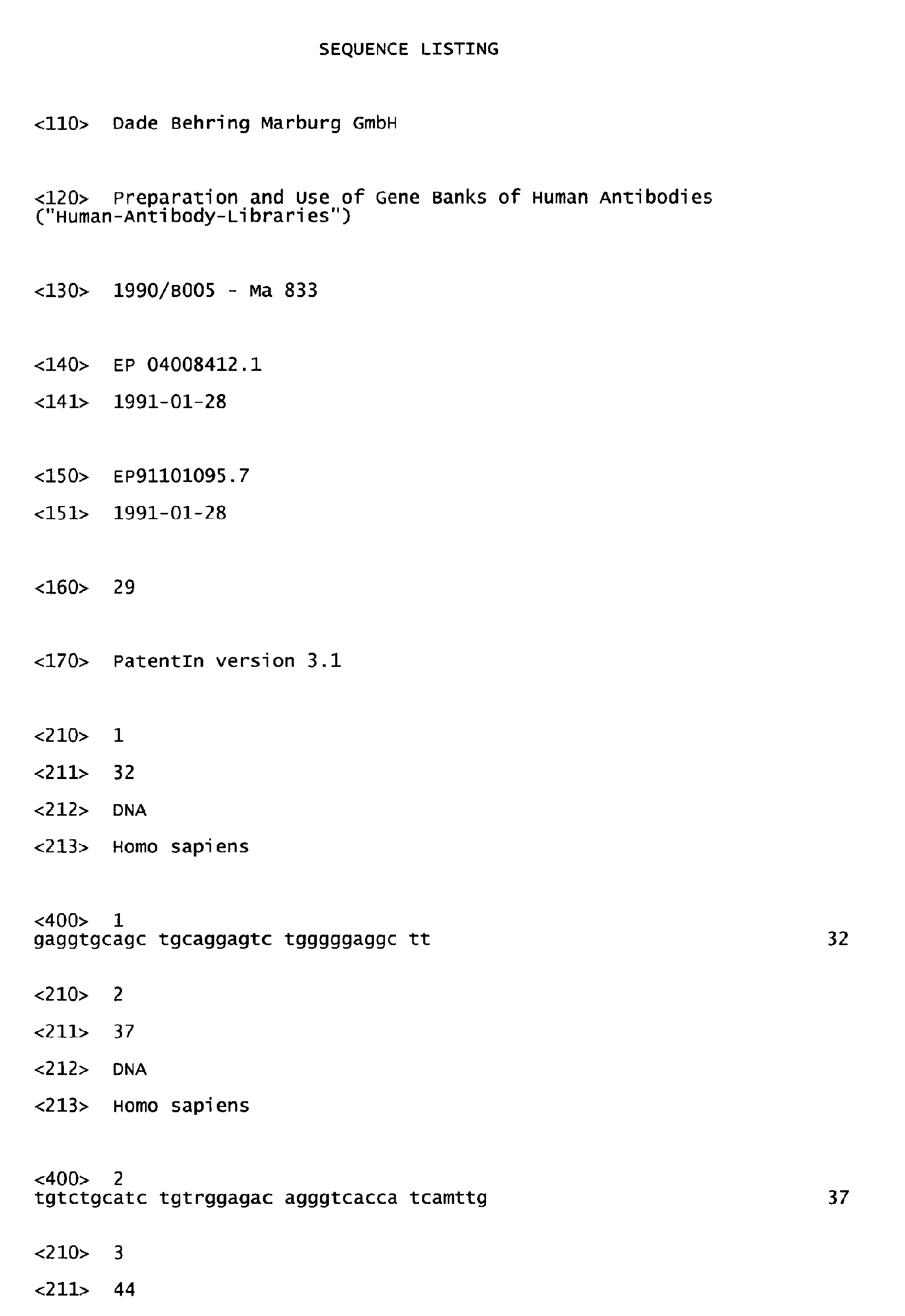
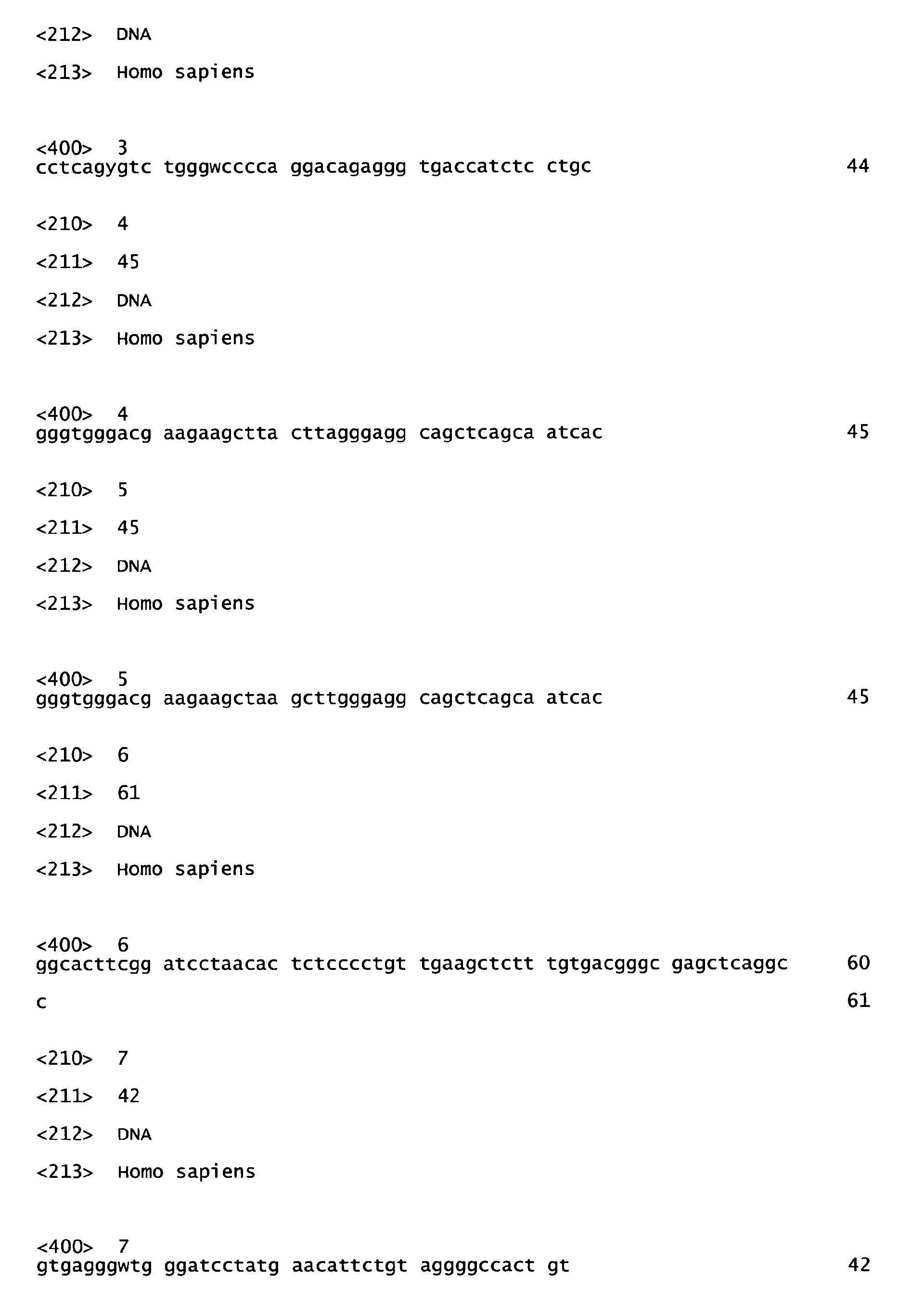
- Table 1 shows suitable oligonucleotide primers for amplification compiled.
- the positions of the aforementioned Primers on the ⁇ , kappa and lambda chains are schematically shown in Tab. 2.
- the molecular biological Constructions in detail, including the Expression vector, i. the antibody expression plasmid pFMT are described in the examples below.
- the invention thus relates to human antibody libraries, produced via transcription of the mRNA non-activated (peripheral) human B lymphocytes by means of oligo-dT primer, subsequent amplification by PCR using primers containing sequences homologous to stored regions of IgM cDNA and subsequent incorporation into suitable expression plasmids for Expression in microorganisms, preferably in the Expression vector pFMT for expression in E. coli.
- a preferred embodiment is additionally a Sequence which encodes a marker peptide, e.g. a "TAG" sequence such that the expression products with established monoclonal antibodies against the marker peptide (Wehland et al., (1984), EMBO J. 3, 1295) easy way can be detected.
- the invention includes the use of the above Human antibody libraries for isolation sought human antibody or antibody parts with functional, Antigen binding site by "screening" with selected Antigens and methods for isolating said human antibody or its antigen-binding parts and also methods for producing said human antibody libraries.
- the invention further comprises expression vectors with the Properties of the antibody expression plasmid pFMT.
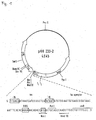
- the plasmid pKK233-2 (Amann and Brosius, (1985) Gene 40, 183 and Straus and Gilbert, (1985) Proc. Natl. Acad. Sci. 82, 2014) was used as the basis vector for the construction of the Antibody expression vector selected ( Figure 1).
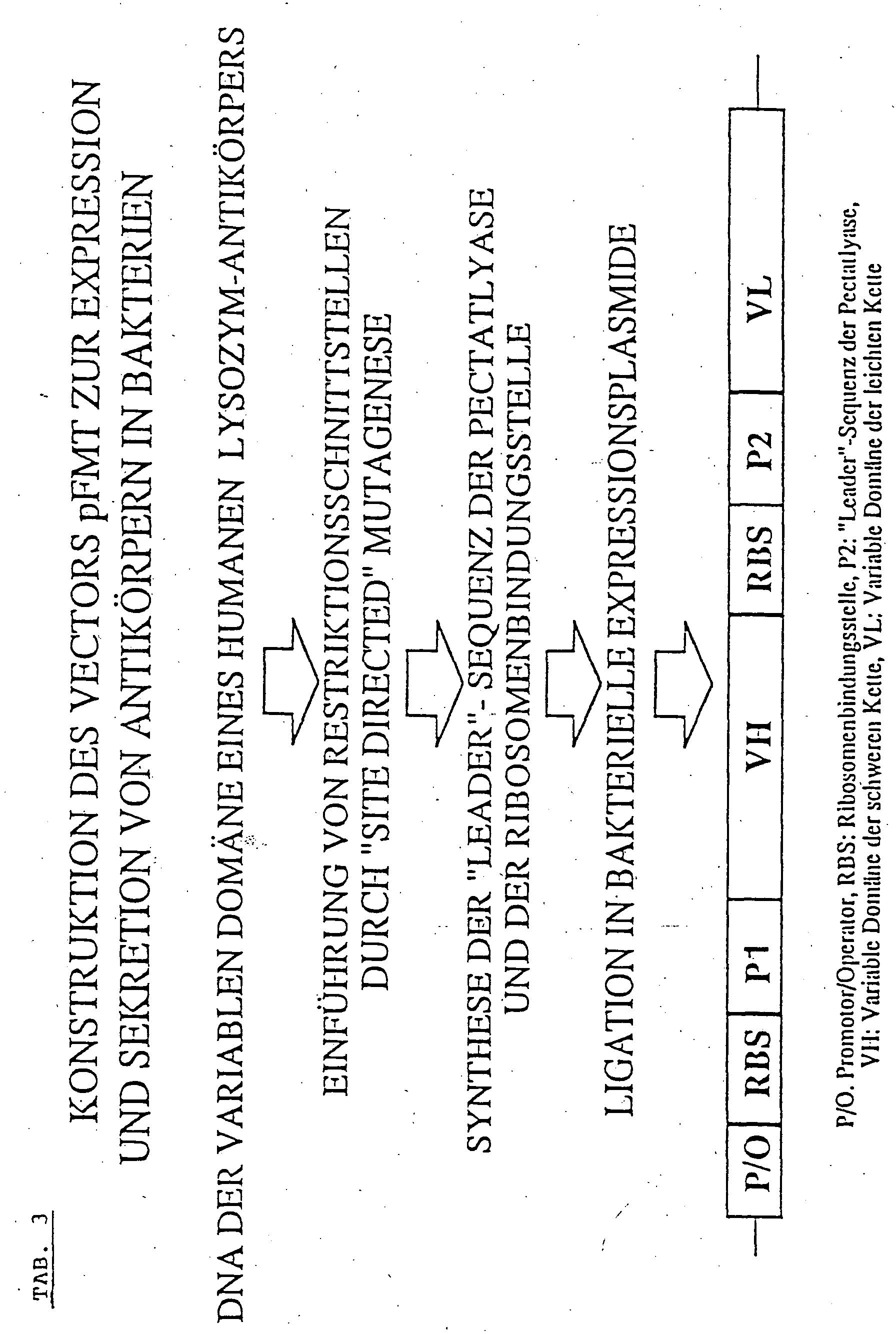
- the plasmid Prior to incorporation of the antibody operon, the plasmid was cut with SalI and BamHI, the ends filled in with Klenow polymerase and ligated. As a result, these two restriction sites and the intervening DNA were removed. In addition, the plasmid was cleaved with HindIII, the ends filled in with Klenow polymerase and ligated with BamHI linkers. This operation removed the HindIII restriction site and inserted a BamHI site. In this modified plasmid, the antibody DNA was inserted. A schematic construction pathway of the antibody operon encoding a bicistronic antibody mRNA is shown in Table 3. In order to facilitate the secretion of the antibody, the "leader" sequence of the bacterial enzyme pectate lyase was used.
- the "leader” sequence of this enzyme is already present for the expression and secretion of a mouse-human chimeric antibody (Fab fragment, Better et al., Supra) as well as the variable portion of a "humanized” antibody (Ward et al., Supra Huse et al., Supra).
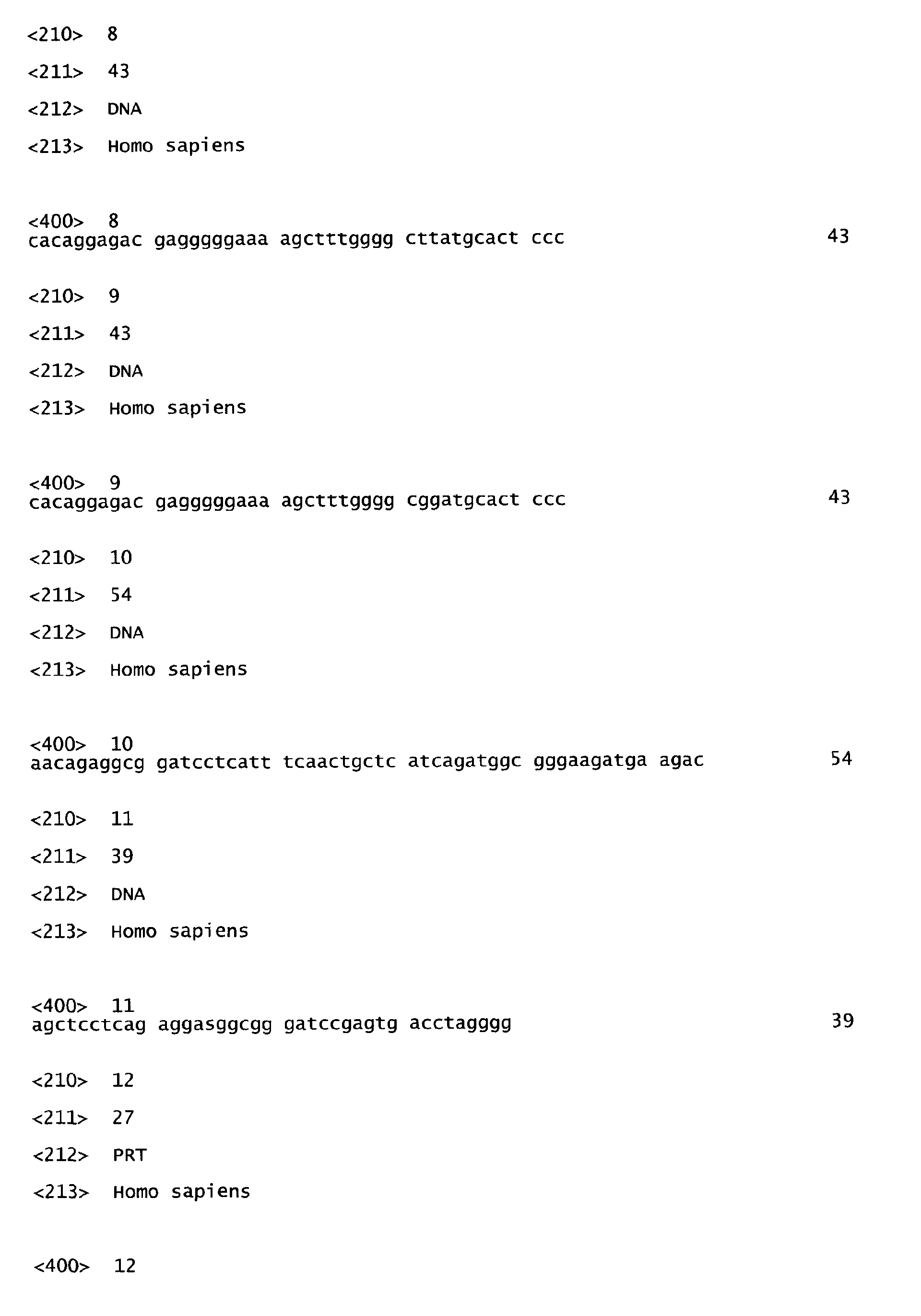
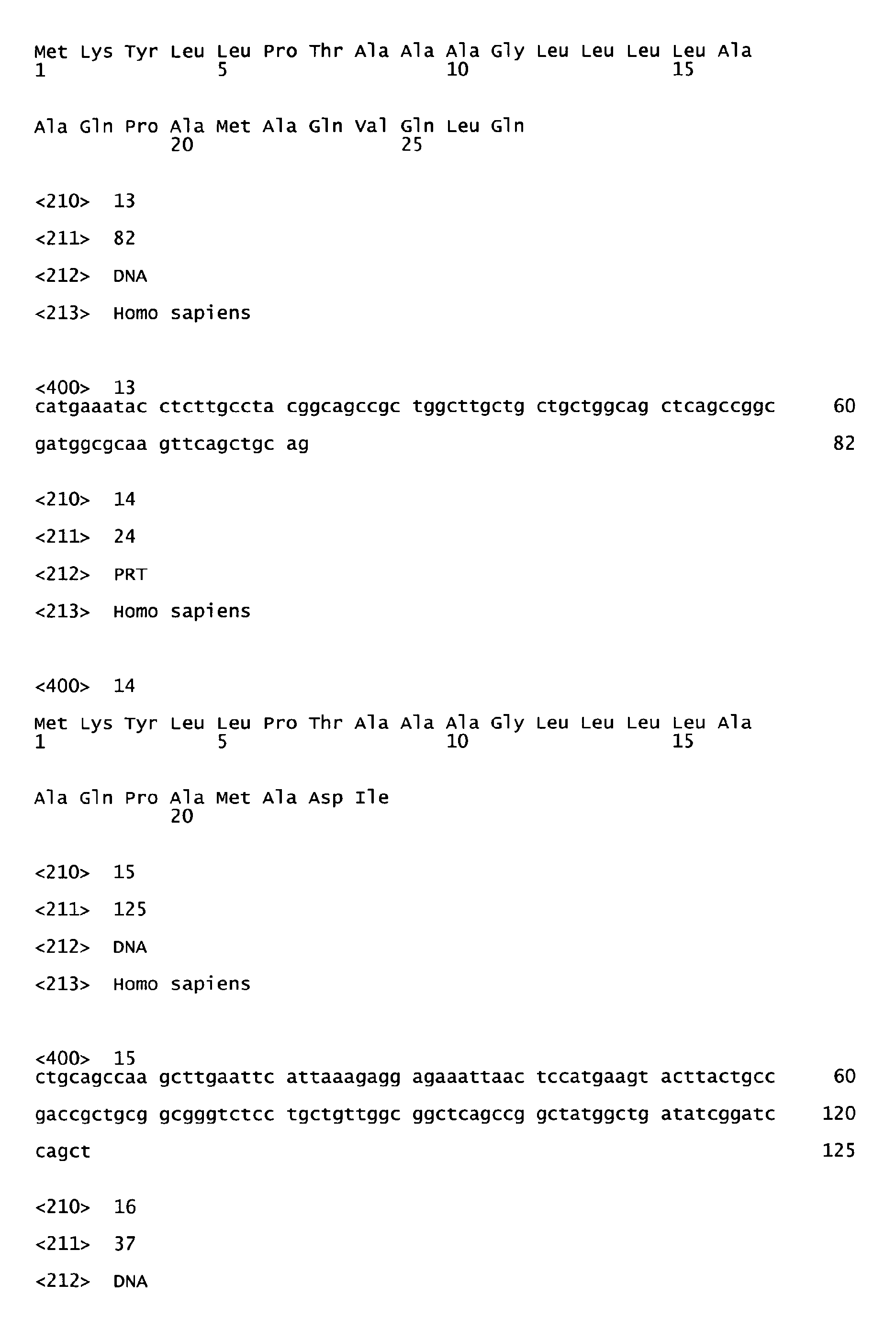
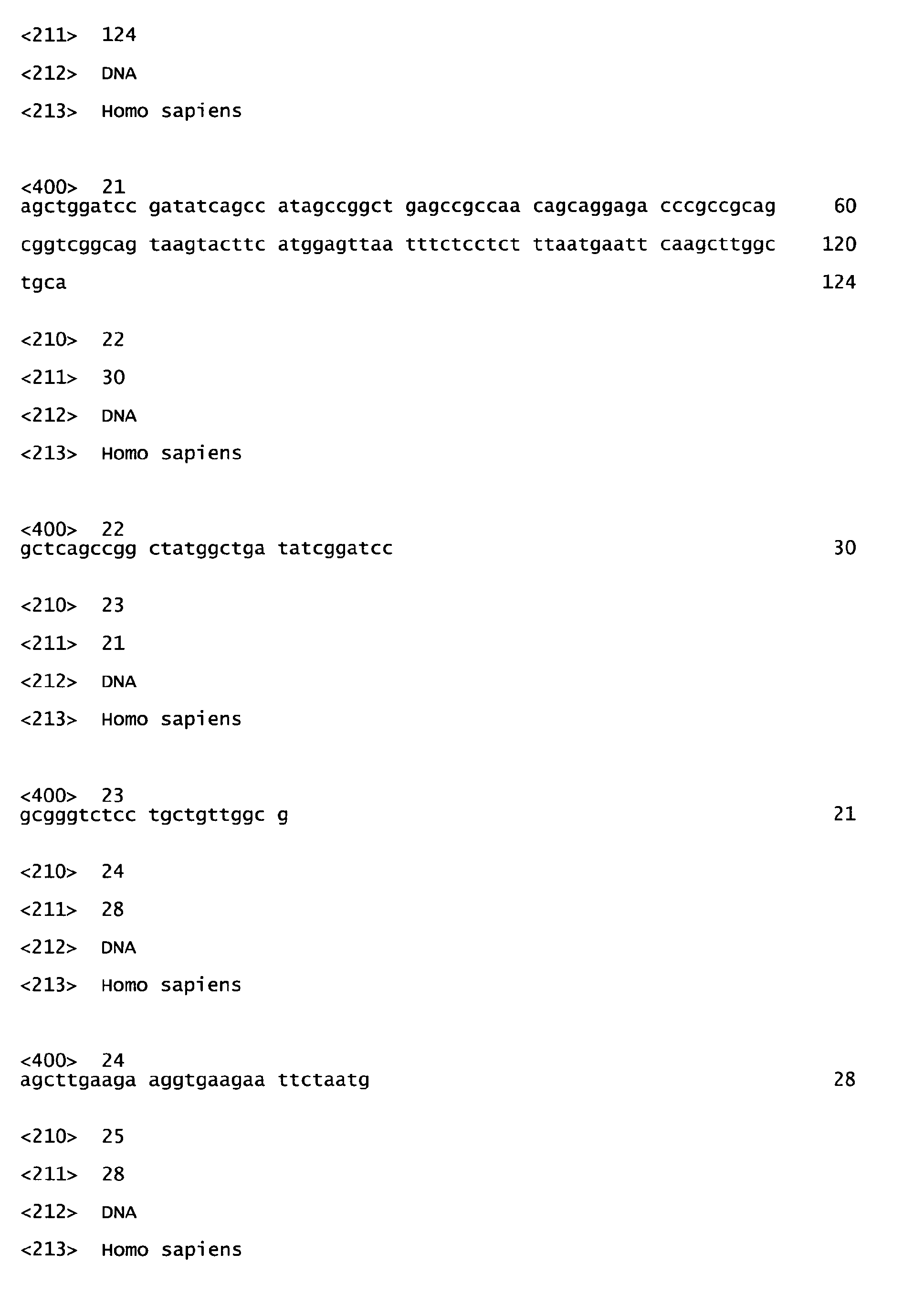
- DNA for the first "leader” sequence (P 1 before the heavy chain) and the sequence for a second ribosome binding site (RBS) and a second "leader” sequence (P 2 before the light chain) were synthesized from several oligonucleotides (Tab. 4).
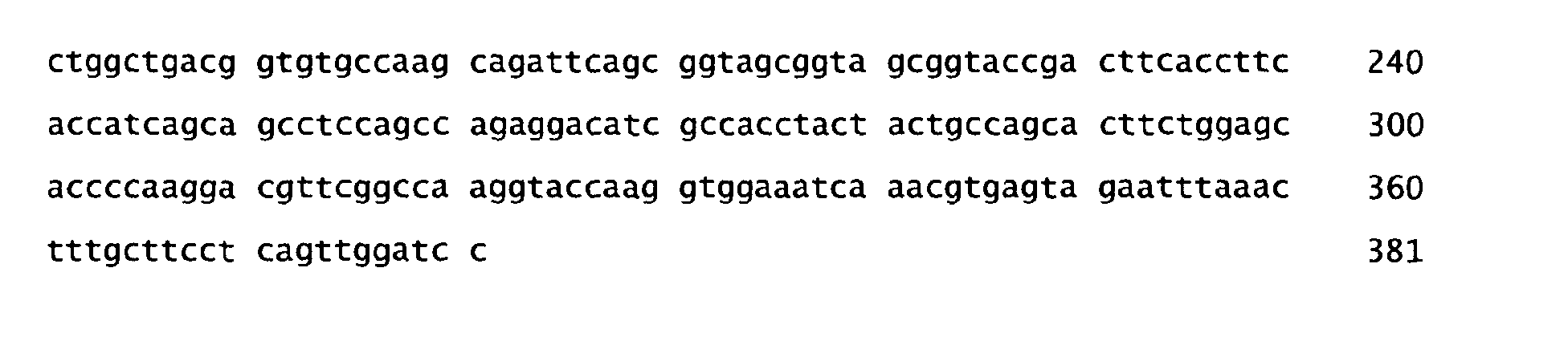
- Antibody cDNAs coding for the variable regions of heavy and light chains of a human antibody (HuVhlys and HuVllys, Riechmann et al., (1988) J. Mol. Biol. 203, 825). G. Winter (Cambridge, UK). The restriction sites HindIII (HuVhlys) and EcoRV (HuVllys) were introduced to the Insertion of the antibody cDNA into the expression vector too enable. Additional restriction sites for BanII (HuVhlys) and BstEII and KpnI (HuVllys) were introduced to exchange hypervariable areas "en bloc". At the end of the HuVhlys cDNA sequence was a stop signal built-in. A BanII site in the light chain was away. These changes were made by "site directed mutagenesis "in the bacteriophage M13mp18 (Zoller and Smith, Meth. Enzymol., 100, 468-500). The Sequence of the final antibody DNA is shown in Tab. 5.
- the modified plasmid pKK233-2 was digested with the restriction enzymes NcoI and PstI and P 1 was inserted between these sites (pKK233-2-P 1 ). Further cloning steps to the last step were undertaken with the plasmid pUC18. The reason is that the presence of individual parts of the antibody operon in the expression vector affects the growth of the bacterial host.
- a "TAG” sequence was ligated into the new HindIII site (Table 4).
- the "TAG” sequence encodes the peptide Glu-Glu-Gly-Glu-Glu-Phe and is derived from the monoclonal.
- Antibody YL 1/2 Wehland et al. (1984) EMBO J. 3, 1295).
- the resulting plasmid is pUC-HTP 2 L.
- peripheral B cells To enrich peripheral B cells from human blood, it was diluted 1: 1 with PBS ("phosphate buffered saline”) and centrifuged over a Ficoll R (Pharmacia) pad (1.077 kg / L). The cells of the interphase were washed twice with PBS and incubated in RPMI medium containing 10% fetal calf serum on a plastic pad (culture flask) for one hour at 37 ° C. The adherent cells (monocytes and macrophages) attach to the culture vessel and could thus be removed from the preparation.
- PBS phosphate buffered saline
- Ficoll R Pulcoa
- the non-adherent cells were collected by centrifugation and homogenized in 4.4 M guanidinium isothiocyanate, 5% mercaptoethanol and 2% lauroyl sarcosine. The homogenate was then centrifuged over a pad of 5.7 M CsCl for 18 hours at 125,000g. The sedimented RNA was redistilled. Dissolved H 2 O and precipitated with 70% ethanol and 1/20 Vol. 8M LiCl at -20 ° C overnight.
- RNA preparations were used 500 ml each of the blood of 20 different persons mixed.
- mRNA was purified by oligo-dT-Sepharose (Kit of Phärmacia) purified and with reverse transcriptase (kit of Amersham) and oligo dT primer translated into cDNA.
- the Products were directly in the "polymerase chain reaction” (PCR) used. PCR primers and hybridization sites are shown in Tab. 1 and 2, respectively.
- the precipitated DNA was taken up in loading buffer for agarose gels (0.1% bromophenol blue, 7% .Ficoll R [Pharmacia]) and over 2% agarose at 10 V / cm in TBE buffer (45 mM Tris-borate pH 8.0., 10 mM EDTA). separated.
- the synthesized antibody DNA was identified by molecular weight and eluted from the gel.
- Competent E. coli are infected with pFMT plasmids containing inserted antibody DNA library, transfected, mounted on agarose plates and then with Nitrocellulose filters incubated with the sought Antigen are coated. Non-specific after removal bound antibody, the active clones with a labeled antibody against those secreted from E. coli identified human immunoglobulins. In the preferred embodiment is used to identify the clones used the monoclonal antibody YL 1/2, which is directed against the "TAG" sequence.
Landscapes
- Health & Medical Sciences (AREA)
- Life Sciences & Earth Sciences (AREA)
- Chemical & Material Sciences (AREA)
- Engineering & Computer Science (AREA)
- Genetics & Genomics (AREA)
- Organic Chemistry (AREA)
- Molecular Biology (AREA)
- Biomedical Technology (AREA)
- Immunology (AREA)
- Biochemistry (AREA)
- General Health & Medical Sciences (AREA)
- Biotechnology (AREA)
- Bioinformatics & Cheminformatics (AREA)
- Zoology (AREA)
- Wood Science & Technology (AREA)
- General Engineering & Computer Science (AREA)
- Medicinal Chemistry (AREA)
- Physics & Mathematics (AREA)
- Microbiology (AREA)
- Biophysics (AREA)
- Urology & Nephrology (AREA)
- Hematology (AREA)
- Proteomics, Peptides & Aminoacids (AREA)
- Plant Pathology (AREA)
- Pathology (AREA)
- General Physics & Mathematics (AREA)
- Food Science & Technology (AREA)
- Cell Biology (AREA)
- Analytical Chemistry (AREA)
- Bioinformatics & Computational Biology (AREA)
- Chemical Kinetics & Catalysis (AREA)
- Crystallography & Structural Chemistry (AREA)
- General Chemical & Material Sciences (AREA)
- Preparation Of Compounds By Using Micro-Organisms (AREA)
- Peptides Or Proteins (AREA)
- Medicines Containing Antibodies Or Antigens For Use As Internal Diagnostic Agents (AREA)
- Measuring Or Testing Involving Enzymes Or Micro-Organisms (AREA)
- Micro-Organisms Or Cultivation Processes Thereof (AREA)
Abstract
Description
- 1) Die SalI und EcoRI Restriktionsstellen wurden zusammen mit der zwischenliegenden DNA entfernt.
- 2) Die HindIII Restriktionsstelle wurde in eine BamHI
Restriktionsstelle umgewandelt.







Claims (6)
Applications Claiming Priority (5)
| Application Number | Priority Date | Filing Date | Title |
|---|---|---|---|
| DE4002898A DE4002898A1 (de) | 1990-02-01 | 1990-02-01 | Herstellung und verwendung von genbanken menschlicher antikoerper ("human-antikoerper-bibliotheken") |
| DE4002898 | 1990-02-01 | ||
| DE4003881A DE4003881A1 (de) | 1990-02-09 | 1990-02-09 | Herstellung und verwendung von genbanken menschlicher antikoerper ("human-antikoerper-bibliotheken") |
| DE4003881 | 1990-02-09 | ||
| EP91101095.7A EP0440147B2 (de) | 1990-02-01 | 1991-01-28 | Herstellung und Verwendung von Genbanken menschlicher Antikörper ("Human-Antikörper-Bibliotheken") |
Related Parent Applications (3)
| Application Number | Title | Priority Date | Filing Date |
|---|---|---|---|
| EP91101095.7 Division | 1991-01-28 | ||
| EP91101095.7A Division-Into EP0440147B2 (de) | 1990-02-01 | 1991-01-28 | Herstellung und Verwendung von Genbanken menschlicher Antikörper ("Human-Antikörper-Bibliotheken") |
| EP91101095.7A Division EP0440147B2 (de) | 1990-02-01 | 1991-01-28 | Herstellung und Verwendung von Genbanken menschlicher Antikörper ("Human-Antikörper-Bibliotheken") |
Publications (3)
| Publication Number | Publication Date |
|---|---|
| EP1566442A2 true EP1566442A2 (de) | 2005-08-24 |
| EP1566442A3 EP1566442A3 (de) | 2006-06-07 |
| EP1566442B1 EP1566442B1 (de) | 2009-11-25 |
Family
ID=25889602
Family Applications (2)
| Application Number | Title | Priority Date | Filing Date |
|---|---|---|---|
| EP04008412A Expired - Lifetime EP1566442B1 (de) | 1990-02-01 | 1991-01-28 | Herstellung und Verwendung von Genbanken menschlicher Antikörper("Human-Antikörper-Bibliotheken") |
| EP91101095.7A Expired - Lifetime EP0440147B2 (de) | 1990-02-01 | 1991-01-28 | Herstellung und Verwendung von Genbanken menschlicher Antikörper ("Human-Antikörper-Bibliotheken") |
Family Applications After (1)
| Application Number | Title | Priority Date | Filing Date |
|---|---|---|---|
| EP91101095.7A Expired - Lifetime EP0440147B2 (de) | 1990-02-01 | 1991-01-28 | Herstellung und Verwendung von Genbanken menschlicher Antikörper ("Human-Antikörper-Bibliotheken") |
Country Status (12)
| Country | Link |
|---|---|
| US (1) | US6319690B1 (de) |
| EP (2) | EP1566442B1 (de) |
| JP (1) | JP3514778B2 (de) |
| KR (1) | KR100186823B1 (de) |
| AT (2) | ATE449853T1 (de) |
| AU (1) | AU633682B2 (de) |
| CA (1) | CA2035381C (de) |
| DE (2) | DE59109264D1 (de) |
| DK (1) | DK0440147T3 (de) |
| ES (2) | ES2336444T3 (de) |
| IE (1) | IE910335A1 (de) |
| PT (1) | PT96625B (de) |
Cited By (2)
| Publication number | Priority date | Publication date | Assignee | Title |
|---|---|---|---|---|
| WO2007068758A1 (en) * | 2005-12-16 | 2007-06-21 | Ribovax Biotechnologies Sa | Methods for obtaining immortalized antibody secreting cells |
| AU2019200298B2 (en) * | 2010-07-16 | 2021-07-29 | Adimab, Llc | Antibody libraries |
Families Citing this family (40)
| Publication number | Priority date | Publication date | Assignee | Title |
|---|---|---|---|---|
| ATE449853T1 (de) † | 1990-02-01 | 2009-12-15 | Siemens Healthcare Diagnostics | HERSTELLUNG UND VERWENDUNG VON GENBANKEN MENSCHLICHER ANTIKÖRPER(ßHUMAN-ANTIKÖRPER- BIBLIOTHEKENß) |
| FI940144A7 (fi) * | 1991-07-15 | 1994-01-12 | The Wellcome Foundation Ltd | Vasta-aineiden tuotanto |
| DE4142077A1 (de) * | 1991-12-19 | 1993-06-24 | Boehringer Mannheim Gmbh | Verfahren zur expression rekombinanter antikoerper |
| PT744958E (pt) * | 1994-01-31 | 2003-11-28 | Univ Boston | Bancos de anticorpos policlonais |
| DE19728697C1 (de) * | 1997-07-04 | 1999-03-25 | Deutsches Krebsforsch | Humaner Antikörper gegen ein Fusions(poly)peptid bzw. -protein, das einen Anteil von mindestens sechs Histidinen aufweist |
| WO1999015696A1 (en) * | 1997-09-19 | 1999-04-01 | Medelys Laboratories Inc. | Method and kit for early diagnosis of autoimmunity and lymphoma in central nervous system |
| CA2372464C (en) | 1999-05-05 | 2012-07-31 | Phylogica Limited | Isolating biological modulators from biodiverse gene fragment libraries |
| US7803765B2 (en) * | 1999-05-05 | 2010-09-28 | Phylogica Limited | Methods of constructing biodiverse gene fragment libraries and biological modulators isolated therefrom |
| US7270969B2 (en) * | 1999-05-05 | 2007-09-18 | Phylogica Limited | Methods of constructing and screening diverse expression libraries |
| US8288322B2 (en) * | 2000-04-17 | 2012-10-16 | Dyax Corp. | Methods of constructing libraries comprising displayed and/or expressed members of a diverse family of peptides, polypeptides or proteins and the novel libraries |
| CA2798625C (en) * | 2000-04-17 | 2017-01-24 | Dyax Corp. | Novel methods of constructing libraries of genetic packages that collectively display the members of a diverse family of peptides, polypeptides or proteins |
| PT1360288E (pt) | 2000-12-18 | 2011-03-07 | Dyax Corp | Bibliotecas orientadas de pacotes genéticos |
| US20040005709A1 (en) * | 2001-10-24 | 2004-01-08 | Hoogenboom Henricus Renerus Jacobus Mattheus | Hybridization control of sequence variation |
| US20040067532A1 (en) | 2002-08-12 | 2004-04-08 | Genetastix Corporation | High throughput generation and affinity maturation of humanized antibody |
| JP4782700B2 (ja) | 2004-01-20 | 2011-09-28 | カロバイオス ファーマシューティカルズ インコーポレイティッド | 最低限必須な結合決定基を用いた抗体特異性の移入 |
| WO2005087812A1 (en) * | 2004-03-05 | 2005-09-22 | Ludwig Institute For Cancer Research | Multivalent antibody materials and methods for vegf/pdgf family of growth factors |
| CA2568644C (en) * | 2004-06-03 | 2015-11-24 | Phylogica Limited | Peptide modulators of cellular phenotype and bi-nucleic acid fragment library |
| US20120208824A1 (en) | 2006-01-20 | 2012-08-16 | Cell Signaling Technology, Inc. | ROS Kinase in Lung Cancer |
| EP2671954B1 (de) | 2006-01-20 | 2018-05-16 | Cell Signaling Technology, Inc. | Translokation und Mutations-ROS-Kinase bei menschlichem nicht-kleinzelligem Lungenkrebs |
| DK1987178T3 (en) | 2006-02-20 | 2015-04-20 | Phylogica Ltd | Process for the construction and screening of peptide structure libraries |
| EP2447359B1 (de) | 2006-04-14 | 2015-11-04 | Cell Signaling Technology, Inc. | Gendefekte und mutierte ALK-Kinase in festen menschlichen Tumoren |
| US8063012B2 (en) * | 2006-09-19 | 2011-11-22 | Phylogica Limited | Neuroprotective peptide inhibitors of AP-1 signaling and uses therefor |
| US8822409B2 (en) * | 2007-06-20 | 2014-09-02 | Phylogica Limited | Compositions and uses thereof for the treatment of acute respiratory distress syndrome (ARDS) and clinical disorders associated with therewith |
| EP3124497B1 (de) | 2007-09-14 | 2020-04-15 | Adimab, LLC | Synthetische antikörperbibliotheken mit rationalem design und verwendungen davon |
| US12529164B2 (en) | 2007-09-14 | 2026-01-20 | Adimab, Llc | Rationally designed, synthetic antibody libraries and uses therefor |
| US8877688B2 (en) | 2007-09-14 | 2014-11-04 | Adimab, Llc | Rationally designed, synthetic antibody libraries and uses therefor |
| EP3741851A1 (de) | 2007-10-18 | 2020-11-25 | Cell Signaling Technology, Inc. | Translokation und mutante ros-kinase in humanem nichtkleinzelligem lungenkarzinom |
| WO2009114815A1 (en) | 2008-03-13 | 2009-09-17 | Dyax Corp | Libraries of genetic packages comprising novel hc cdr3 designs |
| WO2009132287A2 (en) | 2008-04-24 | 2009-10-29 | Dyax Corp. | Libraries of genetic packages comprising novel hc cdr1, cdr2, and cdr3 and novel lc cdr1, cdr2, and cdr3 designs |
| JP5979877B2 (ja) | 2009-02-12 | 2016-08-31 | セル・シグナリング・テクノロジー・インコーポレイテツド | ヒト癌における変異ros発現 |
| JP2013504602A (ja) * | 2009-09-14 | 2013-02-07 | ダイアックス コーポレーション | 新しく設計したhccdr3を含む遺伝子パッケージライブラリー |
| US20130052194A1 (en) | 2009-12-16 | 2013-02-28 | The Trustees Of The University Of Pennsylvania | Anti-prostate cancer antibodies and methods of detection and treatment of prostate cancer using the same |
| US20120101108A1 (en) | 2010-08-06 | 2012-04-26 | Cell Signaling Technology, Inc. | Anaplastic Lymphoma Kinase In Kidney Cancer |
| AU2012245073B2 (en) | 2011-04-21 | 2016-02-11 | Garvan Institute Of Medical Research | Modified variable domain molecules and methods for producing and using them b |
| ES2655842T3 (es) | 2012-04-18 | 2018-02-21 | Cell Signaling Technology, Inc. | EGFR y ROS1 en el cáncer |
| US10809264B2 (en) * | 2014-05-29 | 2020-10-20 | Siemens Healthcare Diagnostics Inc. | Rare molecule detection |
| EP3652209A2 (de) | 2017-07-11 | 2020-05-20 | Compass Therapeutics LLC | Agonistische antikörper zur bindung von humanem cd137 und verwendungen davon |
| US11718679B2 (en) | 2017-10-31 | 2023-08-08 | Compass Therapeutics Llc | CD137 antibodies and PD-1 antagonists and uses thereof |
| EP3713961A2 (de) | 2017-11-20 | 2020-09-30 | Compass Therapeutics LLC | Cd137-antikörper und tumorantigenbindende antikörper sowie deren verwendung |
| WO2020102387A1 (en) | 2018-11-13 | 2020-05-22 | Compass Therapeutics Llc | Multispecific binding constructs against checkpoint molecules and uses thereof |
Family Cites Families (5)
| Publication number | Priority date | Publication date | Assignee | Title |
|---|---|---|---|---|
| ES2052027T5 (es) † | 1988-11-11 | 2005-04-16 | Medical Research Council | Clonacion de secuencias de dominio variable de inmunoglobulina. |
| CA2016841C (en) † | 1989-05-16 | 1999-09-21 | William D. Huse | A method for producing polymers having a preselected activity |
| CA2016842A1 (en) † | 1989-05-16 | 1990-11-16 | Richard A. Lerner | Method for tapping the immunological repertoire |
| AU7247191A (en) * | 1990-01-11 | 1991-08-05 | Molecular Affinities Corporation | Production of antibodies using gene libraries |
| ATE449853T1 (de) † | 1990-02-01 | 2009-12-15 | Siemens Healthcare Diagnostics | HERSTELLUNG UND VERWENDUNG VON GENBANKEN MENSCHLICHER ANTIKÖRPER(ßHUMAN-ANTIKÖRPER- BIBLIOTHEKENß) |
-
1991
- 1991-01-28 AT AT04008412T patent/ATE449853T1/de not_active IP Right Cessation
- 1991-01-28 AT AT91101095T patent/ATE277179T1/de not_active IP Right Cessation
- 1991-01-28 ES ES04008412T patent/ES2336444T3/es not_active Expired - Lifetime
- 1991-01-28 EP EP04008412A patent/EP1566442B1/de not_active Expired - Lifetime
- 1991-01-28 DE DE59109264T patent/DE59109264D1/de not_active Expired - Lifetime
- 1991-01-28 DE DE59109273T patent/DE59109273D1/de not_active Expired - Lifetime
- 1991-01-28 ES ES91101095.7T patent/ES2225816T5/es not_active Expired - Lifetime
- 1991-01-28 EP EP91101095.7A patent/EP0440147B2/de not_active Expired - Lifetime
- 1991-01-28 DK DK91101095T patent/DK0440147T3/da active
- 1991-01-31 AU AU70113/91A patent/AU633682B2/en not_active Expired
- 1991-01-31 PT PT96625A patent/PT96625B/pt not_active IP Right Cessation
- 1991-01-31 CA CA002035381A patent/CA2035381C/en not_active Expired - Lifetime
- 1991-01-31 IE IE033591A patent/IE910335A1/en not_active IP Right Cessation
- 1991-02-01 KR KR1019910001733A patent/KR100186823B1/ko not_active Expired - Lifetime
- 1991-02-01 JP JP03221591A patent/JP3514778B2/ja not_active Expired - Lifetime
-
1993
- 1993-05-06 US US08/057,430 patent/US6319690B1/en not_active Expired - Lifetime
Cited By (6)
| Publication number | Priority date | Publication date | Assignee | Title |
|---|---|---|---|---|
| WO2007068758A1 (en) * | 2005-12-16 | 2007-06-21 | Ribovax Biotechnologies Sa | Methods for obtaining immortalized antibody secreting cells |
| AU2006325236B2 (en) * | 2005-12-16 | 2011-11-10 | Ribovax Biotechnologies Sa | Methods for obtaining immortalized antibody secreting cells |
| US8338172B2 (en) | 2005-12-16 | 2012-12-25 | Ribovax Biotechnologies S.A. | Methods for obtaining immortalized antibody secreting cells |
| EA019505B1 (ru) * | 2005-12-16 | 2014-04-30 | Рибовакс Байотекнолоджиз Са | Способ получения иммортализованных клеток, секретирующих антитела, популяция иммортализованных клеток и ее применения |
| AU2019200298B2 (en) * | 2010-07-16 | 2021-07-29 | Adimab, Llc | Antibody libraries |
| US12018403B2 (en) | 2010-07-16 | 2024-06-25 | Adimab, Llc | Antibody libraries |
Also Published As
| Publication number | Publication date |
|---|---|
| US6319690B1 (en) | 2001-11-20 |
| ES2225816T5 (es) | 2014-08-21 |
| ES2336444T3 (es) | 2010-04-13 |
| JP3514778B2 (ja) | 2004-03-31 |
| KR100186823B1 (ko) | 1999-04-01 |
| EP0440147B1 (de) | 2004-09-22 |
| AU633682B2 (en) | 1993-02-04 |
| DE59109273D1 (de) | 2010-01-07 |
| ATE277179T1 (de) | 2004-10-15 |
| PT96625A (pt) | 1991-11-29 |
| IE910335A1 (en) | 1991-08-14 |
| JPH04211394A (ja) | 1992-08-03 |
| AU7011391A (en) | 1991-08-08 |
| CA2035381A1 (en) | 1991-08-02 |
| DE59109264D1 (de) | 2004-10-28 |
| EP0440147A2 (de) | 1991-08-07 |
| ATE449853T1 (de) | 2009-12-15 |
| DK0440147T3 (da) | 2005-01-17 |
| CA2035381C (en) | 2004-11-09 |
| EP0440147A3 (en) | 1992-07-08 |
| KR910021475A (ko) | 1991-12-20 |
| ES2225816T3 (es) | 2005-03-16 |
| EP0440147B2 (de) | 2014-05-14 |
| EP1566442A3 (de) | 2006-06-07 |
| EP1566442B1 (de) | 2009-11-25 |
| PT96625B (pt) | 1998-07-31 |
Similar Documents
| Publication | Publication Date | Title |
|---|---|---|
| EP0440147B2 (de) | Herstellung und Verwendung von Genbanken menschlicher Antikörper ("Human-Antikörper-Bibliotheken") | |
| EP0440146B1 (de) | Herstellung und Verwendung von Genbanken synthetischer menschlicher Antikörper ("synthetische Human-Anti-Körper-Bibliotheken) | |
| DE69633175T2 (de) | Multimere proteine | |
| DE69327229T2 (de) | Multivalente einkettige Antikörper | |
| DE69331903T2 (de) | Veränderte Antikörper, damit zusammenhängende Produkte und Verfahren | |
| DE69718341T2 (de) | Verfahren und mittel zur auswahl von peptiden und proteinen mit spezifischer affinität zu einem zielmolekül | |
| DE68921364T2 (de) | Verfahren zur Herstellung von Proteinen mittels rekombinanter DNA. | |
| DE69330523T2 (de) | Immunoglobuline ohne leichte ketten | |
| EP1078004B1 (de) | Tetravalente Antikörperkonstrukte | |
| DE69017753T2 (de) | Tumor-Nekrosefaktor-Bindungsprotein II, seine Reinigung und spezifische Antikörper. | |
| DE3853515T3 (de) | Multifunktionelle proteine mit vorbestimmter zielsetzung. | |
| EP1206555B1 (de) | Fv-antikörper-konstrukte mit bindungsstellen für einen cd16-rezeptor und ein cd30-oberflächenprotein | |
| EP0297291B1 (de) | Äusseres Membranprotein F von Pseudomonas aeruginosa | |
| DE69425843T2 (de) | Rekombinantes Vektor für die exozelluläre Verwendung von in Bacillus Subtilis exprimierten einkettigen Antikörpern | |
| DE69020112T2 (de) | Spezifische bindende Wirkstoffe. | |
| EP1287036A1 (de) | Trivalente antikörperkonstrukte mit disulfid-brücken stabilisierten variablen regionen | |
| DE68908138T2 (de) | Polypeptide mit Zellausdehnungs-Aktivität. | |
| DE4344350C2 (de) | Bakterien zur Herstellung stabiler Fusionsproteine und Verfahren zu deren Nachweis | |
| EP1307490B1 (de) | Fv-konstrukte mit beeinflussbarer affinitat zu einer zu bindenden substanz | |
| EP1141271A1 (de) | Selektion von monoklonalen antikörpern | |
| DE19500723A1 (de) | Gen oder Genfragment eines Antikörpers, der krebsspezifisches Mucin erkennt | |
| DE69031996T2 (de) | Menschlicher rekombinanter plazentaler ribonuklease-inhibitor und verfahren zur herstellung | |
| DE69230659T2 (de) | Polypeptide, die an die schweren Ketten von IL-2-Rezeptoren binden können | |
| DE69505660T2 (de) | Ein enzymatisches verfahren zur herstellung eines gewünschten proteins aus einem am aminoterminus verlängerten protein | |
| DE10019967A1 (de) | Antikörper gegen natives gp96, deren Herstellung und Verwendung |
Legal Events
| Date | Code | Title | Description |
|---|---|---|---|
| PUAI | Public reference made under article 153(3) epc to a published international application that has entered the european phase |
Free format text: ORIGINAL CODE: 0009012 |
|
| AC | Divisional application: reference to earlier application |
Ref document number: 0440147 Country of ref document: EP Kind code of ref document: P |
|
| AK | Designated contracting states |
Kind code of ref document: A2 Designated state(s): AT BE CH DE DK ES FR GB GR IT LI LU NL SE |
|
| PUAL | Search report despatched |
Free format text: ORIGINAL CODE: 0009013 |
|
| AK | Designated contracting states |
Kind code of ref document: A3 Designated state(s): AT BE CH DE DK ES FR GB GR IT LI LU NL SE |
|
| 17P | Request for examination filed |
Effective date: 20061207 |
|
| AKX | Designation fees paid |
Designated state(s): AT BE CH DE DK ES FR GB GR IT LI LU NL SE |
|
| 17Q | First examination report despatched |
Effective date: 20080201 |
|
| RAP1 | Party data changed (applicant data changed or rights of an application transferred) |
Owner name: SIEMENS HEALTHCARE DIAGNOSTICS PRODUCTS GMBH |
|
| GRAJ | Information related to disapproval of communication of intention to grant by the applicant or resumption of examination proceedings by the epo deleted |
Free format text: ORIGINAL CODE: EPIDOSDIGR1 |
|
| GRAP | Despatch of communication of intention to grant a patent |
Free format text: ORIGINAL CODE: EPIDOSNIGR1 |
|
| GRAP | Despatch of communication of intention to grant a patent |
Free format text: ORIGINAL CODE: EPIDOSNIGR1 |
|
| GRAS | Grant fee paid |
Free format text: ORIGINAL CODE: EPIDOSNIGR3 |
|
| GRAA | (expected) grant |
Free format text: ORIGINAL CODE: 0009210 |
|
| AC | Divisional application: reference to earlier application |
Ref document number: 0440147 Country of ref document: EP Kind code of ref document: P |
|
| AK | Designated contracting states |
Kind code of ref document: B1 Designated state(s): AT BE CH DE DK ES FR GB GR IT LI LU NL SE |
|
| REG | Reference to a national code |
Ref country code: GB Ref legal event code: FG4D Free format text: NOT ENGLISH |
|
| REG | Reference to a national code |
Ref country code: CH Ref legal event code: EP |
|
| REF | Corresponds to: |
Ref document number: 59109273 Country of ref document: DE Date of ref document: 20100107 Kind code of ref document: P |
|
| REG | Reference to a national code |
Ref country code: SE Ref legal event code: TRGR |
|
| REG | Reference to a national code |
Ref country code: ES Ref legal event code: FG2A Ref document number: 2336444 Country of ref document: ES Kind code of ref document: T3 |
|
| PGFP | Annual fee paid to national office [announced via postgrant information from national office to epo] |
Ref country code: ES Payment date: 20100204 Year of fee payment: 20 |
|
| PGFP | Annual fee paid to national office [announced via postgrant information from national office to epo] |
Ref country code: FR Payment date: 20100211 Year of fee payment: 20 |
|
| PGFP | Annual fee paid to national office [announced via postgrant information from national office to epo] |
Ref country code: GB Payment date: 20100115 Year of fee payment: 20 Ref country code: BE Payment date: 20100204 Year of fee payment: 20 |
|
| PG25 | Lapsed in a contracting state [announced via postgrant information from national office to epo] |
Ref country code: DK Free format text: LAPSE BECAUSE OF FAILURE TO SUBMIT A TRANSLATION OF THE DESCRIPTION OR TO PAY THE FEE WITHIN THE PRESCRIBED TIME-LIMIT Effective date: 20091125 |
|
| PGFP | Annual fee paid to national office [announced via postgrant information from national office to epo] |
Ref country code: DE Payment date: 20100325 Year of fee payment: 20 Ref country code: IT Payment date: 20100127 Year of fee payment: 20 Ref country code: NL Payment date: 20100118 Year of fee payment: 20 Ref country code: SE Payment date: 20100112 Year of fee payment: 20 |
|
| REG | Reference to a national code |
Ref country code: CH Ref legal event code: PL |
|
| PLBE | No opposition filed within time limit |
Free format text: ORIGINAL CODE: 0009261 |
|
| STAA | Information on the status of an ep patent application or granted ep patent |
Free format text: STATUS: NO OPPOSITION FILED WITHIN TIME LIMIT |
|
| PG25 | Lapsed in a contracting state [announced via postgrant information from national office to epo] |
Ref country code: LI Free format text: LAPSE BECAUSE OF NON-PAYMENT OF DUE FEES Effective date: 20100131 Ref country code: GR Free format text: LAPSE BECAUSE OF FAILURE TO SUBMIT A TRANSLATION OF THE DESCRIPTION OR TO PAY THE FEE WITHIN THE PRESCRIBED TIME-LIMIT Effective date: 20100226 Ref country code: CH Free format text: LAPSE BECAUSE OF NON-PAYMENT OF DUE FEES Effective date: 20100131 |
|
| 26N | No opposition filed |
Effective date: 20100826 |
|
| BE20 | Be: patent expired |
Owner name: SIEMENS HEALTHCARE DIAGNOSTICS PRODUCTS G.M.B.H. Effective date: 20110128 |
|
| REG | Reference to a national code |
Ref country code: NL Ref legal event code: V4 Effective date: 20110128 |
|
| REG | Reference to a national code |
Ref country code: GB Ref legal event code: PE20 Expiry date: 20110127 |
|
| REG | Reference to a national code |
Ref country code: ES Ref legal event code: FD2A Effective date: 20110228 |
|
| PG25 | Lapsed in a contracting state [announced via postgrant information from national office to epo] |
Ref country code: NL Free format text: LAPSE BECAUSE OF EXPIRATION OF PROTECTION Effective date: 20110128 Ref country code: AT Free format text: LAPSE BECAUSE OF NON-PAYMENT OF DUE FEES Effective date: 20100128 |
|
| PG25 | Lapsed in a contracting state [announced via postgrant information from national office to epo] |
Ref country code: ES Free format text: LAPSE BECAUSE OF EXPIRATION OF PROTECTION Effective date: 20110129 Ref country code: GB Free format text: LAPSE BECAUSE OF EXPIRATION OF PROTECTION Effective date: 20110127 |
|
| PG25 | Lapsed in a contracting state [announced via postgrant information from national office to epo] |
Ref country code: LU Free format text: LAPSE BECAUSE OF NON-PAYMENT OF DUE FEES Effective date: 20100128 |
|
| PG25 | Lapsed in a contracting state [announced via postgrant information from national office to epo] |
Ref country code: DE Free format text: LAPSE BECAUSE OF EXPIRATION OF PROTECTION Effective date: 20110128 |