EP0727770A1 - Verfahren und Gerät zum Ausrichten von Miniaturbauelementen - Google Patents
Verfahren und Gerät zum Ausrichten von Miniaturbauelementen Download PDFInfo
- Publication number
- EP0727770A1 EP0727770A1 EP96301001A EP96301001A EP0727770A1 EP 0727770 A1 EP0727770 A1 EP 0727770A1 EP 96301001 A EP96301001 A EP 96301001A EP 96301001 A EP96301001 A EP 96301001A EP 0727770 A1 EP0727770 A1 EP 0727770A1
- Authority
- EP
- European Patent Office
- Prior art keywords
- component
- alignment
- transparent substrate
- viewing
- photoresist
- Prior art date
- Legal status (The legal status is an assumption and is not a legal conclusion. Google has not performed a legal analysis and makes no representation as to the accuracy of the status listed.)
- Withdrawn
Links
Images



Classifications
-
- G—PHYSICS
- G11—INFORMATION STORAGE
- G11B—INFORMATION STORAGE BASED ON RELATIVE MOVEMENT BETWEEN RECORD CARRIER AND TRANSDUCER
- G11B5/00—Recording by magnetisation or demagnetisation of a record carrier; Reproducing by magnetic means; Record carriers therefor
- G11B5/127—Structure or manufacture of heads, e.g. inductive
- G11B5/31—Structure or manufacture of heads, e.g. inductive using thin films
- G11B5/3103—Structure or manufacture of integrated heads or heads mechanically assembled and electrically connected to a support or housing
-
- G—PHYSICS
- G11—INFORMATION STORAGE
- G11B—INFORMATION STORAGE BASED ON RELATIVE MOVEMENT BETWEEN RECORD CARRIER AND TRANSDUCER
- G11B5/00—Recording by magnetisation or demagnetisation of a record carrier; Reproducing by magnetic means; Record carriers therefor
- G11B5/10—Structure or manufacture of housings or shields for heads
- G11B5/105—Mounting of head within housing or assembling of head and housing
-
- Y—GENERAL TAGGING OF NEW TECHNOLOGICAL DEVELOPMENTS; GENERAL TAGGING OF CROSS-SECTIONAL TECHNOLOGIES SPANNING OVER SEVERAL SECTIONS OF THE IPC; TECHNICAL SUBJECTS COVERED BY FORMER USPC CROSS-REFERENCE ART COLLECTIONS [XRACs] AND DIGESTS
- Y10—TECHNICAL SUBJECTS COVERED BY FORMER USPC
- Y10T—TECHNICAL SUBJECTS COVERED BY FORMER US CLASSIFICATION
- Y10T156/00—Adhesive bonding and miscellaneous chemical manufacture
- Y10T156/10—Methods of surface bonding and/or assembly therefor
- Y10T156/1089—Methods of surface bonding and/or assembly therefor of discrete laminae to single face of additional lamina
- Y10T156/1092—All laminae planar and face to face
Definitions
- the present invention relates to fabrication of miniature electronic devices and, more particularly, to a structure and manufacturing method for detecting and correcting the orientation of a device component with respect to a mounting structure.
- Thin film magnetic heads increase the storage density in magnetic media storage devices by forming a large number of heads simultaneously on a common supporting member. Media is recorded and read as it traverses the thin film magnetic media heads. For accurate recording and reading of the magnetic media, it is important that media head gaps for a particular recording track are parallel to the direction of media movement.
- the media includes reference surfaces that engage fixed position locators in the media drive. The fixed position locators define reference planes, and the read and write head gaps are aligned with a particular reference plane for proper operation. A slight misalignment can reduce the reliability of the contact and impair reading and writing of recording media.
- a method of affixing a component to a structure in an aligned position includes the step of placing the component upon a support structure.
- the component has an alignment marking.
- the support structure has a viewing aperture and an alignment pattern.
- the support structure and component are arranged so that the alignment marking and the alignment pattern are visible through the viewing aperture.
- the method includes the step of simultaneously viewing the alignment marking and the alignment pattern through the viewing aperture and aligning the component upon the support structure so that the alignment marking of the component is aligned with respect to the alignment pattern of the support structure.
- the method further includes the step of bonding the aligned component to a structural member.
- a method is furnished of affixing a component to a structure in an aligned position.
- a layer of photoresist is deposited on a first surface of a transparent substrate wafer and formed into a well structure having an interior aperture and exterior walls which are formed to support the component.
- a prealignment or coarse positioning guide is marked into the well structure so that the coarse positioning guide is visible through a second surface of the transparent substrate wafer with the second surface opposing the first surface.
- a component having an alignment marking on a surface upon the well structure is placed so that the alignment marking is visible through the interior aperture of the well structure and through the second surface of the transparent substrate wafer.
- the component is aligned within the well structure so that the alignment marking of the component is aligned with respect to the coarse positioning guide of the well structure as viewed simultaneously through the interior aperture of the well structure and through the second surface of the transparent substrate wafer.
- the aligned component is then bonded to a structural member.
- This method aligns and affixes components to a structural member or support structure at particular connection sites with improved accuracy of alignment.
- This technique is advantageous for precisely aligning miniature electronic components during fabrication and is useful for simply and accurately detecting the position of a part.
- a structure which includes a transparent substrate having opposing first and second substantially-planar surfaces.
- a photoresist well structure is formed upon the first surface of the transparent substrate.
- the photoresist well structure has an interior aperture, an exterior wall and an alignment pattern formed into the exterior wall.
- a component has a substantially planar surface which is positioned within the well structure.
- the substantially planar surface has a medial portion, lateral edges and an alignment marking formed upon the medial portion. The component is placed in the well structure so that the lateral edges are supported by the exterior wall, the medial portion overlies the interior aperture and the component is aligned with respect to the transparent substrate by aligning the alignment marking with the alignment pattern.
- the support structure includes a support platform, a first transparent substrate wafer, and a second transparent substrate wafer.
- the support platform has a support platform viewing aperture and a vacuum aperture.
- the first transparent substrate wafer is positioned adjacent to a first planar surface of the support platform and has a substrate wafer viewing aperture arranged in line with the support platform viewing aperture.
- the second transparent substrate wafer is adjacent to a second planar surface of the support platform opposite to the first planar surface.
- the second transparent substrate wafer is positioned to seal the support platform viewing aperture.
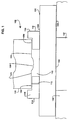
- Figure 1 illustrates a side cross-sectional view of a structure 100, such as an integrated circuit structure, upon which device components are mounted.
- the structure 100 includes a transparent substrate wafer 102 which has a substantially-planar shape and includes a first planar surface 104 and a second planar surface 106 on the opposite sides of the wafer 102.
- the transparent substrate wafer 102 may be constructed from a material such as transparent quartz, glass, epoxy, fiber glass or plastic.
- the transparent substrate wafer 102 forms a transparent quartz lens which has advantageous optical properties of clarity and a highly uniform surface, combined with substantial strength.
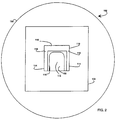
- a photoresist well structure 110 Overlying the first planar surface 104 of the transparent substrate wafer 102 is a photoresist well structure 110 which has an interior aperture 112, an exterior wall 114 and an alignment pattern 116 formed into the exterior wall 114.
- the interior aperture 112, exterior wall 114 and alignment pattern 116 are also shown in Figure 2 which depicts a top plan view of the structure 100.
- the photoresist well structure 110 is patterned into a deposited photoresist layer 118 so that the alignment pattern 116 is visible through a bottom surface 109 of the transparent substrate wafer 102.
- the photoresist layers 118 are formed from an optically transparent film.
- the structure 100 also includes a component 120 which may be any suitable device component but which is depicted as a thin-film magnetic head in the illustrative embodiment.
- the component 120 has a substantially planar surface 122 with a medial portion 124, lateral edges 126 and an alignment marking (also called a "fiducial") 128 formed upon the medial portion 124.
- the substantially planar surface 122 of the component 120 is positioned upon the photoresist well structure 110 so that lateral edges 126 are supported by the exterior wall 114, the medial portion 124 overlies the interior aperture 112 and the component 120 is aligned with respect to the transparent substrate wafer 102 by aligning the alignment marking 128 with the alignment pattern 116.
- the alignment marking 128 is previously formed on the substantially planar surface 122 of the component 120 and the component 120 is positioned over the interior aperture 112 of the photoresist well structure 110 so that a bottom surface of the component is visible through the bottom surface 109 of the transparent substrate wafer 102.
- the structure 100 also includes a support platform 130 which is disposed beneath the transparent substrate wafer 102 and affixes the wafer 102 by adhesive or mechanical clamping.
- the support platform 130 is any suitable structure, for example a flat metal plate or a metal cylinder.
- An aperture 132 in the support platform 130 is formed, for example by drilling, for viewing the component 120.
- the transparent substrate wafer 102 is affixed to the support platform 130 using a suitable adhesive or other coupling so that the wafer 102 can be inclined at any angle with respect to the support platform 130.
- the sizes of the support platform 130, substrate wafer 102 and photoresist well structure 110 are determined by the particular application and the size of the particular component 120 which is mounted and aligned.
- the component 120 is a thin film magnetic head which is approximately a 1 mm 2 wafer having a thickness of about 0.7 mm.
- the exterior wall 114 of photoresist well structure 110 has a generally square form with a size of approximately 4 mm 2 and an interior aperture 112 of roughly 0.7 mm 2 .
- the substrate wafer 102 is an approximately 10 mm 2 square block of transparent quartz with a thickness of about 1.5 mm.
- the support platform 130 is a circular flat metal plate with a diameter, for example, of 40 mm, a 4 mm 2 internal aperture and a thickness of 50 mm.
- Figures 3A through 3C show a method of arranging the alignment of a component 120, for example a thin-film magnetic head.
- the type of component 120 is understood to be considered in general as any suitable electrical or mechanical device component or the like.
- the first step in the fabrication process is the step of forming a photoresist layer 118 on a surface of a transparent substrate 102.
- the photoresist layers 118 are deposited on the first planar surface 104 of the transparent substrate wafer 102 to form a photoresist surface 140.
- Photoresist is a polymer which is easily dissolved and removed and is thus a versatile material for forming one or more well structures of various sizes and shapes.
- the photoresist layers 118 are first spin coated onto the substrate wafer 102, then selectively exposed to a form of radiation, such as ultraviolet light, electrons or x-rays. An exposure tool and mask, or a data tape if electron beam lithography is used, expose the photoresist layers 118.
- the photoresist layers 118 are hardened or cured to furnish a durable adhering structure on the substrate wafer 102.
- the photoresist layers 118 are applied in multiple coats or layers with the individual layers forming a laminated structure, to construct various photoresist thicknesses upon the transparent substrate wafer 102. In this manner, the heights of various well structures, support structures or other arrangements are formed.
- the thickness of the photoresist layer is selected and varied at selected positions on the substrate surface to generally support the component 120 while isolating particular portions of a component surface (not shown) from the photoresist surface 140.
- the photoresist layers 118 are then patterned in a conventional development step to form the photoresist structures.
- alignment patterns 116 are formed on the substrate 102.
- the photoresist layers 118 are patterned to form the well structure 110 at a selected known and calibrated position 142 upon the transparent substrate wafer 102.
- the photoresist well structure 110 is formed to furnish a structure having a shape and size that are suitable for receiving the component 120, such as a thin-film magnetic head.
- the position 142 of the photoresist well structure 110 is calibrated by mutually correlating the photomask (not shown) which is used to fabricate the photoresist layer 118 to a photomask or photomasks which are used to construct the component surface.
- the photoresist well structure 110 is deposited, patterned and cured at a known and preselected X-Y coordinate location and orientation upon the transparent substrate wafer 102 that corresponds to coordinate location and orientation of a corresponding component 120.
- Photomask technology permits highly accurate reference alignment patterns to be patterned into the photoresist layer 118.
- the shape and size of the photoresist well structure 110 is devised to form a suitable structure for holding the component 120 under force of gravity, while the component 120 is aligned. Patterning of the photoresist layers 118 is also used to furnish an alignment pattern 116 which is used to align the component 120 as it is held by the well structure 110.
- the photoresist layers 118 are cured by a dehydration baking or electron beam lithography process. Curing drives off solvents and polymerizes plastics to cause the photoresist to become more insoluble and thus more difficult to remove.
- the photoresist is cured using a baking process by subjecting the transparent substrate wafer 102 and overlying photoresist to high temperatures, such as temperatures generated within an oven, for a relatively long period of time.
- the photoresist well structure 110 includes the interior open region or aperture 112 through which the medial portion 124 of the substantially planar surface 122 is viewed from the second planar surface 106 of the transparent substrate wafer 102.
- the substantially planar surface 122 of the component 120 and the second planar surface 106 of the photoresist well structure 110 are simultaneously viewed using a video viewing system or microscope 150.
- the medial portion 124 of the substantially planar surface 122 of the component 120 includes unique alignment markings 128 which identify the position of the component 120.
- the video viewing system or microscope 150 includes a right angle objective lens (not shown) having a viewing direction away from the translation stages and thus has the capability of viewing targets that are separated perpendicular to the viewing direction.
- Video viewing system or microscope 150 passes an alignment light beam 152 through the optically transparent substrate wafer 102 and substantially perfectly reaches the surface of the alignment marking 128 without regard to thickness and surface unevenness of these films, and reflected and refracted light from the alignment mark is easily detected to thereby effect the alignment precisely.
- Thickness uniformity of photoresist used to form the photoresist well structure 110 is sufficiently accurate, the photoresist is sufficiently flat, for usage as a reference surface for holding the device component 120 level as the component 120 is aligned by rotation about an axis perpendicular to the surface of the photoresist well structure 110.
- the component 120 is placed in the well 110, the component 120 marking is visually aligned with the marking on the photoresist layer, and the component 120 is rotated until the component is aligned.
- Accuracy of alignment is achieved by first placing the component 120 in the well 110 to achieve coarse alignment, visual alignment of the marking on the component 120 to the marking on the photoresist layer. Fine alignment is then performed by moving the coarsely aligned component 120 in x and y linear dimensions in the plane of the surface of the well 110 and in an angular dimension about the axis perpendicular to the well surface to align fiducial targets (not shown) on the component 120 with targets (not shown) in a video viewing system.
- a device component 120 is aligned and mounted in accordance with this embodiment by placing the component 120 in the photoresist well structure 110, where the component 120 is held in position by force of gravity.
- a technician views the alignment marking 128 on the medial portion 124 of the substantially planar surface 122 of the component 120 and the alignment pattern on the photoresist well structure 110, simultaneously.
- the technician then rotates the component 120, or the structure (not shown) to which the component 120 is attached, until the alignment markings 128 on the component are aligned with the photoresist well structure alignment pattern. In this manner, the component 120 is coarsely aligned with the photoresist well structure 110.
- the technician rotates both the photoresist well structure 110 and the component 120 so that a fiducial marker, such as the alignment marking on the component 120 or the photoresist well structure 110 or another fiducial marker on the component 120, is finely aligned with a fiducial marker within the viewing system.
- the fiducial marker in the viewing system is, for example, a crosshair marker within the video viewing system or microscope 150.
- the component is bonded to a support member 460, which is any suitable structure which is external to the photoresist well structure 110.
- the support member 460 may be an integrated circuit chip, a miniature circuit board, a substrate such as a ceramic, alumina or other nonconductive material.
- Each component is affixed to the support member 460 by a suitable bonding method. For example, conventional thermocompression bonding techniques may be used to affix a component to a support member.
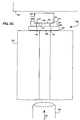
- Figure 4 illustrates a side cross-sectional view of a second embodiment of an alignment structure 500, which uses a vacuum force rather than gravitational force for holding a device component 520 against a structure, such as an integrated circuit structure, upon which device component 520 is mounted.
- the structure 500 includes a support platform 530, a first transparent substrate wafer 510 and a second transparent substrate wafer 540.
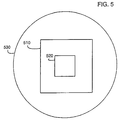
- the support platform 530, first transparent substrate wafer 510 and device component 520 are also shown in Figure 5 which depicts a top plan view of the structure 500.
- the support platform 530 is a suitable structure such as a metal plate with a level first surface 536 and an opposing level second surface 537.
- the support platform 530 is a cylindrical metal plate.
- a viewing aperture 532 which extends from the first surface 534 to the second surface 537, is formed in the support platform 530 to provide for viewing of a device 520 disposed in the vicinity of the first surface 536 using a microscope (not shown) positioned distal to the second surface 537. The line of sight of the microscope is directed toward the support platform 530 second surface 537 through the viewing aperture 532.
- a vacuum aperture 534 is formed in the support platform 530 and extends from a side 538 to the interior of support platform 530 where the vacuum aperture 534 and the viewing aperture 532 intersect. The viewing aperture 532 and the vacuum aperture 534 are formed in the support platform 530 by a suitable process such as drilling.
- the first transparent substrate wafer 510 is positioned adjacent to the first surface 536 of the support platform 530.
- a viewing aperture 512 is formed in the first transparent substrate wafer 510 extending through the thickness of the wafer 510.
- the first transparent substrate wafer 510 is positioned so that the viewing aperture 512 is in line with the viewing aperture 532 of the support platform 530.
- the second transparent substrate wafer 540 is positioned adjacent to the second surface 537 of the support platform 530, covering the viewing aperture 532.
- the second transparent substrate wafer 540 is similar to the first transparent substrate wafer 510 except that an aperture is not formed in the second transparent substrate wafer 540. Instead, the second transparent substrate wafer 540 forms an airtight bond covering the viewing aperture 532.
- the second transparent substrate wafer 540 is affixed to the support platform 530 using a suitable adhesive or other coupling so that the wafer 540 is firmly held by the support platform 530.
- an alignment pattern (not shown) is formed on a region of the first transparent substrate wafer 510 so that the pattern is visible while viewing through the viewing aperture 512.
- the alignment pattern is formed on the second transparent substrate wafer 540 in a region adjacent to the viewing aperture 532 of the support platform 530.
- the alignment pattern is formed on a transparent substrate wafer 510 or 540 using a suitable procedure, such as etching.
- the first and second transparent substrate wafers 510 and 540 have a substantially-planar shape and may be constructed from a material such as transparent quartz, glass, epoxy, fiber glass or plastic. Thickness uniformity of the substrate wafers 510 and 540 exceeds that of the photoresist used to form the photoresist well structure 110, shown in Figure 1 so that flatness of a reference surface for holding the device component 520 level is improved for aligning the component 520 by rotation.
- the transparent substrate wafers 510 and 540 each form a transparent quartz lens for microscopic viewing of the component 520 through the viewing aperture 532 of the support platform 530.
- the device component 520 is positioned overlying the first transparent substrate wafer 510 so that an alignment pattern 528 on a surface of the component 520 is adjacent to the viewing aperture 512.
- a vacuum pump (not shown) is connected to the vacuum aperture 534 using a suitable tubing material (not shown) and activated so that suction is applied through the vacuum aperture 534 and the viewing aperture 532 of the support platform 530 and through the viewing aperture 512 of the first transparent substrate wafer 510. Suction holds the device component 520 against the first transparent wafer 510.
- the microscope passes an alignment light beam through the optically transparent substrate wafers 510 and 540 and substantially perfectly reaches the surface of the alignment marking 528. Reflected and refracted light from the alignment marking 528 is easily detected so that the component 520 is easily manipulated and precisely aligned.
- a device component 520 is aligned and mounted in accordance with this embodiment by placing the component 520 overlying the first transparent substrate wafer 510 with the alignment marking 528 positioned in the viewing aperture 512.
- a suction force is applied to the vacuum aperture 534 of the support platform 530 to firmly hold the component 520 against the first transparent substrate wafer 510.
- a technician views the alignment marking 528 on the component 520 and the alignment pattern on the first transparent substrate wafer 510, simultaneously. The technician then rotates the component 520, or the structure (not shown) to which the component 520 is attached, until the alignment markings 528 on the component are aligned with the alignment pattern on the first substrate wafer 510.
- Alignment includes a coarse and fine alignment steps to realize a high accuracy of alignment.
- the component 520 is placed on the first transparent substrate wafer 510 and the position of the component 520 is adjusted so that alignment markings 528 on the component are aligned with the alignment pattern on the first substrate wafer 510.
- Fine alignment is then performed by moving the coarsely aligned component 520 in x and y linear dimensions in the plane of the surface of the first transparent substrate wafer 510 and in an angular dimension about the axis perpendicular to the wafer 510 surface to align fiducial targets (not shown) on the component 520 with targets (not shown) in a video viewing system (not shown).
- the component 520 is aligned, the component is bonded to a support member 560, which is a suitable structure which is external to the alignment structure 500.
- the support member 460 may be an integrated circuit chip, a miniature circuit board, a substrate such as a ceramic, alumina or other nonconductive material. Components are affixed to the support member 560 using a suitable bonding method.
- the alignment markings are formed in various suitable shapes or forms.
- One example of an alignment pattern is shown in Figure 6. This alignment pattern is representative of the types of patterns which are etched into a silicon wafer such as wafer 510 and 540 for aligning a component.
Landscapes
- Engineering & Computer Science (AREA)
- Manufacturing & Machinery (AREA)
- Container, Conveyance, Adherence, Positioning, Of Wafer (AREA)
- Exposure And Positioning Against Photoresist Photosensitive Materials (AREA)
Applications Claiming Priority (2)
| Application Number | Priority Date | Filing Date | Title |
|---|---|---|---|
| US08/390,469 US5639323A (en) | 1995-02-17 | 1995-02-17 | Method for aligning miniature device components |
| US390469 | 1995-02-17 |
Publications (1)
| Publication Number | Publication Date |
|---|---|
| EP0727770A1 true EP0727770A1 (de) | 1996-08-21 |
Family
ID=23542583
Family Applications (1)
| Application Number | Title | Priority Date | Filing Date |
|---|---|---|---|
| EP96301001A Withdrawn EP0727770A1 (de) | 1995-02-17 | 1996-02-14 | Verfahren und Gerät zum Ausrichten von Miniaturbauelementen |
Country Status (3)
| Country | Link |
|---|---|
| US (1) | US5639323A (de) |
| EP (1) | EP0727770A1 (de) |
| JP (1) | JPH08335592A (de) |
Cited By (1)
| Publication number | Priority date | Publication date | Assignee | Title |
|---|---|---|---|---|
| CN1103990C (zh) * | 1998-05-08 | 2003-03-26 | 阿尔卑斯电气株式会社 | 磁头 |
Families Citing this family (11)
| Publication number | Priority date | Publication date | Assignee | Title |
|---|---|---|---|---|
| JP2725659B2 (ja) * | 1995-11-15 | 1998-03-11 | 日本電気株式会社 | 荷電ビーム描画装置 |
| US6235141B1 (en) * | 1996-09-27 | 2001-05-22 | Digital Optics Corporation | Method of mass producing and packaging integrated optical subsystems |
| US6129259A (en) * | 1997-03-31 | 2000-10-10 | Micron Technology, Inc. | Bonding and inspection system |
| US6048744A (en) | 1997-09-15 | 2000-04-11 | Micron Technology, Inc. | Integrated circuit package alignment feature |
| KR100236487B1 (ko) | 1997-10-22 | 2000-01-15 | 윤종용 | 정전기 방전 불량을 방지하기 위한 분할형 칩 흡착수단을구비하는 칩 접착 장치 |
| US6991960B2 (en) | 2001-08-30 | 2006-01-31 | Micron Technology, Inc. | Method of semiconductor device package alignment and method of testing |
| US20070110361A1 (en) * | 2003-08-26 | 2007-05-17 | Digital Optics Corporation | Wafer level integration of multiple optical elements |
| US7538561B2 (en) * | 2004-09-10 | 2009-05-26 | E. I. Du Pont De Nemours And Company | Method for detecting an interface between first and second strata of materials |
| US20070126445A1 (en) * | 2005-11-30 | 2007-06-07 | Micron Technology, Inc. | Integrated circuit package testing devices and methods of making and using same |
| EP2893556B9 (de) * | 2013-12-06 | 2018-09-12 | Ev Group E. Thallner GmbH | Vorrichtung und verfahren zum ausrichten von substraten |
| JP6215426B1 (ja) * | 2016-09-21 | 2017-10-18 | オリジン電気株式会社 | 加熱装置及び板状部材の製造方法 |
Citations (6)
| Publication number | Priority date | Publication date | Assignee | Title |
|---|---|---|---|---|
| US4537509A (en) * | 1982-03-10 | 1985-08-27 | Nortronics Company, Inc. | Optical inspection and alignment verification system |
| GB2166888A (en) * | 1984-11-13 | 1986-05-14 | Magnetic Peripherals Inc | Process for producing negative pressure slider using a photoresist |
| DE3734670A1 (de) * | 1986-10-13 | 1988-06-16 | Pioneer Electronic Corp | Verfahren zur herstellung einer aufzeichnungsplatte fuer optische informationen |
| EP0444450A1 (de) * | 1990-03-02 | 1991-09-04 | International Business Machines Corporation | Steuerung lithographischer Werkzeuge durch latente Bilder |
| EP0515786A1 (de) * | 1991-05-28 | 1992-12-02 | Read-Rite Corporation | Dünnfilm-Bandkopfanordnung |
| EP0634701A1 (de) * | 1993-07-14 | 1995-01-18 | Canon Kabushiki Kaisha | Belichtungsapparat und Verfahren zur Herstellung einer Vorrichtung unter Verwendung desselben |
Family Cites Families (16)
| Publication number | Priority date | Publication date | Assignee | Title |
|---|---|---|---|---|
| US3428872A (en) * | 1965-07-31 | 1969-02-18 | Hitachi Ltd | Body comprising a mark for indirect detection of an objective part and method of detecting the position of said objective part |
| US3457639A (en) * | 1967-02-16 | 1969-07-29 | Bell Telephone Labor Inc | Method for alignment of microcircuit devices on substrate |
| US3811186A (en) * | 1972-12-11 | 1974-05-21 | Ibm | Method of aligning and attaching circuit devices on a substrate |
| US4537827A (en) * | 1983-02-07 | 1985-08-27 | Hughes Aircraft Company | Optically flat semiconductor baseplate structure |
| JPS6052084A (ja) * | 1983-08-31 | 1985-03-23 | 株式会社東芝 | 印刷配線基板 |
| US4985107A (en) * | 1988-03-01 | 1991-01-15 | Sci Systems, Inc. | Component location device and method for surface-mount printed circuit boards |
| JP2754609B2 (ja) * | 1988-06-08 | 1998-05-20 | 日本電気株式会社 | 半導体装置の製造方法 |
| US5262257A (en) * | 1989-07-13 | 1993-11-16 | Canon Kabushiki Kaisha | Mask for lithography |
| US4999077A (en) * | 1989-08-31 | 1991-03-12 | Xerox Corporation | Method of fabricating full width scanning or imaging arrays from subunits |
| JPH03123010A (ja) * | 1989-10-05 | 1991-05-24 | Murata Mfg Co Ltd | 積層電子部品の製造方法 |
| US5074947A (en) * | 1989-12-18 | 1991-12-24 | Epoxy Technology, Inc. | Flip chip technology using electrically conductive polymers and dielectrics |
| US5130660A (en) * | 1991-04-02 | 1992-07-14 | International Business Machines Corporation | Miniature electronic device aligner using capacitance techniques |
| US5257091A (en) * | 1992-02-19 | 1993-10-26 | Archive Corporation | Optical alignment system for aligning a multiple gap tape head assembly |
| US5336357A (en) * | 1993-03-12 | 1994-08-09 | Quantum Materials, Inc. | Manually operable die attach apparatus |
| US5386626A (en) * | 1993-09-10 | 1995-02-07 | Cen Tronic Co., Ltd. | Method for manufacturing a circuit board with a plurality of conductive terminal pins |
| US5459081A (en) * | 1993-12-21 | 1995-10-17 | Nec Corporation | Process for transferring a device to a substrate by viewing a registration pattern |
-
1995
- 1995-02-17 US US08/390,469 patent/US5639323A/en not_active Expired - Lifetime
-
1996
- 1996-02-14 EP EP96301001A patent/EP0727770A1/de not_active Withdrawn
- 1996-02-19 JP JP3082396A patent/JPH08335592A/ja active Pending
Patent Citations (6)
| Publication number | Priority date | Publication date | Assignee | Title |
|---|---|---|---|---|
| US4537509A (en) * | 1982-03-10 | 1985-08-27 | Nortronics Company, Inc. | Optical inspection and alignment verification system |
| GB2166888A (en) * | 1984-11-13 | 1986-05-14 | Magnetic Peripherals Inc | Process for producing negative pressure slider using a photoresist |
| DE3734670A1 (de) * | 1986-10-13 | 1988-06-16 | Pioneer Electronic Corp | Verfahren zur herstellung einer aufzeichnungsplatte fuer optische informationen |
| EP0444450A1 (de) * | 1990-03-02 | 1991-09-04 | International Business Machines Corporation | Steuerung lithographischer Werkzeuge durch latente Bilder |
| EP0515786A1 (de) * | 1991-05-28 | 1992-12-02 | Read-Rite Corporation | Dünnfilm-Bandkopfanordnung |
| EP0634701A1 (de) * | 1993-07-14 | 1995-01-18 | Canon Kabushiki Kaisha | Belichtungsapparat und Verfahren zur Herstellung einer Vorrichtung unter Verwendung desselben |
Non-Patent Citations (1)
| Title |
|---|
| ANONYMOUS: "Automatic Semiconductor Positioning System Using an Image Dissector. April 1972.", IBM TECHNICAL DISCLOSURE BULLETIN, vol. 14, no. 11, April 1972 (1972-04-01), NEW YORK, US, pages 3367 - 3369, XP002003801 * |
Cited By (1)
| Publication number | Priority date | Publication date | Assignee | Title |
|---|---|---|---|---|
| CN1103990C (zh) * | 1998-05-08 | 2003-03-26 | 阿尔卑斯电气株式会社 | 磁头 |
Also Published As
| Publication number | Publication date |
|---|---|
| US5639323A (en) | 1997-06-17 |
| JPH08335592A (ja) | 1996-12-17 |
Similar Documents
| Publication | Publication Date | Title |
|---|---|---|
| US5639323A (en) | Method for aligning miniature device components | |
| US8268209B2 (en) | Pattern forming method and its mold | |
| US7998833B2 (en) | Method for bonding wafers | |
| JP2021093444A (ja) | 型を製造する方法、型、インプリント方法、インプリント装置及び物品の製造方法 | |
| EP1096320B1 (de) | Kontaktbelichtungsvorrichtung mit Mittel zum Einstellen eines Abstands zwischen Maske und Werkstück | |
| KR20190135422A (ko) | 부품 실장 장치를 교정하기 위한 방법 | |
| KR20110132238A (ko) | 리소그래피 장치 및 물품의 제조 방법 | |
| CN105247670A (zh) | 用于对齐衬底的装置和方法 | |
| US11232960B2 (en) | Pick-and-place tool having multiple pick up elements | |
| KR102246569B1 (ko) | 임프린트 장치, 임프린트 방법 및 물품의 제조 방법 | |
| JP2002305138A (ja) | 露光装置および露光方法 | |
| US6632575B1 (en) | Precision fiducial | |
| US4669868A (en) | Step and repeat exposure apparatus and method | |
| JP4715301B2 (ja) | 素子転写装置、素子転写方法および表示装置の製造方法 | |
| JPH0536767A (ja) | プローブ装置 | |
| JPH0536768A (ja) | プローブ装置 | |
| JP2009152478A (ja) | 接触方法及び接触装置 | |
| CN119542227B (zh) | 一种晶圆键合磁阵列对准方法 | |
| TW202544978A (zh) | 用於多平面參考的工具參考件、以及用於以工具參考件判定組件的定向及/或位置的裝置及方法 | |
| JPH10321691A (ja) | 基板搬送方法及び該方法を使用する露光装置 | |
| CN222440526U (zh) | 一种用于补偿半导体裸片在压缩模塑中产生的裸片偏移的补偿标记载体和模塑面板 | |
| JP2003234372A (ja) | 集積回路基板上に集積回路ダイを整合させるシステム及び方法 | |
| JP2002372658A (ja) | 対物レンズ及び対物レンズの取り付け方法 | |
| US7710672B2 (en) | Magnetic transfer holder unit, transfer apparatus, method of manufacturing a transfer medium, and magnetic recording medium | |
| JPH10300782A (ja) | プローブ装置およびその組立方法 |
Legal Events
| Date | Code | Title | Description |
|---|---|---|---|
| PUAI | Public reference made under article 153(3) epc to a published international application that has entered the european phase |
Free format text: ORIGINAL CODE: 0009012 |
|
| AK | Designated contracting states |
Kind code of ref document: A1 Designated state(s): DE FR GB IT NL |
|
| 17P | Request for examination filed |
Effective date: 19970108 |
|
| 17Q | First examination report despatched |
Effective date: 19991214 |
|
| STAA | Information on the status of an ep patent application or granted ep patent |
Free format text: STATUS: THE APPLICATION IS DEEMED TO BE WITHDRAWN |
|
| 18D | Application deemed to be withdrawn |
Effective date: 20020903 |