EP0716418B1 - Für Hochgeschwindigkeitsübertragung von Aufzeichnungsdaten geeignete Magnetkopftreiberschaltung und magneto-optisches Aufzeichnungsgerät damit - Google Patents
Für Hochgeschwindigkeitsübertragung von Aufzeichnungsdaten geeignete Magnetkopftreiberschaltung und magneto-optisches Aufzeichnungsgerät damit Download PDFInfo
- Publication number
- EP0716418B1 EP0716418B1 EP95119251A EP95119251A EP0716418B1 EP 0716418 B1 EP0716418 B1 EP 0716418B1 EP 95119251 A EP95119251 A EP 95119251A EP 95119251 A EP95119251 A EP 95119251A EP 0716418 B1 EP0716418 B1 EP 0716418B1
- Authority
- EP
- European Patent Office
- Prior art keywords
- signal
- magnetic head
- control pulse
- control
- recording
- Prior art date
- Legal status (The legal status is an assumption and is not a legal conclusion. Google has not performed a legal analysis and makes no representation as to the accuracy of the status listed.)
- Expired - Lifetime
Links
Images





Classifications
-
- G—PHYSICS
- G11—INFORMATION STORAGE
- G11B—INFORMATION STORAGE BASED ON RELATIVE MOVEMENT BETWEEN RECORD CARRIER AND TRANSDUCER
- G11B5/00—Recording by magnetisation or demagnetisation of a record carrier; Reproducing by magnetic means; Record carriers therefor
- G11B5/02—Recording, reproducing, or erasing methods; Read, write or erase circuits therefor
-
- G—PHYSICS
- G11—INFORMATION STORAGE
- G11B—INFORMATION STORAGE BASED ON RELATIVE MOVEMENT BETWEEN RECORD CARRIER AND TRANSDUCER
- G11B11/00—Recording on or reproducing from the same record carrier wherein for these two operations the methods are covered by different main groups of groups G11B3/00 - G11B7/00 or by different subgroups of group G11B9/00; Record carriers therefor
- G11B11/10—Recording on or reproducing from the same record carrier wherein for these two operations the methods are covered by different main groups of groups G11B3/00 - G11B7/00 or by different subgroups of group G11B9/00; Record carriers therefor using recording by magnetic means or other means for magnetisation or demagnetisation of a record carrier, e.g. light induced spin magnetisation; Demagnetisation by thermal or stress means in the presence or not of an orienting magnetic field
- G11B11/105—Recording on or reproducing from the same record carrier wherein for these two operations the methods are covered by different main groups of groups G11B3/00 - G11B7/00 or by different subgroups of group G11B9/00; Record carriers therefor using recording by magnetic means or other means for magnetisation or demagnetisation of a record carrier, e.g. light induced spin magnetisation; Demagnetisation by thermal or stress means in the presence or not of an orienting magnetic field using a beam of light or a magnetic field for recording by change of magnetisation and a beam of light for reproducing, i.e. magneto-optical, e.g. light-induced thermomagnetic recording, spin magnetisation recording, Kerr or Faraday effect reproducing
- G11B11/10502—Recording on or reproducing from the same record carrier wherein for these two operations the methods are covered by different main groups of groups G11B3/00 - G11B7/00 or by different subgroups of group G11B9/00; Record carriers therefor using recording by magnetic means or other means for magnetisation or demagnetisation of a record carrier, e.g. light induced spin magnetisation; Demagnetisation by thermal or stress means in the presence or not of an orienting magnetic field using a beam of light or a magnetic field for recording by change of magnetisation and a beam of light for reproducing, i.e. magneto-optical, e.g. light-induced thermomagnetic recording, spin magnetisation recording, Kerr or Faraday effect reproducing characterised by the transducing operation to be executed
- G11B11/10504—Recording
- G11B11/10508—Recording by modulating only the magnetic field at the transducer
-
- G—PHYSICS
- G11—INFORMATION STORAGE
- G11B—INFORMATION STORAGE BASED ON RELATIVE MOVEMENT BETWEEN RECORD CARRIER AND TRANSDUCER
- G11B11/00—Recording on or reproducing from the same record carrier wherein for these two operations the methods are covered by different main groups of groups G11B3/00 - G11B7/00 or by different subgroups of group G11B9/00; Record carriers therefor
- G11B11/10—Recording on or reproducing from the same record carrier wherein for these two operations the methods are covered by different main groups of groups G11B3/00 - G11B7/00 or by different subgroups of group G11B9/00; Record carriers therefor using recording by magnetic means or other means for magnetisation or demagnetisation of a record carrier, e.g. light induced spin magnetisation; Demagnetisation by thermal or stress means in the presence or not of an orienting magnetic field
- G11B11/105—Recording on or reproducing from the same record carrier wherein for these two operations the methods are covered by different main groups of groups G11B3/00 - G11B7/00 or by different subgroups of group G11B9/00; Record carriers therefor using recording by magnetic means or other means for magnetisation or demagnetisation of a record carrier, e.g. light induced spin magnetisation; Demagnetisation by thermal or stress means in the presence or not of an orienting magnetic field using a beam of light or a magnetic field for recording by change of magnetisation and a beam of light for reproducing, i.e. magneto-optical, e.g. light-induced thermomagnetic recording, spin magnetisation recording, Kerr or Faraday effect reproducing
- G11B11/10595—Control of operating function
Definitions
- This invention relates to a recording apparatus which adopts a magneto-optical recording method.
- a recording head for a disk 91 is so constructed that an optical head 92 faces to a magnetic head 93 in such a manner as to put the disk 91 therebetween.
- the disk 91 has a vertically magnetized film 91a thereon.
- the optical head 92 includes an objective lens 94.
- a laser beam is irradiated from the optical head 92 upon the vertically magnetized film 91a to raise the temperature of a recording portion of the disk 91 to a temperature (approximately 180 °C) higher than the Curie temperature.
- a magnetic field of the N or S pole is applied from the magnetic head 93 to the vertically magnetized film 91a so that a magnetic pattern is recorded onto the vertically magnetized film 91a. Accordingly, recording of data onto the disk 91 is realized when the magnetic head 93 generates a magnetic field of the N or S polarity in accordance with data to be recorded.
- the magnetic head must give a sufficient magnetic field to a range of movement of a lens of the optical head in a tracking direction.
- the range of movement of the lens in the tracking direction is a region of the diameter of 0.6 to 1 mm.
- the magnetic head disposed in an opposing relationship to the optical head includes an E-shaped core.
- the E-shaped core has at a central portion thereof a rectangular parallelepiped center pole wound with a coil and at the opposite ends thereof a pair of rectangular parallelepiped side yokes which serve as side paths of a magnetic field.
- the sectional area of the center pole is set so as to correspond to the diameter of 0.6 to 1mm, which is the range of movement of the lens in the tracking direction, in order to assure a maximum efficiency. Further, in order to assure a high efficiency of a winding on the center pole, the cross section of the winding portion of the center pole is set substantially to a square shape.
- the coil has an inductance L of approximately 4 to 6 ⁇ H and a resistance value of 0.5 to 1 ⁇ .
- EFM data for driving a magnetic head undergo EFM modulation (Eight-Fourteen (8-14) modulation), and such EFM data are a pulse signal which exhibits a pulse reversal interval ranging from 3T at minimum to 11T at maximum.
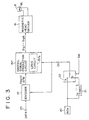
- FIG. 3 A circuit construction of a magnetic head driving system which can switchably use an ordinary transfer rate (for music applications) and a high transfer rate (for computer data or the like) is shown in FIG. 3.
- data such as audio data are supplied from a terminal 23 to an encoder 14.
- the data undergo CIRC (Cross Interleaved Reed Solomon Code) encoding, EFM modulation and some other necessary processing, to form an EFM signal.
- CIRC Cross Interleaved Reed Solomon Code
- the EFM signal is supplied to a control signal production circuit 15P.
- the control signal production circuit 15P includes a logic circuit 15Pa and produces and outputs control signals Sig1 to Sig6 for a magnetic head driving circuit 16 based on the EFM signal (Sig0).
- the magnetic head driving circuit 16 allows an electric current to flow into a coil 6L of a magnetic head 6 in response to the control signals Sig1 to Sig6 so that a magnetic field may be applied from the magnetic head 6 to a disk not shown in FIG. 3.
- a clock generation section 20 generates a clock signal for operation at an ordinary transfer rate.
- a clock frequency variation section 21 multiplies the frequency of the clock signal from the clock generation section 20 by the number of N, to produce another clock signal for operation at a high transfer rate.
- Either the clock signal for the ordinary rate from the clock generation section 20 or the clock signal for the high rate from the clock frequency variation section 21 is selected by a switching operation of a switch 22 in response to a switching signal Sel from a control section or a like element not shown.
- the selected clock signal is supplied as a processing clock signal CK to the encoder 14 and the control signal production circuit 15P.
- a recording operation is performed at the ordinary transfer rate, but when it is connected at an F terminal thereof, a recording operation is performed at the high transfer rate, for example, a rate equal to twice the ordinary transfer rate.
- the magnetic head driving circuit 16 is constructed as shown in FIG. 4.
- the magnetic head driving circuit 16 includes switching elements SW 1 to SW 6 to which the control signals Sig1 to Sig6 from the control signal production circuit 15P are inputted as switching control signals, respectively.
- a head terminal h 1 connected to the coil 6L of the magnetic head 6 is connected to a positive dc power source 16a by way of the switching element SW 1 and is grounded by way of the switching element SW 5 . Further, the head terminal h 1 is connected to a negative dc power source 16b by way of the switching element SW 3 and also by way of a diode D 1 .
- Another head terminal h 2 connected to the other end of the coil 6L of the magnetic head 6 is connected to the positive dc power source 16a by way of the switching element SW 2 and is grounded by way of the switching element SW 6 . Further, the head terminal h 2 is connected to the negative dc power source 16b by way of the switching element SW 4 and also by way of a diode D 2 .
- the potential +V of the positive dc power source 16a is set, for example, to +5 V
- the potential -V of the negative dc power source 16b is set, for example, approximately to -45 V.
- the ground is used as a power source of the 0 V potential.
- the logic circuit 15Pa of the control signal production circuit 15P which supplies the control signals Sig1 to Sig6 to the magnetic head driving circuit 16 is constructed as shown in FIG. 5 and produces the control signals Sig1 to Sig6 using the EFM signal (Sig0) and the clock signal CK.
- the EFM signal is supplied as the signal Sig0 to a terminal 50. Meanwhile, the clock signal CK is supplied to a terminal 57 by way of the switch 22 of FIG. 3.
- the logic circuit 15Pa includes invertors IV 1 to IV 7 , flip-flops FF 1 and FF 2 , AND gates A 1 to A 7 , and delay circuits DL 1 and DL 2 .
- the logic circuit 15Pa has output terminals 51 to 56 for outputting the control signals Sig1 to Sig6, respectively.
- the signal Sig0 is first supplied directly to the terminal 51. As seen from FIG. 6J, the signal Sig0 and the control signal Sig1 are the same signal.
- the signal Sig0 is logically inverted by the invertor IV 1 and supplied as the control signal Sig2 to the terminal 52.
- the control signal Sig2 is such a control signal as seen from FIG. 6K.
- the invertor IV 2 , the flip-flop FF 1 and the AND gate A 1 function as a falling edge detection circuit, and the signal Sig0 is supplied to the invertor IV 2 and the D terminal of the flip-flop FF 1 .
- the flip-flop FF 1 performs a latching operation in response to the clock signal CK and outputs such a Q output as shown in FIG. 6C.
- the output of the invertor IV 2 exhibits a waveform similar to that of the control signal Sig2 of FIG. 6K.
- the AND gate A 1 performs AND-operation for the Q output of the flip-flop FF 1 and the output of the invertor IV 2 , and the output thereof is shown in FIG. 6D.
- the AND output provides a falling edge detection pulse outputted in response to each falling edge of the signal Sig0.
- the falling edge detection pulse is supplied to the AND gate A 4 and is also supplied to the AND gate A 5 by way of the invertor IV 6 .
- the signal Sig0 is inverted by the invertor IV 4 and supplied to the AND gate A 5 .
- the invertor IV 3 , the flip-flop FF 2 and the AND gate A 2 function as a rising edge detection circuit, and the signal Sig0 is supplied, after inverted by the invertor IV 1 , to the invertor IV 3 and the D terminal of the flip-flop FF 2 .
- the flip-flop FF 2 performs a latching operation in response to the clock signal CK and provides such a Q output as shown in FIG. 6E.
- the output of the invertor IV 3 exhibits a waveform similar to that of the control signal Sig1 of FIG. 6J.
- the AND gate A 2 performs AND-operation for the Q output of the flip-flop FF 2 and the output of the invertor IV 3 and provides a rising edge detection pulse which is outputted in response to each rising edge of the signal Sig0 as seen from FIG. 6F.
- the rising edge detection pulse is supplied to the AND gate A 6 and is also supplied to the AND gate A 7 by way of the invertor IV 7 .
- the signal Sig0 is inverted, after inverted by the invertor IV 1 , by the invertor IV 5 again and supplied to the AND gate A 7 .
- the delay circuit DL 1 delays the clock signal CK to produce a delayed clock signal CK D1 of FIG. 6G.
- the delay circuit DL 2 delays the delayed clock signal CK D1 to produce another delayed clock signal CKD2 of FIG. 6H.
- the delayed clock signal CK D1 and the delayed clock signal CK D2 are supplied to the AND gate A 3 so that a reference pulse signal illustrated in FIG. 6I is produced by the AND gate A 3 .
- the reference pulse signal is supplied to the AND gates A 4 , A 5 , A 6 and A 7 .
- the AND gate A 4 performs AND-operation for the falling edge detection pulse signal from the AND gate A 1 and the reference pulse signal from the AND gate A 3 to produce the control signal Sig3 as shown in FIG. 6L.
- the control signal Sig3 is outputted from the terminal 53.
- the AND gate A 6 performs AND-operation for the rising edge detection pulse signal from the AND gate A 2 and the reference pulse signal from the AND gate A 3 to produce the control signal Sig4 as shown in FIG. 6M.
- the control signal Sig4 is outputted from the terminal 54.
- the AND gate A 5 performs AND-operation for the output of the invertor IV 4 , the output of the invertor IV 6 and the reference pulse signal and produces the control signal Sig5 as shown in FIG. 6N.
- the control signal Sig5 is outputted from the terminal 55.
- the AND gate A 7 performs AND-operation for the output of the invertor IV 5 , the output of the invertor IV 7 and the reference pulse signal to produce the control signal Sig6 as shown in FIG. 60.
- the control signal Sig6 is outputted from the terminal 56.
- control signals Sig1 to Sig6 produced in such a manner as described above are supplied as control pulse signals to the switching elements SW 1 to SW 6 of the magnetic head driving circuit 16 of FIG. 4, respectively. Operation of the magnetic head driving circuit 16 based on the control signals Sig1 to Sig6 will be described below. It is to be noted that the description of the operation is given in connection with the points of time t 1 and t 2 between which the EFM signal exhibits the minimum reversal interval of 3T.
- These signals are the control signals Sig3 and Sig5 as apparently seen from FIGs. 6L and 6N.
- the switching elements SW 3 and SW 5 operate to control the electric current to the coil 6L.
- the magnetic head driving circuit 16 of FIG. 4 upon reversal of the EFM signal can be represented as such an equivalent circuit as shown in FIG. 7.
- FIG. 7 it is assumed that the switch 22 of FIG. 3 is connected at the N terminal thereof and the magnetic head driving system is operating at the normal transfer rate.
- T 230 nsec.
- FIGs. 8A to 8E show timing charts of the control signals Sig1, Sig3 and Sig5, the head current Ih flowing through the coil 6L and the voltage Vh 1 at the head terminal h 1 .
- the peak value of the head current Ih is approximately 0.5 A, and +V of the waveform diagram of the head terminal voltage Vh 1 is approximately +5 V and -V is approximately -45 V.
- the switching elements SW 1 , SW 3 and SW 5 are all off, and the head terminal h 1 is disconnected from any voltage source. Meanwhile, since the switching element SW 2 is on (not shown), the head terminal h 2 is fixed to the +V voltage as can be seen from FIG. 7.
- Movement of charge is governed by an electromotive force, produced by an inductance of the coil 6L, which allows charge to flow in the direction of the head terminal h 1 ⁇ h 2 . Consequently, an operation is performed in a direction in which charge is sucked from the head terminal h 1 and discharged to the terminal of the head terminal h 2 . Since the head terminal h 2 is fixed to the +V voltage, the charge is circulated back to the +V voltage source (positive dc power source 16a) side.
- the head terminal h 1 side Since the head terminal h 1 side is disconnected from all of the voltage sources, it sucks charge from a small floating capacitance. Accordingly, the voltage Vh 1 of the head terminal h 1 drops rapidly. As the voltage drop proceeds, the coil current Ih decreases little by little. Thus, an operation which can be seen from a t A period of FIG. 8D is performed.
- the voltage drop described above reaches the -V potential and is fixed there by the voltage source for -V by way of the diode D 1 .
- charge moves from the -V power source (negative dc power source 16b) to the head terminal h 1 side by way of the diode D 1 .
- the head terminal h 1 is short-circuited to the -V power source (negative dc power source 16b). Consequently, the voltage Vh 1 of the head terminal h 1 is fixed to -V as seen within a t c period of FIG. 8E.
- control signal Sig5 is supplied at a required timing so that the head current Ih is kept substantially fixed as seen from FIG. 8D.
- an electric current flows in the direction of the head terminal h 2 ⁇ h 1 in response to the EFM signal of the "L" level, that is, in response to the control signal Sig1, and.a magnetic field is generated from the magnetic head 6 in accordance with the direction of the electric current.
- an electric current flows in the direction of the head terminal h 1 ⁇ h 2 by similar operations by the control signals Sig1, Sig2, Sig4 and Sig6, and within this period of 4T, a magnetic field is generated from the magnetic head 6 in accordance with the direction of the electric current.
- the rise time (t A in FIGs. 8A to 8E) is fixed. This can be calculated by the following expressions.
- the following values are substituted into the expression (4).
- V (-V) - (+V)
- V (-V) - (+V)
- L 5 x 10 -6 (H)
- ⁇ i the electric current value of 0.5 A exhibited at an initial stage.
- the rise time t A is approximately 50 nsec.
- a recording operation at a twice rate with the construction of the magnetic head driving circuit 16 described above will be examined.
- the switch 22 of FIG. 3 is connected to the F terminal side thereof, and a clock signal having a frequency equal to twice that in a normal operation is supplied as the processing clock signal CK.
- the control signal production circuit 15P, the magnetic head driving circuit 16 and the magnetic head 6 are used as they are.
- FIGs. 9A to 9E Timing charts upon a recording operation at the high rate are shown in FIGs. 9A to 9E.
- the absolute time of, for example, the period of 3T is AT/2 in FIGS. 9A to 9E with respect to the time illustrated in FIGs. 8A to 8E.
- the control signals Sig1, Sig3 and Sig5 are pulse signals whose time base is 1/2 that in the case of FIGs. 8A to 8E (T ⁇ 115 nsec).
- the rise time t A is the same as that at the normal rate in the case of FIGs. 8A to 8E because it relies upon the coil 6L and the magnetic head driving circuit 16. Due to the fact that the rise time t A is the same, in the case of FIGs. 9A to 9E, the t B period, that is, the period after the voltage Vh 1 reaches -V until the control signal Sig3 changes to the "H" level, is very short. In this instance, the time from a falling edge of the control signal Sig1 to a rising edge of the control signal Sig3 is approximately 58 nsec and is longer only a little than the rise time t A of approximately 50 nsec.
- FIGs. 10A to 10D Timing charts of the operation of the magnetic head driving circuit 16 at the three time rate are shown in FIGs. 10A to 10D.
- the absolute time of, for example, the period of 3T is reduced to AT/3, and as seen from FIGs. 10A to 10D, the control signals Sig1, Sig3 and Sig5 become pulse signals whose time base is reduced to 1/3 comparing with that in FIGs. 8A to 8E (T ⁇ 78 nsec).
- the rise time t A remains approximately 50 nsec and does not exhibit a variation from that at the normal rate shown in FIGs. 8A to 8E.
- the conventional magnetic head driving system of the construction described above cannot be applied when a high speed operation of three or more times a normal rate is intended.
- a magnetic head driving circuit comprising means for providing at least a first power source voltage and a second power source voltage lower than said first power source voltage, first switching means for switching connection to one end of a coil of said magnetic head at least between said first and second power source voltages, second switching means for switching connection to said end of said coil of said magnetic head to ground, third switching means for switching connection to the other end of said coil of said magnetic head at least between said first and second power source voltage, first control pulse production means for producing a control pulse for controlling said first switching means at a transfer rate T of an input encoded recording signal, whereby the first control pulse production means is adapted to connect said second power source voltage to the one end of said coil of said magnetic head after a delay of a predetermined time after a reversal edge of a pulse interval, which is given by n x T, of an encoded recording signal, n being a positive integral number, at a transfer rate equal to or higher than three times the
- the predetermined time is equal to or higher than 50 nsec.
- the magnetic head driving circuit further comprises second control pulse production means for producing a control pulse for controlling said first switching means, so that the rising edge of said control pulse for controlling said first switching means is produced at a time, which is approximately (1/2)T after the falling edge and the rising edge respectively of a pulse interval, transfer rate variation means for varying the transfer rate T of the recording signal, fourth switching means for switching connection between said first control pulse production means and said second control pulse production means, control means for controlling said fourth switching means in response to a variation be said transfer rate variation means, driving means for driving said first and second switching means in response to the control pulse from said second control pulse production means.
- second control pulse production means for producing a control pulse for controlling said first switching means, so that the rising edge of said control pulse for controlling said first switching means is produced at a time, which is approximately (1/2)T after the falling edge and the rising edge respectively of a pulse interval
- transfer rate variation means for varying the transfer rate T of the recording signal
- fourth switching means for switching connection between said first control pulse production means and said second control pulse production means,
- the magnetic head driving circuit further comprises second control pulse production means for producing control pulses for controlling said first and second switching means, so that the total number of said control pulses within the pulse interval of the encoded recording signal from said signal processing means may be equal to n, transfer rate variation means for varying the transfer rate T of the recording signal, fourth switching means for switching connection between said first control pulse production means and said second control pulse production means, control means for controlling said fourth switching means in response to a variation be said transfer rate variation means, driving means for driving said first and second switching means in response to the control pulse from said second control pulse production means.
- a recording apparatus comprising an optical head for irradiating a laser beam upon a face of a recording medium, a magnetic head disposed in an opposing relationship to a laser irradiation position at which the laser beam is irradiated for applying a magnetic field to the other face of the recording medium, signal processing means for encoding a recording signal to be recorded onto the recording medium, and a magnetic head driving circuit as described above.
- the logic for production of control pulses is set such that, where the encoded data have a pulse period of nT, the total number of control pulses (Sig3 and Sig5, or Sig4 and Sig6) for required switching elements may be smaller than n. Also, upon magnetic reversal, a control pulse signal (Sig3, Sig4) for a switching element for short-circuiting a terminal of a coil to a required power source is set to be outputted after an interval of time sufficient for the voltage at the terminal of the coil to reach a predetermined voltage elapses. Accordingly, it becomes possible to solve a difficulty in high rate recording which arises from the fact that the rise time t A is substantially fixed.
- control pulse generator includes a logic circuit having such production logic as just described as a second logic circuit in addition to a first logic circuit having a similar logical construction to that in the prior art, wherein either of the first and second logic circuits can be selectively used. Accordingly, a recording apparatus enabling high speed recording at a rate in a wide range from a normal rate to a high rate equal to or three times the normal rate can be realized.
- FIG. 11 The construction of a recording and reproduction apparatus which is common to the embodiments is shown in FIG. 11.
- the recording and reproduction apparatus is used to record and reproduce data onto and from a magneto-optical disk 1.
- the recording and reproduction apparatus includes a system controller 11 for controlling various operations thereof.
- the system controller 11 is formed from, for example, a microcomputer.
- the recording and reproduction apparatus further includes a spindle motor 2 for rotating the disk 1 loaded thereon.
- An optical head 3 irradiates, upon recording or reproduction, a laser beam upon the disk 1.
- the optical head 3 outputs, upon recording, a laser beam of a high energy level to heat a recording track of the disk 1 to or higher than its Curie temperature.
- the optical head 3 Upon reproduction, the optical head 3 outputs a laser beam of a comparatively low energy level to detect data from reflected light based on a magnetic Kerr effect.
- the optical head 3 includes a laser diode serving as laser beam outputting means, an optical system including a polarization beam splitter, an objective lens and so forth, and a detector for detecting reflected light.
- the objective lens 3a is held for displacement in a radial direction of the disk 1 and another direction toward and away from the disk 1 by a biaxial mechanism 4.
- the entire optical head 3 is mounted for movement in a radial direction of the disk 1 by a thread mechanism 5.
- a magnetic head 6 applies a magnetic field modulated in accordance with information supplied thereto to the magneto-optical disk 1.
- the magnetic head 6 is disposed in an opposing relationship to the optical head 3 across the disk 1.
- Information detected from the disk 1 by the optical head 3 upon reproduction operation is supplied to a RF amplifier 7.
- the RF amplifier 7 calculates the information supplied thereto to extract a reproduction RF signal, a tracking error signal, a focusing error signal and groove information.
- the groove information is originated from a serpentine groove formed with a predetermined frequency in advance on the disk 1 and also including address information recorded thereon.
- the reproduction RF signal thus extracted is supplied to a decoder section 8. Meanwhile, the tracking error signal and the focusing error signal are supplied to a servo circuit 10.
- An address decoder 9 decodes the groove information to obtain absolute position information. Further, the address information recorded as data is extracted by the decoder section 8. The address information is supplied to the system controller 11, and is used for various controlling operations.
- the servo circuit 10 generates various servo driving signals based on the tracking error signal and the focusing error signal supplied thereto from the RF amplifier 7; and a track jumping instruction, an accessing instruction, rotational speed detection information and so forth supplied from the system controller 11. On the servo signals thus generated, the servo circuits 10 controls the biaxial mechanism 4 and the thread mechanism 5 to perform focusing and tracking control, and also controls the spindle motor 2 to rotate at a constant linear velocity (CLV).
- CLV constant linear velocity
- the reproduction RF signal undergoes EFM demodulation, CIRC (Cross Interleaved Reed Solomon Code) decoding and so forth by the decoder section 8.
- the reproduction RF signal thus processed by the decoder section 8 is supplied as a reproduction data output to a predetermined processing section not shown from a terminal 12 by way of the system controller 11.
- information supplied, upon recording operation, from a terminal 13 to the system controller 11 as information to be recorded onto the disk 1 undergoes encoding processing such as CIRC encoding, EFM modulation and so forth by an encoder section 14 to produce an EFM signal.
- the EFM signal is supplied to a control signal production circuit 15.
- the control signal production circuit 15 produces control signals (Sig1 to Sig6) based on the EFM signal and supplies them to a magnetic head driving circuit 16.
- the magnetic head driving circuit 16 operates based on the control signals (Sig1 to Sig6) to allow an electric current to flow through a coil of the magnetic head 6 for applying a magnetic field of the N or S pole to the disk 1. Simultaneously, the system controller 11 supplies a control signal to the optical head 3 to output a laser beam of the recording level.
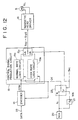
- FIG. 12 is a block diagram of a magnetic head driving system in the first embodiment of the present invention which is incorporated in the recording and reproduction apparatus having the construction described above.
- the magnetic head driving system has a terminal 23 to which recording data are supplied from the system controller 11.
- the encoder 14 performs CIRC encoding and EFM modulation for the recording data to produce an EFM signal and supplies the EFM signal to the control signal production circuit 15.
- the control signal production circuit 15 includes a normal rate logic circuit 15a and a high rate logic circuit 15b.
- the EFM signal is supplied to both of the normal rate logic circuit 15a and the high rate logic circuit 15b.
- the normal rate logic circuit 15a and the high rate logic circuit 15b produce and output control signals Sig1 to Sig6 with different logic constructions on the basis of the EFM signal.
- the outputs of the normal rate logic circuit 15a and the high rate logic circuit 15b are selectively switched by a change-over circuit 15c and supplied to the magnetic head driving circuit 16.
- the magnetic head driving circuit 16 receives those of the control signals Sig1 to Sig6 produced by either the normal rate logic circuit 15a or the high rate logic circuit 15b selected by the change-over circuit 15c and operates based on the received control signals Sig1 to Sig6 to allow an electric current to flow through the coil 6L of the magnetic head 6.
- One of the normal rate clock signal and the three time rate clock signal is selected by a switch 22 and supplied as a processing clock signal to the encoder 14 and the control signal production circuit 15. Changing over of the switch 22 is performed, for example, in response to a change-over control signal Sel from the system controller 11.
- the change-over control signal Sel is supplied also to the change-over circuit 15c to change over the same.
- the system controller 11 connects the switch 22 at the F terminal and the change-over circuit 15c at an A terminal using the change-over control signal Sel.
- the system controller 11 connects the switch 22 at the F terminal and the change-over circuit 15c at a B terminal using the change-over control signal Sel.
- the magnetic head driving circuit 16 may have a circuit construction, for example, similar to that described hereinabove with reference to FIG. 4.
- the switching elements SW 1 to SW 6 are controlled between on and off states in accordance with the control signals Sig1 to Sig6, respectively, and an electric current is supplied in a required direction to the coil 6L based on the operations of the switching elements SW 1 to SW 6 .
- the normal rate logic circuit 15a in the control signal production circuit 15 has a similar construction to that of the logic circuit of FIG. 5.
- the control signals Sig1 to Sig6 from the normal rate logic circuit 15a are supplied to the magnetic head driving circuit 16, and the magnetic head driving circuit 16 operates in such a manner as described hereinabove with reference to FIGs. 8A to 8E. Overlapping description of the operation of the magnetic head driving circuit 16 in this instance is omitted herein.
- the switch 22 is connected at the F terminal so that the transfer rate is raised to three times. Further, the B terminal of the change-over circuit 15c is selected so that the control signals Sig1 to Sig6 from the high rate logic circuit 15b are supplied to the magnetic head driving circuit 16 having the construction of FIG. 4.
- the high rate logic circuit 15b is so constructed as shown in FIG. 13 and produces the control signals Sig1 to Sig6 using the EFM signal (Sig0) and the clock signal CK of the three time rate.
- the high rate logic circuit 15b has a terminal 60 to which the EFM signal is supplied as the signal Sig0.
- the high rate logic circuit 15b has another terminal 67 to which the clock signal CK is supplied by way of the switch 22 of FIG. 12.
- the high rate logic circuit 15b includes invertors IV 11 and IV 12 , flip-flops FF 11 and FF 12 , AND gates A 11 to A 16 , an exclusive OR gate EX 1 and a NOR gate NR 1 .
- the high rate logic circuit 15b has output terminals 61 to 66 for control signals Sig1 to Sig6, respectively.
- the signal Sig0 is first supplied directly to the terminal 61 and makes such a control signal Sig1 as seen in FIG. 14J.
- the signal Sig0 is logically inverted by the invertor IV 11 and supplied to the terminal 62 so that it makes such a control signal Sig2 as seen in FIG. 14K.
- the signal Sig0 is supplied to the D terminal of the flip-flop FF 11 and the exclusive OR gate EX 1 .
- the flip-flop FF 11 performs a latching operation in response to the clock signal CK and outputs such a Q output as shown in FIG. 14C.
- the Q output of the flip-flop FF 11 is supplied to the exclusive OR gate EX 1 .
- the exclusive OR gate EX 1 performs exclusive-OR operation for the Q output of the flip-flop FF 11 of FIG. 14C and the signal Sig0 and provides such an output as shown in FIG. 14D.
- the output of the exclusive OR gate EX 1 shown in FIG. 14D is supplied to the D terminal of the flip-flop FF 12 and the NOR gate NR 1 .
- the flip-flop FF 12 performs a latching operation in response to the clock signal CK and provides such a Q output as shown in FIG. 14E.
- the Q output of the flip-flop FF 12 is supplied to the NOR gate NR 1 and the AND gate A 12 .
- the NOR gate NR 1 performs NOR-operation for the output of the exclusive OR gate EX 1 shown in FIG. 14D and the Q output of the flip-flop FF 12 shown in FIG. 14E and provides such an output as shown in FIG. 14F.
- the output of the NOR gate NR 1 is supplied to the AND gate A 11 .
- the clock signal CK from the terminal 67 is inverted by the invertor IV 12 to form such an inverted clock signal CK- as seen in FIG. 14G.
- the inverted clock signal CK- is supplied to the AND gate A 11 and the AND gate A 12 .
- the AND gate A 11 performs AND-operation for the output of the NOR gate NR 1 and the inverted clock signal CK-to produce such a logical AND output as shown in FIG. 14H.
- the AND gate A 12 performs AND-operation for the Q output of the flip-flop FF 12 and the inverted clock signal CK- to produce such a logical AND output as shown in FIG. 14I.
- the AND gate A 15 performs AND-operation for the output of the AND gate A 12 of FIG. 14I and the output of the invertor IV 11 (which has the same waveform as the control signal Sig2) to produce such a control signal Sig3 as show in FIG. 14L.
- the control signal Sig3 is outputted from the terminal 63.
- the AND gate A 16 performs AND-operation for the output of the AND gate A 12 of FIG. 14I and the signal Sig0 to produce such a control signal Sig4 as shown in FIG. 14M.
- the control signal Sig4 is outputted from the terminal 64.
- the AND gate A 13 performs AND-operation for the output of the AND gate A 11 of FIG. 14H and the output of the invertor IV 11 (which has the same waveform as the control signal Sig2) to produce such a control signal Sig5 as shown in FIG. 14N.
- the control signal Sig5 is outputted from the terminal 65.
- the AND gate A 14 performs AND-operation for the output of the AND gate A 11 and the signal Sig0 to produce such a control signal Sig6 as shown in FIG. 140.
- the control signal Sig6 is outputted from the terminal 66.
- the control signals Sig1 to Sig6 produced by the high rate logic circuit 15b having the logical construction described above are supplied as control pulses to the magnetic head driving circuit 16, that is, to the switching elements SW 1 to SW 6 of the magnetic head driving circuit 16 of FIG. 4. Rising timings of the signal Sig3 to the switching element SW 3 for short-circuiting the head terminal h 1 to the -V power source within a "L" level period of the EFM signal and the control signal Sig4 to the switching element SW 4 for short-circuiting the head terminal h2 to the -V power source within a "H" level period of the EFM signal are later than a timing after at least more than IT elapses after a reversal timing of the EFM signal.
- the period from a point of time of a reversal to a rising edge of the control signal Sig3 or Sig4 can be set at least to a period longer than 78 nsec.
- the rising time is retarded comparing with the control signal Sig3 or Sig4 (illustrated in FIG. 6L or 6M) by the normal rate logic circuit 15a.
- the number of pulses which exhibit the high level within one reversal period is smaller than n where the reversal period is represented by nT.
- FIGs. 15A, 15B, 15C and 15D show waveforms of the control signals Sig1, Sig3 and Sig5 within the "H" level period of the EFM signal when the "H" level period is 3T, 4T, 5T and 11T, respectively.
- the control signal Sig3 rises after an elapse of a timing of approximately 1.5T since a falling edge of the control signal Sig1.
- the total pulse number of the control signals Sig3 and Sig5 is 2 as can be seen from FIG. 15A and is smaller than "3" of 3T.
- FIGs. 16A to 16E These figures take as an example the points of time t 1 and t 2 between which the EFM signal exhibits a minimum reversal interval of 3T.
- FIGs. 16D and 16E show timing charts of the head current Ih flowing through the coil 6L and the voltage Vh 1 at the head terminal h 1 . It is assumed that the peak value of the head current Ih is 0.5 A, and +V in the waveform diagram of the voltage Vh 1 is approximately +5 V and -V is approximately -45 V.
- the switching element SW 3 is not turned on in response to the control signal Sig3 until the voltage drops to the -V potential and is then fixed to the voltage source of -V by the diode D 1 .
- the switching element SW 3 is turned on in response to the control signal Sig3 only after an elapse of the period of t z indicated in FIG. 16B since a falling edge of the control signal Sig1.
- the head terminal h 1 is short-circuited to the-V power source (negative dc power source 16b), and the voltage Vh 1 is hereafter fixed to -V.
- the rise time t A is approximately 50 nsec similarly as in the case of the normal rate described hereinabove with reference to FIGs. 8A to 8E.
- an operation is disabled because the control signal Sig3 rises before an elapse of approximately 50 nsec.
- the switching element SW 3 can be thus turned on at a point of time after the difference between the voltage Vh 1 and the-V potential has been eliminated. Accordingly, an appropriate operation by a high speed switching element is realized.
- the head current Ih is kept substantially fixed by the control signal Sig5.
- a recording operation at a three time rate which has conventionally been impossible, can be performed without any modification to the construction of the magnetic head driving circuit 16 or the magnetic head 6.
- a recording operation at a rate higher than the three time rate can be of course realized.
- FIG. 12 A second embodiment of the present invention will be described below. It is to be noted that the magnetic head driving system has the construction of FIG. 12 similarly to that in the first embodiment.
- the high rate logic circuit 15b is different from that in the first embodiment.
- the high rate logic circuit 15b has a construction shown in FIG. 17 for producing control signals Sig1 to Sig6 using an EFM signal (Sig0) and a clock signal CK of the three time rate.
- the high rate logic circuit 15b is different in construction from that of FIG. 12 in that it additionally includes a flip-flop FF 13 and an invertor IV 13 , which are surrounded by a broken line in FIG. 17, and the output of the NOR gate NR 1 is used as a clear signal for the flip-flop FF 13 and that the Q output of the flip-flop FF 13 is supplied to the AND gate A 11 .
- a clock signal CK is supplied to the flip-flop FF 13 .
- the Q output of the flip-flop FF 13 is inverted by the invertor IV 13 and supplied to the D terminal of the flip-flop FF 13 . Since the output of the NOR gate NR 1 shown in FIG. 18F is used as a clear signal for the flip-flop FF 13 , the Q output of the flip-flop FF 13 exhibits such a waveform as shown in FIG. 18G.
- the Q output of the flip-flop FF 13 is supplied to the AND gate A 11 .
- the AND gate A 11 performs AND-operation for the Q output of the flip-flop FF 13 and an inverted clock signal of FIG. 18H, which is the output of the invertor IV 12 , to provide such an output as shown in FIG. 18I.
- the output of the AND gate A 11 is supplied to the AND gates A 13 and A 14 and used for production of control signals Sig5 and Sig6, respectively.
- the AND gate A 13 performs AND-operation for the output of the AND gate A 11 and the output of the invertor IV 11 (which has the same waveform as the control signal Sig2) to produce such a control signal Sig5 as shown in FIG. 180.
- the AND gate A 14 performs AND-operation for the output of the AND gate A 11 and the signal Sig0 to produce such a control signal Sig6 as shown in FIG. 18P.
- the other control signals Sig1 to Sig4 are such as shown in FIGs. 18K to 18N and are similar to the control signals Sig1 to Sig4 of FIGs. 14J to 14M, respectively.
- FIGs. 19A to 19D the waveforms of the control signals Sig1, Sig3 and Sig5 within a "H" level period of the EFM signal are shown in FIGs. 19A to 19D when the "H" level period is 3T, 4T, 5T and 11T, respectively.
- the control signal Sig3 rises after an elapse of a time of approximately 1.5T since a falling edge of the control signal Sig1. Further, when the "H" level period is 3T, the total pulse number of the control signals Sig3 and Sig5 is 1 as seen from FIG. 19A and is smaller than "3" of 3T. Similarly, when the "H" level period is 11T, the total pulse number of the control signals Sig3 and Sig5 is 5 as seen from FIG. 19D and is smaller than "11" of 11T.
- the switching element SW 3 is not turned on in response to the control signal Sig3 until the voltage of the head terminal h 1 drops to the -V potential and is then fixed to the voltage source of -V by the diode D 1 . Then, the switching element SW 3 is turned on in response to the control signal Sig3 only after an elapse of an interval of time indicated by tz in FIG. 16B since a falling edge of the control signal Sig1.
- the switching element SW 3 is turned on, the head terminal h 1 is short-circuited to the -V power source (negative dc power source 16b) so that the voltage Vh 1 is thereafter fixed to - V.
- t z approximately 117 ns
- the voltage Vh 1 of the head terminal h 1 is substantially equal to the -V potential.
- the switching element SW 3 can be turned on. Accordingly, an appropriate operation by a high speed switching element can be realized.
- a recording operation at a three time rate which has conventionally been impossible, can be performed without any modification to the construction of the magnetic head driving circuit 16 or the magnetic head 6.
- a recording operation at a rate higher than the three time rate can be of course realized.
- control signal production circuit 15 does not include a normal rate logic circuit but includes only the high rate logic circuit 15b.
- the high rate logic circuit 15b may be so constructed as shown in FIG. 13 or 17.
- the present embodiment is constructed as a recording apparatus for exclusive use for a high rate.
- the frequency of the clock signal CK is made variable so that the recording apparatus may operate at a plurality of different transfer rates.
- the requirement to make it possible to use a high speed switching element is that, if it is presumed that the inductance L of a magnetic head is approximately 5 ⁇ H, the interval of time until the switching element SW 3 (SW 4 ) is turned on in response to the control signal Sig3 (Sig4) after a signal reversal, that is, the interval of time within which the terminal is in a high impedance condition, should be longer than at least 50 nsec.
- the upper limit to the interval of time is an interval of time until the direction of the electric current reverses itself, and if this is taken into consideration, the upper limit is approximately 150 nsec.
- the present invention has been described with respect to a magneto-optical disk system; however, the present invention can be realized as a magneto-optical recording apparatus for any other system.
Claims (5)
- Treiberschaltung für einen Magnetkopf (6), die umfasst:Mittel zum Bereitstellen zumindest einer ersten Stromquellen-Spannung und einer zweiten Stromquellen-Spannung, die niedriger als die erste Stromquellen-Spannung ist,ein erstes Schaltmittel (SW3 bzw. SW4) zum Schalten einer Verbindung eines Endes einer Spule des Magnetkopfs (6) zumindest zwischen den ersten und zweiten Stromquellen-Spannungen,ein zweites Schaltmittel (SW5 bzw. SW6) zum Schalten einer Verbindung des Endes der Spule des Magnetkopfs mit Erde,ein drittes Schaltmittel (SW2 bzw. SW1) zum Schalten einer Verbindung des anderen Endes der Spule des Magnetkopfs (6) zumindest zwischen der ersten und der zweiten Stromquellen-Spannung,ein erstes Steuerimpuls-Erzeugungsmittel (15b) zum Erzeugen eines Steuerimpulses zum Steuern des ersten Schaltmittels (SW3 bzw. SW4) mit einer Übertragungsrate T eines eingegebenen kodierten Aufzeichnungssignals, wobei das erste Steuerimpuls-Erzeugungsmittel dazu bestimmt ist, die zweite Stromquellen-Spannung mit dem einen Ende der Spule des Magnetkopfs (6) nach einer Verzögerung um eine vorbestimmte Zeit nach einer Umkehrflanke eines Impulsintervalls des kodierten Aufzeichnungssignals das durch n x T gegeben ist, wobei n eine positive ganze Zahl ist, bei einer Übertragungsrate zu verbinden, die gleich oder höher als das Dreifache einer normalen Rate ist, wobei die Zeitverzögerung von der Anstiegszeit der Magnetspule abhängt und derart eingestellt ist, dass die Spannung des einen Endes der Magnetspule die Spannung der zweiten Stromquelle erreicht,ein Treibermittel zum Treiben der ersten und zweiten Schaltmittel (SW3, SW5 bzw. SW4, SW6) in Reaktion auf den Steuerimpuls aus dem ersten Steuerimpuls-Erzeugungsmittel (15b), wobeidie vorbestimmte Zeit von der Übertragungsrate abhängt und derart eingestellt ist, dass die Anstiegsflanke des Steuerimpulses zum Steuern des ersten Schaltmittels (SW3 bzw. SW4) zu einem Zeitpunkt erzeugt wird, der zumindest 1,5T nach der Abfallflanke bzw. der Anstiegsflanke eines Impulsintervalls liegt, unddas erste Steuerimpuls-Erzeugungsmittel (15b) Steuerimpulse zum Steuern der ersten und zweiten Schaltmittel (SW3, SW5 bzw. SW4, SW6) derart erzeugt, dass eine Gesamtanzahl der Steuerimpulse innerhalb eines Impulsintervalls des kodierten Aufzeichnungssignals aus einem Signalverarbeitungsmittel (11) kleiner als n ist.
- Magnetkopf-Treiberschaltung nach Anspruch 1, wobei die vorbestimmte Zeit gleich oder größer als 50 ns ist.
- Magnetkopf-Treiberschaltung nach Anspruch 1 oder 2, die umfasst:ein zweites Steuerimpuls-Erzeugungsmittel (15a) zum Erzeugen eines Steuerimpulses zum Steuern des ersten Schaltmittels (SW3 bzw. SW4) derart, dass die Anstiegsflanke des Steuerimpulses zum Steuern des ersten Schaltmittels (SW3 bzw. SW4) zu einem Zeitpunkt erzeugt wird, der angenähert (1/2) T nach der Abfallflanke bzw. der Anstiegsflanke eines Impulsintervalls liegt,ein Übertragungsraten-Variationsmittel zum Variieren der Übertragungsrate T des Aufzeichnungssignals,ein viertes Schaltmittel zum Schalten einer Verbindung zwischen dem ersten Steuerimpuls-Erzeugungsmittel (15b) und dem zweiten Steuerimpuls-Erzeugungsmittel (15a),ein Steuermittel zum Steuern des vierten Schaltmittels in Reaktion auf eine Variation durch das Übertragungsraten-Variationsmittel,ein Treibermittel zum Treiben der ersten und zweiten Schaltmittel (SW3, SW5 bzw. SW4, SW6) in Reaktion auf den Steuerimpuls aus dem zweiten Steuerimpuls-Erzeugungsmittel (15a).
- Magnetkopf-Treiberschaltung nach einem der Ansprüche 1 bis 3, die umfasst:ein zweites Steuerimpuls-Erzeugungsmittel (15a) zum Erzeugen von Steuerimpulsen zum Steuern der ersten und zweiten Schaltmittel (SW3, SW5 bzw. SW4, SW6) derart, dass die Gesamtanzahl der Steuerimpulse innerhalb des Impulsintervalls des kodierten Aufzeichnungssignals aus dem Signalverarbeitungsmittel (11) gleich n sein kann,ein Übertragungsraten-Variationsmittel zum Variieren der Übertragungsrate T des Aufzeichnungssignals,ein viertes Schaltmittel zum Schalten einer Verbindung zwischen dem ersten Steuerimpuls-Erzeugungsmittel (15b) und dem zweiten Steuerimpuls-Erzeugungsmittel (15a),ein Steuermittel zum Steuern des vierten Schaltmittels in Reaktion auf eine Variation durch das Übertragungsraten-Variationsmittel,ein Treibermittel zum Treiben der ersten und zweiten Schaltmittel (SW3, 5W5 bzw. SW4, SW6) in Reaktion auf den Steuerimpuls aus dem zweiten Steuerimpuls-Erzeugungsmittel (15a).
- Aufzeichnungsgerät, das umfasst:einen optischen Kopf (3) zum Abstrahlen eines Laserstrahls auf eine Fläche eines Aufzeichnungsmediums (1),einen Magnetkopf (6), der einer Laserstrahl-Abstrahlungsposition, in welcher der Laserstrahl zum Anlegen eines Magnetfelds auf die andere Fläche des Aufzeichnungsmediums (1) abgestrahlt wird, gegenüberliegend angeordnet ist,ein Signalverarbeitungsmittel (11) zum Kodieren eines Aufzeichnungssignals, das auf dem Aufzeichnungsmedium (1) aufzuzeichnen ist, undeine Treiberschaltung für den Magnetkopf (6) nach einem der Ansprüche 1 bis 4.
Applications Claiming Priority (3)
| Application Number | Priority Date | Filing Date | Title |
|---|---|---|---|
| JP33038594 | 1994-12-07 | ||
| JP330385/94 | 1994-12-07 | ||
| JP33038594A JP3351148B2 (ja) | 1994-12-07 | 1994-12-07 | 記録装置、磁気ヘッド駆動装置 |
Publications (3)
| Publication Number | Publication Date |
|---|---|
| EP0716418A2 EP0716418A2 (de) | 1996-06-12 |
| EP0716418A3 EP0716418A3 (de) | 1997-02-26 |
| EP0716418B1 true EP0716418B1 (de) | 2002-08-28 |
Family
ID=18232014
Family Applications (1)
| Application Number | Title | Priority Date | Filing Date |
|---|---|---|---|
| EP95119251A Expired - Lifetime EP0716418B1 (de) | 1994-12-07 | 1995-12-06 | Für Hochgeschwindigkeitsübertragung von Aufzeichnungsdaten geeignete Magnetkopftreiberschaltung und magneto-optisches Aufzeichnungsgerät damit |
Country Status (6)
| Country | Link |
|---|---|
| US (2) | US5654943A (de) |
| EP (1) | EP0716418B1 (de) |
| JP (1) | JP3351148B2 (de) |
| KR (1) | KR100378836B1 (de) |
| CN (1) | CN1075224C (de) |
| DE (1) | DE69527921T2 (de) |
Families Citing this family (7)
| Publication number | Priority date | Publication date | Assignee | Title |
|---|---|---|---|---|
| US5898532A (en) * | 1996-07-02 | 1999-04-27 | Seagate Technology Inc. | MR head thermal asperity recovery |
| JP3573997B2 (ja) * | 1999-03-31 | 2004-10-06 | 三洋電機株式会社 | 磁気ヘッド駆動回路および磁気記録装置 |
| JP2001023262A (ja) * | 1999-07-12 | 2001-01-26 | Fujitsu Ltd | 磁気ヘッドの巻線構造及び駆動回路 |
| SG96239A1 (en) | 2000-09-27 | 2003-05-23 | Seagate Technology Llc | Data head writer coil testing |
| JP4105407B2 (ja) * | 2001-06-15 | 2008-06-25 | 富士通株式会社 | 磁界印加装置用コイル駆動回路及び情報記憶装置並びに磁界印加装置用コイル駆動制御方法 |
| AU2002323295A1 (en) | 2002-03-29 | 2003-10-20 | Seagate Technology Llc | Mr head thermal asperity cancellation |
| WO2008126194A1 (ja) * | 2007-03-19 | 2008-10-23 | Fujitsu Limited | 磁気記録回路、磁気記録装置、および情報記録方法 |
Family Cites Families (10)
| Publication number | Priority date | Publication date | Assignee | Title |
|---|---|---|---|---|
| JPH0833974B2 (ja) * | 1987-08-19 | 1996-03-29 | ソニー株式会社 | 磁気ヘッド駆動回路 |
| US5121369A (en) * | 1989-05-25 | 1992-06-09 | International Business Machines Corporation | Method and apparatus for direct overwriting information on a magneto-optical recording medium using constant laser beam modulated magnetic field generator |
| JP3097088B2 (ja) * | 1989-12-27 | 2000-10-10 | ソニー株式会社 | 磁気ヘッド駆動回路 |
| US5278809A (en) * | 1990-01-17 | 1994-01-11 | Olympus Optical Co., Ltd. | Photomagnetic recording apparatus recording with alternating magnetic field and D.C. magnetic field |
| JP3141242B2 (ja) * | 1990-08-24 | 2001-03-05 | ソニー株式会社 | 光ディスク記録装置 |
| JP3065404B2 (ja) * | 1991-11-18 | 2000-07-17 | シャープ株式会社 | 外部磁界発生装置 |
| JPH05151758A (ja) * | 1991-11-28 | 1993-06-18 | Sharp Corp | 情報記録再生装置 |
| JP3188339B2 (ja) * | 1992-03-06 | 2001-07-16 | キヤノン株式会社 | 磁気ヘッド駆動装置および光磁気記録装置 |
| EP0565751A1 (de) * | 1992-04-14 | 1993-10-20 | Pioneer Electronic Corporation | Optisches Aufzeichnungsverfahren und Gerät dafür |
| JP3179276B2 (ja) * | 1993-03-26 | 2001-06-25 | キヤノン株式会社 | 磁気ヘッド駆動方法および光磁気記録方法 |
-
1994
- 1994-12-07 JP JP33038594A patent/JP3351148B2/ja not_active Expired - Fee Related
-
1995
- 1995-11-30 US US08/565,008 patent/US5654943A/en not_active Expired - Lifetime
- 1995-12-06 EP EP95119251A patent/EP0716418B1/de not_active Expired - Lifetime
- 1995-12-06 KR KR1019950047043A patent/KR100378836B1/ko not_active Expired - Fee Related
- 1995-12-06 DE DE69527921T patent/DE69527921T2/de not_active Expired - Fee Related
- 1995-12-07 CN CN95121756A patent/CN1075224C/zh not_active Expired - Fee Related
-
1996
- 1996-10-08 US US08/727,054 patent/US5748573A/en not_active Expired - Fee Related
Also Published As
| Publication number | Publication date |
|---|---|
| CN1075224C (zh) | 2001-11-21 |
| CN1135076A (zh) | 1996-11-06 |
| KR960025328A (ko) | 1996-07-20 |
| EP0716418A3 (de) | 1997-02-26 |
| JPH08167191A (ja) | 1996-06-25 |
| US5654943A (en) | 1997-08-05 |
| DE69527921D1 (de) | 2002-10-02 |
| US5748573A (en) | 1998-05-05 |
| EP0716418A2 (de) | 1996-06-12 |
| DE69527921T2 (de) | 2003-05-08 |
| KR100378836B1 (ko) | 2003-08-30 |
| JP3351148B2 (ja) | 2002-11-25 |
Similar Documents
| Publication | Publication Date | Title |
|---|---|---|
| JP2742443B2 (ja) | トラッキングサーボループのループゲイン調整装置 | |
| US5313444A (en) | External magnetic field generation apparatus capable of light intensity modulation and magnetic field modulation | |
| EP0716418B1 (de) | Für Hochgeschwindigkeitsübertragung von Aufzeichnungsdaten geeignete Magnetkopftreiberschaltung und magneto-optisches Aufzeichnungsgerät damit | |
| US5621709A (en) | Tracking servo apparatus | |
| US6167010A (en) | Disk reproduction apparatus and tracking servo circuit | |
| US5991242A (en) | Magnetic head drive device, and magneto-optical recording apparatus using the same | |
| US6084830A (en) | Signal reproducing apparatus for reproducing information by moving magnetic walls | |
| US5109366A (en) | Slip-off preventing tracking control apparatus | |
| US6301199B1 (en) | Magneto-optical recording medium and recording/reproducing apparatus therefor in which recorded magnetic domains are transferred from the recording layer to the reproducing layer | |
| US8030994B2 (en) | Driver for an inductive load | |
| JP2734562B2 (ja) | トラッキングサーボの方法 | |
| JP4216555B2 (ja) | ブレーキ信号発生回路及び発生方法 | |
| EP0557094A1 (de) | Magnetkopg-Antriebsvorrichtung | |
| US6115335A (en) | Reproduction apparatus for disk-like recording medium | |
| US20030206502A1 (en) | Method and apparatus for providing motor control in an optical disk drive system | |
| JPH09120547A (ja) | 光学記憶装置 | |
| JPH11162036A (ja) | 記録装置 | |
| JPH02287924A (ja) | オフトラック検出装置 | |
| US6477119B2 (en) | Magnetic head drive circuit including paired auxiliary coils, paired switching elements, and switch element control circuit, and magneto-optical recording device using the same | |
| JP2563511B2 (ja) | トラック検索装置 | |
| JPH0471255B2 (de) | ||
| JPH07307033A (ja) | 光学式記録装置用半導体レーザ駆動回路 | |
| JP2003085845A (ja) | 光磁気記録再生装置 | |
| JP3140564B2 (ja) | 磁気ヘッド装置 | |
| JPH04289544A (ja) | 光磁気記録再生装置 |
Legal Events
| Date | Code | Title | Description |
|---|---|---|---|
| PUAI | Public reference made under article 153(3) epc to a published international application that has entered the european phase |
Free format text: ORIGINAL CODE: 0009012 |
|
| AK | Designated contracting states |
Kind code of ref document: A2 Designated state(s): DE FR GB |
|
| PUAL | Search report despatched |
Free format text: ORIGINAL CODE: 0009013 |
|
| AK | Designated contracting states |
Kind code of ref document: A3 Designated state(s): DE FR GB |
|
| 17P | Request for examination filed |
Effective date: 19970728 |
|
| 17Q | First examination report despatched |
Effective date: 19991105 |
|
| GRAG | Despatch of communication of intention to grant |
Free format text: ORIGINAL CODE: EPIDOS AGRA |
|
| GRAG | Despatch of communication of intention to grant |
Free format text: ORIGINAL CODE: EPIDOS AGRA |
|
| GRAH | Despatch of communication of intention to grant a patent |
Free format text: ORIGINAL CODE: EPIDOS IGRA |
|
| GRAH | Despatch of communication of intention to grant a patent |
Free format text: ORIGINAL CODE: EPIDOS IGRA |
|
| GRAA | (expected) grant |
Free format text: ORIGINAL CODE: 0009210 |
|
| AK | Designated contracting states |
Kind code of ref document: B1 Designated state(s): DE FR GB |
|
| REG | Reference to a national code |
Ref country code: GB Ref legal event code: FG4D |
|
| REF | Corresponds to: |
Ref document number: 69527921 Country of ref document: DE Date of ref document: 20021002 |
|
| ET | Fr: translation filed | ||
| PLBE | No opposition filed within time limit |
Free format text: ORIGINAL CODE: 0009261 |
|
| STAA | Information on the status of an ep patent application or granted ep patent |
Free format text: STATUS: NO OPPOSITION FILED WITHIN TIME LIMIT |
|
| 26N | No opposition filed |
Effective date: 20030530 |
|
| PGFP | Annual fee paid to national office [announced via postgrant information from national office to epo] |
Ref country code: FR Payment date: 20081212 Year of fee payment: 14 |
|
| PGFP | Annual fee paid to national office [announced via postgrant information from national office to epo] |
Ref country code: DE Payment date: 20081205 Year of fee payment: 14 |
|
| PGFP | Annual fee paid to national office [announced via postgrant information from national office to epo] |
Ref country code: GB Payment date: 20081203 Year of fee payment: 14 |
|
| GBPC | Gb: european patent ceased through non-payment of renewal fee |
Effective date: 20091206 |
|
| REG | Reference to a national code |
Ref country code: FR Ref legal event code: ST Effective date: 20100831 |
|
| PG25 | Lapsed in a contracting state [announced via postgrant information from national office to epo] |
Ref country code: FR Free format text: LAPSE BECAUSE OF NON-PAYMENT OF DUE FEES Effective date: 20091231 |
|
| PG25 | Lapsed in a contracting state [announced via postgrant information from national office to epo] |
Ref country code: DE Free format text: LAPSE BECAUSE OF NON-PAYMENT OF DUE FEES Effective date: 20100701 |
|
| PG25 | Lapsed in a contracting state [announced via postgrant information from national office to epo] |
Ref country code: GB Free format text: LAPSE BECAUSE OF NON-PAYMENT OF DUE FEES Effective date: 20091206 |