EP0716396B1 - Processeur d'informations de caractères - Google Patents
Processeur d'informations de caractères Download PDFInfo
- Publication number
- EP0716396B1 EP0716396B1 EP95119247A EP95119247A EP0716396B1 EP 0716396 B1 EP0716396 B1 EP 0716396B1 EP 95119247 A EP95119247 A EP 95119247A EP 95119247 A EP95119247 A EP 95119247A EP 0716396 B1 EP0716396 B1 EP 0716396B1
- Authority
- EP
- European Patent Office
- Prior art keywords
- dot
- pattern
- dot pattern
- user
- size
- Prior art date
- Legal status (The legal status is an assumption and is not a legal conclusion. Google has not performed a legal analysis and makes no representation as to the accuracy of the status listed.)
- Expired - Lifetime
Links
Images





Classifications
-
- G—PHYSICS
- G06—COMPUTING OR CALCULATING; COUNTING
- G06F—ELECTRIC DIGITAL DATA PROCESSING
- G06F3/00—Input arrangements for transferring data to be processed into a form capable of being handled by the computer; Output arrangements for transferring data from processing unit to output unit, e.g. interface arrangements
- G06F3/14—Digital output to display device ; Cooperation and interconnection of the display device with other functional units
-
- G—PHYSICS
- G06—COMPUTING OR CALCULATING; COUNTING
- G06T—IMAGE DATA PROCESSING OR GENERATION, IN GENERAL
- G06T3/00—Geometric image transformations in the plane of the image
- G06T3/40—Scaling of whole images or parts thereof, e.g. expanding or contracting
- G06T3/4023—Scaling of whole images or parts thereof, e.g. expanding or contracting based on decimating pixels or lines of pixels; based on inserting pixels or lines of pixels
-
- G—PHYSICS
- G06—COMPUTING OR CALCULATING; COUNTING
- G06F—ELECTRIC DIGITAL DATA PROCESSING
- G06F40/00—Handling natural language data
- G06F40/10—Text processing
- G06F40/103—Formatting, i.e. changing of presentation of documents
- G06F40/109—Font handling; Temporal or kinetic typography
-
- G—PHYSICS
- G06—COMPUTING OR CALCULATING; COUNTING
- G06K—GRAPHICAL DATA READING; PRESENTATION OF DATA; RECORD CARRIERS; HANDLING RECORD CARRIERS
- G06K15/00—Arrangements for producing a permanent visual presentation of the output data, e.g. computer output printers
- G06K15/02—Arrangements for producing a permanent visual presentation of the output data, e.g. computer output printers using printers
-
- G—PHYSICS
- G06—COMPUTING OR CALCULATING; COUNTING
- G06K—GRAPHICAL DATA READING; PRESENTATION OF DATA; RECORD CARRIERS; HANDLING RECORD CARRIERS
- G06K2215/00—Arrangements for producing a permanent visual presentation of the output data
- G06K2215/0082—Architecture adapted for a particular function
- G06K2215/0097—Printing on special media, e.g. labels, envelopes
Definitions
- the present invention relates to a character information processor endowed with a function of registering characters and symbols (hereunder referred to as user-defined characters (or external characters)) which are not provided therein. Further, the present invention can be applied to, for example, a device for printing characters on tape (hereunder referred to simply as a tape printing device), which uses tape as a printing medium, and a seal making device in which a transfer medium (or printing medium) is the face of a carved seal.
- a device for printing characters on tape hereunder referred to simply as a tape printing device
- a seal making device in which a transfer medium (or printing medium) is the face of a carved seal.
- character information processors have the function of registering user-defined characters in consideration of the difficulty in practically preparing and supporting all characters and symbols (hereunder sometimes referred to generically as characters) used in the real world.
- the character information processors have the function, by which users can register a dot pattern representing a user-defined characters, which is not provided therein preliminarily, therein, if necessary.
- the function of registering user-defined characters is important for the character information processor.
- printed or outputted tape is often used as a label.
- users frequently use a given symbol such as a logotype.
- the function of registering user-defined characters is important therefor in this respect.
- an N-by-N dot pattern (namely, a matrix N dots wide by N dots high) for generating a user-defined character, all dots of which are initially treated as background dots, is displayed in a background color of a display portion or unit (incidentally, N is for instance, 16, 24, 32 or 48). Moreover, one of dots is displayed as an object dot to be operated. If a user operates a cursor moving key when the display unit is in such a state, the object dot to be operated is changed. Further, if the user operates a dot-on key, the object dot to be operated is inverted and displayed as one of dots composing a user-defined character.
- the plurality of dot patterns of different sizes are serially generated, it takes extremely long time to register one user-defined character. Moreover, it is difficult for the user to generate or define a user-defined character in such a manner as to uniform the shapes of the user-defined character, which are respectively represented by the plurality of dot patterns of different sizes.
- the Applicants of the instant application have already proposed a method, in which an already-generated dot pattern of a size smaller than the size of an object dot-pattern to be generated is converted by being enlarged to the size of the object dot-pattern when a dot pattern of a size larger than the smallest one of the different sizes is the object dot-pattern to be generated, and in which the object dot-pattern is generated by displaying the enlarged dot pattern as the dot pattern for generating a user-defined character, in JP-A-6 115 167.
- the dot patterns of the sizes which are 24 ⁇ 24 dots, 32 ⁇ 32 dots and 48 ⁇ 48 dots, are generated by performing the enlargement conversion operation and are tentatively defined. Then, such dot patterns of the sizes, which are 24 ⁇ 24 dots, 32 ⁇ 32 dots and 48 ⁇ 48 dots, are displayed in sequence. If necessary, such dot patterns are corrected by a user. Thus, these dot patterns can be definitely determined and registered.
- This method is preferable in that even if a user defines only the dot pattern of the size of 16 ⁇ 16 dots but instructs the device to finish the registration of a user-defined character, all of the four kinds of dot patterns are provided and thus the registration is accepted.
- the user When, however, a user utilizes this method, the user usually comes to correct the tentatively defined dot patterns of the sizes, which are 24 ⁇ 24 dots, 32 ⁇ 32 dots and 48 ⁇ 48 dots.
- the volume of processing required in this case is relatively small in comparison with that of processing required in the case where all of these dot patterns are generated by selecting all composing dots thereof from the dot pattern for generating a user-defined character, the number of dots to be corrected by the user by turning on or off is still large. Note that for instance, the total number of dots composing the 48 ⁇ 48 dot pattern is 2304. It is, accordingly, required to further improve the operability of the device.
- a method for enlarging a dot pattern representing a character is disclosed in EP-A2-0 606 768.
- An original dot pattern is enlarged to a user defined size.
- a dot matrix type serial printer comprises a character generator for enlarged characters and picture element data memory.
- a printed matter produced by a tape printing device is frequently used as a label.
- pictures and symbols are often used as user-defined characters.
- some pictures and symbols contain a large proportion of filled-in regions.
- the number of turning-on or turning-off of dots is larger than that of the cases of other user-defined characters.
- an operation of generating dot patterns corresponding to such a user-defined character becomes complex. It is, therefore, required to further enhance the operability of the device.
- the display surface (namely, the screen) thereof has a small area. Consequently, in the cases of most of such tape printing devices, one dot of the screen corresponds to one dot of a dot pattern representing a user-defined character. Therefore, even if an object dot to be operated is displayed by being, for example, blinked in such a way as to be able to be discriminated from other dots, a user is liable to closely watch such a small point or dot. Thus, it becomes difficult for a user to pay attention to the position of such a small dot in the entire dot pattern.
- a similar problem crops up in, for example, a seal making device adapted to use a resin having a part, which is hardened at the time of receiving ultraviolet radiation and is left over after the other part is removed by the action of a predetermined fluid, as the face of a seal, which is carved by being irradiated with light rays corresponding to input characters (this is a transferring operation, and in the specification of the instant application, the term "printing" includes the concept of "transferring").
- the present invention is accomplished to solve the aforementioned problems of the conventional character information processors.
- an object of the present invention is to provide a character information processor whose operability concerning the registration of a user-defined character and the modification of a dot pattern is further improved.
- a character information processor for generating and registering dot patterns of a plurality of sizes representing a user-defined character unprovided therein.
- this processor when the dot patterns of the sizes larger than the smallest one of the plurality of sizes are object dot patterns to be generated, the object dot pattern of predetermined one of the sizes is generated by enlarging an already-generated dot pattern of a size smaller than a size of a current object dot pattern to the size of the current object dot pattern and next displaying the enlarged dot pattern and subsequently, modifying the displayed dot pattern.
- This character information processor comprises dot pattern generating means for generating a current object dot pattern of one of the sizes in response to an operation performed by a user, and enlargement conversion means for performing an enlargement conversion from an already generated dot pattern of one of the sizes to a tentative dot pattern of a size larger than the size of the already generated dot pattern.
- the tentative dot pattern of the larger size is employed as an initial dot pattern of the larger size to be used at the time of starting the generation of a definite dot pattern of the larger size.
- This character information processor further comprises control means for causing the enlargement conversion means to further perform an enlargement conversion from the definite dot pattern to a dot pattern of a further larger size if the size of the definite dot pattern is the predetermined size in the case where the dot pattern generating means finishes generating the dot pattern of the larger size by modifying the initial dot pattern having been once enlarged, whereby an initial dot pattern of the further larger size to be used at the time of starting the generation of the definite dot pattern of the further larger size is further provided.
- a user can generate a dot pattern of a predetermined size by performing a modification operation on the tentative dot pattern. Further, a user has only to correct or modify the tentative dot pattern which has been once generated from the dot pattern by taking into account information concerning a correction or modification made thereon. Thus, a user can easily generate a definite dot pattern. Consequently, the processor, whose operability is further improved, can be realized.
- the character information processor is adapted to generate and register a dot pattern representing a user-defined character unprovided therein.
- This character information processor comprises first user-defined character dot-pattern edition means for editing the dot pattern representing the user-defined character by changing each of dots of the dot pattern representing the user-defined character into an "on-dot" or an "off-dot", second user-defined character dot-pattern edition means for editing the dot pattern representing the user-defined character by collectively changing all dots of a designated area of the dot pattern representing the user-defined character into "on-dots", and third user-defined character dot-pattern edition means for editing the dot pattern representing the user-defined character by collectively changing all dots of a designated area of the dot pattern representing the user-defined character into "off-dots".
- a user comes to be able to easily perform operations of registering and modifying a picture and a symbol, which contain a large portion of filled-in areas.
- the processor whose operability is further improved, can be realized.
- the character information processor is adapted to generate and register a dot pattern representing a user-defined character unprovided therein.
- This character information processor comprises display control means for displaying a drawing display area, on which the dot pattern is drawn, and an outer display area provided on the outside of the drawing display area by distinguishing the drawing display area from the outer display area and for displaying a portion, which is located in the outer display area, of each of vertical and lateral segments, which pass through a cursor representing an object dot to be operated in the drawing display area, as a cursor guide.
- the display control means can change a size of the drawing display area according to a size of the dot pattern to be generated, because this facilitates to the recognition of the dot pattern according to the size thereof.
- the tape printing device of this embodiment is composed of an input portion 10, a control portion 20 and an output portion 30, similarly as other information processors. Further, character information input to the input portion 10 is output by being displayed or printed in the output portion 30 under the control of the control portion 20.
- the input portion 10 is provided with pushdown keys, a dialing key and so on and is operative to generate character code data and various kinds of control data to be supplied to the control portion 20 (the detail description of the configuration thereof is omitted herein for the simplicity of description). Further, in the case of the tape printing device according to this embodiment, the input portion 10 is provided with various kinds of keys concerning the function of registering a user-defined character ( these keys may be also used as keys used for realizing other functions).
- the output portion 30 is composed of print elements and display elements.
- a tape/ribbon feeding motor 31 which may consist of, for instance, a stepping motor, is operative to feed tape or an ink ribbon (not shown) loaded in the tape printing device to a predetermined printing position or to the outside thereof.
- a thermal head 32 is operative to print characters on the tape running thereon by performing what is called a thermal transfer printing. For example, the thermal head 32 can simultaneously print 128 dots at the maximum.
- the tape/ribbon feeding motor 31 and the thermal (print) head 32 are driven by a motor drive circuit 33 and a head drive circuit 34, respectively, under the control of the control portion 20.
- a user-defined character registered in the aftermentioned way can be printed on the tape.
- the cutting of the printed tape is performed by using a cutter (not shown) which is driven by, for example, external forces exerted by a user or is automatically driven by the control portion 20.
- a liquid crystal display (LCD) unit 35 on which, for instance, a few lines of several characters of the minimum size can be displayed, is provided therein as a display portion.
- This LCD unit 35 is driven by a display drive circuit 36 under the control of the control portion 20 and is operative to display a sequence of input characters and is also operative to turn on indicators on the screen thereof, which indicators respectively correspond to items of attributes represented by sequences of characters printed on the surface of the circumference portion of the screen thereof.
- a "dot-pattern generating screen" for generating a dot pattern, which represents a user-defined character, is displayed on the screen of the LCD unit 35.
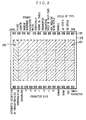
- FIG. 3 illustrates an example of the arrangement (namely, the screen layout) of display elements to be displayed on the screen of the LCD 35.
- This embodiment is adapted to permit a user to input a relatively large number of lines (for example, a maximum of 8 lines) of characters thereto.
- a relatively large number of lines for example, a maximum of 8 lines
- an area sufficient to display 4 lines of 6 characters (a character corresponds to 16 ⁇ 16 dots), which is larger than a corresponding area in the case of the conventional device, is provided on the screen as an area AR1 on which input characters can be displayed.
- a line-number displaying area AR2 for distinguishing among lines is provided on the screen.
- the LCD unit 35 is provided with indicators IND for indicating whether the attributes represented by the sequences of the characters are in on- or off-states. Namely, the LCD unit 35, whose display screen is larger than that in the case of the conventional device, is employed in the case of this embodiment.
- a dot pattern of the maximum size namely, a 48 ⁇ 48 dot pattern can be displayed at a time in the case where dots of a dot pattern representing a user-defined character are respectively assigned to dots provided on the screen of the LCD unit 35 in a one-to-one relationship when registering the user-defined character.
- the control portion 20 is constituted by, for example, a microcomputer. Further, the control portion 20 has a structure in which a central processing unit (CPU) 21, a read-only memory (ROM) 22, a random access memory (RAM) 23, a character-generator ROM (CG-ROM) 24, an input interface portion 25 and an output interface portion 26 are connected with one another through a system bus 27.
- CPU central processing unit
- ROM read-only memory
- RAM random access memory
- CG-ROM character-generator ROM
- kana-kanji translation dictionary data various processing programs and inalterable data (or constant data) like kana-kanji translation dictionary data are stored in the ROM 22.
- a program 22a for user-defined characters which will be described later by referring to FIGS. 1, 6 and 7, is stored in the ROM 22.
- the RAM 23 is used as a work memory and is also operative to store inalterable data, which is input by a user, therein.
- the RAM 23 has: a user-defined character registering area 23a in which a dot pattern representing the generated user-defined character is stored; a pattern-in-preparation buffer 23b for storing a dot pattern representing a user-defined character, which is currently being generated, therein; a display buffer 23c for displaying image data to be displayed on the screen of the LCD unit 35 during performing an operation of registering a user-defined character; and an enlargement conversion buffer 23d used for performing an enlargement conversion on a dot pattern.
- the user-defined character registering area 23a and the pattern-in-preparation buffer 23b are adapted to be capable of storing dot patterns of four sizes.
- a RAM pack (not shown), which has the same function as of the RAM 23, can be added thereto.
- the CG-ROM 24 stores dot patterns of four sizes, which represent characters and symbols supported by this tape printing device, respectively. Moreover, the CG-ROM 24 is adapted to output a dot pattern representing a character or a symbol when code data specifying a character or a symbol is given.
- a CG-ROM for displaying a character or symbol may be provided therein separately from another CG-ROM for printing the character or symbol.
- font information stored in the CG-ROM 24 designates bitmap fonts. Namely, each of these fonts is such that dot patterns of various sizes need to be provided correspondingly thereto. The registration of a user-defined character can be performed on a character, the corresponding dot patterns of which are not provided in the CG-ROM 24.
- the input interface portion 25 is operative to provide the interface between the input portion 10 and the control portion 20. Further, the output interface portion 26 is operative to provide the interface between the output portion 30 and the control portion 20.
- the CPU 21 processes an input signal sent from the input portion 10 and executes a processing program, which is stored in the ROM 22 and corresponds to a current stage of the processing, by utilizing the work area established in the RAM 23 and by suitably using the inalterable data stored in the ROM 22 and in the RAM 23, if necessary. Furthermore, the CPU 21 causes the LCD 35 to display information representing the situation or results of the processing on the screen thereof and also causes the thermal head to print such information on tape (not shown).
- the operations concerning user-defined characters are "registration”, “modification”, “calling”, “copying” and “deletion” operations.
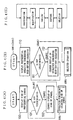
- the device enters a loop consisting of these operations concerning user-defined characters from a symbol selection operation of FIGS. 4(A) and 4(B).
- user-defined characters are provided as a kind of symbols which include editing symbols, symbols used in mathematical expressions and symbols for designating animate beings.
- step 100 the kind of a preferential symbol (for example, the kind of a symbol on which an operation of selecting a symbol is recently performed) is displayed on the LCD unit 35. Thereafter, the operated key is discriminated from the other keys in step 101. If a kind candidate changing key (for example, a cursor moving key) is operated, the CPU 21 changes a candidate for a kind of a symbol and causes the LCD unit 35 to display the new candidate on the screen thereof in step 102. Then, the program returns to step 101.
- a kind candidate changing key for example, a cursor moving key
- the CPU 21 causes the program to advance to one of subroutines SUB1 corresponding to the currently displayed kind of a symbol.
- the selection key is operated under circumstances where a kind of an operation concerning a user-defined character is displayed, the CPU 21 causes the program to advance to one (SUB11) of the subroutines SUB1.
- the program returns to step 111. If it is judged as the result of the discrimination performed in step 111 that a selection key is operated, the CPU 21 causes the program to advance to one (SUB21) of a group SUB2 of subroutines corresponding to the currently displayed operation concerning a user-defined character.
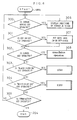
- the CPU 21 fetches data representing an area management number of a user-defined character registration area 23a (namely, a user-defined character identification number) in step 200.
- an area management number of a user-defined character registration area 23a namely, a user-defined character identification number
- the memory capacity of the RAM is small, so that the RAM can store only several user-defined characters therein.
- the user-defined character registration area is divided or partitioned into sub-areas of the number equal to the maximum number of user-defined characters that can be registered therein.
- an area management number is assigned to each of the sub-areas. Namely, the area management number assigned to each sub-area is a user-defined character identification number.
- Each of the sub-areas respectively assigned to user-defined characters is divided or partitioned into sub-regions respectively corresponding to the sizes of dot patterns.
- a key discrimination is performed. Further, the candidate is changed if a next candidate key (namely, a cursor moving key) is operated. A user-defined character identification number displayed at the time of operating the selection key is fetched as being designated.
- a RAM package is connected thereto, user-defined character identification numbers assigned to the RAM package can be selected by a user.
- the CPU 21 When a user-defined character identification number is input to the device, the CPU 21 reads data representing dot patterns of all of the sizes, which are stored in the sub-area, which corresponds to the selected user-defined character identification number, of the user-defined character registration area 23a. Further, the CPU 21 writes the read data representing dot patterns of all of the sizes to corresponding regions of the pattern-in-preparation buffer 23b, respectively.
- a dot pattern In the case where no data corresponding to a user-defined character has been registered in such a region of the buffer 23b, a dot pattern, all of the dots of which represent background dots (namely, what are called "off-dots"), is stored in such a region.
- the CPU 21 sets a size parameter "s" to an initial value of 1. Initially, in the case where the size parameter "s" is 1, this size parameter designates a 16 ⁇ 16 dot pattern. Further, in the case where the size parameter "s” is 2, this size parameter designates a 24 ⁇ 24 dot pattern. Moreover, in the case where the size parameter "s” is 3, this size parameter designates a 32 ⁇ 32 dot pattern. Furthermore, in the case where the size parameter "s” is 4, this size parameter designates a 48 ⁇ 48 dot pattern.
- the CPU 21 loads the dot pattern of the size designated by the size parameter "s", which has been written to the pattern-in-preparation buffer 23b, into the display buffer 23c as the dot pattern for generating a user-defined character. Moreover, the CPU 21 further loads editing mode information into the display buffer 23c. Furthermore, the CPU 21 causes the LCD unit 35 to display such data and information on the screen thereof.
- FIG. 5 illustrates an example of a display screen for the generation of a user-defined character by performing an operation in step 203.
- This display screen for the generation of a user-defined character comprises a user-defined character editing display area 50 and an editing mode display area 51.
- the user-defined character editi display area 50 is composed of a drawing display area 50a, on which character composing portions of the dot pattern representing a user-defined character is displayed by "on-dots" and the background is displayed by "off-dots", and a guide display area 50b on which a cursor guide 50c for guiding the position of a cursor 50d is displayed and portions other than the cursor guide 50c is displayed by "on-dots”.
- the LCD unit 35 of this embodiment has a screen of the size which is 4 lines of 6 characters (namely, 64 ⁇ 96 dots) or so as illustrated in FIG. 3.
- a dot pattern of the maximum size namely, 48 ⁇ 48 dots
- the drawing display area 50a the size of a dot pattern to be registered at that time is assigned to the drawing display area 50a. Therefore, the remaining portion of the user-defined character edition display area 50 is assigned to the guide display area 50b. Namely, the drawing display area 50a varies with the size of the dot pattern.
- a cursor 50d there are four cursor guides 50c which extend from four boundary lines between the drawing display area 50a and the guide display area 50b into the area 50b in such a manner that the four cursor guides are perpendicular to the boundary lines, respectively, and that the position of the point of intersection of a line, which connects two cursor guides extending in a vertical direction (namely, Y-direction), and another line, which connects two cursor guides extending in a lateral direction (namely, X-direction), should be coincident with the position of the cursor 50d. Therefore, when the position of the cursor 50d is changed, the position of the cursor guide 50c varies in response to the change in position of the cursor 50d.
- a user is able to easily achieve the visual recognition of the position of an object dot, namely, a dot at which the cursor 50d is placed, in the entire dot pattern from a graphic display thereof.
- coordinate information 51a indicating the position of the cursor 50d and the names or indications 51b, 51c and 51d of three kinds of editing modes, namely, "normal”, "black-painting” and “white-painting” are displayed on the editing mode display area 51.
- the name of a selected editing mode is reversed.
- a numeric character corresponding to a numeric key to be operated for selecting a corresponding one of the editing modes is also displayed just prior to (namely just on the left side of) the name of the corresponding editing mode as illustrated in this figure.
- the cursor 50d is located at a place which have both of the largest X- and Y-coordinates (namely, is located at an upper right vertex of the guide display area 50b). Further, at that time, the coordinate information 51a designating the position of the cursor 50d comes to represent the size (for instance, 16 ⁇ 16) of a dot pattern to be edited (namely, to be registered or corrected). Thereby, a user can correctly recognize the size of the dot pattern to be edited.
- the "normal” editing mode is an editing mode in which an on-off control operation is performed on each of the dots of a dot pattern to be edited.
- the "black-painting” editing mode is an editing mode in which all of the dots of a dot pattern to be edited are changed into "on-dots”.
- the "white-painting” editing mode is an editing mode in which all of the dots of a dot pattern to be edited are changed into "off-dots”.
- the device is adapted to select the "normal" editing mode when the screen is in an initial display state in which a dot pattern is displayed in step 203.
- the user can easily generate the dot pattern by utilizing the "black-painting" editing mode or the "white-painting” editing mode. For such a reason, the "black-painting" editing mode and the "white-painting” editing mode are provided in the device.
- the CPU 21 executes a group of subroutines SUB3 (to be described later by referring to FIGS. 6 to 8) for editing the dot pattern selected in response to the user's operation.
- the CPU 21 completes the fetch of data representing the dot pattern of the size, which is an object dot-pattern to currently be edited.
- the CPU 21 identifies the value of the size parameter "s" in steps 204 and 205.
- the CPU 21 serially generates a 24 ⁇ 24 dot pattern, a 32 ⁇ 32 dot pattern and a 48 ⁇ 48 dot pattern in step 206 by performing an enlargement conversion operation on the generated 16 ⁇ 16 dot pattern. Moreover, the CPU 21 writes data representing each of the generated dot patterns to one of the regions, which respectively correspond to the sizes of the dot patterns, of the pattern-in-preparation buffer 23b. In example of the enlargement conversion operation (to be described later) is illustrated in FIG. 7.
- the CPU 21 when the size parameter "s" has a value of 2 (namely, the size of 24 ⁇ 24 dots is designated), the CPU 21 generates a 48 ⁇ 48 dot pattern in step 207 by performing an enlargement conversion operation on the generated 24 ⁇ 24 dot pattern. Moreover, the CPU 21 writes data representing each of these dot patterns to one of the regions, which respectively correspond to the sizes of these dot patterns, of the pattern-in-preparation buffer 23b.
- the enlargement conversion operation is not performed on a dot pattern.
- the CPU 21 judges in step 208 whether or not a registration key is operated. If not operated, the size parameter "s" is incremented by 1. Then, the program returns to step 203. In contrast, if operated, the CPU 21 causes the LCD unit 35 in step 210 to display a message indicating that a registration operation is being performed. Moreover, in this step, the CPU 21 transfers the dot patterns of all of the sizes representing a user-defined character, which are stored in the pattern-in-preparation buffer 23b, to the sub-area, which corresponds to the selected user-defined character identification number, of the user-defined character registration area 23a. Upon completion of the transfer, the CPU 21 returns the device into a state of the device immediately before the user-defined character mode is indicated. Then, the CPU 21 finishes performing the sequence of operations for the registration.
- the CPU 21 changes the size of the drawing display area 50a according to the size parameter "s" into a size designated by this parameter.
- a 16 ⁇ 16 dot pattern is first generated by performing such operations. Thereafter, a 24 ⁇ 24 dot pattern, a 32 ⁇ 32 dot pattern and a 48 ⁇ 48 dot pattern are automatically generated in sequence by performing the enlargement conversion operations. Subsequently, the automatically generated 24 ⁇ 24 dot pattern is modified by the user and a new 24 ⁇ 24 dot pattern is thus generated. Then, a new 48 ⁇ 48 dot pattern is automatically generated by performing an enlargement conversion operation on this corrected 24 ⁇ 24 dot pattern. Thereafter, the automatically generated 32 ⁇ 32 dot pattern is modified by the user and a new 32 ⁇ 32 dot pattern is thus generated. Furthermore, the automatically generated 48 ⁇ 48 dot pattern is modified by the user and a new 48 ⁇ 48 dot pattern is thus generated. Then, the dot patterns of the four sizes are registered in the user-defined character registration area 23a by operating the registration key.
- the registration operation is performed at that point of time.
- a 48 ⁇ 48 dot pattern is automatically generated when a 24 ⁇ 24 dot pattern is completed.
- the reason is to reduce the extent of a modification to be made for completing a 48 ⁇ 48 dot pattern by reflecting information, which concerns a modification made by the user to complete a 24 ⁇ 24 dot pattern, in the automatically generated 48 ⁇ 48 dot pattern.
- the automatic generation of a 48 ⁇ 48 dot pattern is unnecessary when a 16 ⁇ 16 dot pattern is completed.
- the registration key is operated just after a 16 ⁇ 16 dot pattern is completed, no 48 ⁇ 48 dot pattern is generated. Namely, a dot pattern of one size is not completed yet. Therefore, the registration of a user-defined character can not be performed.
- an editing operation subroutine SUB31 is provided for the "normal” editing mode. Further, another editing operation subroutine SUB32 is provided for the "black-painting” editing mode. Moreover, still another editing operation subroutine SUB33 is provided for the "white-painting" editing mode.
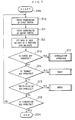
- the CPU 21 judges in steps 300 to 305 what key operation is performed on the keying portion by the user. Such judgements are performed repeatedly. Namely, judgements on whether or not a cursor moving key is operated, whether a dot-on key or a dot-off key is operated, whether or not a cancel key is operated, whether or not a key for designating the "black-painting" editing mode (namely, a key for the digit "2") is operated, whether or not a key for designating the "white-painting" editing mode (namely, a key for the digit "3") is operated, and whether or not a termination key for indicating the termination of the generation of an object dot pattern of a size to be generated is operated, are repeatedly performed in this order.
- the CPU 21 changes places, at which the cursor 50d and the cursor guide 50c are respectively displayed, on the screen of the LCD unit 35 in response to the operation performed on the cursor moving key in step 306. Moreover, the contents of the cursor coordinate information 51a to be displayed are also changed at that time. Subsequently, the program returns to step 300 whereupon it is judged whether or not the cursor moving key is operated. Thereby, the automatic repetition of the aforementioned judgements can be achieved.
- step 307 the CPU 21 causes the LCD unit 35 to display a dot, at which a cursor 41 is placed at that point of time, as an "on-dot” (namely, a portion composing a character or the like) or an "off-dot” (namely, a portion of the background).
- the logical level of a corresponding dot stored in the pattern-in-preparation buffer 23b is changed into the logical level of an "on-dot" (namely, a portion composing a character or the like) or of an "off-dot” (namely, a portion of the background).
- the program advances to step 302 whereupon it is judged whether or not a mode cancel key is operated.
- step 308 the CPU 21 returns to a former state in which the CPU 21 is put before being instructed to perform the "registration”, that is, goes back to a state in which one of the operations concerning a user-defined character, namely, one of "registration”, “modification”, “calling”, “copying” and “deletion” operations is selected.
- the CPU 21 When the key for designating the "black-painting" editing mode is operated, the CPU 21 causes the currently executed program to pass control to the subroutine SUB32. Further, when the key for designating the "white-painting" editing mode is operated, the CPU 21 causes the currently executed program to pass control to the subroutine SUB33.
- the CPU 21 causes the program to advance to the aforesaid step 204.
- the CPU 21 fetches the coordinates of two diagonally opposite vertexes of (or for defining) a region to be filled in with black in steps 310 and 311 (the user may point out these vertexes by, for example, placing the cursor thereat and further operating the selection key). Then, the CPU 21 causes the LCD unit 35 to display all of dots within a rectangular region defined by such two vertexes by using "on-dots" (as a portion composing a character or the like) in step 312. Moreover, the logical level of each of corresponding dots stored in the pattern-in-preparation buffer 23b is changed into the logical level of an "on-dot" (namely, a portion composing a character or the like).
- the CPU 21 judges in steps 313 to 316 whether or not a cancel key is operated, whether or not a key for designating the "normal” editing mode (namely, a key for the digit "1") is operated, whether or not a key for designating the "white-painting” editing mode (namely, a key for the digit "3”) is operated, and whether or not a termination key for indicating the termination of the generation of an object dot pattern of a size to be generated is operated, in this order.
- a cancel key is operated, whether or not a key for designating the "normal” editing mode (namely, a key for the digit "1") is operated, whether or not a key for designating the "white-painting” editing mode (namely, a key for the digit "3”) is operated, and whether or not a termination key for indicating the termination of the generation of an object dot pattern of a size to be generated is operated, in this order.
- step 317 the CPU 21 returns to the former state in which the CPU 21 is put before being instructed to perform the "registration”, that is, goes back to a state in which one of the operations concerning a user-defined character, namely, one of "registration”, “modification”, “calling”, “copying” and “deletion” operations is selected.
- the CPU 21 When the key for designating the "normal” editing mode is operated, the CPU 21 causes the currently executed program to pass control to the subroutine SUB31. Further, when the key for designating the "white-painting" editing mode is operated, the CPU 21 causes the currently executed program to pass control to the subroutine SUB33.
- the CPU 21 causes the program to advance to the aforesaid step 204. If not operated, the CPU 21 causes the program to return to the aforesaid step 310. Incidentally, when the processing is performed in the aforementioned steps 310 to 312, it is monitored whether the cursor moving key or the selection key are operated. If such keys are not operated, the CPU 21 is adapted to cause the program to advance to step 313.
- the CPU 21 fetches the coordinates of two diagonally opposite vertexes of (or for defining) a region to be filled in with white in steps 320 and 321 (incidentally, the user may point out these vertexes by, for example, placing the cursor thereat and further operating the selection key). Then, the CPU 21 causes the LCD unit 35 to display all of dots within a rectangular region defined by such two vertexes by using "off-dots" (as a portion composing the background) in step 322. Moreover, the logical level of each of corresponding dots stored in the pattern-in-preparation buffer 23b is changed into the logical level of an "off-dot" (namely, a portion composing the background).
- the CPU 21 judges in steps 323 to 326 whether or not a cancel key is operated, whether or not a key for designating the "normal” editing mode (namely, a key for the digit "1") is operated, whether or not a key for designating the "black-painting” editing mode (namely, a key for the digit "2”) is operated, and whether or not a termination key for indicating the termination of the generation of an object dot pattern of a size to be generated is operated, in this order.
- a cancel key is operated, whether or not a key for designating the "normal” editing mode (namely, a key for the digit "1") is operated, whether or not a key for designating the "black-painting” editing mode (namely, a key for the digit "2”) is operated, and whether or not a termination key for indicating the termination of the generation of an object dot pattern of a size to be generated is operated, in this order.
- step 327 the CPU 21 returns to the former state in which the CPU 21 is put before being instructed to perform the "registration", that is, goes back to a state in which one of the operations concerning a user-defined character, namely, one of "registration”, “modification”, “calling”, “copying” and “deletion” operations is selected.
- the CPU 21 When the key for designating the "normal” editing mode is operated, the CPU 21 causes the currently executed program to pass control to the subroutine SUB31. Further, when the key for designating the "black-painting" editing mode is operated, the CPU 21 causes the currently executed program to pass control to the subroutine SUB32.
- the CPU 21 causes the program to advance to the aforesaid step 204. If not operated, the CPU 21 causes the program to return to the aforesaid step 320.
- the processing is performed in the aforementioned steps 320 to 322, it is monitored whether the cursor moving key or the selection key are operated. If such keys are not operated, the CPU 21 is adapted to cause the program to advance to step 323.
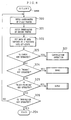
- a 1.5-fold enlargement of a dot pattern is performed by first enlarging the dot pattern in the direction of a row thereof to 1.5 times the size in such a direction thereof and next enlarging the dot pattern in the direction of a column thereof to 1.5 times the size in this direction thereof.
- An enlargement operation in the direction of a row of a dot pattern is similar to that in the direction of a column thereof expect for the direction in which the enlargement is performed.
- an enlargement operation in the direction of a row of a dot pattern will be described hereinbelow in particular.
- step 400 the CPU 21 sets both of a row parameter (hereunder referred to as an original row parameter) "i”, which corresponds to an original dot pattern to be converted or enlarged, and a second parameter (hereunder referred to as a resultant row parameter) "j", which corresponds to a resultant dot pattern obtained by performing the enlargement conversion, to initial values of 1, respectively. Then, it is judged in step 401 whether the original row parameter "i" is odd or even.
- an original row parameter hereunder referred to as an original row parameter
- j a second parameter
- the CPU 21 fetches or reads data representing dots of an ith row of a currently generated dot pattern of a size (namely, an original dot pattern), which are stored in the pattern-in-preparation buffer 23b, therefrom and next causes the enlargement conversion buffer 23d to store the data representing dots of the ith row therein as dots of jth and (j+1)th rows of a resultant dot pattern in steps 402 and 403. Thereafter, the original row parameter "i" is incremented by 1. Further, the resultant row parameter "j” is incremented by 2. Then, the program returns to step 401 whereupon it is judged whether the original row parameter "i" is odd or even.
- the CPU 21 fetches or reads data representing dots of an ith row of a currently generated dot pattern (namely, an original dot pattern), which are stored in the pattern-in-preparation buffer 23b, therefrom and next causes the enlargement conversion buffer 23d to store the data representing dots of the ith row therein as dots of a jth row of a resultant dot pattern in steps 404 and 405. Thereafter, each of the original row parameter "i" and the resultant row parameter "j" is incremented by 1.
- the CPU 21 judges in step 406 whether or not an operation to be performed on the last row of the original dot pattern is finished, namely, whether or not the enlargement in the direction of the row of the original dot pattern is finished. If not, the program returns to step 401 whereupon it is judged whether the original row parameter "i" is odd or even. In contrast, if finished, the CPU 21 causes the program to advance to step 407 whereupon the enlargement in the direction of a column of the original dot pattern is performed. Further, when the enlargement in the direction of a column of the original dot pattern is finished, the series of the enlargement conversion operations is finished.
- the enlargement in the direction of a column of an original dot pattern is similar to that in the direction of a row thereof. Therefore, the detail description of the enlargement in the direction of a column thereof is omitted.
- Data representing a dot pattern of a size already enlarged in the direction of a row thereof, which is stored in the enlargement conversion buffer 23d, is used as data representing the original dot pattern, on which the enlargement in the direction of a column thereof should be performed. Further, data representing a resultant dot pattern obtained by the enlargement in the direction of a column of the original dot pattern of the current size is stored in a region, which corresponds to the next size of the dot pattern, of the pattern-in-preparation buffer 23b.
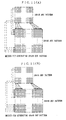
- FIG. 10 illustrates such a 1.5-fold enlargement conversion diagrammatically.
- FIG. 11(A) illustrates such a 2-fold enlargement conversion (namely, an enlargement conversion from a 16 ⁇ 16 dot pattern to a 32 ⁇ 32 dot pattern) diagrammatically.
- information concerning each dot of an original dot pattern is repeatedly utilized two times for each of the enlargement in the direction of a row thereof and that in the direction of a column thereof.
- FIG. 11(B) illustrates such a 3-fold enlargement conversion (namely, an enlargement conversion from a 16 ⁇ 16 dot pattern to a 48 ⁇ 48 dot pattern) diagrammatically.
- information concerning each dot of an original dot pattern is repeatedly utilized three times for each of the enlargement in the direction of a row thereof and that in the direction of a column thereof.
- the "modification” operation is almost similar to the "registration” operation except that even when the modification of a 16 ⁇ 16 dot pattern or a 24 ⁇ 24 dot pattern is completed, an enlargement of such a dot pattern to a dot pattern of another larger size is not performed. Namely, the "modification” operation is different from the “registration” operation in that the "modification” operation does not have the process to be performed in steps 204 to 207 of FIG. 1. Thereby, the modification of a dot pattern of a size does not affect the dot pattern of another size. Consequently, the dot patterns of different sizes can be modified separately.
- one of user-defined character identification numbers is first selected. Further, a code representing the selected user-defined character identification number is added to data stored in a text area of the RAM 23. Then, a 16 ⁇ 16 dot pattern corresponding to the user-defined character is fetched or read therefrom and is given to the display buffer 23c. Thus, the user-defined character is displayed on a character input screen. In the case of the conventional device, a symbol designating a user-defined character identification number is displayed. This embodiment of the present invention is, however, different from the conventional device in that a generated user-defined character is displayed instead of such a symbol.
- an area management number (a user-defined character identification number) of the user-defined character registration area 23a (hereunder referred to as the source area management number) of a device, from which dot patterns representing a user-defined character are copied
- an area management number (a user-defined character identification number) of the user-defined character registration area 23a (hereunder referred to as a destination area management number) of another device, onto which the dot patterns representing a user-defined character are copied, are first fetched or read. Then, dot patterns of all sizes stored in the user-defined character registration area 23a specified by the source area management number are copied onto the user-defined character registration area 23a specified by the destination area management number. Upon completion of the copying, the character input screen is restored.
- an area management number (a user-defined character identification number) of the user-defined character registration area 23a corresponding to a user-defined character to be deleted is first fetched or read. Then, dot patterns of all sizes stored in the user-defined character registration area 23a specified by this area management number (namely, this user-defined character identification number) are deleted (namely, for example, all of these dots are changed into "off-dots"). Upon completion of the deletion, the character input screen is restored.
- a 48 ⁇ 48 (tentative) dot pattern is automatically generated even if the generation of a 24 ⁇ 24 dot pattern is completed.
- a user has only to correct or modify the 48 ⁇ 48 (tentative) dot pattern which has been once generated from the 24 ⁇ 24 dot pattern by taking into account information concerning a correction or modification made thereon.
- a user can easily generate a 48 ⁇ 48 (final) dot pattern. Consequently, the device, whose operability is further improved, can be realized.
- the "black-painting" editing mode for changing all of the dots within a specified region into “on-dots” and the “white-painting” editing mode for changing all of the dots within a specified region into “off-dots” are provided as the editing modes at the time of performing the "registration” and the "modification" of a user-defined character.
- the user-defined character editing display area 50 is composed of the drawing display area 50a, the size of which changes according to the size of a dot pattern representing a user-defined character, for displaying the dot pattern representing the user-defined character, and the guide display area 50b provided on the outside of the drawing display area 50a. Furthermore, the cursor guide 50c for guiding the position of the cursor 50d is displayed on the guide display area 50b.
- the size of the drawing display area 50a is changed according to the size of a dot pattern to be generated. This facilitates to the recognition of the dot pattern according to the size thereof.
- the present invention when performing the registration of a user-defined character, corresponding dot patterns of different sizes are generated in the increasing order of the size.
- the present invention is not limited thereto. In brief, it is essential only that a larger dot pattern can be generated by modifying a dot pattern for generating the larger dot pattern, which has been obtained by enlarging another already generated dot pattern.
- the dot pattern of the size of 16 ⁇ 16 dots, that of the size of 24 ⁇ 24 dots, that of the size of 32 ⁇ 32 dots and that of the size of 48 ⁇ 48 dots may be generated in this order.
- the size of the already generated dot pattern to be used for generating a dot pattern of a new size is not limited to that of the case of the first embodiment.
- a (tentative) 48 ⁇ 48 dot pattern may be automatically generated from the (already generated) 32 ⁇ 32 dot pattern.
- the dot patterns of four sizes are generated correspondingly to each user-defined character.
- the number of kinds of sizes of dot patterns to be generated is not limited to four.
- the dot patterns of the smallest one of the four sizes is generated from scratch.
- the dot patterns of two or more sizes are generated from scratch. Then, the dot patterns of the remaining sizes are generated by enlarging the already generated dot patterns and next displaying the enlarged dot patterns and subsequently modifying the displayed dot patterns.
- the "regions filled in with black” and the "regions filled in with white” are rectangular regions.
- regions of another shape such as a triangle may be employed as the "regions filled in with black” and the "regions filled in with white”.
- the dot pattern for generating a user-defined character which corresponds to a portion composing a character or the like, is displayed as a positive image.
- the guide display area is basically displayed as a negative image.
- the dot pattern for generating a user-defined character may be displayed as a negative image and moreover, the guide display area may be displayed as a positive image.
- the present invention is applied to the tape printing device.
- the present invention can be applied to another character information processor having the functions concerning user-defined characters, for example, a seal making device.
- the techniques of the "black-painting" and “white-painting” editing modes and of the guide display can be applied to another character information processor in which a dot pattern of only one size is employed for generating each user-defined character.
Landscapes
- Engineering & Computer Science (AREA)
- Theoretical Computer Science (AREA)
- Physics & Mathematics (AREA)
- General Physics & Mathematics (AREA)
- General Engineering & Computer Science (AREA)
- Audiology, Speech & Language Pathology (AREA)
- Computational Linguistics (AREA)
- General Health & Medical Sciences (AREA)
- Health & Medical Sciences (AREA)
- Artificial Intelligence (AREA)
- Human Computer Interaction (AREA)
- Controls And Circuits For Display Device (AREA)
- Printers Characterized By Their Purpose (AREA)
- Dot-Matrix Printers And Others (AREA)
- Record Information Processing For Printing (AREA)
Claims (8)
- Unité de traitement d'informations portant sur des caractères, destinée à produire et enregistrer des motifs formés de points ayant une pluralité de tailles représentant un caractère défini par un utilisateur, dans laquelle un motif formé de points ayant une grande taille prédéterminée est produit par les opérations qui consistent à agrandir un motif formé de points ayant une taille plus petite que la taille prédéterminée, afficher le motif formé de points agrandi, puis modifier le motif formé de points agrandi affiché pour terminer la production du motif formé de points ayant la taille prédéterminée, l'unité de traitement d'informations portant sur des caractères étant caractérisée pardes moyens de production (21) de motif formé de points destinés à produire ou modifier chacun des motifs formés de points ayant une pluralité de tailles, en réponse à une opération effectuée par un utilisateur ;des moyens de conversion d'agrandissement (21, 23d) destinés à effectuer une conversion d'agrandissement d'un motif formé de points produit, ayant l'une des plus petites tailles de la pluralité de tailles, en une pluralité de tentatives de motifs formés de points de plus grandes tailles, chacune des tentatives de motifs formés de points ayant des plus grandes tailles étant utilisée comme un motif formé de points initial, ayant la plus grande taille correspondante, pour lesdits moyens de production (21), pour modifier et produire un motif formé de points terminé ayant la plus grande taille correspondante, l'un des plus petits motifs formés de points de ladite pluralité de motifs formés de points de plus grandes tailles étant ladite taille prédéterminée ; etdes moyens de commande (21) destinés à actionner les moyens de conversion d'agrandissement (21, 23d) pour effectuer une autre conversion d'agrandissement d'un motif formé de points terminé, ayant ladite taille prédéterminée, en une tentative de motif formé de points de remplacement, ayant une taille encore plus grande, en réponse aux moyens de production de motifs formés de points (21) terminant la production du motif formé de points ayant la taille prédéterminée, ce en conséquence de quoi la tentative de motif formé de points de remplacement, ayant une taille encore grande, est utilisée par lesdits moyens de production (21) pour modifier et réaliser un motif formé de points terminé ayant l'autre plus grande taille.
- Unité de traitement d'informations portant sur des caractères selon la revendication 1, dans laquelle lesdits moyens de production de motif formé de points (21) comprennent :des premiers moyens d'édition de motif formé de points représentant le caractère défini par l'utilisateur, destinés à éditer le motif formé de points ayant une taille choisie, représentant le caractère défini par l'utilisateur, en changeant, en un point actif ou un point inactif, des points choisis par l'utilisateur du motif formé de points représentant le caractère défini par l'utilisateur,des deuxièmes moyens d'édition de motif de points de caractères définis par l'utilisateur, destinés à éditer le motif formé de points d'une taille choisie, représentant le caractère défini par l'utilisateur, en changeant collectivement, en points actifs, tous les points d'une région désignée par l'utilisateur du motif formé de points représentant le caractère défini par l'utilisateur, etdes troisièmes moyens d'édition de motif formé de points de caractères définis par l'utilisateur, destinés à éditer le motif de points ayant une taille choisie, représentant le caractère défini par l'utilisateur, en changeant collectivement, en points inactifs, tous les points d'une région désignée par l'utilisateur du motif formé de points représentant le caractère défini par l'utilisateur.
- Unité de traitement d'informations portant sur des caractères selon la revendication 1 ou 2, et comprenant en outre :
des moyens de commande d'affichage (36) destinés à afficher une région d'affichage du dessin (50a), sur laquelle le motif formé de points est dessiné, et une région d'affichage extérieure (50b), qui se trouve à l'extérieur de la région d'affichage du dessin (50a) et qui est distincte de cette dernière, lesdits moyens de commande d'affichage (36) affichant des pointeurs (50c) dans la région d'affichage extérieure, qui se déplacent en correspondance avec le déplacement d'un curseur (50d) représentant un point objet à manipuler dans la région d'affichage du dessin (50a), lesdits pointeurs (50c) définissant une ligne verticale et une ligne latérale qui passent par le curseur (50d) pour indiquer la position du curseur (50d). - Unité de traitement d'informations portant sur des caractères selon la revendication 3, dans laquelle lesdits moyens de commande d'affichage (36) sont adaptés pour changer la taille de la région d'affichage du dessin (50a) en fonction de la taille du motif formé de points à produire.
- Unité de traitement d'informations portant sur des caractères selon la revendication 1, comprenant :des moyens de mémorisation (23) ayant une partie de stockage (23b) de motifs-de-points-en-préparation destinée à stocker un motif formé de points représentant un caractère défini par l'utilisateur, qui est en préparation, et une partie d'enregistrement de caractère défini par l'utilisateur (23a) destinée à stocker un motif formé de points produit, représentant un caractère défini par l'utilisateur ;les moyens de production (21) de motifs formés de points produisant un motif formé de points d'une première taille, représentant des caractères définis par l'utilisateur, et stockant les motifs formés de points produits et ayant la première taille dans une première région de la partie de stockage (23b) de motifs formés de points en préparation;les moyens de conversion d'agrandissement comprenant des moyens d'agrandissement / stockage (23d) destinés à agrandir le motif formé de points de la première taille, stocké dans la première région de la partie de stockage (23b) de motifs formés de points en préparation, en un motif formé de points d'une deuxième taille, un motif formé de points d'une troisième taille, et un motif formé de points d'une quatrième taille, et à stocker le motif formé de points de la deuxième taille, le motif formé de points de la troisième taille, et le motif formé de points de la quatrième taille dans des deuxième, troisième et quatrième régions correspondantes de la partie de stockage (23b) de motifs formés de points en préparation,des moyens de modification / stockage destinés à permettre une modification, par l'utilisateur, du motif formé de points de la deuxième taille et du motif formé de points de la troisième taille, qui sont stockés respectivement dans les deuxième et troisième régions de la partie de stockage (23b) de motifs formés de points en préparation, et à stocker le motif formé de points modifié de la deuxième taille et le motif formé de points modifié de la troisième taille dans les deuxième et troisième régions correspondantes de la partie de stockage (23b) de motifs formés de points en préparation,des moyens d'instruction d'enregistrement destinés à émettre une instruction d'enregistrement des motifs formés de points modifiés, qui sont stockés dans la partie de stockage (23b) de motifs formés de points en préparation, dans la partie d'enregistrement (23a) de caractère défini par l'utilisateur,lesdits moyens d'agrandissement / stockage (23d), lorsque le motif formé de points modifié de la deuxième taille est stocké dans la deuxième région de la partie de stockage (23b) de motifs formés de points en préparation, agrandissant le motif formé de points modifié de la deuxième taille, pour ainsi obtenir un motif formé de points modifié de la quatrième taille, et stockant le motif formé de points modifié de la quatrième taille dans la quatrième région de la partie de stockage (23b) de motifs formés de points en préparation,lesdits moyens de modification / stockage permettant une modification, par l'utilisateur, du motif formé de points modifié de la quatrième taille stocké dans la quatrième région de la partie de stockage de motifs formés de points en préparation (23b), et stockant le motif formé de points de la quatrième taille, modifié par l'utilisateur, dans la quatrième région de la partie de stockage (23b) de motifs formés de points en préparation, etdes moyens d'enregistrement destinés à stocker le motif formé de points de la première taille, le motif formé de points modifié de la deuxième taille, le motif formé de points modifié de la troisième taille et le motif formé de points de la quatrième taille, modifié par l'utilisateur, qui sont stockés respectivement dans les première, deuxième, troisième et quatrième régions de la partie de stockage (23b) de motifs formés de points en préparation, dans des régions correspondantes de la partie d'enregistrement de caractère défini par l'utilisateur, en fonction de l'instruction d'enregistrement.
- Unité de traitement d'informations portant sur des caractères selon la revendication 5, dans laquelle les moyens de production de motifs formés de points comprennent :des premiers moyens d'édition de motifs formés de points de caractère défini par l'utilisateur, destinés à éditer le motif formé de points d'une taille choisie, représentant le caractère défini par l'utilisateur, en convertissant, en un point actif ou un point inactif, des points choisis du motif formé de points, représentés par un curseur sur un écran d'une unité d'affichage (35), et changer le niveau logique d'un point correspondant du motif formé de points stocké dans la partie de stockage (23b) de motifs formés de points en préparation, en un niveau logique de point actif ou de point inactif,des deuxièmes moyens d'édition de motifs formés de points de caractère défini par l'utilisateur, destinés à éditer le motif formé de points d'une taille choisie, représentant le caractère défini par l'utilisateur, en changeant collectivement, en points actifs, tous les points d'une région du motif formé de points représentant le caractère défini par l'utilisateur, qui est définie par deux sommets diagonalement opposés, désignés par un utilisateur sur l'écran de l'unité d'affichage (35), et qui doit être remplie de noir, et en changeant le niveau logique d'un point correspondant du motif stocké dans la partie de stockage (23b) de motifs formés de points en préparation en un niveau logique de point actif, etdes troisièmes moyens d'édition de motif formé de points de caractère défini par l'utilisateur, destinés à éditer le motif formé de points d'une taille choisie, représentant le caractère défini par l'utilisateur, en changeant collectivement, en points inactifs, tous les points d'une région du motif formé de points représentan le caractère défini par l'utilisateur, qui est définie par deux sommets diagonalement opposés, désignés par un utilisateur sur l'écran de l'unité d'affichage (35), et qui doit être remplie de blanc, et en changeant le niveau logique d'un point correspondant du motif stocké dans la partie de stockage (23b) de motifs formés de points en préparation en un niveau logique de point inactif.
- Unité de traitement d'informations portant sur des caractères selon la revendication 5, qui comprend en outre des moyens de commande d'affichage (36) destinés à afficher une région d'affichage du dessin (50a), sur laquelle le motif formé de points est dessiné, et une région d'affichage extérieure (50b), qui se trouve à l'extérieur de la région d'affichage du dessin (50a) et qui est distincte de cette dernière, lesdits moyens de commande d'affichage (36) affichant des pointeurs (50c) dans chacun des segments verticaux et latéraux de la région d'affichage extérieure (50b), qui se déplacent en correspondance avec le déplacement d'un curseur (50d) représentant un point objet à manipuler dans la région d'affichage du dessin (50a), lesdits pointeurs (50c) définissant une ligne verticale et une ligne horizontale qui passent par le curseur (50d) pour indiquer la position du curseur (50d).
- Unité de traitement d'informations portant sur des caractères selon la revendication 7, dans laquelle les moyens de commande d'affichage (36) sont adaptés pour changer la taille de la région d'affichage du dessin (50a) en fonction de la taille du motif formé de points à produire.
Applications Claiming Priority (3)
| Application Number | Priority Date | Filing Date | Title |
|---|---|---|---|
| JP6303668A JPH08160934A (ja) | 1994-12-07 | 1994-12-07 | 文字情報処理装置 |
| JP30366894 | 1994-12-07 | ||
| JP303668/94 | 1994-12-07 |
Publications (3)
| Publication Number | Publication Date |
|---|---|
| EP0716396A2 EP0716396A2 (fr) | 1996-06-12 |
| EP0716396A3 EP0716396A3 (fr) | 1998-10-14 |
| EP0716396B1 true EP0716396B1 (fr) | 2001-11-14 |
Family
ID=17923794
Family Applications (1)
| Application Number | Title | Priority Date | Filing Date |
|---|---|---|---|
| EP95119247A Expired - Lifetime EP0716396B1 (fr) | 1994-12-07 | 1995-12-06 | Processeur d'informations de caractères |
Country Status (6)
| Country | Link |
|---|---|
| US (1) | US5793902A (fr) |
| EP (1) | EP0716396B1 (fr) |
| JP (1) | JPH08160934A (fr) |
| KR (1) | KR100355366B1 (fr) |
| CN (1) | CN1077307C (fr) |
| DE (1) | DE69523869T2 (fr) |
Families Citing this family (9)
| Publication number | Priority date | Publication date | Assignee | Title |
|---|---|---|---|---|
| KR970022696A (ko) * | 1995-10-19 | 1997-05-30 | 김광호 | 도트-매트릭스유형에서 다른 확대율로의 정보표시장치 및 정보표시방법과 도트매트릭스디스플레이를 갖춘 무선통신장치 |
| JP3022838B2 (ja) * | 1998-05-26 | 2000-03-21 | 日本電気データ機器株式会社 | 間引き印字駆動方法 |
| CN1196317C (zh) * | 2000-09-04 | 2005-04-06 | 兄弟工业株式会社 | 范围指定装置及范围指定方法 |
| TWI277058B (en) * | 2002-08-30 | 2007-03-21 | Seiko Epson Corp | Font processing device, terminal, font processing method and font processing program |
| DE60322123D1 (de) * | 2003-03-17 | 2008-08-21 | Kenji Yoshida | Informationseingabe-/-ausgabeverfahren mit einem punktmuster |
| JP4819723B2 (ja) * | 2006-03-16 | 2011-11-24 | 株式会社リコー | 情報抽出装置、情報抽出方法、情報抽出プログラム及び記録媒体 |
| US8736897B2 (en) * | 2006-08-31 | 2014-05-27 | Pitney Bowes Inc. | Method for printing address labels using a secure indicia printer |
| US10510168B2 (en) | 2012-01-09 | 2019-12-17 | Jungha Ryu | Method for editing character image in character image editing apparatus and recording medium having program recorded thereon for executing the method |
| KR101845780B1 (ko) * | 2013-07-09 | 2018-04-05 | 류중하 | 기호 이미지 검색 서비스 제공 방법 및 이에 사용되는 기호 이미지 검색용 서버 |
Family Cites Families (8)
| Publication number | Priority date | Publication date | Assignee | Title |
|---|---|---|---|---|
| JPS60165254A (ja) * | 1984-02-08 | 1985-08-28 | Hitachi Ltd | プリンタ装置 |
| US4875173A (en) * | 1985-04-16 | 1989-10-17 | Minolta Camera Kabushiki Kaisha | Image enlarging method and device |
| JPS63287893A (ja) * | 1987-05-20 | 1988-11-24 | 松下電器産業株式会社 | 文字フォント作成方法 |
| JP2899084B2 (ja) * | 1990-08-03 | 1999-06-02 | キヤノン株式会社 | 図形処理装置及び方法 |
| JPH06118934A (ja) * | 1992-10-06 | 1994-04-28 | Kingujimu:Kk | 外字登録方法 |
| JPH06115167A (ja) | 1992-10-06 | 1994-04-26 | Kingujimu:Kk | 外字登録方法 |
| CA2107746A1 (fr) * | 1992-10-06 | 1994-04-07 | Masahiko Nunokawa | Dispositif d'impression a ruban et cartouche de ruban pour ce dispositif |
| JPH06198961A (ja) * | 1992-12-28 | 1994-07-19 | Brother Ind Ltd | 文書処理装置の登録用ドットパターンデータ処理装置 |
-
1994
- 1994-12-07 JP JP6303668A patent/JPH08160934A/ja active Pending
-
1995
- 1995-12-06 DE DE69523869T patent/DE69523869T2/de not_active Expired - Fee Related
- 1995-12-06 EP EP95119247A patent/EP0716396B1/fr not_active Expired - Lifetime
- 1995-12-07 CN CN95120245A patent/CN1077307C/zh not_active Expired - Fee Related
- 1995-12-07 KR KR1019950048173A patent/KR100355366B1/ko not_active Expired - Fee Related
- 1995-12-07 US US08/568,445 patent/US5793902A/en not_active Expired - Lifetime
Also Published As
| Publication number | Publication date |
|---|---|
| DE69523869D1 (de) | 2001-12-20 |
| HK1014220A1 (en) | 1999-09-24 |
| CN1077307C (zh) | 2002-01-02 |
| JPH08160934A (ja) | 1996-06-21 |
| KR100355366B1 (ko) | 2002-12-26 |
| EP0716396A2 (fr) | 1996-06-12 |
| CN1132692A (zh) | 1996-10-09 |
| EP0716396A3 (fr) | 1998-10-14 |
| KR960024873A (ko) | 1996-07-20 |
| US5793902A (en) | 1998-08-11 |
| DE69523869T2 (de) | 2002-04-18 |
Similar Documents
| Publication | Publication Date | Title |
|---|---|---|
| EP0444922B1 (fr) | Modification d'une image d'affichage graphique | |
| KR0179221B1 (ko) | 레이아웃 표시기능이 부착된 문자정보 처리장치 | |
| US5551785A (en) | Divisionally-printable label producing apparatus | |
| JPWO1996016813A1 (ja) | レイアウト表示機能付き文字情報処理装置 | |
| US5793902A (en) | Character information processor | |
| US6438509B1 (en) | Character layout method, image forming method and stamp-making method and apparatus therefor | |
| EP0809212A1 (fr) | Dispositif d'impression | |
| KR19980063578A (ko) | 문자 인쇄장치 | |
| US6441912B1 (en) | Character display apparatus and character input apparatus | |
| HK1014220B (en) | Character information processor | |
| EP0606768A2 (fr) | Processeur pour les données de positionnement en forme de points dans un appareil de traitement de texte | |
| JP3277588B2 (ja) | 画像編集方法 | |
| US5579041A (en) | Printing device bordering function and a method thereof | |
| JPH09185619A (ja) | 文字情報処理装置 | |
| EP0395090B1 (fr) | Dispositif générateur de données de motif de caractère | |
| JP2815158B2 (ja) | 文字処理装置 | |
| JPH0752496A (ja) | 印字装置 | |
| JPH06110891A (ja) | 文書作成装置 | |
| JPH06115167A (ja) | 外字登録方法 | |
| JPH01229649A (ja) | ベクトルフォントデータを用いた印刷方式 | |
| JP3416171B2 (ja) | グラフ処理装置およびその方法 | |
| JP2903516B2 (ja) | 文書処理装置 | |
| JP2002244640A (ja) | 文字情報処理装置 | |
| JPH08230254A (ja) | 印字装置 | |
| JPH04118769A (ja) | 文書作成装置 |
Legal Events
| Date | Code | Title | Description |
|---|---|---|---|
| PUAI | Public reference made under article 153(3) epc to a published international application that has entered the european phase |
Free format text: ORIGINAL CODE: 0009012 |
|
| AK | Designated contracting states |
Kind code of ref document: A2 Designated state(s): DE FR GB |
|
| PUAL | Search report despatched |
Free format text: ORIGINAL CODE: 0009013 |
|
| AK | Designated contracting states |
Kind code of ref document: A3 Designated state(s): DE FR GB |
|
| 17P | Request for examination filed |
Effective date: 19990215 |
|
| 17Q | First examination report despatched |
Effective date: 19991109 |
|
| RIC1 | Information provided on ipc code assigned before grant |
Free format text: 7G 06F 17/21 A, 7G 06K 15/02 B, 7G 06T 3/40 B |
|
| GRAG | Despatch of communication of intention to grant |
Free format text: ORIGINAL CODE: EPIDOS AGRA |
|
| GRAG | Despatch of communication of intention to grant |
Free format text: ORIGINAL CODE: EPIDOS AGRA |
|
| GRAH | Despatch of communication of intention to grant a patent |
Free format text: ORIGINAL CODE: EPIDOS IGRA |
|
| GRAH | Despatch of communication of intention to grant a patent |
Free format text: ORIGINAL CODE: EPIDOS IGRA |
|
| GRAA | (expected) grant |
Free format text: ORIGINAL CODE: 0009210 |
|
| RIN1 | Information on inventor provided before grant (corrected) |
Inventor name: HOSOKAWA, TAKESHI Inventor name: KURASHINA, HIROYASU Inventor name: TOYOSAWA, YOSHIYA Inventor name: SHIMMURA, TOMOYUKI, C/O KING JIM CO., LTD. Inventor name: AIDA, CHIEKO, C/O KING JIM CO., LTD. Inventor name: KAMEDA, TAKANOBU, C/O KING JIM CO., LTD. Inventor name: WATANABE, KENJI, C/O KING JIM CO., LTD. |
|
| AK | Designated contracting states |
Kind code of ref document: B1 Designated state(s): DE FR GB |
|
| REF | Corresponds to: |
Ref document number: 69523869 Country of ref document: DE Date of ref document: 20011220 |
|
| REG | Reference to a national code |
Ref country code: GB Ref legal event code: IF02 |
|
| PLBE | No opposition filed within time limit |
Free format text: ORIGINAL CODE: 0009261 |
|
| STAA | Information on the status of an ep patent application or granted ep patent |
Free format text: STATUS: NO OPPOSITION FILED WITHIN TIME LIMIT |
|
| 26N | No opposition filed | ||
| PGFP | Annual fee paid to national office [announced via postgrant information from national office to epo] |
Ref country code: GB Payment date: 20021125 Year of fee payment: 8 |
|
| PGFP | Annual fee paid to national office [announced via postgrant information from national office to epo] |
Ref country code: FR Payment date: 20021217 Year of fee payment: 8 |
|
| PGFP | Annual fee paid to national office [announced via postgrant information from national office to epo] |
Ref country code: DE Payment date: 20030130 Year of fee payment: 8 |
|
| PG25 | Lapsed in a contracting state [announced via postgrant information from national office to epo] |
Ref country code: GB Free format text: LAPSE BECAUSE OF NON-PAYMENT OF DUE FEES Effective date: 20031206 |
|
| PG25 | Lapsed in a contracting state [announced via postgrant information from national office to epo] |
Ref country code: DE Free format text: LAPSE BECAUSE OF NON-PAYMENT OF DUE FEES Effective date: 20040701 |
|
| GBPC | Gb: european patent ceased through non-payment of renewal fee |
Effective date: 20031206 |
|
| PG25 | Lapsed in a contracting state [announced via postgrant information from national office to epo] |
Ref country code: FR Free format text: LAPSE BECAUSE OF NON-PAYMENT OF DUE FEES Effective date: 20040831 |
|
| REG | Reference to a national code |
Ref country code: FR Ref legal event code: ST |