EP0716081B1 - Hochselektives Verfahren zur Herstellung von enantiomerenreinen phenylsubstituierten 1,4-Dihydropyridin-3,5-dicarbonsäurederivaten - Google Patents
Hochselektives Verfahren zur Herstellung von enantiomerenreinen phenylsubstituierten 1,4-Dihydropyridin-3,5-dicarbonsäurederivaten Download PDFInfo
- Publication number
- EP0716081B1 EP0716081B1 EP95118359A EP95118359A EP0716081B1 EP 0716081 B1 EP0716081 B1 EP 0716081B1 EP 95118359 A EP95118359 A EP 95118359A EP 95118359 A EP95118359 A EP 95118359A EP 0716081 B1 EP0716081 B1 EP 0716081B1
- Authority
- EP
- European Patent Office
- Prior art keywords
- general formula
- enantiomerically pure
- carbon atoms
- chain
- straight
- Prior art date
- Legal status (The legal status is an assumption and is not a legal conclusion. Google has not performed a legal analysis and makes no representation as to the accuracy of the status listed.)
- Expired - Lifetime
Links
- 0 N*(C(C*1)=O)C1=O Chemical compound N*(C(C*1)=O)C1=O 0.000 description 6
- LUDDEZVHBBIIRK-UHFFFAOYSA-N CC(CC(OC(CC(N1Cc2ccccc2)=O)C1=O)=O)=O Chemical compound CC(CC(OC(CC(N1Cc2ccccc2)=O)C1=O)=O)=O LUDDEZVHBBIIRK-UHFFFAOYSA-N 0.000 description 1
Classifications
-
- C—CHEMISTRY; METALLURGY
- C07—ORGANIC CHEMISTRY
- C07D—HETEROCYCLIC COMPOUNDS
- C07D207/00—Heterocyclic compounds containing five-membered rings not condensed with other rings, with one nitrogen atom as the only ring hetero atom
- C07D207/02—Heterocyclic compounds containing five-membered rings not condensed with other rings, with one nitrogen atom as the only ring hetero atom with only hydrogen or carbon atoms directly attached to the ring nitrogen atom
- C07D207/30—Heterocyclic compounds containing five-membered rings not condensed with other rings, with one nitrogen atom as the only ring hetero atom with only hydrogen or carbon atoms directly attached to the ring nitrogen atom having two double bonds between ring members or between ring members and non-ring members
- C07D207/34—Heterocyclic compounds containing five-membered rings not condensed with other rings, with one nitrogen atom as the only ring hetero atom with only hydrogen or carbon atoms directly attached to the ring nitrogen atom having two double bonds between ring members or between ring members and non-ring members with hetero atoms or with carbon atoms having three bonds to hetero atoms with at the most one bond to halogen, e.g. ester or nitrile radicals, directly attached to ring carbon atoms
- C07D207/36—Oxygen or sulfur atoms
- C07D207/40—2,5-Pyrrolidine-diones
- C07D207/416—2,5-Pyrrolidine-diones with hetero atoms or with carbon atoms having three bonds to hetero atoms with at the most one bond to halogen, e.g. ester or nitrile radicals, directly attached to other ring carbon atoms
-
- A—HUMAN NECESSITIES
- A61—MEDICAL OR VETERINARY SCIENCE; HYGIENE
- A61P—SPECIFIC THERAPEUTIC ACTIVITY OF CHEMICAL COMPOUNDS OR MEDICINAL PREPARATIONS
- A61P25/00—Drugs for disorders of the nervous system
-
- A—HUMAN NECESSITIES
- A61—MEDICAL OR VETERINARY SCIENCE; HYGIENE
- A61P—SPECIFIC THERAPEUTIC ACTIVITY OF CHEMICAL COMPOUNDS OR MEDICINAL PREPARATIONS
- A61P25/00—Drugs for disorders of the nervous system
- A61P25/28—Drugs for disorders of the nervous system for treating neurodegenerative disorders of the central nervous system, e.g. nootropic agents, cognition enhancers, drugs for treating Alzheimer's disease or other forms of dementia
-
- C—CHEMISTRY; METALLURGY
- C07—ORGANIC CHEMISTRY
- C07D—HETEROCYCLIC COMPOUNDS
- C07D211/00—Heterocyclic compounds containing hydrogenated pyridine rings, not condensed with other rings
- C07D211/04—Heterocyclic compounds containing hydrogenated pyridine rings, not condensed with other rings with only hydrogen or carbon atoms directly attached to the ring nitrogen atom
- C07D211/80—Heterocyclic compounds containing hydrogenated pyridine rings, not condensed with other rings with only hydrogen or carbon atoms directly attached to the ring nitrogen atom having two double bonds between ring members or between ring members and non-ring members
- C07D211/84—Heterocyclic compounds containing hydrogenated pyridine rings, not condensed with other rings with only hydrogen or carbon atoms directly attached to the ring nitrogen atom having two double bonds between ring members or between ring members and non-ring members with hetero atoms or with carbon atoms having three bonds to hetero atoms, with at the most one bond to halogen directly attached to ring carbon atoms
- C07D211/90—Carbon atoms having three bonds to hetero atoms with at the most one bond to halogen
-
- C—CHEMISTRY; METALLURGY
- C07—ORGANIC CHEMISTRY
- C07D—HETEROCYCLIC COMPOUNDS
- C07D231/00—Heterocyclic compounds containing 1,2-diazole or hydrogenated 1,2-diazole rings
- C07D231/02—Heterocyclic compounds containing 1,2-diazole or hydrogenated 1,2-diazole rings not condensed with other rings
- C07D231/10—Heterocyclic compounds containing 1,2-diazole or hydrogenated 1,2-diazole rings not condensed with other rings having two or three double bonds between ring members or between ring members and non-ring members
- C07D231/12—Heterocyclic compounds containing 1,2-diazole or hydrogenated 1,2-diazole rings not condensed with other rings having two or three double bonds between ring members or between ring members and non-ring members with only hydrogen atoms, hydrocarbon or substituted hydrocarbon radicals, directly attached to ring carbon atoms
-
- C—CHEMISTRY; METALLURGY
- C07—ORGANIC CHEMISTRY
- C07D—HETEROCYCLIC COMPOUNDS
- C07D233/00—Heterocyclic compounds containing 1,3-diazole or hydrogenated 1,3-diazole rings, not condensed with other rings
- C07D233/54—Heterocyclic compounds containing 1,3-diazole or hydrogenated 1,3-diazole rings, not condensed with other rings having two double bonds between ring members or between ring members and non-ring members
- C07D233/56—Heterocyclic compounds containing 1,3-diazole or hydrogenated 1,3-diazole rings, not condensed with other rings having two double bonds between ring members or between ring members and non-ring members with only hydrogen atoms or radicals containing only hydrogen and carbon atoms, attached to ring carbon atoms
-
- C—CHEMISTRY; METALLURGY
- C07—ORGANIC CHEMISTRY
- C07D—HETEROCYCLIC COMPOUNDS
- C07D249/00—Heterocyclic compounds containing five-membered rings having three nitrogen atoms as the only ring hetero atoms
- C07D249/02—Heterocyclic compounds containing five-membered rings having three nitrogen atoms as the only ring hetero atoms not condensed with other rings
- C07D249/08—1,2,4-Triazoles; Hydrogenated 1,2,4-triazoles
-
- C—CHEMISTRY; METALLURGY
- C07—ORGANIC CHEMISTRY
- C07D—HETEROCYCLIC COMPOUNDS
- C07D401/00—Heterocyclic compounds containing two or more hetero rings, having nitrogen atoms as the only ring hetero atoms, at least one ring being a six-membered ring with only one nitrogen atom
- C07D401/02—Heterocyclic compounds containing two or more hetero rings, having nitrogen atoms as the only ring hetero atoms, at least one ring being a six-membered ring with only one nitrogen atom containing two hetero rings
- C07D401/06—Heterocyclic compounds containing two or more hetero rings, having nitrogen atoms as the only ring hetero atoms, at least one ring being a six-membered ring with only one nitrogen atom containing two hetero rings linked by a carbon chain containing only aliphatic carbon atoms
-
- C—CHEMISTRY; METALLURGY
- C07—ORGANIC CHEMISTRY
- C07D—HETEROCYCLIC COMPOUNDS
- C07D401/00—Heterocyclic compounds containing two or more hetero rings, having nitrogen atoms as the only ring hetero atoms, at least one ring being a six-membered ring with only one nitrogen atom
- C07D401/02—Heterocyclic compounds containing two or more hetero rings, having nitrogen atoms as the only ring hetero atoms, at least one ring being a six-membered ring with only one nitrogen atom containing two hetero rings
- C07D401/12—Heterocyclic compounds containing two or more hetero rings, having nitrogen atoms as the only ring hetero atoms, at least one ring being a six-membered ring with only one nitrogen atom containing two hetero rings linked by a chain containing hetero atoms as chain links
Definitions
- the present invention relates to a novel selective process for the preparation of enantiopure phenyl-substituted 1,4-dihydropyridine-3,5-dicarboxylic acid derivatives.
- the process according to the invention enables a highly enantioselective route for the synthesis of enantiomerically pure substituted 4-phenyl-1,4-dihydropyridine-3,5-dicarboxylic acid derivatives by using malic imide radicals in the compounds of the general formulas (IV) and (IVa) as auxiliaries, which are present in both enantiomerically pure forms.
- the malic imides are obtainable from the corresponding (R) or (S) -malic acid via a single, chemically feasible reaction step.
- the process according to the invention is also distinguished by the fact that, in contrast to the prior art, the malic imides can be easily introduced as auxiliaries into the benzylidene compounds of the general formula (II) or into the aminocrotonic acid esters of the general formula (IIIa).
- the malic acid imide residues can be highly selectively treated under very mild conditions weak bases are selectively cleaved from all compounds.
- an optimal solution to the respective dihydropyridine problem solution is possible.
- Another advantage of the method according to the invention is that the entire reaction sequence is very short and inexpensive and already the various intermediates can be obtained in very good yields and with high diastereomeric or enantiomeric purity.
- the inventive method is in principle suitable for the synthesis of enantiomerically pure dihydropyridine-3,5-dicarboxylic acid derivatives.
- Suitable solvents for the reaction of the compounds of the formulas (IIa) and (IIIa) are generally all inert organic solvents which do not change under the reaction conditions. These preferably include alcohols such as methanol, ethanol, propanol or isopropanol, or ethers such as diethyl ether, dioxane, tetrahydrofuran, glycol dimethyl ether, or diethylene glycol dimethyl ether, acetonitrile, or amides such as hexamethylphosphoric triamide or dimethylformamide, or acetic acid, or esters such as ethyl acetate, or halogenated hydrocarbons such as methylene chloride, Carbon tetrachloride or hydrocarbons such as benzene, xylene or toluene. It is also possible to use mixtures of said solvents. Isopropanol is preferred.
- reaction temperatures can be varied within a wide range. In general, one works between 20 ° C and 120 ° C, preferably between 60 ° C and 90 ° C.
- the reactions may be carried out at atmospheric pressure but also at elevated or reduced pressure (e.g., 0.5 to 80 bar). In general, one works at atmospheric pressure.
- Suitable solvents for the reaction of the compounds of the formula (II) and (III) are ethyl acetate or isopropanol.
- the compounds of the general formula (IIa) are known in some cases or can be prepared by customary methods, for example by reacting the corresponding aldehydes with acetoacetic acid 2-alkoxyalkyl esters.
- the enantiomerically pure benzylidene compounds of the general formula (II) are novel and can be prepared by reacting
- Suitable solvents for the first step are all inert organic solvents which do not change under the reaction conditions. These include preferably alcohols such as methanol, ethanol, propanol or isopropanol, or ethers such as diethyl ether, dioxane, tetrahydrofuran, glycol dimethyl ether, or diethylene glycol dimethyl ether, acetonitrile, or amides such as hexamethylphosphoric triamide or dimethylformamide, or acetic acid, or esters such as ethyl acetate, or halogenated hydrocarbons such as dichloromethane, Carbon tetrachloride or hydrocarbons such as benzene or toluene. It is also possible to use mixtures of said solvents. Preference is given to dichloromethane.
- Suitable bases for the first step are preferably cyclic amines, such as piperidine, C 1 -C 3 -tri- and dialkylamines, such as di- and triethylamine or pyridine or dimethylaminopyridine. Preference is given to piperidine.
- the base is generally used in an amount of from 0.01 mol to 0.10 mol, preferably from 0.05 mol to 0.08 mol, based on 1 mol of the aldehyde.
- Suitable acids are preferably C 1 -C 4 -alkylcarboxylic acids, such as, for example, acetic acids.
- the acid is generally used in an amount of from 0.01 mol to 0.10 mol, preferably from 0.05 mol to 0.08 mol, based on 1 mol of the aldehyde.
- the reaction temperature for the first step can be varied within a substantial range. In general, one works in a range of 20 ° C to 120 ° C, preferably from 30 ° C to 60 ° C.
- the processes can be carried out at atmospheric pressure, elevated or reduced pressure (for example from 0.5 to 5 bar), preferably at atmospheric pressure.
- aldehydes of the general formula (V) are known or can be prepared by customary methods.
- the enantiomerically pure compounds of the general formula (VI) are novel and can be prepared by (S) - or (R) -maleic imides of the general formula (VII) in which A has the meaning given above, with diketene or diketene-acetone adduct (2,2,6-trimethyl-1,3-dioxin-4-one) in inert solvents.
- Suitable solvents are generally hydrocarbons, such as benzene, toluene or xylene. Preference is given to toluene.
- the reactions take place in a temperature range from 90.degree. C. to 140.degree. C., preferably from 100.degree. C. to 110.degree.
- the reactions are generally carried out at atmospheric pressure. However, it is also possible to operate at overpressure or underpressure (for example in a range from 0.5 to 5 bar).
- the enantiomerically pure imides of the general formula (VII) are known in some cases [cf. e.g. THL 1990, 4949; J. Am. Chem. Soc., 2589, 1989] or can be prepared by reacting (S) - (-) - or (R) - (-) malic acid with the corresponding amines, in one of the abovementioned solvents, preferably xylene, in a temperature range of 100 ° C to 180 ° C, preferably 130 ° C to 150 ° C.
- the enantiomerically pure aminocrotonic acid esters of the general formula (IIIa) are novel and can be prepared, for example, by adding ammonia or ammonium salts in situ in the preparation of the abovementioned acetoacetic esters of the general formula (VI).
- Suitable solvents are those mentioned for the preparation of the compounds of general formula (VI).
- the reaction with the ammonium salts is carried out in toluene on a water at reflux.
- the reactions take place in a temperature range from 50.degree. C. to 120.degree. C., preferably from 5.degree. C. to 80.degree.
- the reactions are generally carried out at a reduced pressure of 0.1 to 0.5 bar. However, it is also possible to work at normal or overpressure (for example in a range from 1 to 5 bar).
- ammonium salts are generally suitable ammonium salts of organic or inorganic acids, such as ammonium acetate or ammonium formate. Preference is given to ammonium acetate.
- the cleavage of the substituted pyrrolidine-2,5-dione-3-yl radical from the enantiomerically pure 1,4-dihydropyridines of the general formula (IV) is carried out in one of the abovementioned inert solvents. Preference is given to ethyl acetate, tetrahydrofuran or mixtures of the two.
- bases are generally suitable alkali metal carbonates such as sodium or potassium carbonate, or organic bases such as trialkylamines, for example triethylamine, N-ethylmorpholine, N-methylpiperidine or diisopropylethylamine, or dimethylaminopyridine, 1,8-diazabicyclo [5.4.0] undec-7 en (DBU) or 1,5-diazabicyclo [4.3.0] non-5-ene (DBN). Preference is given to 1,8-diazabicyclo [5.4.0] undec-7-ene.
- DBU 1,8-diazabicyclo [5.4.0] undec-7 en
- DBN 1,5-diazabicyclo [4.3.0] non-5-ene
- the base is used in an amount of from 1 mol to 5 mol, preferably from 1 mol to 2 mol, in each case based on 1 mol of the enantiomerically pure compounds of the general formula (IV).
- the reaction takes place in a temperature range from 0 ° C to 50 ° C, preferably at room temperature.
- the reaction is generally carried out at atmospheric pressure. However, it is also possible to operate at overpressure or underpressure (for example in a range from 0.5 to 5 bar).
- condensing agents are preferably used.
- the customary condensation agents such as carbodiimides, e.g. N, N'-diethyl, N, N'-dipropyl, N, N'-diisopropyl, N, N'-dicyclohexylcarbodiimide, N- (3-dimethylaminoisopropyl) -N'-ethylcarbodiimide hydrochloride, or carbonyl compounds such as carbonyldiimidazole , or 1,2-oxazolium compounds such as 2-ethyl-5-phenyl-1,2-oxazolium-3-sulfonate or 2-tert-butyl-5-methyl-isoxazolium perchlorate, or acylamino compounds such as 2-ethoxy-1-ethoxycarbonyl 1,2-dihydroquinoline, or propanephosphonic anhydride, or isobutylch
- the auxiliaries are generally used in an amount of from 1 mol to 3 mol, preferably from 1 mol to 1.5 mol, in each case based on 1 mol of the free carboxylic acid.
- the processes can be carried out at atmospheric pressure, elevated or reduced pressure (for example from 0.5 to 5 bar), preferably at atmospheric pressure.
- the activated enantiomerically pure 1,4-dihydropyridines of the general formula (VIII) are known or can be prepared as described above.
- the inventive method allows in a highly enantioselective manner and at the same time very high yield access to the enantiomerically pure halophenyl-substituted 1,4-dihydropyridines of the general formula (I), which are valuable cerebrally active drugs.
- Example IV The compound from Example IV (73.9 g, 0.128 mol) is suspended in ethyl acetate (480 ml) and tetrahydrofuran (96 ml) with 1,8-diazabicyclo [5.4.0] undec-7-ene (DBU, 29, 0 ml, 0.192 mol) and stirred for 12 h at room temperature. Then 1 N HCl (300 ml) is added and stirred vigorously for 15 minutes. The ethyl acetate phase is separated, once each with 1N HCl (150 ml) and sat. washed aqueous NaCl solution and dried over Na 2 SO 4 .
- DBU 1,8-diazabicyclo [5.4.0] undec-7-ene
Landscapes
- Chemical & Material Sciences (AREA)
- Organic Chemistry (AREA)
- Health & Medical Sciences (AREA)
- Engineering & Computer Science (AREA)
- Bioinformatics & Cheminformatics (AREA)
- Biomedical Technology (AREA)
- Neurology (AREA)
- Neurosurgery (AREA)
- Pharmacology & Pharmacy (AREA)
- Veterinary Medicine (AREA)
- Medicinal Chemistry (AREA)
- Nuclear Medicine, Radiotherapy & Molecular Imaging (AREA)
- Chemical Kinetics & Catalysis (AREA)
- Life Sciences & Earth Sciences (AREA)
- Animal Behavior & Ethology (AREA)
- General Health & Medical Sciences (AREA)
- Public Health (AREA)
- General Chemical & Material Sciences (AREA)
- Hospice & Palliative Care (AREA)
- Psychiatry (AREA)
- Hydrogenated Pyridines (AREA)
- Pharmaceuticals Containing Other Organic And Inorganic Compounds (AREA)
- Plural Heterocyclic Compounds (AREA)
- Organic Low-Molecular-Weight Compounds And Preparation Thereof (AREA)
- Pyrrole Compounds (AREA)
- Low-Molecular Organic Synthesis Reactions Using Catalysts (AREA)
Description
- Die vorliegende Erfindung betrifft ein neues selektives Verfahren zur Herstellung von enantiomerenreinen phenylsubstituierten 1,4-Dihydropyridin-3,5-dicarbonsäurederivaten.
- Die Publikation Angew. Chem. 103, 1991, 1587-1605 beschreibt die große Bedeutung der absoluten Stereochemie von 1,4-Dihydropyridinen für ihre pharmakologische Wirkung als Calciumantagonisten oder -agonisten und eine Aufstellung der heute verfügbaren Methoden zu ihrer Herstellung in enantiomerenreiner Form. Schwerpunkt aller dieser Verfahren ist die Trennung diastereomerer Ester mit Chiralpool Auxiliaren, wobei deren Auswahl im Hinblick auf die oft auftretenden großen Schwierigkeiten bei deren Herstellung und der Einführung und Abspaltung in bzw. aus den Molekülen letztendlich einem trial- und error-Verfahren gleicht. Insbesondere die Abspaltung vieler Auxiliare erfordert oft einen hohen technischen und chemischen Aufwand, der wiederum mit einer Verminderung der Ausbeute verbunden ist.
- Überraschenderweise wurde nun eine hochselektive Methode durch Einsatz von Äpfelsäureimiden als Auxiliare gefunden.
- Gegenstand der Erfindung ist ein neues hochselektives Verfahren zur Herstellung von enantiomerenreinen phenylsubstituierten 1,4-Dihydropyridin-3,5-dicarbonsäurederivaten der allgemeinen Formel (I),

- R1 und R3
- gleich oder verschieden sind und für geradkettiges oder verzweigtes Alkyl mit bis zu 8 Kohlenstoffatomen stehen, das gegebenenfalls durch geradkettiges oder verzweigtes Alkoxy mit bis zu 6 Kohlenstoffatomen oder Hydroxy substituiert ist, oder
für Cycloalkyl mit 3 bis 7 Kohlenstoffatomen stehen, - R2
- für den Rest

R4 und R5 gleich oder verschieden sind und
Halogen, Cyano, Ethinyl, Trifluormethoxy, Methylthio, Nitro, Trifluormethyl oder geradkettiges oder verzweigtes Alkyl, Alkenyl, Alkinyl oder Alkoxy bis zu 4 Kohlenstoffatomen bedeuten, und gegebenenfalls einer der Substituenten für Wasserstoff steht, - R1 und R2
- die oben angegebenen Bedeutungen haben
- A
- für Wasserstoff oder für geradkettiges oder verzweigtes Alkyl mit bis zu 8 Kohlenstoffatomem steht, oder
für Phenyl oder Benzyl steht, die gegebenenfalls bis zu 3-fach gleich oder verschieden durch Hydroxy, Nitro, Halogen, Cyano, Carboxy, Trifluormethyl, Trifluormethoxy, geradkettiges oder verzweigtes Alkoxy mit bis zu 6 Kohlenstoffatomen oder durch eine Gruppe der Formel -NR6R7 oder -SO2R8 substituiert sind,
worin
R6 und R7 gleich oder verschieden sind und
Wasserstoff, Phenyl oder geradkettiges oder verzweigtes Alkyl mit bis zu 5 Kohlenstoffatomen bedeuten und
R8 geradkettiges oder verzweigtes Alkyl mit bis zu 4 Kohlenstoffatomen oder Phenyl bedeutet, - Das erfindungsgemäße Verfahren kann durch folgende Formelschema beispielhaft erläutert werden:


- Im Gegensatz zum oben aufgeführten Stand der Technik ermöglicht das erfindungsgemäße Verfahren einen hochenantioselektiven Weg zur Synthese von enantiomerenreinen substituierten 4-Phenyl-1,4-dihydropyridin-3,5-dicarbonsäurederivaten durch Einsatz von Äpfelsäureimid-Resten in den Verbindungen der allgemeinen Formeln (IV) und (IVa) als Auxiliare, wobei diese in beiden enantiomerenreinen Formen vorliegen. Die Äpfelsäureimide wiederum sind über einen einzigen, chemisch leicht durchführbaren Reaktionsschritt aus der entsprechenden (R)- oder (S)-Äpfelsäure erhältlich. Das erfindungsgemäße Verfahren zeichnet sich außerdem dadurch aus, daß sich im Gegensatz zum Stand der Technik die Äpfelsäureimide als Auxiliare leicht in die Benzylidenverbindungen der allgemeinen Formel (II) oder in die Aminocrotonsäureester der allgemeinen Formel (IIIa) eingeführt werden können. Außerdem können die Äpfelsäureimid-Reste auf hochelegante Weise unter sehr milden Bedingungen mit schwachen Basen selektiv aus allen Verbindungen abgespalten werden. Darüber hinaus ist durch eine einfache und systematische Variation des Restes A in den Äpfelsäureimiden der allgemeinen Formeln (IV) und (IVa) eine auf das jeweilige Dihydropyridin optimale Problemlösung möglich. Aufgrund der rigiden, cyclischen Struktur der Äpfelsäureimide kristallisieren die entsprechenden diastereomerenreinen Dihydropyridine der allgemeinen Formel (IV/ IVa) zum einen in sehr guten Ausbeuten und zeichnen sich außerdem durch erheblich unterschiedliche Kristallisationsverhalten aus.
- Diese Vorzüge, die letztendlich auch die sehr hohen Ausbeuten der erfindungsgemäßen Verbindungen der allgemeinen Formel (I) ermöglichen, werden durch kein bekanntes Auxiliar erreicht.
- Ein weiterer Vorteil des erfindungsgemäßen Verfahrens liegt, insbesondere auch im Hinblick auf den Kostenfaktor, darin, daß die gesamte Reaktionssequenz sehr kurz und wenig aufwendig ist und bereits die verschiedenen Zwischenstufen in sehr guten Ausbeuten und mit hoher Diastereomeren- bzw. Enantiomerenreinheit erhalten werden können.
- Das erfindungsgemäße Verfahren ist prinzipiell zur Synthese enantiomerenreiner Dihydropyridin-3,5-dicarbonsäurederivate geeignet.
- Als Lösemittel für die Umsetzung der Verbindungen der Formeln (IIa) und (IIIa) eignen sich im allgemeinen alle inerten organischen Lösemittel, die sich unter den Reaktionsbedingungen nicht verändern. Hierzu gehören bevorzugt Alkohole wie Methanol, Ethanol, Propanol oder Isopropanol, oder Ether wie Diethylether, Dioxan, Tetrahydrofuran, Glykoldimethylether, oder Diethylenglykoldimethylether, Acetonitril, oder Amide wie Hexamethylphosphorsäuretriamid oder Dimethylformamid, oder Essigsäure, oder Ester wie Ethylacetat, oder halogenierte Kohlenwasserstoffe wie Methylenchlorid, Tetrachlorkohlenstoff oder Kohlenwasserstoffe wie Benzol, Xylol oder Toluol. Ebenso ist es möglich, Gemische der genannten Lösemittel zu verwenden. Bevorzugt ist Isopropanol.
- Die Reaktionstemperaturen können in einem größeren Breich variiert werden. Im allgemeinen arbeitet man zwischen 20°C und 120°C, vorzugsweise zwischen 60°C und 90°C.
- Die Umsetzungen können bei Normaldruck, aber auch bei erhöhtem oder erniedrigtem Druck (z.B. 0,5 bis 80 bar) durchgeführt werden. Im allgemeinen arbeitet man bei Normaldruck.
- Als Lösemittel für die Umsetzung der Verbindungen der Formel (II) und (III) eignen sich Ethylacetat oder Isopropanol.
- Die Verbindungen der allgemeinen Formel (IIa) sind teilweise bekannt oder können nach üblichen Methoden, beispielsweise durch Umsetzung der entsprechenden Aldehyde mit Acetessigsäure-2-alkoxyalkylestern hergestellt werden.
- Die Verbindungen der allgemeinen Formel (III) sind an sich bekannt.
- Die enantiomerenreinen Benzylidenverbindungen der allgemeinen Formeln (II) sind neu und können hergestellt werden, indem man
- Aldehyde der allgemeinen Formel (V)
R2-CHO (V)
in welcher
R2 die oben angegebene Bedeutung hat,
mit enantiomerenreinen Acetessigsäureestern der allgemeinen Formel (VI)
A die oben angegebene Bedeutung hat,
in inerten Lösemitteln und in Anwesenheit einer Base und einer Carbonsäure
umsetzt. - Als Lösemittel für den ersten Schritt eignen sich hierbei alle inerten organischen Lösemittel, die sich unter den Reaktionsbedingungen nicht verändern. Hierzu gehören bevorzugt Alkohole wie Methanol, Ethanol, Propanol oder Isopropanol, oder Ether wie Diethylether, Dioxan, Tetrahydrofuran, Glykoldimethylether, oder Diethylenglykoldimethylether, Acetonitril, oder Amide wie Hexamethylphosphorsäuretriamid oder Dimethylformamid, oder Essigsäure, oder Ester wie Ethylacetat, oder halogenierte Kohlenwasserstoffe wie Dichlormethan, Tetrachlorkohlenstoff oder Kohlenwasserstoffe wie Benzol oder Toluol. Ebenso ist es möglich, Gemische der genannten Lösemittel zu verwenden. Bevorzugt ist Dichlormethan.
- Als Basen für den ersten Schritt eignen sich vorzugsweise cyclische Amine, wie beispielsweise Piperidin, C1-C3-Tri- und Dialkylamine, wie beispielsweise Di- und Triethylamin oder Pyridin oder Dimethylaminopyridin. Bevorzugt ist Piperidin.
- Die Base wird im allgemeinen in einer Menge von 0,01 mol bis 0,10 mol, bevorzugt von 0,05 mol bis 0,08 mol bezogen auf 1 mol des Aldehyds eingesetzt.
- Als Säuren eignen sich vorzugsweise C1-C4-Alkylcarbonsäuren wie beispielsweise Essigsäuren.
- Die Säure wird im allgemeinen in einer Menge von 0,01 mol bis 0,10 mol, bevorzugt von 0,05 mol bis 0,08 mol bezogen auf 1 mol des Aldehyds eingesetzt.
- Die Reaktionstemperatur für den ersten Schritt kann in einem größeren Bereich variiert werden. Im allgemeinen arbeitet man in einem Bereich von 20°C bis 120°C, bevorzugt von 30°C bis 60°C.
- Die Verfahren können bei Normaldruck, erhöhtem oder erniedrigtem Druck (beispielsweise von 0,5 bis 5 bar), vorzugsweise bei Normaldruck durchgeführt werden.
- Die Aldehyde der allgemeinen Formel (V) sind bekannt oder können nach üblichen Methoden hergestellt werden.
- Die enantiomerenreinen Verbindungen der allgemeinen Formel (VI) sind neu und können hergestellt werden, indem man
(S)- oder (R)-Äpfelsäureimide der allgemeinen Formel (VII)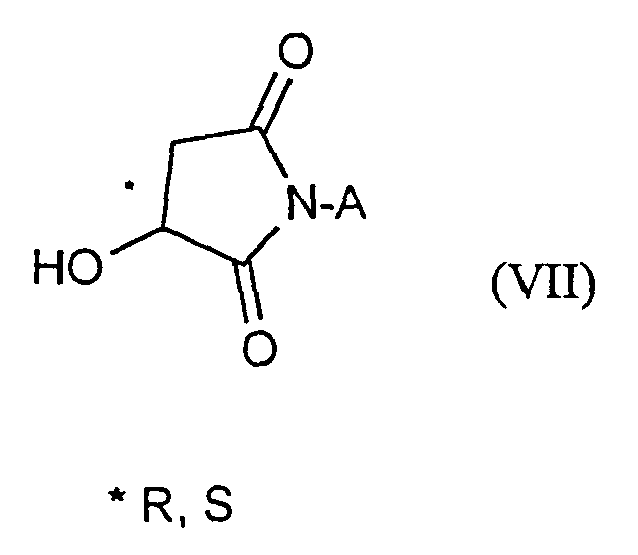
A die oben angegebene Bedeutung hat,
mit Diketen oder Diketen-Aceton-Addukt (2,2,6-Trimethyl-1,3-dioxin-4-on) in inerten Lösemitteln umsetzt. - Als Lösemittel eignen sich im allgemeinen Kohlenwasserstoffe, wie beispielsweise Benzol, Toluol oder Xylol. Bevorzugt ist Toluol.
- Die Umsetzungen erfolgen in einem Temperaturbereich von 90°C bis 140°C, bevorzugt von 100°C bis 110°C.
- Die Umsetzungen werden im allgemeinen bei Normaldruck durchgeführt. Es ist aber auch möglich bei Über- oder Unterdruck (z.B. in einem Bereich von 0,5 bis 5 bar) zu arbeiten.
- Die enantiomerenreinen Imide der allgemeinen Formel (VII) sind teilweise bekannt [vgl. z.B. THL 1990, 4949; J. Am. Chem. Soc., 2589, 1989] oder können hergestellt werden, indem man (S)-(-)- oder (R)-(-)-Äpfelsäure mit den entsprechenden Aminen, in einem der oben aufgeführten Lösemittel, vorzugsweise Xylol, in einem Temperaturbereich von 100°C bis 180°C, bevorzugt 130°C bis 150°C umsetzt.
- Diketen und 2,2,6-Triethyl-1,3-dioxin-4-on sind bekannt.
- Die enantiomerenreinen Aminocrotonsäureester der allgemeinen Formel (IIIa) sind neu und können beispielsweise hergestellt werden, indem man bei der Herstellung der oben aufgeführten Acetessigsäureester der allgemeinen Formel (VI) in situ Ammoniak oder Ammoniumsalze zugibt.
- Als Lösemittel eignen sich die für die Herstellung der Verbindungen der allgemeinen Formel (VI) genannten. Die Umsetzung mit den Ammoniumsalzen erfolgt in Toluol am Wasserabscheider unter Rückfluß.
- Die Umsetzungen erfolgen in einem Temperaturbereich von 50°C bis 120°C, bevorzugt von 5°C bis 80C.
- Die Umsetzungen werden im allgemeinen bei einem Unterdruck von 0,1 bis 0,5 bar durchgeführt. Es ist aber auch möglich bei Normal- oder Überdruck (z.B. in einem Bereich von 1 bis 5 bar) zu arbeiten.
- Als Ammoniumsalze eignen sich im allgemeinen Ammoniumsalze organischer oder anorganischer Säuren, wie beispielsweise Ammoniumacetat oder Ammoniumformiat. Bevorzugt ist Ammoniumacetat.
- Die enantiomerenreinen Verbindungen der allgemeinen Formel (IV) sind neu und können wie oben beschrieben hergestellt werden.
- Die Abspaltung des substituierten Pyrrolidin-2,5-dion-3-yl-Restes aus den enantiomerenreinen 1,4-Dihydropyridinen der allgemeinen Formel (IV) erfolgt in einem der oben aufgeführten inerten Lösemittel. Bevorzugt sind Ethylacetat, Tetrahydrofuran oder Gemische der beiden.
- Als Basen eignen sich im allgemeinen Alkalicarbonate wie beispielsweise Natrium- oder Kaliumcarbonat, oder organische Basen wie Trialkylamine, z.B. Triethylamin, N-Ethylmorpholin, N-Methylpiperidin oder Diisopropylethylamin, oder Dimethylaminopyridin, 1,8-Diazabicyclo[5.4.0]undec-7-en (DBU) oder 1,5-Diazabicyclo[4.3.0]non-5-en (DBN). Bevorzugt ist 1,8-Diazabicyclo[5.4.0]undec-7-en.
- Die Base wird in einer Menge von 1 mol bis 5 mol, bevorzugt von 1 mol bis 2 mol jeweils bezogen auf 1 mol der enantiomerenreinen Verbindungen der allgemeinen Formel (IV) eingesetzt.
- Die Umsetzung erfolgt in einem Temperaturbereich von 0°C bis 50°C, bevorzugt bei Raumtemperatur.
- Die Umsetzung wird im allgemeinen bei Normaldruck durchgeführt. Es ist aber auch möglich bei Über- oder Unterdruck (z.B. in einem Bereich von 0,5 bis 5 bar) zu arbeiten.
- Ohne Isolierung der freien enantiomerenreinen Säure werden die Verbindungen der allgemeinen Formeln (IV) oder (IVa) anschließend durch Aktivierung mit einem Hilfsmittel, in einem der oben aufgeführten Lösemittel in Anwesenheit von Ethylacetat in die enantiomerenreinen Verbindungen der allgemeinen Formel (VIII)
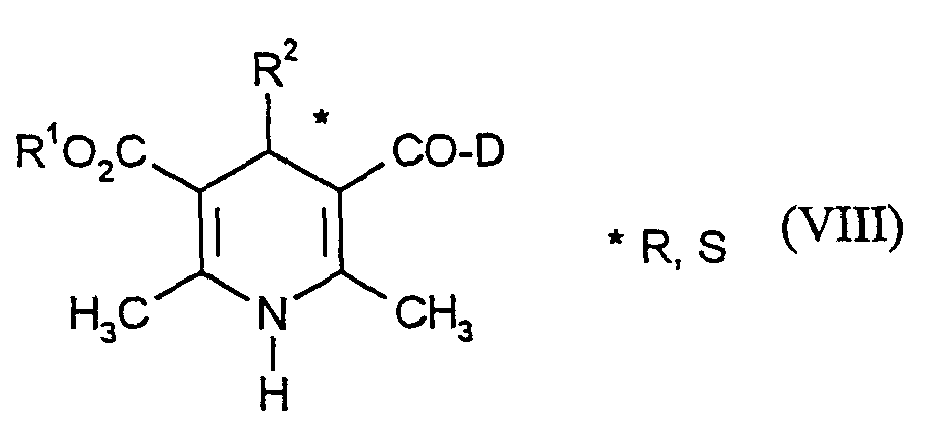
- R1 und R2
- die oben angegebene Bedeutung haben,
- D
- für einen aktivierenden Rest, beispielsweise für Imidazolyl steht,
- Als Hilfsstoffe zur Aktivierung der Carbonsäure werden bevorzugt Kondensationsmittel eingesetzt. Bevorzugt werden hier die üblichen Kondensationsmittel wie Carbodiimide z.B. N,N'-Diethyl-, N,N'-Dipropyl-, N,N'-Diisopropyl-, N,N'-Dicyclohexylcarbodiimid, N-(3-Dimethylaminoisopropyl)-N'-ethylcarbodiimid-Hydrochlorid, oder Carbonylverbindungen wie Carbonyldiimidazol, oder 1,2-Oxazoliumverbindungen wie 2-Ethyl-5-phenyl-1,2-oxazolium-3-sulfonat oder 2-tert.Butyl-5-methyl-isoxazolium-perchlorat, oder Acylaminoverbindungen wie 2-Ethoxy-1-ethoxycarbonyl-1,2-dihydrochinolin, oder Propanphosphonsäureanhydrid, oder Isobutylchloroformat, oder Benzotriazolyloxy-tris(dimethylamino)phosphonium-hexafluorophosphonat eingesetzt. Bevorzugt sind N,N'-Dicyclohexylcarbodiimid und Carbonyldiimidazol.
- Die Hilfsstoffe werden im allgemeinen in einer Menge von 1 mol bis 3 mol, bevorzugt von 1 mol bis 1,5 mol, jeweils bezogen auf 1 mol der freien Carbonsäure eingesetzt.
- Die Verfahren können bei Normaldruck, erhöhtem oder erniedrigtem Druck (beispielsweise von 0,5 bis 5 bar), vorzugsweise bei Normaldruck durchgeführt werden.
- Die aktivierten enantiomerenreinen 1,4-Dihydropyridine der allgemeinen Formel (VIII) sind bekannt oder können wie oben beschrieben hergestellt werden.
- Bevorzugt werden nach dem erfindungsgemäßen Verfahren enantiomerenreine Verbindungen der allgemeinen Formel (I),
in welcher - R1 und R3
- gleich oder verschieden sind und
für geradkettiges oder verzweigtes Alkyl mit bis zu 8 Kohlenstoffatomen stehen, das gegebenenfalls durch geradkettiges oder verzweigtes Alkoxy mit bis zu 5 Kohlenstoffatomen oder Hydroxy substituiert ist, oder für Cyclopropyl, Cyclopentyl, Cyclohexyl oder Cycloheptyl stehen, - R2
- für den Rest

worin
R4 und R5 gleich oder verschieden sind und jeweils Fluor, Brom, Chlor, Cyano, Ethinyl, Trifluormethoxy, Methyl, Nitro, Methylthio, Trifluormethyl oder geradkettiges oder verzweigtes Alkoxy mit bis zu 3 Kohlenstoffatomen bedeuten, und gegebenenfalls einer der Substituenten für Wasserstoff steht, - Besonders bevorzugt werden nach dem erfindungsgemäßen Verfahren Verbindungen der allgemeinen Formel (I),
in welcher - R1 und R3
- gleich oder verschieden sind und
für geradkettiges oder verzweigtes Alkyl mit bis zu 8 Kohlenstoffatomen stehen, das gegebenenfalls durch Methoxy oder Hydroxy substituiert ist, oder
für Cyclopropyl, Cyclopentyl, Cyclohexyl oder Cycloheptyl stehen, - R2
- für den Rest

worin
R4 und R5 gleich oder verschieden sind und Fluor, Chlor, Cyano, Ethinyl, Trifluormethoxy, Methyl, Methylthio, Nitro, Trifluormethyl oder geradkettiges oder verzweigtes Alkoxy mit bis zu 3 Kohlenstoffatomen bedeuten, und gegebenenfalls einer der Substituenten für Wasserstoff steht, - Ganz besonders bevorzugt nach dem erfindungsgemäßen Verfahren werden die enantiomerenreinen Verbindungen (4R)- und (4S)-Isopropyl-(2-methoxyethyl)-4-(2-chlor-3-cyano-phenyl)-1,4-dihydro-2,6-dimethyl-pyridin-3,5-dicarboxylat hergestellt.
- Das erfindungsgemäße Verfahren ermöglicht auf hochenantioselektive Weise und gleichzeitig sehr hoher Ausbeute den Zugang zu den enantiomerenreinen Halogenphenyl-substituierten 1,4-Dihydropyridinen der allgemeinen Formel (I), die wertvolle cerebral wirksame Arzneimittel darstellen.
-

- Zu einer Lösung von (S)-Äpfelsäure-N-benzylimid (9,0 g, 43,8 mmol) [THL 1990, 4949] in Xylol (18 ml) tropft man bei 130°C 2,2,6-Trimethyl-1,3-dioxin-4-on (6,6 g, 4,38 mmol, 95%ig). Das entstehende Aceton wird aus dem Reaktionsgemisch abdestilliert. Man läßt noch 2 h bei 130°C rühren, kühlt die Reaktionslösung auf 50°C und zieht das Lösemittel im Vakuum ab. Der Rückstand wird säulenchromatographisch an Kieselgel gereinigt (Laufmittel: Diethylether). Nach Einengen der Produktfraktionen erhält man 11,8 g (93%) der Titelverbindung.
1H-NMR (CDCl3):δ = 2,28 (s, 3H); 2,77 (dd, J = 18 Hz, 5 Hz, 1H); 3,19 (dd, J = 18 Hz, 8 Hz, 1H); 3,56 (s, 2H); 4,68 (AB-System, 2H); 5,49 (dd, J = 8 Hz, 5 Hz, 1H); 7,25 - 7,42 ppm (m, 5H); Enol-H: schwaches Singulett bei 11,68 ppm). -

- Man erhitzt eine Suspension von (S)-Äpfelsäure-N-benzylimid (1700 g, 8,28 mol) in Toluol (6,8 1) auf 105°C und läßt innerhalb von ca. 20 Min. 2,2,6-Trimethyl-1,3-dioxin-4-on (85%ig, 1447 g, 8,65 mol) zulaufen, wobei das entstehende Aceton zusammen mit Toluol abdestilliert. Man läßt noch 2 h bei 100 - 105°C rühren, wobei weiter Aceton / Toluol abdestilliert wird. Man läßt Toluol (1 1) zur Reaktionslösung laufen und kühlt den Ansatz auf 70°C ab. Nach Zugabe von Ammoniumacetat (1207 g, 15,7 mol) wird 3 h bei 65°C und 250 - 300 mbar am Wasserabscheider unter Rückfluß erhitzt. Man läßt Ethylacetat (3,4 1) zulaufen, kühlt den Ansatz auf Raumtemperatur ab, wäscht mit ges. wäßriger NaHCO3-Lösung, trocknet die organische Phase über Na2SO4, und destilliert das Lösemittel im Vakuum bei 35-40°C ab. Der Rückstand wird in Isopropanol (4,2 1) aufgenommen, und das Lösemittel wird im Vakuum bei 25-65°C abdestilliert. Der Rückstand wird erneut in Isopropanol (2,5 1) aufgenommen. Man erhitzt die Suspension zum Rückfluß, wobei der Feststoff in Lösung geht. Nach dem Abkühlen auf 5-7°C läßt man Wasser (1,8 1) zulaufen, filtriert ausgefallenes Produkt ab, wäscht mit Isopropanol / Wasser (1:1, 3,4 1) und trocknet das Produkt im Vakuum bei 50°C.
Ausbeute: 1990 g (83%)
Schmp.: 104-105°C
1H-NMR (CDCl3) δ = 1,94 (s, 3H); 2,71 (dd, J = 18 Hz, 5 Hz, 1H); 3,12 (dd, J = 18 Hz, 8 Hz, 1H); 4,57 (s, 1H); 4,71 (AB-System, 2H); 4,74 (s, breit, 1H); 5,40 (dd, J = 8 Hz, 5 Hz, 1H); 7,20 - 7,44 (m, 5H); 7,88 ppm (s, breit, 1H). -

- Eine Lösung der Verbindung aus Beispiel I (12,6 g, 43,6 mmol) und 2-Chlor-3-cyano-benzaldehyd (7,2 g, 43,6 mmol) in Dichlormethan (80 ml) wird mit Piperidin (246 mg, 2,8 mmol) und Eisessig (168 mg, 2,8 mmol) versetzt und 18 h am Wasserabscheider unter Rückfluß erhitzt. Nach Abkühlen auf Raumtemperatur wird die Dichlormethan-Lösung mit Wasser (40 ml) gewaschen, über Na2SO4 getrocknet und im Vakuum eingeengt. Der Rückstand wird säulenchromatographisch an Kieselgel gereinigt (Lauftmittel: Ether). Nach Einengen der Produktfraktionen erhält man 13,0 g (68%) der Titelverbindung als Gemisch von E/Z-Isomeren.
1H-NMR (CDCl3): δ = 2,30, 2,51 (2s, 3H); 2,70 - 2,87 (m, 1H); 3,08 - 3,33 (m, 1H); 4,63 - 4,80 (m, 2H); 5,51 - 5,69 (m, 1H); 7,27 - 7,92 (m, 9H). -

- Die Verbindung aus Beispiel II (80,0 g, 0,244 mol) und 2-Acetyl-3-(2-chlor-3-cyano-phenyl)-2-propensäure-2-methoxyethylester (83,29 g, 0,243 mol) werden mit Isopropanol (1100 ml) versetzt und die Mischung wird 8,5 h unter Rückfluß erhitzt. Man kühlt auf Raumtemperatur ab, filtriert das ausgefallene Rohprodukt ab, wäscht zweimal mit je 100 ml Isopropanol und trocknet das Rohprodukt im Vakuum bei 40°C. Das Rohprodukt wird in Ethylacetat (200 ml) suspendiert und die Suspension wird 1 h unter Rückfluß erhitzt. Nach dem Abkühlen auf Raumtemperatur filtriert man das Produkt ab, wäscht mit Ethylacetat (40 ml) und trocknet das Produkt im Vakuum bei 50°C.
Ausbeute: 57,8 g (41%)
Diastereomerenüberschuß ≥ 99,5% (HPLC, Chiracel OD-H)
Schmp.: 239-240°C
1H-NMR (d6-DMSO): δ = 2,26 (s, 6H); 2,68 (dd, J = 18 Hz, 5 Hz, 1H); 3,09 (dd, J = 18 Hz, 8 Hz, 1H); 3,16 (s, 3H); 3,37 - 3,50 (m, 2H); 3,95 - 4,12 (m, 2H); 4,52, 4,64 (AB-Signal, JAB = 15 HZ, 2H); 5,25 (s, 1H); 5,53 (dd, J = 8 Hz, 5 Hz, 1H); 7,22 - 7,77 (m, 8H). - Die Verbindung aus Beispiel III (3,0 g, 6,9 mmol) und 3-Aminocrotonsäure-(2-methoxyethyl)-ester (1,1 g, 6,9 mmol) werden mit Ethylacetat (38 ml) versetzt und 5 h mit Rückfluß erhitzt. Man filtriert ausgefallenes Produkt ab, wäscht mit Ethylacetat (3 ml) und trocknet das Produkt im Vakuum bei 40°C.
Ausbeute: 1,3 g (33%)
Diastereomerenüberschuß: ≥ 99,5% (HPLC, Chiracel OD-H) -

- Die Verbindung aus Beispiel IV (73,9 g, 0,128 mol) wird in Ethylacetat (480 ml) und Tetrahydrofuran (96 ml) suspendiert, mit 1,8-Diazabicyclo[5.4.0]undec-7-en (DBU, 29,0 ml, 0,192 mol) versetzt und 12 h bei Raumtemperatur gerührt. Anschließend wird 1 N HCl (300 ml) zugegeben und 15 Minuten kräftig aufgerührt. Die Ethylacetat-Phase wird abgetrennt, je einmal mit 1 N HCl (150 ml) und ges. wäßriger NaCl-Lösung gewaschen und über Na2SO4 getrocknet. Das Lösemittel wird im Vakuum abgezogen und der Rückstand mit Ethylacetat (420 ml) aufgeommen. Nach Zugabe von N.N'-Carbonyldiimidazol (25,0 g, 0,154 mol) wird 12 h bei Raumtemperatur und 30 Minuten bei 0-5°C gerührt. Ausgefallenes Produkt wird abfiltriert, mit Ethylacetat (25 ml) gewaschen und im Vakuum getrocknet.
Ausbeute: 42,6 g (76%)
Schmp.: 180°C
1H-NMR (CDCl3): δ = 1,90 (s, 3H); 2,48 (s, 3H); 3,22 (s, 3H); 3,40 - 3,52 (m, 2H); 4,10 (t, 2H); 5,58 (s, 1H); 6,02 (s, 1H); 7,08 (d, 1H); 7,25 - 7,58 (m, 4H); 7,91 (s, 1H). -
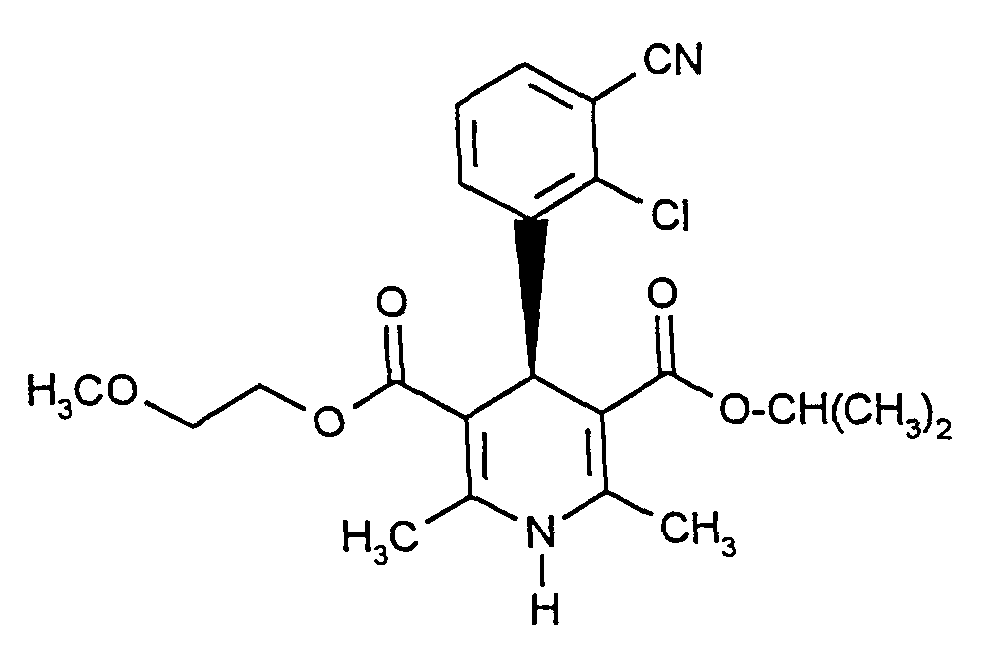
- Die Verbindung aus Beispiel V (73,2 g, 166 mmol) und N,N-Dimethylaminopyridin (0,93 g, 7,6 mmol) werden in Isopropanol (530 ml) 20 h unter Rückfluß erhitzt. Die Reaktionsmischung wird langsam auf 0-5°C abgekühlt und 1 h bei 0-5°C gerührt. Auskristallisiertes Rohprodukt wird abfiltriert, mit kaltem Isopropanol (35 ml) gewaschen und im Vakuum getrocknet. Nach Umkristallisation des Rohproduktes aus Ethylacetat (150 ml) / Cyclohexan (450 ml) erhält man 53,2 g (74%) der Titelverbindung.
Schmp.: 138-140°C
[α]20 D = +13,9 (c = 1, CHCl3)
dadurch gekennzeichnet, daß man die enantiomerenreinen Benzylidenverbindungen der allgemeinen Formel (II) oder die Benzylidenverbindungen der allgemeinen Formel (IIa)

im Fall der enantiomerenreinen Benzylidenverbindungen der allgemeinen Formel (II) mit Aminocrotonsäureestern der allgemeinen Formel (III) und im Fall der Benzylidenverbindungen der allgemeinen Formel (IIa) mit den entsprechenden enantiomerenreinen Aminocrotonsäureestern der allgemeinen Formel (IIIa)

R1 und A die oben angegebenen Bedeutungen haben,
in inerten Lösemitteln, gegebenenfalls in Anwesenheit einer Base,
in die diastereomerenreinen 1,4-Dihydropyridine der allgemeinen Formeln (IVa) und (IVb)

R1, R2 und A die oben angegebenen Bedeutungen haben,
überführt,
und anschließend den Äpfelsäureimid-Rest unter milden Bedingungen mit schwachen Basen, gegebenenfalls unter Isolierung der freien Säure, abspaltet, und die Carbonsäurefunktion nach üblichen Methoden verestert.
Claims (2)
- Verfahren zur Herstellung von enantiomerenreinen phenylsubstituierten 1,4-Dihydropyridin-3,5-dicarbonsäurederivaten der allgemeinen Formel (I)
 R1 und R3 gleich oder verschieden sind und für geradkettiges oder verzweigtes Alkyl mit bis zu 8 Kohlenstoffatomen stehen, das gegebenenfalls durch geradkettiges oder verzweigtes Alkoxy mit bis zu 6 Kohlenstoffatomen oder Hydroxy substituiert ist, oderund
für Cycloalkyl mit 3 bis 7 Kohlenstoffatomen stehen,R2 für den Restdadurch gekennzeichnet, dass man die enantiomerenreinen Benzylidenverbindungen der allgemeinen Formel (II) oder die Benzylidenverbindungen der allgemeinen Formel (IIa),
worinR4 und R5 gleich oder verschieden sind und Halogen, Cyano, Ethinyl, Trifluormethoxy, Methylthio, Nitro, Trifluormethyl oder geradkettiges oder verzweigtes Alkyl, Alkenyl, Alkinyl oder Alkoxy bis zu 4 Kohlenstoffatomen bedeuten, und gegebenenfalls einer der Substituenten für Wasserstoff steht, und deren Salze, R1 und R2 die oben angegebenen Bedeutungen habenundA für Wasserstoff oder für geradkettiges oder verzweigtes Alkyl mit bis zu 8 Kohlenstoffatomem steht, oderin welchen
für Phenyl oder Benzyl steht, die gegebenenfalls bis zu 3-fach gleich oder verschieden durch Hydroxy, Nitro, Halogen, Cyano, Carboxy, Trifluormethyl, Trifluormethoxy, geradkettiges oder verzweigtes Alkoxy mit bis zu 6 Kohlenstoffatomen oder durch eine Gruppe der Formel -NR6R7 oder -SO2R8 substituiert sind,
worinR6 und R7 gleich oder verschieden sind und Wasserstoff, Phenyl oder geradkettiges oder verzweigtes Alkyl mit bis zu 5 Kohlenstoffatomen bedeutenundR8 geradkettiges oder verzweigtes Alkyl mit bis zu 4 Kohlenstoffatomen oder Phenyl bedeutet,durch Umsetzung im Fall der enantiomerenreinen Benzylidenverbindungen der allgemeinen Formel (II) mit Aminocrotonsäureestern der allgemeinen Formel (III) und im Fall der Benzylidenverbindungen der allgemeinen Formel (IIa) mit den entsprechenden enantiomerenreinen Aminocrotonsäureestern der allgemeinen Formel (IIIa),
R1 und A die in Anspruch 1 angegebenen Bedeutungen haben,
in inerten Lösemitteln, gegebenenfalls in Anwesenheit einer Base,
in die diastereomerenreinen 1,4-Dihydropyridine der allgemeinen Formeln (IVa) und (IVb)

R1, R2 und A die oben angegebenen Bedeutungen haben, überführt,
und anschließend den Äpfelsäureimid-Rest unter milden Bedingungen mit schwachen Basen, gegebenenfalls unter Isolierung der freien Säure, abspaltet, und die Carbonsäurefunktion nach üblichen Methoden verestert. - 1,4-Dihydropyridine der allgemeinen Formeln (IVa) und (IVb) gemäß Anspruch 1.
Priority Applications (2)
| Application Number | Priority Date | Filing Date | Title |
|---|---|---|---|
| EP04009787A EP1443043A3 (de) | 1994-12-05 | 1995-11-22 | Hochselektives Verfahren zur Herstellung von enantiomerenreinen phenylsubstituierten1,4- Dihydropyridin-3,5- dicarbonsäurederivaten |
| SI9530725T SI0716081T1 (sl) | 1994-12-05 | 1995-11-22 | Visoko selektiven postopek za pripravo enantiomerno cistih, fenilno substituiranih derivatov 1,4-dihidropiridin-3,5-dikarboksilnih kislin |
Applications Claiming Priority (2)
| Application Number | Priority Date | Filing Date | Title |
|---|---|---|---|
| DE4443168 | 1994-12-05 | ||
| DE4443168A DE4443168A1 (de) | 1994-12-05 | 1994-12-05 | Neues hochselektives Verfahren zur Herstellung von enantiomerenreinen phenylsubstituierten 1,4-Dihydropyridin-3,5-dicarbonsäurederivaten |
Related Child Applications (1)
| Application Number | Title | Priority Date | Filing Date |
|---|---|---|---|
| EP04009787A Division EP1443043A3 (de) | 1994-12-05 | 1995-11-22 | Hochselektives Verfahren zur Herstellung von enantiomerenreinen phenylsubstituierten1,4- Dihydropyridin-3,5- dicarbonsäurederivaten |
Publications (2)
| Publication Number | Publication Date |
|---|---|
| EP0716081A1 EP0716081A1 (de) | 1996-06-12 |
| EP0716081B1 true EP0716081B1 (de) | 2006-04-05 |
Family
ID=6534908
Family Applications (2)
| Application Number | Title | Priority Date | Filing Date |
|---|---|---|---|
| EP95118359A Expired - Lifetime EP0716081B1 (de) | 1994-12-05 | 1995-11-22 | Hochselektives Verfahren zur Herstellung von enantiomerenreinen phenylsubstituierten 1,4-Dihydropyridin-3,5-dicarbonsäurederivaten |
| EP04009787A Withdrawn EP1443043A3 (de) | 1994-12-05 | 1995-11-22 | Hochselektives Verfahren zur Herstellung von enantiomerenreinen phenylsubstituierten1,4- Dihydropyridin-3,5- dicarbonsäurederivaten |
Family Applications After (1)
| Application Number | Title | Priority Date | Filing Date |
|---|---|---|---|
| EP04009787A Withdrawn EP1443043A3 (de) | 1994-12-05 | 1995-11-22 | Hochselektives Verfahren zur Herstellung von enantiomerenreinen phenylsubstituierten1,4- Dihydropyridin-3,5- dicarbonsäurederivaten |
Country Status (27)
| Country | Link |
|---|---|
| US (4) | US5700948A (de) |
| EP (2) | EP0716081B1 (de) |
| JP (1) | JP3891500B2 (de) |
| KR (1) | KR100396011B1 (de) |
| CN (5) | CN1079793C (de) |
| AT (1) | ATE322482T1 (de) |
| AU (1) | AU702274B2 (de) |
| CA (1) | CA2164276C (de) |
| CZ (1) | CZ296438B6 (de) |
| DE (2) | DE4443168A1 (de) |
| DK (1) | DK0716081T3 (de) |
| ES (1) | ES2262138T3 (de) |
| FI (1) | FI115908B (de) |
| HU (1) | HU214683B (de) |
| IL (1) | IL116225A (de) |
| MX (1) | MX9504954A (de) |
| MY (1) | MY112938A (de) |
| NO (1) | NO312832B1 (de) |
| NZ (1) | NZ280578A (de) |
| PL (1) | PL183604B1 (de) |
| PT (1) | PT716081E (de) |
| RU (1) | RU2155752C2 (de) |
| SG (1) | SG73352A1 (de) |
| SI (1) | SI0716081T1 (de) |
| SK (1) | SK282428B6 (de) |
| TW (1) | TW310324B (de) |
| ZA (1) | ZA9510263B (de) |
Families Citing this family (2)
| Publication number | Priority date | Publication date | Assignee | Title |
|---|---|---|---|---|
| EP1110962A1 (de) * | 1999-12-10 | 2001-06-27 | Pfizer Inc. | Verfahren zur herstellung von 1,4-dihydropyridine verbindungen |
| KR102533154B1 (ko) | 2022-09-22 | 2023-05-17 | 임태형 | 안전계단 난간대 |
Family Cites Families (7)
| Publication number | Priority date | Publication date | Assignee | Title |
|---|---|---|---|---|
| US3932646A (en) * | 1971-04-10 | 1976-01-13 | Farbenfabriken Bayer Ag | Pharmaceutical compositions containing unsymmetrical esters of 1,4-dihydropyridine 3,5-dicarboxylate |
| DE2815578C2 (de) * | 1978-04-11 | 1986-01-16 | Bayer Ag, 5090 Leverkusen | Neue pharmazeutische Verwendung von Nimodipin |
| JPS6058239B2 (ja) * | 1978-07-20 | 1985-12-19 | 山之内製薬株式会社 | 新規セフアロスポリン誘導体 |
| DE2911029C2 (de) * | 1979-03-21 | 1985-03-14 | Kombi-Lift Montage- Und Handelsgesellschaft Mbh, 5650 Solingen | Vorrichtung zum Haltern der Führungsrollen für die Lastseile eines Fassadenseilaufzuges in einem oben am Gebäude fest angeordneten Gehäuse |
| GR850872B (de) * | 1984-04-16 | 1985-11-25 | Yamanouchi Pharma Co Ltd | |
| US4539302A (en) * | 1984-04-30 | 1985-09-03 | E. I. Du Pont De Nemours And Company | Recovery of zerovalent nickel complexes |
| DE3423105A1 (de) * | 1984-06-22 | 1986-01-02 | Bayer Ag, 5090 Leverkusen | Verfahren zur herstellung optisch aktiver 1,4-dihydropyridine |
-
1994
- 1994-12-05 DE DE4443168A patent/DE4443168A1/de not_active Withdrawn
-
1995
- 1995-11-16 MY MYPI95003487A patent/MY112938A/en unknown
- 1995-11-17 TW TW084112189A patent/TW310324B/zh active
- 1995-11-22 EP EP95118359A patent/EP0716081B1/de not_active Expired - Lifetime
- 1995-11-22 AT AT95118359T patent/ATE322482T1/de active
- 1995-11-22 DE DE59511043T patent/DE59511043D1/de not_active Expired - Lifetime
- 1995-11-22 PT PT95118359T patent/PT716081E/pt unknown
- 1995-11-22 EP EP04009787A patent/EP1443043A3/de not_active Withdrawn
- 1995-11-22 DK DK95118359T patent/DK0716081T3/da active
- 1995-11-22 ES ES95118359T patent/ES2262138T3/es not_active Expired - Lifetime
- 1995-11-22 SI SI9530725T patent/SI0716081T1/sl unknown
- 1995-11-28 US US08/563,725 patent/US5700948A/en not_active Ceased
- 1995-11-28 MX MX9504954A patent/MX9504954A/es unknown
- 1995-11-29 AU AU39150/95A patent/AU702274B2/en not_active Ceased
- 1995-11-30 PL PL95311539A patent/PL183604B1/pl not_active IP Right Cessation
- 1995-12-01 JP JP33570795A patent/JP3891500B2/ja not_active Expired - Fee Related
- 1995-12-01 IL IL11622595A patent/IL116225A/xx not_active IP Right Cessation
- 1995-12-01 NZ NZ280578A patent/NZ280578A/en not_active IP Right Cessation
- 1995-12-01 HU HU9503438A patent/HU214683B/hu not_active IP Right Cessation
- 1995-12-01 NO NO19954885A patent/NO312832B1/no not_active IP Right Cessation
- 1995-12-01 CA CA002164276A patent/CA2164276C/en not_active Expired - Fee Related
- 1995-12-04 SG SG1995002018A patent/SG73352A1/en unknown
- 1995-12-04 CZ CZ0320595A patent/CZ296438B6/cs not_active IP Right Cessation
- 1995-12-04 FI FI955825A patent/FI115908B/fi not_active IP Right Cessation
- 1995-12-04 SK SK1526-95A patent/SK282428B6/sk not_active IP Right Cessation
- 1995-12-04 ZA ZA9510263A patent/ZA9510263B/xx unknown
- 1995-12-04 KR KR1019950046341A patent/KR100396011B1/ko not_active Expired - Fee Related
- 1995-12-05 RU RU95121073/04A patent/RU2155752C2/ru not_active IP Right Cessation
- 1995-12-05 CN CN95119057A patent/CN1079793C/zh not_active Expired - Fee Related
-
1997
- 1997-07-16 US US08/896,275 patent/US5849924A/en not_active Expired - Lifetime
-
1998
- 1998-09-21 US US09/158,428 patent/US5910593A/en not_active Expired - Lifetime
-
1999
- 1999-03-25 US US09/276,220 patent/USRE36607E/en not_active Expired - Lifetime
- 1999-12-30 CN CN991275276A patent/CN1216054C/zh not_active Expired - Fee Related
- 1999-12-30 CN CN99127530A patent/CN1094926C/zh not_active Expired - Fee Related
- 1999-12-30 CN CN99127528A patent/CN1094486C/zh not_active Expired - Fee Related
- 1999-12-30 CN CN99127529A patent/CN1105102C/zh not_active Expired - Fee Related
Also Published As
Similar Documents
| Publication | Publication Date | Title |
|---|---|---|
| EP0509359B1 (de) | Verfahren zur Herstellung von enantiomerenreinen substituierten (Chinolin-2-yl-methoxy)phenyl-essigsäuren | |
| DE69929079T2 (de) | Zwischenstufe für die synthese von amlodipin, herstellungsverfahren und entsprechende anwendung | |
| EP0288758B1 (de) | Dihydropyridinamide, Verfahren zu ihrer Herstellung und ihre Verwendung in Arzneimitteln | |
| RU2376288C2 (ru) | Способ получения энантиомера амлодипина высокой оптической чистоты | |
| EP1443043A2 (de) | Hochselektives Verfahren zur Herstellung von enantiomerenreinen phenylsubstituierten1,4- Dihydropyridin-3,5- dicarbonsäurederivaten | |
| DE68923159T2 (de) | Verfahren zur Herstellung von 1,4-Dihydropyridin-Derivaten. | |
| EP0856509B1 (de) | Verfahren zur Herstellung von Diacylimiden | |
| US20020132834A1 (en) | Method for preparing amlodipine | |
| EP0225574B1 (de) | Neue, fluorhaltige 1,4-Dihydropyridine, Verfahren zu ihrer Herstellung sowie ihre Verwendung als Arzneimittel | |
| CA2536608C (en) | New highly selective process for the preparation of enantiomerically pure phenyl-substituted 1,4-dihydropyridine-3,5-dicarboxylic acid derivatives | |
| EP0347678B1 (de) | 1,4-Dihydropyridin-threonin-Derivate und Verfahren zu ihrer Herstellung | |
| US5929242A (en) | Manufacture of levobupivacaine and analogues thereof from L-lysine | |
| DE3423105A1 (de) | Verfahren zur herstellung optisch aktiver 1,4-dihydropyridine | |
| EP0394243A1 (de) | Verfahren zur herstellung von carbonsäuren | |
| KR100354806B1 (ko) | 암로디핀 베실레이트의 신규 중간체 및 그의 제조방법 | |
| DE69327092T2 (de) | Optisch aktives 1-phenylpyrrolidonderivat und dessen herstellung | |
| DE19617772A1 (de) | Neues effizientes und hochenantioselektives Verfahren zur Herstellung von enantiomerenreinen Cyclopentan-beta-aminosäuren | |
| DD259189A5 (de) | Verfahren zur herstellung neuer hydropyridin-derivate | |
| HU183484B (en) | Process for preparing new azetidinone derivatives containing protected o-acetyl group |
Legal Events
| Date | Code | Title | Description |
|---|---|---|---|
| PUAI | Public reference made under article 153(3) epc to a published international application that has entered the european phase |
Free format text: ORIGINAL CODE: 0009012 |
|
| AK | Designated contracting states |
Kind code of ref document: A1 Designated state(s): AT BE CH DE DK ES FR GB GR IE IT LI LU MC NL PT SE |
|
| AX | Request for extension of the european patent |
Free format text: LT PAYMENT 951122;SI PAYMENT 951122 |
|
| RAX | Requested extension states of the european patent have changed |
Free format text: LT PAYMENT 951122;SI PAYMENT 951122 |
|
| RIN1 | Information on inventor provided before grant (corrected) |
Inventor name: SCHOHE-LOOP, RUDOLF, DR. Inventor name: MEIER, HEINRICH, DR. Inventor name: VAN LAAK, KAI, DR. Inventor name: KAULEN, JOHANNES, DR. Inventor name: JUNGE, BODO, DR. Inventor name: FEY, PETER, DR. Inventor name: MITTENDORF, JOACHIM, DR. |
|
| 17P | Request for examination filed |
Effective date: 19961127 |
|
| 17Q | First examination report despatched |
Effective date: 19981119 |
|
| GRAG | Despatch of communication of intention to grant |
Free format text: ORIGINAL CODE: EPIDOS AGRA |
|
| GRAG | Despatch of communication of intention to grant |
Free format text: ORIGINAL CODE: EPIDOS AGRA |
|
| APAB | Appeal dossier modified |
Free format text: ORIGINAL CODE: EPIDOS NOAPE |
|
| APAD | Appeal reference recorded |
Free format text: ORIGINAL CODE: EPIDOS REFNE |
|
| RAP1 | Party data changed (applicant data changed or rights of an application transferred) |
Owner name: BAYER HEALTHCARE AG |
|
| APBT | Appeal procedure closed |
Free format text: ORIGINAL CODE: EPIDOSNNOA9E |
|
| GRAP | Despatch of communication of intention to grant a patent |
Free format text: ORIGINAL CODE: EPIDOSNIGR1 |
|
| GRAS | Grant fee paid |
Free format text: ORIGINAL CODE: EPIDOSNIGR3 |
|
| APAF | Appeal reference modified |
Free format text: ORIGINAL CODE: EPIDOSCREFNE |
|
| GRAA | (expected) grant |
Free format text: ORIGINAL CODE: 0009210 |
|
| AK | Designated contracting states |
Kind code of ref document: B1 Designated state(s): AT BE CH DE DK ES FR GB GR IE IT LI LU MC NL PT SE |
|
| AX | Request for extension of the european patent |
Extension state: LT SI |
|
| PG25 | Lapsed in a contracting state [announced via postgrant information from national office to epo] |
Ref country code: IT Free format text: LAPSE BECAUSE OF FAILURE TO SUBMIT A TRANSLATION OF THE DESCRIPTION OR TO PAY THE FEE WITHIN THE PRE;WARNING: LAPSES OF ITALIAN PATENTS WITH EFFECTIVE DATE BEFORE 2007 MAY HAVE OCCURRED AT ANY TIME BEFORE 2007. THE CORRECT EFFECTIVE DATE MAY BE DIFFERENT FROM THE ONE RECORDED.SCRIBED TIME-LIMIT Effective date: 20060405 |
|
| REG | Reference to a national code |
Ref country code: GB Ref legal event code: FG4D Free format text: NOT ENGLISH |
|
| REG | Reference to a national code |
Ref country code: CH Ref legal event code: NV Representative=s name: E. BLUM & CO. PATENTANWAELTE Ref country code: CH Ref legal event code: EP |
|
| REG | Reference to a national code |
Ref country code: IE Ref legal event code: FG4D Free format text: LANGUAGE OF EP DOCUMENT: GERMAN |
|
| REG | Reference to a national code |
Ref country code: IE Ref legal event code: FG4D Free format text: LANGUAGE OF EP DOCUMENT: GERMAN |
|
| REF | Corresponds to: |
Ref document number: 59511043 Country of ref document: DE Date of ref document: 20060518 Kind code of ref document: P |
|
| REG | Reference to a national code |
Ref country code: SE Ref legal event code: TRGR |
|
| GBT | Gb: translation of ep patent filed (gb section 77(6)(a)/1977) |
Effective date: 20060711 |
|
| REG | Reference to a national code |
Ref country code: GR Ref legal event code: EP Ref document number: 20060402080 Country of ref document: GR |
|
| REG | Reference to a national code |
Ref country code: DK Ref legal event code: T3 |
|
| REG | Reference to a national code |
Ref country code: PT Ref legal event code: SC4A Effective date: 20060621 |
|
| ET | Fr: translation filed | ||
| REG | Reference to a national code |
Ref country code: ES Ref legal event code: FG2A Ref document number: 2262138 Country of ref document: ES Kind code of ref document: T3 |
|
| PLBE | No opposition filed within time limit |
Free format text: ORIGINAL CODE: 0009261 |
|
| STAA | Information on the status of an ep patent application or granted ep patent |
Free format text: STATUS: NO OPPOSITION FILED WITHIN TIME LIMIT |
|
| 26N | No opposition filed |
Effective date: 20070108 |
|
| REG | Reference to a national code |
Ref country code: CH Ref legal event code: PFA Owner name: BAYER HEALTHCARE AG Free format text: BAYER HEALTHCARE AG# #51368 LEVERKUSEN (DE) -TRANSFER TO- BAYER HEALTHCARE AG# #51368 LEVERKUSEN (DE) |
|
| REG | Reference to a national code |
Ref country code: PT Ref legal event code: PC4A Owner name: BAYER SCHERING PHARMA AG, DE Effective date: 20090311 |
|
| REG | Reference to a national code |
Ref country code: CH Ref legal event code: PUE Owner name: BAYER SCHERING PHARMA AKTIENGESELLSCHAFT Free format text: BAYER HEALTHCARE AG# #51368 LEVERKUSEN (DE) -TRANSFER TO- BAYER SCHERING PHARMA AKTIENGESELLSCHAFT#MUELLERSTRASSE 178#13353 BERLIN (DE) |
|
| REG | Reference to a national code |
Ref country code: SI Ref legal event code: SP73 Owner name: BAYER SCHERING PHARMA AKTIENGESELLSCHAFT; DE Effective date: 20090723 |
|
| NLS | Nl: assignments of ep-patents |
Owner name: BAYER SCHERING PHARMA AKTIENGESELLSCHAFT Effective date: 20090918 |
|
| REG | Reference to a national code |
Ref country code: FR Ref legal event code: TP |
|
| REG | Reference to a national code |
Ref country code: ES Ref legal event code: PC2A |
|
| PGFP | Annual fee paid to national office [announced via postgrant information from national office to epo] |
Ref country code: NL Payment date: 20101110 Year of fee payment: 16 Ref country code: MC Payment date: 20101026 Year of fee payment: 16 Ref country code: IE Payment date: 20101110 Year of fee payment: 16 Ref country code: FR Payment date: 20101123 Year of fee payment: 16 Ref country code: DK Payment date: 20101110 Year of fee payment: 16 Ref country code: AT Payment date: 20101110 Year of fee payment: 16 |
|
| PGFP | Annual fee paid to national office [announced via postgrant information from national office to epo] |
Ref country code: PT Payment date: 20101115 Year of fee payment: 16 Ref country code: LU Payment date: 20110110 Year of fee payment: 16 Ref country code: DE Payment date: 20101022 Year of fee payment: 16 Ref country code: CH Payment date: 20101112 Year of fee payment: 16 |
|
| PGFP | Annual fee paid to national office [announced via postgrant information from national office to epo] |
Ref country code: GB Payment date: 20101117 Year of fee payment: 16 Ref country code: BE Payment date: 20101117 Year of fee payment: 16 Ref country code: GR Payment date: 20101027 Year of fee payment: 16 Ref country code: IT Payment date: 20101113 Year of fee payment: 16 Ref country code: SE Payment date: 20101111 Year of fee payment: 16 |
|
| PGFP | Annual fee paid to national office [announced via postgrant information from national office to epo] |
Ref country code: ES Payment date: 20101217 Year of fee payment: 16 |
|
| REG | Reference to a national code |
Ref country code: PT Ref legal event code: MM4A Free format text: LAPSE DUE TO NON-PAYMENT OF FEES Effective date: 20120522 |
|
| BERE | Be: lapsed |
Owner name: BAYER SCHERING PHARMA A.G. Effective date: 20111130 |
|
| REG | Reference to a national code |
Ref country code: NL Ref legal event code: V1 Effective date: 20120601 |
|
| LTLA | Lt: lapse of european patent or patent extension |
Effective date: 20111122 |
|
| PG25 | Lapsed in a contracting state [announced via postgrant information from national office to epo] |
Ref country code: MC Free format text: LAPSE BECAUSE OF NON-PAYMENT OF DUE FEES Effective date: 20111130 |
|
| REG | Reference to a national code |
Ref country code: CH Ref legal event code: PL |
|
| REG | Reference to a national code |
Ref country code: DK Ref legal event code: EBP |
|
| REG | Reference to a national code |
Ref country code: SE Ref legal event code: EUG |
|
| REG | Reference to a national code |
Ref country code: GR Ref legal event code: ML Ref document number: 20060402080 Country of ref document: GR Effective date: 20120605 |
|
| GBPC | Gb: european patent ceased through non-payment of renewal fee |
Effective date: 20111122 |
|
| PG25 | Lapsed in a contracting state [announced via postgrant information from national office to epo] |
Ref country code: LI Free format text: LAPSE BECAUSE OF NON-PAYMENT OF DUE FEES Effective date: 20111130 Ref country code: CH Free format text: LAPSE BECAUSE OF NON-PAYMENT OF DUE FEES Effective date: 20111130 Ref country code: NL Free format text: LAPSE BECAUSE OF NON-PAYMENT OF DUE FEES Effective date: 20120601 |
|
| REG | Reference to a national code |
Ref country code: FR Ref legal event code: ST Effective date: 20120731 |
|
| REG | Reference to a national code |
Ref country code: IE Ref legal event code: MM4A |
|
| PG25 | Lapsed in a contracting state [announced via postgrant information from national office to epo] |
Ref country code: PT Free format text: LAPSE BECAUSE OF NON-PAYMENT OF DUE FEES Effective date: 20120522 Ref country code: GR Free format text: LAPSE BECAUSE OF NON-PAYMENT OF DUE FEES Effective date: 20120605 Ref country code: BE Free format text: LAPSE BECAUSE OF NON-PAYMENT OF DUE FEES Effective date: 20111130 Ref country code: IT Free format text: LAPSE BECAUSE OF NON-PAYMENT OF DUE FEES Effective date: 20111122 |
|
| REG | Reference to a national code |
Ref country code: SI Ref legal event code: KO00 Effective date: 20120703 |
|
| REG | Reference to a national code |
Ref country code: DE Ref legal event code: R119 Ref document number: 59511043 Country of ref document: DE Effective date: 20120601 |
|
| PG25 | Lapsed in a contracting state [announced via postgrant information from national office to epo] |
Ref country code: SE Free format text: LAPSE BECAUSE OF NON-PAYMENT OF DUE FEES Effective date: 20111123 Ref country code: IE Free format text: LAPSE BECAUSE OF NON-PAYMENT OF DUE FEES Effective date: 20111122 Ref country code: GB Free format text: LAPSE BECAUSE OF NON-PAYMENT OF DUE FEES Effective date: 20111122 Ref country code: DK Free format text: LAPSE BECAUSE OF NON-PAYMENT OF DUE FEES Effective date: 20111130 |
|
| REG | Reference to a national code |
Ref country code: AT Ref legal event code: MM01 Ref document number: 322482 Country of ref document: AT Kind code of ref document: T Effective date: 20111122 |
|
| PG25 | Lapsed in a contracting state [announced via postgrant information from national office to epo] |
Ref country code: FR Free format text: LAPSE BECAUSE OF NON-PAYMENT OF DUE FEES Effective date: 20111130 |
|
| PG25 | Lapsed in a contracting state [announced via postgrant information from national office to epo] |
Ref country code: AT Free format text: LAPSE BECAUSE OF NON-PAYMENT OF DUE FEES Effective date: 20111122 |
|
| PG25 | Lapsed in a contracting state [announced via postgrant information from national office to epo] |
Ref country code: LU Free format text: LAPSE BECAUSE OF NON-PAYMENT OF DUE FEES Effective date: 20111122 |
|
| REG | Reference to a national code |
Ref country code: ES Ref legal event code: FD2A Effective date: 20130603 |
|
| PG25 | Lapsed in a contracting state [announced via postgrant information from national office to epo] |
Ref country code: DE Free format text: LAPSE BECAUSE OF NON-PAYMENT OF DUE FEES Effective date: 20120601 |
|
| PG25 | Lapsed in a contracting state [announced via postgrant information from national office to epo] |
Ref country code: ES Free format text: LAPSE BECAUSE OF NON-PAYMENT OF DUE FEES Effective date: 20111123 |