EP0710740A1 - Ink-jet printing cloth, textile printing process, and print - Google Patents
Ink-jet printing cloth, textile printing process, and print Download PDFInfo
- Publication number
- EP0710740A1 EP0710740A1 EP95116763A EP95116763A EP0710740A1 EP 0710740 A1 EP0710740 A1 EP 0710740A1 EP 95116763 A EP95116763 A EP 95116763A EP 95116763 A EP95116763 A EP 95116763A EP 0710740 A1 EP0710740 A1 EP 0710740A1
- Authority
- EP
- European Patent Office
- Prior art keywords
- ink
- jet printing
- weight
- cloth
- cloth according
- Prior art date
- Legal status (The legal status is an assumption and is not a legal conclusion. Google has not performed a legal analysis and makes no representation as to the accuracy of the status listed.)
- Withdrawn
Links
Images

Classifications
-
- D—TEXTILES; PAPER
- D06—TREATMENT OF TEXTILES OR THE LIKE; LAUNDERING; FLEXIBLE MATERIALS NOT OTHERWISE PROVIDED FOR
- D06P—DYEING OR PRINTING TEXTILES; DYEING LEATHER, FURS OR SOLID MACROMOLECULAR SUBSTANCES IN ANY FORM
- D06P1/00—General processes of dyeing or printing textiles, or general processes of dyeing leather, furs, or solid macromolecular substances in any form, classified according to the dyes, pigments, or auxiliary substances employed
- D06P1/44—General processes of dyeing or printing textiles, or general processes of dyeing leather, furs, or solid macromolecular substances in any form, classified according to the dyes, pigments, or auxiliary substances employed using insoluble pigments or auxiliary substances, e.g. binders
- D06P1/653—Nitrogen-free carboxylic acids or their salts
-
- D—TEXTILES; PAPER
- D06—TREATMENT OF TEXTILES OR THE LIKE; LAUNDERING; FLEXIBLE MATERIALS NOT OTHERWISE PROVIDED FOR
- D06P—DYEING OR PRINTING TEXTILES; DYEING LEATHER, FURS OR SOLID MACROMOLECULAR SUBSTANCES IN ANY FORM
- D06P1/00—General processes of dyeing or printing textiles, or general processes of dyeing leather, furs, or solid macromolecular substances in any form, classified according to the dyes, pigments, or auxiliary substances employed
- D06P1/44—General processes of dyeing or printing textiles, or general processes of dyeing leather, furs, or solid macromolecular substances in any form, classified according to the dyes, pigments, or auxiliary substances employed using insoluble pigments or auxiliary substances, e.g. binders
- D06P1/52—General processes of dyeing or printing textiles, or general processes of dyeing leather, furs, or solid macromolecular substances in any form, classified according to the dyes, pigments, or auxiliary substances employed using insoluble pigments or auxiliary substances, e.g. binders using compositions containing synthetic macromolecular substances
- D06P1/5207—Macromolecular compounds obtained by reactions involving only carbon-to-carbon unsaturated bonds
- D06P1/5214—Polymers of unsaturated compounds containing no COOH groups or functional derivatives thereof
- D06P1/5242—Polymers of unsaturated N-containing compounds
-
- D—TEXTILES; PAPER
- D06—TREATMENT OF TEXTILES OR THE LIKE; LAUNDERING; FLEXIBLE MATERIALS NOT OTHERWISE PROVIDED FOR
- D06P—DYEING OR PRINTING TEXTILES; DYEING LEATHER, FURS OR SOLID MACROMOLECULAR SUBSTANCES IN ANY FORM
- D06P1/00—General processes of dyeing or printing textiles, or general processes of dyeing leather, furs, or solid macromolecular substances in any form, classified according to the dyes, pigments, or auxiliary substances employed
- D06P1/44—General processes of dyeing or printing textiles, or general processes of dyeing leather, furs, or solid macromolecular substances in any form, classified according to the dyes, pigments, or auxiliary substances employed using insoluble pigments or auxiliary substances, e.g. binders
- D06P1/52—General processes of dyeing or printing textiles, or general processes of dyeing leather, furs, or solid macromolecular substances in any form, classified according to the dyes, pigments, or auxiliary substances employed using insoluble pigments or auxiliary substances, e.g. binders using compositions containing synthetic macromolecular substances
- D06P1/5207—Macromolecular compounds obtained by reactions involving only carbon-to-carbon unsaturated bonds
- D06P1/525—Polymers of unsaturated carboxylic acids or functional derivatives thereof
- D06P1/5257—(Meth)acrylic acid
-
- D—TEXTILES; PAPER
- D06—TREATMENT OF TEXTILES OR THE LIKE; LAUNDERING; FLEXIBLE MATERIALS NOT OTHERWISE PROVIDED FOR
- D06P—DYEING OR PRINTING TEXTILES; DYEING LEATHER, FURS OR SOLID MACROMOLECULAR SUBSTANCES IN ANY FORM
- D06P1/00—General processes of dyeing or printing textiles, or general processes of dyeing leather, furs, or solid macromolecular substances in any form, classified according to the dyes, pigments, or auxiliary substances employed
- D06P1/44—General processes of dyeing or printing textiles, or general processes of dyeing leather, furs, or solid macromolecular substances in any form, classified according to the dyes, pigments, or auxiliary substances employed using insoluble pigments or auxiliary substances, e.g. binders
- D06P1/64—General processes of dyeing or printing textiles, or general processes of dyeing leather, furs, or solid macromolecular substances in any form, classified according to the dyes, pigments, or auxiliary substances employed using insoluble pigments or auxiliary substances, e.g. binders using compositions containing low-molecular-weight organic compounds without sulfate or sulfonate groups
- D06P1/642—Compounds containing nitrogen
- D06P1/645—Aliphatic, araliphatic or cycloaliphatic compounds containing amino groups
-
- D—TEXTILES; PAPER
- D06—TREATMENT OF TEXTILES OR THE LIKE; LAUNDERING; FLEXIBLE MATERIALS NOT OTHERWISE PROVIDED FOR
- D06P—DYEING OR PRINTING TEXTILES; DYEING LEATHER, FURS OR SOLID MACROMOLECULAR SUBSTANCES IN ANY FORM
- D06P1/00—General processes of dyeing or printing textiles, or general processes of dyeing leather, furs, or solid macromolecular substances in any form, classified according to the dyes, pigments, or auxiliary substances employed
- D06P1/44—General processes of dyeing or printing textiles, or general processes of dyeing leather, furs, or solid macromolecular substances in any form, classified according to the dyes, pigments, or auxiliary substances employed using insoluble pigments or auxiliary substances, e.g. binders
- D06P1/673—Inorganic compounds
- D06P1/67333—Salts or hydroxides
- D06P1/6735—Salts or hydroxides of alkaline or alkaline-earth metals with anions different from those provided for in D06P1/67341
-
- D—TEXTILES; PAPER
- D06—TREATMENT OF TEXTILES OR THE LIKE; LAUNDERING; FLEXIBLE MATERIALS NOT OTHERWISE PROVIDED FOR
- D06P—DYEING OR PRINTING TEXTILES; DYEING LEATHER, FURS OR SOLID MACROMOLECULAR SUBSTANCES IN ANY FORM
- D06P5/00—Other features in dyeing or printing textiles, or dyeing leather, furs, or solid macromolecular substances in any form
- D06P5/30—Ink jet printing
-
- Y—GENERAL TAGGING OF NEW TECHNOLOGICAL DEVELOPMENTS; GENERAL TAGGING OF CROSS-SECTIONAL TECHNOLOGIES SPANNING OVER SEVERAL SECTIONS OF THE IPC; TECHNICAL SUBJECTS COVERED BY FORMER USPC CROSS-REFERENCE ART COLLECTIONS [XRACs] AND DIGESTS
- Y10—TECHNICAL SUBJECTS COVERED BY FORMER USPC
- Y10T—TECHNICAL SUBJECTS COVERED BY FORMER US CLASSIFICATION
- Y10T428/00—Stock material or miscellaneous articles
- Y10T428/29—Coated or structually defined flake, particle, cell, strand, strand portion, rod, filament, macroscopic fiber or mass thereof
- Y10T428/2913—Rod, strand, filament or fiber
- Y10T428/2933—Coated or with bond, impregnation or core
- Y10T428/2964—Artificial fiber or filament
- Y10T428/2965—Cellulosic
-
- Y—GENERAL TAGGING OF NEW TECHNOLOGICAL DEVELOPMENTS; GENERAL TAGGING OF CROSS-SECTIONAL TECHNOLOGIES SPANNING OVER SEVERAL SECTIONS OF THE IPC; TECHNICAL SUBJECTS COVERED BY FORMER USPC CROSS-REFERENCE ART COLLECTIONS [XRACs] AND DIGESTS
- Y10—TECHNICAL SUBJECTS COVERED BY FORMER USPC
- Y10T—TECHNICAL SUBJECTS COVERED BY FORMER US CLASSIFICATION
- Y10T428/00—Stock material or miscellaneous articles
- Y10T428/29—Coated or structually defined flake, particle, cell, strand, strand portion, rod, filament, macroscopic fiber or mass thereof
- Y10T428/2913—Rod, strand, filament or fiber
- Y10T428/2933—Coated or with bond, impregnation or core
- Y10T428/2971—Impregnation
Definitions
- the present invention relates to an ink-jet printing cloth and a textile printing process, by which a problem of staining on white portions can be solved, and a print produced by such a process.
- the present inventors have carried out an extensive investigation with a view toward solving the above-described problems, thus leading to completion of the present invention.
- an ink-jet printing cloth which can be dyed with inks containing a reactive dye and is composed mainly of cellulose fiber, wherein the cloth contains, based on the dry weight of the cloth, 0.1 to 50 % by weight of a cationic substance, 0.01 to 5 % by weight of an alkaline substance and 0.01 to 20 % by weight of the ammonium salt of a polyvalent acid.
- a textile printing process comprising applying textile printing inks to a cloth by an ink-jet system, wherein said cloth is the ink-jet printing cloth described above, and a dyeing treatment is carried out after the application of the inks to the cloth, followed by a washing treatment.
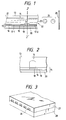
- Fig. 1 is a longitudinal cross-sectional view of a head of an ink-jet printing apparatus.
- Fig. 2 is a transverse cross-sectional view of the head of the ink-jet printing apparatus.
- Fig. 3 is a perspective view of the appearance of a multi-head which is an array of such heads as shown in Fig. 1.
- Fig. 4 is a perspective view of an illustrative ink-jet printing apparatus.
- ammonium salt of the polyvalent acid is first decomposed in a heating step of a dyeing and fixing treatment to generate and release ammonia, and a polyvalent acid formed as an anion at this time preferentially and firmly combines with the cationic substance, whereby the coupling of the reactive dye generated as an anion upon washing with the cationic substance is inhibited so as to prevent redyeing of the dye.
- the amount of an ink (dye) to be applied upon printing is very little compared with the conventional screen printing process, and so staining on white portions occurs to a lesser extent.
- this process is difficult to enhance color depth. Therefore, the color depth has been enhanced by pretreating a cloth with a specific cationic substance.
- the pretreatment by the combination according to the present invention permits the compatibility of the prevention of staining on white portions with the enhancement of color depth. More specifically, the anion generated in the heating step is used as a masking agent for the cationic substance in the washing step.
- the cloth in the present invention is a cloth composed mainly of cellulose fiber or regenerated cellulose fiber.
- the cellulose fiber means fiber comprising cellulose as a principal component. Examples thereof include natural cellulose fibers such as cotton and hemp.
- the regenerated cellulose fiber means fiber obtained by chemically dissolving natural cellulose contained in wood pulp and cotton linters once to regenerate cellulose and redo spinning. Examples thereof include rayon, cupra and polynosic fiber.
- cotton which is cellulose fiber derived from seeds of a plant, and viscose rayon which is regenerated cellulose closest to cotton are particularly preferred for use in the present invention.
- printing cloth means a woven fabric, nonwoven fabric, knitted fabric, felted fabric or the like. It goes without saying that the cloth is preferably formed of the cellulose fiber alone. However, blended woven fabrics or nonwoven fabrics of the cellulose fiber and one or more other materials may also be used as ink-jet printing cloths in the present invention so far as they contain the cellulose fiber at a blending ratio of at least 70 %, preferably at least 80 %.
- a moisture regain in the cloth which primarily characterizes the ink-jet printing cloth according to the present invention, is adjusted within a range of from 13.5 to 108.5 %, preferably from 14.5 to 88.5 %, more preferably from 15.5 to 68.5 %. Any moisture regain lower than 13.5 % results in a printing cloth insufficient in coloring ability and color yield. If the moisture regain exceeds 108.5 % on the other hand, disadvantages tend to occur in points of conveyability and particularly, bleeding.
- Moisture regain (%) ⁇ (W - W')/W'' ⁇ x 100 wherein W is a weight of the cloth before the drying, and W' is a weight of the cloth after the drying, and W'' is a weight of the fiber after the water washing and drying.
- the ink-jet printing cloth according to the present invention is composed mainly of the cellulose fiber
- the cloth should have the above-described moisture regain and besides, the cellulose fiber should have an average length ranging from 25 to 60 mm, preferably from 30 to 55 mm, more preferably from 35 to 50 mm.
- Any average fiber length shorter than 25 mm results in a printing cloth which tends to have disadvantages in points of the occurrence of bleeding and definition.
- any average fiber length longer than 60 mm results in a printing cloth which tends to undergo deterioration in conveyability and color yield.
- the average fiber length was determined in accordance with the staple diagram method by reference to JIS L 1019.
- the ink-jet printing cloth according to the present invention is composed mainly of the cellulose fiber
- the cloth should have the above-described moisture regain and besides, the cellulose fiber should have an average thickness ranging from 0.6 to 2.2 deniers and an average number of natural twist ranging from 70/cm to 150/cm.
- the average thickness of the fiber is preferably within a range of from 0.7 to 2.0 deniers, more preferably from 0.8 to 1.8 deniers. Any average thickness of the fiber thinner than 0.6 denier results in a printing cloth which tends to undergo deterioration in color yield and conveyability. On the other hand, any average thickness of the fiber exceeding 2.2 deniers results in a printing cloth which tends to cause bleeding and undergo deterioration in definition.
- the average number of natural twist of the fiber is preferably within a range of from 80 to 150/cm, more preferably from 90 to 150/cm.
- any average number of natural twist of the fiber less than 70/cm results in a printing cloth which is deteriorated in color yield, and tends to cause bleeding and undergo deterioration in definition.
- any average number of natural twist of the fiber exceeding 150/cm results in a printing cloth which tends to undergo deterioration in conveyability.
- cationic polymers As the cationic substance useful in the practice of the present invention, there may be used all of cationic polymers, reactive quaternary ammonium compounds, cationic inorganic fine particles.
- cationic polymers include cationized polyvinyl pyrrolidone (PVP), cationized polyacrylamide (PAAm) and cationized polyallylamine (PAA), which will be described subsequently.
- PVP polyvinyl pyrrolidone
- PAAm cationized polyacrylamide
- PAA cationized polyallylamine
- the cationized PVP is a copolymer of vinylpyrrolidone and a monomer containing a quaternary ammonium salt compound and has m units of structural unit represented by the following formula (1) and n units of structural unit represented by the following formula (2):
- X is Cl or F
- R0 is H or CH3
- R1, R2 and R3 are, independently of one another, CH3 or C2H5
- Q is C2H4 or O-C2H4.
- a ratio of m to n is within a range of from 8:2 to 2:8, preferably from 6:4 to 2:8. Any ratio of the vinylpyrrolidone group to the quaternary ammonium group exceeding 8:2 results in a printing cloth which fails to achieve sufficient color depth. On the other hand, any ratio lower than 2:8 results in a printing cloth which tends to undergo staining on white portions.
- the cationized PVP preferably has a weight average molecular weight ranging from 3,000 to 100,000.
- the cationized PAAm is a copolymer of acrylamide and a quaternary ammonium salt compound and has p units of structural unit represented by the following formula (3) and q units of structural unit represented by the following formula (4):
- Y is Cl or F
- R4 and R5 are, independently of each other, CH3 or C2H5.
- a ratio of p to q is preferably within a range of from 8:2 to 2:8, more preferably from 6:4 to 2:8. Any ratio of the amide group to the quaternary ammonium group exceeding 8:2 results in a printing cloth which fails to achieve sufficient color depth. On the other hand, any ratio lower than 2:8 results in a printing cloth which tends to undergo staining on white portions.
- the cationized PAAm preferably has a weight average molecular weight ranging from 3,000 to 1,000,000.
- the cationized PAA has structural units represented by the formula
- Z is Cl or F, and R is H or CH3.
- the cationized PAA preferably has a weight average molecular weight ranging from 3,000 to 100,000.
- the amount of these cationic substances to be used is preferably 0.1 to 50 % by weight, more preferably 0.5 to 40 % by weight based on the dry weight of the cloth. Any amount of the cationic substances less than 0.1 % by weight results in a printing cloth which tends to cause bleeding and undergo deterioration in color depth. On the other hand, any amount exceeding 50 % by weight results in a printing cloth which tends to undergo staining on white portions.
- alkaline substance useful in the present invention examples include alkali metal hydroxides such as sodium hydroxide and potassium hydroxide; amines such as mono-, di- and triethanolamines; and alkali metal carbonates and bicarbonates such as sodium carbonate, potassium carbonate and sodium bicarbonate. Further, sodium trichloroacetate and the like, which form an alkaline substance by steaming or under dry heat, may also be used. Sodium carbonate and sodium bicarbonate used in dyeing of reactive dyes are particularly preferred alkaline substances. The amount of the alkaline substance to be used is preferably 0.01 to 5 % by weight based on the dry weight of the cloth.
- the amount of the alkaline substance to be used is less than 0.01 % by weight, the reaction of dyes contained in inks used with the fiber becomes insufficient. On the other hand, any amount exceeding 5 % by weight results in a printing cloth which tends to lower the strength of the fiber and undergo deterioration in coloring stability due to hydrolysis of dyes contained in inks used.
- the amount of the ammonium salt to be used is preferably 0.01 to 20 % by weight, more preferably 0.03 to 15 % by weight based on the dry weight of the cloth. Any amount of the ammonium salt less than 0.01 % by weight results in a printing cloth which undergoes marked staining on white portions. On the other hand, any amount exceeding 20 % by weight results in a printing cloth which tends to lower color yield.
- the combined proportion of the alkaline substance to the ammonium salt of the polyvalent acid is preferably within a range of from 1:1 to 1:10, more preferably from 1:2 to 1:5 in terms of weight ratio.
- the proportion of the alkaline substance is higher than the upper limit of the above range, the problem of staining on white portions is not satisfactorily solved.
- the proportion of the ammonium salt is higher than the upper limit of the above range, the resulting print tends to exhibit lowered color brightness.
- a substance selected from the group consisting of polymers, water-soluble metal salts, urea and thiourea may also be used in combination as a pretreatment agent.
- water-soluble polymers include natural water-soluble polymers such as starch from corn, wheat and the like; cellulosic substances such as carboxymethylcellulose, methylcellulose and hydroxyethylcellulose; polysaccharides such as sodium alginate, gum arabic, locust bean gum, tragacanth gum, guar gum and tamarind seed; proteins such as gelatin and casein; tannin and derivatives thereof; and lignin and derivatives thereof.
- Examples of synthetic polymers include polyvinyl alcohol type compounds, polyethylene oxide type compounds, water-soluble acrylic polymers, water-soluble maleic anhydride polymers and the like. Of these, the polysaccharide polymers and cellulosic polymers are preferred.
- water-soluble metal salts examples include compounds such as halides of alkali metals and alkaline earth metals, which form typical ionic crystals and have a pH of 4 to 10 in the form of an aqueous solution.
- compounds such as halides of alkali metals and alkaline earth metals, which form typical ionic crystals and have a pH of 4 to 10 in the form of an aqueous solution.
- NaCl, Na2SO4, KCl and CH3COONa for alkali metal salts
- CaCl2 and MgCl2 for alkaline earth metal salts.
- salts of Na, K and Ca are preferred.
- ink-jet printing inks composed of a reactive dye and an aqueous liquid medium may preferably be used.
- reactive dyes having a vinylsulfone group and/or a monochlorotriazine group may preferably be used in the process of the present invention.
- these dyes include those typified by C.I. Reactive Yellow 2, 15, 37, 42, 76 and 95; C.I. Reactive Red 21, 22, 24, 33, 45, 111, 112, 114, 180, 218 and 226; C.I. Reactive Blue 15, 19, 21, 38, 49, 72, 77, 176, 203 and 220; C.I. Reactive Orange 5, 12, 13 and 35; C.I. Reactive Brown 7, 11, 33 and 46; C.I. Reactive Green 8 and 19; C.I. Reactive Violet 2, 6 and 22; and C.I. Reactive Black 5, 8, 31 and 39.
- dyes include reactive dyes having at least two reactive groups in their molecules. Specific examples of these dyes include those typified by C.I. Reactive Yellow 168 and 175; C.I. Reactive Red 228 and 235; C.I. Reactive Blue 230 and 235; C.I. Reactive Orange 95; and C.I. Reactive Brown 37. These dyes may be use either singly or in any combination with dyes of the same or different hues. However, dyes used in the present invention are not limited to the above-mentioned dyes.
- the total amount of the dyes to be used is generally within a range of from 5 to 30 % by weight, preferably from 5 to 25 % by weight, more preferably from 5 to 20 % by weight based on the total weight of the ink. Any amount less than 5 % by weight results in an ink insufficient in color depth. On the other hand, any amount exceeding 30 % by weight results in an ink insufficient in ejection properties.
- Water which is an essential component of the liquid medium making up the ink used in the printing process of the present invention is used within a range of from 30 to 90 % by weight, preferably from 40 to 90 % by weight, more preferably from 50 to 85 % by weight based on the total weight of the ink.
- the above components are essential components of the ink-jet printing inks used in the process of the present invention.
- general organic solvents may also be used in combination with water as other components of the liquid medium for the inks.
- ketones and keto-alcohols such as acetone and diacetone alcohol
- ethers such as tetrahydrofuran and dioxane
- triols such as 1,2,6-hexanetriol and glycerol
- thiodiglycol lower alkyl ethers of polyhydric alcohols, such as ethylene glycol monomethyl (or monoethyl) ether, diethylene glycol monomethyl (or monoethyl) ether and triethylene glycol monomethyl (or monoethyl) ether; lower
- the content of the water-soluble organic solvent as described above is generally within a range of from 3 to 60 % by weight, preferably from 5 to 50 % by weight based on the total weight of the ink.
- liquid medium components as described above may be used either singly or in any combination thereof if used in combination with water.
- the most preferred composition of the liquid medium is that comprising at least one polyhydric alcohol as such a solvent.
- a single solvent of thiodiglycol or a mixed solvent system of diethylene glycol and thiodiglycol is particularly preferred.
- the principal components of the inks used in the process of the present invention are as described above, a variety of other additives such as a dispersant, a surfactant, a viscosity modifier, a surface tension modifier and an optical whitening agent may be added to the inks as needed.
- additives may include viscosity modifiers such as polyvinyl alcohol, cellulose and derivatives thereof, and water-soluble resins; various cationic or nonionic surfactants; surface tension modifiers such as diethanolamine and triethanolamine; pH adjustors comprising a buffer solution; mildewproofing agents; and the like.
- viscosity modifiers such as polyvinyl alcohol, cellulose and derivatives thereof, and water-soluble resins
- various cationic or nonionic surfactants such as diethanolamine and triethanolamine
- surface tension modifiers such as diethanolamine and triethanolamine
- pH adjustors comprising a buffer solution
- mildewproofing agents and the like.
- the ink-jet printing process of the present invention is a process in which the printing inks as described above are printed on the ink-jet printing cloth according to the present invention.
- An ink-jet printing system used may be any conventionally-known ink-jet recording system.
- the method described in Japanese Patent Application Laid-Open No. 54-59936 i.e., a system in which thermal energy is applied to an ink so as to undergo rapid volume change, and the ink is ejected from a nozzle by action force caused by this change of state is the most effective method.
- stable printing is feasible.
- an ejected ink droplet be within a range of from 20 to 200 pl, and a shot-in ink quantity be within a range of from 4 to 40 nl/mm2.
- an apparatus which is suitable for use in conducting textile printing using the ink-jet printing cloth according to the present invention, may be mentioned an apparatus in which thermal energy corresponding to recording signals is applied to an ink within a printing head, and ink droplets are generated by the thermal energy.
- FIGS. 1, 2 and 3 Examples of the construction of an head, which is a main component of such an apparatus, are illustrated in Figs. 1, 2 and 3.
- Fig. 1 is a cross-sectional view of a head 13 taken along the flow path of the ink
- Fig. 2 is a cross-sectional view taken along line 2-2' in Fig. 1
- Fig. 3 illustrates an appearance of a multi-head composed of an array of a number of heads as shown in Fig. 1.
- the head 13 is formed by bonding a glass, ceramic or plastic plate or the like having a groove 14 through which an ink is passed, to a heating head 15, which is used for thermal recording (in Fig. 1 and 2, an illustrative example is shown, however, the invention is not limited).
- the heating head 15 is composed of a protective film 16 made of silicon oxide or the like, aluminum electrodes 17-1 and 17-2, a heating resistor layer 18 made of nichrome or the like, a heat accumulating layer 19, and a substrate 20 made of alumina or the like having a good heat radiating property.
- An ink 21 comes up to an ejection orifice (a minute opening) 22 and forms a meniscus 23 due to a pressure P.
- the heating head 15 rapidly generates heat at the region shown by n to form bubbles in the ink 21 which is in contact with this region.
- the meniscus 23 of the ink is projected by the action of the pressure thus produced, and the ink 21 is ejected from the orifice 22 to a cloth 25 of the present invention composed of mainly of cellulose fiber in the form of printing droplets 24.
- the multi-head as illustrated in Fig. 3 is formed by closely bonding a glass plate 27 having a number of channels 26 to a heating head 28 similar to the head as illustrated in Fig. 1.
- Fig. 4 illustrates an example of an ink-jet printing apparatus in which such a head has been incorporated.
- reference numeral 61 designates a blade serving as a wiping member, one end of which is a stationary end held by a blade-holding member to form a cantilever.
- the blade 61 is provided at a position adjacent to a region in which the printing head 65 operates, and in this embodiment, is held in such a form that it protrudes into the course through which the printing head 65 is moved.
- Reference numeral 62 indicates a cap, which is provided at a home position adjacent to the blade 61, and is so constituted that it moves in a direction perpendicular to a direction in which the printing head 65 is moved and comes into contact with the face of ejection openings to cap it.
- Reference numeral 63 designates an absorbing member provided adjoiningly to the blade 61 and, similar to the blade 61, held in such a form that it protrudes into the course through which the printing head 65 is moved.
- the above-described blade 61, cap 62 and absorbing member 63 constitute an ejection-recovery portion 64, where the blade 61 and the absorbing member 63 remove water, dust and/or the like from the face of the ink-ejecting openings.
- Reference numeral 65 designates the printing head having an ejection-energy-generating means and serving to eject the ink onto the cellulose fiber-containing cloth set in an opposing relation to the ejection opening face provided with ejection openings to conduct printing.
- Reference numeral 66 indicates a carriage on which the printing head 65 is mounted so that the printing head 65 can be moved.
- the carriage 66 is slidably interlocked with a guide rod 67 and is connected (not illustrated) at its part to a belt 69 driven by a motor 68.
- the carriage 66 can be moved along the guide rod 67 and hence, the printing head 65 can be moved from a printing region to a region adjacent thereto.
- Reference numerals 51 and 52 denote a cloth feeding part from which the cloths of the present invention composed of mainly of cellulose fibers are separately inserted, and cloth feed rollers driven by a motor (not illustrated), respectively.
- the cloth according to the present invention is fed to the position opposite to the ejection opening face of the printing face of the printing head, and discharged from a cloth discharge section provided with cloth discharge rollers 53 with the progress of printing.
- the cap 62 in the head recovery portion 64 is receded from the path of motion of the printing head 65 when the printing head 65 is returned to its home position, for example, after completion of printing, and the blade 61 remains protruded into the path of motion. As a result, the ejection opening face of the printing head 65 is wiped. When the cap 62 comes into contact with the ejection opening face of the printing head 65 to cap it, the cap 65 is moved so as to protrude into the path of motion of the printing head 65.
- the cap 62 and the blade 61 are at the same positions as the positions for the wiping as described above. As a result, the ejection opening face of the printing head 65 is also wiped at the time of this movement.
- the above movement of the printing head 65 to its home position is made not only when the printing is completed or the printing head is recovered for ejection, but also when the printing head is moved between printing regions for the purpose of printing, during which it is moved to the home position adjacent to each printing region at given intervals, where the ejection opening face is wiped in accordance with this movement.
- the printing inks applied onto the ink-jet printing cloth of this invention in accordance with the process of the present invention in the above-described manner only adhere to the cloth in this state. Accordingly, it is preferable to subsequently subject the cloth to a process for reactively fixing the dyes in the inks to the fiber and a process for removing unfixed dyes. Such reactive fixing and removal of the unreacted dyes may be conducted in accordance with any conventionally-known method.
- Such a treatment may be conducted in accordance with the conventionally-known method in which the printed cloth is treated, for example, by a steaming process, an HT steaming process or a thermofix process, or in case the cloth used has not been pretreated with an alkali, by an alkaline pad-steam process, an alkaline blotch-steam process, an alkaline shock process or an alkaline cold fix process, and then washed.
- Reactive dye (C.I. Reactive Yellow 95) 10 parts Thiodiethanol 24 parts Diethylene glycol 11 parts Water 55 parts.
- Reactive dye (C.I. Reactive Red 24) 10 parts Thiodiethanol 15 parts Diethylene glycol 10 parts Tetraethylene glycol dimethyl ether 5 parts Water 60 parts.
- Reactive dye (C.I. Reactive Blue 72) 13 parts Thiodiethanol 23 parts Triethylene glycol monomethyl ether 6 parts Water 58 parts.
- Reactive dye C.I. Reactive Brown 11
- Reactive dye C.I. Reactive Orange 12
- Reactive dye C.I. Reactive Black 39
- Thiodiethanol 23 parts Diethylene glycol 5 parts Isopropyl alcohol 3 parts Water 59 parts.
- Ink-Jet Printing Inks (A through D) obtained in the above-described manner were charged in a "Color Bubble Jet Printer BJC-600" (trade name, manufactured by Canon Inc.) to print solid print samples (100 % and 200 % duties) of 2 x 10 cm on the thus-pretreated woven fabric.
- the solid print samples of each color were fixed by a steaming treatment at 102°C for 8 minutes. Thereafter, these print samples were washed with water to evaluate the resulting prints as to coloring ability, resistance to bleeding and susceptibility to staining on white portions. The results are shown in Table 1.
- ratio of the comonomers 1:1, weight average molecular weight: 100,000
- Example 1 Using this woven fabric, printing was conducted in the same manner as in Example 1. The solid print samples of each color were fixed by a steaming treatment at 102°C for 8 minutes. Thereafter, these print samples were washed with water to evaluate the resulting prints as to coloring ability, resistance to bleeding and susceptibility to staining on white portions. The results are shown in Table 1.
- ratio of the comonomers 1:1, weight average molecular weight: 5,000
- Example 1 Using this woven fabric, printing was conducted in the same manner as in Example 1. The solid print samples of each color were fixed by a steaming treatment at 102°C for 8 minutes. Thereafter, these print samples were washed with water to evaluate the resulting prints as to coloring ability, resistance to bleeding and susceptibility to staining on white portions. The results are shown in Table 1.
- ratio of the comonomers 1:1, weight average molecular weight: 10,000
- Example 1 Using this woven fabric, printing was conducted in the same manner as in Example 1. The solid print samples of each color were fixed by a steaming treatment at 102°C for 8 minutes. Thereafter, these print samples were washed with water to evaluate the resulting prints as to coloring ability, resistance to bleeding and susceptibility to staining on white portions. The results are shown in Table 1.
- Example 1 As apparent from Table 1, the coloring ability and resistance to bleeding were lowered compared with Example 1.
- ratio of the comonomers 1:1, weight average molecular weight: 10,000
- Example 1 Using this woven fabric, printing was conducted in the same manner as in Example 1. The solid print samples of each color were fixed by a steaming treatment at 102°C for 8 minutes. Thereafter, these print samples were washed with water to evaluate the resulting prints as to coloring ability, resistance to bleeding and susceptibility to staining on white portions. The results are shown in Table 1.
- Example 1 As apparent from Table 1, the susceptibility to staining on white portions became worse compared with Example 1.
- ratio of the comonomers 1:1, weight average molecular weight: 10,000
- Example 1 Using this woven fabric, printing was conducted in the same manner as in Example 1. The solid print samples of each color were fixed by a steaming treatment at 102°C for 8 minutes. Thereafter, these print samples were washed with water to evaluate the resulting prints as to coloring ability, resistance to bleeding and susceptibility to staining on white portions. The results are shown in Table 1.
- Example 1 As apparent from Table 1, the coloring ability and resistance to bleeding were lowered compared with Example 1.
- ratio of the comonomers 1:1, weight average molecular weight: 10,000
- Example 1 Using this woven fabric, printing was conducted in the same manner as in Example 1. The solid print samples of each color were fixed by a steaming treatment at 102°C for 8 minutes. Thereafter, these print samples were washed with water to evaluate the resulting prints as to coloring ability, resistance to bleeding and susceptibility to staining on white portions. The results are shown in Table 1.
- Example 1 As apparent from Table 1, the coloring ability and susceptibility to staining on white portions became worse compared with Example 1.
- ratio of the comonomers 1:1, weight average molecular weight: 10,000
- Example 1 Using this woven fabric, printing was conducted in the same manner as in Example 1. The solid print samples of each color were fixed by a steaming treatment at 102°C for 8 minutes. Thereafter, these print samples were washed with water to evaluate the resulting prints as to coloring ability, resistance to bleeding and susceptibility to staining on white portions. The results are shown in Table 1.
- Example 1 As apparent from Table 1, the susceptibility to staining on white portions became worse compared with Example 1.
- ratio of the comonomers 1:1, weight average molecular weight: 10,000
- Example 1 Using this woven fabric, printing was conducted in the same manner as in Example 1. The solid print samples of each color were fixed by a steaming treatment at 102°C for 8 minutes. Thereafter, these print samples were washed with water to evaluate the resulting prints as to coloring ability, resistance to bleeding and susceptibility to staining on white portions. The results are shown in Table 1.
- Example 1 As apparent from Table 1, the susceptibility to staining on white portions became worse compared with Example 1.
- Example 1 Using this plain weave fabric, printing was conducted in the same manner as in Example 1. The solid print samples of each color were fixed by a steaming treatment at 102°C for 8 minutes. Thereafter, these print samples were washed with water to evaluate the resulting prints as to coloring ability, resistance to bleeding and susceptibility to staining on white portions. The results are shown in Table 1.
- a 100 % cotton plain weave fabric formed of Egyptian cotton having an average fiber length of 45 mm, an average fiber thickness of 1.2 denier and an average number of natural twist of 101/cm was dipped into a tank containing an aqueous solution of 2 % of polyallylamine hydrochloride (weight average molecular weight: 10,000), 1 % of sodium carbonate and 3 % of ammonium-citrate, squeezed to a pickup of 100 % and then dried to adjust the moisture regain of the fabric to 17 %.
- polyallylamine hydrochloride weight average molecular weight: 10,000
- Example 1 Using this plain weave fabric, printing was conducted in the same manner as in Example 1. The solid print samples of each color were fixed by a steaming treatment at 102°C for 8 minutes. Thereafter, these print samples were washed with water to evaluate the resulting prints as to coloring ability, resistance to bleeding and susceptibility to staining on white portions. The results are shown in Table 1.
- an ink-jet printing cloth which can be dyed with inks containing a reactive dye and is composed mainly of cellulose fiber, wherein the cloth contains 0.1 to 50 % by weight of a cationic substance, 0.01 to 5 % by weight of an alkaline substance and 0.01 to 20 % by weight of the ammonium salt of a polyvalent acid, the proportions of said cationic and alkaline substances and said ammonium salt being based on the dry weight of the cloth.
Landscapes
- Engineering & Computer Science (AREA)
- Textile Engineering (AREA)
- Chemical & Material Sciences (AREA)
- Chemical Kinetics & Catalysis (AREA)
- Inorganic Chemistry (AREA)
- Coloring (AREA)
- Ink Jet (AREA)
Applications Claiming Priority (4)
| Application Number | Priority Date | Filing Date | Title |
|---|---|---|---|
| JP260058/94 | 1994-10-25 | ||
| JP26005894 | 1994-10-25 | ||
| JP27123595A JP3584094B2 (ja) | 1994-10-25 | 1995-10-19 | インクジェット捺染用布帛、捺染方法及び捺染物 |
| JP271235/95 | 1995-10-19 |
Publications (1)
| Publication Number | Publication Date |
|---|---|
| EP0710740A1 true EP0710740A1 (en) | 1996-05-08 |
Family
ID=26544428
Family Applications (1)
| Application Number | Title | Priority Date | Filing Date |
|---|---|---|---|
| EP95116763A Withdrawn EP0710740A1 (en) | 1994-10-25 | 1995-10-24 | Ink-jet printing cloth, textile printing process, and print |
Country Status (3)
| Country | Link |
|---|---|
| US (1) | US5698478A (enExample) |
| EP (1) | EP0710740A1 (enExample) |
| JP (1) | JP3584094B2 (enExample) |
Cited By (4)
| Publication number | Priority date | Publication date | Assignee | Title |
|---|---|---|---|---|
| EP0867558A3 (en) * | 1997-03-24 | 1998-12-30 | Canon Kabushiki Kaisha | Cloth for textile printing, textile printing process using the cloth and print obtained thereby |
| EP1331302A1 (de) * | 2002-01-28 | 2003-07-30 | Dr. Th. Böhme KG Chem. Fabrik GmbH & Co. | Faltenverhinderungsmittel |
| CN108589347A (zh) * | 2018-05-10 | 2018-09-28 | 东华大学 | 基于阳离子改性剂墨水用于活性染料喷墨印花的整理方法 |
| EP2740772B1 (en) * | 2012-12-10 | 2019-07-31 | Seiko Epson Corporation | Ink composition for ink jet textile printing and ink jet textile printing method |
Families Citing this family (53)
| Publication number | Priority date | Publication date | Assignee | Title |
|---|---|---|---|---|
| US5781216A (en) * | 1994-10-28 | 1998-07-14 | Canon Kabushiki Kaisha | Ink-jet printing cloth, textile printing method of the same and print resulting therefrom |
| US6214417B1 (en) * | 1997-07-12 | 2001-04-10 | Seiren Co., Ltd. | Cloth for ink-jet printing, method of fabricating same, and method of ink-jet printing same |
| US6258873B1 (en) * | 1998-03-24 | 2001-07-10 | Xerox Corporation | Ink compositions substantially free of organic liquids |
| US6001899A (en) * | 1998-03-24 | 1999-12-14 | Xerox Corporation | Ink compositions with improved waterfastness and smear resistance |
| US6054505A (en) * | 1998-03-24 | 2000-04-25 | Xerox Corporation | Ink compositions with improved shelf stability |
| DE69918287T2 (de) * | 1998-04-22 | 2005-07-14 | Sri International, Menlo Park | Behandlung von Substraten, um die Qualität von darauf gedruckten Bildern zu verbessern, unter Anwendung einer Mischung einer Polysäure mit einer Polybase |
| US6197383B1 (en) | 1998-04-22 | 2001-03-06 | Sri International | Method and composition for coating pre-sized paper with a mixture of a polyacid and a polybase |
| US6241787B1 (en) | 1998-04-22 | 2001-06-05 | Sri International | Treatment of substrates to enhance the quality of printed images thereon with a mixture of a polyacid and polybase |
| US6171444B1 (en) | 1998-04-22 | 2001-01-09 | Sri International | Method and composition for the sizing of paper with a mixture of a polyacid and a polybase |
| US6274645B1 (en) | 1998-06-29 | 2001-08-14 | Xerox Corporation | Washing composition for indelible marks |
| US6140391A (en) * | 1998-10-09 | 2000-10-31 | Marconi Data Systems Inc. | Reactive jet ink composition |
| DE60035558T2 (de) | 1999-10-01 | 2008-03-20 | Canon K.K. | Druckverfahren und damit hergestellte Drucke sowie mit diesem Verfahren hergestellter Artikel |
| US6838498B1 (en) * | 1999-11-04 | 2005-01-04 | Kimberly-Clark Worldwide, Inc. | Coating for treating substrates for ink jet printing including imbibing solution for enhanced image visualization and retention |
| US6264731B1 (en) | 1999-11-29 | 2001-07-24 | Xerox Corporation | Ink compositions containing 1,3,5-trioxane or tetraethylene glycol dimethyl ether |
| US6248162B1 (en) | 1999-11-29 | 2001-06-19 | Xerox Corporation | Ink compositions containing malonaldehyde bis(dimethaylacetal) |
| US6769829B1 (en) | 2000-06-30 | 2004-08-03 | Avery Dennison Corporation | Drawable and/or traceable binder |
| US6936075B2 (en) * | 2001-01-30 | 2005-08-30 | Milliken | Textile substrates for image printing |
| US6513924B1 (en) | 2001-09-11 | 2003-02-04 | Innovative Technology Licensing, Llc | Apparatus and method for ink jet printing on textiles |
| US6936076B2 (en) | 2001-10-22 | 2005-08-30 | Milliken & Company | Textile substrate having coating containing multiphase fluorochemical, cationic material, and sorbant polymer thereon, for image printing |
| US7037346B2 (en) | 2001-10-22 | 2006-05-02 | Milliken & Company | Textile substrate having coating containing multiphase fluorochemical and cationic material thereon for image printing |
| US6749641B2 (en) * | 2001-10-22 | 2004-06-15 | Milliken & Company | Textile substrate having coating containing multiphase fluorochemical, organic cationic material, and sorbant polymer thereon, for image printing |
| US6808776B2 (en) * | 2002-03-11 | 2004-10-26 | Avery Dennison Corporation | Water-absorbent film construction |
| US6779453B2 (en) * | 2002-09-30 | 2004-08-24 | Hewlett-Packard Development Company, L.P. | Fabric printing system and method utilizing a removable/reusable fabric backing |
| AU2003243975B2 (en) | 2003-05-02 | 2010-04-22 | Canon Kabushiki Kaisha | Aqueous fluorescent ink, recorded image using same, and judging method |
| WO2005044932A1 (en) * | 2003-11-11 | 2005-05-19 | Canon Kabushiki Kaisha | An ink comprising a block copolymer dispersing agent having a hydrophilic and a hydrophobic segment and an ink-applying process and apparatus using the same |
| US20050193499A1 (en) * | 2004-03-08 | 2005-09-08 | Chevli Samit N. | Fabric pretreatment for inkjet printing |
| JP4856885B2 (ja) | 2004-03-16 | 2012-01-18 | キヤノン株式会社 | 液体組成物、液体組成物とインクのセット及び画像記録方法 |
| BRPI0507723A (pt) | 2004-03-16 | 2007-07-10 | Canon Kk | tinta para jato de tinta, método de gravação a jato de tinta, cartucho de tinta, e, aparelho de gravação a jato de tinta |
| DE602005025513D1 (de) * | 2004-10-15 | 2011-02-03 | Canon Kk | Tintenstrahlaufzeichnungsmedium und verfahren zur herstellung |
| JP4808418B2 (ja) * | 2005-02-28 | 2011-11-02 | キヤノンファインテック株式会社 | インクジェット用水系インク、インクジェット記録方法、インクカートリッジおよびインクジェット記録装置 |
| US8236385B2 (en) | 2005-04-29 | 2012-08-07 | Kimberly Clark Corporation | Treatment of substrates for improving ink adhesion to the substrates |
| WO2007007855A1 (ja) * | 2005-07-08 | 2007-01-18 | Canon Kabushiki Kaisha | サーマルインクジェット用インク及びそれを用いたインクカートリッジ |
| JP5089070B2 (ja) * | 2006-04-05 | 2012-12-05 | キヤノン株式会社 | インクジェット記録用インク及び記録方法 |
| JP2007277362A (ja) * | 2006-04-05 | 2007-10-25 | Canon Inc | インクジェット記録用インク、記録方法及び記録装置 |
| JP5064783B2 (ja) * | 2006-12-20 | 2012-10-31 | キヤノン株式会社 | インク及びインクジェット記録方法 |
| US7918928B2 (en) | 2007-02-09 | 2011-04-05 | Canon Kabushiki Kaisha | Pigment ink, ink jet recording method, ink cartridge, recording unit and ink jet recording apparatus |
| US8013051B2 (en) | 2007-02-09 | 2011-09-06 | Canon Kabushiki Kaisha | Liquid composition, image forming method, cartridge, recording unit and ink jet recording apparatus |
| WO2009014242A1 (en) * | 2007-07-23 | 2009-01-29 | Canon Kabushiki Kaisha | Ink jet recording ink, ink jet image-forming method and ink jet recording apparatus |
| US8506067B2 (en) * | 2007-07-23 | 2013-08-13 | Canon Kabushiki Kaisha | Ink jet image-forming method, ink jet color image-forming method and ink jet recording apparatus |
| EP2173823B1 (en) * | 2007-07-23 | 2017-05-17 | Canon Kabushiki Kaisha | Ink jet recording ink |
| JP5517515B2 (ja) | 2008-08-08 | 2014-06-11 | キヤノン株式会社 | インクジェット記録方法、インクセット及びインクジェット記録装置 |
| JP5995396B2 (ja) | 2008-08-08 | 2016-09-21 | キヤノン株式会社 | インクセット、インクジェット記録方法、及びインクジェット記録装置 |
| JP5787482B2 (ja) * | 2009-01-22 | 2015-09-30 | キヤノン株式会社 | インクジェット記録用インク及びインクジェット画像形成方法 |
| JP2010188721A (ja) * | 2009-01-22 | 2010-09-02 | Canon Inc | インクジェット画像形成方法及びインクジェット記録装置 |
| JP6233579B2 (ja) * | 2013-12-17 | 2017-11-22 | セイコーエプソン株式会社 | インクジェット捺染用のインク組成物および捺染方法 |
| EP3196259A1 (en) | 2016-01-22 | 2017-07-26 | Canon Kabushiki Kaisha | Ink, ink cartridge, and image recording method |
| EP3196261B1 (en) | 2016-01-22 | 2019-06-19 | Canon Kabushiki Kaisha | Ink, ink cartridge, and image recording method |
| JP2017128700A (ja) | 2016-01-22 | 2017-07-27 | キヤノン株式会社 | インク、インクカートリッジ、及び画像記録方法 |
| US10167399B2 (en) | 2016-01-22 | 2019-01-01 | Canon Kabushiki Kaisha | Ink, ink cartridge, and image recording method |
| JP2017197709A (ja) | 2016-01-22 | 2017-11-02 | キヤノン株式会社 | インク、インクカートリッジ、及び画像記録方法 |
| WO2017159551A1 (en) | 2016-03-16 | 2017-09-21 | Fujifilm Corporation | Inks |
| JP2020019173A (ja) * | 2018-07-31 | 2020-02-06 | セイコーエプソン株式会社 | 処理液組成物、セット、インクジェット捺染方法、および布帛 |
| US11607891B2 (en) | 2019-09-27 | 2023-03-21 | Hill-Rom Services, Inc. | Method of roll-to-roll digital printing, cutting, and punching of medical device surfaces |
Citations (13)
| Publication number | Priority date | Publication date | Assignee | Title |
|---|---|---|---|---|
| JPS5459936A (en) | 1977-10-03 | 1979-05-15 | Canon Inc | Recording method and device therefor |
| EP0177111A2 (en) * | 1984-10-01 | 1986-04-09 | Toray Industries, Inc. | Method of treating textiles |
| DE3543495A1 (de) * | 1984-12-10 | 1986-06-12 | Canon K.K., Tokio/Tokyo | Verfahren zum textildruck |
| JPS62170951A (ja) * | 1986-01-17 | 1987-07-28 | アグフア−ゲヴエルト・アクチエンゲゼルシヤフト | 写真記録材料、写真画像の生成法およびトリアゾ−ル類 |
| JPS636183A (ja) | 1986-06-23 | 1988-01-12 | 日本化薬株式会社 | 織編物の印捺法 |
| JPS6331594B2 (enExample) | 1984-08-27 | 1988-06-24 | Toray Industries | |
| JPH01204783A (ja) * | 1988-02-10 | 1989-08-17 | Canon Inc | 被記録材 |
| JPH0435351B2 (enExample) | 1986-12-29 | 1992-06-10 | Nagase & Co Ltd | |
| EP0534660A1 (en) * | 1991-09-23 | 1993-03-31 | Zeneca Limited | Printing process and pretreatment composition |
| JPH05148775A (ja) | 1991-11-26 | 1993-06-15 | Kanebo Ltd | インクジエツト方式による布帛の捺染方法 |
| EP0558914A1 (en) * | 1992-01-27 | 1993-09-08 | Canon Kabushiki Kaisha | Ink-jet textile printing process |
| EP0590397A1 (de) * | 1992-09-26 | 1994-04-06 | Hoechst Aktiengesellschaft | Verfahren zur Herstellung von Färbungen gemäss der "Ink-Jet"-Drucktechnik auf modifizierten Fasermaterialien mit anionischen Textilfarbstoffen |
| EP0624682A1 (en) * | 1993-05-10 | 1994-11-17 | Canon Kabushiki Kaisha | Printing cloth, production process thereof, textile printing process using the cloth and ink-jet printing apparatus |
Family Cites Families (14)
| Publication number | Priority date | Publication date | Assignee | Title |
|---|---|---|---|---|
| JPS59161470A (ja) * | 1983-03-05 | 1984-09-12 | Canon Inc | 記録液およびそれを用いたインクジエット記録方法 |
| EP0202656B1 (en) * | 1985-05-21 | 1992-01-29 | Canon Kabushiki Kaisha | Ink jet printing method |
| US4725849A (en) * | 1985-08-29 | 1988-02-16 | Canon Kabushiki Kaisha | Process for cloth printing by ink-jet system |
| JPS6253385A (ja) * | 1985-09-02 | 1987-03-09 | Canon Inc | 記録液及びこれを用いたインクジェット記録方法 |
| US4849770A (en) * | 1985-12-13 | 1989-07-18 | Canon Kabushiki Kaisha | Ink for use in ink jet and ink jet printing method using the same |
| US4853036A (en) * | 1986-11-25 | 1989-08-01 | Canon Kabushiki Kaisha | Ink for ink-jet recording and ink-jet recording process using the same |
| US4957553A (en) * | 1986-12-01 | 1990-09-18 | Canon Kabushiki Kaisha | Ink for ink-jet recording and ink-jet recording process employing the same |
| US4838938A (en) * | 1987-02-16 | 1989-06-13 | Canon Kabushiki Kaisha | Recording liquid and recording method by use thereof |
| JP2801411B2 (ja) * | 1990-02-09 | 1998-09-21 | キヤノン株式会社 | インク、これを用いたインクジェット記録方法及び機器 |
| US5250121A (en) * | 1991-09-26 | 1993-10-05 | Canon Kabushiki Kaisha | Ink-jet textile printing ink and ink-jet textile printing process |
| JP2713685B2 (ja) * | 1991-12-27 | 1998-02-16 | キヤノン株式会社 | インクジェット捺染方法、同方法で捺染され布帛、及び捺染された布帛の製造方法 |
| JP2895697B2 (ja) * | 1992-01-27 | 1999-05-24 | キヤノン株式会社 | 捺染用布帛、それを用いたインクジェット捺染方法及び捺染物 |
| JP2952128B2 (ja) * | 1992-01-27 | 1999-09-20 | キヤノン株式会社 | インクジェット捺染用布帛、インクジェット捺染方法及び捺染物 |
| JP3358633B2 (ja) * | 1993-05-26 | 2002-12-24 | 住友大阪セメント株式会社 | 酸素センサのセル部分の封着方法 |
-
1995
- 1995-10-19 JP JP27123595A patent/JP3584094B2/ja not_active Expired - Fee Related
- 1995-10-24 US US08/547,207 patent/US5698478A/en not_active Expired - Fee Related
- 1995-10-24 EP EP95116763A patent/EP0710740A1/en not_active Withdrawn
Patent Citations (14)
| Publication number | Priority date | Publication date | Assignee | Title |
|---|---|---|---|---|
| JPS5459936A (en) | 1977-10-03 | 1979-05-15 | Canon Inc | Recording method and device therefor |
| JPS6331594B2 (enExample) | 1984-08-27 | 1988-06-24 | Toray Industries | |
| EP0177111A2 (en) * | 1984-10-01 | 1986-04-09 | Toray Industries, Inc. | Method of treating textiles |
| DE3543495A1 (de) * | 1984-12-10 | 1986-06-12 | Canon K.K., Tokio/Tokyo | Verfahren zum textildruck |
| JPS62170951A (ja) * | 1986-01-17 | 1987-07-28 | アグフア−ゲヴエルト・アクチエンゲゼルシヤフト | 写真記録材料、写真画像の生成法およびトリアゾ−ル類 |
| JPS636183A (ja) | 1986-06-23 | 1988-01-12 | 日本化薬株式会社 | 織編物の印捺法 |
| JPH0435351B2 (enExample) | 1986-12-29 | 1992-06-10 | Nagase & Co Ltd | |
| JPH01204783A (ja) * | 1988-02-10 | 1989-08-17 | Canon Inc | 被記録材 |
| EP0534660A1 (en) * | 1991-09-23 | 1993-03-31 | Zeneca Limited | Printing process and pretreatment composition |
| JPH05222684A (ja) | 1991-09-23 | 1993-08-31 | Imperial Chem Ind Plc <Ici> | 色強化剤、これを含有する前処理組成物、繊維の着色法及び着色された繊維物質 |
| JPH05148775A (ja) | 1991-11-26 | 1993-06-15 | Kanebo Ltd | インクジエツト方式による布帛の捺染方法 |
| EP0558914A1 (en) * | 1992-01-27 | 1993-09-08 | Canon Kabushiki Kaisha | Ink-jet textile printing process |
| EP0590397A1 (de) * | 1992-09-26 | 1994-04-06 | Hoechst Aktiengesellschaft | Verfahren zur Herstellung von Färbungen gemäss der "Ink-Jet"-Drucktechnik auf modifizierten Fasermaterialien mit anionischen Textilfarbstoffen |
| EP0624682A1 (en) * | 1993-05-10 | 1994-11-17 | Canon Kabushiki Kaisha | Printing cloth, production process thereof, textile printing process using the cloth and ink-jet printing apparatus |
Non-Patent Citations (2)
| Title |
|---|
| CHEMICAL ABSTRACTS, vol. 108, no. 6, 8 February 1988, Columbus, Ohio, US; abstract no. 39573n, "ink jet printing of fabrics" page 84; column 1; * |
| DATABASE WPI Section Ch Week 8939, Derwent World Patents Index; Class A18, AN 89-281391 * |
Cited By (8)
| Publication number | Priority date | Publication date | Assignee | Title |
|---|---|---|---|---|
| EP0867558A3 (en) * | 1997-03-24 | 1998-12-30 | Canon Kabushiki Kaisha | Cloth for textile printing, textile printing process using the cloth and print obtained thereby |
| US6200667B1 (en) | 1997-03-24 | 2001-03-13 | Canon Kabushiki Kaisha | Cloth for textile printing, and textile printing process using the cloth and print obtained thereby |
| EP1331302A1 (de) * | 2002-01-28 | 2003-07-30 | Dr. Th. Böhme KG Chem. Fabrik GmbH & Co. | Faltenverhinderungsmittel |
| EP2740772B1 (en) * | 2012-12-10 | 2019-07-31 | Seiko Epson Corporation | Ink composition for ink jet textile printing and ink jet textile printing method |
| CN108589347A (zh) * | 2018-05-10 | 2018-09-28 | 东华大学 | 基于阳离子改性剂墨水用于活性染料喷墨印花的整理方法 |
| CN108589347B (zh) * | 2018-05-10 | 2019-05-24 | 东华大学 | 基于阳离子改性剂墨水用于活性染料喷墨印花的整理方法 |
| WO2019214186A1 (zh) * | 2018-05-10 | 2019-11-14 | 东华大学 | 基于阳离子改性剂墨水用于活性染料喷墨印花的整理方法 |
| US11041084B2 (en) | 2018-05-10 | 2021-06-22 | Donghua University | Finishing method for reactive dye inkjet printing based on the cationic modifier ink |
Also Published As
| Publication number | Publication date |
|---|---|
| JPH08176972A (ja) | 1996-07-09 |
| JP3584094B2 (ja) | 2004-11-04 |
| US5698478A (en) | 1997-12-16 |
Similar Documents
| Publication | Publication Date | Title |
|---|---|---|
| US5698478A (en) | Ink jet printing cloth, textile printing process, and print | |
| US5902387A (en) | Ink-jet textile printing ink, and ink-jet printing process and instrument making use of the same | |
| US6394597B1 (en) | Ink-jet printing cloth, and ink-jet printing process and production process of print using the same | |
| EP0553761B1 (en) | Cloth suitable for ink-jet textile printing and ink-jet textile printing method | |
| EP0621367B1 (en) | Ink-jet printing process, ink set for use in such process, and processed article obtained thereby | |
| EP0553759B1 (en) | Cloth suitable for textile printing and ink-jet textile printing method | |
| EP0709520B1 (en) | Ink-jet printing cloth with print and textile printing method | |
| EP0583133A1 (en) | Ink jet printing method and printed article | |
| EP0620116B1 (en) | Ink-jet textile printing ink, ink-jet printing process and instrument making use of the same, and processed article obtained | |
| US5584918A (en) | Ink-jet textile printing ink, printing process and instrument making use of the same, and prints obtained | |
| EP0558914B1 (en) | Ink-jet textile printing process | |
| US6284348B1 (en) | Ink-jet printing cloth, textile printing process and print | |
| EP0604105B1 (en) | Ink-jet printing cloth, ink-jet printing process, and print | |
| EP0602940B1 (en) | Ink-jet printing cloth, ink-jet printing process, and print | |
| EP0867558B1 (en) | Cloth for textile printing, textile printing process using the cloth and print obtained thereby | |
| JPH08120576A (ja) | インクジェット捺染用布帛、捺染方法及び捺染物 | |
| JPH08127979A (ja) | インクジェット捺染用布帛、捺染方法及び捺染物 | |
| JP2959691B2 (ja) | インクジェット捺染方法 |
Legal Events
| Date | Code | Title | Description |
|---|---|---|---|
| PUAI | Public reference made under article 153(3) epc to a published international application that has entered the european phase |
Free format text: ORIGINAL CODE: 0009012 |
|
| AK | Designated contracting states |
Kind code of ref document: A1 Designated state(s): CH DE FR GB IT LI NL |
|
| 17P | Request for examination filed |
Effective date: 19960924 |
|
| 17Q | First examination report despatched |
Effective date: 20000818 |
|
| STAA | Information on the status of an ep patent application or granted ep patent |
Free format text: STATUS: THE APPLICATION IS DEEMED TO BE WITHDRAWN |
|
| 18D | Application deemed to be withdrawn |
Effective date: 20010103 |