EP0705015A2 - Schnurloses Telefon - Google Patents
Schnurloses Telefon Download PDFInfo
- Publication number
- EP0705015A2 EP0705015A2 EP95306849A EP95306849A EP0705015A2 EP 0705015 A2 EP0705015 A2 EP 0705015A2 EP 95306849 A EP95306849 A EP 95306849A EP 95306849 A EP95306849 A EP 95306849A EP 0705015 A2 EP0705015 A2 EP 0705015A2
- Authority
- EP
- European Patent Office
- Prior art keywords
- personal
- outside line
- personal set
- key
- telephone
- Prior art date
- Legal status (The legal status is an assumption and is not a legal conclusion. Google has not performed a legal analysis and makes no representation as to the accuracy of the status listed.)
- Withdrawn
Links
Images

Classifications
-
- H—ELECTRICITY
- H04—ELECTRIC COMMUNICATION TECHNIQUE
- H04B—TRANSMISSION
- H04B7/00—Radio transmission systems, i.e. using radiation field
- H04B7/24—Radio transmission systems, i.e. using radiation field for communication between two or more posts
- H04B7/26—Radio transmission systems, i.e. using radiation field for communication between two or more posts at least one of which is mobile
-
- H—ELECTRICITY
- H04—ELECTRIC COMMUNICATION TECHNIQUE
- H04M—TELEPHONIC COMMUNICATION
- H04M1/00—Substation equipment, e.g. for use by subscribers
- H04M1/72—Mobile telephones; Cordless telephones, i.e. devices for establishing wireless links to base stations without route selection
- H04M1/725—Cordless telephones
- H04M1/72502—Cordless telephones with one base station connected to a single line
- H04M1/72505—Radio link set-up procedures
Definitions
- the present invention generally relates to a telephone set as well as a cordless telephone set and more particularly to a telephone set as well as a cordless telephone set transmitting/receiving signals via a radio channel between a master set and a personal set thereof.
- a phone call from an outside line may be received by an ordinary telephone set or by a master set (connecting equipment) of a cordless telephone set by taking action of (1) picking up a handset placed on a main body of the telephone set.
- a phone call may be made through the outside line by taking action of (2) inputting a destination phone number by dial keys of the handset or of the main body of the phone, following the action (1).
- the actions [2] and [4] peculiar to the personal set need to be taken when a phone call is received or is made through the outside line by the personal set of the cordless telephone set and it is inconvenient as compared to the case when a phone call is received/made through the outside line by the ordinary telephone set or the master set of the cordless telephone set.
- the personal set when the personal set has the quick-talk function and when its user takes action of #1 picking up the personal set from its charger, the personal set is connected with the master set by radio automatically, even if the outside line key is not pressed, and the master set is connected to the telephone line. Accordingly, it becomes possible to talk over the phone thereafter when the action is taken to receive a phone call.
- a phone call may be made by taking action of #2 inputting a destination phone number by dial keys of the personal set, following the action #1.
- the personal set equipped with the above-mentioned quick-talk function may cause a trouble. That is, some users put the personal set having the quick-talk function on a desk or the like without returning back to the charger during standby (during when it is not used). Therefore, such user receives/starts to make a phone call by pressing the outside line key and finishes the phone call by pressing the outside line key.
- the user When such user receives a phone call from the outside line when the personal set is put on the charger to charge the personal set, the user takes actions of (A) picking up the personal set from the charger and (B) pressing the outside line key of the personal set picked up from the charger out of habit.
- the personal set is put into a talk mode by the action (A) and the following action (B) is taken during the talk mode as a result. Because a talk is terminated when the outside line key is pressed during the talk mode, the talk mode of (A) is terminated when the action (B) is taken.
- a connection with the telephone line is also cut off by the same reason when the personal set is picked up from the charger and the outside line key is pressed to make a phone call.
- a cordless telephone set comprising a master set, at least one personal set and a charger for charging a battery of the personal set.
- the personal set is connected to a telephone line via the master set.
- the personal set comprises a detecting section for detecting whether the personal set is placed in a state wherein a battery within the personal set is being charged by the charger; a plurality of control keys including an outside line key; and a controller for connecting the personal set to the telephone line via the master set when it detects that the personal set is placed in a state wherein the battery is not charged based on an output signal from the detecting section, performing the process for connecting the personal set to the telephone line via the master set and a terminating process alternately based on an operation of the outside line key, and invalidating the operation of the outside line key for a predetermined period of time when the personal set is shifted from the state wherein the battery within the personal set is charged by the charger to the state not charged based on the output signal from the detecting section.
- a telephone set comprising a master set; and at least one personal set transmitting/receiving signals to/from the master set via a radio channel and connected to a telephone line via the master set.
- the personal set comprises a secondary battery used as a power source; a charger for charging the secondary battery; a detecting section for detecting whether the personal set is connected with the charger; an outside line key; a controller for connecting the personal set to the telephone line via the master set when it detects that the personal set is picked out of the charger based on an output signal from the detecting section, performing the process for connecting the personal set to the telephone line via the master set and a terminating process alternately based on an operation of the outside line key, and invalidating the operation of the outside line key for a predetermined period of time when it detects that the personal set is shifted from the state wherein the personal set is connected with the charger to the state wherein the personal set is picked out of the charger based on the output signal of the detecting section.
- a telephone set according to a preferred embodiment of the present invention will be explained below in detail with reference to the drawings.
- the embodiment described below will be explained exemplifying a telephone set which trans mits/receives signals between a master set and a personal set thereof, i.e. a cordless telephone set.
- the cordless telephone set is equipped with the master set 2 and at least one personal set 1.
- the master set 2 is connected with a telephone line as an out side line.
- the master set 2 transmits signals from the telephone line 3 to the personal set 1 via an antenna 2a and receives signals transmitted from the personal set 1 by the antenna 2a to forward to the telephone line 3.
- the personal set 1 uses a secondary battery 41 as its power source as described later.
- the secondary battery 41 within the personal set 1 is charged when a terminal 42 provided in the personal set 1 is connected with a terminal of a charger 5 when the personal set 1 is placed on the charger 5.
- the charger 5 is connected with a domestic AC power source or a commercial AC power source.
- the personal set 1 has a telephone transmitter 11 comprising a microphone, a transmitting circuit 12 for transmitting speech signals and command signals (data), a receiving circuit 13 for receiving speech signals and command signals and a telephone receiver 14 comprising a speaker unit.
- the personal set 1 also has a controller 15 comprising a microcomputer, various control keys 16 and a ringer 17 for informing an incoming call or the like.
- the controller 15 controls operation modes of the personal set 1 or the whole cordless telephone. That is, the controller 15 controls transmitting and receiving operations of the transmitting circuit 12 and the receiving circuit 13 and transmitting and receiving channels thereof and creates and decodes the command signals.
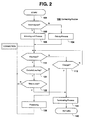
- a connecting routine 100 shown in FIG. 2 for example is stored in a ROM of the controller 15 as part of programs to be executed by a control section of the controller 15.
- the personal set 1 has the secondary battery 41 for power supply and a voltage output from the secondary battery 41 is supplied to each section of the personal set 1.
- a charging voltage is supplied to the charging terminal 42 thereof as described before.
- the charging voltage at the charging terminal 42 is supplied to the secondary battery 41 via a charging circuit 43. Accordingly, the secondary battery 41 is charged during while the personal set 1 is put on the charger 5.
- a charge detecting circuit 44 detects whether the charging voltage exists or not at the charging terminal 42 and a result detected by the charge detecting circuit 44 is provided to the controller 15. Accordingly, the controller 15 can judge whether the personal set 1 is being placed on the charger 5, is being picked up from the charger 5 or has been returned to the charger 5 by monitoring the result detected by the detecting circuit 44.
- the controller 15 also has a counter circuit for timing an elapsed time since when the personal set 1 has entered the talk mode as described later.
- the control section of the controller 15 recognizes that the personal set 1 has been picked up from the charger 5 based on the detection output of the detecting circuit 44, the counter circuit starts to count reference clocks from a reference clock generating circuit within the controller 15 or that of outside based on a control signal from the control section.
- the counter circuit supplies an output signal to the control section when it counts the reference clocks equivalent to three seconds for example as described later or supplies a value counted by it to the control section as necessary.
- the control section Based on the output signal from the counter circuit, the control section recognizes that a predetermined time has passed since when the personal set 1 has been picked up from the charger 5.
- the counter circuit may be reset by a control signal from the control section after when it finishes to count the predetermined time or at the moment when the personal set 1 is returned to the charger 5. Note that it is also possible to time the time elapsed since when the personal set 1 has been shifted to the talk mode by providing a timer circuit, instead of the counter circuit, within the controller 15, though it may be a matter of course.
- the master set 2 is constructed almost in the same manner with the personal set 1 except of its power circuit system and is connected to the line 3 as described before.
- the charger 5 includes a circuit for rectifying commercial AC voltage to create the charging voltage for the battery 41.
- speech signals from the transmitter 11 are supplied to the transmitting circuit 12 and are converted into up-channel FM signals.
- the FM signals output from the transmitting circuit 12 are then transmitted from an antenna 10 to the master set 2.
- the master set 2 receives the FM signals transmitted from the personal set 1 by the antenna 2a and demodulates to reproduce the original speech signals.
- the reproduced speech signals are send out to the line 3 by a transmitting circuit of the master set 2 not shown.
- Speech signals from a person on the other end of the line are provided from the line 3 to the master set 2.
- the speech signals supplied to the master set 2 are converted into down-channel FM signals by the transmitting circuit of the master set 2.
- the signals are transmitted to the personal set 1 via the antenna 2a.
- the FM signals transmitted from the master set 2 are received by the antenna 10.
- the signals received by the antenna 10 are supplied to the receiving circuit 13 to implement signal processing such as demodulation to reproduce the original speech signals.
- the speech signals of the person on the other end of the line are then supplied to the receiver 14. Accordingly, it becomes possible to talk with the person on the other side of the line by using the personal set 1.
- the detecting circuit 44 detects that the personal set 1 has been picked up and the control section of the controller 15 executes the routine 100 shown in FIG. 2.
- the charging voltage supplied to the charging terminal 42 is cut off. Because no charging voltage is supplied to the charging terminal 42, the detecting circuit 44 detects that no charging voltage exists at the terminal 42. This detection output of the detecting circuit 44 is supplied to the controller 15 and the controller 15 judges that the personal set 1 has been picked up from the charger 5. Then, the process of the control section of the controller 15 starts from Step 101 of the routine 100 and it is checked in Step 102 whether the personal set 1 is rung due to an incoming call or not. That is, it is discriminated whether the personal set 1 has been picked up from the charger 5 to receive the incoming call or to make a phone call.
- Step 102 When it is determined that the personal set 1 has been picked up from the charger 5 to receive an incoming phone call, the processing advances from Step 102 to Step 103, wherein the ringer 17 which is being rung due to the incoming call is turned off and a command signal specifying or enabling an off-hook process (to capture the line 3) is transmitted from the personal set 1 to the master set 2. As a result, the personal set 1 is connected with the line 3 via the master set 2.
- the personal set 1 is put into the talk mode from this moment and it becomes possible to talk with a person on the other end of the line who has made the phone call.
- Step 111 it is checked whether any one of the control keys 16 has been operated or not. When no key of the control keys 16 has been operated, the process advances from Step 111 to Step 112 to check whether the personal set 1 is placed on the charger 5 or not. When it is not being placed thereon, the process returns from Step 112 to Step 111.
- the personal set 1 when the personal set 1 is picked up from the charger 5 to receive the incoming call, the personal set 1 is put into the talk mode wherein Steps 111 and 112 are repeated until when a key input is made or the personal set 1 is returned to the charger 5.
- Step 111 When any one of the keys 16 is pressed during when Steps 111 and 112 are repeated in the talk mode, it is discriminated that a key input has been made in Step 111 and the process advances from Step 111 to Step 121. In Step 121, it is discriminated whether the key which has been discriminated to have been input in Step 111 is an outside line key 16T or not.
- Step 121 When it is determined that the key operated is not the outside line key 16T, the process advances from Step 121 to Step 130, wherein a process which corresponds to the pressed key such as a hold process is executed. After finishing such process by operating the same key again or by taking a releasing action, the process of the control section of the controller 15 is returned to Step 111.
- Step 111 If the key discriminated to have been input in Step 111 is determined to be the outside line key 16T in Step 121, the process advances from Step 121 to Step 122, wherein it is determined based on the count value from the counter circuit of the controller 15 described above whether a predetermined time, e.g. three seconds, has passed since when the process in Step 103 or Step 104 described later was executed, entering the talk mode. When the predetermined time has not passed yet after entering the talk mode, the process returns from Step 122 to Step 111.
- a predetermined time e.g. three seconds
- the controller 15 invalidates the input of the outside line key 16T by rejecting it.
- Step 122 when it is determined in Step 122 that the outside line key 16T has been operated after when three seconds has passed since when Step 103 was executed and the personal set 1 was put into the talk mode, the process advances from Step 122 to Step 141, wherein a terminating process is executed. After that, the routine 100 is finished in Step 142.
- the outside line key 16T is invalidated for the first three seconds during the talk mode. It becomes valid when three seconds has passed.
- Steps 111 and 112 are executed repeatedly during the talk mode.
- the controller 15 judges that in Step 112 based on the detection output of the detecting circuit 44 because a charging voltage is supplied again to the charging terminal 42. Then, the process advances from Step 112 to Step 141 and the routine 100 is finished after implementing the terminating process.
- Step 102 When the personal set 1 is picked up from the charger 5 during when it is not rung due to an incoming call in Step 102, i.e. when the personal set 1 is picked up to make a phone call, the process advances from Step 102 to Step 104, wherein a command signal specifying or enabling the off-hook process is transmitted to the master set 2. As a result, the personal set 1 is connected to the line 3 via the master set 2. Accordingly, the personal set 1 is allowed to input the a destination telephone number from this moment.
- the process of the controller 15 advances to Step 111, repeating Steps 111 and 112 thereafter. Accordingly, when a first digit of a destination telephone number is input through a dial key of the keys 16, the process advances from Step 111 to Step 130 via Step 121. A dialing signal of the first digit is sent out to the line 3 by Step 130 and the process returns to Step 111 thereafter. A second digit and thereafter of the destination telephone number are sent out in the same manner and when all the destination telephone number is sent out, a telephone conversation can be made when the person on the other side of the telephone answers the phone.
- Step 141 When the personal set 1 is returned to the charger 5 by finishing the talk, the process advances to Step 141 via Step 112 to execute the terminating process as described above. Or, because three seconds normally passes since the execution of Step 104 in this case, the process advances from Step 111 to Step 141 via Steps 121 and 122 when the outside line key 16T is pressed and then the terminating process is executed.
- the operation of the outside line key 16T is invalidated during three seconds for example since when the personal set 1 has been picked up from the charger 5 to receive or to make a phone call, i.e. during such period when the outside line key 16T is pressed out of habit. Accordingly, the line 3 is not released even if the outside line key 16T is pressed out of habit when the personal set 1 is picked up from the charger 5.
- the present invention also prevents a call transfer from another telephone connected with the same line in parallel from being erroneously made.
- the present invention also permits to deal with the erroneous operation of the outside line key 16T just by modifying the part of the processing routine 100 of the personal set 1 shown in FIG. 2.
Landscapes
- Engineering & Computer Science (AREA)
- Computer Networks & Wireless Communication (AREA)
- Signal Processing (AREA)
- Mobile Radio Communication Systems (AREA)
Applications Claiming Priority (2)
| Application Number | Priority Date | Filing Date | Title |
|---|---|---|---|
| JP259389/94 | 1994-09-29 | ||
| JP6259389A JPH08102775A (ja) | 1994-09-29 | 1994-09-29 | コードレス電話機 |
Publications (2)
| Publication Number | Publication Date |
|---|---|
| EP0705015A2 true EP0705015A2 (de) | 1996-04-03 |
| EP0705015A3 EP0705015A3 (de) | 1998-12-23 |
Family
ID=17333466
Family Applications (1)
| Application Number | Title | Priority Date | Filing Date |
|---|---|---|---|
| EP95306849A Withdrawn EP0705015A3 (de) | 1994-09-29 | 1995-09-28 | Schnurloses Telefon |
Country Status (6)
| Country | Link |
|---|---|
| US (1) | US5661796A (de) |
| EP (1) | EP0705015A3 (de) |
| JP (1) | JPH08102775A (de) |
| KR (1) | KR960012791A (de) |
| CN (2) | CN1078436C (de) |
| TW (1) | TW280070B (de) |
Cited By (1)
| Publication number | Priority date | Publication date | Assignee | Title |
|---|---|---|---|---|
| DE19725797C2 (de) * | 1996-06-25 | 1999-08-05 | Motorola Inc | Verfahren zur Identifizierung aktiver Handapparate in einem schnurlosen Telefonsystem |
Families Citing this family (4)
| Publication number | Priority date | Publication date | Assignee | Title |
|---|---|---|---|---|
| CN1050727C (zh) * | 1996-08-14 | 2000-03-22 | 江志成 | 移动电话机的多附加功能外接装置 |
| US6256518B1 (en) * | 1997-10-10 | 2001-07-03 | At&T Corp. | System for providing power to a wireless system |
| US6571181B1 (en) * | 1999-08-11 | 2003-05-27 | Broadcom Corporation | System and method for detecting a device requiring power |
| US6859012B2 (en) * | 2003-02-21 | 2005-02-22 | Thomson Licensing, S.A. | Battery charging apparatus |
Family Cites Families (5)
| Publication number | Priority date | Publication date | Assignee | Title |
|---|---|---|---|---|
| JPH02277349A (ja) * | 1989-04-18 | 1990-11-13 | Toshiba Corp | コードレス電話装置 |
| JP2777222B2 (ja) * | 1989-09-22 | 1998-07-16 | 株式会社東芝 | 無線電話装置及び無線電話機 |
| JPH03209954A (ja) * | 1990-01-12 | 1991-09-12 | Tamura Electric Works Ltd | コードレス電話装置 |
| JPH03297249A (ja) * | 1990-04-16 | 1991-12-27 | Toshiba Corp | 無線電話装置 |
| US5381472A (en) * | 1990-08-10 | 1995-01-10 | Tamura Electric Works, Ltd. | Power source control apparatus for telephone set |
-
1994
- 1994-09-29 JP JP6259389A patent/JPH08102775A/ja active Pending
-
1995
- 1995-09-18 TW TW084109769A patent/TW280070B/zh active
- 1995-09-18 US US08/529,509 patent/US5661796A/en not_active Expired - Fee Related
- 1995-09-28 EP EP95306849A patent/EP0705015A3/de not_active Withdrawn
- 1995-09-28 KR KR1019950032310A patent/KR960012791A/ko not_active Ceased
- 1995-09-29 CN CN95115670A patent/CN1078436C/zh not_active Expired - Fee Related
-
2001
- 2001-06-29 CN CN01122516A patent/CN1359222A/zh active Pending
Non-Patent Citations (1)
| Title |
|---|
| None |
Cited By (1)
| Publication number | Priority date | Publication date | Assignee | Title |
|---|---|---|---|---|
| DE19725797C2 (de) * | 1996-06-25 | 1999-08-05 | Motorola Inc | Verfahren zur Identifizierung aktiver Handapparate in einem schnurlosen Telefonsystem |
Also Published As
| Publication number | Publication date |
|---|---|
| KR960012791A (ko) | 1996-04-20 |
| EP0705015A3 (de) | 1998-12-23 |
| CN1127974A (zh) | 1996-07-31 |
| CN1078436C (zh) | 2002-01-23 |
| JPH08102775A (ja) | 1996-04-16 |
| CN1359222A (zh) | 2002-07-17 |
| US5661796A (en) | 1997-08-26 |
| TW280070B (de) | 1996-07-01 |
Similar Documents
| Publication | Publication Date | Title |
|---|---|---|
| CA1255025A (en) | Radio telephone system and method for controlling same | |
| EP0326184B1 (de) | Ladesteuerungsschaltung für ein drahtloses Telefonsystem | |
| US4736410A (en) | Telephone equipment for reduced key operations | |
| US5661796A (en) | Telephone set | |
| US4910761A (en) | Radio telephone | |
| US5233644A (en) | Cordless telephone with actuation of off-hook condition by operation of dial key | |
| US5243646A (en) | Fast redial system for a telephone | |
| US6583604B2 (en) | Battery capacity recovery apparatus and method | |
| KR100206175B1 (ko) | 무선전화기의 통화해제방법 | |
| JPS60160230A (ja) | コ−ドレステレホン | |
| JP2940755B2 (ja) | コードレス電話機 | |
| EP0494459A2 (de) | Unterscheidbares Rufsystem für ein schnurloses Telefon | |
| JP3487312B2 (ja) | コードレス電話機 | |
| JP3011557B2 (ja) | 無線通信装置 | |
| JPS60235538A (ja) | コ−ドレステレホン | |
| JPH0718197Y2 (ja) | 移動通信機 | |
| JP3699503B2 (ja) | コードレス電話機 | |
| JPH01105649A (ja) | バッテリーセービング機能を有するコードレス電話装置及び方法 | |
| JPH04249950A (ja) | コ−ドレス電話機 | |
| KR930002771B1 (ko) | 무선전화기의 다이얼링방법 | |
| JP2636842B2 (ja) | コードレステレホン | |
| JP3036994B2 (ja) | コ−ドレス電話機 | |
| JP3191692B2 (ja) | 携帯端末装置 | |
| KR20010069233A (ko) | 유무선전화기를 이용한 휴대폰 통화시스템 | |
| JPH0730620A (ja) | コードレス電話機 |
Legal Events
| Date | Code | Title | Description |
|---|---|---|---|
| PUAI | Public reference made under article 153(3) epc to a published international application that has entered the european phase |
Free format text: ORIGINAL CODE: 0009012 |
|
| AK | Designated contracting states |
Kind code of ref document: A2 Designated state(s): DE FR GB |
|
| PUAL | Search report despatched |
Free format text: ORIGINAL CODE: 0009013 |
|
| AK | Designated contracting states |
Kind code of ref document: A3 Designated state(s): DE FR GB |
|
| 17P | Request for examination filed |
Effective date: 19990607 |
|
| 17Q | First examination report despatched |
Effective date: 20011114 |
|
| STAA | Information on the status of an ep patent application or granted ep patent |
Free format text: STATUS: THE APPLICATION IS DEEMED TO BE WITHDRAWN |
|
| 18D | Application deemed to be withdrawn |
Effective date: 20020820 |