EP0703991B1 - Dna sequencing by stepwise ligation and cleavage - Google Patents
Dna sequencing by stepwise ligation and cleavage Download PDFInfo
- Publication number
- EP0703991B1 EP0703991B1 EP95916916A EP95916916A EP0703991B1 EP 0703991 B1 EP0703991 B1 EP 0703991B1 EP 95916916 A EP95916916 A EP 95916916A EP 95916916 A EP95916916 A EP 95916916A EP 0703991 B1 EP0703991 B1 EP 0703991B1
- Authority
- EP
- European Patent Office
- Prior art keywords
- polynucleotide
- probe
- nuclease
- strand
- nucleotides
- Prior art date
- Legal status (The legal status is an assumption and is not a legal conclusion. Google has not performed a legal analysis and makes no representation as to the accuracy of the status listed.)
- Expired - Lifetime
Links
- 238000003776 cleavage reaction Methods 0.000 title claims abstract description 75
- 230000007017 scission Effects 0.000 title claims abstract description 75
- 238000001712 DNA sequencing Methods 0.000 title description 9
- 239000002157 polynucleotide Substances 0.000 claims abstract description 306
- 108091033319 polynucleotide Proteins 0.000 claims abstract description 302
- 102000040430 polynucleotide Human genes 0.000 claims abstract description 302
- 239000000523 sample Substances 0.000 claims abstract description 225
- 239000002773 nucleotide Substances 0.000 claims abstract description 188
- 125000003729 nucleotide group Chemical group 0.000 claims abstract description 188
- 238000000034 method Methods 0.000 claims abstract description 96
- 150000007523 nucleic acids Chemical group 0.000 claims abstract description 54
- 108010014303 DNA-directed DNA polymerase Proteins 0.000 claims abstract description 13
- 102000016928 DNA-directed DNA polymerase Human genes 0.000 claims abstract description 13
- 101710163270 Nuclease Proteins 0.000 claims description 119
- 102000039446 nucleic acids Human genes 0.000 claims description 52
- 108020004707 nucleic acids Proteins 0.000 claims description 52
- 239000000203 mixture Substances 0.000 claims description 45
- 239000002777 nucleoside Substances 0.000 claims description 44
- 108091034117 Oligonucleotide Proteins 0.000 claims description 42
- 235000011178 triphosphate Nutrition 0.000 claims description 40
- 239000001226 triphosphate Substances 0.000 claims description 40
- 230000000295 complement effect Effects 0.000 claims description 30
- 238000006243 chemical reaction Methods 0.000 claims description 27
- -1 nucleoside triphosphates Chemical class 0.000 claims description 25
- 102000003960 Ligases Human genes 0.000 claims description 24
- 108090000364 Ligases Proteins 0.000 claims description 24
- 108091008146 restriction endonucleases Proteins 0.000 claims description 16
- 239000007850 fluorescent dye Substances 0.000 claims description 12
- 108010042407 Endonucleases Proteins 0.000 claims description 11
- 102000004533 Endonucleases Human genes 0.000 claims description 11
- JLCPHMBAVCMARE-UHFFFAOYSA-N [3-[[3-[[3-[[3-[[3-[[3-[[3-[[3-[[3-[[3-[[3-[[5-(2-amino-6-oxo-1H-purin-9-yl)-3-[[3-[[3-[[3-[[3-[[3-[[5-(2-amino-6-oxo-1H-purin-9-yl)-3-[[5-(2-amino-6-oxo-1H-purin-9-yl)-3-hydroxyoxolan-2-yl]methoxy-hydroxyphosphoryl]oxyoxolan-2-yl]methoxy-hydroxyphosphoryl]oxy-5-(5-methyl-2,4-dioxopyrimidin-1-yl)oxolan-2-yl]methoxy-hydroxyphosphoryl]oxy-5-(6-aminopurin-9-yl)oxolan-2-yl]methoxy-hydroxyphosphoryl]oxy-5-(6-aminopurin-9-yl)oxolan-2-yl]methoxy-hydroxyphosphoryl]oxy-5-(6-aminopurin-9-yl)oxolan-2-yl]methoxy-hydroxyphosphoryl]oxy-5-(6-aminopurin-9-yl)oxolan-2-yl]methoxy-hydroxyphosphoryl]oxyoxolan-2-yl]methoxy-hydroxyphosphoryl]oxy-5-(5-methyl-2,4-dioxopyrimidin-1-yl)oxolan-2-yl]methoxy-hydroxyphosphoryl]oxy-5-(4-amino-2-oxopyrimidin-1-yl)oxolan-2-yl]methoxy-hydroxyphosphoryl]oxy-5-(5-methyl-2,4-dioxopyrimidin-1-yl)oxolan-2-yl]methoxy-hydroxyphosphoryl]oxy-5-(5-methyl-2,4-dioxopyrimidin-1-yl)oxolan-2-yl]methoxy-hydroxyphosphoryl]oxy-5-(6-aminopurin-9-yl)oxolan-2-yl]methoxy-hydroxyphosphoryl]oxy-5-(6-aminopurin-9-yl)oxolan-2-yl]methoxy-hydroxyphosphoryl]oxy-5-(4-amino-2-oxopyrimidin-1-yl)oxolan-2-yl]methoxy-hydroxyphosphoryl]oxy-5-(4-amino-2-oxopyrimidin-1-yl)oxolan-2-yl]methoxy-hydroxyphosphoryl]oxy-5-(4-amino-2-oxopyrimidin-1-yl)oxolan-2-yl]methoxy-hydroxyphosphoryl]oxy-5-(6-aminopurin-9-yl)oxolan-2-yl]methoxy-hydroxyphosphoryl]oxy-5-(4-amino-2-oxopyrimidin-1-yl)oxolan-2-yl]methyl [5-(6-aminopurin-9-yl)-2-(hydroxymethyl)oxolan-3-yl] hydrogen phosphate Polymers Cc1cn(C2CC(OP(O)(=O)OCC3OC(CC3OP(O)(=O)OCC3OC(CC3O)n3cnc4c3nc(N)[nH]c4=O)n3cnc4c3nc(N)[nH]c4=O)C(COP(O)(=O)OC3CC(OC3COP(O)(=O)OC3CC(OC3COP(O)(=O)OC3CC(OC3COP(O)(=O)OC3CC(OC3COP(O)(=O)OC3CC(OC3COP(O)(=O)OC3CC(OC3COP(O)(=O)OC3CC(OC3COP(O)(=O)OC3CC(OC3COP(O)(=O)OC3CC(OC3COP(O)(=O)OC3CC(OC3COP(O)(=O)OC3CC(OC3COP(O)(=O)OC3CC(OC3COP(O)(=O)OC3CC(OC3COP(O)(=O)OC3CC(OC3COP(O)(=O)OC3CC(OC3COP(O)(=O)OC3CC(OC3COP(O)(=O)OC3CC(OC3CO)n3cnc4c(N)ncnc34)n3ccc(N)nc3=O)n3cnc4c(N)ncnc34)n3ccc(N)nc3=O)n3ccc(N)nc3=O)n3ccc(N)nc3=O)n3cnc4c(N)ncnc34)n3cnc4c(N)ncnc34)n3cc(C)c(=O)[nH]c3=O)n3cc(C)c(=O)[nH]c3=O)n3ccc(N)nc3=O)n3cc(C)c(=O)[nH]c3=O)n3cnc4c3nc(N)[nH]c4=O)n3cnc4c(N)ncnc34)n3cnc4c(N)ncnc34)n3cnc4c(N)ncnc34)n3cnc4c(N)ncnc34)O2)c(=O)[nH]c1=O JLCPHMBAVCMARE-UHFFFAOYSA-N 0.000 claims description 11
- 150000003833 nucleoside derivatives Chemical class 0.000 claims description 11
- 125000002264 triphosphate group Chemical class [H]OP(=O)(O[H])OP(=O)(O[H])OP(=O)(O[H])O* 0.000 claims description 10
- 230000015572 biosynthetic process Effects 0.000 claims description 9
- 239000007790 solid phase Substances 0.000 claims description 9
- 230000000903 blocking effect Effects 0.000 claims description 7
- 230000003190 augmentative effect Effects 0.000 claims description 6
- 108091000080 Phosphotransferase Proteins 0.000 claims description 4
- 102000020233 phosphotransferase Human genes 0.000 claims description 4
- 239000011535 reaction buffer Substances 0.000 claims description 4
- UNXRWKVEANCORM-UHFFFAOYSA-N triphosphoric acid Chemical compound OP(O)(=O)OP(O)(=O)OP(O)(O)=O UNXRWKVEANCORM-UHFFFAOYSA-N 0.000 claims description 4
- 239000005549 deoxyribonucleoside Substances 0.000 claims description 2
- 239000005546 dideoxynucleotide Substances 0.000 claims description 2
- 238000000137 annealing Methods 0.000 claims 2
- 108020004414 DNA Proteins 0.000 abstract description 33
- 239000012634 fragment Substances 0.000 abstract description 26
- 238000001514 detection method Methods 0.000 abstract description 13
- 238000004458 analytical method Methods 0.000 abstract description 10
- 108091028043 Nucleic acid sequence Proteins 0.000 abstract description 6
- 238000000926 separation method Methods 0.000 abstract description 6
- 238000012300 Sequence Analysis Methods 0.000 abstract description 2
- 239000011324 bead Substances 0.000 description 38
- 238000012163 sequencing technique Methods 0.000 description 27
- 238000011160 research Methods 0.000 description 23
- 239000000872 buffer Substances 0.000 description 22
- XLYOFNOQVPJJNP-UHFFFAOYSA-N water Chemical compound O XLYOFNOQVPJJNP-UHFFFAOYSA-N 0.000 description 16
- LFQSCWFLJHTTHZ-UHFFFAOYSA-N Ethanol Chemical compound CCO LFQSCWFLJHTTHZ-UHFFFAOYSA-N 0.000 description 15
- 239000003153 chemical reaction reagent Substances 0.000 description 15
- 102000012410 DNA Ligases Human genes 0.000 description 10
- 108010061982 DNA Ligases Proteins 0.000 description 10
- 238000002372 labelling Methods 0.000 description 10
- 125000003835 nucleoside group Chemical group 0.000 description 9
- 239000011541 reaction mixture Substances 0.000 description 9
- HEDRZPFGACZZDS-UHFFFAOYSA-N Chloroform Chemical compound ClC(Cl)Cl HEDRZPFGACZZDS-UHFFFAOYSA-N 0.000 description 8
- 239000002243 precursor Substances 0.000 description 8
- 238000005406 washing Methods 0.000 description 8
- 102000004190 Enzymes Human genes 0.000 description 7
- 108090000790 Enzymes Proteins 0.000 description 7
- 230000000875 corresponding effect Effects 0.000 description 7
- 239000012153 distilled water Substances 0.000 description 7
- 230000002068 genetic effect Effects 0.000 description 7
- 150000004712 monophosphates Chemical class 0.000 description 7
- YBJHBAHKTGYVGT-ZKWXMUAHSA-N (+)-Biotin Chemical group N1C(=O)N[C@@H]2[C@H](CCCCC(=O)O)SC[C@@H]21 YBJHBAHKTGYVGT-ZKWXMUAHSA-N 0.000 description 6
- IQFYYKKMVGJFEH-XLPZGREQSA-N Thymidine Chemical compound O=C1NC(=O)C(C)=CN1[C@@H]1O[C@H](CO)[C@@H](O)C1 IQFYYKKMVGJFEH-XLPZGREQSA-N 0.000 description 6
- OIRDTQYFTABQOQ-KQYNXXCUSA-N adenosine Chemical compound C1=NC=2C(N)=NC=NC=2N1[C@@H]1O[C@H](CO)[C@@H](O)[C@H]1O OIRDTQYFTABQOQ-KQYNXXCUSA-N 0.000 description 6
- 239000000975 dye Substances 0.000 description 6
- 125000005647 linker group Chemical group 0.000 description 6
- 230000008569 process Effects 0.000 description 6
- 239000000126 substance Substances 0.000 description 6
- 238000003786 synthesis reaction Methods 0.000 description 6
- 238000013459 approach Methods 0.000 description 5
- 230000029087 digestion Effects 0.000 description 5
- 239000011859 microparticle Substances 0.000 description 5
- 108090000623 proteins and genes Proteins 0.000 description 5
- WGTODYJZXSJIAG-UHFFFAOYSA-N tetramethylrhodamine chloride Chemical compound [Cl-].C=12C=CC(N(C)C)=CC2=[O+]C2=CC(N(C)C)=CC=C2C=1C1=CC=CC=C1C(O)=O WGTODYJZXSJIAG-UHFFFAOYSA-N 0.000 description 5
- FAPWRFPIFSIZLT-UHFFFAOYSA-M Sodium chloride Chemical compound [Na+].[Cl-] FAPWRFPIFSIZLT-UHFFFAOYSA-M 0.000 description 4
- 239000008346 aqueous phase Substances 0.000 description 4
- 238000001502 gel electrophoresis Methods 0.000 description 4
- 238000002360 preparation method Methods 0.000 description 4
- 125000006850 spacer group Chemical group 0.000 description 4
- 238000012360 testing method Methods 0.000 description 4
- DWRXFEITVBNRMK-UHFFFAOYSA-N Beta-D-1-Arabinofuranosylthymine Natural products O=C1NC(=O)C(C)=CN1C1C(O)C(O)C(CO)O1 DWRXFEITVBNRMK-UHFFFAOYSA-N 0.000 description 3
- VMHLLURERBWHNL-UHFFFAOYSA-M Sodium acetate Chemical compound [Na+].CC([O-])=O VMHLLURERBWHNL-UHFFFAOYSA-M 0.000 description 3
- 108010058966 bacteriophage T7 induced DNA polymerase Proteins 0.000 description 3
- IQFYYKKMVGJFEH-UHFFFAOYSA-N beta-L-thymidine Natural products O=C1NC(=O)C(C)=CN1C1OC(CO)C(O)C1 IQFYYKKMVGJFEH-UHFFFAOYSA-N 0.000 description 3
- 229960002685 biotin Drugs 0.000 description 3
- 235000020958 biotin Nutrition 0.000 description 3
- 239000011616 biotin Substances 0.000 description 3
- 208000037265 diseases, disorders, signs and symptoms Diseases 0.000 description 3
- 230000000694 effects Effects 0.000 description 3
- 238000001962 electrophoresis Methods 0.000 description 3
- 238000005516 engineering process Methods 0.000 description 3
- 238000011049 filling Methods 0.000 description 3
- 238000010369 molecular cloning Methods 0.000 description 3
- 230000035772 mutation Effects 0.000 description 3
- 239000013612 plasmid Substances 0.000 description 3
- 239000002244 precipitate Substances 0.000 description 3
- 238000012552 review Methods 0.000 description 3
- 229940104230 thymidine Drugs 0.000 description 3
- 239000013598 vector Substances 0.000 description 3
- YKBGVTZYEHREMT-KVQBGUIXSA-N 2'-deoxyguanosine Chemical compound C1=NC=2C(=O)NC(N)=NC=2N1[C@H]1C[C@H](O)[C@@H](CO)O1 YKBGVTZYEHREMT-KVQBGUIXSA-N 0.000 description 2
- VGONTNSXDCQUGY-RRKCRQDMSA-N 2'-deoxyinosine Chemical compound C1[C@H](O)[C@@H](CO)O[C@H]1N1C(N=CNC2=O)=C2N=C1 VGONTNSXDCQUGY-RRKCRQDMSA-N 0.000 description 2
- MWBWWFOAEOYUST-UHFFFAOYSA-N 2-aminopurine Chemical compound NC1=NC=C2N=CNC2=N1 MWBWWFOAEOYUST-UHFFFAOYSA-N 0.000 description 2
- FWMNVWWHGCHHJJ-SKKKGAJSSA-N 4-amino-1-[(2r)-6-amino-2-[[(2r)-2-[[(2r)-2-[[(2r)-2-amino-3-phenylpropanoyl]amino]-3-phenylpropanoyl]amino]-4-methylpentanoyl]amino]hexanoyl]piperidine-4-carboxylic acid Chemical compound C([C@H](C(=O)N[C@H](CC(C)C)C(=O)N[C@H](CCCCN)C(=O)N1CCC(N)(CC1)C(O)=O)NC(=O)[C@H](N)CC=1C=CC=CC=1)C1=CC=CC=C1 FWMNVWWHGCHHJJ-SKKKGAJSSA-N 0.000 description 2
- 241001156002 Anthonomus pomorum Species 0.000 description 2
- 108091033380 Coding strand Proteins 0.000 description 2
- 102000053602 DNA Human genes 0.000 description 2
- 239000003298 DNA probe Substances 0.000 description 2
- 108010043461 Deep Vent DNA polymerase Proteins 0.000 description 2
- ZHNUHDYFZUAESO-UHFFFAOYSA-N Formamide Chemical compound NC=O ZHNUHDYFZUAESO-UHFFFAOYSA-N 0.000 description 2
- 229910019142 PO4 Inorganic materials 0.000 description 2
- ISWSIDIOOBJBQZ-UHFFFAOYSA-N Phenol Chemical compound OC1=CC=CC=C1 ISWSIDIOOBJBQZ-UHFFFAOYSA-N 0.000 description 2
- 108010010677 Phosphodiesterase I Proteins 0.000 description 2
- 102000004160 Phosphoric Monoester Hydrolases Human genes 0.000 description 2
- 108090000608 Phosphoric Monoester Hydrolases Proteins 0.000 description 2
- 102000052575 Proto-Oncogene Human genes 0.000 description 2
- 108700020978 Proto-Oncogene Proteins 0.000 description 2
- XSQUKJJJFZCRTK-UHFFFAOYSA-N Urea Chemical compound NC(N)=O XSQUKJJJFZCRTK-UHFFFAOYSA-N 0.000 description 2
- HTYQVONFSSDVSR-JUBFSOONSA-N [[(2r,3s,4s,5r)-3-amino-5-(6-aminopurin-9-yl)-3,4-dihydroxyoxolan-2-yl]methoxy-hydroxyphosphoryl] phosphono hydrogen phosphate Chemical compound C1=NC=2C(N)=NC=NC=2N1[C@@H]1O[C@H](COP(O)(=O)OP(O)(=O)OP(O)(O)=O)[C@@](N)(O)[C@H]1O HTYQVONFSSDVSR-JUBFSOONSA-N 0.000 description 2
- 230000027455 binding Effects 0.000 description 2
- 238000002144 chemical decomposition reaction Methods 0.000 description 2
- 238000010367 cloning Methods 0.000 description 2
- 230000002596 correlated effect Effects 0.000 description 2
- 238000013461 design Methods 0.000 description 2
- VGONTNSXDCQUGY-UHFFFAOYSA-N desoxyinosine Natural products C1C(O)C(CO)OC1N1C(NC=NC2=O)=C2N=C1 VGONTNSXDCQUGY-UHFFFAOYSA-N 0.000 description 2
- 208000035475 disorder Diseases 0.000 description 2
- 238000004374 forensic analysis Methods 0.000 description 2
- 238000009396 hybridization Methods 0.000 description 2
- 125000002887 hydroxy group Chemical group [H]O* 0.000 description 2
- 238000011534 incubation Methods 0.000 description 2
- 239000000463 material Substances 0.000 description 2
- MYWUZJCMWCOHBA-VIFPVBQESA-N methamphetamine Chemical compound CN[C@@H](C)CC1=CC=CC=C1 MYWUZJCMWCOHBA-VIFPVBQESA-N 0.000 description 2
- 230000001035 methylating effect Effects 0.000 description 2
- 230000011987 methylation Effects 0.000 description 2
- 238000007069 methylation reaction Methods 0.000 description 2
- 239000002245 particle Substances 0.000 description 2
- 239000012071 phase Substances 0.000 description 2
- NBIIXXVUZAFLBC-UHFFFAOYSA-K phosphate Chemical compound [O-]P([O-])([O-])=O NBIIXXVUZAFLBC-UHFFFAOYSA-K 0.000 description 2
- 239000010452 phosphate Substances 0.000 description 2
- 125000002467 phosphate group Chemical group [H]OP(=O)(O[H])O[*] 0.000 description 2
- 239000000047 product Substances 0.000 description 2
- 102000004169 proteins and genes Human genes 0.000 description 2
- 238000004904 shortening Methods 0.000 description 2
- YZHUMGUJCQRKBT-UHFFFAOYSA-M sodium chlorate Chemical compound [Na+].[O-]Cl(=O)=O YZHUMGUJCQRKBT-UHFFFAOYSA-M 0.000 description 2
- 239000011780 sodium chloride Substances 0.000 description 2
- 239000000243 solution Substances 0.000 description 2
- 230000003595 spectral effect Effects 0.000 description 2
- 239000006228 supernatant Substances 0.000 description 2
- CKTSBUTUHBMZGZ-SHYZEUOFSA-N 2'‐deoxycytidine Chemical compound O=C1N=C(N)C=CN1[C@@H]1O[C@H](CO)[C@@H](O)C1 CKTSBUTUHBMZGZ-SHYZEUOFSA-N 0.000 description 1
- CKTSBUTUHBMZGZ-ULQXZJNLSA-N 4-amino-1-[(2r,4s,5r)-4-hydroxy-5-(hydroxymethyl)oxolan-2-yl]-5-tritiopyrimidin-2-one Chemical compound O=C1N=C(N)C([3H])=CN1[C@@H]1O[C@H](CO)[C@@H](O)C1 CKTSBUTUHBMZGZ-ULQXZJNLSA-N 0.000 description 1
- 108091023037 Aptamer Proteins 0.000 description 1
- 239000002126 C01EB10 - Adenosine Substances 0.000 description 1
- 241000754798 Calophyllum brasiliense Species 0.000 description 1
- 108020004635 Complementary DNA Proteins 0.000 description 1
- 201000003883 Cystic fibrosis Diseases 0.000 description 1
- HMFHBZSHGGEWLO-SOOFDHNKSA-N D-ribofuranose Chemical compound OC[C@H]1OC(O)[C@H](O)[C@@H]1O HMFHBZSHGGEWLO-SOOFDHNKSA-N 0.000 description 1
- 230000004543 DNA replication Effects 0.000 description 1
- 108700020911 DNA-Binding Proteins Proteins 0.000 description 1
- 102000052510 DNA-Binding Proteins Human genes 0.000 description 1
- CKTSBUTUHBMZGZ-UHFFFAOYSA-N Deoxycytidine Natural products O=C1N=C(N)C=CN1C1OC(CO)C(O)C1 CKTSBUTUHBMZGZ-UHFFFAOYSA-N 0.000 description 1
- 108010054576 Deoxyribonuclease EcoRI Proteins 0.000 description 1
- 241000588724 Escherichia coli Species 0.000 description 1
- 108060002716 Exonuclease Proteins 0.000 description 1
- 229920002527 Glycogen Polymers 0.000 description 1
- 241000721701 Lynx Species 0.000 description 1
- 206010061309 Neoplasm progression Diseases 0.000 description 1
- 102100023170 Nuclear receptor subfamily 1 group D member 1 Human genes 0.000 description 1
- 102000045595 Phosphoprotein Phosphatases Human genes 0.000 description 1
- 108700019535 Phosphoprotein Phosphatases Proteins 0.000 description 1
- 239000002202 Polyethylene glycol Substances 0.000 description 1
- 108010021757 Polynucleotide 5'-Hydroxyl-Kinase Proteins 0.000 description 1
- 102000008422 Polynucleotide 5'-hydroxyl-kinase Human genes 0.000 description 1
- 102000001253 Protein Kinase Human genes 0.000 description 1
- 102000055027 Protein Methyltransferases Human genes 0.000 description 1
- 108700040121 Protein Methyltransferases Proteins 0.000 description 1
- PYMYPHUHKUWMLA-LMVFSUKVSA-N Ribose Natural products OC[C@@H](O)[C@@H](O)[C@@H](O)C=O PYMYPHUHKUWMLA-LMVFSUKVSA-N 0.000 description 1
- 108010090804 Streptavidin Proteins 0.000 description 1
- 108010006785 Taq Polymerase Proteins 0.000 description 1
- 239000007983 Tris buffer Substances 0.000 description 1
- 229920004890 Triton X-100 Polymers 0.000 description 1
- 238000010521 absorption reaction Methods 0.000 description 1
- 239000002253 acid Substances 0.000 description 1
- 230000009471 action Effects 0.000 description 1
- 229960005305 adenosine Drugs 0.000 description 1
- 238000013019 agitation Methods 0.000 description 1
- 125000005011 alkyl ether group Chemical group 0.000 description 1
- HMFHBZSHGGEWLO-UHFFFAOYSA-N alpha-D-Furanose-Ribose Natural products OCC1OC(O)C(O)C1O HMFHBZSHGGEWLO-UHFFFAOYSA-N 0.000 description 1
- 125000003277 amino group Chemical group 0.000 description 1
- 238000004873 anchoring Methods 0.000 description 1
- 239000000427 antigen Substances 0.000 description 1
- 102000036639 antigens Human genes 0.000 description 1
- 108091007433 antigens Proteins 0.000 description 1
- 230000001580 bacterial effect Effects 0.000 description 1
- 239000004202 carbamide Substances 0.000 description 1
- 239000003054 catalyst Substances 0.000 description 1
- 239000003795 chemical substances by application Substances 0.000 description 1
- 239000003086 colorant Substances 0.000 description 1
- 230000006835 compression Effects 0.000 description 1
- 238000007906 compression Methods 0.000 description 1
- 238000012790 confirmation Methods 0.000 description 1
- 239000005289 controlled pore glass Substances 0.000 description 1
- 230000001276 controlling effect Effects 0.000 description 1
- 238000007796 conventional method Methods 0.000 description 1
- 238000009223 counseling Methods 0.000 description 1
- 230000008878 coupling Effects 0.000 description 1
- 238000010168 coupling process Methods 0.000 description 1
- 238000005859 coupling reaction Methods 0.000 description 1
- 230000001351 cycling effect Effects 0.000 description 1
- OPTASPLRGRRNAP-UHFFFAOYSA-N cytosine Chemical class NC=1C=CNC(=O)N=1 OPTASPLRGRRNAP-UHFFFAOYSA-N 0.000 description 1
- 230000007812 deficiency Effects 0.000 description 1
- 239000005547 deoxyribonucleotide Substances 0.000 description 1
- 230000001419 dependent effect Effects 0.000 description 1
- 201000010099 disease Diseases 0.000 description 1
- 238000006073 displacement reaction Methods 0.000 description 1
- 239000003814 drug Substances 0.000 description 1
- 102000013165 exonuclease Human genes 0.000 description 1
- 230000002349 favourable effect Effects 0.000 description 1
- GNBHRKFJIUUOQI-UHFFFAOYSA-N fluorescein Chemical compound O1C(=O)C2=CC=CC=C2C21C1=CC=C(O)C=C1OC1=CC(O)=CC=C21 GNBHRKFJIUUOQI-UHFFFAOYSA-N 0.000 description 1
- 238000001917 fluorescence detection Methods 0.000 description 1
- 238000011331 genomic analysis Methods 0.000 description 1
- 239000011521 glass Substances 0.000 description 1
- 229940096919 glycogen Drugs 0.000 description 1
- 238000004128 high performance liquid chromatography Methods 0.000 description 1
- 239000001257 hydrogen Substances 0.000 description 1
- 229910052739 hydrogen Inorganic materials 0.000 description 1
- 230000003100 immobilizing effect Effects 0.000 description 1
- 238000010348 incorporation Methods 0.000 description 1
- 210000000265 leukocyte Anatomy 0.000 description 1
- 239000012160 loading buffer Substances 0.000 description 1
- 238000011068 loading method Methods 0.000 description 1
- 239000006249 magnetic particle Substances 0.000 description 1
- 238000013507 mapping Methods 0.000 description 1
- 239000004005 microsphere Substances 0.000 description 1
- 230000004048 modification Effects 0.000 description 1
- 238000012986 modification Methods 0.000 description 1
- 239000003068 molecular probe Substances 0.000 description 1
- 239000000178 monomer Substances 0.000 description 1
- 150000004713 phosphodiesters Chemical class 0.000 description 1
- PTMHPRAIXMAOOB-UHFFFAOYSA-L phosphoramidate Chemical compound NP([O-])([O-])=O PTMHPRAIXMAOOB-UHFFFAOYSA-L 0.000 description 1
- 150000008300 phosphoramidites Chemical class 0.000 description 1
- 230000026731 phosphorylation Effects 0.000 description 1
- 238000006366 phosphorylation reaction Methods 0.000 description 1
- 230000000865 phosphorylative effect Effects 0.000 description 1
- 229920002401 polyacrylamide Polymers 0.000 description 1
- 229920001223 polyethylene glycol Polymers 0.000 description 1
- 229920000642 polymer Polymers 0.000 description 1
- 238000003752 polymerase chain reaction Methods 0.000 description 1
- 238000006116 polymerization reaction Methods 0.000 description 1
- 125000002924 primary amino group Chemical group [H]N([H])* 0.000 description 1
- 230000000750 progressive effect Effects 0.000 description 1
- 230000001915 proofreading effect Effects 0.000 description 1
- 108060006633 protein kinase Proteins 0.000 description 1
- 238000000746 purification Methods 0.000 description 1
- 238000006862 quantum yield reaction Methods 0.000 description 1
- 230000002285 radioactive effect Effects 0.000 description 1
- 238000009877 rendering Methods 0.000 description 1
- 125000006853 reporter group Chemical group 0.000 description 1
- 239000011347 resin Substances 0.000 description 1
- 229920005989 resin Polymers 0.000 description 1
- PYWVYCXTNDRMGF-UHFFFAOYSA-N rhodamine B Chemical compound [Cl-].C=12C=CC(=[N+](CC)CC)C=C2OC2=CC(N(CC)CC)=CC=C2C=1C1=CC=CC=C1C(O)=O PYWVYCXTNDRMGF-UHFFFAOYSA-N 0.000 description 1
- 239000002342 ribonucleoside Substances 0.000 description 1
- 238000007841 sequencing by ligation Methods 0.000 description 1
- 238000005549 size reduction Methods 0.000 description 1
- 239000007787 solid Substances 0.000 description 1
- 241000894007 species Species 0.000 description 1
- 230000009870 specific binding Effects 0.000 description 1
- 238000001228 spectrum Methods 0.000 description 1
- 238000010561 standard procedure Methods 0.000 description 1
- 230000002277 temperature effect Effects 0.000 description 1
- RYYWUUFWQRZTIU-UHFFFAOYSA-K thiophosphate Chemical compound [O-]P([O-])([O-])=S RYYWUUFWQRZTIU-UHFFFAOYSA-K 0.000 description 1
- LENZDBCJOHFCAS-UHFFFAOYSA-N tris Chemical compound OCC(N)(CO)CO LENZDBCJOHFCAS-UHFFFAOYSA-N 0.000 description 1
- 230000005751 tumor progression Effects 0.000 description 1
- 239000011534 wash buffer Substances 0.000 description 1
Images







Classifications
-
- C—CHEMISTRY; METALLURGY
- C12—BIOCHEMISTRY; BEER; SPIRITS; WINE; VINEGAR; MICROBIOLOGY; ENZYMOLOGY; MUTATION OR GENETIC ENGINEERING
- C12Q—MEASURING OR TESTING PROCESSES INVOLVING ENZYMES, NUCLEIC ACIDS OR MICROORGANISMS; COMPOSITIONS OR TEST PAPERS THEREFOR; PROCESSES OF PREPARING SUCH COMPOSITIONS; CONDITION-RESPONSIVE CONTROL IN MICROBIOLOGICAL OR ENZYMOLOGICAL PROCESSES
- C12Q1/00—Measuring or testing processes involving enzymes, nucleic acids or microorganisms; Compositions therefor; Processes of preparing such compositions
- C12Q1/68—Measuring or testing processes involving enzymes, nucleic acids or microorganisms; Compositions therefor; Processes of preparing such compositions involving nucleic acids
- C12Q1/6869—Methods for sequencing
-
- C—CHEMISTRY; METALLURGY
- C12—BIOCHEMISTRY; BEER; SPIRITS; WINE; VINEGAR; MICROBIOLOGY; ENZYMOLOGY; MUTATION OR GENETIC ENGINEERING
- C12Q—MEASURING OR TESTING PROCESSES INVOLVING ENZYMES, NUCLEIC ACIDS OR MICROORGANISMS; COMPOSITIONS OR TEST PAPERS THEREFOR; PROCESSES OF PREPARING SUCH COMPOSITIONS; CONDITION-RESPONSIVE CONTROL IN MICROBIOLOGICAL OR ENZYMOLOGICAL PROCESSES
- C12Q1/00—Measuring or testing processes involving enzymes, nucleic acids or microorganisms; Compositions therefor; Processes of preparing such compositions
- C12Q1/68—Measuring or testing processes involving enzymes, nucleic acids or microorganisms; Compositions therefor; Processes of preparing such compositions involving nucleic acids
- C12Q1/6844—Nucleic acid amplification reactions
- C12Q1/6862—Ligase chain reaction [LCR]
-
- C—CHEMISTRY; METALLURGY
- C12—BIOCHEMISTRY; BEER; SPIRITS; WINE; VINEGAR; MICROBIOLOGY; ENZYMOLOGY; MUTATION OR GENETIC ENGINEERING
- C12Q—MEASURING OR TESTING PROCESSES INVOLVING ENZYMES, NUCLEIC ACIDS OR MICROORGANISMS; COMPOSITIONS OR TEST PAPERS THEREFOR; PROCESSES OF PREPARING SUCH COMPOSITIONS; CONDITION-RESPONSIVE CONTROL IN MICROBIOLOGICAL OR ENZYMOLOGICAL PROCESSES
- C12Q1/00—Measuring or testing processes involving enzymes, nucleic acids or microorganisms; Compositions therefor; Processes of preparing such compositions
- C12Q1/68—Measuring or testing processes involving enzymes, nucleic acids or microorganisms; Compositions therefor; Processes of preparing such compositions involving nucleic acids
- C12Q1/6869—Methods for sequencing
- C12Q1/6874—Methods for sequencing involving nucleic acid arrays, e.g. sequencing by hybridisation
-
- Y—GENERAL TAGGING OF NEW TECHNOLOGICAL DEVELOPMENTS; GENERAL TAGGING OF CROSS-SECTIONAL TECHNOLOGIES SPANNING OVER SEVERAL SECTIONS OF THE IPC; TECHNICAL SUBJECTS COVERED BY FORMER USPC CROSS-REFERENCE ART COLLECTIONS [XRACs] AND DIGESTS
- Y02—TECHNOLOGIES OR APPLICATIONS FOR MITIGATION OR ADAPTATION AGAINST CLIMATE CHANGE
- Y02P—CLIMATE CHANGE MITIGATION TECHNOLOGIES IN THE PRODUCTION OR PROCESSING OF GOODS
- Y02P20/00—Technologies relating to chemical industry
- Y02P20/50—Improvements relating to the production of bulk chemicals
- Y02P20/582—Recycling of unreacted starting or intermediate materials
Definitions
- the invention relates generally to methods for determining the nucleotide sequence of a polynucleotide, and more particularly, to a method of step-wise removal and identification of terminal nucleotides of a polynucleotide.
- Native DNA consists of two linear polymers, or strands of nucleotides. Each strand is a chain of nucleosides linked by phosphodiester bonds. The two strands are held together in an antiparallel orientation by hydrogen bonds between complementary bases of the nucleotides of the two strands: deoxyadenosine (A) pairs with thymidine (T) and deoxyguanosine (G) pairs with deoxycytidine (C).
- A deoxyadenosine
- T thymidine
- G deoxyguanosine
- Both the chain termination and chemical degradation methods require the generation of one or more sets of labeled DNA fragments, each having a common origin and each terminating with a known base.
- the set or sets of fragments must then be separated by size to obtain sequence information.
- the DNA fragments are separated by high resolution gel electrophoresis, which must have the capacity of distinguishing very large fragments differing in size by no more than a single nucleotide.
- this step severely limits the size of the DNA chain that can be sequenced at one time. Sequencing using these techniques can reliably accommodate a DNA chain of up to about 400-450 nucleotides, Bankier et al, Meth. Enzymol., 155: 51-93 (1987); and Hawkins et al, Electrophoresis, 13: 552-559 (1992).
- nucleic acid polymerases whose properties, such as processivity, fidelity, rate of polymerization, rate of incorporation of chain terminators, and the like, are often sequence dependent; iii) detection and analysis of DNA sequencing fragments which are typically present in fmol quantities in spatially overlapping bands in a gel; iv) lower signals because the labeling moiety is distributed over the many hundred spatially separated bands rather than being concentrated in a single homogeneous phase, and v) in the case of single-lane fluorescence detection.
- HLA human leukocyte antigen
- a difficulty in determining DNA sequences associated with such conditions to obtain diagnostic or prognostic information is the frequent presence of multiple subpopulations of DNA, e.g. allelic variants, multiple mutant forms, and the like. Distinguishing the presence and identity of multiple sequences with current sequencing technology is virtually impossible, without additional work to isolate and perhaps clone the separate species of DNA.
- WO 95/20053 which is a document under Art. 54(3)(4) EPC, describes a method of sequencing double stranded nucleic acids comprising the steps of ligation of an adaptor to the nucleic acid, cleavage of the ligation product with a nuclease and ligation of another adaptor which contains a specifically labelled nucleotide in a single-strand extension that identifies a nucleotide of the sequence to be analyzed whereby the ligation and cleavage steps are repeated as often as necessary to analyze the desired sequence.
- a major advance in sequencing technology could be made if an alternative approach was available for sequencing DNA that did not require high resolution separations, provided signals more amenable to analysis, and provided a means for readily analyzing DNA from heterozygous genetic loci.
- the invention provides a method of nucleic acid sequence analysis based on ligation and cleavage of probes at the terminus of a target polynucleotide.
- repeated cycles of such ligation and cleavage are implemented in the method, and in each such cycle a nucleotide is identified at the end of the target polynucleotide and the target polynucleotide is shortened, such that further cycles of ligation, cleavage, and identification can take place. That is, preferably, in each cycle the target sequence is shortened by a single nucleotide and the cycles are repeated until the nucleotide sequence of the target polynucleotide is determined.
- the invention provides a method for determining a nucleotide sequence of a polynucleotide, the method comprising the steps of:
- a probe of the invention is a double stranded polynucleotide which (i) contains a recognition site for a nuclease, and (ii) preferably has a protruding strand capable of forming a duplex with a complementary protruding strand of the target polynucleotide.
- a protruding strand capable of forming a duplex with a complementary protruding strand of the target polynucleotide.
- a nuclease recognizing the probe cuts the ligated complex at a site one or more nucleotides from the ligation site along the target polynucleotide leaving an end, usually a protruding strand, capable of participating in the next cycle of ligation and cleavage.
- An important feature of the nuclease is that its recognition site be separate from its cleavage site. As is described more fully below, in the course of such cycles of ligation and cleavage, the terminal nucleotides of the target polynucleotide are identified.
- more than one nucleotide at the terminus of a target polynucleotide can be identified and/or cleaved during each cycle of the method.
- the method of the invention comprises the following steps: (a) ligating a probe to an end of the polynucleotide, the probe having a nuclease recognition site; (b) identifying one or more nucleotides at the end of the polynucleotide; (c) cleaving the polynucleotide with a nuclease recognizing the nuclease recognition site of the probe such that the polynucleotide is shortened by one or more nucleotides; and (d) repeating steps (a) through (c) until the nucleotide sequence of the polynucleotide is determined.
- steps (a) through (c) may vary with different embodiments of the invention.
- identifying the one or more nucleotides can be carried out either before or after cleavage of the ligated complex from the target polynucleotide.
- ligating a probe to the end of the polynucleotide may follow the step of identifying in some preferred embodiments of the invention.
- the method further includes a step of removing the unligated probe after the step of ligating.
- the method further includes a step of methylating the target polynucleotide at the start of a sequencing operation to prevent spurious cleavages at internal recognition sites fortuitously located in the target polynucleotide.
- the present invention overcomes many of the deficiencies inherent to current methods of DNA sequencing: there is no requirement for the electrophoretic separation of closely-sized DNA fragments; no difficult-to-automate gel-based separations are required; no polymerases are required for generating nested sets of DNA sequencing fragments; detection and analysis are greatly simplified because signal-to-noise ratios are much more favorable on a nucleotide-by-nucleotide basis, permitting smaller sample sizes to be employed; and for fluorescent-based detection schemes, analysis is further simplified because fluorophores labeling different nucleotides may be separately detected in homogeneous solutions rather than in spatially overlapping bands.
- the present invention is readily automated, both for small-scale serial operation and for large-scale parallel operation, wherein many target polynucleotides or many segments of a single target polynucleotide are sequenced simultaneously.
- the progressive nature of the method--that is, determination of a sequence nucleotide-by-nucleotide--permits one to monitor the progress of the sequencing operation in real time which, in turn, permits the operation to be curtailed, or re-started, if difficulties arise, thereby leading to significant savings in time and reagent usage.
- the method permits the simultaneous determination of allelic forms of a target polynucleotide: As described more fully below, if a population of target polynucleotides consists of several subpopulations of distinct sequences, e.g. polynucleotides from a heterozygous genetic locus, then the method can identify the proportion of each nucleotide at each position in the sequence.
- the method of the invention is applicable to all tasks where DNA sequencing is employed, including medical diagnostics, genetic mapping, genetic identification, forensic analysis, molecular biology research, and the like.
- Figure 1a illustrates a preferred structure of a labeled probe of the invention.
- Figure 1b illustrates a probe and terminus of a target polynucleotide wherein a separate labeling step is employed to identify one or more nucleotides in the protruding strand of a target polynucleotide.
- Figure 1c illustrates steps of an embodiment wherein a nucleotide of the target polynucleotide is identified by extension with a polymerase in the presence of labeled dideoxynucleoside triphosphates followed by their excision, strand extension, and strand displacement.
- Figure 1d diagrammatically illustrates an embodiment in which nucleotide identification is carried out by polymerase extension of a probe strand in the presence of labeled chain-terminating nucleoside triphosphates.
- Figure 1e diagrammatically illustrates an embodiment in which nucleotide identification is carried out by polymerase extension in the presence of unlabeled chain-terminating 3'-amino nucleoside triphosphates followed by ligation of a labeled probe.
- Figure 1f illustrates probe assembly at the end of a target polynucleotide having a 5' protruding strand.
- Figure 1g illustrates probe assembly at the end of a target polynucleotide having a 3' protruding strand.
- Figure 2 illustrates the relative positions of the nuclease recognition site, ligation site, and cleavage site in a ligated complex.
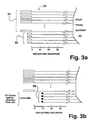
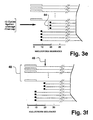
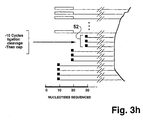
- FIGS 3a through 3h diagrammatically illustrate the embodiment referred to herein as “double stepping,” or the simultaneous use of two different nucleases in accordance with the invention.
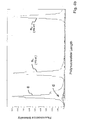
- Figures 4a through 4d illustrate data showing the fidelity of nucleotide identification through ligation with a ligase.
- FIGS 5a through 5c illustrate data showing nucleotide identification through polymerase extension.
- sequence determination or "determining a nucleotide sequence” in reference to polynucleotides includes determination of partial as well as full sequence information of the polynucleotide. That is, the term includes sequence comparisons, fingerprinting, and like levels of information about a target polynucleotide, as well as the express identification and ordering of nucleosides, usually each nucleoside, in a target polynucleotide.
- Perfectly matched duplex in reference to the protruding strands of probes and target polynucleotides means that the protruding strand from one forms a double stranded structure with the other such that each nucleotide in the double stranded structure undergoes Watson-Crick base pairing with a nucleotide on the opposite strand.
- the term also comprehends the pairing of nucleoside analogs, such as deoxyinosine, nucleosides with 2-aminopurine bases, and the like, that may be employed to reduce the degeneracy of the probes.
- oligonucleotide as used herein includes linear oligomers of nucleosides or analogs thereof, including deoxyribonucleosides, ribonucleosides, and the like. Usually oligonucleotides range in size from a few monomeric units, e.g. 3-4, to several hundreds of monomeric units.
- oligonucleotide is represented by a sequence of letters, such as "ATGCCTG,” it will be understood that the nucleotides are in 5'->3' order from left to right and that "A” denotes deoxyadenosine, “C” denotes deoxycytidine, “G” denotes deoxyguanosine, and “T” denotes thymidine, unless otherwise noted.
- nucleoside includes the natural nucleosides, including 2'-deoxy and 2'-hydroxyl forms, e.g. as described in Komberg and Baker, DNA Replication, 2nd Ed. (Freeman, San Francisco, 1992).
- “Analogs” in reference to nucleosides includes synthetic nucleosides having modified base moieties and/or modified sugar moieties, e.g. described generally by Scheit, Nucleotide Analogs (John Wiley, New York, 1980). Such analogs include synthetic nucleosides designed to enhance binding properties, reduce degeneracy, increase specificity, and the like.
- the invention provides a method of sequencing nucleic acids which obviates electrophoretic separation of similarly sized DNA fragments and which eliminates the difficulties associated with the detection and analysis of spatially overlapping bands of DNA fragments in a gel or like medium. Moreover, the invention obviates the need to generate DNA fragments from long single stranded templates with a DNA polymerase.
- the probes ligated to the target polynucleotide are the probes ligated to the target polynucleotide.
- the probes of the invention provide a "platform" from which a nuclease cleaves the target polynucleotide to which probe is ligated.
- Probes of the invention can also provide a means for identifying or labeling a nucleotide at the end of the target polynucleotide. Probes do not necessarily provide both functions in every embodiment.
- probes have the form illustrated in Figure la.
- probes are double stranded segments of DNA having a protruding strand at one end 10, at least one nuclease recognition site 12, and a spacer region 14 between the recognition site and the protruding end 10.
- probes also include a label 16, which in this particular embodiment is illustrated at the end opposite of the protruding strand.
- the probes may be labeled by a variety of means and at a variety of locations, the only restriction being that the labeling means selected does not interfere with the ligation step or with the recognition of the probe by the nuclease.
- a nuclease leaves a 5' phosphate on the terminus of the target polynucleotide, it is sometimes desirable to remove it, e.g. by treatment with a standard phosphatase, prior to ligation. This prevents undesired ligation of one of the strands, when the protruding strands of the probe and target sequence fail to form a perfectly matched duplex. This is particularly problematic with a mismatch occurs precisely at the nucleotide position where identification is sought. Where such phosphatase treatment is employed, the "nick" remaining in the ligated complex after the initial ligation can be repaired by kinase treatment followed by a second ligation step.
- embodiments of the invention employing the above type of probe comprise the following steps: (a) ligating a probe to an end of the polynucleotide having a protruding strand to form a ligated complex, the probe having a complementary protruding strand to that of the polynucleotide and the probe having a nuclease recognition site; (b) identifying one or more nucleotides in the protruding strand of the polynucleotide, e.g.
- the method also includes a step of removing unligated probe from the ligated complex.
- protruding strand 10 of the probe is a 5' or 3' end. However, in this embodiment, it is important that the protruding strands of the target polynucleotide and probes be capable of forming perfectly matched duplexes to allow for specific ligation. If the protruding strands of the target polynucleotide and probe are different lengths the resulting gap can be filled in by a polymerase prior to ligation, e.g. as in "gap LCR" disclosed in Backman et al, European patent application EP-A-0 439 182.
- Such gap filling can be used as a means for identifying one or more nucleotides in the protruding strand of the target polynucleotide.
- the number of nucleotides in the respective protruding strands are the same so that both strands of the probe and target polynucleotide are capable of being ligated without a filling step.
- the protruding strand of the probe is from 2 to 6 nucleotides long. As indicated below, the greater the length of the protruding strand, the greater the complexity of the probe mixture that is applied to the target polynucleotide during each ligation and cleavage cycle.
- the primary function of the probe is to provide a site for a nuclease to bind to the ligated complex so that the complex can be cleaved and the target polynucleotide shortened.
- identification of the nucleotides can take place separately from probe ligation and cleavage.
- So-called "wild card” nucleotides, or “degeneracy reducing analogs” can be provided to significantly reduce, or even eliminate, the complexity of the probe mixture employed in the ligation step, since specific binding is not critical to nucleotide identification in this embodiment.
- probes designed for blunt end ligation may be employed with no need for using degenerate mixtures.
- this embodiment of the invention comprises the following steps: (a) providing a polynucleotide having a protruding strand; (b) identifying one or more nucleotides in the protruding strand by extending a 3' end of a strand with a nucleic acid polymerase, (c) ligating a probe to an end of the polynucleotide to form a ligated complex; (d) cleaving the ligated complex with a nuclease; and (e) repeating steps (a) through (d) until the nucleotide sequence of the polynucleotide is determined.
- the target polynucleotide has a 3' recessed strand which is extended by the nucleic acid polymerase in the presence of chain-terminating nucleoside triphosphates, and the nuclease used produces a 3'-recessed strand and 5' protruding strand at the terminus of the target polynucleotide.
- FIG. 1b An example of this embodiment is illustrated in Figure 1b:
- the 3' recessed strand of polynucleotide (15) is extended with a nucleic acid polymerase in the presence of the four dideoxynucleoside triphosphates, each carrying a distinguishable fluorescent label, so that the 3' recessed strand is extended by one nucleotide (11), which permits its complementary nucleotide in the 5' protruding strand of polynucleotide (15) to be identified.
- Probe (9) having recognition site (12), spacer region (14), and complementary protruding strand (10), is then ligated to polynucleotide (15) to form ligated complex (17).
- Ligated complex (17) is then cleaved at cleavage site (19) to release a labeled fragment (21) and augmented probe (23).
- a shortened polynucleotide (15) with a regenerated 3' recessed strand is then ready for the next cycle of identification, ligation, and cleavage.
- the first nucleotide of the 5' protruding strand adjacent to the double stranded portion of the target polynucleotide is readily identified by extending the 3' strand with a nucleic acid polymerase in the presence of chain-terminating nucleoside triphosphates.
- the 3' strand is extended by a nucleic acid polymerase in the presence of the four chain-terminating nucleoside triphosphates, each being labeled with a distinguishable fluorescent dye so that the added nucleotide is readily identified by the color of the attached dye.
- chain-terminating nucleoside triphosphates are available commercially, e.g.
- a probe may be ligated to the target polynucleotide using conventional procedures, as described more fully below.
- the probe is ligated after a single nucleotide extension of the 3' strand of the target polynucleotide.
- the number of nucleotides in the protruding strand of the probe is the same as the number of nucleotides in the protruding strand of the target polynucleotide after the extension step. That is, if the nuclease provides a protruding strand having four nucleotides, then after the extension step the protruding strand will have three nucleotides and the protruding strand of the preferred probe will have three nucleotides.
- the cleavage step in this embodiment may be accomplished by a variety of techniques, depending on the effect that the added chain-terminating nucleotide has on the efficiencies of the nuclease and/or ligase employed.
- a ligated complex is formed with the presence of the labeled chain-terminating nucleotide, which is subsequently cleaved with the appropriate nuclease, e.g. a class IIs restriction endonuclease, such as Fok I, or the like.
- the chain-terminating nucleotide may be excised.
- this is carried out by the 3' ⁇ 5' exonuclease activity (i.e. proof-reading activity) of a DNA polymerase, e.g. T4 DNA polymerase, acting in the presence of the appropriate nucleoside triphosphates.
- a DNA polymerase e.g. T4 DNA polymerase
- the chain-terminating nucleoside (11) is exchanged with a natural counterpart and the strand is extended, displacing the unligated probe strand (25).
- this step simultaneously caps the target polynucleotides that failed to ligate to a probe in a preceding ligation step by "filling in” their ends thereby preventing subsequent ligation.
- Such excision may also be carried out chemically, provided that the labeled chain-terminating nucleoside is attached by a labile bond, such as an acid-labile phosphoramidate bond.
- a labile bond such as an acid-labile phosphoramidate bond.
- the chain-terminating nucleotide is excised and the recessed 3' strand extended before ligation leaving a blunt-ended target polynucleotide.
- a subsequence cycle is then initiated by ligation of a blunt-ended probe to the end of the target polynucleotide.
- a nuclease is selected which leaves a one nucleotide 5' protruding strand after digestion, e.g. Alw I.
- chain extension need not be carried out in the presence of chain-terminating nucleoside triphosphates; ordinary deoxynucleoside triphosphates can be employed to leave a flush-ended polynucleotide. A blunt-ended probe is then used to initiate the next cycle.
- the nucleoside triphosphates used are labeled, as would be the chain-terminating analogs described in the above embodiments.
- the label is attached by way of a selectively cleavable bond, so that the label can be removed to enhance the efficiency of the nuclease in the subsequent cycle.
- cleavable linkage moieties are available, e.g. Herman et al, Anal. Biochem., 156:48-55 (1986)(disulfide linker); Urdea U.S. patents 4,775,619 and 5,118,605.
- a 3' end of a strand of the probe is extended with a DNA polymerase in the presence of labeled chain-terminating nucleoside triphosphates, as illustrated in Figure ld.
- There target polynucleotide (15) having a 3' protruding end is ligated to probe (130) having a complementary 3' protruding end (134) one nucleotide less in length. That is, when the 3' protruding strand (134) of probe (130) has three nucleotides, the 3' protruding strand of target polynucleotide (15) would have at least four nucleotides.
- Gap (132) is then filled by extending 3' protruding end (134) with a nucleic acid polymerase in the presence of chain-terminating nucleoside triphosphates. After cleavage, the cycle can be repeated.
- This embodiment may also be implemented with unlabeled chain-terminating nucleoside triphosphates, as illustrated in Figure le.
- Target polynucleotide (15) is successively exposed to different 3'-aminonucleoside triphosphates in the presence of a nucleic acid polymerase (150).
- the 3'-aminonucleoside triphosphates act as chain-terminators when incorporated.
- 3'-aminoadenosine triphosphate (152) shown incorporated in Figure le stops further strand extension and reduces the length of the protruding strand by one nucleotide, from 4 to 3.
- probe (154) with label (155) corresponding to the adenosine chain-terminator is mixed with the target sequence for ligation (156).
- the labeled probe has a protruding strand of 3 nucleotides, it will only ligate if there has been an extension. If no ligation takes place, and no probe remains attached after washing, then the next 3'-aminonucleoside triphosphate and corresponding probe are tried. This process continues until the target polynucleotide is successfully extended and a corresponding probe is ligated to form ligated complex (17).
- a probe is assembled at the end of a target polynucleotide in two steps, as illustrated by the example in Figure lf.
- a first single stranded oligonucleotide (100) having a 5' monophosphate is annealed to and ligated with target polynucleotide (15) having a 5' monophosphate on its protruding strand to form a precursor (104) to ligated complex (17).
- a second single stranded oligonucleotide (102) complementary to the protruding strand of precursor (104) is annealed to and ligated with precursor (104) to form ligated complex (17).
- first oligonucleotide (100) may be delivered to the target polynucleotide as a mixture and ligation preferably takes place at high stringency so that perfectly matched hybrids (between the protruding strand of the target polynucleotide and the 5' end of the first oligonucleotide) are preferentially ligated.
- second oligonucleotide (102) need only have a sequence complementary to the protruding portion of precursor (104) so that a second ligation can take place to form ligated complex (17).
- a first single stranded oligonucleotide (120) is annealed to and ligated with target polynucleotide (15) having a 5' monophosphate on its recessed strand to form a precursor (124) to ligated complex (17).
- a second single stranded oligonucleotide (122) complementary to the protruding strand of precursor (124) and having a 5' monophosphate is annealed to and ligated with precursor (124) to form ligated complex (17).
- first oligonucleotide (120) may be delivered to the target polynucleotide as a mixture and ligation preferably takes place at high stringency so that perfectly matched hybrids (between the protruding strand of the target polynucleotide and the 3' end of the first oligonucleotide) are preferentially ligated.
- second oligonucleotide (122) need only have a sequence complementary to the protruding portion of precursor (124) so that a second ligation can take place to form ligated complex (17).
- the complementary strands of the probes are conveniently synthesized on an automated DNA synthesizer, e.g. an Applied Biosystems, Inc. (Foster City, California) model 392 or 394 DNA/RNA Synthesizer, using standard chemistries, such as phosphoramidite chemistry, e.g. disclosed in the following references: Beaucage and lyer, Tetrahedron, 48: 2223-2311 (1992); Molko et al, U.S. patent 4,980,460; Koster et al, U.S. patent 4,725,677; Caruthers et al, U.S. patents 4,415,732; 4,458,066; and 4,973,679; and the like.
- an automated DNA synthesizer e.g. an Applied Biosystems, Inc. (Foster City, California) model 392 or 394 DNA/RNA Synthesizer, using standard chemistries, such as phosphoramidite chemistry, e.g. disclosed
- oligonucleotides are compatible with the ligation and cleavage reagents.
- the complementary strands are combined to form a double stranded probe.
- the protruding strand of a probe is synthesized as a mixture, so that every possible sequence is represented in the protruding portion. For example, if the protruding portion consisted of four nucleotides, in one embodiment four mixtures are prepared as follows:
- the duplex forming region of a probe is between about 12 to about 30 basepairs in length; more preferably, its length is between about 15 to about 25 basepairs.
- the probes can have a wide variety of forms.
- the probes can have the form X 1 X 2 ... X i ANNN, X 1 X 2 ... X i NANN, X 1 X 2 ... X i NNAN, or the like.
- the number of probe sets could be increased and the degeneracy reduced by constructing 16 sets of probes of 16-fold having the form: X 1 X 2 ... X i NNAA, X 1 X 2 ... X i NNAC, X 1 X 2 ... X i NNAG, and so on.
- the duplex forming region of each such set of probes have the same length. Size differences among the probes can be used as a means for identifying them, e.g. Skolnick et al, Genomics, 2: 273-279 (1988). Also, in some embodiments, it may be desirable to synthesize the probe as a single polynucleotide which contains self-complementary regions. After synthesis, the self-complementary regions are allowed to anneal to form a probe with a protruding strand at one end and a single stranded loop at the other end. Preferably, in such embodiments the loop region may comprise from about 3 to 10 nucleotides, or other comparable linking moieties, e.g. alkylether groups, such as disclosed in U.S. patent 4,914,210. Many techniques are available for attaching reactive groups to the bases or internucleoside linkages for labeling, as discussed below.
- the 5' end of the probe may be phosphorylated in some embodiments.
- a 5' monophosphate can be attached to a second oligonucleotide either chemically or enzymatically with a kinase, e.g. Sambrook et al, Molecular Cloning: A Laboratory Manual, 2nd Edition (Cold Spring Harbor Laboratory, New York, 1989). Chemical phosphorylation is described by Horn and Urdea, Tetrahedron Lett., 27: 4705 (1986), and reagents for carrying out the disclosed protocols are commercially available, e.g. 5' Phosphate-ONTM from Clontech Laboratories (Palo Alto, California).
- probes may have the form: the form: or the like, where the Y's are the complementary nucleotides of the X's and "p" is a monophosphate group.
- the probes of the invention can be labeled in a variety of ways, including the direct or indirect attachment of radioactive moieties, fluorescent moieties, colorimetric moieties, and the like.
- Many comprehensive reviews of methodologies for labeling DNA and constructing DNA probes provide guidance applicable to constructing probes of the present invention. Such reviews include Matthews et al, Anal. Biochem., Vol 169, pgs.
- Attachment sites of labeling moieties are not critical in embodiments relying on probe labels to identify nucleotides in the target polynucleotide, provided that such labels do not interfere with the ligation and cleavage steps.
- dyes may be conveniently attached to the end of the probe distal to the target polynucleotide on either the 3' or 5' termini of strands making up the probe, e.g. Eckstein (cited above), Fung (cited above), and the like.
- attaching labeling moieties to interior bases or inter-nucleoside linkages may be preferred.
- the probes are labeled with one or more fluorescent dyes, e.g. as disclosed by Menchen et al, U.S. patent 5,188,934; Begot et al PCT application WO-A 91/05060.
- a probe of the invention is ligated to an end of a target polynucleotide to form a ligated complex in each cycle of ligation and cleavage.
- the ligated complex is the double stranded structure formed after probe and target are ligated, usually after the protruding strands of the target polynucleotide and probe anneal and at least one pair of the identically oriented strands are caused to be covalently linked to one another.
- Ligation can be accomplished either enzymatically or chemically. Chemical ligation methods are well known in the art, e.g.
- ligase in a standard protocol.
- Many ligases are known and are suitable for use in the invention, e.g. Lehman, Science, 186: 790-797 (1974); Engler et al, DNA Ligases, pages 3-30 in Boyer, editor, The Enzymes, Vol. 15B (Academic Press, New York, 1982); and the like.
- Preferred ligases include T4 DNA ligase, T7 DNA ligase, E.
- ligases require that a 5' phosphate group be present for ligation to the 3' hydroxyl of an abutting strand. This is conveniently provided for at least one strand of the target polynucleotide by selecting a nuclease which leaves a 5' phosphate, e.g. as Fok I.
- the step of ligating includes (i) ligating the probe to the target polynucleotide with a ligase so that a ligated complex is formed having a nick on one strand, (ii) phosphorylating the 5' hydroxyl at the nick with a kinase using conventional protocols, e.g. Sambrook et al (cited above), and (iii) ligating again to covalently join the strands at the nick, i.e. to remove the nick.
- a target polynucleotide for use in the invention is double stranded and is prepared so that it has a protruding strand at least one end.
- the protruding strand may be either 5' or 3' and, preferably, the number of nucleotides in the protruding portion of the strand is in the range of from 2 to 6.
- a target polynucleotide is referred to as "-k" where k is some integer, e.g. usually between 2 and 6, whenever the 5' strand is protruding.
- a target polynucleotide is referred to as "+k" whenever the 3' strand is protruding.
- the target polynucleotide is anchored to a solid phase support, such as a magnetic particle, polymeric microsphere, filter material, or the like, which permits the sequential application of reagents without complicated and time-consuming purification steps.
- a solid phase support such as a magnetic particle, polymeric microsphere, filter material, or the like.
- the length of the target polynucleotide can vary widely; however, for convenience of preparation, lengths employed in conventional sequencing are preferred. For example, lengths in the range of a few hundred basepairs, 200-300, to 1 to 2 kilobase pairs are preferred.
- target polynucleotides can be prepared by various conventional methods.
- target polynucleotides can be prepared as inserts of any of the conventional cloning vectors, including those used in conventional DNA sequencing. Extensive guidance for selecting and using appropriate cloning vectors is found in Sambrook et al, Molecular Cloning: A Laboratory Manual, Second Edition (Cold Spring Harbor Laboratory, New York, 1989), and like references. Sambrook et al and Innis et al, editors, PCR Protocols (Academic Press, New York, 1990) also provide guidance for using polymerase chain reactions to prepare target polynucleotides.
- cloned or PCR-amplified target polynucleotides are prepared which permit attachment to magnetic beads, or other solid supports, for ease of separating the target polynucleotide from other reagents used in the method. Protocols for such preparative techniques are described fully in Wahlberg et al, Electrophoresis, 13: 547-551 (1992); Tong et al, Anal.
- Kits are also commercially available for practicing such methods, e.g. DynabeadsTM template preparation kit from Dynal AS. (Oslo, Norway).
- target polynucleotides may be prepared in parallel by the use of microparticles, e.g. magnetic beads, controlled pore glass particles, or the like, that each have a uniform population of adaptors attached.
- the adaptor is an oligonucleotide between about 30 and 100 nucleotides in length that comprises regions for PCR primer binding, regions that form restriction endonuclease cleavage sites when duplexes are established, and an address region of about 12-15 nucleotides that permits capture of a unique target polynucleotide by hybridization.
- Such adaptors may also comprise other linking moieties known in the art, e.g. polyethylene glycol arms, or the like.
- the population of adaptors on a particular microparticle is uniform in the sense that each oligonucleotide has the same sequence, so that the same target polynucleotide would be captured by different adaptors on the same microparticle.
- Preparation of microparticle with uniform populations of oligonucleotides is disclosed in PCT publications WO 92/00091, WO 92/03461, and like references.
- target polynucleotides are prepared in a library whose vector contains complementary address regions adjacent to the target polynucleotide insert.
- Individual particles with captured target polynucleotides may be isolated and manipulated on a microscope slide, e.g. as taught by Lam et al, PCT publication WO 92/00091 and Lam et al, Science, 354: 82-84 (1991).
- Nuclease as the term is used in accordance with the invention means any enzyme, combination of enzymes, or other chemical reagents, or combinations chemical reagents and enzymes that when applied to a ligated complex, discussed more fully below, cleaves the ligated complex to produce an augmented probe and a shortened target polynucleotide.
- a nuclease of the invention need not be a single protein, or consist solely of a combination of proteins.
- a key feature of the nuclease, or of the combination of reagents employed as a nuclease, is that its (their) cleavage site be separate from its (their) recognition site.
- the distance between the recognition site of a nuclease and its cleavage site will be referred to herein as its "reach.”
- “reach” is defined by two integers which give the number of nucleotides between the recognition site and the hydrolyzed phosphodiester bonds of each strand.
- the recognition and cleavage properties of Fok I is typically represented as "GGATG(9/13)" because it recognizes and cuts a double stranded DNA as follows: where the bolded nucleotides are Fok I's recognition site and the N's are arbitrary nucleotides and their complements.
- nuclease only cleave the target polynucleotide after it forms a complex with its recognition site; and preferably, the nuclease leaves a protruding strand on the target polynucleotide after cleavage.
- Cleavage with a nuclease can be accomplished using chemical nucleases, e.g. as disclosed by Sigman et al, Ann. Rev. Biochem., 59: 207-236 (1990); Le Doan et al, Nucleic Acid Research, 15: 7749-7760 (1987); U.S. patent 4,795,700; Francois et al, Proc. Natl. Acad. Sci., 86: 9702-9706 (1989); and like references.
- such embodiments comprise an oligonucleotide moiety linked to a cleavage moiety, wherein the oligonucleotide moiety recognizes the ligated complex by triple helix formation.
- nucleoside type e.g. whether ribose or deoxyribose nucleosides are employed
- base modifications e.g. methylated cytosine, and the like
- Roberts et al Proc. Natl. Acad. Sci., 88: 9397-9401 (1991); Roberts et al, Science, 258: 1463-1466 (1992); Distefano et al, Proc. Natl. Acad.
- such chemical nucleases are employed with an exonuclease which can produce a protruding strand after cleavage.
- exonuclease which can produce a protruding strand after cleavage.
- current chemical nucleases are limited in that their cleavage sites vary around an expected site, they can be employed in fingerprinting, sequence comparisons, and other uses that only require partial sequence information.
- nucleases employed in the invention are natural protein endonucleases (i) whose recognition site is separate from its cleavage site and (ii) whose cleavage results in a protruding strand on the target polynucleotide.
- class IIs restriction endonucleases are employed as nucleases in the invention, e.g. as described in Szybalski et al, Gene, 100: 13-26 (1991); Roberts et al, Nucleic Acids Research, 21: 3125-3137 (1993); and Livak and Brenner, U.S. patent 5,093,245.
- Exemplary class IIS nucleases for use with the invention include Alw XI, Bsm AI, Bbv I, Bsm FI, Sts I, Hga I, Bsc AI, Bbv II, Bce fI, Bce 85I, Bcc I, Bcg I, Bsa I, Bsg I, Bsp MI, Bst 71 I, Ear I, Eco 57I, Esp 3I, Fau I, Fok I, Gsu I, Hph I, Mbo II, Mme I, Rle AI, Sap I, Sfa NI, Taq II, Tth 111II, Bco 5I, Bpu AI, Fin I, Bsr DI, and isoschizomers thereof.
- Preferred nucleases include Fok I, Hga I, Ear I, and Sfa NI.
- the target polynucleotide is treated to block the recognition sites and/or cleavage sites of the nuclease being employed. This prevents undesired cleavage of the target polynucleotide because of the fortuitous occurrence of nuclease recognition sites at interior locations in the target polynucleotide. Blocking can be achieved in a variety of ways, including methylation and treatment by sequence-specific aptamers, DNA binding proteins, or oligonucleotides that form triplexes.
- recognition sites can be conveniently blocked by methylating the target polynucleotide with the cognate methylase of the nuclease being used. That is, for most if not all type II bacterial restriction endonucleases, there exists a so-called "cognate" methylases that methylates its recognition site. Many such methylases are disclosed in Roberts et al (cited above) and Nelson et al, Nucleic Acids Research, 21: 3139-3154 (1993), and are commercially available from a variety of sources, particularly New England Biolabs (Beverly, MA).
- the ligated complex is cleaved with a nuclease to give an augmented probe and a shortened target polynucleotide.
- the probe is designed such that the distance from the recognition site of the probe to end of the probe is less than the distance from the recognition site to the cleavage site of the nuclease. That is, the nuclease necessarily cleaves in a region of the target polynucleotide, thereby shortening it by one or more nucleotides in each cycle, as illustrated in Figure 2.
- the probe has one or more nucleotides added to it after cleavage to form an augmented probe.
- ligated complex 20 is shown with recognition site 22 of the Fok I nuclease.
- the terminus 24 of the probe is one nucleotide to the left of the Fok I cleavage site 26.
- ligation leads to the identification of the terminal thymidine on the target polynucleotide and cleavage results in the shortening of each strand of the target polynucleotide by one nucleotide.
- the nucleotides removed by the cleavage together with the probe to which they remain attached form an augmented probe.
- the method of the invention is preferably carried out in the following steps: (a) ligating a probe to an end of the polynucleotide having a protruding strand to form a ligated complex, the probe having a complementary protruding strand to that of the polynucleotide and the probe having a nuclease recognition site; (b) removing unligated probe from the ligated complex; (c) identifying one or more nucleotides in the protruding strand of the polynucleotide: (d) cleaving the ligated complex with a nuclease; and (e) repeating steps (a) through (d) until the nucleotide sequence of the polynucleotide is determined.
- Identification of the one or more nucleotides in the protruding strand of the target polynucleotide is carried out either before or after the cleavage step, depending on the embodiment of the invention being implemented. Identification of the one or more nucleotides in the protruding strand of the target polynucleotide is carried out either before or after the cleavage step, depending on the embodiment of the invention being implemented. Detection prior to cleavage is preferred in embodiments where sequencing is carried out in parallel on a plurality of sequences (either segments of a single target polynucleotide or a plurality of altogether different target polynucleotides), e.g. attached to separate magnetic beads, or other types of solid phase supports.
- Detection either before or after cleavage may be carried out in embodiments where a homogeneous population of target polynucleotides is being analyzed. e.g. a population of solid phase supports, such as magnetic beads, all have the identical target polynucleotide attached. In such cases, other factors my dictate the ordering of the detection and cleavage steps, such as the detection scheme being employed, whether the sequencing reactions are being carried out in separate reaction mixtures or whether they take place in a common mixture, and the like.
- the method includes a capping step after the unligated probe is washed from the target polynucleotide.
- a capping step by analogy with polynucleotide synthesis, e.g. Andrus et al, U.S. patent 4,816,571, target polynucleotides that have not undergone ligation to a probe are rendered inert to further ligation steps in subsequent cycles. In this manner spurious signals from "out of phase" cleavages are prevented.
- capping is preferably accomplished by exposing the unreacted target polynucleotides to a mixture of the four dideoxynucleoside triphosphates, or other chain-terminating nucleoside triphosphates, and a DNA polymerase.
- the DNA polymerase extends the 3' strand of the unreacted target polynucleotide by one chain-terminating nucleotide, e.g. a dideoxynucleotide, thereby rendering it incapable of ligating in subsequent cycles.
- An important aspect of the invention is "multiple stepping,” or the simultaneous use of a plurality of nucleases which cleave at different distances from the ligation site to sequence a target polynucleotide.
- the use of multiple nucleases having different reaches permits one to periodically "restart” the sequencing process by capping sequences involved in prior or current cycles of ligation and cleavage and by beginning a new cycle of ligation and cleavage on a "fresh" set of target polynucleotides whose protruding strands are exposed by cleavage with a long reach nuclease.
- By employing multiple nucleases in this manner the number of nucleotides that can be determined on a set of target polynucleotides can be increased over that which can be done with a single nuclease.
- a conversion probe that has the following properties: i) a protruding strand compatible with the current target polynucleotide protruding strand, i.e. having the same number of nucleotides in antiparallel orientation, ii) a nuclease recognition site of the nuclease being converted to, and iii) a spacer region selected so that the cut site of the new nuclease corresponds to at least one of the ligation sites of the two strands.
- the conversion probe permits ligation of only one strand and one of the unligated sites, i.e. nicks, is located at the cleavage site of the nuclease being converted to.
- Figures 3a through 3h diagrammatically illustrate this aspect of the invention in the case where two nucleases are employed, a first nuclease which permits cleavage ten nucleotides from the ligation site and a second nuclease which permits cleavage of one nucleotide from the ligation site.
- the process illustrated in figure is readily generalized to more than two nucleases.
- a mixture of probes 34 and 36 are ligated to the target polynucleotides 30 attached to solid phase support 32.
- Probe 34 contains a nuclease recognition site of a first nuclease that has a long reach, e.g.
- Probe 36 converts (if necessary) the protruding strand of the target polynucleotides (initially prepared for the first nuclease) to a protruding strand corresponding to a second nuclease used to cleave the target polynucleotide one nucleotide at a time.
- the second nuclease is employed in nine cycles of ligation and cleavage followed by a capping step to give the identity of the first nine nucleotides of the target polynucleotide.
- capped sequences 38 no longer participate in ligation and cleavage cycles.
- the number of capped sequences produced in this step depends on the mixture of the two probes employed which, in turn, depends on several factors, including the length of the target polynucleotide, the nature of the label on the probes, the efficiencies of ligation and cleavage of the enzymes employed, and the like.
- the target polynucleotides 41 are then cleaved at 40 with the first nuclease, shown in Figure 3c, to produce appropriate protruding strands at the termini of the target polynucleotides and the identity of the tenth nucleotide.
- a mixture of probes 34 and 36 are ligated to the non-capped target polynucleotides 42 ( Figure 3d) to form ligated complexes.
- the ligated complexes including probe 36 are cleaved to convert the protruding strands of their associated target polynucleotides to protruding strands corresponding to the second nuclease, after which another nine cycles of ligation and cleavage take place followed by a capping step, to form a second set of capped sequences 44 ( Figure 3e). In this series of cycles the identities of nucleotides 11 through 19 are determined.
- the target polynucleotides are cleaved with the first nuclease at 46 (in Figure 3f) to produce protruding strands on target polynucleotides 48, after which a mixture of probes 34 and 36 are ligated to the target polynucleotides to form ligated complexes 50 (Figure 3g).
- the ligated complexes comprising probe 36 are again cleaved to convert the protruding strands of their associated target polynucleotides to ones corresponding to the second nuclease, after which nine cycles of ligation and cleavage take place followed by a capping step, to form a third set of capped sequences 52 (Figure 3h). This set of cycles leads to the identification of nucleotides 21 through 29.
- the invention includes systems and apparatus for carrying out sequencing automatically.
- Such systems and apparatus can take a variety of forms depending on several design constraints, including i) the nature of the solid phase support used to anchor the target polynucleotide, ii) the degree of parallel operation desired, iii) the detection scheme employed; iv) whether reagents are re-used or discarded, and the like.
- the apparatus comprises a series of reagent reservoirs, one or more reaction vessels containing target polynucleotide, preferably attached to a solid phase support, e.g. magnetic beads, one or more detection stations, and a computer controlled means for transferring in a predetermined manner reagents from the reagent reservoirs to and from the reaction vessels and the detection stations.
- the computer controlled means for transferring reagents and controlling temperature can be implemented by a variety of general purpose laboratory robots, such as that disclosed by Harrison et al, Biotechniques, 14: 88-97 (1993); Fujita et al, Biotechniques, 9: 584-591 (1990); Wada et al, Rev. Sci. Instrum., 54: 1569-1572 (1983); or the like.
- Such laboratory robots are also available commercially, e.g. Applied Biosystems model 800 Catalyst (Foster City, CA).
- kits of the invention include probes tailored for the nuclease and the detection scheme of the particular embodiment.
- Kits further include the nuclease reagents, the ligation reagents, and instructions for practicing the particular embodiment of the invention.
- ligase buffers and nuclease buffers may be included. In some cases, these buffers may be identical.
- kits may also include a methylase and its reaction buffer and a kinase and its reaction buffer.
- kits also include a solid phase support, e.g. magnetic beads, for anchoring target polynucleotides.
- fluorescently labeled probes are provided such that probes corresponding to different terminal nucleotides of the target polynucleotide carry distinct spectrally resolvable fluorescent dyes.
- spectrally resolvable means that the dyes may be distinguished on basis of their spectral characteristics, particularly fluorescence emission wavelength, under conditions of operation. Thus, the identity of the one or more terminal nucleotides would be correlated to a distinct color, or perhaps ratio of intensities at different wavelengths. More preferably, four such probes are provided that allow a one-to-one correspondence between each of four spectrally resolvable fluorescent dyes and the four possible terminal nucleotides on a target polynucleotide.
- a 368 basepair fragment of pUC19 is amplified by PCR for use as a test target polynucleotide.
- the 5' terminal nucleotide of the coding strand is at position 393 and the 3' terminal nucleotide of the coding strand is at position 740, Yanisch--Perron et al, Gene, 33: 103-119 (1985), so that the polylinker region is spanned.
- the amplified target polynucleotide is isolated and attached to streptavidin-coated magnetic beads (Dynabeads) using manufacturer's protocol, Dynabeads Template Preparation Kit, with M280-streptavidin (Dynal, Inc., Great Neck, New York).
- a sufficient quantity of the biotinylated 393 basepair fragment is provided to load about 300 ⁇ g of Dynabeads M280-Streptavidin.
- the target polynucleotides are digested with Eco RI and washed to provide a 5'-monophosphorylated protruding strand with an overhang of four nucleotides, i.e. a -4 target polynucleotide, shown below. Reactions and washes below are generally carried out in 50 ⁇ L volumes of manufacturer's (New England Biolabs') recommended buffers for the enzymes employed, unless otherwise indicated.
- TAMRA, FAM, ROX, and JOE are spectrally resolvable fluorescent labels attached by way of Aminolinker II (all being available from Applied Biosystems, Inc., Foster City, California); the bold faced nucleotides are the recognition site for Fok I endonuclease, and "N" represents any one of the four nucleotides, A, C, G, T.
- TAMRA tetramethylrhodamine
- FAM fluorescein
- ROX rhodamine X
- JOE 2',7'-dimethoxy-4',5'-dichlorofluorescein
- Each of the above probes is separately incubated in sequence in approximately 5 molar excess of the target polynucleotide ends as follows: the probe is incubated for 60 minutes at 16°C with 200 units of T4 DNA ligase and the anchored target polynucleotide in 50 ⁇ L of T4 DNA ligase buffer; after washing, the target polynucleotide is then incubated with 100 units T4 polynucleotide kinase in the manufacturer's recommended buffer for 30 minutes at 37°C, washed, and again incubated for 30 minutes at 16°C with 200 units of T4 DNA ligase and the anchored target polynucleotide in 50 ⁇ L of T4 DNA ligase buffer.
- Washing is accomplished by immobilizing the magnetic bead support with a magnet and successively adding then removing 50 ⁇ L volumes of wash buffer, e.g. TE, disclosed in Sambrook et al (cited above). After the cycle of ligation-phosphorylation-ligation and a final washing, the beads are interrogated for the presence of fluorescent label. On the fourth set of such incubations, the characteristic fluorescence of JOE is detected indicating that the terminal nucleotide is A.
- the labeled target polynucleotide i.e. the ligated complex, is then incubated with 10 units of Fok I in 50 ⁇ L of manufacturer's recommended buffer for 30 minutes at 37°C, followed by washing in TE. As a result the target polynucleotide is shortened by one nucleotide on each strand and is ready for the next cycle of ligation and cleavage. The process is continued until the desired number of nucleotides are identified.
- a -4 protruding strand is converted into a -3 protruding strand using the conversion probe shown below having an Ear I recognition site (indicated in bold) and a protruding strand whose terminal nucleotide is non-phosphorylated (indicated in lower case).
- the conversion probe is ligated to the terminus of the target polynucleotide using conditions as described in Example 1: After ligation, the complex is digested with Ear I using manufacturer's recommended protocol to give a target polynucleotide with a -3 protruding strand:
- a -4 protruding strand is converted into a -5 protruding strand using the conversion probe shown below having an Hga I recognition site (indicated in bold) and a protruding strand whose terminal nucleotide is non-phosphorylated (indicated in lower case).
- the conversion probe is ligated to the terminus of the target polynucleotide using conditions as described in Example 1: After ligation, the complex is digested with Hga I using manufacturer's recommended protocol to give a target polynucleotide with a -5 protruding strand:
- a +2 protruding strand is converted into a -3 protruding strand using the conversion probe shown below having an Ear 1 recognition site (indicated in bold) and a protruding strand whose terminal nucleotide is non-phosphorylated (indicated in lower case).
- the conversion probe is ligated to the terminus of the target polynucleotide using conditions as described in Example 1: After ligation, the complex is digested with Ear I using manufacturer's recommended protocol to give a target polynucleotide with a -3 protruding strand:
- Ear I and Fok I Two nucleases, Ear I and Fok I, with different reaches are used in the same sequencing operation.
- the procedure is illustrated in Fig. 3.
- a 368 basepair fragment of pUC19 with a -4 protruding strand is prepared as described in Example 1. Because the fragment contains a Ear I site (but no Fok I site), the target polynucleotide is initially treated with an Ear I methylase, e.g. as described in Nelson et al, Nucleic Acids Research, 17: r398-r415 (1989).
- a 9:1 mixture of the following two probes, Probe A:Probe B, is combined in about 5 molar excess with the target polynucleotide, ligated, kinased, and ligated, as described in Example 1 to form two populations of ligated complexes: about 10% terminating with Probe B and about 90% terminating with Probe A.
- the target polynucleotide are then digested with Ear I to convert about 10% of the ligated complexes to a target polynucleotide having a -3 protruding strand.
- the following probes are then used in nine cycles of ligation-phosphorylation-ligation/identification/cleavage as described in Example 1 to give the identity of the first nine nucleotides.
- the subpopulation of target polynucleotides that underwent the nine cycles of cleavage are capped by treating with a DNA polymerase in the presence of the four dideoxynucleoside triphosphates.
- the target polynucleotides are digested with Fok I to give target polynucleotides with a -4 protruding strand.
- 10% of the original population of target polynucleotides is 9 nucleotides shorter (on average) and capped and 90% are precisely 9 nucleotides shorter and ready for successive cycles of cleavage and ligation.
- a segment of plasmid pGEM7Z (Promega, Madison, WI) was amplified and attached to glass beads via a double stranded DNA linker, one strand of which was synthesized directly onto (and therefore covalently linked to) the beads.
- an aliquot of beads was removed from the reaction mixture and loaded onto a gel electrophoresis column for analyzing the non-covalently bound strand of the ligated complex.
- the probes were designed so that the non-covalently bound strand would always carry a fluorescent label for analysis.
- a 47-mer oligonucleotide was synthesized directly on KF169 Ballotini beads using a standard automated DNA synthesizer protocol.
- the complementary strand to the 47-mer was synthesized separately and purified by HPLC. When hybridized the resulting duplex has a Bst XI restriction site at the end distal from the bead.
- the complementary strand was hybridized to the attached 47-mer in the following mixture: 25 ⁇ l complementary strand at 200 pmol/ ⁇ l; 20 mg KF169 Ballotini beads with the 47-mer; 6 ⁇ l New England Biolabs #3 restriction buffer; and 25 ⁇ l distilled water.
- the mixture was heated to 93°C and then slowly cooled to 55°C, after which 40 units of Bst XI (at 10 units/ ⁇ l) was added to bring the reaction volume to 60 ⁇ l.
- the mixture was incubated at 55°C for 2 hours after which the beads were washed three times in TE (pH 8.0).
- the segment of pGEM7Z to be attached to the beads was prepared as follows: Two PCR primers were prepared using standard protocols: The PCR reaction mixture consisted of the following: 1 ⁇ l pGEM7Z at 1 ng/ ⁇ l; 10 ⁇ l primer I at 10 pmol/ ⁇ l; 10 ⁇ l primer 2 at 10 pmol/ ⁇ l; 10 ⁇ l deoxyribonucleotide triphosphates at 2.5 mM; 10 ⁇ l 10x PCR buffer (Perkin-Elmer); 0.5 ⁇ l Taq DNA polymerase at 5 units/ ⁇ l; and 58 ⁇ l distilled water to give a final volume of 100 ⁇ l.
- the reaction mixture was subjected to 25 cycles of 93°C for 30 sec; 60°C for 15 sec; and 72°C for 60 sec, to give a 172 basepair product, which was successively digested with Bbv I (100 ⁇ l PCR reaction mixture, 12 ⁇ l 10x # 1 New England Biolabs buffer, 8 ⁇ l Bbv I at 1 unit/ ⁇ l incubate at 37°C for 6 hours) and with Bst XI (to the Bbv I reaction mixture was added: 5 ⁇ l 1 M NaCl, 67 ⁇ l distilled water, and 8 ⁇ l Bst XI at 10 units/ ⁇ l, and the resulting mixture was incubated at 55°C for 2 hours).
- Bbv I 100 ⁇ l PCR reaction mixture, 12 ⁇ l 10x # 1 New England Biolabs buffer, 8 ⁇ l Bbv I at 1 unit/ ⁇ l incubate at 37°C for 6 hours
- Bst XI to the Bbv I reaction mixture was
- the Bbv I/Bst XI-restricted fragment was ligated to the double stranded linker attached to the Ballotini beads in the following mixture: 17 ⁇ l Bbv I/Bst XI-restricted fragment (10 ⁇ g), 10 ⁇ l beads (20 mg), 6 ml 10x ligation buffer (New England Biolabs, referred to below as NEB), 5 ⁇ l T4 DNA ligase at 2000 units/ ⁇ l, and 22 ⁇ l distilled water, which mixture was incubated at 25°C for 4 hours, after which the beads were washed 3 times with TE (pH 8.0), leaving the following target polynucleotide for sequencing:
- the strands of the following probes were separately synthesized on an automated DNA synthesizer (model 392 Applied Biosystems, Foster City) using standard methods: where p is a monophosphate, N indicates A, C, G, or T, Q is a branched linker carrying a protected amino group for attachment of a label (e.g. Uni-Link AminoModifier, available from Clontech Laboratories, Palo Alto, CA), and FAM, TAMRA, ROX, and JOE are as defined above. 5.0 x 10⁴ pmol of each probe was combined in TE to form a mixture at a concentration of 1000 pmol/ ⁇ l.
- Ligations were carried out in a mixture consisting of 5 ⁇ l beads (20 mg), 3 ⁇ l NEB 10x ligase buffer, 5 ⁇ l probe mix, 2.5 ⁇ l NEB T4 DNA ligase (2000 units/ ⁇ l), and 14.5 ⁇ l distilled water. The mixture was incubated at 16°C for 30 minutes, after which the beads were washed 3 times in TE (pH 8.0). Cleavages were carried out in a mixture consisting of 5 ⁇ l beads (20 mg), 3 ⁇ l 10x NEB buffer #3, 3 ⁇ l NEB Fok I (4 units/ ⁇ l), and 19 ⁇ l distilled water. The mixture was incubated at 37°C for 30 minutes, after which the beads were washed 3 times in TE (pH 8.0).
- Figure 4c is a superposition of curve c of figure 4b onto the curve of figure 4a. This shows that curve c corresponds to a fragment one nucleotide shorter than that of curve a, as expected after the Fok I digestion.
- Figure 4d is a superposition of the data on the fragments generated in cycles 2, 3, and 4, indicated by curves e, f, and g, respectively. Again, the fidelity of ligation is very high and the peaks of the curves are in the correct order, as expected from the one nucleotide size reduction that takes place after each Fok I digestion.
- a segment of plasmid pGEM7Z was amplified by PCR using a biotinylated primer and attached by the biotin to strepavidinated magnetic beads.
- the resulting protruding strand of the target polynucleotide was used as a template to extend the recessed strand by one nucleotide using a DNA polymerase in the presence of a mixture of labeled dideoxynucleoside triphosphates.
- the extended strand was then analyzed by gel electrophoresis as described above.
- the PCR reaction was prepared by combining the following: 1 ⁇ l pGEM7Z plasmid (1 pg/ ⁇ l), 1 ⁇ l B002 biotinylated primer (100 pmoles/ ⁇ l), 1 ⁇ l-337 primer (100 pmole/ ⁇ l), 20 ⁇ l 10 nucleoside triphosphates (2.5 mM stock of each triphosphate), 20 ⁇ l 10x Taq buffer (Perkin-Elmer), 156 ⁇ l distilled water, and 1 ⁇ l Taq (2 units/ml).
- the primers had the following sequences:
- the above PCR mixture was cycled 25 times through the following temperatures in a Perkin-Elmer 9600 thermal cycler: 94°C 1 min, 52°C I min, and 72°C 2 min. After cycling, to the reaction mixture was added 10 ⁇ g glycogen and 100 ⁇ l chloroform, after which the aqueous phase was removed and combined with 20 ⁇ l 3 M NaOAc and 500 ⁇ 1 ethanol. After the resulting mixture was spun in a microfuge for 30 min, the precipitate was collected, dried, and resuspended in 50 ⁇ l H 2 O.
- the strepavidinated magnetic beads (20 ⁇ l) were washed 3 times with 100 ⁇ l of 2x bead wash (1.0 M NaCl, Tris, Triton® X-100) and then resuspended in 10 ⁇ l of 2x bead wash. 10 ml of the biotinylated DNA solution was added to the beads and allowed to sit for 5 min with agitation, after which the beads were magnetically pulled to the side of the tube, the supernatant removed, and the beads washed twice with 2x bead wash and 3 time with water.
- 2x bead wash 1.0 M NaCl, Tris, Triton® X-100
- An initial protruding strand was produced at the end of the attached target polynucleotide by cleaving with Fok I as follows: To the beads were added: 44 ⁇ l H 2 O, 5 ⁇ l 10x Fok I buffer (New England Biolabs), and 1 ⁇ l Fok I (New England Biolabs, 4 units/ ⁇ l). The mixture was incubated for 30 min, after which the supernatant was removed from the magnetic beads. After this initial cleavage, three cycles of extension, ligation, excision, and cleavage were carried out with the following protocols. After each extension a sample of beads were removed from the reaction mixture and the labeled strand of the target polynucleotide was analyzed as described in Example 6.
- the combined aqueous phases were again extracted with 50 ⁇ l chloroform, after which the aqueous phase was removed and mixed with 5 ⁇ l 3 M NaOAc and 125 ⁇ l ethanol. The precipitate was collected, microfuged for 15 min, washed with 70% ethanol, and dried.
- a mixed probe was prepared as described in Example 6 with the following differences: (i) the probe is unlabeled, thus, only a single mixture need be prepared; and (ii) the protruding strand consisted of three nucleotides such that each of the three positions in the protruding strand could be A, C, G, or T, i.e. each was "N" as described above. Ligation was carried out as follows: To a 0.5 ml tube containing the dried DNA was added 20.5 ⁇ l probe (100 pmoles/ ⁇ l), 2.5 ⁇ l 10x ligase buffer (New England Biolabs), 2.0 ⁇ l ligase (New England Biolabs, 0.4 units/ ⁇ l).
- the mixture was incubated for 1 hour at 16°C, after which the DNA was purified on a spin column prepared as follows: resin was swelled with 800 ⁇ l H 2 O for 45 min, drained, and spun at 800 rpm for 2 min.
- the labeled terminator was excised from the ligated complex with the 3' ⁇ 5' exonuclease activity of Deep Vent DNA polymerase. At the same time, the polymerase extends the strand the length of the probe, thereby repairing the nick caused by the presence of the dideoxy terminator.
- the reaction was carried out in a MicroAmp tube (Perkin-Elmer) containing the following: 25.0 ⁇ l DNA, 3.5 ⁇ l 10x nucleoside triphosphates (1.25 mM each), 3.5 ⁇ l 10x Vent buffer (New England Biolabs), and 2.0 ⁇ l Deep Vent DNA polymerase (2 units/ ⁇ l).
- the mixture was incubated for 60 min at 80°C under oil, after which 15 ml H 2 O was added and the combined mixture was extracted with 100 ⁇ l chloroform.
- the aqueous phase was removed and mixed with 5 ⁇ l 3 M NaOAc and 125 ⁇ l ethanol, after which the precipitate was collected, microfuged for 15 min, washed with 70% ethanol, and dried.
- Fok I cleavage was carried out by resuspending the DNA in 21.5 ⁇ l H 2 O and adding 2.5 ⁇ l 10x Fok I buffer (New England Biolabs) and 1.0 ⁇ l Fok I (4 units/ml). The mixture was incubated for 15 min at 37°C, after which the DNA was purified on a spin column prepared as described above.
- Results are shown in Figures 5a through 5c.
- the colors of the curves generated by the GeneScan software containing the dominant peaks in the figures corresponded to the correct nucleotide in the target polynucleotide.
Landscapes
- Chemical & Material Sciences (AREA)
- Life Sciences & Earth Sciences (AREA)
- Proteomics, Peptides & Aminoacids (AREA)
- Organic Chemistry (AREA)
- Zoology (AREA)
- Wood Science & Technology (AREA)
- Health & Medical Sciences (AREA)
- Engineering & Computer Science (AREA)
- Microbiology (AREA)
- Biochemistry (AREA)
- Biotechnology (AREA)
- Molecular Biology (AREA)
- Biophysics (AREA)
- Analytical Chemistry (AREA)
- Physics & Mathematics (AREA)
- Immunology (AREA)
- Bioinformatics & Cheminformatics (AREA)
- General Engineering & Computer Science (AREA)
- General Health & Medical Sciences (AREA)
- Genetics & Genomics (AREA)
- Chemical Kinetics & Catalysis (AREA)
- Measuring Or Testing Involving Enzymes Or Micro-Organisms (AREA)
Applications Claiming Priority (5)
| Application Number | Priority Date | Filing Date | Title |
|---|---|---|---|
| US222300 | 1982-01-05 | ||
| US22230094A | 1994-04-04 | 1994-04-04 | |
| US08/280,441 US5552278A (en) | 1994-04-04 | 1994-07-25 | DNA sequencing by stepwise ligation and cleavage |
| US280441 | 1994-07-25 | ||
| PCT/US1995/003678 WO1995027080A2 (en) | 1994-04-04 | 1995-03-24 | Dna sequencing by stepwise ligation and cleavage |
Publications (2)
| Publication Number | Publication Date |
|---|---|
| EP0703991A1 EP0703991A1 (en) | 1996-04-03 |
| EP0703991B1 true EP0703991B1 (en) | 2001-05-16 |
Family
ID=26916666
Family Applications (1)
| Application Number | Title | Priority Date | Filing Date |
|---|---|---|---|
| EP95916916A Expired - Lifetime EP0703991B1 (en) | 1994-04-04 | 1995-03-24 | Dna sequencing by stepwise ligation and cleavage |
Country Status (12)
| Country | Link |
|---|---|
| US (3) | US5552278A (https=) |
| EP (1) | EP0703991B1 (https=) |
| JP (3) | JP3872812B2 (https=) |
| AT (1) | ATE201238T1 (https=) |
| AU (1) | AU685628B2 (https=) |
| CA (1) | CA2163662A1 (https=) |
| DE (1) | DE69520917T2 (https=) |
| DK (1) | DK0703991T3 (https=) |
| ES (1) | ES2159635T3 (https=) |
| GR (1) | GR3036314T3 (https=) |
| PT (1) | PT703991E (https=) |
| WO (1) | WO1995027080A2 (https=) |
Cited By (2)
| Publication number | Priority date | Publication date | Assignee | Title |
|---|---|---|---|---|
| US7291460B2 (en) | 2002-05-31 | 2007-11-06 | Verenium Corporation | Multiplexed systems for nucleic acid sequencing |
| US10167504B2 (en) | 2010-09-30 | 2019-01-01 | Geneseque As | Method of sequencing |
Families Citing this family (333)
| Publication number | Priority date | Publication date | Assignee | Title |
|---|---|---|---|---|
| AU683015B2 (en) * | 1992-03-13 | 1997-10-30 | Diatech, Inc. | Technetium-99m labeled peptides for imaging inflammation |
| GB9401200D0 (en) * | 1994-01-21 | 1994-03-16 | Medical Res Council | Sequencing of nucleic acids |
| US5714330A (en) * | 1994-04-04 | 1998-02-03 | Lynx Therapeutics, Inc. | DNA sequencing by stepwise ligation and cleavage |
| US5846719A (en) | 1994-10-13 | 1998-12-08 | Lynx Therapeutics, Inc. | Oligonucleotide tags for sorting and identification |
| US5604097A (en) | 1994-10-13 | 1997-02-18 | Spectragen, Inc. | Methods for sorting polynucleotides using oligonucleotide tags |
| US6013445A (en) * | 1996-06-06 | 2000-01-11 | Lynx Therapeutics, Inc. | Massively parallel signature sequencing by ligation of encoded adaptors |
| USRE43097E1 (en) | 1994-10-13 | 2012-01-10 | Illumina, Inc. | Massively parallel signature sequencing by ligation of encoded adaptors |
| US5695934A (en) * | 1994-10-13 | 1997-12-09 | Lynx Therapeutics, Inc. | Massively parallel sequencing of sorted polynucleotides |
| US6974666B1 (en) * | 1994-10-21 | 2005-12-13 | Appymetric, Inc. | Methods of enzymatic discrimination enhancement and surface-bound double-stranded DNA |
| US8236493B2 (en) * | 1994-10-21 | 2012-08-07 | Affymetrix, Inc. | Methods of enzymatic discrimination enhancement and surface-bound double-stranded DNA |
| US5866330A (en) * | 1995-09-12 | 1999-02-02 | The Johns Hopkins University School Of Medicine | Method for serial analysis of gene expression |
| US5695937A (en) * | 1995-09-12 | 1997-12-09 | The Johns Hopkins University School Of Medicine | Method for serial analysis of gene expression |
| US5780231A (en) * | 1995-11-17 | 1998-07-14 | Lynx Therapeutics, Inc. | DNA extension and analysis with rolling primers |
| US5763175A (en) * | 1995-11-17 | 1998-06-09 | Lynx Therapeutics, Inc. | Simultaneous sequencing of tagged polynucleotides |
| US6537776B1 (en) * | 1999-06-14 | 2003-03-25 | Diversa Corporation | Synthetic ligation reassembly in directed evolution |
| US5851772A (en) * | 1996-01-29 | 1998-12-22 | University Of Chicago | Microchip method for the enrichment of specific DNA sequences |
| CA2256700A1 (en) * | 1996-06-06 | 1997-12-11 | Lynx Therapeutics, Inc. | Sequencing by ligation of encoded adaptors |
| GB9620209D0 (en) | 1996-09-27 | 1996-11-13 | Cemu Bioteknik Ab | Method of sequencing DNA |
| GB9620769D0 (en) * | 1996-10-04 | 1996-11-20 | Brax Genomics Ltd | Nucleic acid sequencing |
| US6124092A (en) * | 1996-10-04 | 2000-09-26 | The Perkin-Elmer Corporation | Multiplex polynucleotide capture methods and compositions |
| US6258533B1 (en) * | 1996-11-01 | 2001-07-10 | The University Of Iowa Research Foundation | Iterative and regenerative DNA sequencing method |
| US5858671A (en) | 1996-11-01 | 1999-01-12 | The University Of Iowa Research Foundation | Iterative and regenerative DNA sequencing method |
| US6060240A (en) * | 1996-12-13 | 2000-05-09 | Arcaris, Inc. | Methods for measuring relative amounts of nucleic acids in a complex mixture and retrieval of specific sequences therefrom |
| GB9626815D0 (en) | 1996-12-23 | 1997-02-12 | Cemu Bioteknik Ab | Method of sequencing DNA |
| CN1251609A (zh) * | 1997-02-12 | 2000-04-26 | 尤金·Y·查恩 | 分析聚合物的方法和产品 |
| IL120339A0 (en) * | 1997-02-27 | 1997-06-10 | Gesher Israel Advanced Biotecs | Improved DNA assembly method |
| US6117634A (en) | 1997-03-05 | 2000-09-12 | The Reagents Of The University Of Michigan | Nucleic acid sequencing and mapping |
| US6197557B1 (en) | 1997-03-05 | 2001-03-06 | The Regents Of The University Of Michigan | Compositions and methods for analysis of nucleic acids |
| US5994068A (en) | 1997-03-11 | 1999-11-30 | Wisconsin Alumni Research Foundation | Nucleic acid indexing |
| JP2002503954A (ja) | 1997-04-01 | 2002-02-05 | グラクソ、グループ、リミテッド | 核酸増幅法 |
| US5888737A (en) * | 1997-04-15 | 1999-03-30 | Lynx Therapeutics, Inc. | Adaptor-based sequence analysis |
| EP0985142A4 (en) * | 1997-05-23 | 2006-09-13 | Lynx Therapeutics Inc | SYSTEM AND APPARATUS FOR THE SEQUENTIAL TREATMENT OF ANALYTES |
| ATE289358T1 (de) * | 1997-06-27 | 2005-03-15 | Lynx Therapeutics Inc | Verfahren zur restriktionskarten-analyse von polynukleotiden |
| JP4789294B2 (ja) * | 1997-08-22 | 2011-10-12 | ソレクサ・インコーポレイテッド | ローリングプライマーを用いたdna伸長および分析 |
| US6607878B2 (en) | 1997-10-06 | 2003-08-19 | Stratagene | Collections of uniquely tagged molecules |
| US6289229B1 (en) | 1998-01-20 | 2001-09-11 | Scimed Life Systems, Inc. | Readable probe array for in vivo use |
| GB9803930D0 (en) * | 1998-02-26 | 1998-04-22 | Univ Glasgow | Polynucleotide sequencing method and kits therefor |
| US7875440B2 (en) | 1998-05-01 | 2011-01-25 | Arizona Board Of Regents | Method of determining the nucleotide sequence of oligonucleotides and DNA molecules |
| DE19822287C2 (de) * | 1998-05-18 | 2003-04-24 | Switch Biotech Ag | Klonierungsvektor, seine Herstellung und Verwendung zur Analyse von mRNA Expressionsmuster |
| JP3662850B2 (ja) | 1998-06-24 | 2005-06-22 | イルミナ インコーポレイテッド | 微小球を有するアレイセンサーのデコード |
| US6162602A (en) * | 1998-07-16 | 2000-12-19 | Gautsch; James W. | Automatic direct sequencing of bases in nucleic acid chain elongation |
| US7270958B2 (en) * | 1998-09-10 | 2007-09-18 | The Regents Of The University Of Michigan | Compositions and methods for analysis of nucleic acids |
| US6610492B1 (en) | 1998-10-01 | 2003-08-26 | Variagenics, Inc. | Base-modified nucleotides and cleavage of polynucleotides incorporating them |
| US6777188B2 (en) | 1998-10-01 | 2004-08-17 | Variagenics, Inc. | Genotyping by mass spectrometric analysis of allelic fragments |
| US6500650B1 (en) * | 1998-10-01 | 2002-12-31 | Variagenics, Inc. | Method for identifying polymorphisms |
| US6440705B1 (en) | 1998-10-01 | 2002-08-27 | Vincent P. Stanton, Jr. | Method for analyzing polynucleotides |
| US6994998B1 (en) | 1998-10-01 | 2006-02-07 | Sequenom, Inc. | Base-modified nucleotides and their use for polymorphism detection |
| US6566059B1 (en) | 1998-10-01 | 2003-05-20 | Variagenics, Inc. | Method for analyzing polynucleotides |
| US6458945B1 (en) | 1998-10-01 | 2002-10-01 | Variagenics, Inc. | Method for analyzing polynucleotides |
| US6855500B2 (en) | 1998-10-01 | 2005-02-15 | Sequenom, Inc. | Fluorescence-based genotyping |
| WO2000036151A1 (en) | 1998-12-14 | 2000-06-22 | Li-Cor, Inc. | A heterogeneous assay for pyrophosphate detection |
| NO986133D0 (no) | 1998-12-23 | 1998-12-23 | Preben Lexow | FremgangsmÕte for DNA-sekvensering |
| EP1147220A1 (en) * | 1999-01-29 | 2001-10-24 | Keygene N.V. | Method and arrangement for determining one or more restriction enzymes for analyzing a nucleic acid or nucleic acid sequence |
| EP1159452A1 (fr) * | 1999-03-05 | 2001-12-05 | Transgene S.A. | FRAGMENT NUCLEOTIDIQUE, SONDE, AMORCE, REACTIF ET PROCEDE DE DETECTION D'UNE SEQUENCE NUCLEOTIDIQUE DERIVEE DE L'ORIGINE DE REPLICATION DE pBR322 |
| US6521428B1 (en) * | 1999-04-21 | 2003-02-18 | Genome Technologies, Llc | Shot-gun sequencing and amplification without cloning |
| WO2000075373A2 (en) | 1999-05-20 | 2000-12-14 | Illumina, Inc. | Combinatorial decoding of random nucleic acid arrays |
| US20020119448A1 (en) * | 1999-06-23 | 2002-08-29 | Joseph A. Sorge | Methods of enriching for and identifying polymorphisms |
| US7501245B2 (en) | 1999-06-28 | 2009-03-10 | Helicos Biosciences Corp. | Methods and apparatuses for analyzing polynucleotide sequences |
| US6818395B1 (en) | 1999-06-28 | 2004-11-16 | California Institute Of Technology | Methods and apparatus for analyzing polynucleotide sequences |
| JP2003527087A (ja) * | 1999-08-13 | 2003-09-16 | イェール・ユニバーシティ | バイナリーコード化配列タグ |
| GB0016473D0 (en) * | 2000-07-05 | 2000-08-23 | Amersham Pharm Biotech Uk Ltd | Sequencing method |
| GB0016472D0 (en) * | 2000-07-05 | 2000-08-23 | Amersham Pharm Biotech Uk Ltd | Sequencing method and apparatus |
| US20060057565A1 (en) * | 2000-09-11 | 2006-03-16 | Jingyue Ju | Combinatorial fluorescence energy transfer tags and uses thereof |
| US9708358B2 (en) | 2000-10-06 | 2017-07-18 | The Trustees Of Columbia University In The City Of New York | Massive parallel method for decoding DNA and RNA |
| JP2004510433A (ja) | 2000-10-06 | 2004-04-08 | ザ・トラスティーズ・オブ・コランビア・ユニバーシティー・イン・ザ・シティー・オブ・ニューヨーク | Dnaおよびrnaを解読するための大量並行方法 |
| US7211414B2 (en) * | 2000-12-01 | 2007-05-01 | Visigen Biotechnologies, Inc. | Enzymatic nucleic acid synthesis: compositions and methods for altering monomer incorporation fidelity |
| EP1368497A4 (en) | 2001-03-12 | 2007-08-15 | California Inst Of Techn | METHODS AND APPARATUS FOR ANALYZING ASYNCHRONOUS BASE EXTENSION POLYNUCLEOTIDE SEQUENCES |
| US6949340B2 (en) | 2001-03-28 | 2005-09-27 | Creative Mines Llc | Optical phase modulator |
| EP1262563A3 (en) * | 2001-05-31 | 2003-02-05 | Takara Bio Inc. | Method for immobilizing DNA on a surface |
| US6613523B2 (en) * | 2001-06-29 | 2003-09-02 | Agilent Technologies, Inc. | Method of DNA sequencing using cleavable tags |
| US7668697B2 (en) * | 2006-02-06 | 2010-02-23 | Andrei Volkov | Method for analyzing dynamic detectable events at the single molecule level |
| EP1472335A4 (en) * | 2001-11-08 | 2005-12-28 | Univ Johns Hopkins | METHODS AND SYSTEMS FOR SEQUENCING NUCLEIC ACIDS |
| US20030180764A1 (en) * | 2002-01-09 | 2003-09-25 | Lynx Therapeutics, Inc. | Genes affected by cholesterol treatment and during adipogenesis |
| US20030170700A1 (en) * | 2002-01-09 | 2003-09-11 | Lynx Therapeutics, Inc. | Secreted and cell surface polypeptides affected by cholesterol and uses thereof |
| US20030166026A1 (en) * | 2002-01-09 | 2003-09-04 | Lynx Therapeutics, Inc. | Identification of specific biomarkers for breast cancer cells |
| US6723546B2 (en) * | 2002-03-26 | 2004-04-20 | New England Biolabs, Inc. | Method for cloning and expression of BsaI restriction endonuclease and BsaI methylase in E. coli |
| US7074597B2 (en) * | 2002-07-12 | 2006-07-11 | The Trustees Of Columbia University In The City Of New York | Multiplex genotyping using solid phase capturable dideoxynucleotides and mass spectrometry |
| WO2004029220A2 (en) * | 2002-09-26 | 2004-04-08 | Kosan Biosciences, Inc. | Synthetic genes |
| US20050032081A1 (en) * | 2002-12-13 | 2005-02-10 | Jingyue Ju | Biomolecular coupling methods using 1,3-dipolar cycloaddition chemistry |
| US20040224330A1 (en) * | 2003-01-15 | 2004-11-11 | Liyan He | Nucleic acid indexing |
| WO2005010184A1 (ja) * | 2003-07-25 | 2005-02-03 | Takara Bio Inc. | 変異の検出方法 |
| EP1651779A4 (en) * | 2003-08-08 | 2006-10-04 | Univ Jefferson | METHOD FOR FAST IDENTIFICATION OF ALTERNATIVE SPLEISSEN |
| US20050094807A1 (en) * | 2003-11-04 | 2005-05-05 | John Silzel | Accuracy array assay system and method |
| US7169560B2 (en) | 2003-11-12 | 2007-01-30 | Helicos Biosciences Corporation | Short cycle methods for sequencing polynucleotides |
| DE602005018166D1 (de) * | 2004-02-12 | 2010-01-21 | Population Genetics Technologi | Genetische analyse mittels sequenzspezifischem sortieren |
| EP2436778A3 (en) * | 2004-03-03 | 2012-07-11 | The Trustees of Columbia University in the City of New York | Photocleavable fluorescent nucleotides for DNA sequencing on chip constructed by site-specific coupling chemistry |
| US20050227316A1 (en) * | 2004-04-07 | 2005-10-13 | Kosan Biosciences, Inc. | Synthetic genes |
| WO2006073436A2 (en) * | 2004-04-29 | 2006-07-13 | The Trustees Of Columbia University In The City Of New York | Mass tag pcr for multiplex diagnostics |
| GB0422551D0 (en) * | 2004-10-11 | 2004-11-10 | Univ Liverpool | Labelling and sequencing of nucleic acids |
| WO2006084132A2 (en) | 2005-02-01 | 2006-08-10 | Agencourt Bioscience Corp. | Reagents, methods, and libraries for bead-based squencing |
| EP2233583A1 (en) * | 2005-02-01 | 2010-09-29 | AB Advanced Genetic Analysis Corporation | Nucleic acid sequencing by performing successive cycles of duplex extension |
| US7407757B2 (en) * | 2005-02-10 | 2008-08-05 | Population Genetics Technologies | Genetic analysis by sequence-specific sorting |
| WO2006099604A2 (en) * | 2005-03-16 | 2006-09-21 | Compass Genetics, Llc | Methods and compositions for assay readouts on multiple analytical platforms |
| WO2007002204A2 (en) | 2005-06-21 | 2007-01-04 | The Trustees Of Columbia University In The City Of New York | Pyrosequencing methods and related compostions |
| US7666593B2 (en) | 2005-08-26 | 2010-02-23 | Helicos Biosciences Corporation | Single molecule sequencing of captured nucleic acids |
| US20070065834A1 (en) * | 2005-09-19 | 2007-03-22 | Hillis William D | Method and sequences for determinate nucleic acid hybridization |
| EP1957983A4 (en) * | 2005-11-21 | 2010-03-24 | Univ Columbia | DIGITAL MULTIPLEX IMMUNE PRESENCE USING A LIBRARY OF PHOTOSPARABLE MASS DAYS |
| WO2007097443A1 (ja) * | 2006-02-20 | 2007-08-30 | National University Corporation Hokkaido University | Dna塩基配列を決定する方法 |
| CN101495654A (zh) * | 2006-04-19 | 2009-07-29 | 阿普里拉股份有限公司 | 无凝胶珠基测序的试剂、方法和文库 |
| US20090002703A1 (en) * | 2006-08-16 | 2009-01-01 | Craig Edward Parman | Methods and systems for quantifying isobaric labels and peptides |
| US20080242560A1 (en) * | 2006-11-21 | 2008-10-02 | Gunderson Kevin L | Methods for generating amplified nucleic acid arrays |
| WO2008069973A2 (en) | 2006-12-01 | 2008-06-12 | The Trustees Of Columbia University In The City Of New York | Four-color dna sequencing by synthesis using cleavable fluorescent nucleotide reversible terminators |
| US7947446B2 (en) * | 2007-05-29 | 2011-05-24 | Ming-Sheng Lee | High throughput mutation screening methods and kits using a universalized approach—differential sequence fill-in (DSF)-enabled sequential adapter ligation and amplification |
| EP2657869A3 (en) | 2007-08-29 | 2015-06-03 | Applied Biosystems, LLC | Alternative nucleic acid sequencing methods |
| WO2009051807A1 (en) | 2007-10-19 | 2009-04-23 | The Trustees Of Columbia University In The City Of New York | Design and synthesis of cleavable fluorescent nucleotides as reversible terminators for dna sequencing by synthesis |
| DK2725107T3 (da) | 2007-10-19 | 2019-01-02 | Univ Columbia | DNA-sekventering med ikke-fluorescerende nukleotidreversible terminatorer og ddNTP'er modificeret med spaltbart mærke og nukleinsyre omfattende inosin med reversible terminatorer |
| US8101353B2 (en) * | 2007-12-18 | 2012-01-24 | Advanced Analytical Technologies, Inc. | System and method for nucleotide sequence profiling for sample identification |
| WO2009086353A1 (en) * | 2007-12-26 | 2009-07-09 | Helicos Biosciences Corporation | Improved two-primer sequencing for high-throughput expression analysis |
| US8039817B2 (en) | 2008-05-05 | 2011-10-18 | Illumina, Inc. | Compensator for multiple surface imaging |
| EP2294214A2 (en) * | 2008-05-07 | 2011-03-16 | Illumina, Inc. | Compositions and methods for providing substances to and from an array |
| US8383345B2 (en) | 2008-09-12 | 2013-02-26 | University Of Washington | Sequence tag directed subassembly of short sequencing reads into long sequencing reads |
| EP2373817A4 (en) * | 2008-12-10 | 2013-01-02 | Illumina Inc | METHOD AND COMPOSITIONS FOR HYBRIDIZING NUCLEIC ACIDS |
| GB0904934D0 (en) | 2009-03-23 | 2009-05-06 | Geneseqe As | Method and apparatus for detecting molecules |
| US20110070590A1 (en) | 2009-09-22 | 2011-03-24 | Jan Rohozinski | Primers and Methods for Determining RhD Zygosity |
| US8951940B2 (en) | 2010-04-01 | 2015-02-10 | Illumina, Inc. | Solid-phase clonal amplification and related methods |
| HRP20151294T1 (hr) | 2010-04-05 | 2016-03-11 | Prognosys Biosciences, Inc. | Biološka testiranja sa prostornim kodiranjem |
| US20190300945A1 (en) | 2010-04-05 | 2019-10-03 | Prognosys Biosciences, Inc. | Spatially Encoded Biological Assays |
| US10787701B2 (en) | 2010-04-05 | 2020-09-29 | Prognosys Biosciences, Inc. | Spatially encoded biological assays |
| WO2011143556A1 (en) | 2010-05-13 | 2011-11-17 | Gen9, Inc. | Methods for nucleotide sequencing and high fidelity polynucleotide synthesis |
| US8483969B2 (en) | 2010-09-17 | 2013-07-09 | Illuminia, Inc. | Variation analysis for multiple templates on a solid support |
| WO2012050920A1 (en) | 2010-09-29 | 2012-04-19 | Illumina, Inc. | Compositions and methods for sequencing nucleic acids |
| US9074251B2 (en) | 2011-02-10 | 2015-07-07 | Illumina, Inc. | Linking sequence reads using paired code tags |
| US10457936B2 (en) | 2011-02-02 | 2019-10-29 | University Of Washington Through Its Center For Commercialization | Massively parallel contiguity mapping |
| GB201106254D0 (en) | 2011-04-13 | 2011-05-25 | Frisen Jonas | Method and product |
| EP2718465B1 (en) | 2011-06-09 | 2022-04-13 | Illumina, Inc. | Method of making an analyte array |
| CA2856163C (en) | 2011-10-28 | 2019-05-07 | Illumina, Inc. | Microarray fabrication system and method |
| US20130274148A1 (en) | 2012-04-11 | 2013-10-17 | Illumina, Inc. | Portable genetic detection and analysis system and method |
| US9012022B2 (en) | 2012-06-08 | 2015-04-21 | Illumina, Inc. | Polymer coatings |
| US8895249B2 (en) | 2012-06-15 | 2014-11-25 | Illumina, Inc. | Kinetic exclusion amplification of nucleic acid libraries |
| GB201215435D0 (en) * | 2012-08-30 | 2012-10-17 | Geneseque As | Sequencing method |
| WO2014060483A1 (en) | 2012-10-17 | 2014-04-24 | Spatial Transcriptomics Ab | Methods and product for optimising localised or spatial detection of gene expression in a tissue sample |
| US9683230B2 (en) | 2013-01-09 | 2017-06-20 | Illumina Cambridge Limited | Sample preparation on a solid support |
| US9512422B2 (en) | 2013-02-26 | 2016-12-06 | Illumina, Inc. | Gel patterned surfaces |
| DK2969479T3 (da) | 2013-03-13 | 2021-08-02 | Illumina Inc | Væskeanordninger i flere lag og fremgangsmåder til deres fremstilling |
| WO2014142850A1 (en) | 2013-03-13 | 2014-09-18 | Illumina, Inc. | Methods and compositions for nucleic acid sequencing |
| WO2014144883A1 (en) | 2013-03-15 | 2014-09-18 | The Trustees Of Columbia University In The City Of New York | Raman cluster tagged molecules for biological imaging |
| BR112015022448B1 (pt) | 2013-03-15 | 2020-12-08 | Illumina Cambridge Limited | molécula de nucleotídeo ou nucleosídeo modificado, métodos para preparar o crescimento de polinucleotídeo complementar a polinucleotídeo alvo de fita simples em reação de sequenciação e para determinar a sequência de polinucleotídeo alvo de fita simples e kit |
| US9193998B2 (en) | 2013-03-15 | 2015-11-24 | Illumina, Inc. | Super resolution imaging |
| EP3013983B1 (en) | 2013-06-25 | 2023-02-15 | Prognosys Biosciences, Inc. | Spatially encoded biological assays using a microfluidic device |
| WO2015002813A1 (en) | 2013-07-01 | 2015-01-08 | Illumina, Inc. | Catalyst-free surface functionalization and polymer grafting |
| CA2914248C (en) | 2013-07-03 | 2021-09-07 | Illumina, Inc. | Sequencing by orthogonal synthesis |
| KR20160081896A (ko) | 2013-08-30 | 2016-07-08 | 일루미나, 인코포레이티드 | 친수성 또는 다양한-친수성 표면 상에서의 액적의 조작 |
| US9352315B2 (en) | 2013-09-27 | 2016-05-31 | Taiwan Semiconductor Manufacturing Company, Ltd. | Method to produce chemical pattern in micro-fluidic structure |
| CN106414765A (zh) | 2013-12-20 | 2017-02-15 | Illumina公司 | 在片段化的基因组dna样品中保留基因组连接信息 |
| CN106062212A (zh) | 2013-12-23 | 2016-10-26 | 伊鲁米那股份有限公司 | 用于改进光发射检测的结构化基底和关于其的方法 |
| US10934581B2 (en) | 2014-04-30 | 2021-03-02 | International Business Machines Corporation | Bow tie DNA compositions and methods |
| SG11201610357UA (en) | 2014-06-13 | 2017-01-27 | Illumina Cambridge Ltd | Methods and compositions for preparing sequencing libraries |
| WO2016003814A1 (en) | 2014-06-30 | 2016-01-07 | Illumina, Inc. | Methods and compositions using one-sided transposition |
| EP3460075B1 (en) | 2014-07-15 | 2020-11-04 | Illumina, Inc. | Biochemically activated electronic device |
| GB201413929D0 (en) | 2014-08-06 | 2014-09-17 | Geneseque As | Method |
| GB201414098D0 (en) | 2014-08-08 | 2014-09-24 | Illumina Cambridge Ltd | Modified nucleotide linkers |
| US9982250B2 (en) | 2014-08-21 | 2018-05-29 | Illumina Cambridge Limited | Reversible surface functionalization |
| US11873480B2 (en) | 2014-10-17 | 2024-01-16 | Illumina Cambridge Limited | Contiguity preserving transposition |
| EP3970849B1 (en) | 2014-10-31 | 2025-12-17 | Illumina Cambridge Limited | Polymers and dna copolymer coatings |
| US10774374B2 (en) | 2015-04-10 | 2020-09-15 | Spatial Transcriptomics AB and Illumina, Inc. | Spatially distinguished, multiplex nucleic acid analysis of biological specimens |
| EP3696536A1 (en) | 2015-04-14 | 2020-08-19 | Illumina, Inc. | A method of manufacturing a substrate and a method of analyzing biomolecules capable of generating light emissions |
| ES2938072T3 (es) | 2015-05-11 | 2023-04-04 | Illumina Inc | Plataforma para el descubrimiento y análisis de agentes terapéuticos |
| HK1253950A1 (zh) | 2015-07-07 | 2019-07-05 | Illumina, Inc. | 经由纳米压印的选择性表面图案化 |
| ES2945607T3 (es) | 2015-07-17 | 2023-07-04 | Illumina Inc | Láminas de polímero para aplicaciones de secuenciación |
| CN114634976B (zh) | 2015-07-30 | 2025-02-21 | 亿明达股份有限公司 | 核苷酸的正交去封闭 |
| EP3344389B1 (en) | 2015-09-02 | 2020-06-10 | Illumina Cambridge Limited | Method of fixing defects in a hydrophobic surface of a droplet actuator |
| EP3390657B1 (en) | 2015-12-17 | 2020-09-16 | Illumina, Inc. | Distinguishing methylation levels in complex biological samples |
| US10907195B1 (en) * | 2016-02-16 | 2021-02-02 | Pharmaseq, Inc. | Devices and methods for assembling extremely long DNA molecules |
| US20170274374A1 (en) | 2016-03-28 | 2017-09-28 | Ilumina, Inc. | Multi-plane microarrays |
| US11326206B2 (en) | 2016-04-07 | 2022-05-10 | Pacific Biosciences Of California, Inc. | Methods of quantifying target nucleic acids and identifying sequence variants |
| GB201704754D0 (en) | 2017-01-05 | 2017-05-10 | Illumina Inc | Kinetic exclusion amplification of nucleic acid libraries |
| CN110249059B (zh) | 2017-01-20 | 2021-04-13 | 欧姆尼欧美公司 | 核酸的等位基因特异性捕获 |
| SG11201906569XA (en) | 2017-01-20 | 2019-08-27 | Omniome Inc | Genotyping by polymerase binding |
| US10737267B2 (en) | 2017-04-04 | 2020-08-11 | Omniome, Inc. | Fluidic apparatus and methods useful for chemical and biological reactions |
| WO2019035897A1 (en) | 2017-08-15 | 2019-02-21 | Omniome, Inc. | SCANNING APPARATUS AND METHODS USEFUL FOR DETECTION OF CHEMICAL OR BIOLOGICAL ANALYTES |
| MX2020003204A (es) | 2017-09-20 | 2020-07-20 | Regeneron Pharma | Metodos de inmunoterapia para pacientes cuyos tumores portan una carga mutacional alta de un gen pasajero. |
| CA3097583A1 (en) | 2018-04-19 | 2019-10-24 | Omniome, Inc. | Improving accuracy of base calls in nucleic acid sequencing methods |
| NL2021377B1 (en) | 2018-07-03 | 2020-01-08 | Illumina Inc | Interposer with first and second adhesive layers |
| EP3844308A1 (en) | 2018-08-28 | 2021-07-07 | 10X Genomics, Inc. | Resolving spatial arrays |
| US11519033B2 (en) | 2018-08-28 | 2022-12-06 | 10X Genomics, Inc. | Method for transposase-mediated spatial tagging and analyzing genomic DNA in a biological sample |
| EP3844304B1 (en) | 2018-08-28 | 2024-10-02 | 10X Genomics, Inc. | Methods for generating spatially barcoded arrays |
| EP3870704A4 (en) | 2018-10-25 | 2023-01-11 | Illumina, Inc. | METHODS AND COMPOSITIONS FOR IDENTIFICATION OF LIGANDS ON ARRAYS WITH INDEXES AND BARCODES |
| CN211311477U (zh) | 2018-12-04 | 2020-08-21 | 欧姆尼欧美公司 | 测序系统 |
| SG11202012762WA (en) | 2018-12-05 | 2021-01-28 | Illumina Cambridge Ltd | Methods and compositions for cluster generation by bridge amplification |
| EP3894590B1 (en) | 2018-12-10 | 2025-10-22 | 10X Genomics, Inc. | Methods of using master / copy arrays for spatial detection |
| US12529094B2 (en) | 2018-12-10 | 2026-01-20 | 10X Genomics, Inc. | Imaging system hardware |
| WO2020126602A1 (en) | 2018-12-18 | 2020-06-25 | Illumina Cambridge Limited | Methods and compositions for paired end sequencing using a single surface primer |
| EP3899037B1 (en) | 2018-12-19 | 2023-10-18 | Illumina, Inc. | Methods for improving polynucleotide cluster clonality priority |
| WO2020132350A2 (en) | 2018-12-20 | 2020-06-25 | Omniome, Inc. | Temperature control for analysis of nucleic acids and other analytes |
| US11926867B2 (en) | 2019-01-06 | 2024-03-12 | 10X Genomics, Inc. | Generating capture probes for spatial analysis |
| US11649485B2 (en) | 2019-01-06 | 2023-05-16 | 10X Genomics, Inc. | Generating capture probes for spatial analysis |
| US11499189B2 (en) | 2019-02-14 | 2022-11-15 | Pacific Biosciences Of California, Inc. | Mitigating adverse impacts of detection systems on nucleic acids and other biological analytes |
| CN114174531A (zh) | 2019-02-28 | 2022-03-11 | 10X基因组学有限公司 | 用空间条码化寡核苷酸阵列对生物分析物进行概况分析 |
| WO2020190509A1 (en) | 2019-03-15 | 2020-09-24 | 10X Genomics, Inc. | Methods for using spatial arrays for single cell sequencing |
| WO2020198071A1 (en) | 2019-03-22 | 2020-10-01 | 10X Genomics, Inc. | Three-dimensional spatial analysis |
| EP3976820A1 (en) | 2019-05-30 | 2022-04-06 | 10X Genomics, Inc. | Methods of detecting spatial heterogeneity of a biological sample |
| WO2020252186A1 (en) | 2019-06-11 | 2020-12-17 | Omniome, Inc. | Calibrated focus sensing |
| US10656368B1 (en) | 2019-07-24 | 2020-05-19 | Omniome, Inc. | Method and system for biological imaging using a wide field objective lens |
| EP4028407B1 (en) | 2019-09-10 | 2023-08-16 | Pacific Biosciences of California, Inc. | Reversible modification of nucleotides |
| AU2020351230A1 (en) | 2019-09-20 | 2022-01-20 | Illumina, Inc. | Methods and compositions for identifying ligands on arrays using indexes and barcodes |
| EP4038546B1 (en) | 2019-10-01 | 2024-08-21 | 10X Genomics, Inc. | Systems and methods for identifying morphological patterns in tissue samples |
| EP4045683B1 (en) | 2019-10-18 | 2025-02-19 | Pacific Biosciences of California, Inc. | Methods for capping nucleic acids |
| WO2021092433A2 (en) | 2019-11-08 | 2021-05-14 | 10X Genomics, Inc. | Enhancing specificity of analyte binding |
| WO2021091611A1 (en) | 2019-11-08 | 2021-05-14 | 10X Genomics, Inc. | Spatially-tagged analyte capture agents for analyte multiplexing |
| AU2020388047A1 (en) | 2019-11-18 | 2022-06-23 | 10X Genomics, Inc. | Systems and methods for tissue classification |
| WO2021102039A1 (en) | 2019-11-21 | 2021-05-27 | 10X Genomics, Inc, | Spatial analysis of analytes |
| DE202019106694U1 (de) | 2019-12-02 | 2020-03-19 | Omniome, Inc. | System zur Sequenzierung von Nukleinsäuren in Fluidschaum |
| DE202019106695U1 (de) | 2019-12-02 | 2020-03-19 | Omniome, Inc. | System zur Sequenzierung von Nukleinsäuren in Fluidschaum |
| CA3165571C (en) | 2019-12-23 | 2023-02-07 | Singular Genomics Systems, Inc. | Methods for long read sequencing |
| EP4081656A1 (en) | 2019-12-23 | 2022-11-02 | 10X Genomics, Inc. | Compositions and methods for using fixed biological samples in partition-based assays |
| WO2021133849A1 (en) | 2019-12-23 | 2021-07-01 | 10X Genomics, Inc. | Methods for spatial analysis using rna-templated ligation |
| CN115135984B (zh) | 2019-12-23 | 2025-12-23 | 10X基因组学有限公司 | 可逆固定试剂及其使用方法 |
| US12365942B2 (en) | 2020-01-13 | 2025-07-22 | 10X Genomics, Inc. | Methods of decreasing background on a spatial array |
| US12405264B2 (en) | 2020-01-17 | 2025-09-02 | 10X Genomics, Inc. | Electrophoretic system and method for analyte capture |
| US11732299B2 (en) | 2020-01-21 | 2023-08-22 | 10X Genomics, Inc. | Spatial assays with perturbed cells |
| US11702693B2 (en) | 2020-01-21 | 2023-07-18 | 10X Genomics, Inc. | Methods for printing cells and generating arrays of barcoded cells |
| US20210230681A1 (en) | 2020-01-24 | 2021-07-29 | 10X Genomics, Inc. | Methods for spatial analysis using proximity ligation |
| US11821035B1 (en) | 2020-01-29 | 2023-11-21 | 10X Genomics, Inc. | Compositions and methods of making gene expression libraries |
| US12076701B2 (en) | 2020-01-31 | 2024-09-03 | 10X Genomics, Inc. | Capturing oligonucleotides in spatial transcriptomics |
| US12110541B2 (en) | 2020-02-03 | 2024-10-08 | 10X Genomics, Inc. | Methods for preparing high-resolution spatial arrays |
| US11898205B2 (en) | 2020-02-03 | 2024-02-13 | 10X Genomics, Inc. | Increasing capture efficiency of spatial assays |
| WO2021158511A1 (en) | 2020-02-04 | 2021-08-12 | Omniome, Inc. | Flow cells and methods for their manufacture and use |
| US12112833B2 (en) | 2020-02-04 | 2024-10-08 | 10X Genomics, Inc. | Systems and methods for index hopping filtering |
| US11732300B2 (en) | 2020-02-05 | 2023-08-22 | 10X Genomics, Inc. | Increasing efficiency of spatial analysis in a biological sample |
| WO2021158925A1 (en) | 2020-02-07 | 2021-08-12 | 10X Genomics, Inc. | Quantitative and automated permeabilization performance evaluation for spatial transcriptomics |
| US11835462B2 (en) | 2020-02-11 | 2023-12-05 | 10X Genomics, Inc. | Methods and compositions for partitioning a biological sample |
| CN115428088A (zh) | 2020-02-13 | 2022-12-02 | 10X基因组学有限公司 | 用于基因表达和dna染色质可及性的联合交互式可视化的系统和方法 |
| US12399123B1 (en) | 2020-02-14 | 2025-08-26 | 10X Genomics, Inc. | Spatial targeting of analytes |
| US12281357B1 (en) | 2020-02-14 | 2025-04-22 | 10X Genomics, Inc. | In situ spatial barcoding |
| EP4107284A1 (en) | 2020-02-17 | 2022-12-28 | 10X Genomics, Inc. | In situ analysis of chromatin interaction |
| EP4484571A3 (en) | 2020-02-21 | 2025-03-19 | 10X Genomics, Inc. | Methods and compositions for integrated in situ spatial assay |
| US11891654B2 (en) | 2020-02-24 | 2024-02-06 | 10X Genomics, Inc. | Methods of making gene expression libraries |
| US11926863B1 (en) | 2020-02-27 | 2024-03-12 | 10X Genomics, Inc. | Solid state single cell method for analyzing fixed biological cells |
| AU2021230282A1 (en) | 2020-03-03 | 2022-09-22 | Pacific Biosciences Of California, Inc. | Methods and compositions for sequencing double stranded nucleic acids |
| US11768175B1 (en) | 2020-03-04 | 2023-09-26 | 10X Genomics, Inc. | Electrophoretic methods for spatial analysis |
| US12188085B2 (en) | 2020-03-05 | 2025-01-07 | 10X Genomics, Inc. | Three-dimensional spatial transcriptomics with sequencing readout |
| US11359238B2 (en) | 2020-03-06 | 2022-06-14 | Singular Genomics Systems, Inc. | Linked paired strand sequencing |
| ES2965354T3 (es) | 2020-04-22 | 2024-04-12 | 10X Genomics Inc | Métodos para análisis espacial que usan eliminación de ARN elegido como diana |
| CN116134308B (zh) | 2020-05-19 | 2025-05-27 | 10X基因组学有限公司 | 电泳盒和仪器 |
| EP4153775B1 (en) | 2020-05-22 | 2024-07-24 | 10X Genomics, Inc. | Simultaneous spatio-temporal measurement of gene expression and cellular activity |
| EP4553168A3 (en) | 2020-05-22 | 2025-08-27 | 10x Genomics, Inc. | Spatial analysis to detect sequence variants |
| WO2021242834A1 (en) | 2020-05-26 | 2021-12-02 | 10X Genomics, Inc. | Method for resetting an array |
| EP4158054B1 (en) | 2020-06-02 | 2025-04-16 | 10X Genomics, Inc. | Spatial transcriptomics for antigen-receptors |
| EP4025692A2 (en) | 2020-06-02 | 2022-07-13 | 10X Genomics, Inc. | Nucleic acid library methods |
| US12265079B1 (en) | 2020-06-02 | 2025-04-01 | 10X Genomics, Inc. | Systems and methods for detecting analytes from captured single biological particles |
| US12031177B1 (en) | 2020-06-04 | 2024-07-09 | 10X Genomics, Inc. | Methods of enhancing spatial resolution of transcripts |
| WO2021252499A1 (en) | 2020-06-08 | 2021-12-16 | 10X Genomics, Inc. | Methods of determining a surgical margin and methods of use thereof |
| EP4162075A4 (en) | 2020-06-08 | 2024-06-26 | The Broad Institute, Inc. | Single cell combinatorial indexing from amplified nucleic acids |
| WO2021252747A1 (en) | 2020-06-10 | 2021-12-16 | 1Ox Genomics, Inc. | Fluid delivery methods |
| EP4165207B1 (en) | 2020-06-10 | 2024-09-25 | 10X Genomics, Inc. | Methods for determining a location of an analyte in a biological sample |
| US12435363B1 (en) | 2020-06-10 | 2025-10-07 | 10X Genomics, Inc. | Materials and methods for spatial transcriptomics |
| US12209273B2 (en) | 2020-06-12 | 2025-01-28 | 10X Genomics, Inc. | Nucleic acid assays using click chemistry bioconjugation |
| EP4172362B1 (en) | 2020-06-25 | 2024-09-18 | 10X Genomics, Inc. | Spatial analysis of dna methylation |
| US12168801B1 (en) | 2020-07-02 | 2024-12-17 | 10X Genomics, Inc. | Hybrid/capture probe designs for full-length cDNA |
| US11981960B1 (en) | 2020-07-06 | 2024-05-14 | 10X Genomics, Inc. | Spatial analysis utilizing degradable hydrogels |
| US12209280B1 (en) | 2020-07-06 | 2025-01-28 | 10X Genomics, Inc. | Methods of identifying abundance and location of an analyte in a biological sample using second strand synthesis |
| US11761038B1 (en) | 2020-07-06 | 2023-09-19 | 10X Genomics, Inc. | Methods for identifying a location of an RNA in a biological sample |
| EP4153606A4 (en) | 2020-07-13 | 2024-10-02 | Singular Genomics Systems, Inc. | METHODS FOR SEQUENCING COMPLEMENTARY POLYNUCLEOTIDES |
| EP4121561A4 (en) | 2020-08-06 | 2024-04-17 | Singular Genomics Systems, Inc. | Methods for in situ transcriptomics and proteomics |
| US12553898B1 (en) | 2020-08-10 | 2026-02-17 | 10X Genomics, Inc. | Fluorescent hybridization of antibody-oligonucleotide for multiplexing and signal amplification |
| US11981958B1 (en) | 2020-08-20 | 2024-05-14 | 10X Genomics, Inc. | Methods for spatial analysis using DNA capture |
| US12580044B1 (en) | 2020-09-02 | 2026-03-17 | 10X Genomics, Inc. | Systems and methods for identifying cells that are antigen-specific for an immunogenic feature |
| EP4491742B1 (en) | 2020-09-18 | 2026-03-04 | 10X Genomics, Inc. | Sample handling apparatus and image registration methods |
| US11926822B1 (en) | 2020-09-23 | 2024-03-12 | 10X Genomics, Inc. | Three-dimensional spatial analysis |
| EP4208470A4 (en) | 2020-10-22 | 2024-10-30 | Singular Genomics Systems, Inc. | NUCLEIC ACID CIRCULARIZATION AND AMPLIFICATION ON A SURFACE |
| US12071667B2 (en) | 2020-11-04 | 2024-08-27 | 10X Genomics, Inc. | Sequence analysis using meta-stable nucleic acid molecules |
| US11827935B1 (en) | 2020-11-19 | 2023-11-28 | 10X Genomics, Inc. | Methods for spatial analysis using rolling circle amplification and detection probes |
| EP4012046A1 (en) | 2020-12-11 | 2022-06-15 | 10X Genomics, Inc. | Methods and compositions for multimodal in situ analysis |
| EP4729631A2 (en) | 2020-12-21 | 2026-04-22 | 10X Genomics, Inc. | Methods, compositions, and systems for capturing probes and/or barcodes |
| US12060603B2 (en) | 2021-01-19 | 2024-08-13 | 10X Genomics, Inc. | Methods for internally controlled in situ assays using padlock probes |
| EP4284945B1 (en) | 2021-01-26 | 2024-10-23 | 10X Genomics, Inc. | Nucleic acid analog probes for in situ analysis |
| EP4251770A4 (en) | 2021-02-08 | 2024-05-29 | Singular Genomics Systems, Inc. | METHODS AND COMPOSITIONS FOR SEQUENCING COMPLEMENTARY POLYNUCLEOTIDES |
| WO2022174054A1 (en) | 2021-02-13 | 2022-08-18 | The General Hospital Corporation | Methods and compositions for in situ macromolecule detection and uses thereof |
| WO2022178267A2 (en) | 2021-02-19 | 2022-08-25 | 10X Genomics, Inc. | Modular assay support devices |
| WO2022187366A1 (en) | 2021-03-03 | 2022-09-09 | 10X Genomics, Inc. | Analyte detection in situ using nucleic acid origami |
| EP4263868A4 (en) | 2021-03-12 | 2024-11-27 | Singular Genomics Systems, Inc. | NANONETWORKS AND METHODS OF USE THEREOF |
| US11884977B2 (en) | 2021-03-12 | 2024-01-30 | Singular Genomics Systems, Inc. | Nanoarrays and methods of use thereof |
| ES3008686T3 (en) | 2021-03-18 | 2025-03-24 | 10X Genomics Inc | Multiplex capture of gene and protein expression from a biological sample |
| CA3210451A1 (en) | 2021-03-22 | 2022-09-29 | Illumina Cambridge Limited | Methods for improving nucleic acid cluster clonality |
| EP4428246B1 (en) | 2021-04-14 | 2025-12-24 | 10X Genomics, Inc. | Methods of measuring mislocalization of an analyte |
| WO2022232308A1 (en) | 2021-04-27 | 2022-11-03 | Singular Genomics Systems, Inc. | High density sequencing and multiplexed priming |
| WO2022235764A1 (en) | 2021-05-05 | 2022-11-10 | Singular Genomics Systems, Inc. | Multiomic analysis device and methods of use thereof |
| EP4320271B1 (en) | 2021-05-06 | 2025-03-19 | 10X Genomics, Inc. | Methods for increasing resolution of spatial analysis |
| US20220380838A1 (en) | 2021-06-01 | 2022-12-01 | 10X Genomics, Inc. | Methods and compositions for analyte detection and probe resolution |
| WO2022256422A1 (en) | 2021-06-02 | 2022-12-08 | 10X Genomics, Inc. | Sample analysis using asymmetric circularizable probes |
| EP4582555A3 (en) | 2021-06-03 | 2025-10-22 | 10X Genomics, Inc. | Methods, compositions, kits, and systems for enhancing analyte capture for spatial analysis |
| CN117651855A (zh) | 2021-07-13 | 2024-03-05 | 10X基因组学有限公司 | 用于制备具有可控厚度的聚合基质的方法 |
| US12139751B2 (en) | 2021-07-30 | 2024-11-12 | 10X Genomics, Inc. | Circularizable probes for in situ analysis |
| CA3224093A1 (en) | 2021-07-30 | 2023-02-02 | Jorge Ivan Hernandez Neuta | Methods and compositions for synchronizing reactions in situ |
| US12553805B2 (en) | 2021-08-02 | 2026-02-17 | 10X Genomics, Inc. | Methods of preserving a biological sample |
| US12391984B2 (en) | 2021-08-03 | 2025-08-19 | 10X Genomics, Inc. | Compositions and methods for rolling circle amplification |
| EP4381095A1 (en) | 2021-08-03 | 2024-06-12 | 10X Genomics, Inc. | Nucleic acid concatemers and methods for stabilizing and/or compacting the same |
| US12460251B2 (en) | 2021-08-03 | 2025-11-04 | 10X Genomics, Inc. | Stabilization and/or compaction of nucleic acid molecules |
| US12529096B2 (en) | 2021-08-03 | 2026-01-20 | 10X Genomics, Inc. | Stabilization and/or compaction of nucleic acid structures |
| US12435364B2 (en) | 2021-08-16 | 2025-10-07 | 10X Genomics, Inc. | Probes comprising a split barcode region and methods of use |
| WO2023023638A1 (en) | 2021-08-20 | 2023-02-23 | Singular Genomics Systems, Inc. | Chemical and thermal assisted nucleic acid amplification methods |
| EP4344443A1 (en) | 2021-08-31 | 2024-04-03 | Illumina, Inc. | Flow cell with enhanced well imaging resolution |
| ES3011462T3 (en) | 2021-09-01 | 2025-04-07 | 10X Genomics Inc | Methods for blocking a capture probe on a spatial array |
| WO2023076832A1 (en) | 2021-10-25 | 2023-05-04 | Singular Genomics Systems, Inc. | Manipulating and detecting biological samples |
| EP4422792A4 (en) | 2021-10-26 | 2025-12-17 | Singular Genomics Systems Inc | TARGETED MULTIPLEX AMPLIFICATION OF POLYNUCLEOTIDS |
| WO2023086880A1 (en) | 2021-11-10 | 2023-05-19 | 10X Genomics, Inc. | Methods, compositions, and kits for determining the location of an analyte in a biological sample |
| EP4305195A2 (en) | 2021-12-01 | 2024-01-17 | 10X Genomics, Inc. | Methods, compositions, and systems for improved in situ detection of analytes and spatial analysis |
| EP4441711A1 (en) | 2021-12-20 | 2024-10-09 | 10X Genomics, Inc. | Self-test for pathology/histology slide imaging device |
| WO2023129898A2 (en) | 2021-12-27 | 2023-07-06 | 10X Genomics, Inc. | Methods and compositions for rolling circle amplification |
| CA3222937A1 (en) | 2021-12-29 | 2023-07-06 | Jonathan Mark Boutell | Methods of nucleic acid sequencing using surface-bound primers |
| EP4733410A2 (en) | 2022-01-21 | 2026-04-29 | 10X Genomics, Inc. | Multiple readout signals for analyzing a sample |
| US20250188521A1 (en) | 2022-03-10 | 2025-06-12 | Singular Genomics Systems, Inc. | Nucleic acid delivery scaffolds |
| AU2023243205A1 (en) | 2022-04-01 | 2024-09-19 | 10X Genomics, Inc. | Compositions and methods for targeted masking of autofluorescence |
| CN119234045A (zh) | 2022-04-06 | 2024-12-31 | 10X基因组学有限公司 | 用于多重细胞分析的方法 |
| WO2023215612A1 (en) | 2022-05-06 | 2023-11-09 | 10X Genomics, Inc. | Analysis of antigen and antigen receptor interactions |
| WO2023245190A1 (en) | 2022-06-17 | 2023-12-21 | 10X Genomics, Inc. | Catalytic de-crosslinking of samples for in situ analysis |
| WO2024015962A1 (en) | 2022-07-15 | 2024-01-18 | Pacific Biosciences Of California, Inc. | Blocked asymmetric hairpin adaptors |
| CN119677856A (zh) | 2022-08-12 | 2025-03-21 | 10X基因组学有限公司 | Puma1聚合酶及其用途 |
| WO2024040060A1 (en) | 2022-08-16 | 2024-02-22 | 10X Genomics, Inc. | Ap50 polymerases and uses thereof |
| EP4602344A1 (en) | 2022-10-14 | 2025-08-20 | 10X Genomics, Inc. | Methods for analysis of biological samples |
| WO2024102736A1 (en) | 2022-11-08 | 2024-05-16 | 10X Genomics, Inc. | Immobilization methods and compositions for in situ detection |
| WO2024102809A1 (en) | 2022-11-09 | 2024-05-16 | 10X Genomics, Inc. | Methods, compositions, and kits for determining the location of multiple analytes in a biological sample |
| US20240158852A1 (en) | 2022-11-16 | 2024-05-16 | 10X Genomics, Inc. | Methods and compositions for assessing performance of in situ assays |
| US12372771B2 (en) | 2022-11-18 | 2025-07-29 | 10X Genomics, Inc. | Systems and methods for actively mitigating vibrations |
| US12581050B2 (en) | 2022-11-23 | 2026-03-17 | 10X Genomics, Inc. | Optical assemblies for machine vision calibration |
| WO2024129672A1 (en) | 2022-12-12 | 2024-06-20 | The Broad Institute, Inc. | Trafficked rnas for assessment of cell-cell connectivity and neuroanatomy |
| EP4634400A1 (en) | 2022-12-14 | 2025-10-22 | Illumina, Inc. | Systems and methods for capture and enrichment of clustered beads on flow cell substrates |
| WO2024130203A1 (en) | 2022-12-16 | 2024-06-20 | 10X Genomics, Inc. | Methods and compositions for assessing performance |
| WO2024137860A1 (en) | 2022-12-21 | 2024-06-27 | 10X Genomics, Inc. | Methods for tethering ribonucleic acids in biological samples |
| US20240368678A1 (en) | 2023-05-03 | 2024-11-07 | 10X Genomics, Inc. | Methods and compositions for spatial assay |
| US20240376521A1 (en) | 2023-05-10 | 2024-11-14 | 10X Genomics, Inc. | Boronic acid compositions and methods for tethering ribonucleic acids in biological samples |
| WO2024249591A1 (en) | 2023-05-31 | 2024-12-05 | Illumina, Inc. | Methods for double-stranded sequencing by synthesis |
| WO2025029831A1 (en) | 2023-07-31 | 2025-02-06 | 10X Genomics, Inc. | Methods and systems for targeted rna cleavage and target rna-primed rolling circle amplification |
| US20250163502A1 (en) | 2023-11-22 | 2025-05-22 | 10X Genomics, Inc. | Methods for processing ribonucleic acids in biological samples |
| US20250207203A1 (en) | 2023-12-20 | 2025-06-26 | 10X Genomics, Inc. | In situ detection of copy number variations in biological samples |
| US20250288988A1 (en) | 2024-03-15 | 2025-09-18 | 10X Genomics, Inc. | Systems and methods for covering and sealing an open well |
| WO2025207535A1 (en) | 2024-03-26 | 2025-10-02 | Illumina, Inc. | Photo-switchable surfaces |
| WO2025240918A1 (en) | 2024-05-17 | 2025-11-20 | 10X Genomics, Inc. | Systems and methods for generating codebooks |
| WO2025264831A1 (en) | 2024-06-18 | 2025-12-26 | Illumina, Inc. | Methods for increasing sequencing quality of gc-rich regions |
| WO2025264836A1 (en) | 2024-06-18 | 2025-12-26 | Illumina, Inc. | Methods for increasing sequencing quality of gc-rich regions |
| WO2025264702A1 (en) | 2024-06-18 | 2025-12-26 | 10X Genomics, Inc. | 3d hydrogels for nucleic acid sequencing |
| WO2026006314A1 (en) | 2024-06-28 | 2026-01-02 | Illumina, Inc. | Tagging target regions prior to nucleotide sequencing |
| WO2026043885A1 (en) | 2024-08-20 | 2026-02-26 | 10X Genomics, Inc. | Methods and systems for preparing a nucleic acid library |
Family Cites Families (27)
| Publication number | Priority date | Publication date | Assignee | Title |
|---|---|---|---|---|
| US4237224A (en) * | 1974-11-04 | 1980-12-02 | Board Of Trustees Of The Leland Stanford Jr. University | Process for producing biologically functional molecular chimeras |
| US4321365A (en) * | 1977-10-19 | 1982-03-23 | Research Corporation | Oligonucleotides useful as adaptors in DNA cloning, adapted DNA molecules, and methods of preparing adaptors and adapted molecules |
| US4293652A (en) * | 1979-05-25 | 1981-10-06 | Cetus Corporation | Method for synthesizing DNA sequentially |
| GB2258950B (en) * | 1982-05-11 | 1993-07-07 | Secr Defence | Integrated antenna device with resistive connection |
| US4775619A (en) * | 1984-10-16 | 1988-10-04 | Chiron Corporation | Polynucleotide determination with selectable cleavage sites |
| US5118605A (en) * | 1984-10-16 | 1992-06-02 | Chiron Corporation | Polynucleotide determination with selectable cleavage sites |
| US5242794A (en) * | 1984-12-13 | 1993-09-07 | Applied Biosystems, Inc. | Detection of specific sequences in nucleic acids |
| US4683202A (en) * | 1985-03-28 | 1987-07-28 | Cetus Corporation | Process for amplifying nucleic acid sequences |
| EP0224126A3 (en) * | 1985-11-25 | 1989-02-01 | The University of Calgary | Covalently linked complementary oligodeoxynucleotides as universal nucleic acid sequencing primer linkers |
| GB8612087D0 (en) * | 1986-05-19 | 1986-06-25 | Ici Plc | Hybridisation probes |
| US5202231A (en) * | 1987-04-01 | 1993-04-13 | Drmanac Radoje T | Method of sequencing of genomes by hybridization of oligonucleotide probes |
| US4942124A (en) * | 1987-08-11 | 1990-07-17 | President And Fellows Of Harvard College | Multiplex sequencing |
| US5102785A (en) * | 1987-09-28 | 1992-04-07 | E. I. Du Pont De Nemours And Company | Method of gene mapping |
| US5093245A (en) * | 1988-01-26 | 1992-03-03 | Applied Biosystems | Labeling by simultaneous ligation and restriction |
| US5002867A (en) * | 1988-04-25 | 1991-03-26 | Macevicz Stephen C | Nucleic acid sequence determination by multiple mixed oligonucleotide probes |
| US5114839A (en) * | 1988-05-24 | 1992-05-19 | Gesellschaft Fur Biotechnologische Forsching Mbh | Process for dna sequencing using oligonucleotide bank |
| US5489507A (en) * | 1988-11-30 | 1996-02-06 | Perkin-Elmer Corporation | DNA detection by color complementation |
| EP0392546A3 (en) * | 1989-04-14 | 1991-09-11 | Ro Institut Za Molekularnu Genetiku I Geneticko Inzenjerstvo | Process for determination of a complete or a partial contents of very short sequences in the samples of nucleic acids connected to the discrete particles of microscopic size by hybridization with oligonucleotide probes |
| US5126239A (en) * | 1990-03-14 | 1992-06-30 | E. I. Du Pont De Nemours And Company | Process for detecting polymorphisms on the basis of nucleotide differences |
| CA2036946C (en) * | 1990-04-06 | 2001-10-16 | Kenneth V. Deugau | Indexing linkers |
| US5427911A (en) * | 1990-05-01 | 1995-06-27 | Yale University | Coupled amplification and sequencing of DNA |
| US6004744A (en) * | 1991-03-05 | 1999-12-21 | Molecular Tool, Inc. | Method for determining nucleotide identity through extension of immobilized primer |
| GB9208733D0 (en) * | 1992-04-22 | 1992-06-10 | Medical Res Council | Dna sequencing method |
| US5403708A (en) * | 1992-07-06 | 1995-04-04 | Brennan; Thomas M. | Methods and compositions for determining the sequence of nucleic acids |
| GB9214873D0 (en) * | 1992-07-13 | 1992-08-26 | Medical Res Council | Process for categorising nucleotide sequence populations |
| DE4321198A1 (de) * | 1993-06-25 | 1995-01-05 | Henkel Kgaa | Verwendung von N-Allylaminoaromaten in Oxidationsfärbemitteln |
| GB9401200D0 (en) * | 1994-01-21 | 1994-03-16 | Medical Res Council | Sequencing of nucleic acids |
-
1994
- 1994-07-25 US US08/280,441 patent/US5552278A/en not_active Expired - Lifetime
-
1995
- 1995-03-24 EP EP95916916A patent/EP0703991B1/en not_active Expired - Lifetime
- 1995-03-24 JP JP52576595A patent/JP3872812B2/ja not_active Expired - Lifetime
- 1995-03-24 WO PCT/US1995/003678 patent/WO1995027080A2/en not_active Ceased
- 1995-03-24 CA CA002163662A patent/CA2163662A1/en not_active Abandoned
- 1995-03-24 ES ES95916916T patent/ES2159635T3/es not_active Expired - Lifetime
- 1995-03-24 PT PT95916916T patent/PT703991E/pt unknown
- 1995-03-24 US US08/410,116 patent/US5599675A/en not_active Expired - Lifetime
- 1995-03-24 AT AT95916916T patent/ATE201238T1/de not_active IP Right Cessation
- 1995-03-24 DE DE69520917T patent/DE69520917T2/de not_active Expired - Lifetime
- 1995-03-24 DK DK95916916T patent/DK0703991T3/da active
- 1995-03-24 AU AU23791/95A patent/AU685628B2/en not_active Ceased
- 1995-06-07 US US08/478,239 patent/US5856093A/en not_active Expired - Lifetime
-
2001
- 2001-07-31 GR GR20010401165T patent/GR3036314T3/el not_active IP Right Cessation
-
2005
- 2005-06-27 JP JP2005187466A patent/JP2005323607A/ja not_active Withdrawn
-
2006
- 2006-04-03 JP JP2006102592A patent/JP4250174B2/ja not_active Expired - Lifetime
Cited By (2)
| Publication number | Priority date | Publication date | Assignee | Title |
|---|---|---|---|---|
| US7291460B2 (en) | 2002-05-31 | 2007-11-06 | Verenium Corporation | Multiplexed systems for nucleic acid sequencing |
| US10167504B2 (en) | 2010-09-30 | 2019-01-01 | Geneseque As | Method of sequencing |
Also Published As
| Publication number | Publication date |
|---|---|
| US5599675A (en) | 1997-02-04 |
| US5856093A (en) | 1999-01-05 |
| ES2159635T3 (es) | 2001-10-16 |
| ATE201238T1 (de) | 2001-06-15 |
| WO1995027080A3 (en) | 1995-11-16 |
| JP3872812B2 (ja) | 2007-01-24 |
| DK0703991T3 (da) | 2001-06-18 |
| AU685628B2 (en) | 1998-01-22 |
| GR3036314T3 (en) | 2001-10-31 |
| JP4250174B2 (ja) | 2009-04-08 |
| JPH08511174A (ja) | 1996-11-26 |
| WO1995027080A2 (en) | 1995-10-12 |
| AU2379195A (en) | 1995-10-23 |
| US5552278A (en) | 1996-09-03 |
| DE69520917D1 (de) | 2001-06-21 |
| PT703991E (pt) | 2001-10-30 |
| EP0703991A1 (en) | 1996-04-03 |
| JP2006197944A (ja) | 2006-08-03 |
| CA2163662A1 (en) | 1995-10-12 |
| JP2005323607A (ja) | 2005-11-24 |
| DE69520917T2 (de) | 2001-12-20 |
Similar Documents
| Publication | Publication Date | Title |
|---|---|---|
| EP0703991B1 (en) | Dna sequencing by stepwise ligation and cleavage | |
| US5714330A (en) | DNA sequencing by stepwise ligation and cleavage | |
| CA2218017C (en) | Dna sequencing by parallel oligonucleotide extensions | |
| EP0705349B1 (en) | Parallel primer extension approach to nucleic acid sequence analysis | |
| EP0975655B1 (en) | Improvements in adaptor-based sequence analysis | |
| US6153379A (en) | Parallel primer extension approach to nucleic acid sequence analysis | |
| HUP0003944A2 (en) | Sequencing by ligation of encoded adaptors | |
| US5831065A (en) | Kits for DNA sequencing by stepwise ligation and cleavage | |
| US20030082613A1 (en) | Parallel primer extension approach to nucleic acid sequence analysis | |
| AU754991B2 (en) | DNA sequencing by parallel oligonucleotide extensions |
Legal Events
| Date | Code | Title | Description |
|---|---|---|---|
| PUAI | Public reference made under article 153(3) epc to a published international application that has entered the european phase |
Free format text: ORIGINAL CODE: 0009012 |
|
| 17P | Request for examination filed |
Effective date: 19960125 |
|
| AK | Designated contracting states |
Kind code of ref document: A1 Designated state(s): AT BE CH DE DK ES FR GB GR IE IT LI LU MC NL PT SE |
|
| RAP1 | Party data changed (applicant data changed or rights of an application transferred) |
Owner name: SPECTRAGEN, INC. |
|
| 17Q | First examination report despatched |
Effective date: 19981105 |
|
| GRAG | Despatch of communication of intention to grant |
Free format text: ORIGINAL CODE: EPIDOS AGRA |
|
| GRAG | Despatch of communication of intention to grant |
Free format text: ORIGINAL CODE: EPIDOS AGRA |
|
| GRAG | Despatch of communication of intention to grant |
Free format text: ORIGINAL CODE: EPIDOS AGRA |
|
| GRAH | Despatch of communication of intention to grant a patent |
Free format text: ORIGINAL CODE: EPIDOS IGRA |
|
| GRAH | Despatch of communication of intention to grant a patent |
Free format text: ORIGINAL CODE: EPIDOS IGRA |
|
| GRAH | Despatch of communication of intention to grant a patent |
Free format text: ORIGINAL CODE: EPIDOS IGRA |
|
| RAP1 | Party data changed (applicant data changed or rights of an application transferred) |
Owner name: LYNX THERAPEUTICS, INC. |
|
| GRAA | (expected) grant |
Free format text: ORIGINAL CODE: 0009210 |
|
| AK | Designated contracting states |
Kind code of ref document: B1 Designated state(s): AT BE CH DE DK ES FR GB GR IE IT LI LU MC NL PT SE |
|
| REF | Corresponds to: |
Ref document number: 201238 Country of ref document: AT Date of ref document: 20010615 Kind code of ref document: T |
|
| ITF | It: translation for a ep patent filed | ||
| REG | Reference to a national code |
Ref country code: CH Ref legal event code: EP |
|
| REG | Reference to a national code |
Ref country code: IE Ref legal event code: FG4D |
|
| REG | Reference to a national code |
Ref country code: DK Ref legal event code: T3 |
|
| REF | Corresponds to: |
Ref document number: 69520917 Country of ref document: DE Date of ref document: 20010621 |
|
| ET | Fr: translation filed | ||
| REG | Reference to a national code |
Ref country code: CH Ref legal event code: NV Representative=s name: E. BLUM & CO. PATENTANWAELTE |
|
| REG | Reference to a national code |
Ref country code: ES Ref legal event code: FG2A Ref document number: 2159635 Country of ref document: ES Kind code of ref document: T3 |
|
| REG | Reference to a national code |
Ref country code: GB Ref legal event code: IF02 |
|
| PLBE | No opposition filed within time limit |
Free format text: ORIGINAL CODE: 0009261 |
|
| STAA | Information on the status of an ep patent application or granted ep patent |
Free format text: STATUS: NO OPPOSITION FILED WITHIN TIME LIMIT |
|
| PG25 | Lapsed in a contracting state [announced via postgrant information from national office to epo] |
Ref country code: MC Free format text: LAPSE BECAUSE OF NON-PAYMENT OF DUE FEES Effective date: 20020324 |
|
| PG25 | Lapsed in a contracting state [announced via postgrant information from national office to epo] |
Ref country code: ES Free format text: LAPSE BECAUSE OF NON-PAYMENT OF DUE FEES Effective date: 20020325 |
|
| 26N | No opposition filed | ||
| PG25 | Lapsed in a contracting state [announced via postgrant information from national office to epo] |
Ref country code: PT Free format text: LAPSE BECAUSE OF NON-PAYMENT OF DUE FEES Effective date: 20020930 |
|
| PG25 | Lapsed in a contracting state [announced via postgrant information from national office to epo] |
Ref country code: GR Free format text: LAPSE BECAUSE OF NON-PAYMENT OF DUE FEES Effective date: 20021007 |
|
| REG | Reference to a national code |
Ref country code: PT Ref legal event code: MM4A Free format text: LAPSE DUE TO NON-PAYMENT OF FEES Effective date: 20020930 |
|
| PGFP | Annual fee paid to national office [announced via postgrant information from national office to epo] |
Ref country code: SE Payment date: 20030305 Year of fee payment: 9 |
|
| PG25 | Lapsed in a contracting state [announced via postgrant information from national office to epo] |
Ref country code: SE Free format text: LAPSE BECAUSE OF NON-PAYMENT OF DUE FEES Effective date: 20040325 |
|
| REG | Reference to a national code |
Ref country code: ES Ref legal event code: FD2A Effective date: 20030410 |
|
| EUG | Se: european patent has lapsed | ||
| PGFP | Annual fee paid to national office [announced via postgrant information from national office to epo] |
Ref country code: NL Payment date: 20060228 Year of fee payment: 12 |
|
| PGFP | Annual fee paid to national office [announced via postgrant information from national office to epo] |
Ref country code: AT Payment date: 20060303 Year of fee payment: 12 |
|
| PGFP | Annual fee paid to national office [announced via postgrant information from national office to epo] |
Ref country code: IE Payment date: 20060329 Year of fee payment: 12 |
|
| PGFP | Annual fee paid to national office [announced via postgrant information from national office to epo] |
Ref country code: DK Payment date: 20060331 Year of fee payment: 12 |
|
| PGFP | Annual fee paid to national office [announced via postgrant information from national office to epo] |
Ref country code: LU Payment date: 20060403 Year of fee payment: 12 |
|
| REG | Reference to a national code |
Ref country code: CH Ref legal event code: PFA Owner name: LYNX THERAPEUTICS, INC. Free format text: LYNX THERAPEUTICS, INC.#25861 INDUSTRIAL BLVD.#HAYWARD, CA 94545 (US) -TRANSFER TO- LYNX THERAPEUTICS, INC.#25861 INDUSTRIAL BLVD.#HAYWARD, CA 94545 (US) Ref country code: CH Ref legal event code: PFA Owner name: SOLEXA, INC. Free format text: LYNX THERAPEUTICS, INC.#25861 INDUSTRIAL BLVD.#HAYWARD, CA 94545 (US) -TRANSFER TO- SOLEXA, INC.#25861 INDUSTRIAL BLVD#HAYWARD, CA 94545 (US) |
|
| REG | Reference to a national code |
Ref country code: DK Ref legal event code: EBP |
|
| REG | Reference to a national code |
Ref country code: GB Ref legal event code: 732E |
|
| PG25 | Lapsed in a contracting state [announced via postgrant information from national office to epo] |
Ref country code: AT Free format text: LAPSE BECAUSE OF NON-PAYMENT OF DUE FEES Effective date: 20070324 |
|
| NLV4 | Nl: lapsed or anulled due to non-payment of the annual fee |
Effective date: 20071001 |
|
| REG | Reference to a national code |
Ref country code: IE Ref legal event code: MM4A |
|
| PG25 | Lapsed in a contracting state [announced via postgrant information from national office to epo] |
Ref country code: NL Free format text: LAPSE BECAUSE OF NON-PAYMENT OF DUE FEES Effective date: 20071001 Ref country code: IE Free format text: LAPSE BECAUSE OF NON-PAYMENT OF DUE FEES Effective date: 20070326 |
|
| REG | Reference to a national code |
Ref country code: FR Ref legal event code: CD |
|
| PG25 | Lapsed in a contracting state [announced via postgrant information from national office to epo] |
Ref country code: DK Free format text: LAPSE BECAUSE OF NON-PAYMENT OF DUE FEES Effective date: 20070402 |
|
| PG25 | Lapsed in a contracting state [announced via postgrant information from national office to epo] |
Ref country code: LU Free format text: LAPSE BECAUSE OF NON-PAYMENT OF DUE FEES Effective date: 20070324 |
|
| PGFP | Annual fee paid to national office [announced via postgrant information from national office to epo] |
Ref country code: CH Payment date: 20140312 Year of fee payment: 20 |
|
| PGFP | Annual fee paid to national office [announced via postgrant information from national office to epo] |
Ref country code: IT Payment date: 20140320 Year of fee payment: 20 Ref country code: FR Payment date: 20140311 Year of fee payment: 20 |
|
| PGFP | Annual fee paid to national office [announced via postgrant information from national office to epo] |
Ref country code: GB Payment date: 20140319 Year of fee payment: 20 |
|
| PGFP | Annual fee paid to national office [announced via postgrant information from national office to epo] |
Ref country code: BE Payment date: 20140312 Year of fee payment: 20 |
|
| PGFP | Annual fee paid to national office [announced via postgrant information from national office to epo] |
Ref country code: DE Payment date: 20140417 Year of fee payment: 20 |
|
| REG | Reference to a national code |
Ref country code: DE Ref legal event code: R071 Ref document number: 69520917 Country of ref document: DE |
|
| REG | Reference to a national code |
Ref country code: CH Ref legal event code: PL |
|
| REG | Reference to a national code |
Ref country code: GB Ref legal event code: PE20 Expiry date: 20150323 |
|
| PG25 | Lapsed in a contracting state [announced via postgrant information from national office to epo] |
Ref country code: GB Free format text: LAPSE BECAUSE OF EXPIRATION OF PROTECTION Effective date: 20150323 |