EP0653103B1 - Dosis modulierung und pixel-ablenkung für rasterabgetastetes lithographieverfahren - Google Patents
Dosis modulierung und pixel-ablenkung für rasterabgetastetes lithographieverfahren Download PDFInfo
- Publication number
- EP0653103B1 EP0653103B1 EP94917933A EP94917933A EP0653103B1 EP 0653103 B1 EP0653103 B1 EP 0653103B1 EP 94917933 A EP94917933 A EP 94917933A EP 94917933 A EP94917933 A EP 94917933A EP 0653103 B1 EP0653103 B1 EP 0653103B1
- Authority
- EP
- European Patent Office
- Prior art keywords
- pixel
- pixels
- feature
- duration
- edge
- Prior art date
- Legal status (The legal status is an assumption and is not a legal conclusion. Google has not performed a legal analysis and makes no representation as to the accuracy of the status listed.)
- Expired - Lifetime
Links
- 238000001459 lithography Methods 0.000 title claims abstract description 9
- 238000000034 method Methods 0.000 claims description 50
- 230000001934 delay Effects 0.000 claims description 6
- 238000000206 photolithography Methods 0.000 claims description 4
- 238000005286 illumination Methods 0.000 abstract 1
- 230000008569 process Effects 0.000 description 11
- 230000008901 benefit Effects 0.000 description 7
- 238000010894 electron beam technology Methods 0.000 description 7
- 238000006073 displacement reaction Methods 0.000 description 6
- 239000013598 vector Substances 0.000 description 6
- 238000013459 approach Methods 0.000 description 5
- 230000008859 change Effects 0.000 description 4
- 239000000758 substrate Substances 0.000 description 4
- 239000000470 constituent Substances 0.000 description 3
- 238000013461 design Methods 0.000 description 3
- 238000004519 manufacturing process Methods 0.000 description 3
- 235000012431 wafers Nutrition 0.000 description 3
- 230000005540 biological transmission Effects 0.000 description 2
- 238000004422 calculation algorithm Methods 0.000 description 2
- 239000004020 conductor Substances 0.000 description 2
- 238000012937 correction Methods 0.000 description 2
- 230000001419 dependent effect Effects 0.000 description 2
- 238000009826 distribution Methods 0.000 description 2
- 230000000694 effects Effects 0.000 description 2
- 230000006872 improvement Effects 0.000 description 2
- 150000002500 ions Chemical class 0.000 description 2
- 230000033001 locomotion Effects 0.000 description 2
- 238000012986 modification Methods 0.000 description 2
- 230000004048 modification Effects 0.000 description 2
- 239000002245 particle Substances 0.000 description 2
- 238000012545 processing Methods 0.000 description 2
- 230000009467 reduction Effects 0.000 description 2
- 238000004088 simulation Methods 0.000 description 2
- 238000012360 testing method Methods 0.000 description 2
- 239000004111 Potassium silicate Substances 0.000 description 1
- 239000000364 acidic sodium aluminium phosphate Substances 0.000 description 1
- 230000004913 activation Effects 0.000 description 1
- 230000002411 adverse Effects 0.000 description 1
- 238000004364 calculation method Methods 0.000 description 1
- 230000015556 catabolic process Effects 0.000 description 1
- 238000004590 computer program Methods 0.000 description 1
- 230000003247 decreasing effect Effects 0.000 description 1
- 230000007812 deficiency Effects 0.000 description 1
- 238000006731 degradation reaction Methods 0.000 description 1
- 238000011161 development Methods 0.000 description 1
- 238000000609 electron-beam lithography Methods 0.000 description 1
- 230000008030 elimination Effects 0.000 description 1
- 238000003379 elimination reaction Methods 0.000 description 1
- 238000005516 engineering process Methods 0.000 description 1
- 238000002474 experimental method Methods 0.000 description 1
- 230000006870 function Effects 0.000 description 1
- 238000009499 grossing Methods 0.000 description 1
- 238000003384 imaging method Methods 0.000 description 1
- 230000003116 impacting effect Effects 0.000 description 1
- 239000000463 material Substances 0.000 description 1
- 230000003287 optical effect Effects 0.000 description 1
- 229920002120 photoresistant polymer Polymers 0.000 description 1
- 230000004044 response Effects 0.000 description 1
Images




Classifications
-
- B—PERFORMING OPERATIONS; TRANSPORTING
- B82—NANOTECHNOLOGY
- B82Y—SPECIFIC USES OR APPLICATIONS OF NANOSTRUCTURES; MEASUREMENT OR ANALYSIS OF NANOSTRUCTURES; MANUFACTURE OR TREATMENT OF NANOSTRUCTURES
- B82Y10/00—Nanotechnology for information processing, storage or transmission, e.g. quantum computing or single electron logic
-
- B—PERFORMING OPERATIONS; TRANSPORTING
- B82—NANOTECHNOLOGY
- B82Y—SPECIFIC USES OR APPLICATIONS OF NANOSTRUCTURES; MEASUREMENT OR ANALYSIS OF NANOSTRUCTURES; MANUFACTURE OR TREATMENT OF NANOSTRUCTURES
- B82Y40/00—Manufacture or treatment of nanostructures
-
- H—ELECTRICITY
- H01—ELECTRIC ELEMENTS
- H01J—ELECTRIC DISCHARGE TUBES OR DISCHARGE LAMPS
- H01J37/00—Discharge tubes with provision for introducing objects or material to be exposed to the discharge, e.g. for the purpose of examination or processing thereof
- H01J37/30—Electron-beam or ion-beam tubes for localised treatment of objects
- H01J37/302—Controlling tubes by external information, e.g. programme control
-
- H—ELECTRICITY
- H01—ELECTRIC ELEMENTS
- H01J—ELECTRIC DISCHARGE TUBES OR DISCHARGE LAMPS
- H01J37/00—Discharge tubes with provision for introducing objects or material to be exposed to the discharge, e.g. for the purpose of examination or processing thereof
- H01J37/30—Electron-beam or ion-beam tubes for localised treatment of objects
- H01J37/317—Electron-beam or ion-beam tubes for localised treatment of objects for changing properties of the objects or for applying thin layers thereon, e.g. for ion implantation
- H01J37/3174—Particle-beam lithography, e.g. electron beam lithography
-
- H—ELECTRICITY
- H01—ELECTRIC ELEMENTS
- H01J—ELECTRIC DISCHARGE TUBES OR DISCHARGE LAMPS
- H01J2237/00—Discharge tubes exposing object to beam, e.g. for analysis treatment, etching, imaging
- H01J2237/30—Electron or ion beam tubes for processing objects
- H01J2237/304—Controlling tubes
- H01J2237/30472—Controlling the beam
- H01J2237/30483—Scanning
- H01J2237/30488—Raster scan
Definitions
- This invention relates to raster scan lithography as used for producing masks and wafers for integrated circuit fabrication, and more specifically to raster scan electron beam systems.
- a medium of resist (or photosensitive) material upon which the electron beam is to perform its writing operation is provided overlying a substrate which is to become a mask for imaging a wafer or which is the wafer itself (direct writing).
- the medium with its underlying substrate is positioned on a motordriven stage which is moved continuously in synchronism as the beam is scanned in a raster fashion (a raster scan) and in a direction perpendicular to the stage motion.
- the diameter of the round electron beam spot also called a "Gaussian spot" or "pixel”, focussed on the resist layer, is of the order of (but not necessarily equal to) the writing address dimension (or address unit) of the cartesian grid on which it is written.
- Adjacent rows of pixels in the stage travel direction define the width of a "feature" and a length of the feature is formed by a number of pixels in the raster scan direction.
- the feature is for instance an element of the integrated circuit such as a conductive interconnect or a portion of a transistor.
- adjacent "on" pixels in the same raster scan are not separately scanned; instead the beam is kept on until an "off" pixel is encountered.
- descriptions are given in terms of the normal full pixelization representation.
- the turning on and off of the beam is achieved by a beam blanker which is a well known portion of an E-beam machine, one example of which is shown in U.S. Patent No. 5,276,330, patent application serial no.
- the above disclosures are directed to raster scan methods using a bit map of an image of the feature to be written, in which each pixel is typically either on or off.
- shapes are defined in a stored image. It is well known in vector scan machines to alter the dosage (intensity) of a particular shape.
- Warkentin et al. discloses in Fig. 7b (see col. 5, beginning at line 49):
- Figure 7b shows the edge of a feature 702(b) in which the dosage of the laser beam source is reduced (modulated) for area 705 of the image.
- Warkentin et al. changes dose by reducing laser intensity.
- Warkentin et al. does not indicate that such an approach is suitable, and instead teaches the approach as shown in their Fig. 7c in which the level dose is reduced for all pixels exposed in one pass which are therefore of uniform intensity. Multiple passes of the beams, i.e., multiple scans, are used (see col. 5, lines 54 through 58). Thus, Warkentin et al. teach a multi-pass system with the attendant reduction in throughput.
- Patent Abstracts of Japan Vol. 11, No. 363 (E-560), November 26, 1987, corresponding to JP 62137824A, June 20, 1987, and "Patent Abstracts of Japan,” Vol. 11, No. 286 (E-541), September 16, 1987, corresponding to JP 62086717A, April 21, 1987, disclose a method having the features of the preamble of claim 1.
- the capability is provided to set (modulate) the dose of individual pixels to a known level on the fly on a pixel-by-pixel basis using pulse-width modulation at high speed, for the purpose of moving an edge of an image feature away from the pixel center-to-center cartesian grid.
- This is achieved using pulse-width modulation without reducing the beam current density. (Reducing current density is problematic for E-beams).
- two additional user definable pixel dose levels are provided, e.g. one being about 30% of the duration of nominal and the second being about 70% of the duration of nominal.
- a set of delay elements in the beam blanker control electronics are activated by e.g. a two bit data signal associated with each pixel indicating which of the four pixel durations (0%, 30%, 70% or 100%) are to be assigned to each pixel.
- this method is applicable to the prior art multi-phase printing and virtual addressing systems described above.
- the pixel dose modulation is somewhat similar in result in terms of the written feature to the above described virtual addressing, in that the writing of the image can be done on an address grid three times as large as the design grid by using the two additional modulated dose levels.
- the edges of the written feature that fall at about 1/3 or 2/3 of the writing cartesian grid are exposed respectively for instance at 30% pulse duration of nominal or 70% pulse duration of nominal.
- the method in accordance with the invention minimizes edge roughness of the written feature, compared to virtual addressing which has a characteristic undesirable edge roughness artifact.
- beam size does not need to be expanded, since there are no "missing" pixels unlike the case with virtual addressing.
- the dose modulation method in accordance with the invention minimizes corner rounding of features commensurately with address unit used during writing, unlike the prior art methods.
- a typical chip size is 70x125 millimeters.
- the number of pixels is 1.4 x 10 13 for one IC die.
- the exposure time is thus 12 hours for one pass writing at 1 Hz/pixel.
- dose modulation reduces this exposure time to 1.3 hours assuming three dosage modulation levels.
- the method in the context of raster scan lithography for defining an edge of a feature to lie between pixel centers, i.e. to move the edge of the feature off the pixel grid, does so directly during pixel writing by deflecting the beam so that the pixel centers are displaced by a variably preselected amount from the normal pixel grid center positions.
- Pixel deflection is typically limited to less than plus and minus one-half of an address unit. In one example the various displacement amounts are equal to the address unit (the nominal pixel diameter), 70% of the address unit, 50% of the address unit, and the conventional zero displacement. This deflection of the actual pixel locations achieves some of the same advantages as described above for dose modulation such as reducing corner rounding.
- the position of the pattern edges i.e. feature edges, is changed directly relative to the raster grid.
- Pixel deflection allows feature edge positions to be moved in increments less than the address grid.
- dose modulation because adjacent pixels overlap their intensities differently when their spacings are changed. If uncorrected this results in error in edge position and/or degradation of process latitude.
- This problem can be corrected in several ways combining dose modulation and deflection, but other schemes such as deflecting all pixels within three or four pixel spacings of the edge exactly the same amount are applicable.
- Pixel deflection is achieved in one version by deflecting only along the X direction in the scan (the scan conventionally defining both X and Y directions) with a maximum deflection of one-half pixel length. More generally the deflection is in both the X and Y directions. Adjacent pixels may have different deflection amounts depending on the feature edge position needed.
- An apparatus for achieving deflection is to use two matched impedance electrostatic beam deflectors (one for each deflection direction X and Y) in an E-beam raster scanning system. Thus the objective lens portion of the system is modified to provide for the needed pixel deflection, under computer control.
- Pixel deflection may also be used in combination with dose modulation, whereby particular pixels are modified both by (1) having less than 100% of the maximum dose and (2) having their centers deflected from the normal position.
- the combination is especially advantageous in providing better definition of feature edges, including achieving symmetrical corner rounding independent of corner position relative to nominal pixel centers while maintaining process latitude. (Process latitude refers to change in line width or edge position due to dose variation, or development time variation) This approach therefore maintains the steepness and integrity of the edge dose profile versus position, independent of feature edge position relative to nominal address grid.
- Fig. 1 shows an ideal control pulse waveform for the blanker electronics of a raster scan E-beam photolithography machine.
- Fig. 2 shows wave forms illustrating various modulated beam blanker pulse widths in accordance with dose modulation.
- Fig. 3 shows control electronics in block form for beam blanker electronics for dose modulation.
- Fig. 4a illustrates numerically a mask or IC feature written using dose modulation.
- Fig. 4b illustrates pictorially a mask or IC feature written using dose modulation.
- Fig. 5 illustrates pictorially a mask or IC feature written using pixel deflection.
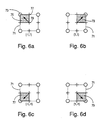
- Figs. 6a, 6b, 6c, 6d show deflection unit vectors.
- Fig. 7 shows deflection assignments at the parent grid pixels.
- Fig. 8 shows image intensity versus distance for the dose modulation technique used alone.
- Fig. 9 illustrates a feature written using dose modulation technique showing edge contour intensities.
- Fig. 10 shows image intensity versus distance for the combination of the dose modulation and deflection.
- Fig. 11 illustrates a feature written using the combination of the dose modulation and deflection techniques.
- Fig. 12 illustrates pictorially a mask or IC feature written using dose modulation and pixel deflection.
- Figs. 13a, 13b, 13c show pictorially a slanted edge of a mask or IC feature with respectively conventional writing, dose modulation, and dose modulation with pixel deflection.
- the current delivered to the substrate to be written to (imaged) is fixed at a certain level and is only changed with a new pattern data file defining a new mask or die or between writing passes.
- dose modulation in accordance with the invention is useful for proximity effect correction and optical proximity correction where the feature to be written has edges which require biasing in order to maintain a uniform line width, i.e. the edges of the feature do not lie along the boundaries halfway between adjacent pixels.
- the beam blanker control electronics are modified to include pulse timing delays determined by a tappable delay line, the selection of the amount of delay being under computer control (called an "autotap") so that the edges of the blanking control pulses are moved in time (and hence space) relative to the raster grid to minimize the X-axis versus Y-axis critical dimensions of the written images.
- autotap pulse timing delays determined by a tappable delay line
- the selection of the amount of delay being under computer control
- the blanker electronics which effectively turn the electron (or other) beam on and off are driven by a control pulse as illustrated in Fig. 1.
- the pulse When the pulse is high this deactivates the blanker to define (illuminate) a pixel on the medium to be written to.
- the horizontal axis represents time t, and the pulse has a nominal width (duration) of X which is inversely proportional to the writing rate.
- a nominal width (duration) of X which is inversely proportional to the writing rate.
- the blanker electronics When a clock pulse of Fig. 1 is received by the blanker electronics, the blanker electronics, in accordance with a second data input signal which controls the pulse duration, delays either or both of the leading or trailing edges of the pulse based on a preset value that the system user determines based on, for instance, experimental data to achieve optimum feature edges.
- the experimentation involves the resist type, process, and dose to make the X vs. Y critical dimensions (CD) the same. Since the X-axis CD is determined by the resist, dose, and process, the only degree of freedom is the Y-axis by controlling the shape width. Alternately, the delays are determined by simulation, or a simple linear approximation of edge placement from the pixel boundaries being proportional to the dose.
- a number of user preset delay values are provided in the pulse blanker control electronics to control the time of occurrence of both the leading and trailing edge of each pixel activation pulse in the blanker electronics. These leading and trailing pulse edges result in a number of preset pulses with varying pulse widths available. This provides a variable dose per pixel.
- the proper pulse width per pixel is selected by modifying the pattern memory in the high speed rasterizer to e.g. a 2 bit (or more) deep bit map representing for example four "gray" levels.
- Fig. 2 where the Data column indicates the two data bits for determining pulse width, i.e. modulating the pulse, and the associated right hand waveforms illustrate the corresponding beam blanker pulse durations varying from nominal 100% duration down to off (0% duration.)
- the intermediate durations 30% and 70% here are examples. The actual values are determined by experimentation to achieve the optimum image result. From signal to noise arguments and the noise characteristics of E-beam gun technology, it has been determined that the number of useful dosage levels is 10 for dosage modulation by itself and 17 for dosage modulation combined with pixel deflection.
- the waveforms of Fig. 2 are achieved in one embodiment by the apparatus of Fig. 3, which allows the user to select the desired beam blanker pulse duration per pixel.
- the blanker control electronics include a data control section 20 which receives both a conventional clock signal determining the writing rate and in this case a D0 and a D1 (extendable to DN) signal, which are the number N data bits shown in the left hand column in Fig. 2.
- the blanker electronics also includes three (N-1) sets of pulse generators 22, 24, 26 (here also labelled pulse 1, pulse 2 and pulse 3). Each set of pulse generators has two controls, one for the pulse leading edge and one for the pulse trailing edge. Each pulse generator 22, 24, 26 can be addressed separately by the data control section 20. The user sets each pulse generator 22, 24, 26 in accordance with the best results taken from experiments for his particular E-beam machine, photoresist medium, and other relevant process factors (or alternatively by simulation or linear approximation).
- the input DIGITAL CLK signal drives all three pulse generator sets 22, 24, 26 as shown thus allowing stable pulses at all times. Selection of which pulse width will be used for a particular pixel is done by a circuit (not shown) which delivers the two bits of data D0, D1 to data control section 20 along with the blanker clock signal.
- the pattern memory in the high speed rasterizer is duplicated as compared to conventional practice to provide the two bit deep memory storing data D0, D1 indicating the pulse width for each pixel.
- the system computer programs (otherwise conventional) are modified (in a manner apparent to one of ordinary skill in the art in accordance with this description) to support this procedure.
- the durations of each of the three pulse widths for pulse 1, pulse 2 and pulse 3 are variable and are determined by the user by providing tappable delay line data via lines 30 to the tappable delay line latches 34 which in turn communicate the duration of the particular pulse needed to the three sets of pulse generators 22, 24, 26. Also provided is a select control signal and a digital clock signal to the tappable delay line latches 34, to load the desired pulse width information in each latch.
- each of the three pulse generators 22, 24, 26 are provided to a high speed pulse select circuit 40 which delivers the appropriate pulse to the beam as needed.
- the pulse select circuit 40 then in response to the clock signal and the two data signals D0, D1 from data control section 20 selects which of the three sets of delay pulses will be provided to the output amplifier 44 which in turn drives the blanking plates (not shown) in the conventional blanker.
- FIG. 4a A typical feature written using dose modulation is numerically represented in Fig. 4a, where the small X's denote intersections of the perimeter lines (light horizontal and vertical lines) defining the pixels.
- the dose value of each pixel is shown digitally in accordance with Fig. 2.
- the heavy line 50 is the outline of the desired feature.
- the left edge 52 of the feature is placed by setting the dose for that column of pixels at 30% (01) and the right edge 54 determined by the 70% dose pixels (10).
- the left edge 52 is spaced approximately 1/3 of the way from the nearest adjacent right grid perimeter line 60
- the right edge 54 of the feature is spaced approximately 2/3 of the way from the nearest adjacent left grid perimeter line 62.
- edges 52, 54 to the feature which lie between the cartesian grid perimeter lines of the raster.
- FIG. 4b Another depiction of the feature of Fig. 4a is shown in Fig. 4b where the relative image intensity of each pixel is shown as the pixel diameter.
- the pixels (circles) are shown centered on the raster grid center points.
- Figures 3, 4a, 4b are representations of the pattern data in the pattern memory. It is to be understood that in reality, where pixel modulation is achieved by controlling pixel exposure (dwell) time, the actual pixel images would be of normal size (beam diameter) in the direction perpendicular to the scan, and shorter in the direction of the scan. Thus in Fig. 4b, the pixels of the left edge 52 are very small (30% of normal), and then at the right edge 54 and somewhat small (70% of normal). The resulting feature outlines as shown.
- the above described dose modulation can be used in accordance with a stripe butting approach for adjacent stripes which form one feature using stripe overlapping, where the overlap area is for example 1/3 to 2/3 dosed in accordance with the present invention.
- This will have the benefits of the well known scan offset voting without the overhead (repeated passes) associated with writing the entire pattern area multiple times. See copending and commonly assigned U.S. patent application Serial No. 08/069-268, filed May 28, 1993 entitled “Gray Scaled Dosing for Lithography” invented by John Poo et al., Attorney Docket No.M-2452.
- a feature written using one embodiment of pixel deflection is illustrated in Figure 5.
- the pixels in the interior 72 and righthand 74 portion of the feature outlined by line 70 are located at the normal raster cartesian grid points. However, the pixels located along the left edge of the feature are deflected (moved) from the normal grid points rightwards by a variable amount so as to define the left edge of the feature to lie off the normal raster grid.
- the pixels in the upper portion 78 of the left edge are deflected less than are the pixels in the lower portion 80 thereof.
- This pixel deflection thereby achieves the advantages of dose modulation, without the need to change the pixel exposure durations.
- the E-beam effective current does not have to be modulated with pixel deflection alone.
- Pixel deflection can be done in one (x,y) direction, with reduced effectiveness, or in both directions.
- the implementation of deflection for the two directions can be different.
- the deflection can be achieved with turn-on and turn-off modulation alone, rather than by electrostatic beam deflection.
- pixel deflection is achieved by a particular type of pattern processing for raster scanning.
- the design pattern defining the feature is composed at an address unit of one half of the writing address unit (the normal cartesian grid spacing).
- the address unit size is doubled, to its normal size.
- the relation of the design pixel (child) and the writing pixel (parent) is shown in Figs. 6a, 6b, 6c, 6d where the circles are the corner points of the parents and the crosses are the children.
- Figs. 6a, 6b, 6c, 6d display the same parent pixel, but highlighting a different child pixel. At each parent pixel, e.g.
- the vector sum (arrows) of the intersecting child pixels 73, 75, 77, 79 is calculated.
- the coordinate pairs, e.g. (-1, 1) represent the four unit vectors of deflection. This sum is mapped into the intensity value at which the pixel is exposed (as described below). For pixel deflection used without dose modulation, this intensity value is the full pixel intensity value.
- the direction of the deflection is given by the direction of the vector sum of the constituent child pixels interacting with the parent.
- the amplitude of the deflection is a function of the sum of the number of constituent child pixels and possibly the pixel configuration. Additional improvements to the positioning of the pixel could be done, if the arrangement of the neighboring pixels is considered.
- the needed deflection is typically inversely related to the sum of the number of constituent configuration.
- An example of a feature pattern defined by outline 80 and the corresponding deflection of each parent is shown in Fig. 7. As shown here, the left 82 and top 84 edges of the feature 80 are extended beyond the parent pixels, e.g. pixel 86, by 1/2 of the writing address unit to the adjacent child pixel 88.
- a generalization of the deflection method allows calculation of the overlap area of the parent pixel with angled lines and assigns a displacement corresponding to the overlap area and assigns a location of the parent pixel. This allows elimination of the staircase effect for angled feature edges than one might obtain for instance with dose modulation.
- Pixel deflection is used during writing of feature edge pixels in the x direction and may be used in the y (scan) direction as explained below.
- the maximum deflection typically is one half pixel length in any direction, and adjacent pixels may have different deflection amounts.
- the precision of the deflection is dependent on the number of edge placements that are used; one example would be sixteen edge placements for each pixel in each direction; i.e., 32 displacement gradations between normal pixel centers.
- Edge deflection is achieved in an E-beam system in terms of apparatus by an electrostatic beam deflector which is impedance matched to the deflector driving circuit.
- each deflector includes an offset (off axis) hole drilled all the way through a coaxial transmission line. The electron beam passes through the hole and is deflected by a voltage of particular levels (plus or negative) on the transmission line central conductor; the outer conductor is at ground.
- One such deflector is provided for each axis (X,Y) in which deflection is to take place.
- Other electrostatic deflectors are also suitable. These X and Y deflectors are placed in the objective lens of the electron beam system.
- Deflection is performed during writing at the start of scan of the beam across a particular pixel. It must be possible to turn the deflection on or off in a time comparable to the write time of a typical feature, usually many pixels in duration. Thus one can start the deflection gradually on pixels that are not written, and turn it off gradually over several pixels that are being written. Typical values for the magnitude of the deflection would be 0, 0.05, 0.07 and 0.1 micrometers for a 0.1 micrometer diameter address unit (pixel diameter).
- Pulse offsets eliminate the need for the Y-direction deflector by instead advancing or delaying the writing pulse that actuate the beam blanker during scanning; this shifts the pulse center left or right of its normal position.
- tappable delay lines advance or delay (in time and hence space) the pixel writing pulse by a predetermined amount.
- Fig. 8 shows image intensity (vertical axis) versus distance ( ⁇ m) from an arbitrary vertical line to a vertical feature edge for dose modulation, given a four pixel wide line (and assuming scanning in the Y-direction). Varying doses of 0%, 33%, 66% and 100% of the maximum dose correspond respectively to index numbers 1, 2, 3, and 4 for address unit and beam diameter of 0.1 micron. Note that the edge profile changes dramatically as the dose at the edge is varied. This is a significant deficiency.
- Fig. 9 shows the equal intensity contours 100 of exposure distribution resulting from writing a feature test pattern 104 as shown, where the dose is varied as in Fig.8 at the left edge of the feature. Note that the horizontal distance between contours increases as the dose at the edge pixels is decreased (bottom to top of feature 104). This may result in reduced process latitude.
- Fig. 10 shows image intensity versus distance for a four pixel wide line (assuming scanning the y direction) with both dose modulation and pixel deflection as indicated in Table 1 for four combinations of dose and deflection. Note that the edge profile does not change as the edge is displaced. Displacement is measured from the edge of the neighboring pixel. (For Figs. 10 and 11) Index Displacement Dose Shift (in Linewidth) 1 0 0 0% 2 .05 33% 0.0238 3 .03 66% 0.0561 4 0 100% 0.1
- Fig. 11 shows the corresponding equal intensity contours of the exposure distributions resulting from writing the feature test pattern 104 shown using dose modulation and pixel deflection corresponding to Figure 10.
- the horizontal distance between contours 108 at the left edge of the figure is approximately constant, because the edge is displaced. This desirably results in uniform process latitude.
- Fig. 12 Details of a feature written using combined dose modulation and pixel deflection is shown in Fig. 12 note that the pixels at the left edge 116 of the feature 114 (defined by outline 118) are both of reduced size and shifted off the normal grid centerpoints.
- dose modulation is accomplished in the same manner as in dose modulation used by itself.
- Figs. 13a, 13b, 13c show pictorially a triangular feature 122 written respectively using conventional single pass printing, dose modulation by itself, and dose modulation with pixel deflection.
- the pixels here are represented as contiguous squares. The darker pixels are those with more intense doses.
- the perceived edges of each feature 122 is delineated by a line; line 124 of Fig. 13a is non-uniform (uneven).
- Line 126 of Fig. 13b is closer to the original triangle shape.
- Line 128 of Fig. 13c is even closer to the original triangle shape, with better uniformity.
Landscapes
- Chemical & Material Sciences (AREA)
- Engineering & Computer Science (AREA)
- Nanotechnology (AREA)
- Analytical Chemistry (AREA)
- Crystallography & Structural Chemistry (AREA)
- Physics & Mathematics (AREA)
- General Physics & Mathematics (AREA)
- Manufacturing & Machinery (AREA)
- Condensed Matter Physics & Semiconductors (AREA)
- Mathematical Physics (AREA)
- Theoretical Computer Science (AREA)
- Electron Beam Exposure (AREA)
- Exposure And Positioning Against Photoresist Photosensitive Materials (AREA)
Claims (20)
- Verfahren zum Belichten eines für eine Belichtung empfindlichen Mediums durch einen Strahl in einer Rasterabtastungs-Lithografievorrichtung, wobei das Verfahren die folgenden Schritte umfasst:Abtasten des Strahls über eine Oberfläche des Mediums in einem Rastermuster, um eine Vielzahl von Pixeln des Rastermusters auf dem Medium zu belichten, um wenigstens ein belichtetes Merkmal auf der Oberfläche des Mediums zu bilden, wobei das Merkmal die Vielzahl von Pixeln und wenigstens eine Kante umfasst,
gekennzeichnet durchModulieren der Dauer der Belichtung von wenigstens einigen der Pixel an der Kante des Merkmals durch das Reduzieren der Dauer der Belichtung der Pixel an der Kante im Vergleich zu den Pixeln in anderen Teilen des Merkmals, um die Kante des Merkmals als eine Linie zu definieren, die zu einem Raster versetzt ist, das durch die Positionen der Pixel des Rastermusters definiert wird. - Verfahren nach Anspruch 1,
dadurch gekennzeichnet, dass
der Schritt zum Modulieren umfasst:Vorbestimmen von wenigstens drei Dauern der Belichtung, wobei eine der Dauern gleich null ist, undAuswählen von einer der wenigstens drei Dauern für jedes zu belichtende Pixel. - Verfahren nach Anspruch 2,
dadurch gekennzeichnet, dass
der Schritt zum Vorbestimmen umfasst:Vorsehen einer Verzögerungsschaltung mit wenigstens zwei Paaren von Verzögerungen, die jeweils zwei Verzögerungen aufweisen, wobei eine Verzögerung mit einem Start und eine Verzögerung mit einem Ende einer bestimmten Pixelbelichtung assoziiert ist. - Verfahren nach Anspruch 3,
dadurch gekennzeichnet, dass
der Schritt zum Auswählen umfasst:Ausgeben eines Zeitsignals und eines Dauersignals zu einem Austaster für das Austasten des Strahls, undAustasten des Strahls in Übereinstimmung mit dem Zeitsignal und dem Dauersignal, um die Dauer der Belichtung zu modulieren. - Verfahren nach Anspruch 4,
dadurch gekennzeichnet, dass
das Dauerauswahlsignal ein digitales Signal mit wenigstens zwei Stellen für jedes Pixel aus der Vielzahl von Pixeln ist. - Verfahren nach Anspruch 2,
dadurch gekennzeichnet, dass
das Verfahren wenigstens drei vorbestimmte Zeitdauern zusätzlich zu der Nulldauer vorsieht, wobei die Dauern jeweils 100%, ungefähr 70% und ungefähr 30% einer vollen Pixelbelichtungsdauer betragen und wobei das Verfahren weiterhin folgende Schritte umfasst:Belichten der Pixel mit der Dauer von ungefähr 70% für ein bestimmtes Pixel an einer Kante des Merkmals, die bei ungefähr 2/3 der Strecke zwischen dem bestimmten Pixel und einem benachbarten unbelichteten Pixel angeordnet ist, undBelichten der Pixel mit der Dauer von ungefähr 30% für ein bestimmtes Pixel an einer Kante des Merkmals, die bei ungefähr 1/3 der Strecke zwischen dem bestimmten Pixel und einem benachbarten unbelichteten Pixel angeordnet ist. - Verfahren nach wenigstens einem der Ansprüche 1 bis 6,
dadurch gekennzeichnet, dass
das Verfahren weiterhin einen Schritt zum Ablenken des Strahls umfasst, während es wenigstens einige der Pixel an der Kante des Merkmals abtastet, um die Pixel an der Kante an Positionen vorzusehen, die gegenüber dem Raster versetzt sind. - Verfahren nach Anspruch 7,
dadurch gekennzeichnet, dass
der Schritt zum Ablenken umfasst:Vorbestimmen von wenigstens zwei Ablenkungsgrößen, undAuswählen von einer der wenigstens zwei Größen zum Ablenken jedes der abgelenkten Pixel. - Verfahren nach Anspruch 8,
dadurch gekennzeichnet, dass
der Schritt zum Ablenken weiterhin umfasst:Vorsehen eines elektrostatischen Strahlablenkers, undSteuern einer Spannung für den elektrostatischen Ablenker, um den Strahl abzulenken. - Verfahren nach einem der Ansprüche 8 und 9,
dadurch gekennzeichnet, dass
das Verfahren weiterhin wenigstens drei Ablenkungsgrößen vorsieht, wobei die wenigstens drei Ablenkungsgrößen relativ zu dem Abstand zwischen den Zentren von nicht abgelenkten Pixeln jeweils 1/2, 0,35 und 0,25 sind. - Verfahren nach Anspruch 7,
dadurch gekennzeichnet, dass
das Rastermuster zwei senkrechte Richtungen definiert, wobei der Schritt zum Ablenken das Ablenken von nur einer der zwei Richtungen umfasst. - Verfahren nach Anspruch 11,
dadurch gekennzeichnet, dass
das Verfahren weiterhin das Ablenken entlang der anderen der zwei Richtungen umfasst. - Verfahren nach Anspruch 7,
dadurch gekennzeichnet, dass
das Verfahren weiterhin einen Schritt zum linearen Ablenken des Strahls für alle Pixel innerhalb eines Merkmals umfasst. - Rasterabtastungs-Fotolithografievorrichtung mit:einem Strahlerzeuger,einer Halterung für ein für die Belichtung durch den Strahl empfindliches Medium,einem Rasterabtastungssystem, das zwischen dem Strahlerzeuger und der Halterung angeordnet ist, um den Strahl in einem Rastermuster mit einer Vielzahl von Pixeln über das Medium abzutasten, um ein Merkmal auf der Oberfläche des Mediums zu belichten, das durch einige der Pixel definiert wird,einem Strahlaustaster, der zwischen dem Strahlerzeuger und der Halterung angeordnet ist, um den Strahl auszutasten, um die Pixel zu definieren,gekennzeichnet durcheine Strahlaustaster-Steuereinrichtung, die operativ mit dem Strahlaustaster verbunden ist, um eine Dauer der Pixel an der Kante des Merkmals auf wenigstens zwei vorbestimmte Größen zu reduzieren, die jeweils zwischen einer Nulldauer und einer Vollpixeldauer liegen.
- Vorrichtung nach Anspruch 14,
dadurch gekennzeichnet, dass
die Strahlaustaster-Steuereinrichtung wenigstens zwei voreingestellte Verzögerungspfade zum Reduzieren der Dauer der Pixel auf die zwei Zwischengrößen umfasst. - Vorrichtung nach Anspruch 15,
dadurch gekennzeichnet, dass
die zwei voreingestellten Verzögerungspfade Pixeldauern von ungefähr 30% und ungefähr 70% der Vollpixeldauer definieren. - Vorrichtung nach einem der Ansprüche 15 oder 16,
dadurch gekennzeichnet, dass
die Strahlaustaster-Steuereinrichtung einen Datensteuerteil zum Empfangen eines Datensignals mit wenigstens zwei Stellen umfasst, um zu bestimmen, welcher der voreingestellten Verzögerungspfade jede der Pixeldauern reduzieren soll. - Vorrichtung nach wenigstens einem der Ansprüche 14 bis 17,
dadurch gekennzeichnet, dass
ein zwei Bit tiefer Musterspeicher mit der Strahlaustaster-Steuereinrichtung assoziiert ist, um Daten zu speichern, welche die Dauer der Belichtung jedes Pixels an der Kante des Merkmals definieren. - Verfahren nach wenigstens einem der Ansprüche 1 bis 13,
dadurch gekennzeichnet, dass
der Modulationsschritt die Variation der Impulsbreite umfasst, welche eine Dauer der Pixel definiert. - Verfahren nach wenigstens einem der Ansprüche 1 bis 13 oder 19,
dadurch gekennzeichnet, dass
das Verfahren das Speichern von Daten, welche die Dauer der Belichtung für jedes Pixel an der Kante des Merkmals definieren, in einem zwei Bit tiefen Musterspeicher umfasst.
Applications Claiming Priority (3)
| Application Number | Priority Date | Filing Date | Title |
|---|---|---|---|
| US69222 | 1993-05-28 | ||
| US08/069,222 US5393987A (en) | 1993-05-28 | 1993-05-28 | Dose modulation and pixel deflection for raster scan lithography |
| PCT/US1994/005102 WO1994028574A1 (en) | 1993-05-28 | 1994-05-06 | Dose modulation and pixel deflection for raster scan lithography |
Publications (3)
| Publication Number | Publication Date |
|---|---|
| EP0653103A1 EP0653103A1 (de) | 1995-05-17 |
| EP0653103A4 EP0653103A4 (de) | 1998-12-16 |
| EP0653103B1 true EP0653103B1 (de) | 2001-12-19 |
Family
ID=22087529
Family Applications (1)
| Application Number | Title | Priority Date | Filing Date |
|---|---|---|---|
| EP94917933A Expired - Lifetime EP0653103B1 (de) | 1993-05-28 | 1994-05-06 | Dosis modulierung und pixel-ablenkung für rasterabgetastetes lithographieverfahren |
Country Status (7)
| Country | Link |
|---|---|
| US (1) | US5393987A (de) |
| EP (1) | EP0653103B1 (de) |
| JP (1) | JP3323505B2 (de) |
| KR (1) | KR0174585B1 (de) |
| CA (1) | CA2139637C (de) |
| DE (1) | DE69429498T2 (de) |
| WO (1) | WO1994028574A1 (de) |
Families Citing this family (59)
| Publication number | Priority date | Publication date | Assignee | Title |
|---|---|---|---|---|
| US5847959A (en) * | 1997-01-28 | 1998-12-08 | Etec Systems, Inc. | Method and apparatus for run-time correction of proximity effects in pattern generation |
| US6274290B1 (en) * | 1997-01-28 | 2001-08-14 | Etec Systems, Inc. | Raster scan gaussian beam writing strategy and method for pattern generation |
| US5876902A (en) * | 1997-01-28 | 1999-03-02 | Etec Systems, Inc. | Raster shaped beam writing strategy system and method for pattern generation |
| GB2328073B (en) * | 1997-08-01 | 2002-05-22 | Leica Lithography Systems Ltd | Method of and machine for pattern writing by an electron beam |
| US5990540A (en) * | 1997-12-15 | 1999-11-23 | Kabushiki Kaisha Toshiba | Semiconductor device and method for manufacturing the same |
| GB2333018A (en) * | 1997-12-23 | 1999-07-07 | Northern Telecom Ltd | Electron beam scanning system suitable for chirped grating fabrication |
| US6941006B1 (en) * | 1998-03-05 | 2005-09-06 | Dupont Photomasks, Inc. | Method and system for calibrating the scan amplitude of an electron beam lithography instrument |
| US6145438A (en) * | 1998-03-20 | 2000-11-14 | Berglund; C. Neil | Method and apparatus for direct writing of semiconductor die using microcolumn array |
| US6360134B1 (en) | 1998-07-20 | 2002-03-19 | Photronics, Inc. | Method for creating and improved image on a photomask by negatively and positively overscanning the boundaries of an image pattern at inside corner locations |
| US6262429B1 (en) | 1999-01-06 | 2001-07-17 | Etec Systems, Inc. | Raster shaped beam, electron beam exposure strategy using a two dimensional multipixel flash field |
| US6259106B1 (en) * | 1999-01-06 | 2001-07-10 | Etec Systems, Inc. | Apparatus and method for controlling a beam shape |
| US6556702B1 (en) | 1999-01-06 | 2003-04-29 | Applied Materials, Inc. | Method and apparatus that determines charged particle beam shape codes |
| US6316164B1 (en) | 1999-03-16 | 2001-11-13 | N. William Parker | Proximity effect correction method through uniform removal of fraction of interior pixels |
| US6819450B1 (en) * | 2000-03-28 | 2004-11-16 | Applied Materials, Inc. | Enhanced edge resolution and critical dimension linearity in lithography |
| WO2001093303A2 (en) * | 2000-06-01 | 2001-12-06 | Applied Materials, Inc. | High throughput multipass printing with lithographic quality |
| US6645677B1 (en) | 2000-09-18 | 2003-11-11 | Micronic Laser Systems Ab | Dual layer reticle blank and manufacturing process |
| US20030233630A1 (en) * | 2001-12-14 | 2003-12-18 | Torbjorn Sandstrom | Methods and systems for process control of corner feature embellishment |
| SE0104238D0 (sv) | 2001-12-14 | 2001-12-14 | Micronic Laser Systems Ab | Method and apparatus for patterning a workpiece |
| US6998217B2 (en) * | 2003-01-06 | 2006-02-14 | Applied Materials, Inc. | Critical dimension edge placement and slope enhancement with central pixel dose addition and modulated inner pixels |
| EP1678536A1 (de) * | 2003-09-05 | 2006-07-12 | Massachusetts Institute Of Technology | Präzise und permanente modifikation der resonanzfrequenz eines dielektrischen mikroresonators und korrektur von frequenzverschiebungen in dielektrischen koppelresonatorfiltern |
| JP2007522671A (ja) * | 2004-02-25 | 2007-08-09 | マイクロニック レーザー システムズ アクチボラゲット | 光マスクレスリソグラフィにおいてパターンを露光し、マスクをエミュレートする方法 |
| JP4614696B2 (ja) * | 2004-06-24 | 2011-01-19 | Hoya株式会社 | グレートーンマスクの製造方法 |
| JP2008511144A (ja) * | 2004-08-23 | 2008-04-10 | マイクロニック レーザー システムズ アクチボラゲット | 強化されたcd線形性のための非コヒーレント結像システムのひとみ改善 |
| WO2006076740A2 (en) * | 2005-01-14 | 2006-07-20 | Arradiance, Inc. | Synchronous raster scanning lithographic system |
| ATE537550T1 (de) * | 2005-07-08 | 2011-12-15 | Nexgen Semi Holding Inc | Vorrichtung und verfahren zur kontrollierten fertigung von halbleitern mittels teilchenstrahlen |
| TWI432908B (zh) | 2006-03-10 | 2014-04-01 | 瑪波微影Ip公司 | 微影系統及投射方法 |
| WO2008140585A1 (en) | 2006-11-22 | 2008-11-20 | Nexgen Semi Holding, Inc. | Apparatus and method for conformal mask manufacturing |
| US8077377B2 (en) * | 2008-04-24 | 2011-12-13 | Micronic Mydata AB | Spatial light modulator with structured mirror surfaces |
| US10991545B2 (en) | 2008-06-30 | 2021-04-27 | Nexgen Semi Holding, Inc. | Method and device for spatial charged particle bunching |
| US10566169B1 (en) | 2008-06-30 | 2020-02-18 | Nexgen Semi Holding, Inc. | Method and device for spatial charged particle bunching |
| DE102009055271A1 (de) * | 2009-12-23 | 2011-06-30 | Carl Zeiss NTS GmbH, 73447 | Verfahren zur Erzeugung einer Darstellung eines Objekts mittels eines Teilchenstrahls sowie Teilchenstrahlgerät zur Durchführung des Verfahrens |
| US8539395B2 (en) | 2010-03-05 | 2013-09-17 | Micronic Laser Systems Ab | Method and apparatus for merging multiple geometrical pixel images and generating a single modulator pixel image |
| FR2959026B1 (fr) * | 2010-04-15 | 2012-06-01 | Commissariat Energie Atomique | Procede de lithographie a optimisation combinee de l'energie rayonnee et de la geometrie de dessin |
| JP5672921B2 (ja) * | 2010-10-06 | 2015-02-18 | 大日本印刷株式会社 | パターン形状予測プログラム、パターン形状予測システム |
| US8464186B2 (en) | 2011-01-21 | 2013-06-11 | Taiwan Semiconductor Manufacturing Company, Ltd. | Providing electron beam proximity effect correction by simulating write operations of polygonal shapes |
| JP5859778B2 (ja) | 2011-09-01 | 2016-02-16 | 株式会社ニューフレアテクノロジー | マルチ荷電粒子ビーム描画装置及びマルチ荷電粒子ビーム描画方法 |
| DE102012000650A1 (de) | 2012-01-16 | 2013-07-18 | Carl Zeiss Microscopy Gmbh | Verfahren und vorrichtung zum abrastern einer oberfläche eines objekts mit einem teilchenstrahl |
| JP2013165121A (ja) * | 2012-02-09 | 2013-08-22 | Canon Inc | 描画装置、生成方法、プログラム及び物品の製造方法 |
| JP6128744B2 (ja) * | 2012-04-04 | 2017-05-17 | キヤノン株式会社 | 描画装置、描画方法、および、物品の製造方法 |
| DE102012010707A1 (de) * | 2012-05-30 | 2013-12-05 | Carl Zeiss Microscopy Gmbh | Verfahren und vorrichtung zum abrastern einer oberfläche einesobjekts mit einem teilchenstrahl |
| JP6147528B2 (ja) | 2012-06-01 | 2017-06-14 | 株式会社ニューフレアテクノロジー | マルチ荷電粒子ビーム描画方法及びマルチ荷電粒子ビーム描画装置 |
| US9658538B2 (en) * | 2014-12-19 | 2017-05-23 | Taiwan Semiconductor Manufacturing Company, Ltd. | System and technique for rasterizing circuit layout data |
| US10410831B2 (en) | 2015-05-12 | 2019-09-10 | Ims Nanofabrication Gmbh | Multi-beam writing using inclined exposure stripes |
| US10325756B2 (en) | 2016-06-13 | 2019-06-18 | Ims Nanofabrication Gmbh | Method for compensating pattern placement errors caused by variation of pattern exposure density in a multi-beam writer |
| JP7196271B2 (ja) * | 2016-11-14 | 2022-12-26 | 株式会社アドテックエンジニアリング | ダイレクトイメージング露光装置及びダイレクトイメージング露光方法 |
| JP7023601B2 (ja) * | 2016-11-14 | 2022-02-22 | 株式会社アドテックエンジニアリング | ダイレクトイメージング露光装置及びダイレクトイメージング露光方法 |
| US10095116B2 (en) | 2016-12-14 | 2018-10-09 | Taiwan Semiconductor Manufacturing Co., Ltd. | Lithography system and lithography method for improving image contrast |
| US10325757B2 (en) | 2017-01-27 | 2019-06-18 | Ims Nanofabrication Gmbh | Advanced dose-level quantization of multibeam-writers |
| US10522329B2 (en) | 2017-08-25 | 2019-12-31 | Ims Nanofabrication Gmbh | Dose-related feature reshaping in an exposure pattern to be exposed in a multi beam writing apparatus |
| JP7201364B2 (ja) * | 2017-08-25 | 2023-01-10 | アイエムエス ナノファブリケーション ゲーエムベーハー | マルチビーム描画装置において露光される露光パターンにおける線量関連の特徴再形成 |
| US11569064B2 (en) | 2017-09-18 | 2023-01-31 | Ims Nanofabrication Gmbh | Method for irradiating a target using restricted placement grids |
| US10651010B2 (en) | 2018-01-09 | 2020-05-12 | Ims Nanofabrication Gmbh | Non-linear dose- and blur-dependent edge placement correction |
| US10840054B2 (en) | 2018-01-30 | 2020-11-17 | Ims Nanofabrication Gmbh | Charged-particle source and method for cleaning a charged-particle source using back-sputtering |
| EP3811153A1 (de) * | 2018-06-19 | 2021-04-28 | EV Group E. Thallner GmbH | Verfahren und vorrichtung zur belichtung von bildpunkten |
| US11099482B2 (en) | 2019-05-03 | 2021-08-24 | Ims Nanofabrication Gmbh | Adapting the duration of exposure slots in multi-beam writers |
| JP7555297B2 (ja) | 2020-04-24 | 2024-09-24 | アイエムエス ナノファブリケーション ゲーエムベーハー | 荷電粒子源 |
| EP4095882A1 (de) | 2021-05-25 | 2022-11-30 | IMS Nanofabrication GmbH | Musterdatenverarbeitung für programmierbare direktschreibgeräte |
| US12154756B2 (en) | 2021-08-12 | 2024-11-26 | Ims Nanofabrication Gmbh | Beam pattern device having beam absorber structure |
| US12493005B1 (en) | 2022-06-07 | 2025-12-09 | Nexgen Semi Holding, Inc. | Extended range active illumination imager |
Family Cites Families (30)
| Publication number | Priority date | Publication date | Assignee | Title |
|---|---|---|---|---|
| US3801792A (en) * | 1973-05-23 | 1974-04-02 | Bell Telephone Labor Inc | Electron beam apparatus |
| US3900737A (en) * | 1974-04-18 | 1975-08-19 | Bell Telephone Labor Inc | Electron beam exposure system |
| US4393312A (en) * | 1976-02-05 | 1983-07-12 | Bell Telephone Laboratories, Incorporated | Variable-spot scanning in an electron beam exposure system |
| JPS603773B2 (ja) * | 1977-03-30 | 1985-01-30 | 株式会社東芝 | 電子ビ−ム露光装置 |
| JPS56158425A (en) * | 1980-05-12 | 1981-12-07 | Jeol Ltd | Electron beam exposure |
| JPS5710236A (en) * | 1980-06-23 | 1982-01-19 | Toshiba Corp | Pattern drawing device |
| US4445041A (en) * | 1981-06-02 | 1984-04-24 | Hewlett-Packard Company | Electron beam blanker |
| JPS5832419A (ja) * | 1981-08-20 | 1983-02-25 | Sanyo Electric Co Ltd | ラスタ−スキヤン型電子ビ−ム露光装置 |
| US4438453A (en) * | 1982-01-21 | 1984-03-20 | Polaroid Corporation | Constant light greyscale generator for CRT color camera system |
| JPS593923A (ja) * | 1982-06-30 | 1984-01-10 | Fujitsu Ltd | 電子ビ−ム露光方法 |
| US4477729A (en) * | 1982-10-01 | 1984-10-16 | International Business Machines Corporation | Continuously writing electron beam stitched pattern exposure system |
| US4547712A (en) * | 1983-05-04 | 1985-10-15 | Fmc Corporation | Subharmonic controller for electromagnetic exciter |
| US4498010A (en) * | 1983-05-05 | 1985-02-05 | The Perkin-Elmer Corporation | Virtual addressing for E-beam lithography |
| US4620288A (en) * | 1983-10-26 | 1986-10-28 | American Semiconductor Equipment Technologies | Data handling system for a pattern generator |
| EP0178156B1 (de) * | 1984-10-09 | 1991-07-10 | Kabushiki Kaisha Toshiba | Verfahren zur Erzeugung eines gewünschten Musters auf einem Ziel mittels Elektronenstrahlbelichtung desselben |
| JPS6286717A (ja) * | 1985-10-11 | 1987-04-21 | Mitsubishi Electric Corp | パタ−ン形成方法 |
| JPS62137824A (ja) * | 1985-12-11 | 1987-06-20 | Mitsubishi Electric Corp | ラスタ−走査型電子ビ−ム露光装置 |
| GB2190567A (en) * | 1986-05-16 | 1987-11-18 | Philips Electronic Associated | Electron beam pattern generator control |
| US4879605A (en) * | 1988-02-29 | 1989-11-07 | Ateq Corporation | Rasterization system utilizing an overlay of bit-mapped low address resolution databases |
| US4868587A (en) * | 1988-05-20 | 1989-09-19 | Xerox Corporation | Image halftoning system for printers |
| GB8814624D0 (en) * | 1988-06-20 | 1988-07-27 | Crosfield Electronics Ltd | Modulating radiation beams |
| US4956650A (en) * | 1988-08-26 | 1990-09-11 | Ateq Corporation | Pattern generation system |
| US4963990A (en) * | 1989-06-09 | 1990-10-16 | Xerox Corporation | Continuous halftoning using quarternary pixel cells |
| US5138337A (en) * | 1990-05-10 | 1992-08-11 | Eastman Kodak Company | Apparatus for grey level printing using a binary architectured printhead |
| US5126759A (en) * | 1990-06-26 | 1992-06-30 | Eastman Kodak Company | Non-impact printer with token bit control of data and current regulation signals |
| DE4022732A1 (de) * | 1990-07-17 | 1992-02-20 | Micronic Laser Systems Ab | Auf einem lichtempfindlich beschichteten substrat durch fokussierte laserstrahlung hergestellte struktur sowie verfahren und vorrichtung zu ihrer herstellung |
| US5196376A (en) * | 1991-03-01 | 1993-03-23 | Polycon Corporation | Laser lithography for integrated circuit and integrated circuit interconnect manufacture |
| US5103101A (en) * | 1991-03-04 | 1992-04-07 | Etec Systems, Inc. | Multiphase printing for E-beam lithography |
| JP2842737B2 (ja) * | 1991-08-08 | 1999-01-06 | 富士通株式会社 | 電子ビーム露光方法 |
| US5204699A (en) * | 1992-09-14 | 1993-04-20 | Xerox Corporation | Apparatus for estimating toner usage |
-
1993
- 1993-05-28 US US08/069,222 patent/US5393987A/en not_active Expired - Lifetime
-
1994
- 1994-05-06 EP EP94917933A patent/EP0653103B1/de not_active Expired - Lifetime
- 1994-05-06 KR KR1019950700291A patent/KR0174585B1/ko not_active Expired - Fee Related
- 1994-05-06 DE DE69429498T patent/DE69429498T2/de not_active Expired - Fee Related
- 1994-05-06 CA CA002139637A patent/CA2139637C/en not_active Expired - Fee Related
- 1994-05-06 WO PCT/US1994/005102 patent/WO1994028574A1/en not_active Ceased
- 1994-05-06 JP JP50067595A patent/JP3323505B2/ja not_active Expired - Fee Related
Also Published As
| Publication number | Publication date |
|---|---|
| EP0653103A4 (de) | 1998-12-16 |
| JPH07509589A (ja) | 1995-10-19 |
| US5393987A (en) | 1995-02-28 |
| WO1994028574A1 (en) | 1994-12-08 |
| CA2139637A1 (en) | 1994-12-08 |
| DE69429498D1 (de) | 2002-01-31 |
| KR0174585B1 (ko) | 1999-02-01 |
| JP3323505B2 (ja) | 2002-09-09 |
| DE69429498T2 (de) | 2002-05-16 |
| EP0653103A1 (de) | 1995-05-17 |
| KR950702743A (ko) | 1995-07-29 |
| CA2139637C (en) | 2000-11-14 |
Similar Documents
| Publication | Publication Date | Title |
|---|---|---|
| EP0653103B1 (de) | Dosis modulierung und pixel-ablenkung für rasterabgetastetes lithographieverfahren | |
| US6433348B1 (en) | Lithography using multiple pass raster-shaped beam | |
| US5103101A (en) | Multiphase printing for E-beam lithography | |
| US4498010A (en) | Virtual addressing for E-beam lithography | |
| US5288567A (en) | Stencil mask and charged particle beam exposure method and apparatus using the stencil mask | |
| KR100403056B1 (ko) | 패턴발생을위한라스터형상빔기록스트레티지방법 | |
| KR100393129B1 (ko) | 패턴발생에서근접효과의런타임보정을위한방법및장치 | |
| EP1060498B1 (de) | Verfahren und vorrichtung zur festlegung der formeinkodierung einen ladungsträgerstrahls in lithographie systemen | |
| KR100416131B1 (ko) | 이차원 다중 픽셀 플래쉬 필드를 이용한 래스터 형상 비임 및 전자 비임 노출 방법 | |
| US9601315B2 (en) | Multiple charged particle beam lithography apparatus and multiple charged particle beam pattern writing method | |
| US6057907A (en) | Method of and system for exposing pattern on object by charged particle beam | |
| JP7126367B2 (ja) | 荷電粒子ビーム描画装置及び荷電粒子ビーム描画方法 | |
| JPH06132203A (ja) | 荷電粒子ビーム露光方法 | |
| US9852876B2 (en) | Multi charged particle beam writing apparatus and multi charged particle beam writing method | |
| JPS63114125A (ja) | 荷電ビ−ム露光装置 | |
| KR20010012701A (ko) | 마이크로컬럼 어레이를 이용한 반도체 다이의 직기입 방법및 장치 | |
| JPH0468768B2 (de) | ||
| EP1060500B1 (de) | Gerät und verfahren zur steuerung einer strahlform in lithographie systemen | |
| Yasuda et al. | Fast electron beam lithography system with 1024 beams individually controlled by blanking aperture array | |
| US11869746B2 (en) | Multi-beam writing method and multi-beam writing apparatus | |
| KR20040005951A (ko) | 2 차원 다중 픽셀 플래시 필드를 이용한 래스터 형상 빔,전자 빔 노광 방법 | |
| WO2001093303A2 (en) | High throughput multipass printing with lithographic quality | |
| JP3481017B2 (ja) | 荷電粒子ビーム露光装置および該荷電粒子ビーム露光装置の露光データ処理方法 | |
| JPH0669112A (ja) | 透過マスク板 | |
| JP7813613B2 (ja) | マルチ荷電粒子ビーム描画装置及びマルチ荷電粒子ビーム描画方法 |
Legal Events
| Date | Code | Title | Description |
|---|---|---|---|
| PUAI | Public reference made under article 153(3) epc to a published international application that has entered the european phase |
Free format text: ORIGINAL CODE: 0009012 |
|
| AK | Designated contracting states |
Kind code of ref document: A1 Designated state(s): DE FR GB IT NL |
|
| 17P | Request for examination filed |
Effective date: 19950517 |
|
| A4 | Supplementary search report drawn up and despatched |
Effective date: 19981029 |
|
| AK | Designated contracting states |
Kind code of ref document: A4 Designated state(s): DE FR GB IT NL |
|
| 17Q | First examination report despatched |
Effective date: 19991109 |
|
| GRAG | Despatch of communication of intention to grant |
Free format text: ORIGINAL CODE: EPIDOS AGRA |
|
| GRAG | Despatch of communication of intention to grant |
Free format text: ORIGINAL CODE: EPIDOS AGRA |
|
| GRAH | Despatch of communication of intention to grant a patent |
Free format text: ORIGINAL CODE: EPIDOS IGRA |
|
| GRAH | Despatch of communication of intention to grant a patent |
Free format text: ORIGINAL CODE: EPIDOS IGRA |
|
| GRAA | (expected) grant |
Free format text: ORIGINAL CODE: 0009210 |
|
| AK | Designated contracting states |
Kind code of ref document: B1 Designated state(s): DE FR GB IT NL |
|
| PG25 | Lapsed in a contracting state [announced via postgrant information from national office to epo] |
Ref country code: IT Free format text: LAPSE BECAUSE OF FAILURE TO SUBMIT A TRANSLATION OF THE DESCRIPTION OR TO PAY THE FEE WITHIN THE PRESCRIBED TIME-LIMIT;WARNING: LAPSES OF ITALIAN PATENTS WITH EFFECTIVE DATE BEFORE 2007 MAY HAVE OCCURRED AT ANY TIME BEFORE 2007. THE CORRECT EFFECTIVE DATE MAY BE DIFFERENT FROM THE ONE RECORDED. Effective date: 20011219 Ref country code: FR Free format text: LAPSE BECAUSE OF FAILURE TO SUBMIT A TRANSLATION OF THE DESCRIPTION OR TO PAY THE FEE WITHIN THE PRESCRIBED TIME-LIMIT Effective date: 20011219 |
|
| REG | Reference to a national code |
Ref country code: GB Ref legal event code: IF02 |
|
| REF | Corresponds to: |
Ref document number: 69429498 Country of ref document: DE Date of ref document: 20020131 |
|
| EN | Fr: translation not filed | ||
| PLBE | No opposition filed within time limit |
Free format text: ORIGINAL CODE: 0009261 |
|
| STAA | Information on the status of an ep patent application or granted ep patent |
Free format text: STATUS: NO OPPOSITION FILED WITHIN TIME LIMIT |
|
| 26N | No opposition filed | ||
| REG | Reference to a national code |
Ref country code: GB Ref legal event code: 732E |
|
| NLS | Nl: assignments of ep-patents |
Owner name: APPLIED MATERIALS, INC |
|
| PGFP | Annual fee paid to national office [announced via postgrant information from national office to epo] |
Ref country code: GB Payment date: 20040406 Year of fee payment: 11 |
|
| PG25 | Lapsed in a contracting state [announced via postgrant information from national office to epo] |
Ref country code: GB Free format text: LAPSE BECAUSE OF NON-PAYMENT OF DUE FEES Effective date: 20050506 |
|
| GBPC | Gb: european patent ceased through non-payment of renewal fee |
Effective date: 20050506 |
|
| PGFP | Annual fee paid to national office [announced via postgrant information from national office to epo] |
Ref country code: NL Payment date: 20060424 Year of fee payment: 13 |
|
| PGFP | Annual fee paid to national office [announced via postgrant information from national office to epo] |
Ref country code: DE Payment date: 20060531 Year of fee payment: 13 |
|
| PG25 | Lapsed in a contracting state [announced via postgrant information from national office to epo] |
Ref country code: NL Free format text: LAPSE BECAUSE OF NON-PAYMENT OF DUE FEES Effective date: 20071201 |
|
| NLV4 | Nl: lapsed or anulled due to non-payment of the annual fee |
Effective date: 20071201 |
|
| PG25 | Lapsed in a contracting state [announced via postgrant information from national office to epo] |
Ref country code: DE Free format text: LAPSE BECAUSE OF NON-PAYMENT OF DUE FEES Effective date: 20071201 |