EP0638552B1 - Procede d'obtention par synthese d'un derive d'azetidinone en substitution 4 - Google Patents
Procede d'obtention par synthese d'un derive d'azetidinone en substitution 4 Download PDFInfo
- Publication number
- EP0638552B1 EP0638552B1 EP94906364A EP94906364A EP0638552B1 EP 0638552 B1 EP0638552 B1 EP 0638552B1 EP 94906364 A EP94906364 A EP 94906364A EP 94906364 A EP94906364 A EP 94906364A EP 0638552 B1 EP0638552 B1 EP 0638552B1
- Authority
- EP
- European Patent Office
- Prior art keywords
- group
- groups
- substituted
- azetidinone
- ethyl
- Prior art date
- Legal status (The legal status is an assumption and is not a legal conclusion. Google has not performed a legal analysis and makes no representation as to the accuracy of the status listed.)
- Expired - Lifetime
Links
- -1 4-substituted azetidinone Chemical class 0.000 title claims abstract description 285
- 238000000034 method Methods 0.000 title claims abstract description 59
- 230000002194 synthesizing effect Effects 0.000 title claims abstract description 7
- 125000000217 alkyl group Chemical group 0.000 claims abstract description 66
- 125000003118 aryl group Chemical group 0.000 claims abstract description 58
- 125000003710 aryl alkyl group Chemical group 0.000 claims abstract description 44
- 125000003342 alkenyl group Chemical group 0.000 claims abstract description 42
- 125000003545 alkoxy group Chemical group 0.000 claims abstract description 39
- 125000003178 carboxy group Chemical group [H]OC(*)=O 0.000 claims abstract description 39
- 238000006243 chemical reaction Methods 0.000 claims abstract description 39
- 125000000623 heterocyclic group Chemical group 0.000 claims abstract description 37
- MNFORVFSTILPAW-UHFFFAOYSA-N azetidin-2-one Chemical class O=C1CCN1 MNFORVFSTILPAW-UHFFFAOYSA-N 0.000 claims abstract description 34
- 125000002252 acyl group Chemical group 0.000 claims abstract description 31
- 125000004414 alkyl thio group Chemical group 0.000 claims abstract description 30
- 125000002924 primary amino group Chemical group [H]N([H])* 0.000 claims abstract description 23
- 125000002887 hydroxy group Chemical group [H]O* 0.000 claims abstract description 15
- 239000005749 Copper compound Substances 0.000 claims abstract description 13
- 150000001880 copper compounds Chemical class 0.000 claims abstract description 13
- HCHKCACWOHOZIP-UHFFFAOYSA-N Zinc Chemical compound [Zn] HCHKCACWOHOZIP-UHFFFAOYSA-N 0.000 claims abstract description 7
- 229910052725 zinc Inorganic materials 0.000 claims abstract description 7
- 239000011701 zinc Substances 0.000 claims abstract description 7
- 229910052736 halogen Inorganic materials 0.000 claims abstract 4
- 150000002367 halogens Chemical class 0.000 claims abstract 4
- 125000001424 substituent group Chemical group 0.000 claims description 74
- 150000002148 esters Chemical class 0.000 claims description 33
- 125000005843 halogen group Chemical group 0.000 claims description 31
- 125000002102 aryl alkyloxo group Chemical group 0.000 claims description 30
- 125000003302 alkenyloxy group Chemical group 0.000 claims description 29
- 125000005108 alkenylthio group Chemical group 0.000 claims description 29
- 125000004659 aryl alkyl thio group Chemical group 0.000 claims description 29
- 125000005110 aryl thio group Chemical group 0.000 claims description 29
- 125000003368 amide group Chemical group 0.000 claims description 28
- 125000004104 aryloxy group Chemical group 0.000 claims description 28
- 125000000449 nitro group Chemical group [O-][N+](*)=O 0.000 claims description 27
- 125000004469 siloxy group Chemical group [SiH3]O* 0.000 claims description 27
- 125000004423 acyloxy group Chemical group 0.000 claims description 26
- 150000007970 thio esters Chemical group 0.000 claims description 24
- 125000001495 ethyl group Chemical group [H]C([H])([H])C([H])([H])* 0.000 claims description 23
- 125000004390 alkyl sulfonyl group Chemical group 0.000 claims description 22
- QMMFVYPAHWMCMS-UHFFFAOYSA-N dimethyl monosulfide Natural products CSC QMMFVYPAHWMCMS-UHFFFAOYSA-N 0.000 claims description 22
- 125000002485 formyl group Chemical group [H]C(*)=O 0.000 claims description 22
- 125000004391 aryl sulfonyl group Chemical group 0.000 claims description 20
- 125000003917 carbamoyl group Chemical group [H]N([H])C(*)=O 0.000 claims description 20
- 125000004644 alkyl sulfinyl group Chemical group 0.000 claims description 19
- 125000003277 amino group Chemical group 0.000 claims description 19
- 125000005140 aralkylsulfonyl group Chemical group 0.000 claims description 19
- 125000005135 aryl sulfinyl group Chemical group 0.000 claims description 19
- 125000004432 carbon atom Chemical group C* 0.000 claims description 18
- 229910052751 metal Inorganic materials 0.000 claims description 14
- 239000002184 metal Substances 0.000 claims description 14
- FCAXRYJATFVDQX-IVMMDQJWSA-N (3s,4r)-3-[(1r)-1-[tert-butyl(dimethyl)silyl]oxyethyl]-4-phenylsulfanylazetidin-2-one Chemical compound N1C(=O)[C@H]([C@H](O[Si](C)(C)C(C)(C)C)C)[C@H]1SC1=CC=CC=C1 FCAXRYJATFVDQX-IVMMDQJWSA-N 0.000 claims description 13
- 125000002950 monocyclic group Chemical group 0.000 claims description 13
- 229910021589 Copper(I) bromide Inorganic materials 0.000 claims description 12
- 229910052802 copper Inorganic materials 0.000 claims description 12
- 239000010949 copper Substances 0.000 claims description 12
- NKNDPYCGAZPOFS-UHFFFAOYSA-M copper(i) bromide Chemical compound Br[Cu] NKNDPYCGAZPOFS-UHFFFAOYSA-M 0.000 claims description 12
- RYGMFSIKBFXOCR-UHFFFAOYSA-N Copper Chemical class [Cu] RYGMFSIKBFXOCR-UHFFFAOYSA-N 0.000 claims description 9
- 239000002253 acid Substances 0.000 claims description 9
- 150000003839 salts Chemical class 0.000 claims description 8
- 150000001408 amides Chemical class 0.000 claims description 6
- 125000005098 aryl alkoxy carbonyl group Chemical group 0.000 claims description 6
- 125000005161 aryl oxy carbonyl group Chemical group 0.000 claims description 6
- QPLDLSVMHZLSFG-UHFFFAOYSA-N Copper oxide Chemical class [Cu]=O QPLDLSVMHZLSFG-UHFFFAOYSA-N 0.000 claims description 5
- 125000005092 alkenyloxycarbonyl group Chemical group 0.000 claims description 5
- 125000004453 alkoxycarbonyl group Chemical group 0.000 claims description 5
- 125000004435 hydrogen atom Chemical group [H]* 0.000 claims description 5
- 125000001181 organosilyl group Chemical class [SiH3]* 0.000 claims description 5
- FCAXRYJATFVDQX-XPKDYRNWSA-N (3r,4s)-3-[(1r)-1-[tert-butyl(dimethyl)silyl]oxyethyl]-4-phenylsulfanylazetidin-2-one Chemical compound N1C(=O)[C@@H]([C@H](O[Si](C)(C)C(C)(C)C)C)[C@@H]1SC1=CC=CC=C1 FCAXRYJATFVDQX-XPKDYRNWSA-N 0.000 claims description 4
- 150000007513 acids Chemical class 0.000 claims description 4
- 125000004691 alkyl thio carbonyl group Chemical group 0.000 claims description 4
- 125000006615 aromatic heterocyclic group Chemical group 0.000 claims description 4
- 229910052500 inorganic mineral Inorganic materials 0.000 claims description 4
- 239000011707 mineral Substances 0.000 claims description 4
- 125000005194 alkoxycarbonyloxy group Chemical group 0.000 claims description 3
- 229910052799 carbon Inorganic materials 0.000 claims description 3
- 150000001735 carboxylic acids Chemical class 0.000 claims description 3
- 125000004185 ester group Chemical group 0.000 claims description 3
- 150000004820 halides Chemical class 0.000 claims description 3
- 150000007860 aryl ester derivatives Chemical class 0.000 claims description 2
- YTGDQYKQSZCSFR-ZCJQDURBSA-N benzyl 2-[(2s,3s)-3-[(1r)-1-[tert-butyl(dimethyl)silyl]oxyethyl]-4-oxoazetidin-2-yl]-2-methyl-3-oxobutanoate Chemical compound N1C(=O)[C@H]([C@H](O[Si](C)(C)C(C)(C)C)C)[C@H]1C(C)(C(C)=O)C(=O)OCC1=CC=CC=C1 YTGDQYKQSZCSFR-ZCJQDURBSA-N 0.000 claims description 2
- OKNHVWOSKITDKX-UHFFFAOYSA-N benzyl 2-methyl-3-oxobutanoate Chemical compound CC(=O)C(C)C(=O)OCC1=CC=CC=C1 OKNHVWOSKITDKX-UHFFFAOYSA-N 0.000 claims description 2
- XBXAIAXNFVTLEO-UHFFFAOYSA-N bis(prop-2-enyl) 2-methylpropanedioate Chemical compound C=CCOC(=O)C(C)C(=O)OCC=C XBXAIAXNFVTLEO-UHFFFAOYSA-N 0.000 claims description 2
- GOWQBFVDZPZZFA-UHFFFAOYSA-N diethyl 2-fluoropropanedioate Chemical compound CCOC(=O)C(F)C(=O)OCC GOWQBFVDZPZZFA-UHFFFAOYSA-N 0.000 claims description 2
- UPQZOUHVTJNGFK-UHFFFAOYSA-N diethyl 2-methylpropanedioate Chemical compound CCOC(=O)C(C)C(=O)OCC UPQZOUHVTJNGFK-UHFFFAOYSA-N 0.000 claims description 2
- BEPAFCGSDWSTEL-UHFFFAOYSA-N dimethyl malonate Chemical compound COC(=O)CC(=O)OC BEPAFCGSDWSTEL-UHFFFAOYSA-N 0.000 claims description 2
- FWHFLTQOXRXMSG-NTZNESFSSA-N ethyl 2-[(2s,3s)-3-[(1r)-1-[tert-butyl(dimethyl)silyl]oxyethyl]-4-oxoazetidin-2-yl]acetate Chemical compound CCOC(=O)C[C@@H]1NC(=O)[C@@H]1[C@@H](C)O[Si](C)(C)C(C)(C)C FWHFLTQOXRXMSG-NTZNESFSSA-N 0.000 claims description 2
- FNENWZWNOPCZGK-UHFFFAOYSA-N ethyl 2-methyl-3-oxobutanoate Chemical compound CCOC(=O)C(C)C(C)=O FNENWZWNOPCZGK-UHFFFAOYSA-N 0.000 claims description 2
- PQJJJMRNHATNKG-UHFFFAOYSA-N ethyl bromoacetate Chemical compound CCOC(=O)CBr PQJJJMRNHATNKG-UHFFFAOYSA-N 0.000 claims description 2
- 125000001160 methoxycarbonyl group Chemical group [H]C([H])([H])OC(*)=O 0.000 claims description 2
- 125000005633 phthalidyl group Chemical group 0.000 claims description 2
- JAOKEDBTEFILQU-UHFFFAOYSA-N prop-2-enyl 2-methyl-3-oxobutanoate Chemical compound CC(=O)C(C)C(=O)OCC=C JAOKEDBTEFILQU-UHFFFAOYSA-N 0.000 claims description 2
- 125000006727 (C1-C6) alkenyl group Chemical group 0.000 claims 2
- OFOBLEOULBTSOW-UHFFFAOYSA-N Propanedioic acid Natural products OC(=O)CC(O)=O OFOBLEOULBTSOW-UHFFFAOYSA-N 0.000 claims 2
- 125000004169 (C1-C6) alkyl group Chemical group 0.000 claims 1
- 125000006728 (C1-C6) alkynyl group Chemical group 0.000 claims 1
- POROIMOHDIEBBO-UHFFFAOYSA-N 2-oxocyclohexanecarboxylic acid Chemical compound OC(=O)C1CCCCC1=O POROIMOHDIEBBO-UHFFFAOYSA-N 0.000 claims 1
- 125000000041 C6-C10 aryl group Chemical group 0.000 claims 1
- 150000002168 ethanoic acid esters Chemical class 0.000 claims 1
- JHDQJBZSGUBXBB-BTSAEYSWSA-N ethyl 2-[(2s,3s)-3-[(1r)-1-[tert-butyl(dimethyl)silyl]oxyethyl]-4-oxoazetidin-2-yl]-2-methyl-3-oxobutanoate Chemical compound CCOC(=O)C(C)(C(C)=O)[C@H]1NC(=O)[C@@H]1[C@@H](C)O[Si](C)(C)C(C)(C)C JHDQJBZSGUBXBB-BTSAEYSWSA-N 0.000 claims 1
- UYRYSQXDBFGFAB-UHFFFAOYSA-N ethyl 3-(2-oxoazetidin-1-yl)propanoate Chemical compound CCOC(=O)CCN1CCC1=O UYRYSQXDBFGFAB-UHFFFAOYSA-N 0.000 claims 1
- 125000001820 oxy group Chemical group [*:1]O[*:2] 0.000 claims 1
- 125000004149 thio group Chemical group *S* 0.000 claims 1
- 150000001875 compounds Chemical class 0.000 abstract description 40
- UFHFLCQGNIYNRP-UHFFFAOYSA-N Hydrogen Chemical compound [H][H] UFHFLCQGNIYNRP-UHFFFAOYSA-N 0.000 abstract 1
- 230000000844 anti-bacterial effect Effects 0.000 abstract 1
- YZBQHRLRFGPBSL-RXMQYKEDSA-N carbapenem Chemical class C1C=CN2C(=O)C[C@H]21 YZBQHRLRFGPBSL-RXMQYKEDSA-N 0.000 abstract 1
- 230000000911 decarboxylating effect Effects 0.000 abstract 1
- 229910052739 hydrogen Inorganic materials 0.000 abstract 1
- 239000001257 hydrogen Substances 0.000 abstract 1
- XEKOWRVHYACXOJ-UHFFFAOYSA-N Ethyl acetate Chemical compound CCOC(C)=O XEKOWRVHYACXOJ-UHFFFAOYSA-N 0.000 description 126
- 239000000243 solution Substances 0.000 description 75
- WYURNTSHIVDZCO-UHFFFAOYSA-N Tetrahydrofuran Chemical compound C1CCOC1 WYURNTSHIVDZCO-UHFFFAOYSA-N 0.000 description 54
- 239000000203 mixture Substances 0.000 description 40
- HEDRZPFGACZZDS-MICDWDOJSA-N Trichloro(2H)methane Chemical compound [2H]C(Cl)(Cl)Cl HEDRZPFGACZZDS-MICDWDOJSA-N 0.000 description 38
- VLKZOEOYAKHREP-UHFFFAOYSA-N n-Hexane Chemical compound CCCCCC VLKZOEOYAKHREP-UHFFFAOYSA-N 0.000 description 32
- YLQBMQCUIZJEEH-UHFFFAOYSA-N tetrahydrofuran Natural products C=1C=COC=1 YLQBMQCUIZJEEH-UHFFFAOYSA-N 0.000 description 27
- 238000003756 stirring Methods 0.000 description 26
- CSNNHWWHGAXBCP-UHFFFAOYSA-L Magnesium sulfate Chemical compound [Mg+2].[O-][S+2]([O-])([O-])[O-] CSNNHWWHGAXBCP-UHFFFAOYSA-L 0.000 description 24
- RTZKZFJDLAIYFH-UHFFFAOYSA-N Diethyl ether Chemical compound CCOCC RTZKZFJDLAIYFH-UHFFFAOYSA-N 0.000 description 18
- 230000015572 biosynthetic process Effects 0.000 description 18
- 238000003786 synthesis reaction Methods 0.000 description 18
- 230000002829 reductive effect Effects 0.000 description 17
- XKRFYHLGVUSROY-UHFFFAOYSA-N Argon Chemical compound [Ar] XKRFYHLGVUSROY-UHFFFAOYSA-N 0.000 description 16
- FAPWRFPIFSIZLT-UHFFFAOYSA-M Sodium chloride Chemical class [Na+].[Cl-] FAPWRFPIFSIZLT-UHFFFAOYSA-M 0.000 description 16
- 239000002904 solvent Substances 0.000 description 15
- IJGRMHOSHXDMSA-UHFFFAOYSA-N Atomic nitrogen Chemical compound N#N IJGRMHOSHXDMSA-UHFFFAOYSA-N 0.000 description 14
- BSIMZHVOQZIAOY-SCSAIBSYSA-N 1-carbapenem-3-carboxylic acid Chemical compound OC(=O)C1=CC[C@@H]2CC(=O)N12 BSIMZHVOQZIAOY-SCSAIBSYSA-N 0.000 description 13
- 125000006239 protecting group Chemical group 0.000 description 13
- ZMANZCXQSJIPKH-UHFFFAOYSA-N Triethylamine Chemical compound CCN(CC)CC ZMANZCXQSJIPKH-UHFFFAOYSA-N 0.000 description 12
- 229910052943 magnesium sulfate Inorganic materials 0.000 description 12
- 235000019341 magnesium sulphate Nutrition 0.000 description 12
- 125000003367 polycyclic group Chemical group 0.000 description 12
- NLXLAEXVIDQMFP-UHFFFAOYSA-N Ammonia chloride Chemical class [NH4+].[Cl-] NLXLAEXVIDQMFP-UHFFFAOYSA-N 0.000 description 11
- 125000001797 benzyl group Chemical group [H]C1=C([H])C([H])=C(C([H])=C1[H])C([H])([H])* 0.000 description 11
- 125000001997 phenyl group Chemical group [H]C1=C([H])C([H])=C(*)C([H])=C1[H] 0.000 description 11
- 125000000094 2-phenylethyl group Chemical group [H]C1=C([H])C([H])=C(C([H])=C1[H])C([H])([H])C([H])([H])* 0.000 description 10
- 125000001449 isopropyl group Chemical group [H]C([H])([H])C([H])(*)C([H])([H])[H] 0.000 description 10
- 125000002496 methyl group Chemical group [H]C([H])([H])* 0.000 description 10
- 125000002911 monocyclic heterocycle group Chemical group 0.000 description 10
- 125000004433 nitrogen atom Chemical group N* 0.000 description 10
- 125000000999 tert-butyl group Chemical group [H]C([H])([H])C(*)(C([H])([H])[H])C([H])([H])[H] 0.000 description 10
- KEAYESYHFKHZAL-UHFFFAOYSA-N Sodium Chemical compound [Na] KEAYESYHFKHZAL-UHFFFAOYSA-N 0.000 description 9
- HEMHJVSKTPXQMS-UHFFFAOYSA-M Sodium hydroxide Chemical compound [OH-].[Na+] HEMHJVSKTPXQMS-UHFFFAOYSA-M 0.000 description 9
- 125000004093 cyano group Chemical group *C#N 0.000 description 9
- 125000001827 mesitylenyl group Chemical group [H]C1=C(C(*)=C(C([H])=C1C([H])([H])[H])C([H])([H])[H])C([H])([H])[H] 0.000 description 9
- 125000004108 n-butyl group Chemical group [H]C([H])([H])C([H])([H])C([H])([H])C([H])([H])* 0.000 description 9
- 125000004123 n-propyl group Chemical group [H]C([H])([H])C([H])([H])C([H])([H])* 0.000 description 9
- 239000000047 product Substances 0.000 description 9
- 239000012312 sodium hydride Substances 0.000 description 9
- 229910000104 sodium hydride Inorganic materials 0.000 description 9
- 125000003944 tolyl group Chemical group 0.000 description 9
- 125000002221 trityl group Chemical group [H]C1=C([H])C([H])=C([H])C([H])=C1C([*])(C1=C(C(=C(C(=C1[H])[H])[H])[H])[H])C1=C([H])C([H])=C([H])C([H])=C1[H] 0.000 description 9
- 125000005023 xylyl group Chemical group 0.000 description 9
- DTGKSKDOIYIVQL-WEDXCCLWSA-N (+)-borneol Chemical group C1C[C@@]2(C)[C@@H](O)C[C@@H]1C2(C)C DTGKSKDOIYIVQL-WEDXCCLWSA-N 0.000 description 8
- JUJWROOIHBZHMG-UHFFFAOYSA-N Pyridine Chemical compound C1=CC=NC=C1 JUJWROOIHBZHMG-UHFFFAOYSA-N 0.000 description 8
- 229910052786 argon Inorganic materials 0.000 description 8
- 238000004440 column chromatography Methods 0.000 description 8
- 125000002592 cumenyl group Chemical group C1(=C(C=CC=C1)*)C(C)C 0.000 description 8
- 125000000113 cyclohexyl group Chemical group [H]C1([H])C([H])([H])C([H])([H])C([H])(*)C([H])([H])C1([H])[H] 0.000 description 8
- 125000001511 cyclopentyl group Chemical group [H]C1([H])C([H])([H])C([H])([H])C([H])(*)C1([H])[H] 0.000 description 8
- 125000004051 hexyl group Chemical group [H]C([H])([H])C([H])([H])C([H])([H])C([H])([H])C([H])([H])C([H])([H])* 0.000 description 8
- BDAGIHXWWSANSR-UHFFFAOYSA-N methanoic acid Natural products OC=O BDAGIHXWWSANSR-UHFFFAOYSA-N 0.000 description 8
- 238000010898 silica gel chromatography Methods 0.000 description 8
- 239000007787 solid Substances 0.000 description 8
- 239000000725 suspension Substances 0.000 description 8
- RIOQSEWOXXDEQQ-UHFFFAOYSA-N triphenylphosphine Chemical compound C1=CC=CC=C1P(C=1C=CC=CC=1)C1=CC=CC=C1 RIOQSEWOXXDEQQ-UHFFFAOYSA-N 0.000 description 8
- 125000003903 2-propenyl group Chemical group [H]C([*])([H])C([H])=C([H])[H] 0.000 description 7
- ZAMOUSCENKQFHK-UHFFFAOYSA-N Chlorine atom Chemical compound [Cl] ZAMOUSCENKQFHK-UHFFFAOYSA-N 0.000 description 7
- PXGOKWXKJXAPGV-UHFFFAOYSA-N Fluorine Chemical compound FF PXGOKWXKJXAPGV-UHFFFAOYSA-N 0.000 description 7
- VEXZGXHMUGYJMC-UHFFFAOYSA-N Hydrochloric acid Chemical compound Cl VEXZGXHMUGYJMC-UHFFFAOYSA-N 0.000 description 7
- 125000005907 alkyl ester group Chemical group 0.000 description 7
- 125000001246 bromo group Chemical group Br* 0.000 description 7
- 239000000460 chlorine Substances 0.000 description 7
- 229910052801 chlorine Inorganic materials 0.000 description 7
- 229910052731 fluorine Inorganic materials 0.000 description 7
- 239000011737 fluorine Substances 0.000 description 7
- 229910052757 nitrogen Inorganic materials 0.000 description 7
- 125000003808 silyl group Chemical class [H][Si]([H])([H])[*] 0.000 description 7
- 125000000391 vinyl group Chemical group [H]C([*])=C([H])[H] 0.000 description 7
- 229920002554 vinyl polymer Polymers 0.000 description 7
- XLYOFNOQVPJJNP-UHFFFAOYSA-N water Substances O XLYOFNOQVPJJNP-UHFFFAOYSA-N 0.000 description 7
- 125000006017 1-propenyl group Chemical group 0.000 description 6
- 125000004974 2-butenyl group Chemical group C(C=CC)* 0.000 description 6
- 125000006022 2-methyl-2-propenyl group Chemical group 0.000 description 6
- CSCPPACGZOOCGX-UHFFFAOYSA-N Acetone Chemical compound CC(C)=O CSCPPACGZOOCGX-UHFFFAOYSA-N 0.000 description 6
- WEVYAHXRMPXWCK-UHFFFAOYSA-N Acetonitrile Chemical compound CC#N WEVYAHXRMPXWCK-UHFFFAOYSA-N 0.000 description 6
- 125000006519 CCH3 Chemical group 0.000 description 6
- HEDRZPFGACZZDS-UHFFFAOYSA-N Chloroform Chemical compound ClC(Cl)Cl HEDRZPFGACZZDS-UHFFFAOYSA-N 0.000 description 6
- YMWUJEATGCHHMB-UHFFFAOYSA-N Dichloromethane Chemical compound ClCCl YMWUJEATGCHHMB-UHFFFAOYSA-N 0.000 description 6
- ZMXDDKWLCZADIW-UHFFFAOYSA-N N,N-Dimethylformamide Chemical compound CN(C)C=O ZMXDDKWLCZADIW-UHFFFAOYSA-N 0.000 description 6
- VYPSYNLAJGMNEJ-UHFFFAOYSA-N Silicium dioxide Chemical compound O=[Si]=O VYPSYNLAJGMNEJ-UHFFFAOYSA-N 0.000 description 6
- 238000006114 decarboxylation reaction Methods 0.000 description 6
- 239000000706 filtrate Substances 0.000 description 6
- 238000001914 filtration Methods 0.000 description 6
- 239000000543 intermediate Substances 0.000 description 6
- 238000002360 preparation method Methods 0.000 description 6
- 239000000741 silica gel Substances 0.000 description 6
- 229910002027 silica gel Inorganic materials 0.000 description 6
- RMRFFCXPLWYOOY-UHFFFAOYSA-N allyl radical Chemical compound [CH2]C=C RMRFFCXPLWYOOY-UHFFFAOYSA-N 0.000 description 5
- 239000002585 base Substances 0.000 description 5
- 239000003153 chemical reaction reagent Substances 0.000 description 5
- 125000004430 oxygen atom Chemical group O* 0.000 description 5
- 239000011541 reaction mixture Substances 0.000 description 5
- 239000007858 starting material Substances 0.000 description 5
- 125000004434 sulfur atom Chemical group 0.000 description 5
- UUFQTNFCRMXOAE-UHFFFAOYSA-N 1-methylmethylene Chemical compound C[CH] UUFQTNFCRMXOAE-UHFFFAOYSA-N 0.000 description 4
- OSWFIVFLDKOXQC-UHFFFAOYSA-N 4-(3-methoxyphenyl)aniline Chemical compound COC1=CC=CC(C=2C=CC(N)=CC=2)=C1 OSWFIVFLDKOXQC-UHFFFAOYSA-N 0.000 description 4
- PMZURENOXWZQFD-UHFFFAOYSA-L Sodium Sulfate Chemical compound [Na+].[Na+].[O-]S([O-])(=O)=O PMZURENOXWZQFD-UHFFFAOYSA-L 0.000 description 4
- FUSUHKVFWTUUBE-UHFFFAOYSA-N buten-2-one Chemical compound CC(=O)C=C FUSUHKVFWTUUBE-UHFFFAOYSA-N 0.000 description 4
- 235000019253 formic acid Nutrition 0.000 description 4
- 238000010438 heat treatment Methods 0.000 description 4
- 230000007062 hydrolysis Effects 0.000 description 4
- 238000006460 hydrolysis reaction Methods 0.000 description 4
- 229910000000 metal hydroxide Inorganic materials 0.000 description 4
- 125000006503 p-nitrobenzyl group Chemical group [H]C1=C([H])C(=C([H])C([H])=C1[N+]([O-])=O)C([H])([H])* 0.000 description 4
- YJVFFLUZDVXJQI-UHFFFAOYSA-L palladium(ii) acetate Chemical compound [Pd+2].CC([O-])=O.CC([O-])=O YJVFFLUZDVXJQI-UHFFFAOYSA-L 0.000 description 4
- BWHMMNNQKKPAPP-UHFFFAOYSA-L potassium carbonate Chemical compound [K+].[K+].[O-]C([O-])=O BWHMMNNQKKPAPP-UHFFFAOYSA-L 0.000 description 4
- UMJSCPRVCHMLSP-UHFFFAOYSA-N pyridine Natural products COC1=CC=CN=C1 UMJSCPRVCHMLSP-UHFFFAOYSA-N 0.000 description 4
- 238000007363 ring formation reaction Methods 0.000 description 4
- 229910052938 sodium sulfate Inorganic materials 0.000 description 4
- 235000011152 sodium sulphate Nutrition 0.000 description 4
- QTBSBXVTEAMEQO-UHFFFAOYSA-N Acetic acid Chemical compound CC(O)=O QTBSBXVTEAMEQO-UHFFFAOYSA-N 0.000 description 3
- UHOVQNZJYSORNB-UHFFFAOYSA-N Benzene Chemical compound C1=CC=CC=C1 UHOVQNZJYSORNB-UHFFFAOYSA-N 0.000 description 3
- 0 CC[C@@](*)C*C*C[C@]1(C2)[C@@]2CCC1 Chemical compound CC[C@@](*)C*C*C[C@]1(C2)[C@@]2CCC1 0.000 description 3
- LFQSCWFLJHTTHZ-UHFFFAOYSA-N Ethanol Chemical compound CCO LFQSCWFLJHTTHZ-UHFFFAOYSA-N 0.000 description 3
- WMFOQBRAJBCJND-UHFFFAOYSA-M Lithium hydroxide Chemical compound [Li+].[OH-] WMFOQBRAJBCJND-UHFFFAOYSA-M 0.000 description 3
- OKKJLVBELUTLKV-UHFFFAOYSA-N Methanol Chemical compound OC OKKJLVBELUTLKV-UHFFFAOYSA-N 0.000 description 3
- KWYUFKZDYYNOTN-UHFFFAOYSA-M Potassium hydroxide Chemical compound [OH-].[K+] KWYUFKZDYYNOTN-UHFFFAOYSA-M 0.000 description 3
- YXFVVABEGXRONW-UHFFFAOYSA-N Toluene Chemical compound CC1=CC=CC=C1 YXFVVABEGXRONW-UHFFFAOYSA-N 0.000 description 3
- 125000005107 alkyl diaryl silyl group Chemical group 0.000 description 3
- 230000000845 anti-microbial effect Effects 0.000 description 3
- 125000005099 aryl alkyl carbonyl group Chemical group 0.000 description 3
- 125000005129 aryl carbonyl group Chemical group 0.000 description 3
- 239000006227 byproduct Substances 0.000 description 3
- 238000001816 cooling Methods 0.000 description 3
- XTVVROIMIGLXTD-UHFFFAOYSA-N copper(II) nitrate Chemical compound [Cu+2].[O-][N+]([O-])=O.[O-][N+]([O-])=O XTVVROIMIGLXTD-UHFFFAOYSA-N 0.000 description 3
- CHKVPAROMQMJNQ-UHFFFAOYSA-M potassium bisulfate Chemical class [K+].OS([O-])(=O)=O CHKVPAROMQMJNQ-UHFFFAOYSA-M 0.000 description 3
- 125000003373 pyrazinyl group Chemical group 0.000 description 3
- 125000002098 pyridazinyl group Chemical group 0.000 description 3
- 125000004076 pyridyl group Chemical group 0.000 description 3
- 125000000714 pyrimidinyl group Chemical group 0.000 description 3
- 229910052717 sulfur Inorganic materials 0.000 description 3
- GFYHSKONPJXCDE-UHFFFAOYSA-N sym-collidine Natural products CC1=CN=C(C)C(C)=C1 GFYHSKONPJXCDE-UHFFFAOYSA-N 0.000 description 3
- 125000004665 trialkylsilyl group Chemical group 0.000 description 3
- 125000005106 triarylsilyl group Chemical group 0.000 description 3
- RYHBNJHYFVUHQT-UHFFFAOYSA-N 1,4-Dioxane Chemical compound C1COCCO1 RYHBNJHYFVUHQT-UHFFFAOYSA-N 0.000 description 2
- QOEUNLQGZBSTBB-UHFFFAOYSA-N 1-methylazetidin-2-one Chemical compound CN1CCC1=O QOEUNLQGZBSTBB-UHFFFAOYSA-N 0.000 description 2
- BWZVCCNYKMEVEX-UHFFFAOYSA-N 2,4,6-Trimethylpyridine Chemical compound CC1=CC(C)=NC(C)=C1 BWZVCCNYKMEVEX-UHFFFAOYSA-N 0.000 description 2
- OISVCGZHLKNMSJ-UHFFFAOYSA-N 2,6-dimethylpyridine Chemical compound CC1=CC=CC(C)=N1 OISVCGZHLKNMSJ-UHFFFAOYSA-N 0.000 description 2
- GVNVAWHJIKLAGL-UHFFFAOYSA-N 2-(cyclohexen-1-yl)cyclohexan-1-one Chemical compound O=C1CCCCC1C1=CCCCC1 GVNVAWHJIKLAGL-UHFFFAOYSA-N 0.000 description 2
- 125000002774 3,4-dimethoxybenzyl group Chemical group [H]C1=C([H])C(=C([H])C(OC([H])([H])[H])=C1OC([H])([H])[H])C([H])([H])* 0.000 description 2
- 101150065749 Churc1 gene Proteins 0.000 description 2
- RGSFGYAAUTVSQA-UHFFFAOYSA-N Cyclopentane Chemical compound C1CCCC1 RGSFGYAAUTVSQA-UHFFFAOYSA-N 0.000 description 2
- IAZDPXIOMUYVGZ-WFGJKAKNSA-N Dimethyl sulfoxide Chemical compound [2H]C([2H])([2H])S(=O)C([2H])([2H])[2H] IAZDPXIOMUYVGZ-WFGJKAKNSA-N 0.000 description 2
- KDLHZDBZIXYQEI-UHFFFAOYSA-N Palladium Chemical compound [Pd] KDLHZDBZIXYQEI-UHFFFAOYSA-N 0.000 description 2
- 102100038239 Protein Churchill Human genes 0.000 description 2
- QAOWNCQODCNURD-UHFFFAOYSA-N Sulfuric acid Chemical compound OS(O)(=O)=O QAOWNCQODCNURD-UHFFFAOYSA-N 0.000 description 2
- 125000005090 alkenylcarbonyl group Chemical group 0.000 description 2
- 125000005370 alkoxysilyl group Chemical group 0.000 description 2
- 125000004448 alkyl carbonyl group Chemical group 0.000 description 2
- HOPRXXXSABQWAV-UHFFFAOYSA-N anhydrous collidine Natural products CC1=CC=NC(C)=C1C HOPRXXXSABQWAV-UHFFFAOYSA-N 0.000 description 2
- 239000003242 anti bacterial agent Substances 0.000 description 2
- 229940088710 antibiotic agent Drugs 0.000 description 2
- 244000309464 bull Species 0.000 description 2
- 239000007795 chemical reaction product Substances 0.000 description 2
- UTBIMNXEDGNJFE-UHFFFAOYSA-N collidine Natural products CC1=CC=C(C)C(C)=N1 UTBIMNXEDGNJFE-UHFFFAOYSA-N 0.000 description 2
- YEOCHZFPBYUXMC-UHFFFAOYSA-L copper benzoate Chemical compound [Cu+2].[O-]C(=O)C1=CC=CC=C1.[O-]C(=O)C1=CC=CC=C1 YEOCHZFPBYUXMC-UHFFFAOYSA-L 0.000 description 2
- ORTQZVOHEJQUHG-UHFFFAOYSA-L copper(II) chloride Chemical compound Cl[Cu]Cl ORTQZVOHEJQUHG-UHFFFAOYSA-L 0.000 description 2
- OPQARKPSCNTWTJ-UHFFFAOYSA-L copper(ii) acetate Chemical compound [Cu+2].CC([O-])=O.CC([O-])=O OPQARKPSCNTWTJ-UHFFFAOYSA-L 0.000 description 2
- 239000013078 crystal Substances 0.000 description 2
- 125000002243 cyclohexanonyl group Chemical group *C1(*)C(=O)C(*)(*)C(*)(*)C(*)(*)C1(*)* 0.000 description 2
- XBDQKXXYIPTUBI-UHFFFAOYSA-N dimethylselenoniopropionate Natural products CCC(O)=O XBDQKXXYIPTUBI-UHFFFAOYSA-N 0.000 description 2
- ZZVUWRFHKOJYTH-UHFFFAOYSA-N diphenhydramine Chemical group C=1C=CC=CC=1C(OCCN(C)C)C1=CC=CC=C1 ZZVUWRFHKOJYTH-UHFFFAOYSA-N 0.000 description 2
- 239000004210 ether based solvent Substances 0.000 description 2
- 125000001301 ethoxy group Chemical group [H]C([H])([H])C([H])([H])O* 0.000 description 2
- 125000003754 ethoxycarbonyl group Chemical group C(=O)(OCC)* 0.000 description 2
- 238000004992 fast atom bombardment mass spectroscopy Methods 0.000 description 2
- RCCPEORTSYDPMB-UHFFFAOYSA-N hydroxy benzenecarboximidothioate Chemical compound OSC(=N)C1=CC=CC=C1 RCCPEORTSYDPMB-UHFFFAOYSA-N 0.000 description 2
- 239000005453 ketone based solvent Substances 0.000 description 2
- 150000002739 metals Chemical class 0.000 description 2
- 125000000956 methoxy group Chemical group [H]C([H])([H])O* 0.000 description 2
- 235000010755 mineral Nutrition 0.000 description 2
- 150000002825 nitriles Chemical class 0.000 description 2
- 239000003960 organic solvent Substances 0.000 description 2
- NFHFRUOZVGFOOS-UHFFFAOYSA-N palladium;triphenylphosphane Chemical compound [Pd].C1=CC=CC=C1P(C=1C=CC=CC=1)C1=CC=CC=C1.C1=CC=CC=C1P(C=1C=CC=CC=1)C1=CC=CC=C1.C1=CC=CC=C1P(C=1C=CC=CC=1)C1=CC=CC=C1.C1=CC=CC=C1P(C=1C=CC=CC=1)C1=CC=CC=C1 NFHFRUOZVGFOOS-UHFFFAOYSA-N 0.000 description 2
- 238000007867 post-reaction treatment Methods 0.000 description 2
- 229910000343 potassium bisulfate Inorganic materials 0.000 description 2
- 229910000027 potassium carbonate Inorganic materials 0.000 description 2
- 230000001681 protective effect Effects 0.000 description 2
- 238000000746 purification Methods 0.000 description 2
- 238000001953 recrystallisation Methods 0.000 description 2
- 239000000126 substance Substances 0.000 description 2
- 238000006467 substitution reaction Methods 0.000 description 2
- 150000003457 sulfones Chemical class 0.000 description 2
- 125000001981 tert-butyldimethylsilyl group Chemical group [H]C([H])([H])[Si]([H])(C([H])([H])[H])[*]C(C([H])([H])[H])(C([H])([H])[H])C([H])([H])[H] 0.000 description 2
- 125000000037 tert-butyldiphenylsilyl group Chemical group [H]C1=C([H])C([H])=C([H])C([H])=C1[Si]([H])([*]C(C([H])([H])[H])(C([H])([H])[H])C([H])([H])[H])C1=C([H])C([H])=C([H])C([H])=C1[H] 0.000 description 2
- 125000001412 tetrahydropyranyl group Chemical group 0.000 description 2
- 125000000101 thioether group Chemical group 0.000 description 2
- 125000005389 trialkylsiloxy group Chemical group 0.000 description 2
- 125000000025 triisopropylsilyl group Chemical group C(C)(C)[Si](C(C)C)(C(C)C)* 0.000 description 2
- 125000000026 trimethylsilyl group Chemical group [H]C([H])([H])[Si]([*])(C([H])([H])[H])C([H])([H])[H] 0.000 description 2
- 125000003774 valeryl group Chemical group O=C([*])C([H])([H])C([H])([H])C([H])([H])C([H])([H])[H] 0.000 description 2
- CAQOQTNQDNYGMI-BBBLOLIVSA-N (2s,3s)-3-[(1r)-1-[tert-butyl(dimethyl)silyl]oxyethyl]-1-(fluoromethyl)-4-oxoazetidine-2-carboxylic acid Chemical compound CC(C)(C)[Si](C)(C)O[C@H](C)[C@@H]1[C@@H](C(O)=O)N(CF)C1=O CAQOQTNQDNYGMI-BBBLOLIVSA-N 0.000 description 1
- ITNALCAXWOHKGC-IKKMQULASA-N (3s,4s)-3-[(1r)-1-[tert-butyl(dimethyl)silyl]oxyethyl]-4-(2-oxocyclohexyl)azetidin-2-one Chemical compound N1C(=O)[C@H]([C@H](O[Si](C)(C)C(C)(C)C)C)[C@@H]1C1C(=O)CCCC1 ITNALCAXWOHKGC-IKKMQULASA-N 0.000 description 1
- XGQDCXJVNYFSLN-PUISIEQESA-N (3s,4s)-3-[(1r)-1-[tert-butyl(dimethyl)silyl]oxyethyl]-4-(3-oxobutan-2-yl)azetidin-2-one Chemical compound CC(C)(C)[Si](C)(C)O[C@H](C)[C@@H]1[C@H](C(C)C(C)=O)NC1=O XGQDCXJVNYFSLN-PUISIEQESA-N 0.000 description 1
- MIOPJNTWMNEORI-GMSGAONNSA-N (S)-camphorsulfonic acid Chemical compound C1C[C@@]2(CS(O)(=O)=O)C(=O)C[C@@H]1C2(C)C MIOPJNTWMNEORI-GMSGAONNSA-N 0.000 description 1
- 125000004511 1,2,3-thiadiazolyl group Chemical group 0.000 description 1
- 125000004504 1,2,4-oxadiazolyl group Chemical group 0.000 description 1
- 125000004514 1,2,4-thiadiazolyl group Chemical group 0.000 description 1
- 125000004506 1,2,5-oxadiazolyl group Chemical group 0.000 description 1
- 125000004517 1,2,5-thiadiazolyl group Chemical group 0.000 description 1
- 125000001781 1,3,4-oxadiazolyl group Chemical group 0.000 description 1
- 125000004520 1,3,4-thiadiazolyl group Chemical group 0.000 description 1
- AUHZEENZYGFFBQ-UHFFFAOYSA-N 1,3,5-Me3C6H3 Natural products CC1=CC(C)=CC(C)=C1 AUHZEENZYGFFBQ-UHFFFAOYSA-N 0.000 description 1
- WDFOGSSTSLBJGG-UHFFFAOYSA-N 1-(2-oxoethenyl)azetidin-2-one Chemical class O=C=CN1CCC1=O WDFOGSSTSLBJGG-UHFFFAOYSA-N 0.000 description 1
- LLDYZCPQKAVBBM-UHFFFAOYSA-N 1-ethenyl-4-methylazetidin-2-one Chemical class CC1CC(=O)N1C=C LLDYZCPQKAVBBM-UHFFFAOYSA-N 0.000 description 1
- UTQNKKSJPHTPBS-UHFFFAOYSA-N 2,2,2-trichloroethanone Chemical group ClC(Cl)(Cl)[C]=O UTQNKKSJPHTPBS-UHFFFAOYSA-N 0.000 description 1
- YQTCQNIPQMJNTI-UHFFFAOYSA-N 2,2-dimethylpropan-1-one Chemical group CC(C)(C)[C]=O YQTCQNIPQMJNTI-UHFFFAOYSA-N 0.000 description 1
- IZXIZTKNFFYFOF-UHFFFAOYSA-N 2-Oxazolidone Chemical compound O=C1NCCO1 IZXIZTKNFFYFOF-UHFFFAOYSA-N 0.000 description 1
- NNANGMFTFSNDLW-NCYANSMOSA-N 2-[(2s,3s)-3-[(1r)-1-[tert-butyl(dimethyl)silyl]oxyethyl]-4-oxoazetidin-2-yl]propanoic acid Chemical compound CC(C)(C)[Si](C)(C)O[C@H](C)[C@@H]1[C@@H](C(C)C(O)=O)NC1=O NNANGMFTFSNDLW-NCYANSMOSA-N 0.000 description 1
- 125000006185 3,4-dimethyl benzyl group Chemical group [H]C1=C(C([H])=C(C(=C1[H])C([H])([H])[H])C([H])([H])[H])C([H])([H])* 0.000 description 1
- 125000004217 4-methoxybenzyl group Chemical group [H]C1=C([H])C(=C([H])C([H])=C1OC([H])([H])[H])C([H])([H])* 0.000 description 1
- QGZKDVFQNNGYKY-UHFFFAOYSA-N Ammonia Chemical compound N QGZKDVFQNNGYKY-UHFFFAOYSA-N 0.000 description 1
- 239000004215 Carbon black (E152) Substances 0.000 description 1
- 229910021591 Copper(I) chloride Inorganic materials 0.000 description 1
- 229910021595 Copper(I) iodide Inorganic materials 0.000 description 1
- 229910021594 Copper(II) fluoride Inorganic materials 0.000 description 1
- XDTMQSROBMDMFD-UHFFFAOYSA-N Cyclohexane Chemical compound C1CCCCC1 XDTMQSROBMDMFD-UHFFFAOYSA-N 0.000 description 1
- DGAQECJNVWCQMB-PUAWFVPOSA-M Ilexoside XXIX Chemical compound C[C@@H]1CC[C@@]2(CC[C@@]3(C(=CC[C@H]4[C@]3(CC[C@@H]5[C@@]4(CC[C@@H](C5(C)C)OS(=O)(=O)[O-])C)C)[C@@H]2[C@]1(C)O)C)C(=O)O[C@H]6[C@@H]([C@H]([C@@H]([C@H](O6)CO)O)O)O.[Na+] DGAQECJNVWCQMB-PUAWFVPOSA-M 0.000 description 1
- 150000001204 N-oxides Chemical class 0.000 description 1
- 229910002651 NO3 Inorganic materials 0.000 description 1
- GRYLNZFGIOXLOG-UHFFFAOYSA-N Nitric acid Chemical compound O[N+]([O-])=O GRYLNZFGIOXLOG-UHFFFAOYSA-N 0.000 description 1
- 229910007161 Si(CH3)3 Inorganic materials 0.000 description 1
- UIIMBOGNXHQVGW-UHFFFAOYSA-M Sodium bicarbonate Chemical class [Na+].OC([O-])=O UIIMBOGNXHQVGW-UHFFFAOYSA-M 0.000 description 1
- NINIDFKCEFEMDL-UHFFFAOYSA-N Sulfur Chemical compound [S] NINIDFKCEFEMDL-UHFFFAOYSA-N 0.000 description 1
- WKDDRNSBRWANNC-ATRFCDNQSA-N Thienamycin Chemical compound C1C(SCCN)=C(C(O)=O)N2C(=O)[C@H]([C@H](O)C)[C@H]21 WKDDRNSBRWANNC-ATRFCDNQSA-N 0.000 description 1
- WKDDRNSBRWANNC-UHFFFAOYSA-N Thienamycin Natural products C1C(SCCN)=C(C(O)=O)N2C(=O)C(C(O)C)C21 WKDDRNSBRWANNC-UHFFFAOYSA-N 0.000 description 1
- DTQVDTLACAAQTR-UHFFFAOYSA-M Trifluoroacetate Chemical compound [O-]C(=O)C(F)(F)F DTQVDTLACAAQTR-UHFFFAOYSA-M 0.000 description 1
- 238000007239 Wittig reaction Methods 0.000 description 1
- 125000002777 acetyl group Chemical group [H]C([H])([H])C(*)=O 0.000 description 1
- 125000003647 acryloyl group Chemical group O=C([*])C([H])=C([H])[H] 0.000 description 1
- 239000005456 alcohol based solvent Substances 0.000 description 1
- 150000007933 aliphatic carboxylic acids Chemical class 0.000 description 1
- 229910000102 alkali metal hydride Inorganic materials 0.000 description 1
- 229910001860 alkaline earth metal hydroxide Inorganic materials 0.000 description 1
- 150000008052 alkyl sulfonates Chemical class 0.000 description 1
- 125000000304 alkynyl group Chemical group 0.000 description 1
- HSFWRNGVRCDJHI-UHFFFAOYSA-N alpha-acetylene Natural products C#C HSFWRNGVRCDJHI-UHFFFAOYSA-N 0.000 description 1
- 239000004599 antimicrobial Substances 0.000 description 1
- 239000007864 aqueous solution Substances 0.000 description 1
- 125000005199 aryl carbonyloxy group Chemical group 0.000 description 1
- 125000005200 aryloxy carbonyloxy group Chemical group 0.000 description 1
- 125000004429 atom Chemical group 0.000 description 1
- QVGXLLKOCUKJST-UHFFFAOYSA-N atomic oxygen Chemical compound [O] QVGXLLKOCUKJST-UHFFFAOYSA-N 0.000 description 1
- 125000002393 azetidinyl group Chemical group 0.000 description 1
- RQPZNWPYLFFXCP-UHFFFAOYSA-L barium dihydroxide Chemical compound [OH-].[OH-].[Ba+2] RQPZNWPYLFFXCP-UHFFFAOYSA-L 0.000 description 1
- 229910001863 barium hydroxide Inorganic materials 0.000 description 1
- 125000003785 benzimidazolyl group Chemical group N1=C(NC2=C1C=CC=C2)* 0.000 description 1
- 125000005874 benzothiadiazolyl group Chemical group 0.000 description 1
- 125000001164 benzothiazolyl group Chemical group S1C(=NC2=C1C=CC=C2)* 0.000 description 1
- 125000003354 benzotriazolyl group Chemical group N1N=NC2=C1C=CC=C2* 0.000 description 1
- 125000004541 benzoxazolyl group Chemical group O1C(=NC2=C1C=CC=C2)* 0.000 description 1
- 125000003236 benzoyl group Chemical group [H]C1=C([H])C([H])=C(C([H])=C1[H])C(*)=O 0.000 description 1
- 125000001231 benzoyloxy group Chemical group C(C1=CC=CC=C1)(=O)O* 0.000 description 1
- 125000001584 benzyloxycarbonyl group Chemical group C(=O)(OCC1=CC=CC=C1)* 0.000 description 1
- 230000003115 biocidal effect Effects 0.000 description 1
- 125000000484 butyl group Chemical group [H]C([*])([H])C([H])([H])C([H])([H])C([H])([H])[H] 0.000 description 1
- 125000004063 butyryl group Chemical group O=C([*])C([H])([H])C([H])([H])C([H])([H])[H] 0.000 description 1
- 125000002915 carbonyl group Chemical group [*:2]C([*:1])=O 0.000 description 1
- 238000009903 catalytic hydrogenation reaction Methods 0.000 description 1
- 239000003795 chemical substances by application Substances 0.000 description 1
- 150000008280 chlorinated hydrocarbons Chemical class 0.000 description 1
- 125000002668 chloroacetyl group Chemical group ClCC(=O)* 0.000 description 1
- 239000012141 concentrate Substances 0.000 description 1
- 238000007796 conventional method Methods 0.000 description 1
- BWFPGXWASODCHM-UHFFFAOYSA-N copper monosulfide Chemical compound [Cu]=S BWFPGXWASODCHM-UHFFFAOYSA-N 0.000 description 1
- RFKZUAOAYVHBOY-UHFFFAOYSA-M copper(1+);acetate Chemical compound [Cu+].CC([O-])=O RFKZUAOAYVHBOY-UHFFFAOYSA-M 0.000 description 1
- OXBLHERUFWYNTN-UHFFFAOYSA-M copper(I) chloride Chemical compound [Cu]Cl OXBLHERUFWYNTN-UHFFFAOYSA-M 0.000 description 1
- BERDEBHAJNAUOM-UHFFFAOYSA-N copper(I) oxide Inorganic materials [Cu]O[Cu] BERDEBHAJNAUOM-UHFFFAOYSA-N 0.000 description 1
- AQMRBJNRFUQADD-UHFFFAOYSA-N copper(I) sulfide Chemical compound [S-2].[Cu+].[Cu+] AQMRBJNRFUQADD-UHFFFAOYSA-N 0.000 description 1
- ARUVKPQLZAKDPS-UHFFFAOYSA-L copper(II) sulfate Chemical compound [Cu+2].[O-][S+2]([O-])([O-])[O-] ARUVKPQLZAKDPS-UHFFFAOYSA-L 0.000 description 1
- 229910000366 copper(II) sulfate Inorganic materials 0.000 description 1
- DOBRDRYODQBAMW-UHFFFAOYSA-N copper(i) cyanide Chemical compound [Cu+].N#[C-] DOBRDRYODQBAMW-UHFFFAOYSA-N 0.000 description 1
- LSXDOTMGLUJQCM-UHFFFAOYSA-M copper(i) iodide Chemical compound I[Cu] LSXDOTMGLUJQCM-UHFFFAOYSA-M 0.000 description 1
- GWFAVIIMQDUCRA-UHFFFAOYSA-L copper(ii) fluoride Chemical compound [F-].[F-].[Cu+2] GWFAVIIMQDUCRA-UHFFFAOYSA-L 0.000 description 1
- YRNNKGFMTBWUGL-UHFFFAOYSA-L copper(ii) perchlorate Chemical compound [Cu+2].[O-]Cl(=O)(=O)=O.[O-]Cl(=O)(=O)=O YRNNKGFMTBWUGL-UHFFFAOYSA-L 0.000 description 1
- PUHAKHQMSBQAKT-UHFFFAOYSA-L copper;butanoate Chemical compound [Cu+2].CCCC([O-])=O.CCCC([O-])=O PUHAKHQMSBQAKT-UHFFFAOYSA-L 0.000 description 1
- LZJJVTQGPPWQFS-UHFFFAOYSA-L copper;propanoate Chemical compound [Cu+2].CCC([O-])=O.CCC([O-])=O LZJJVTQGPPWQFS-UHFFFAOYSA-L 0.000 description 1
- HWUPLUNLNUHIQZ-UHFFFAOYSA-N copper;trifluoromethanesulfonic acid Chemical compound [Cu].OS(=O)(=O)C(F)(F)F.OS(=O)(=O)C(F)(F)F HWUPLUNLNUHIQZ-UHFFFAOYSA-N 0.000 description 1
- 229940076286 cupric acetate Drugs 0.000 description 1
- 229960003280 cupric chloride Drugs 0.000 description 1
- 229960004643 cupric oxide Drugs 0.000 description 1
- 229940045803 cuprous chloride Drugs 0.000 description 1
- KRFJLUBVMFXRPN-UHFFFAOYSA-N cuprous oxide Chemical compound [O-2].[Cu+].[Cu+] KRFJLUBVMFXRPN-UHFFFAOYSA-N 0.000 description 1
- 229940112669 cuprous oxide Drugs 0.000 description 1
- 150000001924 cycloalkanes Chemical class 0.000 description 1
- 125000003074 decanoyl group Chemical group [H]C([H])([H])C([H])([H])C([H])([H])C([H])([H])C([H])([H])C([H])([H])C([H])([H])C([H])([H])C([H])([H])C(*)=O 0.000 description 1
- 230000003247 decreasing effect Effects 0.000 description 1
- 239000012954 diazonium Substances 0.000 description 1
- IJGRMHOSHXDMSA-UHFFFAOYSA-O diazynium Chemical compound [NH+]#N IJGRMHOSHXDMSA-UHFFFAOYSA-O 0.000 description 1
- BADXJIPKFRBFOT-UHFFFAOYSA-N dimedone Chemical compound CC1(C)CC(=O)CC(=O)C1 BADXJIPKFRBFOT-UHFFFAOYSA-N 0.000 description 1
- TZDGGSOSZGBJFS-FOGDFJRCSA-N dimethyl 2-[(2s,3s)-3-[(1r)-1-[tert-butyl(dimethyl)silyl]oxyethyl]-4-oxoazetidin-2-yl]propanedioate Chemical compound COC(=O)C(C(=O)OC)[C@H]1NC(=O)[C@@H]1[C@@H](C)O[Si](C)(C)C(C)(C)C TZDGGSOSZGBJFS-FOGDFJRCSA-N 0.000 description 1
- HPYNZHMRTTWQTB-UHFFFAOYSA-N dimethylpyridine Natural products CC1=CC=CN=C1C HPYNZHMRTTWQTB-UHFFFAOYSA-N 0.000 description 1
- 239000003814 drug Substances 0.000 description 1
- 238000001035 drying Methods 0.000 description 1
- 230000000694 effects Effects 0.000 description 1
- 239000003759 ester based solvent Substances 0.000 description 1
- 125000004494 ethyl ester group Chemical group 0.000 description 1
- 125000002534 ethynyl group Chemical group [H]C#C* 0.000 description 1
- 238000000605 extraction Methods 0.000 description 1
- 125000002541 furyl group Chemical group 0.000 description 1
- DMEGYFMYUHOHGS-UHFFFAOYSA-N heptamethylene Natural products C1CCCCCC1 DMEGYFMYUHOHGS-UHFFFAOYSA-N 0.000 description 1
- 125000005842 heteroatom Chemical group 0.000 description 1
- 125000003104 hexanoyl group Chemical group O=C([*])C([H])([H])C([H])([H])C([H])([H])C([H])([H])C([H])([H])[H] 0.000 description 1
- 229930195733 hydrocarbon Natural products 0.000 description 1
- 150000002430 hydrocarbons Chemical class 0.000 description 1
- 125000002768 hydroxyalkyl group Chemical group 0.000 description 1
- 125000002632 imidazolidinyl group Chemical group 0.000 description 1
- 125000002883 imidazolyl group Chemical group 0.000 description 1
- 238000001727 in vivo Methods 0.000 description 1
- 125000003453 indazolyl group Chemical group N1N=C(C2=C1C=CC=C2)* 0.000 description 1
- 125000001041 indolyl group Chemical group 0.000 description 1
- 208000015181 infectious disease Diseases 0.000 description 1
- 238000011835 investigation Methods 0.000 description 1
- 239000003456 ion exchange resin Substances 0.000 description 1
- 229920003303 ion-exchange polymer Polymers 0.000 description 1
- 125000000959 isobutyl group Chemical group [H]C([H])([H])C([H])(C([H])([H])[H])C([H])([H])* 0.000 description 1
- 125000000904 isoindolyl group Chemical group C=1(NC=C2C=CC=CC12)* 0.000 description 1
- 125000005928 isopropyloxycarbonyl group Chemical group [H]C([H])([H])C([H])(OC(*)=O)C([H])([H])[H] 0.000 description 1
- 125000005956 isoquinolyl group Chemical group 0.000 description 1
- 125000000842 isoxazolyl group Chemical group 0.000 description 1
- 150000002576 ketones Chemical class 0.000 description 1
- 238000004519 manufacturing process Methods 0.000 description 1
- 229940100892 mercury compound Drugs 0.000 description 1
- 150000002731 mercury compounds Chemical class 0.000 description 1
- 125000004184 methoxymethyl group Chemical group [H]C([H])([H])OC([H])([H])* 0.000 description 1
- 125000004170 methylsulfonyl group Chemical group [H]C([H])([H])S(*)(=O)=O 0.000 description 1
- 125000002757 morpholinyl group Chemical group 0.000 description 1
- 125000001038 naphthoyl group Chemical group C1(=CC=CC2=CC=CC=C12)C(=O)* 0.000 description 1
- 229910017604 nitric acid Inorganic materials 0.000 description 1
- 125000002801 octanoyl group Chemical group C(CCCCCCC)(=O)* 0.000 description 1
- 150000007524 organic acids Chemical class 0.000 description 1
- 235000005985 organic acids Nutrition 0.000 description 1
- 125000001715 oxadiazolyl group Chemical group 0.000 description 1
- 125000003431 oxalo group Chemical group 0.000 description 1
- 125000002971 oxazolyl group Chemical group 0.000 description 1
- 229910052760 oxygen Inorganic materials 0.000 description 1
- 239000001301 oxygen Substances 0.000 description 1
- 125000003854 p-chlorophenyl group Chemical group [H]C1=C([H])C(*)=C([H])C([H])=C1Cl 0.000 description 1
- 125000003232 p-nitrobenzoyl group Chemical group [N+](=O)([O-])C1=CC=C(C(=O)*)C=C1 0.000 description 1
- 229910052763 palladium Inorganic materials 0.000 description 1
- 125000001147 pentyl group Chemical group C(CCCC)* 0.000 description 1
- 150000004965 peroxy acids Chemical class 0.000 description 1
- 125000006678 phenoxycarbonyl group Chemical group 0.000 description 1
- UYWQUFXKFGHYNT-UHFFFAOYSA-N phenylmethyl ester of formic acid Natural products O=COCC1=CC=CC=C1 UYWQUFXKFGHYNT-UHFFFAOYSA-N 0.000 description 1
- 125000003170 phenylsulfonyl group Chemical group C1(=CC=CC=C1)S(=O)(=O)* 0.000 description 1
- 125000001476 phosphono group Chemical group [H]OP(*)(=O)O[H] 0.000 description 1
- OJMIONKXNSYLSR-UHFFFAOYSA-N phosphorous acid Chemical compound OP(O)O OJMIONKXNSYLSR-UHFFFAOYSA-N 0.000 description 1
- 125000004193 piperazinyl group Chemical group 0.000 description 1
- 125000005936 piperidyl group Chemical group 0.000 description 1
- NTTOTNSKUYCDAV-UHFFFAOYSA-N potassium hydride Chemical compound [KH] NTTOTNSKUYCDAV-UHFFFAOYSA-N 0.000 description 1
- 229910000105 potassium hydride Inorganic materials 0.000 description 1
- 235000019260 propionic acid Nutrition 0.000 description 1
- 125000001501 propionyl group Chemical group O=C([*])C([H])([H])C([H])([H])[H] 0.000 description 1
- 125000001436 propyl group Chemical group [H]C([*])([H])C([H])([H])C([H])([H])[H] 0.000 description 1
- 125000004742 propyloxycarbonyl group Chemical group 0.000 description 1
- 125000004309 pyranyl group Chemical group O1C(C=CC=C1)* 0.000 description 1
- 125000003072 pyrazolidinyl group Chemical group 0.000 description 1
- 125000003226 pyrazolyl group Chemical group 0.000 description 1
- 125000000719 pyrrolidinyl group Chemical group 0.000 description 1
- 125000001422 pyrrolinyl group Chemical group 0.000 description 1
- 125000000168 pyrrolyl group Chemical group 0.000 description 1
- IUVKMZGDUIUOCP-BTNSXGMBSA-N quinbolone Chemical compound O([C@H]1CC[C@H]2[C@H]3[C@@H]([C@]4(C=CC(=O)C=C4CC3)C)CC[C@@]21C)C1=CCCC1 IUVKMZGDUIUOCP-BTNSXGMBSA-N 0.000 description 1
- 125000005493 quinolyl group Chemical group 0.000 description 1
- 238000006722 reduction reaction Methods 0.000 description 1
- 238000006476 reductive cyclization reaction Methods 0.000 description 1
- 238000010992 reflux Methods 0.000 description 1
- 229920006395 saturated elastomer Polymers 0.000 description 1
- 229910052708 sodium Inorganic materials 0.000 description 1
- 239000011734 sodium Substances 0.000 description 1
- 239000011780 sodium chloride Substances 0.000 description 1
- 125000001174 sulfone group Chemical group 0.000 description 1
- 239000011593 sulfur Substances 0.000 description 1
- 125000005931 tert-butyloxycarbonyl group Chemical group [H]C([H])([H])C(OC(*)=O)(C([H])([H])[H])C([H])([H])[H] 0.000 description 1
- 125000003718 tetrahydrofuranyl group Chemical group 0.000 description 1
- 125000005958 tetrahydrothienyl group Chemical group 0.000 description 1
- 125000003831 tetrazolyl group Chemical group 0.000 description 1
- 229940124597 therapeutic agent Drugs 0.000 description 1
- 125000001113 thiadiazolyl group Chemical group 0.000 description 1
- 125000001984 thiazolidinyl group Chemical group 0.000 description 1
- 125000002769 thiazolinyl group Chemical group 0.000 description 1
- 125000001544 thienyl group Chemical group 0.000 description 1
- 125000005147 toluenesulfonyl group Chemical group C=1(C(=CC=CC1)S(=O)(=O)*)C 0.000 description 1
- 125000005425 toluyl group Chemical group 0.000 description 1
- 230000001988 toxicity Effects 0.000 description 1
- 231100000419 toxicity Toxicity 0.000 description 1
- 125000001425 triazolyl group Chemical group 0.000 description 1
- 125000006000 trichloroethyl group Chemical group 0.000 description 1
- 238000005406 washing Methods 0.000 description 1
- 150000003752 zinc compounds Chemical class 0.000 description 1
Classifications
-
- C—CHEMISTRY; METALLURGY
- C07—ORGANIC CHEMISTRY
- C07D—HETEROCYCLIC COMPOUNDS
- C07D205/00—Heterocyclic compounds containing four-membered rings with one nitrogen atom as the only ring hetero atom
- C07D205/02—Heterocyclic compounds containing four-membered rings with one nitrogen atom as the only ring hetero atom not condensed with other rings
- C07D205/06—Heterocyclic compounds containing four-membered rings with one nitrogen atom as the only ring hetero atom not condensed with other rings having one double bond between ring members or between a ring member and a non-ring member
- C07D205/08—Heterocyclic compounds containing four-membered rings with one nitrogen atom as the only ring hetero atom not condensed with other rings having one double bond between ring members or between a ring member and a non-ring member with one oxygen atom directly attached in position 2, e.g. beta-lactams
Definitions
- the present invention relates to a process for producing 4-substituted azetidinone derivatives which are important as synthetic intermediates, for example, for carbapenem based antimicrobial agents.
- alkylthio group substituted or unsubstituted alkenylthio group, substituted or unsubstituted aralkylthio group, substituted or unsubstituted arylthio group, substituted or unsubstituted alkyloxy group, substituted or unsubstituted alkenyloxy group, substituted or unsubstituted aralkyloxy group, substituted or unsubstituted aryloxy group, substituted or unsubstituted silyloxy group, substituted or unsubstituted heterocyclic group, substituted or unsubstituted heterocyclic-thio group, substituted or unsubstituted heterocyclic-oxy group, substituted or unsubstituted acyl group, substituted or unsubstituted ester group, substituted or unsubstituted thioester group, substituted or unsubstituted amide group, substituted or unsubstituted amino group, hydrogen atom or
- a method of converting the azetidinone derivative of the general formula [1] directly to the azetidinone derivative of the general formula [3] constitutes a process having one step less as compared with the method of converting the azetidinone derivative of [1] to the sulfone-containing or acyloxy-containing derivative to thereby effect the intended synthesis, and could consequently offer a useful, advantageous synthetic means, only if the method can be brought to practice by a simple and practical operation. If the method permits the reaction to be carried out at lower temperatures and can furthermore allow a readily available reagent to be used in the introduction of a substituent at the 1-methylene group directly without being converted to another reagent, in addition, substantial improvement could be achieved.
- the present inventors conducted investigations into a method permitting the azetidinone derivative of the general formula [1] to be converted directly to the azetidinone derivative of the general formula [3] under mild conditions, and have found the present invention.
- US-A-4287123 discloses the preparation of the carbapenem antibiotic thienamycin from a 3-acyloxy-4-hydrocarbyloxycarbonylmethyl-2-azetidinone.
- EP-A-0102239 relates to 1-phosphoranylidenemethyl-4-(hydrocarbyl- or heterocyclic- thio)carbonylmethyl-2-azetidinone intermediates for the preparation of carbapenem derivatives. They are prepared by reaction of the corresponding 1-(protected) carboxycarbonyl derivative by reaction with a triorganophosphorus compound.
- US-A-5075435 discloses certain 4-methylethenyl-2-azetidinone derivatives as intermediates in the preparation of carbapenem derivatives.
- US-A-5075437 discloses the preparation of 4-(1-alkyl-2-oxo-ethyl)-2-azetidinone derivatives substituted at the 2-position of the 4-substituted ethyl group by 1-alkyl-1-(protected)hydroxy-alkyl or 2-thioxothiazolidin-3-yl by reacting a 4-acyloxy-2-azetidinone derivative with a corresponding ketone in the presence of an enolizating agent selected from stannous alkylsulfonate and stannous perhaloalkylsulfonate.
- an enolizating agent selected from stannous alkylsulfonate and stannous perhaloalkylsulfonate.
- EP-A-0045198 discloses the preparation of carbapenem compounds by cyclization of 1-(1-phosphonio or phosphono) activated carboxymethyl-4-hydrocarbyl (or hydrocarbylthio) carbonylmethyl 2-azetidinones.
- EP-A-0546742 relates to 4-(1,1-dialkoxycarbonylalkyl) azetidin-2-one intermediates for the preparation of carbapenem antibiotics. In particular, they are deesterified and decarboxylated to form 4-(1-carboxyalkyl)-azetidin-2-one derivatives (see Formula II).
- an ester compound represented by the general formula [2] (wherein CO 2 R 3 , X and Y are as defined above) can be treated with a metal base to give the corresponding metal enolate, which can then be reacted with an azetidinone derivative of the general formula [1]: (wherein OR 1 and R 2 are as defined above) in the presence of a copper compound to produce a 4-4-substituted azetidinone derivative of the general formula [3]: (wherein OR 1 , CO 2 R 3 , X and Y are as defined above).
- the 4-substituted azetidinone derivatives of the general formulae [3] and [4] can be converted to their carboxylic acid compounds, for example by way of hydrolysis or a reaction procedure selected for the type of ester, followed by decarboxylation treatment to give 4-substituted azetidinone derivatives of the general formula [5] useful as starting materials for carbapenem compounds.
- the present invention is based on such novel findings and relates to (A) a process for synthesizing 4-substituted azetidinone derivatives of the above-described general formula [3], characterized in that said process comprises reacting an azetidinone derivative of the general formula [1] with an ester compound of the above-described general formula [2] in the presence of zinc and copper compounds; (B) a process for synthesizing 4-substituted azetidinone derivatives of the above-described general formula [3], characterized in that said process comprises treating an ester compound of the above-described general formula [2] with a metal base to give a metal enolate, which is then reacted with an azetidinone derivative of the above-mentioned general formula [1] in the presence of a copper compound; (C) a process for synthesizing 4-substituted azetidinone derivatives of the above-mentioned general formula [5],
- the substitution reaction for the 4-position of the azetidinone derivative of the general formula [1] is normally carried out in hydrocarbon solvents such as benzene and toluene, chlorinated hydrocarbon solvents such as methylene chloride and chloroform, nitrile solvents such as acetonitrile, ketone solvents such as acetone and methyl vinyl ketone, ether solvents such as diethyl ether and tetrahydrofuran, ester solvents such as ethyl acetate, or mixtures thereof.
- hydrocarbon solvents such as benzene and toluene
- chlorinated hydrocarbon solvents such as methylene chloride and chloroform
- nitrile solvents such as acetonitrile
- ketone solvents such as acetone and methyl vinyl ketone
- ether solvents such as diethyl ether and tetrahydrofuran
- ester solvents such as ethyl acetate, or
- the ester compound of the general formula [2] is desirably used in proportions of 1 to 3 equivalents against the azetidinone derivative of the general formula [1].
- the ester compound is preferably acted on by an equal amount of a metal base to produce the metal enolate, followed by addition of the azetidinone derivative of the general formula [1] and a copper compound to allow the reaction.
- the reaction is effected in the above-mentioned solvents in the presence of zinc and copper compounds, preferably using the ester compound of the general formula [2] in proportions of 1 to 3 equivalents against the azetidinone derivative of the general formula [1].
- copper oxides copper halides, salts of copper with organic carboxylic acids, salts of copper with mineral acids, and their complexes.
- the preferred examples include cuprous oxide, cupric oxide, cuprous chloride, cupric chloride, cuprous bromide, cupric fluoride, cuprous iodide, cupric perchlorate, cupric nitrate, cupric sulfate, cuprous sulfide, cupric sulfide, cupric trifluoromethanesulfonate, copper cyanide, salts of copper with aliphatic carboxylic acids such as cuprous acetate, cupric acetate, cupric trifluoroacetate, copper propionate and copper butyrate, and salts of copper with aromatic carboxylic acids such as copper benzoate
- cuprous halides and their complexes with cuprous bromide dimethyl sulfide complex being particularly preferred.
- the used amount each of the copper and zinc compounds is suitably in the range of 1 to 4 equivalents against the azetidinone derivative of the general formula [1].
- preferred examples of the metal base include alkali metal hydride compounds such as sodium hydride and potassium hydride.
- the reaction temperature varies depending upon the type of the used ester compound of the general formula [2] and the kind of the azetidinone derivative of the general formula [1] and is usually in the range of 0°C to 50°C, suitably in the region of 0°C to room temperature.
- a saturated ammonium chloride solution can be added to the reaction solution, followed by extraction of the solution mixture with an organic solvent, and the organic extract layer washed with water, dried and concentrated to give the objective compound.
- the crude reaction product can be used in the subsequent reaction directly without being purified, but can also be purified by recrystallization or column chromatography, if necessary.
- the conversion reaction of the ester compound of the general formulae [3] and [4] to the corresponding carboxylic acid compound is usually carried out in pyridine based solvents such as pyridine, lutidine and collidine, nitrile based solvents such as acetonitrile, ketone based solvents such as acetone and methyl vinyl ketone, ether based solvents such as tetrahydrofuran, alcohol based solvents such as methanol and ethanol, or mixtures thereof, suitably in pyridine, collidine or tetrahydrofuran, by hydrolysis in the presence of a base, for example, by adding an aqueous solution of a metal hydroxide compound to the compound of the general formulae [3] and [4] or under conditions of a selective procedure adopted according to the type of the ester compound.
- pyridine based solvents such as pyridine, lutidine and collidine
- nitrile based solvents such as acetonitrile
- the conditions of the selective reaction procedure according to the type of the ester compound can be exemplified by reaction utilizing metals such as palladium for allyl esters, catalytic hydrogenation procedures for benzyl esters and procedures utilizing zinc for trichloroethyl esters and these all are known and can be carried out in accordance with descriptions given in the literature.
- the metal hydroxide compound is preferably used in proportions of 1 to 2 equivalents against the ester compound to conduct the reaction at a temperature in the range of normally 0°C to 50°C, preferably 0°C to room temperature.
- the metal hydroxide compound include alkali metal hydroxide compounds such as sodium hydroxide, potassium hydroxide and lithium hydroxide, and alkaline earth metal hydroxide compounds such as barium hydroxide.
- the decarboxylation of the carboxylic acid compound to form the 4-substituted azetidinone derivative of the general formula [5] can be carried out, for example, by adding an acid in an amount equivalent to the metal hydroxide compound used in the hydrolysis to give the carboxylic acid compound, followed by heating normally at 50°C to 200°C, preferably 100°C to 150°C.
- the acid can be exemplified by mineral acids such as hydrochloric acid, sulfuric acid and nitric acid, organic acids such as acetic acid, propionic acid and camphorsulfonic acid, and ion exchange resins.
- the post-reaction treatment can be effected by concentrating the reaction solution, extracting the concentrate with organic solvent and washing the organic extract layer with water, followed by drying and concentrating to produce the objective compound.
- the crude reaction product can be used in the subsequent reaction directly without being purified, but can also be purified by recrystallization or column chromatography, if necessary.
- the removal procedure of the protective group for the amino group in R 4 of the 4-substituted azetidinone derivative of the general formula [5] varies with the type of the protective group, and can be conducted by selecting an appropriate reaction; when the protective group is a tri-substituted silyl group, for example, a weak acid such as dilute hydrochloric acid may be reacted with the azetidinone derivative of [5], while in the case of the protective group being benzyl, phenethyl or benzhydryl group which may be substituted, metallic sodium may be reacted with the derivative of [5] in liquid ammonia by the Barch's reduction.
- a weak acid such as dilute hydrochloric acid
- the 4-substituted azetidinone derivative of the general formula [5] as produced according to the present invention can be utilized, directly or after removal or replacement of the amino protective group, as a starting compound for carbapenem based compounds.
- the conversion procedure to a carbapenem based compound varies depending upon the kind of substituent at the 4-position, and can be conducted by a suitably selected reaction, for example, in accordance with the descriptions on the cyclization reaction (Hatanaka, M. et al., Tetrahedron Lett., 1981, 22 , 3883) by way of Diechmann reaction, reductive cyclization reaction (Shibata, T. et al., J. Antibiotics, 1989, 42 , 374) with use of phosphite, cyclization reaction (Guthikonda, R. N. et al., J. Med.
- the protected hydroxyl group represented by OR1 is not particularly limited and comprehends hydroxyl groups protected with protective groups conventionally used for the hydroxyl group, which are exemplified by tri-substituted silyloxy groups, specifically trialkylsilyloxy, aryl(alkyl)alkoxysilyloxy, alkoxydiarylsilyloxy, triarylsilyloxy, alkyldiarylsilyloxy, aryldialkylsilyloxy and triaralkylsilyloxy groups, such as trimethylsilyloxy, triethylsilyloxy, triisopropylsilyloxy, dimethylhexylsilyloxy, tert-butyldimethylsilyloxy, methyldiisopropylsilyloxy, isopropyldimethylsilyloxy, tert-butylmethoxyphenylsilyloxy, tert-butoxydiphenylsilyloxy, tripheny
- substituent such as tetrahydropyranyloxy group.
- lower designates the same meaning in the below description throughout the present specification, and means preferably 1 to 6 carbon atoms, particularly preferably 1 to 4 carbon atoms.
- the group represented by R 2 is not particularly limited, but examples of such group, which are readily available and can be produced at low costs, include alkyl groups being exemplified by linear or branched lower alkyl groups such as methyl, ethyl, n-propyl, isopropyl, n-butyl, tert-butyl and hexyl groups and monocyclic or polycyclic alkyl groups such as cyclopentyl, cyclohexyl, menthyl, fenchyl and bornyl groups; alkenyl groups being exemplified by linear or branched alkenyl groups such as vinyl, allyl, 1-propenyl, 2-butenyl and 2-methyl-2-propenyl groups; aromatic groups being exemplified by aryl groups having 6 to 10 carbon atoms such as phenyl, tolyl, xylyl, mesityl and cumenyl groups and aromatic heterocyclic groups such as pyridy
- the group represented by R 3 is not particularly limited, only if it can eliminate from the esterified carboxyl group represented by CO 2 R 3 through hydrolysis or under conditions of the selective procedure according to the type of ester, and its preferred examples include those capable of forming the following esters: Tri-substituted silyl esters such as trialkylsilyl esters, aryl(alkyl)alkoxysilyl esters, alkoxydiarylsilyl esters, triarylsilyl esters, alkyldiarylsilyl esters, aryldialkylsilyl esters, triaralkylsilyl esters (e.g.
- lower alkyl groups e.g. linear or branched lower alkyl such as methyl, ethyl, n-propyl, isopropyl, n-butyl, tert-butyl
- aromatic heterocyclic esters e.g. pyridyl, pyrimidinyl, pyrazinyl and pyridazinyl esters
- lower alkyl esters e.g.
- lower alkyl esters which may have at least one suitable substituent, such as lower alkanoyloxy (lower)alkyl esters [e.g.
- 2-mesylethyl ester mono (or di or tri)halo(lower)alkyl esters (e.g. 2-iodoethyl, 2,2-dichloroethyl and 2,2,2-trichloroethyl esters), lower alkoxycarbonyloxy(lower) alkyl esters [e.g.
- benzyl 4-methoxybenzyl, 4-nitrobenzyl, phenethyl, trityl, benzhydryl, bis(methoxyphenyl)methyl, 3,4-dimethoxybenzyl and 4-hydroxy-3,5-di--tert-butylbenzyl esters]; aryl esters which may have at least one suitable substituent (e.g. phenyl, 4-chlorophenyl, tolyl, tert-butylphenyl, xylyl, mesityl and cumenyl esters); and phthalidyl esters.
- suitable substituent e.g. phenyl, 4-chlorophenyl, tolyl, tert-butylphenyl, xylyl, mesityl and cumenyl esters
- phthalidyl esters e.g. phenyl, 4-chlorophenyl, tolyl, tert-butylphenyl
- halogen atoms such as fluorine, chlorine and bromine atoms
- linear or branched lower alkyl groups such as methyl, ethyl, n-propyl, isopropyl, n-butyl, tert-butyl and hexyl groups
- monocyclic or polycyclic alkyl groups such as cyclopentyl, cyclohexyl, menthyl, fenchyl and bornyl groups
- linear or branched lower alkoxy groups such as methoxy and ethoxy groups; carboxyl group; amino group; nitro group; cyano group; hydroxyl group; aryl groups having 6 to 10 carbon atoms which may be substituted with the above-mentioned halogen atoms and lower alkyl, lower alkoxy, carboxyl, amino, nitro, cyano and hydroxyl groups, such as pheny
- Preferred examples of the groups represented by X and Y include the groups which can be adopted as synthetic intermediates for carbapenem based antimicrobial compounds, being specifically exemplified by hydrogen atoms and the below-described groups:
- alkenyl, aralkyl, aryl, alkylthio, alkenylthio, aralkylthio, arylthio, alkyloxy, alkenyloxy, aralkyloxy and aryloxy groups namely, as the alkyl group
- linear or branched lower alkyl groups such as methyl, ethyl, n-propyl, isopropyl, n-butyl, tert-butyl and hexyl groups
- monocyclic or polycyclic alkyl groups such as cyclopentyl, cyclohexyl, menthyl, fenchyl and bornyl groups
- the alkenyl group includes for example linear or branched lower alkenyl groups such as vinyl, allyl, 1-propenyl, 2-butenyl and 2-methyl-2-propenyl groups
- examples of the aralkyl group include aralkyl groups having
- silyloxy group there may be mentioned tri-substituted silyloxy groups, and their specific examples include trialkylsilyloxy, aryl(alkyl)alkoxysilyloxy, alkoxydiarylsilyloxy, triarylsilyloxy, alkyldiarylsilyloxy, aryldialkylsilyloxy and triaralkylsilyloxy groups, being exemplified by trimethylsilyloxy, triethylsilyloxy, triisopropylsilyloxy, dimethylhexylsilyloxy, tert-butyldimethylsilyloxy, methyldiisopropylsilyloxy, isopropyldimethylsilyloxy, tert-butylmethoxyphenylsilyloxy, tert-butoxydiphenyl-silyloxy, triphenylsilyloxy, tert-butyldiphenylsilyloxy, triphen
- alkyl, alkenyl, aralkyl, aryl, alkylthio, alkenylthio, aralkylthio, arylthio, alkyloxy, alkenyloxy, aralkyloxy, aryloxy and silyloxy groups may be substituted in their individual groups with one or more substituents, for example, halogen atoms such as fluorine, chlorine and bromine atoms; carboxyl group; formyl group; nitro group; cyano group; hydroxyl group; amino group; linear or branched lower alkyl groups such as methyl, ethyl, n-propyl, isopropyl, n-butyl, tert-butyl and hexyl groups; monocyclic and polycyclic alkyl groups such as cyclopentyl, cyclohexyl, menthyl, fenchyl and bornyl groups; linear or branched lower alkenyl groups such as vinyl
- substituents for the alkyl groups include halogen atoms, and carboxyl, formyl, nitro, cyano, hydroxyl, amino, alkyl, alkenyl, aryl, aralkyl, alkylthio, alkenylthio, aralkylthio, arylthio, alkyloxy, alkenyloxy, aralkyloxy, aryloxy, alkylsulfinyl, alkylsulfonyl, aralkylsulfinyl, aralkylsulfonyl, arylsulfinyl, arylsulfonyl, carbamoyl, carbamoyloxy, imino, imino-lower
- heterocyclic group in the heterocyclic, heterocyclic-thio and heterocyclic-oxy groups is understood to comprehend saturated or unsaturated, monocyclic or polycyclic heterocyclic groups having at least one hetero atom such as oxygen, sulfur and nitrogen atoms, and their preferred examples include 3- to 8-membered, particularly preferably 5- or 6-membered unsaturated monocyclic heterocyclic groups having 1 to 4 nitrogen atoms such as pyrrolyl, pyrrolinyl, imidazolyl, pyrazolyl and pyridyl groups and their N-oxides, pyrimidinyl, pyrazinyl, pyridazinyl, triazolyl (e.g.
- heterocyclic groups may be substituted in their individual groups with one or more substituents, for example, halogen atoms such as fluorine, chlorine and bromine atoms; carboxyl group; formyl group; nitro group; cyano group; hydroxyl group; amino group; linear or branched lower alkyl groups such as methyl, ethyl, n-propyl, isopropyl, n-butyl, tert-butyl and hexyl groups; monocyclic and polycyclic alkyl groups such as cyclopentyl, cyclohexyl, menthyl, fenchyl and bornyl groups; linear or branched lower alkenyl groups such as vinyl, allyl, 2-chloroallyl, 1-propenyl, 2-butenyl, and 2-methyl-2-propenyl groups; aryl groups having 6 to 10 carbon atoms such as phenyl, tolyl, xylyl, mesityl and cum
- substituents for the alkyl groups include halogen atoms, and carboxyl, formyl, nitro, cyano, hydroxyl, amino, alkyl, alkenyl, aryl, aralkyl, alkylthio, alkenylthio, aralkylthio, arylthio, alkyloxy, alkenyloxy, aralkyloxy, aryloxy, alkylsulfinyl, alkylsulfonyl, aralkylsulfinyl, aralkylsulfonyl, arylsulfinyl, arylsulfonyl, carbamoyl, carbamoyloxy, imino, imino-lower
- alkylcarbonyl alkenylcarbonyl, aralkylcarbonyl, arylcarbonyl, alkylthiocarbonyl, alkenylthiocarbonyl, aralkylthiocarbonyl, arylthiocarbonyl, alkyloxycarbonyl, alkenyloxycarbonyl, aralkyloxycarbonyl, aryloxycarbonyl, silyloxycarbonyl, heterocyclic carbonyl, heterocyclic thiocarbonyl, heterocyclic oxycarbonyl, estercarbonyl, thioestercarbonyl and amidocarbonyl groups which correspond individually to the above-mentioned alkyl, alkenyl, aralkyl, aryl, alkylthio, alkenylthio, aralkylthio, arylthio, alkyloxy, alkenyloxy, aralkyloxy, aryloxy, silyloxycarbonyl groups which correspond individually to the above-
- ester and thioester groups furthermore, there may be mentioned carboxyl and thiocarboxyl groups which are esterified with the above-mentioned alkyl, alkenyl, aralkyl, aryl, alkylthio, alkenylthio, aralkylthio, arylthio, alkyloxy, alkenyloxy, aralkyloxy, aryloxy, silyl, heterocyclic, heterocyclic-thio and heterocyclic-oxy or acyl groups, as well as the below-described amide and amino groups, while examples of the amide and amino groups include amide and amino groups which may be substituted individually, for example with one or more of the above-mentioned substituents for the amide and amino groups.
- halogen atom there may be mentioned fluorine, chlorine and bromine atoms.
- cycloalkane-2-on-1-yl groups which X and Y together represent
- examples of such cycloalkanes include monocyclic ones such as cyclopentane and cyclohexane, which may be substituted individually, for example with one or more of the above-mentioned substituents for the alkyl groups.
- groups represented by X' there may be mentioned the groups represented by X as well as mercapto, hydroxyl, formyl, carboxyl and thiocarboxyl groups.
- R 4 are not particularly limited, only if they can be adopted as a synthetic intermediate for the carbapenem based antimicrobial compounds, and include for example hydrogen atom or the protective or substituent groups for the amino group to be described in the following:
- the protective and substituent groups for the amino group include alkyl, alkenyl, aralkyl, aryl, acyl, amide and silyl groups and halogen atoms, wherein as the alkyl groups, there may be mentioned linear or branched lower alkyl groups such as methyl, ethyl, n-propyl, isopropyl, n-butyl, tert-butyl and hexyl groups and monocyclic or polycyclic alkyl groups such as cyclopentyl, cyclohexyl, menthyl, fenchyl and bornyl groups; examples of the alkenyl groups include linear or branched lower alkenyl groups such as vinyl, allyl, 1-propenyl, 2-butenyl and 2-methyl-2-propenyl groups; as the aralkyl groups, there may be mentioned, for example, aralkyl groups having 7 to 24 carbon atoms such as benzyl
- silyl groups there may be mentioned tri-substituted silyl groups, which specifically include trialkylsilyl, aryl (alkyl)alkoxysilyl, alkoxydiarylsilyl, triarylsilyl, alkyldiarylsilyl, aryldialkylsilyl and triaralkylsilyl groups, such as trimethylsilyl, triethylsilyl, triisopropylsilyl, dimethylhexylsilyl, tert-butyldimethylsilyl, methyldiisopropylsilyl, isopropyldimethylsilyl, tert-butylmethoxyphenylsilyl, tert-butoxydiphenylsilyl, triphenylsilyl, tert-butyldiphenylsilyl, dimethylcumylsilyl and tribenzylsilyl groups.
- trialkylsilyl aryl (
- alkyl, alkenyl, aralkyl, aryl and silyl groups may be substituted in their individual groups with one or more substituents, for example, halogen atoms such as fluorine, chlorine and bromine atoms; carboxyl groups; formyl groups; nitro group; cyano group; hydroxyl group; amino groups; linear or branched lower alkyl groups such as methyl, ethyl, n-propyl, isopropyl, n-butyl, tert-butyl and hexyl groups; monocyclic or polycyclic alkyl groups such as cyclopentyl, cyclohexyl, menthyl, fenchyl and bornyl groups; linear or branched lower alkenyl groups such as vinyl, allyl, 2-chloroallyl, 1-propenyl, 2-butenyl and 2-methyl-2-propenyl groups; aryl groups having 6 to 10 carbon atoms such as pheny
- substituents for the alkyl groups include halogen atoms, and carboxyl, formyl, nitro, cyano, hydroxyl, amino, alkyl, alkenyl, aryl, aralkyl, alkylthio, alkenylthio, aralkylthio, arylthio, alkyloxy, alkenyloxy, aralkyloxy, aryloxy, alkylsulfinyl, alkylsulfonyl, aralkylsulfinyl, aralkylsulfonyl, arylsulfinyl, arylsulfonyl, carbamoyl, carbamoyloxy, imino, imino-lower-
- alkylcarbonyl alkenylcarbonyl, aralkylcarbonyl, arylcarbonyl, alkylthiocarbonyl, alkenylthiocarbonyl, aralkylthiocarbonyl, arylthiocarbonyl, alkyloxycarbonyl, alkenyloxycarbonyl, aralkyloxycarbonyl, aryloxycarbonyl, silyloxycarbonyl, heterocyclic carbonyl, heterocyclic thiocarbonyl, heterocyclic oxycarbonyl, estercarbonyl, thioestercarbonyl and amidocarbonyl groups which correspond individually to the above-mentioned alkyl, alkenyl, aralkyl, aryl, alkylthio, alkenylthio, aralkylthio, arylthio, alkyloxy, alkenyloxy, aralkyloxy, aryloxy, silyloxycarbonyl groups which correspond individually to the above-
- amide groups which individually may be substituted with one or more substituents such as the above-mentioned substituents for the amide groups, and examples of the halogen atoms include fluorine, chlorine and bromine atoms.
- the protective groups for the amino group are not particularly limited, and there may be suitably selected and used conventionally employed protective groups, preferred examples of which are exemplified by the above-mentioned silyl groups; lower-alkoxy lower alkyl groups which may have at least one suitable substituent, such as methoxymethyl and methoxyethoxymethyl groups; aralkyloxycarbonyl-lower-alkyl groups which may have at least one suitable substituent, such as benzyloxycarbonylmethyl, p-nitrobenzyloxycarbonylmethyl, p-methoxybenzyloxycarbonylmethyl, phenethyloxycarbonylmethyl, trityloxycarbonylmethyl, benzhydryloxycarbonylmethyl, bis(methoxyphenyl)methyloxycarbonylmethyl, 3,4-dimethoxybenzyloxycarbonylmethyl and 4-hydroxy-3,5-di-tert-butylbenzyloxycarbonylmethyl groups; aralkyl groups which may have at
- the ethyl acetate layer was washed with aqueous saturated sodium chloride solution three times, dried over magnesium sulfate and concentrated under reduced pressure, and the residue was purified by silica gel column chromatography (the developing solvent was a 7:1 mixture of n-hexane and ethyl acetate) to give 267 mg (74.4 %) of the subject compound in the form of a colorless solid.
- the ethyl acetate layer was washed with aqueous saturated sodium chloride solution three times, dried over magnesium sulfate and concentrated under reduced pressure, and the residue was purified by silica gel column chromatography (the developing solvent was a 7:1 mixture of n-hexane and ethyl acetate) to give 106 mg (52.8 %) of the subject compound in the form of a colorless solid.
- the ethyl acetate layer was washed with aqueous saturated sodium chloride solution three times, dried over magnesium sulfate and concentrated under reduced pressure, and the residue was purified by silica gel column chromatography (the developing solvent was a 7:1 mixture of n-hexane and ethyl acetate) to give 166 mg (82.%) of the subject compound in the form of a colorless solid.
- the solution was washed with aqueous saturated potassium hydrogen sulfate solution twice, admixed with aqueous saturated sodium hydrogen carbonate solution and separated into two layers and the aqueous layer was washed with chloroform once, admixed with potassium hydrogen sulfate and sodium chloride, and extracted with ethyl acetate.
- the reaction solution was admixed with saturated ammonium chloride solution, and after the insoluble matter was removed by filtration, the filtrate was extracted with ethyl acetate.
- the ethyl acetate layer was washed with aqueous saturated sodium chloride solution three times, dried over magnesium sulfate and concentrated under reduced pressure, and the residue was purified by silica gel column chromatography (the developing solvent was a 4:1 mixture of n-hexane and ethyl acetate) to give 876 mg (78.9 %) of the subject compound consisting of a diastereomer mixture at a ratio of about 5:4 in the form of a colorless solid.
- IR (KBr) cm -1 3178, 2957, 2929, 2856, 1767, 1744, 1716, 1646, 1472, 1377, 1362, 1340, 1250, 1159, 1105, 1063, 967, 837, 777.
- reaction solution was admixed with saturated ammonium chloride solution, and after the insoluble matter was removed by filtration, the filtrate was extracted with ethyl acetate.
- the ethyl acetate layer was washed with aqueous saturated sodium chloride solution three times, dried over magnesium sulfate and concentrated under reduced pressure, and the residue was purified by silica gel column chromatography (the developing solvent was a 3:1 mixture of n-hexane and ethyl acetate) to give 495 mg (64.5%) of the subject compound consisting of a diastereomer mixture (Products A and B) at a ratio of about 1:1 in the form of a colorless solid.
- Benzyl 2-methylacetoacetate (825 mg, 4.00 mmole) was added to a suspension of sodium hydride (160 mg, 4.0 mmole) in tetrahydrofuran (10 ml) in a nitrogen stream, and the solution mixture was stirred for 10 min at room temperature and then admixed with cuprous bromide dimethylsulfide complex (822 mg, 5.98 mmole), followed by stirring for 1 hour, addition of (3S, 4R)-3-[(R )-1-(tert-butyldimethylsilyloxy) ethyl]-4-phenylthio-2-azetidinone (677 mg, 2.00 mmole) and stirring for 3 hours.
- reaction solution was admixed with saturated ammonium chloride solution, and after the insoluble matter was removed by filtration, the filtrate was extracted with ethyl acetate.
- the ethyl acetate layer was washed with aqueous saturated sodium chloride solution three times, dried over magnesium sulfate and concentrated under reduced pressure, and the residue was purified by silica gel column chromatography (the developing solvent was a 3:1 mixture of n-hexane and ethyl acetate) to give 673 mg (77.6 %) of the subject compound consisting of a diastereomer mixture (Products A and B) at a ratio of about 1:1 in the form of a colorless oily matter.
- reaction solution was concentrated under reduced pressure, and the residue was purified by silica gel column chromatography (the developing solvent was a 1:1 mixture of n-hexane and ethyl acetate) to give 108 mg (72.0 %) of the subject compound consisting of a diastereomer at a ratio of about 5:1 in the form of a colorless solid.
- the reaction mixture was admixed with saturated ammonium chloride solution and extracted with ethyl acetate, and the ethyl acetate layer was washed with aqueous saturated sodium chloride solution three times, dried over magnesium sulfate and concentrated under reduced pressure.
- the residue was purified by silica gel column chromatography (the developing solvent was a 7:1 mixture of n-hexane and ethyl acetate) to give 90 mg (29 %) of the subject compound in the form of a colorless solid.
- diallyl 2-methylmalonate (396 mg, 2 mmole) in tetrahydrofuran (2 ml) was added dropwise to a suspension of sodium hydride (80 mg, 2 mmole) in tetrahydrofuran (5 ml) under an argon stream at 0°C, and the solution mixture was stirred for 5 min and admixed with cuprous bromide dimethylsulfide complex (411 mg, 2 mmole), followed by stirring for 30 min at the same temperature, addition of a solution of (3R,4S)-3-[(R)-1-(tert-butyldimethylsilyloxy) ethyl]-4-phenylthio-2-azetidinone (338 mg, 1 mmole) in tetrahydrofuran (3 ml) and stirring for 1 hour.
- reaction solution was admixed with aqueous saturated ammonium chloride solution and extracted with ethyl acetate.
- ethyl acetate layer was dried over magnesium sulfate and concentrated under reduced pressure, and the residue was purified by column chromatography (10 g of silica gel; a 8/1 mixture of n-hexane/ethyl acetate) to give 392 mg (92 %) of the subject compound in the form of colorless crystals.
- reaction solution was admixed with aqueous saturated ammonium chloride solution and extracted with ethyl acetate.
- the ethyl acetate layer was washed with aqueous saturated sodium chloride solution, dried over magnesium sulfate and concentrated under reduced pressure, and the residue was purified by column chromatography (50 g of silica gel; a 4/1 mixture of n-hexane/ethyl acetate) to give 340 mg (24 %) of the subject compound having the cyclohexanone ring in the R-configuration in the form of colorless crystals and 920 mg (64 %) of the subject compound having the cyclohexanone ring in the S-configuration in the form of a colorless oily substance.
- Triethylamine 60 ⁇ l, 0.430 mmole
- formic acid 15 ⁇ l, 0.401 mmole
- triphenylphosphine 3.8 mg, 0.014 mmole
- palladium acetate 1.6 mg, 0.007 mmole
- the reaction mixture was admixed with aqueous saturated ammonium chloride solution (5 ml) and extracted with ethyl acetate (30 ml). The ethyl acetate layer was washed with aqueous saturated sodium chloride solution, dried over magnesium sulfate and concentrated under reduced pressure to give the subject compound as a mixture consisting of the ⁇ (R-isomer)/ ⁇ (S-isomer) at a ratio of 2.5/1. Purification by column chromatography (5 g of silica gel; a 2/1 mixture of hexane/ethyl acetate) yielded 73 mg (90 %) of the subject compound as a mixture.
- Potassium carbonate (323 mg, 1.61 mmole) was added to a solution of the compound (220 mg, 0.517 mmole) obtained in Example 10 and p-nitrobenzyl 1-iodoacetate (0.592 mmole) in N,N-dimethylformamide (5 ml) under an argon stream, followed by stirring at room temperature for 2 hours.
- the solution mixture was furthermore stirred at 50°C for 2 hours, cooled, admixed with water (10 ml) and extracted with diethyl ether (45 ml), and the ether layer was washed with aqueous saturated sodium chloride solution (15 ml), dried over magnesium sulfate and concentrated under reduced pressure.
- Triethylamine 32 ⁇ l, 0.233 mmole
- formic acid 7. ⁇ l, 0.194 mmole
- triphenylphosphine 2.0 mg, 0.0077 mmole
- palladium acetate 1.6 mg, 0.0038 mmole
- the reaction mixture was stirred at 100°C for one hour.
- the mixture was cooled, admixed with potassium hydrogen sulfate (5 ml) and extracted with ethyl acetate (25 ml).
- Triethylamine (13.6 ⁇ l, 0.0972 mmole), formic acid (2.9 ⁇ l, 0.078 mmole), triphenylphosphine (1.0 mg, 0.0038 mmole) and palladium acetate (0.4 mg, 0.0019 mmole) were added to a solution of the compound (20 mg, 0.0331 mmole) as obtained in Example 15 in tetrahydrofuran (1 ml) , successively, under an argon stream, and the reaction mixture was stirred at room temperature for one and a half hours. The mixture was admixed with aqueous saturated sodium chloride solution and extracted with ethyl acetate.
- the ethyl acetate layer was dried over sodium sulfate and concentrated under reduced pressure to give the subject compound as a mixture consisting of the ⁇ (R-isomer)/ ⁇ (S-isomer) at a ratio of 1/1.3.
- Purification of the residue by column chromatography (5 g of silica gel; a 5/1 mixture of hexane/ethyl acetate) yielded 4 mg (23 %) of the ⁇ -form and 7 mg (41 %) of the ⁇ -form.
- the present invention can provide a process of converting the 4-position substituent of the azetidinone derivatives of the general formula [1] in one step to produce the derivatives of the general formula [3], and also can allow the derivatives [3] and [4] to undergo a decarboxylation reaction to give the azetidinone derivatives of the general formula [5], thereby enabling the azetidinone derivatives of the general formula [5] to be synthesized easily in a decreased number of steps as compared with the conventionally known procedures.
Landscapes
- Chemical & Material Sciences (AREA)
- Organic Chemistry (AREA)
- Plural Heterocyclic Compounds (AREA)
- Nitrogen Condensed Heterocyclic Rings (AREA)
- Low-Molecular Organic Synthesis Reactions Using Catalysts (AREA)
Claims (19)
- Procédé pour synthétiser un dérivé azétidinone 4-substitué représenté par la formule générale [3] :(dans laquelle OR1 est un radical hydroxyle protégé, CO2R3 est un radical carboxyle estérifié, et X et Y sont identiques ou différents et représentent individuellement un radical alkyle substitué ou non substitué, un radical alcényle substitué ou non substitué, un radical aralkyle substitué ou non substitué, un radical aryle substitué ou non substitué, un radical alkylthio substitué ou non substitué, un radical alcénylthio substitué ou non substitué, un radical aralkylthio substitué ou non substitué, un radical arylthio substitué ou non substitué, un radical alkyloxy substitué ou non substitué, un radical alcényloxy substitué ou non substitué, un radical aralkyloxy substitué ou non substitué, un radical aryloxy substitué ou non substitué, un radical silyloxy substitué ou non substitué, un radical hétérocyclique substitué ou non substitué, un radical thio hétérocyclique substitué ou non substitué, un radical oxy hétérocyclique substitué ou non substitué, un radical acyle substitué ou non substitué, un radical ester substitué ou non substitué, un radical thioester substitué ou non substitué, un radical amide substitué ou non substitué, un radical amino substitué ou non substitué, un atome d'hydrogène ou un atome d'halogène, ou avec l'atome de carbone auquel ils sont fixés, forment un radical cycloalcan-2-on-1-yle substitué ou non substitué),
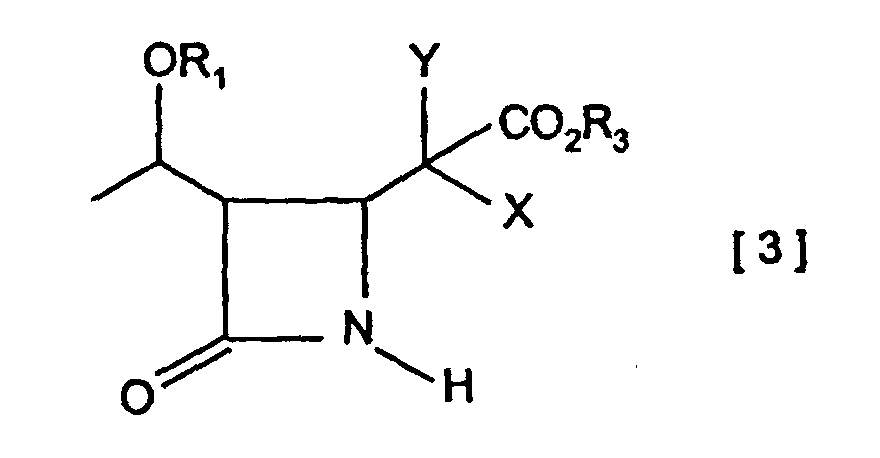
caractérisé en ce que ledit procédé consiste à :(a) faire réagir un dérivé azétidinone représenté par la formule générale [1] :(dans laquelle OR1 est tel que défini ci-dessus ; R2 est un radical alkyle, alcényle, aryle en C6 à C10 ou hétérocyclique aromatique, radical qui peut avoir des substituants choisis parmi un atome d'halogène, les radicaux alkyle en C1 à C6, alkyle monocyclique ou polycyclique, alcoxy en C1 à C6, carboxyle, amino, nitro, cyano, hydroxy, aryle en C6 à C10 et aralkyle en C 7 à C24)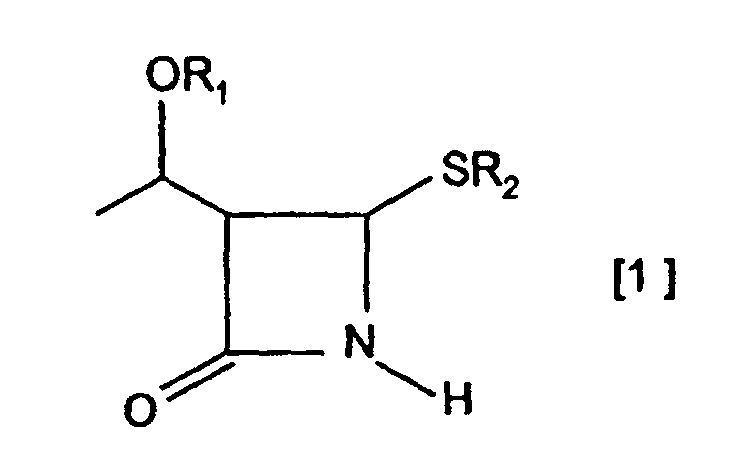
avec un composé ester représenté par la formule générale [2] :(dans laquelle CO2R3, X et Y sont tels que définis ci-dessus)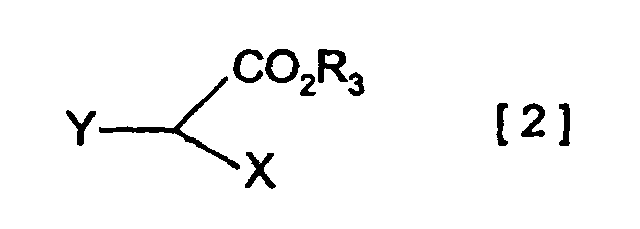
en présence de zinc ou d'un composé du cuivre choisi parmi les oxydes du cuivre, les halogénures du cuivre, les sels du cuivre ayant des acides carboxyliques organiques, les sels du cuivre ayant des acides minéraux et les complexes d'halogénures cuivreux ; ou(b) traiter un composé ester représenté par la formule générale [2] avec une base métallique afin de former l'énolate de métal correspondant, suivi par la réaction avec un dérivé azétidinone représenté par la formule générale [1] en présence d'un composé du cuivre choisi parmi les oxydes du cuivre, les halogénures du cuivre, les sels du cuivre ayant des acides organiques carboxyliques, les sels du cuivre avec les acides minéraux et les complexes d'halogénures cuivreux. - Procédé selon la revendication 1, dans lequel un dérivé azétidinone représenté par la formule générale [1] est mis à réagir avec un composé ester représenté par la formule générale [2].
- Procédé selon la revendication 1, dans lequel un composé ester représenté par la formule générale [2] est traité avec une base métallique afin de former l'énolate de métal correspondant, suivi par la réaction avec un dérivé azétidinone représenté par la formule générale [1] en présence d'un composé du cuivre.
- Procédé selon l'une quelconque des revendications précédentes, dans lequel CO2R3 est un radical carboxyle estérifié choisi parmi les esters silyliques tri-substitués, les esters (alkyle en C1 à C6)silyliques tri-substitués, les esters hétérocycliques aromatiques, les esters d'alkyle en C1 à C6, les esters (alcanoyloxy en C1 à C6)-(alkyle en C1 à C6), les esters alcane(en C1 à C6)sulfonyle-(alkyle en C1 à C6), les esters mono, di ou tri-halogéno(alkyle en C1 à C6), les esters alcoxy(en C1 à C6)carbonyloxy-(alkyle en C1 à C6), les esters (alkyle en C1 à C6) phtalidylidène, les esters (5-(alkyle en C1 à C6)-2-oxo-1,3-dioxolane-4-yl)-(alkyle en C1 à C6), les esters (alcényle en C1 à C6), les esters (alcynyle en C1 à C6), les esters aryl(alkyle en C1 à C6), les esters aryliques, ainsi que les esters phtalidyliques, qui peuvent être éventuellement substitués.
- Procédé selon l'une quelconque des revendications précédentes, dans lequel tout radical ester ou thioester représenté par X ou Y est choisi parmi les radicaux alkyloxycarbonyle, alcényloxycarbonyle, aralkyloxycarbonyle, aryloxycarbonyle, alkylthiocarbonyle, alcénylthiocarbonyle, aralkylthiocarbonyle, arylthiocarbonyle.
- Procédé selon l'une quelconque des revendications précédentes, dans lequel tous substituants sur R3 sont choisis parmi un atome d'halogène, les radicaux alkyle en C1 à C6, alkyle monocyclique ou polycyclique, alcoxy en C1 à C6, carboxyle, amino, nitro, cyano, hydroxy, aryle en C6 à C10, aralyle en C7 à C24, hétérocycliques, acyle, alkyloxycarbonyle, alcényloxycarbonyle, aralkyloxycarbonyle et aryloxycarbonyle.
- Procédé selon l'une quelconque des revendications précédentes, dans lequel tous substituants sur X et Y sont choisis parmi un atome d'halogène, les radicaux carboxyle, formyle, nitro, cyano, hydroxyle, amino, alkyle en C1 à C6, alkyle monocyclique et polycyclique, alcényle en C1 à C6, aryle en C6 à C10, aralkyle en C7 à C24, alkylthio, alcénylthio, aralkylthio, arylthio, alkyloxy, alcényloxy, aralkyloxy, aryloxy, alkylsulfinyle, alkylsulfonyle, aralkylsulfinyle, aralkylsulfonyle, arylsulfinyle, arylsulfonyle, carbamoyle ; carbamoyloxy, imino-(alkyle en C1 à C6), imino-(alkyle en C1 à C6)-amino, acyloxy, silyloxy, hétérocyclique, hétérocyclique-thio, hétérocyclique-oxy, acylcarboxyle, alkyloxycarbonyle, alcényloxycarbonyle, aralkyloxycarbonyle, aryloxycarbonyle, thiocarboxyle, alkylthiocarbonyle, alcénylthiocarbonyle, aralkylthiocarbonyle, arylthiocarbonyle et l'amide substitué et non substitué.
- Procédé selon l'une quelconque des revendications précédentes, dans lequel le composé ester représenté par la formule générale [2] est un ester d'acide acétique halogéné, un ester d'acide malonique, un ester d'acide 2-alkyl-malonique, un ester d'acide malonique 2-halogéné, un ester d'acide 2-alkyl-acylacétique ou un ester d'acide cycloalcan-2-on-1-carboxylique.
- Procédé selon la revendication 8, dans lequel le composé ester représenté par la formule générale [2] est un ester d'acide bromoacétique, un ester d'acide malonique, un ester d'acide 2-méthyl-malonique, un ester d'acide 2-fluoromalonique, un ester d'acide 2-méthylacétoacétique ou un ester d'acide cyclohexan-2-on-1-carboxylique.
- Procédé selon la revendication 2, dans lequel la (3S,4S)-3-[(R)-1-(tert-butyldiméthylsilyloxy)-éthyl]-4-éthoxy-carbonylméthyl-2-azétidinone est préparée à partir du bromoacétate d'éthyle et de la (3S,4R)-3-[(R)-1-(tert-butyldiméthylsilyloxy) -éthyl] -4-phénylthio-2-azétidinone.
- Procédé selon la revendication 3, dans lequel la (3S,4S)-3 -[(R)-1-(tert-butyldiméthylsilyloxy)-éthyl]-4-di(méthoxy-carbonyl) -méthyl-2-azétidinone est préparée à partir du malonate de diméthyle et de la (3S,4R)-3-[(R)-1-(tert-butyldiméthylsilyloxy)-éthyl]-4-phénylthio-2-azétidinone.
- Procédé selon la revendication 3, dans lequel la (3S,4S)-3-[(R)-1-(tert-butyldiméthylsilyloxy)-éthyl]-4-[1,1-di(éthoxycarbonyl)éthyl-2-azétidinone est préparée à partir du 2-méthylmalonate de diéthyle et de la (3S,4R)-3-[(R)-1-(tert-butyldiméthylsilyloxy)-éthyl]-4-phénylthio-2-azétidinone.
- Procédé selon la revendication 3, dans lequel la (3S,4S)-3 -[(R)-1-(tert-butyldiméthylsilyloxy)-éthyl]-4-di(éthoxycarbonyl)fluorométhyl-2-azétidinone est préparée à partir du 2-fluoromalonate de diéthyle et de la (3S,4R)-3-[(R)-1-(tert-butyldiméthylsilyloxy)-éthyl]-4-phénylthio-2-azétidinone.
- Procédé selon la revendication 3, dans lequel la (3S,4S)-3-[(R)-1-(tert-butyldiméthylsilyloxy)-éthyl]-4-(1-acétyl-1-éthoxycarbonyléthyl)-2-azétidinone est préparée à partir du 2-méthylacétoacétate d'éthyle et de la (3S,4R)-3-[(R)-1-(tert-butyldiméthylsilyloxy)-éthyl]-4-phénylthio-2-azétidinone.
- Procédé selon la revendication 3, dans lequel la (3S,4S]-3 -[(R]-1-(tert-butyldiméthylsilyloxy) -éthyl]-4-(1-acétyl-1-allyloxycarbonyléthyl)-2-azétidinone est préparée à partir du 2-méthylacétoacétate d'allyle et de la (3S,4R)-3-[(R) -1- (tert-butyldiméthylsilyloxy) -éthyl] -4-phénylthio-2-azétidinone.
- Procédé selon la revendication 3, dans lequel la (3S, 4S) -3- [(R) -1- (tert-butyldiméthylsilyloxy) -éthyl] -4(1-acétyl-1-benzyloxycarbonyléthyl)-2-azétidinone est préparée à partir du 2-méthylacétoacétate de benzyle et de la (3S,4R)-3-[(R)-1-(tert-butyldiméthylsilyloxy)-éthyl]-4-phénylthio-2-azétidinone.
- Procédé selon la revendication 3, dans lequel la (3S,4S)-3-[(R)-1-(tert-butyldiméthylsilyloxy)-éthyl]-4-[1,1-di(allyloxycarbonyl)éthyl]-2-azétidinone est préparée à partir du 2-méthylmalonate de diallyle et de la (3R,4S)-3-[(R)-1-(tert-butyldiméthylsilyloxy)-éthyl]-4-phénylthio-2-azétidinone.
- Procédé selon la revendication 3, dans lequel la (3S,4S)-3-[(R)-1-(tert-butyldiméthylsilyloxy)-éthyl]-4-[(RS)-1-allyloxycarbonyl-cyclohexan-2-on-1-yl] -2-azétidinone est préparée à partir de la 2-allyloxycarbonylcyclohexanone et de la (3R,4S)-3 -[(R)-1-(tert-butyldiméthylsilyloxy)-éthyl]-4-phénylthio-2-azétidinone.
- Procédé selon l'une quelconque des revendications précédentes, dans lequel le composé du cuivre est un complexe sulfure de diméthyle/bromure cuivreux.
Applications Claiming Priority (4)
| Application Number | Priority Date | Filing Date | Title |
|---|---|---|---|
| JP47552/93 | 1993-02-12 | ||
| JP4755293 | 1993-02-12 | ||
| JP4755293 | 1993-02-12 | ||
| PCT/JP1994/000195 WO1994018163A1 (fr) | 1993-02-12 | 1994-02-10 | Procede d'obtention par synthese d'un derive d'azetidinone en substitution 4 |
Publications (3)
| Publication Number | Publication Date |
|---|---|
| EP0638552A1 EP0638552A1 (fr) | 1995-02-15 |
| EP0638552A4 EP0638552A4 (fr) | 1995-03-29 |
| EP0638552B1 true EP0638552B1 (fr) | 2003-06-04 |
Family
ID=12778334
Family Applications (1)
| Application Number | Title | Priority Date | Filing Date |
|---|---|---|---|
| EP94906364A Expired - Lifetime EP0638552B1 (fr) | 1993-02-12 | 1994-02-10 | Procede d'obtention par synthese d'un derive d'azetidinone en substitution 4 |
Country Status (5)
| Country | Link |
|---|---|
| EP (1) | EP0638552B1 (fr) |
| AT (1) | ATE242211T1 (fr) |
| DE (1) | DE69432777T2 (fr) |
| ES (1) | ES2194866T3 (fr) |
| WO (1) | WO1994018163A1 (fr) |
Families Citing this family (1)
| Publication number | Priority date | Publication date | Assignee | Title |
|---|---|---|---|---|
| JP5309680B2 (ja) * | 2008-05-09 | 2013-10-09 | 大正製薬株式会社 | フッ素化エステル化合物の製造方法及びその中間体 |
Family Cites Families (8)
| Publication number | Priority date | Publication date | Assignee | Title |
|---|---|---|---|---|
| US4287123A (en) * | 1980-01-14 | 1981-09-01 | Merck & Co., Inc. | Synthesis of thienamycin via (3SR, 4RS)-3-((RS)-1-acyloxyethyl)-2-oxo-4-azetidineacetate |
| US4309346A (en) * | 1980-03-27 | 1982-01-05 | Merck & Co., Inc. | Process for the preparation of 1-carbapenems and intermediates via trithioorthoacetates |
| DK329381A (da) * | 1980-07-24 | 1982-01-25 | Takeda Chemical Industries Ltd | Fremgangsmaade til frmstilling af 1,1-disubstitueret carba-z -penem samt salte og estere deraf |
| JPS5946265A (ja) * | 1982-08-24 | 1984-03-15 | Sankyo Co Ltd | アゼチジノン誘導体の製造法 |
| JPH0623187B2 (ja) * | 1985-01-18 | 1994-03-30 | 住友製薬株式会社 | β−ラクタム化合物の新規製造法 |
| GB8607921D0 (en) * | 1986-04-01 | 1986-05-08 | Fujisawa Pharmaceutical Co | 3,4-disubstituted-2-azetidinone derivatives |
| JP2958834B2 (ja) * | 1991-12-09 | 1999-10-06 | 高砂香料工業株式会社 | アゼチジン−2−オン誘導体 |
| EP0546742B1 (fr) * | 1991-12-09 | 2001-06-20 | Takasago International Corporation | Dérivés de (dialcoxycarbonyl-1,1-alkyl)-4-azétidin-2-ones et synthèse de dérivés de (carboxy-1-alkyl)-4-azétidin-2-ones à partir de ces composés |
-
1994
- 1994-02-10 AT AT94906364T patent/ATE242211T1/de not_active IP Right Cessation
- 1994-02-10 EP EP94906364A patent/EP0638552B1/fr not_active Expired - Lifetime
- 1994-02-10 WO PCT/JP1994/000195 patent/WO1994018163A1/fr not_active Ceased
- 1994-02-10 ES ES94906364T patent/ES2194866T3/es not_active Expired - Lifetime
- 1994-02-10 DE DE69432777T patent/DE69432777T2/de not_active Expired - Fee Related
Also Published As
| Publication number | Publication date |
|---|---|
| WO1994018163A1 (fr) | 1994-08-18 |
| EP0638552A4 (fr) | 1995-03-29 |
| ES2194866T3 (es) | 2003-12-01 |
| DE69432777T2 (de) | 2004-03-18 |
| EP0638552A1 (fr) | 1995-02-15 |
| DE69432777D1 (de) | 2003-07-10 |
| ATE242211T1 (de) | 2003-06-15 |
Similar Documents
| Publication | Publication Date | Title |
|---|---|---|
| JP3035325B2 (ja) | ヘテロ環化合物 | |
| JPH0689004B2 (ja) | β―ラクタム化合物、その製法及びそれを含む医薬組成物 | |
| US4997829A (en) | Penem compounds, and use thereof | |
| JPH0438753B2 (fr) | ||
| FR2550533A1 (fr) | Procede pour la fabrication de derives de type penem | |
| EP0037081A1 (fr) | Procédé de préparation des composés du type 1-carbapénème et produits intermédiaires via trithioorthoacétates | |
| JPH0557980B2 (fr) | ||
| CA1234099A (fr) | Procede de preparation de penems | |
| US4443373A (en) | Process for the production of antibiotic penems | |
| KR880002512B1 (ko) | 페넴 화합물 및 이의 제조방법 | |
| US6867297B1 (en) | Process for synthesizing 4-substituted azetidinone derivatives | |
| US4596677A (en) | Anhydropenicillin intermediates | |
| FR2483924A1 (fr) | Derives d'acide peneme-3-carboxylique, leurs procedes de preparation et leur application en therapeutique | |
| EP0638552A1 (fr) | Procede d'obtention par synthese d'un derive d'azetidinone en substitution 4 | |
| JPS6222786A (ja) | 複素環メチレンペネム化合物、その製造法および抗菌組成物 | |
| JP2922220B2 (ja) | ペネムの製法 | |
| JPWO1994018163A1 (ja) | 4位置換アゼチジノン誘導体の合成法 | |
| JPH06104672B2 (ja) | ペネム類の製造方法 | |
| US4663451A (en) | Process for the synthesis of penems and penams | |
| EP0066301B1 (fr) | Intermédiaires pour la préparation de thiénamycine et procédé pour leur préparation | |
| WO2001053305A1 (fr) | Procédés de préparation de dérivés de carbapenem | |
| JPH05239020A (ja) | 3−[(r)−1−(置換オキシカルボニルオキシ)エチル−4−置換−2−アゼチジノンの製造法 | |
| US4760058A (en) | Penam derivatives | |
| JP2002338572A (ja) | カルバペネム類の製造法 | |
| JPH0256349B2 (fr) |
Legal Events
| Date | Code | Title | Description |
|---|---|---|---|
| PUAI | Public reference made under article 153(3) epc to a published international application that has entered the european phase |
Free format text: ORIGINAL CODE: 0009012 |
|
| 17P | Request for examination filed |
Effective date: 19941111 |
|
| AK | Designated contracting states |
Kind code of ref document: A1 Designated state(s): AT BE CH DE DK ES FR GB GR IE IT LI LU MC NL PT SE |
|
| A4 | Supplementary search report drawn up and despatched | ||
| AK | Designated contracting states |
Kind code of ref document: A4 Designated state(s): AT BE CH DE DK ES FR GB GR IE IT LI LU MC NL PT SE |
|
| 17Q | First examination report despatched |
Effective date: 19980515 |
|
| GRAG | Despatch of communication of intention to grant |
Free format text: ORIGINAL CODE: EPIDOS AGRA |
|
| GRAG | Despatch of communication of intention to grant |
Free format text: ORIGINAL CODE: EPIDOS AGRA |
|
| GRAG | Despatch of communication of intention to grant |
Free format text: ORIGINAL CODE: EPIDOS AGRA |
|
| GRAH | Despatch of communication of intention to grant a patent |
Free format text: ORIGINAL CODE: EPIDOS IGRA |
|
| GRAH | Despatch of communication of intention to grant a patent |
Free format text: ORIGINAL CODE: EPIDOS IGRA |
|
| GRAA | (expected) grant |
Free format text: ORIGINAL CODE: 0009210 |
|
| RAP1 | Party data changed (applicant data changed or rights of an application transferred) |
Owner name: DAIICHI SUNTORY PHARMA CO., LTD. |
|
| AK | Designated contracting states |
Designated state(s): AT BE CH DE DK ES FR GB GR IE IT LI LU MC NL PT SE |
|
| PG25 | Lapsed in a contracting state [announced via postgrant information from national office to epo] |
Ref country code: NL Free format text: LAPSE BECAUSE OF FAILURE TO SUBMIT A TRANSLATION OF THE DESCRIPTION OR TO PAY THE FEE WITHIN THE PRESCRIBED TIME-LIMIT Effective date: 20030604 Ref country code: LI Free format text: LAPSE BECAUSE OF FAILURE TO SUBMIT A TRANSLATION OF THE DESCRIPTION OR TO PAY THE FEE WITHIN THE PRESCRIBED TIME-LIMIT Effective date: 20030604 Ref country code: CH Free format text: LAPSE BECAUSE OF FAILURE TO SUBMIT A TRANSLATION OF THE DESCRIPTION OR TO PAY THE FEE WITHIN THE PRESCRIBED TIME-LIMIT Effective date: 20030604 Ref country code: BE Free format text: LAPSE BECAUSE OF FAILURE TO SUBMIT A TRANSLATION OF THE DESCRIPTION OR TO PAY THE FEE WITHIN THE PRESCRIBED TIME-LIMIT Effective date: 20030604 Ref country code: AT Free format text: LAPSE BECAUSE OF FAILURE TO SUBMIT A TRANSLATION OF THE DESCRIPTION OR TO PAY THE FEE WITHIN THE PRESCRIBED TIME-LIMIT Effective date: 20030604 |
|
| REG | Reference to a national code |
Ref country code: GB Ref legal event code: FG4D |
|
| REG | Reference to a national code |
Ref country code: CH Ref legal event code: EP |
|
| REG | Reference to a national code |
Ref country code: IE Ref legal event code: FG4D |
|
| REF | Corresponds to: |
Ref document number: 69432777 Country of ref document: DE Date of ref document: 20030710 Kind code of ref document: P |
|
| PG25 | Lapsed in a contracting state [announced via postgrant information from national office to epo] |
Ref country code: SE Free format text: LAPSE BECAUSE OF FAILURE TO SUBMIT A TRANSLATION OF THE DESCRIPTION OR TO PAY THE FEE WITHIN THE PRESCRIBED TIME-LIMIT Effective date: 20030904 Ref country code: PT Free format text: LAPSE BECAUSE OF FAILURE TO SUBMIT A TRANSLATION OF THE DESCRIPTION OR TO PAY THE FEE WITHIN THE PRESCRIBED TIME-LIMIT Effective date: 20030904 Ref country code: GR Free format text: LAPSE BECAUSE OF FAILURE TO SUBMIT A TRANSLATION OF THE DESCRIPTION OR TO PAY THE FEE WITHIN THE PRESCRIBED TIME-LIMIT Effective date: 20030904 Ref country code: DK Free format text: LAPSE BECAUSE OF FAILURE TO SUBMIT A TRANSLATION OF THE DESCRIPTION OR TO PAY THE FEE WITHIN THE PRESCRIBED TIME-LIMIT Effective date: 20030904 |
|
| NLV1 | Nl: lapsed or annulled due to failure to fulfill the requirements of art. 29p and 29m of the patents act | ||
| REG | Reference to a national code |
Ref country code: CH Ref legal event code: PL |
|
| PG25 | Lapsed in a contracting state [announced via postgrant information from national office to epo] |
Ref country code: LU Free format text: LAPSE BECAUSE OF NON-PAYMENT OF DUE FEES Effective date: 20040210 Ref country code: IE Free format text: LAPSE BECAUSE OF NON-PAYMENT OF DUE FEES Effective date: 20040210 |
|
| PG25 | Lapsed in a contracting state [announced via postgrant information from national office to epo] |
Ref country code: MC Free format text: LAPSE BECAUSE OF NON-PAYMENT OF DUE FEES Effective date: 20040228 |
|
| ET | Fr: translation filed | ||
| PLBE | No opposition filed within time limit |
Free format text: ORIGINAL CODE: 0009261 |
|
| STAA | Information on the status of an ep patent application or granted ep patent |
Free format text: STATUS: NO OPPOSITION FILED WITHIN TIME LIMIT |
|
| 26N | No opposition filed |
Effective date: 20040305 |
|
| REG | Reference to a national code |
Ref country code: IE Ref legal event code: MM4A |
|
| PGFP | Annual fee paid to national office [announced via postgrant information from national office to epo] |
Ref country code: DE Payment date: 20050203 Year of fee payment: 12 |
|
| PGFP | Annual fee paid to national office [announced via postgrant information from national office to epo] |
Ref country code: FR Payment date: 20050208 Year of fee payment: 12 |
|
| PGFP | Annual fee paid to national office [announced via postgrant information from national office to epo] |
Ref country code: GB Payment date: 20050209 Year of fee payment: 12 |
|
| PGFP | Annual fee paid to national office [announced via postgrant information from national office to epo] |
Ref country code: ES Payment date: 20050323 Year of fee payment: 12 |
|
| PG25 | Lapsed in a contracting state [announced via postgrant information from national office to epo] |
Ref country code: GB Free format text: LAPSE BECAUSE OF NON-PAYMENT OF DUE FEES Effective date: 20060210 |
|
| PG25 | Lapsed in a contracting state [announced via postgrant information from national office to epo] |
Ref country code: ES Free format text: LAPSE BECAUSE OF NON-PAYMENT OF DUE FEES Effective date: 20060211 |
|
| PGFP | Annual fee paid to national office [announced via postgrant information from national office to epo] |
Ref country code: IT Payment date: 20060228 Year of fee payment: 13 |
|
| PG25 | Lapsed in a contracting state [announced via postgrant information from national office to epo] |
Ref country code: DE Free format text: LAPSE BECAUSE OF NON-PAYMENT OF DUE FEES Effective date: 20060901 |
|
| GBPC | Gb: european patent ceased through non-payment of renewal fee |
Effective date: 20060210 |
|
| REG | Reference to a national code |
Ref country code: FR Ref legal event code: ST Effective date: 20061031 |
|
| REG | Reference to a national code |
Ref country code: ES Ref legal event code: FD2A Effective date: 20060211 |
|
| PG25 | Lapsed in a contracting state [announced via postgrant information from national office to epo] |
Ref country code: FR Free format text: LAPSE BECAUSE OF NON-PAYMENT OF DUE FEES Effective date: 20060228 |
|
| PG25 | Lapsed in a contracting state [announced via postgrant information from national office to epo] |
Ref country code: IT Free format text: LAPSE BECAUSE OF NON-PAYMENT OF DUE FEES Effective date: 20070210 |