EP0635718B1 - Nouvelle application d'une electrode metal/oxyde metallique - Google Patents
Nouvelle application d'une electrode metal/oxyde metallique Download PDFInfo
- Publication number
- EP0635718B1 EP0635718B1 EP94110689A EP94110689A EP0635718B1 EP 0635718 B1 EP0635718 B1 EP 0635718B1 EP 94110689 A EP94110689 A EP 94110689A EP 94110689 A EP94110689 A EP 94110689A EP 0635718 B1 EP0635718 B1 EP 0635718B1
- Authority
- EP
- European Patent Office
- Prior art keywords
- electrode
- metal
- melt
- oxide
- glass
- Prior art date
- Legal status (The legal status is an assumption and is not a legal conclusion. Google has not performed a legal analysis and makes no representation as to the accuracy of the status listed.)
- Expired - Lifetime
Links
- 239000002184 metal Substances 0.000 title claims abstract description 53
- 229910052751 metal Inorganic materials 0.000 title claims abstract description 50
- 229910044991 metal oxide Inorganic materials 0.000 title claims abstract description 26
- 150000004706 metal oxides Chemical class 0.000 title claims abstract description 26
- 229910052760 oxygen Inorganic materials 0.000 claims abstract description 39
- QVGXLLKOCUKJST-UHFFFAOYSA-N atomic oxygen Chemical compound [O] QVGXLLKOCUKJST-UHFFFAOYSA-N 0.000 claims abstract description 38
- 239000000155 melt Substances 0.000 claims abstract description 38
- 239000001301 oxygen Substances 0.000 claims abstract description 38
- 239000005284 oxidic glass Substances 0.000 claims abstract description 5
- 150000002739 metals Chemical class 0.000 claims description 11
- 239000000956 alloy Substances 0.000 claims description 2
- 229910045601 alloy Inorganic materials 0.000 claims description 2
- 239000011261 inert gas Substances 0.000 claims description 2
- QXYJCZRRLLQGCR-UHFFFAOYSA-N dioxomolybdenum Chemical compound O=[Mo]=O QXYJCZRRLLQGCR-UHFFFAOYSA-N 0.000 claims 2
- CJNBYAVZURUTKZ-UHFFFAOYSA-N hafnium(IV) oxide Inorganic materials O=[Hf]=O CJNBYAVZURUTKZ-UHFFFAOYSA-N 0.000 claims 1
- PBCFLUZVCVVTBY-UHFFFAOYSA-N tantalum pentoxide Inorganic materials O=[Ta](=O)O[Ta](=O)=O PBCFLUZVCVVTBY-UHFFFAOYSA-N 0.000 claims 1
- MCMNRKCIXSYSNV-UHFFFAOYSA-N ZrO2 Inorganic materials O=[Zr]=O MCMNRKCIXSYSNV-UHFFFAOYSA-N 0.000 abstract description 22
- RVTZCBVAJQQJTK-UHFFFAOYSA-N oxygen(2-);zirconium(4+) Chemical compound [O-2].[O-2].[Zr+4] RVTZCBVAJQQJTK-UHFFFAOYSA-N 0.000 abstract description 13
- 230000008901 benefit Effects 0.000 abstract description 3
- 238000002848 electrochemical method Methods 0.000 abstract 1
- 238000005259 measurement Methods 0.000 description 35
- BASFCYQUMIYNBI-UHFFFAOYSA-N platinum Substances [Pt] BASFCYQUMIYNBI-UHFFFAOYSA-N 0.000 description 28
- 239000000156 glass melt Substances 0.000 description 24
- 238000011088 calibration curve Methods 0.000 description 18
- 239000011521 glass Substances 0.000 description 14
- 238000002844 melting Methods 0.000 description 14
- 230000008018 melting Effects 0.000 description 14
- 239000000523 sample Substances 0.000 description 10
- 238000005755 formation reaction Methods 0.000 description 9
- 230000015572 biosynthetic process Effects 0.000 description 8
- 229910052750 molybdenum Inorganic materials 0.000 description 8
- 229910052697 platinum Inorganic materials 0.000 description 7
- 238000006243 chemical reaction Methods 0.000 description 6
- 230000000694 effects Effects 0.000 description 6
- ZOKXTWBITQBERF-UHFFFAOYSA-N Molybdenum Chemical compound [Mo] ZOKXTWBITQBERF-UHFFFAOYSA-N 0.000 description 5
- 239000005388 borosilicate glass Substances 0.000 description 5
- 239000000919 ceramic Substances 0.000 description 5
- 230000007797 corrosion Effects 0.000 description 5
- 238000005260 corrosion Methods 0.000 description 5
- 238000010438 heat treatment Methods 0.000 description 5
- 239000007787 solid Substances 0.000 description 5
- 229910052715 tantalum Inorganic materials 0.000 description 5
- 229910052721 tungsten Inorganic materials 0.000 description 5
- MYMOFIZGZYHOMD-UHFFFAOYSA-N Dioxygen Chemical compound O=O MYMOFIZGZYHOMD-UHFFFAOYSA-N 0.000 description 4
- 238000009792 diffusion process Methods 0.000 description 4
- 150000002500 ions Chemical class 0.000 description 4
- 239000011733 molybdenum Substances 0.000 description 4
- 239000006108 non-alkaline-earth borosilicate glass Substances 0.000 description 4
- 241001295925 Gegenes Species 0.000 description 3
- 238000011156 evaluation Methods 0.000 description 3
- 239000007789 gas Substances 0.000 description 3
- 238000009434 installation Methods 0.000 description 3
- 239000010416 ion conductor Substances 0.000 description 3
- 239000010453 quartz Substances 0.000 description 3
- 238000007670 refining Methods 0.000 description 3
- VYPSYNLAJGMNEJ-UHFFFAOYSA-N silicon dioxide Inorganic materials O=[Si]=O VYPSYNLAJGMNEJ-UHFFFAOYSA-N 0.000 description 3
- 239000007784 solid electrolyte Substances 0.000 description 3
- GUVRBAGPIYLISA-UHFFFAOYSA-N tantalum atom Chemical compound [Ta] GUVRBAGPIYLISA-UHFFFAOYSA-N 0.000 description 3
- 238000012360 testing method Methods 0.000 description 3
- 230000009471 action Effects 0.000 description 2
- 239000000872 buffer Substances 0.000 description 2
- 230000008859 change Effects 0.000 description 2
- 238000013461 design Methods 0.000 description 2
- 239000007772 electrode material Substances 0.000 description 2
- 239000003792 electrolyte Substances 0.000 description 2
- 238000002474 experimental method Methods 0.000 description 2
- 239000000203 mixture Substances 0.000 description 2
- 229910052758 niobium Inorganic materials 0.000 description 2
- 238000007254 oxidation reaction Methods 0.000 description 2
- TWNQGVIAIRXVLR-UHFFFAOYSA-N oxo(oxoalumanyloxy)alumane Chemical compound O=[Al]O[Al]=O TWNQGVIAIRXVLR-UHFFFAOYSA-N 0.000 description 2
- 239000000126 substance Substances 0.000 description 2
- 238000005496 tempering Methods 0.000 description 2
- 101100390736 Danio rerio fign gene Proteins 0.000 description 1
- 101001059454 Homo sapiens Serine/threonine-protein kinase MARK2 Proteins 0.000 description 1
- 102100028920 MAP/microtubule affinity-regulating kinase 3 Human genes 0.000 description 1
- 101150059478 Mark3 gene Proteins 0.000 description 1
- 101100390738 Mus musculus Fign gene Proteins 0.000 description 1
- 102100028904 Serine/threonine-protein kinase MARK2 Human genes 0.000 description 1
- 229910004298 SiO 2 Inorganic materials 0.000 description 1
- 238000005275 alloying Methods 0.000 description 1
- 238000013459 approach Methods 0.000 description 1
- 239000007864 aqueous solution Substances 0.000 description 1
- 230000009286 beneficial effect Effects 0.000 description 1
- 150000001768 cations Chemical class 0.000 description 1
- 239000007795 chemical reaction product Substances 0.000 description 1
- 238000004040 coloring Methods 0.000 description 1
- 239000004020 conductor Substances 0.000 description 1
- 238000010276 construction Methods 0.000 description 1
- 239000002826 coolant Substances 0.000 description 1
- 238000001816 cooling Methods 0.000 description 1
- 230000006735 deficit Effects 0.000 description 1
- 230000001419 dependent effect Effects 0.000 description 1
- 238000011161 development Methods 0.000 description 1
- 238000010586 diagram Methods 0.000 description 1
- 230000005518 electrochemistry Effects 0.000 description 1
- 238000011010 flushing procedure Methods 0.000 description 1
- 238000009472 formulation Methods 0.000 description 1
- 239000012634 fragment Substances 0.000 description 1
- 238000007496 glass forming Methods 0.000 description 1
- 229910052735 hafnium Inorganic materials 0.000 description 1
- 229910001385 heavy metal Inorganic materials 0.000 description 1
- 230000006698 induction Effects 0.000 description 1
- 238000009413 insulation Methods 0.000 description 1
- 230000003993 interaction Effects 0.000 description 1
- 238000011835 investigation Methods 0.000 description 1
- 238000011545 laboratory measurement Methods 0.000 description 1
- 238000004519 manufacturing process Methods 0.000 description 1
- 239000000463 material Substances 0.000 description 1
- 238000000034 method Methods 0.000 description 1
- 230000007935 neutral effect Effects 0.000 description 1
- 229910052762 osmium Inorganic materials 0.000 description 1
- 239000000843 powder Substances 0.000 description 1
- 230000008569 process Effects 0.000 description 1
- 238000012545 processing Methods 0.000 description 1
- 239000011819 refractory material Substances 0.000 description 1
- 230000004044 response Effects 0.000 description 1
- 229910052702 rhenium Inorganic materials 0.000 description 1
- 229910052707 ruthenium Inorganic materials 0.000 description 1
- 230000035945 sensitivity Effects 0.000 description 1
- 239000005368 silicate glass Substances 0.000 description 1
- 239000005361 soda-lime glass Substances 0.000 description 1
- 238000003746 solid phase reaction Methods 0.000 description 1
- 238000010671 solid-state reaction Methods 0.000 description 1
- 239000000243 solution Substances 0.000 description 1
- 238000003756 stirring Methods 0.000 description 1
- 239000004575 stone Substances 0.000 description 1
- 230000008646 thermal stress Effects 0.000 description 1
- 231100000331 toxic Toxicity 0.000 description 1
- 230000002588 toxic effect Effects 0.000 description 1
- 230000001988 toxicity Effects 0.000 description 1
- 231100000419 toxicity Toxicity 0.000 description 1
- WFKWXMTUELFFGS-UHFFFAOYSA-N tungsten Chemical compound [W] WFKWXMTUELFFGS-UHFFFAOYSA-N 0.000 description 1
- 239000010937 tungsten Substances 0.000 description 1
- 229910001928 zirconium oxide Inorganic materials 0.000 description 1
Images

Classifications
-
- G—PHYSICS
- G01—MEASURING; TESTING
- G01N—INVESTIGATING OR ANALYSING MATERIALS BY DETERMINING THEIR CHEMICAL OR PHYSICAL PROPERTIES
- G01N27/00—Investigating or analysing materials by the use of electric, electrochemical, or magnetic means
- G01N27/26—Investigating or analysing materials by the use of electric, electrochemical, or magnetic means by investigating electrochemical variables; by using electrolysis or electrophoresis
- G01N27/403—Cells and electrode assemblies
- G01N27/406—Cells and probes with solid electrolytes
- G01N27/411—Cells and probes with solid electrolytes for investigating or analysing of liquid metals
- G01N27/4115—Composition or fabrication of the electrodes and coatings thereon, e.g. catalysts
- G01N27/4117—Reference electrodes or reference mixtures
Definitions
- the invention relates to a new use of a metal / metal oxide electrode with a metallic electrode body, which with a layer is coated from a poorly soluble oxide of this metal.
- the ZrO 2 reference electrode is designed as a half-tube made of zirconium dioxide or as a cylindrical solid pin which is held on a cylindrical aluminum oxide tube by means of a bore.
- the platinum electrode which is flushed with oxygen or air or surrounded by the above-mentioned metal / metal oxide buffer, is located in the interior of the zirconium dioxide tube or ends above the cylindrical solid spigot in the aluminum oxide tube, the contact between the platinum electrode and the zirconium dioxide tube or spigot usually is improved by embedding the platinum electrode in a zirconia powder.
- the ceramic zirconium dioxide also has a separating element in the measuring probe as well as managerial function. On the one hand, it prevents direct exchange of neutral oxygen and electrons (short circuit of the cell), on the other hand As an almost pure oxygen ion conductor, it allows the ones described above Transport of ions (electrolyte key). Beyond that Zirconia i. a. quite stable against corrosion from glass melts.
- the ceramic breaks.
- a broken or cracked ceramic makes the probe inoperable. Fragments of the ceramic can pass through Stone formation, mechanical blockage in the stir pan, feed units etc. lead to sustainable production downtimes.
- the object of the invention is a reference electrode for electrochemical Determination of the oxygen partial pressure in ion melts, especially in provide oxidic glass melts, at high temperatures, which at mechanical and thermal load is stable and their place of use in the glass melting tank is freely selectable.
- This task is accomplished through the use of a metal / metal oxide electrode with a metallic electrode body, which with at least one Layer of a poorly soluble oxide of this metal is coated as Reference electrode for the electrochemical determination of the oxygen partial pressure in ion melts, especially in oxidic glass melts, by measuring the electromotive force of the electrochemical Chain Pt / Me / Me oxide / melt / Pt released.
- Metal / metal oxide electrodes are aqueous solutions in electrochemistry known as so-called electrodes of the second type. They consist of one Electrode body made of metal, e.g. B. a metal rod of at least a layer of a poorly soluble oxide of this metal is coated. (see e.g. DT 21 21 047 B2 or DE 35 07 183 C1).
- a measuring head for determining the oxygen partial pressure in metal melts which consists of an oxygen and a temperature measuring cell and a counter electrode.
- the oxygen measuring cell consists of a quartz tube, in the lower end of which a solid electrolyte tablet is welded.
- a Mo electrode which, since it is surrounded by air in the quartz tube, coats with an oxide layer when it is used for the first time.
- This Mo / MoO 2 electrode is the so-called reference electrode of the oxygen measuring cell. It sets the known reference partial pressure, which must be used to determine the unknown oxygen partial pressure from the measured values.
- the Mo / MoO 2 electrode thus represents the reference point of the oxygen measuring cell.
- the Mo / MoO 2 electrode itself is not immersed in the melt, but the entire measuring cell. The Mo / MoO 2 electrode is therefore always separated from the melt by the air surrounding it, the solid electrolyte and the quartz tube.
- the oxygen / partial pressure in the melt is also determined in the metal / metal oxide electrode by measuring the EMF E of an electrochemical chain. This can be represented as follows: Pt (1) / Me / O 2 (1) in the Me oxide / melt, O 2 (2) / Pt (2)
- the oxygen partial pressure is also calculated according to equation (1), the oxygen partial pressure pO 2 (1) at the metal / metal oxide phase boundary taking the place of the oxygen partial pressure at the Pt electrode in the zirconium dioxide tube pO 2 (1). If a metal Me is brought into equilibrium with its oxide Me x O y , a defined oxygen potential is established at the phase boundary Me / Me x O y , which only depends on the temperature.
- calibration curves are created for the oxygen partial pressure at the phase boundary Me / Me x O y as a function of the temperature, which can then be used for evaluating the EMF measurements with the metal / metal oxide electrode.
- These calibration curves can either be calculated according to equation 4 from the known thermodynamic data for the relevant metal / metal oxide pair or determined experimentally by measuring the EMF of the metal / metal oxide electrode, for example against a zirconium dioxide electrode and evaluating the measurement results according to equation 1.
- the experimental determination of the calibration curves has the advantage that for each Melt characteristic calibration curves can be created. Through interactions between individual special components of a melt and the electrode material can influence the results of the Calibration measurement come. The use of a universal calibration curve for the different melts would in many cases lead to falsification of the measured oxygen partial pressures.
- the invention To measure the oxygen partial pressure in glass melts, the invention must Electrode made of a metal that is used in the Melt prevailing high temperatures sufficiently temperature resistant is, d. H. that has the highest possible melting point.
- the metal must not be "too noble" for an oxide layer to form can (thermodynamic criterion of oxide formation), but it can also do not react too quickly to the oxide (kinetic criterion of oxide formation), to ensure the longest possible service life of the probe.
- factors such as costs, processability, toxicity etc. to consider.
- the oxide must also have a high melting point and may be in the Glass melt at best be sparingly soluble.
- the thickness of the oxide layer should preferably be at least 10 nm, but it can already a few atomic layers are sufficient.
- the location at which the reference partial pressure pO 2 (1) is fixed (here the phase boundary Me / Me x O y ) must be separated from the melt with the partial pressure pO 2 (2) to be measured.
- the electrolytic connection has requirements regarding the conductivity for ions and electrons, which have already been discussed above.
- ZrO 2 fulfills this as a practically pure oxygen ion conductor.
- the oxide Me x O y also performs the electrolytic function with the potential-defining. The requirements are met if the oxide Me x O y is either a pure oxygen ion conductor or a pure cation conductor (for Me). If there is a mixed line, disturbing diffusion potentials can build up, which lead to absolutely lower EMF values. This can be countered by the fact that after sufficiently long times (for example a few hours) steady, ie stable and reproducible states with regard to the diffusion potential are established. The equally reproducible deviation of the EMF from the theoretical values is taken into account in the calibration.
- interferences that arise as a result of chemical reactions occurring between the oxide layer Me x O y and the glass melt must also be taken into account. Possible reaction products are the formation of mixed oxides, the formation of further solid oxidic phases and also the alloying of the metal Me with metallic components of the oxide melt. These interferences can be eliminated as described above in connection with the mixed line.
- a metal / metal oxide electrode according to the invention compared to the conventional ZrO 2 probe are its robustness and flexibility, since the measurement setup does not require any ceramic components.
- the location of the Pt measuring electrode usually used as counter electrode is determined by the problem to be overcome. All that is required is a homogeneously melted melt between the location of the reference and measuring electrodes. Influences on the EMF formation between the two electrodes due to temperature differences can be corrected using the standard Seebeck coefficient of the glass melt, which can be determined experimentally beforehand in the laboratory. Likewise, thermal and diffusion potentials can also be corrected in a manner known per se (see, for example, BKS Goto, W. Pluschkell, "Oxygen Concentration Cells" in: Physics of Electrolytes, Vol. II (Ed. Hladik), London 1972) .
- the very small thermal voltages close to the electrodes with voltage / current converters to convert current signals and the measured EMF also near the electrodes with an impedance converter and then with a voltage / current converter into a current signal convert.
- the current signals 0-20 mA generated in this way can then be immune to interference over long distances to the hut calculator or an additional one PC are transferred, where they are then processed and stored can be.
- alloys of the above metals with each other and their (Mixed) oxides can be used.
- a doping of the metals mentioned other heavy metals can be beneficial.
- the metals Ru, Re, Os are also suitable in principle, their However, use is due to the high material and processing costs and less in the case of the Os due to the high vapor pressure of the toxic oxides prefers.
- the oxide layer forms on the metal electrode body only when the electrode is immersed in the melt.
- the oxide layer is normally immersed in the melt
- the electrode continues to grow into the metallic body. On the other hand even if it is a poorly soluble oxide, it will be used by the melt is gradually removed from the outside.
- These processes limit the service life of an electrode used according to the invention, however, they lead i. a.
- the measurement will only be disturbed if the Metal core has almost completely disappeared.
- a change in thickness the metal layer and the metal oxide layer relative to one another leads alone still no impairment of the measurement results.
- Mo reference electrodes are preferably used.
- the effect of the Mo electrode is based on the fact that a thin, firmly adhering MoO 2 layer forms in conventional glass melts at temperatures up to approximately 1900 ° C.
- the layer also has a passivating effect and prevents the rapid corrosion of the relatively base molybdenum in the glass melt. This is also the actual basis for the fact that molybdenum electrodes can be used as heating electrodes.
- Mo has proven itself extremely well as an electrode material in a wide variety of glass melts.
- Mo rods can be used in the usual way for the construction of heating electrodes Quality can be used.
- the reference electrode either a disconnected from the heating circuit d. H. disused heating electrode be or an additional mounted electrode, the temperature of which is either advantageously by a thermocouple attached inside the electrode or is measured by an additionally attached thermocouple.
- the temperatures of the Mo electrode parts immersed in the melt should be be as homogeneous as possible.
- the Mo electrode used must also be ensured be that it is installed floating in the tub. Soil-free also means the insulation of all electrically conductive parts of the Tub.
- the electrode is preferably in the form of a rod or closed on one side Tube formed, since in this case it is easier to hold and if necessary can also be easily replaced.
- the function of the alternative reference electrodes was in a row technical glass melting tested.
- EMF of the metal / metal oxide electrode against a zirconium dioxide electrode as a function of temperature calibration curves.
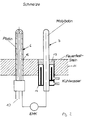
- the experimental setup is outlined in Figure 1.
- a pure platinum electrode (6) and a metal electrode (7) in the exemplary embodiments: Mo, Ta or W rods, each with a diameter of 4 mm, length 400 mm
- an inert gas e.g. B. Ar, loaded sleeve (8), in particular Pt, was protected.
- the metals used had the following purity: Mon 99.95% 0.03% W (Metallwerk Plansee, Reutte (I)) Ta 99.90% 0.04% Nb (”) W 99.96% 0.01% Mo (")
- the test sequence consisted of the one provided with the electrodes (4, 6, 7) Submit glass melt (3) defined temperature programs in usually temperature cycles. The temperatures were between 40 K / h and 400 K / h varied over a temperature range of several hundred degrees. In some cycles, the melts were additionally stirred mechanically (Stirrer is not shown here).
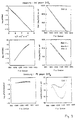
- the typical measurement results and their evaluation for a melt are shown in FIG.
- the reverse route would be to use pO 2 / Pt when using the electrode chain Me / Me-Oxide / Melt.
- Eq. 1 a current and local oxygen partial pressure of the melt from EMF 1 (see Eq. 1 and the plot at the bottom left in Fig. 3 as an example for evaluating a pO 2 determination in the glass melt with the conventional "ZrO 2 probe "), one obtains formally with Eq. 1 a numerical value for the oxygen partial pressure at the phase boundary Me / Me oxide.
- ⁇ S ° ( ⁇ EMK (Me / ZrO 2 ) / ⁇ T) ⁇ (4 ⁇ F)
- the curves should be characteristic as well as the thermodynamic quantities for the metal, but otherwise regardless of the choice of glass melt be.
- the actual deviations can be seen in the comparison the measurement curve with a theoretical curve based solely on the thermodynamic Data of the corresponding oxidation reaction between the pure Components.
- the theoretical curves are in the following figures dotted in the first diagram.
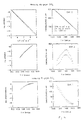
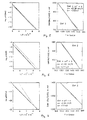
- Figures 4 and 5 summarize the results obtained when testing the molybdenum in the melts of various technical glasses were extracted together.
- the representations are representative of a number of experiments, where temperature cycles with different heating or cooling speeds, partly with the simultaneous use of a stirrer were carried out. Pure metal rods were used, whose Oxide layer only formed when immersed in the glass melt.
- Soda-lime glass (composition: SiO 2 74% by weight, CaO 10% by weight, Na 2 O 16% by weight, Sb 2 O 3 0.2% by weight): No problems occurred even after the probe had been used for several weeks on. The glass contained Sb, but this had no negative effects.
- Borosilicate glass 3.3 (ISO 3585 from 07.91): The molybdenum rod showed the least signs of corrosion in the NaCl-refined borosilicate glass melt. As expected, the pO 2 of the melt varied very little with the temperature.
- a Me / Me x O y electrode is designed as a bottom electrode in a glass melting tank.
- the arrangement shown in the figure consists of a Me / Me x O y rod (7) and a Pt counterelectrode (6) designed as a tube closed on one side, both of which protrude from below through the pan bottom (11) into the glass melting pan.
- Both electrodes (6, 7) are fixed and sealed in openings (12, 13) in the trough base (11) made of refractory material.
- the holder (14) for the Me / Me x O y electrode (7) can be cooled with a coolant. This means that the reference electrodes can be replaced while the tub is running.
- a thermocouple (10) is arranged in the interior of the platinum electrode (6). The electrical connections of the electrodes (6, 7) and the thermocouple are located outside the glass melting tank below the tank bottom (11).
Landscapes
- Chemical & Material Sciences (AREA)
- Life Sciences & Earth Sciences (AREA)
- Health & Medical Sciences (AREA)
- General Physics & Mathematics (AREA)
- Pathology (AREA)
- Electrochemistry (AREA)
- Physics & Mathematics (AREA)
- Analytical Chemistry (AREA)
- Biochemistry (AREA)
- General Health & Medical Sciences (AREA)
- Molecular Biology (AREA)
- Immunology (AREA)
- Chemical Kinetics & Catalysis (AREA)
- Measuring Oxygen Concentration In Cells (AREA)
- Electrodes For Compound Or Non-Metal Manufacture (AREA)
- Glass Compositions (AREA)
- Electrolytic Production Of Metals (AREA)
- Ceramic Capacitors (AREA)
- Thermistors And Varistors (AREA)
- Glass Melting And Manufacturing (AREA)
Claims (6)
- Utilisation d'une électrode métal/oxyde métallique ayant un corps d'électrode métallique qui est revêtu d'au moins une couche d'un oxyde difficilement soluble de ce métal, en tant qu'électrode de référence en vue de la détermination électrochimique de la pression partielle de l'oxygène dans des masses fondues d'ions, en particulier des masses fondues de verre, par mesure de la force électromotrice de la chaíne électrochimique Pt/métal/oxyde métallique/masse fondue/Pt.
- Utilisation selon la revendication 1, caractérisée en ce que la couche d'oxyde ne se forme sur le corps d'électrode que lors de l'immersion de l'électrode dans la masse fondue.
- Utilisation selon la revendication 1 ou 2, caractérisée en ce que l'électrode (7) se compose de Mo/MoO2, de W/WO2, de Hf/HfO2, de Nb/NbO ou de Ta/Ta2O5 ou d'alliages des métaux cités entre eux et de leurs oxydes mixtes.
- Utilisation selon au moins l'une quelconque des revendications 1 à 3, caractérisée en ce que l'électrode (7) est formée en tant que tige ou en tant que tube fermé d'un côté.
- Utilisation selon au moins l'une quelconque des revendications 1 à 4, caractérisée en ce qu'un thermo-élément est disposé dans l'intérieur de l'électrode (7).
- Utilisation selon au moins l'une quelconque des revendications 1 à 5, caractérisée en ce que la partie de l'électrode (7) non immergée dans la masse fondue est entourée d'un manchon (8) que l'on peut remplir d'un gaz inerte.
Applications Claiming Priority (2)
| Application Number | Priority Date | Filing Date | Title |
|---|---|---|---|
| DE4324922 | 1993-07-24 | ||
| DE4324922A DE4324922C2 (de) | 1993-07-24 | 1993-07-24 | Verwendung einer Metall/Metalloxid-Elektrode |
Publications (2)
| Publication Number | Publication Date |
|---|---|
| EP0635718A1 EP0635718A1 (fr) | 1995-01-25 |
| EP0635718B1 true EP0635718B1 (fr) | 1999-01-27 |
Family
ID=6493648
Family Applications (1)
| Application Number | Title | Priority Date | Filing Date |
|---|---|---|---|
| EP94110689A Expired - Lifetime EP0635718B1 (fr) | 1993-07-24 | 1994-07-08 | Nouvelle application d'une electrode metal/oxyde metallique |
Country Status (9)
| Country | Link |
|---|---|
| US (1) | US5580439A (fr) |
| EP (1) | EP0635718B1 (fr) |
| JP (1) | JP3398221B2 (fr) |
| AT (1) | ATE176325T1 (fr) |
| CZ (1) | CZ282862B6 (fr) |
| DE (2) | DE4324922C2 (fr) |
| ES (1) | ES2129545T3 (fr) |
| HU (1) | HU215701B (fr) |
| PL (1) | PL174777B1 (fr) |
Families Citing this family (15)
| Publication number | Priority date | Publication date | Assignee | Title |
|---|---|---|---|---|
| DE19611113C2 (de) * | 1996-03-21 | 1999-11-25 | Juchheim Gmbh & Co M K | Redoxelektrode mit einer passiven Oberflächenschicht, Verfahren zu deren Herstellung und Verwendungen der Redoxelektrode |
| DE19736469A1 (de) * | 1997-08-21 | 1999-02-25 | Wacker Siltronic Halbleitermat | Verfahren und Vorrichtung zur Messung des Sauerstoffpotentials in einer Siliciumschmelze |
| US6340418B1 (en) * | 1999-03-01 | 2002-01-22 | Ethem T. Turkdogan | Slag oxygen sensor |
| DE19955827B4 (de) | 1999-11-20 | 2005-03-31 | Schott Ag | Verfahren zur Unterdrückung der Bildung von O2-Gasblasen an der Kontaktfläche zwischen einer Glasschmelze und Edelmetall |
| EP1269172B1 (fr) | 2000-03-01 | 2009-05-13 | Radiometer Medical ApS | Dispositif a electrodes pourvu d'un systeme de reference a l'etat solide |
| DE50112221D1 (de) * | 2000-09-04 | 2007-05-03 | Schott Ag | Verfahren zur Unterdrückung der Sauerstoffblasenbildung in Glasschmelzen, eine Vorrichtung hierzu sowie die Verwendung des so erhaltenen Glases |
| AT4290U1 (de) | 2000-12-27 | 2001-05-25 | Plansee Ag | Verfahren zur herabsetzung des spezifischen widerstandes einer elektrisch leitenden schicht |
| US6820483B1 (en) * | 2003-09-15 | 2004-11-23 | Mechanical Ingenuity Corp. | Electronic water solution level detector |
| DE102004015577B4 (de) * | 2004-03-30 | 2012-08-23 | Schott Ag | Verfahren zum Herstellen von Glas unter Vermeidung von Blasen an Edelmetallbauteilen |
| DE102010040057A1 (de) * | 2010-08-31 | 2012-03-01 | Endress + Hauser Conducta Gesellschaft für Mess- und Regeltechnik mbH + Co. KG | Elektrochemischer Sensor |
| US20120125050A1 (en) * | 2010-09-30 | 2012-05-24 | Avanstrate Inc. | Method for manufacturing glass plate |
| US20120278009A1 (en) * | 2011-04-30 | 2012-11-01 | Transducers Direct Llc | Melt Pressure Sensor |
| JP6198134B2 (ja) * | 2013-11-22 | 2017-09-20 | 国立研究開発法人日本原子力研究開発機構 | 溶融ガラスの電気化学測定に用いる酸化ニッケル/ニッケル参照極およびそれを用いた電気化学測定装置 |
| US11506620B1 (en) | 2018-07-20 | 2022-11-22 | United States Of America As Represented By The Administrator Of The National Aeronautics And Space Administration | Control of oxygen fugacity in a high pressure solid media assembly using a double capsule |
| US20210055248A1 (en) * | 2019-08-20 | 2021-02-25 | Battelle Energy Alliance, Llc | Reference electrodes for molten salt systems, and related methods and electrochemical systems |
Family Cites Families (12)
| Publication number | Priority date | Publication date | Assignee | Title |
|---|---|---|---|---|
| US3378478A (en) * | 1963-02-20 | 1968-04-16 | Atomic Energy Commission Usa | Apparatus for continuous oxygen monitoring of liquid metals |
| US3462353A (en) * | 1963-02-25 | 1969-08-19 | Continental Oil Co | Reference electrodes of particular utility in anodic corrosion protection systems |
| US3726777A (en) * | 1970-04-30 | 1973-04-10 | Gen Electric | Iridium-iridium oxide electrode for measuring ph of blood and other fluids |
| FR2122758A6 (en) * | 1971-01-22 | 1972-09-01 | Siderurgie Fse Inst Rech | Solid electrolyte electrochemical cell - with a molybdenum wire reference couple |
| US4007106A (en) * | 1973-06-22 | 1977-02-08 | Canadian Patents And Development Limited | Device for measuring oxygen concentration in molten-metal |
| FR2270586B1 (fr) * | 1974-05-06 | 1977-03-04 | Meci Materiel Elect Contr | |
| DE2749357A1 (de) * | 1977-11-04 | 1979-05-10 | Juergen Dr Ing Poetschke | Messonde zur kontinuierlichen bestimmung des sauerstoffgehalts in schmelzen |
| DE2757985B2 (de) * | 1977-12-24 | 1979-11-22 | Max-Planck-Institut Fuer Eisenforschung Gmbh, 4000 Duesseldorf | Verfahrem zum Herstellen einer elektrochemischen Tauchsonden-Meßzelle zum Bestimmen der Aktivität von in Metallschmelzen gelösten Elementen, insbesondere Sauerstoff |
| DE2807247C2 (de) * | 1978-02-21 | 1983-12-15 | Ferrotron Elektronik Gmbh, 4030 Ratingen | Verfahren zur Herstellung einer Sonde zur Ermittlung der Sauerstoffaktivität von Schmelzen |
| US4313799A (en) * | 1980-04-04 | 1982-02-02 | Owens-Corning Fiberglas Corporation | Oxygen sensor and method for determining the oxygen activity in molten glass |
| DE3507183C1 (de) * | 1985-03-01 | 1990-11-15 | Drägerwerk AG, 2400 Lübeck | Metall/Metalloxid-Messelektrode zur pH-Messung |
| DE4138409A1 (de) * | 1991-11-22 | 1993-05-27 | Schott Glaswerke | Referenzelektrodenanordnung einer messkette zur messung des sauerstoffpartialdrucks in aggressiven medien von hoher temperatur |
-
1993
- 1993-07-24 DE DE4324922A patent/DE4324922C2/de not_active Expired - Lifetime
-
1994
- 1994-07-08 AT AT94110689T patent/ATE176325T1/de active
- 1994-07-08 ES ES94110689T patent/ES2129545T3/es not_active Expired - Lifetime
- 1994-07-08 DE DE59407721T patent/DE59407721D1/de not_active Expired - Lifetime
- 1994-07-08 EP EP94110689A patent/EP0635718B1/fr not_active Expired - Lifetime
- 1994-07-19 JP JP16671394A patent/JP3398221B2/ja not_active Expired - Lifetime
- 1994-07-22 CZ CZ941766A patent/CZ282862B6/cs not_active IP Right Cessation
- 1994-07-22 PL PL94304411A patent/PL174777B1/pl unknown
- 1994-07-22 HU HU9402177A patent/HU215701B/hu unknown
-
1995
- 1995-09-15 US US08/528,949 patent/US5580439A/en not_active Expired - Lifetime
Also Published As
| Publication number | Publication date |
|---|---|
| ATE176325T1 (de) | 1999-02-15 |
| JPH07167823A (ja) | 1995-07-04 |
| DE4324922C2 (de) | 1995-08-31 |
| CZ282862B6 (cs) | 1997-11-12 |
| DE59407721D1 (de) | 1999-03-11 |
| DE4324922A1 (de) | 1995-02-23 |
| PL304411A1 (en) | 1995-02-06 |
| JP3398221B2 (ja) | 2003-04-21 |
| CZ176694A3 (en) | 1995-07-12 |
| EP0635718A1 (fr) | 1995-01-25 |
| US5580439A (en) | 1996-12-03 |
| HU215701B (hu) | 1999-02-01 |
| HUT71374A (en) | 1995-11-28 |
| HU9402177D0 (en) | 1994-09-28 |
| ES2129545T3 (es) | 1999-06-16 |
| PL174777B1 (pl) | 1998-09-30 |
Similar Documents
| Publication | Publication Date | Title |
|---|---|---|
| EP0635718B1 (fr) | Nouvelle application d'une electrode metal/oxyde metallique | |
| DE3038104C2 (de) | Wasserstoffion-Sensor | |
| DE69127401T2 (de) | Durch Glas zusammengefügter Körper | |
| DE69325124T2 (de) | Sauerstoffmesssonde | |
| DE69006901T2 (de) | Testelektrode. | |
| DE2822921A1 (de) | Elektrochemische sauerstoffmessvorrichtung mit internem bezugssystem und festem elektrolyten | |
| DE1900406A1 (de) | Hochteinperatur-Brennstoffelement | |
| DE2443037A1 (de) | Elektrochemisches sauerstoffmesselement | |
| DE4305930A1 (de) | Festelektrolytsensor zur Messung gasförmiger Anhydride | |
| DE3908255C2 (fr) | ||
| DE2050050B2 (de) | Glaselektrode und deren herstellung | |
| DE2841016C2 (de) | Vorrichtung zur Überwachung eines Bestandteils eines Fluidgemischs | |
| DE102010001361A1 (de) | Elektrodenanordnung und Latentwärmespeicher | |
| DE3309471A1 (de) | Elektrochemisches messsystem fuer chlor | |
| WO1997008543A1 (fr) | Dispositif permettant de mesurer la concentration en ions fluor ou un rapport de fluorures de metal dans une matiere en fusion ou un melange gazeux | |
| DE69801224T2 (de) | Vorrichtung zur erstarrung und zur kontinuierlichen überwachung der kristallzüchtung | |
| EP0362736A2 (fr) | Sonde d'oxygène pour un four à traitement calorifique | |
| DE3036354A1 (de) | Elektrode | |
| EP1037042B1 (fr) | Capteur submersible appareil et méthode de mesure pour une cellule d'electrolyse d'aluminium | |
| DE2001012C3 (de) | Elektrochemisches Verfahren zur Bestimmung von metallischem Calcium in Blei-Calcium-Legierungen | |
| DE1798002C3 (de) | Meßsonde zur Bestimmung des Sauerstoffgehaltes in Gasen, Dämpfen und Flüssigkeiten, insbesondere in flüssigen Metallen | |
| DE3347479C2 (de) | Verfahren zur Ermittlung des Gasgehaltes in Metallen und Metallegierungen und Einrichtung zur Durchführung des Verfahrens | |
| DE102018208482A1 (de) | Potentiometrische Messkette und Verfahren zur pH-Wert-Bestimmung | |
| DE1798002A1 (de) | Messsonde zur Bestimmung des Sauerstoffgehaltes in Gasen,Daempfen und Fluessigkeiten,insbesondere in fluessigen Metallen | |
| Smetaczek | Investigation of stabilized Li7La3Zr2O12 garnets by combining electrochemical measurements with chemical analysis |
Legal Events
| Date | Code | Title | Description |
|---|---|---|---|
| PUAI | Public reference made under article 153(3) epc to a published international application that has entered the european phase |
Free format text: ORIGINAL CODE: 0009012 |
|
| AK | Designated contracting states |
Kind code of ref document: A1 Designated state(s): AT DE ES FR GB IT NL |
|
| 17P | Request for examination filed |
Effective date: 19941222 |
|
| 17Q | First examination report despatched |
Effective date: 19970219 |
|
| RAP1 | Party data changed (applicant data changed or rights of an application transferred) |
Owner name: CARL-ZEISS-STIFTUNG TRADING AS SCHOTT GLASWERKE Owner name: SCHOTT GLAS |
|
| GRAG | Despatch of communication of intention to grant |
Free format text: ORIGINAL CODE: EPIDOS AGRA |
|
| RAP1 | Party data changed (applicant data changed or rights of an application transferred) |
Owner name: CARL-ZEISS-STIFTUNG TRADING AS SCHOTT GLAS Owner name: SCHOTT GLAS |
|
| GRAG | Despatch of communication of intention to grant |
Free format text: ORIGINAL CODE: EPIDOS AGRA |
|
| GRAH | Despatch of communication of intention to grant a patent |
Free format text: ORIGINAL CODE: EPIDOS IGRA |
|
| GRAH | Despatch of communication of intention to grant a patent |
Free format text: ORIGINAL CODE: EPIDOS IGRA |
|
| GRAA | (expected) grant |
Free format text: ORIGINAL CODE: 0009210 |
|
| AK | Designated contracting states |
Kind code of ref document: B1 Designated state(s): AT DE ES FR GB IT NL |
|
| REF | Corresponds to: |
Ref document number: 176325 Country of ref document: AT Date of ref document: 19990215 Kind code of ref document: T |
|
| ITF | It: translation for a ep patent filed | ||
| REF | Corresponds to: |
Ref document number: 59407721 Country of ref document: DE Date of ref document: 19990311 |
|
| ET | Fr: translation filed | ||
| GBT | Gb: translation of ep patent filed (gb section 77(6)(a)/1977) |
Effective date: 19990223 |
|
| REG | Reference to a national code |
Ref country code: ES Ref legal event code: FG2A Ref document number: 2129545 Country of ref document: ES Kind code of ref document: T3 |
|
| PLBE | No opposition filed within time limit |
Free format text: ORIGINAL CODE: 0009261 |
|
| STAA | Information on the status of an ep patent application or granted ep patent |
Free format text: STATUS: NO OPPOSITION FILED WITHIN TIME LIMIT |
|
| 26N | No opposition filed | ||
| REG | Reference to a national code |
Ref country code: GB Ref legal event code: IF02 |
|
| REG | Reference to a national code |
Ref country code: GB Ref legal event code: 732E |
|
| NLS | Nl: assignments of ep-patents |
Owner name: SCHOTT AG Effective date: 20060612 |
|
| REG | Reference to a national code |
Ref country code: FR Ref legal event code: TP |
|
| PGFP | Annual fee paid to national office [announced via postgrant information from national office to epo] |
Ref country code: AT Payment date: 20130711 Year of fee payment: 20 Ref country code: NL Payment date: 20130719 Year of fee payment: 20 Ref country code: ES Payment date: 20130729 Year of fee payment: 20 Ref country code: DE Payment date: 20130722 Year of fee payment: 20 |
|
| PGFP | Annual fee paid to national office [announced via postgrant information from national office to epo] |
Ref country code: FR Payment date: 20130722 Year of fee payment: 20 Ref country code: GB Payment date: 20130719 Year of fee payment: 20 |
|
| PGFP | Annual fee paid to national office [announced via postgrant information from national office to epo] |
Ref country code: IT Payment date: 20130726 Year of fee payment: 20 |
|
| REG | Reference to a national code |
Ref country code: DE Ref legal event code: R071 Ref document number: 59407721 Country of ref document: DE |
|
| REG | Reference to a national code |
Ref country code: NL Ref legal event code: V4 Effective date: 20140708 |
|
| REG | Reference to a national code |
Ref country code: GB Ref legal event code: PE20 Expiry date: 20140707 |
|
| REG | Reference to a national code |
Ref country code: AT Ref legal event code: MK07 Ref document number: 176325 Country of ref document: AT Kind code of ref document: T Effective date: 20140708 |
|
| PG25 | Lapsed in a contracting state [announced via postgrant information from national office to epo] |
Ref country code: DE Free format text: LAPSE BECAUSE OF EXPIRATION OF PROTECTION Effective date: 20140709 |
|
| REG | Reference to a national code |
Ref country code: ES Ref legal event code: FD2A Effective date: 20141120 |
|
| PG25 | Lapsed in a contracting state [announced via postgrant information from national office to epo] |
Ref country code: GB Free format text: LAPSE BECAUSE OF EXPIRATION OF PROTECTION Effective date: 20140707 |
|
| PG25 | Lapsed in a contracting state [announced via postgrant information from national office to epo] |
Ref country code: ES Free format text: LAPSE BECAUSE OF EXPIRATION OF PROTECTION Effective date: 20140709 |