EP0607213B1 - Nanoskalige teilchen enthaltende kompositmaterialien, verfahren zu deren herstellung und deren verwendung für optische elemente - Google Patents
Nanoskalige teilchen enthaltende kompositmaterialien, verfahren zu deren herstellung und deren verwendung für optische elemente Download PDFInfo
- Publication number
- EP0607213B1 EP0607213B1 EP92920737A EP92920737A EP0607213B1 EP 0607213 B1 EP0607213 B1 EP 0607213B1 EP 92920737 A EP92920737 A EP 92920737A EP 92920737 A EP92920737 A EP 92920737A EP 0607213 B1 EP0607213 B1 EP 0607213B1
- Authority
- EP
- European Patent Office
- Prior art keywords
- compound
- polymer
- composite materials
- process according
- group
- Prior art date
- Legal status (The legal status is an assumption and is not a legal conclusion. Google has not performed a legal analysis and makes no representation as to the accuracy of the status listed.)
- Expired - Lifetime
Links
Classifications
-
- B—PERFORMING OPERATIONS; TRANSPORTING
- B82—NANOTECHNOLOGY
- B82Y—SPECIFIC USES OR APPLICATIONS OF NANOSTRUCTURES; MEASUREMENT OR ANALYSIS OF NANOSTRUCTURES; MANUFACTURE OR TREATMENT OF NANOSTRUCTURES
- B82Y30/00—Nanotechnology for materials or surface science, e.g. nanocomposites
-
- C—CHEMISTRY; METALLURGY
- C08—ORGANIC MACROMOLECULAR COMPOUNDS; THEIR PREPARATION OR CHEMICAL WORKING-UP; COMPOSITIONS BASED THEREON
- C08F—MACROMOLECULAR COMPOUNDS OBTAINED BY REACTIONS ONLY INVOLVING CARBON-TO-CARBON UNSATURATED BONDS
- C08F2/00—Processes of polymerisation
- C08F2/44—Polymerisation in the presence of compounding ingredients, e.g. plasticisers, dyestuffs, fillers
-
- C—CHEMISTRY; METALLURGY
- C08—ORGANIC MACROMOLECULAR COMPOUNDS; THEIR PREPARATION OR CHEMICAL WORKING-UP; COMPOSITIONS BASED THEREON
- C08G—MACROMOLECULAR COMPOUNDS OBTAINED OTHERWISE THAN BY REACTIONS ONLY INVOLVING UNSATURATED CARBON-TO-CARBON BONDS
- C08G77/00—Macromolecular compounds obtained by reactions forming a linkage containing silicon with or without sulfur, nitrogen, oxygen or carbon in the main chain of the macromolecule
- C08G77/02—Polysilicates
-
- C—CHEMISTRY; METALLURGY
- C08—ORGANIC MACROMOLECULAR COMPOUNDS; THEIR PREPARATION OR CHEMICAL WORKING-UP; COMPOSITIONS BASED THEREON
- C08G—MACROMOLECULAR COMPOUNDS OBTAINED OTHERWISE THAN BY REACTIONS ONLY INVOLVING UNSATURATED CARBON-TO-CARBON BONDS
- C08G77/00—Macromolecular compounds obtained by reactions forming a linkage containing silicon with or without sulfur, nitrogen, oxygen or carbon in the main chain of the macromolecule
- C08G77/42—Block-or graft-polymers containing polysiloxane sequences
- C08G77/442—Block-or graft-polymers containing polysiloxane sequences containing vinyl polymer sequences
-
- G—PHYSICS
- G02—OPTICS
- G02B—OPTICAL ELEMENTS, SYSTEMS OR APPARATUS
- G02B1/00—Optical elements characterised by the material of which they are made; Optical coatings for optical elements
-
- G—PHYSICS
- G02—OPTICS
- G02F—OPTICAL DEVICES OR ARRANGEMENTS FOR THE CONTROL OF LIGHT BY MODIFICATION OF THE OPTICAL PROPERTIES OF THE MEDIA OF THE ELEMENTS INVOLVED THEREIN; NON-LINEAR OPTICS; FREQUENCY-CHANGING OF LIGHT; OPTICAL LOGIC ELEMENTS; OPTICAL ANALOGUE/DIGITAL CONVERTERS
- G02F1/00—Devices or arrangements for the control of the intensity, colour, phase, polarisation or direction of light arriving from an independent light source, e.g. switching, gating or modulating; Non-linear optics
- G02F1/35—Non-linear optics
- G02F1/355—Non-linear optics characterised by the materials used
- G02F1/361—Organic materials
- G02F1/3615—Organic materials containing polymers
-
- Y—GENERAL TAGGING OF NEW TECHNOLOGICAL DEVELOPMENTS; GENERAL TAGGING OF CROSS-SECTIONAL TECHNOLOGIES SPANNING OVER SEVERAL SECTIONS OF THE IPC; TECHNICAL SUBJECTS COVERED BY FORMER USPC CROSS-REFERENCE ART COLLECTIONS [XRACs] AND DIGESTS
- Y10—TECHNICAL SUBJECTS COVERED BY FORMER USPC
- Y10S—TECHNICAL SUBJECTS COVERED BY FORMER USPC CROSS-REFERENCE ART COLLECTIONS [XRACs] AND DIGESTS
- Y10S977/00—Nanotechnology
- Y10S977/70—Nanostructure
- Y10S977/773—Nanoparticle, i.e. structure having three dimensions of 100 nm or less
-
- Y—GENERAL TAGGING OF NEW TECHNOLOGICAL DEVELOPMENTS; GENERAL TAGGING OF CROSS-SECTIONAL TECHNOLOGIES SPANNING OVER SEVERAL SECTIONS OF THE IPC; TECHNICAL SUBJECTS COVERED BY FORMER USPC CROSS-REFERENCE ART COLLECTIONS [XRACs] AND DIGESTS
- Y10—TECHNICAL SUBJECTS COVERED BY FORMER USPC
- Y10S—TECHNICAL SUBJECTS COVERED BY FORMER USPC CROSS-REFERENCE ART COLLECTIONS [XRACs] AND DIGESTS
- Y10S977/00—Nanotechnology
- Y10S977/70—Nanostructure
- Y10S977/778—Nanostructure within specified host or matrix material, e.g. nanocomposite films
- Y10S977/779—Possessing nanosized particles, powders, flakes, or clusters other than simple atomic impurity doping
-
- Y—GENERAL TAGGING OF NEW TECHNOLOGICAL DEVELOPMENTS; GENERAL TAGGING OF CROSS-SECTIONAL TECHNOLOGIES SPANNING OVER SEVERAL SECTIONS OF THE IPC; TECHNICAL SUBJECTS COVERED BY FORMER USPC CROSS-REFERENCE ART COLLECTIONS [XRACs] AND DIGESTS
- Y10—TECHNICAL SUBJECTS COVERED BY FORMER USPC
- Y10S—TECHNICAL SUBJECTS COVERED BY FORMER USPC CROSS-REFERENCE ART COLLECTIONS [XRACs] AND DIGESTS
- Y10S977/00—Nanotechnology
- Y10S977/902—Specified use of nanostructure
Definitions
- the invention relates to composite materials which contain nanoscale particles (hereinafter also referred to as "clusters") in a polymer matrix.
- the invention further relates to a method for producing such composite materials, in which the sols of nanoscale metal antimonides, arsenides, chalcogenides, halides or phosphides are stabilized using special stabilizers and then condensed or polymerized into a polymer matrix.
- the invention relates to the use of the transparent composite materials for optical elements produced in this way.
- Chalcogenides are understood to mean oxides (including oxide hydrates, oxide / hydroxides and hydroxides), sulfides, selenides and tellurides.
- halides includes fluorides, chlorides, bromides and iodides.
- Special metals are Cr, Mo, W (group 6), Mn, Re (group 7), Fe, Ru (group 8), Co, Rh (group 9), Ni, Pd, Pt (group 10), Cu, Ag , Au (group 11), Zn, Cd, Hg (group 12), Al, Ga, In (group 13), Ge, Sn, Pb (group 14) and As, Sb, Bi (group 15) and La, Ce , Gd, Pr, Nd, Sm, Eu, Er, Tb (lanthanides).
- Suitable metal compounds (a) are compounds soluble in the solvent used, for example salts (for example halides, sulfates, nitrates, phosphates), complex salts (for example tetrafluoroborates, hexachloroplatinates), alcoholates (for example methylates, ethylates, Isopropylates, butylates, glycolates), phenolates, carbonates, carboxylates (e.g.
- the precipitation reagent (b) is a compound which, when reacted with the metal compound (a), forms an antimonide, arsenide, chalcogenide, halide or phosphide of the metal.
- Precipitation reagents (b) include, for example, salts (e.g. alkali metal or alkaline earth metal salts) of the corresponding anions (antimonides, arsenides, hydroxides, sulfides, selenides, tellurides, fluorides, chlorides, bromides, iodides, phosphides) or corresponding hydrogen compounds which are soluble in the reaction medium in question (e.g.
- reactive compounds can be used as precipitation reagents (b), which release the actual precipitation agent in situ.
- examples include the release of H 2 S from tetrasulfides by reaction with NaBH 4 , the generation of hydroxyl ions by ammonia, amines (e.g. alkylamines, hexamethylenetetramine) or urea and the generation of hydrohalic acids by hydrolysis of carboxylic acid halides.
- the metal compound (a) and the precipitation reagent (b) are each selected so that a compound which is insoluble or poorly soluble in the reaction medium is formed in the form of a sol.
- nanoscale particles that can be produced are oxides such as ZnO, CdO, SiO 2 , TiO 2 , ZrO 2 , CeO 2 , SnO 2 , Al 2 O 3 , In 2 O 3 , La 2 O 3 , Fe 2 O 3 , Cu 2 O, MoO 3 or WO 3 ; Sulfides such as CdS, ZnS, PbS or Ag 2 S; Selenides such as GaSe, CdSe or ZnSe; Tellurides such as ZnTe or CdTe; Halides such as AgCl, AgBr, AgI, CuCl, CuBr, CdI 2 or PbI 2 ; Arsenides such as AlAs, GaAs or GeAs; Antimonides such as InSb; and phosphides such as GaP, InP, Zn 3 P 2 or Cd 3 P 2 .
- oxides such as ZnO, CdO, SiO 2 , TiO 2 , Zr
- the bifunctional compound (c) contains at least one electron pair donor group or a group which can be converted into such an electron pair donor group.
- the electron pair donor group can be neutral or electrically negatively charged and is usually derived from atoms such as O, N or S.
- Such groups are e.g. B. primary, secondary or tertiary amine or amide groups, nitrile, isonitrile, cyanate, isocyanate, thiocyanate, isothiocyanate, azide, thiol, thiolate, sulfide, sulfinate, sulfonate, phosphate , Hydroxyl, alcoholate, phenolate, carbonyl and carboxylate groups.
- Groups which can be converted into an electron pair donor group are e.g. B. the carboxylic acid or carboxylic acid anhydride group and the glycidyl group.
- Bifunctional compounds (c) with several electron pair donor groups contain z.
- the bifunctional compound (c) contains at least one group which can be converted into an inorganic network by polycondensation.
- Bifunctional compounds of this type are e.g. B. called in US-PS 5030608.
- the bifunctional compound (c) contains at least one by polymerization into an organic Network transferable group.
- these groups are the epoxy group and radicals with double or triple bonds, such as vinyl, allyl, (meth) acrylic and ethinyl.
- the electron pair donor group and the group of the bifunctional compound (c) which can be converted into an organic or inorganic network are either bonded directly to one another or preferably connected to one another via a bridging group (eg alkylene or arylene).
- a bridging group eg alkylene or arylene
- reaction of the metal compound (a) with the precipitation reagent (b) in the presence of the bifunctional compound (c) can, for. B. at temperatures from 0 ° C to the boiling point of the solvent used.
- the work is preferably carried out at room temperature.
- the reaction pressure is also not critical.
- the reaction is usually carried out at atmospheric pressure; but it can also be worked at increased or reduced pressure.
- preferred organic solvents are alcohols such as methanol, ethanol, propanol and butanol, ethers such as diethyl ether, dibutyl ether and tetrahydrofuran, ether alcohols such as butoxyethanol, esters such as ethyl acetate, aliphatic and cycloaliphatic hydrocarbons such as pentane, hexane and cyclohexane and aromatic ones Hydrocarbons such as toluene are used.
- alcohols such as methanol, ethanol, propanol and butanol
- ethers such as diethyl ether, dibutyl ether and tetrahydrofuran
- ether alcohols such as butoxyethanol
- esters such as ethyl acetate
- aliphatic and cycloaliphatic hydrocarbons such as pentane, hexane and cyclohexane and aromatic ones Hydrocarbons such as toluene
- reaction takes place within a few minutes to a few hours.
- Inert gas protection e.g. nitrogen, argon, carbon dioxide
- nitrogen, argon, carbon dioxide is preferred.
- the precipitation reagent (b) is generally used at least in the stoichiometrically required amount, preferably in a slight excess, based on the metal compound (a).
- the molar ratio of the metal compound (a) to the bifunctional compound (c) is preferably 1: 1 to 1:50, in particular 1: 5 to 1:20.
- the sol of nanoscale particles which is formed in the reaction and is stabilized by the bifunctional compound (c) is mixed, if appropriate after partial removal of the solvent, with a compound (d) which can be cured or polymerized thermally or photochemically to form a polymer and a polymerization initiator (e).
- part of the thermally or photochemically curable or polymerizable compound (d) can be replaced by a corresponding finished polymer (f), which additionally z. B. is mixed in the form of an organic solution.
- plastics are suitable as polymers (f), e.g. B. polyacrylic acid, polymethacrylic acid, polyacrylates, polymethacrylates, polyolefins, polystyrene, polyamides, polyimides, polyvinyl compounds such as polyvinyl chloride, polyvinyl alcohol, polyvinyl butyral, polyvinyl acetate and corresponding copolymers, e.g. B. poly (ethylene-vinyl acetate), polyester, e.g. B. polyethylene terephthalate or polydiallyl phthalate, polyarylates, polycarbonates, polyethers, e.g. B.
- polyoxymethylene polyethylene oxide or polyphenylene oxide, polyether ketones, polysulfones, polyepoxides, fluoropolymers, e.g. B. polytetrafluoroethylene, and organopolysiloxanes.
- Transparent polymers (f) are preferably used.
- the thermally or photochemically curable or polymerizable compound (d) is generally a polycondensable or polymerizable unsaturated group-containing monomer, oligomer or prepolymer which is used in the thermally or photochemically initiated polymerization or in the (optionally acid - or base-catalyzed) polycondensation of one of the above-mentioned polymers.
- polymerizable monomers (d) which give a purely organic polymer matrix are (meth) acrylic acid, (meth) acrylic acid ester, (meth) acrylonitrile, styrene and styrene derivatives, alkenes (e.g. ethylene, propylene, butene, isobutene) , halogenated alkenes (e.g. tetrafluoroethylene, chlorotrifluoroethylene, vinyl chloride, vinyl fluoride, vinylidene fluoride, vinylidene chloride), vinyl acetate, vinyl pyrrolidone, vinyl carbazole and mixtures such monomers.
- Polyunsaturated monomers (d) can also be used, for. B. butadiene and ethylenedimethacrylate.
- Examples of monomers (d) which give an organic / inorganic or purely inorganic polymer matrix are hydrolyzable and condensable compounds of elements from groups 3 to 6 and 13 to 15 of the periodic table or of lanthanide elements.
- These hydrolyzable and condensable compounds are preferably those of Si, Al, B, Pb, Sn, Ti, Zr, V and Zn, in particular those of Si, Al, Ti and Zr or mixtures thereof.
- other hydrolyzable compounds can also be used, in particular those from elements of groups 1 and 2 of the periodic table (e.g. Na, K, Ca and Mg) or groups 7 to 10 of the periodic table (e.g. Mn, Fe, Co and Ni).
- the compounds just mentioned preferably make up no more than 20 and in particular no more than 10 mol% of the hydrolyzable monomeric compounds used overall.
- hydrolyzable groups in these compounds are halogen (F, Cl, Br and I, especially Cl and Br), alkoxy (especially C 1-4 alkoxy, such as methoxy, ethoxy, n-propoxy, i-propoxy and butoxy) , Aryloxy (especially C 6-10 aryloxy, eg phenoxy), acyloxy (especially C 1-4 acyloxy, such as acetoxy and propionyloxy) and alkylcarbonyl (eg acetyl).
- halogen F, Cl, Br and I, especially Cl and Br
- alkoxy especially C 1-4 alkoxy, such as methoxy, ethoxy, n-propoxy, i-propoxy and butoxy
- Aryloxy especially C 6-10 aryloxy, eg phenoxy
- acyloxy especially C 1-4 acyloxy, such as acetoxy and propionyloxy
- alkylcarbonyl eg acetyl
- hydrolyzable groups which may be mentioned are hydrogen and alkoxy radicals having 5 to 20, in particular 5 to 10, carbon atoms and halogen- and alkoxy-substituted alkoxy groups (such as, for example, ⁇ -methoxyethoxy).
- hydrolyzable groups are practically no longer present in the end product but are lost by hydrolysis, the hydrolysis product sooner or later also having to be removed in any suitable manner, particularly preferred are those hydrolyzable groups which do not carry any substituents and lead to hydrolysis products with low molecular weight, such as lower alcohols, such as methanol, ethanol, propanol, n-, i-, sec- and tert-butanol.
- the latter groups are also preferred because they practically do not influence the pH during hydrolysis (in contrast to, for example, halogen), which is advantageous because the pH of the starting mixture is preferably in the range from 4 to 9, in particular 5 to 6.5, and hydrolysis products which shift the pH value appreciably out of this range, are preferably neutralized by adding suitable substances (acids or bases).
- the non-hydrolyzable groups of the polycondensable monomers (d) used are preferably selected from alkyl (especially C 1-4 alkyl, such as methyl, ethyl, propyl and butyl), alkenyl (especially C 2-4 alkenyl, such as vinyl) , 1-propenyl, 2-propenyl and butenyl), alkynyl (especially C 2-4 alkynyl, such as acetylenyl and propargyl) and aryl (especially C 6-10 aryl, such as phenyl and naphthyl), the groups just mentioned may optionally have one or more substituents, such as halogen, hydroxy, alkoxy, epoxy, optionally substituted amino, etc.
- substituents such as halogen, hydroxy, alkoxy, epoxy, optionally substituted amino, etc.
- the above alkyl radicals also include the corresponding cyclic and aryl-substituted radicals, such as cyclohexyl and benzyl, while the alkenyl and alkynyl groups can also be cyclic and the aryl groups mentioned should also include alkaryl groups (such as tolyl and xylyl).
- Particularly preferred non-hydrolyzable groups are those which have a (poly) unsaturated group Feature carbon-carbon bond.
- groups which have a (meth) acryloxy radical in particular a (meth) acryloxy-C 1-4 -alkyl radical, such as (meth) acryloxypropyl.
- Such monomers (d) are organosilanes (e.g. 3-glycidyloxypropyltrimethoxysilane, 3-methacryloxypropyltrimethoxysilane or vinylsilanes).
- organosilanes e.g. 3-glycidyloxypropyltrimethoxysilane, 3-methacryloxypropyltrimethoxysilane or vinylsilanes.
- monomers (d) are also suitable silicon, aluminum, titanium and zirconium alkoxides, acylates and halides and other z.
- B. in US-PS 5030608 called network builder.
- the compound (d) and / or the polymer (f) can be used either as such or preferably as a solution in an organic solvent.
- the solvent used here is either identical to the solvent used in the previous precipitation reaction or is miscible with it.
- the compound (d) and the optionally admixed polymer (f) are generally used in amounts such that the composite material obtained contains 0.01 to 90 percent by weight of nanoscale particles and 10 to 99.99 percent by weight of polymer matrix. If the polymer (f) is used, its proportion in the total amount of polymer (f) and compound (d) is at least 1 percent by weight and at most 95 percent by weight, preferably at most 50 percent by weight.
- suitable polymerization initiators (e) which can thermally and / or photochemically induce the polymerization and crosslinking of the unsaturated compounds present are the commercially available photoinitiators.
- suitable photoinitiators include Irgacure R 184 (1-hydroxycyclohexylphenyl ketone), Irgacure R 500 (1-hydroxycyclohexylphenyl ketone, benzophenone) and others from the Ciba-Geigy company available photo initiators of the Irgacure R type; Darocur R 1173, 1116, 1398, 1174 and 1020 (available from Merck), benzophenone, 2-chlorothioxanthone, 2-methylthioxanthone, 2-isopropylthioxanthone, benzoin, 4,4'-dimethoxybenzoin, benzoin ethyl ether, benzoin isopropyl ether, benzyl dimethyl ketal, 1, 1,1-t
- the thermal initiators include organic peroxides in the form of diacyl peroxides, peroxydicarbonates, alkyl peresters, dialkyl peroxides, perketals, ketone peroxides and alkyl hydroperoxides.
- organic peroxides in the form of diacyl peroxides, peroxydicarbonates, alkyl peresters, dialkyl peroxides, perketals, ketone peroxides and alkyl hydroperoxides.
- thermal initiators are dibenzoyl peroxide, tert-butyl perbenzoate and azobisisobutyronitrile.
- the polycondensation-inducing polymerization catalysts (e) are e.g. B. Brönsted acids and bases, such as mineral acids or tertiary amines, for anionic polycondensation and Lewis acids, such as metal alcoholates (for example aluminum alcoholates in the case of epoxysilanes) for cationic polycondensation.
- B. Brönsted acids and bases such as mineral acids or tertiary amines
- Lewis acids such as metal alcoholates (for example aluminum alcoholates in the case of epoxysilanes) for cationic polycondensation.
- the polymerization initiator (e) is usually used in an amount of 0.1 to 5, preferably 0.5 to 3 percent by weight based on the mixture.
- reaction components used contain groups which can be converted into an inorganic network
- hydrolysis and polycondensation of these groups is carried out by adding water.
- the molar ratio of total water added to the hydrolyzable groups in all the starting compounds used is preferably in the range from 1: 1 to 0.3: 1, in particular 0.7: 1 to 0.5: 1.
- the polycondensation can e.g. B. in air at temperatures from 0 ° C to the boiling point of the solvent used, usually at room temperature.
- the reaction end can e.g. B. can be determined by Karl Fischer titration.
- the reaction mixture can be further processed either as such or after partial or complete removal of the organic solvent used or of the solvent formed during the reaction (e.g. the alcohols formed by hydrolysis of the alkoxides).
- the organic solvent used or of the solvent formed during the reaction e.g. the alcohols formed by hydrolysis of the alkoxides.
- the reaction mixture depending on its viscosity, is applied to a substrate either directly or after partial removal of the solvent or after addition of further solvent and then dried.
- the reaction mixture can, for. B. pour into suitable molds and then completely remove the solvent so that a gel remains.
- the material is then cured, depending on the type of polymer matrix and the polymerization initiator (s) used, thermally and / or by irradiation with actinic radiation (for example UV light or laser beams).
- actinic radiation for example UV light or laser beams.
- the curing conditions depend on the decomposition conditions of the polymerization initiator in the case of polymerization of unsaturated groups. Thermal curing usually takes place at temperatures below 150 ° C.
- the composite materials according to the invention contain nanoscale particles (clusters) with an average particle size of approximately 0.5 to 20 nm distributed in the polymer matrix.
- cluster size and Cluster distribution can be set specifically.
- the composite materials according to the invention are eminently suitable for optical applications.
- Both optically transparent moldings and coatings can be produced which, for. B. can be structured by laser writing, embossing or photomask technology.
- the solution obtained is first with 2 ⁇ 10 -1 mol of 3-glycidyloxypropyltrimethoxysilane and after 15 minutes Stirring with 2 ⁇ 10 -2 mol aluminum tributoxyethanolate. After stirring for 30 minutes at room temperature, 3.6 ⁇ 10 -1 mol water was added to the mixture for hydrolysis. The mixture is then stirred for 3 hours.
- the resulting coating solution is applied to glass substrates by dipping and cured at 60 ° C. for 60 minutes.
- the remaining solvent is distilled off in vacuo and the viscous solution obtained is poured into a mold and cured at 60 ° C. for 1 hour.
- the solution obtained is first mixed with 2 ⁇ 10 -1 mol of 3-glycidyloxypropyltrimethoxysilane and after 15 minutes of stirring with 2 ⁇ 10 -2 mol of aluminum tributoxyethanolate. After stirring for 30 minutes at room temperature, 3.6 ⁇ 10 -1 mol water was added to the mixture for hydrolysis. The mixture is then stirred for 3 hours.
- the resulting coating solution is applied to glass substrates by dipping and cured at 60 ° C. for 60 minutes.
- the remaining solvent is distilled off in vacuo and the viscous solution obtained is poured into a mold and cured at 60 ° C. for 1 hour.
- Example 2 The procedure is as in Example 2, but silver nitrate is used instead of cadmium acetate.
- Example 3 The procedure is as in Example 3, but silver nitrate is used instead of cadmium acetate.
- Example 4 The procedure is as in Example 4, but silver nitrate is used instead of cadmium acetate.
- Example 6 The procedure is as in Example 6, but silver nitrate is used instead of cadmium acetate.
- Example 8 The procedure is as in Example 8, but silver nitrate is used instead of cadmium acetate.
- Example 10 The procedure is as in Example 10, but silver nitrate is used instead of cadmium acetate.
- Example 11 The procedure is as in Example 11, but silver nitrate is used instead of cadmium acetate.
- Example 12 The procedure is as in Example 12, but silver nitrate is used instead of cadmium acetate.
- Example 25 The procedure is as in Example 25, but silver nitrate is used instead of cadmium acetate.
- Example 27 The procedure is as in Example 27, but silver nitrate is used instead of cadmium acetate.
- 0.1 mol of cadmium acetate are dissolved in 250 ml of ethanol at room temperature and 2 mol of 3-aminopropyltriethoxysilane are added. The mixture is degassed under an N 2 atmosphere. 0.1 mol of (CH 3 ) 3 -Si-S-Si (CH 3 ) 3 (diluted with tetrahydrofuran 1: 1) is added dropwise to the mixture. 200 ml of solvent are then distilled off in vacuo.
- Example 1 The further processing is carried out as in Example 1.
- Example 2 to 4 and 13 the conditions of Examples 2 to 4 and 13 are used.
- Example 29 The further processing is carried out as in Example 29.
- HAuCl 4 0.01 mol HAuCl 4 are dissolved in 50 ml ethanol and treated with triamino-functionalized silane (the Au / Si molar ratio is in the range from 1/5 to 1: 100). This leads to the spontaneous formation of metal clusters and the formation of a long-term stable sol. Further processing is carried out as in Example 7, ie 0.2 mol of 3-methacryloxypropyltrimethoxysilane (MEMO) is added to the solution.
- MEMO 3-methacryloxypropyltrimethoxysilane
- Example 32 The procedure is as in Example 32, but silver acetate or nitrate is used instead of HAuCl 4 .
- HAuCl 4 0.01 mol HAuCl 4 are dissolved in 50 ml ethanol and treated with N-aminoethyl-3-aminopropyltrimethoxysilane (DIAMO). Then 0.1 mol of MEMO pre-hydrolyzate is added. The resulting coating solution is mixed with 0.1% by weight of azoisobutyronitrile starter and used further for coating glass substrates. Wet films are treated photothermally (1 min, UV, 120 ° C). This results in simultaneous Au particle formation and matrix hardening.
- DIAMO N-aminoethyl-3-aminopropyltrimethoxysilane
- Example 35 The procedure is as in Example 35, but silver acetate or nitrate is used instead of HAuCl 4 .
- the ZnO / MEMO molar ratio is variable between 1/3 and 1: 100. The solvent is removed and the product is used for the production of moldings.
Landscapes
- Chemical & Material Sciences (AREA)
- Physics & Mathematics (AREA)
- General Physics & Mathematics (AREA)
- Nonlinear Science (AREA)
- Polymers & Plastics (AREA)
- Organic Chemistry (AREA)
- Chemical Kinetics & Catalysis (AREA)
- Engineering & Computer Science (AREA)
- Medicinal Chemistry (AREA)
- Health & Medical Sciences (AREA)
- Nanotechnology (AREA)
- Optics & Photonics (AREA)
- Condensed Matter Physics & Semiconductors (AREA)
- Materials Engineering (AREA)
- Crystallography & Structural Chemistry (AREA)
- Composite Materials (AREA)
- Compositions Of Macromolecular Compounds (AREA)
- Polymerisation Methods In General (AREA)
- Graft Or Block Polymers (AREA)
- Silicon Polymers (AREA)
- Polymers With Sulfur, Phosphorus Or Metals In The Main Chain (AREA)
- Other Resins Obtained By Reactions Not Involving Carbon-To-Carbon Unsaturated Bonds (AREA)
Abstract
Description
- Die Erfindung betrifft Kompositmaterialien, die nanoskalige Teilchen (im folgenden auch "Cluster" genannt) in einer Polymermatrix enthalten. Ferner betrifft die Erfindung ein Verfahren zur Herstellung derartiger Kompositmaterialien, bei dem Sole von nanoskaligen Metallantimoniden, -arseniden, -chalkogeniden, -halogeniden oder -phosphiden unter Verwendung spezieller Stabilisatoren stabilisiert und anschließend in eine Polymermatrix einkondensiert oder einpolymerisiert werden. Schließlich betrifft die Erfindung die Verwendung der auf diese Weise hergestellten transparenten Kompositmaterialien für optische Elemente.
- Kompositmaterialien, die in einer organischen Polymermatrix ein verstärkendes anorganisches Polykondensatgerüst aufweisen, sind aus der EP-A-351 759 bekannt. In der US-A-5 030 608 werden Metalloxid- oder Metallteilchen in einer Oxidmatrix enthaltende Komposite durch Oxidation von Polykondensaten aus Metallverbindungskomplexen und gegebenenfalls anschließende Reduktion hergestellt.
- Gegenstand der Erfindung ist ein Verfahren zur Herstellung von nanoskalige Teilchen enthaltenden Kompositmaterialien, bei dem man in einem organischen Lösungsmittel
- a) eine in dem Lösungsmittel lösliche Verbindung eines Metalls der Gruppen 6 bis 15 des Periodensystems oder der Lanthaniden mit
- b) einem Fällungsreagenz zur Bildung von Antimoniden, Arseniden, Chalkogeniden, Halogeniden oder Phosphiden des Metalls der Metallverbindung (a) in Gegenwart von
- c) einer bifunktionellen Verbindung, die mindestens eine Elektronenpaar-Donorgruppe und mindestens eine durch Polymerisation oder Polykondensation in ein organisches oder anorganisches Netzwerk überführbare Gruppe aufweisen,
- d) einer thermisch oder photochemisch zu einem Polymer härtbaren oder polymerisierbaren Verbindung und
- e) einem Polymerisationsinitiator
- In der vorliegenden Anmeldung beziehen sich alle Hinweise auf das Periodensystem der Elemente auf die IUPAC-Empfehlung von 1986. Unter Chalkogeniden werden Oxide (einschließlich Oxid-hydrate, Oxid/Hydroxide und Hydroxide), Sulfide, Selenide und Telluride verstanden. Der Ausdruck Halogenide umfaßt Fluoride, Chloride, Bromide und Iodide.
- Als Ausgangsmaterialien werden im erfindungsgemäßen Verfahren in organischen Lösungsmitteln lösliche Verbindungen von Metallen der Gruppen 6 bis 15 des Periodensystems oder der Lanthaniden eingesetzt.
- Spezielle Metalle sind Cr, Mo, W (Gruppe 6), Mn, Re (Gruppe 7), Fe, Ru (Gruppe 8), Co, Rh (Gruppe 9), Ni, Pd, Pt (Gruppe 10), Cu, Ag, Au (Gruppe 11), Zn, Cd, Hg (Gruppe 12), Al, Ga, In (Gruppe 13), Ge, Sn, Pb (Gruppe 14) und As, Sb, Bi (Gruppe 15) sowie La, Ce, Gd, Pr, Nd, Sm, Eu, Er, Tb (Lanthaniden).
- Als Metallverbindungen (a) eignen sich im verwendeten Lösungsmittel lösliche Verbindungen, beispielsweise Salze (z. B. Halogenide, Sulfate, Nitrate, Phosphate), Komplexsalze (z. B. Tetrafluoroborate, Hexachloroplatinate), Alkoholate (z. B. Methylate, Ethylate, Isopropylate, Butylate, Glykolate), Phenolate, Carbonate, Carboxylate (z.B. Formiate, Acetate, Propionate, Oxalate, Succinate, Benzoate), Hydride, Komplexe (Koordinationsverbindungen wie Amminkomplexe, Aminkomplexe, Cyanokomplexe und Chelate wie Acetylacetonate, Aminocarboxylate), metallorganische Verbindungen (z. B. Carbonyl-, Nitrosyl, σ- und π-Komplexe).
- Das Fällungsreagenz (b) ist eine Verbindung, die bei der Reaktion mit der Metallverbindung (a) ein Antimonid, Arsenid, Chalkogenid, Halogenid oder Phosphid des Metalls bildet. Als Fällungsreagenzien (b) kommen beispielsweise im Reaktionsmedium lösliche Salze (z. B. Alkali- oder Erdalkalimetallsalze) der entsprechenden Anionen (Antimonide, Arsenide, Hydroxide, Sulfide, Selenide, Telluride, Fluoride, Chloride, Bromide, Iodide, Phosphide) oder entsprechende Wasserstoffverbindungen in Frage (z. B. SbH3, AsH3, H2S, H2Se, H2Te, HCl, HBr, HI, PH3). Ferner können als Fällungsreagenzien (b) reaktive Verbindungen eingesetzt werden, die das eigentliche Fällungsmittel in situ freisetzen. Beispiele hierfür sind die Freisetzung von H2S aus Tetrasulfiden durch Reaktion mit NaBH4, die Erzeugung von Hydroxylionen durch Ammoniak, Amine (z. B. Alkylamine, Hexamethylentetramin) oder Harnstoff und die Erzeugung von Halogenwasserstoffsäuren durch Hydrolyse von Carbonsäurehalogeniden.
- Die Metallverbindung (a) und das Fällungsreagenz (b) werden jeweils so gewählt, daß eine im Reaktionsmedium unlösliche oder schwerlösliche Verbindung in Form eines Sols entsteht.
- Spezielle Beispiele für herstellbare nanoskalige Teilchen sind Oxide wie ZnO, CdO, SiO2, TiO2, ZrO2, CeO2, SnO2, Al2O3, In2O3, La2O3, Fe2O3, Cu2O, MoO3 oder WO3; Sulfide wie CdS, ZnS, PbS oder Ag2S; Selenide wie GaSe, CdSe oder ZnSe; Telluride wie ZnTe oder CdTe; Halogenide wie AgCl, AgBr, AgI, CuCl, CuBr, CdI2 oder PbI2; Arsenide wie AlAs, GaAs oder GeAs; Antimonide wie InSb; und Phosphide wie GaP, InP, Zn3P2 oder Cd3P2.
- Selbstverständlich können alle Reaktionspartner und sonstige im erfindungsgemäßen Verfahren eingesetzte Substanzen sowohl in Form von einzelnen Verbindungen als auch in Form von Mischungen aus zwei oder mehreren Verbindungen angewandt werden.
- Die bifunktionelle Verbindung (c) enthält mindestens eine Elektronenpaar-Donorgruppe oder eine Gruppe, die in eine solche Elektronenpaar-Donorgruppe überführt werden kann. Die Elektronenpaar-Donorgruppe kann neutral oder elektrisch negativ geladen sein und leitet sich gewöhnlich von Atomen wie O, N oder S ab. Derartige Gruppen sind z. B. primäre, sekundäre oder tertiäre Amin- oder Amidgruppen, Nitril-, Isonitril-, Cyanat-, Isocyanat-, Thiocyanat-, Isothiocyanat-, Azid-, Thiol-, Thiolat-, Sulfid-, Sulfinat-, Sulfonat-, Phosphat-, Hydroxyl-, Alkoholat-, Phenolat-, Carbonyl- und Carboxylatgruppen. In eine Elektronenpaar-Donorgruppe überführbare Gruppen sind z. B. die Carbonsäure- oder Carbonsäureanhydridgruppe und die Glycidylgruppe.
- Bifunktionelle Verbindungen (c) mit mehreren Elektronenpaar-Donorgruppen enthalten z. B. eine Ethylendiamingruppe oder entsprechende ganz oder teilweise alkylierte Gruppen, eine Glykol- oder Glykolatgruppe, einen Ketocarbonsäure- oder Ketocarbonsäureestergruppe, eine β-Dicarbonylgruppe (z. B. Acetylactonatgruppe), eine β-Ketoestergruppe (z. B. Acetessigsäureethyl-, -allyl- oder -vinylestergruppe) oder eine (Meth)acrylsäuregruppe.
- Zusätzlich enthält die bifunktionelle Verbindung (c) mindestens eine durch Polykondensation in ein anorganisches Netzwerk überführbare Gruppe. Diese Gruppen leiten sich von Elementen wie Si, Al, B, Sn, Ti, Zr, Ge, P, As oder V, vorzugsweise Si, Al, Ti oder Zr, als Zentralatomen ab, an die mindestens zwei hydrolysierbare bzw. polykondensierbare Gruppe gebunden sind, z. B. Wasserstoff, Hydroxy, Halogen, Alkoxy, Alkoxyalkyl, Acyl, Acyloxy, Alkoxycarbonyl oder NR2 (R = H und/oder Alkyl). Bifunktionelle Verbindungen dieser Art sind z. B. in der US-PS 5030608 genannt.
- Alternativ enthält die bifunktionelle Verbindung (c) mindestens eine durch Polymerisation in ein organisches Netzwerk überführbare Gruppe. Beispiele für diese Gruppen sind die Epoxygruppe sowie Reste mit Doppel- oder Dreifachbindungen, wie Vinyl, Allyl, (Meth)acryl und Ethinyl.
- Die Elektronenpaar-Donorgruppe und die in ein organisches oder anorganisches Netzwerk überführbare Gruppe der bifunktionellen Verbindung (c) sind entweder direkt aneinander gebunden oder vorzugsweise über eine Brückengruppe (z. B. Alkylen oder Arylen) miteinander verbunden.
- Spezielle Beispiele für geeignete bifunktionelle Verbindungen (c) sind:
H2N-(CH2)3-Si(OC2H5)3, (C2H5)2N(CH2)3Si(OC2H5)3,
(CH3)2N(CH2)3Si(OC2H5)3, H2N-C6H4-Si(OCH3)3,
(CH3)2N-CH2-CH2-N(CH3)-(CH2)3-Si(OC2H5)3,
H2N-CH2-CH2-NH-(CH2)3-Si(OCH3)3,
H2N-(CH2)2-NH-(CH2)2-NH-(CH2)3-Si(OCH3)3,
CN-(CH2)3-Si(OCH3)3, HOOC-HC=CH-O-(CH2)3-Si(OCH3)3,
OCN-CH2-CH2-CH2-Si(OC2H5)3, HS-CH2-CH2-CH2-Si(OC2H5)3,
HS-CH2-Si(OC2H5)3, -OOC-CH2-CH2-CH2-Si(OC2H5)3,
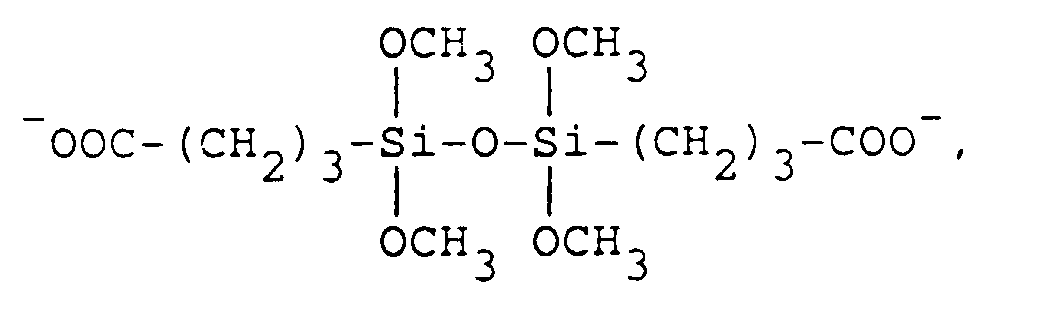
(H5C2O)3Si-(CH2)3-S-S-S-S-(CH2)3-Si(OC2H5)3,


- Die Reaktion der Metallverbindung (a) mit dem Fällungsreagenz (b) in Gegenwart der bifunktionellen Verbindung (c) kann z. B. bei Temperaturen von 0°C bis zum Siedepunkt des verwendeten Lösungsmittels durchgeführt werden. Vorzugsweise wird bei Raumtemperatur gearbeitet.
- Auch der Reaktionsdruck ist unkritisch. Gewöhnlich erfolgt die Umsetzung bei Atmosphärendruck; es kann aber auch bei erhöhtem oder verringertem Druck gearbeitet werden.
- Als organische Lösungsmittel werden erfindungsgemäß vorzugsweise Alkohole, wie Methanol, Ethanol, Propanol und Butanol, Ether, wie Diethylether, Dibutylether und Tetrahydrofuran, Etheralkohole, wie Butoxyethanol, Ester, wie Essigsäureethylester, aliphatische und cycloaliphatiche Kohlenwasserstoffe, wie Pentan, Hexan und Cyclohexan, sowie aromatische Kohlenwasserstoffe, wie Toluol, angewandt.
- Die Reaktion erfolgt innerhalb einiger Minuten bis einiger Stunden. Vorzugsweise wird unter Inertgasschutz (z. B. Stickstoff, Argon, Kohlendioxid) gearbeitet.
- Das Fällungsreagenz (b) wird im allgemeinen mindestens in der stöchiometrisch erforderlichen Menge, vorzugsweise in geringem Überschuß, bezogen auf die Metallverbindung (a) angewandt.
- Das Molverhältnis der Metallverbindung (a) zu der bifunktionellen Verbindung (c) beträgt vorzugsweise 1:1 bis 1:50, insbesondere 1:5 bis 1:20.
- Das bei der Reaktion entstehende, durch die bifunktionelle Verbindung (c) stabilisierte Sol von nanoskaligen Teilchen wird, gegebenenfalls nach teilweiser Abtrennung des Lösungsmittels, mit einer thermisch oder photochemisch zu einem Polymer härtbaren oder polymerisierbaren Verbindung (d) und einem Polymerisationsinitiator (e) vermischt.
- Gegebenenfalls kann ein Teil der thermisch oder photochemisch zu einem Polymer härtbaren oder polymerisierbaren Verbindung (d) durch ein entsprechendes fertiges Polymer (f) ersetzt werden, das zusätzlich z. B. in Form einer organischen Lösung zugemischt wird.
- Als Polymere (f) eignen sich beliebige bekannte Kunststoffe, z. B. Polyacrylsäure, Polymethacrylsäure, Polyacrylate, Polymethacrylate, Polyolefine, Polystyrol, Polyamide, Polyimide, Polyvinylverbindungen, wie Polyvinylchlorid, Polyvinylalkohol, Polyvinylbutyral, Polyvinylacetat und entsprechende Copolymere, z. B. Poly(ethylen-vinylacetat), Polyester, z. B. Polyethylenterephthalat oder Polydiallylphthalat, Polyarylate, Polycarbonate, Polyether, z. B. Polyoxymethylen, Polyethylenoxid oder Polyphenylenoxid, Polyetherketone, Polysulfone, Polyepoxide, Fluorpolymere, z. B. Polytetrafluorethylen, und Organopolysiloxane. Vorzugsweise weisen transparente Polymere (f) angewandt.
- Bei der thermisch oder photochemisch zu einem Polymer härtbaren oder polymerisierbaren Verbindung (d) handelt es sich in der Regel um ein polykondensierbares oder polymerisierbares, ungesättigte Gruppen aufweisendes Monomer, Oligomer oder Prepolymer, das bei der thermisch oder photochemisch initiierten Polymerisation oder bei der (gegebenenfalls Säure- oder Basen-katalysierten) Polykondensation eines der oben genannten Polymeren ergibt.
- Spezielle Beispiele für polymerisierbare Monomere (d), die eine rein organische Polymermatrix ergeben, sind (Meth)acrylsäure, (Meth)acrylsäureester, (Meth)acrylnitril, Styrol und Styrolderivate, Alkene (z. B. Ethylen, Propylen, Buten, Isobuten), halogenierte Alkene (z. B. Tetrafluorethylen, Chlortrifluorethylen, Vinylchlorid, Vinylfluorid, Vinylidenfluorid, Vinylidenchlorid), Vinylacetat, Vinylpyrrolidon, Vinylcarbazol und Gemische derartiger Monomere. Auch mehrfach ungesättigte Monomere (d) können angewandt werden, z. B. Butadien und Ethylendimethacrylat.
- Beispiele für Monomere (d), die eine organisch/anorganische oder rein anorganische Polymermatrix ergeben, sind hydrolysierbare und kondensierbare Verbindungen von Elementen der Gruppen 3 bis 6 und 13 bis 15 des Periodensystems oder von Lanthaniden-Elementen. Bei diesen hydrolysierbaren und kondensierbaren Verbindungen handelt es sich vorzugsweise um solche von Si, Al, B, Pb, Sn, Ti, Zr, V und Zn, insbesondere solche von Si, Al, Ti und Zr oder Mischungen davon. Es können aber auch andere hydrolysierbare Verbindungen eingesetzt werden, insbesondere solche von Elementen der Gruppen 1 und 2 des Periodensystems (z.B. Na, K, Ca und Mg) oder der Gruppen 7 bis 10 des Periodensystems (z.B. Mn, Fe, Co und Ni). Vorzugsweise machen die soeben genannten Verbindungen aber nicht mehr als 20 und insbesondere nicht mehr als 10 Mol-% der insgesamt eingesetzten hydrolysierbaren monomeren Verbindungen aus.
- Beispiele für hydrolysierbare Gruppen in diesen Verbindungen sind Halogen (F, Cl, Br und I, insbesondere Cl und Br), Alkoxy (insbesondere C1-4-Alkoxy, wie z.B. Methoxy, Ethoxy, n-Propoxy, i-Propoxy und Butoxy), Aryloxy (insbesondere C6-10-Aryloxy, z.B. Phenoxy), Acyloxy (insbesondere C1-4-Acyloxy, wie z.B. Acetoxy und Propionyloxy) und Alkylcarbonyl (z.B. Acetyl).
- Neben den oben genannten hydrolysierbaren Gruppen können als weitere geeignete Gruppen erwähnt werden Wasserstoff und Alkoxyreste mit 5 bis 20, insbesondere 5 bis 10 Kohlenstoffatomen und Halogen- und Alkoxy-substituierte Alkoxygruppen (wie z.B. β-Methoxyethoxy).
- Da die hydrolysierbaren Gruppen im Endprodukt praktisch nicht mehr vorhanden sind, sondern durch Hydrolyse verlorengehen, wobei das Hydrolyseprodukt früher oder später auch in irgendeiner geeigneten Weise entfernt werden muß, sind solche hydrolysierbare Gruppen besonders bevorzugt, die keine Substituenten tragen und zu Hydrolyseprodukten mit niedrigem Molekulargewicht, wie z.B. niederen Alkoholen, wie Methanol, Ethanol, Propanol, n-, i, sek- und tert-Butanol, führen. Die letztgenannten Gruppen sind auch deshalb bevorzugt, weil sie bei der Hydrolyse den pH-Wert praktisch nicht beeinflussen (im Gegensatz zu z.B. Halogen), was von Vorteil ist, weil der pH-Wert der Ausgangsmischung vorzugsweise im Bereich von 4 bis 9, insbesondere 5 bis 6,5, liegt und Hydrolyseprodukte, die den pH-Wert merklich aus diesem Bereich heraus verschieben, vorzugsweise durch Zugabe geeigneter Substanzen (Säuren oder Basen) neutralisiert werden.
- Die nicht-hydrolysierbaren Gruppen der eingesetzten polykondensierbaren Monomeren (d) werden vorzugsweise ausgewählt aus Alkyl (insbesondere C1-4-Alkyl, wie z.B. Methyl, Ethyl, Propyl und Butyl), Alkenyl (insbesondere C2-4-Alkenyl, wie z.B. Vinyl, 1-Propenyl, 2-Propenyl und Butenyl), Alkinyl (insbesondere C2-4-Alkinyl, wie Acetylenyl und Propargyl) und Aryl (insbesondere C6-10-Aryl, wie z.B. Phenyl und Naphthyl), wobei die soeben genannten Gruppen gegebenenfalls einen oder mehrere Substituenten, wie z.B. Halogen, Hydroxy, Alkoxy, Epoxy, gegebenenfalls substituiertes Amino usw. aufweisen können. Die obigen Alkylreste schließen auch die entsprechenden cyclischen und aryl-substituierten Reste, wie z.B. Cyclohexyl und Benzyl, ein, während die Alkenyl- und Alkinylgruppen ebenfalls cyclisch sein können und die genannten Arylgruppen auch Alkarylgruppen (wie Tolyl und Xylyl) mit einschließen sollen. Besonders bevorzugte nicht-hydrolysierbare Gruppen sind solche, die über eine (mehrfach) ungesättigte Kohlenstoff-Kohlenstoff-Bindung verfügen. In diesem Zusammenhang sind insbesondere zu erwähnen Gruppen, die über einen (Meth)acryloxyrest verfügen, insbesondere einen (Meth)acryloxy-C1-4-alkylrest wie z.B. (Meth)acryloxypropyl.
- Spezielle Beispiele für solche Monomeren (d) sind Organosilane (z. B. 3-Glycidyloxypropyltrimethoxysilan, 3-Methacryloxypropyltrimethoxysilan oder Vinylsilane). Als Monomere (d) eignen sich ferner Silicium-, Aluminium-, Titan- und Zirkonalkoxide, -acylate und -halogenide und andere z. B. in der US-PS 5030608 genannte Netzwerkbildner.
- Die Verbindung (d) und/oder das Polymer (f) können entweder als solche oder vorzugsweise als Lösung in einem organischen Lösungsmittel eingesetzt werden. Das hierbei verwendete Lösungmittel ist entweder identisch mit dem in der vorangehenden Fällungsreaktion verwendeten Lösungsmittel oder damit mischbar.
- Die Verbindung (d) und das gegebenenfalls zugemischte Polymer (f) werden im allgemeinen in solchen Mengen verwendet, daß das erhaltene Kompositmaterial 0,01 bis 90 Gewichtsprozent nanoskalige Teilchen und 10 bis 99,99 Gewichtsprozent Polymermatrix enthält. Im Falle der Verwendung des Polymers (f) beträgt dessen Anteil an der Gesamtmenge von Polymer (f) und Verbindung (d) mindestens 1 Gewichtsprozent und maximal 95 Gewichtsprozent, vorzugsweise maximal 50 Gewichtsprozent.
- Als Polymerisationsinitiatoren (e), welche die Polymerisation und Vernetzung der vorhandenen ungesättigten Verbindungen thermisch und/oder photochemisch induzieren können, eignen sich z.B. die im Handel erhältlichen Photoinitiatoren. Beispiele hierfür sind IrgacureR 184 (1-Hydroxycyclohexylphenylketon), Irgacure R 500 (1-Hydroxycyclohexylphenylketon, Benzophenon) und andere von der Firma Ciba-Geigy erhältliche Photoinitiatoren vom IrgacureR-Typ; DarocurR 1173, 1116, 1398, 1174 und 1020 (erhältlich von der Firma Merck), Benzophenon, 2-Chlorthioxanthon, 2-Methylthioxanthon, 2-Isopropylthioxanthon, Benzoin, 4,4'-Dimethoxybenzoin, Benzoinethylether, Benzoinisopropylether, Benzyldimethylketal, 1,1,1-Trichloracetophenon, Diethoxyacetophenon und Dibenzosuberon.
- Als thermische Initiatoren kommen u.a. organische Peroxide in Form von Diacylperoxiden, Peroxydicarbonaten, Alkylperestern, Dialkylperoxiden, Perketalen, Ketonperoxiden und Alkylhydroperoxiden in Frage. Konkrete Beispiele für derartige thermische Initiatoren sind Dibenzoylperoxid, tert.-Butylperbenzoat und Azobisisobutyronitril.
- Die Polykondensation induzierende Polymerisationskatalysatoren (e) sind z. B. Brönsted-Säuren und -Basen, wie Mineralsäuren oder tertiäre Amine, für die anionische Polykondensation und Lewis-Säuren, wie Metallalkoholate (z. B. Aluminiumalkoholate im Falle von Epoxysilanen) für die kationische Polykondensation.
- Der Polymerisationsinitiator (e) wird gewöhnlich in einer Menge von 0,1 bis 5, vorzugsweise 0,5 bis 3 Gewichtsprozent, bezogen auf die Mischung, angewandt.
- Falls die verwendeten Reaktionskomponenten in ein anorganisches Netzwerk überführbare Gruppen enthalten, wird durch Zugabe von Wasser eine Hydrolyse und Polykondensation dieser Gruppen durchgeführt. Das Molverhältnis von insgesamt zugegebenem Wasser zu den hydrolysierbaren Gruppen in allen eingesetzten Ausgangsverbindungen liegt dabei vorzugsweise im Bereich von 1:1 bis 0,3: 1, insbesondere 0,7:1 bis 0,5:1. Die Polykondensation kann z. B. an der Luft bei Temperaturen von 0°C bis zum Siedepunkt des verwendeten Lösungsmittels, gewöhnlich bei Raumtemperatur, durchgeführt werden. Das Reaktionsende kann z. B. durch Karl-Fischer-Titration bestimmt werden.
- Die Reaktionsmischung kann entweder als solche oder nach teilweiser oder vollständiger Entfernung des eingesetzten organischen Lösungsmittels bzw. des während der Reaktion gebildeten Lösungsmittels (z.B. der durch Hydrolyse der Alkoxide entstandenen Alkohole) weiterverarbeitet werden.
- Im Falle der Herstellung von Beschichtungen wird die Reaktionsmischung in Abhängigkeit von ihrer Viskosität entweder direkt oder nach teilweiser Abtrennung des Lösungsmittels oder nach Zugabe von weiterem Lösungsmittel auf ein Substrat aufgebracht und dann getrocknet.
- Im Falle der Herstellung von Formkörpern kann man die Reaktionsmischung z. B. in geeignete Formen eingießen und dann das Lösungsmittel vollständig abziehen, so daß ein Gel zurückbleibt.
- Anschließend wird das Material in Abhängigkeit von der Art der Polymermatrix und des verwendeten Polymerisationsinitiators (e) thermisch und/oder durch Bestrahlung mit aktinischer Strahlung (z. B. UV-Licht oder Laserstrahlen) gehärtet. Die Härtungsbedingungen (Temperatur, UV-Wellenlänge, etc.) richten sich im Falle der Polymerisation ungesättigter Gruppen nach den Zerfallsbedingungen des Polymerisationsinitiators. Die thermische Härtung erfolgt gewöhnlich bei Temperaturen unter 150°C.
- Die erfindungsgemäßen Kompositmaterialien enthalten nanoskalige Teilchen (Cluster) mit einer durchschnittlichen Partikelgröße von etwa 0,5 bis 20 nm in der Polymermatrix verteilt. Durch geeignete Wahl der Reaktionskomponenten und der Reaktionsbedingungen kann die Clustergröße und Clusterverteilung gezielt eingestellt werden.
- Die erfindungsgemäßen Kompositmaterialien eignen sich im Falle der Verwendung transparenter Polymerkomponenten hervorragend für optische Anwendungen. Es sind sowohl optisch transparente Formkörper als auch Beschichtungen herstellbar, welche z. B. durch Laser-Writing, Prägen oder Photomasken-Technik strukturiert werden können.
- Spezielle Anwendungsgebiete sind:
- abstimmbare strukturierte lineare optische Elemente für passive Anwendungen, wie Filter oder Wellenleiter;
- abstimmbare strukturierte nicht-lineare optische Elemente für aktive Anwendungen, wie Signalverarbeitung, Komputation, Frequenzverdoppelung oder -verdreifachung, Lichtverstärkung für optische Informationsübertragung, Lasing, Laser-Selbstfokussierung, Wellenmischen, Phasenkonjugation oder Holographie, z. B. optische Schalter, ausbleichbare Absorber und holographische Elemente;
- Photovoltaische Festkörperzellen, photoelektrochemische Solarzellen und Quantenpunkt-Halbleiter.
- Die folgenden Beispiele erläutern die Erfindung.
- 2·10-3 mol Cadmiumacetat werden bei Raumtemperatur in 200 ml Ethanol gelöst und mit 2·10-3 mol 3-Aminopropyltriethoxysilan versetzt. Die Mischung wird unter N2-Atmosphäre entgast. Zur Mischung werden 5·10-3 mol H2S gegeben und 10 Minuten bei Raumtemperatur gerührt. Anschließend werden im Vakuum 150 ml Lösungsmittel abdestilliert.
- Die erhaltene Lösung wird zuerst mit 2·10-1 mol 3-Glycidyloxypropyltrimethoxysilan und nach 15 Minuten Rühren mit 2·10-2 mol Aluminiumtributoxyethanolat versetzt. Nach 30 Minuten Rühren bei Raumtemperatur wurden zu der Mischung für die Hydrolyse 3,6·10-1 mol Wasser gegeben. Anschließend wird 3 Stunden gerührt.
- Die resultierende Beschichtungslösung wird durch Tauchen auf Glassubstrate aufgebracht und 60 Minuten bei 60°C gehärtet. Zur Herstellung von Formkörpern wird das restliche Lösungsmittel im Vakuum abdestilliert und die erhaltene viskose Lösung in eine Form gegossen und bei 60°C 1 Stunde ausgehärtet.
- Es wird wie in Beispiel 1 verfahren, allerdings wird statt 3-Aminopropyltriethoxysilan N-[2-Aminoethyl]-3-aminopropyltrimethoxysilan verwendet.
- Es wird wie in Beispiel 1 verfahren, allerdings wird statt 3-Aminopropyltriethoxysilan triaminomodifiziertes Propyltrimethoxysilan [H2N-(CH2)2 NH(CH2)2 NH(CH2)3-Si(OCH3)3] verwendet.
- Es wird wie in Beispiel 1 verfahren, allerdings wird statt 3-Aminopropyltriethoxysilan 3-Mercaptopropyltriethoxysilan verwendet.
- 2·10-3 mol Cadmiumacetat werden bei Raumtemperatur in 200 ml Ethanol gelöst und mit 2·10-3 mol Bis[3-triethoxysilylpropyl]-tetrasulfid versetzt. Die Mischung wird unter N2-Atmosphäre entgast. Anschließend werden zur der Lösung 2·10-2 mol Natriumborhydrid in 10 ml Ethanol gegeben und 30 Minuten bei Raumtemperatur gerührt und anschließend im Vakuum 150 ml von dem Lösungsmittel abdestilliert.
- Die erhaltene Lösung wird zuerst mit 2·10-1 mol 3-Glycidyloxypropyltrimethoxysilan und nach 15 Minuten Rühren mit 2·10-2 mol Aluminiumtributoxyethanolat versetzt. Nach 30 Minuten Rühren bei Raumtemperatur wurden zu der Mischung für die Hydrolyse 3,6·10-1 mol Wasser gegeben. Anschließend wird 3 Stunden gerührt.
- Die resultierende Beschichtungslösung wird durch Tauchen auf Glassubstrate aufgebracht und 60 Minuten bei 60°C gehärtet. Zur Herstellung von Formkörpern wird das restliche Lösungsmittel im Vakuum abdestilliert und die erhaltene viskose Lösung in eine Form gegossen und bei 60°C 1 Stunde ausgehärtet.
- Es wird wie in Beispiel 1 verfahren, allerdings wird statt 3-Aminopropyltriethoxysilan frisch aus 2·10-2 (3-Triethoxysilylpropyl)-bernsteinsäureanhydrid und 2·10-2 mol Wasser hergestellte (3-Triethoxysilylpropyl)-bernsteinsäure verwendet.
- 2·10-3 mol Cadmiumacetat werden bei Raumtemperatur in 200 ml Ethanol gelöst und mit 2·10-2 mol 3-Aminopropyltriethoxysilan versetzt. Die Mischung wird unter N2-Atmosphäre entgast. Zur Mischung werden 2·10-2 mol H2S gegeben und 10 Minuten bei Raumtemperatur (RT) gerührt und anschließend 150 ml von dem Lösungsmittel abdestilliert.
- Die erhaltene Lösung wird dann mit 2·10-1 mol 3-Methacryloxypropyltrimethoxysilan versetzt und 15 Minuten bei RT gerührt. Zu der Mischung wird für die Hydrolyse 3,3·10-1 mol H2O gegeben und 3 Stunden bei Raumtemperatur gerührt. Zum Beschichten von Substraten und zur Herstellung von Formkörpern wird der erhaltenen viskosen Lösung 1 Gew.-% tert-Butylperbenzoat zugesetzt. Die weitere Bearbeitung erfolgt wie in Beispiel 1.
- Es wird wie in Beispiel 7 verfahren, allerdings wird statt 3-Aminopropyltriethoxysilan N-[2-Aminoethyl]-3-aminopropyltrimethoxysilan verwendet.
- Es wird wie in Beispiel 7 verfahren, allerdings wird statt 3-Aminopropyltriethoxysilan triaminomodifiziertes Propyltrimethoxysilan [H2N-(CH2)2 NH(CH2)2 NH(CH2)3 Si(OCH3)3] verwendet.
- Es wird wie in Beispiel 7 verfahren, allerdings wird statt 3-Aminopropyltriethoxysilan 3-Mercaptopropyltriethoxysilan verwendet.
- 2·10-3 mol Cadmiumacetat werden bei Raumtemperatur in 200 ml Ethanol gelöst und mit 2·10-2 mol Bis-[3-triethoxysilylpropyl]-tetrasulfid versetzt. Die Mischung wird unter N2-Atmosphäre entgast. Anschließend wird zu der Mischung 2·10-2 mol Natriumborhydrid in 10 ml Ethanol gegeben und 30 Minuten bei RT gerührt. Nach Abdestillieren von 150 ml Lösungsmittel erfolgt die weitere Bearbeitung wie in Beispiel 7.
- Es wird wie in Beispiel 7 verfahren, allerdings wird statt 3-Aminopropyltriethoxysilan frisch aus 2·10-2 (3-Triethoxysilylpropyl)-bernsteinsäureanhydrid und 2·10-2 mol Wasser hergestellte (3-Triethoxysilylpropyl)-bernsteinsäure verwendet.
- Es wird wie in Beispiel 1 verfahren, allerdings wird statt Cadmiumacetat Silbernitrat verwendet.
- Es wird wie in Beispiel 2 verfahren, allerdings wird statt Cadmiumacetat Silbernitrat verwendet.
- Es wird wie in Beispiel 3 verfahren, allerdings wird statt Cadmiumacetat Silbernitrat verwendet.
- Es wird wie in Beispiel 4 verfahren, allerdings wird statt Cadmiumacetat Silbernitrat verwendet.
- Es wird wie in Beispiel 5 verfahren, allerdings wird statt Cadmiumacetat Silbernitrat verwendet.
- Es wird wie in Beispiel 6 verfahren, allerdings wird statt Cadmiumacetat Silbernitrat verwendet.
- Es wird wie in Beispiel 7 verfahren, allerdings wird statt Cadmiumacetat Silbernitrat verwendet.
- Es wird wie in Beispiel 8 verfahren, allerdings wird statt Cadmiumacetat Silbernitrat verwendet.
- Es wird wie in Beispiel 9 verfahren, allerdings wird statt Cadmiumacetat Silbernitrat verwendet.
- Es wird wie in Beispiel 10 verfahren, allerdings wird statt Cadmiumacetat Silbernitrat verwendet.
- Es wird wie in Beispiel 11 verfahren, allerdings wird statt Cadmiumacetat Silbernitrat verwendet.
- Es wird wie in Beispiel 12 verfahren, allerdings wird statt Cadmiumacetat Silbernitrat verwendet.
- Es wird wie in Beispiel 7 verfahren, allerdings wird statt 3-Aminopropyltriethoxysilan Methacrylsäure verwendet.
- Es wird wie in Beispiel 25 verfahren, allerdings wird statt Cadmiumacetat Silbernitrat verwendet.
- Es wird wie in Beispiel 25 verfahren, allerdings wird statt 3-Methacryloxypropyltrimethoxysilan Triethylenglykoldimethacrylat verwendet.
- Es wird wie in Beispiel 27 verfahren, allerdings wird statt Cadmiumacetat Silbernitrat verwendet.
- 0,1 mol Cadmiumacetat werden bei Raumtemperatur in 250 ml Ethanol gelöst und mit 2 mol 3-Aminopropyltriethoxysilan versetzt. Die Mischung wird unter N2 Atmosphäre entgast. Zur Mischung werden 0,1 mol (CH3)3-Si-S-Si(CH3)3 (verdünnt mit Tetrahydrofuran 1:1) tropfenweise zugegeben. Anschließend werden im Vakuum 200 ml Lösungsmittel abdestilliert.
- Die weitere Verarbeitung erfolgt wie in Beispiel 1. In Abwandlung dieses Verfahrens werden die Bedingungen der Beispiele 2 bis 4 und 13 angewandt.
- 0,1 mol Zinkacetat (Zn(Ac)2·2H2O) werden bei 80°C (3h) in 260 ml Ethanol gelöst, die Lösung auf Raumtemperatur abgekühlt und mit 2 mol 3-Aminopropyltriethoxysilan versetzt. Die Mischung wird mit N2 begast.
- Die weitere Verarbeitung erfolgt wie in Beispiel 29.
- Es wird wie in Beispiel 30 verfahren, jedoch verwendet man Bleiethoxyethanolat anstelle des Zinkacetats.
- 0,01 mol HAuCl4 werden in 50 ml Ethanol gelöst und mit triaminofunktionalisiertem Silan behandelt (das Molverhältnis Au/Si liegt im Bereich von 1/5 bis 1:100). Dabei kommt es zur spontanen Metallclusterbildung und Entstehung eines langzeitstabilen Sols. Die weitere Verarbeitung erfolgt wie in Beispiel 7, d.h. die Lösung wird mit 0,2 mol 3-Methacryloxypropyltrimethoxysilan (MEMO) versetzt.
- Es wird wie in Beispiel 32 verfahren, jedoch verwendet man Silberacetat bzw. -nitrat anstelle von HAuCl4.
- Es wird wie in Beispiel 32 verfahren, jedoch verwendet man H2PtCl6 anstelle von HAuCl4.
- 0,01 mol HAuCl4 werden in 50 ml Ethanol gelöst und mit N-Aminoethyl-3-aminopropyltrimethoxysilan (DIAMO) behandelt. Anschließend werden 0,1 mol MEMO-Vorhydrolysat zugegeben. Die resultierende Beschichtungslösung wird mit 0,1 Gew.-% Azoisobutyronitril-Starter versetzt und zur Beschichtung von Glassubstraten weiterverwendet. Nasse Filme werden photothermisch behandelt (1 min, UV, 120°C). Dabei kommt es zur simultanen Au-Teilchenbildung und Matrixhärtung.
- Es wird wie in Beispiel 35 verfahren, jedoch verwendet man Silberacetat bzw. -nitrat anstelle von HAuCl4.
- Es wird wie in Beispiel 35 verfahren, jedoch verwendet man H2PtCl6 anstelle von HAuCl4.
- Nanokristallines ZnO wird in Ethanol mit DIAMO versetzt (Molverhältnis ZnO/DIAMO = 1:20) und bei Raumtemperatur in MEMO-Vorhydrolysat eingerührt. Das ZnO/MEMO-Molverhältnis ist variabel zwischen 1/3 und 1:100. Das Lösungsmittel wird abgezogen und das Produkt zur Herstellung von Formkörpern verwendet.
- Es wird wie in Beispiel 38 verfahren, jedoch verwendet man TiO2 anstelle von ZnO.
Claims (11)
- Verfahren zur Herstellung von nanoskalige Teilchen enthaltenden Kompositmaterialien, dadurch gekennzeichnet, daß man in einem organischen Lösungsmittela) eine in dem Lösungsmittel lösliche Verbindung eines Metalls der Gruppen 6 bis 15 des Periodensystems oder der Lanthaniden mitb) einem Fällungsreagenz zur Bildung von Antimoniden, Arseniden, Chalkogeniden, Halogeniden oder Phosphiden des Metalls der Metallverbindung (a)
in Gegenwart vonc) einer bifunktionellen Verbindung, die mindestens eine Elektronenpaar-Donorgruppe und mindestens eine durch Polymerisation oder Polykondensation in ein organisches oder anorganisches Netzwerk überführbare Gruppe aufweisen,umsetzt, das erhaltene stabilisierte Sol von nanoskaligen Teilchen mitd) einer thermisch oder photochemisch zu einem Polymer härtbaren oder polymerisierbaren Verbindung unde) einem Polymerisationsinitiator vermischt,eine Hydrolyse und Polykondensation der gegebenenfalls anwesenden, in ein anorganisches Netzwerk überführbaren Gruppen durchführt und das Material thermisch oder photochemisch härtet. - Verfahren nach Anspruch 1, dadurch gekennzeichnet, daß man eine Lösung der thermisch oder photochemisch zu einem Polymer härtbaren oder polymerisierbaren Verbindung (d) in einem organischen Lösungsmittel verwendet.
- Verfahren nach Anspruch 1, dadurch gekennzeichnet, daß man das stabilisierte Sol von nanoskaligen Teilchen zusätzlich mit einem in organischen Lösungsmitteln löslichen Polymer (f) vermischt.
- Verfahren nach Anspruch 1, dadurch gekennzeichnet, daß man als organische Lösungsmittel Alkohole, Ether, Ester, aliphatische oder aromatische Kohlenwasserstoffe verwendet.
- Verfahren nach Anspruch 1, dadurch gekennzeichnet, daß man als Fällungsreagenzien (b) Salze der entsprechenden Anionen, die entsprechenden Wasserstoffverbindungen oder Verbindungen verwendet, aus denen das eigentliche Fällungsmittel in situ freigesetzt wird.
- Verfahren nach Anspruch 1, dadurch gekennzeichnet, daß das Fällungsreagenz (b) in geringem stöchiometrischem Überschuß, bezogen auf die Metallverbindung (a), eingesetzt wird.
- Verfahren nach Anspruch 1, dadurch gekennzeichnet, daß das Molverhältnis der Metallverbindung (a) zu der bifunktionellen Verbindung (c) etwa 1:1 bis 1:50 beträgt.
- Verfahren nach Anspruch 1, dadurch gekennzeichnet, daß die thermisch oder photochemisch zu einem Polymer härtbare oder polymerisierbare Verbindung (d) und das gegebenenfalls zugemischte, in organischen Lösungsmitteln lösliche Polymer (f) in solchen Mengen verwendet, daß das erhaltene Kompositmaterial 0,01 bis 90 Gewichtsprozent nanoskalige Teilchen und 10 bis 99,99 Gewichtsprozent Polymermatrix enthält.
- Nanoskalige Teilchen enthaltende Kompositmaterialien, erhältlich nach dem Verfahren von Anspruch 1.
- Kompositmaterialien nach Anspruch 9 in Form von Beschichtungen oder Formkörpern.
- Verwendung von transparenten Kompositmaterialien nach Anspruch 10 für optische Elemente.
Applications Claiming Priority (3)
| Application Number | Priority Date | Filing Date | Title |
|---|---|---|---|
| DE4133621A DE4133621A1 (de) | 1991-10-10 | 1991-10-10 | Nanoskalige teilchen enthaltende kompositmaterialien, verfahren zu deren herstellung und deren verwendung fuer optische elemente |
| DE4133621 | 1991-10-10 | ||
| PCT/EP1992/002327 WO1993007179A2 (de) | 1991-10-10 | 1992-10-09 | Nanoskalige teilchen enthaltende kompositmaterialien, verfahren zu deren herstellung und deren verwendung für optische elemente |
Publications (2)
| Publication Number | Publication Date |
|---|---|
| EP0607213A1 EP0607213A1 (de) | 1994-07-27 |
| EP0607213B1 true EP0607213B1 (de) | 1997-01-02 |
Family
ID=6442447
Family Applications (1)
| Application Number | Title | Priority Date | Filing Date |
|---|---|---|---|
| EP92920737A Expired - Lifetime EP0607213B1 (de) | 1991-10-10 | 1992-10-09 | Nanoskalige teilchen enthaltende kompositmaterialien, verfahren zu deren herstellung und deren verwendung für optische elemente |
Country Status (5)
| Country | Link |
|---|---|
| US (1) | US5470910A (de) |
| EP (1) | EP0607213B1 (de) |
| JP (1) | JP3115323B2 (de) |
| DE (2) | DE4133621A1 (de) |
| WO (1) | WO1993007179A2 (de) |
Families Citing this family (111)
| Publication number | Priority date | Publication date | Assignee | Title |
|---|---|---|---|---|
| US5817410A (en) * | 1991-11-18 | 1998-10-06 | Matsushita Electric Industrial Co., Ltd. | Nonlinear optical composites using linear transparent substances and method for producing the same |
| DE4338361A1 (de) * | 1993-11-10 | 1995-05-11 | Inst Neue Mat Gemein Gmbh | Verfahren zur Herstellung von Zusammensetzungen auf der Basis von Epoxidgruppen-haltigen Silanen |
| US5587422A (en) * | 1994-05-18 | 1996-12-24 | Cornell Research Foundation, Inc. | Single phase solids containing metalloploymers |
| EP0689067A3 (de) * | 1994-06-22 | 1997-04-09 | Fujitsu Ltd | Herstellungsverfahren für ein optisches Wellenleitersystem, optisches Bauelement und optischer Koppler mit dessen Verwendung, optisches Netzwerk und optische Leiterplatte |
| DE19544912A1 (de) * | 1995-12-01 | 1997-06-05 | Gore W L & Ass Gmbh | PTFE-Körper aus mikroporösem Polytetrafluorethylen mit Füllstoff und Verfahren zu dessen Herstellung |
| US5711803A (en) * | 1995-09-29 | 1998-01-27 | Midwest Research Institute | Preparation of a semiconductor thin film |
| US6126740A (en) * | 1995-09-29 | 2000-10-03 | Midwest Research Institute | Solution synthesis of mixed-metal chalcogenide nanoparticles and spray deposition of precursor films |
| DE19540623A1 (de) * | 1995-10-31 | 1997-05-07 | Inst Neue Mat Gemein Gmbh | Verfahren zur Herstellung von Kompositmaterialien mit hohem Grenzflächenanteil und dadurch erhältliche Kompositmaterialien |
| DE19613645A1 (de) * | 1996-04-04 | 1997-10-09 | Inst Neue Mat Gemein Gmbh | Optische Bauteile mit Gradientenstruktur und Verfahren zu deren Herstellung |
| WO1998013008A1 (en) * | 1996-09-27 | 1998-04-02 | Southwest Research Institute | Metal oxide compositions and methods |
| DE19706515A1 (de) * | 1997-02-19 | 1998-08-20 | Inst Neue Mat Gemein Gmbh | Hydroxylgruppen-arme organisch/anorganische Komposite, Verfahren zu deren Herstellung und deren Verwendung |
| DE19710685B4 (de) * | 1997-03-14 | 2005-12-01 | Fraunhofer-Gesellschaft zur Förderung der angewandten Forschung e.V. | Nanokristalline Partikel enthaltendes Material, Verfahren zur Herstellung und dessen Verwendung |
| US6099798A (en) * | 1997-10-31 | 2000-08-08 | Nanogram Corp. | Ultraviolet light block and photocatalytic materials |
| US7226966B2 (en) * | 2001-08-03 | 2007-06-05 | Nanogram Corporation | Structures incorporating polymer-inorganic particle blends |
| DE19740343A1 (de) * | 1997-09-13 | 1998-09-17 | Kuhnke Gmbh Kg H | Vorrichtung, insbesondere fluidische oder elektromagnetische Vorrichtung |
| JP4451501B2 (ja) * | 1997-10-03 | 2010-04-14 | デンツプライ インターナショナル インコーポレーテッド | ナノスケールの充填剤を含む歯科材料 |
| DE19756790A1 (de) * | 1997-12-19 | 1999-07-01 | Fraunhofer Ges Forschung | Prepolymer mit darin isoliert dispergierten nanoskaligen Feststoffteilchen, Verfahren zu seiner Herstellung und seine Verwendung |
| US7347974B1 (en) * | 1998-05-04 | 2008-03-25 | The United States Of America As Represented By The Secretary Of The Navy | Materials, method and apparatus for detection and monitoring of chemical species |
| GB9815270D0 (en) * | 1998-07-14 | 1998-09-09 | Cambridge Display Tech Ltd | Particles and devices comprising particles |
| GB9815271D0 (en) | 1998-07-14 | 1998-09-09 | Cambridge Display Tech Ltd | Particles and devices comprising particles |
| US6329058B1 (en) | 1998-07-30 | 2001-12-11 | 3M Innovative Properties Company | Nanosize metal oxide particles for producing transparent metal oxide colloids and ceramers |
| US6294401B1 (en) * | 1998-08-19 | 2001-09-25 | Massachusetts Institute Of Technology | Nanoparticle-based electrical, chemical, and mechanical structures and methods of making same |
| CN1094467C (zh) * | 1999-02-15 | 2002-11-20 | 上海跃龙有色金属有限公司 | 纳米铈锆复合氧化物、其制备方法及用途 |
| DE19948548B4 (de) | 1999-04-19 | 2006-04-13 | Fraunhofer-Gesellschaft zur Förderung der angewandten Forschung e.V. | Pastöse Massen mit nanokristallinen Materialien für elektrochemische Bauelemente und daraus hergestellte Schichten und elektrochemische Bauelemente |
| GB9923747D0 (en) * | 1999-10-07 | 1999-12-08 | Welding Inst | Composite materials,their production and uses |
| US6387981B1 (en) | 1999-10-28 | 2002-05-14 | 3M Innovative Properties Company | Radiopaque dental materials with nano-sized particles |
| US6730156B1 (en) | 1999-10-28 | 2004-05-04 | 3M Innovative Properties Company | Clustered particle dental fillers |
| JP4800535B2 (ja) | 1999-10-28 | 2011-10-26 | スリーエム イノベイティブ プロパティズ カンパニー | ナノサイズシリカ粒子を含有する歯科材料 |
| DE19952040A1 (de) | 1999-10-28 | 2001-05-03 | Inst Neue Mat Gemein Gmbh | Substrat mit einem abriebfesten Diffusionssperrschichtsystem |
| US6376590B2 (en) | 1999-10-28 | 2002-04-23 | 3M Innovative Properties Company | Zirconia sol, process of making and composite material |
| US6572693B1 (en) | 1999-10-28 | 2003-06-03 | 3M Innovative Properties Company | Aesthetic dental materials |
| JP4537528B2 (ja) * | 2000-03-29 | 2010-09-01 | 株式会社東芝 | 光記録媒体 |
| JP3839637B2 (ja) | 2000-04-03 | 2006-11-01 | 三菱化学産資株式会社 | 折畳み可能な床暖房用パネル |
| AT411306B (de) * | 2000-04-27 | 2003-11-25 | Qsel Quantum Solar Energy Linz | Photovoltaische zelle mit einer photoaktiven schicht aus zwei molekularen organischen komponenten |
| AT410729B (de) * | 2000-04-27 | 2003-07-25 | Qsel Quantum Solar Energy Linz | Photovoltaische zelle mit einer photoaktiven schicht aus zwei molekularen organischen komponenten |
| AT410859B (de) * | 2000-04-27 | 2003-08-25 | Qsel Quantum Solar Energy Linz | Verfahren zum herstellen einer photovoltaischen zelle mit einer photoaktiven schicht aus zwei organischen komponenten |
| JP3559962B2 (ja) * | 2000-09-04 | 2004-09-02 | 日本航空電子工業株式会社 | 熱電変換材料及びその製造方法 |
| FR2816756B1 (fr) * | 2000-11-15 | 2003-10-31 | Univ Paris Curie | Procede d'obtention d'une composition polymere dopee par des nanoparticules pour la realisation de materiaux composites polymeres, dispositif pour sa mise en oeuvre, composition et materiaux obtenus |
| CN1241681C (zh) * | 2000-11-24 | 2006-02-15 | 纳米技术有限公司 | 纳米粒子的相转移 |
| DE10136583B4 (de) * | 2000-11-24 | 2006-01-05 | Nanosolutions Gmbh | Phasentransfer von Nanopartikeln, Nanopartikel enthaltende wässrige oder alkoholische Phase und deren Verwendung |
| US6458462B1 (en) | 2000-12-13 | 2002-10-01 | 3M Innovative Properties Company | Sporting goods having a ceramer coating |
| US6586096B2 (en) * | 2000-12-22 | 2003-07-01 | Eastman Kodak Company | Polymethylmethacrylate nanocomposite optical article and method of making same |
| US6498208B2 (en) * | 2000-12-22 | 2002-12-24 | Eastman Kodak Company | Polystyrene nanocomposite optical plastic article and method of making same |
| US6552111B2 (en) * | 2000-12-22 | 2003-04-22 | Eastman Kodak Company | Cyclic olefin polymeric nanocomposite optical plastic article and method of making same |
| US6518353B2 (en) * | 2000-12-22 | 2003-02-11 | Eastman Kodal Company | Reduced temperature sensitive polymeric optical article and method of making same |
| US6441077B1 (en) * | 2000-12-22 | 2002-08-27 | Eastman Kodak Company | Polysulfone nanocomposite optical plastic article and method of making same |
| US6759452B2 (en) * | 2000-12-22 | 2004-07-06 | Eastman Kodak Company | Polycarbonate nanocomposite optical plastic article and method of making same |
| US7265174B2 (en) * | 2001-03-22 | 2007-09-04 | Clemson University | Halogen containing-polymer nanocomposite compositions, methods, and products employing such compositions |
| DE10118309C2 (de) * | 2001-04-12 | 2003-03-20 | Bayer Ag | Anionisch stabilisierte, wässrige Dispersionen von nanopartikulärem Zinkoxid, Verfahren zu deren Herstellung sowie deren Verwendung |
| US6846870B2 (en) * | 2001-08-23 | 2005-01-25 | Sunoco, Inc. (R&M) | Hydrotalcites, syntheses, and uses |
| US6979708B2 (en) | 2001-08-23 | 2005-12-27 | Sunoco, Inc. (R&M) | Hydrotalcites, syntheses, and uses |
| US7588699B2 (en) * | 2001-11-02 | 2009-09-15 | The United States Of America As Represented By The Administrator Of The National Aeronautics And Space Administration | Electrically conductive, optically transparent polymer/carbon nanotube composites and process for preparation thereof |
| US6642295B2 (en) * | 2001-12-21 | 2003-11-04 | Eastman Kodak Company | Photoresist nanocomposite optical plastic article and method of making same |
| DE10200648A1 (de) * | 2002-01-10 | 2003-07-24 | Inst Neue Mat Gemein Gmbh | Verfahren zur Herstellung Optischer Elemente mit Gradientenstruktur |
| DE10200760A1 (de) * | 2002-01-10 | 2003-07-24 | Clariant Gmbh | Nanokompositmaterial zur Herstellung von Brechzahlgradientenfolien |
| JP4748938B2 (ja) | 2002-01-31 | 2011-08-17 | スリーエム イノベイティブ プロパティズ カンパニー | 歯科ペースト、歯科物品、および方法 |
| JP2004168846A (ja) * | 2002-11-19 | 2004-06-17 | Asahi Glass Co Ltd | 複合微粒子およびその製造方法 |
| TWI252215B (en) * | 2003-03-27 | 2006-04-01 | Univ Nat Central | Zirconia sol and method of preparing the same |
| JP4283026B2 (ja) * | 2003-04-07 | 2009-06-24 | 株式会社日本触媒 | 光学樹脂用添加剤とその製造方法および光学樹脂組成物 |
| KR20060112189A (ko) * | 2003-07-23 | 2006-10-31 | 코니카 미놀타 옵토 인코포레이티드 | 촬상 렌즈 및 촬상 장치 |
| US7858267B2 (en) | 2003-07-24 | 2010-12-28 | Kabushiki Kaisha Toyota Chuo Kenkyusho | Fuel cell electrode, fuel cell, and manufacturing methods thereof |
| US6913830B2 (en) * | 2003-08-14 | 2005-07-05 | Ppg Industries Ohio, Inc. | Coating compositions containing semiconductor colorants |
| US11591436B2 (en) | 2004-09-01 | 2023-02-28 | Ppg Industries Ohio, Inc. | Polyurethane article and methods of making the same |
| US9464169B2 (en) | 2004-09-01 | 2016-10-11 | Ppg Industries Ohio, Inc. | Polyurethanes, articles and coatings prepared therefrom and methods of making the same |
| US11008418B2 (en) | 2004-09-01 | 2021-05-18 | Ppg Industries Ohio, Inc. | Polyurethanes, articles and coatings prepared therefrom and methods of making the same |
| US11248083B2 (en) | 2004-09-01 | 2022-02-15 | Ppg Industries Ohio, Inc. | Aircraft windows |
| US9598527B2 (en) | 2004-09-01 | 2017-03-21 | Ppg Industries Ohio, Inc. | Polyurethanes, articles and coatings prepared therefrom and methods of making the same |
| US20090280709A1 (en) | 2004-09-01 | 2009-11-12 | Ppg Industries Ohio, Inc. | Polyurethanes, Articles and Coatings Prepared Therefrom and Methods of Making the Same |
| US11149107B2 (en) | 2004-09-01 | 2021-10-19 | Ppg Industries Ohio, Inc. | Polyurethanes, articles and coatings prepared therefrom and methods of making the same |
| US8178615B2 (en) * | 2004-09-01 | 2012-05-15 | Ppg Industries Ohio, Inc | Process for making polymers having nanostructures incorporated into the matrix of the polymer |
| US20090280329A1 (en) | 2004-09-01 | 2009-11-12 | Ppg Industries Ohio, Inc. | Polyurethanes, Articles and Coatings Prepared Therefrom and Methods of Making the Same |
| US7507480B2 (en) * | 2005-05-31 | 2009-03-24 | Brookhaven Science Associates, Llc | Corrosion-resistant metal surfaces |
| US8718437B2 (en) | 2006-03-07 | 2014-05-06 | Qd Vision, Inc. | Compositions, optical component, system including an optical component, devices, and other products |
| WO2007103310A2 (en) | 2006-03-07 | 2007-09-13 | Qd Vision, Inc. | An article including semiconductor nanocrystals |
| US7749761B2 (en) * | 2005-09-29 | 2010-07-06 | Industrial Technology Research Institute | Hydrogel composition for cell culture apparatus |
| US9874674B2 (en) | 2006-03-07 | 2018-01-23 | Samsung Electronics Co., Ltd. | Compositions, optical component, system including an optical component, devices, and other products |
| US9951438B2 (en) | 2006-03-07 | 2018-04-24 | Samsung Electronics Co., Ltd. | Compositions, optical component, system including an optical component, devices, and other products |
| US8849087B2 (en) | 2006-03-07 | 2014-09-30 | Qd Vision, Inc. | Compositions, optical component, system including an optical component, devices, and other products |
| EP2022123B1 (de) * | 2006-05-04 | 2016-09-28 | LG Chem, Ltd. | Elektrochemische energiespeicheranordnung mit hoher kapazität und hoher leistung mit einem leitfähigen polymerverbund |
| US7892447B2 (en) | 2006-08-11 | 2011-02-22 | Aqua Resources Corporation | Nanoplatelet metal hydroxides and methods of preparing same |
| US8822030B2 (en) | 2006-08-11 | 2014-09-02 | Aqua Resources Corporation | Nanoplatelet metal hydroxides and methods of preparing same |
| WO2008063658A2 (en) | 2006-11-21 | 2008-05-29 | Qd Vision, Inc. | Semiconductor nanocrystals and compositions and devices including same |
| WO2008063653A1 (en) | 2006-11-21 | 2008-05-29 | Qd Vision, Inc. | Semiconductor nanocrystals and compositions and devices including same |
| WO2008063652A1 (en) | 2006-11-21 | 2008-05-29 | Qd Vision, Inc. | Blue emitting semiconductor nanocrystals and compositions and devices including same |
| US8322754B2 (en) | 2006-12-01 | 2012-12-04 | Tenaris Connections Limited | Nanocomposite coatings for threaded connections |
| US7972691B2 (en) * | 2006-12-22 | 2011-07-05 | Nanogram Corporation | Composites of polymers and metal/metalloid oxide nanoparticles and methods for forming these composites |
| CN101610749B (zh) | 2006-12-28 | 2013-01-02 | 3M创新有限公司 | 牙科填料及方法 |
| US8836212B2 (en) | 2007-01-11 | 2014-09-16 | Qd Vision, Inc. | Light emissive printed article printed with quantum dot ink |
| US8119233B2 (en) * | 2007-02-17 | 2012-02-21 | Nanogram Corporation | Functional composites, functional inks and applications thereof |
| JP5773646B2 (ja) | 2007-06-25 | 2015-09-02 | キユーデイー・ビジヨン・インコーポレーテツド | ナノ材料を被着させることを含む組成物および方法 |
| WO2009014707A2 (en) | 2007-07-23 | 2009-01-29 | Qd Vision, Inc. | Quantum dot light enhancement substrate and lighting device including same |
| US8128249B2 (en) | 2007-08-28 | 2012-03-06 | Qd Vision, Inc. | Apparatus for selectively backlighting a material |
| US20100294989A1 (en) * | 2007-12-28 | 2010-11-25 | Shaffer Ii Edward O | Small scale functional materials |
| US20100302487A1 (en) * | 2007-12-28 | 2010-12-02 | Storer Joey W | Phase compensation film |
| WO2009145813A1 (en) | 2008-03-04 | 2009-12-03 | Qd Vision, Inc. | Particles including nanoparticles, uses thereof, and methods |
| JP2009256616A (ja) * | 2008-03-21 | 2009-11-05 | Shin Etsu Chem Co Ltd | グリセリン変性シリコーン及びそれを含む化粧料 |
| WO2009123763A2 (en) | 2008-04-03 | 2009-10-08 | Qd Vision, Inc. | Light-emitting device including quantum dots |
| JP5353357B2 (ja) * | 2008-04-03 | 2013-11-27 | 信越化学工業株式会社 | カルボキシル基を有するオルガノポリシロキサン |
| JP5532648B2 (ja) * | 2008-04-03 | 2014-06-25 | 信越化学工業株式会社 | カルボキシル基を有するオルガノポリシロキサンで表面処理された粉体、該粉体の分散物および該粉体を含む化粧料 |
| US9525148B2 (en) | 2008-04-03 | 2016-12-20 | Qd Vision, Inc. | Device including quantum dots |
| WO2009151515A1 (en) | 2008-05-06 | 2009-12-17 | Qd Vision, Inc. | Solid state lighting devices including quantum confined semiconductor nanoparticles |
| EP2370362B1 (de) * | 2008-10-15 | 2013-11-27 | 3M Innovative Properties Company | Füllstoffe und verbundwerkstoffe mit zirconiumoxid- und siliciumoxid-nanopartikeln |
| CN102272218B (zh) | 2009-01-08 | 2014-07-16 | 纳克公司 | 聚硅氧烷聚合物与无机纳米颗粒的复合物 |
| US20100264371A1 (en) * | 2009-03-19 | 2010-10-21 | Nick Robert J | Composition including quantum dots, uses of the foregoing, and methods |
| JP2013502047A (ja) | 2009-08-14 | 2013-01-17 | キユーデイー・ビジヨン・インコーポレーテツド | 照明装置、照明装置用光学部品および方法 |
| KR101865888B1 (ko) | 2009-09-09 | 2018-06-08 | 삼성전자주식회사 | 나노입자들을 포함하는 입자, 그의 용도, 및 방법 |
| WO2011031876A1 (en) | 2009-09-09 | 2011-03-17 | Qd Vision, Inc. | Formulations including nanoparticles |
| JP2011256394A (ja) * | 2011-08-09 | 2011-12-22 | Asahi Kasei E-Materials Corp | 感光性耐熱性樹脂前駆体組成物 |
| US9929325B2 (en) | 2012-06-05 | 2018-03-27 | Samsung Electronics Co., Ltd. | Lighting device including quantum dots |
| WO2014052887A2 (en) | 2012-09-27 | 2014-04-03 | Rhodia Operations | Process for making silver nanostructures and copolymer useful in such process |
| AR100953A1 (es) | 2014-02-19 | 2016-11-16 | Tenaris Connections Bv | Empalme roscado para una tubería de pozo de petróleo |
Family Cites Families (7)
| Publication number | Priority date | Publication date | Assignee | Title |
|---|---|---|---|---|
| US3891594A (en) * | 1972-04-07 | 1975-06-24 | Lynn J Taylor | Direct synthesis of composite materials |
| JPS6137817A (ja) * | 1984-07-31 | 1986-02-22 | Toray Ind Inc | ポリエステルの製造方法 |
| JPH0735407B2 (ja) * | 1985-10-18 | 1995-04-19 | 住友化学工業株式会社 | 反応性モノマ−を分散媒とする酸化物ゾル |
| DE3824333A1 (de) * | 1988-07-18 | 1990-01-25 | Fraunhofer Ges Forschung | Verfahren zur fixierung einer anorganischen spezies in einer organischen matrix |
| JPH04305001A (ja) * | 1989-08-23 | 1992-10-28 | Fraunhofer Ges | 酸化物マトリックス中に金属小粒子または金属酸化物小粒子を含む複合材料の製造方法 |
| JP3133357B2 (ja) * | 1990-06-11 | 2001-02-05 | 日本エーアールシー株式会社 | 高屈折率耐擦傷性被膜形成用コーティング組成物および該組成物を用いる成形体 |
| AU653825B2 (en) * | 1991-06-25 | 1994-10-13 | Itoh Optical Industrial Co., Ltd. | Coating composition for optical plastic moldings |
-
1991
- 1991-10-10 DE DE4133621A patent/DE4133621A1/de not_active Withdrawn
-
1992
- 1992-10-09 DE DE59207816T patent/DE59207816D1/de not_active Expired - Lifetime
- 1992-10-09 WO PCT/EP1992/002327 patent/WO1993007179A2/de not_active Ceased
- 1992-10-09 US US08/211,431 patent/US5470910A/en not_active Expired - Lifetime
- 1992-10-09 JP JP05506632A patent/JP3115323B2/ja not_active Expired - Lifetime
- 1992-10-09 EP EP92920737A patent/EP0607213B1/de not_active Expired - Lifetime
Also Published As
| Publication number | Publication date |
|---|---|
| US5470910A (en) | 1995-11-28 |
| JP3115323B2 (ja) | 2000-12-04 |
| DE59207816D1 (de) | 1997-02-13 |
| WO1993007179A2 (de) | 1993-04-15 |
| WO1993007179A3 (de) | 1993-05-27 |
| DE4133621A1 (de) | 1993-04-22 |
| JPH07502055A (ja) | 1995-03-02 |
| EP0607213A1 (de) | 1994-07-27 |
Similar Documents
| Publication | Publication Date | Title |
|---|---|---|
| WO1993007179A2 (de) | Nanoskalige teilchen enthaltende kompositmaterialien, verfahren zu deren herstellung und deren verwendung für optische elemente | |
| Dhaene et al. | The trouble with ODE: polymerization during nanocrystal synthesis | |
| US6379635B2 (en) | Process for preparing a nanocrystalline material | |
| EP0728164B1 (de) | Verfahren zur herstellung von zusammensetzungen auf der basis von epoxidgruppen-haltigen silanen | |
| EP1463963B1 (de) | Verfahren zur herstellung optischer elemente mit gradientenstruktur | |
| DE69221283T2 (de) | Verfahren zur Herstellung von Polysilanen | |
| KR101587933B1 (ko) | 고굴절률 분말, 그 제조 방법 및 용도 | |
| US20080248289A1 (en) | Zinc Oxide Nanoparticles | |
| JP3932866B2 (ja) | 重合性液体組成物 | |
| US20100092761A1 (en) | Nanoparticles | |
| WO2016016260A1 (de) | Hybridmaterial zur verwendung als beschichtungsmittel in optoelektronischen bauteilen | |
| EP0603274A1 (de) | Optische elemente und verfahren zu deren herstellung | |
| DE19719948A1 (de) | Nanostrukturierte Formkörper und Schichten sowie Verfahren zu deren Herstellung | |
| US11939454B2 (en) | Dendritic fibrous materials-based poly(methyl methacrylate) and methods of preparation | |
| DE19746885A1 (de) | Nanostrukturierte Formkörper und Schichten sowie Verfahren zu deren Herstellung | |
| JP4750051B2 (ja) | 光学部材用架橋樹脂組成物及び光学部材 | |
| JP2003183414A (ja) | 超微粒子を含有する架橋樹脂組成物成形体 | |
| Holzinger et al. | Hybrid inorganic–organic core–shell metal oxide nanoparticles from metal salts | |
| KR20220068744A (ko) | 이중 합성을 통한 산화 나노입자의 형성 방법 | |
| CN116997528B (zh) | 具有金红石型晶体结构的粒子及其制造方法以及粒子的分散液、涂布液、带膜基材的制造方法 | |
| Shiojiri et al. | Thiol-mediated immobilization of photocatalytic metal sulfide ultrafine particles formed in reverse micellar systems in polythiourethane | |
| DE19849048A1 (de) | Verfahren zur Herstellung von Suspensionen und Pulvern von Indium-Zinn-Oxid und deren Verwendung | |
| US4645619A (en) | Process for the preparation of colloidal dispersions of chalcogens and chalcogenide alloys | |
| DE10212961A1 (de) | Kunststofffolie mit Mehrschicht-Interferenzbeschichtung | |
| DE102013108664A1 (de) | Oberflächenmodifizierte Metallkolloide und ihre Herstellung |
Legal Events
| Date | Code | Title | Description |
|---|---|---|---|
| PUAI | Public reference made under article 153(3) epc to a published international application that has entered the european phase |
Free format text: ORIGINAL CODE: 0009012 |
|
| 17P | Request for examination filed |
Effective date: 19940506 |
|
| AK | Designated contracting states |
Kind code of ref document: A1 Designated state(s): DE FR GB IT NL |
|
| 17Q | First examination report despatched |
Effective date: 19950519 |
|
| GRAG | Despatch of communication of intention to grant |
Free format text: ORIGINAL CODE: EPIDOS AGRA |
|
| GRAH | Despatch of communication of intention to grant a patent |
Free format text: ORIGINAL CODE: EPIDOS IGRA |
|
| GRAH | Despatch of communication of intention to grant a patent |
Free format text: ORIGINAL CODE: EPIDOS IGRA |
|
| GRAA | (expected) grant |
Free format text: ORIGINAL CODE: 0009210 |
|
| AK | Designated contracting states |
Kind code of ref document: B1 Designated state(s): DE FR GB IT NL SE |
|
| REF | Corresponds to: |
Ref document number: 59207816 Country of ref document: DE Date of ref document: 19970213 |
|
| GBT | Gb: translation of ep patent filed (gb section 77(6)(a)/1977) |
Effective date: 19970125 |
|
| ET | Fr: translation filed | ||
| ITF | It: translation for a ep patent filed | ||
| PLBE | No opposition filed within time limit |
Free format text: ORIGINAL CODE: 0009261 |
|
| STAA | Information on the status of an ep patent application or granted ep patent |
Free format text: STATUS: NO OPPOSITION FILED WITHIN TIME LIMIT |
|
| 26N | No opposition filed | ||
| REG | Reference to a national code |
Ref country code: GB Ref legal event code: IF02 |
|
| PGFP | Annual fee paid to national office [announced via postgrant information from national office to epo] |
Ref country code: IT Payment date: 20101023 Year of fee payment: 19 Ref country code: GB Payment date: 20101021 Year of fee payment: 19 |
|
| PGFP | Annual fee paid to national office [announced via postgrant information from national office to epo] |
Ref country code: SE Payment date: 20111021 Year of fee payment: 20 Ref country code: FR Payment date: 20111103 Year of fee payment: 20 Ref country code: NL Payment date: 20111025 Year of fee payment: 20 |
|
| PGFP | Annual fee paid to national office [announced via postgrant information from national office to epo] |
Ref country code: DE Payment date: 20111216 Year of fee payment: 20 |
|
| REG | Reference to a national code |
Ref country code: DE Ref legal event code: R071 Ref document number: 59207816 Country of ref document: DE |
|
| REG | Reference to a national code |
Ref country code: DE Ref legal event code: R071 Ref document number: 59207816 Country of ref document: DE |
|
| REG | Reference to a national code |
Ref country code: NL Ref legal event code: V4 Effective date: 20121009 |
|
| REG | Reference to a national code |
Ref country code: GB Ref legal event code: PE20 Expiry date: 20121008 |
|
| REG | Reference to a national code |
Ref country code: SE Ref legal event code: EUG |
|
| PG25 | Lapsed in a contracting state [announced via postgrant information from national office to epo] |
Ref country code: GB Free format text: LAPSE BECAUSE OF EXPIRATION OF PROTECTION Effective date: 20121008 |