EP0600518B1 - Farbphotographisches lichtempfindliches Silberhalogenidmaterial - Google Patents
Farbphotographisches lichtempfindliches Silberhalogenidmaterial Download PDFInfo
- Publication number
- EP0600518B1 EP0600518B1 EP93119556A EP93119556A EP0600518B1 EP 0600518 B1 EP0600518 B1 EP 0600518B1 EP 93119556 A EP93119556 A EP 93119556A EP 93119556 A EP93119556 A EP 93119556A EP 0600518 B1 EP0600518 B1 EP 0600518B1
- Authority
- EP
- European Patent Office
- Prior art keywords
- group
- silver halide
- layer
- sensitive
- silver
- Prior art date
- Legal status (The legal status is an assumption and is not a legal conclusion. Google has not performed a legal analysis and makes no representation as to the accuracy of the status listed.)
- Expired - Lifetime
Links
- -1 Silver halide Chemical class 0.000 title claims description 82
- 229910052709 silver Inorganic materials 0.000 title claims description 70
- 239000004332 silver Substances 0.000 title claims description 70
- 239000000463 material Substances 0.000 title claims description 29
- 239000010410 layer Substances 0.000 claims description 95
- 239000000839 emulsion Substances 0.000 claims description 75
- 125000004432 carbon atom Chemical group C* 0.000 claims description 26
- 125000000217 alkyl group Chemical group 0.000 claims description 19
- 150000001875 compounds Chemical class 0.000 claims description 17
- 239000011229 interlayer Substances 0.000 claims description 17
- 125000003118 aryl group Chemical group 0.000 claims description 16
- 230000000694 effects Effects 0.000 claims description 16
- 230000001235 sensitizing effect Effects 0.000 claims description 14
- 125000004435 hydrogen atom Chemical group [H]* 0.000 claims description 13
- 125000003917 carbamoyl group Chemical group [H]N([H])C(*)=O 0.000 claims description 8
- 239000000084 colloidal system Substances 0.000 claims description 8
- 125000002252 acyl group Chemical group 0.000 claims description 6
- 125000003545 alkoxy group Chemical group 0.000 claims description 6
- 125000003277 amino group Chemical group 0.000 claims description 6
- 125000004397 aminosulfonyl group Chemical group NS(=O)(=O)* 0.000 claims description 6
- 125000004104 aryloxy group Chemical group 0.000 claims description 6
- 125000004093 cyano group Chemical group *C#N 0.000 claims description 6
- 125000003710 aryl alkyl group Chemical group 0.000 claims description 5
- 125000000623 heterocyclic group Chemical group 0.000 claims description 5
- BUGBHKTXTAQXES-UHFFFAOYSA-N Selenium Chemical group [Se] BUGBHKTXTAQXES-UHFFFAOYSA-N 0.000 claims description 4
- 125000004423 acyloxy group Chemical group 0.000 claims description 4
- 125000004453 alkoxycarbonyl group Chemical group 0.000 claims description 4
- 125000003178 carboxy group Chemical group [H]OC(*)=O 0.000 claims description 4
- 125000005843 halogen group Chemical group 0.000 claims description 4
- 229910052711 selenium Inorganic materials 0.000 claims description 4
- 229910052717 sulfur Inorganic materials 0.000 claims description 4
- 125000005161 aryl oxy carbonyl group Chemical group 0.000 claims description 3
- 125000004430 oxygen atom Chemical group O* 0.000 claims description 3
- 150000003839 salts Chemical class 0.000 claims description 3
- 125000004434 sulfur atom Chemical group 0.000 claims description 3
- 125000003342 alkenyl group Chemical group 0.000 claims description 2
- 125000004414 alkyl thio group Chemical group 0.000 claims description 2
- 125000003368 amide group Chemical group 0.000 claims description 2
- 150000001450 anions Chemical class 0.000 claims description 2
- 125000005110 aryl thio group Chemical group 0.000 claims description 2
- 125000001951 carbamoylamino group Chemical group C(N)(=O)N* 0.000 claims description 2
- 125000001434 methanylylidene group Chemical group [H]C#[*] 0.000 claims description 2
- 125000005740 oxycarbonyl group Chemical group [*:1]OC([*:2])=O 0.000 claims description 2
- 125000000475 sulfinyl group Chemical group [*:2]S([*:1])=O 0.000 claims description 2
- 125000000565 sulfonamide group Chemical group 0.000 claims description 2
- 125000000472 sulfonyl group Chemical group *S(*)(=O)=O 0.000 claims description 2
- ANRHNWWPFJCPAZ-UHFFFAOYSA-M thionine Chemical compound [Cl-].C1=CC(N)=CC2=[S+]C3=CC(N)=CC=C3N=C21 ANRHNWWPFJCPAZ-UHFFFAOYSA-M 0.000 claims description 2
- 239000000975 dye Substances 0.000 description 28
- BQCADISMDOOEFD-UHFFFAOYSA-N Silver Chemical compound [Ag] BQCADISMDOOEFD-UHFFFAOYSA-N 0.000 description 27
- 108010010803 Gelatin Proteins 0.000 description 22
- 239000008273 gelatin Substances 0.000 description 22
- 229920000159 gelatin Polymers 0.000 description 22
- 235000019322 gelatine Nutrition 0.000 description 22
- 235000011852 gelatine desserts Nutrition 0.000 description 22
- ZUNKMNLKJXRCDM-UHFFFAOYSA-N silver bromoiodide Chemical compound [Ag].IBr ZUNKMNLKJXRCDM-UHFFFAOYSA-N 0.000 description 18
- 238000000034 method Methods 0.000 description 16
- 239000013078 crystal Substances 0.000 description 8
- 125000001997 phenyl group Chemical group [H]C1=C([H])C([H])=C(*)C([H])=C1[H] 0.000 description 7
- 239000000654 additive Substances 0.000 description 6
- 125000000484 butyl group Chemical group [H]C([*])([H])C([H])([H])C([H])([H])C([H])([H])[H] 0.000 description 6
- 239000000203 mixture Substances 0.000 description 6
- 206010070834 Sensitisation Diseases 0.000 description 5
- 125000001797 benzyl group Chemical group [H]C1=C([H])C([H])=C(C([H])=C1[H])C([H])([H])* 0.000 description 5
- 125000001147 pentyl group Chemical group C(CCCC)* 0.000 description 5
- 125000001436 propyl group Chemical group [H]C([*])([H])C([H])([H])C([H])([H])[H] 0.000 description 5
- 230000008313 sensitization Effects 0.000 description 5
- ZAMOUSCENKQFHK-UHFFFAOYSA-N Chlorine atom Chemical compound [Cl] ZAMOUSCENKQFHK-UHFFFAOYSA-N 0.000 description 4
- 230000000996 additive effect Effects 0.000 description 4
- 229910052801 chlorine Inorganic materials 0.000 description 4
- 239000000460 chlorine Substances 0.000 description 4
- 239000011248 coating agent Substances 0.000 description 4
- 238000000576 coating method Methods 0.000 description 4
- 238000011161 development Methods 0.000 description 4
- 238000002360 preparation method Methods 0.000 description 4
- 230000035945 sensitivity Effects 0.000 description 4
- GEHJYWRUCIMESM-UHFFFAOYSA-L sodium sulfite Chemical compound [Na+].[Na+].[O-]S([O-])=O GEHJYWRUCIMESM-UHFFFAOYSA-L 0.000 description 4
- 230000003595 spectral effect Effects 0.000 description 4
- XLYOFNOQVPJJNP-UHFFFAOYSA-N water Substances O XLYOFNOQVPJJNP-UHFFFAOYSA-N 0.000 description 4
- 125000000094 2-phenylethyl group Chemical group [H]C1=C([H])C([H])=C(C([H])=C1[H])C([H])([H])C([H])([H])* 0.000 description 3
- 125000006201 3-phenylpropyl group Chemical group [H]C1=C([H])C([H])=C(C([H])=C1[H])C([H])([H])C([H])([H])C([H])([H])* 0.000 description 3
- 101100501963 Caenorhabditis elegans exc-4 gene Proteins 0.000 description 3
- XEKOWRVHYACXOJ-UHFFFAOYSA-N Ethyl acetate Chemical compound CCOC(C)=O XEKOWRVHYACXOJ-UHFFFAOYSA-N 0.000 description 3
- 230000015572 biosynthetic process Effects 0.000 description 3
- 230000002401 inhibitory effect Effects 0.000 description 3
- 125000000959 isobutyl group Chemical group [H]C([H])([H])C([H])(C([H])([H])[H])C([H])([H])* 0.000 description 3
- 125000001449 isopropyl group Chemical group [H]C([H])([H])C([H])(*)C([H])([H])[H] 0.000 description 3
- 239000004816 latex Substances 0.000 description 3
- 229920000126 latex Polymers 0.000 description 3
- 229920000120 polyethyl acrylate Polymers 0.000 description 3
- NLKNQRATVPKPDG-UHFFFAOYSA-M potassium iodide Chemical compound [K+].[I-] NLKNQRATVPKPDG-UHFFFAOYSA-M 0.000 description 3
- 239000011241 protective layer Substances 0.000 description 3
- JKFYKCYQEWQPTM-UHFFFAOYSA-N 2-azaniumyl-2-(4-fluorophenyl)acetate Chemical compound OC(=O)C(N)C1=CC=C(F)C=C1 JKFYKCYQEWQPTM-UHFFFAOYSA-N 0.000 description 2
- WKBOTKDWSSQWDR-UHFFFAOYSA-N Bromine atom Chemical compound [Br] WKBOTKDWSSQWDR-UHFFFAOYSA-N 0.000 description 2
- 101100501966 Caenorhabditis elegans exc-6 gene Proteins 0.000 description 2
- 239000003109 Disodium ethylene diamine tetraacetate Substances 0.000 description 2
- ZGTMUACCHSMWAC-UHFFFAOYSA-L EDTA disodium salt (anhydrous) Chemical compound [Na+].[Na+].OC(=O)CN(CC([O-])=O)CCN(CC(O)=O)CC([O-])=O ZGTMUACCHSMWAC-UHFFFAOYSA-L 0.000 description 2
- PXGOKWXKJXAPGV-UHFFFAOYSA-N Fluorine Chemical compound FF PXGOKWXKJXAPGV-UHFFFAOYSA-N 0.000 description 2
- WSFSSNUMVMOOMR-UHFFFAOYSA-N Formaldehyde Chemical compound O=C WSFSSNUMVMOOMR-UHFFFAOYSA-N 0.000 description 2
- 229910021612 Silver iodide Inorganic materials 0.000 description 2
- XLOMVQKBTHCTTD-UHFFFAOYSA-N Zinc monoxide Chemical compound [Zn]=O XLOMVQKBTHCTTD-UHFFFAOYSA-N 0.000 description 2
- 125000002777 acetyl group Chemical group [H]C([H])([H])C(*)=O 0.000 description 2
- 125000003236 benzoyl group Chemical group [H]C1=C([H])C([H])=C(C([H])=C1[H])C(*)=O 0.000 description 2
- 125000001231 benzoyloxy group Chemical group C(C1=CC=CC=C1)(=O)O* 0.000 description 2
- 125000001584 benzyloxycarbonyl group Chemical group C(=O)(OCC1=CC=CC=C1)* 0.000 description 2
- 238000004061 bleaching Methods 0.000 description 2
- GDTBXPJZTBHREO-UHFFFAOYSA-N bromine Substances BrBr GDTBXPJZTBHREO-UHFFFAOYSA-N 0.000 description 2
- 229910052794 bromium Inorganic materials 0.000 description 2
- 125000000113 cyclohexyl group Chemical group [H]C1([H])C([H])([H])C([H])([H])C([H])(*)C([H])([H])C1([H])[H] 0.000 description 2
- 125000001559 cyclopropyl group Chemical group [H]C1([H])C([H])([H])C1([H])* 0.000 description 2
- 235000019301 disodium ethylene diamine tetraacetate Nutrition 0.000 description 2
- 125000003754 ethoxycarbonyl group Chemical group C(=O)(OCC)* 0.000 description 2
- 125000001495 ethyl group Chemical group [H]C([H])([H])C([H])([H])* 0.000 description 2
- 229910052731 fluorine Inorganic materials 0.000 description 2
- 239000011737 fluorine Substances 0.000 description 2
- 150000002391 heterocyclic compounds Chemical class 0.000 description 2
- 125000001972 isopentyl group Chemical group [H]C([H])([H])C([H])(C([H])([H])[H])C([H])([H])C([H])([H])* 0.000 description 2
- 125000001160 methoxycarbonyl group Chemical group [H]C([H])([H])OC(*)=O 0.000 description 2
- 125000002496 methyl group Chemical group [H]C([H])([H])* 0.000 description 2
- 125000001037 p-tolyl group Chemical group [H]C1=C([H])C(=C([H])C([H])=C1*)C([H])([H])[H] 0.000 description 2
- UYWQUFXKFGHYNT-UHFFFAOYSA-N phenylmethyl ester of formic acid Natural products O=COCC1=CC=CC=C1 UYWQUFXKFGHYNT-UHFFFAOYSA-N 0.000 description 2
- IOLCXVTUBQKXJR-UHFFFAOYSA-M potassium bromide Chemical compound [K+].[Br-] IOLCXVTUBQKXJR-UHFFFAOYSA-M 0.000 description 2
- BWHMMNNQKKPAPP-UHFFFAOYSA-L potassium carbonate Chemical compound [K+].[K+].[O-]C([O-])=O BWHMMNNQKKPAPP-UHFFFAOYSA-L 0.000 description 2
- 238000012545 processing Methods 0.000 description 2
- 125000001501 propionyl group Chemical group O=C([*])C([H])([H])C([H])([H])[H] 0.000 description 2
- 238000011160 research Methods 0.000 description 2
- 230000005070 ripening Effects 0.000 description 2
- 229940045105 silver iodide Drugs 0.000 description 2
- 235000010265 sodium sulphite Nutrition 0.000 description 2
- 125000001424 substituent group Chemical group 0.000 description 2
- 125000000999 tert-butyl group Chemical group [H]C([H])([H])C(*)(C([H])([H])[H])C([H])([H])[H] 0.000 description 2
- 125000001973 tert-pentyl group Chemical group [H]C([H])([H])C([H])([H])C(*)(C([H])([H])[H])C([H])([H])[H] 0.000 description 2
- 238000012360 testing method Methods 0.000 description 2
- GVEYRUKUJCHJSR-UHFFFAOYSA-N (4-azaniumyl-3-methylphenyl)-ethyl-(2-hydroxyethyl)azanium;sulfate Chemical compound OS(O)(=O)=O.OCCN(CC)C1=CC=C(N)C(C)=C1 GVEYRUKUJCHJSR-UHFFFAOYSA-N 0.000 description 1
- PAWQVTBBRAZDMG-UHFFFAOYSA-N 2-(3-bromo-2-fluorophenyl)acetic acid Chemical compound OC(=O)CC1=CC=CC(Br)=C1F PAWQVTBBRAZDMG-UHFFFAOYSA-N 0.000 description 1
- QCDWFXQBSFUVSP-UHFFFAOYSA-N 2-phenoxyethanol Chemical compound OCCOC1=CC=CC=C1 QCDWFXQBSFUVSP-UHFFFAOYSA-N 0.000 description 1
- RYYXDZDBXNUPOG-UHFFFAOYSA-N 4,5,6,7-tetrahydro-1,3-benzothiazole-2,6-diamine;dihydrochloride Chemical compound Cl.Cl.C1C(N)CCC2=C1SC(N)=N2 RYYXDZDBXNUPOG-UHFFFAOYSA-N 0.000 description 1
- ZNBNBTIDJSKEAM-UHFFFAOYSA-N 4-[7-hydroxy-2-[5-[5-[6-hydroxy-6-(hydroxymethyl)-3,5-dimethyloxan-2-yl]-3-methyloxolan-2-yl]-5-methyloxolan-2-yl]-2,8-dimethyl-1,10-dioxaspiro[4.5]decan-9-yl]-2-methyl-3-propanoyloxypentanoic acid Chemical compound C1C(O)C(C)C(C(C)C(OC(=O)CC)C(C)C(O)=O)OC11OC(C)(C2OC(C)(CC2)C2C(CC(O2)C2C(CC(C)C(O)(CO)O2)C)C)CC1 ZNBNBTIDJSKEAM-UHFFFAOYSA-N 0.000 description 1
- 125000001255 4-fluorophenyl group Chemical group [H]C1=C([H])C(*)=C([H])C([H])=C1F 0.000 description 1
- ZCYVEMRRCGMTRW-UHFFFAOYSA-N 7553-56-2 Chemical compound [I] ZCYVEMRRCGMTRW-UHFFFAOYSA-N 0.000 description 1
- QFOHBWFCKVYLES-UHFFFAOYSA-N Butylparaben Chemical compound CCCCOC(=O)C1=CC=C(O)C=C1 QFOHBWFCKVYLES-UHFFFAOYSA-N 0.000 description 1
- 229920002284 Cellulose triacetate Polymers 0.000 description 1
- DBVJJBKOTRCVKF-UHFFFAOYSA-N Etidronic acid Chemical compound OP(=O)(O)C(O)(C)P(O)(O)=O DBVJJBKOTRCVKF-UHFFFAOYSA-N 0.000 description 1
- QPCDCPDFJACHGM-UHFFFAOYSA-N N,N-bis{2-[bis(carboxymethyl)amino]ethyl}glycine Chemical compound OC(=O)CN(CC(O)=O)CCN(CC(=O)O)CCN(CC(O)=O)CC(O)=O QPCDCPDFJACHGM-UHFFFAOYSA-N 0.000 description 1
- DWAQJAXMDSEUJJ-UHFFFAOYSA-M Sodium bisulfite Chemical compound [Na+].OS([O-])=O DWAQJAXMDSEUJJ-UHFFFAOYSA-M 0.000 description 1
- NINIDFKCEFEMDL-UHFFFAOYSA-N Sulfur Chemical compound [S] NINIDFKCEFEMDL-UHFFFAOYSA-N 0.000 description 1
- YSMRWXYRXBRSND-UHFFFAOYSA-N TOTP Chemical compound CC1=CC=CC=C1OP(=O)(OC=1C(=CC=CC=1)C)OC1=CC=CC=C1C YSMRWXYRXBRSND-UHFFFAOYSA-N 0.000 description 1
- ZMZDMBWJUHKJPS-UHFFFAOYSA-M Thiocyanate anion Chemical compound [S-]C#N ZMZDMBWJUHKJPS-UHFFFAOYSA-M 0.000 description 1
- 235000010724 Wisteria floribunda Nutrition 0.000 description 1
- NNLVGZFZQQXQNW-ADJNRHBOSA-N [(2r,3r,4s,5r,6s)-4,5-diacetyloxy-3-[(2s,3r,4s,5r,6r)-3,4,5-triacetyloxy-6-(acetyloxymethyl)oxan-2-yl]oxy-6-[(2r,3r,4s,5r,6s)-4,5,6-triacetyloxy-2-(acetyloxymethyl)oxan-3-yl]oxyoxan-2-yl]methyl acetate Chemical compound O([C@@H]1O[C@@H]([C@H]([C@H](OC(C)=O)[C@H]1OC(C)=O)O[C@H]1[C@@H]([C@@H](OC(C)=O)[C@H](OC(C)=O)[C@@H](COC(C)=O)O1)OC(C)=O)COC(=O)C)[C@@H]1[C@@H](COC(C)=O)O[C@@H](OC(C)=O)[C@H](OC(C)=O)[C@H]1OC(C)=O NNLVGZFZQQXQNW-ADJNRHBOSA-N 0.000 description 1
- HOLVRJRSWZOAJU-UHFFFAOYSA-N [Ag].ICl Chemical compound [Ag].ICl HOLVRJRSWZOAJU-UHFFFAOYSA-N 0.000 description 1
- 239000002250 absorbent Substances 0.000 description 1
- 230000002745 absorbent Effects 0.000 description 1
- 238000010521 absorption reaction Methods 0.000 description 1
- 239000002253 acid Substances 0.000 description 1
- SWLVFNYSXGMGBS-UHFFFAOYSA-N ammonium bromide Chemical compound [NH4+].[Br-] SWLVFNYSXGMGBS-UHFFFAOYSA-N 0.000 description 1
- XYXNTHIYBIDHGM-UHFFFAOYSA-N ammonium thiosulfate Chemical compound [NH4+].[NH4+].[O-]S([O-])(=O)=S XYXNTHIYBIDHGM-UHFFFAOYSA-N 0.000 description 1
- 230000002421 anti-septic effect Effects 0.000 description 1
- XNSQZBOCSSMHSZ-UHFFFAOYSA-K azane;2-[2-[bis(carboxylatomethyl)amino]ethyl-(carboxymethyl)amino]acetate;iron(3+) Chemical compound [NH4+].[Fe+3].[O-]C(=O)CN(CC([O-])=O)CCN(CC([O-])=O)CC([O-])=O XNSQZBOCSSMHSZ-UHFFFAOYSA-K 0.000 description 1
- DMSMPAJRVJJAGA-UHFFFAOYSA-N benzo[d]isothiazol-3-one Chemical compound C1=CC=C2C(=O)NSC2=C1 DMSMPAJRVJJAGA-UHFFFAOYSA-N 0.000 description 1
- 238000009835 boiling Methods 0.000 description 1
- 150000001722 carbon compounds Chemical class 0.000 description 1
- 125000002057 carboxymethyl group Chemical group [H]OC(=O)C([H])([H])[*] 0.000 description 1
- 239000003086 colorant Substances 0.000 description 1
- 230000000052 comparative effect Effects 0.000 description 1
- 239000002131 composite material Substances 0.000 description 1
- 238000007796 conventional method Methods 0.000 description 1
- 230000007547 defect Effects 0.000 description 1
- 238000009510 drug design Methods 0.000 description 1
- 230000005284 excitation Effects 0.000 description 1
- PCHJSUWPFVWCPO-UHFFFAOYSA-N gold Chemical compound [Au] PCHJSUWPFVWCPO-UHFFFAOYSA-N 0.000 description 1
- 229910052737 gold Inorganic materials 0.000 description 1
- 239000010931 gold Substances 0.000 description 1
- 125000001188 haloalkyl group Chemical group 0.000 description 1
- 229910052736 halogen Inorganic materials 0.000 description 1
- 150000002367 halogens Chemical class 0.000 description 1
- 125000003187 heptyl group Chemical group [H]C([*])([H])C([H])([H])C([H])([H])C([H])([H])C([H])([H])C([H])([H])C([H])([H])[H] 0.000 description 1
- 125000004051 hexyl group Chemical group [H]C([H])([H])C([H])([H])C([H])([H])C([H])([H])C([H])([H])C([H])([H])* 0.000 description 1
- 125000002887 hydroxy group Chemical group [H]O* 0.000 description 1
- 229910000378 hydroxylammonium sulfate Inorganic materials 0.000 description 1
- 230000005764 inhibitory process Effects 0.000 description 1
- 229910052740 iodine Inorganic materials 0.000 description 1
- 239000011630 iodine Substances 0.000 description 1
- 150000002503 iridium Chemical class 0.000 description 1
- 229910052741 iridium Inorganic materials 0.000 description 1
- GKOZUEZYRPOHIO-UHFFFAOYSA-N iridium atom Chemical compound [Ir] GKOZUEZYRPOHIO-UHFFFAOYSA-N 0.000 description 1
- 150000002505 iron Chemical class 0.000 description 1
- 230000001788 irregular Effects 0.000 description 1
- 230000031700 light absorption Effects 0.000 description 1
- 238000005259 measurement Methods 0.000 description 1
- 125000004170 methylsulfonyl group Chemical group [H]C([H])([H])S(*)(=O)=O 0.000 description 1
- 125000006518 morpholino carbonyl group Chemical group [H]C1([H])OC([H])([H])C([H])([H])N(C(*)=O)C1([H])[H] 0.000 description 1
- 125000001624 naphthyl group Chemical group 0.000 description 1
- 125000005186 naphthyloxy group Chemical group C1(=CC=CC2=CC=CC=C12)O* 0.000 description 1
- 125000002347 octyl group Chemical group [H]C([*])([H])C([H])([H])C([H])([H])C([H])([H])C([H])([H])C([H])([H])C([H])([H])C([H])([H])[H] 0.000 description 1
- 230000003287 optical effect Effects 0.000 description 1
- 239000003960 organic solvent Substances 0.000 description 1
- 125000003854 p-chlorophenyl group Chemical group [H]C1=C([H])C(*)=C([H])C([H])=C1Cl 0.000 description 1
- 229960003330 pentetic acid Drugs 0.000 description 1
- 125000000951 phenoxy group Chemical group [H]C1=C([H])C([H])=C(O*)C([H])=C1[H] 0.000 description 1
- 229960005323 phenoxyethanol Drugs 0.000 description 1
- 150000003057 platinum Chemical class 0.000 description 1
- 238000006116 polymerization reaction Methods 0.000 description 1
- 229910000027 potassium carbonate Inorganic materials 0.000 description 1
- 150000003283 rhodium Chemical class 0.000 description 1
- 239000011669 selenium Substances 0.000 description 1
- 235000010267 sodium hydrogen sulphite Nutrition 0.000 description 1
- VGTPCRGMBIAPIM-UHFFFAOYSA-M sodium thiocyanate Chemical compound [Na+].[S-]C#N VGTPCRGMBIAPIM-UHFFFAOYSA-M 0.000 description 1
- SDKPSXWGRWWLKR-UHFFFAOYSA-M sodium;9,10-dioxoanthracene-1-sulfonate Chemical compound [Na+].O=C1C2=CC=CC=C2C(=O)C2=C1C=CC=C2S(=O)(=O)[O-] SDKPSXWGRWWLKR-UHFFFAOYSA-M 0.000 description 1
- 239000011877 solvent mixture Substances 0.000 description 1
- 238000001228 spectrum Methods 0.000 description 1
- 230000006641 stabilisation Effects 0.000 description 1
- 238000011105 stabilization Methods 0.000 description 1
- 230000000087 stabilizing effect Effects 0.000 description 1
- 239000000126 substance Substances 0.000 description 1
- 125000000547 substituted alkyl group Chemical group 0.000 description 1
- 125000003107 substituted aryl group Chemical group 0.000 description 1
- 125000000020 sulfo group Chemical group O=S(=O)([*])O[H] 0.000 description 1
- 239000011593 sulfur Substances 0.000 description 1
- 125000002023 trifluoromethyl group Chemical group FC(F)(F)* 0.000 description 1
- 239000011787 zinc oxide Substances 0.000 description 1
Classifications
-
- G—PHYSICS
- G03—PHOTOGRAPHY; CINEMATOGRAPHY; ANALOGOUS TECHNIQUES USING WAVES OTHER THAN OPTICAL WAVES; ELECTROGRAPHY; HOLOGRAPHY
- G03C—PHOTOSENSITIVE MATERIALS FOR PHOTOGRAPHIC PURPOSES; PHOTOGRAPHIC PROCESSES, e.g. CINE, X-RAY, COLOUR, STEREO-PHOTOGRAPHIC PROCESSES; AUXILIARY PROCESSES IN PHOTOGRAPHY
- G03C1/00—Photosensitive materials
- G03C1/005—Silver halide emulsions; Preparation thereof; Physical treatment thereof; Incorporation of additives therein
- G03C1/06—Silver halide emulsions; Preparation thereof; Physical treatment thereof; Incorporation of additives therein with non-macromolecular additives
- G03C1/08—Sensitivity-increasing substances
- G03C1/10—Organic substances
- G03C1/12—Methine and polymethine dyes
- G03C1/14—Methine and polymethine dyes with an odd number of CH groups
-
- G—PHYSICS
- G03—PHOTOGRAPHY; CINEMATOGRAPHY; ANALOGOUS TECHNIQUES USING WAVES OTHER THAN OPTICAL WAVES; ELECTROGRAPHY; HOLOGRAPHY
- G03C—PHOTOSENSITIVE MATERIALS FOR PHOTOGRAPHIC PURPOSES; PHOTOGRAPHIC PROCESSES, e.g. CINE, X-RAY, COLOUR, STEREO-PHOTOGRAPHIC PROCESSES; AUXILIARY PROCESSES IN PHOTOGRAPHY
- G03C1/00—Photosensitive materials
- G03C1/76—Photosensitive materials characterised by the base or auxiliary layers
- G03C1/825—Photosensitive materials characterised by the base or auxiliary layers characterised by antireflection means or visible-light filtering means, e.g. antihalation
- G03C1/83—Organic dyestuffs therefor
- G03C1/832—Methine or polymethine dyes
-
- G—PHYSICS
- G03—PHOTOGRAPHY; CINEMATOGRAPHY; ANALOGOUS TECHNIQUES USING WAVES OTHER THAN OPTICAL WAVES; ELECTROGRAPHY; HOLOGRAPHY
- G03C—PHOTOSENSITIVE MATERIALS FOR PHOTOGRAPHIC PURPOSES; PHOTOGRAPHIC PROCESSES, e.g. CINE, X-RAY, COLOUR, STEREO-PHOTOGRAPHIC PROCESSES; AUXILIARY PROCESSES IN PHOTOGRAPHY
- G03C7/00—Multicolour photographic processes or agents therefor; Regeneration of such processing agents; Photosensitive materials for multicolour processes
- G03C7/30—Colour processes using colour-coupling substances; Materials therefor; Preparing or processing such materials
- G03C7/3003—Materials characterised by the use of combinations of photographic compounds known as such, or by a particular location in the photographic element
Definitions
- the present invention relates to a silver halide color photographic light-sensitive material and, more particularly, to a silver halide color photographic light-sensitive material which has a good color reproduction and also has a high speed and a high graininess.
- interlayer effect means of improving color reproduction in silver halide color photographic light-sensitive materials.
- JP-A-61-34541 means Published Unexamined Japanese Patent Application
- This technique aims to achieve a fresh, high-fidelity color reproduction in a silver halide color light-sensitive material
- a silver halide color light-sensitive material comprising a support having provided thereon at least one blue-sensitive silver halide emulsion layer containing a color coupler for forming a yellow color, at least one green-sensitive silver halide emulsion layer containing a color coupler for forming a magenta color, and at least one red-sensitive silver halide emulsion layer containing a color coupler for forming a cyan color
- the barycentric sensitivity wavelength (barycenter ⁇ G ) of the spectral sensitivity distribution of the green-sensitive layer is 520 nm ⁇ barycenter ⁇ G ⁇ 580 nm
- an object of the present invention to provide a silver halide photographic light-sensitive material which has a good color reproduction and also has a high speed and a high graininess.
- a silver halide color photographic light-sensitive material comprising a support having provided thereon at least one blue-sensitive silver halide emulsion layer, at least one green-sensitive silver halide emulsion layer, at least one red-sensitive silver halide emulsion layer, at least one hydrophilic colloid layer, and a silver halide emulsion layer having an interlayer effect on said red-sensitive layer, wherein said hydrophilic colloid layer contains a compound represented by formula (I) below and said layer with the interlayer effect contains a silver halide emulsion spectrally sensitized with a sensitizing dye represented by formula (II) or (III) below: wherein R 1 represents a hydrogen atom, an alkyl group, an alkenyl group, an aryl group, a heterocyclic ring, an ureido group, a sulfonamide group, a sulfamoyl group, a sulfonyl group, a sulfin
- the blue-sensitive silver halide emulsion layer used in the light-sensitive material of the present invention contains a color coupler for forming a yellow color.
- the green-sensitive silver halide emulsion layer used in the light-sensitive material of the present invention contains a color coupler for forming a magenta color.
- the red-sensitive silver halide emulsion layer used in the light-sensitive material of the present invention contains a color coupler for forming a cyan color.
- the hydrophilic colloid layer used in the light-sensitive material of the present invention contains a compound represented by formula (I) above.
- the compound of formula (I) when used as a filter dye, it can be used in a given effective amount, but it is preferably used such that the optical density ranges between 0.05 and 3.0.
- the amount of the compound of formula (I) is preferably 1 to 1,000 mg per 1 m 2 of the light-sensitive material.
- the compound of formula (I) when used as a component other than the filter dye, it can also be used in a given effective amount.
- a practical amount of said compound in this case is the same as described above.
- the dye represented by Formula (I) can be dispersed in the hydrophilic colloid layer (e.g., an interlayer, a protective layer, an antihalation layer, and a filter layer) by various conventional methods.
- the hydrophilic colloid layer e.g., an interlayer, a protective layer, an antihalation layer, and a filter layer
- a practical example is the method described in JP-A-3-173383.
- the dye represented by formula (I) can be dispersed in emulsion layers and other hydrophilic colloid layers, it is preferred to disperse the dye in a layer farther from a support than a green-sensitive silver halide emulsion layer.
- the dye is most preferably dispersed in this yellow filter layer, because the dye of formula (I) has a sharper light absorption for a particular wavelength than yellow colloidal silver. Therefore the sensitivity in the green-sensitive emulsion layer is raised more significantly when the dye is used in the yellow filter layer, instead of using colloidal silver.
- At least one red-sensitive silver halide emulsion layer for forming a cyan color undergoes inhibition caused by the interlayer effect of a donor layer in order to improve color reproduction.
- Said layer is spectrally sensitized with a sensitizing dye represented by formula (II) or (III) above.
- R 11 , R 12 , R 13 , and R 14 are an alkyl group ⁇ e.g., methyl, ethyl, propyl, isopropyl, butyl, branched butyl (e.g., isobutyl and tert-butyl), pentyl, branched pentyl (e.g., isopentyl and tert-pentyl), vinylmethyl, and cyclohexyl) with 10 or less carbon atoms, an aryl group (e.g., phenyl, 4-methylphenyl, 4-chlorophenyl, and naphthyl) with 10 or less carbon atoms, an aralkyl group (e.g., benzyl, phenethyl, and 3-phenylpropyl) with 10 or less carbon atoms,
- R 15 and R 16 are an alkyl group (e.g., methyl, ethyl, propyl, vinylmethyl, butyl, pentyl, hexyl, heptyl, and octyl) with 8 or less carbon atoms and an aralkyl group (e.g., benzyl, phenethyl, and 3-phenylpropyl) with 10 or less carbon atoms.
- alkyl group e.g., methyl, ethyl, propyl, vinylmethyl, butyl, pentyl, hexyl, heptyl, and octyl
- aralkyl group e.g., benzyl, phenethyl, and 3-phenylpropyl
- R 15 and R 16 are hydroxyl, carboxyl, sulfo, cyano, a halogen atom (e.g., fluorine, chlorine, and bromine), an alkoxycarbonyl group (e.g., methoxycarbonyl, ethoxycarbonyl, and benzyloxycarbonyl) with 8 or less carbon atoms, an alkoxy group (e.g., methoxy, ethoxy, butyloxy, benzyloxy, and phenethyloxy) with 8 or less carbon atoms, an aryloxy group (e.g., phenoxy and p-tolyloxy) with 8 or less carbon atoms, an acyloxy group (e.g., acetyloxy, propionyloxy, and benzoyloxy) with 8 or less carbon atoms, an acyl group (e.g., acetyl, propionyl, benzoyl, and 4-fluorine, chlorine, and
- R 15 and R 16 are more preferably sulfoethyl, sulfopropyl, sulfobutyl, 1-methylsulfopropyl, carboxymethyl, and carboxyethyl, and most preferably sulfopropyl and sulfobutyl.
- R 17 are an alkyl group (e.g., propyl, isopropyl, cyclopropyl, butyl, a branched butyl group (e.g., isobutyl and tert-butyl), pentyl, branched pentyl (e.g., isopentyl and tert-pentyl), and cyclohexyl) with 3 to 8 carbon atoms, an aryl group (e.g., phenyl and p-tolyl) with 10 or less carbon atoms, and an aralkyl group (e.g., benzyl, phenethyl, and 3-phenylpropyl) with 10 or less carbon atoms.
- alkyl group e.g., propyl, isopropyl, cyclopropyl, butyl, a branched butyl group (e.g., isobutyl and tert-butyl), pen
- R 17 is preferably an alkyl group (including substituted alkyl) or an aryl group (including substituted aryl) each having L, B 1 , B 2 , B 3 , and B 4 which satisfy relations L > 4.11, B 1 > 1.52, B 2 > 1.90, B 3 > 1.90, and B 4 > 2.97.
- R 17 are propyl, isopropyl, cyclopropyl, butyl, isobutyl, 3-chloropropyl, phenyl, and benzyl.
- R 17 is most preferably propyl, phenyl, or benzyl.
- R 21 , R 22 , R 23 , R 24 , R 25 , R 26 , R 27 , R 28 , R 29 , and R 30 have the same meaning as that of R 11
- R 31 and R 32 have the same meaning as that of R 15
- Y represents a sulfur atom, a selenium atom, or an oxygen atom.
- X 2 has the same meaning as that of X 1
- n has the same meaning as that of m.
- the use amount of the sensitizing dye represented by Formula (II) or (III) above is 20% or more of the amount of dyes used in the donor layer with the interlayer effect.
- the actual addition amount of the sensitizing dye is preferably 4 ⁇ 10 -6 to 8 ⁇ 10 -3 mol, and more preferably 1 ⁇ 10 -5 to 2 ⁇ 10 -3 mol per mol of a silver halide.
- This sensitizing dye can be added at any stage, which has been conventionally known to be useful, during preparation of an emulsion.
- sensitizing dye can be used either singly or in combination with any other dye, it is more preferred to use it together with a cyanine-based dye.
- the donor layer with the interlayer effect which is spectrally sensitized with the sensitizing dye represented by Formula (II) or (III) above, can be arranged at any position provided that the layer is nearer to a support than the hydrophilic layer containing a compound represented by Formula (I).
- a preferable silver halide contained in photographic emulsion layers of the photographic light-sensitive material of the present invention is silver bromoiodide, silver iodochloride, or silver bromochloroiodide each containing about 30 mol% or less of silver iodide.
- the silver halide is most preferably silver bromoiodide or silver bromochloroiodide each containing about 2 mol% to about 10 mol% of silver iodide.
- Silver halide grains contained in the photographic emulsion may have regular crystals, such as cubic, octahedral, or tetradecahedral crystals, or irregular crystals, such as spherical or tabular crystals.
- the silver halide grains can also have crystal defects, such as twin planes, or may take composite shapes of these shapes.
- the silver halide color photographic light-sensitive material of the present invention comprises emulsions containing tabular grains having an aspect ratio of 3 to 20, which occupy 50% or more of the total projected area of all silver halide grains in the emulsion.
- the silver halide may consist of fine grains having a grain size of about 0.2 ⁇ m or less or large grains having a projected area diameter of about 10 ⁇ m, and the emulsion may be either a polydisperse or monodisperse emulsion.
- Silver halide photographic emulsions which can be used in the light-sensitive material of the present invention can be prepared by the methods described in, for example, "I. Emulsion preparation and types," Research Disclosure (RD) No. 17643 (December, 1978), pp. 22 and 23, RD No. 18716 (November, 1979), page 648, and RD No. 307105 (November, 1989), pp. 863 to 865; P. Glafkides, "Chemie et Phisique Photographique", Paul Montel, 1967; G.F. Duffin, "Photographic Emulsion Chemistry", Focal Press, 1966; and V.L. Zelikman et al., “Making and Coating Photographic Emulsion", Focal Press, 1964.
- Monodisperse emulsions described in, for example, U.S. Patents 3,574,628 and 3,655,394 and British Patent 1,413,748 are also preferred.
- tabular grains having an aspect ratio of about 3 or more can be used in the present invention.
- the tabular grains can be easily prepared by methods described in, e.g., Gutoff, "Photographic Science and Engineering", Vol. 14, pp. 248 to 257 (1970); U.S. Patents 4,434,226, 4,414,310, 4,433,048, and 4,439,520, and British Patent 2,112,157.
- a crystal structure may be uniform, may have different halogen compositions in the internal and the external layer thereof, or may be a layered structure.
- a silver halide may be bonded to another silver halide having a different composition via an epitaxial junction or to a compound except for a silver halide, such as silver rhodanide or zinc oxide.
- a mixture of grains having various types of crystal shapes may also be used.
- the above emulsion may be any of a surface latent image type emulsion which mainly forms a latent image on the surface of a grain, an internal latent image type emulsion which forms a latent image in the interior of a grain, and an emulsion of another type which has latent images both on the surface and in the interior of a grain.
- the emulsion must be a negative type emulsion.
- the internal latent image type emulsion may be a core/shell internal latent image type emulsion described in JP-A-63-264740. A method of preparing this core/shell internal latent image type emulsion is described in JP-A-59-133542.
- the thickness of a shell of this emulsion depends on, e.g., development conditions, it is preferably 3 to 40 nm, and most preferably 5 to 20 nm.
- a silver halide emulsion is normally subjected to physical ripening, chemical ripening, and spectral sensitization steps before being used.
- the kinds of additives for use in these steps are described in Research Disclosure Nos. 17643, 18716, and 307105, and the kinds of additive and the relevant part in the publications are summarized in the following table.
- the silver halide light-sensitive material of the present invention can achieve its effect more easily when applied to a lens-incorporating film unit, such as those described in JP-B-2-32615 ("JP-B" means Published Examined Japanese Patent Application) and Published Examined Japanese Utility Model Application No. 3-39784.
- Layers having the following compositions were formed on a subbed triacetylcellulose film support to make a sample 101 as a multilayered color light-sensitive material.
- the coating amount of each of a silver halide and colloidal silver is represented by a silver amount in units of g/m 2 , and that of each of a coupler, an additive, and gelatin is represented in units of g/m 2 .
- the coating amount of a sensitizing dye is represented by the number of mols per mol of a silver halide in the same layer. Note that symbols representing additives have the following meanings. Note also that when an additive has a plurality of effects, a representative one of the effects is shown.
- the sample thus manufactured was added with 1,2-benzisothiazolin-3-one (200 ppm on average with respect to gelatin), n-butyl-p-hydroxybenzoate (about 1,000 ppm on average with respect to gelatin), and 2-phenoxyethanol (about 10,000 ppm on average with respect to gelatin).
- the individual layers were further added with W-1 to W-6, B-1 to B-6, F-1 to F-16, iron salt, lead salt, gold salt, platinum salt, iridium salt, and rhodium salt.
- Samples 102 to 111 were made following the same procedures as for the sample 101 except that the sensitizing dye and the coupler amount in the 10th layer and the yellow colloidal silver in the 11th layer of the sample 101 were changed as shown in Table 2 below.
- a list of the samples 101 to 102 is given in Table 2.
- compositions of the processing solutions used in the individual steps were as follows. Color developing solution Diethylenetriaminepentaacetic acid 1.0g 1-hydroxyethylidene-1,1-diphosphonic acid 2.0g Sodium sulfite 4.0g Potassium carbonate 30.0g Potassium bromide 1.4g Potassium iodide 1.3 mg Hydroxylamine sulfate 2.4g 4-(N-ethyl-N- ⁇ -hydroxylethylamino)-2-methylaniline sulfate 4.5g Water to make 1.0l pH 10.0 Bleaching solution Ferric ammonium ethylenediamine-tetraacetate 100.0g Disodium ethylenediaminetetraacetate 10.0g Ammonium bromide 150.0g Ammonium nitrate 10.0g Water to make 1.0l pH 6.0 Fixing solution Disodium ethylenediaminetetraacetate 1.0g Sodium sulfite 4.0g Aqueous ammonium thiosulfate solution (70
- samples 101 to 111 were wedge-exposed to white light and subjected to the processing (to be described later), samples with substantially equal sensitivities and gradations could be obtained.
- the granularity of the magenta dye image of each resultant sample was measured by a conventional RMS (Root Mean Square) method.
- the determination of granularity according to the RMS method is known to those skilled in the art and described as an article titled “RMS Granularity; Determination of Just noticeable difference” in "Photographic Science and Engineering," Vol. 19, No. 4 (1975), pp. 235 to 238.
- An aperture of 48 fm was used in the measurement.
- a dominant wavelength in reproduction of each of the samples 101 to 111 was obtained by the method described in JP-A-62-160448 for the purpose of evaluating the reproduction of wavelengths of a spectrum. That is, a difference ( ⁇ - ⁇ 0 ) between a wavelength ⁇ 0 of testing light and a dominant wavelength ⁇ of a reproduced color was obtained at 450 to 600 nm, and the obtained values were average as follows: The results are summarized in Table 3 below.
- the testing light was spectral light with an excitation purity of 0.7 + white light.
- the exposure amount was 0.04 lux ⁇ sec and 0.01 lux ⁇ sec for the white light mixed. The latter value is supposed to better represent the characteristics of color reproduction in underexposure.
- each sample of the present invention was improved significantly in granularity as compared with the comparative samples.
- Example 1 Each of the samples 101 to 111 of Example 1 was processed into the form of an "UTSURUNDESU FLASH (tradename)" (Quick Snap) available from Fuji Photo Film Co., Ltd., and photography was performed by using each lens-incorporating film thus manufactured. When the results of photography were evaluated, it was found that each sample of the present invention exhibited a high print quality, indicating the obvious improving effect of the present invention.
Landscapes
- Physics & Mathematics (AREA)
- Chemical & Material Sciences (AREA)
- General Physics & Mathematics (AREA)
- Engineering & Computer Science (AREA)
- Materials Engineering (AREA)
- Spectroscopy & Molecular Physics (AREA)
- Chemical Kinetics & Catalysis (AREA)
- Silver Salt Photography Or Processing Solution Therefor (AREA)
Claims (4)
- Farbphotographisches, lichtempfindliches Silberhalogenidmaterial, umfassend einen Träger, der darauf mindestens eine blauempfindliche Silberhalogenidemulsionsschicht, mindestens eine grünempfindliche Silberhalogenidemulsionsschicht, mindestens eine rotempfindliche Silberhalogenidemulsionsschicht, mindestens eine hydrophile Kolloidschicht und eine Silberhalogenidemulsionsschicht mit einem Zwischenschichteffekt auf die rotempfindliche Schicht aufweist,
wobei die hydrophile Kolloidschicht eine Verbindung enthält, die durch die Formel (I) unten dargestellt ist und wobei die Schicht mit der Zwischenschichtwirkung eine Silberhalogenidemulsion enthält, die mit einem sensibilisierenden Farbstoff spektral sensibilisiert ist, der durch die Formeln (II) oder (III) unten dargestellt wird:wobei R1 ein Wasserstoffatom, eine Alkylgruppe, eine Alkenylgruppe, eine Arylgruppe, einen heterocyclischen Ring, eine Ureidogruppe, eine Sulfonamidgruppe, eine Sulfamoylgruppe, eine Sulfonylgruppe, eine Sulfinylgruppe, eine Alkylthiogruppe, eine Arylthiogruppe, eine Oxycarbonylgruppe, eine Acylgruppe, eine Carbamoylgruppe, eine Cyanogruppe, eine Alkoxygruppe, eine Aryloxygruppe, eine Aminogruppe oder eine Amidgruppe bedeutet; Q bedeutet -O- oder -NR2-, wobei R2 ein Wasserstoffatom, eine Alkylgruppe, eine Arylgruppe oder eine heterocyclische Gruppe bedeutet; R3, R4 und R5 bedeuten jeweils ein Wasserstoffatom, eine Alkylgruppe oder eine Arylgruppe und R4 und R5 können miteinander verbunden sein, um einen sechsgliedrigen Ring zu bilden.; R6 bedeutet ein Wasserstoffatom, eine Alkylgruppe, eine Arylgruppe oder eine Aminogruppe; L1, L2 und L3 bedeuten jeweils Methin; und k bedeutet 0 oder 1;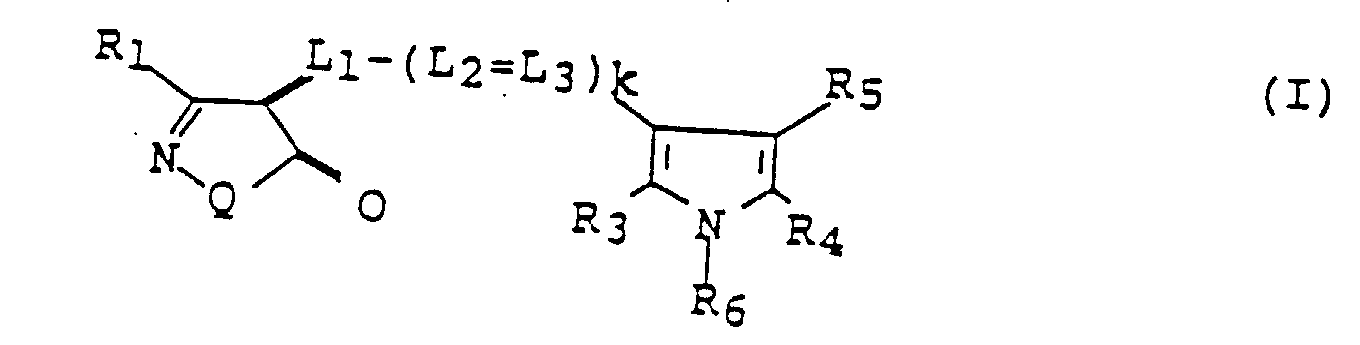 worin R11, R12, R13 und R14 dieselben oder unterschiedlich sein können und jeweils ein Wasserstoffatom, ein Halogenatom, eine Cyanogruppe, eine Carboxylgruppe oder eine Alkylgruppe, eine Arylgruppe, eine Alkoxygruppe, eine Aryloxygruppe, eine Aryloxycarbonylgruppe, eine Alkoxycarbonylgruppe, eine Aminogruppe, eine Acylgruppe, eine Carbamoylgruppe, eine Sulfamoylgruppe oder eine Acyloxygruppe bedeuten, wobei die Gruppen substituiert sein können, mit der Maßgabe, daß R11 und R12 oder R13 und R14 nicht gleichzeitig ein Wasserstoffatom bedeuten; R15 und R16 können dieselben oder unterschiedlich sein und bedeuten jeweils eine Alkylgruppe, die substituiert sein kann; R17 bedeutet ein Alkyl, das nicht weniger als drei Kohlenstoffatome aufweist, eine Arylgruppe oder eine Aralkylgruppe, wobei diese Gruppen substituiert sein können; X1 bedeutet ein Gegenanion und m bedeutet 0 oder und m = 0, wenn ein intermolekulares Salz geformt werden soll;
 worin R21, R22, R23, R24, R25, R26, R27, R28, R29 und R30 jeweils dieselbe Bedeutung haben wie R11; R31 und R32 haben jeweils dieselbe Bedeutung wie R15; Y bedeutet ein Schwefelatom, ein Selenatom oder ein Sauerstoffatom; X2 hat dieselbe Bedeutung wie X1 und n hat dieselbe Bedeutung wie m.
- Farbphotographisches, lichtempfindliches Silberhalogenidmaterial nach Anspruch 1, dadurch gekennzeichnet, daß R17 in Formel (II) eine Alkylgruppe mit drei Kohlenstoffatomen bedeutet.
- Farbphotographisches, lichtempfindliches Silberhalogenidmaterial nach Anspruch 1, dadurch gekennzeichnet, daß der durch Formel (II) oder (III) dargestellte sensibilisierende Farbstoff zusammen mit einem anderen auf Cyanin basierenden Farbstoff verwendet wird.
- Farbphotographisches, lichtempfindliches Silberhalogenidmaterial nach Anspruch 1, dadurch gekennzeichnet, daß das Material Emulsionen umfaßt, die tafelförmige Kömer mit einem Seitenverhältnis von 3 bis 20 enthalten, die 50% oder mehr der gesamten projizierten Fläche aller Silberhalogenidkörner in der Emulsion einnehmen.
Applications Claiming Priority (2)
| Application Number | Priority Date | Filing Date | Title |
|---|---|---|---|
| JP4349998A JPH06175289A (ja) | 1992-12-03 | 1992-12-03 | ハロゲン化銀カラー写真感光材料 |
| JP349998/92 | 1992-12-03 |
Publications (3)
| Publication Number | Publication Date |
|---|---|
| EP0600518A2 EP0600518A2 (de) | 1994-06-08 |
| EP0600518A3 EP0600518A3 (de) | 1995-03-29 |
| EP0600518B1 true EP0600518B1 (de) | 1998-03-25 |
Family
ID=18407544
Family Applications (1)
| Application Number | Title | Priority Date | Filing Date |
|---|---|---|---|
| EP93119556A Expired - Lifetime EP0600518B1 (de) | 1992-12-03 | 1993-12-03 | Farbphotographisches lichtempfindliches Silberhalogenidmaterial |
Country Status (4)
| Country | Link |
|---|---|
| US (1) | US5449594A (de) |
| EP (1) | EP0600518B1 (de) |
| JP (1) | JPH06175289A (de) |
| DE (1) | DE69317629T2 (de) |
Families Citing this family (6)
| Publication number | Priority date | Publication date | Assignee | Title |
|---|---|---|---|---|
| US5695917A (en) * | 1995-11-22 | 1997-12-09 | Eastman Kodak Company | Combination of yellow filter dye and 4-equivalent pyrazolone magenta coupler |
| US6011052A (en) * | 1996-04-30 | 2000-01-04 | Warner-Lambert Company | Pyrazolone derivatives as MCP-1 antagonists |
| JPH10207010A (ja) * | 1997-01-20 | 1998-08-07 | Fuji Photo Film Co Ltd | ハロゲン化銀カラー写真感光材料 |
| JP3950569B2 (ja) * | 1998-04-21 | 2007-08-01 | 富士フイルム株式会社 | ハロゲン化銀カラー写真感光材料 |
| ITSV20000031A1 (it) | 2000-07-07 | 2002-01-07 | Ferrania Spa | Elemento fotografico a colori multistrato agli alogenuri d'argento |
| US20100291706A1 (en) * | 2009-05-15 | 2010-11-18 | Millipore Corporation | Dye conjugates and methods of use |
Family Cites Families (7)
| Publication number | Priority date | Publication date | Assignee | Title |
|---|---|---|---|---|
| JPS4945717A (en) * | 1972-09-04 | 1974-05-01 | Fuji Photo Film Co Ltd | Bunkozokan sareta harogenkaginshashinnyuzai |
| JPH0690463B2 (ja) * | 1986-01-08 | 1994-11-14 | 富士写真フイルム株式会社 | カラ−写真感光材料 |
| US5198332A (en) * | 1986-11-27 | 1993-03-30 | Fuji Photo Film Co. Ltd. | Silver halide photographic emulsion |
| US4904578A (en) * | 1988-02-01 | 1990-02-27 | Mitsubishi Paper Mills, Ltd. | Light absorbing dye for photography |
| JP2649980B2 (ja) * | 1989-11-27 | 1997-09-03 | 富士写真フイルム株式会社 | ハロゲン化銀写真感光材料 |
| US5213957A (en) * | 1989-11-27 | 1993-05-25 | Fuji Photo Film Co., Ltd. | Silver halide photographic light-sensitive materials |
| US5296344A (en) * | 1991-06-11 | 1994-03-22 | Fuji Photo Film Co., Ltd. | Silver halide photographic light-sensitive material |
-
1992
- 1992-12-03 JP JP4349998A patent/JPH06175289A/ja active Pending
-
1993
- 1993-12-01 US US08/159,748 patent/US5449594A/en not_active Expired - Lifetime
- 1993-12-03 EP EP93119556A patent/EP0600518B1/de not_active Expired - Lifetime
- 1993-12-03 DE DE69317629T patent/DE69317629T2/de not_active Expired - Lifetime
Also Published As
| Publication number | Publication date |
|---|---|
| JPH06175289A (ja) | 1994-06-24 |
| DE69317629D1 (de) | 1998-04-30 |
| DE69317629T2 (de) | 1998-07-16 |
| US5449594A (en) | 1995-09-12 |
| EP0600518A2 (de) | 1994-06-08 |
| EP0600518A3 (de) | 1995-03-29 |
Similar Documents
| Publication | Publication Date | Title |
|---|---|---|
| US5449594A (en) | Silver halide color photographic light-sensitive material | |
| US6210871B1 (en) | Silver halide color photographic light-sensitive material | |
| US6127110A (en) | Silver halide emulsion and photographic light-sensitive material using the same | |
| JPH07140581A (ja) | ハロゲン化銀カラー写真感光材料 | |
| JP3439551B2 (ja) | ハロゲン化銀写真感光材料 | |
| US5389505A (en) | Silver halide photographic material | |
| US5538836A (en) | Silver halide color photographic material | |
| JP3058545B2 (ja) | ハロゲン化銀カラー写真感光材料 | |
| JP4857166B2 (ja) | ハロゲン化銀写真感光材料及びこれを用いた画像形成方法 | |
| JP2851206B2 (ja) | ハロゲン化銀写真乳剤およびこれを用いるハロゲン化銀写真感光材料 | |
| JP3449435B2 (ja) | ハロゲン化銀カラー写真感光材料の処理方法 | |
| US6645710B2 (en) | Silver halide color photographic light-sensitive material | |
| JPH1073898A (ja) | ハロゲン化銀写真感光材料 | |
| JP3496790B2 (ja) | ハロゲン化銀写真感光材料 | |
| JPH07119978B2 (ja) | 迅速処理可能でカブリ防止効果等に優れるハロゲン化銀カラ−写真感光材料 | |
| JP3487995B2 (ja) | ハロゲン化銀カラー写真感光材料 | |
| JP3470839B2 (ja) | ハロゲン化銀写真感光材料 | |
| JPH05341429A (ja) | ハロゲン化銀カラー感光材料 | |
| JPH06230511A (ja) | ハロゲン化銀カラー写真感光材料 | |
| JPH0743846A (ja) | ハロゲン化銀カラー写真感光材料 | |
| JP2001005129A (ja) | ハロゲン化銀カラー写真感光材料 | |
| JPH0743847A (ja) | ハロゲン化銀カラー写真感光材料 | |
| JPH0527360A (ja) | ハロゲン化銀カラー写真感光材料 | |
| JPH09211770A (ja) | ハロゲン化銀写真感光材料 | |
| JPH05150391A (ja) | ハロゲン化銀カラー写真感光材料 |
Legal Events
| Date | Code | Title | Description |
|---|---|---|---|
| PUAI | Public reference made under article 153(3) epc to a published international application that has entered the european phase |
Free format text: ORIGINAL CODE: 0009012 |
|
| AK | Designated contracting states |
Kind code of ref document: A2 Designated state(s): BE DE FR GB NL |
|
| PUAL | Search report despatched |
Free format text: ORIGINAL CODE: 0009013 |
|
| AK | Designated contracting states |
Kind code of ref document: A3 Designated state(s): BE DE FR GB NL |
|
| 17P | Request for examination filed |
Effective date: 19950906 |
|
| 17Q | First examination report despatched |
Effective date: 19960719 |
|
| GRAG | Despatch of communication of intention to grant |
Free format text: ORIGINAL CODE: EPIDOS AGRA |
|
| GRAG | Despatch of communication of intention to grant |
Free format text: ORIGINAL CODE: EPIDOS AGRA |
|
| GRAH | Despatch of communication of intention to grant a patent |
Free format text: ORIGINAL CODE: EPIDOS IGRA |
|
| GRAH | Despatch of communication of intention to grant a patent |
Free format text: ORIGINAL CODE: EPIDOS IGRA |
|
| GRAA | (expected) grant |
Free format text: ORIGINAL CODE: 0009210 |
|
| AK | Designated contracting states |
Kind code of ref document: B1 Designated state(s): BE DE FR GB NL |
|
| PG25 | Lapsed in a contracting state [announced via postgrant information from national office to epo] |
Ref country code: NL Free format text: LAPSE BECAUSE OF FAILURE TO SUBMIT A TRANSLATION OF THE DESCRIPTION OR TO PAY THE FEE WITHIN THE PRESCRIBED TIME-LIMIT Effective date: 19980325 Ref country code: FR Free format text: LAPSE BECAUSE OF FAILURE TO SUBMIT A TRANSLATION OF THE DESCRIPTION OR TO PAY THE FEE WITHIN THE PRESCRIBED TIME-LIMIT Effective date: 19980325 Ref country code: BE Free format text: LAPSE BECAUSE OF FAILURE TO SUBMIT A TRANSLATION OF THE DESCRIPTION OR TO PAY THE FEE WITHIN THE PRESCRIBED TIME-LIMIT Effective date: 19980325 |
|
| REF | Corresponds to: |
Ref document number: 69317629 Country of ref document: DE Date of ref document: 19980430 |
|
| EN | Fr: translation not filed | ||
| NLV1 | Nl: lapsed or annulled due to failure to fulfill the requirements of art. 29p and 29m of the patents act | ||
| PLBE | No opposition filed within time limit |
Free format text: ORIGINAL CODE: 0009261 |
|
| STAA | Information on the status of an ep patent application or granted ep patent |
Free format text: STATUS: NO OPPOSITION FILED WITHIN TIME LIMIT |
|
| 26N | No opposition filed | ||
| REG | Reference to a national code |
Ref country code: GB Ref legal event code: IF02 |
|
| REG | Reference to a national code |
Ref country code: GB Ref legal event code: 732E |
|
| PGFP | Annual fee paid to national office [announced via postgrant information from national office to epo] |
Ref country code: GB Payment date: 20091202 Year of fee payment: 17 |
|
| PGFP | Annual fee paid to national office [announced via postgrant information from national office to epo] |
Ref country code: DE Payment date: 20091105 Year of fee payment: 17 |
|
| GBPC | Gb: european patent ceased through non-payment of renewal fee |
Effective date: 20101203 |
|
| REG | Reference to a national code |
Ref country code: DE Ref legal event code: R119 Ref document number: 69317629 Country of ref document: DE Effective date: 20110701 |
|
| PG25 | Lapsed in a contracting state [announced via postgrant information from national office to epo] |
Ref country code: DE Free format text: LAPSE BECAUSE OF NON-PAYMENT OF DUE FEES Effective date: 20110701 Ref country code: GB Free format text: LAPSE BECAUSE OF NON-PAYMENT OF DUE FEES Effective date: 20101203 |