EP0585694B1 - Separating sheet glass - Google Patents
Separating sheet glass Download PDFInfo
- Publication number
- EP0585694B1 EP0585694B1 EP19930112994 EP93112994A EP0585694B1 EP 0585694 B1 EP0585694 B1 EP 0585694B1 EP 19930112994 EP19930112994 EP 19930112994 EP 93112994 A EP93112994 A EP 93112994A EP 0585694 B1 EP0585694 B1 EP 0585694B1
- Authority
- EP
- European Patent Office
- Prior art keywords
- score line
- glass
- glass sheet
- pressure
- sheet
- Prior art date
- Legal status (The legal status is an assumption and is not a legal conclusion. Google has not performed a legal analysis and makes no representation as to the accuracy of the status listed.)
- Expired - Lifetime
Links
Images

Classifications
-
- C—CHEMISTRY; METALLURGY
- C03—GLASS; MINERAL OR SLAG WOOL
- C03B—MANUFACTURE, SHAPING, OR SUPPLEMENTARY PROCESSES
- C03B33/00—Severing cooled glass
- C03B33/02—Cutting or splitting sheet glass or ribbons; Apparatus or machines therefor
- C03B33/023—Cutting or splitting sheet glass or ribbons; Apparatus or machines therefor the sheet or ribbon being in a horizontal position
- C03B33/033—Apparatus for opening score lines in glass sheets
-
- B—PERFORMING OPERATIONS; TRANSPORTING
- B65—CONVEYING; PACKING; STORING; HANDLING THIN OR FILAMENTARY MATERIAL
- B65G—TRANSPORT OR STORAGE DEVICES, e.g. CONVEYORS FOR LOADING OR TIPPING, SHOP CONVEYOR SYSTEMS OR PNEUMATIC TUBE CONVEYORS
- B65G2249/00—Aspects relating to conveying systems for the manufacture of fragile sheets
- B65G2249/04—Arrangements of vacuum systems or suction cups
Definitions
- This invention relates to a method of, and apparatus for, separating sheet glass along a score line.
- the separation procedure while subject to many variations in detail, may be stated as (1) creating a controlled defect in a glass sheet (scoring) and (2) extending that defect to separate the glass (breaking). Scoring may be by any means that induces or creates a crack, or other controlled defect. The crack or defect may be extended to separate the glass by bending to stress the glass, by tapping on the surface opposite a score line, or by thermal separation.
- United States Patent No. 3,543,979 to Grove et al. describes a method of cutting glass with a laser beam of a wavelength to which the glass is opaque. If the glass is not immediately fractured, stress may be applied, for example, by passing the glass over a slightly elevated breaking roll.
- FIGURE 7 in the patent shows applying a bending moment to a sheet of glass around a thermal score or heat path.
- United Kingdom Patent No. 1,110,764 to Barradell-Smith describes a method of snapping a sheet of glass having a score line extending along the sheet.
- the method is characterized by applying, to opposite faces of the sheet, uniformly curved bending members of complementary form.
- the members extend across the sheet.
- Each comprises a plurality of contacting elements to impose on the sheet a curvature which is sufficient to snap the sheet along any score line parallel to the axis of the curvature, but is insufficient to break any unscored area of the sheet.
- U.S. Patent No. 5,165,585 to Lisec discloses a method for breaking glass sheets in which the scored area of a sheet of glass is lifted, while a vacuum is applied underneath the glass sheet and on each side of the score line, either by vacuum-bore holes or suction devices which attach to the undersurface of the glass. With such devices, it can be difficult, at times, to consistently achieve an adequate and uniform vacuum.
- U.S. Patent No. 2,005,487 to Zemanek discloses a glass breaker tool having an upwardly facing fulcrum element and two downwardly facing ribs.
- the upwardly facing fulcrum element applies a pressure underneath the score line
- the downwardly facing ribs apply a pressure on each side of the score line, thereby bending the glass sheet and causing the glass to break along the score line.
- U.S. Patent No. 3,592,370 to Boardman discloses a variety of glass breaking devices in which a roll on a conveyor system is used as a fulcrum to lift the undersurface of the scored area of the glass sheet, and two finger elements are utilized to exert a downward force on both sides of the score line, causing the glass to break along the score line.
- U.S. Patent No. 2,924,044 to Basso, Jr. discloses an apparatus for severing glass to accommodate the thrust on one side of the sheet, and the glass will be severed in a clean straight line.
- U.S. Patent No. 4,595,132 to Abel discloses a device for fracturing glass along a score line, which consists of according to the preamble of claim 1 below, a convexly curved fulcrum element and a pressure block having a concavely curved planar surface facing the fulcrum element.
- the pressure block is positioned so that the concavely curved planar surface pushes down on and contacts the glass on opposite sides of the score line, thereby breaking the glass sheet over the fulcrum.
- U.S. Patent No. 3,303,980 to Offenbacher discloses an edge snapping device utilizing rollers, in which a continuous glass ribbon is broken into sheets by bending the sheet in the score line area over a fulcrum roller. The glass is pinned lying between two rollers on one side of the fulcrum, while a striker roller applies a downward force on the other side of the fulcrum.
- the striker roller consists of a steel tube having an annular jacket or cover of rubber.
- an apparatus for separating a glass sheet along a score line on the sheet comprising:
- a method of separating a glass sheet along a score line on a surface of said glass sheet comprising:
- the present invention is generally applicable to the separation of a glass sheet into smaller size units. It is particularly applicable to the production of precision panels of thin glass sheets (such as those less than or about 1.2 mm), where it is essential to obtain square edges which are free of surface damage and edge defects, such as chips, hackles and hooks.
- the invention is also applicable to the trimming of glass sheets prior to separation into panels.
- the invention was developed as part of an effort to automatically separate bi-axially scored glass sheets into individual panels for liquid crystal display (LCD) structures.
- the target was to produce panels having precision panel quality in a high speed automatic process. Accordingly, much of the ensuing description is oriented to such product.
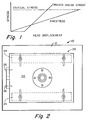
- FIGURE 1 is a generalized graphical representation of the considerations that must be imposed on a glass sheet to carry out this concept.
- the stress level in the glass is plotted on the vertical axis.
- the displacement of the pressure head creating stresses on the glass is plotted on the horizontal axis.
- Absolute values are purposely omitted in the interest of generalizing the showing.
- a solid line labeled "Prestress” shows the continuously increasing level of stress created along the full length of a score line as a pressure head is lowered against the glass.
- the prestress load is applied to the score line to create stress in the score line by flexure.
- the critical stress level is the level at which the glass freely separates along the score line. It is shown in FIGURE 1 by a non-uniformly dashed line labeled "Critical Stress”.
- a greater stress is applied, equal to or greater than the critical stress, to cause the glass to break along the score line.
- this critical stress is applied at one end of the score line, so that the break or crack runs continuously from the initiation point at one end of the score line to the opposite end of the line. Since separation occurs in a prestressed environment, a chip-free, square edge is formed on each separated piece of glass.
- FIGURE 1 is not represented in any real units, and consequently the amount of prestress illustrated could vary therefrom.
- the critical factor is that the score line be uniformly prestressed an amount less than the critical stress, after which time the critical stress is quickly applied.
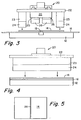
- FIGURE 2 is a top plan view of an apparatus developed to practice an aspect of the invention wherein a glass sheet is separated into two smaller units.
- the apparatus is generally designated by the numeral 10.
- FIGURE 3 is a front plan view of apparatus 10.
- Apparatus 10 embodies a base plate 12 which provides a flat surface against which a glass sheet 14 may be pressed. As shown, glass sheet 14 is conveyed over base plate 12 on a conveyor belt 16. When breaking extremely thin (less than 1.2 mm) glass sheets, the thin glass sheets are very susceptible to any surface irregularities on the glass surface. Thin surface irregularities, which may be caused by, for example, glass chips or other hard particles on the glass surface, having a deleterious effect on breakage quality. Consequently, a flexible belt 16 is preferred to a hard surface for breaking so surface irregularities, which would otherwise cause deviations from a square edge on the glass, are prevented from doing so.
- Base plate 12 is provided with an elongated, raised, linear portion 18 in the nature of a hump.
- Raised portion 18 runs laterally the full width of conveyor belt 16 and glass sheet 14. As explained later, it functions as a fulcrum and defines an axis of flexure along which glass sheet 14 is flexed and stressed. Fulcrum 18 is positioned so that a score line on glass sheet 14 may be positioned directly above and in registry with it.
- a fulcrum height of about 0.75 mm is preferred for 1.1 mm thick glass. However, heights of 0.1 to 1.5 mm have been used successfully. In general, greater fulcrum heights can be used with thinner glass.
- the pressure head is mounted above base plate 12, arid adapted to vertical movement, is a pressure head for applying stress to the sheet.
- the pressure head is generally designated 20.
- Pressure head 20 has a top plate 22 which carries two prestress members 23. Each prestress member 23 is preferably provided with a resiliently cushioning prestress pad 24.
- one or more trigger break members 25 may be provided.
- each trigger break member 25 is provided with a resiliently cushioning pad 26.
- Prestress pads 24 are preferably coextensive in length with the width of base plate 12 and/or glass sheet 14, and spaced apart equally on opposite sides of fulcrum 18.
- the optional trigger pads 26, if used, are positioned on either side of fulcrum 18, and spaced between pads 24.
- Trigger pads 26 also may be configured to be as long as the width of the base plate 12 and/or glass sheet 14. More preferably, however, trigger pads 26 are relatively short, and positioned adjacent to one edge of glass sheet 14, as illustrated in FIGURE 2.
- resiliently cushioning members can be achieved using a variety of techniques.
- a layer of resiliently cushioning material may be provided on each of the members, or, alternatively, it is conceivable that mechanical springs could be utilized to support the members and achieve a similar effect.
- the pressure members be provided with a cushioning layer or device which achieves a spring constant, between the pressure members and the glass sheet, of less than or equal to about 20 pounds/inch deflection per inch length of the pressure member (138 Newtons of force/millimeter deflection/meter length).
- the cushioning effect is achieved by providing pressure members 23 and 25 with resiliently cushioning materials 24 and 26 which provide the cushioning effect.
- Suitable cushioning materials which provide such a cushioning effect include those having a hardness, in international rubber hardness degrees, between about 10 to about 25 hardness degrees.
- Preferred materials for forming the resiliently cushioning layers are foam materials, such as, for example, foam layers of neoprene rubber, polyethylene, vinyl, acrylic, or ethylene propylene terpolymer.
- ethylene proplylene terpolymer having a hardness of 15 degrees International Rubber Hardness Degrees
- any surface irregularities such as glass chips, dirt or other hard particles have a deleterious effect on the breakage edge quality.
- these prior art devices utilized relatively hard surfaces to transmit the forces necessary to break the glass sheet along the score line. Consequently, any glass chips or other hard particles caught between these pressure members and the glass sheet would create an uneven force in the area of the glass chip, which would then be transmitted directly to the score line surface.
- By covering the glass contacting surfaces of the pressure members 23 with a layer of resiliently deformable material there is an added benefit in that any edge chips caught between the glass surface and the layer merely deform the material, and do not adversely affect the overall performance of the member 23.
- the use of devices having such resiliently cushioning materials have resulted in much higher quality edge breaks than was previously thought possible.
- trigger members 25 are utilized, they also are preferably covered with a layer 26 of a resiliently deformable material.
- this material is formed from a less cushioning material than pads 24, so that greater stress can be quickly generated therewith.
- Preferred cushioning materials are foam materials, which include both open and closed cell foam materials.
- closed cell foam materials are utilized, to preclude entrapment of foreign particles within the foam material.
- Suitable foam material include those which are made from neoprene foam rubber, polyethylene, vinyl, or acrylic materials. Taking fulcrum 18 and the glass score line as a reference centerline, pads 24 are preferably spaced an equal distance from the center line. A preferred spacing between the inside edges of pads 24 is about 140 mm. As a general rule, thinner prestress pads 24 can be used with thinner glass. We have used 50 mm thick pads with 1.1 mm glass.
- pads 24 apply the only pressure to the glass sheet and prior to the time the glass sheet breaks along the score line, it is preferable that prestress pads 24 deform a distance of at least 1 mm, more preferably at least 2 mm and most preferably at least 3 mm. This relatively large deformation insures that any glass chips, etc., will not have a deleterious effect on edge quality.
- the cushioning surface should be composed of a material having a hardness of from about 10 to 25 degrees (International Rubber Hardness Degrees).
- pads 24 When trigger pads 26 are utilized, pads 24 preferably extend downwardly further than pads 26, thereby reaching the glass surface sooner. In a preferred embodiment, pads 24 are designed to reach the glass surface at least about 13 mm before pads 26. In addition to being shorter, pads 26 are also more closely spaced. In one preferred embodiment, they are about 15 mm to each side of the center line.
- glass sheet 14 is scored along line 28.
- Glass sheet 14 is then positioned on conveyor belt 16 so that score line 28 is aligned with the axis of flexure provided by fulcrum 18.
- the alignment is as near exact as is feasible. However, slight offsets, either laterally or rotationally, may be tolerated.
- Score line 28 may be produced in any known manner. We have employed a Villa score machine, Model GS100. Score line depths ranging from 5 to 130 microns have been used successfully. The critical requirement is that the score line be deeper than any surface defect. Shallower depths are preferred to permit higher prestress levels which appear to give better quality break surfaces. A preferred score depth is about 80 microns.
- pads 24 can be utilized to apply only a prestress, and trigger pads 26 then can be utilized to apply the stress necessary to break the glass along the score line.
- trigger pads 26 before the prestress level caused by prestress pads 24 reaches the critical stress level, break pads 26 contact the glass. Contact is preferably made at the edge of glass sheet 14 and on opposite sides of score line 28. Break pads 26 generate a stress in excess of the critical level as illustrated in FIGURE 1, causing a break to be initiated that runs along score line 28.
- the break is initiated at one end of score line 28. If a break is initiated at a location along the score line other than an end, the origin of the crack is less predictable, and backside hooks seem to be more common.
- the cleanest breaks are achieved when both the prestress pads 24 and trigger pads 26 are lowered in one rapid stroke of stress applicator 20. This assures minimum growth of the score line before a break is triggered by break pads 26.
- trigger pads 26 may be utilized to apply the critical stress to the score line.
- the concept of any embodiment using trigger pads 26 is merely that the critical stress level must be reached along the score line using one or more trigger pads 26, after the score line has first been prestressed at a lesser stress level using prestress pads 24.
- FIGURE 6 a side view similar to that of FIGURE 3.
- pressure pads 24 are spaced asymmetrically with respect to fulcrum 18 (which could alternatively be the edge of a table) and score line 28. This is indicated by a dotted line composed of segments x and y which meet at a point in line with score line 28.
- a glass sheet is scored a relatively short distance from the edge of the sheet, along a line parallel with the edge.
- Pressure head 20 is set to generate stress on opposite sides of the score line to prestress the glass sheet.
- Prestress pads 24 contact the sheet on opposite sides off the score line 28, but are spaced asymmetrically therefrom.
- the pad 24 contacting the strip to be separated from the sheet may be set to contact closer to the score line than the pad 24 that contacts the main part of the sheet. This is indicated by the dotted line composed of segments x and y.
- x might be 20 mm and y might be 70 mm.
Landscapes
- Chemical & Material Sciences (AREA)
- Engineering & Computer Science (AREA)
- Materials Engineering (AREA)
- Organic Chemistry (AREA)
- Re-Forming, After-Treatment, Cutting And Transporting Of Glass Products (AREA)
- Laminated Bodies (AREA)
Applications Claiming Priority (4)
| Application Number | Priority Date | Filing Date | Title |
|---|---|---|---|
| US07/938,956 US5303861A (en) | 1992-09-01 | 1992-09-01 | Separating sheet glass |
| US938956 | 1992-09-01 | ||
| US9975193A | 1993-08-05 | 1993-08-05 | |
| US99751 | 1993-08-05 |
Publications (2)
| Publication Number | Publication Date |
|---|---|
| EP0585694A1 EP0585694A1 (en) | 1994-03-09 |
| EP0585694B1 true EP0585694B1 (en) | 1997-12-10 |
Family
ID=26796442
Family Applications (1)
| Application Number | Title | Priority Date | Filing Date |
|---|---|---|---|
| EP19930112994 Expired - Lifetime EP0585694B1 (en) | 1992-09-01 | 1993-08-13 | Separating sheet glass |
Country Status (6)
| Country | Link |
|---|---|
| EP (1) | EP0585694B1 (OSRAM) |
| JP (1) | JP2683785B2 (OSRAM) |
| KR (1) | KR0130747B1 (OSRAM) |
| CA (1) | CA2104155A1 (OSRAM) |
| DE (1) | DE69315643T2 (OSRAM) |
| TW (1) | TW319754B (OSRAM) |
Cited By (1)
| Publication number | Priority date | Publication date | Assignee | Title |
|---|---|---|---|---|
| US8171753B2 (en) | 2009-11-18 | 2012-05-08 | Corning Incorporated | Method for cutting a brittle material |
Families Citing this family (5)
| Publication number | Priority date | Publication date | Assignee | Title |
|---|---|---|---|---|
| EP0987226A1 (fr) * | 1998-08-28 | 2000-03-22 | Fabricom S.A. | Procédé et dispositif de rompage d'une feuille de verre |
| US6853587B2 (en) * | 2002-06-21 | 2005-02-08 | Micron Technology, Inc. | Vertical NROM having a storage density of 1 bit per 1F2 |
| ES2370880T3 (es) | 2003-11-06 | 2011-12-23 | Peter Lisec | Procedimiento y dispositivo para romper placas de vidrio talladas. |
| KR101648010B1 (ko) * | 2015-03-03 | 2016-08-17 | 한국미쯔보시다이아몬드공업(주) | 스크라이브 라인 형성 방법 |
| JP7162597B2 (ja) * | 2017-01-27 | 2022-10-28 | コーニング インコーポレイテッド | ガラスシートを分離する方法および装置 |
Family Cites Families (9)
| Publication number | Priority date | Publication date | Assignee | Title |
|---|---|---|---|---|
| GB1110764A (en) * | 1963-11-20 | 1968-04-24 | Pilkington Brothers Ltd | Improvements in or relating to the snapping of sheets of glass |
| US3520457A (en) * | 1968-10-07 | 1970-07-14 | Ford Motor Co | Method of separating pieces of edge trim remaining after the cutting of a glass bracket |
| JPS6140611A (ja) * | 1984-08-02 | 1986-02-26 | Mitsubishi Heavy Ind Ltd | プレイバツク方式によるnc工作機械 |
| JPH0747499B2 (ja) * | 1988-09-16 | 1995-05-24 | セントラル硝子株式会社 | 厚板ガラスの切断方法ならびにその装置 |
| AT399865B (de) * | 1990-05-15 | 1995-08-25 | Lisec Peter | Verfahren und vorrichtung zum brechen von glasscheiben |
| JP2516103Y2 (ja) * | 1990-05-28 | 1996-11-06 | 日立電線株式会社 | 通信ケーブルの接続構造 |
| JP2961721B2 (ja) * | 1991-01-16 | 1999-10-12 | 旭硝子株式会社 | 板硝子の切断方法及びその装置 |
| DE4123929C2 (de) * | 1991-07-19 | 1995-04-06 | Schott Glaswerke | Verfahren und Vorrichtung zum Zerteilen von Flachglastafeln |
| JPH0674153B2 (ja) * | 1991-11-07 | 1994-09-21 | 旭硝子株式会社 | ガラス板の切断方法及びその装置 |
-
1993
- 1993-08-13 EP EP19930112994 patent/EP0585694B1/en not_active Expired - Lifetime
- 1993-08-13 DE DE1993615643 patent/DE69315643T2/de not_active Expired - Fee Related
- 1993-08-16 CA CA 2104155 patent/CA2104155A1/en not_active Abandoned
- 1993-09-01 JP JP5217353A patent/JP2683785B2/ja not_active Expired - Fee Related
- 1993-09-01 KR KR93017427A patent/KR0130747B1/ko not_active Expired - Fee Related
- 1993-12-17 TW TW82110618A patent/TW319754B/zh active
Cited By (1)
| Publication number | Priority date | Publication date | Assignee | Title |
|---|---|---|---|---|
| US8171753B2 (en) | 2009-11-18 | 2012-05-08 | Corning Incorporated | Method for cutting a brittle material |
Also Published As
| Publication number | Publication date |
|---|---|
| TW319754B (OSRAM) | 1997-11-11 |
| CA2104155A1 (en) | 1994-03-02 |
| JPH06157061A (ja) | 1994-06-03 |
| EP0585694A1 (en) | 1994-03-09 |
| JP2683785B2 (ja) | 1997-12-03 |
| DE69315643D1 (de) | 1998-01-22 |
| KR0130747B1 (en) | 1998-04-08 |
| DE69315643T2 (de) | 1998-04-02 |
| KR940006942A (ko) | 1994-04-26 |
Similar Documents
| Publication | Publication Date | Title |
|---|---|---|
| US5303861A (en) | Separating sheet glass | |
| US8875967B2 (en) | Mechanical scoring and separation of strengthened glass | |
| KR101265904B1 (ko) | 취성재료의 이동하는 리본으로부터 취성재료의 유리판을절단하기 위한 방법 및 장치 | |
| TWI619684B (zh) | Breaking device | |
| US8656738B2 (en) | Glass sheet separating device | |
| US10640411B2 (en) | Device for bending sheets of glass | |
| KR100893871B1 (ko) | 취성재료 기판의 스크라이브 방법 및 스크라이브 장치및 취성재료 기판의 절단 시스템 | |
| JP5016606B2 (ja) | 帯状ガラスから製造されたガラスシートにおける応力偏差を低減する方法および装置 | |
| KR101323678B1 (ko) | 취성 재료 기판의 브레이크 방법 | |
| US20200361807A1 (en) | Method for producing glass film | |
| EP0585694B1 (en) | Separating sheet glass | |
| KR100754286B1 (ko) | 편평한 유리의 제조 중에 연속의 유리판을 절단하는 방법 | |
| KR102719803B1 (ko) | 컷팅 에지를 갖는 유리 부재 및 이의 제조 방법 | |
| US5300806A (en) | Separation of diode array chips during fabrication thereof | |
| US3344968A (en) | Trimming glass sheets | |
| KR20050082449A (ko) | 플라스틱 필름 lcd의 셀 커팅 방법 및 그 장치 | |
| US3956547A (en) | Method of maintaining edge strength of a piece of glass | |
| JP2017170757A (ja) | 分断装置 | |
| KR100642902B1 (ko) | 유리기판의 절단장치 | |
| JP2017171535A (ja) | 分断装置 | |
| CN115348954B (zh) | 玻璃板的制造装置以及制造方法 | |
| JP2017109910A (ja) | 分断装置 | |
| CN114845963B (zh) | 玻璃带的切断装置、切断玻璃带的方法以及玻璃板的制造方法 | |
| KR102172681B1 (ko) | 취성 재료 기판의 브레이크 방법 그리고 브레이크 장치 | |
| CN115572056B (zh) | 玻璃板的破开方法 |
Legal Events
| Date | Code | Title | Description |
|---|---|---|---|
| PUAI | Public reference made under article 153(3) epc to a published international application that has entered the european phase |
Free format text: ORIGINAL CODE: 0009012 |
|
| AK | Designated contracting states |
Kind code of ref document: A1 Designated state(s): BE DE FR GR IT NL |
|
| 17P | Request for examination filed |
Effective date: 19940817 |
|
| 17Q | First examination report despatched |
Effective date: 19960129 |
|
| GRAG | Despatch of communication of intention to grant |
Free format text: ORIGINAL CODE: EPIDOS AGRA |
|
| GRAG | Despatch of communication of intention to grant |
Free format text: ORIGINAL CODE: EPIDOS AGRA |
|
| GRAH | Despatch of communication of intention to grant a patent |
Free format text: ORIGINAL CODE: EPIDOS IGRA |
|
| GRAH | Despatch of communication of intention to grant a patent |
Free format text: ORIGINAL CODE: EPIDOS IGRA |
|
| RBV | Designated contracting states (corrected) |
Designated state(s): BE DE FR GB IT NL |
|
| GRAA | (expected) grant |
Free format text: ORIGINAL CODE: 0009210 |
|
| AK | Designated contracting states |
Kind code of ref document: B1 Designated state(s): BE DE FR GB IT NL |
|
| PG25 | Lapsed in a contracting state [announced via postgrant information from national office to epo] |
Ref country code: IT Free format text: LAPSE BECAUSE OF FAILURE TO SUBMIT A TRANSLATION OF THE DESCRIPTION OR TO PAY THE FEE WITHIN THE PRESCRIBED TIME-LIMIT;WARNING: LAPSES OF ITALIAN PATENTS WITH EFFECTIVE DATE BEFORE 2007 MAY HAVE OCCURRED AT ANY TIME BEFORE 2007. THE CORRECT EFFECTIVE DATE MAY BE DIFFERENT FROM THE ONE RECORDED. Effective date: 19971210 Ref country code: BE Free format text: LAPSE BECAUSE OF FAILURE TO SUBMIT A TRANSLATION OF THE DESCRIPTION OR TO PAY THE FEE WITHIN THE PRESCRIBED TIME-LIMIT Effective date: 19971210 |
|
| REF | Corresponds to: |
Ref document number: 69315643 Country of ref document: DE Date of ref document: 19980122 |
|
| ET | Fr: translation filed | ||
| PLBE | No opposition filed within time limit |
Free format text: ORIGINAL CODE: 0009261 |
|
| 26N | No opposition filed | ||
| PGFP | Annual fee paid to national office [announced via postgrant information from national office to epo] |
Ref country code: NL Payment date: 19990630 Year of fee payment: 7 |
|
| PGFP | Annual fee paid to national office [announced via postgrant information from national office to epo] |
Ref country code: GB Payment date: 19990702 Year of fee payment: 7 |
|
| PGFP | Annual fee paid to national office [announced via postgrant information from national office to epo] |
Ref country code: FR Payment date: 19990802 Year of fee payment: 7 |
|
| PG25 | Lapsed in a contracting state [announced via postgrant information from national office to epo] |
Ref country code: GB Free format text: LAPSE BECAUSE OF NON-PAYMENT OF DUE FEES Effective date: 20000813 |
|
| PG25 | Lapsed in a contracting state [announced via postgrant information from national office to epo] |
Ref country code: NL Free format text: LAPSE BECAUSE OF NON-PAYMENT OF DUE FEES Effective date: 20010301 |
|
| GBPC | Gb: european patent ceased through non-payment of renewal fee |
Effective date: 20000813 |
|
| PG25 | Lapsed in a contracting state [announced via postgrant information from national office to epo] |
Ref country code: FR Free format text: LAPSE BECAUSE OF NON-PAYMENT OF DUE FEES Effective date: 20010430 |
|
| NLV4 | Nl: lapsed or anulled due to non-payment of the annual fee |
Effective date: 20010301 |
|
| REG | Reference to a national code |
Ref country code: FR Ref legal event code: ST |
|
| PGFP | Annual fee paid to national office [announced via postgrant information from national office to epo] |
Ref country code: DE Payment date: 20080930 Year of fee payment: 16 |
|
| PG25 | Lapsed in a contracting state [announced via postgrant information from national office to epo] |
Ref country code: DE Free format text: LAPSE BECAUSE OF NON-PAYMENT OF DUE FEES Effective date: 20100302 |