EP0585352B1 - Mit wasserdispergierbarer Folie überzogene alkalische Zusammensetzung - Google Patents
Mit wasserdispergierbarer Folie überzogene alkalische Zusammensetzung Download PDFInfo
- Publication number
- EP0585352B1 EP0585352B1 EP92912083A EP92912083A EP0585352B1 EP 0585352 B1 EP0585352 B1 EP 0585352B1 EP 92912083 A EP92912083 A EP 92912083A EP 92912083 A EP92912083 A EP 92912083A EP 0585352 B1 EP0585352 B1 EP 0585352B1
- Authority
- EP
- European Patent Office
- Prior art keywords
- article
- film
- layer
- alkaline
- solid
- Prior art date
- Legal status (The legal status is an assumption and is not a legal conclusion. Google has not performed a legal analysis and makes no representation as to the accuracy of the status listed.)
- Expired - Lifetime
Links
Images



Classifications
-
- C—CHEMISTRY; METALLURGY
- C11—ANIMAL OR VEGETABLE OILS, FATS, FATTY SUBSTANCES OR WAXES; FATTY ACIDS THEREFROM; DETERGENTS; CANDLES
- C11D—DETERGENT COMPOSITIONS; USE OF SINGLE SUBSTANCES AS DETERGENTS; SOAP OR SOAP-MAKING; RESIN SOAPS; RECOVERY OF GLYCEROL
- C11D17/00—Detergent materials or soaps characterised by their shape or physical properties
- C11D17/0047—Detergents in the form of bars or tablets
- C11D17/0065—Solid detergents containing builders
-
- C—CHEMISTRY; METALLURGY
- C11—ANIMAL OR VEGETABLE OILS, FATS, FATTY SUBSTANCES OR WAXES; FATTY ACIDS THEREFROM; DETERGENTS; CANDLES
- C11D—DETERGENT COMPOSITIONS; USE OF SINGLE SUBSTANCES AS DETERGENTS; SOAP OR SOAP-MAKING; RESIN SOAPS; RECOVERY OF GLYCEROL
- C11D17/00—Detergent materials or soaps characterised by their shape or physical properties
- C11D17/04—Detergent materials or soaps characterised by their shape or physical properties combined with or containing other objects
- C11D17/041—Compositions releasably affixed on a substrate or incorporated into a dispensing means
- C11D17/042—Water soluble or water disintegrable containers or substrates containing cleaning compositions or additives for cleaning compositions
- C11D17/044—Solid compositions
Definitions
- This invention relates generally to alkaline cleaning systems packaged in aqueous soluble or dispersible polymeric films. More specifically, the invention relates to a film covered, contact safe aqueous soluble or dispersible alkaline cleaning composition capable of dispensing a variety of chemical agents including water softening agents, warewashing agents, laundry detergents, sanitizers, as well as any variety of other compositions including highly alkaline materials.
- Water soluble films have previously been made from polyvinyl alcohol and vinyl acetate resin blends. These chemicals are generally not compatible with any number of chemical systems. For example, these polymers are generally not compatible with chemical systems having a high pH or alkalinity such as caustic (NaOH) or caustic type materials. The alkali reacts with the vinyl acetate portion of the film converting it to vinyl alcohol. Films made of 100 wt-% vinyl alcohol have dramatically reduced water solubility. Moreover, packaged chemical detergents, cleaners, and the like must also be contained in a system which combines strength and structural integrity with storage stability to contain the product during storage and transportation prior to reaching its final end use. At the final location the package has to have enough strength to withstand handling prior to use.
- EP 0 337 568 discloses an alkaline detergent composition in a closed container composed of an outer sheet of water-soluble polyvinyl alcohol and an inner sheet of cellulose compound, but being water-soluble also in cold water.
- the invention is an alkaline cleaning system having an alkaline detergent composition which has a pH greater than 10.5 when diluted to a 1 wt-% aqueous solution which is covered by a continuous polymeric film which remains aqueous soluble or dispersible after exposure to the alkaline detergent.
- highly alkaline compositions may be wrapped or packaged in a film of high structural integrity and maintained in this state prior to use for an extended period without degradation of the film.
- the films used to package the highly alkaline solid remain water soluble or dispersible throughout packaging and storage into the use application.
- This aspect of the invention results from a multilayer film having an internal alkali stable layer, an intermediate or outer layer providing structural integrity and physical strength.
- the multilayer film may have an additional outer layer which is cold water insoluble allowing dissolution only under heated aqueous conditions such as those found in a warewashing or laundry machine. This aspect of the invention prevents operator exposure to the alkaline composition due to solubilization of the film by the wet hands of the operator.
- a further aspect of the invention is the block shapes of the invention which offer increased handling ability, assist in uniform dissolution, assist in defining container specific application, and increased aesthetic appeal.
- the film may be made into a package useful for containing any number of cleaning or detergent chemicals in granular, compressed solid, or cast solid form.
- Any application that requires an alkaline product for example, warewashing, laundry, clean in place, bottle washing applications, etc., may use this cleaning article.
- This article is designed for single use or multiple use applications and the ultimate use solution may be prepared manually or by way of a dispensing unit.
- the alkaline article comprises a unit dose or a solid alkaline composition capable of more than one use.
- the alkaline article is used through an automatic dispensing machine or is applied through the manual application of an aqueous solution to the system.
- the multidose alkaline cleaning article comprises :
- the multidose alkaline cleaning article comprises :
- the method of using a multidose alkaline cleaning article comprises :
- FIGURE 1 is a perspective view of one embodiment of the detergent composition of the invention.
- FIGURE 2 is a top plan view of the invention shown in Figure 1.
- FIGURE 3 is a side elevational view of the embodiment of the invention depicted in Figure 1.
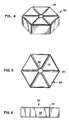
- FIGURE 4 is a perspective view of an alternative embodiment of the detergent composition of the invention.
- FIGURE 5 is a top plan view of the invention shown in Figure 4.
- FIGURE 6 is a side elevational view of the invention shown in Figure 4.
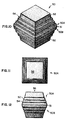
- FIGURE 7 is a further alternative embodiment of the detergent composition of the invention.
- FIGURE 8 is a top elevational view of the detergent composition shown in Figure 7.
- FIGURE 9 is a side elevational view of the detergent composition of the invention shown in Figure 7.
- FIGURE 10 is a perspective view of another further alternative embodiment of the detergent composition of the present invention.
- FIGURE 11 is a top elevational view of the embodiment of the invention shown in Figure 10.
- FIGURE 12 is a side elevational view of the invention shown in Figure 10.
- FIGURE 13 is a perspective view depicting a further alternative embodiment of the detergent composition of the invention.
- FIGURE 14 is a first side plan view of the detergent composition depicted in Figure 13.
- FIGURE 15 is a second side plan view of the detergent composition depicted in Figure 13.
- FIGURE 16 is a top plan view of the detergent composition shown in Figure 13.
- FIGURE 17 is a bottom plan view of the detergent composition shown in Figure 13.
- the invention combines alkaline detergent compositions packaged in alkaline tolerant polymeric films.
- the term detergent compositions should be interpreted to include any rinsing, cleaning, conditioning, antimicrobial, preparatory, etc. chemical or other solid composition which has an alkaline pH and may conveniently be packaged in the polymeric film of the invention.
- the composition used in the invention includes an alkalinity source and a hardness sequestrant or a builder.
- the composition used in the invention may also include a solidifying agent, sanitizing and disinfectant agents, surfactants and any variety of other formulatory and application adjuvants.
- the composition comprises an alkalinity source.
- the alkalinity source raises the pH of the composition to at least 10.5 in a 1 wt-% aqueous solutions and generally to a range of from about 10.5 to 14, preferably from about 11 to 13, and most preferably from about 11.5 to 12.5.
- the alkaline source comprises from about 30 wt-% to about 60 wt-% of the composition.
- alkalinity source This higher pH increases the efficacy of the soil removal and sediment breakdown when the chemical is placed in use and further facilitates the rapid dispersion of soils.
- the general character of the alkalinity source is limited only to those chemical compositions which have a greater solubility. That is, the alkalinity source should not contribute metal ions which promote the formation of precipitates or film salts.
- Exemplary alkalinity sources include silicates, hydroxides, phosphates, and carbonates.
- Silicates useful in accord with this invention include alkali metal ortho, meta-, di-, tri-, and tetrasilicates such as sodium orthosilicate, sodium sesquisilicate, sodium sesquisilicate pentahydrate, sodium metasilicate, sodium metasilicate pentahydrate, sodium metasilicate hexahydrate, sodium metasilicate octahydrate, sodium metasilicate nanohydrate, sodium disilicate, sodium trisilicate, sodium tetrasilicate, potassium metasilicate, potassium metasilicate hemihydrate, potassium silicate monohydrate, potassium disilicate, potassium disilicate monohydrate, potassium tetrasilicate, potassium tetrasilicate monohydrate, or mixtures thereof.
- alkali metal ortho, meta-, di-, tri-, and tetrasilicates such as sodium orthosilicate, sodium sesquisilicate, sodium sesquisilicate pentahydrate, sodium metasilicate, sodium metasilicate pentahydrate, sodium metasilicate
- the concentration of the silicate will range from about 5 wt-% to 80 wt-%, preferably from about 5 wt-% to 60 wt-%, preferably from about 15 wt-% to 50 wt-%, and most preferably from about 25 wt-% to 45 wt-%.
- Alkali metal hydroxides have also been found useful as an alkalinity source in the present invention.
- Alkali metal hydroxides are generally exemplified by species such as potassium hydroxide, sodium hydroxide, lithium hydroxide, and the like. Mixtures of these hydroxide species may also be used. While present, the alkaline hydroxide concentration generally ranges from about 5 wt-% to about 85 wt-%, preferably from about 10 wt-% to about 85 wt-%, preferably from about 30 wt-% to 70 wt-%, and most preferably from about 40 wt-% to 60 wt-%.
- An additional source of alkalinity includes carbonates.
- Alkali metal carbonates which may be used in the invention include sodium carbonate, potassium carbonate, sodium or potassium bicarbonate or sesquicarbonate, among others.
- Preferred carbonates include sodium and potassium carbonates.
- concentration of these agents generally ranges from about 5 wt-% to 70 wt-%, preferably from about 15 wt-% to 55 wt-%, and most preferably from about 30 wt-% to 45 wt-%.
- Phosphates which may be used as an alkalinity source in accordance with the invention include cyclic phosphates such as sodium or potassium orthophosphate, alkaline condensed phosphates such as sodium or potassium pyrophosphate, sodium tripolyphosphate, sodium hexametaphosphate, and the like.
- concentration will generally range from 5 wt-% to 50 wt-%, preferably from 20 wt-% to 35 wt-%, and most preferably 25 wt-% to 35 wt-%.
- composition of the present invention generally comprises builders, chelating agents or sequestrants.
- sequestrants are those molecules capable of coordinating the metal ions commonly found in service water and thereby preventing the metal ions from interfering with the functioning of detersive components within the composition.
- the number of covalent bonds capable of being formed by a sequestrant upon a single hardness ion is reflected by labeling the sequestrant as bidentate (2), tridentate (3), tetradendate (4), etc. Any number of sequestrants may be used in accordance with the invention.
- Representative sequestrants include salts of amino carboxylic acids, phosphonic acid salts, water soluble acrylic polymers, among others.
- Suitable amino carboxylic acid chelating agents include N-hydroxyethyliminodiacetic acid, nitrilotriacetic acid (NTA), ethylenediaminetetraacetic acid (EDTA), N-hydroxyethyl-ethylenediaminetriacetic acid (HEDTA), and diethylenetriaminepentaacetic acid (DTPA).
- NTA nitrilotriacetic acid
- EDTA ethylenediaminetetraacetic acid
- HEDTA N-hydroxyethyl-ethylenediaminetriacetic acid
- DTPA diethylenetriaminepentaacetic acid
- these amino carboxylic acids are generally present in concentrations ranging from about 1 wt-% to 25 wt-%, preferably from about 5 wt-% to 20 wt-%, and most preferably from about 10 wt-% to 15 wt-%.
- Suitable sequestrants include water soluble acrylic polymers used to condition the wash solutions under end use conditions.
- Such polymers include polyacrylic acid, polymethacrylic acid, acrylic acidmethacrylic acid copolymers, hydrolyzed polyacrylamide, hydrolyzed methacrylamide, hydrolyzed acrylamidemethacrylamide copolymers, hydrolyzed polyacrylonitrile, hydrolyzed polymethacrylonitrile, hydrolyzed acrylonitrile methacrylonitrile copolymers, or mixtures thereof.
- Water soluble salts or partial salts of these polymers such as their respective alkali metal (for example, sodium or potassium) or ammonium salts can also be used.
- the weight average molecular weight of the polymers is from about 4000 to about 12,000.
- Preferred polymers include polyacrylic acid, the partial sodium salts of polyacrylic acid or sodium polyacrylate having an average molecular weight within the range of 4000 to 8000.
- These acrylic polymers are generally useful in concentrations ranging from about 0.5 wt-% to 20 wt-%, preferably from about 1 to 10, and most preferably from about 1 to 5.
- phosphonic acids and phosphonic acid salts are also useful as sequestrants.
- Such useful phosphonic acids include, mono, di, tri and tetra-phosphonic acids which can also contain groups capable of forming anions under alkaline conditions such as carboxy, hydroxy, thio and the like.
- phosphonic acids having the formula R1N[C2PO3H2]2 or R2C(PO3H2)2OH, wherein R1 may be -[(lower) alkylene]N[CH2PO3H2]2 or a third (C2PO3H2) moiety; and wherein R2 is selected from the group consisting of C1-C6 alkyl.
- the phosphonic acid may also comprise a low molecular weight phosphonopolycarboxylic acid such as one having about 2-4 carboxylic acid moieties and about 1-3 phosphonic acid groups.
- Such acids include 1-phosphono-1-methylsuccinic acid, phosphonosuccinic acid and 2-phosphonobutane-1,2,4-tricarboxylic acid.
- phosphonic acids or salts are present in a concentration ranging from about 0.25 wt-% to 15 wt-%, preferably from about 1 to 10, and most preferably from about 1 to 5.
- the invention may also comprise a solidifying agent.
- a solidifying agent may be selected from any organic or inorganic compound which imparts a solid character and/or controls the soluble character of the present composition when placed in an aqueous environment.
- the solidifying agent may provide for controlled dispensing by using solidification agents which have a relative aqueous solubility. For systems which require less aqueous solubility or a slower rate of dissolution an organic nonionic or amide hardening agent may be appropriate. For a higher degree of aqueous solubility, an inorganic solidification agent or a more soluble organic agent such as urea.
- Compositions which may be used with the present invention to vary hardness and solubility include amides such as stearic monoethanolamide, lauric diethanolamide, and stearic diethanolamide.
- Amphoteric or zwitterionic surfactants are also useful in providing detergency, emulsification, wetting and conditioning properties.
- Representative amphoteric surfactants include N-coco-3-aminopropionic acid and acid salts, N-tallow-3-iminodiproprionate salts.
- N-lauryl-3-iminodiproprionate disodium salt N-carboxymethyl-N-cocoalkyl-N-dimethylammonium hydroxide, N-carboxymethyl-N-dimethyl-N-(9-octadecenyl)ammonium hydroxide, (1-carboxyheptadecyl)trimethylammonium hydroxide, (1-carboxyundecyl)trimethylammonium hydroxide, N-cocoamidoethyl-N-hydroxyethylglycine sodium salt, N-hydroxyethyl-N-stearamidoglycine sodium salt, N-hydroxyethyl-N-lauramido- ⁇ -alanine sodium salt, N-cocoamido-N-hydroxyethyl- ⁇ -alanine sodium salt, as well as mixed alicyclic amines, and their ethoxylated and sulfated sodium salts, 2-alkyl-1-car
- Amine oxide amphoteric surfactants are also useful. This list is by no means exclusive or limiting.
- Nonionic surfactants have also been found to impart varying degrees of hardness and solubility when combined with a coupler such as propylene glycol or polyethylene glycol.
- Nonionics useful in this invention include nonylphenol ethoxylates, linear alkyl alcohol ethoxylates, ethylene oxide/propylene oxide block copolymers such as the PluronicTM surfactants commercially available from BASF Wyandotte.
- Nonionic surfactants particularly desirable as hardeners are those which are solid at room temperature and have an inherently reduced aqueous solubility as a result of the combination with the coupling agent.
- surfactants which may be used as solidifying agents include anionic surfactants which have high melting points to provide a solid at the temperature of application.
- Anionic surfactants which have been found most useful include linear alkyl benzene sulfonate surfactants, alcohol sulfates, alcohol ether sulfates, and alpha olefin sulfonates. Generally, linear alkyl benzene sulfonates are preferred for reasons of cost and efficiency.
- compositions which may be used as hardening agents with the composition of the invention include urea, also known as carbamide, and starches which have been made water soluble through an acid or alkaline treatment.
- various inorganics which either impart solidifying properties to the present composition and can be processed into pressed tablets for carrying the alkaline agent.
- Such inorganic agents include calcium carbonate, sodium sulfate, sodium bisulfate, alkali metal phosphates, anhydrous sodium acetate and other known hydratable compounds.
- Solidifying agents may be used in concentrations which promote solubility and the requisite structural integrity for the given application. Generally, the concentration of solidifying agent ranges from about 5 wt-% to 35 wt, preferably from about 10 wt-% to 25 wt-%, and most preferably from about 15 wt-% to 20 wt-%.
- the article of this invention may also comprise any number of formulatory or application based adjuvants such as sanitizers, bleaches, colorants, fragrances, etc.
- the detergent composition used in the invention may also comprise a bleaching source.
- Bleaches suitable for use in the detergent composition include any of the well known bleaching agents capable of removing stains from such substrates as dishes, flatware, pots and pans, textiles, countertops, appliances, flooring, etc. without significantly damaging the substrate. These compounds are also capable of providing disinfecting and sanitizing antimicrobial efficacy in certain applications.
- a nonlimiting list of bleaches include hypochlorites, chlorites, chlorinated phosphates, chloroisocyanates, chloroamines, etc.; and peroxide compounds such as hydrogen peroxide, perborates, percarbonates, etc.
- Preferred bleaches include those bleaches which liberate an active halogen species such as Cl ⁇ , Br ⁇ , OCl ⁇ , or OBr ⁇ under conditions normally encountered in typical cleaning processes. Most preferably, the bleaching agent releases Cl ⁇ or OCl ⁇ .
- a nonlimiting list of useful chlorine releasing bleaches includes calcium hypochloride, lithium hypochloride, chlorinated trisodiumphosphate, sodium dichloroisocyanaurate, chlorinated trisodium phosphate, sodium dichloroisocyanurate, potassium dichloroisocyanurate, pentaisocyanurate, trichloromelamine, sulfondichloroamide, 1,3-dichloro 5,5-dimethyl hydantoin, N-chlorosuccinimide, N,N'-dichloroazodicarbonimide, N,N'-chloroacetylurea, N,N'-dichlorobiuret, trichlorocyanuric acid and hydrates
- the most preferred bleaching agents are the alkaline metal salts of dichloroisocyanurates and the hydrates thereof.
- the actual concentration of bleach source or agent in wt-% active may comprise about 0.5 to 20 wt-%, preferably about 1 to 10 wt-%, and most preferably from about 2 to 8 wt-% of the composition.
- the composition used in the invention may also comprise a defoaming surfactant useful in warewashing compositions.
- a defoamer is a chemical compound with a hydrophobehydrophile balance suitable for reducing the stability of protein foam.
- the hydrophobicity can be provided by an oleophilic portion of the molecule.
- an aromatic alkyl or alkyl group, an oxypropylene unit or oxypropylene chain, or other oxyalkylene functional groups other than oxyethylene provide this hydrophobic character.
- the hydrophilicity can be provided by oxyethylene units, chains, blocks and/or ester groups.
- organophosphate esters, salt type groups or salt forming groups all provide hydrophilicity within a defoaming agent.
- defoamers are nonionic organic surface active polymers having hydrophobic groups, blocks or chains and hydrophilic ester groups, blocks, units or chains.
- anionic, cationic and amphoteric defoamers are also known.
- esters are also suitable for use as defoaming agents.
- esters of the formula RO-(PO3M)- n R wherein n is a number ranging from 1 to about 60, typically less than 10 for cyclic phosphates, M is an alkali metal and R is an organic group or M, with at least one R being an organic group such as an oxyalkylene chain.
- Suitable defoaming surfactants include ethylene oxide/propylene oxide blocked nonionic surfactants, fluorocarbons and alkylated phosphate esters.
- defoaming agents may be present in a concentration ranging from about 0.1 wt-% to 10 wt-%, preferably from about 0.5 wt-% to 6 wt-% and most preferably from about 1 wt-% to 4 wt-% of the composition.
- the alkaline chemical compositions used in the claimed article may take any number of forms including granular, compressed or cast solid.
- Granular solids may include any particle solids ranging in diameter from about microns or millimeters in diameter to inches in diameter and preferably from 0.635 cm (0.25 inches) or less. These granular solids may be formed through any variety of means known to those of skill in the art.
- Compressed solids include solids formed by processes such as extrusion, tableting, pelletizing and the like known to those of skill in the art. Compressed solids may range in diameter from fractions of inches or greater and preferably from about 5.08 cm (2 inches) in diameter. Cast solids are materials which are cast by processes known to those of skill in the art. Cast solids generally comprise a single mass of chemical agent ranging in diameter from about 10.16 to 30.48 cm (4 inches to 12 inches), and most preferably from about 15.24 to 20.32 cm (6 inches to 8 inches) for reasons of economy in use.
- Solids used in the invention may be homogeneous or nonhomogeneous.
- Homogeneous indicates that the solid mass has an even and uniform chemical and physical mixture of constituents.
- Nonhomogeneous indicates that the solid mass may have an uneven or nonuniform chemical or physical makeup.
- a nonhomogeneous mass comprises a solid detergent cleaner containing a nonionic surfactant and encapsulated chlorine granules. The incompatibility of the nonionic surfactant and the chlorine generally necessitate the encapsulation of the chlorine which, when mixed in the solid, constitute granules or encapsulates of different chemical composition and physical size than the solid mass in general.
- the physical form of the cast and compressed solids may take any general form conducive to dispensing manually or through mechanical or electro-mechanical machine including block, pellet, or granule. If in block form, the invention may take any variety of shapes including cylindrical, conical, cubed or square, hexagonal and the like as can be seen in Figs. 1-17.
- the alkaline detergent composition comprises a solid block having a mass of at least 800 grams.
- compressed or cast solid blocks may take the form of a cylinder 20.
- the cylinder may be regular in shape or, in the alternative, have any variety of grooved patterns 24A and 24B or inserts 28. These grooves tend to increase the handle ability of the block solid as well as provide for uniform dissolution of the block when exposed to aqueous liquids.
- side wall grooves 28, see Figs. 1-3 function to provide increased handling ability in the chemical block. Increased handling ability is especially important with highly alkaline chemical compositions as these chemicals may provide exposure hazards if not properly handled.
- the upper flat surface 22 of the block may have grooves 24A and 24B formed in any variety of patterns. As can be seen in Fig. 2, grooves 24A may radiate outwardly from the center opening 26 of surface 22, Fig. 2. Additionally, a series of concentric circular grooves 24B may be formed in surface 22. These concentric rings provide additional space in which water may pool leading to the dissolution of the block.
- a block of the claimed article may also take a hexagonal shape having six side walls 38 and grooves 34 formed in the upper surface 32 of block 30.
- a central opening 36 is defined in the block to facilitate the passage of aqueous solutions through the center of the block 30 and in turn, dissolution of the chemical composition of the block.
- Fig. 5 illustrates that the grooves not only facilitate the pooling of water and thus the regular or uniform dissolution of the block but also are capable of providing any variety of aesthetic patterns or shapes in the block.
- the block 40 may also take a cylindrical shape having a conically projecting surface 42, Figs. 1 and 3.
- the cylindrical side wall of the block has again retained grooves 48 which facilitate one's ability to handle the block.
- Conical surface 42 comes to a flat face surface 46 which is capable of providing direct contact with a spray mist.
- the shape of Figs. 7-9 illustrates the ability of the article of the present invention to adopt any number of forms which have aesthetic appeal.
- Figs. 7-9 illustrates that the solid blocks may be designed and formed to fit any number of dispensing units, allowing for the integration of a specific product shape with a specific unit intended for a given application.
- chemical compositions intended for warewashing operations would have that specific product design.
- chemical products not intended for warewashing operations would retain another design unlike that of the warewashing compositions.
- the cast or compressed solid block may be formed as a single piece or as multiple pieces.
- block 50 presents one embodiment of a article which may be used to dispense two incompatible chemical compositions.
- line 51 may represent a point of separation between autonomous block 50A and 50B.
- separation point 51 may house an inert liner (not shown) which is held in place between two blocks during preparation and storage.
- Insert liners which may be used may be soluble or insoluble, organic or inorganic depending upon the chemistry of the alkaline composition. Once applied, the inert liner may be removed to allow the intermixing of the chemicals towards the final use application.
- the liner used may be inert to the chemical compositions of block 50A and 50B but retain a certain degree of aqueous solubility so that application of the blocks to any dispenser will not require removal of the liner from between the blocks.
- the mere application of an aqueous diluent to the article will allow the liner to be solubilized and the chemicals of block 50A and 50B to contact and be intermixed.
- This embodiment of the invention also comprises steps, 52 and 54. These steps provide greater surface area in the formed block and also allow for uniform dissolution of the block once contacted with a diluent.
- Figures 13-17 show an additional embodiment of the invention.
- Figure 13 is a perspective view of the claimed composition in the form of a regular square or rectangular block 60.
- the upper surface 62 has formed therein grooves to allow for the pooling of water and solubilization of the chemical agent.
- these grooves may be formed in the block to coincide with the block side 68 or to run parallel to the block side 68 ( Figure 15).
- the bottom of the block 65 may be patterned or unpatterned as seen in Figure 17.
- the article of the invention may be dispensed by simple submersion in water or through a mechanical dispenser such as a Universal Reservoir Dispenser sold by Ecolab, St. Paul, Minnesota.
- the alkaline cleaning article of the present invention also comprises a continuous multilayer polymeric film.
- the films of the invention have at least three general functions or properties. First, the disclosed films remain stable even though used with highly alkaline chemical compositions. In this instance, stability means that the films will not chemically or mechanically degrade or erode over time when placed in storage even though in contact with highly alkaline solid materials. Further, the film must remain aqueous soluble or dispersible after extended contact with alkaline chemicals.
- films used in accordance with the invention must have sufficient tensile strength to allow their use in the packaging of solid block, granular, compressed or pelletized chemical agents.
- the multilayer polymeric films of the invention should have sufficient strength to allow storage and transport after packaging so that the alkaline chemical agent is contained within a package of adequate structural integrity.
- the films used in the present invention preferably provide enough tolerance to humid, temperate environments to prevent degradation of the film exposure of the highly alkaline material to packagers, transporters, or operators in the use of the chemical composition. Yet the films remain soluble or dispersible when exposed to water of the appropriate temperature.
- any aqueous soluble or dispersible multilayer polymeric film may be used which provide adequate stability, strength, and aqueous tolerance in accordance with this invention.
- certain vinyl monomers, polymers, copolymers, and polymeric mixtures have been found especially preferable including vinyl alcohol polymers, polymers resulting from alpha, beta unsaturated carboxylic acid monomers, polymers resulting from alkyl or aliphatic esters of alpha, beta unsaturated carboxylic ester monomers, oxyalkylene polymers and copolymers.
- PVOH Polymeric vinyl alcohol or polyvinyl alcohol
- PVOH polyvinyl alcohol
- Polyvinyl alcohol is one of the very few high molecular weight commercial polymers that may be water soluble or dispersible. It is commonly available as a dry solid and is available in granular or powder form.
- PVOH grades include a "super" hydrolyzed form (99.3 wt-%+ removal of the acetate groups), a fully hydrolyzed form (99 wt-%+ removal of the acetate groups), a form of intermediate hydrolysis (about 98 to 91 wt-% removal of the acetate groups), and partially hydrolyzed (about 91 to 85 wt-% removal of the acetate groups) polyvinyl alcohol.
- the properties of the resins vary according to the molecular weight of the parent polymer and the degree of hydrolysis.
- Polyvinyl alcohols are commonly produced in nominal number average molecular weights that range from about 20,000 to about 200,000. Commonly, the molecular weight of the commercial polyvinyl alcohol grades is reflected in the viscosity of a 4 wt-% solution measured in centipoise (cP) at 20°C with a Brookfield viscometer. The viscosity of a 4 wt-% solution can range from about 5 to about 65 cP. Variation in film flexibility, water sensitivity, ease of solvation, viscosity, block resistance, adhesive strength, dispersing power, can all be varied by adjusting the molecular weight or degree of hydrolysis.
- Solutions of polyvinyl alcohol in water can be made with large quantities of lower alcoholic cosolvents and salt cosolutes.
- Polyvinyl alcohol can react with aldehydes to form acetals, can be reacted with acrylonitrile to form cyanoethyl groups, and can be reacted with ethylene and propylene oxide to form hydroxy alkaline groups.
- Polyvinyl alcohols can be readily crosslinked and can be borated to effect gelation.
- Polyvinyl alcohol is made by first forming polyvinyl acetate or vinyl acetate containing copolymer such as an ethylene vinyl acetate copolymer and removing the acetate groups using a base catalyzed alkanolysis.
- the production of polyvinyl acetate or a vinyl acetate copolymer can be done by conventional processes which control the ultimate molecular weight. Catalyst selection, temperatures, solvent selection and chain transfer agents can be used by persons skilled in the art to control molecular weight.
- the degree of hydrolysis is controlled by preventing the completion of the alkanolysis reaction.
- the polymeric films used in the invention may also result from the polymerization or copolymerization of monomeric alpha, beta unsaturated carboxylic acid or monomeric esters of alpha, beta unsaturated carboxylic acid.
- Suitable monomers include those containing a carboxylic acid or carboxylate group as a functional group and include a vinyl monomer having a free carboxylic acid or carboxylate functional group.
- Preferred carboxylic acid containing monomers comprises alpha, beta unsaturated carboxylic acids including methacrylic acid, acrylic acid, itaconic acid, iconatic acid, cinnamic acid, crotonic acid, mesaconic acid, carboxyethyl acrylic acid, maleic acid, fumaric acid, and the like.
- esters of alpha, beta unsaturated carboxylic acid such as those mentioned above.
- the alkyl esters may be selected from higher alkyl esters such as those of about 5-22 carbon atoms.
- Examples of C5 ⁇ 22 compounds include hexyl, octyl, ethyl (hexyl), isodecyl, and lauryl, acrylates, and methacrylates and itaconates.
- Alkyl esters having branched as opposed to straight chain moieties are also useful in the present copolymers.
- Polymer films resulting from these monomers can be prepared by carrying out the polymerization of the mixture of monomer and solvent or solvent mixture such as those processes known to those of skill in the art.
- ethylene oxide resins polymeric ethylene oxide resins.
- ethylene oxide has the formula: H(OCH2CH2) n OH.
- Polyethylene oxides are generally clear viscous liquids, or depending on molecular weight and moles of ethylene oxide, white solids which dissolve in water, forming transparent solutions. Polyethylene oxide is soluble in many organic solvents and readily soluble in aromatic hydrocarbons while only slightly soluble in aliphatic hydrocarbons. Polyethylene oxides are generally classified not only by moles of ethylene oxide present within the composition, but also by molecular weight.
- the multilayer polymeric film used in the invention may have any variety of constituencies depending upon the given application. Generally, the most preferred films are two layer and three layer films. Both two and three layer films made in accordance with this invention have an inner layer which is alkali stable.
- this alkali stable inner layer comprises a copolymer of monomeric alpha, beta unsaturated carboxylic acid and monomeric alkyl esters of an alpha, beta unsaturated carboxylic acid.
- This copolymeric blend provides stability in high pH environments allowing extended storage prior to use without operator exposure to the highly alkaline material through the package. Additionally, this copolymer does not break down or degrade so as to become nonaqueous soluble or dispersible.
- the most preferred film is one made from an acrylic acid-ethyl acrylate copolymer.
- Preferred resins include the commercially Bellund and resin such as 2620 which provides heightened caustic stability.
- the inner alkali stable layer may also preferably comprise a polymeric mixture of polyvinyl alcohol and polyoxyethylene.
- Partially hydrolyzed polyvinyl alcohol has been found to be the most useful in this polymeric mixture having a level of hydrolysis ranging from 80 wt-% to 90 wt-%, preferably from about 83 wt-% to 89 wt-%, and most preferably from about 87 wt-% to 89 wt-% such as Air Products Vinex® 2034 or 2134 resins of partially hydrolyzed polyvinyl alcohol.
- the other constituent of this polymeric blend may generally comprise polyoxyethylene.
- polyoxyethylene useful in this aspect of the invention include those sold by Union Carbide such as Polyox ® WRPA 3154.
- the intermediate layer of a multi-layer film has most preferably been found to comprise a partially hydrolyzed polyvinyl alcohol.
- This layer is intended to provide the multi-layer polymeric film with suitable tensile strength so that the film may withstand processing stresses and those physical stresses encountered in transport and application of the article.
- the level of hydrolysis in the partially hydrolyzed polyvinyl alcohol will range from about 80 wt-% to 90 wt-%, preferably from about 83 wt-% to 89 wt-%, and most preferably from about 87 wt-% to 89 wt-%.
- an outer layer comprising polyvinyl alcohol having a level of hydrolysis of at least 95 wt-% and generally ranging from 96 wt-% to 99.5 wt-%, preferably from about 97 wt-% to 99 wt-%, and most preferably from about 98 wt-% to 99 wt-% provides the most suitable protection from premature dissolution of the film due to ambient moisture or cold water.
- Preferred films include those made from Air Products resins such as Vinex ® 1003. Also prevented is exposure of the highly alkaline material to operators, transporters, or packagers. As a result, the disclosed three-ply film is stable in alkaline environments for extended periods of time, retains aqueous solubility after extended exposure to high pH compositions, and remains aqueous insoluble in the face of environmental stresses such as high humidity, high temperature and inadvertent cold water exposure.
- the solubilization temperature may range from about 60 to 82.22°C (140°F to 180°F), preferably from about 60 to 71.11°C (140°F to 150°F) for multiple layer films.
- dissolution temperatures generally range from about 37.78 to 60°C (100°F to 140°F), preferably from about 37.78 to 54.44°C (100°F to 130°F) and most preferably from about 37.78 to 48.89°C (100°F to 120°F).
- the polymeric film may have an inner layer comprising an ethyl acetate-acrylic acid copolymer or a polymer mixture of polyoxyalkylenes and polyvinyl alcohol as disclosed above.
- the intermediate layer would be omitted from this article and an outer layer of highly hydrolyzed polyvinyl alcohol to provide mechanical strength and stability as well as resistance to cold water dissolution or dispersion.
- the inner layer and the outer layer are joined by a plurality of randomly distributed film to film bonds or by coextensive layer to layer lamination.
- Films used with the article of the invention may be formed around the cleaning detergents through any variety of means known to those of skill in the art.
- Processes useful in forming the polymeric film include melt forming processes such as calendaring or extrusion including blown bubble, slot dye casting, and coating on a substrate; solution forming chemical regeneration methods, emulsion forming, and powder forming.
- preferred methods of forming the film over the solid include co-casting, coextrusion, extrusion laminating, and blown extrusion.
- the resulting films generally have a thickness which prior to stretching may vary considerably.
- Once stretched film thickness preferably ranges from about 1.52 x 10 ⁇ 3 cm to about 38.1 x 10 ⁇ 3 cm (0.6 mil. to about 15 mil.), preferably from about 2.54 x 10 ⁇ 3 cm to about 38.1 x 10 ⁇ 3 cm (1 mil. to about 15 mil.), preferably from about 2.54 x 10 ⁇ 3 cm to 15.24 x 10 ⁇ 3 cm (1 mli. to 6 mil.), and most preferably from about 2.54 x 10 ⁇ 3 cm to 7.62 x 10 ⁇ 3 cm (1 mil. to 3 mil.).
- These film thicknesses have been found to provide the best protection to operator and handler along with providing optimal solubility when placed in their use application.
- a control of alkali pellets (100 wt-% NaOH) were packaged (454 g (1 lb.)), stored, and dispenses in a monolayer Vinex 4025 ® film (partially hydrolyzed PVOH) supplied by Air Products. These bags were dispensed using a dispenser commonly available in the market (Universal Reservoir Dispenser from Ecolab Inc.). Upon dispensing, no residual film remained in the presence of alkali at 130°F. However, the film became unacceptably brittle after storage with the product at room temperature.
- An alkaline composition generally comprising 27.7 wt-% of sodium tripolyphosphate, 10 wt-% dense ash, 9 wt-% NaCl, 2 wt-% sodium polyacrylate builder, 0.3 wt-% defoamer, 4 wt-% chlorine source in the form of an isocyanurate, and 40 wt-% sodium hydroxide, was then packaged in a film having an outer layer of fully hydrolyzed polyvinyl alcohol and an inner layer partially hydrolyzed polyvinyl alcohol.
- the resulting compositions comprise bags of roughly 500 grams alkaline product. The bags were then placed into a dispenser (Universal Universal Reservoir Dispenser from Ecolab Inc.) having a 0.99 mm opening (No.
- the dispenser 16 mesh flat support screen with 4.45 cm (1-3/4 inch) ring spacer.
- the dispenser also had a powder screen with a 0.701 mm opening (No. 24 mesh) which concaved downward.
- the water pressure was applied at 1.36 atm (20 psi) through a 5.6 gauge nozzle.
- the nozzle extension was 4.45 cm (1-3/4 inch) from the product and it applied 60°C (140°F) water.
- the package alkaline material was then dispensed under the conditions detailed above. After dispensing, about 11 grams of residue remained in the dispenser. This was cearly an unacceptable amount of residue resulting from exposure of the polymeric bag to the caustic material.
- Comparative Example 2 The same composition used in Comparative Example 2 was then packaged in a bag comprising an inner layer of acrylic acid/ethylacrylate copolymer, a median layer of partially hydrolyzed polyvinyl alcohol, and an outer layer of fully hydrolyzed polyvinyl alcohol.
- a bag comprising an inner layer of acrylic acid/ethylacrylate copolymer, a median layer of partially hydrolyzed polyvinyl alcohol, and an outer layer of fully hydrolyzed polyvinyl alcohol.
- one bag of the product split exposing both sides of the three other bags to the caustic products. However, the three remaining bags of the product provided adequate sealing against the caustic product.
- a block of alkaline chemical concentrate comprising, among other constituents, 45 wt-% caustic and 35 wt-% sodium tripolyphosphate was then packaged in the film used in Comparative Example 3. After packaging, the block was placed in a warewashing detergent dispenser (Universal Reservoir, Ecolab Inc.) and dispensed with 140°F water under similar conditions to those disclosed in Comparative Example 2. After dispensing, about 1 gram of residue remained. Additional runs of the same composition in the same film are shown below in Table 1 illustrating the water temperature, the time of water application, and the resulting residue. TABLE 1 Working Example Water Temperature Time of Water Application Resulting Residue 1A 79.44°C (175°F) 4 min. Negligible 1B 60°C (140°F) 4 min. Negligible 1C 60-79.44°C 4 min. Negligible (140-175°F)
- Extruded caustic (84 wt-% sodium hydroxide and 10 wt-% H2O) ropes or pellets were then prepared and treated and stored as indicated below. Provided below is a summary of results for given treatment and storage conditions.
- Working Example Treatment Storage Time Comments 2A C 28 Days OK 2B CG 28 Days OK 2C E 28 Days OK 1D EG 24 Days Bag Split Failed
- Examples 3A-3H and 3K-3T showed detectable alkalinity on the exteriorsurface of the film.
- Examples 3I and 3J showed no detectable alkalinity on the exterior surface of the film. Storage times may be increased by allowing the composition to equilibrate prior to being packaged in the film.
- Working Example 3 The formulation of Working Example 3 was then reprocessed and remixed under heated conditions (about 150°F) and used in additional bags under the disclosed treatment conditions and the results are reported below.
- Examples 4B-4G, 4M, 4N, and 4P all showed no detectable alkalinity on the outside surface of the film.
- composition was packaged in the three layer film used in Working Example 2 and subjected to storage conditions detailed below.
- Working Example Treatment Storage Days 5A C 27 Days 5B C 41 Days/OK 5C C 41 Days/OK 5D C 41 Days 5E C 41 Days/OK 5F CG 41 Days/OK 5G CG 41 Days/OK 5H CG 41 Days/OK 5I CG 41 Days/OK 5J CG 41 Days 5K E 41 Days/OK 5L E 28 Days 5M E 41 Days/OK 5N E 41 Days/OK 5O E 41 Days/OK 5P EG 41 Days/OK 5Q EG 41 Days/OK 5R EG 41 Days/OK 5S EG 41 Days/OK 5T EG 41 Days/OK
- the anhydrous powder article used in Exmaples 5A-5T provided no detectable alkalinity on the exterior surface of the film in the majority of the Examples after 41 days.
- control composition was 100 wt-% caustic bead composition (NaOH 100 wt-%) wrapped in a partially hydrolyzed polyvinyl alcohol film. As can be seen in the Table provided below, this outer wrap caustic composition failed after three days.
- Working Examples 6A through 6M were then prepared.
- the varying compositions were wrapped in a three layer film comprising an inner layer of ethylacrylate/acrylic acid copolymer, a median layer of partially hydrolyzed polyvinyl alcohol, and an outer layer of fully hydrolyzed polyvinyl alcohol.
- Examples 6A-6H showed stability extending in certain cases beyond 60 days.
- Examples 6I-6L demonstrated stability equivalent or superior to the control with up to 10 wt-% H2O present in the film.
Landscapes
- Chemical & Material Sciences (AREA)
- Life Sciences & Earth Sciences (AREA)
- Engineering & Computer Science (AREA)
- Chemical Kinetics & Catalysis (AREA)
- Oil, Petroleum & Natural Gas (AREA)
- Wood Science & Technology (AREA)
- Organic Chemistry (AREA)
- Detergent Compositions (AREA)
- Paints Or Removers (AREA)
- Treatments Of Macromolecular Shaped Articles (AREA)
- Laminated Bodies (AREA)
- Lubricants (AREA)
Claims (56)
- Alkalischer Multidosis-Reinigungsartikel, umfassend:(a) eine feste Detergens-Zusammensetzung mit einem pH größer als 10,5 bei Verdünnung auf eine 1 Gew.-% wässerige Lösung, wobei die Detergens-Zusammensetzung eine Alkalinitätsquelle umfaßt, und die Alkalinitätsquelle aus der ein Silikat, ein Alkalimetallhydroxid, ein Phosphat, ein Carbonat und Mischungen daraus umfassenden Gruppe ausgewählt wird; und(b) einen geschlossenen mehrschichtigen Polymer-Film, dispergierbar oder löslich in wässerigen Flüssigkeiten, der die feste Detergens-Zusammensetzung bedeckt, wobei der Mehrschichten-Film einen inneren gegen alkalischen pH beständigen Film und einen äußeren gegen Umgebungsfeuchtigkeit oder kaltes Wasser stabilen Film umfaßt, der mechanische Festigkeit verleiht, wobei der Mehrschichten-Film mechanisch stabil und wasserlöslich oder -dispergierbar bleibt, nachdem er der Detergens-Zusammensetzung ausgesetzt wurde.
- Der Artikel nach Anspruch 1, wobei der Polymerfilm im wesentlichen die gesamte feste Detergens-Zusammensetzung bedeckt.
- Der Artikel nach Anspruch 1, wobei der geschlossene Polymerfilm ein Vinyl-Polymer umfaßt.
- Der Artikel nach Anspruch 1, wobei der Vinylfilm zwei oder mehr Schichten umfaßt.
- Der Artikel nach Anspruch 4, wobei der Film eine innere alkalibeständige Schicht und eine äußere tragende Schicht umfaßt.
- Der Artikel nach Anspruch 5, wobei die innere Schicht und die äußere Schicht durch eine Vielzahl von willkürlich verteilten Film-Film-Bindungen verbunden sind.
- Der Artikel nach Anspruch 5, wobei die innere und die äußere Schicht durch eine coextensive Schicht-Schicht-Laminierung verbunden sind.
- Der Artikel nach Anspruch 4, wobei der geschlossene Vinylfilm eine innere alkalibeständige Schicht, eine äußere kaltwasserfeste Schicht und eine dazwischenliegende tragende Schicht umfaßt.
- Der Artikel nach Anspruch 1, wobei der Polymerfilm eine Dicke im Bereich von etwa 1,52 x 10⁻³ cm bis etwa 38,1 x 10⁻³ cm (0,6 mil. bis etwa 15 mil.) aufweist.
- Der Artikel nach Anspruch 9, wobei das Hydroxid ausgewählt wird aus der aus Natriumhydroxid, Kaliumhydroxid und Mischungen daraus bestehenden Gruppe.
- Der Artikel nach Anspruch 10, wobei das alkalische Mittel ein Hydroxid umfaßt, das in einer Konzentration im Bereich von etwa 5 Gew.-% bis etwa 85 Gew.-%, bevorzugt von etwa 10 Gew.-% bis etwa 85 Gew.-% anwesend ist.
- Der Artikel nach Anspruch 10, wobei das alkalische Mittel ein Silikat umfaßt, das in einer Konzentration im Bereich von etwa 5 Gew.-% bis etwa 85 Gew.-%, bevorzugt von etwa 5 Gew.-% bis etwa 60 Gew.-% anwesend ist.
- Der Artikel nach Anspruch 1, wobei die alkalische Detergens-Zusammensetzung ein festes Granulat umfaßt.
- Der Artikel nach Anspruch 13, wobei das feste Granulat in dem geschlossene Vinylfilm enthalten ist und zu einem festen Formblock geformt ist, wobei die Form ausgewählt wird aus der aus einem würfelförmigen Block, einem hexagonalen Block, einem zylindrischen Block, und einem einen zylindrischen Körper und eine konische Oberfläche umfassenden Körper bestehenden Gruppe.
- Der Artikel nach Anspruch 1, wobei die alkalische Detergens-Zusammensetzung einen komprimierten festen Block umfaßt.
- Der Artikel nach Anspruch 1, wobei die alkalische Detergens-Zusammensetzung einen festen Block einer Masse von mindestens 800 Gramm umfaßt.
- Der Artikel nach Anspruch 16, wobei der feste Block eine Form umfaßt, wobei die Form ausgewählt wird aus der aus einem würfelförmigen Block, einem hexagonalen Block, einem zylindrischen Block, und einem einen zylindrischen Körper und eine konische Oberfläche umfassenden Körper bestehenden Gruppe.
- Der Artikel nach Anspruch 16, wobei der feste Block eine gerillte Seitenwand umfaßt.
- Der Artikel nach Anspruch 17, wobei der Block eine flache Oberfläche mit Rillen umfaßt.
- Der Artikel nach Anspruch 19, wobei die Rillen über die flache Oberfläche radial nach außen verlaufen.
- Der Artikel nach Anspruch 19, wobei die flache Oberfläche eine kreisförmige Form aufweist und einen ersten Satz Rillen umfaßt, die vom Zentrum der Oberfläche radial nach außen verlaufen, und einen zweiten Satz Rillen, die konzentrisch in Bezug auf den Mittelpunkt der flachen Oberfläche angeordnet sind, wobei der erste Satz Rillen und der zweite Satz Rillen sich schneiden.
- Alkalischer Multidosis-Reinigungsartikel entsprechend Anspruch 1, umfassend:(a) eine feste Detergens-Zusammensetzung, umfassend etwa 5 Gew.-% bis 80 Gew.-% einer Alkalinitätsquelle, mit einem pH größer als 10,5 bei Verdünnung auf eine 1 Gew.-% wässrige Lösung. Das Detergens umfaßt eine Alkalinitätsquelle, die ausgewählt wird aus der ein Silikat, ein Alkalimetallhydroxid, ein Phosphat, ein Carbonat und Mischungen daraus umfassenden Gruppe; und(b) einen geschlossenen mehrschichtigen Vinyl-Polymer-Film, der mindestens eine innere alkalibeständige Schicht und eine äußere gegen Umgebungsfeuchtigkeit oder kaltes Wasser stabile Schicht umfaßt, die mechanische Festigkeit verleiht, wobei der Film in wässerigen Flüssigkeiten löslich oder dispergierbar ist und die feste Detergens-Zusammensetzung bedeckt, und wobei der Film mechanisch stabil und wasserlöslich oder -dispergierbar bleibt, nachdem er dem alkalischen Detergens längere Zeit ausgesetzt wurde.
- Der Artikel nach Anspruch 22, wobei der Polymerfilm im wesentlichen die gesamte feste Detergens-Zusammensetzung bedeckt.
- Der Artikel nach Anspruch 22, wobei der geschlossene Polymerfilm eine Dicke im Bereich von etwa 1,52 x 10⁻³ cm bis etwa 38,1 x 10⁻³ cm (0,6 mil. bis etwa 15 mil.) aufweist.
- Der Artikel nach Anspruch 22, wobei die innere Schicht und die äußere Schicht durch eine Vielzahl von willkürlich verteilten Film-Film-Bindungen verbunden sind.
- Der Artikel nach Anspruch 22, wobei die innere und die äußere Schicht durch eine coextensive Schicht-Schicht-Laminierung verbunden sind.
- Der Artikel nach Anspruch 22, wobei der geschlossene Vinylfilm eine innere alkalibeständige Schicht, eine äußere kaltwasserfeste Schicht und eine dazwischenliegende tragende Schicht umfaßt.
- Der Artikel nach Anspruch 22, wobei das Hydroxid ausgewählt wird aus der aus Natriumhydroxid, Kaliumhydroxid und Mischungen daraus bestehenden Gruppe.
- Der Artikel nach Anspruch 28, wobei der pH von etwa 11,5 bis etwa 12,5 reicht.
- Der Artikel nach Anspruch 22, wobei die alkalische Detergens-Zusammensetzung ein festes Granulat umfaßt.
- Der Artikel nach Anspruch 30, wobei das feste Granulat in dem geschlossene Vinylfilm enthalten ist und zu einem festen Formblock geformt ist, wobei die Form ausgewählt wird aus der aus einem würfelförmigen Block, einem hexagonalen Block, einem zylindrischen Block, und einem einen zylindrischen Körper und eine konische Oberfläche umfassenden Körper bestehenden Gruppe.
- Der Artikel nach Anspruch 22, wobei die alkalische Detergens-Zusammensetzung einen komprimierten Feststoff umfaßt.
- Der Artikel nach Anspruch 22, wobei die alkalische Feststoff-Zusammensetzung einen festen Block mit einer Masse von mindestens 800 Gramm umfaßt.
- Der Artikel nach Anspruch 33, wobei der feste Block eine Form umfaßt, wobei die Form ausgewählt wird aus der aus einem würfelförmigen Block, einem hexagonalen Block, einem zylindrischen Block, und einem einen zylindrischen Körper und eine konische Oberfläche umfassenden Körper bestehenden Gruppe.
- Der Artikel nach Anspruch 33, wobei der feste Block eine gerillte Seitenwand umfaßt.
- Der Artikel nach Anspruch 35, wobei der Block mindestens eine flache Oberfläche mit Rillen umfaßt.
- Der Artikel nach Anspruch 36, wobei die Rillen über die flache Oberfläche radial nach außen verlaufen.
- Der Artikel nach Anspruch 37, wobei die flache Oberfläche eine kreisförmige Form aufweist und einen ersten Satz Rillen umfaßt, die vom Zentrum der Oberfläche radial nach außen verlaufen, und einen zweiten Satz Rillen, die konzentrisch in Bezug zum Mittelpunkt der flachen Oberfläche angeordnet sind, wobei der erste Satz Rillen und der zweite Satz Rillen sich schneiden.
- Der alkalische Multidosis-Reinigungsartikel nach Anspruch 22 umfaßt:(a) eine Detergens-Zusammensetzung, umfassend:(i) mindestens 30 Gew.-% einer alkalischen hydratisierbaren Chemikalie, wobei das Detergens eine Alkalinitätsquelle umfaßt und die Alkalinitätsquelle ausgewählt wird aus der aus einem Silikat, einem Alkalimetallhydroxid, einem Phosphat, einem Carbonat und Mischungen daraus bestehenden Gruppe;(ii) eine wirksame Menge eines Härte-maskierenden Mittels;(iii) Hydratationswasser, wobei mindestens ein Teil des Wassers mit der Alkalinitätsquelle assoziiert ist, wobei die Alkalinitätsquelle und das Härte-maskierende Mittel in solchen Mengen vorhanden sind, daß das Detergens fest wird; und(b) einen mehrschichtigen Vinyl-Polymer-Film, der die Detergens-Zusammensetzung bedeckt, wobei der Film umfaßt eine innere Schicht, umfassend eine alkalibeständige Schicht, die eine dazwischenliegende Schicht umfaßt, welche mechanische Festigkeit verleiht, und eine äußere Schicht, umfassend einen Film, der bei Kontakt mit kaltem Wasser nicht-klebrig und intakt bleiben kann.
- Der Artikel nach Anspruch 39, wobei das Härtemaskierende Mittel ausgewählt wird aus der aus eine Alkalimetalltripolyphosphatsalz, einer Polyacrylsäure oder einem Salz davon, einer Phosphonsäure oder einem Salz davon, einer Polycarbonsäure oder einem Salz davon, und Mischungen daraus bestehenden Gruppe.
- Der Artikel nach Anspruch 39, zusätzlich umfassend ein oberflächenaktives Mittel.
- Der Artikel nach Anspruch 39, wobei die Alkaliquelle von etwa 30 Gew.-% bis etwa 60 Gew.-% der Zusammensetzung umfaßt.
- Der Artikel nach Anspruch 42, umfassend von 0,5 Gew.-% bis etwa 20 Gew.-% einer chlorquelle.
- Eine Methode zur Verwendung eines alkalischen Multidosis-Reinigungsartikels umfaßt:(a) eine feste Detergens-Zusammensetzung mit einem pH größer als 10,5 bei Verdünnung auf eine 1 Gew.-% wässrige Lösung , wobei das Detergens umfaßt eine Alkalinitätsquelle, die ausgewählt wird aus der ein Silikat, ein Alkalimetallhydroxid, ein Phosphat, ein Carbonat und Mischungen daraus umfassenden Gruppe ; und(b) einen geschlossenen mehrschichtige Polymer-Film, in wässerigen Flüssigkeiten löslich oder dispergierbar, wobei der Mehrschichten-Film die feste Detergens-Zusammensetzung bedeckt, wobei der Film einen inneren gegen alkalischen pH beständigen Film und eine äußere gegen Umgebungsfeuchtigkeit oder kaltes Wasser beständige Schicht umfaßt, die mechanische Festigkeit veleiht, und wobei der Film mechanisch stabil und wasserlöslich oder - dispergierbar bleibt, nachdem er dem alkalischen Detergens ausgesetzt wurde, wobei die Methode umfaßt Einwirken von Wasserauf den Artikel zum Lösen oder Dispergieren eines Teils des Polymerfilms und zum in-Kontakt-Bringen mit dem festen Detergens zur Erzeugung einer zur Anwendung verdünnten Lösung.
- Die Methode nach Anspruch 44, wobei der alkalische Reinigungsartikel eine Einheits-Dosis umfaßt.
- Die Methode nach Anspruch 44, wobei der alkalische Reinigungsartikel eine für mehr als eine Verwendung geeignete feste alkalische Detergens-Zusammensetzung umfaßt.
- Die Methode nach Anspruch 44, wobei der alkalische Reinigungsartikel mit einer automatischen Spendermaschine verwendet wird.
- Die Methode nach Anspruch 44, wobei der alkalische Reinigungsartikel durch manuelle Anwendung einer wässerigen Lösung auf das System angewendet wird.
- Ein Reinigungssystem, umfassend einen Spender und einen alkalischen Reinigungsartikel, wobei der Artikel umfaßt:(a) eine feste Detergens-Zusammensetzung mit einem pH größer als 10,5 bei Verdünnung auf eine 1 Gew.-% wässrige Lösung, wobei das Detergens umfaßt eine Alkalinitätsquelle, die ausgewählt wird aus der ein Silikat, ein Alkalimetallhydroxid, ein Phosphat, ein Carbonat, und Mischungen daraus umfassenden Gruppe; und(b) einen geschlossenen mehrschichtigne Polymer-Film, in wässerigen Flüssigkeiten löslich oder dispergierbar, wobei der Mehrschichten-Film die feste Detergens-Zusammensetzung bedeckt, wobei der Film einen inneren gegen alkalischen pH beständigen Film und eine äußere gegen Umgebungsfeuchtigkeit oder kaltes Wasser beständige Schicht umfaßt, die mechanische Festigkeit veleiht, und wobei der Film mechanisch stabil und wasserlöslich oder - dispergierbar bleibt, nachdem er dem alkalischen Detergens ausgesetzt wurde.
- Das System nach Anspruch 49, wobei der Polymerfilm im wesentlichen die gesamte Oberfläche der festen Detergens-Zusammensetzung bedeckt.
- Das System nach Anspruch 49, wobei der geschlossene Polymerfilm ein Vinylpolymer umfaßt.
- Das System nach Anspruch 49, wobei die innere Schicht und die äußere Schicht durch eine Vielzahl von willkürlich verteilten Film-Film-Bindungen verbunden sind.
- Das System nach Anspruch 49, wobei die innere und die äußere Schicht durch eine coextensive Schicht-Schicht-Laminierung verbunden sind.
- Der Artikel nach Anspruch 51, wobei der geschlossene Vinylfilm eine innere alkalibeständige Schicht, eine äußere kaltwasserfeste Schicht und eine dazwischenliegende tragende Schicht umfaßt.
- Das System nach Anspruch 49, wobei der Polymerfilm eine Dicke im Bereich von etwa 1,52 x 10⁻³ cm bis etwa 38,1 x 10⁻³ cm (0,6 mil. bis etwa 15 mil.) hat.
- Das System nach Anspruch 55, wobei der Film drei Schichten umfaßt.
Applications Claiming Priority (3)
| Application Number | Priority Date | Filing Date | Title |
|---|---|---|---|
| US699688 | 1991-05-14 | ||
| US07/699,688 US5316688A (en) | 1991-05-14 | 1991-05-14 | Water soluble or dispersible film covered alkaline composition |
| PCT/US1992/003933 WO1992020775A1 (en) | 1991-05-14 | 1992-05-11 | Water dispersible film covered alkaline composition |
Publications (2)
| Publication Number | Publication Date |
|---|---|
| EP0585352A1 EP0585352A1 (de) | 1994-03-09 |
| EP0585352B1 true EP0585352B1 (de) | 1995-07-26 |
Family
ID=24810452
Family Applications (1)
| Application Number | Title | Priority Date | Filing Date |
|---|---|---|---|
| EP92912083A Expired - Lifetime EP0585352B1 (de) | 1991-05-14 | 1992-05-11 | Mit wasserdispergierbarer Folie überzogene alkalische Zusammensetzung |
Country Status (14)
| Country | Link |
|---|---|
| US (1) | US5316688A (de) |
| EP (1) | EP0585352B1 (de) |
| JP (1) | JPH06507667A (de) |
| AT (1) | ATE125565T1 (de) |
| AU (1) | AU659848B2 (de) |
| CA (1) | CA2104880C (de) |
| DE (1) | DE69203721T2 (de) |
| DK (1) | DK0585352T3 (de) |
| ES (1) | ES2078049T3 (de) |
| GR (1) | GR3017791T3 (de) |
| MX (1) | MX9202257A (de) |
| NZ (1) | NZ242699A (de) |
| UA (1) | UA44685C2 (de) |
| WO (1) | WO1992020775A1 (de) |
Families Citing this family (121)
| Publication number | Priority date | Publication date | Assignee | Title |
|---|---|---|---|---|
| JP3135066B2 (ja) * | 1991-05-14 | 2001-02-13 | エコラボ インコーポレイテッド | 2部式薬剤濃縮物 |
| DE4204489C2 (de) * | 1992-02-14 | 1997-07-24 | Ecosan Hygiene Gmbh | Verfahren zur Herstellung von Wasch-, Reinigungs-, Desinfektions- und/oder Konservierungsmitteln, recyclebare Mehrweg-Behälter, insbesondere zur Durchführung des Verfahrens, Wasch-, Reinigungs-, Desinfektions- und/oder Konservierungsmittel enthaltender Mehrweg-Behälter sowie Verwendung des Mehrweg-Behälters |
| DE69408530T2 (de) * | 1993-04-01 | 1998-05-28 | Unilever Nv | Feste waschmittelbriketten |
| JPH08510772A (ja) | 1993-06-01 | 1996-11-12 | エコラブ インコーポレイテッド | 濃厚硬質表面洗浄剤 |
| NZ271952A (en) * | 1993-09-13 | 1997-10-24 | Diversey Corp | High caustic tableted detergent and dispensing thereof |
| US5759976A (en) * | 1993-09-13 | 1998-06-02 | Diversey Lever, Inc. | Process for forming tableted high-caustic detergent |
| US5474698A (en) * | 1993-12-30 | 1995-12-12 | Ecolab Inc. | Urea-based solid alkaline cleaning composition |
| WO1995018214A1 (en) * | 1993-12-30 | 1995-07-06 | Ecolab Inc. | Method of making non-caustic solid cleaning compositions |
| AU685572B2 (en) * | 1993-12-30 | 1998-01-22 | Ecolab Inc. | Method of making highly alkaline solid cleaning compositions |
| ATE189904T1 (de) * | 1993-12-30 | 2000-03-15 | Ecolab Inc | Stabiler hygroskopischer reinigungsartikel |
| US6489278B1 (en) * | 1993-12-30 | 2002-12-03 | Ecolab Inc. | Combination of a nonionic silicone surfactant and a nonionic surfactant in a solid block detergent |
| DE69427696T2 (de) * | 1994-09-12 | 2002-05-08 | Procter & Gamble | Portionsverpacktes Waschmittel |
| US5786092A (en) * | 1994-11-21 | 1998-07-28 | W.R. Grace & Co.-Conn. | Peelable laminate |
| US6579814B1 (en) | 1994-12-30 | 2003-06-17 | 3M Innovative Properties Company | Dispersible compositions and articles of sheath-core microfibers and method of disposal for such compositions and articles |
| US5472518A (en) * | 1994-12-30 | 1995-12-05 | Minnesota Mining And Manufacturing Company | Method of disposal for dispersible compositions and articles |
| US6673765B1 (en) | 1995-05-15 | 2004-01-06 | Ecolab Inc. | Method of making non-caustic solid cleaning compositions |
| US6471401B1 (en) * | 1997-11-13 | 2002-10-29 | Kyodo Shiko Co., Ltd. | Laminated film, method for production thereof, bag and package using the laminated film, and method for separation thereof |
| EP0769369B1 (de) | 1995-10-09 | 2004-07-14 | Kyodo Shiko Co., Ltd. | Mehrschichtfolie, Verfahren zu ihrer Herstellung, Beutel und Verpackung enthaltend diese Folie und Verfahren zum Entfernen dieser Folie |
| US5627150A (en) * | 1995-10-16 | 1997-05-06 | Ecolab Inc. | Paperboard container for solid block detergents |
| CA2234901C (en) * | 1995-11-13 | 2005-06-14 | Guido Clemens Van Den Brom | Solid detergent block |
| US6071618A (en) * | 1996-10-11 | 2000-06-06 | Cryovac, Inc. | Process for increasing the solubility rate of a water soluble film |
| DE19644176A1 (de) * | 1996-10-24 | 1998-04-30 | Belland Ag | Packung, enthaltend einen trockenen alkalischen Feststoff |
| US5786317A (en) * | 1996-11-22 | 1998-07-28 | Townsend; Clint E. | Stain removal compositions for carpets |
| US6150324A (en) * | 1997-01-13 | 2000-11-21 | Ecolab, Inc. | Alkaline detergent containing mixed organic and inorganic sequestrants resulting in improved soil removal |
| US6156715A (en) | 1997-01-13 | 2000-12-05 | Ecolab Inc. | Stable solid block metal protecting warewashing detergent composition |
| US6258765B1 (en) * | 1997-01-13 | 2001-07-10 | Ecolab Inc. | Binding agent for solid block functional material |
| US6177392B1 (en) * | 1997-01-13 | 2001-01-23 | Ecolab Inc. | Stable solid block detergent composition |
| US5876514A (en) * | 1997-01-23 | 1999-03-02 | Ecolab Inc. | Warewashing system containing nonionic surfactant that performs both a cleaning and sheeting function and a method of warewashing |
| GB9704776D0 (en) * | 1997-03-07 | 1997-04-23 | Unilever Plc | Detergent - packaging combination |
| US6136776A (en) * | 1997-04-01 | 2000-10-24 | Dickler Chemical Laboratories, Inc. | Germicidal detergent packet |
| US6037319A (en) * | 1997-04-01 | 2000-03-14 | Dickler Chemical Laboratories, Inc. | Water-soluble packets containing liquid cleaning concentrates |
| GB2327949A (en) * | 1997-08-02 | 1999-02-10 | Procter & Gamble | Detergent tablet |
| USD414895S (en) | 1998-08-25 | 1999-10-05 | Ecolab Inc. | Solid block wash chemical designed with regular curved and linear aspect |
| DE19845602A1 (de) | 1998-10-05 | 2000-04-06 | Henkel Kgaa | Spülmittel-Tab-Packung für Geschirrspülmaschinen |
| USD419262S (en) * | 1999-03-12 | 2000-01-18 | Ecolab Inc. | Solid block detergent |
| US6387870B1 (en) | 1999-03-29 | 2002-05-14 | Ecolab Inc. | Solid pot and pan detergent |
| DE19932765A1 (de) * | 1999-07-14 | 2001-01-18 | Henkel Kgaa | Befüllte Wasch- und Reinigungsmittelformkörper |
| DE19935257A1 (de) * | 1999-07-27 | 2001-02-08 | Henkel Ecolab Gmbh & Co Ohg | Portionelle Reinigungsformkörper |
| GB9925829D0 (en) * | 1999-11-02 | 1999-12-29 | Smiths Industries Plc | Disposal means |
| WO2001079417A1 (en) * | 2000-04-14 | 2001-10-25 | Unilever N.V. | Water soluble package and liquid contents thereof |
| EP1197546A1 (de) * | 2000-05-12 | 2002-04-17 | Unilever Plc | Einzeldosis Reinigungsprodukt |
| JP2001322668A (ja) * | 2000-05-16 | 2001-11-20 | Nippon Synthetic Chem Ind Co Ltd:The | 薬剤包装用フィルム |
| US6331432B1 (en) | 2000-07-11 | 2001-12-18 | Nestec S.A. | Device and method for cleaning and sanitizing a food reservoir |
| US6624130B2 (en) | 2000-12-28 | 2003-09-23 | Unilever Home & Personal Care Usa Division Of Conopco, Inc. | Laundry product |
| US6638902B2 (en) * | 2001-02-01 | 2003-10-28 | Ecolab Inc. | Stable solid enzyme compositions and methods employing them |
| US6632291B2 (en) | 2001-03-23 | 2003-10-14 | Ecolab Inc. | Methods and compositions for cleaning, rinsing, and antimicrobial treatment of medical equipment |
| GB2374582A (en) * | 2001-04-20 | 2002-10-23 | Reckitt Benckiser | Water soluble container containing a composition |
| WO2003031637A1 (en) * | 2001-10-09 | 2003-04-17 | Arrow Coated Products Limited | Method of manufacturing embedded water soluble film carrier |
| US6521581B1 (en) | 2001-12-14 | 2003-02-18 | Unilever Home & Personal Care Usa, Division Of Conopco, Inc. | Water-soluble package with multiple distinctly colored layers of liquid laundry detergent |
| US7049272B2 (en) * | 2002-07-16 | 2006-05-23 | Santrol, Inc. | Downhole chemical delivery system for oil and gas wells |
| DE10254314B4 (de) * | 2002-11-21 | 2004-10-14 | Henkel Kgaa | Verfahren zur Herstellung befüllter Wasch- und Reinigungsmittelformkörper II |
| DE602004005312T2 (de) * | 2004-04-29 | 2008-01-10 | JohnsonDiversey, Inc., Sturtevant | Granulares Reinigungsmittel enthaltende Portionspackung zur Reinigung einer Kaffeemaschine |
| WO2006062857A2 (en) * | 2004-12-09 | 2006-06-15 | The Dial Corporation | Compositions having a high antiviral and antibacterial efficacy |
| CA2588833A1 (en) * | 2004-12-09 | 2007-04-19 | The Dial Corporation | Compositions having a high antiviral and antibacterial efficacy |
| EP1830638A2 (de) * | 2004-12-09 | 2007-09-12 | The Dial Corporation | Zusammensetzungen mit starker antiviraler und antibakterieller wirksamkeit |
| WO2006062846A2 (en) * | 2004-12-09 | 2006-06-15 | The Dial Corporation | Compositions having a high antiviral and antibacterial efficacy |
| WO2006062897A2 (en) * | 2004-12-09 | 2006-06-15 | The Dial Corporation | Compositions having a high antiviral and antibacterial efficacy |
| MX2007006861A (es) * | 2004-12-09 | 2008-02-15 | Dial Corp | Composiciones que tienen alta eficacia antiviral y antibacterial. |
| CA2652818A1 (en) * | 2006-05-24 | 2007-12-06 | The Dial Corporation | Composition and method for controlling the transmission of noroviruses |
| EP2040544A2 (de) * | 2006-05-26 | 2009-04-01 | The Dial Corporation | Verfahren zur hemmung der übertragung von viren |
| RU2008152402A (ru) * | 2006-05-30 | 2010-07-10 | Дзе Дайл Корпорейшн (Us) | Композиции, обладающие сильным противовирусным действием |
| EP2034831A2 (de) * | 2006-05-31 | 2009-03-18 | The Dial Corporation | Alkoholhaltige antimikrobielle zusammensetzungen mit verbesserter wirksamkeit |
| WO2008036134A2 (en) | 2006-06-02 | 2008-03-27 | The Dial Corporation | Method of inhibiting the transmission of influenza virus |
| WO2007145886A2 (en) * | 2006-06-05 | 2007-12-21 | The Dial Corporation | Methods and articles having a high antiviral and antibacterial efficacy |
| US20100311633A1 (en) * | 2007-02-15 | 2010-12-09 | Ecolab Usa Inc. | Detergent composition for removing fish soil |
| US8093200B2 (en) | 2007-02-15 | 2012-01-10 | Ecolab Usa Inc. | Fast dissolving solid detergent |
| EP2274410A4 (de) | 2008-04-07 | 2012-05-09 | Ecolab Inc | Ultrakonzentrierte feste entfettungsmittelzusammensetzung |
| US8286288B2 (en) | 2008-07-01 | 2012-10-16 | Whirlpool Corporation | Method of indicating operational information for a bulk dispensing system |
| US8397544B2 (en) | 2008-07-01 | 2013-03-19 | Whirlpool Corporation | Household cleaning appliance with a single water flow path for both non-bulk and bulk dispensing |
| US10138587B2 (en) | 2008-07-01 | 2018-11-27 | Whirlpool Corporation | Household cleaning appliance with a dispensing system operable between a single use dispensing system and a bulk dispensing system |
| US8196441B2 (en) * | 2008-07-01 | 2012-06-12 | Whirlpool Corporation | Household cleaning appliance with a dispensing system operable between a single use dispensing system and a bulk dispensing system |
| US20100000264A1 (en) | 2008-07-01 | 2010-01-07 | Whirlpool Corporation | Method for converting a household cleaning appliance with a non-bulk dispensing system to a household cleaning appliance with a bulk dispensing system |
| JP5369521B2 (ja) * | 2008-07-15 | 2013-12-18 | 東京電力株式会社 | 油入変圧器コンサベータ用複合膜 |
| MX364609B (es) * | 2010-01-29 | 2019-05-02 | Monosol Llc | Pelicula soluble en agua mejorada que tiene una mezcla de polimeros de pvoh, y envases realizados a partir de la misma. |
| PL2388309T3 (pl) * | 2010-05-17 | 2017-07-31 | Dalli-Werke Gmbh & Co. Kg | Detergentowe tabletki mające więcej niż cztery powierzchnie boczne |
| US8936095B2 (en) | 2010-05-28 | 2015-01-20 | Schlumberger Technology Corporation | Methods of magnetic particle delivery for oil and gas wells |
| US10184097B2 (en) | 2013-02-08 | 2019-01-22 | Ecolab Usa Inc. | Protective coatings for detersive agents and methods of forming and detecting the same |
| EP3074499B1 (de) * | 2013-11-26 | 2019-08-14 | Ecolab USA Inc. | Produktverpackung enthaltend festen produktblock |
| BR112016020336B1 (pt) | 2014-03-07 | 2022-12-13 | Ecolab Usa Inc | Composições de enxágue e detergente alcalino e método para limpeza e enxágue de artigo |
| US10549245B2 (en) | 2014-08-05 | 2020-02-04 | Ecolab Usa Inc. | Apparatus and method for dispensing solutions from solid products |
| US10017714B2 (en) | 2015-05-19 | 2018-07-10 | Ecolab Usa Inc. | Efficient surfactant system on plastic and all types of ware |
| US10118137B2 (en) | 2015-07-23 | 2018-11-06 | Ecolab Usa Inc. | Solid product dispenser for small volume applications |
| EP3337885B1 (de) | 2015-08-21 | 2020-09-23 | Ecolab Usa Inc. | Pyrithionkonservierungssystem in klarspülerprodukten |
| JP6730426B2 (ja) | 2015-09-17 | 2020-07-29 | エコラボ ユーエスエー インコーポレイティド | トリアミン固体を作製する方法 |
| WO2017049076A1 (en) | 2015-09-17 | 2017-03-23 | Ecolab Usa Inc. | Triamine solidification using diacids |
| US10626350B2 (en) | 2015-12-08 | 2020-04-21 | Ecolab Usa Inc. | Pressed manual dish detergent |
| USD845541S1 (en) | 2016-04-05 | 2019-04-09 | Budich International Gmbh | Blocks of washing products |
| PL3443030T3 (pl) | 2016-04-13 | 2022-10-10 | Monosol, Llc | Folia rozpuszczalna w wodzie, opakowania z folią oraz sposoby jej wytwarzania i stosowania |
| DE102016109795A1 (de) * | 2016-05-27 | 2017-11-30 | Budich International Gmbh | Reinigungs- und/oder Klarspülmittelformkörper |
| WO2017218441A1 (en) | 2016-06-13 | 2017-12-21 | The Procter & Gamble Company | Water-soluble unit dose articles made from a combination of different films and containing household care compositions |
| CN109312276A (zh) | 2016-06-13 | 2019-02-05 | 蒙诺苏尔有限公司 | 由不同薄膜的组合制得的水溶性单位剂量制品 |
| US10899518B2 (en) | 2016-06-13 | 2021-01-26 | Monosol, Llc | Water-soluble packets |
| WO2017218414A1 (en) | 2016-06-13 | 2017-12-21 | Monosol, Llc | Use of a first film and a second film to improve seal strength of a water-soluble |
| HUE068143T2 (hu) | 2016-06-13 | 2024-12-28 | Procter & Gamble | Különbözõ filmek kombinációjából készült, vízoldható, háztartási tisztítókészítményeket tartalmazó egyadagos termékek |
| EP4043541B1 (de) | 2017-03-01 | 2024-02-21 | Ecolab USA Inc. | Mechanismus der harnsäure/festsäure-interaktion unter lagerbedingungen und herstellungsverfahren zu lagerstabilen festen zusammensetzungen mit harnstoff und säure |
| BR112020001116A2 (pt) | 2017-07-19 | 2020-07-21 | Rohm And Haas Company | filme solúvel em água, e, pacote de detergente. |
| US20190062226A1 (en) * | 2017-08-29 | 2019-02-28 | United States Gypsum Company | Decorative product including soluble packaged bleach for inhibiting spoilage |
| EP3687293A1 (de) | 2017-09-26 | 2020-08-05 | Ecolab Usa Inc. | Saure/anionische antimikrobielle und viruzide zusammensetzungen und deren verwendung |
| KR20200140243A (ko) | 2018-01-26 | 2020-12-15 | 에코랍 유에스에이 인코퍼레이티드 | 고체 세척 조성물 |
| WO2019148071A1 (en) | 2018-01-26 | 2019-08-01 | Ecolab Usa Inc. | Solidifying liquid anionic surfactants |
| CA3089629A1 (en) | 2018-01-26 | 2019-08-01 | Ecolab Usa Inc. | Solidifying liquid amine oxide, betaine, and/or sultaine surfactants with a carrier |
| EP3743494B1 (de) | 2018-01-26 | 2025-08-06 | Ecolab Usa Inc. | Verfestigendes flüssiges aminoxid-tensid mit einem harnstoff-bindemittel und einem optionalen träger |
| EP3749589A1 (de) | 2018-02-05 | 2020-12-16 | Ecolab USA, Inc. | Verpackungs- und andocksystem zur kontaktlosen chemischen ausgabe |
| US11278922B2 (en) | 2018-02-13 | 2022-03-22 | Ecolab Usa Inc. | Portable solid product dispenser |
| MY206943A (en) | 2018-02-13 | 2025-01-21 | Ecolab Usa Inc | System and method for dissolving solid chemicals and generating liquid solutions |
| WO2020163470A1 (en) | 2019-02-05 | 2020-08-13 | Ecolab Usa Inc. | Packaging and docking system for non-contact chemical dispensing |
| EP3969555A1 (de) | 2019-06-21 | 2022-03-23 | Ecolab USA, Inc. | Feste nichtionische tensidzusammensetzungen |
| EP3976747A1 (de) | 2019-07-03 | 2022-04-06 | Ecolab USA Inc. | Reinigungsmittel für harte oberflächen mit verminderter oberflächenspannung |
| WO2021046285A1 (en) | 2019-09-06 | 2021-03-11 | Ecolab Usa Inc. | Concentrated surfactant systems for rinse aid and other applications |
| CN114222808A (zh) | 2019-09-27 | 2022-03-22 | 埃科莱布美国股份有限公司 | 浓缩二合一洗碗机洗涤剂和漂洗助剂 |
| AU2020408331B2 (en) | 2019-12-16 | 2023-12-14 | Ecolab Usa Inc. | Anionic surfactant impact on virucidal efficacy |
| WO2021222510A1 (en) | 2020-04-30 | 2021-11-04 | Ecolab Usa Inc. | Low foam cleaning compositions |
| AU2022258722B2 (en) | 2021-04-15 | 2025-12-18 | Ecolab Usa Inc. | Enzymatic floor cleaning composition |
| JP7367811B1 (ja) * | 2022-07-25 | 2023-10-24 | 栗田工業株式会社 | 使用済み衛生用品の処理方法 |
| US20240309142A1 (en) | 2023-03-17 | 2024-09-19 | Ecolab Usa Inc. | Capped block copolymers, their synthesis, manufacture, and methods of use |
| WO2024211707A1 (en) | 2023-04-05 | 2024-10-10 | Ecolab Usa Inc. | Solid 2-in-1 detergent rinse formula for under-counter machine ware wash |
| US20250115827A1 (en) | 2023-10-09 | 2025-04-10 | Ecolab Usa Inc. | Wipe compositions for hand polishing with improved shine on flatware and other surfaces |
| WO2025179023A1 (en) | 2024-02-22 | 2025-08-28 | Ecolab Usa Inc. | An enzyme driven mechanism for fast dissolution of unit dose solids |
| US20250382550A1 (en) | 2024-06-14 | 2025-12-18 | Ecolab Usa Inc. | Super-gemini type surfactants |
| US20260014531A1 (en) | 2024-07-11 | 2026-01-15 | Ecolab Usa Inc. | Solid chemical dissolution system with small footprint and limited offgassing |
| WO2026085268A1 (en) | 2024-10-18 | 2026-04-23 | Ecolab Usa Inc. | Compositions and methods for washing surfaces in the manufacturing industry |
Family Cites Families (40)
| Publication number | Priority date | Publication date | Assignee | Title |
|---|---|---|---|---|
| BE605277A (de) * | 1960-06-22 | |||
| US3413229A (en) * | 1964-03-03 | 1968-11-26 | Mono Sol Division Baldwin Mont | Polyvinyl alcohol compositions |
| US3546716A (en) * | 1968-06-19 | 1970-12-15 | David H E Laumann | Disposable bedpan liner |
| JPS4831725B1 (de) * | 1969-05-12 | 1973-10-01 | ||
| US3661695A (en) * | 1970-05-19 | 1972-05-09 | M D Ind Inc | Two water soluble films connected to each side of a water impervious synthetic membrane |
| US3892905A (en) * | 1970-08-12 | 1975-07-01 | Du Pont | Cold water soluble plastic films |
| US3790067A (en) * | 1970-12-04 | 1974-02-05 | S Scheier | Container |
| GB1384791A (en) * | 1972-04-28 | 1975-02-19 | Grace W R & Co | Laminates |
| EP0010171B1 (de) * | 1978-09-21 | 1981-08-26 | Intermedicat GmbH | Mehrschichtige, im wässrigen Medium desintegrierende Folie, und aus dieser Folie hergestellte Behälter und Beutel |
| DE3000516A1 (de) * | 1980-01-09 | 1981-07-16 | Roland Dipl.-Kfm. 7022 Leinfelden-Echterdingen Belz | Verbundfolie, insbesondere toilettensitzauflage, sowie verfahren und vorrichtung zu ihrer herstellung |
| DE3017246C2 (de) * | 1980-05-06 | 1984-12-20 | Peter Dr. 5630 Remscheid Melchior | Wäschesack |
| GB2083762B (en) * | 1980-08-12 | 1985-02-20 | Enak Ltd | Wc disposable sheet material and containers made therefrom |
| US4372311A (en) * | 1980-09-12 | 1983-02-08 | Union Carbide Corporation | Disposable articles coated with degradable water insoluble polymers |
| US4828744A (en) * | 1981-11-10 | 1989-05-09 | The Clorox Company | Borate solution soluble polyvinyl alcohol films |
| US4672956A (en) * | 1982-05-06 | 1987-06-16 | Smith And Nephew Associated Companies P.L.C | Bandages, components thereof and use |
| DE3335954A1 (de) * | 1983-10-04 | 1985-04-04 | Roland Dipl.-Kaufm. 7022 Leinfelden-Echterdingen Belz | Verfahren zur durchfuehrung von chemischen reaktionen, insbesondere zur herstellung von kunststoffen mit hilfe von extrudern und anlage hierzu |
| GB8330414D0 (en) * | 1983-11-15 | 1983-12-21 | Ici Plc | Disposable bags |
| JPS6260644A (ja) * | 1985-09-10 | 1987-03-17 | 日本合成化学工業株式会社 | 自己崩壊性積層構造物 |
| DE3541153A1 (de) * | 1985-11-21 | 1987-05-27 | Henkel Kgaa | Mehrschichtige reinigungsmittel in schmelzblockform |
| AU603076B2 (en) * | 1985-12-09 | 1990-11-08 | W.R. Grace & Co.-Conn. | Polymeric products and their manufacture |
| US4725376A (en) * | 1986-04-23 | 1988-02-16 | Ecolab Inc. | Method of making solid cast alkaline detergent composition |
| US4762738A (en) * | 1986-12-22 | 1988-08-09 | E. R. Squibb & Sons, Inc. | Means for disposal of articles by flushing and ostomy pouches particularly suited for such disposal |
| US4930942A (en) * | 1986-12-22 | 1990-06-05 | E. R. Squibb & Sons, Inc. | Method of disposal of articles by flushing |
| US4772663A (en) * | 1987-01-16 | 1988-09-20 | Air Products And Chemicals, Inc. | Copolymers of vinyl alcohol and acrylates |
| US4948857A (en) * | 1987-01-16 | 1990-08-14 | Air Products And Chemicals, Inc. | Copolymers of vinyl acetate and acrylates |
| US4765916A (en) * | 1987-03-24 | 1988-08-23 | The Clorox Company | Polymer film composition for rinse release of wash additives |
| US4885105A (en) * | 1987-05-14 | 1989-12-05 | The Clorox Company | Films from PVA modified with nonhydrolyzable anionic comonomers |
| US4851472A (en) * | 1987-07-01 | 1989-07-25 | Air Products And Chemicals, Inc. | Copolymers of vinyl alcohol and fluorine-containing acrylate monomers |
| DE3742472A1 (de) * | 1987-12-15 | 1989-06-29 | Belland Ag | Aminogruppen enthaltendes polymerisat, verfahren zu seiner herstellung und verwendung |
| US4806261A (en) * | 1988-04-11 | 1989-02-21 | Colgate-Palmolive Co. | Detersive article |
| JPH0260906A (ja) * | 1988-08-29 | 1990-03-01 | Kao Corp | ポリビニルアルコール系フィルム |
| US4973416A (en) * | 1988-10-14 | 1990-11-27 | The Procter & Gamble Company | Liquid laundry detergent in water-soluble package |
| JPH02108534A (ja) * | 1988-10-19 | 1990-04-20 | Kao Corp | 冷水可溶性多層フィルム |
| JPH062770B2 (ja) * | 1988-12-16 | 1994-01-12 | 花王株式会社 | ポリビニルアルコール系フィルム |
| FR2649403B1 (fr) * | 1989-07-05 | 1991-10-25 | Lenigen Norbert | Film d'alcool polyvinylique ayant des caracteristiques ameliorees de solubilite |
| JPH03124734A (ja) * | 1989-10-06 | 1991-05-28 | Kuraray Co Ltd | 水溶性フイルム |
| US5108807A (en) * | 1990-03-14 | 1992-04-28 | First Brands Corporation | Degradable multilayer thermoplastic articles |
| AU649039B2 (en) * | 1990-05-17 | 1994-05-12 | W.R. Grace & Co.-Conn. | Water soluble film |
| NZ238385A (en) * | 1990-07-03 | 1993-05-26 | Ecolab Inc | A detersive system in a water soluble film package |
| US5181966A (en) * | 1991-04-10 | 1993-01-26 | Honeycutt Travis W | Hot water soluble packaging materials |
-
1991
- 1991-05-14 US US07/699,688 patent/US5316688A/en not_active Expired - Lifetime
-
1992
- 1992-05-11 DK DK92912083.0T patent/DK0585352T3/da active
- 1992-05-11 DE DE69203721T patent/DE69203721T2/de not_active Expired - Fee Related
- 1992-05-11 EP EP92912083A patent/EP0585352B1/de not_active Expired - Lifetime
- 1992-05-11 AT AT92912083T patent/ATE125565T1/de not_active IP Right Cessation
- 1992-05-11 WO PCT/US1992/003933 patent/WO1992020775A1/en not_active Ceased
- 1992-05-11 CA CA002104880A patent/CA2104880C/en not_active Expired - Lifetime
- 1992-05-11 ES ES92912083T patent/ES2078049T3/es not_active Expired - Lifetime
- 1992-05-11 UA UA94051474A patent/UA44685C2/uk unknown
- 1992-05-11 AU AU20162/92A patent/AU659848B2/en not_active Ceased
- 1992-05-11 JP JP4511787A patent/JPH06507667A/ja active Pending
- 1992-05-12 NZ NZ242699A patent/NZ242699A/en not_active IP Right Cessation
- 1992-05-14 MX MX9202257A patent/MX9202257A/es not_active IP Right Cessation
-
1995
- 1995-10-18 GR GR950402894T patent/GR3017791T3/el unknown
Also Published As
| Publication number | Publication date |
|---|---|
| EP0585352A1 (de) | 1994-03-09 |
| AU659848B2 (en) | 1995-06-01 |
| MX9202257A (es) | 1993-08-01 |
| AU2016292A (en) | 1992-12-30 |
| UA44685C2 (uk) | 2002-03-15 |
| ES2078049T3 (es) | 1995-12-01 |
| US5316688A (en) | 1994-05-31 |
| WO1992020775A1 (en) | 1992-11-26 |
| NZ242699A (en) | 1994-12-22 |
| CA2104880C (en) | 2002-01-29 |
| ATE125565T1 (de) | 1995-08-15 |
| GR3017791T3 (en) | 1996-01-31 |
| DE69203721T2 (de) | 1996-01-11 |
| DK0585352T3 (da) | 1995-12-27 |
| JPH06507667A (ja) | 1994-09-01 |
| DE69203721D1 (de) | 1995-08-31 |
| CA2104880A1 (en) | 1992-11-15 |
Similar Documents
| Publication | Publication Date | Title |
|---|---|---|
| EP0585352B1 (de) | Mit wasserdispergierbarer Folie überzogene alkalische Zusammensetzung | |
| US6211129B1 (en) | Two part chemical concentrate | |
| US20260042980A1 (en) | Pressed, self-solidifying, solid cleaning compositions and methods of making them | |
| CA2085985C (en) | Detersive system containing water soluble film article | |
| US5078301A (en) | Article comprising a water soluble bag containing a multiple use amount of a pelletized functional material and methods of its use | |
| EP0314890B2 (de) | Verfahren zur Abgabe eines granulierten funktionellen Stoffes aus einem wasserlöslichen Behälter | |
| JP2006336019A (ja) | 洗浄及び被覆機能を有する非イオン性界面活性剤を含有する食器洗浄システム並びに食器洗浄方法 | |
| EP2206767B1 (de) | Feste reinigungsmittel |
Legal Events
| Date | Code | Title | Description |
|---|---|---|---|
| PUAI | Public reference made under article 153(3) epc to a published international application that has entered the european phase |
Free format text: ORIGINAL CODE: 0009012 |
|
| 17P | Request for examination filed |
Effective date: 19931210 |
|
| AK | Designated contracting states |
Kind code of ref document: A1 Designated state(s): AT BE CH DE DK ES FR GB GR IT LI LU MC NL SE |
|
| 17Q | First examination report despatched |
Effective date: 19940412 |
|
| GRAA | (expected) grant |
Free format text: ORIGINAL CODE: 0009210 |
|
| AK | Designated contracting states |
Kind code of ref document: B1 Designated state(s): AT BE CH DE DK ES FR GB GR IT LI LU MC NL SE |
|
| PG25 | Lapsed in a contracting state [announced via postgrant information from national office to epo] |
Ref country code: MC Free format text: LAPSE BECAUSE OF NON-PAYMENT OF DUE FEES Effective date: 19950726 Ref country code: GR Free format text: LAPSE BECAUSE OF FAILURE TO SUBMIT A TRANSLATION OF THE DESCRIPTION OR TO PAY THE FEE WITHIN THE PRESCRIBED TIME-LIMIT Effective date: 19950726 |
|
| REF | Corresponds to: |
Ref document number: 125565 Country of ref document: AT Date of ref document: 19950815 Kind code of ref document: T |
|
| REF | Corresponds to: |
Ref document number: 69203721 Country of ref document: DE Date of ref document: 19950831 |
|
| ET | Fr: translation filed | ||
| ITF | It: translation for a ep patent filed | ||
| REG | Reference to a national code |
Ref country code: ES Ref legal event code: FG2A Ref document number: 2078049 Country of ref document: ES Kind code of ref document: T3 |
|
| REG | Reference to a national code |
Ref country code: DK Ref legal event code: T3 |
|
| REG | Reference to a national code |
Ref country code: GR Ref legal event code: FG4A Free format text: 3017791 |
|
| PGFP | Annual fee paid to national office [announced via postgrant information from national office to epo] |
Ref country code: SE Payment date: 19960417 Year of fee payment: 5 |
|
| PG25 | Lapsed in a contracting state [announced via postgrant information from national office to epo] |
Ref country code: DK Effective date: 19960511 Ref country code: AT Effective date: 19960511 |
|
| REG | Reference to a national code |
Ref country code: DK Ref legal event code: EBP |
|
| PG25 | Lapsed in a contracting state [announced via postgrant information from national office to epo] |
Ref country code: ES Free format text: THE PATENT HAS BEEN ANNULLED BY A DECISION OF A NATIONAL AUTHORITY Effective date: 19960513 |
|
| PG25 | Lapsed in a contracting state [announced via postgrant information from national office to epo] |
Ref country code: LU Free format text: LAPSE BECAUSE OF NON-PAYMENT OF DUE FEES Effective date: 19960531 Ref country code: LI Effective date: 19960531 Ref country code: CH Effective date: 19960531 |
|
| PLBE | No opposition filed within time limit |
Free format text: ORIGINAL CODE: 0009261 |
|
| STAA | Information on the status of an ep patent application or granted ep patent |
Free format text: STATUS: NO OPPOSITION FILED WITHIN TIME LIMIT |
|
| 26N | No opposition filed | ||
| REG | Reference to a national code |
Ref country code: GR Ref legal event code: MM2A Free format text: 3017791 |
|
| REG | Reference to a national code |
Ref country code: CH Ref legal event code: PL |
|
| PG25 | Lapsed in a contracting state [announced via postgrant information from national office to epo] |
Ref country code: SE Effective date: 19970512 |
|
| EUG | Se: european patent has lapsed |
Ref document number: 92912083.0 |
|
| REG | Reference to a national code |
Ref country code: GB Ref legal event code: IF02 |
|
| REG | Reference to a national code |
Ref country code: ES Ref legal event code: FD2A Effective date: 20020204 |
|
| PGFP | Annual fee paid to national office [announced via postgrant information from national office to epo] |
Ref country code: GB Payment date: 20050406 Year of fee payment: 14 |
|
| PGFP | Annual fee paid to national office [announced via postgrant information from national office to epo] |
Ref country code: FR Payment date: 20050517 Year of fee payment: 14 |
|
| PGFP | Annual fee paid to national office [announced via postgrant information from national office to epo] |
Ref country code: BE Payment date: 20050527 Year of fee payment: 14 |
|
| PGFP | Annual fee paid to national office [announced via postgrant information from national office to epo] |
Ref country code: DE Payment date: 20050531 Year of fee payment: 14 |
|
| PG25 | Lapsed in a contracting state [announced via postgrant information from national office to epo] |
Ref country code: GB Free format text: LAPSE BECAUSE OF NON-PAYMENT OF DUE FEES Effective date: 20060511 |
|
| PG25 | Lapsed in a contracting state [announced via postgrant information from national office to epo] |
Ref country code: BE Free format text: LAPSE BECAUSE OF NON-PAYMENT OF DUE FEES Effective date: 20060531 |
|
| PGFP | Annual fee paid to national office [announced via postgrant information from national office to epo] |
Ref country code: IT Payment date: 20060531 Year of fee payment: 15 |
|
| PG25 | Lapsed in a contracting state [announced via postgrant information from national office to epo] |
Ref country code: DE Free format text: LAPSE BECAUSE OF NON-PAYMENT OF DUE FEES Effective date: 20061201 |
|
| GBPC | Gb: european patent ceased through non-payment of renewal fee |
Effective date: 20060511 |
|
| REG | Reference to a national code |
Ref country code: FR Ref legal event code: ST Effective date: 20070131 |
|
| BERE | Be: lapsed |
Owner name: *ECOLAB INC. Effective date: 20060531 |
|
| PG25 | Lapsed in a contracting state [announced via postgrant information from national office to epo] |
Ref country code: FR Free format text: LAPSE BECAUSE OF NON-PAYMENT OF DUE FEES Effective date: 20060531 |
|
| PG25 | Lapsed in a contracting state [announced via postgrant information from national office to epo] |
Ref country code: IT Free format text: LAPSE BECAUSE OF NON-PAYMENT OF DUE FEES Effective date: 20070511 |
|
| PGFP | Annual fee paid to national office [announced via postgrant information from national office to epo] |
Ref country code: NL Payment date: 20110523 Year of fee payment: 20 |
|
| REG | Reference to a national code |
Ref country code: NL Ref legal event code: V4 Effective date: 20120511 |