EP0574317A1 - Nouveau procédé de préparation de composés stéroides 20-céto 21alpha-hydroxy et intermédiaires - Google Patents
Nouveau procédé de préparation de composés stéroides 20-céto 21alpha-hydroxy et intermédiaires Download PDFInfo
- Publication number
- EP0574317A1 EP0574317A1 EP93401481A EP93401481A EP0574317A1 EP 0574317 A1 EP0574317 A1 EP 0574317A1 EP 93401481 A EP93401481 A EP 93401481A EP 93401481 A EP93401481 A EP 93401481A EP 0574317 A1 EP0574317 A1 EP 0574317A1
- Authority
- EP
- European Patent Office
- Prior art keywords
- formula
- compound
- carbon atoms
- carried out
- radical containing
- Prior art date
- Legal status (The legal status is an assumption and is not a legal conclusion. Google has not performed a legal analysis and makes no representation as to the accuracy of the status listed.)
- Granted
Links
- 0 *[C@@](C(C(CC1)C(*)(CC2)C1C(CC1)C2=C(CC2)C1=CC2=O)=O)O Chemical compound *[C@@](C(C(CC1)C(*)(CC2)C1C(CC1)C2=C(CC2)C1=CC2=O)=O)O 0.000 description 3
Classifications
-
- C—CHEMISTRY; METALLURGY
- C07—ORGANIC CHEMISTRY
- C07J—STEROIDS
- C07J9/00—Normal steroids containing carbon, hydrogen, halogen or oxygen substituted in position 17 beta by a chain of more than two carbon atoms, e.g. cholane, cholestane, coprostane
-
- C—CHEMISTRY; METALLURGY
- C07—ORGANIC CHEMISTRY
- C07J—STEROIDS
- C07J21/00—Normal steroids containing carbon, hydrogen, halogen or oxygen having an oxygen-containing hetero ring spiro-condensed with the cyclopenta(a)hydrophenanthrene skeleton
- C07J21/005—Ketals
- C07J21/006—Ketals at position 3
-
- C—CHEMISTRY; METALLURGY
- C07—ORGANIC CHEMISTRY
- C07J—STEROIDS
- C07J33/00—Normal steroids having a sulfur-containing hetero ring spiro-condensed or not condensed with the cyclopenta(a)hydrophenanthrene skeleton
- C07J33/005—Normal steroids having a sulfur-containing hetero ring spiro-condensed or not condensed with the cyclopenta(a)hydrophenanthrene skeleton spiro-condensed
- C07J33/007—Cyclic thioketals
-
- C—CHEMISTRY; METALLURGY
- C07—ORGANIC CHEMISTRY
- C07J—STEROIDS
- C07J41/00—Normal steroids containing one or more nitrogen atoms not belonging to a hetero ring
- C07J41/0033—Normal steroids containing one or more nitrogen atoms not belonging to a hetero ring not covered by C07J41/0005
- C07J41/0094—Normal steroids containing one or more nitrogen atoms not belonging to a hetero ring not covered by C07J41/0005 containing nitrile radicals, including thiocyanide radicals
Definitions
- the present invention relates to a new process for the preparation of 20-keto 21 ⁇ -hydroxy steroid compounds and intermediates.
- R1 may represent a methyl, ethyl or propyl radical, methyl being preferred.
- R2 may in particular represent a methyl, ethyl, propyl, isopropyl, n-butyl, isobutyl, n-pentyl, n-hexyl, 2-methylpentyl, 2,3-dimethylbutyl, n-octyl or 2,2-dimethylhexyl radical.
- R3 may especially represent a methyl, ethyl or n-propyl radical.
- K can in particular represent a group of formula: n being equal to 2 or 3 and alk representing an alkyl radical containing from 1 to 4 carbon atoms.
- R4 can in particular represent an alkyl radical containing from 1 to 6 carbon atoms, for example methyl, ethyl or propyl, a tetrahydropyranyl radical, an aryl radical containing from 6 to 12 carbon atoms, for example a phenyl radical optionally substituted by 1 or several methyl radicals, or even a silylated radical, for example trialkylsilyl such as trimethyl or dimethyl terbutylsilyl, triarylsilyl such as triphenylsilyl, or diarylalkylsilyl such as diphenylterbutylsilyl.
- the trialkylsilyl and in particular trimethylsilyl value is very particularly preferred.
- the reaction of the compound of formula (II) with the magnesium reagent of formula (A) is preferably carried out in an ether, for example ethyl ether, tetrahydrofuran, dioxane, or in an aromatic solvent , for example benzene or toluene, or even within a mixture of these solvents.
- an ether for example ethyl ether, tetrahydrofuran, dioxane, or in an aromatic solvent , for example benzene or toluene, or even within a mixture of these solvents.
- Hal represents a bromine, chlorine or iodine atom.
- the hydrolysis leading to the compound 17alpha-OH can be carried out for example by ammonium chloride, by a monoalkaline phosphate or also by a weak acid such as acetic acid.
- the acylating agent which is made to act on the compound of formula (III) is preferably an appropriate anhydride or acyl halide.
- R5 may in particular represent a methyl, ethyl, propyl or butyl radical, or a phenyl radical optionally substituted by one or more methyl radicals.
- the acylating agent is preferably acetic anhydride or acetyl chloride.
- the operation is carried out in the presence of a base which may be, for example, a nitrogenous base such as pyridine, dimethylaminopyridine or even triethylamine, within an inert solvent such as benzene, toluene, xylene or cyclohexane or in the absence of solvent.
- the alkylating agent can be a halide or an alkyl sulphate, iodide being more particularly preferred.
- the reaction is carried out in the presence of a strong basic agent which may in particular be an amide or an alkali alcoholate, low temperature in an appropriate anhydrous solvent, in particular an ether such as tetrahydrofuran.
- the autoxidation reaction consists in reacting molecular oxygen on a compound previously subjected to the action of a strong base which transforms the 20-keto function into the corresponding enolate.
- the strong base may in particular be an alkaline alcoholate such as sodium or potassium methylate, ethylate or terbutylate or sodium teramylate, an alkaline hydride or an alkaline amide, for example of lithium, sodium or potassium.
- Oxygen is preferably introduced by bubbling into the medium. One can also operate by air bubbling.
- One operates within an organic solvent which can be for example dimethylformamide, dimethylsulfoxide, dimethoxyethane ...
- the release of the ketone in position 3 can, depending on the value of K, be carried out in different ways.
- An acid agent is used in an aqueous medium, in the case where K represents a ketal. It is for example a mineral or organic acid such as hydrochloric, hydrobromic, sulfuric, perchloric, nitric, paratoluene sulfonic, acetic, formic, oxalic acid or a mixture of acids, or a acidic resin, for example a sulfonic resin.
- the deprotection of the 3-oxo function is carried out by action of iodine in the presence of a base, for example an alkaline bicarbonate, or by action of iodine in quantity catalytic, in the presence of an oxidizing agent, in particular hydrogen peroxide, by the action of methyl iodide, glyoxylic acid, or also of metal salts, such as mercury or cadmium.
- a base for example an alkaline bicarbonate
- an oxidizing agent in particular hydrogen peroxide
- metal salts such as mercury or cadmium
- the regional and enantioselective reduction of the compound of formula (VII) can in particular be carried out by the enzymatic route. Under preferential conditions for implementing this process, the reduction is carried out by the action of a yeast, and in particular of a yeast chosen from the class of Hemiascomycetes and preferentially from the family of Saccharomycetaceae which includes the genera Saccharomyces , Kluyveromyces and Schizosaccharomyces or Octosporomyces.
- the yeast Saccharomyces cerevisiae is very particularly preferred.
- the reaction can be carried out in a solvent or a mixture of solvents.
- hexane, toluene, alkanols of 1 to 12 carbons for example ethanol, isopropanol or dodecanol, dimethylformamide, dimethylsulfoxide, tetrahydrofuran.
- the operation is carried out in the presence of a carbonaceous substrate which may in particular be glucose, glycerol or ethanol.
- a sequestering agent of the cyclodextrin type One operates at a pH which is preferably between 3 and 7 and at a temperature which can be between 25 and 50 ° C.
- the invention particularly relates to a process as described above, characterized in that a compound of formula (II) in which R dans represents a methyl radical is used at the start, a reagent of formula (A) in which R2 represents a methyl radical and, as alkylating agent, a methylating agent.
- the subject of the invention is also, as compounds new industrial compounds of formula (VIII): wherein R1 is defined as above and either Z represents K, K being defined as above and either A represents -CH2-R2 and B represents -OH or -O-CO-R5, R2 and R5 being defined as previously, either A represents -CO-R2 and B represents R3, R2 and R3 being defined as above, or else Z represents an oxygen atom, A represents -CO-R2 and B represents R3, R2 and R3 being defined as ci above, or else Z represents K, A represents -CH2-R2 and B represents R3, K, R2 and R3 being defined as above, with the exception of the compound in which Z represents ethylenedioxy, R1 and B represent methyl and A represents -CH2-CH3; - the compounds of formula (VII) as defined above.
- the compounds of formula (V) can also, by unblocking the ketone function in position 3, according to the methods described above, lead to certain compounds of the type of those described in French patent 2 149 302 or analogues, and in particular to 17 ⁇ -methyl 17 ⁇ - (1-oxopropyl) estra 4,9-dienn-3-one.
- the compounds of formula (I) are endowed with progestomimetic and antiestrogenic activities and are described in European patent n ° 7823.
- the treatment of the tests is carried out after variable incubation times, with magnetic stirring and air bubbling, at approximately 30 ° C. For this, take 100 ⁇ l of mixture which is placed in a tube containing glass beads, add 5 ml of chlorobutane and stir for 1 minute. The upper phase is recovered and the quantity of expected product present is determined by HPLC, which is related to the total volume of the test.
Landscapes
- Chemical & Material Sciences (AREA)
- Organic Chemistry (AREA)
- Health & Medical Sciences (AREA)
- General Health & Medical Sciences (AREA)
- Toxicology (AREA)
- Steroid Compounds (AREA)
- Preparation Of Compounds By Using Micro-Organisms (AREA)
- Organic Low-Molecular-Weight Compounds And Preparation Thereof (AREA)
Abstract
où R₁ est alkyle (1-3c), R₂ est alkyle (1-12c) et R₃ est alkyle (1-4c), au départ du dérivé 17β-CN 17α-OR₄ correspondant, où R₄ est un reste d'éther facilement clivable, ainsi que des intermédiaires.
Description
- La présente invention concerne un nouveau procédé de préparation de composés stéroïdes 20-céto 21α-hydroxy et des intermédiaires.
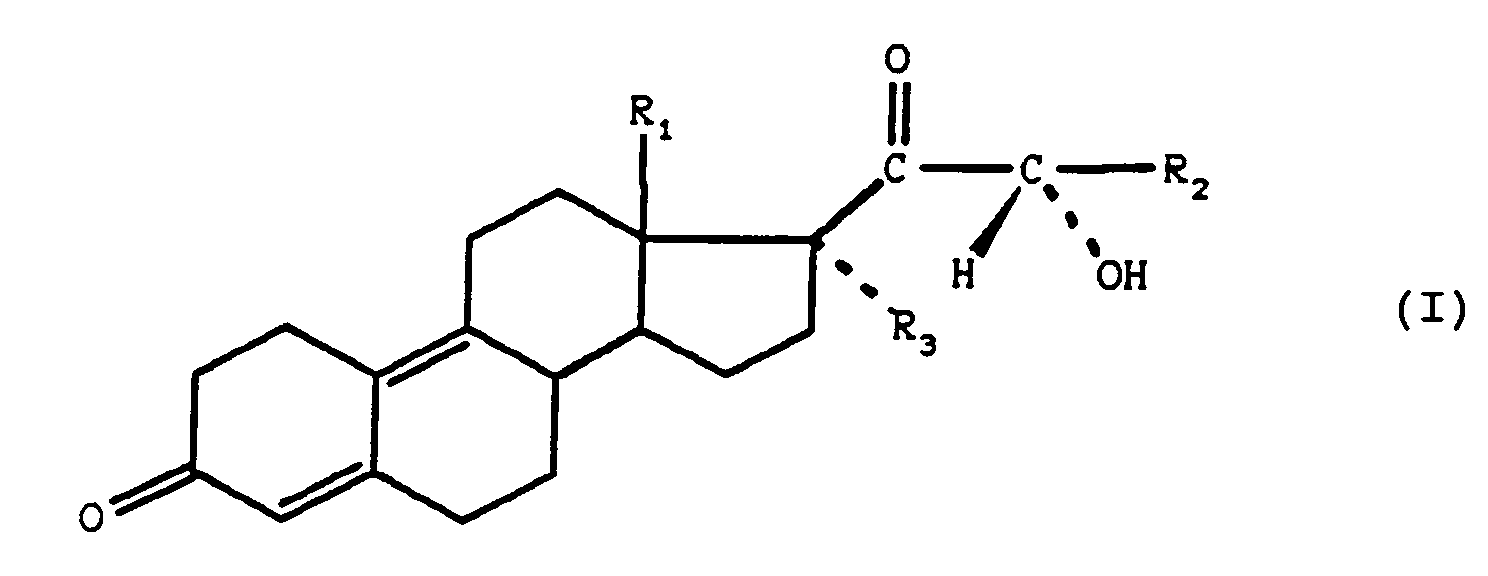
- L'invention a ainsi pour objet un procédé de préparation des composés de formule (I) :

dans laquelle : - R₁ représente un radical alkyle renfermant de 1 à 3 atomes de carbone,
- R₂ un radical alkyle renfermant de 1 à 12 atomes de carbone,
- R₃ un radical alkyle renfermant de 1 à 4 atomes de carbone,
- R₁ peut représenter un radical méthyle, éthyle ou propyle, méthyle étant préféré.
- R₂ peut notamment représenter un radical méthyle, éthyle, propyle, isopropyle, n-butyle, isobutyle, n-pentyle, n-hexyle, 2-méthylpentyle, 2,3-diméthylbutyle, n-octyle ou 2,2-diméthylhexyle.
- R₃ peut notamment représenter un radical méthyle, éthyle ou n-propyle.
- K peut notamment représenter un groupement de formule :

n étant égal à 2 ou 3 et alk représentant un radical alkyle renfermant de 1 à 4 atomes de carbone. - R₄ peut notamment représenter un radical alkyle renfermant de 1 à 6 atomes de carbone, par exemple méthyle, éthyle ou propyle, un radical tétrahydropyranyle, un radical aryle renfermant de 6 à 12 atomes de carbone, par exemple un radical phényle éventuellement substitué par 1 ou plusieurs radicaux méthyle, ou encore un radical silylé, par exemple trialkylsilyle tel que triméthyle ou diméthyl terbutylsilyle, triarylsilyle tel triphénylsilyle, ou diarylalkylsilyle tel que diphénylterbutylsilyle. La valeur trialkylsilyle et notamment triméthylsilyle est tout particulièrement préférée.
- La réaction du composé de formule (II) avec le réactif magnésien de formule (A) est réalisée de préférence au sein d'un éther, par exemple l'éther éthylique, le tétrahydrofuranne, le dioxanne, ou au sein d'un solvant aromatique, par exemple le benzène ou le toluène, ou encore au sein d'un mélange de ces solvants. Dans la formule (A), Hal représente un atome de brome, de chlore ou d'iode.
- L'hydrolyse conduisant au composé 17alpha-OH peut être effectuée par exemple par le chlorure d'ammonium, par un phosphate monoalcalin ou encore par un acide faible tel que l'acide acétique.
- L'agent d'acylation que l'on fait agir sur le composé de formule (III) est de préférence un anhydride ou un halogénure d'acyle approprié. R₅ peut notamment représenter un radical méthyle, éthyle, propyle ou butyle, ou un radical phényle éventuellement substitué par un ou plusieurs radicaux méthyle. L'agent d'acylation est préférentiellement l'anhydride acétique ou le chlorure d'acétyle. On opère en présence d'une base qui peut être, par exemple, une base azotée telle que la pyridine, la diméthylaminopyridine ou encore la triéthylamine, au sein d'un solvant inerte tel que le benzène, le toluène, le xylène ou le cyclohexane ou en l'absence de solvant.
- L'agent d'alkylation peut être un halogénure ou un sulfate d'alkyle, l'iodure étant plus particulièrement préféré. On effectue la réaction en présence d'un agent basique fort qui peut notamment être un amidure ou un alcoolate alcalin, à basse température au sein d'un solvant approprié anhydre, notamment un éther tel que le tétrahydrofuranne.
- La réaction d'autoxydation consiste à faire réagir l'oxygène moléculaire sur un composé préalablement soumis à l'action d'une base forte qui transforme la fonction 20-céto en l'énolate correspondant. La base forte peut être notamment un alcoolate alcalin tel que le méthylate, l'éthylate ou le terbutylate de sodium ou de potassium ou le teramylate de sodium, un hydrure alcalin ou un amidure alcalin, par exemple de lithium, de sodium ou de potassium. L'oxygène est introduit de préférence par barbotage dans le milieu. On peut également opérer par barbotage d'air. On opère au sein d'un solvant organique qui peut être par exemple le diméthylformamide, le diméthylsulfoxyde, le diméthoxyéthane ....
- Le déblocage de la cétone en position 3 peut selon la valeur de K, être effectué de différentes façons. On utilise un agent acide en milieu aqueux, dans le cas où K représente un cétal. Il s'agit par exemple d'un acide minéral ou organique tel que l'acide chlorhydrique, bromhydrique, sulfurique, perchlorique, nitrique, paratoluène sulfonique, acétique, formique, oxalique ou d'un mélange d'acides, ou encore d'une résine acide, par exemple une résine sulfonique. Dans le cas où K représente un thiocétal ou un cétal mixte, la déprotection de la fonction 3-oxo est réalisée par action de l'iode en présence d'une base par exemple un bicarbonate alcalin, ou par action de l'iode en quantité catalytique, en présence d'un agent oxydant, notamment l'eau oxygénée, par action de l'iodure de méthyle, de l'acide glyoxylique, ou encore de sels de métaux, tels le mercure ou le cadmium. On peut, en général, opérer dans un solvant tel qu'un alcanol inférieur, par exemple le méthanol ou l'éthanol, en mélange avec un solvant halogéné, par exemple le chlorure de méthylène, en présence d'eau. On obtient intermédiairement dans le cas d'un déblocage de thiocétal ou de cétal mixte, un produit de type 3-céto déconjugué de formule (VII') :

à partir duquel on obtient le dérivé de formule (VII) par traitement acide, dans les conditions indiquées ci-dessus. - La réduction régio et énantiosélective du composé de formule (VII) peut notamment être réalisée par voie enzymatique. Dans des conditions préférentielles de mise en oeuvre de ce procédé, la réduction est réalisée par l'action d'une levure, et notamment d'une levure choisie dans la classe des Hemiascomycetes et préférentiellement dans la famille des Saccharomycetaceae dont font partie les genres Saccharomyces, Kluyveromyces et Schizosaccharomyces ou Octosporomyces. La levure Saccharomyces cerevisiae est tout particulièrement préférée. La réaction peut être conduite au sein d'un solvant ou d'un mélange de solvants. Parmi ceux-ci, on peut citer notamment l'hexane, le toluène, les alcanols de 1 à 12 carbones, par exemple l'éthanol, l'isopropanol ou le dodécanol, le diméthylformamide, le diméthylsulfoxyde, le tétrahydrofuranne. On opère en présence d'un substrat carboné qui peut être notamment le glucose, le glycérol ou l'éthanol. On peut aussi opérer en présence d'un agent séquestrant du type cyclodextrine. Enfin, on opère à un pH qui est de préférence compris entre 3 et 7 et à une température qui peut se situer entre 25 et 50°C.
- L'invention a notamment pour objet un procédé tel que décrit précédemment, caractérisé en ce que :
- l'on utilise au départ un composé de formule (II) dans laquelle R₄ représente un radical trialkylsilyle et notamment triméthylsilyle et K représente un groupement cétal et notamment éthylène cétal ;
- l'agent d'acylation que l'on fait agir sur le composé de formule (III) est l'anhydride acétique ou le chlorure ou le bromure d'acétyle ;
- l'agent d'alkylation est un halogénure ou un sulfate d'alkyle et l'on opère en présence d'un amidure ou d'un alcoolate alcalin ;
- la réaction d'autoxydation est effectuée par barbotage d'oxygène ou d'air sur un énolate en position 20 obtenu par action d'une base forte notamment un alcoolate ou un amidure alcalin, sur le composé de formule (V) ;
- le traitement acide du composé de formule (VI) dans laquelle K représente un groupement cétal est effectué par un mélange acide acétique-acide perchlorique ou chlorhydrique aqueux ;
- la réduction est effectuée par action d'une levure choisie dans le groupe cité plus haut et notamment de Saccharomyces cerevisiae.
- L'invention a tout particulièrement pour objet un procédé tel que décrit précédemment, caractérisé en ce que l'on utilise au départ un composé de formule (II) dans laquelle R₁ représente un radical méthyle, un réactif de formule (A) dans laquelle R₂ représente un radical méthyle et, à titre d'agent d'alkylation, un agent de méthylation.
- Une variante évidente du procédé, objet de la présente invention consiste à utiliser au départ un composé de formule (II') :

dans laquelle R₁ et R₄ sont définis comme précédemment et K' représente une fonction cétone protégée sous forme de thiocétal. On obtient ainsi les autres intermédiaires correspondants comportant un système de doubles liaisons identique à ci-dessus, puis après déblocage, le composé de formule (VII) puis le composé de formule (I). - L'invention a encore pour objet, à titre de composés industriels nouveaux les composés de formule (VIII) :

dans laquelle R₁ est défini comme ci-dessus et ou bien Z représente K, K étant défini comme ci-dessus et soit A représente -CH₂-R₂ et B représente -OH ou -O-CO-R₅, R₂ et R₅ étant définis comme précédemment, soit A représente -CO-R₂ et B représente R₃, R₂ et R₃ étant définis comme précédemment, ou bien Z représente un atome d'oxygène, A représente -CO-R₂ et B représente R₃, R₂ et R₃ étant définis comme ci-dessus, ou bien Z représente K, A représente -CH₂-R₂ et B représente R₃, K, R₂ et R₃ étant définis comme ci-dessus, à l'exception du composé dans lequel Z représente éthylènedioxy, R₁ et B représentent méthyle et A représente -CH₂-CH₃ ;
- les composés de formule (VII) telle que définie précédemment. - En dehors de leur intérêt comme intermédiaires dans le cadre du procédé objet de la présente invention, les composés de formule (V) peuvent encore par déblocage de la fonction cétone en position 3, selon les méthodes décrites plus haut, conduire à certains composés du type de ceux décrits dans le brevet français 2 149 302 ou à des analogues, et notamment à la 17α-méthyl 17β-(1-oxopropyl) estra 4,9-dièn-3-one.
- Les composés de formule (I) sont doués d'activités progestomimétique et anti-estrogène et sont décrits dans le brevet européen n° 7823.
- Les composés de départ de formule (II) sont décrits dans le brevet français 2 082 129, ou peuvent être préparés par des procédés connus de l'homme du métier à partir de composés décrits dans ce brevet ou connus par ailleurs.
- Les composés de formule (II') peuvent être obtenus par des procédés connus de l'homme du métier, à partir des composés 3-céto correspondants.
- L'exemple suivant illustre l'invention sans toutefois la limiter.
- On mélange sous gaz inerte 30 cm³ de tétrahydrofuranne anhydre et 20 cm³ d'une solution 3M de bromure d'éthylmagnésium dans l'éther éthylique. On ajoute lentement, à température ambiante 3,63 g de 3-(1,2-éthanediyl) acétal cyclique de 17α-triméthylsilyloxy 17β-cyano estra 5(10), 9(11) dièn-3-one en solution dans 10 cm³ de tétrahydrofuranne. On chauffe légèrement le milieu réactionnel pour éliminer l'éther éthylique et atteindre une concentration d'environt 2M du magnésien, puis on maintient le milieu réactionnel à +64°/+65°C pendant 16 heures. On refroidit à +15°/+20°C et verse dans le milieu, 25 cm³ d'une solution saturée de chlorure d'ammonium en contrôlant la température par un bain d'eau et de glace, puis à nouveau 40 cm³ d'une solution saturée de chlorure d'ammonium. On maintient sous agitation pendant 1 heure à 25°C puis extrait au chlorure de méthylène, lave la phase organique à l'eau, la sèche et évapore le solvant. On chromatographie le résidu sur silice en éluant au mélange toluène-acétate d'éthyle (85-15). On obtient 2,7 g de produit attendu que l'on recristallise dans l'éther isopropylique. F = 159°C.
Spectre IR (CHCl₃) - Absorptions à 3618 et 3513 cm⁻¹ (OH), 1706 et 1691 cm⁻¹ (C=O), 1640 et 1617 cm⁻¹ (C=C).
Spectre RMN (CDCl₃, 300 MHz, ppm)
0,23 (s), 0,66 (s) : 18-CH₃ ; 1,07 (t) : CH₃ du propyl ;
2,45-2,80 : -CH₂- du propyl ; 3,99 : cétal ; 5,57 : H₁₁. - On mélange sous gaz inerte 1,7 g de produit obtenu au stade A, 17 cm³ de toluène et 0,34 g de diméthylaminopyridine. On introduit lentement sous agitation 0,9 cm³ d'anhydride acétique et porte au reflux pendant 40 heures environ. On refroidit à 0°/+5°C et ajoute 10 cm³ d'acétate d'éthyle puis 34 cm³ d'une solution aqueuse saturée de chlorure d'ammonium. On agite pendant 1 heure à 0°/+5°C, décante et extrait la phase aqueuse à l'acétate d'éthyle. On lave les phases organiques réunies à l'eau, sèche et évapore le solvant. On reprend le résidu à l'éther isopropylique, essore les cristaux et les sèche. On obtient 1,98 g de produit attendu. F = 195°C.
Spectre IR (CHCl₃)
Absorptions à 1729-1715 cm⁻¹ (C=O), présence de cétal, absence d'OH.
Spectre RMN (CDCl₃, 300 MHz, ppm)
0,53 (s) : 18 CH₃ ; 1,05 (t) : CH₃ du propyl ; 2,07 (s) : O-AC ; 3,99 (cétal) ; 5,58 : H₁₁. - On mélange sous gaz inerte à -70°C, 8 cm³ d'ammoniac liquéfié et 33 mg de lithium et agite pendant 15 minutes. On introduit lentement 10 cm³ de tétrahydrofuranne anhydre puis agite à -75°C pendant 30 minutes et introduit 0,5 g de produit obtenu au stade B. On agite pendant 1 heure, puis ajoute lentement 0,375 cm³ d'iodure de méthyle et maintient sous agitation pendant 1 heure 30 minutes. On laisse ensuite remonter la température et élimine l'ammoniac, puis, vers 0°/+5°C, ajoute 25 cm³ d'eau et agite à +20°/+25°C pendant 30 minutes. On extrait à l'acétate d'éthyle, lave la phase organique à l'eau et sèche puis élimine le solvant. On chromatographie le résidu sur silice en éluant au mélange cyclohexaneacétate d'éthyle (91-9) et obtient après recristallisation dans l'éther isopropylique 0,34 g du produit attendu. F = 107°C.
Spectre IR (CHCl₃)
Absence d'acétate - Absorption à 1698 cm⁻¹ (cétone non conjuguée).
Spectre RMN (CDCl₃, 300 MHz, ppm)
0,60 (s) : 18-CH₃ ; 1,04 (t) : CH₃ du propyl ; 1,12 (s) : CH₃ en 17 ; 3,98 : cétal ; 5,58 : H₁₁. - On mélange sous gaz inerte, 1,5 g de produit obtenu comme décrit au stade C et 15 cm³ de diméthylformamide. On agite à 20°C pendant 10 minutes puis refroidit à 0°/+5°C et ajoute 1 g de terbutylate de potassium. On agite la suspension à 0°/+5°C pendant 5 minutes puis refroidit à -25°C et introduit par barbotage 0,27 1 d'oxygène. On maintient ensuite sous agitation en laissant remonter la température jusqu'à 0°C. On coule le mélange à 0°C, sous atmosphère inerte, sur 30 cm³ d'un tampon phosphate 0,2 M et agite pendant 30 minutes. On extrait à l'acétate d'éthyle, lave la phase organique à l'eau, sèche et évapore le solvant. On chromatographie le résidu sur silice en éluant au mélange toluène-chlorure de méthylène-acétate d'éthyle (90-7-3) et obtient, après recristallisation dans l'éther isopropylique, 1,07 g de produit attendu. F - 100°C.
Spectre IR (CHCl₃)
Absorptions à 1725-1694 cm⁻¹ (C=O)
Spectre RMN (CDCl₃, 300 MHz, ppm)
0,66 (s) : 18-CH₃ ; 1,26 (s) : CH₃ en 17 ; 2,32 (s) : CH₃ du propyl ; 3,99 : cétal ; 5,59 : H₁₁. - On mélange sous gaz inerte 0,2 g de produit obtenu au stade D et 1,5 cm³ d'acide acétique à 99,5 % puis ajoute à température ambiante 0,075 cm³ d'acide perchlorique à 65 %, puis 0,075 cm³ d'eau. On agite pendant 2 heures puis ajoute un mélange de 5,2 cm³ d'eau et 2,8 g de glace. On extrait au chlorure de méthylène, lave la phase organique à l'eau, la sèche et la concentre à sec. On chromatographie le résidu sur silice en éluant au mélange toluène-dioxane (95-5) et obtient 0,142 g de produit attendu.
Spectre IR : (CHCl₃)
Absorptions à 1716-1694 cm⁻¹ (C=O), 1653 cm⁻¹ (C=O conjuguée), 1607 cm⁻¹ (C=C).
Spectre RMN : (CDCl₃ -300 MHz, ppm)
0,86 : 18-CH₃ ; 1,26 : CH₃ en 17 ; 2,33 : CH₃ du propyl ; 5,68 : C=C. - On mélange à 30°C ± 1°C, 500 cm³ de tampon acétate de sodium et 20 g de levure Saccharomyces cerevisiae. On agite pendant 20 minutes à 30°C puis ajoute 6,6 g de glucose. Tout en maintenant la température à 30°C, et le pH à 5,4 par addition de soude 2N ou d'acide acétique 2M, on introduit 0,1 g de produit obtenu au stade E en solution dans le diméthylsulfoxyde, puis maintient sous agitation pendant 22 heures. Après centrifugation du milieu pendant 45 minutes à 20 000 g et à 20°C maximum, on extrait le surnageant à l'acétate d'éthyle, sature à 50 % la phase aqueuse par addition de chlorure de sodium, puis extrait de nouveau à l'acétate d'éthyle. Les phases organiques réunies sont lavées à l'eau, séchées et concentrées à sec. On obtient 100,3 mg de produit attendu brut, dont une analyse par HPLC montre qu'il renferme 99,75 % d'isomère 21-0H(S).
- On chromatographie 0,090 g du produit brut sur silice en éluant au mélange toluène-acétate d'éthyle-isopropanol (90-6-4) et obtient 0,043 g de produit attendu. F = 115°C.
Spectre RMN (CDCl₃ - 300 MHz, ppm).
0,83 (s) : 18-CH₃ ; 1,18 (s) : CH₃ en 17 ; 1,32 (d) : CH₃-CH- - Des essais ont été réalisés avec les levures figurant sur le tableau ci-dessous, dans les conditions suivantes :
- a) La croissance de la levure a été effectuée sur un milieu de type synthétique (tampon phosphate + source d'azote minéral) complété en oligoéléments et vitamines, la source du carbone étant le glucose. On obtient un milieu de pH 6,4. L'incubation est faite à 30°C, sur agitateur orbital à 150 t/m pendant 24 heures.
- b) Pour effectuer la bioconversion, on dilue au préalable 1 volume de bouillon de croissance dans 1 volume de milieu neuf contenant une nouvelle source de carbone constituée par du glycérol, à raison de 40 g/l et une concentration en substrat dicétone de 1 g/l. Aucun tiers solvant n'est ajouté. On obtient un pH d'environ 5,5.
- Le traitement des essais est effectué après des durées variables d'incubation, sous agitation magnétique et barbotage d'air, à 30°C environ. Pour cela on prélève 100 µl de mélange que l'on place dans un tube contenant des billes de verre, ajoute 5 ml de chlorobutane et agite pendant 1 minute. On récupère la phase supérieure et détermine par HPLC la quantité de produit attendu présent, que l'on rapporte au volume total de l'essai.
- Les résultats figurent sur le tableau ci-après :

caractérisé en ce que l'on traite un composé de formule (II) :

dans laquelle R₄ représente un reste d'éther facilement clivable, K représente une fonction cétone protégée sous forme de cétal, de thiocétal ou de cétal mixte et R₁ est défini comme précédemment, par un réactif organomagnésien de formule (A) :
HalMg-CH₂-R₂ (A)
dans laquelle Hal représente un atome d'halogène et R₂ est défini comme précédemment, pour obtenir un composé de formule (III) :

dans laquelle R₁, R₂ et K sont définis comme précédemment, que l'on traite par un agent d'acylation pour obtenir un composé de formule (IV) :

dans laquelle R₅ représente un radical alkyle renfermant de 1 à 6 atomes de carbone ou un radical aryle renfermant de 6 à 10 atomes de carbone et R₁, R₂ et K sont définis comme précédemment, que l'on soumet à l'action d'un agent d'alkylation approprié, pour obtenir un composé de formule (V) :

dans laquelle R₁, R₂, R₃ et K sont définis comme précédemment, que l'on soumet à une réaction d'autoxydation, pour obtenir un composé de formule (VI) :
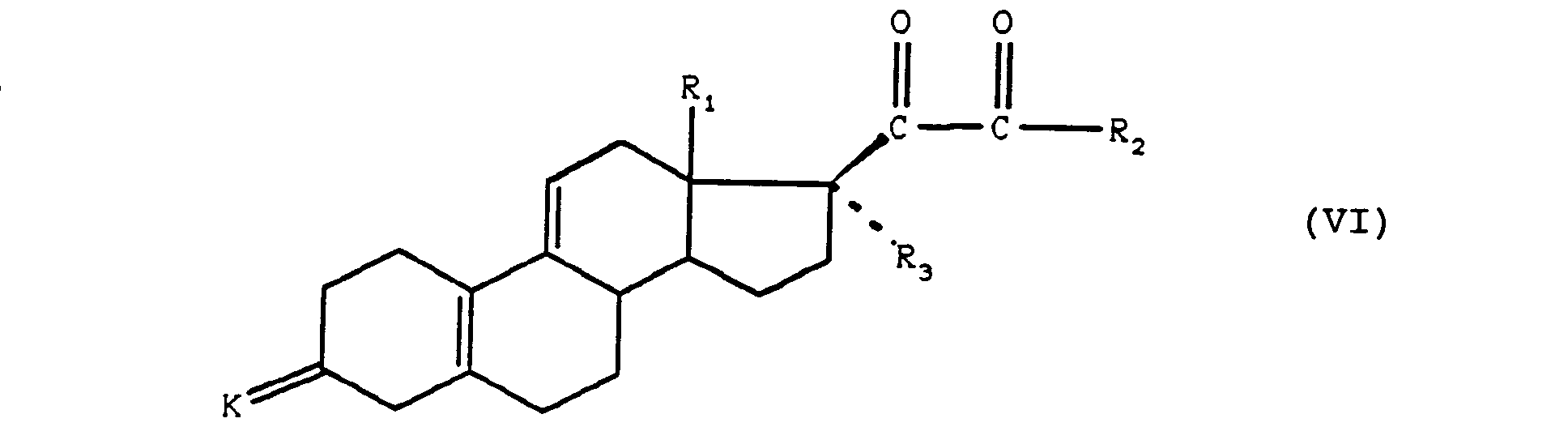
dans laquelle R₁, R₂, R₃ et K sont définis comme précédemment que l'on traite par un acide pour obtenir le composé 3-céto reconjugué de formule (VII) :

dans laquelle R₁, R₂ et R₃ sont définis comme précédemment, que l'on soumet à l'action d'un agent de réduction régio et énantiosélectif pour obtenir le composé de formule (I) attendu.
Claims (13)


HalMg-CH₂-R₂ (A)
dans laquelle Hal représente un atome d'halogène et R₂ est défini comme précédemment, pour obtenir un composé de formule (III) :


Applications Claiming Priority (2)
| Application Number | Priority Date | Filing Date | Title |
|---|---|---|---|
| FR9207047A FR2692267B1 (fr) | 1992-06-11 | 1992-06-11 | Nouveau procédé de préparation de composés stéroïdes 20-céto 21alpha-hydroxy et intermédiaires. |
| FR9207047 | 1992-06-11 |
Publications (2)
| Publication Number | Publication Date |
|---|---|
| EP0574317A1 true EP0574317A1 (fr) | 1993-12-15 |
| EP0574317B1 EP0574317B1 (fr) | 1996-10-09 |
Family
ID=9430627
Family Applications (1)
| Application Number | Title | Priority Date | Filing Date |
|---|---|---|---|
| EP93401481A Expired - Lifetime EP0574317B1 (fr) | 1992-06-11 | 1993-06-10 | Nouveau procédé de préparation de composés stéroides 20-céto 21alpha-hydroxy et intermédiaires |
Country Status (13)
| Country | Link |
|---|---|
| US (1) | US5399685A (fr) |
| EP (1) | EP0574317B1 (fr) |
| JP (1) | JP3231901B2 (fr) |
| AT (1) | ATE143971T1 (fr) |
| CA (1) | CA2098146C (fr) |
| DE (2) | DE10299019I2 (fr) |
| DK (1) | DK0574317T3 (fr) |
| ES (1) | ES2092785T3 (fr) |
| FR (1) | FR2692267B1 (fr) |
| GR (1) | GR3021337T3 (fr) |
| HU (3) | HU213673B (fr) |
| MX (1) | MX9303454A (fr) |
| NL (1) | NL300068I1 (fr) |
Cited By (2)
| Publication number | Priority date | Publication date | Assignee | Title |
|---|---|---|---|---|
| US5399685A (en) * | 1992-06-11 | 1995-03-21 | Roussel-Uclaf | Process for the preparation of 20-keto-21 alpha-01-steroids |
| US7868194B2 (en) | 2004-10-21 | 2011-01-11 | Industriale Chimica S.R.L. | Process for the preparation of 21-hydroxy steroids with control of the epimeric distribution at the C-21 position |
Families Citing this family (6)
| Publication number | Priority date | Publication date | Assignee | Title |
|---|---|---|---|---|
| FR2749012B1 (fr) * | 1996-05-22 | 1998-08-07 | Hoechst Marion Roussel Inc | Nouveaux steroides 1 ou 6-hydroxyles, leur procede de preparation, leur application a titre de medicament et les compositions pharmaceutiques les renfermant |
| FR2801218B1 (fr) * | 1999-11-23 | 2001-12-28 | Hoechst Marion Roussel Inc | Compositions pharmaceutiques comprenant de la trimegestone, leurs procedes de preparation ainsi que le conditionnement primaire les renfermant |
| TW200306846A (en) * | 2002-04-03 | 2003-12-01 | Wyeth Corp | Hormone replacement therapy |
| TW200306196A (en) * | 2002-04-03 | 2003-11-16 | Wyeth Corp | Hormone replacement therapy |
| TW200306851A (en) * | 2002-04-29 | 2003-12-01 | Wyeth Corp | Hormone replacement therapy |
| TW200400040A (en) * | 2002-05-17 | 2004-01-01 | Wyeth Corp | Hormone replacement therapy |
Citations (3)
| Publication number | Priority date | Publication date | Assignee | Title |
|---|---|---|---|---|
| FR2149302A1 (en) * | 1971-08-19 | 1973-03-30 | Roussel Uclaf | 21-methyl pregnadienes prepn - used as progestomimetics |
| EP0007823A2 (fr) * | 1978-07-13 | 1980-02-06 | Roussel-Uclaf | Nouveaux dérivés 3,20-dioxo 4,9-diène 21-hydroxyle stéroides, leur procédé de préparation, leur application à titre de médicaments et les compositions pharmaceutiques les renfermant |
| CH629504A5 (en) * | 1977-12-14 | 1982-04-30 | Roussel Uclaf | 19-Norpregnatetraene derivatives |
Family Cites Families (2)
| Publication number | Priority date | Publication date | Assignee | Title |
|---|---|---|---|---|
| US4181720A (en) * | 1978-04-05 | 1980-01-01 | Syntex (U.S.A.) Inc. | Corticosteroid antiinflammatory agents |
| FR2692267B1 (fr) * | 1992-06-11 | 1995-05-19 | Roussel Uclaf | Nouveau procédé de préparation de composés stéroïdes 20-céto 21alpha-hydroxy et intermédiaires. |
-
1992
- 1992-06-11 FR FR9207047A patent/FR2692267B1/fr not_active Expired - Fee Related
-
1993
- 1993-06-09 MX MX9303454A patent/MX9303454A/es unknown
- 1993-06-10 HU HU9301694A patent/HU213673B/hu unknown
- 1993-06-10 CA CA002098146A patent/CA2098146C/fr not_active Expired - Lifetime
- 1993-06-10 ES ES93401481T patent/ES2092785T3/es not_active Expired - Lifetime
- 1993-06-10 EP EP93401481A patent/EP0574317B1/fr not_active Expired - Lifetime
- 1993-06-10 HU HU9603209A patent/HU221970B1/hu active IP Right Grant
- 1993-06-10 DK DK93401481.2T patent/DK0574317T3/da active
- 1993-06-10 DE DE10299019C patent/DE10299019I2/de active Active
- 1993-06-10 AT AT93401481T patent/ATE143971T1/de active
- 1993-06-10 HU HU9603208A patent/HU221161B1/hu unknown
- 1993-06-10 DE DE69305241T patent/DE69305241T2/de not_active Expired - Lifetime
- 1993-06-11 JP JP16497993A patent/JP3231901B2/ja not_active Expired - Lifetime
- 1993-06-11 US US08/075,822 patent/US5399685A/en not_active Expired - Lifetime
-
1996
- 1996-10-11 GR GR960401133T patent/GR3021337T3/el unknown
-
2001
- 2001-11-02 NL NL300068C patent/NL300068I1/nl unknown
Patent Citations (3)
| Publication number | Priority date | Publication date | Assignee | Title |
|---|---|---|---|---|
| FR2149302A1 (en) * | 1971-08-19 | 1973-03-30 | Roussel Uclaf | 21-methyl pregnadienes prepn - used as progestomimetics |
| CH629504A5 (en) * | 1977-12-14 | 1982-04-30 | Roussel Uclaf | 19-Norpregnatetraene derivatives |
| EP0007823A2 (fr) * | 1978-07-13 | 1980-02-06 | Roussel-Uclaf | Nouveaux dérivés 3,20-dioxo 4,9-diène 21-hydroxyle stéroides, leur procédé de préparation, leur application à titre de médicaments et les compositions pharmaceutiques les renfermant |
Cited By (2)
| Publication number | Priority date | Publication date | Assignee | Title |
|---|---|---|---|---|
| US5399685A (en) * | 1992-06-11 | 1995-03-21 | Roussel-Uclaf | Process for the preparation of 20-keto-21 alpha-01-steroids |
| US7868194B2 (en) | 2004-10-21 | 2011-01-11 | Industriale Chimica S.R.L. | Process for the preparation of 21-hydroxy steroids with control of the epimeric distribution at the C-21 position |
Also Published As
| Publication number | Publication date |
|---|---|
| MX9303454A (es) | 1994-07-29 |
| HU221161B1 (en) | 2002-08-28 |
| DE69305241D1 (de) | 1996-11-14 |
| ES2092785T3 (es) | 1996-12-01 |
| DE10299019I2 (de) | 2008-06-19 |
| CA2098146A1 (fr) | 1993-12-12 |
| JP3231901B2 (ja) | 2001-11-26 |
| DE69305241T2 (de) | 1997-03-06 |
| HU9603209D0 (en) | 1997-01-28 |
| NL300068I1 (nl) | 2002-02-01 |
| FR2692267A1 (fr) | 1993-12-17 |
| DE10299019I1 (de) | 2002-11-07 |
| HU221970B1 (hu) | 2003-03-28 |
| GR3021337T3 (en) | 1997-01-31 |
| CA2098146C (fr) | 2003-12-30 |
| HU213673B (en) | 1997-09-29 |
| DK0574317T3 (da) | 1996-12-23 |
| EP0574317B1 (fr) | 1996-10-09 |
| JPH0665283A (ja) | 1994-03-08 |
| HUT64557A (en) | 1994-01-28 |
| HU9603208D0 (en) | 1997-01-28 |
| US5399685A (en) | 1995-03-21 |
| HU9301694D0 (en) | 1994-01-28 |
| FR2692267B1 (fr) | 1995-05-19 |
| ATE143971T1 (de) | 1996-10-15 |
Similar Documents
| Publication | Publication Date | Title |
|---|---|---|
| EP0574318B1 (fr) | Nouveau procédé de préparation de stéroides 16 alpha-méthylés | |
| EP0574317B1 (fr) | Nouveau procédé de préparation de composés stéroides 20-céto 21alpha-hydroxy et intermédiaires | |
| EP0056000B1 (fr) | Dérivés 17/(alkoxycarbonyle) (formamido) méthylène/stéroides et leur préparation | |
| EP0001029B1 (fr) | Procédé de préparation d'oximes en 3 de stéroides | |
| EP0607088B1 (fr) | Nouveaux dérivés 17,20-époxydes du pregnane, leur application à la préparation de dérivés cortisoniques et intermédiaires | |
| CH652726A5 (fr) | Derives steroides 17-oxazolines, leur procede de preparation et leur utilisation a la preparation de corticosteroides. | |
| EP0192288B1 (fr) | Nouveaux dérivés stéroides portant en 17 un radical nitrométhylène, Leur application à la préparation de produits biologiquement actifs | |
| JPH0118919B2 (fr) | ||
| EP0044575B1 (fr) | Produits intermédiaires dans la synthèse de 19-nor stéroides substitués en position 2 | |
| EP0058097B1 (fr) | Nouveau procédé de préparation de 17alpha-hydroxy 17bêta-hydroxyacétyl stéroides et produits intermédiaires correspondants obtenus | |
| EP0275728B1 (fr) | Nouveaux produits stéroîdes comportant, en position 23, un radical sulfinyle, leur procédé de préparation, leur application à la préparation de produits de la série des 20-cétoprégnanes et des intermédiaires de cette application | |
| RU2161623C2 (ru) | Способ изомеризации эквилина | |
| EP0702025B1 (fr) | Procédé de préparation d'un dérivé stéroide 17bêta-carboxy et nouveaux intermédiaires | |
| EP2121724B1 (fr) | Nouveau procede pour l'obtention diastereoselective d'une amine primaire chirale sur un steroïde | |
| FR2474038A1 (fr) | 17-spiro-dihydrofuranones steroidales a action anti-inflammatoire, et leur procede de preparation | |
| EP0275729B1 (fr) | Nouveaux produits stéroides comportant, en position 23, un radical cétonique, leur procédé de préparation, leur application à la préparation de produits de la série des 20-cétoprégnanes et des intermédiaires de cette application | |
| CH627193A5 (fr) | ||
| EP0546875A2 (fr) | Nouveau procédé de préparation de dérivés 20-oxo 17alpha,21-dihydroxylés du pregnane et nouveaux intermédiaires | |
| FR2570076A1 (fr) | Nouveaux steroides et leur procede de preparation | |
| FR2559156A1 (fr) | Procede de preparation de derives de la prednisone et produits intermediaires de ce procede | |
| BE667124A (fr) | ||
| BE562659A (fr) |
Legal Events
| Date | Code | Title | Description |
|---|---|---|---|
| PUAI | Public reference made under article 153(3) epc to a published international application that has entered the european phase |
Free format text: ORIGINAL CODE: 0009012 |
|
| AK | Designated contracting states |
Kind code of ref document: A1 Designated state(s): AT BE CH DE DK ES FR GB GR IT LI LU NL PT SE |
|
| 17P | Request for examination filed |
Effective date: 19940509 |
|
| 17Q | First examination report despatched |
Effective date: 19950217 |
|
| RAP1 | Party data changed (applicant data changed or rights of an application transferred) |
Owner name: ROUSSEL UCLAF |
|
| GRAG | Despatch of communication of intention to grant |
Free format text: ORIGINAL CODE: EPIDOS AGRA |
|
| GRAH | Despatch of communication of intention to grant a patent |
Free format text: ORIGINAL CODE: EPIDOS IGRA |
|
| GRAH | Despatch of communication of intention to grant a patent |
Free format text: ORIGINAL CODE: EPIDOS IGRA |
|
| GRAA | (expected) grant |
Free format text: ORIGINAL CODE: 0009210 |
|
| ITF | It: translation for a ep patent filed | ||
| AK | Designated contracting states |
Kind code of ref document: B1 Designated state(s): AT BE CH DE DK ES FR GB GR IT LI LU NL PT SE |
|
| REF | Corresponds to: |
Ref document number: 143971 Country of ref document: AT Date of ref document: 19961015 Kind code of ref document: T |
|
| REG | Reference to a national code |
Ref country code: CH Ref legal event code: NV Representative=s name: A. BRAUN, BRAUN, HERITIER, ESCHMANN AG PATENTANWAE |
|
| GBT | Gb: translation of ep patent filed (gb section 77(6)(a)/1977) |
Effective date: 19961010 |
|
| REF | Corresponds to: |
Ref document number: 69305241 Country of ref document: DE Date of ref document: 19961114 |
|
| REG | Reference to a national code |
Ref country code: ES Ref legal event code: FG2A Ref document number: 2092785 Country of ref document: ES Kind code of ref document: T3 |
|
| REG | Reference to a national code |
Ref country code: DK Ref legal event code: T3 |
|
| REG | Reference to a national code |
Ref country code: GR Ref legal event code: FG4A Free format text: 3021337 |
|
| REG | Reference to a national code |
Ref country code: PT Ref legal event code: SC4A Free format text: AVAILABILITY OF NATIONAL TRANSLATION Effective date: 19961015 |
|
| REG | Reference to a national code |
Ref country code: AT Ref legal event code: UEP Ref document number: 93401481 Country of ref document: AT Kind code of ref document: T |
|
| PLBE | No opposition filed within time limit |
Free format text: ORIGINAL CODE: 0009261 |
|
| STAA | Information on the status of an ep patent application or granted ep patent |
Free format text: STATUS: NO OPPOSITION FILED WITHIN TIME LIMIT |
|
| 26N | No opposition filed | ||
| REG | Reference to a national code |
Ref country code: FR Ref legal event code: TP |
|
| REG | Reference to a national code |
Ref country code: CH Ref legal event code: PFA Free format text: ROUSSEL UCLAF TRANSFER- HOECHST MARION ROUSSEL |
|
| REG | Reference to a national code |
Ref country code: GB Ref legal event code: 732E |
|
| NLS | Nl: assignments of ep-patents |
Owner name: HOECHST MARION ROUSSEL |
|
| REG | Reference to a national code |
Ref country code: PT Ref legal event code: PC4A Free format text: HOECHST MARION ROUSSEL FR Effective date: 19991118 |
|
| REG | Reference to a national code |
Ref country code: SE Ref legal event code: SPCF Free format text: 0190010-9, 20000922 |
|
| REG | Reference to a national code |
Ref country code: FR Ref legal event code: TP |
|
| REG | Reference to a national code |
Ref country code: GB Ref legal event code: IF02 |
|
| REG | Reference to a national code |
Ref country code: IT Ref legal event code: SPCF Ref document number: 501996900538919 Country of ref document: IT Free format text: AUTHORISATION NUMBER(S) AND DATE(S): 15733, 20000922;035315011/M-023/M, 20010802 Spc suppl protection certif: 132002900987740 |
|
| REG | Reference to a national code |
Ref country code: PT Ref legal event code: PC4A Free format text: AVENTIS PHARMA S.A. FR Effective date: 20011106 |
|
| REG | Reference to a national code |
Ref country code: NL Ref legal event code: AC1 Free format text: NLAC1 300068, 20011102 |
|
| REG | Reference to a national code |
Ref country code: FR Ref legal event code: CP Free format text: PRODUCT NAME: ESTRADIOL HEMIHYDRATE; TRIMEGESTONE; NAT. REGISTRATION NO/DATE: NL 26 295 20010831; FIRST REGISTRATION: SE - 15 733 20000922 Spc suppl protection certif: 02C0010 Filing date: 20020208 |
|
| REG | Reference to a national code |
Ref country code: ES Ref legal event code: PC2A |
|
| REG | Reference to a national code |
Ref country code: IT Ref legal event code: SPCG Ref document number: 501996900538919 Country of ref document: IT Free format text: AUTHORISATION NUMBER(S) AND DATE(S): 15733, 20000922;035315011/M-023/M, 20010802 Spc suppl protection certif: 132002900987740 Extension date: 20150922 |
|
| REG | Reference to a national code |
Ref country code: GB Ref legal event code: CTFF Free format text: GBCTFFSPC/GB02/017: 20020305 |
|
| REG | Reference to a national code |
Ref country code: FR Ref legal event code: CR Free format text: FRCR 2002C0010, 20020208 |
|
| REG | Reference to a national code |
Ref country code: DK Ref legal event code: CTFF Free format text: DKCTFF CA 2001 00034, 20011016, EXPIRES: 20150922 |
|
| REG | Reference to a national code |
Ref country code: AT Ref legal event code: EEIH Ref document number: 93401481 Country of ref document: AT Kind code of ref document: T |
|
| REG | Reference to a national code |
Ref country code: DE Ref legal event code: V448 Ref document number: 69305241 Country of ref document: DE Free format text: PRODUCT NAME: ONDEVA 2MG/0,5MG (ESTRADIOL-HEMIHYDRAT/TRIMEGESTON); REGISTRATION NO/DATE: 50929.00.00, 20011219 Spc suppl protection certif: 102 99 019 Filing date: 20020516 |
|
| NLS | Nl: assignments of ep-patents |
Owner name: AVENTIS PHARMA S.A. |
|
| REG | Reference to a national code |
Ref country code: AT Ref legal event code: ESZA Ref document number: 93401481 Country of ref document: AT Kind code of ref document: T Free format text: PRODUCT NAME: NEUES VERFAHREN ZUR HERSTELLUNG 20-KETO, 21-ALPHA-HYDROXYSTEROIDE UND ZWISCHENPRODUKTE DAZU Spc suppl protection certif: SZ 7/2002 Filing date: 20020305 |
|
| REG | Reference to a national code |
Ref country code: AT Ref legal event code: EEZF Ref document number: 93401481 Country of ref document: AT Kind code of ref document: T Free format text: PRODUCT NAME: NEUES VERFAHREN ZUR HERSTELLUNG 20-KETO, 21-ALPHA-HYDROXYSTEROIDE UND ZWISCHENPRODUKTE DAZU Spc suppl protection certif: SZ 7/2002 Filing date: 20020305 Extension date: 20150922 Effective date: 20020923 |
|
| REG | Reference to a national code |
Ref country code: CH Ref legal event code: PFA Free format text: HOECHST MARION ROUSSEL TRANSFER- AVENTIS PHARMA S.A. |
|
| REG | Reference to a national code |
Ref country code: SE Ref legal event code: SPCG Free format text: 0190010-9, 20000922 |
|
| BECA | Be: change of holder's address |
Free format text: 20020110 S.A. *AVENTIS PHARMA:20 AVENUE RAYMOND ARON, 92160 ANTONY |
|
| BECH | Be: change of holder |
Free format text: 20020110 S.A. *AVENTIS PHARMA |
|
| NLS | Nl: assignments of ep-patents |
Owner name: AVENTIS PHARMA S.A. |
|
| REG | Reference to a national code |
Ref country code: GB Ref legal event code: CTFW Free format text: SPC/GB02/017: 20040301 Spc suppl protection certif: SPC/GB02/017 Filing date: 20040301 |
|
| REG | Reference to a national code |
Ref country code: DE Ref legal event code: 8328 Ref document number: 69305241 Country of ref document: DE Representative=s name: PFENNING MEINIG & PARTNER GBR, 80339 MUENCHEN |
|
| REG | Reference to a national code |
Ref country code: DE Ref legal event code: V472 Ref document number: 69305241 Country of ref document: DE Free format text: PRODUCT NAME: ONDEVA 2MG/0,5MG (ESTRADIOL-HEMIHYDRAT/TRIMEGESTON); REGISTRATION NO/DATE: 50929.00.00, 20011219 Spc suppl protection certif: 102 99 019 Filing date: 20020516 |
|
| REG | Reference to a national code |
Ref country code: CH Ref legal event code: PFA Owner name: AVENTIS PHARMA S.A. Free format text: AVENTIS PHARMA S.A.#20, AVENUE RAYMOND ARON#92160 ANTONY (FR) -TRANSFER TO- AVENTIS PHARMA S.A.#20, AVENUE RAYMOND ARON#92160 ANTONY (FR) |
|
| REG | Reference to a national code |
Ref country code: DE Ref legal event code: 8328 Ref document number: 69305241 Country of ref document: DE Representative=s name: MAIWALD PATENTANWALTSGESELLSCHAFT MBH, 80335 MUENC |
|
| PGFP | Annual fee paid to national office [announced via postgrant information from national office to epo] |
Ref country code: LU Payment date: 20110621 Year of fee payment: 19 |
|
| PGFP | Annual fee paid to national office [announced via postgrant information from national office to epo] |
Ref country code: DK Payment date: 20120612 Year of fee payment: 20 Ref country code: DE Payment date: 20120607 Year of fee payment: 20 Ref country code: NL Payment date: 20120614 Year of fee payment: 20 Ref country code: CH Payment date: 20120612 Year of fee payment: 20 |
|
| PGFP | Annual fee paid to national office [announced via postgrant information from national office to epo] |
Ref country code: FR Payment date: 20120619 Year of fee payment: 20 Ref country code: SE Payment date: 20120612 Year of fee payment: 20 Ref country code: GB Payment date: 20120606 Year of fee payment: 20 Ref country code: GR Payment date: 20120521 Year of fee payment: 20 |
|
| PGFP | Annual fee paid to national office [announced via postgrant information from national office to epo] |
Ref country code: IT Payment date: 20120616 Year of fee payment: 20 |
|
| PGFP | Annual fee paid to national office [announced via postgrant information from national office to epo] |
Ref country code: BE Payment date: 20120620 Year of fee payment: 20 |
|
| PGFP | Annual fee paid to national office [announced via postgrant information from national office to epo] |
Ref country code: ES Payment date: 20120726 Year of fee payment: 20 |
|
| PGFP | Annual fee paid to national office [announced via postgrant information from national office to epo] |
Ref country code: PT Payment date: 20120608 Year of fee payment: 20 |
|
| PGFP | Annual fee paid to national office [announced via postgrant information from national office to epo] |
Ref country code: AT Payment date: 20120529 Year of fee payment: 20 |
|
| REG | Reference to a national code |
Ref country code: DE Ref legal event code: R071 Ref document number: 69305241 Country of ref document: DE |
|
| REG | Reference to a national code |
Ref country code: DK Ref legal event code: EUP |
|
| REG | Reference to a national code |
Ref country code: NL Ref legal event code: V4 Effective date: 20130610 Ref country code: PT Ref legal event code: MM4A Free format text: MAXIMUM VALIDITY LIMIT REACHED Effective date: 20130610 |
|
| REG | Reference to a national code |
Ref country code: NL Ref legal event code: KC1 Free format text: PRODUCT NAME: ESTRADIOL ALS EERSTE FASE, GEVOLGD DOOR ESTRADIOL EN TRIMEGESTON ALS TWEEDE FASE; NAT. REGISTRATION NO/DATE: RVG 26003 20010504; FIRST REGISTRATION: 15733 20000922 Spc suppl protection certif: C300068 Filing date: 20011102 Extension date: 20150921 |
|
| REG | Reference to a national code |
Ref country code: CH Ref legal event code: PL |
|
| BE20 | Be: patent expired |
Owner name: S.A. *AVENTIS PHARMA Effective date: 20130610 |
|
| REG | Reference to a national code |
Ref country code: GB Ref legal event code: PE20 Expiry date: 20130609 |
|
| REG | Reference to a national code |
Ref country code: AT Ref legal event code: MK07 Ref document number: 143971 Country of ref document: AT Kind code of ref document: T Effective date: 20130610 |
|
| PG25 | Lapsed in a contracting state [announced via postgrant information from national office to epo] |
Ref country code: GB Free format text: LAPSE BECAUSE OF EXPIRATION OF PROTECTION Effective date: 20130609 Ref country code: DE Free format text: LAPSE BECAUSE OF EXPIRATION OF PROTECTION Effective date: 20130611 |
|
| REG | Reference to a national code |
Ref country code: ES Ref legal event code: FD2A Effective date: 20130823 |
|
| PG25 | Lapsed in a contracting state [announced via postgrant information from national office to epo] |
Ref country code: PT Free format text: LAPSE BECAUSE OF EXPIRATION OF PROTECTION Effective date: 20130619 |
|
| REG | Reference to a national code |
Ref country code: GR Ref legal event code: MA Ref document number: 960401133 Country of ref document: GR Effective date: 20130611 |
|
| PG25 | Lapsed in a contracting state [announced via postgrant information from national office to epo] |
Ref country code: ES Free format text: LAPSE BECAUSE OF EXPIRATION OF PROTECTION Effective date: 20130611 |
|
| REG | Reference to a national code |
Ref country code: FR Ref legal event code: SPAY Free format text: PRODUCT NAME: ESTRADIOL HEMIHYDRATE; TRIMEGESTONE; NAT. REGISTRATION NO/DATE: NL 26 295 20010831; FIRST REGISTRATION: SE - 15 733 20000922 Spc suppl protection certif: 02C0010 Filing date: 20020208 Year of fee payment: 3 Extension date: 20150922 |
|
| REG | Reference to a national code |
Ref country code: AT Ref legal event code: SPCX Ref document number: 143971 Country of ref document: AT Kind code of ref document: T Free format text: PRODUCT NAME: NEUES VERFAHREN ZUR HERSTELLUNG 20-KETO, 21-ALPHA-HYDROXYSTEROIDE UND ZWISCHENPRODUKTE DAZU; NAT. REGISTRATION NO/DATE: 1-24191 20010906; FIRST REGISTRATION: SE 15733, 15734 20000922 Spc suppl protection certif: 7/2002 Filing date: 20020305 Expiry date: 20130610 Extension date: 20150922 Effective date: 20150922 |