EP0508296A1 - Verfahren zur Herstellung phosphorhaltiger L-Aminosäuren, deren Derivate und Zwischenprodukte für dieses Verfahren - Google Patents
Verfahren zur Herstellung phosphorhaltiger L-Aminosäuren, deren Derivate und Zwischenprodukte für dieses Verfahren Download PDFInfo
- Publication number
- EP0508296A1 EP0508296A1 EP92105615A EP92105615A EP0508296A1 EP 0508296 A1 EP0508296 A1 EP 0508296A1 EP 92105615 A EP92105615 A EP 92105615A EP 92105615 A EP92105615 A EP 92105615A EP 0508296 A1 EP0508296 A1 EP 0508296A1
- Authority
- EP
- European Patent Office
- Prior art keywords
- formula
- compound
- alkyl
- compounds
- formula iii
- Prior art date
- Legal status (The legal status is an assumption and is not a legal conclusion. Google has not performed a legal analysis and makes no representation as to the accuracy of the status listed.)
- Granted
Links
- 238000000034 method Methods 0.000 title claims description 54
- 238000002360 preparation method Methods 0.000 title claims description 11
- 150000008575 L-amino acids Chemical class 0.000 title abstract description 10
- OAICVXFJPJFONN-UHFFFAOYSA-N Phosphorus Chemical compound [P] OAICVXFJPJFONN-UHFFFAOYSA-N 0.000 title description 9
- 229910052698 phosphorus Inorganic materials 0.000 title description 9
- 239000011574 phosphorus Substances 0.000 title description 9
- 239000000543 intermediate Substances 0.000 title description 6
- 150000001875 compounds Chemical class 0.000 claims abstract description 46
- LFQSCWFLJHTTHZ-UHFFFAOYSA-N Ethanol Chemical compound CCO LFQSCWFLJHTTHZ-UHFFFAOYSA-N 0.000 claims abstract description 21
- VEXZGXHMUGYJMC-UHFFFAOYSA-N Hydrochloric acid Chemical compound Cl VEXZGXHMUGYJMC-UHFFFAOYSA-N 0.000 claims abstract description 20
- 150000003839 salts Chemical class 0.000 claims abstract description 17
- 229910052739 hydrogen Inorganic materials 0.000 claims abstract description 13
- IXCSERBJSXMMFS-UHFFFAOYSA-N hydrogen chloride Substances Cl.Cl IXCSERBJSXMMFS-UHFFFAOYSA-N 0.000 claims abstract description 12
- 229910000041 hydrogen chloride Inorganic materials 0.000 claims abstract description 12
- 150000003254 radicals Chemical class 0.000 claims description 17
- OKKJLVBELUTLKV-UHFFFAOYSA-N Methanol Chemical compound OC OKKJLVBELUTLKV-UHFFFAOYSA-N 0.000 claims description 16
- 239000001257 hydrogen Substances 0.000 claims description 12
- 125000004178 (C1-C4) alkyl group Chemical group 0.000 claims description 11
- 125000003118 aryl group Chemical group 0.000 claims description 11
- 238000006243 chemical reaction Methods 0.000 claims description 10
- -1 R5 H Chemical group 0.000 claims description 9
- 229910052736 halogen Inorganic materials 0.000 claims description 9
- 125000001797 benzyl group Chemical group [H]C1=C([H])C([H])=C(C([H])=C1[H])C([H])([H])* 0.000 claims description 8
- 150000002367 halogens Chemical class 0.000 claims description 7
- UFHFLCQGNIYNRP-UHFFFAOYSA-N Hydrogen Chemical compound [H][H] UFHFLCQGNIYNRP-UHFFFAOYSA-N 0.000 claims description 6
- BDERNNFJNOPAEC-UHFFFAOYSA-N propan-1-ol Chemical compound CCCO BDERNNFJNOPAEC-UHFFFAOYSA-N 0.000 claims description 6
- 125000005842 heteroatom Chemical group 0.000 claims description 5
- 125000000623 heterocyclic group Chemical group 0.000 claims description 5
- 125000004765 (C1-C4) haloalkyl group Chemical group 0.000 claims description 4
- 125000004169 (C1-C6) alkyl group Chemical group 0.000 claims description 4
- 125000001584 benzyloxycarbonyl group Chemical group C(=O)(OCC1=CC=CC=C1)* 0.000 claims description 4
- 125000000113 cyclohexyl group Chemical group [H]C1([H])C([H])([H])C([H])([H])C([H])(*)C([H])([H])C1([H])[H] 0.000 claims description 4
- 125000001511 cyclopentyl group Chemical group [H]C1([H])C([H])([H])C([H])([H])C([H])(*)C1([H])[H] 0.000 claims description 4
- 125000004435 hydrogen atom Chemical group [H]* 0.000 claims description 4
- 229910052740 iodine Inorganic materials 0.000 claims description 4
- 125000001997 phenyl group Chemical group [H]C1=C([H])C([H])=C(*)C([H])=C1[H] 0.000 claims description 4
- UYWQUFXKFGHYNT-UHFFFAOYSA-N phenylmethyl ester of formic acid Natural products O=COCC1=CC=CC=C1 UYWQUFXKFGHYNT-UHFFFAOYSA-N 0.000 claims description 4
- KFZMGEQAYNKOFK-UHFFFAOYSA-N Isopropanol Chemical compound CC(C)O KFZMGEQAYNKOFK-UHFFFAOYSA-N 0.000 claims description 3
- 125000004453 alkoxycarbonyl group Chemical group 0.000 claims description 3
- 125000004448 alkyl carbonyl group Chemical group 0.000 claims description 3
- HPXRVTGHNJAIIH-UHFFFAOYSA-N cyclohexanol Chemical compound OC1CCCCC1 HPXRVTGHNJAIIH-UHFFFAOYSA-N 0.000 claims description 3
- 125000005843 halogen group Chemical group 0.000 claims description 3
- 238000010992 reflux Methods 0.000 claims description 3
- 125000006536 (C1-C2)alkoxy group Chemical group 0.000 claims description 2
- 125000004769 (C1-C4) alkylsulfonyl group Chemical group 0.000 claims description 2
- 125000004916 (C1-C6) alkylcarbonyl group Chemical group 0.000 claims description 2
- 125000004739 (C1-C6) alkylsulfonyl group Chemical group 0.000 claims description 2
- 125000006376 (C3-C10) cycloalkyl group Chemical group 0.000 claims description 2
- 125000006272 (C3-C7) cycloalkyl group Chemical group 0.000 claims description 2
- 125000004343 1-phenylethyl group Chemical group [H]C1=C([H])C([H])=C(C([H])=C1[H])C([H])(*)C([H])([H])[H] 0.000 claims description 2
- 125000000094 2-phenylethyl group Chemical group [H]C1=C([H])C([H])=C(C([H])=C1[H])C([H])([H])C([H])([H])* 0.000 claims description 2
- 125000000882 C2-C6 alkenyl group Chemical group 0.000 claims description 2
- 125000003601 C2-C6 alkynyl group Chemical group 0.000 claims description 2
- 125000005161 aryl oxy carbonyl group Chemical group 0.000 claims description 2
- 125000004391 aryl sulfonyl group Chemical group 0.000 claims description 2
- 125000006678 phenoxycarbonyl group Chemical group 0.000 claims description 2
- 125000003170 phenylsulfonyl group Chemical group C1(=CC=CC=C1)S(=O)(=O)* 0.000 claims description 2
- LMBFAGIMSUYTBN-MPZNNTNKSA-N teixobactin Chemical compound C([C@H](C(=O)N[C@@H]([C@@H](C)CC)C(=O)N[C@@H](CO)C(=O)N[C@H](CCC(N)=O)C(=O)N[C@H]([C@@H](C)CC)C(=O)N[C@@H]([C@@H](C)CC)C(=O)N[C@@H](CO)C(=O)N[C@H]1C(N[C@@H](C)C(=O)N[C@@H](C[C@@H]2NC(=N)NC2)C(=O)N[C@H](C(=O)O[C@H]1C)[C@@H](C)CC)=O)NC)C1=CC=CC=C1 LMBFAGIMSUYTBN-MPZNNTNKSA-N 0.000 claims 1
- 230000003301 hydrolyzing effect Effects 0.000 abstract 1
- YMWUJEATGCHHMB-UHFFFAOYSA-N Dichloromethane Chemical compound ClCCl YMWUJEATGCHHMB-UHFFFAOYSA-N 0.000 description 11
- YXFVVABEGXRONW-UHFFFAOYSA-N Toluene Chemical compound CC1=CC=CC=C1 YXFVVABEGXRONW-UHFFFAOYSA-N 0.000 description 9
- 125000002496 methyl group Chemical group [H]C([H])([H])* 0.000 description 9
- 238000005160 1H NMR spectroscopy Methods 0.000 description 7
- 239000000047 product Substances 0.000 description 7
- XEKOWRVHYACXOJ-UHFFFAOYSA-N Ethyl acetate Chemical compound CCOC(C)=O XEKOWRVHYACXOJ-UHFFFAOYSA-N 0.000 description 6
- 239000002253 acid Substances 0.000 description 6
- 239000012043 crude product Substances 0.000 description 5
- 238000007142 ring opening reaction Methods 0.000 description 5
- 238000003786 synthesis reaction Methods 0.000 description 5
- UKAUYVFTDYCKQA-UHFFFAOYSA-N -2-Amino-4-hydroxybutanoic acid Natural products OC(=O)C(N)CCO UKAUYVFTDYCKQA-UHFFFAOYSA-N 0.000 description 4
- OKTJSMMVPCPJKN-UHFFFAOYSA-N Carbon Chemical compound [C] OKTJSMMVPCPJKN-UHFFFAOYSA-N 0.000 description 4
- CPELXLSAUQHCOX-UHFFFAOYSA-N Hydrogen bromide Chemical compound Br CPELXLSAUQHCOX-UHFFFAOYSA-N 0.000 description 4
- CKLJMWTZIZZHCS-REOHCLBHSA-N L-aspartic acid Chemical compound OC(=O)[C@@H](N)CC(O)=O CKLJMWTZIZZHCS-REOHCLBHSA-N 0.000 description 4
- 238000005654 Michaelis-Arbuzov synthesis reaction Methods 0.000 description 4
- IMNFDUFMRHMDMM-UHFFFAOYSA-N N-Heptane Chemical compound CCCCCCC IMNFDUFMRHMDMM-UHFFFAOYSA-N 0.000 description 4
- 150000007513 acids Chemical class 0.000 description 4
- 230000015572 biosynthetic process Effects 0.000 description 4
- 150000001805 chlorine compounds Chemical class 0.000 description 4
- 239000012230 colorless oil Substances 0.000 description 4
- 238000004519 manufacturing process Methods 0.000 description 4
- 239000000203 mixture Substances 0.000 description 4
- 125000006239 protecting group Chemical group 0.000 description 4
- 239000007858 starting material Substances 0.000 description 4
- QTBSBXVTEAMEQO-UHFFFAOYSA-N Acetic acid Chemical compound CC(O)=O QTBSBXVTEAMEQO-UHFFFAOYSA-N 0.000 description 3
- CSCPPACGZOOCGX-UHFFFAOYSA-N Acetone Chemical compound CC(C)=O CSCPPACGZOOCGX-UHFFFAOYSA-N 0.000 description 3
- UHOVQNZJYSORNB-UHFFFAOYSA-N Benzene Chemical compound C1=CC=CC=C1 UHOVQNZJYSORNB-UHFFFAOYSA-N 0.000 description 3
- CKLJMWTZIZZHCS-UHFFFAOYSA-N D-OH-Asp Natural products OC(=O)C(N)CC(O)=O CKLJMWTZIZZHCS-UHFFFAOYSA-N 0.000 description 3
- CKLJMWTZIZZHCS-UWTATZPHSA-N L-Aspartic acid Natural products OC(=O)[C@H](N)CC(O)=O CKLJMWTZIZZHCS-UWTATZPHSA-N 0.000 description 3
- 125000001135 L-homoserine lactone group Chemical group O1C(=O)[C@](N([H])[*])([H])C([H])([H])C1([H])[H] 0.000 description 3
- VYPSYNLAJGMNEJ-UHFFFAOYSA-N Silicium dioxide Chemical compound O=[Si]=O VYPSYNLAJGMNEJ-UHFFFAOYSA-N 0.000 description 3
- 230000002378 acidificating effect Effects 0.000 description 3
- 229940024606 amino acid Drugs 0.000 description 3
- 235000001014 amino acid Nutrition 0.000 description 3
- 150000001413 amino acids Chemical class 0.000 description 3
- 239000007864 aqueous solution Substances 0.000 description 3
- 229960005261 aspartic acid Drugs 0.000 description 3
- 239000002585 base Substances 0.000 description 3
- KRKNYBCHXYNGOX-UHFFFAOYSA-N citric acid Chemical compound OC(=O)CC(O)(C(O)=O)CC(O)=O KRKNYBCHXYNGOX-UHFFFAOYSA-N 0.000 description 3
- 238000004440 column chromatography Methods 0.000 description 3
- 239000007789 gas Substances 0.000 description 3
- 230000002363 herbicidal effect Effects 0.000 description 3
- 230000007062 hydrolysis Effects 0.000 description 3
- 238000006460 hydrolysis reaction Methods 0.000 description 3
- 150000002596 lactones Chemical group 0.000 description 3
- 230000003287 optical effect Effects 0.000 description 3
- 230000006340 racemization Effects 0.000 description 3
- 239000000741 silica gel Substances 0.000 description 3
- 229910002027 silica gel Inorganic materials 0.000 description 3
- NYYLZXREFNYPKB-UHFFFAOYSA-N 1-[ethoxy(methyl)phosphoryl]oxyethane Chemical compound CCOP(C)(=O)OCC NYYLZXREFNYPKB-UHFFFAOYSA-N 0.000 description 2
- IJGRMHOSHXDMSA-UHFFFAOYSA-N Atomic nitrogen Chemical compound N#N IJGRMHOSHXDMSA-UHFFFAOYSA-N 0.000 description 2
- KRHYYFGTRYWZRS-UHFFFAOYSA-N Fluorane Chemical compound F KRHYYFGTRYWZRS-UHFFFAOYSA-N 0.000 description 2
- FQPGMQABJNQLLF-VKHMYHEASA-N L-canaline Chemical compound NOCC[C@H](N)C(O)=O FQPGMQABJNQLLF-VKHMYHEASA-N 0.000 description 2
- WHUUTDBJXJRKMK-VKHMYHEASA-N L-glutamic acid Chemical compound OC(=O)[C@@H](N)CCC(O)=O WHUUTDBJXJRKMK-VKHMYHEASA-N 0.000 description 2
- NBIIXXVUZAFLBC-UHFFFAOYSA-N Phosphoric acid Chemical compound OP(O)(O)=O NBIIXXVUZAFLBC-UHFFFAOYSA-N 0.000 description 2
- QAOWNCQODCNURD-UHFFFAOYSA-N Sulfuric acid Chemical compound OS(O)(=O)=O QAOWNCQODCNURD-UHFFFAOYSA-N 0.000 description 2
- 125000001931 aliphatic group Chemical group 0.000 description 2
- 229910000272 alkali metal oxide Inorganic materials 0.000 description 2
- 125000000217 alkyl group Chemical group 0.000 description 2
- 125000003277 amino group Chemical group 0.000 description 2
- 125000006364 carbonyl oxy methylene group Chemical group [H]C([H])([*:2])OC([*:1])=O 0.000 description 2
- 238000003776 cleavage reaction Methods 0.000 description 2
- GQGFBDINVGWTSG-LURJTMIESA-N ethyl (2s)-4-chloro-2-(methoxycarbonylamino)butanoate Chemical compound CCOC(=O)[C@H](CCCl)NC(=O)OC GQGFBDINVGWTSG-LURJTMIESA-N 0.000 description 2
- UDKXUKZBZSCYKK-LBPRGKRZSA-N ethyl (2s)-4-chloro-2-[(4-methylphenyl)sulfonylamino]butanoate Chemical compound CCOC(=O)[C@H](CCCl)NS(=O)(=O)C1=CC=C(C)C=C1 UDKXUKZBZSCYKK-LBPRGKRZSA-N 0.000 description 2
- 125000001495 ethyl group Chemical group [H]C([H])([H])C([H])([H])* 0.000 description 2
- 150000002431 hydrogen Chemical class 0.000 description 2
- 229910000042 hydrogen bromide Inorganic materials 0.000 description 2
- XMBWDFGMSWQBCA-UHFFFAOYSA-N hydrogen iodide Chemical compound I XMBWDFGMSWQBCA-UHFFFAOYSA-N 0.000 description 2
- 239000012535 impurity Substances 0.000 description 2
- JVTAAEKCZFNVCJ-UHFFFAOYSA-N lactic acid Chemical compound CC(O)C(O)=O JVTAAEKCZFNVCJ-UHFFFAOYSA-N 0.000 description 2
- BDAGIHXWWSANSR-UHFFFAOYSA-N methanoic acid Natural products OC=O BDAGIHXWWSANSR-UHFFFAOYSA-N 0.000 description 2
- 229910052757 nitrogen Inorganic materials 0.000 description 2
- 239000003960 organic solvent Substances 0.000 description 2
- 150000003018 phosphorus compounds Chemical class 0.000 description 2
- 239000000243 solution Substances 0.000 description 2
- 239000002904 solvent Substances 0.000 description 2
- 229910052717 sulfur Inorganic materials 0.000 description 2
- 125000006273 (C1-C3) alkyl group Chemical group 0.000 description 1
- 125000000229 (C1-C4)alkoxy group Chemical group 0.000 description 1
- 125000004454 (C1-C6) alkoxycarbonyl group Chemical group 0.000 description 1
- DNIAPMSPPWPWGF-GSVOUGTGSA-N (R)-(-)-Propylene glycol Chemical class C[C@@H](O)CO DNIAPMSPPWPWGF-GSVOUGTGSA-N 0.000 description 1
- IAJOBQBIJHVGMQ-UHFFFAOYSA-N 2-amino-4-[hydroxy(methyl)phosphoryl]butanoic acid Chemical compound CP(O)(=O)CCC(N)C(O)=O IAJOBQBIJHVGMQ-UHFFFAOYSA-N 0.000 description 1
- JIUHDQRXTPIQSV-UHFFFAOYSA-N 2-amino-4-chlorobutanoic acid Chemical class OC(=O)C(N)CCCl JIUHDQRXTPIQSV-UHFFFAOYSA-N 0.000 description 1
- BMYNFMYTOJXKLE-UHFFFAOYSA-N 3-azaniumyl-2-hydroxypropanoate Chemical compound NCC(O)C(O)=O BMYNFMYTOJXKLE-UHFFFAOYSA-N 0.000 description 1
- OSWFIVFLDKOXQC-UHFFFAOYSA-N 4-(3-methoxyphenyl)aniline Chemical compound COC1=CC=CC(C=2C=CC(N)=CC=2)=C1 OSWFIVFLDKOXQC-UHFFFAOYSA-N 0.000 description 1
- ZCYVEMRRCGMTRW-UHFFFAOYSA-N 7553-56-2 Chemical compound [I] ZCYVEMRRCGMTRW-UHFFFAOYSA-N 0.000 description 1
- BVKZGUZCCUSVTD-UHFFFAOYSA-M Bicarbonate Chemical class OC([O-])=O BVKZGUZCCUSVTD-UHFFFAOYSA-M 0.000 description 1
- WKBOTKDWSSQWDR-UHFFFAOYSA-N Bromine atom Chemical compound [Br] WKBOTKDWSSQWDR-UHFFFAOYSA-N 0.000 description 1
- LNILTTWLWBPLLY-LYNSQETBSA-N C(C)OC([C@@](C(COCC)C)(NC(=O)OC)[PH2]=O)=O Chemical compound C(C)OC([C@@](C(COCC)C)(NC(=O)OC)[PH2]=O)=O LNILTTWLWBPLLY-LYNSQETBSA-N 0.000 description 1
- NTPXZPHIALBTDR-UHFFFAOYSA-N CCOC(C(C)(C)CCCl)=O Chemical compound CCOC(C(C)(C)CCCl)=O NTPXZPHIALBTDR-UHFFFAOYSA-N 0.000 description 1
- ZAMOUSCENKQFHK-UHFFFAOYSA-N Chlorine atom Chemical compound [Cl] ZAMOUSCENKQFHK-UHFFFAOYSA-N 0.000 description 1
- PXGOKWXKJXAPGV-UHFFFAOYSA-N Fluorine Chemical compound FF PXGOKWXKJXAPGV-UHFFFAOYSA-N 0.000 description 1
- 239000005561 Glufosinate Substances 0.000 description 1
- QWCKQJZIFLGMSD-VKHMYHEASA-N L-alpha-aminobutyric acid Chemical compound CC[C@H](N)C(O)=O QWCKQJZIFLGMSD-VKHMYHEASA-N 0.000 description 1
- RQVLGLPAZTUBKX-VKHMYHEASA-N L-vinylglycine Chemical class C=C[C@H](N)C(O)=O RQVLGLPAZTUBKX-VKHMYHEASA-N 0.000 description 1
- 238000005684 Liebig rearrangement reaction Methods 0.000 description 1
- NTIZESTWPVYFNL-UHFFFAOYSA-N Methyl isobutyl ketone Chemical compound CC(C)CC(C)=O NTIZESTWPVYFNL-UHFFFAOYSA-N 0.000 description 1
- UIHCLUNTQKBZGK-UHFFFAOYSA-N Methyl isobutyl ketone Natural products CCC(C)C(C)=O UIHCLUNTQKBZGK-UHFFFAOYSA-N 0.000 description 1
- CTQNGGLPUBDAKN-UHFFFAOYSA-N O-Xylene Chemical compound CC1=CC=CC=C1C CTQNGGLPUBDAKN-UHFFFAOYSA-N 0.000 description 1
- 239000002262 Schiff base Substances 0.000 description 1
- 150000004753 Schiff bases Chemical class 0.000 description 1
- NINIDFKCEFEMDL-UHFFFAOYSA-N Sulfur Chemical compound [S] NINIDFKCEFEMDL-UHFFFAOYSA-N 0.000 description 1
- 102000003929 Transaminases Human genes 0.000 description 1
- 108090000340 Transaminases Proteins 0.000 description 1
- 235000011054 acetic acid Nutrition 0.000 description 1
- 238000005903 acid hydrolysis reaction Methods 0.000 description 1
- 150000001340 alkali metals Chemical class 0.000 description 1
- 229910001860 alkaline earth metal hydroxide Inorganic materials 0.000 description 1
- 125000003342 alkenyl group Chemical group 0.000 description 1
- 125000003282 alkyl amino group Chemical group 0.000 description 1
- 150000001348 alkyl chlorides Chemical class 0.000 description 1
- 230000029936 alkylation Effects 0.000 description 1
- 238000005804 alkylation reaction Methods 0.000 description 1
- 125000005529 alkyleneoxy group Chemical group 0.000 description 1
- 125000000304 alkynyl group Chemical group 0.000 description 1
- 229910000147 aluminium phosphate Inorganic materials 0.000 description 1
- 150000001412 amines Chemical class 0.000 description 1
- 125000005129 aryl carbonyl group Chemical group 0.000 description 1
- 150000001509 aspartic acid derivatives Chemical class 0.000 description 1
- 238000009876 asymmetric hydrogenation reaction Methods 0.000 description 1
- IADUEWIQBXOCDZ-UHFFFAOYSA-N azetidine-2-carboxylic acid Chemical class OC(=O)C1CCN1 IADUEWIQBXOCDZ-UHFFFAOYSA-N 0.000 description 1
- 239000003782 beta lactam antibiotic agent Substances 0.000 description 1
- GDTBXPJZTBHREO-UHFFFAOYSA-N bromine Substances BrBr GDTBXPJZTBHREO-UHFFFAOYSA-N 0.000 description 1
- 229910052794 bromium Inorganic materials 0.000 description 1
- 150000001649 bromium compounds Chemical class 0.000 description 1
- 244000309464 bull Species 0.000 description 1
- 150000004649 carbonic acid derivatives Chemical class 0.000 description 1
- 125000002915 carbonyl group Chemical group [*:2]C([*:1])=O 0.000 description 1
- 150000001732 carboxylic acid derivatives Chemical class 0.000 description 1
- 150000001735 carboxylic acids Chemical class 0.000 description 1
- 239000003054 catalyst Substances 0.000 description 1
- 239000007795 chemical reaction product Substances 0.000 description 1
- 239000000460 chlorine Substances 0.000 description 1
- 229910052801 chlorine Inorganic materials 0.000 description 1
- 235000015165 citric acid Nutrition 0.000 description 1
- 238000004140 cleaning Methods 0.000 description 1
- 239000002131 composite material Substances 0.000 description 1
- 125000004663 dialkyl amino group Chemical group 0.000 description 1
- NSSMTQDEWVTEKN-UHFFFAOYSA-N diethoxy(methyl)phosphane Chemical compound CCOP(C)OCC NSSMTQDEWVTEKN-UHFFFAOYSA-N 0.000 description 1
- 230000000694 effects Effects 0.000 description 1
- 230000002255 enzymatic effect Effects 0.000 description 1
- 125000004185 ester group Chemical group 0.000 description 1
- 150000002148 esters Chemical class 0.000 description 1
- YYVLQLQDBLNKNB-DUOAPZILSA-N ethyl (2s)-4-[ethoxy(methyl)phosphoryl]-2-(methoxycarbonylamino)butanoate Chemical compound CCOC(=O)[C@@H](NC(=O)OC)CCP(C)(=O)OCC YYVLQLQDBLNKNB-DUOAPZILSA-N 0.000 description 1
- OGUGHZKIOKHIHU-FZADBTJQSA-N ethyl (2s)-4-[ethoxy(methyl)phosphoryl]-2-[(4-methylphenyl)sulfonylamino]butanoate Chemical compound CCOP(C)(=O)CC[C@@H](C(=O)OCC)NS(=O)(=O)C1=CC=C(C)C=C1 OGUGHZKIOKHIHU-FZADBTJQSA-N 0.000 description 1
- CYWRCPCXLOMBLR-UHFFFAOYSA-N ethyl 4-bromo-2-(1,3-dioxoisoindol-2-yl)butanoate Chemical compound C1=CC=C2C(=O)N(C(CCBr)C(=O)OCC)C(=O)C2=C1 CYWRCPCXLOMBLR-UHFFFAOYSA-N 0.000 description 1
- 230000002349 favourable effect Effects 0.000 description 1
- 229910052731 fluorine Inorganic materials 0.000 description 1
- 239000011737 fluorine Substances 0.000 description 1
- 235000019253 formic acid Nutrition 0.000 description 1
- IAJOBQBIJHVGMQ-BYPYZUCNSA-N glufosinate-P Chemical compound CP(O)(=O)CC[C@H](N)C(O)=O IAJOBQBIJHVGMQ-BYPYZUCNSA-N 0.000 description 1
- 229960002989 glutamic acid Drugs 0.000 description 1
- 150000004820 halides Chemical class 0.000 description 1
- 125000001188 haloalkyl group Chemical group 0.000 description 1
- 150000008282 halocarbons Chemical class 0.000 description 1
- 239000004009 herbicide Substances 0.000 description 1
- 238000004128 high performance liquid chromatography Methods 0.000 description 1
- 150000003840 hydrochlorides Chemical class 0.000 description 1
- 229910000043 hydrogen iodide Inorganic materials 0.000 description 1
- 229940071870 hydroiodic acid Drugs 0.000 description 1
- 125000004356 hydroxy functional group Chemical group O* 0.000 description 1
- 229910052500 inorganic mineral Inorganic materials 0.000 description 1
- 239000011630 iodine Substances 0.000 description 1
- 238000002955 isolation Methods 0.000 description 1
- 239000004310 lactic acid Substances 0.000 description 1
- 235000014655 lactic acid Nutrition 0.000 description 1
- VNWKTOKETHGBQD-UHFFFAOYSA-N methane Natural products C VNWKTOKETHGBQD-UHFFFAOYSA-N 0.000 description 1
- YACKEPLHDIMKIO-UHFFFAOYSA-N methylphosphonic acid Chemical compound CP(O)(O)=O YACKEPLHDIMKIO-UHFFFAOYSA-N 0.000 description 1
- 244000005700 microbiome Species 0.000 description 1
- 239000011707 mineral Substances 0.000 description 1
- 229930014626 natural product Natural products 0.000 description 1
- 125000000449 nitro group Chemical group [O-][N+](*)=O 0.000 description 1
- 229930189801 nocardicin Natural products 0.000 description 1
- 150000007524 organic acids Chemical class 0.000 description 1
- 235000005985 organic acids Nutrition 0.000 description 1
- 229910052760 oxygen Inorganic materials 0.000 description 1
- 125000004430 oxygen atom Chemical group O* 0.000 description 1
- 239000000575 pesticide Substances 0.000 description 1
- 239000002243 precursor Substances 0.000 description 1
- 125000002924 primary amino group Chemical group [H]N([H])* 0.000 description 1
- 230000002035 prolonged effect Effects 0.000 description 1
- 238000000746 purification Methods 0.000 description 1
- 125000006413 ring segment Chemical group 0.000 description 1
- 229920006395 saturated elastomer Polymers 0.000 description 1
- 230000007017 scission Effects 0.000 description 1
- 239000007787 solid Substances 0.000 description 1
- 239000000126 substance Substances 0.000 description 1
- 125000003107 substituted aryl group Chemical group 0.000 description 1
- 239000011593 sulfur Substances 0.000 description 1
- 125000004434 sulfur atom Chemical group 0.000 description 1
- 238000005891 transamination reaction Methods 0.000 description 1
- 239000008096 xylene Substances 0.000 description 1
- 239000002132 β-lactam antibiotic Substances 0.000 description 1
- 229940124586 β-lactam antibiotics Drugs 0.000 description 1
Classifications
-
- C—CHEMISTRY; METALLURGY
- C07—ORGANIC CHEMISTRY
- C07F—ACYCLIC, CARBOCYCLIC OR HETEROCYCLIC COMPOUNDS CONTAINING ELEMENTS OTHER THAN CARBON, HYDROGEN, HALOGEN, OXYGEN, NITROGEN, SULFUR, SELENIUM OR TELLURIUM
- C07F9/00—Compounds containing elements of Groups 5 or 15 of the Periodic Table
- C07F9/02—Phosphorus compounds
- C07F9/28—Phosphorus compounds with one or more P—C bonds
- C07F9/38—Phosphonic acids [RP(=O)(OH)2]; Thiophosphonic acids ; [RP(=X1)(X2H)2(X1, X2 are each independently O, S or Se)]
- C07F9/44—Amides thereof
-
- C—CHEMISTRY; METALLURGY
- C07—ORGANIC CHEMISTRY
- C07F—ACYCLIC, CARBOCYCLIC OR HETEROCYCLIC COMPOUNDS CONTAINING ELEMENTS OTHER THAN CARBON, HYDROGEN, HALOGEN, OXYGEN, NITROGEN, SULFUR, SELENIUM OR TELLURIUM
- C07F9/00—Compounds containing elements of Groups 5 or 15 of the Periodic Table
- C07F9/02—Phosphorus compounds
- C07F9/28—Phosphorus compounds with one or more P—C bonds
- C07F9/30—Phosphinic acids [R2P(=O)(OH)]; Thiophosphinic acids ; [R2P(=X1)(X2H) (X1, X2 are each independently O, S or Se)]
- C07F9/32—Esters thereof
- C07F9/3205—Esters thereof the acid moiety containing a substituent or a structure which is considered as characteristic
- C07F9/3211—Esters of acyclic saturated acids which can have further substituents on alkyl
-
- C—CHEMISTRY; METALLURGY
- C07—ORGANIC CHEMISTRY
- C07C—ACYCLIC OR CARBOCYCLIC COMPOUNDS
- C07C229/00—Compounds containing amino and carboxyl groups bound to the same carbon skeleton
- C07C229/02—Compounds containing amino and carboxyl groups bound to the same carbon skeleton having amino and carboxyl groups bound to acyclic carbon atoms of the same carbon skeleton
- C07C229/04—Compounds containing amino and carboxyl groups bound to the same carbon skeleton having amino and carboxyl groups bound to acyclic carbon atoms of the same carbon skeleton the carbon skeleton being acyclic and saturated
- C07C229/20—Compounds containing amino and carboxyl groups bound to the same carbon skeleton having amino and carboxyl groups bound to acyclic carbon atoms of the same carbon skeleton the carbon skeleton being acyclic and saturated the carbon skeleton being further substituted by halogen atoms or by nitro or nitroso groups
-
- C—CHEMISTRY; METALLURGY
- C07—ORGANIC CHEMISTRY
- C07C—ACYCLIC OR CARBOCYCLIC COMPOUNDS
- C07C271/00—Derivatives of carbamic acids, i.e. compounds containing any of the groups, the nitrogen atom not being part of nitro or nitroso groups
- C07C271/06—Esters of carbamic acids
- C07C271/08—Esters of carbamic acids having oxygen atoms of carbamate groups bound to acyclic carbon atoms
- C07C271/10—Esters of carbamic acids having oxygen atoms of carbamate groups bound to acyclic carbon atoms with the nitrogen atoms of the carbamate groups bound to hydrogen atoms or to acyclic carbon atoms
- C07C271/22—Esters of carbamic acids having oxygen atoms of carbamate groups bound to acyclic carbon atoms with the nitrogen atoms of the carbamate groups bound to hydrogen atoms or to acyclic carbon atoms to carbon atoms of hydrocarbon radicals substituted by carboxyl groups
-
- C—CHEMISTRY; METALLURGY
- C07—ORGANIC CHEMISTRY
- C07C—ACYCLIC OR CARBOCYCLIC COMPOUNDS
- C07C311/00—Amides of sulfonic acids, i.e. compounds having singly-bound oxygen atoms of sulfo groups replaced by nitrogen atoms, not being part of nitro or nitroso groups
- C07C311/01—Sulfonamides having sulfur atoms of sulfonamide groups bound to acyclic carbon atoms
- C07C311/02—Sulfonamides having sulfur atoms of sulfonamide groups bound to acyclic carbon atoms of an acyclic saturated carbon skeleton
- C07C311/03—Sulfonamides having sulfur atoms of sulfonamide groups bound to acyclic carbon atoms of an acyclic saturated carbon skeleton having the nitrogen atoms of the sulfonamide groups bound to hydrogen atoms or to acyclic carbon atoms
- C07C311/06—Sulfonamides having sulfur atoms of sulfonamide groups bound to acyclic carbon atoms of an acyclic saturated carbon skeleton having the nitrogen atoms of the sulfonamide groups bound to hydrogen atoms or to acyclic carbon atoms to acyclic carbon atoms of hydrocarbon radicals substituted by carboxyl groups
-
- C—CHEMISTRY; METALLURGY
- C07—ORGANIC CHEMISTRY
- C07C—ACYCLIC OR CARBOCYCLIC COMPOUNDS
- C07C311/00—Amides of sulfonic acids, i.e. compounds having singly-bound oxygen atoms of sulfo groups replaced by nitrogen atoms, not being part of nitro or nitroso groups
- C07C311/15—Sulfonamides having sulfur atoms of sulfonamide groups bound to carbon atoms of six-membered aromatic rings
- C07C311/16—Sulfonamides having sulfur atoms of sulfonamide groups bound to carbon atoms of six-membered aromatic rings having the nitrogen atom of at least one of the sulfonamide groups bound to hydrogen atoms or to an acyclic carbon atom
- C07C311/19—Sulfonamides having sulfur atoms of sulfonamide groups bound to carbon atoms of six-membered aromatic rings having the nitrogen atom of at least one of the sulfonamide groups bound to hydrogen atoms or to an acyclic carbon atom to an acyclic carbon atom of a hydrocarbon radical substituted by carboxyl groups
-
- C—CHEMISTRY; METALLURGY
- C07—ORGANIC CHEMISTRY
- C07F—ACYCLIC, CARBOCYCLIC OR HETEROCYCLIC COMPOUNDS CONTAINING ELEMENTS OTHER THAN CARBON, HYDROGEN, HALOGEN, OXYGEN, NITROGEN, SULFUR, SELENIUM OR TELLURIUM
- C07F9/00—Compounds containing elements of Groups 5 or 15 of the Periodic Table
- C07F9/02—Phosphorus compounds
- C07F9/28—Phosphorus compounds with one or more P—C bonds
- C07F9/30—Phosphinic acids [R2P(=O)(OH)]; Thiophosphinic acids ; [R2P(=X1)(X2H) (X1, X2 are each independently O, S or Se)]
- C07F9/301—Acyclic saturated acids which can have further substituents on alkyl
-
- C—CHEMISTRY; METALLURGY
- C07—ORGANIC CHEMISTRY
- C07F—ACYCLIC, CARBOCYCLIC OR HETEROCYCLIC COMPOUNDS CONTAINING ELEMENTS OTHER THAN CARBON, HYDROGEN, HALOGEN, OXYGEN, NITROGEN, SULFUR, SELENIUM OR TELLURIUM
- C07F9/00—Compounds containing elements of Groups 5 or 15 of the Periodic Table
- C07F9/02—Phosphorus compounds
- C07F9/28—Phosphorus compounds with one or more P—C bonds
- C07F9/38—Phosphonic acids [RP(=O)(OH)2]; Thiophosphonic acids ; [RP(=X1)(X2H)2(X1, X2 are each independently O, S or Se)]
- C07F9/3804—Phosphonic acids [RP(=O)(OH)2]; Thiophosphonic acids ; [RP(=X1)(X2H)2(X1, X2 are each independently O, S or Se)] not used, see subgroups
- C07F9/3808—Acyclic saturated acids which can have further substituents on alkyl
Definitions
- the invention relates to processes and intermediates for the preparation of phosphorus-containing L-amino acids of the formula I or their salts, wherein R1 and R2 independently of one another are hydrogen, (C1-C6) -alkyl which is unsubstituted or substituted by halogen or aryl or substituted one or more times, or (C3-C10) -cycloalkyl, R3 and R4 independently of one another are hydrogen, (C1-C6) alkyl, (C2-C6) alkenyl, (C2-C6) alkynyl, where the latter 3 radicals can be straight-chain or branched and can have heteroatoms in the chain, ( C1-C6) alkylcarbonyl, aryl (C1-C4) alkylcarbonyl, (C1-C6) alkoxycarbonyl, (C1-C6) alkylsulfonyl, benzyl, benzyloxycarbonyl, aryloxycarbonyl or arylsulf
- the L form of the herbicide glufosinate (4- [hydroxy (methyl) phosphinoyl] homoalanine and its salts is of particular importance, see D, L form in "The Pesticide Manual", 9th Ed. 1990, p. 458; see L -Form in DE-A-2856260).
- Phosphorus-containing L-amino acids with high optical purity have hitherto been obtained by complex, enzymatic resolution processes (DE-A-2939265 and DE-A-3048612).
- German patent application P 4103821.5 has already proposed a simple process for the preparation of L-homoserine lactones from the inexpensive and easily accessible L-aspartic acid; it would therefore be advantageous to be able to use L-homoserine lactones as intermediates for the preparation of the phosphorus-containing L-amino acids of the formula I.
- aryl also in the composite radicals such as arylcarbonyl, preferably denotes phenyl;
- Substituted aryl or benzyl is preferably phenyl or benzyl, which is substituted by one or more radicals from the group (C1-C4) alkyl, (C1-C4) alkoxy, halogen, nitro, (C1-C4) alkoxycarbonyl, amino, (C1-C4) alkylamino and (C1-C4) dialkylamino, in particular from the group methyl, ethyl, methoxy, ethoxy and halogen, are substituted.
- Halogen in the formulas means fluorine, chlorine, bromine or iodine.
- Alkyl, alkenyl and alkynyl, which may contain heteroatoms in the chain, are, for example, those radicals having oxygen atoms or sulfur atoms as heteroatoms, preferably polyoxalkylene radicals having 2 to 5 alkyleneoxy units.
- Heterocycle is, for example, an optionally substituted, aromatic unsaturated or saturated ring with 3 to 7 ring atoms, which can contain 1 to 4 heteroatoms from the group O, S and N.
- Haloalkyl is alkyl which is substituted by one or more halogen atoms.
- the invention also relates to the processes which correspond to the individual process steps a) and b) of the above-mentioned overall process.
- the overall process according to the invention thus provides a lactone ring opening of optically active L-homoserine lactones of the formula II, which are easily accessible from L-aspartic acid, with gaseous hydrogen chloride and a subsequent reaction of the chlorides of the formula III thus obtained with compounds of the formula IV to give the phosphorus-containing L- Amino acids of formula I.
- the starting materials of the formula II are based on methods known from the literature from homoserine lactones of the formula V. easily accessible (Houben-Weyl, volume 15/1, 46-305).
- starting materials of the formula II in which a radical of the radicals R3 and R4 is hydrogen are in a simple manner from aspartic acid derivatives of the formula VI, where R has the meaning given for R3 or R4, easily accessible (see P4103821.5).
- R1 and R2 independently of one another (C1-C4) alkyl, (C1-C4) haloalkyl, benzyl, 1- or 2-phenylethyl, cyclopentyl or cyclohexyl, in particular methyl or ethyl, R3 and R4 independently from each other (C1-C4) alkyl, (C1-C4) alkylcarbonyl, phenacetyl, (C1-C4) alkoxycarbonyl, (C1-C4) alkylsulfonyl, benzyl, benzyloxycarbonyl, phenoxycarbonyl, benzenesulfonyl, the 4 last-mentioned radicals in the phenyl ring are unsubstituted or substituted by radicals from the group (C1-C3) alkyl, (C1-C2) alkoxy and halogen, R5 H, (C1-C4) alkyl,
- the process according to the invention is carried out in process step a) z. B. carried out so that the lactones of formula II in a suitable aliphatic, cycloaliphatic, araliphatic or heterocyclically substituted aliphatic alcohol, such as.
- a suitable aliphatic, cycloaliphatic, araliphatic or heterocyclically substituted aliphatic alcohol such as.
- methanol, ethanol, n-propanol, i-propanol and cyclohexanol at temperatures from 0 ° C to reflux temperature, preferably 40 to 70 ° C, treated with hydrogen chloride gas.
- the process according to the invention makes it possible to use the cheaper hydrogen chloride instead of hydrogen bromide to carry out the desired ring opening without racemization and without splitting off protective groups.
- the practically racemization-free ring opening of the compounds of the formula II to the compounds of the formula III is all the more surprising because, when hydrogen iodide is used, partial racemization takes place (see Tetrahedron Lett. 1984, 2231).
- optically active compounds of the formula III can not only be used as intermediates for the process according to the invention, but are valuable synthons for the preparation of optically active and biologically active compounds.
- they can be converted into the optically active azetidine-2-carboxylic acid derivatives ( JP-49014457). They can also be used in the synthesis of nocardicin, a ⁇ -lactam antibiotic (J. Am. Chem. Soc. 112 (1990), 760-770). They can also be used to produce important amino acids, such as. B. L-canaline (Liebigs Ann.Chem. 1986, 287-291 and there cited Lit.) or sulfur-containing amino acids (DE-A-2627069).
- the compounds of the formula III obtained according to the invention in process stage a) can be selectively hydrolyzed to the corresponding carboxylic acid by customary methods on the ester group and further reacted to form salts with bases.
- the esters and carboxylic acids of formula III can form acid addition salts.
- the compounds of formula III and their salts are therefore also the subject of this invention.
- the chlorides of the formula III obtained according to the invention are used without intermediate isolation or preferably after working up and, if appropriate, purification in process step b) with phosphorus compounds of the formula IV, for example in bulk or in organic solvents, such as aliphatic or aromatic, optionally halogenated hydrocarbons, for.
- B. benzene or toluene at temperatures of preferably 50 ° C - 150 ° C, preferably in bulk (without solvent) at 110 to 140 ° C to the compounds of formula I.
- compounds of the formula I are preferably obtained in which R1, R2, R3 and / or R4 and R5 are not equal to hydrogen.
- process step b) is, for example, that the arbuzov reaction can be carried out with the chlorides of the formula III, although alkyl chlorides are far less reactive than the corresponding bromides (Chem. Rev. 81 (1981) 415-430 and cited there. Lit.), and that in this Arbuzov reaction, despite the relatively high reaction temperatures, no racemizations take place.
- the compounds of the formula I obtained can be derivatized to other compounds of the formula I or their salts, for example by hydrolysis of all or part of the hydrolytically removable radicals and, if appropriate, salt formation with bases or acids.
- a favorable hydrolysis process is, for example, the acidic hydrolysis of compounds of the formula I in which R1, R2 and R5 and at least one radical of the two radicals R3 and R4 are not hydrogen, to compounds of the formula I in which R1 has the meaning given and R2 to R5 are each hydrogen.
- the initially obtained are Compounds of the formula I are preferably dissolved in aqueous hydrochloric acid (preferably 3N-12N HCl) and heated to 90 ° C.
- the acidic, aqueous solution is then mixed with a water-immiscible or hardly miscible organic solvent, such as. B. toluene, xylene, dichloromethane or methyl isobutyl ketone, extracted to remove the secondary products of the cleavage.
- a water-immiscible or hardly miscible organic solvent such as. B. toluene, xylene, dichloromethane or methyl isobutyl ketone
- acid addition salts can be prepared, for example with mineral acids such as sulfuric acid, hydrochloric acid, hydrobromic acid, hydroiodic acid, hydrofluoric acid and phosphoric acid, or with organic acids such as formic acid, acetic acid, lactic acid and citric acid.
- mineral acids such as sulfuric acid, hydrochloric acid, hydrobromic acid, hydroiodic acid, hydrofluoric acid and phosphoric acid
- organic acids such as formic acid, acetic acid, lactic acid and citric acid.
- the process according to the invention provides the L-isomers of the formula I in high optical yields of over 90% ee, which corresponds to a proportion of more than 95% of the L-isomer.
- the configuration of the L-shapes corresponds in the R, S nomenclature (Cahn, Ingold and Prelog) to the S configuration.
- the process according to the invention thus enables, in particular, the production of optically active ⁇ -chloro- ⁇ -aminobutyric acid derivatives of the formula III from easily accessible and optically active homoserine lactones of the formula II and the production of optically active phosphorus-containing L-amino acids of the formula I from the easily accessible chlorine compounds of the formula III .
- the process according to the invention means that phosphorus-containing L-amino acids of the formula I are produced inexpensively using the natural product L-aspartic acid as a chiral pool substance.
Landscapes
- Chemical & Material Sciences (AREA)
- Organic Chemistry (AREA)
- Health & Medical Sciences (AREA)
- Life Sciences & Earth Sciences (AREA)
- Biochemistry (AREA)
- General Health & Medical Sciences (AREA)
- Molecular Biology (AREA)
- Organic Low-Molecular-Weight Compounds And Preparation Thereof (AREA)
- Furan Compounds (AREA)
- Pharmaceuticals Containing Other Organic And Inorganic Compounds (AREA)
Abstract
Description
- Die Erfindung betrifft Verfahren und Zwischenprodukte zur Herstellung von phosphorhaltigen L-Aminosäuren der Formel I oder deren Salze,

worin
R¹ und R² unabhängig voneinander Wasserstoff, (C₁-C₆)-Alkyl, das unsubstituiert ist oder durch Halogen oder Aryl ein- oder mehrfach substituiert ist, oder (C₃-C₁₀)-Cycloalkyl,
R³ und R⁴ unabhängig voneinander Wasserstoff, (C₁-C₆)-Alkyl, (C₂-C₆)-Alkenyl, (C₂-C₆)-Alkinyl, wobei die 3 letztgenannten Reste geradkettig oder verzweigt sein können und Heteroatome in der Kette besitzen können, (C₁-C₆)-Alkylcarbonyl, Aryl(C₁-C₄)-alkylcarbonyl, (C₁-C₆)-Alkoxycarbonyl, (C₁-C₆)-Alkylsulfonyl, Benzyl, Benzyloxycarbonyl, Aryloxycarbonyl oder Arylsulfonyl, wobei die vier letztgenannten Reste im Arylteil unsubstituiert oder substituiert sind,
R⁵ Wasserstoff oder (C₁-C₄)-Alkyl, das geradkettig oder verzweigt ist und unsubstituiert oder durch Halogen, Aryl oder einen Heterocyclus substituiert ist, oder (C₃-C₇)-Cycloalkyl und
n die Zahl 0 oder 1 bedeuten. - Die Verbindungen der Formel I sind z. B. aus Bull. Chem. Soc. Japan 60, 1761 (1987) und DE-A-2 856 260 bekannt. Dort werden auch deren herbizide Eigenschaften beschrieben. Hervorzuheben unter den Verbindungen der Formel I sind die Verbindungen, worin R¹(O)n = CH₃ oder C₂H₅, R²O = OH sowie R³, R⁴ und R⁵ jeweils Wasserstoff bedeuten, und deren Salze. Besondere Bedeutung besitzt die L-Form des Herbizids Glufosinate (4-[Hydroxy(methyl)phosphinoyl]-homoalanin und deren Salze, siehe D,L-Form in "The Pesticide Manual", 9th Ed. 1990, S. 458; siehe L-Form in DE-A-2856260).
- Da gemäß DE-A-2856260 die herbizide Wirkung des L-Isomeren doppelt so stark wie die des Racemats ist, bietet der Einsatz des L-Isomeren eindeutige Vorteile, z. B. reduzierte Aufwandmenge, geringere Nebenwirkungen etc.
- Phosphorhaltige L-Aminosäuren können mit hoher optischer Reinheit bisher durch aufwendige, enzymatische Racematspaltungsverfahren erhalten werden (DE-A-2939265 und DE-A-3048612).
- Daneben gibt es Verfahren, die eine Transaminierung der zugrundeliegenden phosphorhaltigen α-Ketocarbonsäuren (d. h. wenn in Formel I eine Carbonylgruppe anstelle von CHNR³R⁴ steht) mit Mikroorganismen bzw. deren Transaminasen beschreiben (EP-A-248357, EP-A-249188). Ein Nachteil dieser Verfahren liegt in der geringen Raum-Zeit-Ausbeute, der technisch problematischen Aufarbeitung der Rohlösung und in der schwierigen Reinigung der Endprodukte.
- Weiterhin gibt es auch Verfahren für enantioselektive Synthesen von L-Aminosäurederivaten, welche jedoch verschiedene Nachteile besitzen. So ergibt z. B. die in EP-A-127429 beschriebene enantioselektive Alkylierung von chiralen Schiff-Basen nur optische Ausbeuten von maximal 78 %, während die in DE-A-3609818 beschriebene asymmetrische Hydrierung von schwer zugänglichen 2,3-Dehydroaminosäuren und Katalysatoren ausgeht.
- Daneben sind Verfahren bekannt, die von heterocyclischen Vorstufen ausgehen (DE-A-3542645 und DE-A-3525267). Diese Verfahren haben jedoch den Nachteil, daß die betreffenden heterocyclischen Ausgangsverbindungen nur in mehrstufigen und aufwendigen Syntheseschritten herstellbar sind.
- Weiterhin ist ein Verfahren bekannt, welches von L-Glutaminsäure ausgeht (DE-A-3817956). Ein Nachteil bei diesem Verfahren liegt in der geringen Ausbeute bei der Herstellung von Vinylglycinderivaten, welche die zentralen Zwischenverbindungen bei dieser Synthese darstellen (Tetrahedron Lett. 1984, 1425).
- In der deutschen Patentanmeldung P 4103821.5 wurde bereits ein einfaches Verfahren zur Herstellung von L-Homoserinlactonen aus der preiswerten und gut zugänglichen L-Asparaginsäure vorgeschlagen; es wäre deshalb von Vorteil L-Homoserinlactone als Zwischenprodukte zur Herstellung der phosphorhaltigen L-Aminosäuren der Formel I einsetzen zu können.
- Es wurden nun Verfahren zur Herstellung der Verbindungen der Formel I gefunden, welche die obengenannten Nachteile vermeiden und von gut zugänglichen optisch aktiven Ausgangsstoffen ausgehen.
- Gegenstand der Erfindung ist ein Verfahren zur Herstellung einer phosphorhaltigen L-Aminosäuren der genannten Formel I oder deren Salzen, dadurch gekennzeichnet, daß man
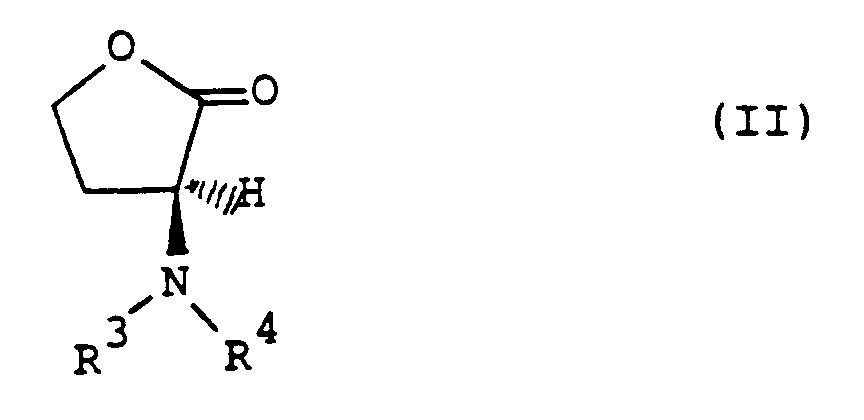
- a) ein optisch aktives S-Homoserinlacton der Formel II,

R³, R⁴ und R⁵ wie in Formel I definiert sind, ausgenommen R⁵ = H, umsetzt und - b) die erhaltene Verbindung der Formel III mit einer Verbindung der Formel IV,
R¹(O)n - P(OR²)₂ (IV)
worin
R¹, R² und n wie in Formel I definiert sind, umsetzt und gewünschtenfalls zur Verbindung der Formel I, worin R⁵ = H ist, hydrolysiert. - In den genannten Formeln und im folgenden bedeutet Aryl, auch in den zusammengesetzten Resten wie Arylcarbonyl, vorzugsweise Phenyl; substituiertes Aryl oder Benzyl ist vorzugsweise Phenyl bzw. Benzyl, die durch ein oder mehrere Reste aus der Gruppe (C₁-C₄)-Alkyl, (C₁-C₄)-Alkoxy, Halogen, Nitro, (C₁-C₄)-Alkoxycarbonyl, Amino, (C₁-C₄)-Alkylamino und (C₁-C₄)-Dialkylamino, insbesondere aus der Gruppe Methyl, Ethyl, Methoxy, Ethoxy und Halogen, substituiert sind. Halogen bedeutet in den Formeln Fluor, Chlor, Brom oder Jod.
- Alkyl, Alkenyl und Alkinyl, welche Heteroatome in der Kette enthalten können, sind beispielsweise solche Reste mit Sauerstoffatomen oder Schwefelatomen als Heteroatomen, vorzugsweise Polyoxalkylenreste mit 2 bis 5 Alkylenoxyeinheiten.
- Heterocyclus ist beispielsweise ein gegebenenfalls substituierter, aromatischer ungesättigter oder gesättigter Ring mit 3 bis 7 Ringatomen, der 1 bis 4 Heteroatome aus der Gruppe O, S und N enthalten kann. Haloalkyl ist Alkyl, welches durch ein oder mehrere Halogenatome substituiert ist.
- Gegenstand der Erfindung sind auch die Verfahren, die den einzelnen Verfahrensstufen a) und b) des obengenannten Gesamtverfahrens entsprechen.
- Das erfindungsgemäße Gesamtverfahren stellt somit eine Lactonringöffnung von optisch aktiven L-Homoserinlactonen der Formel II, welche aus L-Asparaginsäure leicht zugänglich sind, mit gasförmigem Chlorwasserstoff und eine anschließende Umsetzung der so erhaltenen Chloride der Formel III mit Verbindungen der Formel IV zu den phosphorhaltigen L-Aminosäuren der Formel I dar.
- Die Ausgangsstoffe der Formel II sind nach literaturbekannten Methoden aus Homoserinlactonen der Formel V

leicht zugänglich (Houben-Weyl, Band 15/1, 46-305). - Weiterhin sind Ausgangsstoffe der Formel II, worin ein Rest der Reste R³ und R⁴ Wasserstoff bedeutet, auf einfache Weise aus Asparaginsäurederivaten der Formel VI,

worin R die für R³ oder R⁴ genannte Bedeutung hat, leicht zugänglich (siehe P4103821.5). - Bevorzugt sind erfindungsgemäße Verfahren, in denen R¹ und R² unabhängig voneinander (C₁-C₄)-Alkyl, (C₁-C₄)-Haloalkyl, Benzyl, 1- oder 2-Phenylethyl, Cyclopentyl oder Cyclohexyl, insbesondere Methyl oder Ethyl, R³ und R⁴ unabhängig voneinander (C₁-C₄)-Alkyl, (C₁-C₄)-Alkylcarbonyl, Phenacetyl, (C₁-C₄)-Alkoxycarbonyl, (C₁-C₄)-Alkylsulfonyl, Benzyl, Benzyloxycarbonyl, Phenoxycarbonyl, Benzolsulfonyl, wobei die 4 letztgenannten Reste im Phenylring unsubstituiert oder durch Reste aus der Gruppe (C₁-C₃)-Alkyl, (C₁-C₂)-Alkoxy und Halogen substituiert sind, R⁵ H, (C₁-C₄)-Alkyl, (C₁-C₄)-Haloalkyl, Phenyl-(C₁-C₄)-alkyl, Cyclopentyl oder Cyclohexyl und n 0 oder 1 bedeuten.
- Das erfindungsgemäße Verfahren wird in Verfahrensstufe a) z. B. so durchgeführt, daß man die Lactone der Formel II in einem geeigneten aliphatischen, cycloaliphatischen, araliphatischen oder heterocyclisch substituierten aliphatischen Alkohol, wie z. B. Methanol, Ethanol, n-Propanol, i-Propanol und Cyclohexanol, bei Temperaturen von 0°C bis Rückflußtemperatur, vorzugsweise 40 bis 70°C, mit Chlorwasserstoffgas behandelt.
- Die Herstellung einiger γ-Halogen-α-amino-buttersäurederivate durch Ringöffnungsreaktionen von Homoserinlactonen mit gasförmigen Halogenwasserstoffen ist bekannt. Die bekannten Synthesen sind aber mit verschiedenen Nachteilen behaftet.
- Bei den meisten Verfahren wird zur Lactonringöffnung Bromwasserstoff eingesetzt (Chemistry Lett., 1973, 5; Tetrahedron Lett., 1986, 27, 5935). Diese Methode erfordert recht stabile Schutzgruppen an der Aminogruppe. Viele Schutzgruppen halten diesen sauren Bedingungen nicht stand, was schließlich zu Ausbeuteverlusten und Produktgemischen führt (Tetrahedron 44(1988), 637). Auch bei Ringöffnungsreaktionen mit Chlorwasserstoff werden bestimmte Reste am Stickstoff abgespalten (J. Chem. Soc. 1958, 1629). Da es sich hierbei zum Teil auch um Schutzgruppen handelt, die erst später unter bestimmten Bedingungen gezielt entfernt werden sollen, sind solche Abspaltungsreaktionen nicht wünschenswert.
- Überraschenderweise gelingt es nach dem erfindungsgemäßen Verfahren, mit Hilfe des preiswerteren Chlorwasserstoffs anstelle von Bromwasserstoff die gewünschte Ringöffnung ohne Racemisierung und ohne Abspaltung von Schutzgruppen durchzuführen. Die praktisch racemisierungsfreie Ringöffnung der Verbindungen der Formel II zu den Verbindungen der Formel III ist umso Überraschender, weil bei Verwendung von Jodwasserstoff teilweise Racemisierung stattfindet (siehe Tetrahedron Lett. 1984, 2231).
- Die optisch aktiven Verbindungen der Formel III sind nicht nur als Zwischenprodukte für das erfindungsgemäße Verfahren einsetzbar, sondern stellen wertvolle Synthone zur Herstellung von optisch aktiven und biologisch wirksamen Verbindungen dar. So können sie zum Beispiel in die optisch aktiven Azetidin-2-carbonsäurederivate überführt werden (JP-49014457). Weiterhin können sie bei der Synthese von Nocardicin, einem β-Lactam-antibiotikum, Verwendung finden (J.Am.Chem.Soc. 112(1990), 760-770). Man kann sie auch zur Herstellung von wichtigen Aminosäuren, wie z. B. L-Canalin (Liebigs Ann.Chem. 1986, 287-291 und dort zit. Lit.) oder schwefelhaltigen Aminosäuren (DE-A-2627069) einsetzen. Die erfindungsgemäß in Verfahrensstufe a) erhaltenen Verbindungen der Formel III können selektiv nach üblichen Methoden an der Estergruppe zur entsprechenden Carbonsäure hydrolysiert und weiter zu Salzen mit Basen umgesetzt werden. Außerdem können die Ester und Carbonsäuren der Formel III Säureadditionssalze bilden. Die Verbindungen der genannten Formel III und ihre Salze sind deshalb auch Gegenstand dieser Erfindung.
- Die erfindungsgemäß erhaltenen Chloride der Formel III werden ohne Zwischenisolierung oder vorzugsweise nach Aufarbeitung und gegebenenfalls Reinigung in Verfahrensstufe b) mit Phosphorverbindungen der Formel IV beispielsweise in Substanz oder in organischen Lösungsmitteln, wie aliphatischen oder aromatischen, gegebenenfalls halogenierten Kohlenwasserstoffen, z. B. Benzol oder Toluol, bei Temperaturen von vorzugsweise 50°C - 150°C, vorzugsweise in Substanz (ohne Lösungsmittel) bei 110 bis 140°C zu den Verbindungen der Formel I umgesetzt. Auf diese Weise werden vorzugsweise Verbindungen der Formel I erhalten, worin R¹, R², R³ und/oder R⁴ und R⁵ ungleich Wasserstoff sind.
- Arbuzovreaktionen von Phosphorverbindungen der Formel III mit Halogeniden, die sich strukturell von denen der Formel II unterscheiden, sind bekannt (Chem. Rev. 81 (1981) 415-430 und dort zit. Lit.). Weiterhin sind Arbuzovreaktionen mit racemischen 4-Brom-2-phthalimido-buttersäureethylester bekannt (Tetrahedron Lett., 1986, 5935).
- Überraschend an der erfindungsgemäßen Verfahrensstufe b) ist aber beispielsweise, daß man die Arbuzovreaktion mit den Chloriden der Formel III durchführen kann, obwohl Alkylchloride weitaus weniger reaktiv sind als die entsprechenden Bromide (Chem. Rev. 81 (1981) 415-430 und dort zit. Lit.), und daß bei dieser Arbuzovreaktion trotz der relativ hohen Reaktionstemperaturen keine Racemisierungen stattfinden.
- Im Anschluß an die Umsetzung der Verbindungen der Formeln II und III können die erhaltenen Verbindungen der Formel I zu anderen Verbindungen der Formel I oder deren Salzen derivatisiert werden, beispielsweise durch Hydrolyse aller oder eines Teils der hydrolytisch abspaltbaren Reste und gegebenenfalls Salzbildung mit Basen oder Säuren. Ein günstiges Hydrolyseverfahren ist beispielsweise die saure Hydrolyse von Verbindungen der Formel I, worin R¹, R² und R⁵ sowie mindestens ein Rest der beiden Reste R³ und R⁴ ungleich Wasserstoff sind, zu Verbindungen der Formel I, worin R¹ die genannte Bedeutung hat und R² bis R⁵ jeweils Wasserstoff sind. Zur Hydrolyse werden dabei die zunächst erhaltenen Verbindungen der Formel I vorzugsweise in wässeriger Salzsäure (bevorzugt 3N-12N HCl) gelöst und mehrere Stunden auf 90°C bis 130°C erhitzt. Die saure, wäßrige Lösung wird dann mit einem mit Wasser nicht oder kaum mischbaren organischen Lösungsmittel, wie z. B. Toluol, Xylol, Dichlormethan oder Methylisobutylketon, extrahiert, um die Folgeprodukte der Abspaltung zu entfernen. Die wässrige Losung wird vollständig eingeengt und, wenn nötig, das Rohprodukt nach bekannten Methoden gereinigt. Falls erwünscht, können die so erhaltenen Hydrochloride der Verbindungen der allgemeinen Formel I auf üblichem Wege in die freien Aminosäuren überführt werden.
- Zur Überführung der Verbindungen der Formel I in ihre Salze werden solche mit einem aciden Wasserstoffatom beispielsweise mit Basen, vorzugsweise Alkalimetall- oder Erdalkalimetallhydroxiden, -carbonaten oder -hydrogencarbonaten oder organischen Aminen, zu im Pflanzenschutz einsetzbaren Salzen umgesetzt.
- Außerdem können aufgrund der enthaltenen Aminogruppe Säureadditionssalze, beispielsweise mit Mineralsäuren wie Schwefelsäure, Salzsäure, Bromwasserstoffsäure, Jodwasserstoffsäure, Fluorwasserstoffsäure und Phosphorsäure, oder mit organischen Säuren, wie Ameisensäure, Essigsäure, Milchsäure und Citronensäure, hergestellt werden.
- Das erfindungsgemäße Verfahren liefert die L-Isomeren der Formel I in hohen optischen Ausbeuten von über 90 % ee, was einem Anteil von mehr als 95 % des L-Isomeren entspricht. Die Konfiguration der L-Formen (Fischer-Projektion) entspricht in der R,S-Nomenklatur (Cahn, Ingold und Prelog) der S-Konfiguration.
- Das erfindungsgemäße Verfahren ermöglicht somit insbesondere die Herstellung optisch aktiver γ-Chlor-α-aminobuttersäurederivate der Formel III aus einfach zugänglichen und optisch aktiven Homoserinlactonen der Formel II und die Herstellung optisch aktiver phosphorhaltiger L-Aminosäuren der Formel I aus den leicht zugänglichen Chlorverbindungen der Formel III.
- Da die Homoserinlactone der Formel II aus leicht zugänglichen L-Asparaginsäurederivaten hergestellt werden können, bedeutet das erfindungsgemäße Verfahren eine günstige Herstellung von phosphorhaltigen L-Aminosäuren der Formel I unter Nutzung des Naturprodukts L-Asparaginsäure als Chiral-Pool-Substanz.
-

- 7,5 g (29,4 mmol) N-p-Toluolsulfonyl-L-homoserinlacton (= S-Form), hergestellt nach P 4103821.5 werden in 60 ml Ethanol gelöst und auf 60°C - 70°C erwärmt. Danach leitet man 4 h lang Chlorwasserstoffgas ein und läßt die Reaktionslösung anschließend 12 h bei Raumtemperatur stehen. Danach engt man bis zur Trockne ein und reinigt das Rohprodukt säulenchromatographisch an Kieselgel (Laufmittel: Heptan/Essigsäureethylester = 3/7); man erhält 8 g (89 % d. Th.) Produkt als farbloses Öl, das nach längerem Stehen zu kristallisieren beginnt. Charakteristische Daten des Produkts sind:
Spezifische Drehung: [α]D²⁵ = 10,4 (c=1, CH₃OH);
¹H-NMR (100 MHz): δ [ppm] = 7,75 und 7,26(2m, 4H, Aromaten-H in -C₆H₄-CH₃); 5,35 (bd, 1H, NH); 4,10 (m 1H CH-N); 4,00 (q, 2H, COOCH₂-CH₃); 3,65 (t, 2H, -CH₂Cl); 2,40 (s, 3H, -C₆H₄-CH₃); 2,15 (m, 2H, -CH₂-CH₂Cl); 1,10 (t, 3H, -COOCH₂CH₃). -

- 4 g (25 mmol) N-Methoxycarbonyl-L-homoserinlacton (=S-Form), hergestellt nach P 4103821.5 werden in 50 ml Ethanol gelöst und auf 60°C erwärmt. Danach leitet man 6 h lang Chlorwasserstoffgas ein. Danach engt man bis zur Trockne ein und reinigt das Rohprodukt säulenchromatographisch an Kieselgel (Laufmittel: Heptan/Essigsäureethylester = 1/1); man erhält 4,0 g (72 % d. Th.) Produkt als farbloses Öl mit den folgenden charakteristischen physikalischen Daten:
Drehwert: [α]
¹H-NMR (100MHz): δ [ppm] = 5,40 (bd, 1H, NH); 4,49 (m, 1H, CH-N); 4,22 (q, 2H, -COOCH₂CH₃); 3,70 (s, 3H, COOCH₃); 3,60 (t, 2H, -CH₂-CH₂Cl); 2,25 (m, 2H, -CH₂CH₂Cl); 1,30 (t, 3H, -COOCH₂CH₃). - In analoger Weise zu Beispielen 1 und 2 werden die in der Tabelle 1 aufgeführten Verbindungen erhalten.


-

- 5g (16,35 mmol) (S)-2-(p-Toluolsulfonyl-amino)-4-chlor-butansäureethylester und 9 g (66,13 mmol) Methanphosphonigsäurediethylester werden 15 h bei 140°C gerührt. Danach entfernt man den überschüssigen Methanphosphonigsäurediethylester am Hochvakuum. Das so erhaltene Rohprodukt Zeigt im ¹H-NMR keine weiteren organischen Verunreinigungen mehr und wird säulenchromatographisch an Kieselgel (Laufmittel: Methylenchlorid/Methanol = 95/5) weiter gereinigt; man erhält 4,1 g (65 %) Produkt als farbloses Öl mit folgenden physikalischen Daten:
[α]
¹H-NMR (100 MHz): δ [ppm] = 7,73 und 7,29 (2 bd, 4H, -C₆H₄); 5,68 (bd, 1H, NH); 4,00 (m 5H CH-N, COOCH₂CH₃, -POCH₂CH₂); 2,40 (s, 3H, -C₆H₄-CH₃); 1,90 (m, 4H, -CH₂-CH₂-); 1,45 (d, 3H, CH₃-P); 1,30 und 1,13 (2t, 6H, POCH₂CH₃, COOCH₂CH₃). -

- 2,6 g (11,6 mmol) (S)-2-(Methoxycarbonyl-amino)-4-chlor-butansäureethylester und 6,3 g (46,4 mmol) Methanphosphonigsäurediethylester werden 15 h bei 140°C gerührt. Danach entfernt man den überschüssigen Methanphosphonigsäurediethylester bei 90°C am Hochvakuum. Das so erhaltene Rohprodukt fällt als farbloses Öl an und zeigt im ¹H-NMR keine weiteren Verunreinigungen mehr; Ausbeute: 2,8 g (82 %),
¹H-NMR (100 MHz) : δ [ppm] = 5,75 (bd, 1H, NH), 4,40 (m, 1H,[CH-N); 4,19 und 4,00 (2q, 4H, -COOCH₂CH₃, -POCH₂CH₃); 3,67 (s, 3H, COOCH₃); 1,90 (m, 4H, - CH₂CH₂-); 1,44 (d, 3H, CH₃P); 1,29 und 1,26 (2t, 6H, POCH₂CH₃, COOCH₂CH₃). -

- 2,8 g (9,5 mmol) (S)-2-Methoxycarbonylamino-4-ethoxy(methyl)phosphinylbutansäureethylester werden in 50 ml 6N HCl 12 h am Rückfluß gekocht. Danach wird die wässrige Lösung mit Dichlormethan extrahiert, mit wenig Aktivkohle versetzt, kurz aufgekocht und nach Abfiltrieren der Aktivkohle bis zur Trockne eingeengt. Der Rückstand wird mehrmals in Toluol/Aceton aufgenommen und eingeengt. Man erhält 1,5 g (73 % d. Th.) Produkt als farblosen Feststoff; ¹H-NMR (100 MHz, D₂O): δ [ppm] = 4,16 (t, 1H, CH-N), 2,10 (m, 4H, -CH₂CH₂-); 1,55 (d, 3H, CH₃-P).
- Der Enantiomerenüberschuß, der mit Hilfe einer HPLC Methode [J. Chromatogr. 368, 413 (1986)] bestimmt wurde, beträgt 94,2 % ee (ee = enantiomeric excess).
Claims (17)
- Verfahren zur Herstellung einer Verbindung der Formel I oder deren Salze,

R¹ und R² unabhängig voneinander Wasserstoff, (C₁-C₆)-Alkyl, das unsubstituiert ist oder durch Halogen oder Aryl ein- oder mehrfach substituiert ist, oder (C₃-C₁₀)-Cycloalkyl,
R³ und R⁴ unabhängig voneinander Wasserstoff, (C₁-C₆)-Alkyl, (C₂-C₆)-Alkenyl, (C₂-C₆)-Alkinyl, wobei die drei letztgenannten Reste geradkettig oder verzweigt sein können und Heteroatome in der Kette besitzen können, (C₁-C₆)-Alkylcarbonyl, Aryl-(C₁-C₄)-alkylcarbonyl, (C₁-C₆)-Alkoxycarbonyl, (C₁-C₆)-Alkylsulfonyl, Benzyl, Benzyloxycarbonyl, Aryloxycarbonyl oder Arylsulfonyl, wobei die vier letztgenannten Reste im Arylteil unsubstituiert oder substituiert sind,
R⁵ Wasserstoff oder (C₁-C₄)-Alkyl, das geradkettig oder verzweigt ist und unsubstituiert oder durch Halogen, Aryl oder einen Heterocyclus substituiert ist, oder (C₃-C₇)-Cycloalkyl und
n die Zahl 0 oder 1 bedeuten,
dadurch gekennzeichnet, daß mana) ein optisch aktives S-Homoserinlacton der Formel II,
R³ und R⁴ wie in Formel I definiert sind, in Gegenwart eines Alkohols der Formel R⁵-OH mit Chlorwasserstoff zu einer Verbindung der Formel III,
R³, R⁴ und R⁵ wie in Formel I definiert sind, ausgenommen R⁵ = H, umsetzt undb) die erhaltene Verbindung der Formel III mit einer Verbindung der Formel IV,
R¹(O)n - P(OR²)₂ (IV)
worin
R¹, R² und n wie in Formel I definiert sind, umsetzt und gewünschtenfalls zur Verbindung der Formel I, worin R⁵ = H ist, hydrolysiert. - Verfahren nach Anspruch 1, dadurch gekennzeichnet, daß
R¹ und R² unabhängig voneinander (C₁-C₄)Alkyl, (C₁-C₄)-Haloalkyl, Benzyl, 1- oder 2-Phenylethyl, Cyclopentyl oder Cyclohexyl,
R³ und R⁴ unabhängig voneinander (C₁-C₄)-Alkyl, (C₁-C₄)-Alkylcarbonyl, Phenacetyl, (C₁-C₄)-Alkoxycarbonyl, (C₁-C₄)-Alkylsulfonyl, Benzyl, Benzyloxycarbonyl, Phenoxycarbonyl, Benzolsulfonyl, wobei die 4 letztgenannten Reste im Phenylring unsubstituiert oder durch Reste aus der Gruppe (C₁-C₂)-Alkoxy und Halogen substituiert sind,
R⁵ H, (C₁-C₄)-Alkyl, (C₁-C₄)-Haloalkyl, Phenyl-(C₁-C₄)alkyl, Cyclopentyl oder Cyclohexyl und
n 0 oder 1 bedeuten. - Verfahren nach Anspruch 1 oder 2, dadurch gekennzeichnet, daß man in Verfahrensstufe a) die Umsetzung bei 0°C bis zur Rückflußtemperatur durchführt.
- Verfahren nach Anspruch 3, dadurch gekennzeichnet, daß die Temperatur 40 bis 70°C beträgt.
- Verfahren nach einem oder mehreren der Ansprüche 1 bis 4, dadurch gekennzeichnet, daß der Alkohol R⁵-OH in Verfahrensstufe a) Methanol, Ethanol, n-Propanol, i-Propanol oder Cyclohexanol ist.
- Verfahren nach einem oder mehreren der Ansprüche 1 bis 5, dadurch gekennzeichnet, daß die Umsetzung in Verfahrensstufe b) in Substanz bei 50 bis 150°C durchgeführt wird.
- Verbindungen der Formel III und ihre Salze,

R³, R⁴ und R⁵ die in Formel I nach Anspruch 1 oder 2 definierte Bedeutung haben. - Verfahren zur Herstellung von Verbindungen der Formel III nach Anspruch 7, dadurch gekennzeichnet, daß man eine Verbindung der Formel II,

R³ und R⁴ wie in Formel III definiert sind, in Gegenwart eines Alkohols der Formel R⁵-OH, worin R⁵ wie in Formel III definiert ist, mit Chlorwasserstoff umsetzt und gewünschtenfalls zur Verbindung der Formel III, worin R⁵ = H ist, hydrolysiert. - Verfahren nach Anspruch 8, dadurch gekennzeichnet, daß man die Umsetzung bei 0°C bis zur Rückflußtemperatur durchführt.
- Verfahren nach Anspruch 9, dadurch gekennzeichnet, daß die Temperatur 40 bis 70°C beträgt.
- Verfahren nach einem oder mehreren der Ansprüche 8 bis 10, dadurch gekennzeichnet, daß der Alkohol R⁵-OH Methanol, Ethanol, n-Propanol, i-Propanol oder Cyclohexanol ist.
- Verfahren zur Herstellung einer Verbindung der Formel I oder deren Salze, wie sie in Anspruch 1 oder 2 definiert sind, dadurch gekennzeichnet, daß man eine Verbindung der Formel III,

R³, R⁴ und R⁵ wie in Formel I, außer R⁵ = H, definiert sind, mit einer Verbindung der Formel IV,
R¹(O)n-P(OR²)₂ (IV)
worin R¹ und R² wie in Formel I definiert sind, umsetzt und gewünschtenfalls zur Verbindungen der Formel I, worin R⁵ = H ist, hydrolysiert. - Verfahren nach Anspruch 12, dadurch gekennzeichnet, daß die Umsetzung bei 50 bis 150°C durchgeführt wird.
- Verfahren nach Anspruch 13 oder 14, dadurch gekennzeichnet, daß die Umsetzung in Substanz durchgeführt wird.
- Verfahren nach Anspruch 14, dadurch gekennzeichnet, daß die Umsetzung bei 110 bis 140°C durchgeführt wird.
- Verfahren nach einem oder mehreren der Ansprüche 12 bis 15, dadurch gekennzeichnet, daß die erhaltene Verbindung der Formel I mit 3N bis 12N wäßriger Salzsäure bei 90 bis 130°C zur Verbindung der Formel I, worin R⁵ = H ist, hydrolysiert wird.
- Verwendung von Verbindungen der Formel III nach Anspruch 7 zur Herstellung von optisch aktiven Verbindungen der Formel I oder deren Salzen, wie sie in Formel I nach Anspruch 1 oder 2 definiert sind.
Applications Claiming Priority (2)
| Application Number | Priority Date | Filing Date | Title |
|---|---|---|---|
| DE4111188 | 1991-04-06 | ||
| DE4111188 | 1991-04-06 |
Publications (2)
| Publication Number | Publication Date |
|---|---|
| EP0508296A1 true EP0508296A1 (de) | 1992-10-14 |
| EP0508296B1 EP0508296B1 (de) | 1995-11-22 |
Family
ID=6428975
Family Applications (1)
| Application Number | Title | Priority Date | Filing Date |
|---|---|---|---|
| EP92105615A Expired - Lifetime EP0508296B1 (de) | 1991-04-06 | 1992-04-01 | Verfahren zur Herstellung phosphorhaltiger L-Aminosäuren, deren Derivate und Zwischenprodukte für dieses Verfahren |
Country Status (12)
| Country | Link |
|---|---|
| US (1) | US5442088A (de) |
| EP (1) | EP0508296B1 (de) |
| JP (2) | JP3236337B2 (de) |
| KR (1) | KR920019807A (de) |
| AT (1) | ATE130615T1 (de) |
| AU (1) | AU646938B2 (de) |
| CA (1) | CA2065128C (de) |
| DE (1) | DE59204389D1 (de) |
| HU (1) | HU213632B (de) |
| IL (1) | IL101488A (de) |
| TW (1) | TW353663B (de) |
| ZA (1) | ZA922456B (de) |
Cited By (8)
| Publication number | Priority date | Publication date | Assignee | Title |
|---|---|---|---|---|
| US5767309A (en) * | 1994-03-04 | 1998-06-16 | Hoechst Schering Agrevo Gmbh | Processes for preparing L!- or D!-homoalanin-4-yl-(methyl)phosphinic acid and salts thereof by racemate resolution |
| CN109232644A (zh) * | 2018-09-30 | 2019-01-18 | 武汉工程大学 | 草铵膦的合成方法 |
| EP4151643A1 (de) | 2021-09-16 | 2023-03-22 | Evonik Operations GmbH | Verbessertes verfahren zur herstellung von phosphoestern von glufosinat-vorläufern |
| WO2024175643A1 (en) | 2023-02-23 | 2024-08-29 | Basf Se | A process for preparing l-glufosinate from cyanhydrine or cyanhydrine derivatives |
| US12146167B2 (en) | 2021-04-01 | 2024-11-19 | Evonik Operations Gmbh | Enzymatic method for producing L-glufosinate and its phosphoesters |
| WO2025025324A1 (zh) * | 2023-08-01 | 2025-02-06 | 南京合谷生命生物科技有限公司 | 一种合成l-草铵膦或其盐的方法 |
| US12398410B2 (en) | 2022-03-14 | 2025-08-26 | Evonik Operations Gmbh | Enzymatic method for the production of L-glufosinate P-esters |
| US12435349B2 (en) | 2021-06-16 | 2025-10-07 | Evonik Operations Gmbh | Enzymatic method for the production of l-glufosinate p-alkyl esters |
Families Citing this family (28)
| Publication number | Priority date | Publication date | Assignee | Title |
|---|---|---|---|---|
| US6528499B1 (en) * | 2000-04-27 | 2003-03-04 | Georgetown University | Ligands for metabotropic glutamate receptors and inhibitors of NAALADase |
| CN100375748C (zh) * | 2005-04-26 | 2008-03-19 | 华中师范大学 | 具有杀菌除草活性的取代苯氧乙酰氧基芳杂环基烃基次膦酸酯及其制备 |
| CA2669127C (en) | 2006-11-08 | 2016-09-13 | Molecular Insight Pharmaceuticals, Inc. | Heterodimers of glutamic acid |
| US8562945B2 (en) | 2008-01-09 | 2013-10-22 | Molecular Insight Pharmaceuticals, Inc. | Technetium- and rhenium-bis(heteroaryl) complexes and methods of use thereof |
| BR112012000209B8 (pt) | 2009-06-15 | 2021-07-27 | Molecular Insight Pharm Inc | heterodímeros de ácido glutâmico e seus processos de preparação |
| EP2800471A4 (de) | 2012-01-06 | 2015-11-04 | Molecular Insight Pharm Inc | Metallkomplexe von poly(carboxyl)aminhaltigen liganden mit einer affinität für carboanhydrase ix |
| US9687876B2 (en) | 2012-01-30 | 2017-06-27 | Hemlock Semiconductor Corporation | Method of repairing and/or protecting a surface in a reactor |
| CA2897437C (en) | 2013-01-14 | 2021-12-14 | Molecular Insight Pharmaceuticals, Inc. | Triazine based radiopharmaceuticals and radioimaging agents |
| CN106045947A (zh) * | 2016-06-23 | 2016-10-26 | 李建中 | 合成L‑草铵膦中间体(S)‑3‑氨基‑γ‑丁内酯盐酸盐的方法及应用 |
| CN106083922B (zh) * | 2016-08-23 | 2018-08-31 | 山东省农药科学研究院 | 一种精草铵膦的制备方法 |
| CN108164560B (zh) * | 2016-12-07 | 2019-12-13 | 中国科学院成都有机化学有限公司 | 草铵膦的制备方法 |
| WO2020046403A1 (en) * | 2018-08-31 | 2020-03-05 | Muhammed Majeed | Novel process for the preparation of enantiopure 3- enantiopure 3-amino tetrahydrofuran and its salts |
| CN109369418A (zh) * | 2018-10-10 | 2019-02-22 | 河南师范大学 | 一种节能环保型烷基苯胺类液体抗氧剂的连续合成工艺及合成装置 |
| AU2019420442B2 (en) * | 2019-01-11 | 2022-06-02 | Cj Cheiljedang Corporation | L-glufosinate intermediate and L-glufosinate preparation method |
| CN110386882A (zh) * | 2019-08-12 | 2019-10-29 | 利尔化学股份有限公司 | (s)-4-氯-2-((乙氧基羰基)氨基)丁酸乙酯的制备方法 |
| CN114555612A (zh) * | 2020-01-13 | 2022-05-27 | 利尔化学股份有限公司 | 一种制备l-草铵膦中间体的方法 |
| WO2021143713A1 (zh) * | 2020-01-13 | 2021-07-22 | 利尔化学股份有限公司 | 制备l-草铵膦中间体的方法 |
| AU2021209728B2 (en) * | 2020-01-20 | 2022-08-18 | Guangan Lier Chemical Co., Ltd. | Preparation method for glufosinate ammonium |
| CN113248537B (zh) * | 2020-02-11 | 2023-06-06 | 利尔化学股份有限公司 | 草铵膦的制备方法 |
| CA3223166A1 (en) * | 2021-06-15 | 2022-12-22 | Upl Limited | One pot process for preparation of a chiral amino acid |
| WO2022264168A1 (en) * | 2021-06-17 | 2022-12-22 | Chandrasekhar Dayal Mudaliar | A process for preparation of an intermediate of l-glufosinate |
| AU2022314007B2 (en) * | 2021-07-20 | 2023-09-14 | Lier Chemical Co., Ltd. | Preparation Method for Glufosinate |
| AR126485A1 (es) * | 2021-07-20 | 2023-10-11 | Lier Chemical Co Ltd | Proceso para preparar glufosinato o análogos del mismo |
| AR127219A1 (es) * | 2021-09-30 | 2023-12-27 | Lier Chemical Co Ltd | Métodos para preparar clorhidrato de ácido (s)-4-cloro-2-aminobutírico y (s)-4-cloro-2-aminobutirato |
| CN115093339B (zh) * | 2022-07-20 | 2024-12-27 | 永农生物科学有限公司 | 一种l-草铵膦中间体的合成方法 |
| EP4371992B1 (de) | 2022-11-17 | 2025-07-02 | YongNong BioSciences Co., Ltd | Verfahren zur herstellung von glufosinat |
| CN116478207B (zh) * | 2023-04-12 | 2026-05-08 | 宁夏永农生物科学有限公司 | 一种草铵膦的制备方法 |
| CN118165033A (zh) * | 2024-03-14 | 2024-06-11 | 三峡大学 | 一种制备高纯度精精草铵膦的方法 |
Citations (1)
| Publication number | Priority date | Publication date | Assignee | Title |
|---|---|---|---|---|
| DE2856260A1 (de) * | 1977-12-28 | 1979-07-05 | Meiji Seika Kaisha | Herbicide |
Family Cites Families (7)
| Publication number | Priority date | Publication date | Assignee | Title |
|---|---|---|---|---|
| DE3048612C2 (de) * | 1980-12-23 | 1982-12-02 | Hoechst Ag, 6000 Frankfurt | "Verfahren zur enzymatischen Trennung von L-2-Ami no-4-methylphosphinobuttersäure" |
| JPS59219297A (ja) * | 1983-05-27 | 1984-12-10 | Meiji Seika Kaisha Ltd | 光学活性な〔(3−アミノ−3−カルボキシ)プロピル−1〕−ホスフイン酸誘導体の製造法 |
| DE3542645A1 (de) * | 1985-12-03 | 1987-06-04 | Hoechst Ag | Verfahren zur herstellung von l-homoalanin-4-yl(methyl)-phosphinsaeure sowie ihrer alkylester |
| DE3609818A1 (de) * | 1986-03-22 | 1987-09-24 | Hoechst Ag | Verfahren zur herstellung von l-phosphinothricin(derivaten) sowie ihrer alkylester |
| DE3752311D1 (de) * | 1986-06-04 | 2000-04-27 | Hoechst Schering Agrevo Gmbh | Verfahren zur Herstellung von L-tertiär-Leucin durch Transaminierung |
| AU599985B2 (en) * | 1986-06-09 | 1990-08-02 | Meiji Seika Kaisha Ltd. | New process for the production of L-2-amino-4- (hydroxymethyl-phosphinyl)-butyric acid |
| DE3817956A1 (de) * | 1988-05-27 | 1989-12-07 | Hoechst Ag | Verfahren zur herstellung phosphorhaltiger l-aminosaeuren sowie ihrer ester und n-derivate |
-
1992
- 1992-03-24 TW TW081102245A patent/TW353663B/zh active
- 1992-04-01 EP EP92105615A patent/EP0508296B1/de not_active Expired - Lifetime
- 1992-04-01 AT AT92105615T patent/ATE130615T1/de not_active IP Right Cessation
- 1992-04-01 DE DE59204389T patent/DE59204389D1/de not_active Expired - Fee Related
- 1992-04-03 HU HU9201143A patent/HU213632B/hu not_active IP Right Cessation
- 1992-04-03 ZA ZA922456A patent/ZA922456B/xx unknown
- 1992-04-03 IL IL10148892A patent/IL101488A/xx active IP Right Grant
- 1992-04-03 CA CA002065128A patent/CA2065128C/en not_active Expired - Fee Related
- 1992-04-03 JP JP08237292A patent/JP3236337B2/ja not_active Expired - Fee Related
- 1992-04-03 AU AU14021/92A patent/AU646938B2/en not_active Ceased
- 1992-04-04 KR KR1019920005659A patent/KR920019807A/ko not_active Ceased
-
1994
- 1994-07-07 US US08/271,775 patent/US5442088A/en not_active Expired - Lifetime
-
2001
- 2001-07-11 JP JP2001211250A patent/JP3860980B2/ja not_active Expired - Fee Related
Patent Citations (1)
| Publication number | Priority date | Publication date | Assignee | Title |
|---|---|---|---|---|
| DE2856260A1 (de) * | 1977-12-28 | 1979-07-05 | Meiji Seika Kaisha | Herbicide |
Non-Patent Citations (3)
| Title |
|---|
| BULLETIN OF THE CHEMICAL SOCIETY OF JAPAN, Band 40, Nr. 9, 1967, T. CHEN "Azetidines II. Some Functional Derivatives of Azetidines" Seiten 2398-2401 * |
| CHEMICAL ABSTRACTS (STN online), American Chemical Society, CA 80(21): 120 734r * |
| JOURNAL OF THE AMERICAN CHEMICAL SOCIETY 1990, Band 112, American Chemical Society G.M. SALITURU & C.A. TOWNSEND "Total Syntheses of (-)Nocardicins A-G: A Bio- genetic Approach" Seiten 760-770 * |
Cited By (9)
| Publication number | Priority date | Publication date | Assignee | Title |
|---|---|---|---|---|
| US5767309A (en) * | 1994-03-04 | 1998-06-16 | Hoechst Schering Agrevo Gmbh | Processes for preparing L!- or D!-homoalanin-4-yl-(methyl)phosphinic acid and salts thereof by racemate resolution |
| US5869668A (en) * | 1994-03-04 | 1999-02-09 | Hoechst Schering Agrevo Gmbh | Processes for preparing L!- or D!-homoalanin-4-yl-(methyl) phosphinic acid and salts thereof by racemate resolution |
| CN109232644A (zh) * | 2018-09-30 | 2019-01-18 | 武汉工程大学 | 草铵膦的合成方法 |
| US12146167B2 (en) | 2021-04-01 | 2024-11-19 | Evonik Operations Gmbh | Enzymatic method for producing L-glufosinate and its phosphoesters |
| US12435349B2 (en) | 2021-06-16 | 2025-10-07 | Evonik Operations Gmbh | Enzymatic method for the production of l-glufosinate p-alkyl esters |
| EP4151643A1 (de) | 2021-09-16 | 2023-03-22 | Evonik Operations GmbH | Verbessertes verfahren zur herstellung von phosphoestern von glufosinat-vorläufern |
| US12398410B2 (en) | 2022-03-14 | 2025-08-26 | Evonik Operations Gmbh | Enzymatic method for the production of L-glufosinate P-esters |
| WO2024175643A1 (en) | 2023-02-23 | 2024-08-29 | Basf Se | A process for preparing l-glufosinate from cyanhydrine or cyanhydrine derivatives |
| WO2025025324A1 (zh) * | 2023-08-01 | 2025-02-06 | 南京合谷生命生物科技有限公司 | 一种合成l-草铵膦或其盐的方法 |
Also Published As
| Publication number | Publication date |
|---|---|
| US5442088A (en) | 1995-08-15 |
| HU213632B (en) | 1997-08-28 |
| JP3236337B2 (ja) | 2001-12-10 |
| CA2065128C (en) | 2006-05-30 |
| JP3860980B2 (ja) | 2006-12-20 |
| HUT62301A (en) | 1993-04-28 |
| EP0508296B1 (de) | 1995-11-22 |
| AU1402192A (en) | 1992-10-08 |
| HU9201143D0 (en) | 1992-06-29 |
| ATE130615T1 (de) | 1995-12-15 |
| CA2065128A1 (en) | 1992-10-07 |
| ZA922456B (en) | 1992-11-25 |
| KR920019807A (ko) | 1992-11-20 |
| JP2002080436A (ja) | 2002-03-19 |
| IL101488A0 (en) | 1992-12-30 |
| IL101488A (en) | 2000-07-16 |
| TW353663B (en) | 1999-03-01 |
| JPH0665268A (ja) | 1994-03-08 |
| DE59204389D1 (de) | 1996-01-04 |
| AU646938B2 (en) | 1994-03-10 |
Similar Documents
| Publication | Publication Date | Title |
|---|---|---|
| EP0508296B1 (de) | Verfahren zur Herstellung phosphorhaltiger L-Aminosäuren, deren Derivate und Zwischenprodukte für dieses Verfahren | |
| EP0346658B1 (de) | Verfahren zur Herstellung phosphorhaltiger L-Aminosäuren sowie ihrer Ester und N-Derivate | |
| DE19515625C2 (de) | Verfahren zur Herstellung von enantiomerenreinen Tropasäureestern | |
| EP1876168B1 (de) | Verfahren zur Herstellung von beta-Amino-alpha-hydroxy-carbonsäureamiden | |
| EP0206993B1 (de) | Neue Sulfonsäureester | |
| EP0546566B1 (de) | Verfahren zur Herstellung von L-Phosphinothricin und seinen Derivaten | |
| DE69716452T2 (de) | Verfahren zur herstellung von beta-amino-alpha-hydroxycarbonsaeure-derivaten | |
| DE3312165A1 (de) | Verfahren zur herstellung von phosphinothricin | |
| EP0224880B1 (de) | Verfahren zur Herstellung von L-Homoalanin-4-yl(methyl)-phosphinsäure sowie ihrer Alkylester | |
| EP0063731A1 (de) | Verfahren zur Herstellung von optisch aktiven Carbonsäuren | |
| DE2735036C2 (de) | Verfahren zur Herstellung optisch aktiver, N-substituierter Pyrrolidine | |
| EP0788473A1 (de) | Neues hochenantioselektives verfahren zur herstellung von enantiomerenreinen cyclopentan- und -penten-beta-aminosäuren | |
| EP0382114A2 (de) | Phosphinesterhaltige N-Acyl-2-aminosäureamide, Verfahren zu ihrer Herstellung und N-Acyl-2-aminosäurenitrile als Vorprodukte | |
| EP0496369A1 (de) | Verfahren zur Herstellung der racemischen und optisch aktiven 1,2,3,4-Tetrahydroisochinolin-3-carbonsäure sowie deren Vorprodukte | |
| EP0511558B1 (de) | Racemat-Spaltverfahren und diastereomere Assoziate | |
| DE4341605C2 (de) | Verfahren zur Herstellung homochiraler Aminoalkohole | |
| DE102005012771A1 (de) | Verfahren zur Herstellung von 2-Azabicyclo(3.3.0)octan-3-carbonsäurederivaten | |
| EP0530506B1 (de) | Optisch aktive Omega-Halogen-2-amino-alkancarbonsäure-derivate, Verfahren zu ihrer Herstellung und ihre Verwendung zur Herstellung optisch aktiver phosphorhaltiger Alpha-Aminosäuren | |
| DE19505992C2 (de) | Verfahren zur Herstellung von racemischen Aminoalkoholen | |
| DE2546910C3 (de) | PhosphinylureidopeniciUansäurederivate und ihre Verwendung | |
| DE60024540T2 (de) | Synthese von alpha-amino-alpha',alpha'-dihaloketonen und verfahren zur herstellung von beta)-aminosäurederivaten durch verwendung derselben | |
| CH615438A5 (de) | ||
| DE602004006438T2 (de) | Verfahren zur herstellung von enantiomeren angereicherten aminosäuren | |
| CH646690A5 (de) | Carbamatderivate von hydroxyprolinen. | |
| EP0759425A2 (de) | Verfahren zur Herstellung von optisch aktiven 1-Aryl-alkylaminen |
Legal Events
| Date | Code | Title | Description |
|---|---|---|---|
| PUAI | Public reference made under article 153(3) epc to a published international application that has entered the european phase |
Free format text: ORIGINAL CODE: 0009012 |
|
| AK | Designated contracting states |
Kind code of ref document: A1 Designated state(s): AT BE CH DE DK ES FR GB IT LI NL PT |
|
| 17P | Request for examination filed |
Effective date: 19921217 |
|
| RAP1 | Party data changed (applicant data changed or rights of an application transferred) |
Owner name: HOECHST SCHERING AGREVO GMBH |
|
| 17Q | First examination report despatched |
Effective date: 19940711 |
|
| RBV | Designated contracting states (corrected) |
Designated state(s): AT BE CH DE FR GB IT LI NL |
|
| GRAA | (expected) grant |
Free format text: ORIGINAL CODE: 0009210 |
|
| AK | Designated contracting states |
Kind code of ref document: B1 Designated state(s): AT BE CH DE FR GB IT LI NL |
|
| REF | Corresponds to: |
Ref document number: 130615 Country of ref document: AT Date of ref document: 19951215 Kind code of ref document: T |
|
| REF | Corresponds to: |
Ref document number: 59204389 Country of ref document: DE Date of ref document: 19960104 |
|
| ITF | It: translation for a ep patent filed | ||
| GBT | Gb: translation of ep patent filed (gb section 77(6)(a)/1977) |
Effective date: 19960126 |
|
| ET | Fr: translation filed | ||
| PLBE | No opposition filed within time limit |
Free format text: ORIGINAL CODE: 0009261 |
|
| STAA | Information on the status of an ep patent application or granted ep patent |
Free format text: STATUS: NO OPPOSITION FILED WITHIN TIME LIMIT |
|
| 26N | No opposition filed | ||
| PGFP | Annual fee paid to national office [announced via postgrant information from national office to epo] |
Ref country code: AT Payment date: 19990415 Year of fee payment: 8 |
|
| PGFP | Annual fee paid to national office [announced via postgrant information from national office to epo] |
Ref country code: BE Payment date: 19990614 Year of fee payment: 8 |
|
| PG25 | Lapsed in a contracting state [announced via postgrant information from national office to epo] |
Ref country code: AT Free format text: LAPSE BECAUSE OF NON-PAYMENT OF DUE FEES Effective date: 20000401 |
|
| PG25 | Lapsed in a contracting state [announced via postgrant information from national office to epo] |
Ref country code: BE Free format text: LAPSE BECAUSE OF NON-PAYMENT OF DUE FEES Effective date: 20000430 |
|
| BERE | Be: lapsed |
Owner name: HOECHST SCHERING AGREVO G.M.B.H. Effective date: 20000430 |
|
| REG | Reference to a national code |
Ref country code: GB Ref legal event code: IF02 |
|
| REG | Reference to a national code |
Ref country code: GB Ref legal event code: 732E |
|
| REG | Reference to a national code |
Ref country code: CH Ref legal event code: PUE Owner name: BAYER CROPSCIENCE AG Free format text: HOECHST SCHERING AGREVO GMBH#GERICHTSTRASSE 27#D-13342 BERLIN (DE) -TRANSFER TO- BAYER CROPSCIENCE AG#ALFRED-NOBEL-STRASSE 50#40789 MONHEIM (DE) Ref country code: CH Ref legal event code: NV Representative=s name: PATENTANWAELTE SCHAAD, BALASS, MENZL & PARTNER AG |
|
| NLS | Nl: assignments of ep-patents |
Owner name: BAYER CROPSCIENCE AG Effective date: 20071213 |
|
| NLT1 | Nl: modifications of names registered in virtue of documents presented to the patent office pursuant to art. 16 a, paragraph 1 |
Owner name: AVENTIS CROPSCIENCE GMBH Owner name: BAYER CROPSCIENCE GMBH |
|
| PGFP | Annual fee paid to national office [announced via postgrant information from national office to epo] |
Ref country code: DE Payment date: 20080325 Year of fee payment: 17 Ref country code: CH Payment date: 20080415 Year of fee payment: 17 |
|
| PGFP | Annual fee paid to national office [announced via postgrant information from national office to epo] |
Ref country code: IT Payment date: 20080428 Year of fee payment: 17 |
|
| PGFP | Annual fee paid to national office [announced via postgrant information from national office to epo] |
Ref country code: NL Payment date: 20080403 Year of fee payment: 17 |
|
| PGFP | Annual fee paid to national office [announced via postgrant information from national office to epo] |
Ref country code: FR Payment date: 20080414 Year of fee payment: 17 |
|
| PGFP | Annual fee paid to national office [announced via postgrant information from national office to epo] |
Ref country code: GB Payment date: 20080402 Year of fee payment: 17 |
|
| REG | Reference to a national code |
Ref country code: FR Ref legal event code: CD Ref country code: FR Ref legal event code: TP Ref country code: FR Ref legal event code: CA |
|
| REG | Reference to a national code |
Ref country code: CH Ref legal event code: PL |
|
| GBPC | Gb: european patent ceased through non-payment of renewal fee |
Effective date: 20090401 |
|
| NLV4 | Nl: lapsed or anulled due to non-payment of the annual fee |
Effective date: 20091101 |
|
| REG | Reference to a national code |
Ref country code: FR Ref legal event code: ST Effective date: 20091231 |
|
| PG25 | Lapsed in a contracting state [announced via postgrant information from national office to epo] |
Ref country code: DE Free format text: LAPSE BECAUSE OF NON-PAYMENT OF DUE FEES Effective date: 20091103 Ref country code: CH Free format text: LAPSE BECAUSE OF NON-PAYMENT OF DUE FEES Effective date: 20090430 Ref country code: LI Free format text: LAPSE BECAUSE OF NON-PAYMENT OF DUE FEES Effective date: 20090430 |
|
| PG25 | Lapsed in a contracting state [announced via postgrant information from national office to epo] |
Ref country code: NL Free format text: LAPSE BECAUSE OF NON-PAYMENT OF DUE FEES Effective date: 20091101 |
|
| PG25 | Lapsed in a contracting state [announced via postgrant information from national office to epo] |
Ref country code: FR Free format text: LAPSE BECAUSE OF NON-PAYMENT OF DUE FEES Effective date: 20091222 Ref country code: GB Free format text: LAPSE BECAUSE OF NON-PAYMENT OF DUE FEES Effective date: 20090401 |
|
| PG25 | Lapsed in a contracting state [announced via postgrant information from national office to epo] |
Ref country code: IT Free format text: LAPSE BECAUSE OF NON-PAYMENT OF DUE FEES Effective date: 20090401 |