EP0346658B1 - Verfahren zur Herstellung phosphorhaltiger L-Aminosäuren sowie ihrer Ester und N-Derivate - Google Patents
Verfahren zur Herstellung phosphorhaltiger L-Aminosäuren sowie ihrer Ester und N-Derivate Download PDFInfo
- Publication number
- EP0346658B1 EP0346658B1 EP89109313A EP89109313A EP0346658B1 EP 0346658 B1 EP0346658 B1 EP 0346658B1 EP 89109313 A EP89109313 A EP 89109313A EP 89109313 A EP89109313 A EP 89109313A EP 0346658 B1 EP0346658 B1 EP 0346658B1
- Authority
- EP
- European Patent Office
- Prior art keywords
- ala
- denotes
- hydrogen
- formula
- alkyl
- Prior art date
- Legal status (The legal status is an assumption and is not a legal conclusion. Google has not performed a legal analysis and makes no representation as to the accuracy of the status listed.)
- Expired - Lifetime
Links
- OAICVXFJPJFONN-UHFFFAOYSA-N Phosphorus Chemical compound [P] OAICVXFJPJFONN-UHFFFAOYSA-N 0.000 title claims description 5
- 229910052698 phosphorus Inorganic materials 0.000 title claims description 5
- 239000011574 phosphorus Substances 0.000 title claims description 5
- 150000008575 L-amino acids Chemical class 0.000 title claims description 4
- 150000002148 esters Chemical class 0.000 title description 3
- 238000004519 manufacturing process Methods 0.000 title description 3
- 238000000034 method Methods 0.000 claims description 37
- 150000001875 compounds Chemical class 0.000 claims description 21
- UFHFLCQGNIYNRP-UHFFFAOYSA-N Hydrogen Chemical compound [H][H] UFHFLCQGNIYNRP-UHFFFAOYSA-N 0.000 claims description 20
- 239000001257 hydrogen Substances 0.000 claims description 17
- 229910052739 hydrogen Inorganic materials 0.000 claims description 17
- 125000004169 (C1-C6) alkyl group Chemical group 0.000 claims description 15
- 229910052736 halogen Inorganic materials 0.000 claims description 15
- 150000002367 halogens Chemical group 0.000 claims description 15
- 238000006243 chemical reaction Methods 0.000 claims description 11
- 125000004191 (C1-C6) alkoxy group Chemical group 0.000 claims description 9
- -1 alkali metal alkoxide Chemical class 0.000 claims description 8
- 125000000041 C6-C10 aryl group Chemical group 0.000 claims description 6
- 125000002887 hydroxy group Chemical group [H]O* 0.000 claims description 6
- 150000003839 salts Chemical class 0.000 claims description 6
- 125000002924 primary amino group Chemical group [H]N([H])* 0.000 claims description 5
- 150000002431 hydrogen Chemical group 0.000 claims description 4
- 125000006376 (C3-C10) cycloalkyl group Chemical group 0.000 claims description 3
- 150000008044 alkali metal hydroxides Chemical class 0.000 claims description 3
- 125000001797 benzyl group Chemical group [H]C1=C([H])C([H])=C(C([H])=C1[H])C([H])([H])* 0.000 claims description 3
- BYXHQQCXAJARLQ-ZLUOBGJFSA-N Ala-Ala-Ala Chemical compound C[C@H](N)C(=O)N[C@@H](C)C(=O)N[C@@H](C)C(O)=O BYXHQQCXAJARLQ-ZLUOBGJFSA-N 0.000 claims description 2
- DEFJQIDDEAULHB-IMJSIDKUSA-N L-alanyl-L-alanine Chemical compound C[C@H](N)C(=O)N[C@@H](C)C(O)=O DEFJQIDDEAULHB-IMJSIDKUSA-N 0.000 claims description 2
- 230000003197 catalytic effect Effects 0.000 claims description 2
- 150000001451 organic peroxides Chemical class 0.000 claims description 2
- 238000002360 preparation method Methods 0.000 claims description 2
- 229910052783 alkali metal Inorganic materials 0.000 claims 1
- 125000004435 hydrogen atom Chemical group [H]* 0.000 claims 1
- YMWUJEATGCHHMB-UHFFFAOYSA-N Dichloromethane Chemical compound ClCCl YMWUJEATGCHHMB-UHFFFAOYSA-N 0.000 description 27
- HEDRZPFGACZZDS-MICDWDOJSA-N Trichloro(2H)methane Chemical compound [2H]C(Cl)(Cl)Cl HEDRZPFGACZZDS-MICDWDOJSA-N 0.000 description 24
- OKKJLVBELUTLKV-UHFFFAOYSA-N Methanol Chemical compound OC OKKJLVBELUTLKV-UHFFFAOYSA-N 0.000 description 18
- VEXZGXHMUGYJMC-UHFFFAOYSA-N Hydrochloric acid Chemical compound Cl VEXZGXHMUGYJMC-UHFFFAOYSA-N 0.000 description 15
- HEDRZPFGACZZDS-UHFFFAOYSA-N Chloroform Chemical compound ClC(Cl)Cl HEDRZPFGACZZDS-UHFFFAOYSA-N 0.000 description 12
- OKTJSMMVPCPJKN-UHFFFAOYSA-N Carbon Chemical compound [C] OKTJSMMVPCPJKN-UHFFFAOYSA-N 0.000 description 10
- 238000005160 1H NMR spectroscopy Methods 0.000 description 9
- YXFVVABEGXRONW-UHFFFAOYSA-N Toluene Chemical compound CC1=CC=CC=C1 YXFVVABEGXRONW-UHFFFAOYSA-N 0.000 description 9
- 239000000203 mixture Substances 0.000 description 9
- PHRRNLKLDAHFKN-AJWVYOOVSA-N benzyl (4S)-4-[2-[methyl(2-methylpropoxy)phosphoryl]ethyl]-5-oxo-1,3-oxazolidine-3-carboxylate Chemical compound C(C1=CC=CC=C1)OC(=O)N1COC([C@@H]1CCP(=O)(C)OCC(C)C)=O PHRRNLKLDAHFKN-AJWVYOOVSA-N 0.000 description 8
- 238000005481 NMR spectroscopy Methods 0.000 description 7
- CTQNGGLPUBDAKN-UHFFFAOYSA-N O-Xylene Chemical compound CC1=CC=CC=C1C CTQNGGLPUBDAKN-UHFFFAOYSA-N 0.000 description 7
- 239000012230 colorless oil Substances 0.000 description 7
- 239000008096 xylene Substances 0.000 description 7
- QGZKDVFQNNGYKY-UHFFFAOYSA-N Ammonia Chemical compound N QGZKDVFQNNGYKY-UHFFFAOYSA-N 0.000 description 6
- HEMHJVSKTPXQMS-UHFFFAOYSA-M Sodium hydroxide Chemical compound [OH-].[Na+] HEMHJVSKTPXQMS-UHFFFAOYSA-M 0.000 description 6
- WYURNTSHIVDZCO-UHFFFAOYSA-N Tetrahydrofuran Chemical compound C1CCOC1 WYURNTSHIVDZCO-UHFFFAOYSA-N 0.000 description 6
- 239000012043 crude product Substances 0.000 description 6
- 239000000243 solution Substances 0.000 description 6
- 125000000999 tert-butyl group Chemical group [H]C([H])([H])C(*)(C([H])([H])[H])C([H])([H])[H] 0.000 description 6
- VYPSYNLAJGMNEJ-UHFFFAOYSA-N Silicium dioxide Chemical compound O=[Si]=O VYPSYNLAJGMNEJ-UHFFFAOYSA-N 0.000 description 5
- 239000012300 argon atmosphere Substances 0.000 description 5
- KDELOINPWYYJSZ-NSHDSACASA-N benzyl (4s)-4-ethenyl-5-oxo-1,3-oxazolidine-3-carboxylate Chemical compound C1OC(=O)[C@H](C=C)N1C(=O)OCC1=CC=CC=C1 KDELOINPWYYJSZ-NSHDSACASA-N 0.000 description 5
- 230000015572 biosynthetic process Effects 0.000 description 5
- 238000004587 chromatography analysis Methods 0.000 description 5
- 239000000741 silica gel Substances 0.000 description 5
- 229910002027 silica gel Inorganic materials 0.000 description 5
- 239000002904 solvent Substances 0.000 description 5
- XKRFYHLGVUSROY-UHFFFAOYSA-N Argon Chemical compound [Ar] XKRFYHLGVUSROY-UHFFFAOYSA-N 0.000 description 4
- CURLTUGMZLYLDI-UHFFFAOYSA-N Carbon dioxide Chemical compound O=C=O CURLTUGMZLYLDI-UHFFFAOYSA-N 0.000 description 4
- WHUUTDBJXJRKMK-VKHMYHEASA-N L-glutamic acid Chemical compound OC(=O)[C@@H](N)CCC(O)=O WHUUTDBJXJRKMK-VKHMYHEASA-N 0.000 description 4
- DKYHFSYUJKXKSU-KRWDZBQOSA-N benzyl (4S)-4-[2-di(propan-2-yloxy)phosphorylethyl]-5-oxo-1,3-oxazolidine-3-carboxylate Chemical compound C1OC(=O)[C@H](CCP(=O)(OC(C)C)OC(C)C)N1C(=O)OCC1=CC=CC=C1 DKYHFSYUJKXKSU-KRWDZBQOSA-N 0.000 description 4
- 239000003054 catalyst Substances 0.000 description 4
- 125000002496 methyl group Chemical group [H]C([H])([H])* 0.000 description 4
- 230000003287 optical effect Effects 0.000 description 4
- 238000003756 stirring Methods 0.000 description 4
- DDOQBQRIEWHWBT-VKHMYHEASA-N (2S)-2-amino-4-phosphonobutanoic acid Chemical compound OC(=O)[C@@H](N)CCP(O)(O)=O DDOQBQRIEWHWBT-VKHMYHEASA-N 0.000 description 3
- GCZPTWOGXDBENT-WCCKRBBISA-N (2s)-2-amino-4-[hydroxy(methyl)phosphoryl]butanoic acid;hydrochloride Chemical compound Cl.CP(O)(=O)CC[C@H](N)C(O)=O GCZPTWOGXDBENT-WCCKRBBISA-N 0.000 description 3
- WEVYAHXRMPXWCK-UHFFFAOYSA-N Acetonitrile Chemical compound CC#N WEVYAHXRMPXWCK-UHFFFAOYSA-N 0.000 description 3
- IJGRMHOSHXDMSA-UHFFFAOYSA-N Atomic nitrogen Chemical compound N#N IJGRMHOSHXDMSA-UHFFFAOYSA-N 0.000 description 3
- FXDNYOANAXWZHG-UHFFFAOYSA-N O-phospho-L-homoserine Natural products OC(=O)C(N)CCOP(O)(O)=O FXDNYOANAXWZHG-UHFFFAOYSA-N 0.000 description 3
- ZMANZCXQSJIPKH-UHFFFAOYSA-N Triethylamine Chemical compound CCN(CC)CC ZMANZCXQSJIPKH-UHFFFAOYSA-N 0.000 description 3
- 229940024606 amino acid Drugs 0.000 description 3
- 150000001413 amino acids Chemical class 0.000 description 3
- 239000007864 aqueous solution Substances 0.000 description 3
- 125000003118 aryl group Chemical group 0.000 description 3
- DHXSHRHKTIDZRP-ZDUSSCGKSA-N benzyl (4S)-4-(2-dimethylphosphorylethyl)-5-oxo-1,3-oxazolidine-3-carboxylate Chemical compound C1OC(=O)[C@H](CCP(C)(=O)C)N1C(=O)OCC1=CC=CC=C1 DHXSHRHKTIDZRP-ZDUSSCGKSA-N 0.000 description 3
- 125000001584 benzyloxycarbonyl group Chemical group C(=O)(OCC1=CC=CC=C1)* 0.000 description 3
- 239000007795 chemical reaction product Substances 0.000 description 3
- 239000000706 filtrate Substances 0.000 description 3
- 239000007789 gas Substances 0.000 description 3
- 230000002363 herbicidal effect Effects 0.000 description 3
- UYWQUFXKFGHYNT-UHFFFAOYSA-N phenylmethyl ester of formic acid Natural products O=COCC1=CC=CC=C1 UYWQUFXKFGHYNT-UHFFFAOYSA-N 0.000 description 3
- 230000001681 protective effect Effects 0.000 description 3
- 239000011541 reaction mixture Substances 0.000 description 3
- FVAUCKIRQBBSSJ-UHFFFAOYSA-M sodium iodide Chemical compound [Na+].[I-] FVAUCKIRQBBSSJ-UHFFFAOYSA-M 0.000 description 3
- 239000007787 solid Substances 0.000 description 3
- 239000007858 starting material Substances 0.000 description 3
- YLQBMQCUIZJEEH-UHFFFAOYSA-N tetrahydrofuran Natural products C=1C=COC=1 YLQBMQCUIZJEEH-UHFFFAOYSA-N 0.000 description 3
- XLYOFNOQVPJJNP-UHFFFAOYSA-N water Substances O XLYOFNOQVPJJNP-UHFFFAOYSA-N 0.000 description 3
- NSKLRYIFYUNOTF-JEDNCBNOSA-N (2S)-2-amino-4-dimethylphosphorylbutanoic acid hydrochloride Chemical compound Cl.CP(C)(=O)CC[C@H](N)C(O)=O NSKLRYIFYUNOTF-JEDNCBNOSA-N 0.000 description 2
- IAJOBQBIJHVGMQ-UHFFFAOYSA-N 2-amino-4-[hydroxy(methyl)phosphoryl]butanoic acid Chemical compound CP(O)(=O)CCC(N)C(O)=O IAJOBQBIJHVGMQ-UHFFFAOYSA-N 0.000 description 2
- CSCPPACGZOOCGX-UHFFFAOYSA-N Acetone Chemical compound CC(C)=O CSCPPACGZOOCGX-UHFFFAOYSA-N 0.000 description 2
- 101000623895 Bos taurus Mucin-15 Proteins 0.000 description 2
- JIQROMRBIKXNMO-CYQMCQFNSA-N CC(C)COP(C)(=O)CC[C@H](N)C(O)=O Chemical compound CC(C)COP(C)(=O)CC[C@H](N)C(O)=O JIQROMRBIKXNMO-CYQMCQFNSA-N 0.000 description 2
- LFQSCWFLJHTTHZ-UHFFFAOYSA-N Ethanol Chemical compound CCO LFQSCWFLJHTTHZ-UHFFFAOYSA-N 0.000 description 2
- 239000005561 Glufosinate Substances 0.000 description 2
- KDLHZDBZIXYQEI-UHFFFAOYSA-N Palladium Chemical compound [Pd] KDLHZDBZIXYQEI-UHFFFAOYSA-N 0.000 description 2
- GOOHAUXETOMSMM-UHFFFAOYSA-N Propylene oxide Chemical compound CC1CO1 GOOHAUXETOMSMM-UHFFFAOYSA-N 0.000 description 2
- 239000002253 acid Substances 0.000 description 2
- 150000007513 acids Chemical class 0.000 description 2
- 239000003513 alkali Substances 0.000 description 2
- 229910001854 alkali hydroxide Inorganic materials 0.000 description 2
- 229910052786 argon Inorganic materials 0.000 description 2
- 239000012298 atmosphere Substances 0.000 description 2
- AZZHSWZSAMTSFA-BVFFRPSBSA-N benzyl (4S)-4-[2-[cyclohexyloxy(methyl)phosphoryl]ethyl]-5-oxo-1,3-oxazolidine-3-carboxylate Chemical compound C(C1=CC=CC=C1)OC(=O)N1COC([C@@H]1CCP(=O)(C)OC1CCCCC1)=O AZZHSWZSAMTSFA-BVFFRPSBSA-N 0.000 description 2
- DZKVBXCAPGNWBS-OIGLVOGNSA-N benzyl (4S)-4-[2-[methyl(3-methylbutoxy)phosphoryl]ethyl]-5-oxo-1,3-oxazolidine-3-carboxylate Chemical compound C(C1=CC=CC=C1)OC(=O)N1COC([C@@H]1CCP(=O)(C)OCCC(C)C)=O DZKVBXCAPGNWBS-OIGLVOGNSA-N 0.000 description 2
- NGKCAHVPMJZTTQ-LNYMIDHXSA-N benzyl (4s)-4-[2-[ethoxy(methyl)phosphoryl]ethyl]-5-oxo-1,3-oxazolidine-3-carboxylate Chemical compound C1OC(=O)[C@H](CCP(C)(=O)OCC)N1C(=O)OCC1=CC=CC=C1 NGKCAHVPMJZTTQ-LNYMIDHXSA-N 0.000 description 2
- 238000009835 boiling Methods 0.000 description 2
- 244000309464 bull Species 0.000 description 2
- 229910002092 carbon dioxide Inorganic materials 0.000 description 2
- 239000001569 carbon dioxide Substances 0.000 description 2
- IJOOHPMOJXWVHK-UHFFFAOYSA-N chlorotrimethylsilane Chemical compound C[Si](C)(C)Cl IJOOHPMOJXWVHK-UHFFFAOYSA-N 0.000 description 2
- 238000003776 cleavage reaction Methods 0.000 description 2
- WQAWEUZTDVWTDB-UHFFFAOYSA-N dimethyl(oxo)phosphanium Chemical compound C[P+](C)=O WQAWEUZTDVWTDB-UHFFFAOYSA-N 0.000 description 2
- NFORZJQPTUSMRL-UHFFFAOYSA-N dipropan-2-yl hydrogen phosphite Chemical compound CC(C)OP(O)OC(C)C NFORZJQPTUSMRL-UHFFFAOYSA-N 0.000 description 2
- 239000000284 extract Substances 0.000 description 2
- IAJOBQBIJHVGMQ-BYPYZUCNSA-N glufosinate-P Chemical compound CP(O)(=O)CC[C@H](N)C(O)=O IAJOBQBIJHVGMQ-BYPYZUCNSA-N 0.000 description 2
- 229960002989 glutamic acid Drugs 0.000 description 2
- 239000004009 herbicide Substances 0.000 description 2
- 125000000623 heterocyclic group Chemical group 0.000 description 2
- 150000003840 hydrochlorides Chemical class 0.000 description 2
- 125000004029 hydroxymethyl group Chemical group [H]OC([H])([H])* 0.000 description 2
- 239000012442 inert solvent Substances 0.000 description 2
- 125000002510 isobutoxy group Chemical group [H]C([H])([H])C([H])(C([H])([H])[H])C([H])([H])O* 0.000 description 2
- DWHMMGGJCLDORC-UHFFFAOYSA-N methoxy(methyl)phosphinic acid Chemical compound COP(C)(O)=O DWHMMGGJCLDORC-UHFFFAOYSA-N 0.000 description 2
- ZNGLGLXWTVMUCL-UHFFFAOYSA-N methyl(2-methylpropoxy)phosphinic acid Chemical compound CC(C)COP(C)(O)=O ZNGLGLXWTVMUCL-UHFFFAOYSA-N 0.000 description 2
- PMVVRSKJCGEFIY-UHFFFAOYSA-N methylphosphonous acid Chemical compound CP(O)O PMVVRSKJCGEFIY-UHFFFAOYSA-N 0.000 description 2
- 125000001624 naphthyl group Chemical group 0.000 description 2
- 239000012299 nitrogen atmosphere Substances 0.000 description 2
- 229910000069 nitrogen hydride Inorganic materials 0.000 description 2
- 125000001997 phenyl group Chemical group [H]C1=C([H])C([H])=C(*)C([H])=C1[H] 0.000 description 2
- 125000005328 phosphinyl group Chemical group [PH2](=O)* 0.000 description 2
- 230000006340 racemization Effects 0.000 description 2
- 238000010992 reflux Methods 0.000 description 2
- 238000007086 side reaction Methods 0.000 description 2
- 238000003786 synthesis reaction Methods 0.000 description 2
- SSKBIJLCBQGOSM-BQBZGAKWSA-N (2s)-2-[[(2s)-2-(butanoylamino)propanoyl]amino]propanoic acid Chemical compound CCCC(=O)N[C@@H](C)C(=O)N[C@@H](C)C(O)=O SSKBIJLCBQGOSM-BQBZGAKWSA-N 0.000 description 1
- NTUFODODXXJKRF-VKHMYHEASA-N (2s)-2-amino-4-dihydroxyphosphanylbutanoic acid Chemical compound OC(=O)[C@@H](N)CCP(O)O NTUFODODXXJKRF-VKHMYHEASA-N 0.000 description 1
- 125000003088 (fluoren-9-ylmethoxy)carbonyl group Chemical group 0.000 description 1
- 0 *C(N(*)[C@@]1C=C)OC1=O Chemical compound *C(N(*)[C@@]1C=C)OC1=O 0.000 description 1
- UTQNKKSJPHTPBS-UHFFFAOYSA-N 2,2,2-trichloroethanone Chemical compound ClC(Cl)(Cl)[C]=O UTQNKKSJPHTPBS-UHFFFAOYSA-N 0.000 description 1
- DANDTMGGYNCQLG-UHFFFAOYSA-N 4h-1,3-oxazol-5-one Chemical class O=C1CN=CO1 DANDTMGGYNCQLG-UHFFFAOYSA-N 0.000 description 1
- OMPJBNCRMGITSC-UHFFFAOYSA-N Benzoylperoxide Chemical compound C=1C=CC=CC=1C(=O)OOC(=O)C1=CC=CC=C1 OMPJBNCRMGITSC-UHFFFAOYSA-N 0.000 description 1
- LZOUQJPZGDSBSK-DFWYDOINSA-N Cl.OC(=O)[C@@H](N)CCP(O)(O)=O Chemical compound Cl.OC(=O)[C@@H](N)CCP(O)(O)=O LZOUQJPZGDSBSK-DFWYDOINSA-N 0.000 description 1
- IAZDPXIOMUYVGZ-WFGJKAKNSA-N Dimethyl sulfoxide Chemical compound [2H]C([2H])([2H])S(=O)C([2H])([2H])[2H] IAZDPXIOMUYVGZ-WFGJKAKNSA-N 0.000 description 1
- QWCKQJZIFLGMSD-VKHMYHEASA-N L-alpha-aminobutyric acid Chemical compound CC[C@H](N)C(O)=O QWCKQJZIFLGMSD-VKHMYHEASA-N 0.000 description 1
- NTIZESTWPVYFNL-UHFFFAOYSA-N Methyl isobutyl ketone Chemical compound CC(C)CC(C)=O NTIZESTWPVYFNL-UHFFFAOYSA-N 0.000 description 1
- UIHCLUNTQKBZGK-UHFFFAOYSA-N Methyl isobutyl ketone Natural products CCC(C)C(C)=O UIHCLUNTQKBZGK-UHFFFAOYSA-N 0.000 description 1
- 239000002262 Schiff base Substances 0.000 description 1
- 150000004753 Schiff bases Chemical class 0.000 description 1
- PMZURENOXWZQFD-UHFFFAOYSA-L Sodium Sulfate Chemical compound [Na+].[Na+].[O-]S([O-])(=O)=O PMZURENOXWZQFD-UHFFFAOYSA-L 0.000 description 1
- 230000002378 acidificating effect Effects 0.000 description 1
- 125000002252 acyl group Chemical group 0.000 description 1
- 238000005904 alkaline hydrolysis reaction Methods 0.000 description 1
- 125000000217 alkyl group Chemical group 0.000 description 1
- 230000029936 alkylation Effects 0.000 description 1
- 238000005804 alkylation reaction Methods 0.000 description 1
- 229910021529 ammonia Inorganic materials 0.000 description 1
- 239000003242 anti bacterial agent Substances 0.000 description 1
- 230000000840 anti-viral effect Effects 0.000 description 1
- 229940088710 antibiotic agent Drugs 0.000 description 1
- 238000009876 asymmetric hydrogenation reaction Methods 0.000 description 1
- 235000019400 benzoyl peroxide Nutrition 0.000 description 1
- XYRWZDLAOCPSCA-IPFAWSGXSA-N benzyl (4s)-4-[2-[ethoxy(methyl)phosphoryl]ethyl]-2-methyl-5-oxo-1,3-oxazolidine-3-carboxylate Chemical compound CC1OC(=O)[C@H](CCP(C)(=O)OCC)N1C(=O)OCC1=CC=CC=C1 XYRWZDLAOCPSCA-IPFAWSGXSA-N 0.000 description 1
- SALMWQZGRMVNIZ-KFJBMODSSA-N benzyl (4s)-4-ethenyl-2-methyl-5-oxo-1,3-oxazolidine-3-carboxylate Chemical compound CC1OC(=O)[C@H](C=C)N1C(=O)OCC1=CC=CC=C1 SALMWQZGRMVNIZ-KFJBMODSSA-N 0.000 description 1
- IYYIVELXUANFED-UHFFFAOYSA-N bromo(trimethyl)silane Chemical compound C[Si](C)(C)Br IYYIVELXUANFED-UHFFFAOYSA-N 0.000 description 1
- 150000001733 carboxylic acid esters Chemical class 0.000 description 1
- 238000009903 catalytic hydrogenation reaction Methods 0.000 description 1
- 239000003153 chemical reaction reagent Substances 0.000 description 1
- SWYGLBJVTQMYSE-UHFFFAOYSA-N cyclohexyloxy(methyl)phosphinic acid Chemical compound CP(O)(=O)OC1CCCCC1 SWYGLBJVTQMYSE-UHFFFAOYSA-N 0.000 description 1
- LSXWFXONGKSEMY-UHFFFAOYSA-N di-tert-butyl peroxide Chemical compound CC(C)(C)OOC(C)(C)C LSXWFXONGKSEMY-UHFFFAOYSA-N 0.000 description 1
- 125000003963 dichloro group Chemical group Cl* 0.000 description 1
- 239000002027 dichloromethane extract Substances 0.000 description 1
- 238000004821 distillation Methods 0.000 description 1
- 230000008030 elimination Effects 0.000 description 1
- 238000003379 elimination reaction Methods 0.000 description 1
- 230000002255 enzymatic effect Effects 0.000 description 1
- NLFBCYMMUAKCPC-KQQUZDAGSA-N ethyl (e)-3-[3-amino-2-cyano-1-[(e)-3-ethoxy-3-oxoprop-1-enyl]sulfanyl-3-oxoprop-1-enyl]sulfanylprop-2-enoate Chemical class CCOC(=O)\C=C\SC(=C(C#N)C(N)=O)S\C=C\C(=O)OCC NLFBCYMMUAKCPC-KQQUZDAGSA-N 0.000 description 1
- 125000001495 ethyl group Chemical group [H]C([H])([H])C([H])([H])* 0.000 description 1
- 238000012262 fermentative production Methods 0.000 description 1
- 238000001914 filtration Methods 0.000 description 1
- 125000003983 fluorenyl group Chemical group C1(=CC=CC=2C3=CC=CC=C3CC12)* 0.000 description 1
- 230000000855 fungicidal effect Effects 0.000 description 1
- 239000011521 glass Substances 0.000 description 1
- 238000010438 heat treatment Methods 0.000 description 1
- FUZZWVXGSFPDMH-UHFFFAOYSA-N hexanoic acid Chemical compound CCCCCC(O)=O FUZZWVXGSFPDMH-UHFFFAOYSA-N 0.000 description 1
- 238000004128 high performance liquid chromatography Methods 0.000 description 1
- 238000009776 industrial production Methods 0.000 description 1
- 229910052500 inorganic mineral Inorganic materials 0.000 description 1
- 239000013067 intermediate product Substances 0.000 description 1
- 238000005342 ion exchange Methods 0.000 description 1
- LNLRCQQTGATDQI-WHFBIAKZSA-N methyl (2s)-2-[[(2s)-2-aminopropanoyl]amino]propanoate Chemical compound COC(=O)[C@H](C)NC(=O)[C@H](C)N LNLRCQQTGATDQI-WHFBIAKZSA-N 0.000 description 1
- GSYSFVSGPABNNL-UHFFFAOYSA-N methyl 2-dimethoxyphosphoryl-2-(phenylmethoxycarbonylamino)acetate Chemical group COC(=O)C(P(=O)(OC)OC)NC(=O)OCC1=CC=CC=C1 GSYSFVSGPABNNL-UHFFFAOYSA-N 0.000 description 1
- 239000011707 mineral Substances 0.000 description 1
- 235000010755 mineral Nutrition 0.000 description 1
- 229910052757 nitrogen Inorganic materials 0.000 description 1
- JCXJVPUVTGWSNB-UHFFFAOYSA-N nitrogen dioxide Inorganic materials O=[N]=O JCXJVPUVTGWSNB-UHFFFAOYSA-N 0.000 description 1
- 239000003921 oil Substances 0.000 description 1
- 229910052763 palladium Inorganic materials 0.000 description 1
- 239000000575 pesticide Substances 0.000 description 1
- 238000006116 polymerization reaction Methods 0.000 description 1
- KWYUFKZDYYNOTN-UHFFFAOYSA-M potassium hydroxide Substances [OH-].[K+] KWYUFKZDYYNOTN-UHFFFAOYSA-M 0.000 description 1
- 239000000843 powder Substances 0.000 description 1
- 239000002244 precipitate Substances 0.000 description 1
- 239000002243 precursor Substances 0.000 description 1
- 239000000047 product Substances 0.000 description 1
- 238000000425 proton nuclear magnetic resonance spectrum Methods 0.000 description 1
- 238000010526 radical polymerization reaction Methods 0.000 description 1
- 238000001953 recrystallisation Methods 0.000 description 1
- 230000007017 scission Effects 0.000 description 1
- 235000009518 sodium iodide Nutrition 0.000 description 1
- 229910052938 sodium sulfate Inorganic materials 0.000 description 1
- 235000011152 sodium sulphate Nutrition 0.000 description 1
- 239000000126 substance Substances 0.000 description 1
- LMBFAGIMSUYTBN-MPZNNTNKSA-N teixobactin Chemical compound C([C@H](C(=O)N[C@@H]([C@@H](C)CC)C(=O)N[C@@H](CO)C(=O)N[C@H](CCC(N)=O)C(=O)N[C@H]([C@@H](C)CC)C(=O)N[C@@H]([C@@H](C)CC)C(=O)N[C@@H](CO)C(=O)N[C@H]1C(N[C@@H](C)C(=O)N[C@@H](C[C@@H]2NC(=N)NC2)C(=O)N[C@H](C(=O)O[C@H]1C)[C@@H](C)CC)=O)NC)C1=CC=CC=C1 LMBFAGIMSUYTBN-MPZNNTNKSA-N 0.000 description 1
- KQYLUTYUZIVHND-UHFFFAOYSA-N tert-butyl 2,2-dimethyloctaneperoxoate Chemical compound CCCCCCC(C)(C)C(=O)OOC(C)(C)C KQYLUTYUZIVHND-UHFFFAOYSA-N 0.000 description 1
- 125000004044 trifluoroacetyl group Chemical group FC(C(=O)*)(F)F 0.000 description 1
- 239000005051 trimethylchlorosilane Substances 0.000 description 1
- 229920002554 vinyl polymer Polymers 0.000 description 1
Classifications
-
- C—CHEMISTRY; METALLURGY
- C07—ORGANIC CHEMISTRY
- C07F—ACYCLIC, CARBOCYCLIC OR HETEROCYCLIC COMPOUNDS CONTAINING ELEMENTS OTHER THAN CARBON, HYDROGEN, HALOGEN, OXYGEN, NITROGEN, SULFUR, SELENIUM OR TELLURIUM
- C07F9/00—Compounds containing elements of Groups 5 or 15 of the Periodic Table
- C07F9/02—Phosphorus compounds
- C07F9/28—Phosphorus compounds with one or more P—C bonds
- C07F9/50—Organo-phosphines
- C07F9/53—Organo-phosphine oxides; Organo-phosphine thioxides
- C07F9/5304—Acyclic saturated phosphine oxides or thioxides
-
- C—CHEMISTRY; METALLURGY
- C07—ORGANIC CHEMISTRY
- C07F—ACYCLIC, CARBOCYCLIC OR HETEROCYCLIC COMPOUNDS CONTAINING ELEMENTS OTHER THAN CARBON, HYDROGEN, HALOGEN, OXYGEN, NITROGEN, SULFUR, SELENIUM OR TELLURIUM
- C07F9/00—Compounds containing elements of Groups 5 or 15 of the Periodic Table
- C07F9/02—Phosphorus compounds
- C07F9/28—Phosphorus compounds with one or more P—C bonds
- C07F9/30—Phosphinic acids [R2P(=O)(OH)]; Thiophosphinic acids ; [R2P(=X1)(X2H) (X1, X2 are each independently O, S or Se)]
- C07F9/32—Esters thereof
- C07F9/3205—Esters thereof the acid moiety containing a substituent or a structure which is considered as characteristic
- C07F9/3211—Esters of acyclic saturated acids which can have further substituents on alkyl
-
- C—CHEMISTRY; METALLURGY
- C07—ORGANIC CHEMISTRY
- C07F—ACYCLIC, CARBOCYCLIC OR HETEROCYCLIC COMPOUNDS CONTAINING ELEMENTS OTHER THAN CARBON, HYDROGEN, HALOGEN, OXYGEN, NITROGEN, SULFUR, SELENIUM OR TELLURIUM
- C07F9/00—Compounds containing elements of Groups 5 or 15 of the Periodic Table
- C07F9/02—Phosphorus compounds
- C07F9/28—Phosphorus compounds with one or more P—C bonds
- C07F9/38—Phosphonic acids [RP(=O)(OH)2]; Thiophosphonic acids ; [RP(=X1)(X2H)2(X1, X2 are each independently O, S or Se)]
- C07F9/40—Esters thereof
- C07F9/4003—Esters thereof the acid moiety containing a substituent or a structure which is considered as characteristic
- C07F9/4006—Esters of acyclic acids which can have further substituents on alkyl
-
- C—CHEMISTRY; METALLURGY
- C07—ORGANIC CHEMISTRY
- C07F—ACYCLIC, CARBOCYCLIC OR HETEROCYCLIC COMPOUNDS CONTAINING ELEMENTS OTHER THAN CARBON, HYDROGEN, HALOGEN, OXYGEN, NITROGEN, SULFUR, SELENIUM OR TELLURIUM
- C07F9/00—Compounds containing elements of Groups 5 or 15 of the Periodic Table
- C07F9/02—Phosphorus compounds
- C07F9/547—Heterocyclic compounds, e.g. containing phosphorus as a ring hetero atom
- C07F9/6527—Heterocyclic compounds, e.g. containing phosphorus as a ring hetero atom having nitrogen and oxygen atoms as the only ring hetero atoms
- C07F9/653—Five-membered rings
-
- C—CHEMISTRY; METALLURGY
- C07—ORGANIC CHEMISTRY
- C07K—PEPTIDES
- C07K5/00—Peptides containing up to four amino acids in a fully defined sequence; Derivatives thereof
- C07K5/04—Peptides containing up to four amino acids in a fully defined sequence; Derivatives thereof containing only normal peptide links
- C07K5/08—Tripeptides
- C07K5/0827—Tripeptides containing heteroatoms different from O, S, or N
Definitions
- aryl is to be understood in the above definitions in particular phenyl or naphthyl.
- (C6-C13) aryl means in particular phenyl, naphthyl or fluorenyl.
- substituted acyl radicals mentioned for R3 are dichloro-, trichloro- or trifluoroacetyl, benzyloxycarbonyl, fluorenylmethoxycarbonyl, naphthylmethoxycarbonyl.
- the compounds of formula I are e.g. B. from Bull. Chem. Soc. Japan 60 , 1761 (1987), DE-OS 2 856 260 and Sci. Rep. Meiji Seika Kaisha 13 , 34 (1973). Their herbicidal, fungicidal and antiviral properties are also described there. The latter property applies especially to L-2-amino-4-phosphono-butyric acid. L-3-amino-3-carboxypropane-phosphonous acid is also an important intermediate in the fermentative production of the herbicides in question. (J. Antibiotics 36 , 96 (1983).
- the herbicidal action of the L isomer of glufosinate is twice as great as that of the racemate.
- the use of the L isomer therefore offers clear advantages.
- the process according to the invention provides the L-isomers of the formula I in high optical yields of over 90%, which corresponds to a content of 95% of the L-isomer.
- Process step a) of the process according to the invention is carried out in the temperature range between 50 ° and 200 ° C., preferably between 70 ° and 140 ° C.
- radical formers All known compounds which form radicals in the temperature range from 50 ° to 200 ° C. can be used as radical formers.
- Organic peroxides such as di-tert.-butyl peroxide or dibenzoyl peroxide, carboxylic acid esters such as tert.-butyl perpivalate, tert.-butyl peroctoate, tert.-amyl perpivalate, tert.-butyl perneodecanoate or tert.-amyl perneodecanoate or aliphatic azo compounds such as azobitrisobutyl compounds.
- carboxylic acid esters such as tert.-butyl perpivalate, tert.-butyl peroctoate, tert.-amyl perpivalate, tert.-butyl perneodecanoate or tert.-amyl perneodecanoate or aliphatic azo compounds such as azobitrisobutyl compounds.
- the catalyst can also consist of mixtures of two or more of the radical formers listed.
- Process step a) is generally carried out in such a way that the unsaturated compound of the general formula III is used in a 1 to 10-fold amount, preferably in a 1.5- to 4-fold excess of the hydrogen phosphide compound of the general formula II without solvent or heated to the reaction temperature in the presence of a high-boiling, inert solvent such as toluene or xylene and admixed with 0.1 to 20 mol percent, but preferably with 0.5 to 10 mol percent, of the radical-forming catalyst, based on the component of the general formula III.
- a high-boiling, inert solvent such as toluene or xylene and admixed with 0.1 to 20 mol percent, but preferably with 0.5 to 10 mol percent, of the radical-forming catalyst, based on the component of the general formula III.
- Another procedure consists in introducing the hydrogen phosphide compound of the general formula II, heating to the reaction temperature and adding a mixture of the unsaturated compound III and the catalyst, optionally dissolved in a high-boiling, inert solvent.
- Nitrogen, argon or carbon dioxide can be used as protective gases.
- the excess phosphorus hydrogen component II optionally together with the solvent, by known methods such.
- the crude reaction product can by known methods such.
- B. Chromatography can be further purified.
- the compounds of formula III are known from Tetrahedron Letters 25 , 1425 (1984) or can be prepared by the methods described there. They are produced from the easily accessible L-glutamic acid.
- aqueous 3N-12N HCl particularly preferably 5N-10N HCl, is used.
- the compound of the formula IV is expediently dissolved in the aqueous hydrochloric acid and heated to 90 ° to 130 ° C. for several hours.
- the acidic, aqueous solution is then extracted with a water-immiscible solvent such as toluene, xylene, dichloromethane or methyl isobutyl ketone in order to remove the secondary products of the elimination of the radicals R3, R4 or optionally R1, R2.
- the aqueous solution is completely concentrated and the crude product is optionally purified by known measures such as recrystallization or ion exchange. If desired, the hydrochlorides of the compounds of the general formula I thus obtained can be converted into the free amino acids in the usual way.
- process step b) is advantageously carried out under a protective gas atmosphere, for example under argon, nitrogen or carbon dioxide.
- alkaline hydrolysis using alkali hydroxides such as NaOH, KOH or alkali alcoholates is carried out analogously to the procedure described in Chem. Pharm. Bull. 17 , 1679 (1969).
- the compounds of formula I obtained can either be converted into their salts by known processes or the radicals R1, R2, R3, R4, R5 or R6 can be eliminated in a suitable manner.
- Salt formation takes place by means of processes familiar to the person skilled in the art.
- the salts of the compounds I are known from DE-OS 2 856 260.
- Example 7 Starting from L-2-methyl-3-benzyloxycarbonyl-4- [2- [ethoxy (methyl) phosphinyl] ethyl] -1,3-oxazolidin-5-one (Example 7), 91.1% is obtained analogously to Example 10 the theory L-homoalanin-4-yl (methyl) phosphinic acid hydrochloride with an enantiomeric excess of 97.0% ee, which is converted into the free amino acid in the usual manner by reaction with about twice the molar amount of propene oxide.
Landscapes
- Chemical & Material Sciences (AREA)
- Organic Chemistry (AREA)
- Health & Medical Sciences (AREA)
- Life Sciences & Earth Sciences (AREA)
- Biochemistry (AREA)
- General Health & Medical Sciences (AREA)
- Molecular Biology (AREA)
- Biophysics (AREA)
- Genetics & Genomics (AREA)
- Medicinal Chemistry (AREA)
- Proteomics, Peptides & Aminoacids (AREA)
- Heterocyclic Carbon Compounds Containing A Hetero Ring Having Nitrogen And Oxygen As The Only Ring Hetero Atoms (AREA)
Description
- Gegenstand der vorliegenden Erfindung ist ein Verfahren zur Herstellung von phosphorhaltigen L-Aminosäuren der Formel I oder deren Salzen

worin - R₁ und R₂
- unabhängig voneinander Wasserstoff, (C₁-C₆)-Alkyl, das unsubstituiert ist oder durch Halogen oder (C₆-C₁₀)-Aryl ein- oder mehrfach substituiert ist, oder (C₃-C₁₀)-Cycloalkyl,
- R₃
- Wasserstoff, (C₁-C₆)-Alkyl, das unsubstituiert ist oder ein- oder mehrfach durch Halogen und/oder einfach durch Hydroxy substituiert ist, (C₁-C₁₀)-Acyl, das ein- oder mehrfach durch Halogen oder (C₁-C₆)-Alkyl oder einfach durch (C₆-C₁₀)-Aryl, (C₁-C₆)-Alkoxy oder (C₁-C₆)-Alkoxy, das durch (C₆-C₁₃)-Aryl substituiert ist, substituiert sein kann,
- R₄
- Wasserstoff oder 1-Hydroxy-(C₁-C₆)-alkyl, das unsubstituiert oder ein- oder mehrfach durch Halogen substituiert ist,
- R₅
- Hydroxy, (C₁-C₆)-Alkoxy, Amino, Ala-Ala-OR₆ oder Ala-Leu-OR₆,
- R₆
- Wasserstoff, (C₁-C₆)-Alkyl oder Benzyl,
- n
- die Zahl null oder eins und
- m
- die Zahl null, wenn R₂ nicht Wasserstoff ist, oder 1
- a) eine Verbindung der Formel II

R₁ nicht Wasserstoff sein darf, wenn n = 1 ist, mit einer Verbindung der Formel III
- R₃′
- die Bedeutung von R₃ außer Wasserstoff besitzt und
- R₇
- H, (C₁-C₅)-Alkyl, das unsubstituiert ist oder ein-oder mehrfach durch Halogen substituiert ist, bedeutet, in Gegenwart katalytischer Mengen eines Radikalbildners umsetzt und
- b) das erhaltene Zwischenprodukt der Formel IV

- Unter (C₆-C₁₀)-Aryl ist bei den obigen Definitionen insbesondere Phenyl oder Naphthyl zu verstehen.
- (C₆-C₁₃)-Aryl bedeutet insbesondere Phenyl, Naphthyl oder Fluorenyl. Beispiele für die bei R₃ genannten substituierten Acylreste sind Dichlor-, Trichlor- oder Trifluoracetyl, Benzyloxycarbonyl, Fluorenylmethoxycarbonyl, Naphthylmethoxycarbonyl.
- Die Verbindungen der Formel I sind z. B. aus Bull. Chem. Soc. Japan 60, 1761 (1987), DE-OS 2 856 260 und Sci. Rep. Meiji Seika Kaisha 13, 34 (1973) bekannt. Dort werden auch deren herbizide, fungizide und antivirale Eigenschaften beschrieben. Letztere Eigenschaft gilt speziell für L-2-Amino-4-phosphono-buttersäure. Ferner ist L-3-Amino-3-carboxypropan-phosphonige Säure ein wichtiges Zwischenprodukt bei der fermentativen Herstellung der betreffenden Herbizide. (J. Antibiotics 36, 96 (1983).
- Hervorzuheben unter den Verbindungen der Formel I sind die Verbindungen, worin R₁(O)n = CH₃ oder C₂H₅, R₂(O)m = OH, R₃ und R₄ = H und R₅ = OH, Ala-Ala-OH oder Ala-Leu-OH bedeuten und deren Salze. Besondere Bedeutung besitzt das Herbizid Glufosinate (4-[Hydroxy(methyl)phosphinoyl]homoalanin, Pesticide Manual, 8. Aufl. (1987), S. 448).
- Gemäß DE-OS 28 56 260 ist die herbizide Wirkung des L-Isomeren von Glufosinate doppelt so groß wie die des Racemats. Daher bietet der Einsatz des L-Isomeren eindeutige Vorteile.
- Das erfindungsgemäße Verfahren liefert die L-Isomeren der Formel I in hohen optischen Ausbeuten von über 90 %, was einem Gehalt von 95 % des L-Isomeren entspricht.
- Phosphorhaltige L-Aminosäuren können mit hoher optischer Reinheit bisher nur durch aufwendige, enzymatische Racematspaltungsverfahren erhalten werden (DE-OS 29 39 269 und DE-OS 30 48 612).
- Daneben sind zwar auch Verfahren bekannt, die sich einer enantioselektiven Synthese bedienen, jedoch besitzen diese verschiedene Nachteile.
- So ergibt z. B. die in EP-OS 127 429 beschriebene enantioselektive Alkylierung von chiralen Schiff-Basen nur optische Ausbeuten von maximal 78 %, während die in DE-OS 36 09 818 beschriebene asymmetrische Hydrierung von 2,3-Dehydroaminosäuren von schwer zugänglichen Ausgangsmaterialien ausgeht.
- Daneben sind zwei Verfahren bekannt, die von heterocyclischen Vorstufen ausgehen (DE-OS 35 42 645 und DE-OS 35 25 267).
- Diese Verfahren haben jedoch den Nachteil, daß die betreffenden heterocyclischen Ausgangsverbindungen nur in mehrstufigen aufwendigen Syntheseschritten herstellbar sind, während die Ausgangsverbindungen der Formel III des erfindungsgemäßen Verfahrens aus der gut zugänglichen L-Glutaminsäure auch in einem technischen Produktionsverfahren einfach herzustellen sind.
- Der Verfahrensschritt a) des erfindungsgemäßen Verfahrens wird im Temperaturbereich zwischen 50° und 200°C, bevorzugt zwischen 70° und 140°C durchgeführt.
- Als Radikalbildner kommen alle die bekannten Verbindungen in Frage, die im Temperaturbereich von 50° - 200°C Radikale bilden.
- Beispiele für solche Verbindungen sind:
Organische Peroxide wie Di-tert.-Butylperoxid oder Dibenzoylperoxid, Carbonsäureperester wie tert.-Butylperpivalat, tert.-Butylperoctoat, tert.-Amylperpivalat, tert.-Butylperneodecanoat oder tert.-Amylperneodecanoat oder aliphatische Azoverbindungen wie Azobisisobutyronitril. - Anstelle chemischer Radikalbildner können auch energiereiche, zur Radikalbildung führende Strahlen wie UV-, γ- oder Röntgenstrahlen verwendet werden. Ebenso kann der Katalysator aus Gemischen von zweien oder mehreren der aufgeführten Radikalbildner bestehen.
- Der Verfahrensschritt a) wird im allgemeinen so durchgeführt, daß man die ungesättigte Verbindung der allgemeinen Formel III mit der 1- bis 10-fachen Menge, vorzugsweise mit dem 1,5- bis 4-fachen Überschuß der Phosphorwasserstoffverbindung der allgemeinen Formel II ohne Lösungsmittel oder in Gegenwart eines hochsiedenden, inerten Lösungsmittels wie Toluol oder Xylol auf die Reaktionstemperatur erwärmt und mit 0,1 bis 20 Molprozent, vorzugsweise jedoch mit 0,5 bis 10 Molprozent des radikalbildenden Katalysators, bezogen auf die Komponente der allgemeinen Formel III, versetzt.
- Eine andere Verfahrensweise besteht darin, daß man die Phosphorwasserstoffverbindung der allgemeinen Formel II vorlegt, auf Reaktionstemperatur erwärmt und mit einer Mischung der ungesättigten Verbindung III und des Katalysators, gegebenenfalls gelöst in einem hochsiedenden, inerten Lösungsmittel, versetzt.
- Zur Vermeidung unerwünschter Nebenreaktionen ist es ratsam, die Reaktion in einer Schutzgasatmosphäre durchzuführen. Als Schutzgase kommen Stickstoff, Argon oder Kohlendioxid in Frage.
- Nach beendeter Reaktion wird die im Überschuß vorhandene Phosphorwasserstoffkomponente II, gegebenenfalls zusammen mit dem Lösungsmittel, durch bekannte Verfahren wie z. B. Destillation vom Reaktionsprodukt abgetrennt. Das rohe Reaktionsprodukt kann durch bekannte Verfahren wie z. B. Chromatographie weiter gereinigt werden.
- Überraschenderweise findet bei den beschriebenen Reaktionsbedingungen keine radikalische Polymerisation der substituierten Vinylverbindung III, sondern eine glatte Reaktion zum Zwischenprodukt der Formel IV statt, vgl. G. Henrici-Olive, S. Olive: Polymerisation, S. 1 ff, Verlag Chemie, Weinheim (1969).
- Außerdem war nicht zu erwarten, daß eine regioselektive Addition der Komponente II an die Doppelbindung von III eintritt, da bei ähnlichen Reaktionen die Bildung von Isomerengemischen beobachtet wurde, s. Tetrahedron Letters 1984, 4737.
- Weiterhin ist bemerkenswert, daß trotz der relativ hohen Reaktionstemperaturen keine Racemisierung eintritt.
- Die Verbindungen der Formel III sind aus Tetrahedron Letters 25, 1425 (1984) bekannt oder können nach den dort beschriebenen Methoden hergestellt werden. Ihre Herstellung erfolgt aus der gut zugänglichen L-Glutaminsäure.
- Die Verbindungen der Formel II werden in Houben-Weyl, Methoden der organischen Chemie, Band XII/1, S. 1, 5, 193 und 294 (1963), Georg-Thieme-Verlag, Stuttgart, beschrieben.
- Bei Verfahrensschritt b) werden bei Einsatz von HCl die Aminosäuren (R₅ = OH) in Form ihrer Hydrochloride erhalten.
- Insbesondere wird wäßrige 3N - 12N HCl, besonders bevorzugt 5N - 10N HCl verwendet.
- Zweckmäßigerweise wird die Verbindung der Formel IV in der wäßrigen Salzsäure gelöst und mehrere Stunden auf 90° bis 130°C erhitzt. Die saure, wäßrige Lösung wird dann mit einem nicht mit Wasser mischbaren Lösungsmittel wie Toluol, Xylol, Dichlormethan oder Methylisobutylketon extrahiert, um die Folgeprodukte der Abspaltung der Reste R₃, R₄ oder gegebenenfalls R₁, R₂ zu entfernen. Die wäßrige Lösung wird vollständig eingeengt und das Rohprodukt gegebenenfalls durch bekannte Maßnahmen wie Umkristallisation oder Ionenaustausch gereinigt. Falls gewünscht, können die so erhaltenen Hydrochloride der Verbindungen der allgemeinen Formel I auf üblichem Wege in die freien Aminosäuren überführt werden.
- Auch bei Verfahrensschritt b) tritt überraschenderweise keine Racemisierung ein, obwohl dies für die verwandten 1,3-Oxazolin-5-on-Verbindungen bekannt ist (Houben-Weyl, Band XV/1, S. 35 ff).
- Zur Vermeidung unerwünschter Nebenreaktionen wird auch bei Verfahrensschritt b) vorteilhafterweise unter einer Schutzgasatmosphäre, beispielsweise unter Argon, Stickstoff oder Kohlendioxid gearbeitet.
- Die alkalische Hydrolyse mittels Alkalihydroxiden wie NaOH, KOH oder Alkalialkoholaten erfolgt analog der in Chem. Pharm. Bull. 17, 1679 (1969) beschriebenen Verfahrensweisen.
- Die Umsetzung der Verbindungen der Formel IV mit Ammoniak, Ala-Ala-OR₆ bzw. Ala-Leu-OR₆ erfolgt auf übliche Weise (Houben-Weyl XV/2, S. 91 ff).
- Die erhaltenen Verbindungen der Formel I können nach bekannten Verfahren entweder in ihre Salze überführt werden oder die Reste R₁, R₂, R₃, R₄, R₅ oder R₆ auf geeignete Weise abgespalten werden.
- Die Salzbildung erfolgt mittels dem Fachmann geläufigen Verfahren. Die Salze der Verbindungen I sind aus DE-OS 2 856 260 bekannt.
- Die Abspaltungsreaktionen der Reste R₁, R₂, R₃, R₄, R₅ oder R₆ sind ebenfalls an sich bekannt.
- Falls R₃ = -COOCH₂C₆H₅ und R₆ = CH₂C₆H₅ bedeutet, gelingt die Abspaltung beispielsweise durch katalytische Hydrierung. Die Abspaltung des Rests R₁ (für n = 1) oder R₂ (für m = 1) gelingt mittels Mineralsäuren oder speziellen Reagentien wie Natriumjodid/Trimethylchlorsilan in Acetonitril (Houben-Weyl E2, S. 312 ff und 322 ff) oder Bromtrimethylsilan (Tetrahedron Letters 1977, 155).
- Die Zwischenverbindungen der Formel IV sind neu und sind daher ebenfalls Gegenstand der vorliegenden Erfindung.
- Die nachfolgenden Beispiele dienen zur Erläuterung der Erfindung.
- 5,0 g (0,033 mol) Methanphosphonigsäureisoamylester werden unter Argonatmosphäre auf 90°C erhitzt und innerhalb von 10 min tropfenweise mit einer Lösung von 2,7 g (0,011 mol) L-3-Benzyloxycarbonyl-4-vinyl-1,3-oxazolidin-5-on und 0,024 g (0,00011 mol) tert.-Butylperneodecanoat in 4 ml Xylol versetzt. Nach beendeter Zugabe wird noch 60 min bei 90°C weitergerührt, dann wird der überschüssige Methanphosphonigsäureisoamylester im Hochvakuum abdestilliert. Das Rohprodukt wird durch Chromatographie an Kieselgel gereinigt (Laufmittel: Dichlormethan/Methanol). Man erhält 0,8 g (18,3 % der Theorie) L-3-Benzyloxycarbonyl-4-[2-[isoamoxy(methyl)phosphinyl]ethyl]-1,3-oxazolidin-5-on als farbloses Öl.
³¹P-NMR (CDCl₃): 52,710
[α]
- 2,0 g (0,008 mol) L-3-Benzyloxycarbonyl-4-vinyl-1,3-oxazolidin-5-on und 3,2 g (0,024 mol) Methanphosphonigsäureisobutylester werden in 6 ml Xylol gelöst und unter Argonatmosphäre auf 125°C erhitzt. In die heiße Reaktionsmischung werden 0,022 g (0,0001 mol) tert.Butylperethylhexanoat getropft. Nach 30 min bzw. 60 min werden nochmals je 0,022 g (0,0001 mol) tert.-Butylperethylhexanoat zugetropft.
- Nach der letzten Zugabe wird noch 60 min bei 125°C gerührt. Der überschüssige Methanphosphonigsäureisobutylester wird im Hochvakuum abdestilliert und das Rohprodukt an Kieselgel chromatographiert (Laufmittel: Dichlormethan/Methanol). Man erhält 2,20 g (71,1 % der Theorie) L-3-Benzyloxy-carbonyl-4-[2-[isobutoxy(methyl)phosphinyl]ethyl]-1,3-oxazolidin-5-on als farbloses Öl.
¹H-NMR (CDCl₃): 0,93 (d, J=7Hz, 6H), 1,43 (d, J=14Hz, 3H), 1,68-2,38 (m, 5H), 3,72 (t, J=7Hz, 2H), 4,38 (t, J=5,5Hz, 1H), 5,19 (s, 2H), 5,24 (d, J= 5Hz, 1H), 5,53 (d, J=5Hz, 1H), 7,38 (s, 5H)
³¹P-NTR (CDCl₃) : 52,852
72,6° (c = 0,67 in CHCl₃)C₁₈H₂₆NO₆P (383,373) Ber.: C 56,4 H 6,8 N 3,6 Gef.: C 56,3 H 6,8 N 3,6 - 2,0 g (0,0182 mol) Methanphosphonigsäureethylester werden unter Argonatmosphäre auf 120°C erhitzt und innerhalb von 15 min tropfenweise mit einer Lösung von 1,5 g (0,006 mol) L-3-Benzyloxycarbonyl-4-vinyl-1,3-oxazolidin-5-on und 0,032 g (0,00015 mol) tert.-Butylperethylhexanoat in 4 ml Xylol versetzt. Nach beendeter Zugabe wird noch 70 min bei 120°C weitergerührt, dann wird der überschüssige Methanphosphonigsäureethylester im Hochvakuum abdestilliert. Das Rohprodukt wird durch Chromatographie an Kieselgel gereinigt (Laufmittel: Dichlormethan/Methanol). Man erhält 2,1 g (97,4 % der Theorie) L-3-Benzyloxycarbonyl-4-[2-[ethoxy(methyl)phosphinyl]ethyl]-1,3 oxazolidin-5-on als farbloses Öl.
¹H-NMR (CDCl₃): 1,30 (t, J=7Hz, 3H), 1,43 (d, J=14Hz, 3H), 1,57-2,48 (m, 4H), 4,03 (quint, J=7Hz, 2H), 4,37 (t, J=5,5Hz, 1H), 5,19 (s, 2H), 5,24 (d, J=5Hz, 1H), 5,53 (d, J=5Hz, 1H) 7,40 (s, 5H)
³¹P-NMR (CDCl₃) : 52,780
[α]
- Unter Einsatz von Methanphosphonigsäurecyclohexylester erhält man analog zu Beispiel 3 89,0 % der Theorie L-3-Benzyloxycarbonyl-4[2-[cyclohexyloxy(methyl)phosphinyl]ethyl]-1,3-oxazolidin-5-on als farbloses Öl.
¹H-NMR (CDCl₃): 1,43 (d, J=14Hz, 3H) überlagert durch 1,10-2,45 (m, 14H), 4,37 (t, J=5,5Hz, 1H), 5,19 (s, 2H), 5,23 (d, J=5Hz, 1H), 5,52 (d, J=5Hz, 1H), 7,38 (s, 5H)
³¹P-NMR (CDCl₃) : 51,364
[α]
- 2,6 g (0,033 mol) Dimethylphosphanoxid werden unter Argonatmosphäre auf 120°C erhitzt und innerhalb von 10 min tropfenweise mit einer Lösung 2,7 g (0,011 mol) L-3-Benzyloxycarbonyl-4-vinyl-1,3-oxazolidin-5-on und 0,040 g (0,00018 mol) tert.-Butylperethylhexanoat in 4,5 ml Xylol versetzt.
- Nach beendeter Zugabe wird noch 55 min bei 120°C weitergerührt, dann wird das überschüssige Dimethylphosphanoxid im Hochvakuum abdestilliert. Das Rohprodukt wird durch Chromatographie an Kieselgel gereinigt (Laufmittel: Dichlormethan/Methanol). Man erhält 2,20 g (62,0 % der Theorie) L-3-Benzyloxycarbonyl-4[2-(dimethylphosphinyl)ethyl]-1,3-oxazolidin-5-on als farbloses Öl.
¹H-NMR (CDCl₃): 1,44 (d, J=14Hz, 6H) überlagert durch 1,30-2,50 (m, 4H), 4,35 (t, J=5,5Hz, 1H), 5,18 (s, 2H), 5,24 (d, J=5Hz, 1H), 5,50 (d, J=5Hz, 1H), 7,35 (s,5H)
³¹P-NMR (CDCl₃) : 42,170
[α]
- 5,1 g (0,031 mol) Diisopropylphosphit werden unter Argonatmosphäre auf 120°C erhitzt und innerhalb von 25 min tropfenweise mit einer Lösung von 1,9 g (0,0077 mol) L-3-Benzyloxycarbonyl-4-vinyl-1,3-oxazolidin-5-on und 0,12 g (0,00055 mol) tert.-Butylperethylhexanoat in 4 ml Xylol versetzt. Die Mischung wird 60 min bei 120°C gerührt, dann werden nochmals 0,12 g (0,00055 mol) tert.-Butylperethylhexanoat zugegeben und weitere 60 min bei 120°C gerührt. Das überschüssige Diisopropylphosphit sowie das Lösungsmittel werden unter reduziertem Druck (Anlegen von Hochvakuum) abdestilliert. Das Rohprodukt wird durch Chromatographie an Kieselgel gereinigt (Laufmittel: Dichlormethan/Methanol).
Man erhält 1,95 g (61,4 % der Theorie) L-3-Benzyloxycarbonyl-4[2-(diisopropoxyphosphinyl)ethyl]-1,3-oxazolidin-5-on als farbloses Öl.
¹H-NMR (CDCl₃): 1,30 (d, J=6Hz, 12H), 1,47-2,45 (m, 4H), 4,36 (t, J=5,5Hz, 1H), 5,66 (m, 2H), 5,18 (s, 2H), 5,23 (d, J=5Hz, 1H), 5,53 (d, J=5Hz, 1H), 7,37 (s, 5H)
³¹P-NMR (CDCl₃): 27,645
[α]
Ausgehend von L-2-Methyl-3-benzyloxycarbonyl-4-vinyl-1,3-oxazolidin-5-on können folgende Verbindungen der Formel IV erhalten werden:

- 1,84 g (0,0048 mol) L-3-Benzyloxycarbonyl-4-[2-[isobutoxy(methyl)phosphinyl]ethyl]-1,3-oxazolidin-5-on werden in 60 ml 6N Salzsäure aufgenommen und unter Stickstoffatmosphäre 6 Stunden am Rückfluß gekocht. Die wäßrige Reaktionsmischung wird dreimal mit je 20 ml Dichlormethan extrahiert, mit wenig Aktivkohle versetzt, kurz aufgekocht und nach Abfiltrieren der Aktivkohle bis zur Trockne eingeengt. Die vereinigten Dichlormethan-Extrakte werden verworfen. Auf diese Weise erhält man 0,95 g (91,0 % der Theorie) L-Homoalanin-4-yl(methyl)phosphinsäurehydrochlorid als leicht gelbliches Pulver, das durch sein ¹H-NMR-Spektrum identifiziert wird.
¹H-NMR (D₂O): 1,55 (d, J= 14Hz, 3H), 1,71-2,43 (m, 4H), 4,16 (t, J=5,5Hz, 1H)
Der Enantiomerenüberschuß, der mit Hilfe einer HPLC-Methode [J. Chromatogr. 368, 413 (1986)] bestimmt wurde, beträgt 97,4 % ee. - Ausgehend von L-2-Methyl-3-benzyloxycarbonyl-4-[2-[ethoxy(methyl)phosphinyl]ethyl]-1,3-oxazolidin-5-on (Beispiel 7) erhält man analog zu Beispiel 10 91,1 % der Theorie L-Homoalanin-4-yl(methyl)phosphinsäurehydrochlorid mit einem Enantiomerenüberschuß von 97,0 % ee, das in üblicher Weise durch Umsetzung mit ca. der doppelt molaren Menge Propenoxid in die freie Aminosäure überführt wird.
¹H-NMR (D₂O): 1,38 (d, J= 14Hz, 3H), 1,50-2,35 (m, 4H), 3,97 (t, J=5,5Hz, 1H)
Fp = 208-211°C (Zers.)
[α]
Dies entspricht einer optischen Ausbeute von mindestens 94,7 %, bezogen auf [α]
- 1,15 g (0,0028 mol) L-3-Benzyloxycarbonyl-4-[2-(diisopropoxyphosphinyl)ethyl]-1,3-oxazolidin-5-on (Beispiel 6) werden in 25 ml 6N Salzsäure gelöst und unter Stickstoffatmosphäre 10 Stunden am Rückfluß gekocht. Die wässrige Reaktionsmischung wird dreimal mit je 15 ml Dichlormethan extrahiert, mit wenig Aktivkohle versetzt, kurz aufgekocht und nach dem Abfiltrieren der Aktivkohle zur Trockne eingeengt. Die vereinigten organischen Extrakte werden verworfen. Man erhält 0,52 g (84,6 %) L-2-Amino-4-phosphonobuttersäurehydrochlorid als glasartig erstarrenden Feststoff, der in 15 ml Ethanol/Wasser aufgenommen wird. Durch Zugabe von 0,5 ml [=̂ 0,42 g (0,0072 mol)] Propenoxid erhält man 0,24 g (46,8 % der Theorie) L-2-Amino-4-phosphonobuttersäure.
¹H-NMR (D₂O): 1,50-2,37 (m, 4H), 4,00 (t, J= 5,5Hz, 1H)
[α]
- Analog zu Beispiel 12 erhält man ausgehend von L-3-Benzyloxycarbonyl-4[2-(dimethylphosphinyl)ethyl]-1,3-oxazolidin-5-on (Beispiel 5) 95,7 % der Theorie L-4-Dimethylphosphinyl-2-aminobuttersäurehydrochlorid als glasartig erstarrenden Feststoff.
[α]
- 2,10 g (0,0055 mol) L-3-Benzyloxycarbonyl-4-[2-[isobutoxy(methyl)phosphinyl]ethyl]-1,3-oxazolidin-5-on (Beispiel 2) werden in 11 ml Tetrahydrofuran gelöst und mit 11 ml 1N Natronlauge versetzt. Die Mischung wird 1 Stunde bei Raumtemperatur gerührt und anschließend im Wasserstrahlvakuum eingeengt. Der Rückstand wird durch Zugabe von 11 ml 1N Salzsäure sauergestellt und die wässrige Lösung dreimal mit je 20 ml Dichlormethan extrahiert. Die vereinigten, organischen Extrakte werden über Natriumsulfat getrocknet und zur Trockne eingeengt. Man erhält 1,62 g (79,3 % der Theorie) L-(N-Benzyloxycarbonyl)-homoalanin-4-yl(methyl)phosphinsäureisobutylester als glasartig erstarrenden Feststoff.
³¹P-NMR (CDCl₃): 58.550, 58.652
: 32,4° (c = 1,06 in CHCl₃)C₁₇H₂₆NO₆P (371,363) Ber.: C 55,0 H 7,1 N 3,8 Gef.: C 54,6 H 6,8 N 3,9 - 1,00 g (0,0027 mol) L-(N-Benzyloxycarbonyl)-homoalanin-4-yl(methyl)phosphinsäureisobutylester (Beispiel 14) werden in 25 ml Methanol gelöst, mit 0,1 g Palladium auf Aktivkohle (10 %) versetzt und 24 h bei Raumtemperatur und einem Druck von 3,0 bar hydriert. Nach dem Entspannen des Reaktionsgefäßes wird der Katalysator abfiltriert und das Filtrat zur Trockne eingeengt. Durch Aufnehmen des Rückstand in Aceton/Wasser erhält man 0,54 g (84,3 % der Theorie) L-Homoalanin-4-yl(methyl)phosphinsäureisobutylester. Fp.: 183-84°C (Zers.)
³¹P-NMR (D₂O) : 61,466
[α]
C₉H₂₀NO₄P (237,233) Ber.: C 45,6 H 8,5 N 5,9 Gef.: C 46,2 H 8,2 N 5,9 - 0,53 g (0,0025 mol) L-Alanyl-L-alaninmethylesterhydrochlorid werden in 5 ml Tetrahydrofuran suspendiert und bei -20°C mit 0,23 g (0,0022 mol) Triethylamin versetzt. Nach 20 min Rühren bei -20°C wird eine Lösung von 0,86 g (0,0022 mol) L-3-Benzyloxycarbonyl-4-[2-[isobutoxy(methyl)phosphinyl]ethyl]-1,3-oxazolidin-5-on in 5 ml Tetrahydrofuran zugetropft. Die Mischung wird 30 min bei -20°C gerührt, dann wird auf Raumtemperatur erwärmt und anschließend bei 50°C gerührt. Der ausgefallene Niederschlag wird abfiltriert und das Filtrat im Hochvakuum vollständig eingeengt. Man erhält 1,10 g eines zähen Öls, das heiß in Toluol aufgenommen und filtriert wird. Nach dem Einengen des Filtrats im Hochvakuum verbleiben 0,85 g (71,6 % der Theorie) L-4-[Isobutoxy(methyl)phosphinyl]-2-[(benzyloxycarbonyl)(hydroxymethyl)amino]butyryl-L-alanyl-L-alaninmethylester als farbloses Öl.
¹H-NMR (d₆-DMSO): 0,86 (d, J=7Hz, 6H), 1,28 (d, J=7Hz, 3H), 1,32 (d, J=7Hz, 3H), 1,36 (d, J=14Hz, 3H), 1,10-2,22 (m, 5H), 3,62 (s, 3H), 3,63 (t, J=7Hz, 2H), 4,27 (m, 3H), 4,84 (m, breit, 2H), 5,10 (s, 2H), 7,35 (s, 5H), 8,10 (s, breit, 1H), 8,35 (d, breit 7Hz, 1H).
Claims (10)
- Verfahren zur Herstellung von phosphorhaltigen L-Aminosäuren der Formel I oder deren Salze,
 R₁ und R₂ unabhängig voneinander Wasserstoff, (C₁-C₆)-Alkyl, das unsubstituiert ist oder durch Halogen oder (C₆-C₁₀)-Aryl ein- oder mehrfach substituiert ist, oder (C₃-C₁₀)-Cycloalkyl,R₃ Wasserstoff, (C₁-C₆)-Alkyl, das unsubstituiert ist oder ein- oder mehrfach durch Halogen und/oder einfach durch Hydroxy substituiert ist, (C₁-C₁₀)-Acyl, das ein- oder mehrfach durch Halogen oder (C₁-C₆)-Alkyl oder einfach durch (C₆-C₁₀)-Aryl, (C₁-C₆)-Alkoxy oder (C₁-C₆)-Alkoxy, das durch (C₆-C₁₃)-Aryl substituiert ist, substituiert sein kann,R₄ Wasserstoff oder 1-Hydroxy-(C₁-C₆)-alkyl, das unsubstituiert oder ein- oder mehrfach durch Halogen substituiert ist,R₅ Hydroxy, (C₁-C₆)-Alkoxy, Amino, Ala-Ala-OR₆ oder Ala-Leu-OR₆,R₆ Wasserstoff, (C₁-C₆)-Alkyl oder Benzyl,n die Zahl null oder eins undm die Zahl null, wenn R₂ nicht Wasserstoff ist, oder 1bedeuten, dadurch gekennzeichnet, daß mana) eine Verbindung der Formel II
 R₃′ die Bedeutung von R₃ außer Wasserstoff besitzt undR₇ H, (C₁-C₅)-Alkyl, das ein- oder mehrfach durch Halogen substituiert sein kann, bedeutet, in Gegenwart katalytischer Mengen eines Radikalbildners umsetzt undb) das erhaltene Zwischenprodukt der Formel IV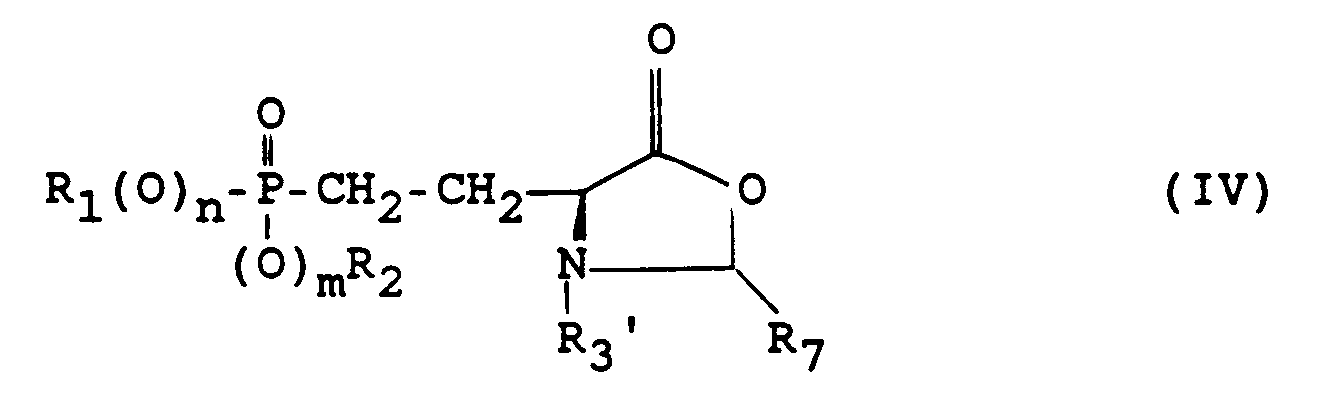
- Verfahren gemäß Anspruch 1, dadurch gekennzeichnet, daß in Formel I R₁(O)n = CH₃ oder C₂H₅, R₂(O)m = OH, R₃ und R₄ = H und R₅ = OH, Ala-Ala-OH oder Ala-Leu-OH bedeuten.
- Verfahren gemäß Ansprüchen 1 oder 2, dadurch gekennzeichnet, daß der Verfahrensschritt a) im Temperaturbereich zwischen 50° und 200°C durchgeführt wird.
- Verfahren gemäß Anspruch 1 oder 2, dadurch gekennzeichnet, daß der Verfahrensschritt a) im Temperaturbereich zwischen 70° und 140°C durchgeführt wird.
- Verfahren gemäß einem oder mehreren der Ansprüche 1 bis 4, dadurch gekennzeichnet, daß man im Verfahrensschritt a) als Radikalbildner organische Peroxide, Carbonsäureperester oder aliphatische Azoverbindungen verwendet.
- Verfahren nach Anspruch 5, dadurch gekennzeichnet, daß man als Radikalbildner Carbonsäureperester verwendet.
- Verfahren nach Anspruch 5 oder 6, dadurch gekennzeichnet, daß man den Radikalbildner in einer Menge von 0,1 bis 20 Molprozent, bezogen auf die Komponente III, einsetzt.
- Verfahren gemäß einem oder mehreren der Ansprüche 1 bis 7, dadurch gekennzeichnet, daß man beim Verfahrensschritt b) wäßrige 3N bis 12N HCl verwendet.
- Verfahren gemäß Anspruch 8, dadurch gekennzeichnet, daß man die Umsetzung mit HCl bei 90° bis 130°C durchführt.
- Verbindungen der in Anspruch 1 definierten Formel IV.
Applications Claiming Priority (2)
| Application Number | Priority Date | Filing Date | Title |
|---|---|---|---|
| DE3817956A DE3817956A1 (de) | 1988-05-27 | 1988-05-27 | Verfahren zur herstellung phosphorhaltiger l-aminosaeuren sowie ihrer ester und n-derivate |
| DE3817956 | 1988-05-27 |
Publications (2)
| Publication Number | Publication Date |
|---|---|
| EP0346658A1 EP0346658A1 (de) | 1989-12-20 |
| EP0346658B1 true EP0346658B1 (de) | 1993-09-01 |
Family
ID=6355196
Family Applications (1)
| Application Number | Title | Priority Date | Filing Date |
|---|---|---|---|
| EP89109313A Expired - Lifetime EP0346658B1 (de) | 1988-05-27 | 1989-05-24 | Verfahren zur Herstellung phosphorhaltiger L-Aminosäuren sowie ihrer Ester und N-Derivate |
Country Status (7)
| Country | Link |
|---|---|
| US (2) | US5374736A (de) |
| EP (1) | EP0346658B1 (de) |
| JP (1) | JP2705979B2 (de) |
| DE (2) | DE3817956A1 (de) |
| HU (2) | HU207093B (de) |
| IL (1) | IL90413A (de) |
| ZA (1) | ZA894012B (de) |
Families Citing this family (53)
| Publication number | Priority date | Publication date | Assignee | Title |
|---|---|---|---|---|
| DE3817956A1 (de) * | 1988-05-27 | 1989-12-07 | Hoechst Ag | Verfahren zur herstellung phosphorhaltiger l-aminosaeuren sowie ihrer ester und n-derivate |
| TW353663B (en) * | 1991-04-06 | 1999-03-01 | Hoechst Ag | Process for the preparation of phosphorus-containing L-amino acids, their derivatives and intermediates for this process |
| HUT63622A (en) * | 1991-08-03 | 1993-09-28 | Hoechst Ag | Process for producing optically active omega-halogen-2-amino-alkanecarboxylic acid derivatives and optically active phosphorous alpha-amino acids by using such derivatives |
| JP3294647B2 (ja) * | 1991-12-13 | 2002-06-24 | ヘキスト・アクチェンゲゼルシャフト | L−ホスフィノトリシンおよびその誘導体の製造方法 |
| DE4407197A1 (de) * | 1994-03-04 | 1995-09-07 | Hoechst Schering Agrevo Gmbh | Verfahren zur Herstellung von /L/-Homoalanin-4-yl-(methyl)phosphinsäure und deren Salze durch Racematspaltung |
| DE4422045A1 (de) * | 1994-06-26 | 1996-01-04 | Hoechst Schering Agrevo Gmbh | Verfahren zur enzymatischen Spaltung von 2-Amino-4-methylphosphinobutansäureamid-Derivaten |
| CN108164560B (zh) * | 2016-12-07 | 2019-12-13 | 中国科学院成都有机化学有限公司 | 草铵膦的制备方法 |
| WO2019030086A2 (en) | 2017-08-09 | 2019-02-14 | Basf Se | HERBICIDE MIXTURES COMPRISING L-GLUFOSINATE AND THEIR USE IN COLZA CULTURES |
| WO2019030087A1 (en) | 2017-08-09 | 2019-02-14 | Basf Se | HERBICIDE MIXTURES COMPRISING L-GLUFOSINATE OR SALT THEREOF AND AT LEAST ONE INHIBITOR OF LIPID BIOSYNTHESIS |
| WO2019030103A1 (en) | 2017-08-09 | 2019-02-14 | Basf Se | HERBICIDE MIXTURES COMPRISING L-GLUFOSINATE OR SALT THEREOF AND AT LEAST ONE AUXINIC HERBICIDE |
| WO2019030102A1 (en) | 2017-08-09 | 2019-02-14 | Basf Se | HERBICIDE MIXTURES COMPRISING L-GLUFOSINATE OR A SALT THEREOF AND GLYPHOSATE OR SALTS THEREOF |
| EP3440937A1 (de) | 2017-08-09 | 2019-02-13 | Basf Se | Herbizidmischungen mit l-glufosinat oder dessen salz und einem zweiten herbizid |
| US11363818B2 (en) | 2017-08-09 | 2022-06-21 | Basf Se | Herbicidal mixtures comprising L-glufosinate and their use in soybean cultures |
| WO2019030089A1 (en) | 2017-08-09 | 2019-02-14 | Basf Se | HERBICIDE MIXTURES COMPRISING L-GLUFOSINATE OR SALT THEREOF AND AT LEAST ONE ALS INHIBITOR |
| WO2019030090A1 (en) | 2017-08-09 | 2019-02-14 | Basf Se | HERBICIDE MIXTURES COMPRISING L-GLUFOSINATE AND THEIR USE IN RICE CROPS |
| EP3440939A1 (de) | 2017-08-09 | 2019-02-13 | Basf Se | Herbizidmischungen mit l-glufosinat |
| BR122023021519A2 (pt) | 2017-08-09 | 2024-01-09 | Basf Se | Mistura de herbicidas, composição pesticida e método de controle de vegetação |
| WO2019030100A1 (en) | 2017-08-09 | 2019-02-14 | Basf Se | HERBICIDE MIXTURES COMPRISING L-GLUFOSINATE OR SALT THEREOF AND AT LEAST ONE MITOSE INHIBITOR |
| WO2019030088A1 (en) | 2017-08-09 | 2019-02-14 | Basf Se | HERBICIDE MIXTURES COMPRISING L-GLUFOSINATE AND THEIR USE IN CEREAL CROPS |
| WO2019030091A2 (en) | 2017-08-09 | 2019-02-14 | Basf Se | HERBICIDE MIXTURES COMPRISING L-GLUFOSINATE AND THEIR USE IN COTTON CULTURES |
| WO2019030092A1 (en) | 2017-08-09 | 2019-02-14 | Basf Se | HERBICIDE MIXTURES COMPRISING L-GLUFOSINATE OR SALT THEREOF AND AT LEAST ONE PHOTOSYNTHESIS INHIBITOR |
| BR122023021537A2 (pt) | 2017-08-09 | 2024-03-05 | Basf Se | Mistura herbicida, composição pesticida e método para controlar vegetação indesejável |
| CN122536584A (zh) | 2017-08-09 | 2026-08-11 | 巴斯夫欧洲公司 | 包含l-固杀草或其盐和至少一种vlcfa抑制剂的除草混合物 |
| CN114980740A (zh) | 2020-01-23 | 2022-08-30 | 巴斯夫欧洲公司 | 用于农业化学配制剂的新型添加剂 |
| US20220378042A1 (en) | 2020-01-31 | 2022-12-01 | Basf Se | Herbicide combinations comprising glufosinate and oxyfluorfen |
| BR112022014950A2 (pt) | 2020-01-31 | 2022-09-20 | Basf Se | Combinação de herbicidas, composição, métodos de produção de combinações de herbicidas, de controle do crescimento vegetal indesejado e de tratamento ou proteção de plantas e uso da combinação de herbicidas |
| BR112022014879A2 (pt) | 2020-01-31 | 2022-09-20 | Basf Se | Combinação de herbicidas, composição, métodos de produção de combinações de herbicidas, de tratamento ou proteção de plantas produtoras em fileiras e de tratamento ou proteção de plantas especializadas e uso da combinação de herbicidas |
| BR112022014824A2 (pt) | 2020-01-31 | 2022-12-13 | Basf Se | Combinação de herbicidas, composição, métodos de produção de combinações herbicidas, de tratamento ou proteção de plantas produtoras em fileiras e de tratamento ou proteção de plantas especializadas e uso da composição herbicida |
| BR112022014800A2 (pt) | 2020-01-31 | 2022-09-20 | Basf Se | Combinação de herbicidas, composição, métodos para produzir combinação de herbicidas, para controlar o crescimento indesejado das plantas e/ou controle de plantas nocivas e para tratar ou proteger culturas e uso da combinação de herbicidas |
| US20230080819A1 (en) | 2020-01-31 | 2023-03-16 | Basf Se | Herbicide combinations comprising glufosinate and tiafenacil |
| US20230091888A1 (en) | 2020-01-31 | 2023-03-23 | Basf Se | Herbicide combinations comprising glufosinate and selected ppo inhibitors |
| BR112022014960A2 (pt) | 2020-01-31 | 2022-09-20 | Basf Se | Combinação de herbicidas, composição, métodos de produção de uma combinação de herbicidas, para controlar o crescimento de plantas indesejadas, para tratar ou proteger culturas em linha e culturas de especialidades e uso |
| BR112022014952A2 (pt) | 2020-01-31 | 2022-09-20 | Basf Se | Combinação de herbicidas, composição, métodos de produção de combinações de herbicidas, de controle do crescimento vegetal indesejado e de tratamento ou proteção de plantas e uso da combinação de herbicidas |
| WO2021151752A1 (en) | 2020-01-31 | 2021-08-05 | Basf Se | Herbicide combinations comprising glufosinate and selected ppo inhibitors |
| US20230068414A1 (en) | 2020-01-31 | 2023-03-02 | Basf Se | Herbicide combinations comprising glufosinate and trifludimoxazin |
| WO2021151740A1 (en) | 2020-01-31 | 2021-08-05 | Basf Se | Herbicide combinations comprising glufosinate and sulfentrazone |
| US20230054749A1 (en) | 2020-01-31 | 2023-02-23 | Basf Se | Herbicide Combinations Comprising Glufosinate and Flumiclorac-pentyl |
| US12557815B2 (en) | 2020-01-31 | 2026-02-24 | Basf Se | Herbicide combinations comprising glufosinate and pyraflufen-ethyl |
| US12262715B2 (en) | 2020-02-05 | 2025-04-01 | Basf Se | Herbicidal mixtures comprising L-glufosinate or its salt and at least one protoporphyrinogen-IX oxidase inhibitor |
| EP4000400A1 (de) | 2020-11-17 | 2022-05-25 | Basf Se | Herbizidkombination aus glufosinat, saflufenacil und trifludimoxazin |
| US20240023556A1 (en) | 2020-10-12 | 2024-01-25 | Basf Se | Herbicide combination comprising glufosinate, saflufenacil and trifludimoxazin |
| CN116507203B (zh) | 2020-10-27 | 2026-08-07 | 巴斯夫欧洲公司 | 农药微乳剂组合物 |
| CA3207197A1 (en) | 2021-02-05 | 2022-08-11 | Murat Mertoglu | Liquid herbicidal compositions |
| WO2022207753A1 (en) | 2021-04-01 | 2022-10-06 | Basf Se | Methods for preparing l-glufosinate |
| CA3219689A1 (en) | 2021-05-21 | 2022-11-24 | Anna SOYK | Computer-implemented method for applying a glutamine synthetase inhibitor on an agricultural field |
| CA3238333A1 (en) | 2021-11-15 | 2023-05-19 | Dean A Oester | Method for increasing the efficacy of a herbicide |
| CN114989213B (zh) * | 2022-06-07 | 2024-09-17 | 永农生物科学有限公司 | 一种l-草铵膦或其盐的制备方法 |
| CN119451575A (zh) | 2022-06-29 | 2025-02-14 | 巴斯夫欧洲公司 | 包含l-草铵膦或其盐和第二除草剂的除草混合物 |
| WO2024056517A1 (en) | 2022-09-14 | 2024-03-21 | Basf Se | Use of an alkylether sulfate for improving the efficacy of herbicides |
| EP4338592A1 (de) | 2022-09-15 | 2024-03-20 | Basf Se | Verwendung einer verbindung zur verbesserung der wirksamkeit von herbiziden |
| CN118724833A (zh) * | 2023-03-28 | 2024-10-01 | 南京华狮新材料有限公司 | 一种氨基酸衍生物及其制备方法和作为中间体合成l-草铵膦的方法 |
| AR133862A1 (es) | 2023-09-21 | 2025-11-12 | Specialty Operations France | Emulsión en agua concentrada que comprende glufosinato, inhibidor de vlcfa y tensioactivos específicos |
| CN121889038A (zh) | 2023-09-21 | 2026-04-17 | 法国特种经营公司 | 包含特定表面活性剂的除草剂组合物 |
Family Cites Families (14)
| Publication number | Priority date | Publication date | Assignee | Title |
|---|---|---|---|---|
| DE2010396A1 (de) * | 1970-03-05 | 1971-09-16 | Badische Anilin- & Soda-Fabrik Ag, 6700 Ludwigshafen | Phosphorsäureesterderivate |
| US3956305A (en) * | 1975-05-08 | 1976-05-11 | Commercial Solvents Corporation | Phosphated oxazolines |
| DE2549961C2 (de) * | 1975-11-07 | 1982-10-21 | Basf Ag, 6700 Ludwigshafen | Neue Phosphorsäurederivate, Verfahren zu ihrer Herstellung und Schädlingsbekämpfungsmittel auf Basis dieser Verbindungen |
| US4176121A (en) * | 1977-11-11 | 1979-11-27 | Stauffer Chemical Company | 1,3-Oxazole phosphates and phosphonates |
| US4265654A (en) * | 1977-12-28 | 1981-05-05 | Meiji Seika Kaisha Ltd. | Herbicidal compositions |
| US4226941A (en) * | 1979-09-27 | 1980-10-07 | Meiji Seika Kaisha, Ltd. | Process for the optical resolution of d,l-2-amino-4-methylphosphinobutyric acid |
| DE3048612C2 (de) * | 1980-12-23 | 1982-12-02 | Hoechst Ag, 6000 Frankfurt | "Verfahren zur enzymatischen Trennung von L-2-Ami no-4-methylphosphinobuttersäure" |
| JPS59219297A (ja) * | 1983-05-27 | 1984-12-10 | Meiji Seika Kaisha Ltd | 光学活性な〔(3−アミノ−3−カルボキシ)プロピル−1〕−ホスフイン酸誘導体の製造法 |
| US4594199A (en) * | 1983-09-19 | 1986-06-10 | E. R. Squibb & Sons, Inc. | Method for making phosphinic acid intermediates |
| DE3428524A1 (de) * | 1984-08-02 | 1986-02-13 | Boehringer Mannheim Gmbh, 6800 Mannheim | Neue diphosphonsaeurederivate, verfahren zu deren herstellung und diese verbindungen enthaltende arzneimittel |
| DE3525267A1 (de) * | 1984-09-08 | 1986-03-20 | Basf Ag, 6700 Ludwigshafen | Verfahren zur herstellung von weitgehend reinen enantiomeren von (3-amino-3-carboxy-propyl)-alkyl-phosphinsaeurederivaten, neue pyrazinderivate und ihre verwendung als herbizide und bioregulatoren |
| DE3542645A1 (de) * | 1985-12-03 | 1987-06-04 | Hoechst Ag | Verfahren zur herstellung von l-homoalanin-4-yl(methyl)-phosphinsaeure sowie ihrer alkylester |
| DE3609818A1 (de) * | 1986-03-22 | 1987-09-24 | Hoechst Ag | Verfahren zur herstellung von l-phosphinothricin(derivaten) sowie ihrer alkylester |
| DE3817956A1 (de) * | 1988-05-27 | 1989-12-07 | Hoechst Ag | Verfahren zur herstellung phosphorhaltiger l-aminosaeuren sowie ihrer ester und n-derivate |
-
1988
- 1988-05-27 DE DE3817956A patent/DE3817956A1/de not_active Withdrawn
-
1989
- 1989-05-24 DE DE89109313T patent/DE58905425D1/de not_active Expired - Fee Related
- 1989-05-24 EP EP89109313A patent/EP0346658B1/de not_active Expired - Lifetime
- 1989-05-26 ZA ZA894012A patent/ZA894012B/xx unknown
- 1989-05-26 HU HU892700A patent/HU207093B/hu not_active IP Right Cessation
- 1989-05-26 HU HU9203706A patent/HU9203706D0/hu unknown
- 1989-05-26 JP JP1131682A patent/JP2705979B2/ja not_active Expired - Fee Related
- 1989-05-26 IL IL90413A patent/IL90413A/xx unknown
-
1993
- 1993-02-12 US US08/017,405 patent/US5374736A/en not_active Expired - Lifetime
-
1994
- 1994-09-20 US US08/308,975 patent/US5530142A/en not_active Expired - Lifetime
Also Published As
| Publication number | Publication date |
|---|---|
| IL90413A (en) | 1993-04-04 |
| DE58905425D1 (de) | 1993-10-07 |
| US5374736A (en) | 1994-12-20 |
| US5530142A (en) | 1996-06-25 |
| ZA894012B (en) | 1990-02-28 |
| HU207093B (en) | 1993-03-01 |
| JPH0219390A (ja) | 1990-01-23 |
| IL90413A0 (en) | 1990-01-18 |
| DE3817956A1 (de) | 1989-12-07 |
| JP2705979B2 (ja) | 1998-01-28 |
| EP0346658A1 (de) | 1989-12-20 |
| HU9203706D0 (en) | 1993-03-29 |
| HUT52105A (en) | 1990-06-28 |
Similar Documents
| Publication | Publication Date | Title |
|---|---|---|
| EP0346658A1 (de) | Verfahren zur Herstellung phosphorhaltiger L-Aminosäuren sowie ihrer Ester und N-Derivate | |
| EP0508296B1 (de) | Verfahren zur Herstellung phosphorhaltiger L-Aminosäuren, deren Derivate und Zwischenprodukte für dieses Verfahren | |
| EP0238954B1 (de) | Verfahren zur Herstellung von L-Phosphinothricin(derivaten) sowie ihrer Alkylester | |
| EP0121226B1 (de) | Verfahren zur Herstellung von Phosphinothricin | |
| DE3229893A1 (de) | Neue aminosaeureisomere, verfahren zu ihrer herstellung sowie ihre verwendung | |
| EP0546566A1 (de) | Verfahren zur Herstellung von L-Phosphinothricin und seinen Derivaten | |
| DE2914294C2 (de) | Verfahren zur Herstellung von Verbindungen mit Phosphor-Kohlenstoff-Stickstoff-Bindung | |
| EP0027199B2 (de) | Verfahren zur Herstellung von Phosphono-hydroxy-essigsäure und Salzen derselben sowie diese enthaltende autivirale Mittel | |
| DD212966A5 (de) | Methode zur herstellung von n-phosphonomethylglyzin | |
| EP0224880B1 (de) | Verfahren zur Herstellung von L-Homoalanin-4-yl(methyl)-phosphinsäure sowie ihrer Alkylester | |
| DE60104446T2 (de) | VERFAHREN ZUR HERSTELLUNG VON Beta-PHOSPHORNITROXIDRADIKALEN | |
| EP0194521B1 (de) | Phosphorhaltige alpha-Aminonitrile und Verfahren zu ihrer Herstellung | |
| EP0029175A1 (de) | Verfahren zur Gewinnung der enantiomeren Formen von 4-Cyan-1-(N-methyl-N-(2'-((3",4"-dimethoxyphenyl))-ethyl)-amino)-5-methyl-4-(3',4',5'-trimethoxyphenyl)-hexan und dessen Salzen | |
| EP0480307B1 (de) | Verfahren zur Herstellung von Acylaminomethanphosphonsäuren | |
| EP0543845B1 (de) | Verfahren zur herstellung von aminomethanphosphonsäure und aminomethyl-phosphinsäuren | |
| DE4341605C2 (de) | Verfahren zur Herstellung homochiraler Aminoalkohole | |
| EP0022546A2 (de) | Verfahren zur Herstellung von 1-Oxophospholan-chlorhydrinen sowie einige spezielle dieser Verbindungen | |
| DE10019291C2 (de) | 2-Alkoxy-5-methoxypyrimidine bzw. deren tautomere Formen sowie Verfahren zu deren Herstellung | |
| DE3734219C2 (de) | ||
| EP0530506B1 (de) | Optisch aktive Omega-Halogen-2-amino-alkancarbonsäure-derivate, Verfahren zu ihrer Herstellung und ihre Verwendung zur Herstellung optisch aktiver phosphorhaltiger Alpha-Aminosäuren | |
| DE2135349C3 (de) | Verfahren zur Herstellung von N-unsubstituierten (Thio-)-Phosphor-(phosphon)-säureesteramiden | |
| DD232050A5 (de) | Verfahren zur herstellung von phosphonsaeure-diestern | |
| DE2510831A1 (de) | Isonipecotinsaeurederivate enthaltende herbizidzubereitungen | |
| DE2407460C2 (de) | Verfahren zur Herstellung von Methylphosphinoxiden | |
| EP0386654A1 (de) | Verfahren zur Herstellung optisch reiner Oxirancarbonsäuren |
Legal Events
| Date | Code | Title | Description |
|---|---|---|---|
| PUAI | Public reference made under article 153(3) epc to a published international application that has entered the european phase |
Free format text: ORIGINAL CODE: 0009012 |
|
| AK | Designated contracting states |
Kind code of ref document: A1 Designated state(s): BE CH DE FR GB IT LI NL |
|
| 17P | Request for examination filed |
Effective date: 19900616 |
|
| 17Q | First examination report despatched |
Effective date: 19921109 |
|
| GRAA | (expected) grant |
Free format text: ORIGINAL CODE: 0009210 |
|
| AK | Designated contracting states |
Kind code of ref document: B1 Designated state(s): BE CH DE FR GB IT LI NL |
|
| REF | Corresponds to: |
Ref document number: 58905425 Country of ref document: DE Date of ref document: 19931007 |
|
| ITF | It: translation for a ep patent filed | ||
| GBT | Gb: translation of ep patent filed (gb section 77(6)(a)/1977) |
Effective date: 19931109 |
|
| ET | Fr: translation filed | ||
| PLBE | No opposition filed within time limit |
Free format text: ORIGINAL CODE: 0009261 |
|
| STAA | Information on the status of an ep patent application or granted ep patent |
Free format text: STATUS: NO OPPOSITION FILED WITHIN TIME LIMIT |
|
| 26N | No opposition filed | ||
| REG | Reference to a national code |
Ref country code: GB Ref legal event code: IF02 |
|
| PGFP | Annual fee paid to national office [announced via postgrant information from national office to epo] |
Ref country code: DE Payment date: 20070303 Year of fee payment: 19 |
|
| PGFP | Annual fee paid to national office [announced via postgrant information from national office to epo] |
Ref country code: NL Payment date: 20070503 Year of fee payment: 19 |
|
| PGFP | Annual fee paid to national office [announced via postgrant information from national office to epo] |
Ref country code: CH Payment date: 20070516 Year of fee payment: 19 |
|
| PGFP | Annual fee paid to national office [announced via postgrant information from national office to epo] |
Ref country code: GB Payment date: 20070523 Year of fee payment: 19 |
|
| REG | Reference to a national code |
Ref country code: GB Ref legal event code: 732E |
|
| REG | Reference to a national code |
Ref country code: CH Ref legal event code: PUE Owner name: BAYER CROPSCIENCE AG Free format text: HOECHST AKTIENGESELLSCHAFT#POSTFACH 80 03 20#D-65926 FRANKFURT (DE) -TRANSFER TO- BAYER CROPSCIENCE AG#ALFRED-NOBEL-STRASSE 50#40789 MONHEIM (DE) |
|
| PGFP | Annual fee paid to national office [announced via postgrant information from national office to epo] |
Ref country code: IT Payment date: 20070525 Year of fee payment: 19 |
|
| PGFP | Annual fee paid to national office [announced via postgrant information from national office to epo] |
Ref country code: BE Payment date: 20070717 Year of fee payment: 19 |
|
| NLS | Nl: assignments of ep-patents |
Owner name: HOECHST SCHERING AGREVO GMBH Effective date: 20071213 Owner name: BAYER CROPSCIENCE AG Effective date: 20071213 |
|
| NLT1 | Nl: modifications of names registered in virtue of documents presented to the patent office pursuant to art. 16 a, paragraph 1 |
Owner name: BAYER CROPSCIENCE GMBH Owner name: AVENTIS CROPSCIENCE GMBH |
|
| PGFP | Annual fee paid to national office [announced via postgrant information from national office to epo] |
Ref country code: FR Payment date: 20070510 Year of fee payment: 19 |
|
| BECA | Be: change of holder's address |
Owner name: *BAYER CROPSCIENCE A.G.ALFRED-NOBEL-STRASSE 50, D- Effective date: 20080520 |
|
| BECH | Be: change of holder |
Owner name: *BAYER CROPSCIENCE A.G.ALFRED-NOBEL-STRASSE 50, D- Effective date: 20080520 |
|
| BECN | Be: change of holder's name |
Owner name: *BAYER CROPSCIENCE A.G.ALFRED-NOBEL-STRASSE 50, D- Effective date: 20080520 Owner name: *BAYER CROPSCIENCE A.G. Effective date: 20080520 |
|
| BERE | Be: lapsed |
Owner name: *BAYER CROPSCIENCE A.G. Effective date: 20080531 |
|
| REG | Reference to a national code |
Ref country code: CH Ref legal event code: PL |
|
| REG | Reference to a national code |
Ref country code: FR Ref legal event code: TP Ref country code: FR Ref legal event code: CA Ref country code: FR Ref legal event code: CD |
|
| GBPC | Gb: european patent ceased through non-payment of renewal fee |
Effective date: 20080524 |
|
| PG25 | Lapsed in a contracting state [announced via postgrant information from national office to epo] |
Ref country code: CH Free format text: LAPSE BECAUSE OF NON-PAYMENT OF DUE FEES Effective date: 20080531 Ref country code: LI Free format text: LAPSE BECAUSE OF NON-PAYMENT OF DUE FEES Effective date: 20080531 Ref country code: NL Free format text: LAPSE BECAUSE OF NON-PAYMENT OF DUE FEES Effective date: 20081201 |
|
| REG | Reference to a national code |
Ref country code: FR Ref legal event code: ST Effective date: 20090119 |
|
| PG25 | Lapsed in a contracting state [announced via postgrant information from national office to epo] |
Ref country code: BE Free format text: LAPSE BECAUSE OF NON-PAYMENT OF DUE FEES Effective date: 20080531 |
|
| PG25 | Lapsed in a contracting state [announced via postgrant information from national office to epo] |
Ref country code: FR Free format text: LAPSE BECAUSE OF NON-PAYMENT OF DUE FEES Effective date: 20080602 Ref country code: DE Free format text: LAPSE BECAUSE OF NON-PAYMENT OF DUE FEES Effective date: 20081202 |
|
| PG25 | Lapsed in a contracting state [announced via postgrant information from national office to epo] |
Ref country code: GB Free format text: LAPSE BECAUSE OF NON-PAYMENT OF DUE FEES Effective date: 20080524 |
|
| PG25 | Lapsed in a contracting state [announced via postgrant information from national office to epo] |
Ref country code: IT Free format text: LAPSE BECAUSE OF NON-PAYMENT OF DUE FEES Effective date: 20080524 |