EP0507337A2 - Neue Erucyl-, Brassidyl- und Nervonylderivate - Google Patents
Neue Erucyl-, Brassidyl- und Nervonylderivate Download PDFInfo
- Publication number
- EP0507337A2 EP0507337A2 EP92105822A EP92105822A EP0507337A2 EP 0507337 A2 EP0507337 A2 EP 0507337A2 EP 92105822 A EP92105822 A EP 92105822A EP 92105822 A EP92105822 A EP 92105822A EP 0507337 A2 EP0507337 A2 EP 0507337A2
- Authority
- EP
- European Patent Office
- Prior art keywords
- compounds
- erucyl
- active ingredient
- medicament according
- general formula
- Prior art date
- Legal status (The legal status is an assumption and is not a legal conclusion. Google has not performed a legal analysis and makes no representation as to the accuracy of the status listed.)
- Granted
Links
Classifications
-
- C—CHEMISTRY; METALLURGY
- C07—ORGANIC CHEMISTRY
- C07F—ACYCLIC, CARBOCYCLIC OR HETEROCYCLIC COMPOUNDS CONTAINING ELEMENTS OTHER THAN CARBON, HYDROGEN, HALOGEN, OXYGEN, NITROGEN, SULFUR, SELENIUM OR TELLURIUM
- C07F9/00—Compounds containing elements of Groups 5 or 15 of the Periodic Table
- C07F9/02—Phosphorus compounds
- C07F9/547—Heterocyclic compounds, e.g. containing phosphorus as a ring hetero atom
- C07F9/655—Heterocyclic compounds, e.g. containing phosphorus as a ring hetero atom having oxygen atoms, with or without sulfur, selenium, or tellurium atoms, as the only ring hetero atoms
- C07F9/65515—Heterocyclic compounds, e.g. containing phosphorus as a ring hetero atom having oxygen atoms, with or without sulfur, selenium, or tellurium atoms, as the only ring hetero atoms the oxygen atom being part of a five-membered ring
-
- A—HUMAN NECESSITIES
- A61—MEDICAL OR VETERINARY SCIENCE; HYGIENE
- A61P—SPECIFIC THERAPEUTIC ACTIVITY OF CHEMICAL COMPOUNDS OR MEDICINAL PREPARATIONS
- A61P31/00—Antiinfectives, i.e. antibiotics, antiseptics, chemotherapeutics
- A61P31/04—Antibacterial agents
-
- A—HUMAN NECESSITIES
- A61—MEDICAL OR VETERINARY SCIENCE; HYGIENE
- A61P—SPECIFIC THERAPEUTIC ACTIVITY OF CHEMICAL COMPOUNDS OR MEDICINAL PREPARATIONS
- A61P33/00—Antiparasitic agents
- A61P33/02—Antiprotozoals, e.g. for leishmaniasis, trichomoniasis, toxoplasmosis
-
- A—HUMAN NECESSITIES
- A61—MEDICAL OR VETERINARY SCIENCE; HYGIENE
- A61P—SPECIFIC THERAPEUTIC ACTIVITY OF CHEMICAL COMPOUNDS OR MEDICINAL PREPARATIONS
- A61P35/00—Antineoplastic agents
-
- A—HUMAN NECESSITIES
- A61—MEDICAL OR VETERINARY SCIENCE; HYGIENE
- A61P—SPECIFIC THERAPEUTIC ACTIVITY OF CHEMICAL COMPOUNDS OR MEDICINAL PREPARATIONS
- A61P35/00—Antineoplastic agents
- A61P35/02—Antineoplastic agents specific for leukemia
-
- A—HUMAN NECESSITIES
- A61—MEDICAL OR VETERINARY SCIENCE; HYGIENE
- A61P—SPECIFIC THERAPEUTIC ACTIVITY OF CHEMICAL COMPOUNDS OR MEDICINAL PREPARATIONS
- A61P37/00—Drugs for immunological or allergic disorders
- A61P37/02—Immunomodulators
- A61P37/06—Immunosuppressants, e.g. drugs for graft rejection
-
- C—CHEMISTRY; METALLURGY
- C07—ORGANIC CHEMISTRY
- C07F—ACYCLIC, CARBOCYCLIC OR HETEROCYCLIC COMPOUNDS CONTAINING ELEMENTS OTHER THAN CARBON, HYDROGEN, HALOGEN, OXYGEN, NITROGEN, SULFUR, SELENIUM OR TELLURIUM
- C07F9/00—Compounds containing elements of Groups 5 or 15 of the Periodic Table
- C07F9/02—Phosphorus compounds
- C07F9/06—Phosphorus compounds without P—C bonds
- C07F9/08—Esters of oxyacids of phosphorus
- C07F9/09—Esters of phosphoric acids
- C07F9/091—Esters of phosphoric acids with hydroxyalkyl compounds with further substituents on alkyl
-
- C—CHEMISTRY; METALLURGY
- C07—ORGANIC CHEMISTRY
- C07F—ACYCLIC, CARBOCYCLIC OR HETEROCYCLIC COMPOUNDS CONTAINING ELEMENTS OTHER THAN CARBON, HYDROGEN, HALOGEN, OXYGEN, NITROGEN, SULFUR, SELENIUM OR TELLURIUM
- C07F9/00—Compounds containing elements of Groups 5 or 15 of the Periodic Table
- C07F9/02—Phosphorus compounds
- C07F9/06—Phosphorus compounds without P—C bonds
- C07F9/08—Esters of oxyacids of phosphorus
- C07F9/09—Esters of phosphoric acids
- C07F9/10—Phosphatides, e.g. lecithin
-
- C—CHEMISTRY; METALLURGY
- C07—ORGANIC CHEMISTRY
- C07F—ACYCLIC, CARBOCYCLIC OR HETEROCYCLIC COMPOUNDS CONTAINING ELEMENTS OTHER THAN CARBON, HYDROGEN, HALOGEN, OXYGEN, NITROGEN, SULFUR, SELENIUM OR TELLURIUM
- C07F9/00—Compounds containing elements of Groups 5 or 15 of the Periodic Table
- C07F9/02—Phosphorus compounds
- C07F9/06—Phosphorus compounds without P—C bonds
- C07F9/08—Esters of oxyacids of phosphorus
- C07F9/09—Esters of phosphoric acids
- C07F9/113—Esters of phosphoric acids with unsaturated acyclic alcohols
-
- C—CHEMISTRY; METALLURGY
- C07—ORGANIC CHEMISTRY
- C07F—ACYCLIC, CARBOCYCLIC OR HETEROCYCLIC COMPOUNDS CONTAINING ELEMENTS OTHER THAN CARBON, HYDROGEN, HALOGEN, OXYGEN, NITROGEN, SULFUR, SELENIUM OR TELLURIUM
- C07F9/00—Compounds containing elements of Groups 5 or 15 of the Periodic Table
- C07F9/02—Phosphorus compounds
- C07F9/06—Phosphorus compounds without P—C bonds
- C07F9/16—Esters of thiophosphoric acids or thiophosphorous acids
- C07F9/165—Esters of thiophosphoric acids
- C07F9/173—Esters of thiophosphoric acids with unsaturated acyclic alcohols
-
- C—CHEMISTRY; METALLURGY
- C07—ORGANIC CHEMISTRY
- C07F—ACYCLIC, CARBOCYCLIC OR HETEROCYCLIC COMPOUNDS CONTAINING ELEMENTS OTHER THAN CARBON, HYDROGEN, HALOGEN, OXYGEN, NITROGEN, SULFUR, SELENIUM OR TELLURIUM
- C07F9/00—Compounds containing elements of Groups 5 or 15 of the Periodic Table
- C07F9/02—Phosphorus compounds
- C07F9/547—Heterocyclic compounds, e.g. containing phosphorus as a ring hetero atom
- C07F9/553—Heterocyclic compounds, e.g. containing phosphorus as a ring hetero atom having one nitrogen atom as the only ring hetero atom
- C07F9/572—Five-membered rings
-
- C—CHEMISTRY; METALLURGY
- C07—ORGANIC CHEMISTRY
- C07F—ACYCLIC, CARBOCYCLIC OR HETEROCYCLIC COMPOUNDS CONTAINING ELEMENTS OTHER THAN CARBON, HYDROGEN, HALOGEN, OXYGEN, NITROGEN, SULFUR, SELENIUM OR TELLURIUM
- C07F9/00—Compounds containing elements of Groups 5 or 15 of the Periodic Table
- C07F9/02—Phosphorus compounds
- C07F9/547—Heterocyclic compounds, e.g. containing phosphorus as a ring hetero atom
- C07F9/553—Heterocyclic compounds, e.g. containing phosphorus as a ring hetero atom having one nitrogen atom as the only ring hetero atom
- C07F9/576—Six-membered rings
- C07F9/59—Hydrogenated pyridine rings
Definitions
- the present invention relates to new phospholipids which contain an erucyl, brassidyl or nervonyl residue and their use as medicaments, in particular for combating tumors and protozoan and fungal diseases, and for the therapy of autoimmune diseases and bone marrow damage.
- EP-A 0 108 565 discloses phospholipids, including their pharmaceutically acceptable salts of the general formula wherein R1 is an aliphatic C8-C30 hydrocarbon radical, R2, R3 and R4 are independently hydrogen or C1-C5-alkyl or wherein represents cyclic ammonium and n is 0 or 1.
- R 1 is preferably an aliphatic hydrocarbon radical having 12 to 22, particularly preferably 14, 17 or 18, carbon atoms. These compounds are said to be suitable for combating tumor cells or fungal diseases or for use as crop protection agents.
- DE-OS 32 39 817 discloses glycerol derivatives of the general formula wherein R1 and R2 can mean substituted or unsubstituted alkyl radicals with 1 to 24 carbon atoms, X can mean oxygen and R3 can mean an aminoalkyl group and an N-alkylaminoalkyl group with 2 to 14 carbon atoms in the alkyl radicals. Furthermore, general processes for the preparation of the above compounds are also disclosed there, so that glycerol derivatives with various radicals can be prepared in a position-specific manner and with high selectivity.
- the compounds hexadecylphosphocholine and oleylphosphocholine are particularly preferred.
- the use of the abovementioned compounds as medicaments, in particular for the treatment of tumors is also disclosed. Such drugs can also be used as an additional active ingredient for the topical treatment of skin tumors Contain alkylglycerol.
- General preparation methods for the compounds according to the general formula mentioned above are also taught.
- DE-OS 36 41 491 discloses an antitumor drug, which contains hexadecylphosphocholine as an active ingredient and, where appropriate, other customary pharmaceutical additives, carriers and / or diluents. Such a drug can also contain an alkyl glycerol as an additional active ingredient.
- ET-18-OCH3 a very effective antitumor agent (see, for example, Berdel et al. In Phospholipids and Cellular Regulation (1985), edited by JF Kuo, pages 41-74, CRC-Press, Boca Raton, Florida). Furthermore, ET-18-OCH3 has also proven to be a suitable medicament for combating autoimmune diseases such as multiple sclerosis.
- phosphatidylamines and ether lysolecitins are suitable as medicaments for various applications, for example for combating tumors and autoimmune diseases.
- the most effective drugs from this class of compounds have so far been found to be hexadecylphosphocholine and ET-18-OCH3.
- these substances also have the disadvantage that they show a toxic effect at high doses.
- Another disadvantage of the phospholipids known hitherto is that they bring about a cytolysis of cells, in particular hemolysis of erythrocytes. For this reason, these substances cannot be administered intravenously, since this leads to hemolytic and tissue-necrotic side effects, as described in detail in DE 40 26 136.
- the object of the present invention was therefore to find new phospholipids which are effective as medicaments, but in which the disadvantages of the prior art are at least partially eliminated.
- R1, R2 and R3 independently of one another each have a straight-chain, branched, cyclic saturated or unsaturated alkyl radical having 1 to 4 carbon atoms, which can also contain an OH group and two of these radicals can also be linked to form a ring,
- A is a single bond or one of the groups with the formulas the groups (II) to (VII) have such an orientation that the oxygen atom is bonded to the phosphorus atom of the compound (I)
- X is an oxygen atom when A is a single bond or is an oxygen or sulfur atom when A is one of groups (II) to (VII).
- X preferably represents an oxygen atom
- A preferably represents a single bond. It is further preferred that R1, R2 and R3 are each methyl groups, so that the resulting compounds are phosphocholine derivatives. Erucylphosphocholine is particularly preferred.
- Erucyl, brassidyl and nervonyl residues are long chain alkyl residues. They can be obtained from the corresponding fatty acids, some of which occur naturally.
- Erucic acid cis-13-docosenoic acid
- the stereoisomeric brassidic acid trans-13-docosenoic acid
- Nervonic acid is found in shark liver oils, sphingomyelins and cerebrosides, especially nervon.
- R is an erucyl, brassidyl or nervonyl radical
- the alcohol R-OH in which R is an erucyl, brassidyl or nervonyl radical is preferably converted directly into the corresponding alkylphosphoamine derivatives, in particular into the corresponding alkylphosphocholines, by phosphorylation.
- R is an erucyl, brassidyl or nervonyl radical
- a compound with the general formula (XI) results from this reaction and subsequent work-up by hydrolysis: in which R and Y ′′ have the meanings given above.
- the last step of the reaction comprises the reaction of this compound (XI) with an amine of the formula N - R1, R2, R3 or a quaternary ammonium salt of the formula HN+R1, R2, R3Y ⁇ , where R1, R2 and R3 are in claim 1 have the meanings given.
- tertiary amines suitable according to the invention are, for example, trimethylamine, dimethylethylamine, diethylmethylamine, Triethylamine, NN-dimethyl-N-propylamine, NN-dimethyl-N-iso-propylamine, N-cyclopropyl-NN-dimethylamine, N-allyl-NN-dimethylamine, N-ethyl-N-methyl-N-propylamine, N- Butyl-NN-dimethylamine, NN-dimethyl-N-hydroxyethylamine, NN-dihydroxyethyl-N-methylamine, N-cyclobutyl-NN-dimethylamine, N-methylpyrrolidine, N-ethylpyrrolidine, N-methylmorpholine and the like.
- This product in turn can be reacted with a tertiary ammonium salt of the formula HOCH2-CH2-N+-R1, R2, R3 to a substance of the general formula I according to the invention.
- a tertiary ammonium salt of the formula HOCH2-CH2-N+-R1, R2, R3 to a substance of the general formula I according to the invention.
- the detailed reaction conditions can be found in the references mentioned above.
- the preferred process for the preparation of the substances according to the invention is the reaction of the alcohol (IX) with POCl3 to form the corresponding phosphoric acid dichloride (XIII)
- the substances according to the invention have proven to be very suitable as pharmaceuticals.
- the present invention therefore also relates to a medicament which contains, as active ingredient, one or more of the substances according to the invention, optionally together with pharmaceutically customary carriers, auxiliaries, fillers and diluents.
- the medicament according to the invention preferably contains erucyl, brassidyl or nervonyl phosphocholine as the active substance, particularly preferably erucyl phosphocholine.
- the substances according to the invention can also be used in combination with alkylglycerols of the general formula (XVI) are used in which one of the radicals R3 and R4 is an alkyl group having 2 to 12 carbon atoms and the other radical is an H atom.
- a medicament preferably contains an alkylglycerol mixture of nonyl- or octylglycerol, hexyl- or pentylglycerol and propyl- or ethylglycerol as well as water.
- Such drug combinations of alkylglycerols and phospholipids and the preferred contents of the individual active ingredients are disclosed in DE-OS 36 41 379.
- the medicaments which contain a substance according to the invention in combination with at least one alkylglycerol are particularly suitable for topical application.
- the substances according to the invention in particular the erucyl and nervonyl derivatives, do not have any hemolytic properties, as have been observed with other lysolecitins. Therefore, these substances can be taken up in physiological solutions (saline, Ringer's etc.) and administered intravenously. Even more surprising is the fact that these substances have a significantly better effect than hexadecylphosphocholine.
- the medicaments according to the invention have proven particularly suitable for combating tumors. Erucylphosphocholine, in comparison to hexadecylphosphocholine in the same quantities, significantly improves tumor growth control in methylnitourea-induced breast cancer.
- the medicaments according to the invention are also suitable for combating protozoan and fungal diseases, in particular leishmaniasis.
- the medicaments according to the invention are also suitable for the therapy of autoimmune diseases, in particular multiple sclerosis. Therapy for bone marrow damage is also possible that has occurred due to treatment with cytostatics and other substances that damage the bone marrow.
- the present invention furthermore also relates to a process for the preparation of a medicament according to the invention, in particular as an anti-tumor agent, agents for combating protozoan and fungal diseases, in particular leishmaniasis, as an agent for the therapy of autoimmune diseases, in particular multiple sclerosis, and as an agent for therapy of bone marrow damage is formulated.
- the drug is preferably administered intravenously.
- subcutaneous or topical administration of the medicament according to the invention is also possible.
- the compounds according to Examples 1 to 19 and 33 to 35 are prepared by methods such as those described in e.g. in DE 27 52 125, DE 36 41 379, DE 36 41 491, DE 36 41 377 and DE 40 13 632 or the literature cited therein.
- the sulfur-containing compounds can, according to Bosies et al. (Lipids, 22 (1987) 947-951). However, the corresponding thiol was phosphorylated according to the phosphorylation methods cited in Example 1 and further reacted.
- Nervonyl-phosphocholine (cis-15-tetracosenyl-PC) C29H60NO4P; 517.776 calc .: C, 67.27 H, 11.68 N, 2.71 P, 5.98 67.13 11.59 2.64 5.68
- Nervonyl derivatives which are analogous to the compounds according to Examples 7 to 26 are prepared by the processes described there in each case.
- a hexadecylphosphocholine formulation in liposomes is produced in accordance with DE 40 26 136.0. Hexadecylphosphocholine (12 mmol), cholesterol (15 mmol) and DPPG (3 mmol) are dissolved in 200 ml of 2-propanol with heating. The solvent is then stripped off in vacuo and 300 ml of phosphate buffer solution, pH 7.0, are added to the finely divided lipid film. The mixture is then kept under slow rotation at 40 ° C. for 60 minutes.
- the lipid suspension obtained is then transferred to the pressure cell of the French Press and pressed at 740 MPa, and this process is repeated three times.
- the liposome dispersion formed is then centrifuged for 30 minutes at 27,000 g and 5 ° C and the supernatant is obtained.
- an erucylphosphocholine formulation was prepared in physiological NaCl solution.
- Methyl nitrourea-induced breast carcinomas in the rat are treated with the formulations prepared as above in an amount which corresponds to the stated concentrations of hexadecylphosphocholine or erucylphosphocholine per kg rat as a daily dose.
- the tumor weights of untreated control animals are set to 100%. This value corresponds to unhindered tumor growth.
- the tumor animals in the treated group achieve values between 0 and 100% compared to the control group, as indicated in Table 1.
Landscapes
- Chemical & Material Sciences (AREA)
- Organic Chemistry (AREA)
- Health & Medical Sciences (AREA)
- Life Sciences & Earth Sciences (AREA)
- General Health & Medical Sciences (AREA)
- Biochemistry (AREA)
- Molecular Biology (AREA)
- Veterinary Medicine (AREA)
- Animal Behavior & Ethology (AREA)
- Medicinal Chemistry (AREA)
- Nuclear Medicine, Radiotherapy & Molecular Imaging (AREA)
- Pharmacology & Pharmacy (AREA)
- General Chemical & Material Sciences (AREA)
- Public Health (AREA)
- Chemical Kinetics & Catalysis (AREA)
- Immunology (AREA)
- Engineering & Computer Science (AREA)
- Oncology (AREA)
- Bioinformatics & Cheminformatics (AREA)
- Hematology (AREA)
- Transplantation (AREA)
- Communicable Diseases (AREA)
- Tropical Medicine & Parasitology (AREA)
- Pharmaceuticals Containing Other Organic And Inorganic Compounds (AREA)
- Organic Low-Molecular-Weight Compounds And Preparation Thereof (AREA)
Abstract
Description
- Die vorliegende Erfindung betrifft neue Phospholipide, die einen Erucyl-, Brassidyl- oder Nervonyl-Rest enthalten, und deren Verwendung als Arzneimittel, insbesondere zur Bekämpfung von Tumoren sowie Protozoen- und Pilzerkrankungen, sowie zur Therapie von Autoimmunerkrankungen und Knochenmarkschädigungen.
- Die Verwendung von Phospholipiden als Arzneimittel ist bekannt. Die EP-A 0 108 565 offenbart Phospholipide, einschließlich ihrer pharmazeutisch verträglichen Salze der allgemeinen Formel

worin R¹ ein aliphatischer C₈-C₃₀-Kohlenwasserstoffrest ist, R², R³ und R⁴ unabhängig Wasserstoff oder C₁-C₅-Alkyl sind oder worin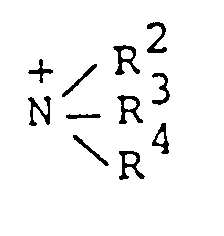
cyclisches Ammonium darstellt und n 0 oder 1 ist. Vorzugsweise ist R¹ ein aliphatischer Kohlenwasserstoffrest mit 12 bis 22, besonders bevorzugt mit 14, 17 oder 18 Kohlenstoffatomen. Diese Verbindungen werden als geeignet zur Bekämpfung von Tumorzellen oder Pilzerkrankungen oder zur Verwendung als Pflanzenschutzmittel bezeichnet. - Die DE-OS 32 39 817 offenbart Glycerinderivate der allgemeinen Formel
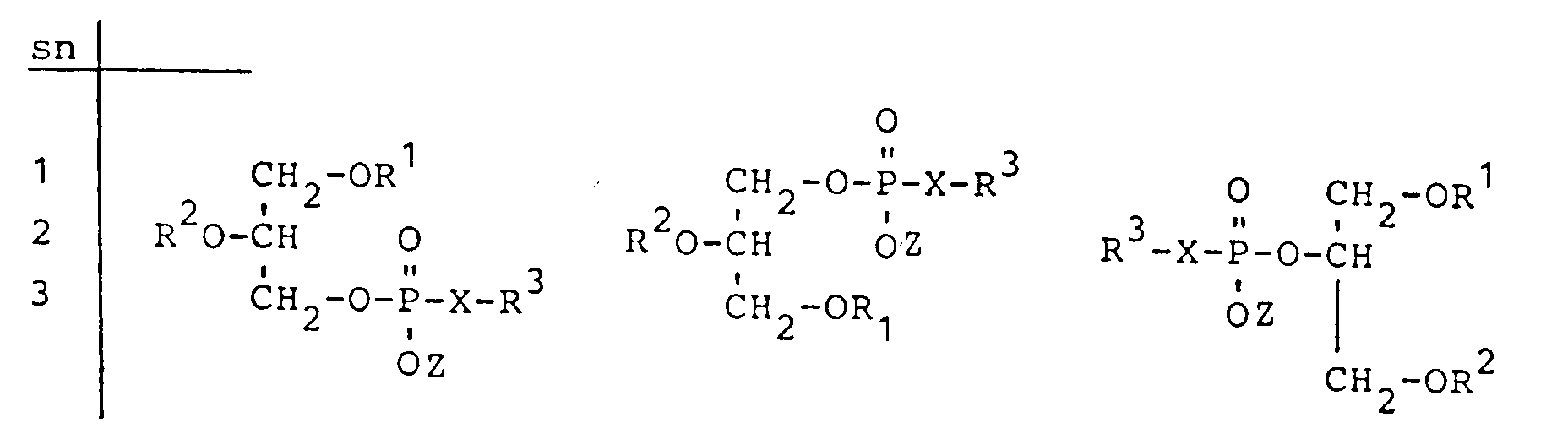
worin R¹ und R² u.a. substituierte oder unsubstituierte Alkylreste mit 1 bis 24 Kohlenstoffatomen bedeuten können, X u.a. Sauerstoff bedeuten kann und R³ u.a. eine Aminoalkylgruppe und eine N-Alkylaminoalkylgruppe mit 2 bis 14 Kohlenstoffatomen in den Alkylresten bedeuten kann. Weiterhin sind dort auch allgemeine Verfahren zur Herstellung der obigen Verbindungen offenbart, so daß man Glycerinderivate mit verschiedenen Resten stellungsspezifisch und mit hoher Selektivität herstellen kann. - Die DE-OS 36 41 379 offenbart Verbindungen der allgemeinen Formel
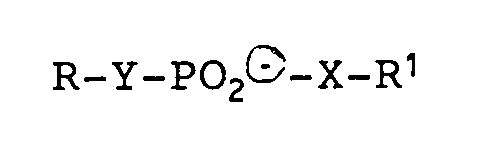
worin R einen Kohlenwasserstoffrest mit 12 bis 24 C-Atomen sein kann, X u.a. O bedeutet und R¹ u.a. eine Alkylgruppe bedeuten kann, die mit unterschiedlichen Aminogruppen substituiert sein kann. Vorzugsweise ist R ein Alkyl- oder Alkylenrest mit 14 bis 20 C-Atomen, X = O und R¹ = Trialkylammoniumethyl mit 1 bis 3 C-Atomen je Alkylgruppe. Besonders bevorzugt sind die Verbindungen Hexadecylphosphocholin und Oleylphosphocholin. Ferner wird die Verwendung der oben genannten Verbindungen als Arzneimittel, insbesondere zur Behandlung von Tumoren offenbart. Derartige Arzneimittel können auch zur topischen Behandlung von Hauttumoren als zusätzlichen Wirkstoff Alkylglycerin enthalten. Es werden auch allgemeine Herstellungsmethoden für die Verbindungen gemäß der oben genannten allgemeinen Formel gelehrt. - Die DE-OS 36 41 491 offenbart ein Antitumor-wirksames Arzneimittel, das Hexadecylphosphocholin als Wirkstoff sowie gegebenenfalls weitere übliche pharmazeutische Zusatz-, Träger- und/oder Verdünnungsstoffe enthält. Ein derartiges Arzneimittel kann als zusätzlichen Wirkstoff auch ein Alkylglycerin enthalten.
- Weiterhin ist bekannt, daß ein in Position 2 methyliertes Glycerinderivat von Hexadecylphosphocholin das Etherphospholipid ET-18-OCH₃ ein sehr wirksames Antitumormittel ist (siehe z.B. Berdel et al. in Phospholipids and Cellular Regulation (1985), herausgegeben J.F. Kuo, Seiten 41-74, CRC-Press, Boca Raton, Florida). Ferner hat sich ET-18-OCH₃ auch als geeignetes Arzneimittel zur Bekämpfung von Autoimmunkrankheiten wie etwa Multipler Sklerose erwiesen.
- Aus den oben genannten Veröffentlichungen ist ersichtlich, daß Phosphatidylamine und Etherlysolecitine als Arzneimittel für unterschiedliche Anwendungen, z.B. zur Bekämpfung von Tumoren und Autoimmunerkrankungen, geeignet sind. Als bisher wirksamste Arzneimittel aus dieser Verbindungsklasse haben sich Hexadecylphosphocholin und ET-18-OCH₃ erwiesen. Jedoch auch diese Substanzen haben den Nachteil, daß sie bei hoher Dosierung eine toxische Wirkung zeigen. Ein weiterer Nachteil der bisher bekannten Phospholipide ist, daß sie eine Zytolyse von Zellen, insbesondere ein Hämolyse von Erythrozyten bewirken. Deshalb können diese Substanzen nicht intravenös appliziert werden, da dies zu hämolytischen und gewebenekrotischen Begleiterscheinungen führt, wie detailliert in der DE 40 26 136 beschrieben ist.
- Aufgabe der vorliegenden Erfindung war es somit, neue Phospholipide zu finden, die als Arzneimittel wirksam sind, bei denen jedoch die Nachteile des Standes der Technik mindestens teilweise beseitigt sind.
- Die erfindungsgemäße Aufgabe wird gelöst durch Verbindungen der allgemeinen Formel I

in der R einen Erucyl-, Brassidyl- oder Nervonyl-Rest,
R₁, R₂ und R₃ unabhängig voneinander je einen geradkettigen, verzweigten, cyclischen gesättigten oder ungesättigten Alkylrest mit 1 bis 4 C-Atomen, der auch eine OH-Gruppe enthalten kann und wobei zwei dieser Reste auch zu einem Ring verbunden sein können,
A eine Einfachbindung oder eine der Gruppen mit den Formeln
wobei die Gruppen (II) bis (VII) eine solche Orientierung besitzen, daß das Sauerstoffatom an das Phosphoratom der Verbindung (I) gebunden ist,
und X ein Sauerstoffatom ist, wenn A eine Einfachbindung ist oder ein Sauerstoff- oder Schwefelatom bedeutet, wenn A eine der Gruppen (II) bis (VII) ist. - In der obigen Formel (I) bedeutet X vorzugsweise ein Sauerstoffatom, und A bedeutet vorzugsweise eine Einfachbindung. Weiterhin bevorzugt ist, daß R₁, R₂ und R₃ jeweils Methylgruppen sind, so daß es sich bei den resultierenden Verbindungen um Phosphocholinderivate handelt. Besonders bevorzugt ist Erucylphosphocholin.
- Erucyl-, Brassidyl- und Nervonyl-Reste sind langkettige Alkylreste. Sie können aus den entsprechenden Fettsäuren, die teilweise natürlich vorkommen, gewonnen werden. Die Erucasäure (cis-13-Docosensäure) kommt als Glycerinester in Senf-, Traubenkern-, Dorschleber- und Cruciferenölen, insbesondere in Rapsöl vor. Die dazu stereoisomere Brassidinsäure (trans-13-Docosensäure) kommt in der Natur nicht vor, ist jedoch bei Erwärmen mit salpetriger Säure aus der Erucasäure erhältlich. Die Nervonsäure (Selacholeinsäure, cis-15-Tetracosensäure) kommt in Haifischleberölen, Sphingomyelinen und Cerebrosiden, insbesondere Nervon vor.
- Zur Herstellung der erfindungsgemäßen Substanzen können diese Fettsäuren der allgemeinen Formel (VIII):
R - OOH (VIII)
in der R ein Erucyl-, Brassidyl- oder Nervonylrest ist, durch Reduktion nach bekannten Methoden, vorzugsweise mit LiAlH₄ in die entsprechenden Alkohole der allgemeinen Formel (IX):
R - OH (IX)
überführt werden. Diese Alkohole können dann nach ebenfalls bekannten Verfahren in die erfindungsgemäßen Substanzen überführt werden. - Die Herstellung von erfindungsgemäßen Verbindungen (I), bei denen X ein Sauerstoffatom und A eine Einfachbindung bedeutet, können z.B. nach den in DE 27 52 125, EP-A 0 108 565, DE 36 41 491, DE 36 41 379 , DE 36 41 377 und DE 40 13 632 offenbarten Verfahren oder gemäß der darin zitierten Literatur hergestellt werden.
- Vorzugsweise wird dabei der Alkohol R-OH bei dem R einen Erucyl-, Brassidyl- oder Nervonyl-Rest darstellt, direkt durch Phosphorylierung in die entsprechenden Alkylphosphoaminderivate, insbesondere in die entsprechenden Alkylphosphocholine überführt. Hierzu kann man z.B. den Alkohol (IX) mit einer Verbindung der allgemeinen Formel (X):

umsetzen, wobei Y, Y' und Y'' Halogenreste darstellen (z.B. kann es sich bei der Verbindung (X) um 2-Bromethyl-phosphordichlorid handeln). Aus dieser Reaktion und anschließender Aufarbeitung durch Hydrolyse resultiert eine Verbindung mit der allgemeinen Formel (XI):
bei der R und Y'' die oben genannten Bedeutungen besitzen. Der letzte Schritt der Reaktion umfaßt die Umsetzung dieser Verbindung (XI) mit einem Amin der Formel N - R₁,R₂,R₃ bzw. einem quarternären Ammoniumsalz der Formel HN⁺R₁,R₂,R₃Y⁻, wobei R₁, R₂ und R₃ die in Anspruch 1 angegebenen Bedeutungen besitzen. Beispiele für erfindungsgemäß geeignete tertiäre Amine sind etwa Trimethylamin, Dimethylethylamin, Diethylmethylamin, Triethylamin, N.N-Dimethyl-N-propylamin, N.N-Dimethyl-N-iso-propylamin, N-Cyclopropyl-N.N-dimethylamin, N-Allyl-N.N-dimethylamin, N-Ethyl-N-methyl-N-propylamin, N-Butyl-N.N-dimethylamin, N.N-Dimethyl-N-hydroxyethylamin, N.N-Dihydroxyethyl-N-methylamin, N-Cyclobutyl-N.N-dimethylamin, N-Methylpyrrolidin, N-Ethylpyrrolidin, N-Methylmorpholin und dgl.. - Andererseits kann man zur Herstellung der erfindungsgemäßen Substanzen den Alkohol (IX) mit Phosphoroxytrichlorid (POCl₃) umsetzen. Bei nachfolgender Hydrolyse erhält man ein Produkt der allgemeinen Formel (XII)

- Dieses Produkt wiederum kann mit einem tertiären Ammoniumsalz der Formel HOCH₂-CH₂-N⁺-R₁,R₂,R₃ zu einer erfindungsgemäßen Substanz der allgemeinen Formel I umgesetzt werden. Die detaillierten Reaktionsbedingungen sind dabei aus den oben genannten Literaturstellen zu entnehmen.
- Das bevorzugte Verfahren zur Herstellung der erfindungsgemäßen Substanzen ist die Umsetzung des Alkohols (IX) mit POCl₃ unter Bildung des entsprechenden Phosphorsäuredichlorids (XIII)

- Diese Verbindung wird mit einem Ethanolamin oder einem entsprechend substituierten Ethanolamin zu einem heterozyklischen 5-Ring umgesetzt (XIV)

- Die Öffnung des Ringes unter sauren Bedingungen führt zu den entsprechenden Phosphoethanolaminen, die durch Alkylierung in die gewünschten peralkylierten Verbindungen der allgemeinen Formel I, u.a. in Phosphocholin umgewandelt werden können. Dieses Verfahren ist detailliert in H. Eibl (Proc.Natl.Acad. Sci. USA 75 (1978), 4074-4077) beschrieben.
- Die Herstellung von erfindungsgemäßen Verbindungen der allgemeinen Formel (I), wo A eine Gruppe mit den Formeln (II), (IV), (V), (VI) und (VII)

ist, erfolgt ebenfalls nach bekannten Verfahren. Ein Beispiel hierfür ist neben den bereits oben zitierten Methoden insbesondere die DE 32 39 817. Ferner können die Alkohole der Formel (IX) auch über ihre Mesylate in die entsprechenden Alkylglycerine oder anderen Derivate umgewandelt werden, deren Phosphorylierung dann zu erfindungsgemäßen Substanzen führt. - Die Herstellung von Verbindungen, bei denen X Schwefel ist, kann gemäß Bosies et al. (Lipids 22 (1987), 947-951) durch eine mehrstufige Reaktion aus Glycerin und einem Thiol der allgemeinen Formel (XV):
R - SH (XV)
erfolgen, wobei R ein Erucyl-, Brassidyl- oder Nervonylrest ist. Andererseits kann die Phosphorylierung des Thiols auch durch die oben zitierten Phosphorylierungsmethoden erfolgen. - Die Herstellung von Verbindungen der Formel (I), bei denen A eine Gruppe mit der Formel (III)

darstellt, erfolgt gemäß Houlihan et al. (Lipids 22 (1987), 884-890) ausgehend von der kommerziell erhältlichen 2-Furancarbonsäure. Andererseits kann der Alkohol als Grundkörper jedoch auch nach den oben zitierten Methoden phosphoryliert und weiter umgesetzt werden. - Die erfindungsgemäßen Substanzen haben sich sehr gut als Arzneimittel geeignet erwiesen. Ein Gegenstand der vorliegenden Erfindung ist daher auch ein Arzneimittel, das als Wirkstoff eine oder mehrere der erfindungsgemäßen Substanzen, gegebenenfalls zusammen mit pharmazeutisch üblichen Träger-, Hilfs-, Füll- und Verdünnungsmitteln enthält. Vorzugsweise enthält das erfindungsgemäße Arzneimittel als Wirkstoff Erucyl-, Brassidyl- oder Nervonylphosphocholin, besonders bevorzugt Erucylphosphocholin.
- Die erfindungsgemäßen Substanzen können auch in Kombination mit Alkylglycerinen der allgemeinen Formel (XVI)

verwendet werden, in der einer der Reste R³ und R⁴ eine Alkylgruppe mit 2 bis 12 C-Atomen und der andere Rest ein H-Atom bedeutet. Vorzugsweise enthält ein derartiges Arzneimittel ein Alkylglycerin-Gemisch aus Nonyl- bzw. Octylglycerin, Hexyl- bzw. Pentylglycerin und Propyl- bzw. Ethylglycerin sowie Wasser. Derartige Arzneimittelkombinationen von Alkylglycerinen und Phospholipiden und die bevorzugten Gehalte der einzelnen Wirkstoffe sind in der DE-OS 36 41 379 offenbart. Die Arzneimittel, die eine erfindungsgemäße Substanz in Kombination mit mindestens einem Alkylglycerin enthalten, sind insbesondere zur topischen Applikation geeignet. - Überraschenderweise besitzen die erfindungsgemäßen Substanzen, insbesondere die Erucyl- und Nervonylderivate keine hämolytischen Eigenschaften, wie sie bei anderen Lysolecitinen beobachtet wurden. Deshalb können diese Substanzen in physiologischen Lösungen (Kochsalz-, Ringer- etc.) aufgenommen und intravenös appliziert werden. Noch überraschender ist aber die Tatsache, daß diese Substanzen gegenüber Hexadecylphosphocholin eine deutlich bessere Wirkung besitzen.
- Besonders geeignet haben sich die erfindungsgemäßen Arzneimittel zur Bekämpfung von Tumoren erwiesen. So wird mit Erucylphosphocholin eine gegenüber Hexadecylphosphocholin in gleichen Mengen erheblich verbesserte Kontrolle des Tumorwachstums bei Methylnitroharnstoff induzierten Mammakarzinomen erzielt. Die erfindungsgemäßen Arzneimittel sind weiterhin zur Bekämpfung von Protozoen- und Pilzerkrankungen, insbesondere der Leishmaniasis geeignet. Ferner eignen sich die erfindungsgemäßen Arzneimittel auch zur Therapie von Autoimmunerkrankungen, insbesondere von Multipler Sklerose. Überdies ist eine Therapie von Knochenmarkschädigungen möglich, die durch Behandlung mit Zytostatika und anderen knochenmarkschädigenden Wirkstoffen aufgetreten ist.
- Weiterhin ein Gegenstand der vorliegenden Erfindung ist auch ein Verfahren zur Herstellung eines erfindungsgemäßen Arzneimittels, das insbesondere als Antitumormittel, Mittel zur Bekämpfung von Protozoen- und Pilzerkrankungen, insbesondere von Leishmaniasis, als Mittel zur Therapie von Autoimmunerkrankungen, insbesondere von Multipler Sklerose sowie als Mittel zur Therapie von Knochenmarkschädigungen formuliert ist.
- Durch Verabreichung des erfindungsgemäßen Arzneimittels werden Verfahren zur Bekämpfung von Tumoren, Protozoen- und Pilzerkrankungen, Autoimmunerkrankungen oder Knochenmarkschädigungen bereitgestellt. Vorzugsweise wird dabei das Arzneimittel intravenös verabreicht. Es ist jedoch ebenfalls eine subkutane oder topische Verabreichung des erfindungsgemäßen Arzneimittels möglich.
- Die vorliegende Erfindung soll durch die folgenden Beispiele weiter verdeutlicht werden.
- Gruppe I: Erucylreste und Brassidylreste
- Erucyl-Phosphocholin

C₂₇H₅₆NO₄P; 489.722 ber.(%): C, 66.22 H, 11.53 N, 2.86 P, 6.33 gef.(%): 65.98 11.45 2.69 6.21 - Die Herstellung der Verbindungen gemäß den Beispielen 1 bis 19 und 33 bis 35 erfolgt gemäß Methoden, wie sie z.B. in DE 27 52 125, DE 36 41 379, DE 36 41 491, DE 36 41 377 und DE 40 13 632 oder der darin zitierten Literatur beschrieben sind.
- Brassidyl-Phosphocholin

C₂₇H₅₆NO₄P; 489.722 gef. (%): C,66.04 H, 11.50 N, 2.54 P, 6.17 - Erucyl-phospho-(N.N-dimethyl-N-ethyl)-ethanolamin
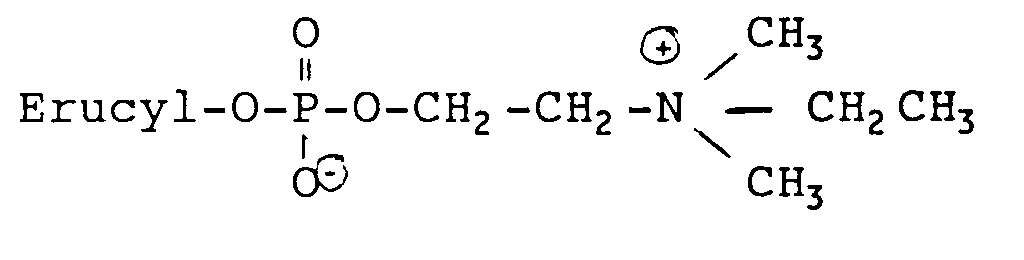
C₂₈H₅₈NO₄P, 503.749 ber.(%): C, 66.76 H, 11.61 N, 2.78 P, 6.15 gef.(%): 66.51 11.53 2.69 6.01 - Brassidyl-phospho-(N.N-dimethyl-N-ethyl)-ethanolamin
C₂₈H₅₈NO₄P; 503.749 - Erucyl-phospho-(N.N-diethyl-N-methyl)-ethanolamin

C₂₉H₆₀NO₄P; 517.776 - Brassidyl-phospho-(N.N-diethyl-N-methyl)-ethanolamin
C₂₉H₆₀NO₄P; 517.776 - Erucyl-phospho-(N.N.N-triethyl)-ethanolamin

C₃₀H₆₂NO₄P; 531.803 - Erucyl-phospho-(N.N-dimethyl-N-propyl)-ethanolamin

C₂₉H₆₀NO₄P; 517.776 - Erucyl-phospho-(N.N-dimethyl-N-isopropyl)-ethanolamin

C₂₉H₆₀NO₄P; 517.776 - Erucyl-phospho-(N-cyclopropyl-N.N-dimethyl)-ethanolamin

C₂₉H₅₈NO₄P; 515.760 - Erucyl-phospho-(N-allyl-N.N-dimethyl)-ethanolamin

C₂₉H₅₈NO₄P; 515.760 - Erucyl-phospho-(N-ethyl-N-methyl-N-propyl)-ethanolamin

C₃₀H₆₂NO₄P; 531.803 - Erucyl-phospho-(N-butyl-N.N-dimethyl)-ethanolamin

C₃₀H₆₂NO₄P; 530.803 - Erucyl-phospho-(N.N-dimethyl-N-hydroxyethyl)-ethanolamin

C₂₈H₅₈NO₅P; 519.748 - Erucyl-phospho-(N.N-dihydroxyethyl-N-methyl)-ethanolamin

C₂₉H₆₀NO₆P; 549.774 - Erucyl-phospho-(N-cyclobutyl-N.N-dimethyl)-ethanolamin

C₃₀H₆₀NO₄P; 529.787 - Erucyl-phosphorsäure-(N-methyl)-pyrrolidinoethylester

C₂₉H₅₈NO₄P; 515.760 - Erucyl-phosphorsäure-(N-ethyl)-pyrrolidinoethylester

C₃₀H₆₀NO₄P; 529.787 - Erucyl-phosphorsäure-(N-methyl)-morpholino-ethylester

C₃₀H₆₀NO₄P; 529.787 - 1-Erucyl-2-methyl-rac-glycero-3-phosphocholin

C₃₁H₆₄NO₆P; 577.828 - Die Herstellung der Verbindungen gemäß den Beispielen 20 bis 22 und 27 bis 32 erfolgt wie z.B. in der DE 32 39 817 und der dort zitierten Literatur oder wie in Beispiel 1 beschrieben.
- 1-Erucyl-2-methyl-sn-glycero-3-phosphocholin
- 3-Erucyl-2-methyl-sn-glycero-1-phosphocholin
- Alle Modifikationen bezüglich der Aminogruppe sowie der Austausch des Erucylrests gegen einen Brassidylrest, die in den Beispielen 1 bis 19 beschrieben worden sind, können auch auf das Grundgerüst 1-Erucyl-2-methyl-glycerin übertragen werden, mit der gleichen Methodologie und vergleichbaren Ausbeuten.
- 1-Erucylmercapto-2-methoxymethylpropyl-2'-(N.N.N-trimethyl)-ammonio-ethylphosphat
C₃₂H₆₆NO₅PS, 607.916
ber.(%): C, 63.23 H, 10.94 N, 2.30 P, 5.10 gef.(%): 62.95 10.89 2.26 4.98 - Die Schwefel enthaltenden Verbindungen können nach Bosies et al. (Lipids, 22 (1987) 947-951) hergestellt werden. Das entsprechende Thiol wurde jedoch nach den in Beispiel 1 zitierten Phosphorylierungsmethoden phosphoryliert und weiter umgesetzt.
- Auch hier können die Modifikationen 1 bis 19 eingeführt werden, ausgehend von dem entsprechenden Alkohol.
- 1-Erucylmercapto-2-methoxymethylpropyl-2'-(N.N-dihydroxyethyl-N-methyl)-ammonio-ethylphosphat
C₃₄H₇₀NO₇PS, 667.968 - Weiter können nach Houlihan et al. (Lipids, 22 (1987) 884-890) folgende Wirkstoffe, die Erucyl- oder Brassidyl-Reste enthalten, hergestellt werden, die auf folgendem Grundgerüst aufgebaut sind: (±) -2-{Hydroxy[tetrahydro-2-(alkyl)-methylfuran-2-yl]methoxyphosphinyloxy}-N.N.N-trimethylethaniminiumhydroxid. Der Alkohol als Grundkörper wurde jedoch nach den in Beispiel 1 zitierten Methoden phosphoryliert und weiter umgesetzt.
- Erucyl als Alkylrest C₃₂H₆₄NO₆P; 589.839

- Brassidyl als Alkylrest C₃₂H₆₄NO₆P; 589.839
- 1-Erucyl-3-methyl-rac-glycero-3-phosphocholin

C₃₁H₆₄NO₆P; 577.828 ber.(%): C, 64.44 H, 11.17 N, 2.42 P, 5.36 gef.(%): 64.29 11.11 2.39 5.31 - 1-Erucyl-3-methyl-sn-glycero-3-phosphocholin
- 3-Erucyl-1-methyl-sn-glycero-2-phosphocholin
- 1-Erucyl-propandiol-(1,3)-phosphocholin

C₃₀H₆₂NO₅P; 547.802 ber.(%): C, 65.78 H, 11.41 N, 2.56 P, 5.65 gef.(%): 65.61 11.35 2.49 5.58 - 1-Erucyl-propandiol-(1,2)-phosphocholin
C₃₀H₆₂NO₅P; 547.802 - Erucyl-glykol-phosphocholin

C₂₉H₆₀NO₅P; 533.775 ber.(%): C, 65.26 H, 11.33 N, 2.62 P, 5.80 gef.(%): 65.17 11.26 2.57 5.72 - Alle Verbindungen aus Gruppe I (Beispiel 1 bis 32) können durch analoge Verfahren auch mit Nervonylresten hergestellt werden.
- Nervonyl-Phosphocholin (cis-15-Tetracosenyl-PC)

C₂₉H₆₀NO₄P; 517.776 ber.: C, 67.27 H, 11.68 N, 2.71 P, 5.98 67.13 11.59 2.64 5.68 - Nervonyl-phospho-(N.N-dimethyl-N-ethyl)-ethanolamin

C₃₀H₆₂NO₄P; 531.803 - Nervonyl-phospho-(N.N-diethyl-N-methyl)-ethanolamin

C₃₁H₆₄NO₄P; 545.830 - Nervonylderivate, die zu den Verbindungen gemäß den Beispielen 7 bis 26 analog sind, werden nach den jeweils dort beschriebenen Verfahren hergestellt.
- Die Herstellung einer Hexadecylphosphocholin-Formulierung in Liposomen erfolgt gemäß DE 40 26 136.0. Hexadecylphosphocholin (12 mmol), Cholesterin (15 mmol) und DPPG (3 mmol) werden in 200 ml 2-Propanol unter Erwärmen gelöst. Dann wird das Lösungsmittel im Vakuum abgezogen und der feinverteilte Lipidfilm mit 300 ml Phosphatpufferlösung, pH 7,0 versetzt. Anschließend wird das Gemisch unter langsamer Rotation 60 Minuten bei 40°C gehalten.
- Anschließend wird die erhaltene Lipidsuspension in die Druckzelle der French Press überführt und bei 740 MPa ausgepreßt und dieser Vorgang dreimal wiederholt. Die gebildete Liposomendispersion wird dann 30 Minuten bei 27.000 g und 5°C zentrifugiert und der Überstand gewonnen.
- Gleichzeitig wurde eine Erucylphosphocholin-Formulierung in physiologischer NaCl-Lösung hergestellt.
- Methylnitroharnstoff-induzierte Mammakarzinome in der Ratte werden mit den wie oben hergestellten Formulierungen in einer Menge behandelt, die den angegebenen Konzentrationen von Hexadecylphosphocholin bzw. Erucylphosphocholin pro kg Ratte als Tagesdosis entspricht. Nach 4 Wochen werden die Tumorgewichte von unbehandelten Kontrolltieren auf 100 % gesetzt. Dieser Wert entspricht ungehindertem Tumorwachstum. Die Tumortiere in der behandelten Gruppe erreichen Werte zwischen 0 und 100 % im Vergleich zur Kontrollgruppe, wie in Tabelle 1 angegeben.
Tabelle 1 Wirkstoffe Formulierung Menge/Tag Wirkung* Hexadecylphosphocholin Liposomen 30 µmol < 10 % 10 µmol ∼ 90 % Erucylphosphocholin in phys. NaCl-Lös. 10 µmol < 10 % 6 µmol < 10 % 3 µmol < 10 % * Restgewicht des Tumors in % bezüglich der unbehandelten Kontrolle
Claims (24)
- Verbindungen der allgemeinen Formel I

R₁, R₂ und R₃ unabhängig voneinander je einen geradkettigen, verzweigten, cyclischen gesättigten oder ungesättigten Alkylrest mit 1 bis 4 C-Atomen, der auch eine OH-Gruppe enthalten kann und wobei zwei dieser Reste auch zu einem Ring verbunden sein können,
A eine Einfachbindung oder eine der Gruppen mit den Formeln
und X ein Sauerstoffatom ist, wenn A eine Einfachbindung ist oder ein Sauerstoff- oder Schwefelatom bedeutet, wenn A eine der Gruppen (II) bis (VII) ist. - Verbindungen nach Anspruch 1,
dadurch gekennzeichnet,
daß X ein Sauerstoffatom bedeutet. - Verbindungen nach Anspruch 1 oder 2,
dadurch gekennzeichnet,
daß A eine Einfachbindung bedeutet. - Verbindungen nach den Ansprüchen 1 bis 3,
dadurch gekennzeichnet,
daß R₁, R₂ und R₃ jeweils Methylgruppen sind. - Erucylphosphocholin.
- Verfahren zur Herstellung einer Verbindung nach einem der Ansprüche 1 bis 5,
dadurch gekennzeichnet,
daß man eine Carbonsäure der allgemeinen Formel
R - OOH (VIII)
in der R die in Anspruch 1 angegebene Bedeutung hat, mit LiAlH₄ zum entsprechenden Alkohol mit der allgemeinen Formel
R - OH (IX)
reduziert und dann auf an sich bekannte Weise zu einer Verbindung mit der allgemeinen Formel (I) umsetzt. - Arzneimittel,
dadurch gekennzeichnet,
daß es als Wirkstoff eine oder mehrere Verbindungen nach einem der Ansprüche 1 bis 5, gegebenenfalls zusammen mit pharmazeutisch üblichen Träger-, Hilfs-, Füll- und Verdünnungsmitteln enthält. - Arzneimittel nach Anspruch 7,
dadurch gekennzeichnet,
daß es als Wirkstoff Erucyl-, Brassidyl- oder Nervonylphosphocholin enthält. - Arzneimittel nach Anspruch 8,
dadurch gekennzeichnet,
daß es als Wirkstoff Erucylphosphocholin enthält. - Arzneimittel nach einem der Ansprüche 7 bis 9,
dadurch gekennzeichnet,
daß es den Wirkstoff in einer physiologischen Lösung enthält. - Arzneimittel nach einem der Ansprüche 7 bis 10,
dadurch gekennzeichnet,
daß es zusätzlich mindestens ein Alkylglycerin der allgemeinen Formel (XVI)
- Arzneimittel nach Anspruch 11,
dadurch gekennzeichnet,
daß es ein Alkylglycerin-Gemisch enthält aus Nonyl- bzw. Octylglycerin, Hexyl- bzw. Pentylglycerin und Propyl- bzw. Ethylglycerin und Wasser. - Verwendung eines Arzneimittels nach einem der Ansprüche 7 bis 12 zur Bekämpfung von Tumoren.
- Verwendung eines Arzneimittels nach einem der Ansprüche 7 bis 12 zur Bekämpfung von Protozoen- und Pilzerkrankungen, insbesondere der Leishmaniasis.
- Verwendung eines Arzneimittels nach einem der Ansprüche 7 bis 12 zur Therapie von Autoimmunerkrankungen, insbesondere von multipler Sklerose.
- Verwendung eines Arzneimittels nach einem der Ansprüche 7 bis 12 zur Therapie von Knochenmarkschädigungen durch Behandlung mit Zytostatika und anderen knochenmarkschädigenden Wirkstoffen.
- Verfahren zur Herstellung eines Antitumormittels,
dadurch gekennzeichnet,
daß man eine Formulierung herstellt, die als Wirkstoff eine oder mehrere Verbindungen nach einem der Ansprüche 1 bis 5 enthält, gegebenenfalls zusammen mit pharmazeutisch üblichen Träger-, Hilfs-, Füll- und Verdünnungsmitteln. - Verfahren zur Herstellung eines Mittels zur Bekämpfung von Protozoen- und Pilzerkrankungen, insbesondere von Leishmaniasis,
dadurch gekennzeichnet,
daß man eine Formulierung herstellt, die als Wirkstoff eine oder mehrere Verbindungen nach einem der Ansprüche 1 bis 5 enthält, gegebenenfalls zusammen mit pharmazeutisch üblichen Träger-, Hilfs-, Füll- und Verdünnungsmitteln. - Verfahren zur Herstellung eines Mittels zur Therapie von Autoimmunerkrankungen, insbesondere von Multipler Sklerose,
dadurch gekennzeichnet,
daß man eine Formulierung herstellt, die als Wirkstoff eine oder mehrere Verbindungen nach einem der Ansprüche 1 bis 5 enthält, gegebenenfalls zusammen mit pharmazeutisch üblichen Träger-, Hilfs-, Füll- und Verdünnungsmitteln. - Verfahren zur Herstellung eines Mittels zur Therapie von Knochenmarksschädigungen,
dadurch gekennzeichnet,
daß man eine Formulierung herstellt, die als Wirkstoff eine oder mehrere Verbindungen nach einem der Ansprüche 1 bis 5 enthält, gegebenenfalls zusammen mit pharmazeutisch üblichen Träger-, Hilfs-, Füll- und Verdünnungsmitteln. - Verfahren zur Bekämpfung von Tumoren, Protozoen- und Pilzerkrankungen, Autoimmunerkrankungen oder Knochenmarksschädigungen,
dadurch gekennzeichnet,
daß man dem Patienten ein Arzneimittel nach einem der Ansprüche 7 bis 12 verabreicht. - Verfahren nach Anspruch 21,
dadurch gekennzeichnet,
daß man das Arzneimittel intravenös verabreicht. - Verfahren nach Anspruch 21,
dadurch gekennzeichnet,
daß man das Arzneimittel subkutan verabreicht. - Verfahren nach Anspruch 21,
dadurch gekennzeichnet,
daß man das Arzneimittel topisch verabreicht.
Applications Claiming Priority (2)
| Application Number | Priority Date | Filing Date | Title |
|---|---|---|---|
| DE4111105 | 1991-04-05 | ||
| DE4111105A DE4111105A1 (de) | 1991-04-05 | 1991-04-05 | Neue erucyl-, brassidyl- und nervonylderivate |
Publications (3)
| Publication Number | Publication Date |
|---|---|
| EP0507337A2 true EP0507337A2 (de) | 1992-10-07 |
| EP0507337A3 EP0507337A3 (en) | 1993-01-27 |
| EP0507337B1 EP0507337B1 (de) | 1996-10-23 |
Family
ID=6428914
Family Applications (1)
| Application Number | Title | Priority Date | Filing Date |
|---|---|---|---|
| EP92105822A Expired - Lifetime EP0507337B1 (de) | 1991-04-05 | 1992-04-03 | Neue Erucyl-, Brassidyl- und Nervonylderivate |
Country Status (9)
| Country | Link |
|---|---|
| US (1) | US5436234A (de) |
| EP (1) | EP0507337B1 (de) |
| JP (1) | JP3218313B2 (de) |
| AT (1) | ATE144517T1 (de) |
| CA (1) | CA2065104C (de) |
| DE (2) | DE4111105A1 (de) |
| DK (1) | DK0507337T3 (de) |
| ES (1) | ES2093732T3 (de) |
| GR (1) | GR3021456T3 (de) |
Cited By (6)
| Publication number | Priority date | Publication date | Assignee | Title |
|---|---|---|---|---|
| WO1994002153A1 (en) * | 1992-07-22 | 1994-02-03 | Boehringer Mannheim Gmbh | Use of sulphur containing phospholipids for treating leishmaniasis |
| WO2000008031A1 (de) * | 1998-08-06 | 2000-02-17 | MAX-PLANCK-Gesellschaft zur Förderung der Wissenschaften e.V. | Phospholipide mit ungesattigen alkyl-und acylketten |
| EP1578754A4 (de) * | 2002-10-30 | 2006-07-19 | Makscientific Llc | Ringsubstituiertephospholipide mit wirkung gegen protozoen |
| WO2007071658A3 (de) * | 2005-12-19 | 2007-10-04 | Aeterna Zentaris Gmbh | Novel alkyl phospholipid derivatives with reduced cytotoxicity and uses thereof |
| WO2007147875A3 (de) * | 2006-06-21 | 2008-04-03 | Staatliches Weinbauinstitut Fr | Alkylphospholipide als wirkstoffe zur bekämpfung von pflanzenpathogenen |
| TWI391137B (zh) * | 2005-12-19 | 2013-04-01 | Aeterna Zentaris Gmbh | 細胞毒性減低之新穎烷基磷脂衍生物及其用途 |
Families Citing this family (16)
| Publication number | Priority date | Publication date | Assignee | Title |
|---|---|---|---|---|
| US5958906A (en) * | 1992-10-01 | 1999-09-28 | Asta-Medica Aktiengesellschaft | Phospholipid derivatives containing higher elements of the fifth main group |
| DE4233044A1 (de) * | 1992-10-01 | 1994-04-07 | Asta Medica Ag | Phospholipidderivate, die höhere Elemente der V. Hauptgruppe enthalten |
| EP0785773B1 (de) * | 1994-10-14 | 2001-01-03 | The Liposome Company, Inc. | Etherlipid-liposomen und deren therapeutische verwendung |
| US7517858B1 (en) * | 1995-06-07 | 2009-04-14 | The Regents Of The University Of California | Prodrugs of pharmaceuticals with improved bioavailability |
| US5942246A (en) * | 1996-02-16 | 1999-08-24 | The Liposome Company, Inc. | Etherlipid containing multiple lipid liposomes |
| US5965159A (en) * | 1996-02-16 | 1999-10-12 | The Liposome Company, Inc. | Etherlipid-containing multiple lipid liposomes |
| USRE39042E1 (en) * | 1996-02-16 | 2006-03-28 | The Liposome Company, Inc. | Etherlipid-containing multiple lipid liposomes |
| US6007839A (en) * | 1996-02-16 | 1999-12-28 | The Liposome Company, Inc. | Preparation of pharmaceutical compositions containing etherlipid-containing multiple lipid liposomes |
| US6667053B1 (en) | 1996-02-16 | 2003-12-23 | Elan Pharmaceuticals, Inc. | D and L etherlipid stereoisomers and liposomes |
| US6440980B1 (en) * | 1996-09-17 | 2002-08-27 | Avanir Pharmaceuticals | Synergistic inhibition of viral replication by long-chain hydrocarbons and nucleoside analogs |
| US5952392A (en) * | 1996-09-17 | 1999-09-14 | Avanir Pharmaceuticals | Long-chain alcohols, alkanes, fatty acids and amides in the treatment of burns and viral inhibition |
| DE10015814A1 (de) * | 2000-03-30 | 2001-10-11 | Max Planck Gesellschaft | Arzneimittel zur Stimulierung der Leukopoese, zur Behandlung von Tumor- und Protozoenerkrankungen und Verfahren zu seiner Herstellung |
| CA2421026C (en) * | 2001-10-16 | 2005-02-15 | Avanir Pharmaceuticals | Viral inhibition by n-docosanol |
| DE10242367A1 (de) * | 2002-09-12 | 2004-03-18 | MAX-PLANCK-Gesellschaft zur Förderung der Wissenschaften e.V. | Thermolabiles Liposom mit geregelter Freigabetemperatur |
| US20070167408A1 (en) * | 2005-12-19 | 2007-07-19 | Zentaris Gmbh | Novel alkyl phospholipid derivatives with reduced cytotoxicity and uses thereof |
| US20230320994A1 (en) * | 2020-08-21 | 2023-10-12 | The Board Of Regents Of The University Of Texas System | Functional ionizable phospholipids |
Family Cites Families (4)
| Publication number | Priority date | Publication date | Assignee | Title |
|---|---|---|---|---|
| EP0061872B1 (de) * | 1981-03-30 | 1985-08-07 | Takeda Chemical Industries, Ltd. | Äthylenglykolderivate, ihre Herstellung und Verwendung |
| JPS5984824A (ja) * | 1982-11-08 | 1984-05-16 | Takeda Chem Ind Ltd | 抗腫瘍剤 |
| JPS59184195A (ja) * | 1983-04-04 | 1984-10-19 | Takeda Chem Ind Ltd | グリセロ−ル誘導体 |
| IE59778B1 (en) * | 1985-12-04 | 1994-04-06 | Max Planck Gesellschaft | Medicament with anti-tumour action containing hexadecylphosphocholine |
-
1991
- 1991-04-05 DE DE4111105A patent/DE4111105A1/de not_active Withdrawn
-
1992
- 1992-04-03 AT AT92105822T patent/ATE144517T1/de active
- 1992-04-03 ES ES92105822T patent/ES2093732T3/es not_active Expired - Lifetime
- 1992-04-03 JP JP08205692A patent/JP3218313B2/ja not_active Expired - Lifetime
- 1992-04-03 CA CA002065104A patent/CA2065104C/en not_active Expired - Lifetime
- 1992-04-03 DE DE59207397T patent/DE59207397D1/de not_active Expired - Lifetime
- 1992-04-03 DK DK92105822.8T patent/DK0507337T3/da active
- 1992-04-03 EP EP92105822A patent/EP0507337B1/de not_active Expired - Lifetime
-
1994
- 1994-02-28 US US08/203,618 patent/US5436234A/en not_active Expired - Lifetime
-
1996
- 1996-10-24 GR GR960402761T patent/GR3021456T3/el unknown
Cited By (10)
| Publication number | Priority date | Publication date | Assignee | Title |
|---|---|---|---|---|
| WO1994002153A1 (en) * | 1992-07-22 | 1994-02-03 | Boehringer Mannheim Gmbh | Use of sulphur containing phospholipids for treating leishmaniasis |
| WO2000008031A1 (de) * | 1998-08-06 | 2000-02-17 | MAX-PLANCK-Gesellschaft zur Förderung der Wissenschaften e.V. | Phospholipide mit ungesattigen alkyl-und acylketten |
| US8129552B2 (en) | 1998-08-06 | 2012-03-06 | Max-Planck-Gesellschaft Zur Forderung Der Wissenschaften E.V. | Phospholipids with unsaturated alkyl and acyl chains |
| EP1578754A4 (de) * | 2002-10-30 | 2006-07-19 | Makscientific Llc | Ringsubstituiertephospholipide mit wirkung gegen protozoen |
| US8097752B2 (en) | 2002-10-30 | 2012-01-17 | Makscientific, Llc | Antiprotozoal ring-substituted phospholipids |
| WO2007071658A3 (de) * | 2005-12-19 | 2007-10-04 | Aeterna Zentaris Gmbh | Novel alkyl phospholipid derivatives with reduced cytotoxicity and uses thereof |
| RU2469727C2 (ru) * | 2005-12-19 | 2012-12-20 | Этерна Центарис ГмбХ | Способ лечения или профилактики заболеваний и/или патофизиологических состояний, вызванных микроорганизмами, посредством производных алкилфосфолипидов |
| TWI391137B (zh) * | 2005-12-19 | 2013-04-01 | Aeterna Zentaris Gmbh | 細胞毒性減低之新穎烷基磷脂衍生物及其用途 |
| WO2007147875A3 (de) * | 2006-06-21 | 2008-04-03 | Staatliches Weinbauinstitut Fr | Alkylphospholipide als wirkstoffe zur bekämpfung von pflanzenpathogenen |
| AU2007263018B2 (en) * | 2006-06-21 | 2012-09-13 | Ktb-Tumorforschungs Gmbh | Alkylphospholipids as active agents for prevention of plant pathogens |
Also Published As
| Publication number | Publication date |
|---|---|
| JP3218313B2 (ja) | 2001-10-15 |
| ATE144517T1 (de) | 1996-11-15 |
| JPH0597878A (ja) | 1993-04-20 |
| CA2065104A1 (en) | 1992-10-06 |
| EP0507337B1 (de) | 1996-10-23 |
| EP0507337A3 (en) | 1993-01-27 |
| DE4111105A1 (de) | 1992-10-08 |
| CA2065104C (en) | 2002-10-01 |
| ES2093732T3 (es) | 1997-01-01 |
| DE59207397D1 (de) | 1996-11-28 |
| DK0507337T3 (da) | 1997-03-24 |
| US5436234A (en) | 1995-07-25 |
| GR3021456T3 (en) | 1997-01-31 |
Similar Documents
| Publication | Publication Date | Title |
|---|---|---|
| EP0507337B1 (de) | Neue Erucyl-, Brassidyl- und Nervonylderivate | |
| EP0248062B1 (de) | Arzeimittel | |
| DE69822514T2 (de) | Wasserlösliche pro-pharmaka von arzneistoffen, die ein tertiäres amin enthalten, und verfahren zu ihrer herstellung | |
| EP0188749A2 (de) | Fumarsäurederivate, Verfahren zu ihrer Herstellung und sie enthaltende pharmazeutische Zubereitungen | |
| EP0534445A1 (de) | Verfahren zur Herstellung eines Arzneimittels zur oralen oder topischen Verabreichung bei der Behandlung von Leishmaniasis | |
| WO1999009037A1 (de) | Phospholipidanaloge verbindungen | |
| DE69818823T2 (de) | Dipohosphonsäuresalze für die behandlung von osteoporose | |
| EP0154977A2 (de) | Glycerinäther-phosphatide, ihre Herstellung und Verwendung | |
| EP0112872A1 (de) | Neue glycerinderivate zur synthese von phospholipiden | |
| EP0002062B1 (de) | Phosphororganische Ringverbindungen, Verfahren zu ihrer Herstellung und ihre Verwendung | |
| EP1827379B1 (de) | Formulierungen mit alkylphosphocholinen unter verwendung von neuen negativen ladungsträgern | |
| DE19810999A1 (de) | Verwendung von Sphingosin, Sphingosin-1-Phosphat, Sphingosin-1-Phosphat-Derivaten und/oder deren Gemischen zur Behandlung von entzündlichen Hautkrankheiten | |
| EP0112871B1 (de) | Derivate des n.n-bis(2-chlor-äthyl)-phosphorsäureamids | |
| EP0521353B1 (de) | Arzneimittel mit antineoplastischer Wirkung enthaltend als Wirkstoff Octadecyl-[2-(N-methylpiperidino)-ethyl]-phosphat und Verfahren zu dessen Herstellung | |
| DE2446640A1 (de) | Neue gentamicinderivate, verfahren zur herstellung derselben und diese enthaltende antibiotisch wirksame zusammensetzungen | |
| DE60118625T2 (de) | Stabilisierte ascorbinsäure -3- phosphat- derivate | |
| EP1443921B1 (de) | Herstellung reiner stereoisomere von tricyclo-[5.2.1.0(2.6) ]-dec-9-yl-xanthogenat sowie deren verwendung als arzneimittel | |
| EP1521761B1 (de) | Cdg-therapie mit mannose | |
| DE69828524T2 (de) | Tetrahydrofuran-phosphat- und hydroxy-ester als prodrugs der entsprechenden antifungiziden mittel | |
| AT393505B (de) | Arzneimittel, welche alkylphosphoamine in kombination mit einem alkylglycerin enthalten | |
| DE3220672A1 (de) | Cis-oxazaphosphorin-4-thio-alkansulfonsaeuren, ihre neutralen salze, verfahren zur herstellung derselben und diese enthaltenden pharmazeutischen praeparate | |
| DE69328585T2 (de) | Neue Alkaloidderivate, ihre Verwendung und diese enthaltende pharmazeutische Formulierungen | |
| DE2238304A1 (de) | Choleretisch wirksame ester bzw. salze von gallensaeuren, verfahren zu ihrer herstellung und diese verbindungen enthaltende arzneipraeparate | |
| DE3701461C2 (de) | ||
| DE1004194B (de) | Verfahren zur Herstellung von einheitlichen, hautvertraeglichen tertiaeren N-(ª‰,ª†-Dioxypropyl)-aminen |
Legal Events
| Date | Code | Title | Description |
|---|---|---|---|
| PUAI | Public reference made under article 153(3) epc to a published international application that has entered the european phase |
Free format text: ORIGINAL CODE: 0009012 |
|
| AK | Designated contracting states |
Kind code of ref document: A2 Designated state(s): AT BE CH DE DK ES FR GB GR IT LI LU MC NL PT SE |
|
| PUAL | Search report despatched |
Free format text: ORIGINAL CODE: 0009013 |
|
| AK | Designated contracting states |
Kind code of ref document: A3 Designated state(s): AT BE CH DE DK ES FR GB GR IT LI LU MC NL PT SE |
|
| 17P | Request for examination filed |
Effective date: 19930312 |
|
| 17Q | First examination report despatched |
Effective date: 19950313 |
|
| GRAH | Despatch of communication of intention to grant a patent |
Free format text: ORIGINAL CODE: EPIDOS IGRA |
|
| GRAH | Despatch of communication of intention to grant a patent |
Free format text: ORIGINAL CODE: EPIDOS IGRA |
|
| GRAA | (expected) grant |
Free format text: ORIGINAL CODE: 0009210 |
|
| AK | Designated contracting states |
Kind code of ref document: B1 Designated state(s): AT BE CH DE DK ES FR GB GR IT LI LU MC NL PT SE |
|
| REF | Corresponds to: |
Ref document number: 144517 Country of ref document: AT Date of ref document: 19961115 Kind code of ref document: T |
|
| ITF | It: translation for a ep patent filed | ||
| REG | Reference to a national code |
Ref country code: CH Ref legal event code: NV Representative=s name: E. BLUM & CO. PATENTANWAELTE |
|
| GBT | Gb: translation of ep patent filed (gb section 77(6)(a)/1977) |
Effective date: 19961023 |
|
| REF | Corresponds to: |
Ref document number: 59207397 Country of ref document: DE Date of ref document: 19961128 |
|
| ET | Fr: translation filed | ||
| REG | Reference to a national code |
Ref country code: GR Ref legal event code: FG4A Free format text: 3021456 |
|
| REG | Reference to a national code |
Ref country code: ES Ref legal event code: FG2A Ref document number: 2093732 Country of ref document: ES Kind code of ref document: T3 |
|
| REG | Reference to a national code |
Ref country code: PT Ref legal event code: SC4A Free format text: AVAILABILITY OF NATIONAL TRANSLATION Effective date: 19961029 |
|
| REG | Reference to a national code |
Ref country code: DK Ref legal event code: T3 |
|
| PLBE | No opposition filed within time limit |
Free format text: ORIGINAL CODE: 0009261 |
|
| STAA | Information on the status of an ep patent application or granted ep patent |
Free format text: STATUS: NO OPPOSITION FILED WITHIN TIME LIMIT |
|
| 26N | No opposition filed | ||
| REG | Reference to a national code |
Ref country code: GB Ref legal event code: IF02 |
|
| REG | Reference to a national code |
Ref country code: CH Ref legal event code: PFA Owner name: MAX-PLANCK-GESELLSCHAFT ZUR FOERDERUNG DER WISSEN Free format text: MAX-PLANCK-GESELLSCHAFT ZUR FOERDERUNG DER WISSENSCHAFTEN E.V.#BUNSENSTRASSE 10#D-37073 GOETTINGEN (DE) -TRANSFER TO- MAX-PLANCK-GESELLSCHAFT ZUR FOERDERUNG DER WISSENSCHAFTEN E.V.#BUNSENSTRASSE 10#D-37073 GOETTINGEN (DE) |
|
| PGFP | Annual fee paid to national office [announced via postgrant information from national office to epo] |
Ref country code: PT Payment date: 20110329 Year of fee payment: 20 Ref country code: LU Payment date: 20110429 Year of fee payment: 20 |
|
| PGFP | Annual fee paid to national office [announced via postgrant information from national office to epo] |
Ref country code: SE Payment date: 20110414 Year of fee payment: 20 Ref country code: DE Payment date: 20110131 Year of fee payment: 20 Ref country code: ES Payment date: 20110426 Year of fee payment: 20 Ref country code: MC Payment date: 20110414 Year of fee payment: 20 Ref country code: FR Payment date: 20110510 Year of fee payment: 20 Ref country code: CH Payment date: 20110428 Year of fee payment: 20 Ref country code: GR Payment date: 20110418 Year of fee payment: 20 |
|
| PGFP | Annual fee paid to national office [announced via postgrant information from national office to epo] |
Ref country code: GB Payment date: 20110421 Year of fee payment: 20 Ref country code: BE Payment date: 20110414 Year of fee payment: 20 Ref country code: DK Payment date: 20110418 Year of fee payment: 20 Ref country code: NL Payment date: 20110426 Year of fee payment: 20 Ref country code: AT Payment date: 20110414 Year of fee payment: 20 |
|
| PGFP | Annual fee paid to national office [announced via postgrant information from national office to epo] |
Ref country code: IT Payment date: 20110422 Year of fee payment: 20 |
|
| REG | Reference to a national code |
Ref country code: DE Ref legal event code: R071 Ref document number: 59207397 Country of ref document: DE |
|
| REG | Reference to a national code |
Ref country code: DE Ref legal event code: R071 Ref document number: 59207397 Country of ref document: DE |
|
| REG | Reference to a national code |
Ref country code: PT Ref legal event code: MM4A Free format text: MAXIMUM VALIDITY LIMIT REACHED Effective date: 20120403 Ref country code: NL Ref legal event code: V4 Effective date: 20120403 |
|
| REG | Reference to a national code |
Ref country code: CH Ref legal event code: PL |
|
| REG | Reference to a national code |
Ref country code: DK Ref legal event code: EUP |
|
| REG | Reference to a national code |
Ref country code: GB Ref legal event code: PE20 Expiry date: 20120402 |
|
| BE20 | Be: patent expired |
Owner name: *MAX-PLANCK-GESELLSCHAFT ZUR FORDERUNG DER WISSENS Effective date: 20120403 |
|
| REG | Reference to a national code |
Ref country code: GR Ref legal event code: MA Ref document number: 960402761 Country of ref document: GR Effective date: 20120404 |
|
| PG25 | Lapsed in a contracting state [announced via postgrant information from national office to epo] |
Ref country code: GB Free format text: LAPSE BECAUSE OF EXPIRATION OF PROTECTION Effective date: 20120402 |
|
| REG | Reference to a national code |
Ref country code: SE Ref legal event code: EUG |
|
| PG25 | Lapsed in a contracting state [announced via postgrant information from national office to epo] |
Ref country code: DE Free format text: LAPSE BECAUSE OF EXPIRATION OF PROTECTION Effective date: 20120404 |
|
| PG25 | Lapsed in a contracting state [announced via postgrant information from national office to epo] |
Ref country code: PT Free format text: LAPSE BECAUSE OF EXPIRATION OF PROTECTION Effective date: 20120411 |
|
| REG | Reference to a national code |
Ref country code: AT Ref legal event code: MK07 Ref document number: 144517 Country of ref document: AT Kind code of ref document: T Effective date: 20120403 |
|
| REG | Reference to a national code |
Ref country code: ES Ref legal event code: FD2A Effective date: 20130730 |
|
| PG25 | Lapsed in a contracting state [announced via postgrant information from national office to epo] |
Ref country code: ES Free format text: LAPSE BECAUSE OF EXPIRATION OF PROTECTION Effective date: 20120404 |