EP0506959B1 - Gravierverfahren mit bildmaske und lichtempfindlicher laminatfilm für besagte bildmaske - Google Patents
Gravierverfahren mit bildmaske und lichtempfindlicher laminatfilm für besagte bildmaske Download PDFInfo
- Publication number
- EP0506959B1 EP0506959B1 EP90915189A EP90915189A EP0506959B1 EP 0506959 B1 EP0506959 B1 EP 0506959B1 EP 90915189 A EP90915189 A EP 90915189A EP 90915189 A EP90915189 A EP 90915189A EP 0506959 B1 EP0506959 B1 EP 0506959B1
- Authority
- EP
- European Patent Office
- Prior art keywords
- image
- layer
- water
- photo
- mask
- Prior art date
- Legal status (The legal status is an assumption and is not a legal conclusion. Google has not performed a legal analysis and makes no representation as to the accuracy of the status listed.)
- Expired - Lifetime
Links
- 238000000034 method Methods 0.000 title claims abstract description 60
- 239000005001 laminate film Substances 0.000 title claims abstract description 40
- 239000000463 material Substances 0.000 claims abstract description 53
- 239000011342 resin composition Substances 0.000 claims abstract description 40
- XLYOFNOQVPJJNP-UHFFFAOYSA-N water Substances O XLYOFNOQVPJJNP-UHFFFAOYSA-N 0.000 claims abstract description 16
- 238000005530 etching Methods 0.000 claims description 29
- 229920005989 resin Polymers 0.000 claims description 23
- 239000011347 resin Substances 0.000 claims description 23
- 238000005488 sandblasting Methods 0.000 claims description 16
- 239000004372 Polyvinyl alcohol Substances 0.000 claims description 12
- 229920002451 polyvinyl alcohol Polymers 0.000 claims description 12
- 239000007864 aqueous solution Substances 0.000 claims description 10
- 239000000126 substance Substances 0.000 claims description 8
- 229920003169 water-soluble polymer Polymers 0.000 claims description 8
- 229920000642 polymer Polymers 0.000 claims description 6
- JQWHASGSAFIOCM-UHFFFAOYSA-M sodium periodate Chemical compound [Na+].[O-]I(=O)(=O)=O JQWHASGSAFIOCM-UHFFFAOYSA-M 0.000 claims description 6
- DHKHKXVYLBGOIT-UHFFFAOYSA-N acetaldehyde Diethyl Acetal Natural products CCOC(C)OCC DHKHKXVYLBGOIT-UHFFFAOYSA-N 0.000 claims description 4
- 150000001241 acetals Chemical class 0.000 claims description 4
- 238000004132 cross linking Methods 0.000 claims description 4
- AMXOYNBUYSYVKV-UHFFFAOYSA-M lithium bromide Chemical compound [Li+].[Br-] AMXOYNBUYSYVKV-UHFFFAOYSA-M 0.000 claims description 4
- KWGKDLIKAYFUFQ-UHFFFAOYSA-M lithium chloride Chemical compound [Li+].[Cl-] KWGKDLIKAYFUFQ-UHFFFAOYSA-M 0.000 claims description 4
- IIPYXGDZVMZOAP-UHFFFAOYSA-N lithium nitrate Chemical compound [Li+].[O-][N+]([O-])=O IIPYXGDZVMZOAP-UHFFFAOYSA-N 0.000 claims description 4
- YVXDRFYHWWPSOA-BQYQJAHWSA-N 1-methyl-4-[(e)-2-phenylethenyl]pyridin-1-ium Chemical group C1=C[N+](C)=CC=C1\C=C\C1=CC=CC=C1 YVXDRFYHWWPSOA-BQYQJAHWSA-N 0.000 claims description 3
- UXVMQQNJUSDDNG-UHFFFAOYSA-L Calcium chloride Chemical compound [Cl-].[Cl-].[Ca+2] UXVMQQNJUSDDNG-UHFFFAOYSA-L 0.000 claims description 3
- 239000001856 Ethyl cellulose Substances 0.000 claims description 3
- ZZSNKZQZMQGXPY-UHFFFAOYSA-N Ethyl cellulose Chemical compound CCOCC1OC(OC)C(OCC)C(OCC)C1OC1C(O)C(O)C(OC)C(CO)O1 ZZSNKZQZMQGXPY-UHFFFAOYSA-N 0.000 claims description 3
- 239000004793 Polystyrene Substances 0.000 claims description 3
- 239000001110 calcium chloride Substances 0.000 claims description 3
- 229910001628 calcium chloride Inorganic materials 0.000 claims description 3
- 229920001249 ethyl cellulose Polymers 0.000 claims description 3
- 235000019325 ethyl cellulose Nutrition 0.000 claims description 3
- 238000010438 heat treatment Methods 0.000 claims description 3
- 238000012986 modification Methods 0.000 claims description 3
- 230000004048 modification Effects 0.000 claims description 3
- 229920002223 polystyrene Polymers 0.000 claims description 3
- 239000004800 polyvinyl chloride Substances 0.000 claims description 3
- 229920000915 polyvinyl chloride Polymers 0.000 claims description 3
- 238000005406 washing Methods 0.000 claims description 3
- CNCOEDDPFOAUMB-UHFFFAOYSA-N N-Methylolacrylamide Chemical compound OCNC(=O)C=C CNCOEDDPFOAUMB-UHFFFAOYSA-N 0.000 claims description 2
- 239000000020 Nitrocellulose Substances 0.000 claims description 2
- 239000004952 Polyamide Substances 0.000 claims description 2
- FJWGYAHXMCUOOM-QHOUIDNNSA-N [(2s,3r,4s,5r,6r)-2-[(2r,3r,4s,5r,6s)-4,5-dinitrooxy-2-(nitrooxymethyl)-6-[(2r,3r,4s,5r,6s)-4,5,6-trinitrooxy-2-(nitrooxymethyl)oxan-3-yl]oxyoxan-3-yl]oxy-3,5-dinitrooxy-6-(nitrooxymethyl)oxan-4-yl] nitrate Chemical compound O([C@@H]1O[C@@H]([C@H]([C@H](O[N+]([O-])=O)[C@H]1O[N+]([O-])=O)O[C@H]1[C@@H]([C@@H](O[N+]([O-])=O)[C@H](O[N+]([O-])=O)[C@@H](CO[N+]([O-])=O)O1)O[N+]([O-])=O)CO[N+](=O)[O-])[C@@H]1[C@@H](CO[N+]([O-])=O)O[C@@H](O[N+]([O-])=O)[C@H](O[N+]([O-])=O)[C@H]1O[N+]([O-])=O FJWGYAHXMCUOOM-QHOUIDNNSA-N 0.000 claims description 2
- 150000001298 alcohols Chemical class 0.000 claims description 2
- SOIFLUNRINLCBN-UHFFFAOYSA-N ammonium thiocyanate Chemical compound [NH4+].[S-]C#N SOIFLUNRINLCBN-UHFFFAOYSA-N 0.000 claims description 2
- 229920002301 cellulose acetate Polymers 0.000 claims description 2
- 229920001220 nitrocellulos Polymers 0.000 claims description 2
- 229920002037 poly(vinyl butyral) polymer Polymers 0.000 claims description 2
- 229920002647 polyamide Polymers 0.000 claims description 2
- 239000011521 glass Substances 0.000 abstract description 21
- 229910052751 metal Inorganic materials 0.000 abstract description 6
- 239000002184 metal Substances 0.000 abstract description 6
- 229920003023 plastic Polymers 0.000 abstract description 5
- 239000004033 plastic Substances 0.000 abstract description 5
- 230000001678 irradiating effect Effects 0.000 abstract description 2
- 238000000059 patterning Methods 0.000 abstract 1
- 239000010410 layer Substances 0.000 description 87
- 238000011161 development Methods 0.000 description 13
- KRHYYFGTRYWZRS-UHFFFAOYSA-N Fluorane Chemical compound F KRHYYFGTRYWZRS-UHFFFAOYSA-N 0.000 description 10
- 239000000243 solution Substances 0.000 description 8
- 238000012545 processing Methods 0.000 description 7
- 239000000758 substrate Substances 0.000 description 6
- -1 for instance Substances 0.000 description 5
- 239000007788 liquid Substances 0.000 description 5
- 239000012790 adhesive layer Substances 0.000 description 4
- 230000004075 alteration Effects 0.000 description 4
- 239000012528 membrane Substances 0.000 description 4
- 238000005507 spraying Methods 0.000 description 4
- UHOVQNZJYSORNB-UHFFFAOYSA-N Benzene Chemical compound C1=CC=CC=C1 UHOVQNZJYSORNB-UHFFFAOYSA-N 0.000 description 3
- HEMHJVSKTPXQMS-UHFFFAOYSA-M Sodium hydroxide Chemical compound [OH-].[Na+] HEMHJVSKTPXQMS-UHFFFAOYSA-M 0.000 description 3
- 239000000853 adhesive Substances 0.000 description 3
- 230000001070 adhesive effect Effects 0.000 description 3
- 238000004519 manufacturing process Methods 0.000 description 3
- 150000002739 metals Chemical class 0.000 description 3
- 229920006267 polyester film Polymers 0.000 description 3
- CSCPPACGZOOCGX-UHFFFAOYSA-N Acetone Chemical compound CC(C)=O CSCPPACGZOOCGX-UHFFFAOYSA-N 0.000 description 2
- 229920000298 Cellophane Polymers 0.000 description 2
- RYGMFSIKBFXOCR-UHFFFAOYSA-N Copper Chemical compound [Cu] RYGMFSIKBFXOCR-UHFFFAOYSA-N 0.000 description 2
- VEXZGXHMUGYJMC-UHFFFAOYSA-N Hydrochloric acid Chemical compound Cl VEXZGXHMUGYJMC-UHFFFAOYSA-N 0.000 description 2
- XEEYBQQBJWHFJM-UHFFFAOYSA-N Iron Chemical compound [Fe] XEEYBQQBJWHFJM-UHFFFAOYSA-N 0.000 description 2
- 229910021578 Iron(III) chloride Inorganic materials 0.000 description 2
- QAOWNCQODCNURD-UHFFFAOYSA-N Sulfuric acid Chemical compound OS(O)(=O)=O QAOWNCQODCNURD-UHFFFAOYSA-N 0.000 description 2
- 238000005422 blasting Methods 0.000 description 2
- 239000011248 coating agent Substances 0.000 description 2
- 238000000576 coating method Methods 0.000 description 2
- 229910052802 copper Inorganic materials 0.000 description 2
- 239000010949 copper Substances 0.000 description 2
- RBTARNINKXHZNM-UHFFFAOYSA-K iron trichloride Chemical compound Cl[Fe](Cl)Cl RBTARNINKXHZNM-UHFFFAOYSA-K 0.000 description 2
- 229910001507 metal halide Inorganic materials 0.000 description 2
- 150000005309 metal halides Chemical class 0.000 description 2
- 239000011259 mixed solution Substances 0.000 description 2
- 239000000203 mixture Substances 0.000 description 2
- 238000000465 moulding Methods 0.000 description 2
- 239000004745 nonwoven fabric Substances 0.000 description 2
- 239000002245 particle Substances 0.000 description 2
- 238000007639 printing Methods 0.000 description 2
- 238000007650 screen-printing Methods 0.000 description 2
- 238000000926 separation method Methods 0.000 description 2
- 239000004575 stone Substances 0.000 description 2
- 238000012546 transfer Methods 0.000 description 2
- QLAJNZSPVITUCQ-UHFFFAOYSA-N 1,3,2-dioxathietane 2,2-dioxide Chemical compound O=S1(=O)OCO1 QLAJNZSPVITUCQ-UHFFFAOYSA-N 0.000 description 1
- ZCDADJXRUCOCJE-UHFFFAOYSA-N 2-chlorothioxanthen-9-one Chemical compound C1=CC=C2C(=O)C3=CC(Cl)=CC=C3SC2=C1 ZCDADJXRUCOCJE-UHFFFAOYSA-N 0.000 description 1
- NIXOWILDQLNWCW-UHFFFAOYSA-M Acrylate Chemical compound [O-]C(=O)C=C NIXOWILDQLNWCW-UHFFFAOYSA-M 0.000 description 1
- 229910000881 Cu alloy Inorganic materials 0.000 description 1
- VGGSQFUCUMXWEO-UHFFFAOYSA-N Ethene Chemical compound C=C VGGSQFUCUMXWEO-UHFFFAOYSA-N 0.000 description 1
- 239000005977 Ethylene Substances 0.000 description 1
- 239000004698 Polyethylene Substances 0.000 description 1
- 239000004743 Polypropylene Substances 0.000 description 1
- XTXRWKRVRITETP-UHFFFAOYSA-N Vinyl acetate Chemical compound CC(=O)OC=C XTXRWKRVRITETP-UHFFFAOYSA-N 0.000 description 1
- HVVWZTWDBSEWIH-UHFFFAOYSA-N [2-(hydroxymethyl)-3-prop-2-enoyloxy-2-(prop-2-enoyloxymethyl)propyl] prop-2-enoate Chemical compound C=CC(=O)OCC(CO)(COC(=O)C=C)COC(=O)C=C HVVWZTWDBSEWIH-UHFFFAOYSA-N 0.000 description 1
- 230000001464 adherent effect Effects 0.000 description 1
- 230000001476 alcoholic effect Effects 0.000 description 1
- 230000015572 biosynthetic process Effects 0.000 description 1
- 229910021538 borax Inorganic materials 0.000 description 1
- 238000006243 chemical reaction Methods 0.000 description 1
- 239000003795 chemical substances by application Substances 0.000 description 1
- 229920006026 co-polymeric resin Polymers 0.000 description 1
- 238000010276 construction Methods 0.000 description 1
- 239000003431 cross linking reagent Substances 0.000 description 1
- 239000003599 detergent Substances 0.000 description 1
- 238000010586 diagram Methods 0.000 description 1
- 125000000664 diazo group Chemical group [N-]=[N+]=[*] 0.000 description 1
- 239000006185 dispersion Substances 0.000 description 1
- 238000004090 dissolution Methods 0.000 description 1
- 238000001035 drying Methods 0.000 description 1
- 239000000839 emulsion Substances 0.000 description 1
- 239000003365 glass fiber Substances 0.000 description 1
- 229910052742 iron Inorganic materials 0.000 description 1
- 239000010985 leather Substances 0.000 description 1
- QSHDDOUJBYECFT-UHFFFAOYSA-N mercury Chemical compound [Hg] QSHDDOUJBYECFT-UHFFFAOYSA-N 0.000 description 1
- 229910052753 mercury Inorganic materials 0.000 description 1
- 230000007935 neutral effect Effects 0.000 description 1
- 239000002736 nonionic surfactant Substances 0.000 description 1
- 239000003960 organic solvent Substances 0.000 description 1
- 239000000049 pigment Substances 0.000 description 1
- 229920006289 polycarbonate film Polymers 0.000 description 1
- 229920000573 polyethylene Polymers 0.000 description 1
- 238000006116 polymerization reaction Methods 0.000 description 1
- 229920001155 polypropylene Polymers 0.000 description 1
- 229920002689 polyvinyl acetate Polymers 0.000 description 1
- 239000011118 polyvinyl acetate Substances 0.000 description 1
- 239000001057 purple pigment Substances 0.000 description 1
- 239000004576 sand Substances 0.000 description 1
- 238000007127 saponification reaction Methods 0.000 description 1
- 235000010339 sodium tetraborate Nutrition 0.000 description 1
- 125000006850 spacer group Chemical group 0.000 description 1
- 239000004094 surface-active agent Substances 0.000 description 1
- 229920003002 synthetic resin Polymers 0.000 description 1
- 239000000057 synthetic resin Substances 0.000 description 1
- BSVBQGMMJUBVOD-UHFFFAOYSA-N trisodium borate Chemical compound [Na+].[Na+].[Na+].[O-]B([O-])[O-] BSVBQGMMJUBVOD-UHFFFAOYSA-N 0.000 description 1
- 229910052724 xenon Inorganic materials 0.000 description 1
- FHNFHKCVQCLJFQ-UHFFFAOYSA-N xenon atom Chemical compound [Xe] FHNFHKCVQCLJFQ-UHFFFAOYSA-N 0.000 description 1
Images


Classifications
-
- G—PHYSICS
- G03—PHOTOGRAPHY; CINEMATOGRAPHY; ANALOGOUS TECHNIQUES USING WAVES OTHER THAN OPTICAL WAVES; ELECTROGRAPHY; HOLOGRAPHY
- G03F—PHOTOMECHANICAL PRODUCTION OF TEXTURED OR PATTERNED SURFACES, e.g. FOR PRINTING, FOR PROCESSING OF SEMICONDUCTOR DEVICES; MATERIALS THEREFOR; ORIGINALS THEREFOR; APPARATUS SPECIALLY ADAPTED THEREFOR
- G03F7/00—Photomechanical, e.g. photolithographic, production of textured or patterned surfaces, e.g. printing surfaces; Materials therefor, e.g. comprising photoresists; Apparatus specially adapted therefor
- G03F7/26—Processing photosensitive materials; Apparatus therefor
- G03F7/34—Imagewise removal by selective transfer, e.g. peeling away
-
- B—PERFORMING OPERATIONS; TRANSPORTING
- B24—GRINDING; POLISHING
- B24C—ABRASIVE OR RELATED BLASTING WITH PARTICULATE MATERIAL
- B24C1/00—Methods for use of abrasive blasting for producing particular effects; Use of auxiliary equipment in connection with such methods
- B24C1/04—Methods for use of abrasive blasting for producing particular effects; Use of auxiliary equipment in connection with such methods for treating only selected parts of a surface, e.g. for carving stone or glass
-
- G—PHYSICS
- G03—PHOTOGRAPHY; CINEMATOGRAPHY; ANALOGOUS TECHNIQUES USING WAVES OTHER THAN OPTICAL WAVES; ELECTROGRAPHY; HOLOGRAPHY
- G03F—PHOTOMECHANICAL PRODUCTION OF TEXTURED OR PATTERNED SURFACES, e.g. FOR PRINTING, FOR PROCESSING OF SEMICONDUCTOR DEVICES; MATERIALS THEREFOR; ORIGINALS THEREFOR; APPARATUS SPECIALLY ADAPTED THEREFOR
- G03F7/00—Photomechanical, e.g. photolithographic, production of textured or patterned surfaces, e.g. printing surfaces; Materials therefor, e.g. comprising photoresists; Apparatus specially adapted therefor
- G03F7/12—Production of screen printing forms or similar printing forms, e.g. stencils
-
- G—PHYSICS
- G03—PHOTOGRAPHY; CINEMATOGRAPHY; ANALOGOUS TECHNIQUES USING WAVES OTHER THAN OPTICAL WAVES; ELECTROGRAPHY; HOLOGRAPHY
- G03F—PHOTOMECHANICAL PRODUCTION OF TEXTURED OR PATTERNED SURFACES, e.g. FOR PRINTING, FOR PROCESSING OF SEMICONDUCTOR DEVICES; MATERIALS THEREFOR; ORIGINALS THEREFOR; APPARATUS SPECIALLY ADAPTED THEREFOR
- G03F7/00—Photomechanical, e.g. photolithographic, production of textured or patterned surfaces, e.g. printing surfaces; Materials therefor, e.g. comprising photoresists; Apparatus specially adapted therefor
- G03F7/26—Processing photosensitive materials; Apparatus therefor
- G03F7/34—Imagewise removal by selective transfer, e.g. peeling away
- G03F7/346—Imagewise removal by selective transfer, e.g. peeling away using photosensitive materials other than non-macromolecular photopolymerisable compounds having carbon-to-carbon double bonds
-
- Y—GENERAL TAGGING OF NEW TECHNOLOGICAL DEVELOPMENTS; GENERAL TAGGING OF CROSS-SECTIONAL TECHNOLOGIES SPANNING OVER SEVERAL SECTIONS OF THE IPC; TECHNICAL SUBJECTS COVERED BY FORMER USPC CROSS-REFERENCE ART COLLECTIONS [XRACs] AND DIGESTS
- Y10—TECHNICAL SUBJECTS COVERED BY FORMER USPC
- Y10S—TECHNICAL SUBJECTS COVERED BY FORMER USPC CROSS-REFERENCE ART COLLECTIONS [XRACs] AND DIGESTS
- Y10S430/00—Radiation imagery chemistry: process, composition, or product thereof
- Y10S430/1053—Imaging affecting physical property or radiation sensitive material, or producing nonplanar or printing surface - process, composition, or product: radiation sensitive composition or product or process of making binder containing
- Y10S430/1055—Radiation sensitive composition or product or process of making
- Y10S430/106—Binder containing
- Y10S430/11—Vinyl alcohol polymer or derivative
Definitions
- the present invention relates to a method for forming images by engraving through sand blasting or by etching with chemicals, for instance, solutions of etching agents through an image-carrying mask such as picture images, patterns or letters on the surface of materials to be processed such as glass, stone, pottery, metals, plastics, wooden materials and leather as well as a photo-sensitive laminate film for use in making such an image-carrying mask.
- an image-carrying mask such as picture images, patterns or letters on the surface of materials to be processed such as glass, stone, pottery, metals, plastics, wooden materials and leather as well as a photo-sensitive laminate film for use in making such an image-carrying mask.
- Conventionally known methods for processing the surface of a material such as glass, a metal or a plastic by engraving images on the surface comprise the steps of first forming a resist layer, in the form of images, on the surface of a material to be processed and then subjecting the entire surface inclusive of the surface of the resist layer to sand blasting to thus engrave the surface on which any image is not present and to thereby form the images thereon.
- a treatment of the surface with hydrofluoric acid can be substituted for the sand blasting treatment and thus desired images can be formed on the surface through engraving and/or etching of the surface portion on which any image is not present.
- the material to be processed is a copper plate
- the surface can also be treated with an agueous solution of ferric chloride and thus the desired images can be formed through engraving and/or etching of the surface portion on which any image is not present.
- a resist layer can be performed according to a method which comprises printing desired images on the surface of a material to be processed with a resist ink according to the screen printing method to thus form a resist layer in the form of desired images.
- a resist layer can also be formed by likewise printing images on the surface of a non-woven fabric of glass fibers according to the screen printing method and then adhering the resulting non-woven fabric carrying the printed images to the surface of a material to be processed.
- J.P. KOKOKU Japanese Patent Publication for Opposition Purpose
- Sho 46-35681 discloses a method for producing an image carrying mask which comprises the steps of enclosing a predetermined surface area of a material to be processed such as glass with a rubber frame, directly pouring a photo-sensitive resin into the enclosed area, covering the area with a cellophane film, exposing the resin to light through a negative film carrying pictures and/or patterns, peeling off the cellophane film and then developing the imagewise exposed photo-sensitive resin to thus form a resist layer carrying the desired images.
- a material to be processed such as glass with a rubber frame
- J.P. KOKAI Japanese Patent Unexamined publication
- Sho 53-99258 discloses a method for producing an image-carrying mask which comprises sandwiching a liquid photo-sensitive resin composition between two transparent films to form a photo-sensitive resin composition between two transparent films to form a photo-sensitive layer, exposing the liquid photo-sensitive resin layer to light while coming the composition in close contact with a photomask carrying desired pictures and/or patterns, peeling off the transparent film on the side of the photomask, removing the unexposed areas of the layer to thus give the desired image, adhering the resulting photo-sensitive resin layer on which the images are thus formed to the surface of a material to be processed so that the face of the former on the photomask side opposes to the surface of the material and peeling off the remaining transparent film.
- a support layer for instance, a polyester film having a thickness of 100 ⁇ m
- J.P. KOKAI No. Sho 60-104939 discloses a transfer material for forming a mask for sand blasting which comprises a layer carrying a mask-pattern formed from a liquid photosensitive resin composition in which the molecular structure and the properties of its components are specified; a substrate layer for supporting the layer carrying the mask-pattern; and a support layer which is placed between the layer carrying the mask-pattern and the substrate layer, which can be well-adhered to the layer carrying the mask-pattern but is capable of being peeled off from the substrate layer and which can be destroyed through sand blasting.
- an organic solvent such as acetone or benzene
- an alkaline aqueous solution such as an aqueous sodium hydroxide or sodium borate solution
- an alcoholic solution of calcium chloride or an aqueous solution of a surfactant such as a neutral detergent as a developer.
- US-A-4 764 449 relates to a resist laminate for adherent application to the surface of an object which is to be partially etched.
- a water-soluble polymer and a photo-crosslinking agent for such a polymer thus providing photo-crosslinkability, is used in the form of a photo-sensitive laminate film for the etching method.
- the method for etching a material according to this document is practiced by means of two embodiments. In one embodiment, a complete unit comprising an object to be processed, an adhesive layer, a support membrane and a resist layer (which is partially photo-crosslinked) is subjected to a water-dissolution step for removing the non-crosslinked portion of the resist layer.
- the method then comprises a subsequent sand-blasting step for removing the support membrane and the adhesive layer under the dissolved portion, and finally an etching step for removing the remainder of the photo-crosslinked resist layer, membrane support and adhesive layer.
- the resulting laminate film is adhered to the substrate to be processed by providing an adhesive layer between the resist layer and the substrate.
- the present invention has been completed under such circumstances and the object of the present invention is to provide a method for engraving or etching images with a mask carrying such images as well as a photo-sensitive laminate film for use in making a mask carrying images, which makes it possible to easily and precisely form fine precise images on a mask according to the photoprinting technique in the production of such a mask which is used when images are engraved or etched on the surface of a material to be processed such as glass, a metal or a plastic; which can be handled in the form of a film; which can easily be exposed to light and developed; which can be developed with a developer simply comprising water and whose handling is thus safe and economical; whose surface carrying images obtained after development has strong adhesion and thus can be adhered to the surface of a material to be processed without using any adhesive to thus transfer images to the material; whose substrate can easily be peeled off after fine pictures and/or patterns are transferred to the material to thus prevent the aberration of the position of an image; and which makes it possible to prevent the removal of fine portions of images
- the method for engraving and/or etching a material according to the present invention for achieving the foregoing object comprises the following steps (a) to (e): (a) a process for exposing, to light, a layer of a water-soluble resin composition of a photo-sensitive laminate film which comprises a supporting sheet, an image mask-protection layer peelablly adhered to the supporting sheet and a water-soluble resin composition layer having photocrosslinkability, wherein the water-soluble resin composition comprises a water-soluble polymer having photocrosslinkable groups in the polymer molecule, to thus cause crosslinking of the exposed areas of the resin layer to thereby form a predetermined pattern on the resin layer; (b) a process for dissolving out the non-crosslinked portion on the layer of the water-soluble photo-sensitive resin composition by developing the layer with water to thus form an image-carrying mask which is constituted from the crosslinked areas of the photo-sensitive resin composition remaining on the image mask-protection layer; (c) a process for adhering the photo-sensitive laminate
- fine and precise images can be easily and precisely formed on a material to be processed through the photo-duplicating method.
- exposure and development processings are very simple since the photo-sensitive material is in the form of a film.
- the development processing is safe and economical since it is performed with a developer simply comprising water.
- the surface of the image-carrying mask obtained after development exhibits strong adhesion and correspondingly the mask can be adhered to the material to be processed without using any adhesive.
- the supporting sheet can easily be peeled off because of a presence of the image mask-protection layer after fine pictures and/or patterns are transferred to the material to thus prevent the aberration of the position of images and the removal of fine portions of the images can be prevented during sand blasting.
- the precise engraving and/or etching of a desired patterns and/or pictures can be performed.
- the present invention also provides a photo-sensitive laminate for uses in making an image-carrying mask comprising a supporting sheet, an image mask-protection layer peelably adhered to the supporting sheet and a layer of a water-soluble resin composition having photocrosslinkability applied onto the image mask-protection layer, wherein the water-soluble resin composition comprises a water-soluble polymer having photocrosslinkable groups in the polymer molecule, to thus cause crosslinking of the exposed area of the resin layer to thereby form a predetermined pattern on the resin layer, and wherein the photocrosslinked resin layer of the image-carrying mask is capable of being contact-bonded to the surface of a material to be processed.
- the treatment with water in the process (b) is preferably performed by previously immersing the photo-sensitive laminate film which has been exposed to light through a pattern to swell the non-crosslinked portion on the layer of the water-soluble resin composition and then washing with water.
- the non-crosslinked portion on the layer of the water-soluble resin composition can be completely be removed and hence clear images can be obtained.
- the photo-sensitive laminate film is preferably adhered to a material to be processed while applying a pressure or heating the same.
- the process (c) can be performed by applying, to the layer of the crosslinked water-soluble resin composition, an aqueous solution of sodium periodate, lithium chloride, lithium bromide, lithium nitrate, calcium chloride or ammonium thiocyanate to swell or solubilize the layer and then adhering the photo-sensitive laminate film to the material to be processed under pressure.
- the process (e) for engraving or etching the material to be processed is preferably performed according to engraving or etching through sand blast. Likewise, the process (e) may be performed according to the engraving or etching with a chemical.
- the photo-sensitive laminate film used in the method for engraving or etching a material to be processed comprises a supporting sheet, an image mask-protection layer peelablly adhered to the supporting sheet and a layer of a water-soluble resin composition having phtocrosslinkability.
- the water-soluble resin composition having photocrosslinkability may be a composition comprising a water-soluble polymer having a photocrosslinkable groups in the molecule selected from polyvinyl alcohol which is subjected to modification with acetal to introduce stilbazolium groups therein and polyvinyl alcohol to which N-methylolacrylamide is added.
- the layer of the water-soluble resin composition having photocrosslinkability preferably has a thickness ranging from 0.03 to 2mm.
- the image mask-protection layer of the photo-sensitive laminate film for making an image-carrying mask is preferably prepared from a member selected from the group consisting of polyvinyl alcohol, polyvinyl alcohol derivatives, polyvinyl butyral, ethyl cellulose, cellulose acetate and cellulose nitrate.
- the image mask-protection layer is made from a material different from that for the supporting sheet and may be obtained from a member selected from the group consisting of polyvinyl chloride, polystyrene and polyamide. If the material for forming the image mask-protection layer is limited to these specific ones, the image mask-protection layer is weakly adhered to the supporting sheet during the development processing and can easily be peeled off therefrom, while it is relatively strongly adhered to the layer of the water-soluble resin composition, i. e., to the image-carrying mask.
- the thickness of the image mask-protection layer preferably ranges from 1 to 30 ⁇ m. This is because, if the thickness thereof falls within the range defined above, the image-carrying mask can be supported by the layer without causing any breakage and the mask can easily be removed during the process for engraving and/or etching the material to be processed without any difficulty.
- Fig. 1 shows the construction of the photo-sensitive laminate film for an image-carrying mask used in the method for engraving and/or etching a material with the used of such an image-carrying mask according to the present invention.
- an image mask-protection layer 12 is adhered to a supporting sheet 11 obtained from a polyester film having a thickness of 75 ⁇ m.
- the image mask-protection layer 12 comprises a layer of ethyl cellulose having a thickness of about 5 ⁇ m formed according to a coating technique.
- a layer 13 of a water-soluble resin composition having photocrosslinkability having a thickness of 80 ⁇ m is formed on the image mask-protection layer 12, the layer 13 being formed by coating a solution containing polyvinyl alcohol, an ethylene/vinyl acetate copolymer resin, a diazo resin, a water-dispersible pigment and a non-ionic surfactant, i.e., polyoxyethylene laurylphenyl ether and then drying the coated layer.
- a non-ionic surfactant i.e., polyoxyethylene laurylphenyl ether
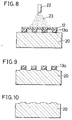
- the method for engraving and/or etching a material with an image-carrying mask according to the present invention can be practiced with the aid of the photo-sensitive laminate film 10 for making an image-carrying mask in accordance with the processes as shown in the attached Figs. 2 to 10.
- an original positive film 15 carrying fine pictures and patterns comes in close contact with the surface of the water-soluble resin composition-layer 13 of the photo-sensitive laminate film 10 and is irradiated with light 16 from a metal halide lamp. Then, as shown in Fig. 3, the original positive film 15 is peeled off from the photo-sensitive laminate film 10.
- the exposed photo-sensitive laminate film 10 is immersed in water 17, the exposed portion thereof 13a is not swollen since it is crosslinked, but non-crosslinked unexposed portion 13b gets swollen and is soluble in water as shown in Fig. 4. As shown in Fig. 5, if water 19 is sprayed with a spraying device 18 to wash away the unexposed portion, only the exposed portion 13a remains as an image-carrying mask and the laminate film is thus developed. The resulting product is hot-air dried to give an image-carrying mask 13a on the image mask-protection layer 12 which is put on the supporting sheet 11.
- the image-carrying mask 13a which is still supported by the supporting sheet 11 and the image mask-protection layer 12 is adhered and contact-bonded to a glass plate 20 while heating with an iron 21. Then, as shown in Fig. 7, the supporting sheet 11 is peeled off from the image mask-protection layer 12. Further, as shown in Fig. 8, the glass plate is engraved or etched by blasting abrasive particles 23 through the image mask-protection layer 12 using a sand blasting machine 22.
- the portion of the glass plate 20 to which the image-carrying mask 13a is adhered is not engraved and/or etched, while on the portion of the glass plate to which the image-carrying mask 13a is not adhered or which is covered with only the image mask-protection layer 12 is engraved and/or etched, the image mask- protection layer 12 is completely removed and the surface of the glass plate 20 is engraved and etched as shown in Fig.9.
- the remaining abrasive 23 and the image-carrying mask 13a are washed out so that the glass plate 20 on which the image is engraved or etched is completed as shown in Fig. 10.
- the supporting sheet 11 there may be used, for instance, a polypropylene film, a polyethylene film, a polystyrene film, a polyvinyl chloride film, a polycarbonate film, synthetic paper or paper coated with a synthetic resin in addition to the polyester film used in the embodiment.
- the thickness of the supporting sheet 11 may be adjusted within the range of from 50 to 500 ⁇ m.
- the layer 13 of the water-soluble resin composition used has a thickness of 80 ⁇ m.
- the thickness thereof may be varied between 0.03 to 2 mm and it is thus preferred to properly control the thickness thereof depending on the depth to be engraved and/or etched so that the image-carrying mask obtained after development shows proper resistance to sand blasting or chemicals. If the depth to be engraved is great, the thickness thereof should be adjusted within the range of from 0.1 to 2mm so as to withstand the processing over a long time period, while if the depth to be engraved is small, it is sufficient to adjust the thickness to 30 to 80 ⁇ m.
- the exposure process shown in Fig. 2 is performed by irradiating with the light 16 from a metal halide lamp, but it is also possible to use other light sources which emit actinic rays having a wave length ranging from 300 to 500 nm such as an arc lamp, a xenon lamp or a high pressure mercury lamp.
- the development processing as shown in Fig. 5 is carried out by spraying water 19 using a spraying machine 18, but it is also effective to lightly rub the surface with a brush or a sponge simultaneously with such a spraying operation to wash out the non-exposed portion and to thus develop the laminate film.
- the engraving or etching process is performed by blasting the abrasive particles 23 with the aid of the sandblasting machine 22, but the etching with a chemical is likewise effective.
- chemicals used in the engraving or etching treatment are an aqueous solution of hydrofluoric acid when the materials to be processed are glass and stones, an aqueous solution of ferric chloride when the materials are copper and copper alloys, and aqueous solutions of hydrochloric acid and sulfuric acid when they are other metals.
- a stilbazolium-added polyvinyl alcohol which was prepared by subjecting, to a reaction with acetal, polyvinyl alcohol having an average degree of polymerization of 1,700 and degree of saponification of 88 mole % (available from Shin Etsu Chemical Co., Ltd. under the trade name of PA-18) to add 1.4 mole % of N-methyl- ⁇ -(p-formylstilyl)-pyridinium methosulfate to thus give a solution having a concentration of 15% by weight. 15 parts by weight of an acrylate oligomer (available from Toagosei Chemical Industry Ltd.
- This mixed solution of the photo-sensitive resin composition was applied onto the surface of an image mask-protection layer applied to a supporting sheet similar to those used in Example 1 of EP-A-0 506 959 and then dried to give a photo-sensitive laminate film carrying a layer of the photo-sensitive resin composition having a thickness of 100 ⁇ m.
- Example 1 of EP-A-0 506 959 The same procedures used in Example 1 of EP-A-0 506 959 were repeated to give an image-carrying mask using the photo-sensitive laminate film. There was not observed any separation between the supporting sheet and the image mask-protection layer and between the image mask-protection layer and the layer of the photo-sensitive resin composition, i.e., the image-carrying mask during the development processing.
- the image-carrying mask thus obtained which had been still carried by the supporting sheet and the image mask-protection layer was adhered to a glass plate having a thickness of 8 mm on which a 1% aqueous solution of sodium periodate was coated and subjected to contact bonding. Then the supporting sheet was peeled off from the image mask-protection layer. The supporting sheet was easily be separated from the image mask-protection layer, but the adhesion between the image mask-protection layer and the image-carrying mask was strong and, therefore, there was not observed any aberration of the relative position between the image-carrying mask and the glass plate.
- a 50% by weight aqueous solution of hydrofluoric acid was applied onto the surface of the resulting assembly which comprised the glass plate, the image-carrying mask adhered to the glass plate and the image mask-protection layer on the image-carrying mask, on the side of the image mask-protection layer. After about 2 minutes, the assembly was sufficiently washed with water to wash out the aqueous hydrofluoric acid solution as well as the remaining image-carrying mask. The portion of the glass plate to which the image-carrying mask had been adhered was not corroded with the hydrofluoric acid aqueous solution.
- the image mask-protection layer was approximately easily be removed and the portion of the glass plate to which any image-carrying mask had not been adhered , i.e., that covered with only the image mask-protection layer was corroded and dissolved out to a depth of about 50 ⁇ m.
- the fine picture and patterns of the original were faithfully etched on the glass plate.
- the method for engraving and/or etching according to the present invention, fine and precise images can be engraved and/or etched on the surface of a material to be processed such as glass, metals and plastics.
- the photo-sensitive laminate film for making an image-carrying mask used in the engraving and/or etching method can be handled in the form of a film during preparing the image-carrying mask and thus the handling thereof during the exposure to light and the development is very simple.
- the development thereof can be performed with a developer simply comprising water, the film is safe and economical.
- the image-carrying mask obtained after development can be adhered to a material to be processed without using any adhesive since the surface thereof has adherence and does not cause the aberration of the position relative to the material to be processed even if it carries fine pictures and patterns because of a presence of the image mask-protection layer.
- the image mask-protection layer serves to prevent the separation of fine portions of the image during the sand blasting operation and as a result, precise engraving can be performed.
Landscapes
- Physics & Mathematics (AREA)
- General Physics & Mathematics (AREA)
- Spectroscopy & Molecular Physics (AREA)
- Engineering & Computer Science (AREA)
- Mechanical Engineering (AREA)
- Photosensitive Polymer And Photoresist Processing (AREA)
- Laminated Bodies (AREA)
- Manufacture Or Reproduction Of Printing Formes (AREA)
- Preparing Plates And Mask In Photomechanical Process (AREA)
- Printing Plates And Materials Therefor (AREA)
Claims (12)
- Verfahren zur Gravierung und/oder Ätzung eines Materials, welches die folgenden Schritte (a) bis (e) umfasst:(a) einen Verfahrensschritt zur Belichtung mit Licht (16) einer Schicht einer wasserlöslichen Harzzusammensetzung eines lichtempfindlichen Laminatfilms (10), der eine Trägerlage (11), eine auf der Trägerlage abziehbar angeheftete Bildmaskenschutzschicht (12) und eine Schicht einer wasserlöslichen Harzzusammensetzung mit Lichtvernetzbarkeit (13) umfasst, wobei die wasserlösliche Harzzusammensetzung ein wasserlösliches Polymer mit lichtvernetzbaren Gruppen in dem Polymermolekül umfasst, um so eine Vernetzung des belichteten Bereichs der Harzschicht zu bewirken, um dadurch ein vorbestimmtes Muster auf der Harzschicht zu bilden;(b) einen Verfahrensschritt zur Herauslösung der nicht-vernetzten Teile (13b) auf der Schicht der wasserlöslichen, lichtempfindlichen Harzzusammensetzung durch das Entwickeln der Schicht mit Wasser (17, 19), um so eine bildtragende Maske (13a) zu bilden, die aus den vernetzten Bereichen der lichtempfindlichen Harzzusammensetzung, die auf der Bildmaskenschutzschicht zurückgeblieben sind, aufgebaut ist;(c) einen Verfahrensschritt zur Anheftung des lichtempfindlichen Laminatfilms, auf dem die Abbilder gebildet sind, auf die Oberfläche eines zu verarbeitenden Materials (20) durch Kontaktbinden;(d) einen Verfahrensschritt zur Ablösung der Trägerlage (11) von dem lichtempfindlichen Laminatfilm, und(e) einen Verfahrensschritt zur Gravierung und/oder Ätzung des zu verarbeitenden Materials (20) durch die auf dem Material angeheftete bildtragende Maske hindurch, während die Bildmaskenschutzschicht entfernt wird.
- Verfahren nach Anspruch 1, wobei die Behandlung mit Wasser in dem Verfahrensschritt (b) durch vorheriges Eintauchen des lichtempfindlichen Laminatfilms, um die Schicht der wasserlöslichen Harzzusammensetzung aufzuquellen, und nachfolgendem Waschen mit Wasser durchgeführt wird.
- Verfahren nach Anspruch 1, wobei in dem Verfahrensschritt (c) der lichtempfindliche Laminatfilm auf das zu verarbeitende Material angeheftet wird, während Druck auf den Film ausgeübt wird und derselbe beheizt wird.
- Verfahren nach Anspruch 1, wobei der Verfahrensschritt (c) durchgeführt wird mittels:Auftragung einer wässrigen Lösung wenigstens eines Elements, das aus der aus Natriumperiodat, Lithiumchlorid, Lithiumbromid, Lithiumnitrat, Calciumchlorid und Ammoniumthiocyanat bestehenden Gruppe ausgewählt ist, auf die Schicht der wasserlöslichen Harzzusammensetzung, um die vernetzte wasserlösliche Harzzusammensetzung aufzuquellen oder zu lösen, und dänachAnheftung des lichtempfindlichen Laminatfilms auf das zu verarbeitende Material unter Druck.
- Verfahren nach Anspruch 1, wobei der Verfahrensschritt (e) eine Gravierbehandlung durch Sandstrahlen ist.
- Verfahren nach Anspruch 1, wobei der Verfahrensschritt (e) eine Gravierbehandlung mit einer Chemikalie ist.
- Verfahren nach Anspruch 1, wobei das wasserlösliche Polymer mit lichtvernetzbaren Gruppen in dem Polymermolekül, wie es in der wasserlöslichen Harzzusammensetzung im Verfahrensschritt (a) umfasst ist, ein Polyvinylalkohol ist, der einer Modifizierung mit Acetal unterworfen worden ist, um darin Stilbazoliumgruppen einzuführen.
- Lichtempfindlicher Laminatfilm (10) für die Verwendung zur Herstellung einer bildtragenden Maske, die eine Trägerlage (11), eine auf der Trägerlage abziehbar angehefteten Bildmaskenschutzschicht (12) und eine Schicht einer wasserlöslichen Harzzusammensetzung mit Lichtvernetzbarkeit (13), die auf der Bildmaskenschutzschicht (12) aufgetragen ist, umfasst, wobei die wasserlösliche Harzzusammensetzung ein wasserlösliches Polymer mit lichtvernetzbaren Gruppen in dem Polymermolekül umfasst, um so eine Vernetzung des belichteten Bereichs der Harzschicht zu bewirken, um dadurch ein vorbestimmtes Muster auf der Harzschicht zu bilden, und wobei die lichtvernetzte Harzschicht der bildtragenden Maske zur Kontaktbindung auf die Oberfläche eines zu verarbeitenden Materials fähig ist.
- Lichtempfindlicher Laminatfilm für die Verwendung zur Herstellung einer bildtragenden Maske nach Anspruch 8, wobei die wasserlösliche Harzzusammensetzung mit Lichtvernetzbarkeit ein wasserlösliches Polymer mit lichtvernetzbaren Gruppen in dem Molekül umfasst, welches aus Polyvinylalkohol der einer Modifizierung mit Acetal unterworfen worden ist, um Stilbazoliumgruppen darin einzuführen, und Polyvinylalkohol, zu dem N-Methylolacrylamid zugegeben ist, ausgewählt ist.
- Lichtempfindlicher Laminatfilm für die Verwendung zur Herstellung einer bildtragenden Maske nach Anspruch 8, wobei die Schicht der wasserlöslichen Harzzusammensetzung mit Lichtvernetzbarkeit eine im Bereich von 0,04 bis 2 mm liegende Dicke aufweist.
- Lichtempfindlicher Laminatfilm für die Verwendung zur Herstellung einer bildtragenden Maske nach Anspruch 8, wobei die Bildmaskenschutzschicht aus einem Element hergestellt ist, das aus der aus Polyvinylalkohol, Polyvinylalkoholderivaten, Polyvinylbutyral, Ethylcellulose, Celluloseacetat und Cellulosenitrat bestehenden Gruppe ausgewählt ist, und wobei die Dicke der Bildmaskenschutzschicht in einem Bereich von 1 bis 30 µm liegt.
- Lichtempfindlicher Laminatfilm für die Verwendung zur Herstellung einer bildtragenden Maske nach Anspruch 8, wobei die Bildmaskenschutzschicht aus einem Material hergestellt ist, das unterschiedlich zu dem der Trägerlage ist, und aus einem Element erhalten wird, das aus der aus Polyvinylchlorid, Polystyrol und Polyamid bestehenden Gruppe ausgewählt ist, und wobei die Dicke der Bildmaskenschutzschicht in einem Bereich von 1 bis 30 µm liegt.
Applications Claiming Priority (1)
| Application Number | Priority Date | Filing Date | Title |
|---|---|---|---|
| PCT/JP1990/001360 WO1992007303A1 (fr) | 1990-10-22 | 1990-10-22 | Procede de gravure avec masque a image, et film stratifie photosensible pour ledit masque |
Publications (3)
| Publication Number | Publication Date |
|---|---|
| EP0506959A1 EP0506959A1 (de) | 1992-10-07 |
| EP0506959A4 EP0506959A4 (en) | 1993-03-31 |
| EP0506959B1 true EP0506959B1 (de) | 2000-09-06 |
Family
ID=13986771
Family Applications (1)
| Application Number | Title | Priority Date | Filing Date |
|---|---|---|---|
| EP90915189A Expired - Lifetime EP0506959B1 (de) | 1990-10-22 | 1990-10-22 | Gravierverfahren mit bildmaske und lichtempfindlicher laminatfilm für besagte bildmaske |
Country Status (7)
| Country | Link |
|---|---|
| US (1) | US5427890B1 (de) |
| EP (1) | EP0506959B1 (de) |
| AT (1) | ATE196200T1 (de) |
| CA (1) | CA2041521C (de) |
| DE (1) | DE69033623T2 (de) |
| ES (1) | ES2149754T3 (de) |
| WO (1) | WO1992007303A1 (de) |
Cited By (3)
| Publication number | Priority date | Publication date | Assignee | Title |
|---|---|---|---|---|
| US7074358B2 (en) | 2001-12-13 | 2006-07-11 | Alexander Sergeievich Gybin | Polymer casting method and apparatus |
| US7964335B2 (en) | 2002-01-30 | 2011-06-21 | Ikonics Corporation | Ink receptive photosensitive laminate |
| TWI488010B (zh) * | 2010-07-15 | 2015-06-11 | Lg Innotek Co Ltd | 印刷版和其製造方法 |
Families Citing this family (19)
| Publication number | Priority date | Publication date | Assignee | Title |
|---|---|---|---|---|
| US5629132B1 (en) * | 1991-03-28 | 2000-02-08 | Aicello Chemical | Method for engraving and/or etching with image-carrying mask and photo-sensitive laminate film for use in making the mask |
| JP2901129B2 (ja) * | 1994-03-14 | 1999-06-07 | アイセロ化学株式会社 | サンドブラストレジストインキ |
| NL1004603C2 (nl) * | 1996-11-22 | 1998-05-27 | Michael Van Gerwen | Werkwijze voor het vormen van een afbeelding op een door zandstralen te bewerken drager en een aldus verkregen drager voorzien van een foto. |
| FR2770434A1 (fr) * | 1997-11-05 | 1999-05-07 | Jean Michel Hostein | Procede de gravure a l'aide d'un masque de sablage - masque obtenu selon le procede |
| US6558496B1 (en) | 1997-11-28 | 2003-05-06 | Eschmann-Stahl Gmbh & Co., Kg | Rapid texture prototyping |
| WO1999028535A1 (en) * | 1997-11-28 | 1999-06-10 | Gravutex Eschmann International Limited | Etching methods |
| GB9725102D0 (en) * | 1997-11-28 | 1998-01-28 | Gravutex Limited | Rapid texture prototyping |
| US6140006A (en) * | 1998-06-15 | 2000-10-31 | The Chromaline Corporation | Integral membrane layer formed from a photosensitive layer in an imageable photoresist laminate |
| US6248498B1 (en) | 1998-12-08 | 2001-06-19 | The Chromaline Corporation | Photosensitive resin composition |
| US6235449B1 (en) | 1999-11-16 | 2001-05-22 | Rayzist Photomask Inc. | Non-stick photoresist laminate |
| US7211656B2 (en) * | 2002-01-30 | 2007-05-01 | Abbott Laboratories | Desaturase genes, enzymes encoded thereby, and uses thereof |
| US20040062896A1 (en) * | 2002-09-26 | 2004-04-01 | Picone Terrence F. | Fractionally-releasable bonding layer for use in photo-sensitive laminate films |
| EP2558908B1 (de) * | 2010-04-12 | 2015-06-03 | Ikonics Corporation | Fotolackfolie und verfahren für abrasionsätzen und schneiden |
| JP6742711B2 (ja) * | 2015-10-09 | 2020-08-19 | 株式会社アイセロ | 凹凸表面貼付用フィルムを用いた表面凹凸被処理物への微細パターン転写方法 |
| US12220786B2 (en) * | 2019-01-21 | 2025-02-11 | TVITEC System Glass SL | Method for producing a glass substrate with an embossed surface finish and glass substrate obtained using said method |
| US11707815B2 (en) * | 2019-07-09 | 2023-07-25 | General Electric Company | Creating 3D mark on protective coating on metal part using mask and metal part so formed |
| DE102019211858A1 (de) * | 2019-08-07 | 2021-02-11 | Audi Ag | Verfahren zum Maskieren von zu mattierenden Oberflächen |
| CN112264281A (zh) * | 2020-10-28 | 2021-01-26 | 哈尔滨电机厂有限责任公司 | 一种发电机组加工面喷砂防护方法 |
| CN113829242A (zh) * | 2021-09-14 | 2021-12-24 | 杭州之芯半导体有限公司 | 一种晶圆基座表面喷砂加工工艺 |
Family Cites Families (16)
| Publication number | Priority date | Publication date | Assignee | Title |
|---|---|---|---|---|
| US4530896A (en) * | 1970-03-03 | 1985-07-23 | Shipley Company Inc. | Photosensitive laminate |
| JPS511550B1 (de) * | 1971-02-20 | 1976-01-19 | ||
| JPS5420719A (en) * | 1977-07-15 | 1979-02-16 | Fuji Photo Film Co Ltd | Photosensitive material for image formation and image formation method |
| US4272620A (en) * | 1978-08-09 | 1981-06-09 | Agency Of Industrial Science And Technology | Polyvinyl alcohol-styrylpyridinium photosensitive resins and method for manufacture thereof |
| US4430416A (en) * | 1980-06-27 | 1984-02-07 | Asahi Kasei Kogyo Kabushiki Kaisha | Transfer element for sandblast carving |
| US4444868A (en) * | 1981-08-06 | 1984-04-24 | Agency Of Industrial Science & Technology | Photosensitive composition |
| JPS58159530A (ja) * | 1982-03-12 | 1983-09-21 | Nippon Synthetic Chem Ind Co Ltd:The | 画像形成方法 |
| JPS60104939A (ja) * | 1983-11-14 | 1985-06-10 | Asahi Chem Ind Co Ltd | サンドブラスト用マスク転写材 |
| US4587186A (en) * | 1982-05-13 | 1986-05-06 | Asahi Kasei Kogyo Kabushiki Kaisha | Mask element for selective sandblasting and a method |
| JPS58196971A (ja) * | 1982-05-13 | 1983-11-16 | Asahi Chem Ind Co Ltd | サンドブラスト用マスクの製造方法 |
| JPS60104938A (ja) * | 1982-05-13 | 1985-06-10 | Asahi Chem Ind Co Ltd | 固体表面加工用マスク転写材 |
| JPS61160748A (ja) * | 1985-01-10 | 1986-07-21 | Asahi Chem Ind Co Ltd | 感光性樹脂版の製版方法 |
| US4764449A (en) * | 1985-11-01 | 1988-08-16 | The Chromaline Corporation | Adherent sandblast photoresist laminate |
| JPH07113773B2 (ja) * | 1986-07-04 | 1995-12-06 | 株式会社日立製作所 | パタ−ン形成方法 |
| JP2618719B2 (ja) * | 1989-10-11 | 1997-06-11 | 富士写真フイルム株式会社 | 画像形成材料 |
| US5057394A (en) * | 1989-11-01 | 1991-10-15 | Sanyo-Kokusaku Pulp Co., Ltd. | Method of forming an image |
-
1990
- 1990-10-22 ES ES90915189T patent/ES2149754T3/es not_active Expired - Lifetime
- 1990-10-22 AT AT90915189T patent/ATE196200T1/de not_active IP Right Cessation
- 1990-10-22 EP EP90915189A patent/EP0506959B1/de not_active Expired - Lifetime
- 1990-10-22 WO PCT/JP1990/001360 patent/WO1992007303A1/ja not_active Ceased
- 1990-10-22 DE DE69033623T patent/DE69033623T2/de not_active Expired - Lifetime
-
1991
- 1991-04-30 CA CA002041521A patent/CA2041521C/en not_active Expired - Lifetime
-
1993
- 1993-09-03 US US08116277 patent/US5427890B1/en not_active Expired - Lifetime
Cited By (3)
| Publication number | Priority date | Publication date | Assignee | Title |
|---|---|---|---|---|
| US7074358B2 (en) | 2001-12-13 | 2006-07-11 | Alexander Sergeievich Gybin | Polymer casting method and apparatus |
| US7964335B2 (en) | 2002-01-30 | 2011-06-21 | Ikonics Corporation | Ink receptive photosensitive laminate |
| TWI488010B (zh) * | 2010-07-15 | 2015-06-11 | Lg Innotek Co Ltd | 印刷版和其製造方法 |
Also Published As
| Publication number | Publication date |
|---|---|
| WO1992007303A1 (fr) | 1992-04-30 |
| US5427890B1 (en) | 2000-02-01 |
| ATE196200T1 (de) | 2000-09-15 |
| ES2149754T3 (es) | 2000-11-16 |
| DE69033623T2 (de) | 2001-05-23 |
| US5427890A (en) | 1995-06-27 |
| CA2041521C (en) | 1998-10-27 |
| EP0506959A1 (de) | 1992-10-07 |
| EP0506959A4 (en) | 1993-03-31 |
| CA2041521A1 (en) | 1992-04-23 |
| DE69033623D1 (de) | 2000-10-12 |
Similar Documents
| Publication | Publication Date | Title |
|---|---|---|
| US5629132A (en) | Method for engraving and/or etching with image-carrying mask and photo-sensitive laminate film for use in making the mask | |
| US5427890A (en) | Photo-sensitive laminate film for use in making the mask comprising a supporting sheet, an image mask protection layer which is water insoluble and a water soluble image mask forming composition | |
| US4530896A (en) | Photosensitive laminate | |
| US5259311A (en) | Laser engraving of photopolymer printing plates | |
| US5415971A (en) | Photoresist laminate including photoimageable adhesive layer | |
| JPS597948A (ja) | 画像形成方法 | |
| US4544619A (en) | Photosensitive laminate | |
| US5518857A (en) | Image-carrying mask photo-sensitive laminate film for use in making an image carry mask | |
| US6140006A (en) | Integral membrane layer formed from a photosensitive layer in an imageable photoresist laminate | |
| JPS62103376A (ja) | 凸版像およびそれに有用な感光性物質の製造法 | |
| US4834833A (en) | Mask for etching, and method of making mask and using same | |
| GB2248506A (en) | Process for preparing imaged material | |
| EP0501312B1 (de) | Verfahren zur Behandlung der Peripherie von unbelichteten Photolackplatten | |
| JPH0811365B2 (ja) | 彫食刻マスク用感光性積層フイルム | |
| JP2562954B2 (ja) | 彫食刻マスク用感光性積層フイルム | |
| KR940007799B1 (ko) | 전사용 볼록판 및 이 전사용 볼록판에 의한 전사방법 | |
| KR100407292B1 (ko) | 피가공물체 표면처리방법 | |
| JPH0572740A (ja) | 感光性樹脂印刷版用粘着防止層組成物 | |
| JP3009010B2 (ja) | 感光性樹脂積層体 | |
| CA2108674A1 (en) | Process for preparing electromagnetic radiation imaged material | |
| JPH0432846A (ja) | 転写用凸版及びその製造方法 | |
| JPH0560855B2 (de) | ||
| JP3129511B2 (ja) | 感光性樹脂未露光版の側面処理方法 | |
| JPH05323615A (ja) | 感光性樹脂印刷版用粘着防止層組成物 | |
| JPS63153552A (ja) | 感光性凹版材の露光方法 |
Legal Events
| Date | Code | Title | Description |
|---|---|---|---|
| PUAI | Public reference made under article 153(3) epc to a published international application that has entered the european phase |
Free format text: ORIGINAL CODE: 0009012 |
|
| 17P | Request for examination filed |
Effective date: 19910516 |
|
| AK | Designated contracting states |
Kind code of ref document: A1 Designated state(s): AT DE ES FR GB IT |
|
| A4 | Supplementary search report drawn up and despatched |
Effective date: 19930209 |
|
| AK | Designated contracting states |
Kind code of ref document: A4 Designated state(s): AT DE ES FR GB IT |
|
| 17Q | First examination report despatched |
Effective date: 19961118 |
|
| TPAD | Observations filed by third parties |
Free format text: ORIGINAL CODE: EPIDOS TIPA |
|
| TPAD | Observations filed by third parties |
Free format text: ORIGINAL CODE: EPIDOS TIPA |
|
| GRAG | Despatch of communication of intention to grant |
Free format text: ORIGINAL CODE: EPIDOS AGRA |
|
| TPAD | Observations filed by third parties |
Free format text: ORIGINAL CODE: EPIDOS TIPA |
|
| GRAG | Despatch of communication of intention to grant |
Free format text: ORIGINAL CODE: EPIDOS AGRA |
|
| GRAH | Despatch of communication of intention to grant a patent |
Free format text: ORIGINAL CODE: EPIDOS IGRA |
|
| GRAH | Despatch of communication of intention to grant a patent |
Free format text: ORIGINAL CODE: EPIDOS IGRA |
|
| GRAA | (expected) grant |
Free format text: ORIGINAL CODE: 0009210 |
|
| AK | Designated contracting states |
Kind code of ref document: B1 Designated state(s): AT DE ES FR GB IT |
|
| REF | Corresponds to: |
Ref document number: 196200 Country of ref document: AT Date of ref document: 20000915 Kind code of ref document: T |
|
| REF | Corresponds to: |
Ref document number: 69033623 Country of ref document: DE Date of ref document: 20001012 |
|
| ET | Fr: translation filed | ||
| ITF | It: translation for a ep patent filed | ||
| REG | Reference to a national code |
Ref country code: ES Ref legal event code: FG2A Ref document number: 2149754 Country of ref document: ES Kind code of ref document: T3 |
|
| PLBE | No opposition filed within time limit |
Free format text: ORIGINAL CODE: 0009261 |
|
| STAA | Information on the status of an ep patent application or granted ep patent |
Free format text: STATUS: NO OPPOSITION FILED WITHIN TIME LIMIT |
|
| 26N | No opposition filed | ||
| REG | Reference to a national code |
Ref country code: GB Ref legal event code: IF02 |
|
| PGFP | Annual fee paid to national office [announced via postgrant information from national office to epo] |
Ref country code: AT Payment date: 20091013 Year of fee payment: 20 Ref country code: DE Payment date: 20091015 Year of fee payment: 20 Ref country code: ES Payment date: 20091117 Year of fee payment: 20 |
|
| PGFP | Annual fee paid to national office [announced via postgrant information from national office to epo] |
Ref country code: IT Payment date: 20091015 Year of fee payment: 20 Ref country code: FR Payment date: 20091029 Year of fee payment: 20 Ref country code: GB Payment date: 20091021 Year of fee payment: 20 |
|
| REG | Reference to a national code |
Ref country code: GB Ref legal event code: PE20 Expiry date: 20101021 |
|
| PG25 | Lapsed in a contracting state [announced via postgrant information from national office to epo] |
Ref country code: GB Free format text: LAPSE BECAUSE OF EXPIRATION OF PROTECTION Effective date: 20101021 |
|
| PG25 | Lapsed in a contracting state [announced via postgrant information from national office to epo] |
Ref country code: DE Free format text: LAPSE BECAUSE OF EXPIRATION OF PROTECTION Effective date: 20101022 |
|
| REG | Reference to a national code |
Ref country code: ES Ref legal event code: FD2A Effective date: 20130719 |
|
| PG25 | Lapsed in a contracting state [announced via postgrant information from national office to epo] |
Ref country code: ES Free format text: LAPSE BECAUSE OF EXPIRATION OF PROTECTION Effective date: 20101023 |