EP0506826B1 - Antibody antagonists of human interleukin-4 - Google Patents
Antibody antagonists of human interleukin-4 Download PDFInfo
- Publication number
- EP0506826B1 EP0506826B1 EP91902038A EP91902038A EP0506826B1 EP 0506826 B1 EP0506826 B1 EP 0506826B1 EP 91902038 A EP91902038 A EP 91902038A EP 91902038 A EP91902038 A EP 91902038A EP 0506826 B1 EP0506826 B1 EP 0506826B1
- Authority
- EP
- European Patent Office
- Prior art keywords
- polypeptide
- antibodies
- amino acid
- binding
- cells
- Prior art date
- Legal status (The legal status is an assumption and is not a legal conclusion. Google has not performed a legal analysis and makes no representation as to the accuracy of the status listed.)
- Expired - Lifetime
Links
Images


Classifications
-
- C—CHEMISTRY; METALLURGY
- C07—ORGANIC CHEMISTRY
- C07K—PEPTIDES
- C07K14/00—Peptides having more than 20 amino acids; Gastrins; Somatostatins; Melanotropins; Derivatives thereof
- C07K14/435—Peptides having more than 20 amino acids; Gastrins; Somatostatins; Melanotropins; Derivatives thereof from animals; from humans
- C07K14/52—Cytokines; Lymphokines; Interferons
- C07K14/54—Interleukins [IL]
-
- C—CHEMISTRY; METALLURGY
- C07—ORGANIC CHEMISTRY
- C07K—PEPTIDES
- C07K16/00—Immunoglobulins [IG], e.g. monoclonal or polyclonal antibodies
- C07K16/18—Immunoglobulins [IG], e.g. monoclonal or polyclonal antibodies against material from animals or humans
- C07K16/24—Immunoglobulins [IG], e.g. monoclonal or polyclonal antibodies against material from animals or humans against cytokines, lymphokines or interferons
- C07K16/244—Interleukins [IL]
- C07K16/247—IL-4
-
- A—HUMAN NECESSITIES
- A61—MEDICAL OR VETERINARY SCIENCE; HYGIENE
- A61P—SPECIFIC THERAPEUTIC ACTIVITY OF CHEMICAL COMPOUNDS OR MEDICINAL PREPARATIONS
- A61P37/00—Drugs for immunological or allergic disorders
- A61P37/08—Antiallergic agents
-
- C—CHEMISTRY; METALLURGY
- C07—ORGANIC CHEMISTRY
- C07K—PEPTIDES
- C07K14/00—Peptides having more than 20 amino acids; Gastrins; Somatostatins; Melanotropins; Derivatives thereof
- C07K14/435—Peptides having more than 20 amino acids; Gastrins; Somatostatins; Melanotropins; Derivatives thereof from animals; from humans
- C07K14/52—Cytokines; Lymphokines; Interferons
- C07K14/54—Interleukins [IL]
- C07K14/5406—IL-4
-
- C—CHEMISTRY; METALLURGY
- C07—ORGANIC CHEMISTRY
- C07K—PEPTIDES
- C07K16/00—Immunoglobulins [IG], e.g. monoclonal or polyclonal antibodies
- C07K16/18—Immunoglobulins [IG], e.g. monoclonal or polyclonal antibodies against material from animals or humans
- C07K16/24—Immunoglobulins [IG], e.g. monoclonal or polyclonal antibodies against material from animals or humans against cytokines, lymphokines or interferons
-
- C—CHEMISTRY; METALLURGY
- C07—ORGANIC CHEMISTRY
- C07K—PEPTIDES
- C07K16/00—Immunoglobulins [IG], e.g. monoclonal or polyclonal antibodies
- C07K16/42—Immunoglobulins [IG], e.g. monoclonal or polyclonal antibodies against immunoglobulins
- C07K16/4208—Immunoglobulins [IG], e.g. monoclonal or polyclonal antibodies against immunoglobulins against an idiotypic determinant on Ig
- C07K16/4241—Immunoglobulins [IG], e.g. monoclonal or polyclonal antibodies against immunoglobulins against an idiotypic determinant on Ig against anti-human or anti-animal Ig
-
- A—HUMAN NECESSITIES
- A61—MEDICAL OR VETERINARY SCIENCE; HYGIENE
- A61K—PREPARATIONS FOR MEDICAL, DENTAL OR TOILETRY PURPOSES
- A61K38/00—Medicinal preparations containing peptides
-
- C—CHEMISTRY; METALLURGY
- C07—ORGANIC CHEMISTRY
- C07K—PEPTIDES
- C07K2317/00—Immunoglobulins specific features
- C07K2317/30—Immunoglobulins specific features characterized by aspects of specificity or valency
- C07K2317/34—Identification of a linear epitope shorter than 20 amino acid residues or of a conformational epitope defined by amino acid residues
Definitions
- Interleukin-4 is a protein which affects a broad spectrum of hematopoietic cells [Strober et al ., Pediatr. Res. 24 :549 (1988)]. IL-4 enhances a number of activities including macrophage function, IgG and IgE production, and the proliferation of immunoglobulin-stimulated B cells, antigen-stimulated T cells and erythropoietin-stimulated red blood cell progenitors. It also increases the proliferation of IL-3-stimulated mast cells.
- mast cells play a central role in allergic reactions.
- Mast cells are granule-containing connective tissue cells which are located proximally to capillaries throughout the body, with especially high concentrations in the lungs, skin and gastrointestinal and genitourinary tracts. Following exposure to an antigenic substance, mast cells degranulate and release chemical mediators such as histamine, serotonin, heparin, prostaglandins etc. to produce an allergic reaction.
- an antagonist of IL-4 may be useful for the treatment of allergies by decreasing mast cell growth and IgE production.
- the invention provides a polypeptide containing from about 5 to about 26 amino acid residues and having an amino acid sequence corresponding to the sequence of amino acid residues 61 to 82, or a subsequence thereof of human IL-4 or the sequence of amino acid residues 104 to 129 of human IL-4.
- Preferred polypeptides have the amino acid sequences
- This invention further provides methods for making antibodies which specifically bind to and inhibit the binding of human IL-4 to cellular receptors, comprising inoculating a mammal with a polypeptide as defined above under conditions wherein the mammal produces antibodies to said polypeptide; and isolating said antibodies.
- Fig. 1 shows the amino acid sequence of mature human IL4, from the amino- to the carboxyl-terminus.
- Fig. 2 is a graphical representation of the binding of IL-4 (lower curve) and polypeptide No. 7 (upper curve; see Table 1) by a rabbit IgG fraction against the polypeptide, in direct ELISA analyses.
- the amount of protein/ polypeptide bound in picomoles is shown as a function of absorbance at 414 nm.
- Fig. 3 is a graphical representation of the inhibition of the specific binding of 15I-IL-4 to Daudi cells by a rabbit IgG fraction against polypeptide No. 7, showing percent specifically bound radioactivity as a function of increasing IgG concentration.
- Fig. 4 is a graphical representation of the inhibition of the specific binding of 15I-IL-4 to Daudi cells by anti-idiotypic antiserum 1448, showing % inhibition of specifically bound radioactivity as a function of decreasing antiserum concentration.
- Fig. 5 is a graphical representation of the results of epitope analysis performed on rabbit antiserum against polypeptide No. 7.
- ELISA absorbance produced by binding of the antiserum to a series of octapeptides used in the analysis is shown.
- the numbers of the octapeptides correspond to the numbers in Table 3.
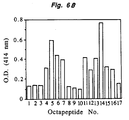
- Fig. 6 is a graphical representation of the results of epitope analysis performed on rabbit antiserum against polypeptide No. 6.
- ELISA absorbance produced by binding of the antiserum to a series of octapeptides used in the analysis is shown.
- the antiserum used to obtain the results shown in panel A was collected early in the course of immunization of the rabbit and did not inhibit the binding of 15I-IL-4 to Daudi cells.
- the antiserum used in panel B was collected later and was a strong inhibitor of the binding of the labeled IL-4.
- the numbers of the octapeptides correspond to the numbers in Table 4.
- the present invention provides polypeptides useful for eliciting antibodies which antagonize the binding of human IL-4 to cellular receptors by (a) combining with a region of the IL-4 which apparently is involved in interactions with the receptors or by (b) mimicing IL-4 itself, thereby competing with it for binding to the cellular receptors.
- IL-4 stimulates the production of IgE antibodies and the proliferation of mast cells, two effectors of allergic responses
- the antibody antagonists produced using the invention are useful in the treatment of allergies. They also are useful in in vitro IL-4 receptor binding systems, to elucidate the mechanism of action of IL-4 or to screen for other IL-4 antagonists or agonists.
- human "IL-4" means a protein which (a) has an amino acid sequence that is substantially identical to the sequence of mature, human IL-4 shown in Fig. 1 and (b) has biological activity that is common to native IL-4.
- Substantial identity of amino acid sequences means that the sequence of another IL-4 compared to the sequence of Fig. 1 is identical or differs by one or more amino acid alterations (deletions, additions, substitutions) that do not substantially impair biological activity.
- amino acid sequences in the IL-4 regions mentioned above may differ in the case of substantially identical IL-4s.
- the first of the foregoing binding regions of IL-4 contains 22 amino acid residues. It is well known in the art that antigenic determinants (epitopes) generally contain at least about 5 amino acid residues [Ohno et al ., Proc. Natl. Acad. Sci. USA 82 :2945 (1985)]. Therefore, the polypeptides of the invention comprise from about 5 to about 22 amino add residues and have the above-mentioned amino acid sequences. Whether a given polypeptide falls within the scope of this invention can readily be determined by routine experimentation using the methods described below.
- the polypeptides are synthesized by a suitable method such as by exclusive solid phase synthesis, partial solid phase methods, fragment condensation or classical solution synthesis.
- the polypeptides are preferably prepared by solid phase peptide synthesis as described by Merrifield, J. Am. Chem. Soc. 85 :2149 (1963).
- the synthesis is carried out with amino acids that are protected at the alpha-amino terminus.
- Trifunctional amino acids with labile side-chains are also protected with suitable groups to prevent undesired chemical reactions from occurring during the assembly of the polypeptides.
- the alpha-amino protecting group is selectively removed to allow subsequent reaction to take place at the amino-terminus. The conditions for the removal of the alpha-amino protecting group do not remove the side-chain protecting groups.
- the alpha-amino protecting groups are those known to be useful in the art of stepwise polypeptide synthesis. Included are acyl type protecting groups (e.g. , formyl, trifluoroacetyl, acetyl), aromatic urethane type protecting groups [ e.g. , benzyloxycarbonyl (Cbz), substituted benzyloxycarbonyl and 9-fluorenylmethyloxycarbonyl (Fmoc)], aliphatic urethane protecting groups [ e.g , t-butyloxycarbonyl (Boc), isopropyloxycarbonyl, cyclohexyloxycarbonyl] and alkyl type protecting groups (e.g.
- acyl type protecting groups e.g. , formyl, trifluoroacetyl, acetyl
- aromatic urethane type protecting groups e.g. , benzyloxycarbonyl (Cbz), substituted benz
- the preferred protecting group is Boc.
- the side-chain protecting groups for Tyr include tetrahydropyranyl, tert.-butyl, trityl, benzyl, Cbz, 4-Br-Cbz and 2,6-dichlorobenzyl.
- the preferred side-chain protecting group for Tyr is 2,6-dichlorobenzyl.
- the side-chain protecting groups for Asp include benzyl, 2,6-dichlorobenzyl, methyl, ethyl and cyclohexyl.
- the preferred side-chain protecting group for Asp is cyclohexyl.
- the side-chain protecting groups for Thr and Ser include acetyl, benzoyl, trityl, tetrahydropyranyl, benzyl, 2,6-dichlorobenzyl and Cbz.
- the preferred protecting group for Thr and Ser is benzyl.
- the side-chain protecting groups for Arg include nitro, Tos, Cbz, adamantyloxycarbonyl and Boc.
- the preferred protecting group for Arg is Tos.
- the side-chain amino group of Lys may be protected with.Cbz, 2-Cl-Cbz, Tos or Boc.
- the 2-Cl-Cbz group is the preferred protecting group for Lys.
- the side-chain protecting groups selected must remain intact during coupling and not be removed during the deprotection of the amino-terminus protecting group or during coupling conditions.
- the side-chain protecting groups must also be removable upon the completion of synthesis, using reaction conditions that will not alter the finished polypeptide.
- Solid phase synthesis is usually carried out from the carboxyl-terminus by coupling the -alpha-amino protected (side-chain protected) amino acid to a suitable solid support.
- An ester linkage is formed when the attachment is made to a chloromethyl or hydroxymethyl resin, and the resulting polypeptide will have a free carboxyl group at the C-terminus.
- a benzhydrylamine or p-methylbenzhydrylamine resin is used, an amide bond is formed and the resulting polypeptide will have a carboxamide group at the C-terminus.
- DCC dicyclohexylcarbodiimide
- N,N'-diisopropylcarbodiimide N,N'-diisopropylcarbodiimide and carbonyldiimidazole.
- the alpha-amino protecting group is removed using trifluoroacetic acid (TFA) or HCl in dioxane at a temperature between 0° and 25°C.
- Dimethylsulfide is added to the TFA after the introduction of methionine (Met) to suppress possible S-alkylation.
- the remaining protected amino acids are coupled stepwise in the required order to obtain the desired sequence.
- Various activating agents can be used for the coupling reactions including DCC, N,N'-diisopropylcarbodiimide, benzotriazol-1-yl-oxy-tris-(dimethylamino)-phosphonium hexafluorophosphate (BOP) and DCC-hydroxybenzotriazole (HOBt).
- BOP benzotriazol-1-yl-oxy-tris-(dimethylamino)-phosphonium hexafluorophosphate
- HOBt DCC-hydroxybenzotriazole
- the polypeptide-resin is cleaved with a reagent such as liquid HF for 1-2 hours at 0°C, which cleaves the polypeptide from the resin and removes all side-chain protecting groups.
- a scavenger such as anisole is usually used with the liquid HF to prevent cations formed during the cleavage from alkylating the amino acid residues present in the polypeptide.
- the polypeptide-resin may be deprotected with TFA/dithioethane prior to cleavage if desired.
- Recombinant DNA methodology can also be used to prepare the polypeptides.
- the known genetic code tailored if desired with known preferred codons for more efficient expression in a given host organism, can be used to synthesize oligonucleotides encoding the desired amino acid sequences.
- the phosphoramidite solid support method of Matteucci et al. [J. Am. Chem. Soc. 103 :3185 (1981)] or other known methods can be used for such syntheses.
- the resulting oligonucleotides can be inserted into an appropriate vector and expressed in a compatible host organism.
- polypeptides of the invention can be purified using HPLC, gel filtration, ion exchange and partition chromatography, countercurrent distribution or other well known methods.
- Antibodies can be prepared against the polypeptides of the invention using standard methods.
- the word “antibody” refers to both polyclonal and monoclonal antibodies. It also includes whole immunoglobulins and antigen binding fragments thereof.
- the polyclonal antibodies can be produced by immunizing a host animal such as a rabbit, rat, goat, sheep, mouse, etc. with one of the polypeptides. Preferably, one or more booster injections are given after the initial injection, to increase the antibody titer. Blood is then drawn from the animal and serum is prepared and screened by standard methods such as enzyme-linked immunosorbent assay (ELISA) using the polypeptide as the antigen.
- ELISA enzyme-linked immunosorbent assay
- the immunogenicity of the polypeptides is increased by combination with an adjuvant and/or by conversion to a larger form prior to immunization.
- Suitable adjuvants for the vaccination of animals include but are not limited to Adjuvant 65 (containing peanut oil, mannide monooleate and aluminum monostearate); Freund's complete or incomplete adjuvant; mineral gels such as aluminum hydroxide, aluminum phosphate and alum; surfactants such as hexadecylamine, octadecylamine, lysolecithin, dimethyldioctadecylammonium bromide, N,N-dioctadecyl-N',N'-bis(2-hydroxymethyl) propanediamine, methoxyhexadecylglycerol and pluronic polyols; polyanions such as pyran, dextran sulfate, poly IC, polyacrylic acid and carbopol; peptides such as muramyl dipeptide, dimethylglycine and tuftsin; and oil emulsions.
- the polypeptides could also be administered following incorporation
- the immunogenicity of the polypeptides can also be enhanced by cross-linking or by coupling to an immunogenic carrier molecule (i.e., a macromolecule having the property of independently eliciting an immunological response in a host animal, to which the polypeptides of the invention can be covalently linked).
- an immunogenic carrier molecule i.e., a macromolecule having the property of independently eliciting an immunological response in a host animal, to which the polypeptides of the invention can be covalently linked.
- Cross-linking or conjugation to a carrier molecule may be required because small polypeptides sometimes act as haptens (molecules which are capable of specifically binding to an antibody but incapable of eliciting antibody production, i.e., they are not immunogenic). Conjugation of such polypeptides to an immunogenic carrier molecule renders the fragments immunogenic through what is commonly known as the "carrier effect".
- Suitable carrier molecules include, e.g. , proteins and natural or synthetic polymeric compounds such as polypeptides, polysaccharides, lipopolysaccharides etc.
- a useful carrier is a glycoside called Quil A. which has been described by Morein et al ., Nature 308 :457 (1984).
- Protein carrier molecules are especially preferred, including but not limited to keyhole limpet hemocyanin and mammalian serum proteins such as human or bovine gammaglobulin, human, bovine or rabbit serum albumin, or methylated or other derivatives of such proteins.
- Other protein carriers will be apparent to those skilled in the art.
- the protein carrier will be foreign to the host animal in which antibodies against the polypeptides are to be elicited.
- Covalent coupling to the carrier molecule can be carried out using methods well known in the art, the exact choice of which will be dictated by the nature of the carrier molecule used.
- the immunogenic carrier molecule is a protein
- the polypeptides of the invention can be coupled, e.g. , using water soluble carbodiimides such as dicyclohexylcarbodiimide or glutaraldehyde.
- Coupling agents such as these can also be used to crosslink the polypeptides to themselves without the use of a separate carrier molecule. Such cross-linking into aggregates can also increase immunogenicity.
- Serum produced from animals thus immunized can be used directly.
- the IgG fraction can be separated from the serum using standard methods such as plasmaphoresis or adsorption chromatography using IgG specific adsorbents such as immobilized Protein A.
- Monoclonal antibodies can be prepared using standard methods, e.g. , as described by Kohler et al . [Nature 256 :495 (1975); Eur. J. Immunol. 6 :511 (1976)]. Essentially, an animal is immunized as described above to produce antibody-secreting somatic cells. These cells are then removed from the immunized animal for fusion to myeloma cells.
- Somatic cells with the potential to produce antibodies are suitable for-fusion with a myeloma cell line.
- These somatic cells may be derived from the lymph nodes, spleens and peripheral blood of primed animals.
- mouse spleen cells are used, in part because these cells produce a relatively high percentage of stable fusions with mouse myeloma lines. It would be possible, however, to use rat, rabbit, frog or other cells instead.
- myeloma cell lines have been developed from lymphocytic tumors for use in hyridoma-producing fusion procedures [Kohler and Milstein, Eur. J. Immunol. 6 :511 (1976); Shulman et al ., Nature 276 :269 (1978); Volk et al ., J. Virol. 42 :220 (1982)]. These cell lines have been developed for at least three reasons. The first is to facilitate the selection of fused hybridomas from unfused and similarly indefinitely self-propagating myeloma cells. Usually, this is accomplished by using myelomas with enzyme deficiencies that render them incapable of growing in certain selective media that support the growth of hybridomas.
- the purpose of using monoclonal techniques is to obtain fused hybrid cell lines with unlimited lifespans that produce the desired single antibody under the genetic control of the somatic cell component of the hybridoma.
- myeloma cell lines incapable of producing light or heavy immunoglobulin chains or deficient in antibody secretion mechanisms are used.
- a third reason for selection of these cell lines is for their suitability and efficiency for fusion.
- myeloma cell lines may be used for the production of fused cell hybrids, including, e.g. , P3X63-Ag8, P3/NS1-Ag4-1 (NS-1), Sp2/0-Ag14 and S194/5.XXO.Bu.1.
- the P3X63-Ag8 and NS-1 cell lines have been described by Kohler and Milstein [Eur. J. Immunol. 6 :511 (1976)].
- Shulman et al . [Nature 276 :269 (1978)] developed the Sp2/0-Ag14 myeloma line.
- the S194/5.XXO.Bu.1 line was reported by Trowbridge [J. Exp. Med. 148 :313 (1979)].
- Methods for generating hybrids of antibody-producing spleen or lymph node cells and myeloma cells usually involve mixing somatic cells with myeloma cells in a 10:1 proportion (although the proportion may vary from about 20:1 to about 1:1), respectively, in the presence of an agent or agents (chemical, viral or electrical) that promotes the fusion of cell membranes. Fusion methods have been described by Kohler and Milstein, supra , Gefter et al . [Somatic Cell Genet. 3 :231 (1977)], and Volk et al . (J. Virol. 42 :220 (1982)]. The fusion-promoting agents used by those investigators were Sendai virus and polyethylene glycol (PEG). The fusion procedure of the example of the present invention uses PEG.
- fusion procedures produce viable hybrids at very low frequency (e.g. , when spleens are used as a source of somatic cells, only one hybrid is obtained for roughly every 1 x 10⁵ spleen cells). It is essential to have a means of selecting the fused cell hybrids from the remaining unfused cells, particularly the unfused myeloma cells. A means of detecting the desired antibody-producing hybridomas among other resulting fused cell hybrids is also necessary.
- the selection of fused cell hybrids is accomplished by culturing the cells in media that support the growth of hybridomas but prevent the growth of the unfused myeloma cells, which normally would go on dividing indefinitely.
- the somatic cells used in the fusion do not maintain long-term viability in in vitro culture and hence do not pose a problem.
- myeloma cells lacking hypoxanthine phosphoribosyl transferase HPRT-negative
- Selection against these cells is made in hypoxanthine/aminopterin/thymidine (HAT) medium, a medium in which the fused cell hybrids survive due to the HPRT-positive genotype of the spleen cells.
- HAT hypoxanthine/aminopterin/thymidine
- the use of myeloma cells with different genetic deficiencies (drug sensitivities, etc.) that can be selected against in media supporting the growth of genotypically competent hybrids is also possible.
- each cell line may be propagated in either of two standard ways.
- a suspension of the hybridoma cells can be injected into a histocompatible animal. The injected animal will then develop tumors that secrete the specific monoclonal antibody produced by the fused cell hybrid.
- the body fluids of the animal such as serum or ascites fluid, can be tapped to provide monoclonal antibodies in high concentration.
- the individual cell lines may be propagated in vitro in laboratory culture vessels.
- the culture medium containing high concentrations of a single specific monoclonal antibody can be harvested by decantation, filtration or centrifugation.
- anti-polypeptide antibodies made as described above are suitable for use in this invention is determined by a two-part screening procedure involving (a) ELISA analysis using the immunizing polypeptide and human IL-4 as antigens and (b) radioligand receptor binding analysis, in which inhibition of the specific binding of 15I-IL-4 to cellular receptors is measured.
- Recombinant human IL-4 for use in such assays is an article of commerce, available, e.g ., from Genzyme Corporation, Boston, MA. Alternatively, it can be produced using the known nucleotide sequence of the IL-4 gene [Yokoto et al ., Proc. Natl. Acad. Sci. USA 83 :5894 (1986)] and standard recombinant DNA methods [see, e.g. , International Patent Application Publication No. WO 87/02990; Kimmenade et al ., Eur. J. Biochem. 173 :109 (1988)].
- ELISA analysis is carried out by standard methods such as the method of Chretien et al . [J. Immunol. Meth. 117 :67 (1989)], using a polypeptide or IL-4 adsorbed to a microtiter plate.
- the presence of antibodies bound to the immobilized polypeptide or protein is detected with a labeled anti-IgG second antibody.
- second antibodies are . preferably labeled with an enzyme such as a peroxidase, glucose oxidase, b-galactosidase or alkaline phosphatase.
- Horseradish peroxidase can be detected by spectrophotometric analysis of its activity on a substrate such as pyrogallol, o-phenylenediamine or 2,2'-azino-bis(3-ethyl-benzthiazoline-6-sulfonic acid).
- a substrate such as pyrogallol, o-phenylenediamine or 2,2'-azino-bis(3-ethyl-benzthiazoline-6-sulfonic acid).
- Antibodies found to specifically bind to both the immunizing polypeptide and IL-4 are further evaluated for the ability to inhibit the specific binding of labeled IL-4 to receptors on appropriate target cells.
- the anti-polypeptide antibodies of the invention are characterized by an ability to inhibit at least 60% of such binding.
- Daudi cells are a well-characterized B lymphoblast cell line derived from a Burkitt lymphoma patient which can be purchased from the American Type Culture Collection under Accession No. ATCC CCL 213.
- 15I-IL-4 for use in the assay can be prepared by labeling IL-4 with iodine-125 using, e.g. , the lactoperoxidase method [David et al ., Biochemistry 13 :1014 (1974)] or the method of Bolton et al . [Biochem.J. 133 :529 (1973)].
- Glycosylated recombinant human IL-4 is an article of commerce, available for purchase, e.g. , from Genzyme Corporation, Boston, MA.
- the anti-idiotypic antibodies may be produced which are directed against antibodies specific for the IL-4 antigenic determinants present in the polypeptides of the invention. Such anti-idiotypic antibodies mimic or act like the original antigenic determinants (see, e.g. , U.S. Patent No. 4,731,237 to Reagan et al .). Like IL-4 itself, these antibodies are presumed to bind specifically and directly to IL-4 receptors. The anti-idiotypic antibodies, however, do not possess the biological activity of IL-4.
- Such anti-idiotypic antibodies are prepared by vaccinating an animal with an antibody (polyclonal or monoclonal) against a polypeptide of the invention. They may be recovered as a whole polyclonal antiserum or as an IgG fraction thereof, or as monoclonal antibodies produced by cloned hybridomas, as described above.
- compositions can be prepared which contain effective amounts of one or more of the antibodies produced according to the invention and a physiologically acceptable carrier. Such carriers are well known to those skilled in the art.
- the antibodies can be administered directly or in the form of a composition to a human patient for the treatment of allergies or other conditions mediated by IL-4.
- the pharmaceutical compositions are made by admixing a physiologically acceptable carrier with an effective amount of one or more of the antibodies.
- Determination of the proper dosage of an antibody of the invention for a particular situation is within the skill of the art. Generally, treatment is initiated with smaller dosages that are less than optimum. Thereafter, the dosage is increased by small increments until the optimum effect under the circumstances is reached. For convenience, the total daily dosage may be divided and administered in portions during the day if desired.
- the amount and frequency of administration of the antibodies of the invention will be regulated according to the judgment of the attending clinician, taking into account such factors as age, condition and size of the patient and severity of the symptom(s) being treated.
- polypeptides were synthesized, the amino acid sequences of which, taken together, correspond to the amino acid sequence of the entire mature human IL-4 protein.
- polypeptide No. 7 Two milligrams of polypeptide No. 7 (Table 1) corresponding to residues 61-82 of human IL-4 were dissolved in 0.4 ml of 0.5 M Tris-HCl, pH 6.8, and 0.1 ml of pertussis vaccine (source, strain 18334, heat killed, 20 Units/ml, 1/10,000 dilution thimersal). Freund's complete adjuvant (0.5 ml) was added, and the sample was homogenized in a syringe. New Zealand white rabbits were each immunized with 1 ml of the sample by 0.1 ml (200 ⁇ g polypeptide) intradermal injections.
- ELISA was carried out on the isolated IgG fractions by coating 96-well microtiter plates (Becton-Dickinson) with about 0.25 ⁇ g of one of the various polypeptides in 50 ⁇ l of Tris-buffered saline (TBS; 50 mM Tris, 0.15 M NaCI, pH 7.0) for one hour at room temperature. Following this incubation, the wells were washed five times with TBS containing 0.1% Tween 20 (polyoxyethylenesorbitan monolaurate).
- TBS Tris-buffered saline
- the iodinated protein was isolated by gel filtration in a PD-1 column (Pharmacia, Piscataway, NJ) equilibrated with 0.2% gelatin in 50 mM sodium phosphate, pH 7.4. Radioactive material eluting from the column in the void volume was pooled and analyzed.
- the specific radioactivity of the labeled IL-4 was 1500 Ci/mmole as determined by the self displacement method of Calvo et al ., Biochem. J. 212 :259 (1983)], and the molar incorporation ratio was 0.68 mole of iodine per mole of protein.
- the cells were pelleted by centrifugation at 800 or 12,000 x g for 30 seconds at 4°C, and the supernatants were discarded.
- the cells were resuspended in 0.1 ml of fresh binding medium without labeled IL-4 at 4°C, pelleted as above, resuspended in 100 ⁇ l of assay medium and overlaid on 100 ⁇ l of dibutyl phthalate and dioctyl phthalate (1:1).
- the cells were pelleted at 13,000 x g for 2 minutes, frozen in liquid nitrogen and were then counted in a gamma counter. Nonspecific binding was determined in parallel samples containing 1.0 mg of unlabeled human IL-4.
- Monoclonal antibodies were prepared essentially as described by Kohler and Milstein [Nature 256 :495 (1975)]. All incubations were carried out at 37°C in a 5% CO2 incubator.
- Balb/c mice (Charles River) were immunologically sensitized by administering 500 ⁇ l of 2,6,10,14-Tetramethylpentadecane (Pristane) intraperitoneally (i.p.). About four days later, 250 ⁇ g of polypeptide No. 7 (Table 1; corresponding to residues 61-82 of human IL-4) were dissolved in 250 ⁇ l volumes of phosphate buffered saline (PBS), 250 ⁇ l aliquots of Freund's complete adjuvant were added, and the mixtures were homogenized and administered i.p. to each mouse. About one month later, booster injections containing 125 ⁇ g of the polypeptide in 1:1 diluted Freund's incomplete adjuvant were administered i.p.
- PBS phosphate buffered saline
- Fig. 5 The results of this analysis is shown in Fig. 5, where absorbance at 414 nm is shown for each of the octapeptides.
- the numbers of the octapeptides shown in Fig. 5 correspond to the numbers in Table 3. Strong binding of antibodies to octapeptides 5-12 can be seen in Fig. 5. Referring to Table 3, it can be seen that the approximate centers of these octapeptides corresponded to residues 69-76 of mature human IL-4.
- the non-inhibitory early antiserum 342-6 against polypeptide No. 6 contained antibodies reactive with octapeptides 3-7 and 9-13. Referring to Table 4, it can be seen that the centers of these octapeptides corresponded approximately to residues 53-57 and 59-63, respectively, of mature human IL-4.
- the late, inhibitory antiserum 342-6 produced a similar binding pattern (Fig. 6B), except that it also contained antibodies which exhibited stronger binding to octapeptides 11-16, the centers of which corresponded to residues 61-66 of the human IL-4.
Landscapes
- Health & Medical Sciences (AREA)
- Chemical & Material Sciences (AREA)
- Organic Chemistry (AREA)
- Life Sciences & Earth Sciences (AREA)
- General Health & Medical Sciences (AREA)
- Medicinal Chemistry (AREA)
- Biophysics (AREA)
- Genetics & Genomics (AREA)
- Molecular Biology (AREA)
- Proteomics, Peptides & Aminoacids (AREA)
- Biochemistry (AREA)
- Immunology (AREA)
- Toxicology (AREA)
- Gastroenterology & Hepatology (AREA)
- Zoology (AREA)
- Bioinformatics & Cheminformatics (AREA)
- Chemical Kinetics & Catalysis (AREA)
- Nuclear Medicine, Radiotherapy & Molecular Imaging (AREA)
- Pharmacology & Pharmacy (AREA)
- Animal Behavior & Ethology (AREA)
- Public Health (AREA)
- Veterinary Medicine (AREA)
- General Chemical & Material Sciences (AREA)
- Engineering & Computer Science (AREA)
- Pulmonology (AREA)
- Peptides Or Proteins (AREA)
- Medicines Containing Antibodies Or Antigens For Use As Internal Diagnostic Agents (AREA)
- Preparation Of Compounds By Using Micro-Organisms (AREA)
- Medicines That Contain Protein Lipid Enzymes And Other Medicines (AREA)
- Micro-Organisms Or Cultivation Processes Thereof (AREA)
- Medicines Containing Material From Animals Or Micro-Organisms (AREA)
Applications Claiming Priority (3)
| Application Number | Priority Date | Filing Date | Title |
|---|---|---|---|
| US45357089A | 1989-12-20 | 1989-12-20 | |
| US453570 | 1989-12-20 | ||
| PCT/US1990/007289 WO1991009059A1 (en) | 1989-12-20 | 1990-12-18 | Antibody antagonists of human interleukin-4 |
Publications (2)
| Publication Number | Publication Date |
|---|---|
| EP0506826A1 EP0506826A1 (en) | 1992-10-07 |
| EP0506826B1 true EP0506826B1 (en) | 1996-04-17 |
Family
ID=23801108
Family Applications (1)
| Application Number | Title | Priority Date | Filing Date |
|---|---|---|---|
| EP91902038A Expired - Lifetime EP0506826B1 (en) | 1989-12-20 | 1990-12-18 | Antibody antagonists of human interleukin-4 |
Country Status (26)
| Country | Link |
|---|---|
| US (1) | US6358509B1 (https=) |
| EP (1) | EP0506826B1 (https=) |
| JP (1) | JPH0730116B2 (https=) |
| KR (1) | KR960016862B1 (https=) |
| AT (1) | ATE136906T1 (https=) |
| AU (1) | AU639754B2 (https=) |
| CA (1) | CA2071908C (https=) |
| CZ (1) | CZ283050B6 (https=) |
| DE (1) | DE69026627T2 (https=) |
| DK (1) | DK0506826T3 (https=) |
| ES (1) | ES2085983T3 (https=) |
| FI (1) | FI104180B1 (https=) |
| GR (1) | GR3020325T3 (https=) |
| HU (1) | HU215245B (https=) |
| IE (1) | IE74708B1 (https=) |
| IL (1) | IL96714A0 (https=) |
| MX (1) | MX9203401A (https=) |
| MY (1) | MY106507A (https=) |
| NO (1) | NO922457D0 (https=) |
| NZ (1) | NZ236511A (https=) |
| OA (1) | OA09704A (https=) |
| PT (1) | PT96230B (https=) |
| SK (1) | SK635290A3 (https=) |
| TW (1) | TW221675B (https=) |
| WO (1) | WO1991009059A1 (https=) |
| ZA (1) | ZA9010190B (https=) |
Families Citing this family (35)
| Publication number | Priority date | Publication date | Assignee | Title |
|---|---|---|---|---|
| US5714146A (en) * | 1992-08-26 | 1998-02-03 | Board Of Regents Of The University Of Washington | IL-4 bone therapy |
| ZA946765B (en) | 1993-09-02 | 1996-02-15 | Dartmouth College | Methods of prolonged suppression of humoral immunity |
| US20020193575A1 (en) | 1993-09-07 | 2002-12-19 | Smithkline Beecham P.L.C. | Recombinant IL4 antibodies useful in treatment of IL4 mediated disorders |
| US5928904A (en) * | 1993-09-07 | 1999-07-27 | Smithkline Beecham Corporation | DNA encoding recombinant IL4 antibodies useful in treatment of IL4 mediated disorders |
| WO1995007301A1 (en) * | 1993-09-07 | 1995-03-16 | Smithkline Beecham Corporation | Recombinant il4 antibodies useful in treatment of il4 mediated disorders |
| US5914110A (en) * | 1993-09-07 | 1999-06-22 | Smithkline Beecham Corporation | Recombinant IL4 antibodies useful in treatment of IL4 mediated disorders |
| US5597710A (en) * | 1994-03-10 | 1997-01-28 | Schering Corporation | Humanized monoclonal antibodies against human interleukin-4 |
| US5705154A (en) * | 1995-03-08 | 1998-01-06 | Schering Corporation | Humanized monoclonal antibodies against human interleukin-4 |
| IL126714A (en) * | 1997-02-28 | 2010-12-30 | Enzo Therapeutics Inc | Use of cells, organs or components thereof for the preparation of a pharmaceutical composition for establishing selective immune downregulation |
| US7553487B2 (en) | 1998-12-14 | 2009-06-30 | Genetics Institute, Llc | Method and compositions for treating asthma |
| MXPA01006006A (es) | 1998-12-14 | 2004-08-12 | Genetics Inst | Cadena receptora de citocina. |
| DE60135170D1 (de) * | 2000-04-06 | 2008-09-18 | Fujifilm Corp | Farbstoffkomplex und optisches Informationsaufzeichnungsmedium |
| DK2990420T3 (en) | 2000-05-26 | 2017-04-03 | Immunex Corp | USE OF INTERLEUKIN-4 RECEPTOR ANTIBODIES AND COMPOSITIONS THEREOF |
| AU2001273413A1 (en) * | 2000-07-12 | 2002-01-21 | Immunex Corporation | Method for treating cancer using an interleukin- 4 antagonist |
| US20030170258A1 (en) * | 2001-05-09 | 2003-09-11 | Enzo Therapeutics, Inc. | Novel processes implementing selective immune down regulation (SIDR) |
| FR2838444B1 (fr) * | 2002-04-10 | 2016-01-01 | Neovacs | Nouveaux peptides et leur application en therapeutique |
| US20070104710A1 (en) * | 2002-06-28 | 2007-05-10 | Domants Limited | Ligand that has binding specificity for IL-4 and/or IL-13 |
| AU2003251633A1 (en) * | 2002-07-01 | 2004-01-19 | The Government Of The United States Of America As Represented By The Secretary Of The Department Of | Il-21 as a regulator of immunoglobin production |
| US20110223168A1 (en) * | 2002-12-27 | 2011-09-15 | Greg Winter | Ligand that has binding specificity for il-4 and/or il-13 |
| WO2004096849A2 (en) * | 2003-04-25 | 2004-11-11 | University Of Manitoba | Peptide-based cytokine/chemokine vaccines against allergy |
| BRPI0416603A (pt) | 2003-11-07 | 2007-01-30 | Immunex Corp | anticorpo que se liga ao receptor interleucina-4 (il-4) humano |
| PL3718564T3 (pl) | 2003-12-23 | 2024-03-18 | Genentech, Inc. | Nowe przeciwciała anty-IL 13 i ich zastosowania |
| US7501121B2 (en) | 2004-06-17 | 2009-03-10 | Wyeth | IL-13 binding agents |
| AR049390A1 (es) | 2004-06-09 | 2006-07-26 | Wyeth Corp | Anticuerpos contra la interleuquina-13 humana y usos de los mismos |
| PE20060560A1 (es) * | 2004-08-03 | 2006-06-27 | Novartis Ag | Anticuerpos de interleucina-4 humana |
| RU2382049C2 (ru) * | 2004-08-03 | 2010-02-20 | Новартис Аг | ЧЕЛОВЕЧЕСКИЕ МОНОКЛОНАЛЬНЫЕ АНТИТЕЛА К ЧЕЛОВЕЧЕСКОМУ ИНТЕРЛЕЙКИНУ-4 (hIL-4) |
| NZ592943A (en) * | 2008-11-17 | 2012-09-28 | Uinv Kobenhavns | Il-4-derived peptides for modulation of the chronic inflammatory response and treatment of autoimmune diseases |
| KR101860963B1 (ko) | 2010-04-23 | 2018-05-24 | 제넨테크, 인크. | 이종다량체 단백질의 생산 |
| US10689447B2 (en) | 2011-02-04 | 2020-06-23 | Genentech, Inc. | Fc variants and methods for their production |
| RU2018108836A (ru) | 2011-02-04 | 2019-03-14 | Дженентек, Инк. | ВАРИАНТЫ Fc И СПОСОБЫ ИХ ПОЛУЧЕНИЯ |
| JP2016522168A (ja) * | 2013-04-05 | 2016-07-28 | ジェネンテック, インコーポレイテッド | 抗il−4抗体及び二重特異性抗体及びその使用 |
| CN120904322A (zh) | 2013-09-13 | 2025-11-07 | 豪夫迈·罗氏有限公司 | 包含纯化的重组多肽的方法和组合物 |
| RU2016107435A (ru) | 2013-09-13 | 2017-10-18 | Дженентек, Инк. | Композиции и способы обнаружения и количественного определения белка клеток-хозяев в клеточных линиях и рекомбинантные полипептидные продукты |
| BR122021009041B1 (pt) | 2014-05-06 | 2022-11-29 | Genentech, Inc | Métodos para a preparação de uma proteína heteromultimérica |
| RU2758092C1 (ru) * | 2018-02-01 | 2021-10-26 | Бэйцзин Кавин Текнолоджи Шеа-Холдинг Ко., Лтд. | АНТИТЕЛО К IL-4Rα И ЕГО ПРИМЕНЕНИЕ |
Family Cites Families (5)
| Publication number | Priority date | Publication date | Assignee | Title |
|---|---|---|---|---|
| IL80678A (en) * | 1985-11-19 | 1999-05-09 | Schering Biotech Corp | Human interleukin-4 |
| US5013824A (en) * | 1985-11-19 | 1991-05-07 | Schering Corporation | Human interleukin-4 peptides and conjugates thereof |
| US5041381A (en) * | 1986-07-03 | 1991-08-20 | Schering Corporation | Monoclonal antibodies against human interleukin-4 and hybridomas producing the same |
| ZA872781B (en) | 1986-05-19 | 1987-10-05 | Immunology Ventures | B-cell stimulating factor |
| DE68908431T2 (de) * | 1988-02-02 | 1993-12-23 | Schering Biotech Corp | Methode zur Verminderung der Immunglobulin-E-Reaktion. |
-
1990
- 1990-12-18 AT AT91902038T patent/ATE136906T1/de not_active IP Right Cessation
- 1990-12-18 JP JP3502759A patent/JPH0730116B2/ja not_active Expired - Fee Related
- 1990-12-18 DE DE69026627T patent/DE69026627T2/de not_active Expired - Fee Related
- 1990-12-18 HU HU9202073A patent/HU215245B/hu not_active IP Right Cessation
- 1990-12-18 AU AU71762/91A patent/AU639754B2/en not_active Ceased
- 1990-12-18 KR KR1019920701458A patent/KR960016862B1/ko not_active Expired - Fee Related
- 1990-12-18 NZ NZ236511A patent/NZ236511A/xx unknown
- 1990-12-18 EP EP91902038A patent/EP0506826B1/en not_active Expired - Lifetime
- 1990-12-18 MX MX9203401A patent/MX9203401A/es unknown
- 1990-12-18 CA CA002071908A patent/CA2071908C/en not_active Expired - Fee Related
- 1990-12-18 WO PCT/US1990/007289 patent/WO1991009059A1/en not_active Ceased
- 1990-12-18 PT PT96230A patent/PT96230B/pt not_active IP Right Cessation
- 1990-12-18 CZ CS906352A patent/CZ283050B6/cs not_active IP Right Cessation
- 1990-12-18 ES ES91902038T patent/ES2085983T3/es not_active Expired - Lifetime
- 1990-12-18 IL IL96714A patent/IL96714A0/xx unknown
- 1990-12-18 DK DK91902038.8T patent/DK0506826T3/da active
- 1990-12-18 SK SK6352-90A patent/SK635290A3/sk unknown
- 1990-12-18 ZA ZA9010190A patent/ZA9010190B/xx unknown
- 1990-12-19 TW TW079110658A patent/TW221675B/zh active
- 1990-12-19 MY MYPI90002208A patent/MY106507A/en unknown
- 1990-12-19 IE IE458990A patent/IE74708B1/en not_active IP Right Cessation
-
1992
- 1992-06-18 FI FI922847A patent/FI104180B1/fi active
- 1992-06-19 NO NO922457A patent/NO922457D0/no not_active Application Discontinuation
- 1992-06-19 OA OA60233A patent/OA09704A/en unknown
-
1994
- 1994-07-07 US US08/271,539 patent/US6358509B1/en not_active Expired - Fee Related
-
1996
- 1996-06-24 GR GR960401694T patent/GR3020325T3/el unknown
Non-Patent Citations (1)
| Title |
|---|
| Methods 117 (1), 1989, 67-82 * |
Also Published As
Similar Documents
| Publication | Publication Date | Title |
|---|---|---|
| EP0506826B1 (en) | Antibody antagonists of human interleukin-4 | |
| US5272258A (en) | Monoclonal antibodies to C-reactive protein | |
| US5013824A (en) | Human interleukin-4 peptides and conjugates thereof | |
| EP0550650B1 (en) | Antagonists of human gamma interferon | |
| US4652629A (en) | Synthetic peptide-based anti-rabies compositions and methods | |
| CA1341231C (en) | Primary biliary cirrhosis autoantigen | |
| AU587967B2 (en) | Anti-idiotype antibodies induced by synthetic polypeptides | |
| EP0331100A1 (en) | Anti-endothelin antibodies and their use | |
| US6682896B1 (en) | Peptides representing epitopic sites on r-IFN-β, antibodies thereto and uses thereof | |
| CA2000420C (en) | Peptides representing epitopic sites on r-ifn-beta, antibodies thereto, and uses thereof | |
| WO1994012531A1 (en) | Antagonists of human gamma interferon | |
| US4707356A (en) | Synthetic peptide-based anti-rabies compositions and methods | |
| US5066593A (en) | Synthetic peptide-based anti-rabies compositions and methods | |
| JP3024987B2 (ja) | 抗体、その製造法および用途 |
Legal Events
| Date | Code | Title | Description |
|---|---|---|---|
| PUAI | Public reference made under article 153(3) epc to a published international application that has entered the european phase |
Free format text: ORIGINAL CODE: 0009012 |
|
| 17P | Request for examination filed |
Effective date: 19920611 |
|
| AK | Designated contracting states |
Kind code of ref document: A1 Designated state(s): AT BE CH DE DK ES FR GB GR IT LI LU NL SE |
|
| 17Q | First examination report despatched |
Effective date: 19940425 |
|
| GRAH | Despatch of communication of intention to grant a patent |
Free format text: ORIGINAL CODE: EPIDOS IGRA |
|
| GRAA | (expected) grant |
Free format text: ORIGINAL CODE: 0009210 |
|
| AK | Designated contracting states |
Kind code of ref document: B1 Designated state(s): AT BE CH DE DK ES FR GB GR IT LI LU NL SE |
|
| REF | Corresponds to: |
Ref document number: 136906 Country of ref document: AT Date of ref document: 19960515 Kind code of ref document: T |
|
| REG | Reference to a national code |
Ref country code: CH Ref legal event code: NV Representative=s name: HUG INTERLIZENZ AG |
|
| REG | Reference to a national code |
Ref country code: DK Ref legal event code: T3 |
|
| REF | Corresponds to: |
Ref document number: 69026627 Country of ref document: DE Date of ref document: 19960523 |
|
| REG | Reference to a national code |
Ref country code: ES Ref legal event code: FG2A Ref document number: 2085983 Country of ref document: ES Kind code of ref document: T3 |
|
| ET | Fr: translation filed | ||
| ITF | It: translation for a ep patent filed | ||
| REG | Reference to a national code |
Ref country code: GR Ref legal event code: FG4A Free format text: 3020325 |
|
| PLBE | No opposition filed within time limit |
Free format text: ORIGINAL CODE: 0009261 |
|
| STAA | Information on the status of an ep patent application or granted ep patent |
Free format text: STATUS: NO OPPOSITION FILED WITHIN TIME LIMIT |
|
| 26N | No opposition filed | ||
| PGFP | Annual fee paid to national office [announced via postgrant information from national office to epo] |
Ref country code: DK Payment date: 20010919 Year of fee payment: 12 |
|
| PGFP | Annual fee paid to national office [announced via postgrant information from national office to epo] |
Ref country code: NL Payment date: 20010921 Year of fee payment: 12 |
|
| PGFP | Annual fee paid to national office [announced via postgrant information from national office to epo] |
Ref country code: LU Payment date: 20011011 Year of fee payment: 12 |
|
| PGFP | Annual fee paid to national office [announced via postgrant information from national office to epo] |
Ref country code: GR Payment date: 20011017 Year of fee payment: 12 |
|
| PGFP | Annual fee paid to national office [announced via postgrant information from national office to epo] |
Ref country code: AT Payment date: 20011105 Year of fee payment: 12 |
|
| PGFP | Annual fee paid to national office [announced via postgrant information from national office to epo] |
Ref country code: SE Payment date: 20011204 Year of fee payment: 12 |
|
| REG | Reference to a national code |
Ref country code: GB Ref legal event code: IF02 |
|
| PGFP | Annual fee paid to national office [announced via postgrant information from national office to epo] |
Ref country code: CH Payment date: 20020103 Year of fee payment: 12 |
|
| PGFP | Annual fee paid to national office [announced via postgrant information from national office to epo] |
Ref country code: BE Payment date: 20020117 Year of fee payment: 12 |
|
| REG | Reference to a national code |
Ref country code: CH Ref legal event code: NV Representative=s name: E. BLUM & CO. PATENTANWAELTE |
|
| PG25 | Lapsed in a contracting state [announced via postgrant information from national office to epo] |
Ref country code: LU Free format text: LAPSE BECAUSE OF NON-PAYMENT OF DUE FEES Effective date: 20021218 Ref country code: AT Free format text: LAPSE BECAUSE OF NON-PAYMENT OF DUE FEES Effective date: 20021218 |
|
| PG25 | Lapsed in a contracting state [announced via postgrant information from national office to epo] |
Ref country code: SE Free format text: LAPSE BECAUSE OF NON-PAYMENT OF DUE FEES Effective date: 20021219 |
|
| PG25 | Lapsed in a contracting state [announced via postgrant information from national office to epo] |
Ref country code: LI Free format text: LAPSE BECAUSE OF NON-PAYMENT OF DUE FEES Effective date: 20021231 Ref country code: CH Free format text: LAPSE BECAUSE OF NON-PAYMENT OF DUE FEES Effective date: 20021231 Ref country code: BE Free format text: LAPSE BECAUSE OF NON-PAYMENT OF DUE FEES Effective date: 20021231 |
|
| PG25 | Lapsed in a contracting state [announced via postgrant information from national office to epo] |
Ref country code: DK Free format text: LAPSE BECAUSE OF NON-PAYMENT OF DUE FEES Effective date: 20030131 |
|
| BERE | Be: lapsed |
Owner name: *SCHERING CORP. Effective date: 20021231 |
|
| PG25 | Lapsed in a contracting state [announced via postgrant information from national office to epo] |
Ref country code: NL Free format text: LAPSE BECAUSE OF NON-PAYMENT OF DUE FEES Effective date: 20030701 |
|
| PG25 | Lapsed in a contracting state [announced via postgrant information from national office to epo] |
Ref country code: GR Free format text: LAPSE BECAUSE OF NON-PAYMENT OF DUE FEES Effective date: 20030707 |
|
| EUG | Se: european patent has lapsed | ||
| REG | Reference to a national code |
Ref country code: CH Ref legal event code: PL |
|
| NLV4 | Nl: lapsed or anulled due to non-payment of the annual fee |
Effective date: 20030701 |
|
| PGFP | Annual fee paid to national office [announced via postgrant information from national office to epo] |
Ref country code: GB Payment date: 20031105 Year of fee payment: 14 |
|
| PGFP | Annual fee paid to national office [announced via postgrant information from national office to epo] |
Ref country code: FR Payment date: 20031201 Year of fee payment: 14 |
|
| PGFP | Annual fee paid to national office [announced via postgrant information from national office to epo] |
Ref country code: ES Payment date: 20031215 Year of fee payment: 14 |
|
| PGFP | Annual fee paid to national office [announced via postgrant information from national office to epo] |
Ref country code: DE Payment date: 20031230 Year of fee payment: 14 |
|
| PG25 | Lapsed in a contracting state [announced via postgrant information from national office to epo] |
Ref country code: GB Free format text: LAPSE BECAUSE OF NON-PAYMENT OF DUE FEES Effective date: 20041218 |
|
| PG25 | Lapsed in a contracting state [announced via postgrant information from national office to epo] |
Ref country code: ES Free format text: LAPSE BECAUSE OF NON-PAYMENT OF DUE FEES Effective date: 20041220 |
|
| PG25 | Lapsed in a contracting state [announced via postgrant information from national office to epo] |
Ref country code: DE Free format text: LAPSE BECAUSE OF NON-PAYMENT OF DUE FEES Effective date: 20050701 |
|
| GBPC | Gb: european patent ceased through non-payment of renewal fee |
Effective date: 20041218 |
|
| PG25 | Lapsed in a contracting state [announced via postgrant information from national office to epo] |
Ref country code: FR Free format text: LAPSE BECAUSE OF NON-PAYMENT OF DUE FEES Effective date: 20050831 |
|
| REG | Reference to a national code |
Ref country code: FR Ref legal event code: ST |
|
| PG25 | Lapsed in a contracting state [announced via postgrant information from national office to epo] |
Ref country code: IT Free format text: LAPSE BECAUSE OF NON-PAYMENT OF DUE FEES Effective date: 20051218 |
|
| REG | Reference to a national code |
Ref country code: ES Ref legal event code: FD2A Effective date: 20041220 |