EP0503339B1 - Reaktivfarbstoffe mit einer Kupplungskomponente aus der Hydroxypyridonreihe - Google Patents
Reaktivfarbstoffe mit einer Kupplungskomponente aus der Hydroxypyridonreihe Download PDFInfo
- Publication number
- EP0503339B1 EP0503339B1 EP92103014A EP92103014A EP0503339B1 EP 0503339 B1 EP0503339 B1 EP 0503339B1 EP 92103014 A EP92103014 A EP 92103014A EP 92103014 A EP92103014 A EP 92103014A EP 0503339 B1 EP0503339 B1 EP 0503339B1
- Authority
- EP
- European Patent Office
- Prior art keywords
- radical
- hydroxysulfonyl
- formula
- alkyl
- case
- Prior art date
- Legal status (The legal status is an assumption and is not a legal conclusion. Google has not performed a legal analysis and makes no representation as to the accuracy of the status listed.)
- Expired - Lifetime
Links
- 230000008878 coupling Effects 0.000 title description 9
- 238000010168 coupling process Methods 0.000 title description 9
- 238000005859 coupling reaction Methods 0.000 title description 9
- GGOZGYRTNQBSSA-UHFFFAOYSA-N pyridine-2,3-diol Chemical compound OC1=CC=CN=C1O GGOZGYRTNQBSSA-UHFFFAOYSA-N 0.000 title description 4
- 239000000987 azo dye Substances 0.000 title description 2
- -1 vinylsulfonyl Chemical group 0.000 claims description 61
- 125000000020 sulfo group Chemical group O=S(=O)([*])O[H] 0.000 claims description 23
- 125000004178 (C1-C4) alkyl group Chemical group 0.000 claims description 22
- 239000000985 reactive dye Substances 0.000 claims description 18
- UFHFLCQGNIYNRP-UHFFFAOYSA-N Hydrogen Chemical compound [H][H] UFHFLCQGNIYNRP-UHFFFAOYSA-N 0.000 claims description 15
- 239000001257 hydrogen Substances 0.000 claims description 13
- 229910052739 hydrogen Inorganic materials 0.000 claims description 13
- 238000006243 chemical reaction Methods 0.000 claims description 11
- ZAMOUSCENKQFHK-UHFFFAOYSA-N Chlorine atom Chemical compound [Cl] ZAMOUSCENKQFHK-UHFFFAOYSA-N 0.000 claims description 10
- 229910052757 nitrogen Inorganic materials 0.000 claims description 10
- IJGRMHOSHXDMSA-UHFFFAOYSA-N Atomic nitrogen Chemical compound N#N IJGRMHOSHXDMSA-UHFFFAOYSA-N 0.000 claims description 9
- 125000001997 phenyl group Chemical group [H]C1=C([H])C([H])=C(*)C([H])=C1[H] 0.000 claims description 9
- 239000000460 chlorine Substances 0.000 claims description 8
- 229910052801 chlorine Inorganic materials 0.000 claims description 8
- PXGOKWXKJXAPGV-UHFFFAOYSA-N Fluorine Chemical compound FF PXGOKWXKJXAPGV-UHFFFAOYSA-N 0.000 claims description 7
- 125000000664 diazo group Chemical group [N-]=[N+]=[*] 0.000 claims description 7
- PAYRUJLWNCNPSJ-UHFFFAOYSA-N Aniline Chemical compound NC1=CC=CC=C1 PAYRUJLWNCNPSJ-UHFFFAOYSA-N 0.000 claims description 6
- 229910052731 fluorine Inorganic materials 0.000 claims description 5
- 239000011737 fluorine Substances 0.000 claims description 5
- 125000004433 nitrogen atom Chemical group N* 0.000 claims description 5
- KUCSCMPOKWLORO-UHFFFAOYSA-N biphenylene-1,2-disulfonic acid Chemical group C1=CC=C2C3=C(S(O)(=O)=O)C(S(=O)(=O)O)=CC=C3C2=C1 KUCSCMPOKWLORO-UHFFFAOYSA-N 0.000 claims description 4
- 238000004043 dyeing Methods 0.000 claims description 4
- 239000000758 substrate Substances 0.000 claims description 4
- 125000000229 (C1-C4)alkoxy group Chemical group 0.000 claims description 3
- 125000004209 (C1-C8) alkyl group Chemical group 0.000 claims description 3
- RUFPHBVGCFYCNW-UHFFFAOYSA-N 1-naphthylamine Chemical class C1=CC=C2C(N)=CC=CC2=C1 RUFPHBVGCFYCNW-UHFFFAOYSA-N 0.000 claims description 3
- NINIDFKCEFEMDL-UHFFFAOYSA-N Sulfur Chemical compound [S] NINIDFKCEFEMDL-UHFFFAOYSA-N 0.000 claims description 3
- 125000004435 hydrogen atom Chemical group [H]* 0.000 claims description 3
- QJGQUHMNIGDVPM-UHFFFAOYSA-N nitrogen group Chemical group [N] QJGQUHMNIGDVPM-UHFFFAOYSA-N 0.000 claims description 3
- 229910052760 oxygen Inorganic materials 0.000 claims description 3
- 239000001301 oxygen Substances 0.000 claims description 3
- 125000000951 phenoxy group Chemical group [H]C1=C([H])C([H])=C(O*)C([H])=C1[H] 0.000 claims description 3
- UBQKCCHYAOITMY-UHFFFAOYSA-N pyridin-2-ol Chemical group OC1=CC=CC=N1 UBQKCCHYAOITMY-UHFFFAOYSA-N 0.000 claims description 3
- 150000001448 anilines Chemical class 0.000 claims description 2
- QVGXLLKOCUKJST-UHFFFAOYSA-N atomic oxygen Chemical compound [O] QVGXLLKOCUKJST-UHFFFAOYSA-N 0.000 claims description 2
- 125000002091 cationic group Chemical group 0.000 claims description 2
- 125000001033 ether group Chemical group 0.000 claims description 2
- 125000005842 heteroatom Chemical group 0.000 claims description 2
- 125000004430 oxygen atom Chemical group O* 0.000 claims description 2
- 229910052717 sulfur Inorganic materials 0.000 claims description 2
- 239000011593 sulfur Substances 0.000 claims description 2
- 239000000975 dye Substances 0.000 description 21
- 150000003254 radicals Chemical class 0.000 description 17
- FAPWRFPIFSIZLT-UHFFFAOYSA-M Sodium chloride Chemical compound [Na+].[Cl-] FAPWRFPIFSIZLT-UHFFFAOYSA-M 0.000 description 14
- 239000007859 condensation product Substances 0.000 description 9
- 229920000742 Cotton Polymers 0.000 description 8
- 239000011780 sodium chloride Substances 0.000 description 7
- VEXZGXHMUGYJMC-UHFFFAOYSA-N Hydrochloric acid Chemical compound Cl VEXZGXHMUGYJMC-UHFFFAOYSA-N 0.000 description 6
- UIIMBOGNXHQVGW-UHFFFAOYSA-M Sodium bicarbonate Chemical compound [Na+].OC([O-])=O UIIMBOGNXHQVGW-UHFFFAOYSA-M 0.000 description 6
- 239000000203 mixture Substances 0.000 description 6
- MGNCLNQXLYJVJD-UHFFFAOYSA-N cyanuric chloride Chemical compound ClC1=NC(Cl)=NC(Cl)=N1 MGNCLNQXLYJVJD-UHFFFAOYSA-N 0.000 description 5
- 239000005457 ice water Substances 0.000 description 5
- XLYOFNOQVPJJNP-UHFFFAOYSA-N water Substances O XLYOFNOQVPJJNP-UHFFFAOYSA-N 0.000 description 5
- 150000001450 anions Chemical class 0.000 description 4
- 125000000623 heterocyclic group Chemical group 0.000 description 4
- 125000002887 hydroxy group Chemical group [H]O* 0.000 description 4
- 150000002978 peroxides Chemical class 0.000 description 4
- JVMSQRAXNZPDHF-UHFFFAOYSA-N 2,4-diaminobenzenesulfonic acid Chemical compound NC1=CC=C(S(O)(=O)=O)C(N)=C1 JVMSQRAXNZPDHF-UHFFFAOYSA-N 0.000 description 3
- FFRBMBIXVSCUFS-UHFFFAOYSA-N 2,4-dinitro-1-naphthol Chemical compound C1=CC=C2C(O)=C([N+]([O-])=O)C=C([N+]([O-])=O)C2=C1 FFRBMBIXVSCUFS-UHFFFAOYSA-N 0.000 description 3
- 150000001412 amines Chemical class 0.000 description 3
- RAXXELZNTBOGNW-UHFFFAOYSA-N imidazole Natural products C1=CNC=N1 RAXXELZNTBOGNW-UHFFFAOYSA-N 0.000 description 3
- 230000007935 neutral effect Effects 0.000 description 3
- 150000003222 pyridines Chemical class 0.000 description 3
- 235000017557 sodium bicarbonate Nutrition 0.000 description 3
- 229910000030 sodium bicarbonate Inorganic materials 0.000 description 3
- 239000000725 suspension Substances 0.000 description 3
- 125000006702 (C1-C18) alkyl group Chemical group 0.000 description 2
- YADSWTKOIHUSDX-UHFFFAOYSA-N 4,6-diaminobenzene-1,3-disulfonic acid Chemical compound NC1=CC(N)=C(S(O)(=O)=O)C=C1S(O)(=O)=O YADSWTKOIHUSDX-UHFFFAOYSA-N 0.000 description 2
- CPELXLSAUQHCOX-UHFFFAOYSA-M Bromide Chemical compound [Br-] CPELXLSAUQHCOX-UHFFFAOYSA-M 0.000 description 2
- VEXZGXHMUGYJMC-UHFFFAOYSA-M Chloride anion Chemical compound [Cl-] VEXZGXHMUGYJMC-UHFFFAOYSA-M 0.000 description 2
- UIIMBOGNXHQVGW-DEQYMQKBSA-M Sodium bicarbonate-14C Chemical compound [Na+].O[14C]([O-])=O UIIMBOGNXHQVGW-DEQYMQKBSA-M 0.000 description 2
- 125000003277 amino group Chemical group 0.000 description 2
- 238000004061 bleaching Methods 0.000 description 2
- 125000000484 butyl group Chemical group [H]C([*])([H])C([H])([H])C([H])([H])C([H])([H])[H] 0.000 description 2
- 125000003178 carboxy group Chemical group [H]OC(*)=O 0.000 description 2
- 125000001495 ethyl group Chemical group [H]C([H])([H])C([H])([H])* 0.000 description 2
- 239000000706 filtrate Substances 0.000 description 2
- XMBWDFGMSWQBCA-UHFFFAOYSA-N hydrogen iodide Chemical compound I XMBWDFGMSWQBCA-UHFFFAOYSA-N 0.000 description 2
- 150000002460 imidazoles Chemical class 0.000 description 2
- 125000000959 isobutyl group Chemical group [H]C([H])([H])C([H])(C([H])([H])[H])C([H])([H])* 0.000 description 2
- 125000001449 isopropyl group Chemical group [H]C([H])([H])C([H])(*)C([H])([H])[H] 0.000 description 2
- LVWZTYCIRDMTEY-UHFFFAOYSA-N metamizole Chemical compound O=C1C(N(CS(O)(=O)=O)C)=C(C)N(C)N1C1=CC=CC=C1 LVWZTYCIRDMTEY-UHFFFAOYSA-N 0.000 description 2
- 238000000034 method Methods 0.000 description 2
- 125000002496 methyl group Chemical group [H]C([H])([H])* 0.000 description 2
- 125000001436 propyl group Chemical group [H]C([*])([H])C([H])([H])C([H])([H])[H] 0.000 description 2
- 238000005185 salting out Methods 0.000 description 2
- 150000003839 salts Chemical class 0.000 description 2
- 125000002914 sec-butyl group Chemical group [H]C([H])([H])C([H])([H])C([H])(*)C([H])([H])[H] 0.000 description 2
- 238000004809 thin layer chromatography Methods 0.000 description 2
- 238000005406 washing Methods 0.000 description 2
- 125000004769 (C1-C4) alkylsulfonyl group Chemical group 0.000 description 1
- UGEHFOSBNBEWMP-UHFFFAOYSA-N 2,3-diaminobenzenesulfonic acid Chemical compound NC1=CC=CC(S(O)(=O)=O)=C1N UGEHFOSBNBEWMP-UHFFFAOYSA-N 0.000 description 1
- VOPSFYWMOIKYEM-UHFFFAOYSA-N 2,5-diaminobenzene-1,4-disulfonic acid Chemical compound NC1=CC(S(O)(=O)=O)=C(N)C=C1S(O)(=O)=O VOPSFYWMOIKYEM-UHFFFAOYSA-N 0.000 description 1
- HEAHMJLHQCESBZ-UHFFFAOYSA-N 2,5-diaminobenzenesulfonic acid Chemical compound NC1=CC=C(N)C(S(O)(=O)=O)=C1 HEAHMJLHQCESBZ-UHFFFAOYSA-N 0.000 description 1
- RCSKWERUNIWHAD-UHFFFAOYSA-N 2-amino-4-(methylaminomethyl)benzenesulfonic acid Chemical compound CNCC1=CC=C(S(O)(=O)=O)C(N)=C1 RCSKWERUNIWHAD-UHFFFAOYSA-N 0.000 description 1
- 125000000954 2-hydroxyethyl group Chemical group [H]C([*])([H])C([H])([H])O[H] 0.000 description 1
- 125000004200 2-methoxyethyl group Chemical group [H]C([H])([H])OC([H])([H])C([H])([H])* 0.000 description 1
- 125000003229 2-methylhexyl group Chemical group [H]C([H])([H])C([H])([H])C([H])([H])C([H])([H])C([H])(C([H])([H])[H])C([H])([H])* 0.000 description 1
- 125000005916 2-methylpentyl group Chemical group 0.000 description 1
- ZAJAQTYSTDTMCU-UHFFFAOYSA-N 3-aminobenzenesulfonic acid Chemical compound NC1=CC=CC(S(O)(=O)=O)=C1 ZAJAQTYSTDTMCU-UHFFFAOYSA-N 0.000 description 1
- QOXOZONBQWIKDA-UHFFFAOYSA-N 3-hydroxypropyl Chemical group [CH2]CCO QOXOZONBQWIKDA-UHFFFAOYSA-N 0.000 description 1
- VXAOMQMMCGVYOO-UHFFFAOYSA-N 4-amino-2-(methylamino)benzenesulfonic acid Chemical compound CNC1=CC(N)=CC=C1S(O)(=O)=O VXAOMQMMCGVYOO-UHFFFAOYSA-N 0.000 description 1
- HVBSAKJJOYLTQU-UHFFFAOYSA-N 4-aminobenzenesulfonic acid Chemical compound NC1=CC=C(S(O)(=O)=O)C=C1 HVBSAKJJOYLTQU-UHFFFAOYSA-N 0.000 description 1
- SXIFAEWFOJETOA-UHFFFAOYSA-N 4-hydroxy-butyl Chemical group [CH2]CCCO SXIFAEWFOJETOA-UHFFFAOYSA-N 0.000 description 1
- GOYNRDSJTYLXBU-UHFFFAOYSA-N 5-chloro-2,4,6-trifluoropyrimidine Chemical compound FC1=NC(F)=C(Cl)C(F)=N1 GOYNRDSJTYLXBU-UHFFFAOYSA-N 0.000 description 1
- WKBOTKDWSSQWDR-UHFFFAOYSA-N Bromine atom Chemical compound [Br] WKBOTKDWSSQWDR-UHFFFAOYSA-N 0.000 description 1
- KMNQFBGWTMVJJH-UHFFFAOYSA-N CN(C)c1nc(Nc2cc(S(O)(=O)=O)ccc2)nc(C(F)(F)F)n1 Chemical compound CN(C)c1nc(Nc2cc(S(O)(=O)=O)ccc2)nc(C(F)(F)F)n1 KMNQFBGWTMVJJH-UHFFFAOYSA-N 0.000 description 1
- MYMOFIZGZYHOMD-UHFFFAOYSA-N Dioxygen Chemical compound O=O MYMOFIZGZYHOMD-UHFFFAOYSA-N 0.000 description 1
- KRHYYFGTRYWZRS-UHFFFAOYSA-M Fluoride anion Chemical compound [F-] KRHYYFGTRYWZRS-UHFFFAOYSA-M 0.000 description 1
- AFVFQIVMOAPDHO-UHFFFAOYSA-M Methanesulfonate Chemical compound CS([O-])(=O)=O AFVFQIVMOAPDHO-UHFFFAOYSA-M 0.000 description 1
- 229910004727 OSO3H Inorganic materials 0.000 description 1
- ISWSIDIOOBJBQZ-UHFFFAOYSA-N Phenol Chemical compound OC1=CC=CC=C1 ISWSIDIOOBJBQZ-UHFFFAOYSA-N 0.000 description 1
- 239000004952 Polyamide Substances 0.000 description 1
- QAOWNCQODCNURD-UHFFFAOYSA-L Sulfate Chemical compound [O-]S([O-])(=O)=O QAOWNCQODCNURD-UHFFFAOYSA-L 0.000 description 1
- 125000000217 alkyl group Chemical group 0.000 description 1
- SRSXLGNVWSONIS-UHFFFAOYSA-M benzenesulfonate Chemical compound [O-]S(=O)(=O)C1=CC=CC=C1 SRSXLGNVWSONIS-UHFFFAOYSA-M 0.000 description 1
- 125000001797 benzyl group Chemical group [H]C1=C([H])C([H])=C(C([H])=C1[H])C([H])([H])* 0.000 description 1
- 125000002529 biphenylenyl group Chemical group C1(=CC=CC=2C3=CC=CC=C3C12)* 0.000 description 1
- 239000007844 bleaching agent Substances 0.000 description 1
- GDTBXPJZTBHREO-UHFFFAOYSA-N bromine Substances BrBr GDTBXPJZTBHREO-UHFFFAOYSA-N 0.000 description 1
- 229910052794 bromium Inorganic materials 0.000 description 1
- 150000001875 compounds Chemical class 0.000 description 1
- 239000002657 fibrous material Substances 0.000 description 1
- 150000004820 halides Chemical class 0.000 description 1
- 229910052736 halogen Inorganic materials 0.000 description 1
- 125000003187 heptyl group Chemical group [H]C([*])([H])C([H])([H])C([H])([H])C([H])([H])C([H])([H])C([H])([H])C([H])([H])[H] 0.000 description 1
- 125000004051 hexyl group Chemical group [H]C([H])([H])C([H])([H])C([H])([H])C([H])([H])C([H])([H])C([H])([H])* 0.000 description 1
- 125000001972 isopentyl group Chemical group [H]C([H])([H])C([H])(C([H])([H])[H])C([H])([H])C([H])([H])* 0.000 description 1
- 150000003854 isothiazoles Chemical class 0.000 description 1
- 150000002545 isoxazoles Chemical class 0.000 description 1
- 239000010985 leather Substances 0.000 description 1
- 239000000463 material Substances 0.000 description 1
- SQYUJKVKVFILNB-UHFFFAOYSA-N methyl 2-amino-4-[(2,5-dichlorophenyl)carbamoyl]benzoate Chemical compound C1=C(N)C(C(=O)OC)=CC=C1C(=O)NC1=CC(Cl)=CC=C1Cl SQYUJKVKVFILNB-UHFFFAOYSA-N 0.000 description 1
- 125000001971 neopentyl group Chemical group [H]C([*])([H])C(C([H])([H])[H])(C([H])([H])[H])C([H])([H])[H] 0.000 description 1
- 125000003261 o-tolyl group Chemical group [H]C1=C([H])C(*)=C(C([H])=C1[H])C([H])([H])[H] 0.000 description 1
- 125000002347 octyl group Chemical group [H]C([*])([H])C([H])([H])C([H])([H])C([H])([H])C([H])([H])C([H])([H])C([H])([H])C([H])([H])[H] 0.000 description 1
- 150000002916 oxazoles Chemical class 0.000 description 1
- 125000001147 pentyl group Chemical group C(CCCC)* 0.000 description 1
- 125000003170 phenylsulfonyl group Chemical group C1(=CC=CC=C1)S(=O)(=O)* 0.000 description 1
- SIOXPEMLGUPBBT-UHFFFAOYSA-N picolinic acid Chemical compound OC(=O)C1=CC=CC=N1 SIOXPEMLGUPBBT-UHFFFAOYSA-N 0.000 description 1
- 229920002647 polyamide Polymers 0.000 description 1
- 150000003216 pyrazines Chemical class 0.000 description 1
- 150000003217 pyrazoles Chemical class 0.000 description 1
- 150000004892 pyridazines Chemical class 0.000 description 1
- 150000003230 pyrimidines Chemical class 0.000 description 1
- 150000003233 pyrroles Chemical class 0.000 description 1
- 239000004627 regenerated cellulose Substances 0.000 description 1
- 125000005920 sec-butoxy group Chemical group 0.000 description 1
- 125000001424 substituent group Chemical group 0.000 description 1
- 125000001973 tert-pentyl group Chemical group [H]C([H])([H])C([H])([H])C(*)(C([H])([H])[H])C([H])([H])[H] 0.000 description 1
- 239000004753 textile Substances 0.000 description 1
- 150000004867 thiadiazoles Chemical class 0.000 description 1
- 150000003557 thiazoles Chemical class 0.000 description 1
- JOXIMZWYDAKGHI-UHFFFAOYSA-N toluene-4-sulfonic acid Chemical compound CC1=CC=C(S(O)(=O)=O)C=C1 JOXIMZWYDAKGHI-UHFFFAOYSA-N 0.000 description 1
- 150000003852 triazoles Chemical class 0.000 description 1
- 229940066528 trichloroacetate Drugs 0.000 description 1
- YNJBWRMUSHSURL-UHFFFAOYSA-N trichloroacetic acid Chemical compound OC(=O)C(Cl)(Cl)Cl YNJBWRMUSHSURL-UHFFFAOYSA-N 0.000 description 1
- 210000002268 wool Anatomy 0.000 description 1
Classifications
-
- C—CHEMISTRY; METALLURGY
- C09—DYES; PAINTS; POLISHES; NATURAL RESINS; ADHESIVES; COMPOSITIONS NOT OTHERWISE PROVIDED FOR; APPLICATIONS OF MATERIALS NOT OTHERWISE PROVIDED FOR
- C09B—ORGANIC DYES OR CLOSELY-RELATED COMPOUNDS FOR PRODUCING DYES, e.g. PIGMENTS; MORDANTS; LAKES
- C09B62/00—Reactive dyes, i.e. dyes which form covalent bonds with the substrates or which polymerise with themselves
- C09B62/02—Reactive dyes, i.e. dyes which form covalent bonds with the substrates or which polymerise with themselves with the reactive group directly attached to a heterocyclic ring
- C09B62/20—Reactive dyes, i.e. dyes which form covalent bonds with the substrates or which polymerise with themselves with the reactive group directly attached to a heterocyclic ring to a pyrimidine ring
- C09B62/24—Azo dyes
- C09B62/245—Monoazo dyes
-
- C—CHEMISTRY; METALLURGY
- C09—DYES; PAINTS; POLISHES; NATURAL RESINS; ADHESIVES; COMPOSITIONS NOT OTHERWISE PROVIDED FOR; APPLICATIONS OF MATERIALS NOT OTHERWISE PROVIDED FOR
- C09B—ORGANIC DYES OR CLOSELY-RELATED COMPOUNDS FOR PRODUCING DYES, e.g. PIGMENTS; MORDANTS; LAKES
- C09B62/00—Reactive dyes, i.e. dyes which form covalent bonds with the substrates or which polymerise with themselves
- C09B62/02—Reactive dyes, i.e. dyes which form covalent bonds with the substrates or which polymerise with themselves with the reactive group directly attached to a heterocyclic ring
- C09B62/04—Reactive dyes, i.e. dyes which form covalent bonds with the substrates or which polymerise with themselves with the reactive group directly attached to a heterocyclic ring to a triazine ring
-
- C—CHEMISTRY; METALLURGY
- C09—DYES; PAINTS; POLISHES; NATURAL RESINS; ADHESIVES; COMPOSITIONS NOT OTHERWISE PROVIDED FOR; APPLICATIONS OF MATERIALS NOT OTHERWISE PROVIDED FOR
- C09B—ORGANIC DYES OR CLOSELY-RELATED COMPOUNDS FOR PRODUCING DYES, e.g. PIGMENTS; MORDANTS; LAKES
- C09B62/00—Reactive dyes, i.e. dyes which form covalent bonds with the substrates or which polymerise with themselves
- C09B62/44—Reactive dyes, i.e. dyes which form covalent bonds with the substrates or which polymerise with themselves with the reactive group not directly attached to a heterocyclic ring
- C09B62/4401—Reactive dyes, i.e. dyes which form covalent bonds with the substrates or which polymerise with themselves with the reactive group not directly attached to a heterocyclic ring with two or more reactive groups at least one of them being directly attached to a heterocyclic system and at least one of them being directly attached to a non-heterocyclic system
- C09B62/4403—Reactive dyes, i.e. dyes which form covalent bonds with the substrates or which polymerise with themselves with the reactive group not directly attached to a heterocyclic ring with two or more reactive groups at least one of them being directly attached to a heterocyclic system and at least one of them being directly attached to a non-heterocyclic system the heterocyclic system being a triazine ring
- C09B62/4411—Azo dyes
Definitions
- Reactive dyes with a coupling component from the hydroxypyridone series Reactive dyes with a coupling component from the hydroxypyridone series
- Basic azo dyes are known from DE-A-2 752 282 or US-A-4 673 735, the coupling component of which is derived from hydroxypyridones, which among other things. have a pyridinium radical.
- the object of the present invention was to provide new reactive dyes based on azo, which are also derived from a hydroxypyridone derivative with a cationic heterocyclic radical.
- the new dyes should have good wet fastness and good light fastness when used.
- L2, L4 and R1 are e.g. Methyl, ethyl, propyl, isopropyl, butyl, isobutyl or sec-butyl.
- Residues L2 are furthermore, for example, pentyl, isopentyl, neopentyl, tert-pentyl, hexyl, 2-methylpentyl, heptyl, 2-methylhexyl, octyl, 2-methylheptyl, 2-ethylhexyl, 2-methoxyethyl, 2-ethoxyethyl, 2-propoxyethyl, 2-isopropoxyethyl, 2-butoxyethyl, 2- or 3-methoxypropyl, 2- or 3-ethoxypropyl, 2- or 3-propoxypropyl, 2- or 3-butoxypropyl, 2- or 3-butoxypropyl, 2- or 4-methoxybutyl, 2- or 4-ethoxybutyl, 2- or 4-propoxybutyl, 3,6-dioxaheptyl, 3,6-dioxaoctyl, 4,8-dioxanonyl, 3,7-
- radicals L1 are e.g. Methoxy, ethoxy, propoxy, isopropoxy, butoxy, isobutoxy or sec-butoxy.
- radicals L 1 are, for example, methyl, ethyl, propyl, isopropyl, butyl, isobutyl, sec-butyl, phenyl, 2-, 3- or 4-hydroxysulfonylphenyl , 2,3-, 2,4-, 2,5-, 2,6-, 3,4- or 3,5-dihydroxysulfonylphenyl, 2-, 3- or 4-vinylsulfonylphenyl or a radical of the formula
- Z stands for a group that can be split off under alkaline reaction conditions.
- groups are, for example, chlorine, bromine, C1-C4-alkylsulfonyl, phenylsulfonyl, OSO3H, SSO3H, OP (O) (OH) 2, C1-C4-alkylsulfonyloxy, optionally substituted phenylsulfonyloxy, C1-C4-alkanoyloxy, C1-C4-dialkylamino or a residue of the formula wherein Q1, Q2 and Q3 are the same or different and each independently of the other is C1-C4-alkyl or benzyl and An ⁇ each is an anion.
- Anions An ⁇ can be fluoride, chloride, bromide, iodide, mono-, di- or trichloroacetate, methyl sulfonate , phenyl sulfonate or 2- or 4-methylphenyl sulfonate.
- L 1 is a bridge member which has one or two hydroxysulfonyl groups.
- Suitable bridge members are, for example, mono- or dihydroxysulfonylphenylene, such as 4-hydroxysulfonyl-1,2-phenylene or 2,5-dihydroxysulfonyl-1,4-phenylene, mono- or dihydroxysulfonylbiphenylene, such as 2-hydroxysulfonyl-4,4'biphenylene or 2, 2'-dihydroxysulfonyl-4,4'-biphenylene, mono- or dihydroxysulfonylstilbenediyl, such as or mono- or dihydroxysulfonyl-4,4'-ureylene-bis-phenyl, such as
- Residues D derive e.g. from diazo components from the aniline or aminonaphthalene series, these having at least one, preferably one or two hydroxysulfonyl groups as substituents.
- Suitable heterocycles from which the rest L3 is derived are e.g. from the class of pyrroles, pyrazoles, imidazoles, oxazoles, isoxazoles, thiazoles, isothiazoles, triazoles, oxdiazoles, thiadiazoles, pyridines, pyridazines, pyrimidines or pyrazines. These residues can e.g. be substituted by C1-C18 alkyl, especially C1-C4 alkyl, or carboxyl.
- heterocycles from the class of imidazoles or pyridines L3 residues derived from such heterocycles obey in particular the formula wherein R2, R4 and R5 are identical or different and independently of one another are hydrogen or C1-C4-alkyl and R3 is hydrogen or C1-C18-alkyl, in particular C1-C4-alkyl.
- the reactive dyes of the formula I are usually in the form of internal salts, ie if the cationic heterocyclic radical L3, for example has a carboxyl group, it has the carboxylate anion as counterion, in all other cases the sulfonate anion occurs as counterion.
- Reactive dyes of the formula I are preferred, in which X is a radical of the formula IIa or IIb and L1 in the case a1), if n is 1 and X is a radical of the formula IIb, chlorine, in the case a2), if n is 1 and X represents a radical of the formula IIa, C1-C4-alkyl or phenyl which is optionally mono- or disubstituted by hydroxysulfonyl, vinylsulfonyl or the radical -SO2-C2H4-Z, where Z represents a group which can be split off under alkaline reaction conditions, or in case b1), when n is 2 and X is a radical of the formula IIa, is a bridge member which has one or two hydroxysulfonyl groups.
- reactive dyes of the formula Ia in which L3 is the cationic radical of a heterocycle from the imidazole or pyridine series which is linked to the pyridone ring via the nitrogen atom.
- the reactive dyes of the formula I according to the invention can be prepared by methods known per se.
- the new reactive dyes of the formula I are advantageously suitable for dyeing or printing hydroxyl groups or nitrogen-containing organic substrates.
- Such substrates are, for example, leather or fiber material which predominantly contains natural or synthetic polyamides or natural or regenerated cellulose.
- the new dyes are preferably suitable for dyeing or printing textile material based on wool or in particular cotton.
- the dyes according to the invention produce brilliant greenish yellow to golden yellow colorations which have high lightfastness and good wet fastness properties, in particular high peroxide washing fastness and peroxide bleaching fastness.
- the secondary condensation product obtained was diazotized with hydrochloric acid at 0 to 5 ° C. and with 24.2 g (0.1 mol) of 3- (3-methylimidazol-1-ylium) -4-methyl-6-hydroxypyrid-2-one hydrochloride transferred. The coupling was completed by raising the pH to 6-7. The resulting suspension was salted out with sodium chloride and filtered off.
- the dye obtained corresponds to the formula and dyes cotton in a brilliant greenish yellow shade with good light fastness and good wet fastness properties.
Landscapes
- Chemical & Material Sciences (AREA)
- Organic Chemistry (AREA)
- Coloring (AREA)
- Pyridine Compounds (AREA)
Description
- Die vorliegende Erfindung betrifft neue Reaktivfarbstoffe der Formel I

in der - n
- 1 oder 2,
- X
- im Fall a), wenn n für 1 steht, einen Rest der Formel IIa, IIb oder IIc

im Fall b), wenn n für 2 steht, einen Rest der obengenannten Formel IIa, - L¹
- im Fall a1), wenn n für 1 und X für einen Rest der Formel IIb oder IIc stehen, Fluor, Chlor, C₁-C₄-Alkoxy oder Phenoxy,
im Fall a2), wenn n für 1 und X für einen Rest der Formel IIa stehen, C₁-C₄-Alkyl oder Phenyl, das gegebenenfalls durch Hydroxysulfonyl, Vinylsulfonyl oder den Rest
-SO₂-C₂H₄-Z ,
worin Z für eine unter alkalischen Reaktionsbedingungen abspaltbare Gruppe steht, einfach oder zweifach substituiert ist, oder
im Fall b1), wenn n für 2 und X für einen Rest der Formel IIa stehen, ein Brückenglied, das eine oder zwei Hydroxysulfonylgruppen aufweist, - D
- den Rest einer Diazokomponente aus der Anilin- oder Aminonaphthalinreihe, der mindestens eine Hydroxysulfonylgruppe aufweist,
- L²
- Wasserstoff oder C₁-C₈-Alkyl, das gegebenenfalls durch Hydroxy substituiert ist und durch ein oder zwei Sauerstoffatome in Etherfunktion unterbrochen sein kann,
- L³
- den kationischen Rest eines fünf- oder sechsgliedrigen aromatischen Heterocyclus, der mindestens ein Stickstoffatom und gegebenenfalls ein oder zwei weitere Heteroatome, ausgewählt aus der Gruppe, bestehend aus Stickstoff, Sauerstoff und Schwefel, aufweist und der über das Stickstoffatom an den Pyridonring geknüpft ist, und
- L⁴
- Wasserstoff oder C₁-C₄-Alkyl bedeuten,
- Aus der DE-A-2 752 282 oder der US-A-4 673 735 sind basische Azofarbstoffe bekannt, deren Kupplungskomponente sich von Hydroxypyridonen ableitet, die u.a. einen Pyridiniumrest aufweisen.
- Aufgabe der vorliegenden Erfindung war es, neue Reaktivfarbstoffe auf Azobasis bereitzustellen, die sich ebenfalls von einem Hydroxypyridonderivat mit einem kationischen heterocyclischen Rest ableiten. Die neuen Farbstoffe sollten bei ihrer Anwendung gute Naßechtheiten und eine gute Lichtechtheit aufweisen.
- Demgemäß wurden die eingangs näher bezeichneten Reaktivfarbstoffe der Formel I gefunden.
- Alle in der obengenannten Formel I auftretenden Alkylgruppen können sowohl geradkettig als auch verzweigt sein.
- Reste L², L⁴ und R¹ sind z.B. Methyl, Ethyl, Propyl, Isopropyl, Butyl, Isobutyl oder sec-Butyl.
- Reste L² sind weiterhin z.B. Pentyl, Isopentyl, Neopentyl, tert-Pentyl, Hexyl, 2-Methylpentyl, Heptyl, 2-Methylhexyl, Octyl, 2-Methylheptyl, 2-Ethylhexyl, 2-Methoxyethyl, 2-Ethoxyethyl, 2-Propoxyethyl, 2-Isopropoxyethyl, 2-Butoxyethyl, 2- oder 3-Methoxypropyl, 2- oder 3-Ethoxypropyl, 2- oder 3-Propoxypropyl, 2- oder 3-Butoxypropyl, 2- oder 4-Methoxybutyl, 2- oder 4-Ethoxybutyl, 2- oder 4-Propoxybutyl, 3,6-Dioxaheptyl, 3,6-Dioxaoctyl, 4,8-Dioxanonyl, 3,7-Dioxaoctyl, 3,7-Dioxanonyl, 4,7-Dioxaoctyl, 4,7-Dioxanonyl, 2- oder 4-Butoxybutyl, 4,8-Dioxadecyl, 2-Hydroxyethyl, 2- oder 3-Hydroxypropyl, 2- oder 4-Hydroxybutyl, 5-Hydroxy-3-oxapentyl, 6-Hydroxy-4-oxahexyl, 8-Hydroxy-4-oxaoctyl oder 9-Hydroxy-4,7-dioxanonyl.
- Im Fall a1), wenn n für 1 und X für einen Rest der Formel IIb oder IIc stehen, sind Reste L¹ z.B. Methoxy, Ethoxy, Propoxy, Isopropoxy, Butoxy, Isobutoxy oder sec-Butoxy.
- Im Fall a2), wenn n für 1 und X für einen Rest der Formel IIa stehen, sind Reste L¹ z.B. Methyl, Ethyl, Propyl, Isopropyl, Butyl, Isobutyl, sec-Butyl, Phenyl, 2-, 3- oder 4-Hydroxysulfonylphenyl, 2,3-, 2,4-, 2,5-, 2,6-, 3,4- oder 3,5-Dihydroxysulfonylphenyl, 2-, 3- oder 4-Vinylsulfonylphenyl oder ein Rest der Formel

- Z steht dabei für eine unter alkalischen Reaktionsbedingungen abspaltbare Gruppe. Solche Gruppen sind z.B. Chlor, Brom, C₁-C₄-Alkylsulfonyl, Phenylsulfonyl, OSO₃H, SSO₃H, OP(O)(OH)₂, C₁-C₄-Alkylsulfonyloxy, gegebenenfalls substituiertes Phenylsulfonyloxy, C₁-C₄-Alkanoyloxy, C₁-C₄-Dialkylamino oder ein Rest der Formel

wobei Q¹, Q² und Q³ gleich oder verschieden sind und unabhängig voneinander jeweils die Bedeutung von C₁-C₄-Alkyl oder Benzyl und An⊖ jeweils die Bedeutung eines Anions besitzen. Als Anion An⊖ kann dabei z.B. Fluorid, Chlorid, Bromid, Iodid, Mono-, Di- oder Trichloracetat, Methylsulfonat, Phenylsulfonat oder 2- oder 4-Methylphenylsulfonat in Betracht kommen. - Im Fall b1), wenn n für 2 und X für einen Rest der Formel IIa stehen, bedeutet L¹ ein Brückenglied, das eine oder zwei Hydroxysulfonylgruppen aufweist.
- Geeignete Brückenglieder sind z.B. Mono- oder Dihydroxysulfonylphenylen, wie 4-Hydroxysulfonyl-1,2-phenylen oder 2,5-Dihydroxysulfonyl-1,4-phenylen, Mono- oder Dihydroxysulfonylbiphenylen, wie 2-Hydroxysulfonyl-4,4′biphenylen oder 2,2′-Dihydroxysulfonyl-4,4′-biphenylen, Mono- oder Dihydroxysulfonylstilbendiyl, wie

oder Mono- oder Dihydroxysulfonyl-4,4′-ureylen-bis-phenyl, wie
- Reste D leiten sich z.B. von Diazokomponenten aus der Anilin- oder Aminonaphthalinreihe ab, wobei diese über mindestens eine, vorzugsweise eine oder zwei Hydroxysulfonylgruppen als Substituenten verfügen.
- Beispielhaft seien die folgenden Diazokomponenten L⁴-NH-D-NH₂ genannt, worin L⁴ jeweils die obengenannte Bedeutung besitzt:


oder
- Geeignete Heterocyclen, von denen sich der Rest L³ ableitet, stammen z.B. aus der Klasse der Pyrrole, Pyrazole, Imidazole, Oxazole, Isoxazole, Thiazole, Isothiazole, Triazole, Oxdiazole, Thiadiazole, Pyridine, Pyridazine, Pyrimidine oder Pyrazine. Diese Reste können z.B. durch C₁-C₁₈-Alkyl, insbesondere C₁-C₄-Alkyl, oder Carboxyl substituiert sein.
- Hervorzuheben sind dabei Heterocyclen aus der Klasse der Imidazole oder Pyridine. Reste L³, die sich von solchen Heterocyclen ableiten, gehorchen insbesondere der Formel


worin R², R⁴ und R⁵ gleich oder verschieden sind und unabhängig voneinander Wasserstoff oder C₁-C₄-Alkyl und R³ Wasserstoff oder C₁-C₁₈-Alkyl, dabei insbesondere C₁-C₄-Alkyl, bedeuten. - Die Reaktivfarbstoffe der Formel I liegen üblicherweise in Form von inneren Salzen vor, d.h. wenn der kationische heterocyclische Rest L³ z.B. über eine Carboxylgruppe verfügt, weist er als Gegenion das Carboxylatanion auf, in allen übrigen Fällen tritt als Gegenion das Sulfonatanion auf.
- Bevorzugt sind Reaktivfarbstoffe der Formel I, in der X einen Rest der Formel IIa oder IIb und L¹ im Fall a1), wenn n für 1 und X für einen Rest der Formel IIb stehen, Chlor, im Fall a2), wenn n für 1 und X für einen Rest der Formel IIa stehen, C₁-C₄-Alkyl oder Phenyl, das gegebenenfalls durch Hydroxysulfonyl, Vinylsulfonyl oder den Rest -SO₂-C₂H₄-Z, worin Z für eine unter alkalischen Reaktionsbedingungen abspaltbare Gruppe steht, einfach oder zweifach substituiert ist, oder im Fall b1), wenn n für 2 und X für einen Rest der Formel IIa stehen, ein Brückenglied, das eine oder zwei Hydroxysulfonylgruppen aufweist, bedeuten.
- Bevorzugt sind weiterhin Reaktivfarbstoffe der Formel I, in der D den Rest einer Diazokomponente aus der Anilinreihe bedeutet, der ein oder zwei Hydroxysulfonylgruppen aufweist.
- Besonders bevorzugt sind Reaktivfarbstoffe der Formel Ia

in der - n, R¹, Hal, L³ und L⁴
- jeweils die obengenannte Bedeutung besitzen,
- L²
- Wasserstoff oder C₁-C₄-Alkyl,
- A
- Wasserstoff oder Hydroxysulfonyl und
- L¹
- wenn n für 1 steht, C₁-C₄-Alkyl oder Phenyl, das gegebenenfalls durch Hydroxysulfonyl, Vinylsulfonyl oder den Rest -SO₂-C₂H₄-Z, worin Z für eine unter alkalischen Reaktionsbedingungen abspaltbare Gruppe steht, einfach oder zweifach substituiert ist, oder, wenn n für 2 steht, Mono- oder Dihydroxysulfonylphenylen, Mono- oder Dihydroxysulfonylbiphenylen, Mono- oder Dihydroxysulfonylstilbendiyl oder Mono- oder Dihydroxysulfonyl-4,4′-ureylen-bis-phenyl bedeuten.
- Besonders hervorzuheben sind Reaktivfarbstoffe der Formel Ia, in der L³ den kationischen Rest eines Heterocyclus aus der Imidazol- oder Pyridinreihe, der über das Stickstoffatom an den Pyridonring geknüpft ist, bedeutet.
- Insbesondere zu nennen sind Reaktivfarbstoffe der Formel Ia, in der L³ den Rest der Formel

bedeutet, worin
R², R³, R⁴ und R⁵ unabhängig voneinander jeweils Wasserstoff oder C₁-C₄-Alkyl bedeuten. - Die erfindungsgemäßen Reaktivfarbstoffe der Formel I können nach an sich bekannten Methoden hergestellt werden.
- Beispielsweise kann man eine Diazokomponente der Formel III
L⁴-NH-D-NH₂ (III),
in der L⁴ und D jeweils die obengenannte Bedeutung besitzen, mit einem Halogenheterocyclus der Formel IVa oder IVb
wobei Hal, Fluor oder Chlor bedeutet, umsetzen und das resultierende Kondensationsprodukt der Formel Va oder Vb
wobei Hal, L⁴ und D jeweils die obengenannte Bedeutung besitzen, mit einem C₁-C₄-Alkanol, Phenol oder mit einem Amin der Formel VI
L¹(-NH-R¹)n (VI),
in der L¹, R¹ und n jeweils die obengenannte Bedeutung besitzen, zur Reaktion bringen. In Abhängigkeit von n sollte dabei ein Molverhältnis Kondensationsprodukt Va/Vb: Amin VI von ca. 1 : 1 oder 2 : 1 eingehalten werden. - Die resultierende Zwischenverbindung der Formel VII

in der L¹, X, L⁴, D und n jeweils die obengenannte Bedeutung besitzen, wird dann diazotiert und mit einem Pyridon der Formel VIII
in der L² und L³ jeweils die obengenannte Bedeutung besitzen und An⊖ das Äquivalent eines Anions, z.B. Halogenid, wie Chlorid, Bromid oder Iodid, oder Sulfat, bedeutet, gekuppelt. (Wenn der Rest L³ sich von einer Pyridincarbonsäure ableitet, ist selbstverständlich kein externes Anion An⊖ vorhanden, da dann der Rest L³, wie oben bereits ausgeführt, als inneres Salz vorliegt.) - Es ist auch möglich das Kondensationsprodukt Va oder Vb zu diazotieren und mit dem Pyridon VIII zu kuppeln, man gelangt auf diese Weise zu den Reaktivfarbstoffen der Formel Ib oder Ic


wobei Hal, L⁴, D, L² und L³ jeweils die obengenannte Bedeutung besitzen. Diese können dann gegebenenfalls noch mit einem Amin der Formel VI zur Reaktion gebracht werden. - Die neuen Reaktivfarbstoffe der Formel I eignen sich in vorteilhafter Weise zum Färben oder Bedrucken von Hydroxygruppen oder Stickstoff enthaltenden organischen Substraten. Solche Substrate sind beispielsweise Leder oder Fasermaterial, das überwiegend natürliche oder synthetische Polyamide oder natürliche oder regenerierte Cellulose enthält. Vorzugsweise eignen sich die neuen Farbstoffe zum Färben oder Bedrucken von Textilmaterial auf der Basis von Wolle oder insbesondere von Baumwolle.
- Die erfindungsgemäßen Farbstoffe ergeben brillante grünstichig gelbe bis goldgelbe Färbungen, die eine hohe Lichtechtheit sowie gute Naßechtheiten, dabei insbesondere eine hohe Peroxidwaschechtheit und Peroxidbleichechtheit, aufweisen.
- Die folgenden Beispiele sollen die Erfindung näher erläutern.
- 25,3 g (0,1 mol) Anilin-2,5-disulfonsäure wurden in 200 ml Wasser bei einem pH-Wert von 7 gelöst und bei 0°C mit einer Suspension von 18,5 g (0,1 mol) Cyanurchlorid in 250 ml Eiswasser versetzt. Durch Zugabe von Natriumbicarbonat wurde innerhalb von 2 Stunden ein pH-Wert von 6 bis 7 bei einer Temperatur von 0 bis 5°C eingehalten.
- Nachdem keine freien Aminogruppen mehr nachweisbar waren, wurde filtriert und das Filtrat mit einer neutralen Lösung von 18,8 g (0,1 mol) 1,3-Diaminobenzol-4-sulfonsäure in 200 ml Wasser versetzt. Nun wurde bei 15 bis 20°C und einem pH-Wert von 6 bis 7 bis zum dünnschichtchromatographisch ermittelten Ende der Umsetzung gerührt. Das so erhaltene sekundäre Kondensationsprodukt wurde bei 0 bis 5°C salzsauer diazotiert und mit 24,2 g 3-(3-Methylimidazol-1-ylium)-4-methyl-6-hydroxypyrid-2-on-hydrochlorid versetzt. Durch Zugabe von Natriumbicarbonat wurde die Kupplung bei einem pH-Wert von 6 bis 7 zu Ende geführt. Nach Aussalzen mit Natriumchlorid wurde der Farbstoff der Formel

erhalten. Er färbt Baumwolle in brillantem grünstichig gelben Ton mit guter Lichtechtheit und guten Naßechtheiten, insbesondere guter Peroxidwasch- und bleichechtheit. - 55,3 g (0,1 mol) des sekundären Kondensationsproduktes aus 1,3-Diaminobenzol-4,6-disulfonsäure, Cyanurchlorid und Anilin-4-sulfonsäure wurden in 600 ml Eiswasser salzsauer diazotiert und mit 24,2 g (0,1 mol) 3-(3-Methylimidazol-1-ylium)-4-methyl-6-hydroxypyrid-2-on-hydrochlorid versetzt. Durch Zugabe von Natriumbicarbonat wurde die Kupplung bei einem pH-Wert von 6 bis 7 zu Ende geführt und der gebildete Farbstoff durch Zugabe von Natriumchlorid ausgefällt. Er entspricht der Formel

und färbt Baumwolle in brillantem grünstichig gelben Farbton mit guter Lichtechtheit und guten Naßechtheiten, insbesondere guter Peroxidwasch- und -bleichechtheit. - Analog Beispiel 1 und 2 werden die Beispiele der Tabelle 1 erhalten.


- 33,6 g (0,1 mol) des Kondensationsproduktes aus 1,3-Diaminobenzol-4-sulfonsäure und Cyanurchlorid wurden in 500 ml Eiswasser bei einem pH-Wert von 6 bis 7 und 30 bis 35°C mit 10,1 g (0,05 mol) 1-Amino-3-methylaminobenzol-4-sulfonsäure bis zur dünnschichtchromatographisch ermittelten vollständigen Umsetzung gerührt. Anschließend wurde salzsauer diazotiert und mit 24,2 g 3-(3-Methylimidazol-1-ylium)-4-methyl-6-hydroxypyrid-2-on-hydrochlorid versetzt. Durch Zusatz von Natriumbicarbonat wurde die Kupplung bei einem pH-Wert von 6 bis 7 zu Ende geführt. Der erhaltene Farbstoff entspricht der Formel

- Er wurde mit Natriumchlorid ausgefällt und färbt Baumwolle in grünstichig gelbem Ton mit guter Lichtechtheit und guten Naßechtheiten.
- Analog Beispiel 34 werden die in Tabelle 2 aufgeführten Farbstoffe erhalten.


- Man verfuhr analog Beispiel 1 verwendete jedoch anstelle von 1,3-Diaminobenzol-4-sulfonsäure 1,4-Diaminobenzol-2-sulfonsäure und erhielt nach Aussalzen mit Natriumchlorid den Farbstoff der Formel

- Er färbt Baumwolle in goldgelbem Farbton von mit guter Lichtechtheit und guten Naßechtheiten.
- Analog Beispiel 2 werden die in Tabelle 3 aufgeführten Farbstoffe erhalten.

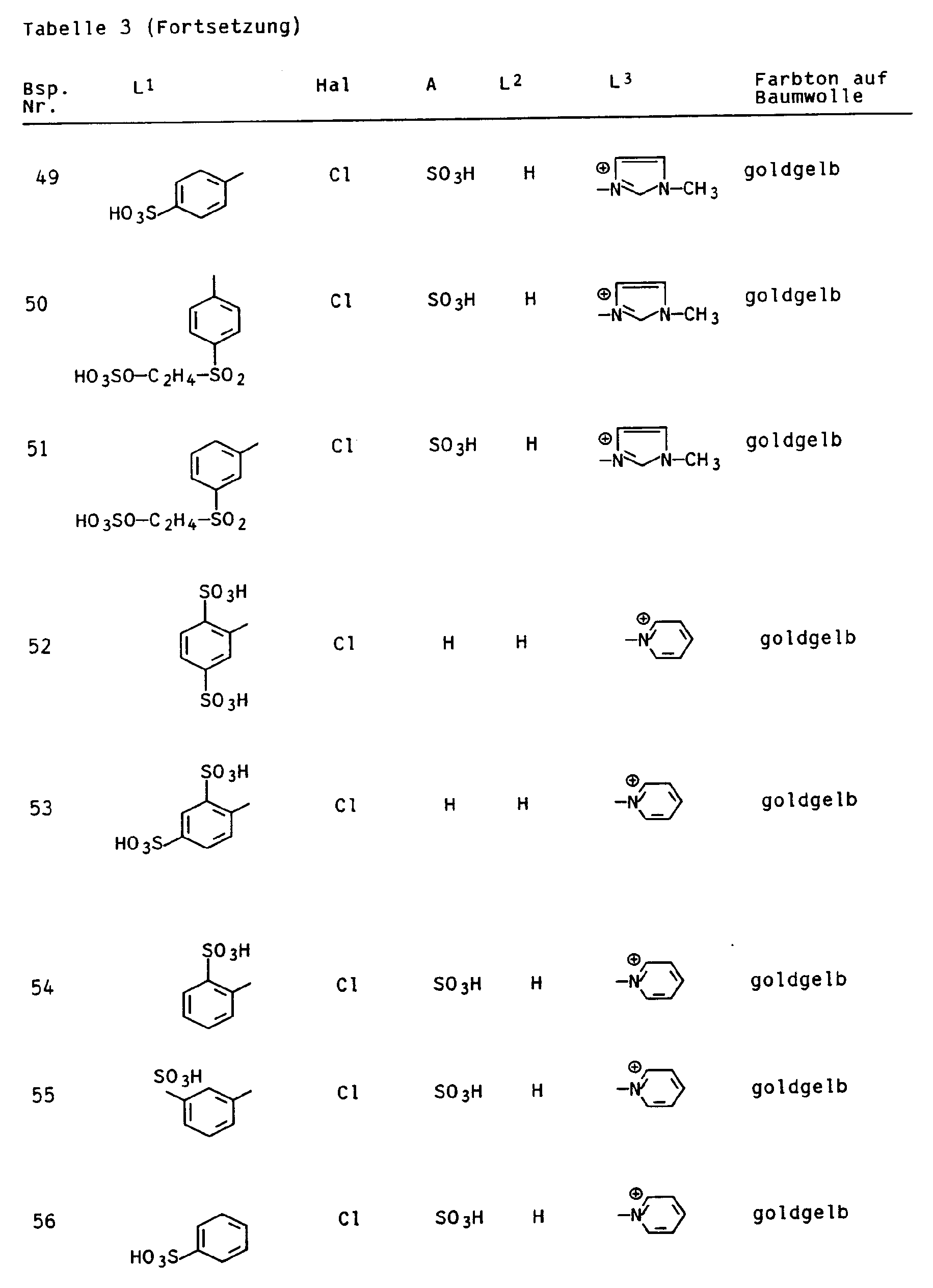
- 41,6 g des Kondensationsproduktes aus 1,4-Diaminobenzol-2,5-disulfonsäure und Cyanurchlorid wurden in 500 ml Eiswasser salzsauer diazotiert und mit 24,2 g 3-(3-Methylimidazol-1-ylium)-4-methyl-6-hydroxypyrid-2-on-hydrochlorid versetzt. Durch Anheben des pH-Wertes auf 6 bis 7 wurde die Kupplung zu Ende geführt. Nun wurden 9,4 g (0,05 mol) 1,2-Diaminobenzol-3-sulfonsäure, in 200 ml Wasser neutral gelöst, zugesetzt und 2 Stunden bei einem pH-Wert von 6 bis 7 und 40 bis 45°C gerührt. Nach beendeter Umsetzung wurde durch Zugabe von Natriumchlorid ausgesalzen und der erhaltene Farbstoff der Formel

abfiltriert. Er färbt Baumwolle in brillantem goldgelben Ton mit guter Lichtechtheit und guten Naßechtheiten. - In analoger Weise werden die in Tabelle 4 aufgeführten Farbstoffe erhalten.
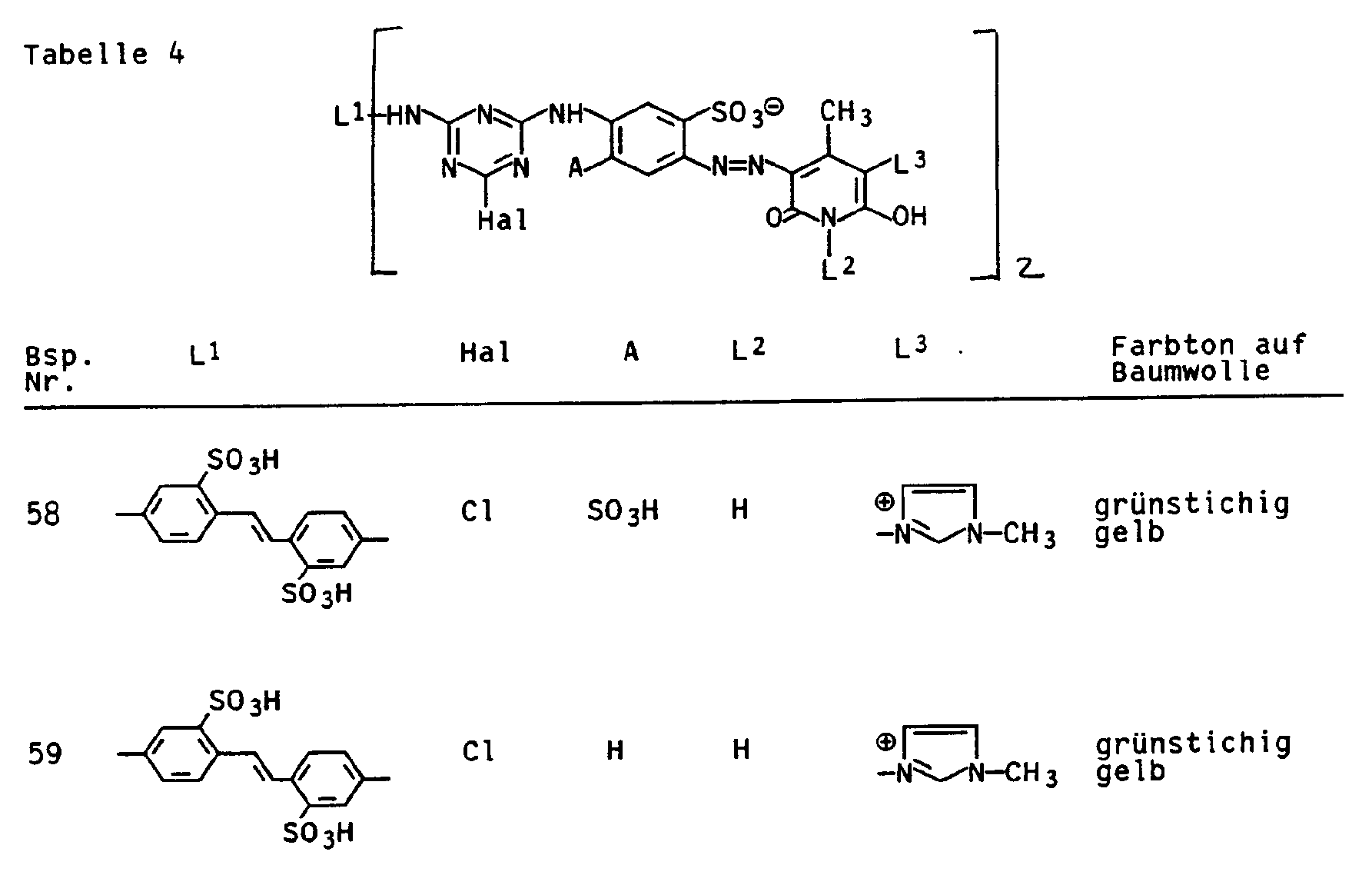

- 17,3 g (0,1 mol) Anilin-3-sulfonsäure wurden in 200 ml Wasser bei einem pH-Wert von 7 gelöst und mit einer Suspension von 18,5 g (0,1 mol) Cyanurchlorid in 200 ml Eiswasser versetzt. Nachdem keine freien Aminogruppen mehr nachweisbar waren, wurde filtriert. Das Filtrat wurde mit einer neutralen Lösung von 2,02 g (0,1 mol) 1-(N-Methylaminomethyl)-3-aminobenzol-4-sulfonsäure in 300 ml Wasser versetzt und 2 Stunden bei 30°C und einem pH-Wert von 8,5 bis 9 gerührt.
- Das erhaltene sekundäre Kondensationsprodukt wurde bei 0 bis 5°C salzsauer diazotiert und mit 24,2 g (0,1 mol) 3-(3-Methylimidazol-1-ylium)-4-methyl-6-hydroxypyrid-2-on-hydrochlorid versetzt. Durch Anheben des pH-Wertes auf 6 bis 7 wurde die Kupplung zu Ende geführt. Die entstandene Suspension wurde mit Natriumchlorid ausgesalzen und abfiltriert. Der erhaltene Farbstoff entspricht der Formel

und färbt Baumwolle in brillantem grünstichig gelben Farbton mit guter Lichtechtheit und guten Naßechtheiten. - Zu 25,7 g (0,1 mol) des salzsauer diazotierten Kondensationsproduktes aus 5-Chlor-2,4,6-trifluorpyrimidin und 1,3-Diaminobenzol-4,6-disulfonsäure wurden bei 0 bis 5°C 24,3 g (0,1 mol) 3-(3-Methylimidazol-1-ylium)-4-methyl-6-hydroxypyrid-2-on-hydrochlorid gegeben. Durch Zugabe von Natriumbicarbonat wurde die Kupplung bei einem pH-Wert von 6 bis 7 beendigt. Der erhaltene Farbstoff der Formel

wurde durch Zugabe von Natriumchlorid abgeschieden und färbt Baumwolle in brillantem grünstichig gelben Farbton und guter Lichtechtheit und guten Naßechtheiten.
mit der Maßgabe, daß die Anzahl der Hydroxysulfonylgruppen im Molekül die der kationischen Gruppen um mindestens eins übersteigt, sowie die Verwendung der neuen Farbstoffe zum Färben oder Bedrucken von Hydroxygruppen oder Stickstoff enthaltenden Substraten.
Claims (5)
- Reaktivfarbstoffe der Formel I
 n 1 oder 2,X im Fall a), wenn n für 1 steht, einen Rest der Formel IIa, IIb oder IIc
im Fall b), wenn n für 2 steht, einen Rest der obengenannten Formel IIa,L¹ im Fall a1), wenn n für 1 und X für einen Rest der Formel IIb oder IIc stehen, Fluor, Chlor, C₁-C₄-Alkoxy oder Phenoxy,
im Fall a2), wenn n für 1 und X für einen Rest der Formel IIa stehen, C₁-C₄-Alkyl oder Phenyl, das gegebenenfalls durch Hydroxysulfonyl, Vinylsulfonyl oder den Rest
-SO₂-C₂H₄-Z ,
worin Z für eine unter alkalischen Reaktionsbedingungen abspaltbare Gruppe steht, einfach oder zweifach substituiert ist, oder
im Fall b1), wenn n für 2 und X für einen Rest der Formel IIa stehen, ein Brückenglied, das eine oder zwei Hydroxysulfonylgruppen aufweist,D den Rest einer Diazokomponente aus der Anilin- oder Aminonaphthalinreihe, der mindestens eine Hydroxysulfonylgruppe aufweist,L² Wasserstoff oder C₁-C₈-Alkyl, das gegebenenfalls durch Hydroxy substituiert ist und durch ein oder zwei Sauerstoffatome in Etherfunktion unterbrochen sein kann,L³ den kationischen Rest eines fünf- oder sechsgliedrigen aromatischen Heterocyclus, der mindestens ein Stickstoffatom und gegebenenfalls ein oder zwei weitere Heteroatome, ausgewählt aus der Gruppe, bestehend aus Stickstoff, Sauerstoff und Schwefel, aufweist und der über das Stickstoffatom an den Pyridonring geknüpft ist, undL⁴ Wasserstoff oder C₁-C₄-Alkyl bedeuten,mit der Maßgabe, daß die Anzahl der Hydroxysulfonylgruppen im Molekül die der kationischen Gruppen um mindestens eins übersteigt. - Reaktivfarbstoffe nach Anspruch 1, dadurch gekennzeichnet, daß X einen Rest der Formel IIa oder IIb und L¹ im Fall a1), wenn n für 1 und X für einen Rest der Formel IIb stehen, Chlor,
im Fall a2), wenn n für 1 und X für einen Rest der Formel IIa stehen, C₁-C₄-Alkyl oder Phenyl, das gegebenenfalls durch Hydroxysulfonyl, Vinylsulfonyl, oder den Rest
-SO₂-C₂H₄-Z ,
worin Z für eine unter alkalischen Reaktionsbedingungen abspaltbare Gruppe steht, einfach oder zweifach substituiert ist, oder
im Fall b1), wenn n für 2 und X für einen Rest der Formel IIa stehen, ein Brückenglied, das eine oder zwei Hydroxysulfonylgruppen aufweist, bedeuten. - Reaktivfarbstoffe nach Anspruch 1, dadurch gekennzeichnet, daß D den Rest einer Diazokomponente aus der Anilinreihe bedeutet, der ein oder zwei Hydroxysulfonylgruppen aufweist.
- Reaktivfarbstoffe nach Anspruch 1, die der Formel Ia
 n R¹, Hal, L³ und L⁴ jeweils die in Anspruch 1 genannte Bedeutung besitzen,L² Wasserstoff oder C₁-C₄-Alkyl,A Wasserstoff oder Hydroxysulfonyl undL¹, wenn n für 1 steht, C₁-C₄-Alkyl oder Phenyl, das gegebenenfalls durch Hydroxysulfonyl, Vinylsulfonyl oder den Rest
-SO₂-C₂H₄-Z ,
worin Z für eine unter alkalischen Reaktionsbedingungen abspaltbare Gruppe steht, einfach oder zweifach substituiert ist, oder, wenn n für 2 steht, Mono- oder Dihydroxysulfonylphenylen, Mono- oder Dihydroxysulfonylbiphenylen, Mono- oder Dihydroxysulfonylstilbendiyl oder Mono- oder Dihydroxysulfonyl-4,4′-ureylen-bis-phenyl bedeuten. - Verwendung der Reaktivfarbstoffe gemäß Anspruch 1 zum Färben oder Bedrucken von Hydroxygruppen oder Stickstoff enthaltenden Substraten.
Applications Claiming Priority (2)
| Application Number | Priority Date | Filing Date | Title |
|---|---|---|---|
| DE4107377 | 1991-03-08 | ||
| DE4107377A DE4107377A1 (de) | 1991-03-08 | 1991-03-08 | Reaktivfarbstoffe mit einer kupplungskomponente aus der hydroxypyridonreihe |
Publications (2)
| Publication Number | Publication Date |
|---|---|
| EP0503339A1 EP0503339A1 (de) | 1992-09-16 |
| EP0503339B1 true EP0503339B1 (de) | 1994-06-22 |
Family
ID=6426725
Family Applications (1)
| Application Number | Title | Priority Date | Filing Date |
|---|---|---|---|
| EP92103014A Expired - Lifetime EP0503339B1 (de) | 1991-03-08 | 1992-02-22 | Reaktivfarbstoffe mit einer Kupplungskomponente aus der Hydroxypyridonreihe |
Country Status (4)
| Country | Link |
|---|---|
| US (1) | US5175259A (de) |
| EP (1) | EP0503339B1 (de) |
| JP (1) | JPH04345669A (de) |
| DE (2) | DE4107377A1 (de) |
Families Citing this family (6)
| Publication number | Priority date | Publication date | Assignee | Title |
|---|---|---|---|---|
| CH689424A5 (de) * | 1994-05-06 | 1999-04-15 | Clariant Finance Bvi Ltd | Faserreaktive Disazofarbstoffe. |
| GB9602787D0 (en) * | 1996-02-12 | 1996-04-10 | Clariant Finance Bvi Ltd | Organic compounds |
| ES2169491T3 (es) * | 1997-02-07 | 2002-07-01 | Ciba Sc Holding Ag | Formulaciones acuosas de colorantes reactivos y procedimientos para teñir y estampar materiales de fibras textiles. |
| GB9804175D0 (en) * | 1998-02-28 | 1998-04-22 | Zeneca Ltd | Compounds |
| JP2005520868A (ja) * | 2001-09-24 | 2005-07-14 | チバ スペシャルティ ケミカルズ ホールディング インコーポレーテッド | カチオン性反応染料 |
| CN103725036B (zh) * | 2014-01-05 | 2015-09-30 | 盐城工业职业技术学院 | 一种橙红色阳离子活性染料 |
Family Cites Families (14)
| Publication number | Priority date | Publication date | Assignee | Title |
|---|---|---|---|---|
| GB1384056A (en) * | 1971-04-29 | 1975-02-19 | Ici Ltd | Water-soluble reactive azo dyestuffs |
| CA1067070A (en) * | 1975-06-30 | 1979-11-27 | Helmut Moser | Azo dyestuffs |
| DE2752282A1 (de) * | 1976-11-30 | 1978-06-01 | Sandoz Ag | Organische verbindungen, ihre herstellung und verwendung |
| DE2831912A1 (de) * | 1978-07-20 | 1980-02-07 | Bayer Ag | Azoreaktivfarbstoffe |
| US4673735A (en) * | 1982-04-15 | 1987-06-16 | Sandoz Ltd. | Azo compounds having at least one 6-hydroxypyrid-2-one coupling component radical metal complexes thereof and intermediates therefor |
| FR2536406B1 (fr) * | 1982-11-22 | 1986-08-22 | Sandoz Sa | Nouveaux composes azoiques exempts de groupes sulfo, leur preparation et leur utilisation comme colorants |
| CH663417A5 (de) * | 1984-05-19 | 1987-12-15 | Sandoz Ag | Basische verbindungen, deren herstellung und verwendung. |
| DE3538517A1 (de) * | 1984-11-08 | 1986-05-15 | Sandoz-Patent-GmbH, 7850 Lörrach | Basische azoverbindungen, deren herstellung und verwendung |
| CH665215A5 (de) * | 1984-11-08 | 1988-04-29 | Sandoz Ag | Basische azoverbindungen. |
| DE3767390D1 (de) * | 1986-07-09 | 1991-02-21 | Mitsubishi Chem Ind | Wasserloesliche disazofarbstoffe und verfahren zum faerben mit diesen farbstoffen. |
| DE3707550A1 (de) * | 1987-03-10 | 1988-09-22 | Bayer Ag | Reaktivfarbstoffe |
| DE3739350A1 (de) * | 1987-11-20 | 1989-06-01 | Hoechst Ag | 2-hydroxy-pyridon-azoverbindungen, verfahren zu ihrer herstellung und ihre verwendung als farbstoffe |
| DE3801945A1 (de) * | 1988-01-23 | 1989-07-27 | Basf Ag | Aufzeichnungsfluessigkeit fuer das ink-jet-verfahren |
| DE3829595A1 (de) * | 1988-09-01 | 1990-03-15 | Bayer Ag | Reaktivfarbstoffe |
-
1991
- 1991-03-08 DE DE4107377A patent/DE4107377A1/de not_active Withdrawn
-
1992
- 1992-02-22 DE DE59200247T patent/DE59200247D1/de not_active Expired - Lifetime
- 1992-02-22 EP EP92103014A patent/EP0503339B1/de not_active Expired - Lifetime
- 1992-02-28 US US07/843,193 patent/US5175259A/en not_active Expired - Fee Related
- 1992-03-06 JP JP4049782A patent/JPH04345669A/ja not_active Withdrawn
Also Published As
| Publication number | Publication date |
|---|---|
| JPH04345669A (ja) | 1992-12-01 |
| EP0503339A1 (de) | 1992-09-16 |
| DE4107377A1 (de) | 1992-09-10 |
| US5175259A (en) | 1992-12-29 |
| DE59200247D1 (de) | 1994-07-28 |
Similar Documents
| Publication | Publication Date | Title |
|---|---|---|
| DE2748929C2 (de) | Wasserlösliche Farbstoffe, Verfahren zu ihrer Herstellung, deren Verwendung als faserreaktive Farbstoffe zum Färben und Bedrucken von Fasermaterialien | |
| DE1289930B (de) | Verfahren zur Herstellung von Azofarbstoffen und deren Metallkomplexverbindungen | |
| EP0503339A1 (de) | Reaktivfarbstoffe mit einer Kupplungskomponente aus der Hydroxypyridonreihe | |
| DE2349709A1 (de) | Azoverbindungen, deren herstellung und verwendung | |
| DE69411291T2 (de) | Faserreaktive Phthalocyaninfarbstoffe | |
| DE4116785A1 (de) | Phenylazo- oder naphthylazobenzole mit mehreren reaktiven ankern | |
| DE1226728B (de) | Verfahren zur Herstellung von metallhaltigen Reaktivfarbstoffen | |
| DE19521056A1 (de) | Aluminium Phthalocyanin Reaktivfarbstoffe | |
| EP0514330A1 (de) | Azofarbstoffe | |
| EP0437699B1 (de) | Phenylazo- oder Naphthylazobenzole mit mehreren reaktiven Gruppen sowie deren Zwischenprodukte | |
| DE2751785C2 (de) | ||
| DE2050901A1 (de) | Wasserlösliche Azofarbstoffe | |
| EP0192964B1 (de) | Phthalocyanin-Reaktivfarbstoffe | |
| DE4425619A1 (de) | Reaktivfarbstoffe, Verfahren zu deren Herstellung und deren Verwendung | |
| DE4120696A1 (de) | Verfahren zur herstellung von reaktivfarbstoffen und neue reaktivfarbstoffe | |
| DE3739350A1 (de) | 2-hydroxy-pyridon-azoverbindungen, verfahren zu ihrer herstellung und ihre verwendung als farbstoffe | |
| DE1419841A1 (de) | Verfahren zur Herstellung von neuen schwermetallhaltigen Formazanfarbstoffen | |
| EP0712429B1 (de) | Phenylazotriazolopyridinfarbstoffe | |
| EP0342158B1 (de) | Wasserlösliche Phthalocyaninverbindungen, Verfahren zu ihrer Herstellung und ihre Verwendung | |
| EP0694053B1 (de) | Wasserlösliche faserreaktive farbstoffe, verfahren zu ihrer herstellung und ihre verwendung | |
| EP0402318B1 (de) | Verfahren zur Herstellung von faserreaktiven Formazanverbindungen | |
| DE1904111C3 (de) | Faserreaktive schwermetallhaltige Formazanfarbstoffe, Verfahren zu ihrer Herstellung und deren Verwendung zum Färben oder Bedrucken von Textilmaterialien | |
| DE19636483C2 (de) | Wasserlösliche Azoverbindungen, Verfahren zu ihrer Herstellung und ihre Verwendung als Farbstoffe | |
| EP0433764A1 (de) | Reaktivfarbstoffe mit Triazin- und Chlorbutinylanker | |
| DE2708441A1 (de) | 2-amino-5-thiocyanato-thiadiazol- (1,3,4), dessen herstellung und verwendung zum aufbau von azofarbstoffen |
Legal Events
| Date | Code | Title | Description |
|---|---|---|---|
| PUAI | Public reference made under article 153(3) epc to a published international application that has entered the european phase |
Free format text: ORIGINAL CODE: 0009012 |
|
| 17P | Request for examination filed |
Effective date: 19920626 |
|
| AK | Designated contracting states |
Kind code of ref document: A1 Designated state(s): CH DE FR GB IT LI |
|
| RBV | Designated contracting states (corrected) |
Designated state(s): CH DE FR GB IT LI |
|
| 17Q | First examination report despatched |
Effective date: 19931108 |
|
| GRAA | (expected) grant |
Free format text: ORIGINAL CODE: 0009210 |
|
| AK | Designated contracting states |
Kind code of ref document: B1 Designated state(s): CH DE FR GB IT LI |
|
| PG25 | Lapsed in a contracting state [announced via postgrant information from national office to epo] |
Ref country code: IT Free format text: LAPSE BECAUSE OF FAILURE TO SUBMIT A TRANSLATION OF THE DESCRIPTION OR TO PAY THE FEE WITHIN THE PRESCRIBED TIME-LIMIT;WARNING: LAPSES OF ITALIAN PATENTS WITH EFFECTIVE DATE BEFORE 2007 MAY HAVE OCCURRED AT ANY TIME BEFORE 2007. THE CORRECT EFFECTIVE DATE MAY BE DIFFERENT FROM THE ONE RECORDED. Effective date: 19940622 Ref country code: FR Effective date: 19940622 |
|
| REF | Corresponds to: |
Ref document number: 59200247 Country of ref document: DE Date of ref document: 19940728 |
|
| GBT | Gb: translation of ep patent filed (gb section 77(6)(a)/1977) |
Effective date: 19940712 |
|
| EN | Fr: translation not filed | ||
| PLBE | No opposition filed within time limit |
Free format text: ORIGINAL CODE: 0009261 |
|
| STAA | Information on the status of an ep patent application or granted ep patent |
Free format text: STATUS: NO OPPOSITION FILED WITHIN TIME LIMIT |
|
| 26N | No opposition filed | ||
| PGFP | Annual fee paid to national office [announced via postgrant information from national office to epo] |
Ref country code: CH Payment date: 19970203 Year of fee payment: 6 |
|
| PGFP | Annual fee paid to national office [announced via postgrant information from national office to epo] |
Ref country code: GB Payment date: 19970217 Year of fee payment: 6 |
|
| PGFP | Annual fee paid to national office [announced via postgrant information from national office to epo] |
Ref country code: DE Payment date: 19970225 Year of fee payment: 6 |
|
| PG25 | Lapsed in a contracting state [announced via postgrant information from national office to epo] |
Ref country code: DE Free format text: LAPSE BECAUSE OF THE APPLICANT RENOUNCES Effective date: 19971218 |
|
| PG25 | Lapsed in a contracting state [announced via postgrant information from national office to epo] |
Ref country code: GB Free format text: LAPSE BECAUSE OF NON-PAYMENT OF DUE FEES Effective date: 19980222 |
|
| PG25 | Lapsed in a contracting state [announced via postgrant information from national office to epo] |
Ref country code: CH Free format text: LAPSE BECAUSE OF NON-PAYMENT OF DUE FEES Effective date: 19980228 Ref country code: LI Free format text: LAPSE BECAUSE OF NON-PAYMENT OF DUE FEES Effective date: 19980228 |
|
| GBPC | Gb: european patent ceased through non-payment of renewal fee |
Effective date: 19980222 |
|
| REG | Reference to a national code |
Ref country code: CH Ref legal event code: PL |