EP0484157B1 - Maleimidharzzusammensetzung und kunststoffumhüllte Halbleiteranordnung hergestellt unter Verwendung dieser Zusammensetzung - Google Patents
Maleimidharzzusammensetzung und kunststoffumhüllte Halbleiteranordnung hergestellt unter Verwendung dieser Zusammensetzung Download PDFInfo
- Publication number
- EP0484157B1 EP0484157B1 EP91310073A EP91310073A EP0484157B1 EP 0484157 B1 EP0484157 B1 EP 0484157B1 EP 91310073 A EP91310073 A EP 91310073A EP 91310073 A EP91310073 A EP 91310073A EP 0484157 B1 EP0484157 B1 EP 0484157B1
- Authority
- EP
- European Patent Office
- Prior art keywords
- resin
- maleimide resin
- resin composition
- maleimide
- phenolic
- Prior art date
- Legal status (The legal status is an assumption and is not a legal conclusion. Google has not performed a legal analysis and makes no representation as to the accuracy of the status listed.)
- Expired - Lifetime
Links
- 0 Cc1c(*)c(*)ccc1 Chemical compound Cc1c(*)c(*)ccc1 0.000 description 3
Images
Classifications
-
- H—ELECTRICITY
- H10—SEMICONDUCTOR DEVICES; ELECTRIC SOLID-STATE DEVICES NOT OTHERWISE PROVIDED FOR
- H10W—GENERIC PACKAGES, INTERCONNECTIONS, CONNECTORS OR OTHER CONSTRUCTIONAL DETAILS OF DEVICES COVERED BY CLASS H10
- H10W74/00—Encapsulations, e.g. protective coatings
- H10W74/40—Encapsulations, e.g. protective coatings characterised by their materials
- H10W74/47—Encapsulations, e.g. protective coatings characterised by their materials comprising organic materials, e.g. plastics or resins
- H10W74/473—Encapsulations, e.g. protective coatings characterised by their materials comprising organic materials, e.g. plastics or resins containing a filler
-
- H—ELECTRICITY
- H10—SEMICONDUCTOR DEVICES; ELECTRIC SOLID-STATE DEVICES NOT OTHERWISE PROVIDED FOR
- H10W—GENERIC PACKAGES, INTERCONNECTIONS, CONNECTORS OR OTHER CONSTRUCTIONAL DETAILS OF DEVICES COVERED BY CLASS H10
- H10W74/00—Encapsulations, e.g. protective coatings
- H10W74/40—Encapsulations, e.g. protective coatings characterised by their materials
- H10W74/47—Encapsulations, e.g. protective coatings characterised by their materials comprising organic materials, e.g. plastics or resins
-
- C—CHEMISTRY; METALLURGY
- C08—ORGANIC MACROMOLECULAR COMPOUNDS; THEIR PREPARATION OR CHEMICAL WORKING-UP; COMPOSITIONS BASED THEREON
- C08K—Use of inorganic or non-macromolecular organic substances as compounding ingredients
- C08K5/00—Use of organic ingredients
- C08K5/04—Oxygen-containing compounds
- C08K5/14—Peroxides
-
- C—CHEMISTRY; METALLURGY
- C08—ORGANIC MACROMOLECULAR COMPOUNDS; THEIR PREPARATION OR CHEMICAL WORKING-UP; COMPOSITIONS BASED THEREON
- C08K—Use of inorganic or non-macromolecular organic substances as compounding ingredients
- C08K5/00—Use of organic ingredients
- C08K5/49—Phosphorus-containing compounds
- C08K5/51—Phosphorus bound to oxygen
- C08K5/53—Phosphorus bound to oxygen bound to oxygen and to carbon only
- C08K5/5313—Phosphinic compounds, e.g. R2=P(:O)OR'
-
- C—CHEMISTRY; METALLURGY
- C08—ORGANIC MACROMOLECULAR COMPOUNDS; THEIR PREPARATION OR CHEMICAL WORKING-UP; COMPOSITIONS BASED THEREON
- C08L—COMPOSITIONS OF MACROMOLECULAR COMPOUNDS
- C08L79/00—Compositions of macromolecular compounds obtained by reactions forming in the main chain of the macromolecule a linkage containing nitrogen with or without oxygen or carbon only, not provided for in groups C08L61/00 - C08L77/00
- C08L79/04—Polycondensates having nitrogen-containing heterocyclic rings in the main chain; Polyhydrazides; Polyamide acids or similar polyimide precursors
- C08L79/08—Polyimides; Polyester-imides; Polyamide-imides; Polyamide acids or similar polyimide precursors
- C08L79/085—Unsaturated polyimide precursors
-
- H—ELECTRICITY
- H01—ELECTRIC ELEMENTS
- H01B—CABLES; CONDUCTORS; INSULATORS; SELECTION OF MATERIALS FOR THEIR CONDUCTIVE, INSULATING OR DIELECTRIC PROPERTIES
- H01B3/00—Insulators or insulating bodies characterised by the insulating materials; Selection of materials for their insulating or dielectric properties
- H01B3/18—Insulators or insulating bodies characterised by the insulating materials; Selection of materials for their insulating or dielectric properties mainly consisting of organic substances
- H01B3/30—Insulators or insulating bodies characterised by the insulating materials; Selection of materials for their insulating or dielectric properties mainly consisting of organic substances plastics; resins; waxes
- H01B3/303—Macromolecular compounds obtained by reactions forming a linkage containing nitrogen with or without oxygen or carbon in the main chain of the macromolecule, not provided for in groups H01B3/38 or H01B3/302
- H01B3/306—Polyimides or polyesterimides
-
- H—ELECTRICITY
- H10—SEMICONDUCTOR DEVICES; ELECTRIC SOLID-STATE DEVICES NOT OTHERWISE PROVIDED FOR
- H10W—GENERIC PACKAGES, INTERCONNECTIONS, CONNECTORS OR OTHER CONSTRUCTIONAL DETAILS OF DEVICES COVERED BY CLASS H10
- H10W72/00—Interconnections or connectors in packages
- H10W72/50—Bond wires
- H10W72/531—Shapes of wire connectors
- H10W72/536—Shapes of wire connectors the connected ends being ball-shaped
-
- H—ELECTRICITY
- H10—SEMICONDUCTOR DEVICES; ELECTRIC SOLID-STATE DEVICES NOT OTHERWISE PROVIDED FOR
- H10W—GENERIC PACKAGES, INTERCONNECTIONS, CONNECTORS OR OTHER CONSTRUCTIONAL DETAILS OF DEVICES COVERED BY CLASS H10
- H10W72/00—Interconnections or connectors in packages
- H10W72/50—Bond wires
- H10W72/531—Shapes of wire connectors
- H10W72/5363—Shapes of wire connectors the connected ends being wedge-shaped
-
- H—ELECTRICITY
- H10—SEMICONDUCTOR DEVICES; ELECTRIC SOLID-STATE DEVICES NOT OTHERWISE PROVIDED FOR
- H10W—GENERIC PACKAGES, INTERCONNECTIONS, CONNECTORS OR OTHER CONSTRUCTIONAL DETAILS OF DEVICES COVERED BY CLASS H10
- H10W90/00—Package configurations
- H10W90/701—Package configurations characterised by the relative positions of pads or connectors relative to package parts
- H10W90/751—Package configurations characterised by the relative positions of pads or connectors relative to package parts of bond wires
- H10W90/756—Package configurations characterised by the relative positions of pads or connectors relative to package parts of bond wires between a chip and a stacked lead frame, conducting package substrate or heat sink
Definitions
- This invention relates to a maleimide resin composition suitably allowing encapsulation of a semiconductor element and to a resin encapsulated semiconductor device manufactured using the composition.
- An epoxy resin composition containing a thermosetting epoxy resin as a resin component and a phenolic resin as a curing agent is widely used for resin encapulation of the semiconductor element.
- a flat package-type IC for example, a gate array called ASIC (Application specific IC) and a standard cell-type LSI, encapuslated with the resin composition described above is mounted on a substrate by processes of vapor phase re-flow, infrared re-flow, and soaking in solder. In these process, the package is exposed to high temperature (ca. 215-260°C). Then, in the resin encapsulated semiconductor encapsulated with said epoxy resin composition, very small amount of water permeated through resin to inside abruptly evaporates allowing to crack the encapsulating resin. Crack developed to outside spoils moisture-resistance reliability of the resin encapsulated semiconductor to make a great problem. Besides, a phenomenon occurs to disturb to mount the package due to swelling of the encapsulating resin.
- ASIC Application specific IC
- LSI standard cell-type LSI
- encapsulation of a semiconductor element using these maleimide resins is made by molding a resin composition containing a maleimide resin as a main component of resin, a phenolic resin as a curing agent component, a curing catalyst, and other additives such as an inorganic filler and a flame-retardant, employing normal molding process, such as transfer molding.
- a resin composition containing a maleimide resin as a main component of resin, a phenolic resin as a curing agent component, a curing catalyst, and other additives such as an inorganic filler and a flame-retardant
- Such maleimide resin compositions containing as a curing catalyst, a basic hardening catalyst and an organic peroxide, are described in, for example, JP-A 1 254 735, JP-A 63 191 833, JP-A 1 213 335, JP-A 62 072 722 and JP-A 1 213 336.
- the following problems occur at resin encapsulation of a semiconductor element using the maleimide resin composition described above.
- the maleimide resin composition shows less curing characteristics, because the reaction between the maleimide resin and the phenolic resin slowly progresses in said maleimide resin composition.
- molding resin for encapsulating requires long time to result in remaining non-reacted components and in decrease in mold release characteristics from a mold used.
- An object of the present invention is to improve such as curing characteristics of a maleimide resin composition used for encapsulation of a semiconductor element.
- the present invention is intended to provide a maleimide resin composition having increased mouldability so as to reduce moulding time, less staining of a mould during the moulding process, increased releasability from a mould, and improved external appearance of mouldings.
- Another object of the present invention is to provide highly reliable resin encapsulated semiconductor device having resin encapsulation with the maleimide resin composition showing better mouldability as described above.
- a maleimide resin composition comprising a maleimide resin, a phenolic resin, and a curing catalyst, said curing catalyst being a combination of a basic catalyst and a peroxide, the maleimide resin composition being characterised in that the content of organic acid therein does not exceed a value of 0.2 weight percent when said value is analysed by extracting said organic acid using hot water treatment of said maleimide resin under the condition of 95°C for 20 hours or more.
- the present invention provides a resin encapsulated semiconductor device manufactured by encapsulating a semiconductor element with a maleimide resin composition in accordance with the present invention.
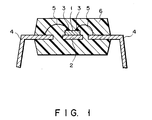
- Fig. 1 shows a sectional view showing structure of a resin encapsulated semiconductor device according to the present invention.
- a maleimide resin composition according to the present invention, the additional reaction of the phenolic resin being a curing agent component to double bonds of the maleimide resin being a main component of resin and the mutual reaction of the maleimide resin occur place through the function of the curing catalyst, and the resin composition is cured by progress of polymerization of the maleimide resin to form a cured product.
- maleimide resin is not particularly restricted in the present invention, for example, a N,N'-substituted bismaleimide compound represented by general formula (1) given below or poly(phenylene methylene)polymaleimide represented by general formula (2) given below can be used.
- X represents a divalent hydrocarbon group such as an alkylene group, a cyclo-alkylene group, and a monocyclic or polycyclic arylene group, or a divalent hydrocarbon group combined by a divalent atomic group such as -CH 2 -, -CO-, -SO 2 -, and -CONH-.
- m represents an integral of 1 to 5.
- the maleimide resin used in the present invention includes, for example, N,N'-phenylenebismaleimide, N,N'-hexamethylene-bismaleimide, N,N'-diphenylmethanebismaleimide, N,N'-oxy-di-p-phenylenebismaleimide, N,N'-4,4'-benzophenonebismaleimide, N,N'-p-diphenylsulfonebismaleimide, N,N'-(3,3' dimethyl)methylene-di-p-phenylenebismaleimide, poly(phenylmethylene)polymaleimide, 2,2'-bis(4-phenoxyphenyl)propane-N,N'-bismaleimide, bis(4-phenoxyphenyl)sulfone-N,N'-bismaleimide, 1,4-bis(4-phenoxy)benzene-N,N'-bismaleimide, 1,3-bis(4-phenoxy)benzene
- the maleimide resin can contain a trace amount of an organic acid.
- the organic acid referred to is that remaining in the resin when the purity thereof is insufficient; examples of such organic acids are acetic acid. maleic acid. fumaric acid, and fatty acids.
- These organic acids can be extracted from the resin by hot water treatment of the maleimide resin under the condition of 95°C for 20 hours or more and can be analyzed by an ion chromatography and a liquid chromatography.
- the organic acid content of the maleimide resin has a great influence on the properties of a cured product when it is moulded.
- organic acid content in the maleimide resin should be not more than 0.2 weight per cent or preferably not more than 0.1 weight per cent in values determined by the extracting and analyzing methods described above.
- the method for obtaining a bismaleimide resin of sufficient purity is the direct dehydration and cyclisation of the bismaleamic acid by heating, without acetic anhydride as reaction solvent.
- Phenolic resin is used as a curing agent component in the maleimide resin composition of the present invention.
- novolak type phenolic resin may be used. Any novolak type phenolic resin having two or more phenolic hydroxyl groups in a single molecule can be used. More specifically, types of novalak resin which may be used in the present invention include phenolic novolak resin, cresol novolak resin, t-butyl phenolic novolak resin, nonyl phenolic novolak resin, phenolic aralkyl resin, dicyclopentadien phenolic novolak resin.
- phenolic resins having a group reactive to a maleimide resin such as amino group, allyl group, vinyl group, and acryl group
- phenolic novolak resin is particularly preferable in terms of mouldability and strength.
- phenolic resin examples include: Shonol BRG-555 (Showa High Polymer Co., Ltd., softening point 68°C, melting viscosity 2.4 ps at 125°C), Shonol BRG-556 (Showa High Polymer Co., Ltd., softening point 80°C, melting viscosity 1.8 ps at 150°C), Shonol BRG-557 (Showa High Polymer Co., Ltd., softening point 87°C, melting viscosity 3.0 ps at 150°C), Shonol BRG-558 (Showa High Polymer Co., Ltd., softening point 97°C, melting viscosity 6.2 ps at 150°C), Varcum TD-2131 (Dai Nippon Ink, kk, softening point 80°C, melting viscosity 3.3 ps at 150°C), and Varcum TD
- the phenolic resin contained in the maleimide resin composition according to one embodiment of the present invention is allyl phenolic resin represented by general formulae (3), (4), or (5) given below.
- the content of allyl phenol monomer contained in the allyl phenolic resin is preferably 1000 ppm or less to reduce the volatility of components at melting.
- Preferable examples of allyl phenol monomers allowing to use in the present invention are SH-140A (Mitsubishi Petrochemical Co., Ltd.), SH-150A (Mitsubishi Petrochemical Co., Ltd.), and XPSF-4488 (Gunei Chemical Industry Co., Ltd.).
- the content of the phenolic resin in the maleimide resin composition of the present invention is 10 to 50 weight percent based the maleimide resin content.
- a content of phenolic resin below 10 weight percent increases the melting viscosity of the maleimide resin composition to result in unloading and wire flow at moulding.
- the content of the phenolic resin over 50 weight percent makes curing characteristics of the resin composition unsatisfactory and causes the heat resistance of a cured and moulded product to be reduced.
- a more preferable content of the phenolic resin is 20-40 weight percent based on the maleimide resin content.
- a binary catalyst including a basic catalyst and a peroxide is used as a curing catalyst.
- organic phosphine compounds for example, organic phosphine compounds, imidazole compounds or their derivatives, and DBU (1,8-diazabicyclo (5,4,0)undecene-7) or its phenolic salt are used. These compounds can be used singly or in comination as the need arises.
- the specific organic phosphines include, for example, trimethylphosphine, triethylphosphine, tributylphosphine, triphenylphosphine, tri(p-methylphenyl)phosphine, tri(nonylphenyl)phosphine, methyldiphenylphosphine, butylphenylphosphine, tricyclohexylphosphine, 1,2-bis(diphenylphosphine)ethane, and bis(diphenylphosphine)methane.
- These organic phosphine compounds can be used singly or in combination.
- the specific imidazole compounds include, for example, 2-methylimidazole, 2,4-dimethylimidazole, 2-ethyl-4-methylimidazole, 2-phenylimidazole, 2-phenyl-4-methylimidazole, and 2-heptadecylimidazole.
- the phenolic salt of DBU is exemplified by SA-853 (Sanapuro).
- the specific peroxides which may be used in the composition of the present invention may, for example, include diallyl peroxides such as di-t-2,5-dimethyl-2,5-di-t-butyl peroxyhexane; peroxy esters such as t-butyl peroxy acetate, t-butyl peroxy phthalate, t-butyl peroxy benzoate, 2,5-dimethyl-2,5-dibenzoyl peroxyhexane, and t-butyl peroxy-2-ethyl hexanoate; diacyl peroxides such as acetyl peroxide, isobutyryl peroxide, decanoyl peroxide, lauroyl peroxide, 3,5,5-trimethylhexanoyl peroxide, benzoyl peroxide, and di-2-ethylhexyl peroxy dicarbonate; hydroperoxides such as t-butyl hydroperoxide, cumen
- the total content of the curing catalyst is preferably 0.1 to 10 weight percent based on the total content of the maleimide resin (main component of resin) and the phenolic resin (curing agent component). If the content of curing catalyst is below 0.1 weight percent, reaction of the maleimide resin to the phenolic resin is insufficient and insufficient curing occurs. Hence, electrical characteristics of cured and moulded product, i.e. an encapsulating resin moulded, are substantially reduced. On the other hand, a content of curing catalyst above 10% causes a reduction in heat resistance, moisture-resistance, and electrical characteristics of the cured and moulded product.
- the most preferable content of curing catalyst is 0.5 to 5 weight percent depending on the total content of the maleimide resin and the phenolic resin.
- the content of peroxide is preferably 10 to 50 weight percent based on the content of the basic catalyst.
- a peroxide content below 10 weight percent promotes a polymerixing reaction of maleimide resin (bismaleimide) which is insufficient, so as to result in a reduced mouldability of the resin composition, and to inhibit improvement of, for example, heat resistance of a cured product.
- a peroxide content over 50% considerably lowers moisture-resistance and electrical characteristics of a cured product.
- the content of the peroxide is preferably 20 to 30 weight percent depending on the content of the basic catalyst.
- the maleimide resin composition of the present invention is particularly suitable for encapsulating a semiconductor element, for which it usually contains an inorganic filler in addition to essential components described above.
- the inorganic filler may, for example, be quartz glass powder, crystalline silica powder, glass fiber, talc, alumina powder, calcium silicate powder, calcium carbonate powder, barium sulfate powder, and magnesia powder.
- these fillers the most suitable are quartz powder and crystalline silica powder.
- the content of the silica powder can be in the range of 50 to 85 weight percent based on the content of the maleimide resin composition with proper combination of ground silica, globular silica, and fumed silica.
- a content of the inorganic filler below 50 weight percent increases the thermal coefficient of expansion of a cured product finally obtained, causing insufficient thermal impulse resistance.
- the content of inorganic filler is over 85 weight percent, the fluidity of the maleimide resin composition is insufficient to result in wire flow, bed flow and unloading.
- Suitable waxes for this purpose are, for example, polyethylene series waxes, i.e. waxy materials containing a main component of polyethylene with a molecular weight of 500 to 4000.
- the polyethylene series waxes are generally called a polyethylene wax.
- other suitable waxes are those having a carbonyl group as a polar group introduced by oxidizing denaturation of denaturation with acid.
- polyethylene series waxes having a softening point of 65 to 140°C are particularly preferably.
- the content of the wax contained in the maleimide resin composition of the present invention should be 0.2 to 19 parts by weight, preferably 0.5 to 5 parts by weight, based on 100 parts by weight of the resin composition. If the wax content is less than 0.2 parts by weight, releasability of a cured product from a mould is reduced. On the other hand, if the content is over 19 parts by weight, a mould can become stained, primarily by bleeding wax contained in the resin composition.
- ester series waxes such as carunauba wax and fatty acid amide series waxes can be added and a combination of these waxes and polyethylene series waxes can also be used.
- Organosyloxane bismaleimide can be added to the maleimide resin composition of the present invention in order to improve adhesion of the cured and moulded composition to a polyimide protecting film and to an insulating film such as SiO 2 and SiN formed on the surface of a semiconductor element.
- additives containing silicon rubber or silicon gel as a main component or MBS or ABS as a main component can be added in order to give low stress to a cured and moulded product.
- a flame-retardant such as an epoxy halide resin and antimony trioxide, a colorant such as carbon powder, or a coupling agent can be added, if necessary.
- a part or all of the phenolic resin being a component of a curing agent, is preblended with the curing catalyst containing a basic catalyst and a peroxide in advance of other components, in order to improve mouldability of the resin composition.
- a part or all of the phenolic resin and a part or all of the curing catalyst are dissolved and blended (preblending) to yield them in uniform and clear state.
- this blend is cooled and powdered by grinding to obtain a phenolic resin containing the curing catalyst.
- the phenolic resin containing the curing catalyst, the maleimide resin, the remainder of the phenolic resin, the remainder of the curing catalyst (when a part of the phenolic resin and a part of the curing catalyst are preblended), and as the need arises, other components such as an inorganic filler and additives, are melted and kneaded together, and then ground into powder form so as to obtain the maleimide resin composition of the present invention.
- both or either of the basic catalyst and the peroxide can be used.
- both the basic catalyst and the peroxide are preblended with the phenolic resin in order to improve dispersability of the curing catalyst in the resin composition.
- the temperature at which preblending is performed should be the softening point of the phenolic resin used, or higher.
- the temperature is preferably in the range so as to retain catalytic activity by thermal decomposition of the peroxide contained in the curing catalyst.
- the amount of phenolic resin preblended with the curing catalyst should be preferably 1 to 50 weight percent depending on the total amount of phenolic resin used for the preparation of the maleimide resin composition.
- the amount of preblended phenolic resin is less than I weight percent based on the total amount of phenolic resin used for preparing the maleimide resin composition, dispersion of the curing catalyst during preblending is insufficient, such that the effect of preblending is severely reduced.
- the amount of preblended phenolic resin is more than 50 weight percent based on the total amount of phenolic resin used for preparing the maleimide resin composition, the amount of phenolic resin remaining for pre-polymerization with the maleimide resin is too low and the operational performance of the pre-polymerization is reduced.
- the particularly preferable amount of phenolic resin used for preblending is 3 to 40 weight percent based on the total amount of phenolic resin amount used for the preparation of the maleimide resin composition.
- the combined result of preblending a part of said phenolic resin with the curing catalyst and pre-polymerizing the remainder of the phenolic resin with the maleimide resin improves dispersiblity of the curing catalyst to result in improvement of curing characteristics of the maleimide resin composition.
- the preparation of the maleimide resin composition of the present invention there are the following possible methods for preblending a part or whole of the phenolic resin with the curing catalyst and for melting and kneading of remaining components:
- the resin encapsulated semiconductor device of the present invention is manufactured by encapsulating a semiconductor element with the maleimide resin composition described previously, which contains an inorganic filler, according to conventional method.
- Fig. 1 shows a sectional structure of an example of a resin encapsulated semiconductor device of the invention.
- 1 shows a semiconductor chip mounted on an island 2.
- the individual device composed of a semiconductor element and parts such as a lead frame is encapsulated as covered with an encapsulating resin 6.
- the encapsulating resin 6 in the present invention the resin composition containing the maleimide resin, the phenolic resin, the combination of the basic catalyst and the peroxide as a curing catalyst, and the inorganic filler described previously is used.
- the most common method of this type of resin encapsulation is low pressure transfer molding, resin encapsulation by injection molding, compression molding, and casting is possible to employ. On this occasion, after-curing at 175°C or higher is preferred after the molding.
- the maleimide resin composition of the present invention can be applied to a thermoresistance plywood, and a thermoresistance adhesive and a thermoresistance paint, which are obtained by adding a diluting solvent to the composition, as well as use for the resin encapsulation of a semiconductor element.
- the maleimide resin composition of the invention has a characteristic of combined use of the basic catalyst and the peroxide as the curing catalyst. Between them, the peroxide has a function of a radical polymerization intiator, which reacts to double bonds of the maleimide resin so as to promote polymerization among molecules of the resin.
- the basic catalyst primarily promotes additional reaction of the phenolic resin being a curing agent to the maleimide resin.
- sole use of the basic catalyst as the curing catalyst leaves unreacted double bonds in the maleimide resin to result in insufficient progress of its polymerization. Sole use of the peroxide as the curing catalyst inhibits enough progress of reaction between the phenolic resin and the maleimide resin.
- both reactions of the mutual polymerization of the maleimide resin and the additional reaction of the phenolic resin to the maleimide resin are promoted to improve its curing characteristics. Consequently improvements are achieved for moldability of the resin composition such as shortening of molding time, reducing stain of a mold, and improvement of mold release characteristics of a cured product from a mold to result in obtaining an encapsulating resin mold having good external appearance.
- a cured product has properties of heat resistance, moisture-resistance reliability, and electric characteristics appropriate for an encapsulating resin.
- the maleimide resin composition of the present invention preblending a part or whole of the phenolic resin being a curing agent with the curing catalyst, prior to blending with other components, allows to make improvement of dispersability of the curing catalyst in the resin composition.
- resin encapsulation of a semiconductor element with the maleimide resin composition is performed, progress of the additional reaction of the phenolic resin to the maleimide resin and the mutual reaction of the maleimide resin is promoted to make curing characteristics of the resin composition better. Therefore, improvement is also realized for moldability of the resin composition and for various performances of a cured product obtained, as well as those mentioned above.
- the maleimide resin composition of the present invention its curing characteristics is further improved by preparing the maleimide resin composition in such a manner that a part of the phenolic resin is preblended with the curing catalyst in advance of other components, while the remainder of the phenolic resin is added to the maleimide resin to prepolymerize, and then, the preblend is blended with the other components.
- the maleimide resin compositions of Examples 1 to 11 and Comparative Examples 1 to 7 were prepared with components in content ratios showed in the following Table 1 (Examples 1 to 11) and Table 2 (Comparative Examples 1 to 7).
- pre-polymerization was performed by blending a phenolic resin, which had not been preblended with the curing catalyst, with the maleimide resin.
- melted silica powder GR-80T available from Toshiba Ceramics Co., Ltd.
- epoxy silane coupling agent A-187 available from Nihon Unicar Co., Ltd.
- all components containing these are put in the mixer to treat for five minutes and kneaded with a roll heated 110°C. Following to this process, the kneaded mixture was cooled, grirded, and made in tablets to obtain maleimide composition of each Examples 1 to 11 and Comparative Examples 1 to 7.
- Examples 1 and 4 employed the phenolic resin containing curing catalyst made by preblending the curing catalyst of (a)
- Examples 2 and 5 employed the phenolic resin containing curing catalyst made by preblending the curing catalyst of (b)
- Examples 3 and 6 to 8 employed the phenolic resin containing curing catalyst made by preblending the curing catalyst of (c)
- Example 9 employed the phenolic resin containing curing catalyst made by preblending the curing catalyst of (d)
- Example 10 employed the phenolic resin containing curing catalyst made by preblending the curing catalyst of (e)
- Example 11 employed the phenolic resin containing curing catalyst made by preblending the curing catalyst of (f).
- the content of an organic acid in the maleimide resin used for the resin composition was measured according to the method described previously. The values of them are showed in Table 1 and 2.
- the molded product obtained by the resin composition of the present invention shows excellent moldabilitys such as short time for molding and low 0 to 9 kg values of mold releasing load.
- the maleimide resin compositions of Examples 7 to 11 containing polyethylene waxes as mold release agent shows particularly low mold-releasing load to result in excellent moldability.
- test samples were formed by after-curing molded products of maleimide resin compositions of Examples and Comparative Examples.
- the chips were applied to measurements of the following physical properties.
- QFP Quad Flat Package
- VPS vaper phase re-flow treatment at 215°C
- the maleimide resin composition of the invention has very improved curing characteristics to result in excellent moldability.
- the resin encapsulated semiconductor device can be provided with good external appearance of the molded encapsulating resin mold to result in high reliability.
- the maleimide resin composition of the invention is an encapsulating material providing the better characteristics of heat resistance and thermal impulse resistance and meeting requirement of moisture-resistance reliability and trend of thinning to a future resin encapsulating semiconductor device to result in bringing great value to industries.
Landscapes
- Chemical & Material Sciences (AREA)
- Chemical Kinetics & Catalysis (AREA)
- Health & Medical Sciences (AREA)
- Medicinal Chemistry (AREA)
- Polymers & Plastics (AREA)
- Organic Chemistry (AREA)
- Physics & Mathematics (AREA)
- Spectroscopy & Molecular Physics (AREA)
- Structures Or Materials For Encapsulating Or Coating Semiconductor Devices Or Solid State Devices (AREA)
- Compositions Of Macromolecular Compounds (AREA)
Claims (7)
- Maleimidharzzusammensetzung, die ein Maleimidharz, ein Phenolharz und einen Härtungskatalysator, der aus einer Kombination aus einem basischen Katalysator und einem Peroxid besteht, umfaßt, wobei das Maleimidharz dadurch gekennzeichnet ist, daß der Gehalt an organischer Säure darin einen Wert von 0,2 Gew.-% nicht übersteigt, wenn der Wert durch Extrahieren der organischen Säure unter Verwendung einer Heißwasserbehandlung des Maleimidharzes bei Bedingungen von 95°C während 20 h oder mehr analysiert wird.
- Maleimidharzzusammensetzung nach Anspruch 1, die des weiteren einen anorganischen Füllstoff umfaßt.
- Maleimidharzzusammensetzung nach Anspruch 1, dadurch gekennzeichnet, daß ein Polyethylenwachs als Formtrennmittel zugesetzt ist.
- Maleimidharzzusammensetzung nach Anspruch 1, dadurch gekennzeichnet, daß der basische Katalysator unter organischen Phosphinverbindungen, Imidazolverbindungen oder Derivaten hiervon und DBU (1,8-Diazabicyclo-(5,4,0)-undecen-7) oder Phenolsalzen hiervon ausgewählt ist.
- In Harz eingebettete Halbleitervorrichtung, hergestellt durch Einbetten eines Halbleiterelements in einer Maleimidharzzusammensetzung, die ein Maleimidharz, ein Phenolharz, eine Kombination aus einem basischen Katalysator und einem Peroxid als Härtungskatalysator und einen anorganischen Füllstoff umfaßt, dadurch gekennzeichnet, daß die Maleimidharzzusammensetzung nicht mehr als 0,2 Gew.-% organische Säure enthält, wenn der Gehalt an organischer Säure durch Extrahieren der organischen Säure unter Verwendung einer Heißwasserbehandlung der Maleimidharzverbindung unter Bedingungen von 95°C während 20 h oder mehr analysiert wird.
- In Harz eingebettete Halbleitervorrichtung nach Anspruch 5, dadurch gekennzeichnet, daß ein Polyethylenwachs als Formtrennmittel der Maleimidharzzusammensetzung zugegeben ist.
- In Harz eingebettete Halbleitervorrichtung nach Anspruch 5, dadurch gekennzeichnet, daß der in der Maleimidharzzusammensetzung enthaltene basische Katalysator unter organischen Phosphinverbindungen, Imidazolverbindungen oder Derivaten hiervon und DBU (1,8-Diazabicyclo(5,4,0)-undecen-7) oder Phenolsalzen hiervon ausgewählt ist.
Applications Claiming Priority (2)
| Application Number | Priority Date | Filing Date | Title |
|---|---|---|---|
| JP293910/90 | 1990-10-31 | ||
| JP29391090 | 1990-10-31 |
Publications (3)
| Publication Number | Publication Date |
|---|---|
| EP0484157A2 EP0484157A2 (de) | 1992-05-06 |
| EP0484157A3 EP0484157A3 (en) | 1993-05-26 |
| EP0484157B1 true EP0484157B1 (de) | 1997-12-17 |
Family
ID=17800739
Family Applications (1)
| Application Number | Title | Priority Date | Filing Date |
|---|---|---|---|
| EP91310073A Expired - Lifetime EP0484157B1 (de) | 1990-10-31 | 1991-10-31 | Maleimidharzzusammensetzung und kunststoffumhüllte Halbleiteranordnung hergestellt unter Verwendung dieser Zusammensetzung |
Country Status (5)
| Country | Link |
|---|---|
| US (1) | US5272377A (de) |
| EP (1) | EP0484157B1 (de) |
| JP (1) | JP3128291B2 (de) |
| KR (1) | KR960000704B1 (de) |
| DE (1) | DE69128454T2 (de) |
Families Citing this family (29)
| Publication number | Priority date | Publication date | Assignee | Title |
|---|---|---|---|---|
| US7645899B1 (en) | 1994-09-02 | 2010-01-12 | Henkel Corporation | Vinyl compounds |
| US6852814B2 (en) * | 1994-09-02 | 2005-02-08 | Henkel Corporation | Thermosetting resin compositions containing maleimide and/or vinyl compounds |
| US6960636B2 (en) | 1994-09-02 | 2005-11-01 | Henkel Corporation | Thermosetting resin compositions containing maleimide and/or vinyl compounds |
| US20030055121A1 (en) * | 1996-09-10 | 2003-03-20 | Dershem Stephen M. | Thermosetting resin compositions containing maleimide and/or vinyl compounds |
| GB9623878D0 (en) | 1996-11-15 | 1997-01-08 | Marlit Ltd | Bonding materials |
| US7967943B2 (en) * | 1997-03-31 | 2011-06-28 | Hitachi Chemical Company, Ltd. | Circuit-connecting material and circuit terminal connected structure and connecting method |
| US6350840B1 (en) | 1998-07-02 | 2002-02-26 | National Starch And Chemical Investment Holding Corporation | Underfill encapsulants prepared from allylated amide compounds |
| SG82001A1 (en) * | 1998-07-02 | 2001-07-24 | Nat Starch Chem Invest | Method of making an electronic component using reworkable underfill encapsulants |
| US6281314B1 (en) * | 1998-07-02 | 2001-08-28 | National Starch And Chemical Investment Holding Corporation | Compositions for use in the fabrication of circuit components and printed wire boards |
| US6057381A (en) | 1998-07-02 | 2000-05-02 | National Starch And Chemical Investment Holding Corporation | Method of making an electronic component using reworkable underfill encapsulants |
| US6063828A (en) * | 1998-07-02 | 2000-05-16 | National Starch And Chemical Investment Holding Corporation | Underfill encapsulant compositions for use in electronic devices |
| US6316566B1 (en) | 1998-07-02 | 2001-11-13 | National Starch And Chemical Investment Holding Corporation | Package encapsulant compositions for use in electronic devices |
| SG105450A1 (en) | 1998-07-02 | 2004-08-27 | Nat Starch Chem Invest | Allylated amide compounds and die attach adhesives prepared therefrom |
| JP2000228467A (ja) * | 1998-12-02 | 2000-08-15 | Toshiba Corp | 半導体封止用樹脂組成物及び半導体装置とその製造方法 |
| US6882058B2 (en) * | 2002-11-05 | 2005-04-19 | Henkel Corporation | Organic acid containing compositions and methods for use thereof |
| US7297370B2 (en) * | 2004-12-22 | 2007-11-20 | General Electric Company | Curable encapsulant composition, device including same, and associated method |
| US20060135704A1 (en) * | 2004-12-22 | 2006-06-22 | Vallance Michael A | Tack free compositions useful for electronic encapsulation |
| US20070060210A1 (en) * | 2005-08-03 | 2007-03-15 | Tennrich International Corp. | Strap attached with a cell unit |
| JP4650456B2 (ja) * | 2006-08-25 | 2011-03-16 | 日立化成工業株式会社 | 回路接続材料、これを用いた回路部材の接続構造及びその製造方法 |
| JP5617548B2 (ja) * | 2010-11-11 | 2014-11-05 | ソニー株式会社 | 半導体装置の製造方法 |
| US20140210111A1 (en) * | 2013-01-25 | 2014-07-31 | Apple Inc. | Embedded package on package systems |
| JP5978380B1 (ja) * | 2015-12-25 | 2016-08-24 | 太陽インキ製造株式会社 | 半導体用封止材 |
| JP6828238B2 (ja) * | 2016-01-06 | 2021-02-10 | 昭和電工マテリアルズ株式会社 | 樹脂組成物及び硬化物 |
| JP6537188B2 (ja) * | 2016-02-19 | 2019-07-03 | 京セラ株式会社 | 封止用成形材料及び電子部品装置 |
| EP3523354B1 (de) | 2016-10-06 | 2022-05-11 | 3M Innovative Properties Company | Härtbare zusammensetzungen und zugehörige verfahren |
| JP7065832B2 (ja) * | 2017-04-19 | 2022-05-12 | 昭和電工株式会社 | 硬化性樹脂組成物、その硬化物、及びその硬化物を含む構造体 |
| CN116285345B (zh) * | 2021-12-20 | 2024-05-14 | 无锡创达新材料股份有限公司 | 一种热固性树脂组合物在封装第三代半导体材料中的应用 |
| CN116285344B (zh) * | 2021-12-20 | 2024-05-14 | 无锡创达新材料股份有限公司 | 一种耐高温半导体封装用的热固性树脂组合物及其制备方法 |
| CN116285211B (zh) * | 2023-01-06 | 2025-12-23 | 无锡创达新材料股份有限公司 | 一种第三代半导体功率器件封装用双马来酰亚胺树脂组合物 |
Family Cites Families (5)
| Publication number | Priority date | Publication date | Assignee | Title |
|---|---|---|---|---|
| US4131632A (en) * | 1976-09-28 | 1978-12-26 | Tokyo Shibaura Electric Co., Ltd. | Heat-resistant resin compositions |
| JPH0674370B2 (ja) * | 1985-04-09 | 1994-09-21 | 住友ベ−クライト株式会社 | 熱硬化性樹脂組成物 |
| JPH0653786B2 (ja) * | 1985-11-26 | 1994-07-20 | 住友化学工業株式会社 | 熱硬化性樹脂組成物 |
| JPS62169825A (ja) * | 1986-01-22 | 1987-07-27 | Mitsubishi Petrochem Co Ltd | 熱硬化性樹脂組成物 |
| KR950005314B1 (ko) * | 1989-09-11 | 1995-05-23 | 신에쓰 가가꾸 고오교 가부시끼가이샤 | 열경화성 수지 조성물 |
-
1991
- 1991-10-09 JP JP03262204A patent/JP3128291B2/ja not_active Expired - Fee Related
- 1991-10-31 US US07/785,812 patent/US5272377A/en not_active Expired - Lifetime
- 1991-10-31 DE DE69128454T patent/DE69128454T2/de not_active Expired - Lifetime
- 1991-10-31 EP EP91310073A patent/EP0484157B1/de not_active Expired - Lifetime
- 1991-10-31 KR KR1019910019251A patent/KR960000704B1/ko not_active Expired - Fee Related
Also Published As
| Publication number | Publication date |
|---|---|
| EP0484157A3 (en) | 1993-05-26 |
| DE69128454T2 (de) | 1998-04-23 |
| US5272377A (en) | 1993-12-21 |
| KR920008900A (ko) | 1992-05-28 |
| JPH059364A (ja) | 1993-01-19 |
| EP0484157A2 (de) | 1992-05-06 |
| JP3128291B2 (ja) | 2001-01-29 |
| DE69128454D1 (de) | 1998-01-29 |
| KR960000704B1 (ko) | 1996-01-11 |
Similar Documents
| Publication | Publication Date | Title |
|---|---|---|
| US5272377A (en) | Maleimide resin composition and resin encapsulated semiconductor device manufactured using the composition | |
| JP4793565B2 (ja) | 半導体封止用エポキシ樹脂組成物及び半導体装置 | |
| EP0559338A1 (de) | Wärmehärtbare Harzzusammensetzungen | |
| EP0507603B1 (de) | Wärmehärtende Harzzusammensetzungen und ihre Herstellung | |
| JPH04359911A (ja) | 熱硬化性樹脂組成物 | |
| EP0384774A2 (de) | Einkapselung einer Halbleiteranordnung | |
| KR100663680B1 (ko) | 에폭시 수지 조성물 및 반도체 장치 | |
| JPH08157561A (ja) | 半導体封止用エポキシ樹脂組成物及び半導体装置 | |
| KR0175322B1 (ko) | 반도체 밀봉용 수지 조성물 및 이 조성물을 사용하는 반도체 장치 | |
| JPH093167A (ja) | 樹脂組成物及びこれを用いた樹脂封止型半導体装置 | |
| JP3622937B2 (ja) | 半導体封止用樹脂組成物 | |
| JP2809885B2 (ja) | 半導体封止用樹脂組成物 | |
| JP2823704B2 (ja) | 半導体封止用樹脂組成物 | |
| JP2003268071A (ja) | エポキシ系樹脂組成物およびそれを用いた半導体装置 | |
| KR100540913B1 (ko) | 액상 에폭시 수지 조성물 | |
| JPH06157754A (ja) | 樹脂組成物 | |
| KR101992006B1 (ko) | 반도체 소자 밀봉용 에폭시 수지 조성물 및 이를 이용하여 밀봉된 반도체 소자 | |
| KR100384273B1 (ko) | 반도체 소자 봉지용 에폭시 수지 조성물 | |
| JP4872161B2 (ja) | エポキシ系樹脂組成物およびそれを用いた半導体装置 | |
| JPH0693085A (ja) | 樹脂組成物 | |
| JP3719781B2 (ja) | イミド環含有フェノール樹脂並びにその製造方法及びそのフェノール樹脂を硬化剤としたエポキシ樹脂組成物 | |
| JPH03210325A (ja) | 半導体封止用エポキシ樹脂成形材料 | |
| JPH05283559A (ja) | 樹脂封止型半導体装置 | |
| JPS59197154A (ja) | 半導体装置およびその製造法 | |
| JP3159428B2 (ja) | 液状封止樹脂 |
Legal Events
| Date | Code | Title | Description |
|---|---|---|---|
| PUAI | Public reference made under article 153(3) epc to a published international application that has entered the european phase |
Free format text: ORIGINAL CODE: 0009012 |
|
| 17P | Request for examination filed |
Effective date: 19911122 |
|
| AK | Designated contracting states |
Kind code of ref document: A2 Designated state(s): DE FR GB |
|
| PUAL | Search report despatched |
Free format text: ORIGINAL CODE: 0009013 |
|
| AK | Designated contracting states |
Kind code of ref document: A3 Designated state(s): DE FR GB |
|
| 17Q | First examination report despatched |
Effective date: 19950314 |
|
| GRAG | Despatch of communication of intention to grant |
Free format text: ORIGINAL CODE: EPIDOS AGRA |
|
| GRAH | Despatch of communication of intention to grant a patent |
Free format text: ORIGINAL CODE: EPIDOS IGRA |
|
| GRAH | Despatch of communication of intention to grant a patent |
Free format text: ORIGINAL CODE: EPIDOS IGRA |
|
| GRAA | (expected) grant |
Free format text: ORIGINAL CODE: 0009210 |
|
| AK | Designated contracting states |
Kind code of ref document: B1 Designated state(s): DE |
|
| REF | Corresponds to: |
Ref document number: 69128454 Country of ref document: DE Date of ref document: 19980129 |
|
| EN | Fr: translation not filed | ||
| PLBE | No opposition filed within time limit |
Free format text: ORIGINAL CODE: 0009261 |
|
| STAA | Information on the status of an ep patent application or granted ep patent |
Free format text: STATUS: NO OPPOSITION FILED WITHIN TIME LIMIT |
|
| 26N | No opposition filed | ||
| PGFP | Annual fee paid to national office [announced via postgrant information from national office to epo] |
Ref country code: DE Payment date: 20101027 Year of fee payment: 20 |
|
| REG | Reference to a national code |
Ref country code: DE Ref legal event code: R071 Ref document number: 69128454 Country of ref document: DE |
|
| REG | Reference to a national code |
Ref country code: DE Ref legal event code: R071 Ref document number: 69128454 Country of ref document: DE |
|
| PG25 | Lapsed in a contracting state [announced via postgrant information from national office to epo] |
Ref country code: DE Free format text: LAPSE BECAUSE OF EXPIRATION OF PROTECTION Effective date: 20111101 |