EP0478794B2 - Photohärtbares kunstharz - Google Patents
Photohärtbares kunstharz Download PDFInfo
- Publication number
- EP0478794B2 EP0478794B2 EP91907282A EP91907282A EP0478794B2 EP 0478794 B2 EP0478794 B2 EP 0478794B2 EP 91907282 A EP91907282 A EP 91907282A EP 91907282 A EP91907282 A EP 91907282A EP 0478794 B2 EP0478794 B2 EP 0478794B2
- Authority
- EP
- European Patent Office
- Prior art keywords
- resin
- photosetting
- meth
- acrylate
- weight
- Prior art date
- Legal status (The legal status is an assumption and is not a legal conclusion. Google has not performed a legal analysis and makes no representation as to the accuracy of the status listed.)
- Expired - Lifetime
Links
- 239000011347 resin Substances 0.000 title claims abstract description 140
- 229920005989 resin Polymers 0.000 title claims abstract description 140
- 239000000178 monomer Substances 0.000 claims abstract description 32
- 239000000203 mixture Substances 0.000 claims abstract description 20
- 150000001875 compounds Chemical class 0.000 claims abstract description 15
- 239000003999 initiator Substances 0.000 claims abstract description 11
- NIXOWILDQLNWCW-UHFFFAOYSA-M Acrylate Chemical compound [O-]C(=O)C=C NIXOWILDQLNWCW-UHFFFAOYSA-M 0.000 claims description 28
- GWEVSGVZZGPLCZ-UHFFFAOYSA-N Titan oxide Chemical compound O=[Ti]=O GWEVSGVZZGPLCZ-UHFFFAOYSA-N 0.000 claims description 14
- 239000000945 filler Substances 0.000 claims description 13
- 239000002245 particle Substances 0.000 claims description 7
- 239000007788 liquid Substances 0.000 claims description 6
- 239000004408 titanium dioxide Substances 0.000 claims description 5
- MCMNRKCIXSYSNV-UHFFFAOYSA-N ZrO2 Inorganic materials O=[Zr]=O MCMNRKCIXSYSNV-UHFFFAOYSA-N 0.000 claims description 3
- PNEYBMLMFCGWSK-UHFFFAOYSA-N aluminium oxide Inorganic materials [O-2].[O-2].[O-2].[Al+3].[Al+3] PNEYBMLMFCGWSK-UHFFFAOYSA-N 0.000 claims description 3
- RVTZCBVAJQQJTK-UHFFFAOYSA-N oxygen(2-);zirconium(4+) Chemical compound [O-2].[O-2].[Zr+4] RVTZCBVAJQQJTK-UHFFFAOYSA-N 0.000 claims description 3
- 238000005452 bending Methods 0.000 description 31
- ATUOYWHBWRKTHZ-UHFFFAOYSA-N Propane Chemical compound CCC ATUOYWHBWRKTHZ-UHFFFAOYSA-N 0.000 description 28
- VVQNEPGJFQJSBK-UHFFFAOYSA-N Methyl methacrylate Chemical compound COC(=O)C(C)=C VVQNEPGJFQJSBK-UHFFFAOYSA-N 0.000 description 18
- 101100058598 Arabidopsis thaliana BPM1 gene Proteins 0.000 description 16
- 239000001294 propane Substances 0.000 description 14
- 101100272683 Arabidopsis thaliana BPM5 gene Proteins 0.000 description 10
- VYPSYNLAJGMNEJ-UHFFFAOYSA-N Silicium dioxide Chemical compound O=[Si]=O VYPSYNLAJGMNEJ-UHFFFAOYSA-N 0.000 description 10
- IISBACLAFKSPIT-UHFFFAOYSA-N bisphenol A Chemical compound C=1C=C(O)C=CC=1C(C)(C)C1=CC=C(O)C=C1 IISBACLAFKSPIT-UHFFFAOYSA-N 0.000 description 10
- 230000000052 comparative effect Effects 0.000 description 10
- 239000000463 material Substances 0.000 description 10
- 125000002496 methyl group Chemical group [H]C([H])([H])* 0.000 description 10
- 239000011256 inorganic filler Substances 0.000 description 8
- 229910003475 inorganic filler Inorganic materials 0.000 description 8
- IAYPIBMASNFSPL-UHFFFAOYSA-N Ethylene oxide Chemical compound C1CO1 IAYPIBMASNFSPL-UHFFFAOYSA-N 0.000 description 6
- 239000000654 additive Substances 0.000 description 6
- 230000000996 additive effect Effects 0.000 description 6
- 238000000034 method Methods 0.000 description 6
- 239000011342 resin composition Substances 0.000 description 6
- 238000002834 transmittance Methods 0.000 description 6
- 101100058599 Arabidopsis thaliana BPM2 gene Proteins 0.000 description 5
- 229920001519 homopolymer Polymers 0.000 description 5
- 239000000377 silicon dioxide Substances 0.000 description 5
- SOGAXMICEFXMKE-UHFFFAOYSA-N alpha-Methyl-n-butyl acrylate Natural products CCCCOC(=O)C(C)=C SOGAXMICEFXMKE-UHFFFAOYSA-N 0.000 description 4
- 239000011248 coating agent Substances 0.000 description 4
- 238000000576 coating method Methods 0.000 description 4
- 239000011521 glass Substances 0.000 description 4
- -1 benzoin ethers Chemical class 0.000 description 3
- 239000003505 polymerization initiator Substances 0.000 description 3
- 235000012239 silicon dioxide Nutrition 0.000 description 3
- 101100272681 Arabidopsis thaliana BPM3 gene Proteins 0.000 description 2
- 101100272682 Arabidopsis thaliana BPM4 gene Proteins 0.000 description 2
- 101100272684 Arabidopsis thaliana BPM6 gene Proteins 0.000 description 2
- OMPJBNCRMGITSC-UHFFFAOYSA-N Benzoylperoxide Chemical compound C=1C=CC=CC=1C(=O)OOC(=O)C1=CC=CC=C1 OMPJBNCRMGITSC-UHFFFAOYSA-N 0.000 description 2
- GAWIXWVDTYZWAW-UHFFFAOYSA-N C[CH]O Chemical group C[CH]O GAWIXWVDTYZWAW-UHFFFAOYSA-N 0.000 description 2
- QIGBRXMKCJKVMJ-UHFFFAOYSA-N Hydroquinone Chemical compound OC1=CC=C(O)C=C1 QIGBRXMKCJKVMJ-UHFFFAOYSA-N 0.000 description 2
- 235000019400 benzoyl peroxide Nutrition 0.000 description 2
- 125000001797 benzyl group Chemical group [H]C1=C([H])C([H])=C(C([H])=C1[H])C([H])([H])* 0.000 description 2
- 229910052681 coesite Inorganic materials 0.000 description 2
- 229910052906 cristobalite Inorganic materials 0.000 description 2
- 230000007547 defect Effects 0.000 description 2
- SUPCQIBBMFXVTL-UHFFFAOYSA-N ethyl 2-methylprop-2-enoate Chemical compound CCOC(=O)C(C)=C SUPCQIBBMFXVTL-UHFFFAOYSA-N 0.000 description 2
- 125000001495 ethyl group Chemical group [H]C([H])([H])C([H])([H])* 0.000 description 2
- 230000001771 impaired effect Effects 0.000 description 2
- QSHDDOUJBYECFT-UHFFFAOYSA-N mercury Chemical compound [Hg] QSHDDOUJBYECFT-UHFFFAOYSA-N 0.000 description 2
- 229910052753 mercury Inorganic materials 0.000 description 2
- 239000012766 organic filler Substances 0.000 description 2
- 239000000049 pigment Substances 0.000 description 2
- 238000002360 preparation method Methods 0.000 description 2
- 230000035945 sensitivity Effects 0.000 description 2
- 229910052682 stishovite Inorganic materials 0.000 description 2
- 229910052905 tridymite Inorganic materials 0.000 description 2
- VNQXSTWCDUXYEZ-UHFFFAOYSA-N 1,7,7-trimethylbicyclo[2.2.1]heptane-2,3-dione Chemical compound C1CC2(C)C(=O)C(=O)C1C2(C)C VNQXSTWCDUXYEZ-UHFFFAOYSA-N 0.000 description 1
- 239000012956 1-hydroxycyclohexylphenyl-ketone Substances 0.000 description 1
- WSSSPWUEQFSQQG-UHFFFAOYSA-N 4-methyl-1-pentene Chemical compound CC(C)CC=C WSSSPWUEQFSQQG-UHFFFAOYSA-N 0.000 description 1
- 0 C*(C)Oc1ccc(CC2CCC(C)CC2)cc1 Chemical compound C*(C)Oc1ccc(CC2CCC(C)CC2)cc1 0.000 description 1
- CERQOIWHTDAKMF-UHFFFAOYSA-N Methacrylic acid Chemical compound CC(=C)C(O)=O CERQOIWHTDAKMF-UHFFFAOYSA-N 0.000 description 1
- WHNWPMSKXPGLAX-UHFFFAOYSA-N N-Vinyl-2-pyrrolidone Chemical compound C=CN1CCCC1=O WHNWPMSKXPGLAX-UHFFFAOYSA-N 0.000 description 1
- 239000004743 Polypropylene Substances 0.000 description 1
- 244000028419 Styrax benzoin Species 0.000 description 1
- 235000000126 Styrax benzoin Nutrition 0.000 description 1
- 235000008411 Sumatra benzointree Nutrition 0.000 description 1
- 239000004809 Teflon Substances 0.000 description 1
- 229920006362 Teflon® Polymers 0.000 description 1
- ZJCCRDAZUWHFQH-UHFFFAOYSA-N Trimethylolpropane Chemical compound CCC(CO)(CO)CO ZJCCRDAZUWHFQH-UHFFFAOYSA-N 0.000 description 1
- 150000008062 acetophenones Chemical class 0.000 description 1
- 150000001252 acrylic acid derivatives Chemical class 0.000 description 1
- 239000000853 adhesive Substances 0.000 description 1
- 230000001070 adhesive effect Effects 0.000 description 1
- 229960002130 benzoin Drugs 0.000 description 1
- 239000012965 benzophenone Substances 0.000 description 1
- 150000008366 benzophenones Chemical class 0.000 description 1
- 230000015572 biosynthetic process Effects 0.000 description 1
- MQDJYUACMFCOFT-UHFFFAOYSA-N bis[2-(1-hydroxycyclohexyl)phenyl]methanone Chemical compound C=1C=CC=C(C(=O)C=2C(=CC=CC=2)C2(O)CCCCC2)C=1C1(O)CCCCC1 MQDJYUACMFCOFT-UHFFFAOYSA-N 0.000 description 1
- 229930006711 bornane-2,3-dione Natural products 0.000 description 1
- 150000001634 bornane-2,3-dione derivatives Chemical class 0.000 description 1
- 125000000484 butyl group Chemical group [H]C([*])([H])C([H])([H])C([H])([H])C([H])([H])[H] 0.000 description 1
- 238000006243 chemical reaction Methods 0.000 description 1
- 239000003086 colorant Substances 0.000 description 1
- 239000000470 constituent Substances 0.000 description 1
- 238000007796 conventional method Methods 0.000 description 1
- 125000000113 cyclohexyl group Chemical group [H]C1([H])C([H])([H])C([H])([H])C([H])(*)C([H])([H])C1([H])[H] 0.000 description 1
- 210000003298 dental enamel Anatomy 0.000 description 1
- 239000005548 dental material Substances 0.000 description 1
- 239000004851 dental resin Substances 0.000 description 1
- 210000004268 dentin Anatomy 0.000 description 1
- ISAOCJYIOMOJEB-UHFFFAOYSA-N desyl alcohol Natural products C=1C=CC=CC=1C(O)C(=O)C1=CC=CC=C1 ISAOCJYIOMOJEB-UHFFFAOYSA-N 0.000 description 1
- 125000004386 diacrylate group Chemical group 0.000 description 1
- 230000000694 effects Effects 0.000 description 1
- 230000002708 enhancing effect Effects 0.000 description 1
- 239000005357 flat glass Substances 0.000 description 1
- 235000019382 gum benzoic Nutrition 0.000 description 1
- 229910052736 halogen Inorganic materials 0.000 description 1
- 150000002367 halogens Chemical class 0.000 description 1
- XXMIOPMDWAUFGU-UHFFFAOYSA-N hexane-1,6-diol Chemical compound OCCCCCCO XXMIOPMDWAUFGU-UHFFFAOYSA-N 0.000 description 1
- 125000004051 hexyl group Chemical group [H]C([H])([H])C([H])([H])C([H])([H])C([H])([H])C([H])([H])C([H])([H])* 0.000 description 1
- 239000003112 inhibitor Substances 0.000 description 1
- ZFSLODLOARCGLH-UHFFFAOYSA-N isocyanuric acid Chemical compound OC1=NC(O)=NC(O)=N1 ZFSLODLOARCGLH-UHFFFAOYSA-N 0.000 description 1
- 238000004519 manufacturing process Methods 0.000 description 1
- 239000012778 molding material Substances 0.000 description 1
- 238000000465 moulding Methods 0.000 description 1
- GYVGXEWAOAAJEU-UHFFFAOYSA-N n,n,4-trimethylaniline Chemical compound CN(C)C1=CC=C(C)C=C1 GYVGXEWAOAAJEU-UHFFFAOYSA-N 0.000 description 1
- 230000003287 optical effect Effects 0.000 description 1
- 150000001451 organic peroxides Chemical class 0.000 description 1
- NWVVVBRKAWDGAB-UHFFFAOYSA-N p-methoxyphenol Chemical compound COC1=CC=C(O)C=C1 NWVVVBRKAWDGAB-UHFFFAOYSA-N 0.000 description 1
- 239000004033 plastic Substances 0.000 description 1
- 238000013001 point bending Methods 0.000 description 1
- 238000006116 polymerization reaction Methods 0.000 description 1
- 229920001155 polypropylene Polymers 0.000 description 1
- 239000000843 powder Substances 0.000 description 1
- 125000001436 propyl group Chemical group [H]C([*])([H])C([H])([H])C([H])([H])[H] 0.000 description 1
- 230000001105 regulatory effect Effects 0.000 description 1
- 230000000630 rising effect Effects 0.000 description 1
- 125000006850 spacer group Chemical group 0.000 description 1
- 238000003860 storage Methods 0.000 description 1
- 239000000758 substrate Substances 0.000 description 1
- 238000009864 tensile test Methods 0.000 description 1
- 150000003512 tertiary amines Chemical class 0.000 description 1
- 238000012719 thermal polymerization Methods 0.000 description 1
- OKYDCMQQLGECPI-UHFFFAOYSA-N thiopyrylium Chemical class C1=CC=[S+]C=C1 OKYDCMQQLGECPI-UHFFFAOYSA-N 0.000 description 1
- ZIBGPFATKBEMQZ-UHFFFAOYSA-N triethylene glycol Chemical compound OCCOCCOCCO ZIBGPFATKBEMQZ-UHFFFAOYSA-N 0.000 description 1
- 229910052724 xenon Inorganic materials 0.000 description 1
- FHNFHKCVQCLJFQ-UHFFFAOYSA-N xenon atom Chemical compound [Xe] FHNFHKCVQCLJFQ-UHFFFAOYSA-N 0.000 description 1
Classifications
-
- G—PHYSICS
- G02—OPTICS
- G02B—OPTICAL ELEMENTS, SYSTEMS OR APPARATUS
- G02B1/00—Optical elements characterised by the material of which they are made; Optical coatings for optical elements
- G02B1/04—Optical elements characterised by the material of which they are made; Optical coatings for optical elements made of organic materials, e.g. plastics
-
- A—HUMAN NECESSITIES
- A61—MEDICAL OR VETERINARY SCIENCE; HYGIENE
- A61K—PREPARATIONS FOR MEDICAL, DENTAL OR TOILETRY PURPOSES
- A61K6/00—Preparations for dentistry
- A61K6/80—Preparations for artificial teeth, for filling teeth or for capping teeth
- A61K6/884—Preparations for artificial teeth, for filling teeth or for capping teeth comprising natural or synthetic resins
- A61K6/887—Compounds obtained by reactions only involving carbon-to-carbon unsaturated bonds
Definitions
- the present invention relates to a resin which is cured by photopolymerization. More particularly, the invention pertains to a photosetting resin which, when used as producing material for resin molded products, can provide a set or cured material which is excellent in strength as well as in toughness.
- monomer compositions added with a small quantity of a photopolymerization initiator, said monomer compositions comprising a polyfunctional monomer such as 1,6-hexanediol di(meth)acrylate, triethylene glycol di(meth)acrylate, dicyclopentanyl di(meth)acrylate, tri((meth)acryloxymethyl) isocyanurate, urethane-modified di(meth)acrylate, epoxy-modified di(meth)acrylate, trimethylolpropane and tri(meth)acrylate, and further, if necessary, with a monofunctional monomer such as methyl (meth)acrylate, ethyl (meth)acrylate, dicyclopentanyl (meth)acrylate, hydroxyethyl (meth)acrylate and N-vinylpyrrolidone.
- a polyfunctional monomer such as 1,6-hexanediol di(meth)acrylate, triethylene glycol di(meth)acrylate
- colored photosetting resins prepared by adding a dye or pigment to said photosetting resins and ones added with an organic or inorganic filler to regulate the color tone or mechanical properties of the set or cured resins.
- photosetting resins can be set by irradiation of light such as ultraviolet light for a short time, from several seconds to several minutes, to give a desired set or cured resin. Further, most of these photo-setting resins are one-pack type and very easy to handle. They also have a characteristic that the thickness where setting takes place is usually within a range from several ⁇ m to several hundred ⁇ m, so that they find a wide scope of application including, for instance, coating material, printing ink and adhesive.
- photosetting resin as a material for dental use, which can be set with visible light.
- this photosetting resin for dental use since visible light is used for setting the resin, there can be relatively easily obtained a set or cured resin even when the photosetting resin has a large thickness of up to 5-6 mm or is an opaque one mixed with a filler. Accordingly, this type of photosetting resin is applied advantageously as a filling resin for cavities or hard resin to be used as resin veneer for cast crown, and for other dental applications.
- the obtained molded products were indeed excellent in surface hardness and other properties such as tensile and compressive strength, but generally the molded products would become hard and fragile so that only a slight flaw to the molded product could result in break thereof.
- Such defects of the conventional photosetting resins are due to the very small breaking strain of the set or cured resins as noticed in a bending test or tensile test of said resins.
- the conventional photosetting resins were frangible and poor in toughness and therefore unsuited for use as a material for forming strong and tough resin molded articles.
- the present inventors have made assiduous studies for solving said prior art problems and, as a result, succeeded in obtaining a tough photosetting resin by adding a photopolymerization initiator to a liquid monomer composition comprising, in a ratio by weight of from 97:3 to 50:50, a compound represented by the following formula (1) and a compound represented by the following formula (2): (wherein R 1 is H or CH 3 , and 0 ⁇ m 1 + m 2 ⁇ 4) (wherein R 2 is H or CH 3 , and 5 ⁇ n 1 + n 2 ⁇ 12), said photosetting resin further containing a monofunctional (meth)acrylate in a weight ratio of the liquid monomer composition of the compounds of formula (1) and (2) to the monofunctional (meth)acrylate within a range of from 90:10 to 40:60.
- the present invention also provides a molded article of a cured resin as defined above.
- the liquid monomer composition used in the present invention is characterized by that, regarding the monomer components constituting the photosetting resin, bisphenol A di(meth)acrylate having an ethylene oxide additive molar number of 4 or less is used as the first component and bisphenol A di(meth)acrylate having an ethylene oxide additive molar number in a range from of 5 to 12 is used as the second component.
- Bisphenol A di(meth)acrylate having the ethylene oxide additive molar number of 4 or less which is used as the first component of the monomer components constituting the photosetting resin of this invention, is a component which serves for affording strength such as tensile and bending strength to the set resin.
- the weight ratio of said two monomer components is within the range from 97:3 to 50:50, preferably from 95:5 to 70:30. If the ratio of the first component is higher than the above-defined range, although strength of the set material will be high, breaking strain will be lessened to make the molded product frangible. Also, if the ratio of the second component exceeds the above-defined range, although breaking strain will be increased, the strength will be excessively lowered and a molded product having a desired strength can not be obtained.
- the feature of the present invention resides in that said two monomer components are used in a weight ratio within the range specified in the present invention so as to increase both of strength and breaking strain.
- the set product of the photosetting resin will be reduced in strength and/or its breaking strain will be lessened, disadvantageously resulting in unsatisfactory toughness of the set resin.
- the monomer of the first component used in the present invention which is selected from bisphenol A di(meth)acrylates having the ethylene oxide additive molar number of 4 or less, it is possible to use in combination, for example, said di(meth)acrylate with said molar number of 0 and the one with said molar number of 4. The same is true of the second component.
- photopolymerization initiators usable in the present invention there can be mentioned ordinary photopolymerization initiators for photopolymerization by ultraviolet ray such as benzoin ethers, benzophenones, thioxanthones, acetophenones and 1-hydroxycyclohexyl phenyl ketone. It is also possible to use photopolymerization initiators having sensitivity in a visible light region, such as benzyl, camphorquinone, camphorquinone derivatives and thiopyrylium salts.
- the photopolymerization initiator be used usually in an amount within a range of from 0.01 to 10% based on the weight of the monomer components, but it is especially desirable that said range is from 0.05 to 1% in case of producing a molded article having a relatively large thickness.
- a tertiary amine or an organic peroxide may be added as reaction assistant, in addition to the photopolymerization initiator, for the purpose of further enhancing a setting or curing rate.
- a thermal polymerization inhibitor such as hydroquinone and hydroquinone monometyl ether may be added for the purpose of improving storage stability of the photosetting resin.
- a monofunctional (meth)acrylate is added in a weight ratio within a range of from 90:10 to 40:60, preferably from 80:20 to 60:40 based on the monomer components consisting of said first and second components, for the purpose of further improving the properties of the photosetting resin.
- said third component there can be cited methyl (meth)acrylate, ethyl (meth)acrylate, propyl (meth)acrylate, butyl (meth)acrylate, hexyl (meth)acrylate, cyclohexyl (meth)acrylate, benzyl (meth)acrylate, (meth)acrylic acid and hydroxyethyl (meth)acrylate.
- an organic or inorganic filler and/or a colorant such as a dye or pigment may be added according to the purpose of use of the product in the same way as used in the conventional photosetting resins.
- inorganic fillers usable in the present invention there can be mentioned silicon dioxide, titanium dioxide, glass powder and the like, which are ordinarily used.
- the photosetting resin of this invention is applied as a dental material having a color resembling that of the teeth, it is preferred to use a filler with a high refractive index such as titanium dioxide, zirconium dioxide, alumina and the like in a very small amount for maximizing the toughness characteristic of the resin which is the feature of the present invention.
- a filler with a high refractive index such as mentioned above, even though in a small amount, enables obtainment of an opalescent or translucent resin, namely a resin with a color closely analogous to that of the teeth.
- the resin is not made frangible by use of said filler since the amount of said filler added is so small that toughness possessed by the photosetting resin of this invention is not impaired.
- the added amount of the filler with a high refractive index such as titanium dioxide, zirconium dioxide and alumina is preferably defined to a range of from 0.001 to 1% by weight, more preferably from 0.01 to 0.1% by weight.
- an average particle size of said filler with a high refractive index is usually in a range of from 0.02 to 1 ⁇ m, preferably from 0.05 to 0.5 ⁇ m.
- the photosetting resin of this invention there can be used a commonly-employed type of ultraviolet light source such as a high pressure mercury lamp and ultra-high pressure mercury lamp, but in case of setting a molded product having a large thickness, it is recommended to prepare a photosetting resin by using a photopolymerization initiator having sensitivity to visible light and to employ a light source which generates visible light such as a xenon or halogen lamp.
- a photopolymerization initiator having sensitivity to visible light
- a light source which generates visible light such as a xenon or halogen lamp.
- Irradiance of the light applied is preferably adjusted to be in a range of from 1 to 50 mW/cm 2 , more preferably from 10 to 30 mW/cm 2 .
- Irradiation time is usually set between one second and about 30 minutes, practically being preferably in a range of from about 30 seconds to about 20 minutes.
- a method is employed in which the photosetting resin is filled in an ordinary molding frame, then light is applied to the resin to cure it. After curing has been completed, the cured product is taken out of the frame.
- the frame used here should be the one which allows irradiation without the light being intercepted by the molded product to be cured.
- a frame may be, for instance, the one which is at least partly made of such material as glass, poly-4-methyl-1-pentene, transparent polypropylene or the like.
- this liquid resin was filled in a polypropylene-made tube, 4.6 mm in inner diameter and 70 mm long, in such a way that no air cells would get thereinto, and the packed tube, after sealed, was irradiated with visible light by using a commercially available visible light irradiator ( ⁇ -Light mfd. by Morita Tokyo Seisakusho, Ltd.) for 20 minutes to effect polymerization of the resin.
- a commercially available visible light irradiator ⁇ -Light mfd. by Morita Tokyo Seisakusho, Ltd.
- the cured resin composition was taken out of the tube.
- the resin thus obtained was hard and transparent.
- the test showed that the resin of the instant example had a bending strength of 16.5 kg f/mm 2 and a flexural breaking strain of 13%, which indicate excellent strength of the resin.
- the test also showed a flexural breaking strain energy of 48 kg f•mm, indicating high toughness of the resin.
- the flexural breaking strain energy was determined as an area of the section where the stress-strain curve obtained in the bending test encompassed the strain axis.
- the photosetting resin samples of this invention were prepared in the same way as Reference Example 1 by using the monomer compositions indicated by 2, 3 and 4 in Table 1, and the prepared photosetting resin samples were subjected to photopolymerization by visible light irradiation.
- the resulting resins of Reference Examples 2, 3 and 4 all had a high bending strength and also showed a large flexural breaking strain energy and excellent toughness.
- Homopolymers of 2,2'-bis(4-methacryloxyethoxyphenyl)propane and 2,2'-bis(4-methacryloxypentaethoxyphenyl)propane were prepared by the same operations as in Reference Example 1, and they were subjected to the bending test.
- the homopolymer of 2,2'-bis(4-methacryloxyethoxyphenyl)propane was high in bending strength but its bending strain was as small as 9%, indicating its hard and frangible characteristic (see R1 in Table 1), while the homopolymer of 2,2'-bis(4-methacryloxypentaethoxyphenyl)propane showed a notably large bending strain of 54% but its bending strength was as low as 1.9 kg f/mm 2 .
- a resin composition was prepared by following the same procedure as Reference Example 1 while adopting the compositional ratio of the monomers outside the range specified in the present invention as shown under R 3 in Table 1.
- the resin obtained in this example was transparent but rather soft.
- the bending test of this resin showed its low bending strength - 13.2 kg f/mm 2 .
- the flexural breaking strain energy of this resin was also low - 36 kg f•mm.
- a resin composition was prepared according to the same procedure as Reference Example 1 except for the use of 2,2'-bis(4-acryloxydiethoxycyclohexyl)propane as a monomer.
- the obtained resin was very sound showed a large flexural breaking strain of 17%, which was comparable with those of the resins of Reference Examples 2 and 3, but its bending strength was intolerably low - 5.0 kg f/mm 2 .
- the flexural breaking strain energy as determined from the stress-strain curve was as low as 18 kg f•mm, indicating poor toughness of this resin.
- a photosetting resin of this invention by adding 0.6 part by weight of d,l-camphorquinone and 0.6 part by weight of N,N-dimethylparatoluidine as a polymerization initiator to a monomer composition consisting of 62 parts by weight of 2,2'-bis(4-methacryloxyethoxyphenyl)propane, 18 parts by weight of 2,2'-bis(4-methacryloxypentaethoxyphenyl)propane and 20 parts by weight of methyl methacrylate, and the prepared resin composition was photopolymerized with visible light irradiation in the same way as in Reference Example 1.
- the resin thus obtained was hard and transparent as those of Reference Examples 1-4.
- the bending test of this resin showed that it had a bending strength of 19.3 kg f/mm 2 and a flexural breaking strain of 16%, indicating excellent strength of this resin.
- Base solutions for photosetting resin compositions of this invention were prepared with the monomer compositions shown in Table 2 in the same way as in Example 5, and the prepared base solutions were subjected to photopolymerization with visible light irradiation in the same way as in Example 5 to obtain the resins.
- a base solution for resin composition was prepared in the same way as in Example 5 by adding a polymerization initiator to a monomer composition consisting of 80 parts by weight of 2,2'-bis(4-methacryloxyethoxyphenyl)propane and 20 parts by weight of methyl methacrylate.
- This base monomer solution was photopolymerized in the same way as in Reference Example 1 to prepare a resin.
- the resin was subjected to the bending test, which showed a satisfactorily high bending strength of 18.0 kg f/mm 2 , but the flexural breaking strain was as low as 10%, indicating the hard and frangible characteristic of this resin.
- the flexural breaking strain energy determined in the same way as described above was 40 kg f•mm, which was far smaller than those obtained in Examples 5-10, indicating poor toughness of this resin.
- a monomer composition consisting of 55 parts by weight of 2,2'-bis(4-methacryloxyethoxyphenyl)propane, 15 parts by weight of 2,2'-bis(4-methacryloxypentaethoxyphenyl)propane and 30 parts by weight of methyl methacrylate was mixed with 0.6 part by weight of d,1-camphorquinone and 0.75 part by weight of dibenzoyl peroxide and then further added with 0.02 part by weight of titanium dioxide having an average particle size of 0.26 ⁇ m as inorganic filler, and the mixture was stirred well to prepare a photosetting resin for dental use.
- the photosetting resin thus prepared was polymerized by using visible light in the same way as in Reference Example 1.
- the cured resin being translucent and opalescent, had a close resemblance to tooth enamel and an admirable aesthetic quality.
- the photosetting resin prepared in this Example was filled between two pieces of slide glass, each being made of blue plate glass, with a 0.5 mm thick Teflon spacer interposed therebetween, and cured in the same way as in Reference Example 1.
- Light transmittance of the cured resin at a wavelength of 550 nm was measured by using a spectrophotometer. The result showed that the resin of this Example had a light transmittance of 71%.
- the thus obtained resin was also subjected to the bending test of Reference Example 1, which showed a bending strength of 19.3 kg f/mm 2 , a flexural breaking strain of 18% and a flexural breaking strain energy of 92 kg f•mm, which indicated that the resin was excellent in both strength and toughness.
- a photosetting resin was prepared by following the same procedure as Example 11 except the amount of the inorganic filler added.
- the properties of the cured resin are shown in Table 3.
- the cured resin of this Example was lower in transparency than the product of Example 11 and had a color tone resembling that of dentine and an excellent aesthetic quality. Light transmittance of this resin determined in the same way as in Example 11 was 49%.
- the cured resin of this Example also had excellent toughness as noted from the results of the bending test shown in Table 3.
- the cured version of the photosetting resin thus prepared had light transmittance of 52% and an aesthetic quality equal to that of the product of Comparative Example 6.
- the photosetting resin disclosed in the present invention has remarkably improved the defects of the conventional photosetting resins which are incapable of maintaining mechanical strength unless they are coated thinly on a substrate to form a coating film.
- the set or cured version of the present photosetting resin has satisfactorily high toughness by itself. Therefore, the photosetting resin of the present invention can be well applied to the production of resin molded articles.
- the photosetting resin of the present invention fully exhibits its advantageous characteristics when it is used for resin molded articles which are required to have strength and toughness. More specifically, the photosetting resin of this invention finds its particularly useful application to dental articles such as brackets for orthodontics, denture base, etc., and to precision machine parts such as miniature gears, pulleys, plastic screws, etc. It can be also used as a molding material for optical elements such as lens, prisms, etc.
Landscapes
- Health & Medical Sciences (AREA)
- Oral & Maxillofacial Surgery (AREA)
- Physics & Mathematics (AREA)
- Veterinary Medicine (AREA)
- General Physics & Mathematics (AREA)
- Animal Behavior & Ethology (AREA)
- General Health & Medical Sciences (AREA)
- Public Health (AREA)
- Epidemiology (AREA)
- Plastic & Reconstructive Surgery (AREA)
- Life Sciences & Earth Sciences (AREA)
- Optics & Photonics (AREA)
- Addition Polymer Or Copolymer, Post-Treatments, Or Chemical Modifications (AREA)
- Dental Preparations (AREA)
- Macromonomer-Based Addition Polymer (AREA)
- Polymerisation Methods In General (AREA)
- Organic Low-Molecular-Weight Compounds And Preparation Thereof (AREA)
Claims (3)
- Photohärtendes Kunstharz, enthaltend eine flüssige Monomerzusammensetzung und einen PhotopolymerisationsInitiator, wobei die Monomerzusammensetzung eine durch die folgende Formel (1) dargestellte Verbindung und eine durch die folgende Verbindung (2) dargestellte Verbindung in einem Gewichtsverhältnis im Bereich von 97:3 bis 50:50 enthält(worin R1 H oder CH3 ist und 0 ≤ m1 + m2 ≤ 4)
 (worin R2 H oder CH3 ist und 5 ≤ n1 + n2 ≤ 12),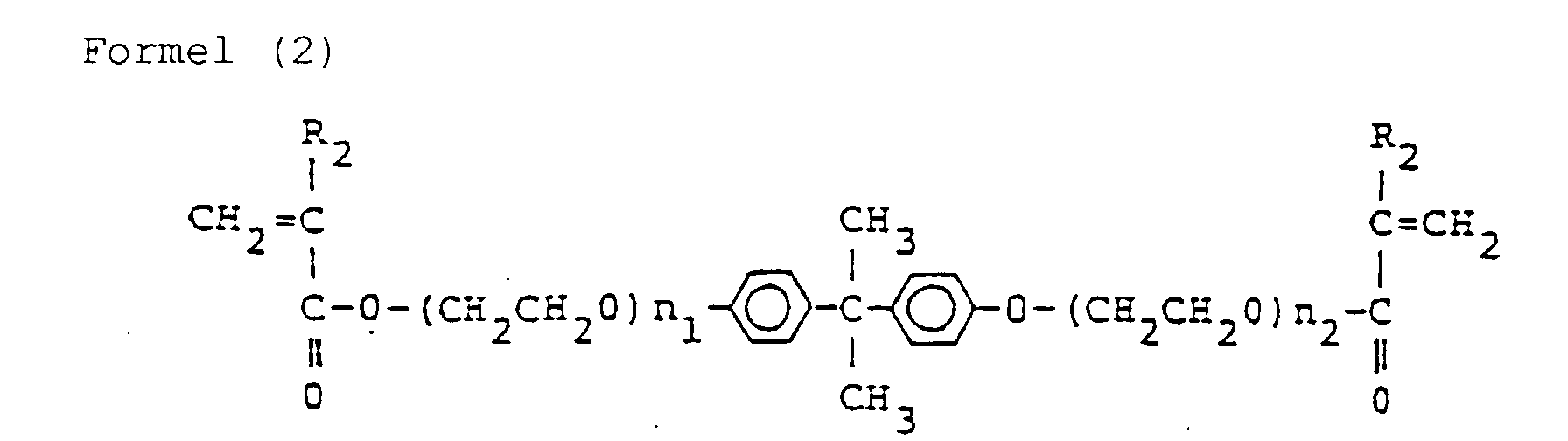
wobei das photohärtende Kunstharz weiterhin ein monofunktionelles (Meth)acrylat in einem Gewichtsverhältnis der flüssigen Monomerzusammensetzung aus den Verbindungen der Formel (1) und (2) zu dem monofunktionellen (Meth)acrylat im Bereich von 90:10 bis 40:60 enthält. - Photohärtendes Kunstharz nach Anspruch 1, das 0,001 bis 1 Gew.-% eines unter Titandioxid, Zirconiumdioxid und Aluminiumoxid ausgewählten Füllstoffes mit einer durchschnittlichen Teilchengröße von 0,02 bis 1 µm enthält.
- Formkörper aus einem gehärteten Kunstharz gemäß der Definition in Anspruch 1 oder 2.
Applications Claiming Priority (4)
| Application Number | Priority Date | Filing Date | Title |
|---|---|---|---|
| JP104677/90 | 1990-04-20 | ||
| JP2104677A JPH0649737B2 (ja) | 1990-04-20 | 1990-04-20 | 強靭な厚肉注型品製造用の光硬化型樹脂用組成物 |
| JP10467790 | 1990-04-20 | ||
| PCT/JP1991/000451 WO1991016364A1 (fr) | 1990-04-20 | 1991-04-04 | Resine photovulcanisable |
Publications (4)
| Publication Number | Publication Date |
|---|---|
| EP0478794A1 EP0478794A1 (de) | 1992-04-08 |
| EP0478794A4 EP0478794A4 (en) | 1992-08-26 |
| EP0478794B1 EP0478794B1 (de) | 1995-11-29 |
| EP0478794B2 true EP0478794B2 (de) | 2001-02-28 |
Family
ID=14387102
Family Applications (1)
| Application Number | Title | Priority Date | Filing Date |
|---|---|---|---|
| EP91907282A Expired - Lifetime EP0478794B2 (de) | 1990-04-20 | 1991-04-04 | Photohärtbares kunstharz |
Country Status (5)
| Country | Link |
|---|---|
| US (1) | US5308886A (de) |
| EP (1) | EP0478794B2 (de) |
| JP (1) | JPH0649737B2 (de) |
| DE (1) | DE69114979T3 (de) |
| WO (1) | WO1991016364A1 (de) |
Families Citing this family (26)
| Publication number | Priority date | Publication date | Assignee | Title |
|---|---|---|---|---|
| US6417244B1 (en) | 1993-04-13 | 2002-07-09 | Southwest Research Institute | Metal oxide compositions and methods |
| US6258974B1 (en) | 1993-04-13 | 2001-07-10 | Southwest Research Institute | Metal oxide compositions composites thereof and method |
| US6696585B1 (en) | 1993-04-13 | 2004-02-24 | Southwest Research Institute | Functionalized nanoparticles |
| JP3085570B2 (ja) * | 1994-07-08 | 2000-09-11 | 株式会社トクヤマ | 重合性組成物 |
| EP0900244A4 (de) * | 1996-05-23 | 2000-05-10 | Sola Int Holdings | Uv härtbare vinylhester mit hohem brechungsindex |
| KR100388698B1 (ko) * | 1998-01-30 | 2003-06-25 | 미쓰비시 마테리알 가부시키가이샤 | 세라믹 캐필러리 리브 형성 방법, 그에 사용되는 세라믹 페이스트 및 그 형성 장치 |
| US6030606A (en) * | 1998-06-22 | 2000-02-29 | 3M Innovative Properties Company | Dental restoratives comprising Bis-EMA6 |
| US6194481B1 (en) | 1999-05-19 | 2001-02-27 | Board Of Regents Of The University Of Texas System | Mechanically strong and transparent or translucent composites made using zirconium oxide nanoparticles |
| US6232367B1 (en) | 1999-10-07 | 2001-05-15 | Kerr Corporation | Opalescent fillers for dental restorative composites |
| US6630083B1 (en) | 1999-12-21 | 2003-10-07 | Johnson & Johnson Vision Care, Inc. | Methods and compositions for the manufacture of ophthalmic lenses |
| US8026295B2 (en) * | 2000-02-17 | 2011-09-27 | Dentsply International, Inc. | Dental composition with improved light stability |
| US20030225182A1 (en) * | 2001-01-04 | 2003-12-04 | Dentsply Detrey Gmbh | Dental composition with improved light stability |
| US20040225029A1 (en) * | 2000-02-17 | 2004-11-11 | Uwe Walz | Dental composition with improved light stability |
| US20040171716A1 (en) * | 2002-12-03 | 2004-09-02 | Uwe Walz | Dental compositions comprising bisacrylamides and use thereof |
| WO2002013767A2 (en) * | 2000-08-11 | 2002-02-21 | Dentsply International Inc. | Polyaminoester and their application in dental compositions |
| US20030069327A1 (en) * | 2001-08-09 | 2003-04-10 | Uwe Walz | Dental compostions comprising bisacrylamides and use thereof |
| EP1366133B1 (de) * | 2001-01-23 | 2010-03-24 | Southwest Research Institute | Neue verfahren und mischungen zum einstellen des rheologischen verhaltens und der übergangstemperatur von flüssigkristallen |
| US20040199004A1 (en) * | 2001-01-23 | 2004-10-07 | Southwest Research Institute | Novel mesogens |
| US7147800B2 (en) * | 2001-01-23 | 2006-12-12 | Southwest Research Institute | Selective ether cleavage synthesis of liquid crystals |
| ATE312069T1 (de) * | 2001-03-07 | 2005-12-15 | Univ Texas | Verbundharze mit ultraniedriger schrumpfung auf grundlage von mischungen nematischer flüssigkristallmonomere |
| WO2003015718A1 (en) * | 2001-08-13 | 2003-02-27 | Dentsply International Inc. | Dental root canal filling cones |
| US6767955B2 (en) | 2002-05-08 | 2004-07-27 | Pentron Clinical Technologies | Flowable dental resin materials and method of use thereof |
| US20040209990A1 (en) * | 2003-04-15 | 2004-10-21 | Uwe Walz | Low shrinking polymerizable dental material |
| CN100504448C (zh) | 2003-07-22 | 2009-06-24 | 大日本油墨化学工业株式会社 | 透镜片用活化能射线固化型树脂组合物和透镜片 |
| JP4515357B2 (ja) * | 2005-01-27 | 2010-07-28 | リンテック株式会社 | 偏光板用粘着剤、粘着剤付き偏光板及びその製造方法 |
| US20100105795A1 (en) * | 2005-02-01 | 2010-04-29 | Henkel Corporation | Liquid Stable Thiol-Acrylate/Vinyl Ether Compositions |
Citations (5)
| Publication number | Priority date | Publication date | Assignee | Title |
|---|---|---|---|---|
| US4134930A (en) † | 1975-12-15 | 1979-01-16 | G-C Dental Industrial Corp. | Resinous materials for restoring crowns |
| EP0173567A2 (de) † | 1984-08-30 | 1986-03-05 | JOHNSON & JOHNSON DENTAL PRODUCTS COMPANY | Verfahren zur Behandlung von Zähnen mit photopolymerisierbaren Zusammensetzungen die ein Acylphosphinoxyd als Katalysator enthalten |
| EP0210580A2 (de) † | 1985-07-25 | 1987-02-04 | T F "Petko Vladov" | Polschlingengewirke sowie Verfahren und Maschine zu seiner Herstellung |
| JPS62180782A (ja) † | 1986-02-04 | 1987-08-08 | Matsushita Electric Ind Co Ltd | 光デイスク基板 |
| JPH01185308A (ja) † | 1988-01-19 | 1989-07-24 | Sanyo Chem Ind Ltd | 高透明・高屈折率樹脂の製造法 |
Family Cites Families (10)
| Publication number | Priority date | Publication date | Assignee | Title |
|---|---|---|---|---|
| JPS5436953A (en) * | 1977-08-29 | 1979-03-19 | Furukawa Electric Co Ltd:The | Centering method of optical fiber and connector members |
| JPS55102618A (en) * | 1979-01-30 | 1980-08-06 | Mitsubishi Petrochem Co Ltd | Curable resin composition |
| US4394494A (en) * | 1980-07-04 | 1983-07-19 | Lion Corporation | Dental filling material |
| US4388421A (en) * | 1980-12-20 | 1983-06-14 | Lion Corporation | N-(2-Hydroxy-3-methacryloyloxypropyl)-aminobenzoic acid derivatives and dental adhesive composition containing same |
| JPS5950688B2 (ja) * | 1982-04-13 | 1984-12-10 | 大阪曹達株式会社 | 光硬化性樹脂組成物 |
| IT1190382B (it) * | 1985-07-26 | 1988-02-16 | Montedison Spa | Diesteri acrilici per bisfenolo alchil etere,relativi polimeri e compositi per uso dentale |
| JPH0699528B2 (ja) * | 1986-12-26 | 1994-12-07 | 三井石油化学工業株式会社 | 硬化性組成物 |
| JPS6451413A (en) * | 1987-08-24 | 1989-02-27 | Toyo Ink Mfg Co | Photo-setting covering material |
| JPH0696485B2 (ja) * | 1987-08-28 | 1994-11-30 | ダイキン工業株式会社 | 歯科用材料 |
| JPH07107085B2 (ja) * | 1987-09-29 | 1995-11-15 | 三井石油化学工業株式会社 | アクリロイルオキシル基とメタクリロイルオキシル基を一分子中に有する重合性化合物および硬化剤 |
-
1990
- 1990-04-20 JP JP2104677A patent/JPH0649737B2/ja not_active Expired - Fee Related
-
1991
- 1991-04-04 EP EP91907282A patent/EP0478794B2/de not_active Expired - Lifetime
- 1991-04-04 DE DE69114979T patent/DE69114979T3/de not_active Expired - Fee Related
- 1991-04-04 WO PCT/JP1991/000451 patent/WO1991016364A1/ja not_active Ceased
- 1991-04-19 US US07/820,625 patent/US5308886A/en not_active Expired - Lifetime
Patent Citations (5)
| Publication number | Priority date | Publication date | Assignee | Title |
|---|---|---|---|---|
| US4134930A (en) † | 1975-12-15 | 1979-01-16 | G-C Dental Industrial Corp. | Resinous materials for restoring crowns |
| EP0173567A2 (de) † | 1984-08-30 | 1986-03-05 | JOHNSON & JOHNSON DENTAL PRODUCTS COMPANY | Verfahren zur Behandlung von Zähnen mit photopolymerisierbaren Zusammensetzungen die ein Acylphosphinoxyd als Katalysator enthalten |
| EP0210580A2 (de) † | 1985-07-25 | 1987-02-04 | T F "Petko Vladov" | Polschlingengewirke sowie Verfahren und Maschine zu seiner Herstellung |
| JPS62180782A (ja) † | 1986-02-04 | 1987-08-08 | Matsushita Electric Ind Co Ltd | 光デイスク基板 |
| JPH01185308A (ja) † | 1988-01-19 | 1989-07-24 | Sanyo Chem Ind Ltd | 高透明・高屈折率樹脂の製造法 |
Non-Patent Citations (12)
| Title |
|---|
| Dental Materials Journal, 6(2), 1987, pp. 148-155 † |
| Dental Materials Journal, 7(2), 1988, pp. 174-181 † |
| Free Radical Reactions in Preparative Organic Chemistry, 1964, pp. 1-5 † |
| Japanese Industrial Standard, Dental Heat Curing Acrylic Resin for Crown, JIS T 6508, 11.02.1985 † |
| Organic Coatings and Plastics Chemistry, 42, 1980, pp. 321-326 † |
| Physics, M. Alonso et al., Addison-Wesley Publishing Company, 1975, pp. 131-135 † |
| Polymer Chemistry, An Introduction, 2nd. Ed. M. Stevens, Oxford University Press, 1990, pp. 11, 29, 98-99, 114-119 † |
| Polymer Composites, 4(2), 1983, pp. 120-125 † |
| Principles of Polymerization, 2nd Ed. G. Odian, John Wiley & Sons, 1981, pp. 127-128, 138 † |
| Technical Information AKZO Chemical Division "Diacryl 121, Tetra-ethoxylated Bisphenol A Dimethacrylate", October 1989 † |
| The Structure of Polymers, M.L. Miller, Reinhold Publishing Corporation, 1966, p. 322 † |
| UV Curing: Science and Technology, 2, 1985, p. 3 † |
Also Published As
| Publication number | Publication date |
|---|---|
| US5308886A (en) | 1994-05-03 |
| DE69114979T2 (de) | 1996-08-08 |
| JPH044209A (ja) | 1992-01-08 |
| DE69114979D1 (de) | 1996-01-11 |
| EP0478794A4 (en) | 1992-08-26 |
| DE69114979T3 (de) | 2001-05-31 |
| EP0478794A1 (de) | 1992-04-08 |
| EP0478794B1 (de) | 1995-11-29 |
| JPH0649737B2 (ja) | 1994-06-29 |
| WO1991016364A1 (fr) | 1991-10-31 |
Similar Documents
| Publication | Publication Date | Title |
|---|---|---|
| EP0478794B2 (de) | Photohärtbares kunstharz | |
| US5684103A (en) | Color stable dental restorative materials | |
| US6933327B2 (en) | Dental curable composition | |
| US4824876A (en) | Light curable dental liquid or paste | |
| US5969000A (en) | Dental resin materials | |
| EP0434334B1 (de) | Zahnärztliche Zusammensetzungen, Verfahren zur Herstellung von geformten, zahnärztlichen Artikeln via "photoiniferte Polymerisation" von zahnärztlichen Zusammensetzungen und dadurch erzeugte geformte, zahnärztliche Artikel | |
| AU2016340522A1 (en) | Curable composition and dental filling restorative material | |
| JPH0820615A (ja) | 重合性組成物 | |
| JPWO1994014913A1 (ja) | 可視光重合型接着剤用光重合開始剤組成物 | |
| EP0166009A1 (de) | Photopolymerisierbare Dentalmasse für die Herstellung von Kronen und Brücken | |
| US20230392041A1 (en) | Polymerizable composition for dental tooth and material 3d printing | |
| US4406625A (en) | Adducts of 1,4-bis[(3-Methacroyl-2-hydroxypropoxy)methyl]cyclohexane and derivatives thereof with isocyanates | |
| JPH09152510A (ja) | 低複屈折光学部材及びその製造方法 | |
| US4337349A (en) | Dimethacrylate adducts of glycidyl methacrylate with diesters of bis (hydroxymethyl) tricyclo[5.2.1.02,6] decane and dicarboxylic acids | |
| US4304893A (en) | 1,4-Bis[(3'-methacroyl-2'-hydroxypropoxy)methyl] cyclohexane | |
| CN108472411B (zh) | 具有低残余mma含量的高冲击韧性透明假体材料 | |
| US4831066A (en) | Dental compositions comprising oligomer of hexahydrophtalic anhydride, glycidylmethacrylate and 2-hydroxyethyl-methacrylate | |
| US20020061993A1 (en) | Polymerizable compositions for producing transparent polymeric substrates, resulting transparent polymeric substrates and applications thereof in optics | |
| JPS608214A (ja) | 歯科用材料 | |
| KR100404233B1 (ko) | 3작용성 메타(아)크릴레이트 단량체 및 그를 함유하는치아 수복용 조성물 | |
| JP2000336011A (ja) | 歯科用組成物 | |
| US4362888A (en) | Adducts of 1,4-bis[(3-methacroyl-2-hydroxypropoxy)methyl] cyclohexane and derivatives thereof with isocyanates | |
| JPS61143310A (ja) | 歯科用材料 | |
| JPS63107954A (ja) | アクリル/メタクリル酸混成エステル | |
| JPH0412974B2 (de) |
Legal Events
| Date | Code | Title | Description |
|---|---|---|---|
| PUAI | Public reference made under article 153(3) epc to a published international application that has entered the european phase |
Free format text: ORIGINAL CODE: 0009012 |
|
| 17P | Request for examination filed |
Effective date: 19911217 |
|
| AK | Designated contracting states |
Kind code of ref document: A1 Designated state(s): DE FR GB |
|
| A4 | Supplementary search report drawn up and despatched |
Effective date: 19920710 |
|
| AK | Designated contracting states |
Kind code of ref document: A4 Designated state(s): DE FR GB |
|
| 17Q | First examination report despatched |
Effective date: 19950120 |
|
| GRAA | (expected) grant |
Free format text: ORIGINAL CODE: 0009210 |
|
| AK | Designated contracting states |
Kind code of ref document: B1 Designated state(s): DE FR GB |
|
| REF | Corresponds to: |
Ref document number: 69114979 Country of ref document: DE Date of ref document: 19960111 |
|
| ET | Fr: translation filed | ||
| PLBI | Opposition filed |
Free format text: ORIGINAL CODE: 0009260 |
|
| PLBF | Reply of patent proprietor to notice(s) of opposition |
Free format text: ORIGINAL CODE: EPIDOS OBSO |
|
| 26 | Opposition filed |
Opponent name: AKZO NOBEL N.V. Effective date: 19960829 |
|
| PLBF | Reply of patent proprietor to notice(s) of opposition |
Free format text: ORIGINAL CODE: EPIDOS OBSO |
|
| PLBF | Reply of patent proprietor to notice(s) of opposition |
Free format text: ORIGINAL CODE: EPIDOS OBSO |
|
| PLAW | Interlocutory decision in opposition |
Free format text: ORIGINAL CODE: EPIDOS IDOP |
|
| PLAW | Interlocutory decision in opposition |
Free format text: ORIGINAL CODE: EPIDOS IDOP |
|
| PLAW | Interlocutory decision in opposition |
Free format text: ORIGINAL CODE: EPIDOS IDOP |
|
| PUAH | Patent maintained in amended form |
Free format text: ORIGINAL CODE: 0009272 |
|
| STAA | Information on the status of an ep patent application or granted ep patent |
Free format text: STATUS: PATENT MAINTAINED AS AMENDED |
|
| 27A | Patent maintained in amended form |
Effective date: 20010228 |
|
| AK | Designated contracting states |
Kind code of ref document: B2 Designated state(s): DE FR GB |
|
| ET3 | Fr: translation filed ** decision concerning opposition | ||
| REG | Reference to a national code |
Ref country code: GB Ref legal event code: IF02 |
|
| PGFP | Annual fee paid to national office [announced via postgrant information from national office to epo] |
Ref country code: GB Payment date: 20060329 Year of fee payment: 16 |
|
| PGFP | Annual fee paid to national office [announced via postgrant information from national office to epo] |
Ref country code: DE Payment date: 20060330 Year of fee payment: 16 |
|
| PGFP | Annual fee paid to national office [announced via postgrant information from national office to epo] |
Ref country code: FR Payment date: 20060410 Year of fee payment: 16 |
|
| GBPC | Gb: european patent ceased through non-payment of renewal fee |
Effective date: 20070404 |
|
| PG25 | Lapsed in a contracting state [announced via postgrant information from national office to epo] |
Ref country code: DE Free format text: LAPSE BECAUSE OF NON-PAYMENT OF DUE FEES Effective date: 20071101 |
|
| PG25 | Lapsed in a contracting state [announced via postgrant information from national office to epo] |
Ref country code: GB Free format text: LAPSE BECAUSE OF NON-PAYMENT OF DUE FEES Effective date: 20070404 |
|
| PG25 | Lapsed in a contracting state [announced via postgrant information from national office to epo] |
Ref country code: FR Free format text: LAPSE BECAUSE OF NON-PAYMENT OF DUE FEES Effective date: 20070430 |